EUROPEAN ECONOMIC COMMUNITY EUROPEAN ATOMIC ENERGY COMMUNITY
COMMISSION
Report on
Social Developments
Year1979
(Published in conjunction with the
'Thirteenth General Report ·
on the Activities
of the European Communities'
in accordance with Article 122
of the EEC Treaty)
DA ISBN 92-825-1618-0 DE ISBN 92-825-1619-9 FA ISBN 92-825-1621-0 IT ISBN 92-825-1622-9 NL ISBN 92-825-1623-7
Cataloguing data can be found at the end of this publication
Manuscript finished: 31 January 1980
©
Copyright ECSC/EEC/EAEC, Brussels and Luxembourg, 1980Printed in Belgium
Reproduction authorized, in whole or in part, provided the source is acknowledged
Contents
A - Political and general Introduction 5
I - Present situation and prospects 7
II - Summary of the social actions of the Community in 1979 11
B - Outline of activities by the institutions of the European Communities In the
social field In 1979 1 7
C - Social developments in 1979 37
Chapter I - Employment (including migrant workers)
Chapter II - Vocational training
Chapter Ill - Industrial relations
Chapter IV - Working conditions and labour law
Chapter V - Wages, incomes and asset formation
Chapter VI - Housing
Chapter VII - Family affairs
Chapter VIII - Social welfare services
Chapter IX - Social security
Chapter X - Safety, hygiene and health protection at work
Chapter XI - Health protection
List of tables Summary of contents
39 61
75
93
107
125
137
145
155
165
177
183
General Report and of the other reports published in conjunction with it.
BFA Belgische frank I franc beige
DKR Dansk krone
OM Deutsche Mark
FF Franc franc;:ais IRL Irish pound LIT Lira italiana
LFR Franc luxembourgeois
HFL Nederlandse gulden (Hollandse florijn) UKL Pound sterling
I. The employment situation continues to be adversely affected by the economic prob-lems, which for more than five years have beset the Community: there were over 6 million registered unemployed at the end of 1979 and there is little prospect of any significant improvement in the near future.
The Commission's main goal will therefore remain the improvement of the employment situation. That's why action will be needed to stimulate investment and the restructuring of undertakings if recruitment is to be encouraged and redundancies prevented. One other priority in this connection is the short-term introduction of measures designed to promote the reorganization of working time and other measures supporting the labour market.
Special efforts must be made on behalf of certain groups of workers, industries and regions which are particularly affected by the crisis. As a matter of fact it has been observed that unemployment in 1979 has more particularly affected not only young people-whose unemployment was a matter of everyday concern during the year-but also women and workers in the. steel, textile and clothing and shipbuilding industries.
However, the improvement of levels of employment is not an aim which can be attained by the Community and national governments acting alone: it is vital that the two sides of industry develop their relationships with a view to reaching a consensus at both national and Community level.
2. The Commission is pursuing its work in connection with the reorganization of working ·time on the basis of the Council Resolution of 22 November 1979. It is proposed that after meetings with the two sides of industry, the Commission will put before the Council of Ministers of Employment and Social Affairs its conclusions as regards the scope for Community guidelines concerning:
(i) restrictions on systematic overtime work;
(ii) reducing effective annual working time.
In addition, the Commission will present special memoranda to the Standing Committee on Employment on the following subjects:
(ii) the progressive introduction of flexible retirement schemes;
(iii) action to curb abuses in temporary work.
3. An active policy to combat the qualitative mismatch between the supply of and demand for labour which currently hinders the operation of the labour market constitutes a necessary but not a sufficient condition for the re-establishment of full employment under optimum conditions. In line with the conclusions drawn by the President of the Standing Committee on Employment at its 16th meeting on 9 October 1979, the Commission will continue, in conjunction with the Working Parties of Senior Employment Officials and Directors of Employment Services, to look for measures likely to be implemented. 1
The Commission will present to the Council a communication setting out 'Guidelines for a Community labour market policy'.
With a view to tackling the repercussions of technological change and facilitating the adjustments in jobs and training made necessary, in particular, by the devefopment of microprocessors, the Commission will, as requested by the European Council, send the Standing Committee on Employment a memorandum on the employment and soCial problems raised by new technologies to enabie the main lines of the Community solution to be formulated with the help of the two sides of industry.
To implement the Council Resolution' on training work experience schemes for young people, the Commission is proposing to support various activities through financing from the European Social Fund. For this purpose, it intends to improve the selectio.n criteria established for the management of the Fund and support certain experimental projects aimed at speeding up the work of improving training systems.
4. The Commission will continue its efforts to ensure .that measures are .taken to deal with the social repercussions of restructuring in certain industries which have been in difficulties for some years. Following on its communication on 'The social aspects of the iron and steel policy' transmitted to the. Council in October 197X.2 the Commission transmitted a draft Decision relating to the creation of special temporary allowances to help workers affected by the restructuring operations. Statements were also made on this point by the Commission representative at the meeting of the Council pf Ministers of Employment and Social Affairs on 15 May and 22 November.
As this draft Decision provides for the implementation of social measures accompanying the restructuring of the iron and steel industry-which will render such restructuring more acceptable-the Commission has insisted that the Council's acceptance be given with the
least possible delay. As soon as it has obtained the assent of the Council, the Commission will begin negotiations with the Member States on new bilateral agreements to put this aid into operation.
Concurrently with the implementation of its industrial restructuring measures in the shipbuilding industry and in accordance with the Council Resolution of 19 September 1978, the Commission will, after consultation with the two sides of industry, work out guidelines for measures to resolve certain social problems in this sector, making use of the funds available for this purpose. The Commission will also organize systematic contacts with management and labour in the textile sector to examine in detail the special employ-ment problems in this industry.
5. The Commission will continue its efforts to ensure the strict application of Community provisions prohibiting discrimination against workers from other Member States with respect to employment and living/working conditions. To this .end, it will put before the Council a proposal aimed at eliminating the remaining restrictions concerning the exercise of trade-union rights, including the right to participate as a trade-union delegate in the administration of bodies governed by public law and the right to hold public office.
In connection with social security for migrant ~orkers, the Commission will endeavour to persuade the Council to reach a decision on the proposal to extend the Community rules to self-employed persons and certain· categories of persons not pursuing an occupation. In addition, the Commission will make proposals to the Council regarding the improvement of arrangements for paying unemployment benefits to persons leaving the country where they were last employed and the modification of the system for calculating pensions in the light of cases decided by the Court of Justice.
6. In accordance with Article 10 of Council Directive 76/207/EEC of9 February 1976, a report will be drawn up on the application of the provisions of this Directive concerning equal treatment for men and women as regards access to employment, vocational training and promotion, and working conditions. Special attention will be given to discrimination arising from protective legislation. ·
To supplement the Directive on equal treatment for men and women under statutory social security schemes, the Commission will take appropriate steps with a view to ensuring that the same principle is observed in the case of occupational schemes.
7. As regards living and working conditions, independently of its efforts in connection with the reorganization of working time, 1 the Commission will begin consultations with the social partners in the various sectors to seek a solution to certain problems connected with shift work, regarding the workers' health and welfare.
After looking into the situation in the Member States as regards maternity leave (ban on dismissal, length of leave, remuneration), the Commission will put proposals before the Council, bearing in mind the possibilities offered by new concepts such as 'parental leave'.
In the context of efforts to improve safety at work, the Commission will propose specific Directives on asbestos, cadmium, and other carcinogenic substances on the basis of the outline Directives on the protection of workers from harmful exposure to chemical, physical and biological agents at work. The Directive specifically concerned with lead has already been presented in 1979 to the Council.
The Commission will also submit two proposals for Directives to the Council in respect of medical irradiation and of microwaves respectively.
As regards the protection of workers in the steel and coalmining industries, a new programme of research in ergonomics is to be initiated. The research will be carried out both in specialized institutes and on the spot in relation to jobs of key significance for the adaptation of machines to men.
in 1979
Economic activity
9. The process of gradual economic recovery in the Community has, in the last year, been upset by the turbulent situation on the world oil market. It has led to a somewhat poorer growth than anticipated: gross domestic product in the Community increased by slightly over 3% in 1979, the same figure as that recorded in 1978. It is expected that growth will continue to slow down in 1980 (the GDP growth rate is expected to be only about 2%).
Following the deterioration in the terms of trade due to oil price increases, inflation increased throughout the Community in 1979: the implicit consumer price index for the Community rose from 6.8% in 1978 to about 9% in 1979, even exceeding 10% in four Member States. No improvement in this area is expected in 1980.
The substantial current account surplus in the Community in 1978 (14 000 million EUA) gave way to a slight deficit in 1979, partly attributable to the effect cif higher prices for oil and other raw materials on the terms of trade and also, at least in equal part, to the deterioration of the trade balances in certain member countries.
The situation on the labour markets
10. Economic growth in 1979 went hand in hand with an increase of about 0.9% in the employment level. However, given that the total working population increased still more-partly as a result of the increase in the number of women job-seekers-unemployment has not declined: in 1979 the number of unemployed registered with the labour offices in the 9 Member States averaged 6.05 million, against 5.97 million in 1978.
among job-seekers and unfavourable working conditions, such as a pace of work leading to excessive physical or mental fatigue, unhealthy work, long hours, etc.
Principal activities in regard to employment policy
11. In view of the circumstances, the Governments and the Community continued to concentrate on efforts to combat unemployment. Governments tended to focus their attention on hard-core unemployment problems, with particular emphasis on support for workers affected by restructuring measures in certain industries.
In addition, they continued to promote the creation of jobs, giving priority to young people. In this connection, various member countries offered premiums to employers for the recruitment of new workers, total or partial relief from social charges for undertakings in respect of (young) workers recruited, and other measures.
Lastly, the question of whether work-sharing would make a genuine contribution to solving the unemployment problem continued to be the subject of discussio'n. In the course of the year, Member States' positions with regard to certain aspects became crystallized. Most seemed to favour the introduction of earlier (or more flexible) retirement and restrictions on overtime working rather than shortening the working week.
12. The Community also adopted several employment promotion measures in line with those discussed or adopted at national level. To this end, on two occasions the Commission · placed before the Standing Committee on Employment a staff paper on the 'Reduction of the qualitative mismat~h between the supply of and demand for labour' 1 setting out its position on the problem and laying the foundations for concerted conclusions between the parties represented on the Standing Committee.
The 15th meeting of the Standing Committee on Employment was called on 22 May 1979 to discuss the problem of the qualitative mismatch on the labour market. After the Chairman had informed participants of the discussions--especially as regards work-sharing-at the last Council meeting on Employment and Social Affairs on 15 May 1979, the representa-tives of the European Trade-Union Confederation submitted draft conclusions embodying an undertaking to begin negotiations on working time and to adopt relevant decisions by 1 October 1979.
The employers' representatives having declared, however, that they could not commit themselves on the question of working time, the item not being on the Agenda for that meeting, no agreement could be reached on a joint text. The ETUC representatives then withdrew from the meeting leaving only the representatives of the other organizations
present to express their preliminary views on the paper on the qualitative mismatch on the labour market.
13. The Standing Committee on Employment held its 16th meeting on 9 October 1979. Once again, the problem of the qualitative mismatch on the labour market was central to the discussions. The Committee took note of the Commission's analysis, commenting that this was the very first time this subject had been tackled at Community level. Having recalled that one of the principal means of restoring employment levels was to pursue a dynamic economic growth policy, participants presented a number of specific proposals to rectify mismatching problems,. which were summed up in the Chairman's conclusions.
In addition, the Standing Committee on Employment took note of a verbal report by the Cominission representative on the progress of the Commission's work on the reorganiza-tion of working time. He noted that in November 1979 the Council of Ministers of Employment and Social Affairs was to examine the results of the Commission's work to date and any other developments in the area with a view to achieving tangible progress in this sector.
14. The question of employment, in particular the reorganization of working time, was also one of the main concerns of the two European Councils and the two meetings of the Council of Ministers of Employment and Social Affairs held in 1979.
The European Council held in Paris on 12 and 13 March 1979 acknowledged that priority should be given to improving the employment situation, which continued to give rise to concern. It requested the Council to look into certain measures which should contribute to improving the employment situation. In addition, the European Council asked the Com-mission to present a communication on the social and economic implications of concerted work-sharing.
In response to this request and following the fourth tripartite conference, 1 the Commission drafted a Communication on· work-sharing which was discussed at the meeting of the Council of Ministers of Employment and Social Affairs held on 15 May 1979. Having noted the Communication from the Commission, the Council took the view that the approach to the problem of work-sharing should take account of the need to maintain internal and external competitiveness in the Community and to establish close cooperation with the. two sides of industry in preparing and implementing any measures relating to working time. It requested the Commission to.continue its studies and analyses in this area and to make proposals, taking account of the discussions of the European Council and the guidelines indicated by the Council meeting on social affairs, with a view to establishing a Community framework for the reorganization of working time and submitting proposals at an appropriate time.
15. After several discussions with employers' and workers' organizations, the Commis-sion revised its initial Communication which was then re-submitted to the Council of Ministers of Employment and Social Affairs on 22 November 1979 in the form of a draft resolution.
'
After a thorough discussion, the Council adopted a 'Council Resolution on the reorganiza-tion of working time', thus committing itself to a Community approach along the proposed guidelines. 1
In .this Resolution the Commission is requested to carry further the contacts it has made which are essential for the implementation of measures at Community level referred to in the Resolution.
Also at the meeting on 22 November, the Council approved another Resolution on linking work and training for young persons in the Community. 2 Under this Resolution, the
Council established a set of guidelines to promote the development of linked work and training schemes.
Lastly, at its meeting on 29 and 30 November 1979 in Dublin, the European Council looked into the serious unemployment situation in the Community. It took the view that a better coordinated approach to employment problems should be defined and requested the Commission to present proposals on specific measures designed to promote more incisive action to deal with the unemployment problem. It took note of the adoption by the Council of Ministers of a Resolution on the reorganization of working time and requested the Commission and the Council to continue holding consultations with the two sides of industry.
Actions in support of sectors facing structural problems
16. In 1979, the Commission continued to devote special attention to certain sectors which have been facing serious structural difficulties. Having already submitted to the Council, at the end of October 1978, a Communication on the social aspects of the iron and steel policy, together with a Resolution adopted by the ECSC Consultative Committee, 3 the Commission set out detailed proposals in a 'Communication on the social aspects of the restructuring of the steel industry', together with a 'Draft Decision of the Commission relating to the creation of special temporary allowances to help workers in the iron and steel industry in the framework of the Community restructuring plan'. 4 The draft Decision constitutes the social frame which needs must accompany the restructuring of the iron and steel industry. Its objective is to contribute, by all adequate means, to as harmonious as
possible a transition between the time the worker is laid off and the time a new job becomes available. The European Parliament and the ECSC Consultative Committee have both issued favourable opinions on this draft Decision.
Other Community measures
17. At two meetings of the Council of Ministers of Employment and Social Affairs, several other decisions were adopted:
(i) at the meeting of 15 May 1979, the Council adopted certain conclusions on the improvement of relations with the two sides of industry, stressing that such improve-ments should lead to more thorough preparation of tripartite meetings, greater com-mitment on the part of all parties participating in such meetings and the practical implementation of the conclusions resulting from the meetings;
(ii) at the same meeting, the Council took note of a report by the Commission on the extent to which the Directive on the application of the principle of equal pay for men and women had so far been incorporated in national law. As a result of this report, the Commission started infringement procedures against seven Member States;
(iii) after an introductory statement by the Commission representative on a Communica-tion on consultaCommunica-tion within the Community on migraCommunica-tion policy on 15 May 1979, the Council adopted certain conclusions at its meeting of 22 November 1979;
(iv) at the meeting on 15 May 1979, pending receipt of the opinion of the Economic and Social Committee and before adopting a definite position, the Council noted that agreement existed on the setting up of the second joint programme to encourage exchanges of young workers within the Community. The final decision was adopted on 17 July 1979; 1
(v) in 1979 two amendments were made to Community Regulations on social security arrangements for migrant workers:
(a) Regulation 1517/791 amends Regulations Nos 1408/71 and 574172 to bring them
into line with changes in Member States' legislation, in particular as regards the United Kingdom social security system;
(b) Regulation 2615179 2 concerns the adaptation of the procedure to be followed for the conversion of currencies in the light of the mechanisms laid down for calculating the ECU under the European Monetary System.
Lastly, the Council of 22 November 1979 took note of the following:
(i) a memorandum from the Commission on employee participation in asset formation, and delegates' initial reactions on this subject;
(ii) the third annual report (1978) of the Advisory Committee on Safety, Hygiene and Health Protection at Work;
18. In the social field the main concern of all Community authorities has been to continue the process of directing efforts towards combating the persistent employment problems caused by current economic difficulties. With this in mind, the Commission sought ways of improving the distribution of work through the reorganization of working time and counteracting employment reductions in the most severely affected areas, such as the steel industry. In addition, the activities of the European Social Fund were stepped up and, again with the employment situation in mind, steps were taken towards consultation between the Member States on migration policies vis-a-vis workers from non-member countries.
The Commission also directed its attention to enforcement of the Community provisions designed to promote equality between men and women as regards remuneration and access to employment and to the improvement of relations with the two sides of industry.
Lastly, several significant decisions were taken concerning exchanges of young workers, the launching of a ninth scheme of ECSC aid for the construction of housing, health protection at places of work and a new research programme on the control of nuisances and pollution in the steel industry.
Employment
Reorganization of working time
19. The fourth Tripartite Conference, held in November 1978,1 focused on problems connected with the reduction of working time. In response to this concern, the Commission prepared a communication on work-sharing2 which was sent to the Council on 7 May. This was discussed fully at the Council meeting on 15 May, 3 when the Commission was asked
1 Social Report 1978, point 20.
to continue its studies and analyses with a view to establishing a Community framework for work-sharing, covering in particular the annual duration of work, the restriction of sys-tematic overtime, the development of vocational training and schemes combining training with work experience, flexible retirement arrangements, voluntary part-time work, tem-porary work and continuous shift-work.
The Commission concentrated on three priority topics: the annual duration of work, overtime and schemes combining training with work experience. After several meetings with or between the two sides of industry, 1 including the meetings of the Standing Committee on Employment, the Commission sent to the Council a proposal2 to be used as a
basis for the discussions it held on 22 November; at the end of this meeting the Council approved a Resolution-which it formally adopted on 18 December--on the reorganization of working time, which contained guidelines on a number of specific measures to be taken. 3 Combined work and training schemes were dealt with in a separate Resolution4 approved on the same day.
Concerting of the Member States' employment policies
20. The Working Party of Senior Employment Officials gave its attention to assessing the implications of measures taken in the member countries and the possibilities of concerted action. At the same time, steps were taken to extend cooperation between the heads of public employment agencies: joint work was carried out in particular on the mismatch between the demand for and supply of labour, vocational training and long-term unemployment. 5 Action to support the reform of the employment services in Italy was continued. 6
Labour market policy
Employment of women 7
21. The Commission was obliged, by virtue of its responsibility for monitoring the application of Community law, to initiate infringement proceedings 8 against the Govern-ments of the Federal Republic of Germany, Luxembourg and the Netherlands, which have
1 Bull. EC 5-1979, point 2.1.50; Bull. EC 10-1979, point 2.1.44. 2 Bull. EC 10-1979, point 2.1.48.
3 OJ C 2 of 4.1.1980; Bull. EC 11-1979, point 2.1.41. 4 Point 23 of this Report.
not yet adopted all the measures necessary to transpose into national law the provisions of the Directive of 9 February 1976 1 on the implementation of the principle of equal treatment of men and women as regards access to employment, vocational training and promotion, and working conditions. The appropriate letters were sent to these Member States. In the light of the replies received, it was decided to deliver a reasoned opinion concerning Luxembourg. The other two countries were asked for further information.
With a view to reinforcing the Community strategy to promote the employment of women, the Commission increased its support for vocational training measures for female job seekers with the help of the European Social Fund.
Vocational training
22. Work on the approximation of training levels was stepped up. For certain sectors, investigations were carried out and views exchanged on the implications of technological developments for vocational training. The European Centre for the Development of Vocational Training made a major specialist contribution to these activities, 2 as was recognized by Parliament in a Resolution adopted on 9 May, 3 and expanded its role as a forum for discussion between the various parties ·interested in training problems. Collabo-ration between the services responsible for vocational guidance and information for workers in the Member States was increased.
Linking work and training (sandwich courses)
23. In March and May respectively, the European Council4 and the Council5 requested the Commission to present proposals concerning 'alternance' training (schemes combining training with work experience). A draft Resolution setting out guidelines for the promotion of schemes linking work and training was laid before the Council on 31 Octo her. 6 On 18 December the Council adopted a Resolution in which it asked the Commission to examine the conditions in which the European Social Fund might assist measures carried out by the
Member States. 7 · · · ·
1 OJL39ofl4.2.1976. 2 Bull. EC 5-1979, point 2.1.57. 3 OJ C 140 of 5.6.1979.
4 Bull. EC 3-1979, points 1.1.5 and 2.1.40. Bull. EC 5-1979, point 2.1.53.
Bull. EC 10-1979, point 2.1.49.
Employment of young people
,
24. Youth unemployment continued to be one of the Community's major concerns. Despite some improvement in the employment situation in the Federal Republic of Ger-many and the United Kingdom, the youth unemployment figures worsened slightly over the Community as a whole.
The Commission encouraged the Member States to set up vocational preparation pro-grammes for young people in line with its Recommendation of 6 July 1977. 1 Financial assistance was provided by the European Social Fund. In collaboration with the Member States, the Commission reviewed the measures adopted. Progress was found to have been achieved in varying degrees-the evidence showed an increase in vocational preparation provision, but many young people are clearly still not receiving adequate preparation for work.
Exchanges of young workers
25. On 13 March the Commission put before the Council a second programme to encourage the exchange of young workers. 2 Having received favourable Opinions from both Parliament3 and the Economic and Social Committee, 4 the Council formally adopted the programme on 16 July. 5 Exchanges under the new programme began during the second half of the year.
Freedom of movement for workers
26. In the light of the falling-off in the movement of labour between the Member States, the Commission increased its efforts to ensure the strict application of Community provi-sions prohibiting discrimination against workers from other Member States with respect to employment and living/working conditions. Many instances of de facto discrimination connected with the right of residence were eliminated. 6 However, the Commission's efforts are still mainly directed towards studying problems connected with public service posts not entailing the exercise of official authority.
The Commission continued to work towards bringing the Community's international vacancy clearance system (SEDOC) 7 into full operation-firstly by establishing a network
1 OJL 180of20.7.1977.
2 OJ C 81 of 28.3.1979; Bull. EC 3-1979, point 2.1.45. 3 OJ C 127 of21.5.1979; Bull. EC 4-1979, point 2.3.15. 4 OJ C 247 of 1.10.1979; Bull. EC 6-1979, point 2.3.47.
5 OJ L 185 of21.7.1979; Bull. EC 5-1979, point 2.1.59.
of officials to take charge in the member countries; secondly by organizing training seminars for these officials; and thirdly by linking the exchanges of employment service officials with SEDOC. 1 These exchanges were continued successfully between Italy, France, Belgium and the Federal Republic of Germany and extended to the United Kingdom.
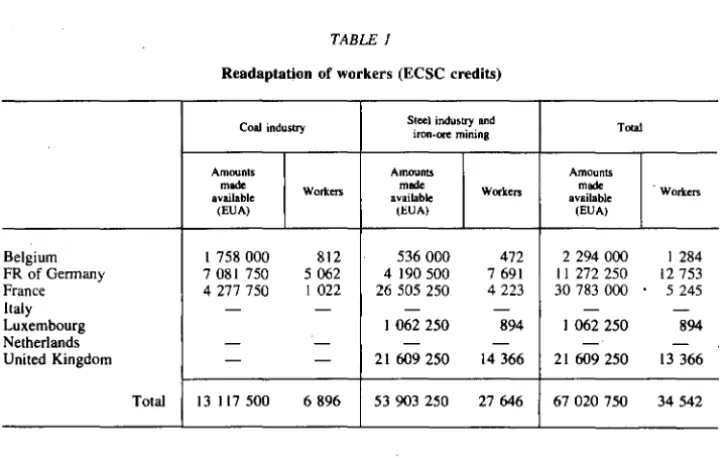
Readaptation of workers in ECSC industries
27. The social repercussions of restructuring in the Community steel industry became yet more acute during the year. Faced with this situation, the funds available for redeploy-ment and early retireredeploy-ment were increased both in real terms and as a percentage of the total readaptation appropriation. The French and Luxembourg steel industries in particular continued with their programmes of closures and modernization. To cushion the social effects of these programmes, the Commission agreed to contribute towards new aid measures more suited to the present situation an<;l providing better income support for workers. On the other hand, fewer coalmines and coking plants were closed than in 1978.
TABLE I
Readaptation of workers (ECSC credits)
Coal industry Steel industry and iron.ore mining Total
Amounts Amounts Amounts
made Workers made
Workcn made Workers
available available available
(EUA) (EUA) (EUA)
Belgium I 758 000 812 536 000 472 2 294 000 I 284
FR of Gennany 7 081 750 5 062 4 190 500 7 691 II 272 250 12 753 France 4 277 750 I 022 26 505 250 4 223 30 783 000 5 245
Italy - - -
-Luxembourg I 062 250 894 I 062 250 894
Netherlands - - -
-United Kingdom - - 21 609 250 14 366 21 609 250 13 366
Total 13 117 500 6 896 53 903 250 27 646 67 020 750 34 542
[image:21.448.32.394.297.526.2]Social aspects of restructuring and conversion in priority industries
28. On 4 May the Commission transmitted to the Council a communication on the social aspects of restructuring in the steel industry together with a draft Decision relating to the creation of special temporary allowances to help workers affected by the restructuring operations. 1 The draft Decision was later revised to take account of the ECSC Consultative Committee's suggestions2 and referred to the Council for its assent in July. 3 Parliament was also consulted. 4 The aim of the Decision is to supplement Community intervention under Article 56(2)(b) of the ECSC Treaty.
European Social Fund
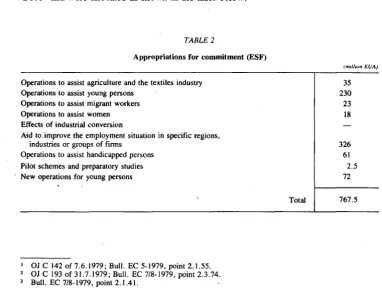
29. ·The appropriations available for commitme·nt in 1979 amounted to 767.5 million EU A 5 and were allocated as shown in the table below.
TABLE 2
Appropriations for commitment (ESF)
Operations to assist agriculture and the textiles industry Operations to assist young persons
Operations to assist migrant workers Operations to assist women Effects of industrial conversion
Aid to. improve the employment situation in specific regions, industries or groups of firms
Operations to assist handicapped persons Pilot schemes and preparatory studies · New operations for young persons
1 OJ C 142 of 7.6.1979; Bull. EC 5-1979, point 2.1.55. 2 OJ C 193 of 31.7.1979; Bull. EC 7/8-1979, point 2.3.74. 3 Bull. EC 7/8-1979, point 2.1.41.
4 OJ C 309 of 10.12.1979; Bull. EC 11-1979, point 2.3.15.
{mlllwnEUA)
35 230 23 18
326 61
2.5 72
Total 767.5
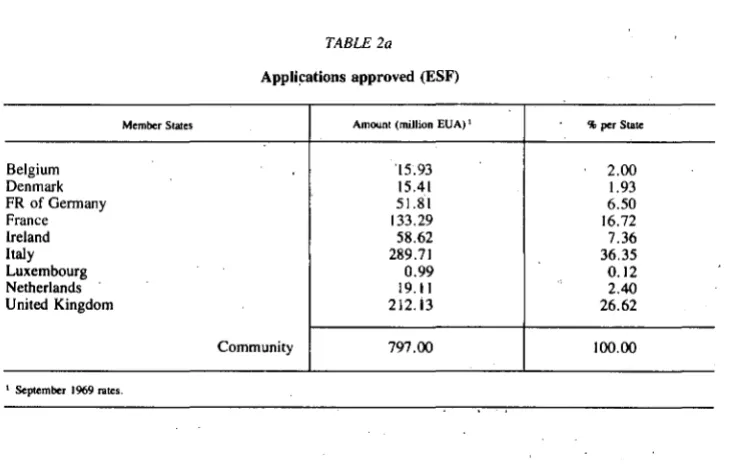
[image:22.446.33.415.252.539.2]1980.-The applications approved for each Member State were as shown below. (1980.-The total shown here includes appropriations for commitment which were reimbursed and were available for re-use; this is why the total is different from that for the appropriations for commitment in the above table.)
[image:23.445.28.393.120.355.2]TABLE 2a
Appli~ations approved (ESF)
Member States Amount (million EUA) 1 %per State
Belgium "15.93 2.00
Denmark 15.41 1.93
FR of Germany 51.81 6.50
France 133.29 16.72
Ireland 58.62 7.36
Italy 289.71 36.35
Luxembourg 0.99 0.12
Netherlands 19.11 2.40
United Kingdom 212.i3 26.62
Community 797.00 100.00
1 September 1969 mtes.
Overall demand for Fund assistance continued· to rise, reaching a total of 1 320 million EUA, thus exceeding by 72% the appropriations available. The greatest discrepancy between the volume of applications and available resources occurred in the areas of migrant workers (+439%), women(+72%), young people (+70%) and regions (+66%).
The Cori11.nission was therefore obliged, after consulting the Fund Committee, to apply the. more rigorous selection criteria laid down in the guidelines for the management of the Fund during the period 1979~81. 1 Priority was given to those programmes with the best employ-ment prospects.
Appropriations for payment entered in the 1979 budget amounted to 527.5 million EUA, to which should be added 299.5 million EUA carried over from 1978. The total amount of payments made at 31 December 1979 is estimated at 520 million EUA (compared with
284.3 million EUA in 1978). ·
Financial aid was granted to studies and pilot schemes with a view to rendering Fund intervention more effective. These studies and schemes are mainly concerned with young people, women, migrant workers, handicapped persons and the setting-up of businesses.
Social protection
Social security, the European social budget and the fight against poverty
30. The second European social budget (1976-80), which the Commission had present-ed to the Council on 28 July 1978,1 was the subject of a Resolution by Parliament2 and an Opinion from the Economic and Social Committee. 3
A second report on the European programme of pilot schemes and studies to combat poverty was sent to the Council on 29 October. 4 And on 27 November the Commission presented to the Council a proposal for a decision concerning an interim poverty pro-gramme. 5
Social security for migrant workers
31. The Commission transmitted two proposals on the application of social security schemes to employed persons and their families moving within the Community, one on 11 April6 and the other on 6 July. 7
The Council adopted the first of these proposals on 16 July, 8 afterreceiving the Opinions of Parliament9 and the Economic and Social Committee. 10 The new Regulation aligns the Community rules with changes in the legislation of the Member States, in particular the social security system in the United Kingdom. The second, adopted by the Council on 23 November 11 after Opinions had been received from Parliament 12 and the Economic and Social Committee, 13 amends the procedure used to establish currency conversion rates.
1 Bull. EC 7/8-1978, point 2.1.59.
2 OJ C 127 of 21.5.1979; Bull. EC 4-1979, point 2.3.16. 3 Bull. EC 10-1979, point 2.3.93.
4 Bull. EC 10-1979, point 2.1.53.
5 OJ C 307 of7.12.1979; Bull. EC 11-1979, point 2.1.49.
6 OJ C 115 of 8.5.1979; Bull. EC 4-1979, point 2.1.36. 7 OJ C 249 of 3.10.1979; Bull. EC 7/8-1979, point 2.1.44. 8 OJ L 185 of21.7.1979; Bull. EC 7/8-1979, point 2.1.45. 9 OJ C 140 of 5.6.1979.
10 OJ C 247 of 1.10.1979.
11 OJ L 301 of28.11.1979; Bull. EC 11-1979, point 2.1.47. 12 OJ C 309 of 10.12.1979.
The Council has not yet reached a decision on the Commission proposals 1 to extend the Community rules to self-employed persons and insured persons not pursuing an occupa-tion. 2
The Administrative Commission and the Advisory Committee on Social Security for Migrant Workers examined various questions relating to the application of the rules currently in force. The Court of Justice delivered 15 judgments3 in cases involving references for preliminary rulings on the interpretation or validity of certain provisions enacted under Article 51 of the EEC Treaty.
On 29 May the Commission sent to the Council a communication on the implementation of the provisions concerning cooperation in the sphere of social security contained in the Cooperation Agreements with the Maghreb countries and the Additional Protocol to the Agreement with Portugal. 4
Activities on behalf of migrant workers and their families
32. Pursuant to the action programme in favour of migrant workers and their families and the Council Resolution of 9 February 1976, 5 a communication setting out the Commis-sion's views regarding the principles for consultation on the Member States' migration policies vis-a-vis non-member countries was sent t9 the Council on 23 March. 6 The Economic and Social Committee delivered its Opinion on this communication at its 24-25 October meeting, 7 and on 22 November8 the Council asked the Commission to organize consultation along the lines suggested.
The Technical Committee and the Advisory Committee on Free Movement continued their discussions on the employment of migrant workers; they also considered the question of 'second-generation' migrant workers and assessed the implications of measures taken to assist migrant workers returning to their country of origin.
The European Centre for the Development of Vocational Training continued its activities in connection with vocational training for migrant workers on the basis of the conclusions reached at the European symposium on vocational training held in Berlin in December 1978.
1 Social Report 1978. point 32. 2 Bull. EC 5-1979, point 2.1.62.
-' Point 50 of this Report; Cases 100178, 129178, 139178, 144/78, 173m;, 174/78, 176178, 180/78, 182/78. 207/78, 236178, 237/78, 266178, 268/78, 9179. .
4 Bull. EC 5-1979, point 2.1.64.
5 OJ C 34 of 14.2.1976; Supplement 3/76- Bull. EC. 6 Bull. EC 3-1979, point 2.1.43.
Natural disasters
33. In 1979 the Commission granted 2.5 million EUA in Community aid to the victims
of natural disasters in Martinique and Guadeloupe (France), 1 Umbria (Italy) and Orkney, Shetland and the Western Isles (United Kingdom).
Living and working conditions
Wages and the organization of work
34. The Commission sent a report on the application of the principle of equal pay for
men and women2 to the Council on 18 January, and Parliament adopted a Resolution in the same connection on 9 May.3 The main objective of the Commission's report was to examine progress made in transposing into national law the provisions of the Council Directive of 10 February 1975.4 As a result of its findings, the Commission decided to initiate infringement proceedings. 5 The appropriate letters were sent to seven Member
States: Belgium, :Qenmark, Federal Republic of Germany, France, Luxembourg, Netherlands and the United Kingdom.
On 7 September the Commission presented a memorandum on employee participation in asset formation 6 to the Council, Parliament and the Economic and Social Com-mittee. The memorandum outlines the aims, problems and choices involved in the
im-plementation of such a policy and is based on a description of the systems applied or under consideration in the Member States. In its conclusions, the Commission sets out guidelines favouring certain formulas and procedures which it hopes will form the basis for a broad debate and give fresh impetus to asset-formation policy.
Labour law, industrial relations and participation of the two sides of industry
35. In order to take account of the Opinions of Parliament 7 and the Economic and Social Committee, 8 the Commission sent an amendment 9 to its proposal for a Directive on the
Bull. EC 9-1979, point 2.2.24. Bull. EC 1-1979, point 2.1.49.
3 OJ C 140 of 5.6.1979; Bull. EC 5-1979, point 2.3.7. 4 OJ L 45 of 19.2.1975.
5 Bull. EC 3-1979, point 2.1.42.
6 Bull. EC 7/8-1979, points 1.2.1 to 1.2.5; Supplement 6/79- Bull. EC. 7 OJ C 39 of 12.2.1979; Bull. EC 1-1979, point 2.3.17.
8 OJ C 105 of 26.4.1979; Bull. EC 11-1978, point 2.3.65.
protection of employees in the event of the inso~vency of their employer 1 to the Council on 23 March. The proposal was then approved in principle on 15 May. 2 However, a list of exceptions to the field of application of the Directive requested by some Member States is currently under discussion.
On 27 April the Commission laid before the Council a communication on the improvement of relations with the two sides of industry in the context of the Tripartite Conferences. 3 This communication formed the subject of a Resolution adopted by Parliament on 9 May. 4
The European employers' and workers' organizations were consulted frequently both at meetings of the existing advisory committees and ad hoc meetings on the formulation and implementation of Commission proposals on the various a~pects of social policy. Con-sultation was particularly important in the context of preparations for the tripartite meetings of the Standing Committee on Employment.
36. The difficult economic situation highlighted the importance of joint consultations at industry level, which enable the two sides to maintain an overview both of general problems and of questions specific to their particular industry.
Housing
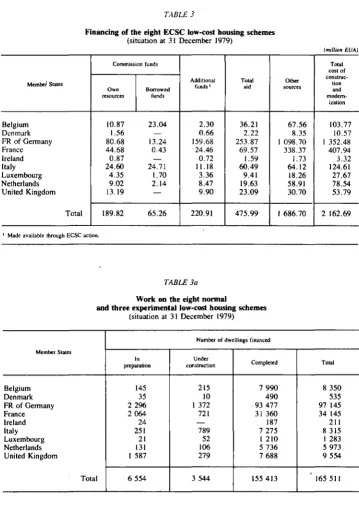
37. All the funds available under the eighth scheme of financial aid for the construction
of low-cost housing for workers in the ECSC industries (25 million EUA for the first instalment and 30 million EUA for the second) have been committed, and by 31 December 1979 the majority (53 265 000 EUA) had already been allocated to help finance about 24 400 dwellings. The balance should be sufficient to enable the Community to contribute towards financing some 600 dwellings, making a total of25 000 for the eighth scheme as a whole. In addition, on 29 June the Commission approved the launching of a ninth scheme. Appropriations under the first instalment (1979-81) will amount to 30 million EUA to be allocated in accordance with the selection criteria laid down in the Commission Decision of 19 November 1979.5
' Social Report 1978, point 36; OJ C 135 of 9.6. 1978. 2 Bull. EC 5-1979, point 2.1.69.
3 Bull. EC 4-1979, point 2.1.39.
4 OJ C 140 of 5.6.1979; Bull. EC 5-1979, point 2.3.6.
Membef States
Belgium Denmark FR of Germany France Ireland Italy Luxembourg Netherlands United Kingdom
Total
TABLE 3
Financing of the eight ECSC low-cost housing schemes (situation at 31 December 1979)
Commission funds
Additional Total
Own Borrowed funds 1 aid
resources funds
10.87 23.04 2.30 36.21
1.56 - 0.66 2.22
80.68 13.24 159.68 253.87
44.68 0.43 . 24.46 69.57
0.87 - 0.72 1.59
24.60 24.71 11.18 60.49
4.35 1.70 3.36 9.41
9.02 2.14 8.47 19.63
13.19 - 9.90 23.09
189.82 65.26 220.91 475.99
1 Made available through ECSC action.
Member States
Belgium Denmark FR of Germany France Ireland Italy Luxembourg Netherlands United Kingdom
TABLE 3a
Work on the eight normal
and three experimental low-cost housing schemes (situation at 31 December 1979)
Number of dwellings financed
In Under
Completed preparation construction
145 215 7 990
35 10 490
2 296 I 372 . 93 477
2 064 721 31 360
24 - 187
251 789 7 275
21 52 I 210
131 106 5 736
I 587 279 7 688
Total 6 554 3 544 155 413
(million EUA)
Total
cost of Other construe-lion sources and
modem-ization
67.56 103.77 8.35 10.57 I 098.70 I 352.48 338.37 407.94
1.73 3.32
64.12 124.61 18.26 27.67 58.91 78.54 30.70 53.79
I 686.70 2 162.69
Total
8 350 535 97 145 34 145 211 8 315 I 283
5 973
9 554
[image:28.445.54.413.62.570.2] [image:28.445.56.414.102.299.2]38. The Commission financed 15 pilot schemes on adapting housing to the needs of the handicapped. In addition, on the basis of the findings of a survey on migrant workers' housing conditions, 1 it granted financial aid to pilot schemes aimed at improving housing for these workers or assisting the reception services. Lastly, in connection its work on the European Habitat Competition, the Commission selected 16 projects from various countries.
Health and safety
Public health
39. In compliance with the wishes of the Health Ministers, who had met in Brussels on 16 November 1978, 2 the Commission consulted the Member States with a view to establishing a coherent health education policy, the main aims of which would be to reduce tobacco consumption and improve the eating habits of the public at large. At the same time, studies and surveys on motivation, behaviour and admissibility of health publicity were undertaken.
40. As regards mutual medical assistance in the event of catastrophes, major accidents or exceptionally serious outbreaks of disease, a survey had to be conducted among the Member States' health authorities before any specific projects could be contemplated. The findings of this survey were the subject of an initial examination.
Radiation protection
41. On 29 January the Commission proposed to the Council that there should be a revision of its 1976 Directive which lays down the basic standards for the protection of health against the dangers of ionizing radiation. 3 The proposal was endorsed by Parlia-ment4 and the Economic and Social Committee. 5 On 14 December the Commission also adopted a proposal for a Directive laying down the basic measures applicable to the radiation protection of persons undergoing medical examination or therapy. 6
1 Social Report 1977, point 36.
2 Social Report 1978, point 40.
3 OJ C 86 of 2.4.1976; Bull. EC ll-1978, point 2.1.51. 4 OJ C 140 of 5.6.1979.
Health aspects of the environment
Radioactive effluents
42. In accordance with Article 37 of the Euratom Treaty, the Commission has delivered two opinions on projects for the discharge of radioactive effluents from the nuclear power station at Fessenheim and the HAO
+
UP2 spent nuclear fuel reprocessing plant at the Cap de la Hague. Three other projects covering a reprocessing plant at Dounreay, the nuclear power station at Gravelines and a fission product vitrification unit at Marcoule (A VM) are being examined.Effects of pollutants on health
43. Documents laying down criteria (exposure effect on health ratio) have been pre-pared for arsenic and chlqrinated organic solvents. Work on asbestos has been continued, especially on the carcinogenic effects on man, and agreement has been reached at expert level on the pathological definition and the interpretation of the image of mesotheliomas.
As regards the Directive on the biological screening of the population for lead, 1 the initial campaign of measurements involving 30 000 human blood samples has been completed. The results are now being interpreted.
The Scientific Advisory Committee to examine the toxicity and ecotoxicity of chemical compounds, 2 set up in 1978, held its first general meeting in October, which was followed in December by an initial meeting of the toxicology section.
Safety, hygiene and health protection at work
44. The first step in implementing the action programme approved by the Council on 29 June 19783 was a proposal for a Directive on the protection of workers from harmful . exposure to chemical, physical and biological agents at work, which was transmitted by the Commission to the Council on 6 March. 4 This Directive will open the way for the gradual harmonization of national provisions governing health and safety at work; it will also enable individual Directives on lead to be drawn up, the first of which was in fact proposed to the Council on 10 December. 5
1 OJ L 105 of28.4.1977.
2 OJL198of22.7.1978.
3 OJ C 165 of 11.7.1978; Bull. EC 6-1978, point 2.1.39.
4 OJ C 89 of 5.4.1979; Bull. EC 3-1979. point 2.1.52.
On 19 July 1 the Commission sent the Council a proposal for a Directive on the major accident hazards of certain industrial activities. On 21 June it adopted a Directive2 amending the annexes to the Council Directive of 25 July 1977 3 on the provision of safety signs at places of ,work.
Another important feature of the implementation of the programme consisted in the organization of a joint seminar, held with the American authorities-in line with the Cooperation Agreement concluded by the Commission and the United States-and the ILO on the implementation of an early warning system for safety and health at work (Hazard Alert System).
The Advisory Committee on Safety, Hygiene and Health Protection at Work held three full meetings, prepared by 16 meetings of the working parties and gave its opinion on proposals for directives and draft directives.
ECSC social research
45. The ECSC' s research policy has been developed on the. basis of preceding pro-grammes. The new programme on industrial hygiene in mines, which was decided in 1978, has been put into effect. A research programme on the prevention of nuisances at the place of work and in the environment of iron and steelworks was decided by the Commission on 22 May. 4 Three information meetings have been held to discuss rescue work in mines, in coking plants and the epidemiology of pneumoconiosis in coalminers.
Mines Safety and Health Commission
46. The Commission held four plenary meetings. In addition to the information reports which it adopted, it proposed a method for controlling the neutralization of flammable dust to member governments and continued its regular statistical work. In view of the extension of its terms of reference, special attention was paid to safety in offshore gas arid oilfields as regards production equipment, well reconditioning and staff training. In addition, safety campaigns were organized for open-air occupations, a code of practice for deep-sea divers was published, 5 and seminars were held for miners' unions.
t OJ C 212 of24.8.1979; Bull. EC 7/8-1979, point 2.1.50. 2 OJ L 183 of 19.7.1979; Bull. EC 6-1979, point 2.1.49.
J OJL229of7.9.1977.
4 OJ C 147 of 13.6.1979; Bull. EC2-1979, point 2.1.34; Bull. EC 5-1979, point 2.1.71.
Handicapped persons
47. On 30 October, 1 the Commission forwarded to the Council its report on the initial
Community action programme for the vocational rehabilitation of handicapped persons (1974-79). This report was drawn up in the light of the results of the projects aided by the Social Fund, which were reviewed at seminars held in Luxembourg on 21, 22 and 23 March 2 Representatives of the network of rehabilitation and training centres continued work on the preparation of guidelines or the further training of staff involved in rehabilita-tion.·
Paul Finet Foundation
48. During the 1979 academic year, the Paul Finet Foundation examined I 354 applica-tions and awarded 991 scholarships, for a total of BFR 9481609, to schoolchildren and students whose fathers had been employed in ECSC industries and had lost their lives as a result of an industrial accident or occupational disease.
Interpretation and application of the social provisions
by
the Court of Justice49. The Court has had the opportunity to state its views on the range of persons covered by the Community rules governing free movement of persons.
In two decisions the Court laid down the principle that provisions of the EEC Treaty relating to the free movement of persons cannot be applied to situations which are purely internal to a Member State. In Case 175/783 the Court held that, although the rights conferred upon workers may lead the Member States to amend their legislation even with respect to their own nationals. Article 48 of the Treaty does not aim to restrict the power of the Member States to lay down restrictions, within their own territory, on the freedom of movement of all persons subject to their jurisdiction in implementation of domestic criminal law. In Case 115/78 4 the Court held that Article 52 of the Treaty cannot be interpreted in such a way as to exclude from the benefit of Community law a given Member State's own nationals when the latter, owing to the fact that they have lawfully resided on the territory of another Member State and have there acquired a trade qualification which is recognized by the provisions of Community law, are, with regard to their State of origin, in a situation which may be assimilated to that of any other persons enjoying the rights and
1 Bull. EC 10-1979, point 2.1.61. 2 Bull. EC 3-1979, point 2.1.56.
3 CJEC 28.3.1979 (Regina v Saunders), 175/78: [1979] ECR 1129.
liberties guaranteed by the Treaty. This applies, however, only if specific Community measures for securing complete freedom of establishment, according to Articles 54 and 57 of the EEC Treaty, have been adopted. The Court has, for example, held in another case 1 that if no such measure exists, Article 52 of the EEC Treaty, in so far as it is intended to ensure the benefit of national treatment, can only concern, in each Member State, the nationals of other Member States.
50. In the field of social security for migrant workers, the year has been marked by a particularly large number of decisions given on requests for preliminary rulings. As in the past, the questions of interpretation raised have been concerned with a variety of provisions of Regulation No 1408/712 -for instance, the range of persons3 or matters4 covered, aggregation and the overlapping of benefits, 5 unemployment 6 or invalidity benefit: 7 in only one case 8 has the validity of a provision of the Regulation been questioned. The Court has again emphasized that the social security regulations-to be interpreted in a uniform manner in the various language versions 9- are to be considered in the light of the aims pursued by the provisions of the EEC Treaty (Articles 4X to 51) under which they are made, 10 provisions which are limited to ensuring the coordination of the different national
s~cial security laws. 11
This year has also been marked by three cases 12 in which the referring court has felt itself obliged to refer again to the Court of Justice, notwithstanding the replies given to the questions originally raised.
1 CJEC 7.2.1979 (Ministere Public v Auer), 136/78: [1978] ECR 437. 2 OJ L 149 of 5.7.1971.
3 CJEC 12.7.1979 (Caisse rt?gionale d'assurance maladie de Lille v Toia), 237/78: not yet reported. • CJEC 8.3.1979 (Bestuur van de Sociale Verzekeringsbank v Lohmann), 129/78: (1979) ECR 853. s CJEC 5.10.1978 (lnstitut National d'Assurance Maladie-lnvalidite v Viola), 26/78: (1978) ECR 1771. 6 CJEC 20.3.1979 (Coccioli v Bundesanstaltfur Arbeit), 139/78: [1979) ECR 991.
1 CJEC 19.6.1979 (Brouwer-Kaune v Bestuur van de Bedrijfsvereniging voor het Kledingsbedrijf), 180178: not
yet reported.
s CJEC 22.2.1979 (Tinelli v Berufsgenossenschaft der Chemischen lndustrie}, 144178: [1979] ECR 757. 9 CJEC 12.7.1979 (Koschinske v Raad van Arbeid), 9179: not yet reported.
10 CJEC 6.3.1979 (Rossi v Caisse de Compensation pour Allocations Familiales des Regions de Charleroi et
Namur), 100/78: [1979) ECR 831.
11 CJEC 12.7.1979 (Brunori v Landesversicherungsanstalt Rheinprovinz), 266/78: not yet reported. 12 CJEC 5.4.1979 (Schaap), 176178; CJEC 16.5.1979 (FNROM v Mura), 236178; CJEC 31.5.1979 (Pierik),
)
I
f
Employment
(Including migrant workers)
Trends within the Community
51. The gradual economic recovery in the Member States, which began to take shape at the end of 1978, was held back by the rise in oil prices and some tendency for inflation to pick up once more. However, aGDP growth rate of about 3.3% was recorded for the year as a whole and as a result the employment level rose by about 0. 9%.
The total number of registered unemployed for the whole of the Community remained static between December 1978 and December 1979. However, this overall figure reflects diffe-rent n'ational situations, ranging from a rapid increase in France (
+
10.6%) to a sharp fall in Denmark (-22.8%), as can be seen from Table 4.In 1979, the public authorities efforts to combat unemployment were directed to solving the problem of the existence of 'hard cores' of unemployed workers ill-prepared for the structural changes taking place in the European economies. These problems, which concern both the capacity to adapt of those affected by the consequences of the crisis and the ability of young workers to integrate into working life, demand radical measures which will only show results in the medium and long term. For example, provision has been made in the majority of countries for additional vocational training and retraining facilities. Greater emphasis is also being placed on the links between school and the working world.
52. At Community level, efforts were concentrated on the reorganization of working time (sf?e Introductory Chapter, in particular points 14 and 15) and the difficulties affecting the operation of the labour market due to the extent of the qualitative mismatch between supply and demand (mobility problems, skills and working conditions offered and required).
"'
0 (") 5> r JJ m :uYear/Month Belgium
1970 81.0
1971 84.5
1972 105.2
1973 111.2
1974 124.1
1975 207.8
1976 266.6
1977 307.6
1978 333.4
1979 351.8
1978 December 347.6
1979 January 344.8 February 341.2
March 333.5
April 328.2
May 322.5
June 315.3
July 367.9
August 380.9
September 380.2 October 372.1 November 368.2 December 366.8
1 New series.
p Provisional figures.
TABLE4
Number of registered unemployed in the Member States of the Community
(annual averages and monthly situation)
Denmark FRof France Inoland1 Italy Lux em-
Nether-Gennany bourg lands
23.9 148.8 262.0 58.8 887.6 0.0 46.4
28.71 -185.1 338.2 57.3 I 038.1 0.0 62.0
28.8 246.4 383.5 66.6 I 047.8 0.0 107.9
17.8 273.5 393.9 62.0 I 004.8 0.0 109.9
47.9 582.5 497.7 67.2 997.2 0.1 134.9
I 13.5 I 074.2 839.7 96.2 I 106.9 0.3 195.3 118.2 I 060.3 933.5 107.8 I 181.7 0.5 210.8 147.0 I 030.0 I 071.8 106.4 I 381.9 0.8 206.91 169.8 992.9 I 166.9 99.2 I 528.6 1.2 205.6 137.8 876.1 I 349.9 89.6 'I 645.2P 1.1 210.0
185.4 I 006.7 I 328.3 98.4 I 635.5 1.2 219.7
177.1 I 171.4 I 356.2 100.2 I 730.6 1.3 229.0 180.9 I 134.1 I 341.9 98.2 I 728.7 1.2 225.8 161.7 957.7 I 313.0 94.7 I 686.6 1.1 209.7 143.4 875.5 I 290.6 92.5 I 624.9 0.9 193.5 123.5 775.1 I 258.9 89.6 I 588.5 0.9 188.2 113.4 763.2 I 233.0 87.4 I 619.3 0.8 198.3 120.9 803.7 I 256.6 87.2 I 590.9 0.9 211.2 119.9 798.9 I 302.6 87.1 I 570.6 0.9 218.0 118.9 736.8 I 423.9 82.6 I 643.3 1.0 212.6 122.6. 761.7 I 479.9 82.9 I 673.6 1.2 207.4 124.5 799.0 I 472.7 84.7 I 623.0P 1.2 209.5 143.2 866.8 I 468.9 88.6 I 662.9P 1.2 216.7
- L_____ - L _ _ _ - _ L _ _ _ _ _ -'----
-Source: Standardized series on registered unemployment, submitted to the SOEC by the national employment services.
United Kingdom 612.0 792.1 875.6 618.8 615.1 977.6 I 358.8 I 483.6 I 475.0 I 390.5
I 364.3
I 455.3 I 451.9 I 402.3 I 340.6 I 299.3 I 343.9 I 464.0 I 455.5 I 394.5 I 367.6 I 355.2 I 355.5
-(in thousands)
EUR9
2 120.5 2 586.0 2 861.8 2 591.9 3 066.7 4 611.5
5 238.1 5 736.0 5 972.6
6 052.0P
6 187.1
6 565.9 6 503.9 6 160.3
5 890.1 5 646.5 5 674.6 5 903.3 5 934.4 5 993.8 6 069.0 6 038.0P 6 J70.6P '---
-0
I
8
F:
.,
In most Member States, the effectiveness of policies to restimulate growth was-and still is-limited by the qualitative mismatch between job seekers' qualifications and the type of vacancies offered by employers, in addition to the weaknesses still to be found in certain public employment services and vocational training systems.
The organization of working time cannot be considered only in relation to curbing produc-tion costs. It must also be considered in the light of the sensitive problems of adjustment that would certainly affect the labour market, particularly as regards the supply of and demand for certain skills.
Lastly, reducing qualitative mismatching on the labour market is one of the prerequisites~
though not in itself sufficient-for a return to full and better employment.
In his conclusions, the Chairman of the Standing Committee on Employment emphasized the need to reinforce labour market policies.
Firstly, vocational and career guidance for both young people and adults should be further developed and should not be confined only to the unemployed.
Secondly, vocational training facilities should be expanded and brought into line with the current and foreseeable needs of the Community economies. In particular, access for girls to certain training courses and certain jobs traditionally reserved for men should be made easier; more extensive use should be made of schemes based on the combined training/work experience principle at all stages of working life (see Council Resolution of 22 November 1979 and point 73 of this Report).
Thirdly, job prospection and placement activities should be stepped up and more emphasis given to liaison between undertakings and job-seekers. Employment agency staff should be qualified and trained to ensure such liaison and public employment services should be given the means to improve their credibility in the eyes of employers and workers.
Lastly, the demand for temporary workers on the part of certain undertakings and the demand for part-time jobs on the part of certain workers should be satisfied in conditions ensuring equity and providing social protection.
These conclusions and guidelines are under study by the group of Directors-General of Employment and the group of Directors of Employment Agencies. After consultation with the two sides of industry this work should lead, in the first half of 1980, to a communication to the Council on guidelines for a Community labour market policy.