This is a repository copy of
CFD based optimisation of the superhydrophobic functional
surface in dropwise condensation
.
White Rose Research Online URL for this paper:
http://eprints.whiterose.ac.uk/116601/
Version: Accepted Version
Proceedings Paper:
Khatir, Z and Kubiak, KJ (2014) CFD based optimisation of the superhydrophobic
functional surface in dropwise condensation. In: Proceedings of International Conference
on the Analysis and Mathematical Applications in Engineering and Science (AMAES
2014). International Conference on the Analysis and Mathematical Applications in
Engineering and Science (AMAES 2014), 19-22 Jan 2014, Miri, Sarawak, Malaysia. . ISBN
978-983-44482-6-4
[email protected] https://eprints.whiterose.ac.uk/
Reuse
Unless indicated otherwise, fulltext items are protected by copyright with all rights reserved. The copyright exception in section 29 of the Copyright, Designs and Patents Act 1988 allows the making of a single copy solely for the purpose of non-commercial research or private study within the limits of fair dealing. The publisher or other rights-holder may allow further reproduction and re-use of this version - refer to the White Rose Research Online record for this item. Where records identify the publisher as the copyright holder, users can verify any specific terms of use on the publisher’s website.
Takedown
If you consider content in White Rose Research Online to be in breach of UK law, please notify us by
1
CFD BASED OPTIMISATION OF THE
SUPERHYDROPHOBIC FUNCTIONAL
SURFACE IN DROPWISE CONDENSATION
Z. Khatir
@a, K.J. Kubiak
∗baCurtin University, School of Engineering and Science, Department of Mechanical Engineering
Sarawak Campus CDT 250, 98009 Miri, Sarawak, Malaysia
bUniversity of Liverpool, School of Engineering, Liverpool L69 3GH, United Kingdom
@[email protected] ∗[email protected]/[email protected]
Abstract: Dropwise condensation processes, where condensation occurs through small droplets on a solid surface, has been demonstrated to significantly improve heat transfer rates in comparison to film-wise condensation (where a whole surface is covered by a thin film of liquid). Dropwise condensation usually takes place on superhydrophobic surfaces, and one of the main engineering and scientific challenges is to develop such a surface to allow condensation, and removal of the droplets, to occur in a continuous manner. Experimentally validated CFD analysis of droplets on superhydrophobic surfaces is undertaken to describe the mechanism of self propelled droplets ’jumping’ from the surface after coalescence, the process by which two droplets merge during contact to form a single droplet. Owing to the larger diameter of the newly created droplet, it starts to push against the surface and spread beyond static contact angle usually observed between the fluid and the solid surface in equilibrium. Spreading beyond the equilibrium state creates a reaction at solid-liquid interface and shifts the momentum upwards, generating unbalanced kinetic energy and propelling the droplet. This allows the liquid to overcome the adhesion forces and dewet the surface separating droplet from surface. Optimisation of droplets radius and contact angle to obtain high ’jumping’ droplet velocity, hence improving droplets evacuation, was performed using design of experiment and surface response techniques. CFD-based optimisation is proven to be a reliable and fast predictive modelling tool.
Key words: dropwise condensation; heat transfer; superhydrophobic surfaces; self propelled drops; CFD optimi-sation; surface response.
1 INTRODUCTION
The so called dropwise condensation when liquid condense on a solid surface in a form of droplets has been studied for several decades and there has been a huge effort to enhance the heat transfer from vapour to liquid state using dropwise condensation which shows much higher heat transfer rate than filmwise condensation ( Lee2013) when surface is covered by a liquid film. In dropwise condensation crucial task is to efficiently remove condensate from the surface and create place for new droplets nucleation. This is where the droplets coalescence and self propelled (’jumping’) phenomenon can enhance this process.
2
the surface asperities) and Cassie-Baxter state (when liquid stays on top of the asperities and air is trapped between liquid and solid) (Wang2011) and in some cases to fully dewet the surface allowing the droplet to ’jump’.
Process of droplet coalescence can be described by three flowing stages:
1. Nucleation of bridge, stage when the bridge is created and gap between the droplets rapidly start to close, while contact line start to move creating the neck,
2. Neck expansion stage when contact line move and composite droplet with ’peanut’ like shape is created, 3. Composite droplet relaxation stage where free surface oscillate and droplet slowly relax to the equilibrium
shape and finally to spherical cap shape.
The dynamics of coalescence in stage I and II is a few order of magnitude higher that in stage III. All of those processes involved in droplet coalescence has been modelled using different numerical tools and techniques. In our analysis, we use two different techniques. A Lattice Boltzmann Method (LBM) code with a newly implemented model for contact angle hysteresis and a Volume of Fluid (VoF) flow solvers are effectively applied.
2 EXPERIMENTAL VALIDATED CFD ANALYSIS
The dynamics of sessile droplet coalescence process was analysed numerically using LBM (Succi01) and VoF ( Hirt-Nichols1981) as implemented in the OpenFoam CFD toolbox (OpenFOAM c).
The LBM mesoscopic approach has the benefit that liquid free surfaces do not require special tracking or reconstruction at each time step, they arise naturally as part of the (liquid-gas) phase separation model, which in this case is the popular Shan-Chen single component, multiphase model (Shan93). More details about the LBM used in this study can be found in (Castrejon-Pita2011). On the other hand, the two-phase finite volume interFoam solver of the OpenFOAM open source CFD toolbox (OpenFOAM c) was chosen because of its characteristics for automatic interface tracking and mass conservation). interFoam uses a VOF (Hirt-Nichols1981) approach modified with the introduction of an additional term in the volume fraction equation, to obtain interface compression by means of a tunable parameter as detailed in (Guilizzoni2012).
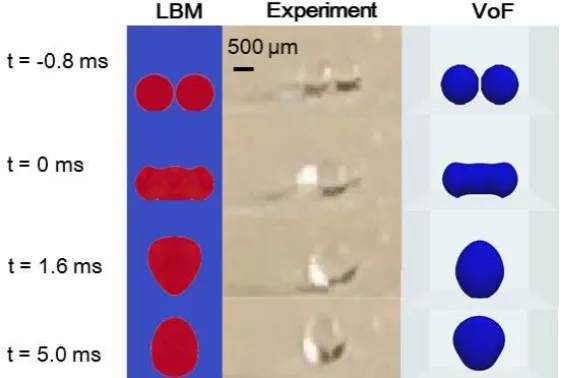
An experiment of the coalescence of two water droplets with radius R = 405µm and static contact angle θS = 157o is undertaken to validate both CFD methods. Fig. 2.1 displays the results for both CFD techniques
[image:3.595.158.442.442.631.2]together with experimental data. It is shown that both CFD methods show very good agreement with the experiment. Droplets coalesce to form a single droplet which then ’jumps’ upwards due to the particular conditions.
Figure 2.1 Coalescence of two water droplets with radius R = 405µm and contact angle θS = 157o at various time:
comparison between LBM and VoF flow simulations with experimentation.
In the following, we will investigate the conditions by which such droplets jump after coalescence.
3 OPTIMISATION ANALYSIS AND RESULTS
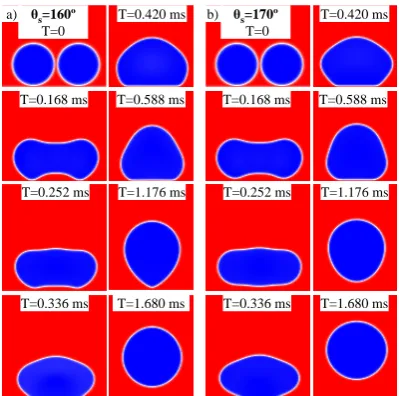
We perform two simulation of the coalescence of droplets with radius R=100µm and static angles θS = 160o
andθS = 170o. Numerical results are presented in Fig. 3.1. They show that due to the larger diameter of the
bigger combined droplet, it starts to press against the solid surface resulting in unstable conditions.
s=160º
T=0
T=0.168 ms
T=0.252 ms
T=0.336 ms
T=0.420 ms
T=0.588 ms
T=1.176 ms
T=1.680 ms
s=170º
T=0
T=0.168 ms
T=0.252 ms
T=0.336 ms
T=0.420 ms
T=0.588 ms
T=1.176 ms
T=1.680 ms
[image:4.595.196.396.47.245.2]a) b)
Figure 3.1 Influence of static contact angle on coalescing droplet shape and self propelling behaviour, LBM simulation (initial droplets radius R=100µm).
Figure 3.2 Critical contact angle (θC = 140◦) for self propelled behaviour of drops on superhydrophobic surfaces, numerical
analysis for water droplets of initial radiusr= 100µm.
spherical shape. When the droplet deforms and pushes against the solid surface, it can only escape upwards, shifting kinetic momentum in direction normal to the surface. When the static contact angle is high enough (θc>140◦) the drop will ’jump’ from the surface.
Droplet jumping phenomenon can be observed mainly on superhydrophobic surfaces, our numerical analysis on the contact angle influence on droplet velocity reveals the existence of a critical static contact angle around θc = 140◦ required to observe this phenomenon. In the results presented in Fig. 3.2, the velocity profile of
jumping drop indicates that for lower contact angle an energy released upon coalescence is dissipated mainly by surface dewetting process, and forθS < θCthere is not enough energy left to separate droplet from the surface,
and hence the combined droplet will stay attached to the surface after coalescence.
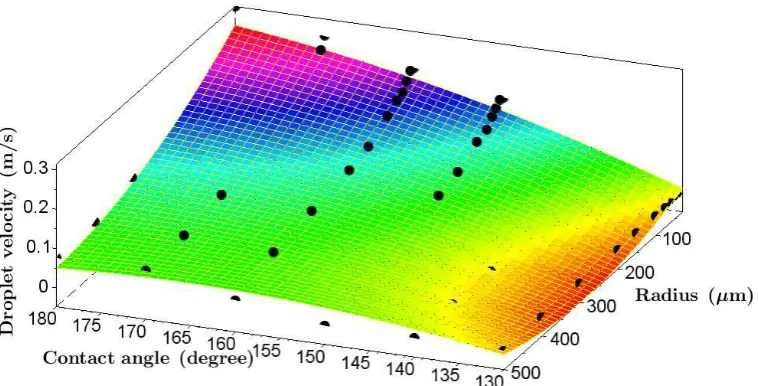
Optimisation analysis is undertaken to establish an optimal surface and droplets conditions to obtain max-imum velocity of jumping droplets. The surface response method was used to analyse the influence of contact angle of solid surface and the droplet diameter. Design of experiment were used to define experimental conditions and several models were build using CFD solver, based on lattice Boltzmann method.
Optimisation consists of building a meta-model in function of the two design variables namely: the contact angleθSand initial droplet radiusR. A second order non-linear polynomial approximation is employed involving
the termsθ2
S;R
2;
θS;Rand θS·R, and the resulting meta-model for the jumping droplets velocityUdropis thus
obtained:
Udrop=−5.2×10−
5 θS
2
+ 0.09×10⁻⁵R2−0.83×10⁻⁵(θ
SR) + 0.021θS+ 0.0006R−1.88 (3.1)
Results of this analysis and the estimated response surface are presented in Fig. 3.3.
[image:4.595.187.403.287.476.2]4
Figure 3.3 Results of surface response analysis based on LBM CFD-based model of droplets jumping upon coalescence. (Droplet velocity - m/s; Droplets Radius -µm; Contact angle - degree))
is rather technologically not yet accessible. Smaller droplet can jump from surface with higher initial velocity and bigger droplets have too large contact area to dewet the surface and they will remain attached.
4 CONCLUSION
A CFD based optimisation procedure has been applied for heat transfer enhancement in dropwise condensation process. The following conclusions can be formulated:
Higher static contact angle (θS) results in higher velocity of droplets jumping after coalescence,
Critical contact angle for droplets to ’jump’ upon coalescence was estimated to beθC= 140◦,
Optimisation of droplets size indicate that the maximum speed of jumping droplets can be achieved for smaller dropletsD <130µm,
Superhydrophobic functional surface allowing condensation, coalescence and droplets ’jumping’ can be a good strategy to enhance heat transfer rate in dropwise condensation process.
References
S. Lee, K. Cheng, V. Palmre, M.H. Bhuiya, K.J. Kim , B.J. Zhang, H. Yoon, (2013) International Journal of Heat and Mass TransferVol. 65, pp. 619-626.
M. Sellier and E. Trelluyer, “Modeling the coalescence of sessile droplets,” Biomicrofluidics, vol. 3, no. 2, p. 022412, 2009.
F. M. C. Blanchette, “Simulation of mixing within drops due to surface tension variations,” Phys. Rev. Lett., vol. 105, p. 074501, Aug 2010.
K. Fezzaa and Y. Wang, “Ultrafast x-ray phase-contrast imaging of the initial coalescence phase of two water droplets,”Phys. Rev. Lett., vol. 100, p. 104501, Mar 2008.
S. C. Case and S. R. Nagel, “Coalescence in low-viscosity liquids,” Phys. Rev. Lett., vol. 100, p. 084503, Feb 2008.
F.-C. Wang, F. Yang, and Y.-P. Zhao, “Size effect on the coalescence-induced self-propelled droplet,” vol. 98, no. 5, p. 053112, 2011.
S. Succi,The Lattice Boltzmann Equation for Fluid Dynamics and Beyond. Oxford University Press, 2001. X. Shan and H. Chen, “Lattice boltzmann model for simulating flows with multiple phases and components,”
Phys. Rev. E, vol. 47, pp. 1815–1819, Mar 1993.
J. R. Castrejon-Pita, E. S. Betton, K. J. Kubiak, M. C. T. Wilson, and I. M. Hutchings, “The dynamics of the impact and coalescence of droplets on a solid surface,”Biomicrofluidics, vol. 5, no. 1, p. 014112, 2011. OpenFOAM c, The open source CFD toolbox, website: http://www.openfoam.com/.
M. Guilizzoni, “Drop deposition and low-speed impact on flat, curved and microfinned solid surface: comparison between simulations, models and experiments”, DIPSI Workshop 2012 on Droplet Impact Phenomena & Spray Investigation, May 18, 2012, Bergamo, Italy.