This is a repository copy of Complex topography and human evolution: the missing link.
White Rose Research Online URL for this paper: http://eprints.whiterose.ac.uk/109663/
Version: Accepted Version
Article:
Winder, Isabelle Catherine orcid.org/0000-0003-3874-303X, King, Geoffrey, Deves, M. et al. (1 more author) (2013) Complex topography and human evolution: the missing link. Antiquity. pp. 333-349. ISSN 0003-598X
https://doi.org/10.1017/S0003598X00048985
[email protected] https://eprints.whiterose.ac.uk/
Reuse
Items deposited in White Rose Research Online are protected by copyright, with all rights reserved unless indicated otherwise. They may be downloaded and/or printed for private study, or other acts as permitted by national copyright laws. The publisher or other rights holders may allow further reproduction and re-use of the full text version. This is indicated by the licence information on the White Rose Research Online record for the item.
Takedown
If you consider content in White Rose Research Online to be in breach of UK law, please notify us by
Complex Topography and Human Evolution: the
Missing Link
I.C. Winder1*, G.C.P. King1,2, M. Dev•s2 and G. Bailey1 1
Department of Archaeology, University of York, York YO1 7EP, UK 2
Institut de Physique du Globe, 75238 Paris, France *
Corresponding author
E-mail addresses: I.C. Winder: [email protected]; G.C.P. King: [email protected]; M. Dev•s: [email protected]; G.N. Bailey: [email protected].
Abstract
Why did humans walk upright? Previous models based on adaptions to forest or savannah are challenged here in favour of physical incentives presented by steep rugged terrain Ð the kind of tectonically varied landscape that has produced early hominin remains. ÒScrambler manÓ pursued his prey up hill and down dale and in so doing became that agile, sprinting, enduring, grasping, jumping two legged athlete that we know today.
Keywords: Africa, Kenya, South Africa, hominins, bipedalism, terrestrialisation, tectonic landscape, rift valleys.
Introduction
There are many hypotheses about hominin environments (Potts 1998a, 2007), each drawing on different evolutionary theories and palaeoenvironmental datasets to characterise the selective regimes driving hominisation. They fall into two groups. One emphasises climate, positing either simple climatic shifts (Dart 1925; Morgan 1972) or changes in climatic variability (Foley 1987; Potts 1998b) as drivers of corresponding changes in the niches available to hominins. The other focuses on specific vegetation types that might have selected for hominin traits by generating unique ecological opportunities for these species to exploit (Blumenschine et al. 1987; Thorpe et al. 2007). In recent years the role of woodlands in producing some human characters has gained acceptance (OÕHiggins & Elton 2007), but the original savannah hypothesis still underpins many discussions of human origins (Cerling et al. 2011; Feibel 2011a).
tectonics as a key driving factor. We highlight the limitations of hypotheses based solely on climate or vegetational change in accounting for the evolutionary transition from tree-dwelling to ground-tree-dwelling bipedalism, show how complex topography provides a better explanation for the specific anatomical features associated with the human evolutionary trajectory and divergence from other primates, and emphasise the need for new research that takes account of the long-term history of rift dynamics and provides reconstructions of the physical landscape at an appropriate scale.
Here we propose that conceptualising hominin environments as ÔlandscapesÕ of complex topography brings into focus a variable that has been missing from evaluations of anatomical evolution, and one that helps to explain the inconsistencies in existing theories. This Ôcomplex topography hypothesisÕ supplements and complements vegetational and climatic alternatives rather than completely replacing them. It entails predictions about the hominin evolutionary trajectory which can be tested against those produced by alternative hypotheses, and opens up a new research agenda of field investigation.
Limitations of existing hypotheses
The original savannah hypothesis proposed that aridification thinned out the forests and forced hominins out of the trees onto savannah plains via an intermediate stage involving the use of the remaining trees for security (Dart 1925). Terrestrialisation was identified as the driver of the hominin-panin split, responsible for the appearance of most characteristic hominin features including upright bipedalism. However, the theory ultimately lost support precisely because no savannah niche exploitable by semi-terrestrial and relatively defenceless apes was identified.
Newer ÔwoodlandÕ hypotheses (Blumenschine et al. 1987; Potts 2007; Thorpe et al. 2007) have proposed that upright posture or even bipedal gait evolved in the ancestral hominids within a closed, forested environment, and that this served as a pre-adaptation that later facilitated the transition from arboreality to terrestriality as the forests disappeared (OÕHiggins & Elton 2007).
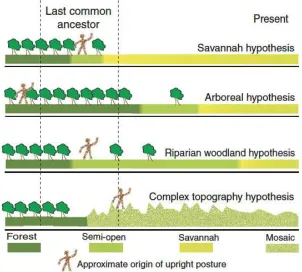
In these newer theories, the relative timing of evolutionary changes is different, but climatically driven vegetational change remains the key driver promoting evolutionary diversification within the hominin lineage (Figure 1). However, an upright climbing adaptation, evolved within the context of tree-dwelling, would not produce all the features required for effective rapid, long-distance terrestrial bipedalism. Explaining how our ancestors survived a locomotor transition in a relatively dangerous semi-open habitat remains a critical challenge to these hypotheses.
woodlands (Pickford & Senut 2001; White et al. 2009) and mixed habitats (Vignaud et al. 2002) with later ones across the full habitat spectrum (Winder 2012).
[image:4.595.144.446.288.560.2]There are, however, elements of environment that have been missed. Recent research has demonstrated that hominin site distributions are strongly linked to topographic patterns (King & Bailey 2006; Bailey et al., 2011; Reynolds et al. 2011). In particular, hominin sites are found in topographically complex regions where active tectonics and other geomorphological processes produce and maintain vegetational mosaics, accessible water sources, and rough topography providing tactical advantage in avoiding predators and accessing mobile prey. The traditional interpretation of this pattern, that these landscapes simply promote fossilisation and discovery (Kullmer 2007), has been challenged by clear instances where taphonomic factors cannot provide a complete explanation of observed patterns (Bailey et al. 2011).
Figure 1: schematic showing the substantial similarities in broad pattern and differences in relative timings between the histories proposed by several vegetation-based theories of hominin evolutionary environments and
the complex topography hypothesis.
Figure 2, from top to bottom: (a) continental map of African vegetation superimposed on a map of topography from SRTM30 data; (b) vegetation and topography in East Africa showing the prevalence of complex topography within and around the Rift Valley. Yellow colours indicate ÔsavannahÕ vegetation (though most is not grassland). The Serengeti is unusual because it is both grassland and smooth, and consequently provides a
misleading impression of local environments; (c) the Transvaal region, South Africa showing vegetation (classified as in 2a) and topography. Part of the catchment boundary of the Limpopo River is shown. This river and its tributaries have been extending their catchment by headward erosion of rivers resulting from uplift of the
whole of southern Africa (Burke 1996). This boundary is therefore associated with downcutting and steep sided valleys associated with the upstream migration of nick points. The Johannesburg Dome has been deeply dissected by erosion over the last 2-3Ma (Dirks et al. 2010). Within the basin the region of the Makapansgat site
(black circle) is also associated with local active tectonics (Bailey et al. 2011).
Figure 3: Images of complex landscapes in East Africa, including (a) the Ethiopian rift from Addis Ababa, with old eroded volcanoes visible; (b) Ôbaboon countryÕ near the Gemeri Lake, showing an active scarp locatable on Google Earth; (c) Google Earth map of the same region near the Gemeri Lake; (d) the region near Lake Victoria
showing the edge of the granite exposure and mosaic habitats near the forest edge.
Testing the alternatives
Early bipedalism
Any convincing hypothesis of hominin evolution must explain the appearance of key human adaptations like upright ÔstridingÕ bipedalism, endurance running, large brains and bodies, manual dexterity, advanced tool use and changes to life history, which together form an adaptive suite of interlinked characteristics. Manual dexterity and tool use, for instance, are interlinked and may follow naturally from upright posture as arms lose their locomotor function. Successful hypotheses thus do not need to provide separate explanations for each adaptation. Instead, many focus primarily on explaining bipedal locomotion as this is both the first ÔhumanÕ character to appear in the fossil record and one that permitted or drove subsequent changes.
knuckle-walker too, or many chimpanzee and gorilla adaptations result from convergent evolution. Both have been advocated in the recent literature (e.g. Dainton & Macho 1999; Richmond & Strait 2000; Richmond et al. 2001; Kelly 2001; Crompton et al. 2008).
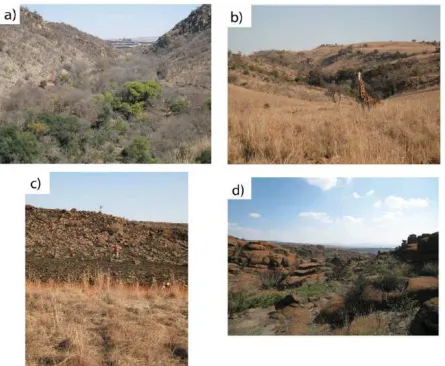
Figure 4: Complex landscapes in South Africa, including (a) a view towards Sterkfontein from the adjacent hard rock showing the complex topography often missed by visitors; (b) a valley close to the Australopithecus sediba
findspot. The landscape has evolved but similar features would have existed in the past; (c) a landscape displaying small-scale roughness usually hidden beneath savannah vegetation and (d) complex topography at
Magalisberg, where there are no hominin fossils due to soil acidity but we might expect to find archaeology.
However, regardless of whether the ancestral form was a knuckle-walker or an upright-bodied climber (or indeed something else entirely), the key question that remains is how hominins shifted from one locomotor mode to another. Neither of these ancestral forms is perfectly suited for terrestrial bipedalism (indeed someÑthough not allÑspecies of Australopithecus might not have been that efficient at this form of locomotion either, as discussed in Harcourt-Smith & Aiello 2004).
terrestrial predators. In areas with a discontinuous canopy (including riparian forests and patchy semi-open habitats), very little protection is offered by arboreality; even a predator that cannot climb trees can simply lie in wait for an ape trapped in the small habitat of one or a few trees.
Figure 5: The Johannesburg dome is associated with an ancient granitic intrusion (~3000Ma) that has up warped overlying rocks to produce an ÔeyeÕ shaped structure. Downcutting of rocks of widely varying strength has produced complex and varied topography. Rates of ~50m per Ma have been documented (Dirks et al. 2010). Red
star = the Sterkfontein site; white star = the approximate location of the Australopithecus sediba site. Small white circles indicate other fossil sites.
Evidence from living primates also suggests that the provision of supporting rocky structures might make the acquisition of bipedal locomotion easier even if the ancestral hominin was not pre-adapted for it. Chimpanzees engage in postural or supported bipedalism (tripedalism) more often than in independent walking and can move fluently between quadrupedal, tripedal and bipedal postures in complex arboreal habitats (Stanford 2006).
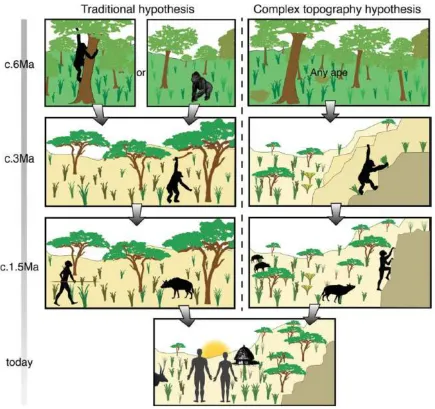
Figure 6: a cartoon showing the evolution of hominin locomotor capabilities as predicted by the savannah hypothesis (left) and the complex topography hypothesis (right) and illustrating the differences between these two modelsÕ abilities to explain our history. Both sequences begin with the predicted last common ancestor of
Pan and Homo at about 6Ma towards the top and culminate in Homo sapiens at the bottom.
generalist, scrambling adaptation which would presumably incorporate a more upright stance, a shortening of the upper limbs and, in the lower limbs, a compromise between adaptations for flexibility and grasping ability and those entailing rigidity and leverage during terrestrial locomotion on uneven surfaces. Under this model, the australopith anatomical mosaics of terrestrial and putatively ÔarborealÕ traits (Harcourt-Smith & Aiello 2004) could be identified as adaptations to scrambling as easily as to semi-arboreal locomotion, and a range of different mosaics would be expected as the hominins radiate to fill different ecological niches on complex landscapes. These anatomical complexes would constitute an effective morphology for scrambling, rather than one riddled with relic features or caught uncomfortably between two niches. The shift from one refugium (trees) to another (complex topography) by a group near the LCA might also explain our lineageÕs divergence from the panins, as such shifts are likely to have been important right up to our own speciesÕ evolution (Stewart & Stringer 2012).
Obligate bipedalism
For the earliest stages of hominin evolution, then, the complex topography hypothesis performs better than other hypotheses as an explanatory framework for terrestrialisation. But what of the appearance of obligate (ie permanent and necessary) ÔstridingÕ bipedalism and endurance running later in our history? This is an area where the implicit 2D ÔplainsÕ assumption of older hypotheses comes into its own, and is an important challenge for our hypothesis. The two major adaptive changes to the human footÑthe aligned hallux (big toe) and the foot archesÑseem well fitted to striding and running, as their key function is to make the foot act as a rigid lever during locomotion. This is clearly advantageous on flat terrain, but would also serve an important function on complex topography: it would enable the release of stored energy to lever the body upwards even if only a small part of the foot was in contact with the substrate. This more efficient means of transmitting gait forces and driving locomotion on rough substrates would mean there was less need for scramblers to use their arms to assist locomotion once these features had appeared, thus facilitating further changes to the upper limbs and body proportions and matching the observed trajectory of adaptations in the fossil record.
rapid adaptive change that would drive the elaboration of existing anatomical, cognitive, social and technological capacities to better exploit the new niche. By this account, explanations of human adaptations for running/striding remain the same but are based on earlier scrambling features which allowed hominins to venture onto the plains only when they already possessed traits which aided the pursuit of prey and escape from predators. Complex topography would still be accessible to these lineages, but might cease to be their primary niche as the ratchet continued to act and their adaptations became more specialised.
Figure 7: Schematic summarising the ways the traditional hypotheses (left) and complex topography hypothesis (right) explain modern human anatomical features. Explanations are classified Ð those labelled (A) are based on active selection for the trait, (F) indicates a feedback loop based on selection for another trait, and (P) passive selection or drift. The silhouette is coloured accordingly Ð red indicates adaptations only indirectly explained by the hypothesis, orange those explicable by a single direct selective pressure, and green those subject to more than
Expanding this evolutionary trajectory to explain other uniquely human anatomies is fairly simple (Figure 7). HomininsÕ upper limbs would initially shorten to enable them to pull themselves up when climbing. In fact, this can explain why modern humansÕ arms are shorter than predicted by energetic considerations of striding bipedalism (Wang & Crompton 2004). Under traditional hypotheses, this has to be explained through a reliance on regular carrying of fairly heavy weights. Using the hands to grip while climbing also explains grasping adaptations and increasing manual dexterity. The extreme capabilities found in modern humans would be facilitated by decreasing reliance on this form of locomotion as the lever adaptations of the foot developed, with consequent freeing of the pre-adapted hand for dextrous tasks like tool use. The active use of complex topographies for strategic advantage, seen in modern humans (King et al. 1994; Crouch 2004), can even explain the trends towards larger brains and bodies through the effects of these topographiesÕ enabling relatively defenceless hominins to obtain high quality food (meat), thus initiating a positive feedback which ultimately drove excursions into flat open areas and the development of running adaptations. The relative security offered by topographically complex environments would also facilitate the appearance of the modern human life history, with extended childhood and shorter interbirth intervals. Overall, the complex topography hypothesis explains the key events of hominin evolution better than previous models.
Divergence from other ground-dwelling primates
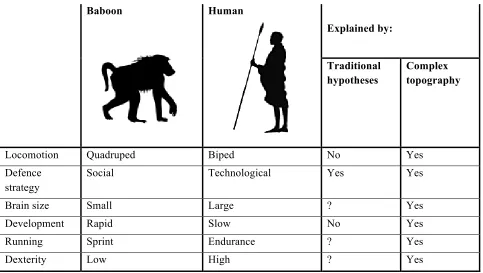
The final test of any palaeoanthropological hypothesis is its ability to explain why hominins are unique. For hypotheses identifying savannahs as a key component (whether throughout evolution or only in the later stages), a key challenge is the fact that the so-called ÔsavannahÕ baboonsÑPapio spp.Ñpossess none of the adaptations of the hominins. Either these features are not essential adaptations to savannah plains, or adaptation to plains cannot be such a major influence on our history as previously thought. The alternativeÑthat baboons and hominins were in sufficiently close competition as to undergo character displacement (where co-occurring speciesÕ adaptations diverge to minimise competition in areas of overlap)Ñassumes that the two lineagesÕ adaptations are genuine alternative solutions to savannah challenges, and that the adoption of either would serve to aid survival in these environments. The discussion above, however, suggests that the idea that hominin adaptations are fitted to savannah survival is unlikely.
Baboon Human
Explained by:
Traditional hypotheses
Complex topography
Locomotion Quadruped Biped No Yes
Defence strategy
Social Technological Yes Yes
Brain size Small Large ? Yes
Development Rapid Slow No Yes
Running Sprint Endurance ? Yes
[image:14.595.58.541.67.340.2]Dexterity Low High ? Yes
Table 1: Summary of the major ecological differences between ÔsavannahÕ baboons (Papio spp.) and Homo sapiens, and the abilities of the savannah and complex topography hypotheses to explain them. Also worth noting, although perhaps not adaptively explicable, is the fact that humans climb down cliffs/rock faces by almost exactly reversing the sequence of movements they use to climb up, moving feet first, while other primate
species (Theropithecus and Papio) included do not.
If hominins are indeed adapted to using complex topography as their primary habitat rather than as a refuge, we would not expect them to share many adaptations with either savannah baboons or the gelada. According to the complex topography hypothesis, hominins were actively adapting to rough terrain and would have shown a strong preference for it, while Papio baboons living on more open, smoother landscapes would have been driven along a separate evolutionary trajectory. Baboon adaptationsÑgroup defences, rapid (rather than endurance) running abilities, sociality, early onset of adulthood (see Table 1)Ñmake them more efficient at plains survival than the australopiths would have been. Once hominins began to access flat areas they would have differed predictably as described above.
Future directions: reconstructing past physical landscapes
Existing studies of fossil and archaeological sites have tended to focus on eroding edges of ancient sedimentary deposits, typically at lake and river margins, and their immediate environs, because this is where material is most likely to have been deposited, preserved and exposed. The immediate surroundings of such locations are typically characterised by smooth topography, and this fact no doubt accounts for the mistaken impression that smooth topography is the defining characteristic of early hominin sites. Until recently, reconstructions of a wider geographical territory have generally been avoided in the belief that such reconstructions are too difficult because of geological changes in the interim and the resulting complexities of stratigraphic correlation between widely separated deposits.
[image:15.595.345.512.71.772.2]However, no visitor to the African Rift can fail to be impressed by the extraordinary range and diversity of tectonic features and resulting complexity of land forms: rift scarps, downcut gorges, volcanic cones, lava fields, back-tilting along fault boundaries and rift scarps with basins that trap sediment and water, large fault-bounded lake basins on the rift floor, smaller volcanic crater lakes, and a complex staircase-effect of faulting, rift scarps, volcanic features and localised basins rising on either side of the main rift axis. Some of these features have come into existence within the Pleistocene, long after the occupation of the earliest hominin sites, others have been erased or modified, and yet others have remained relatively unchanged, subject only to climatically imposed variations in vegetation and water supply, and this is to be expected in a dynamic landscape that has been continuously remoulded over at least the past 5 million years. Geological and stratigraphic studies of these landscapes reinforce the impression of extreme and variable complexity (Brown & McDougall 2011; Feibel 2011b).
It is axiomatic that sites such as the famous hippo butchery site of FxJj3 on Lake Turkana occur near a lake margin in a locality that was originally characterised by flat terrain in the immediate vicinity, and many other early sites are on lake or river margins (Isaac & Isaac 1997). But it remains unclear to what extent such sites are representative of all the locations and activities undertaken by early hominins, or whether they represent more than fleeting visitations and a tiny fraction of the full range of places of significance in the daily lives and lifetimes of their creators, who are likely to have ranged over a larger territory.
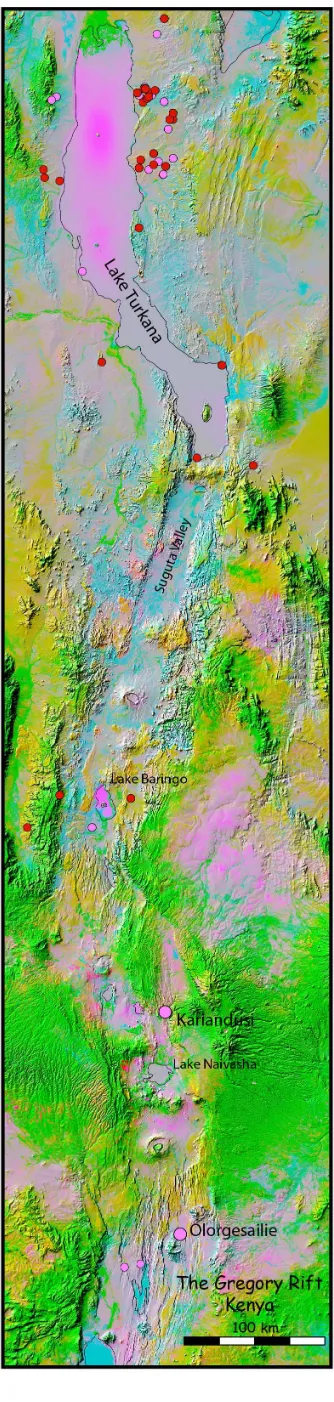
In the Kenyan rift, a more complex topography of faulting and other tectonic features is rarely far away from these lake and river margin sites, whether around Lake Turkana in the north, at Olorgesailie in the south, or in the Naivasha-Baringo corridor in between (Figure 8). Investigation of this hinterland topography is essential in understanding the wider context of existing early hominin sites, and may prove rewarding in the discovery of new ones.
In such dynamic landscapes, however, reconstructing with confidence all the details of the original surface topography over a large area as it existed at any point in time may prove elusive. In regions of dramatic change such as the Ethiopian sector of the Rift, so much has changed that only an approach by analogy is possible (Bailey et al. 2011). At the other end of the spectrum, as in South Africa, enough can be discerned of the original topography to make reconstructions with confidence. Large parts of the Kenyan Rift lie somewhere between these extremes. But we can be sure that the overall combination of features and condition of topographic complexity has been a defining characteristic throughout this geographical range and throughout the time span of human evolution. Moreover, improved theories and understanding of rift dynamics and new techniques of satellite imagery, field mapping and dating, offer a realistic prospect of topographic reconstruction.
Perhaps not surprisingly, modern road access tends to avoid areas of complex topography, and this is an added deterrent to the types of field investigations that are necessary to pursue the complex typography hypothesis. An extreme example is the Suguta Valley, a 100-km section of the Kenyan Rift south of Lake Turkana (Figure 8), with a wide range of extreme tectonic and volcanic features interspersed with fertile areas, capable today of supporting cattle herds, and the type of landscape that we believe to have been particularly advantageous for early hominins. However, there is almost no road access into this region, and access is only possible by helicopter or lengthy treks on foot. There is also the added deterrent of chronic cattle-raiding between rival Pokot and Turkana tribes, who, not surprisingly, are keen to keep their activities out of sight of the state police and military, and do not welcome outsiders. To this day, they use the complex topography of the region to protect their cattle and raid their competitorsÕ animals, a modern analogy for the conditions in which we believe that early hominin populations had to compete with other predators in the early Rift landscape.
Conclusion
hypotheses. It explains all the key processes in hominin evolution more convincingly than the traditional hypotheses, fits at least as well with current palaeoenvironmental evidence, and explains additional patterning like the ecological differences between humans and other primates better. Modern human biology and (to an extent) sociality are what we would expect of creatures initially occupying rich, relatively stable but highly dynamic and strategically advantageous areas of complex topography. Excursions onto flat plains then arose later as a means of expanding home ranges, increasing populations and obtaining a protein-rich diet. Field testing of these ideas through more detailed investigation of fossil and archaeological sites in their wider landscape setting is now a realistic possibility, and will be an essential element in future research agendas if we are fully to understand the role of environmental, ecological and climatic changes in human evolution.
Acknowledgements
We acknowledge funding support from the European Research Council (ERC Project 269586 DISPERSE). ICW also acknowledges additional support from the Holbeck Charitable Trust, the LeathersellersÕ Company Charitable Fund, the Department of Archaeology (University of York) research fund and a Charles A. Lockwood Memorial Grant administered by the Primate Society of Great Britain. We thank the National Museums of Kenya and the British Institute in Eastern Africa, and in particular Purity Kiura (NMR) and Matt Davies (BIEA), for facilitating a reconnaissance trip in the Kenya Rift on which the field observations and the map of Figure 8 are based. We also acknowledge fruitful conversations with Dan Olago and Tina Atieno, Department of Geology, Nairobi University. GK would like to thank Paul Dirks for field excursions and discussions in South Africa and Zimbabwe. Finally, we thank Sarah Elton, Robyn Inglis, Inmaculada Lopez-Bonilla, Terry OÕConnor, Paul OÕHiggins, Penny Spikins and two anonymous reviewers for helpful comments. This paper is DISPERSE contribution no. 0001 and IPGP contribution no. 3315.
Note
Since this paper went into production, we have become aware of RomanoÕs (2006) hypothesis of uphill clambering carrying moderately heavy weights as a selective pressure on the development of hominin bipedality, which also focuses on topography as a key variable.
References
AIELLO, L.C. & P. WHEELER. 1994. The expensive tissue hypothesis: the brain and the
digestive system in human and primate evolution. Current Anthropology 36: 199Ð221.
BAILEY, G.N. & G.C.P. KING. 2011. Dynamic landscapes and human evolution: tectonics,
coastlines and the reconstruction of human habitats. Quaternary Science Reviews 30: 1533Ð53.
BAILEY, G.N., G.C.P. KING, & I. MANIGHETTI. 2000. Tectonics, volcanism, landscape
archaeology conference 1998 held at the University of Newcastle upon Tyne: 31Ð46. Oxford: Oxbow.
BAILEY,G.N.,S.C.REYNOLDS &G.C.P.KING.2011. Landscapes of human evolution: models and methods of tectonic geomorphology and the reconstruction of hominin landscapes. Journal of Human Evolution 60: 257Ð80.
Blumenschine, R.J., H.T. Bunn, V. Geist, F. Ikawa-Smith, C.W. Marean, A.G. Payne, J. Tooby & N.J. van der Merwe. 1987. Characteristics of an early hominid scavenging niche. Current Anthropology 28: 383Ð407.
BROWN,F.H., I. MCDOUGALL. 2011. Geochronology of the Turkana Depression of northern
Kenya and southern Ethiopia. Evolutionary Anthropology 20: 217Ð27.
BURKE,K. 1996. The 24th Alex L. Du Toit memorial lecture: the African Plate. South African Journal of Geology 99: 339Ð409.
Cerling, T.E., J.G. Wynn, S.A. Andanje, M.I. Bird, D.K. Korir, N.E. Levin, W. Mace, A.N. Macharia, J. Quade & C.H. Remien. 2011. Woody cover and hominin environments in the past 6 million years. Science 476: 51Ð6.
CROMPTON,R.H.,E.E.VEREECKE &S.K.S.THORPE. 2008. Locomotion and posture from the common hominoid ancestor to fully modern hominins, with special reference to the last common panin/hominin ancestor. Journal of Anatomy 212: 501Ð43.
CROUCH, D.P. 2004. Geology and settlement: Greco-Roman patterns. Oxford: Oxford
University Press.
DAINTON,M.& G.A.MACHO. 1999. Did knuckle-walking evolve twice? Journal of Human Evolution 36: 171Ð94.
DART,R.A. 1925. Australopithecus africanus: the man-ape of South Africa. Nature 115: 195Ð
9.
Dirks, P.H.G.M., J.M. Kibii, B.F. Kuhn, C. Steininger, S.E. Churchill, J.D. Kramers, R. Pickering, D.L. Farber, A.-S. Meriaux, A.I.R. Herries, G.C.P King & L.R. Berger.2010. Geological setting and age of Australopithecus sediba from Southern Africa. Science 328: 205Ð8.
FEIBEL,C.S. 2011a. Shades of the savannah. Nature 476: 39Ð40.
FEIBEL,C.S. 2011b. A geological history of the Turkana Basin. Evolutionary Anthropology 20: 206Ð16.
FOLEY, R.A. 1987. Another unique species: patterns in human evolutionary ecology. New
York: Longman Scientific and Technical Press.
GR…N, K.J. 2008. Primate factsheets: Gelada baboon (Theropithecus gelada) taxonomy,
morphology and ecology. Available at:
HARCOURT-SMITH,W. 2007. The origins of bipedal locomotion. In W. Henke & I. Tattersall (ed.) Handbook of paleoanthropology: 1483Ð1518. Heidelberg: Springer-Verlag.
HARCOURT-SMITH,W.E.H. & L.C. AIELLO.2004. Fossils, feet and the evolution of human bipedal locomotion. Journal of Anatomy 204: 403Ð16.
ISAAC,G&B.ISSAC (ed.). 1997. Koobi Fora research project. Plio-Pleistocene archaeology,
vol. 5. Oxford: Clarendon.
KELLY, R.E. 2001. Tripedal knuckle-walking: a proposal for the evolution of human locomotion and handedness. Journal of Theoretical Biology 213: 333Ð58
KING,G.C.P.&G.N.BAILEY. 1985. The palaeoenvironment of some archaeological sites in
Greece: the influence of accumulated uplift in a seismically active region. Proceedings of the Prehistoric Society 51: 273Ð82.
KING,G.C.P.&G.N.BAILEY. 2006. Tectonics and human evolution. Antiquity 80: 1Ð22.
KING, G.C.P., G.N. BAILEY & D.A. STURDY. 1994. Active tectonics and human survival
strategies. Journal of Geophysical Research 99: 20063Ð78.
KULLMER,O. 2007.Geological background of early hominid sites in Africa. In W. Henke, & I. Tattersall (ed.) Handbook of paleoanthropology: 339Ð56. Heidelberg: Springer-Verlag.
MORGAN,E. 1972. The aquatic ape: a theory of human evolution.London: Souvenir Press.
OÕHIGGINS,P.&S. ELTON.2007. Walking on trees. Science 316: 1292Ð4.
PICKFORD,M.&B.SENUT.2001. The geological and faunal context of Late Miocene hominid
remains from Lukeino, Kenya. Comptes Rendus de lÕAcademie des Sciences IIA 332: 145Ð52.
POTTS, R. 1998a. Environmental hypotheses of hominin evolution. American Journal of
Physical Anthropology 41: 93Ð136.
- 1998b. Variability selection in hominid evolution. Evolutionary Anthropology 7: 81Ð96.
- 2007. Environmental hypotheses of Pliocene human evolution. In R. Bobe, Z. Alemseged & A.K. Behrensmeyer (ed.) Hominin environments in the East African Pliocene: an assessment of the faunal evidence: 25Ð49. Heidelberg: Springer-Verlag.
REYNOLDS, S.C., G.N. BAILEY & G.C.P. KING, 2011. Landscapes and their relation to hominin habitats: case studies from Australopithecus sites in eastern and southern Africa. Journal of Human Evolution 60 (3): 281Ð98.
REYNOLDS,S.C.,G.C.P.KING &G.N.BAILEy. 2012. Tectonic landscape model. In B. Wood
(ed.) Wiley-Blackwell encyclopedia of human evolution, 2nd ed.
RICHMOND, B.G. & D.S. STRAIT. 2000. Evidence that humans evolved from a
RICHMOND, B.G., D.R. BEGUN & D.S. STRAIT. 2001. Origin of human bipedalism: the knuckle-walking hypothesis revisited. American Journal of Physical Anthropology 116: 70Ð105.
ROMANO, M. 2006. Hominid dual type of gait and its ecosystem implications. Human
Evolution 21: 101Ð139.
STANFORD, C.B. 2006. Arboreal bipedalism in wild chimpanzees: implications for the
evolution of hominin posture and locomotion. American Journal of Physical Anthropology 129: 225Ð31.
STEWART,J.R. AND C.S.STRINGER. 2012. Human evolution out of Africa: the role of refugia
and climate change. Science 335: 1317-1321.
THORPE,S.K.S.,R.L. HOLDER &R.H. CROMPTON. 2007. Origin of human bipedalism as an adaptation for locomotion on flexible branches. Science 316: 1328Ð31.
VIGNAUD,P., P.DURINGER,H.T.MACKAYE,A. LIKIUS,C.BLONDEL,J.-R.BOISSERIE,L. DE
BONIS, V. EISENMANN, M.-E. ETIENNE, D. GERAADS, F. GUY, T. LEHMANN, F.
LIHOREAU, N. LOPEZ-MARTINEZ, C.MOURER-CHAUVIRE,O. OTERO, J.-C. RAGE, M. SCHUSTER,L.VIRIOT,A. ZAZZO & M. BRUNET. 2002 Geology and palaeontology of the Upper Miocene Toros-Menalla hominid locality, Chad. Nature 418: 152Ð5.
WANG,W.J.&R.H.CROMPTON. 2004. The role of load-carrying in the evolution of modern
body proportions. Journal of Anatomy 204: 417Ð30.
WHITE,T.D.,S.H.AMBROSE,G.SUWA,D.F.SU,D.DEGUSTA,R.L.BERNOR,J.-R.BOISSERIE,
M. BRUNET, E. DELSON, S. FROST, N. GARCIA, I.X. GIAOURTSAKIS, Y. HAILE -SELASSIE, F.C. HOWELL, T. LEHMANN, A. LIKIUS, C. PEHLEVAN, H. SAEGUSA, G.
SEMPREBON, M. TEAFORD & E. VRBA. 2009. Macrovertebrate paleontology and the
Pliocene habitat of Ardipithecus ramidus. Science 326: 67Ð93.