t·
HILLf~AN
COMMISSION OF
THE EUROPEAN COMMUNITIES
COM(77) 383
final.Brussels, 28 July
I977
ft.B
'l
1918
SEJ\\ALS UN\T
• I
PROPOSAL FOR A COUNCIL DECISION ADOPrlliG A PROGRAMME
.. OF RESEARCH AND DEVEIDPMENT FOR THE EUROPEAN ATOMIC ENERGY COMMUNITY
ON
:URANIDM EXPLORATION AND URANIUM EK.:TRACTION •' '·(submitted to the Council by the Commission)
.
'..
_•
·PROPOSAL FUR A MULTIANNUAL R & D PROORA.MMID
IN THE FIELD OF URANIUM EXPWRATION AND URANIUM FXTRAOTION
(indirect action) (1978-80)
•
-·-
X11/I78/77 • B
• . ' i
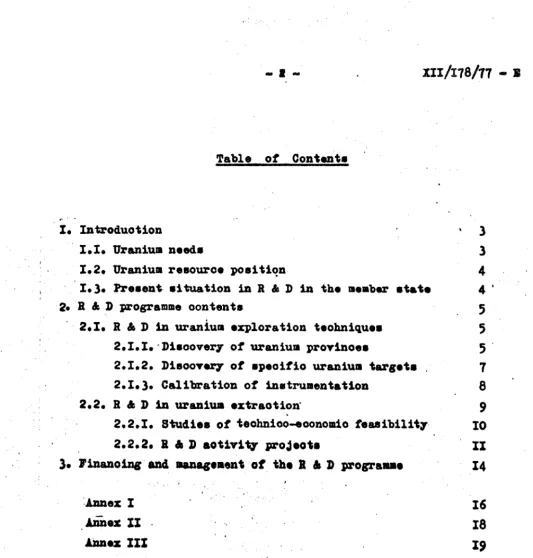
• Table
ot
Content•,. . .
I.
Introduction3
· I.I. Uranium need• 3
I. 2. Uraniu11 resource posi ti~n 4
I. l• Preaent. ai tuation in R & D in the meaber •tate 4 '
2• R
&
D programme contents 52.1.
R & D in ura.n:i.um exploration technique• 52.1.1.
·Di•oover7ot
uranium proTince• 5 ·2.1.2.
DiscoTer,yot
•peoitio uraniu11 target•7
2.1.3.
Calibrationot
inatrumentation8
2.2. R & D in uraniua extraction·
9
~.2.1. Studies
ot
teohnioo-eoonomio teaaibilit7· 102.2.2.
a
A D
aotivi~ proJeota II3•
J'inanoins.
a.nc1ll&llqeaent of the R
& ]) pl'OI'l"&•e14
:AJmex: I 16
AnDes
XI
I8
[image:5.612.20.553.23.581.2]' '·
XII/I78/77 .. B .
le INTRODUCTION
The Commission is at present engaged in various· actions to ensure adequate and secure supplies of natural uranium for the Community.
These include actions outside the Community to facilitate the supply of uranium to the Member States by improving the conditions for the Communities' industry to operate abroad in uranium exploration and production. Inside the Community, the Commission is partially funding uranium exploration, under article 70 of the Euratom Treaty.
To complement these.measures, the Commission and experts trom the Community consider that support of research and develop-ment in uranium exploration and uranium ore-processing· is needed at Community level as provided by the Council
resolutions of
14
January1974
on an outline programme in the field of science and technology.The need to finance R
&
D should be seen in the light of the Community's expanding requirements for natural uranium and the need to develop more advanced uranium exploration methods and uranium extraction and recovery technology toevaluate and &xploit potential uranium resources.
1.1. URANIUM NEEDS
By 1985,
it is pro'jected that the natural uranium requirement of the Community will have grown from itapresent level of 6.000 tonnes U to
18
000 tonnes Upar 78ar
(see annex II) and this will represent about onethird of the increasing world demand for uranium.
Even if there is further slight slippage in nuolea.r · . programmes and as it takes 7 - 10 years to dis-cover and develop an uranium deposit, action to facilitate the discovery and methods of processing urani.J;un deposits· in addition to ·those· already know
is needed now to have an effect on the marke'l in '\he
mid-19.80'
s •. .
..
...
• .•
f ..
•
I
• 4 • '
XII/178/77 - B
1.2. URANIUM RESOURCE POSITION
Presently outlined uranium reserves {see annex III), at a coat of under 15 ~/lb u~oa are estimate.d at 1.250.000 tonnes
uranium. Estimated additional resources in the same cost bracket are assessed at 980.000 tonnes uranium. Reasonably assured resources in the 15 - 30 ~/lb. U~Oa category amount to 820.000 tonnes uranium and estimated additional resources in the same .cost bracket to 890.000 tonnes.
These estimated additional resources still, in many cases, remain to be found. However, the potential for finding large new deposits throughout the world is good, provided R
&
D ia carried out to provide adequate exploration methods.Besides these estimated additional resourcesv it is con-sidered that there might well be at least another 10 million tonnes uranium available at a cost under 30 ~/lb., but at unknown locations. No reliable evaluation can be made at present for the category above 30 ~/lb.
It has been estimated that the annual discovery rate to date for uranium is between 40.000 and 80.000 tonnes a year. Since by 1990 the world uranium requirement could be of the order of 120.000 tonnes, the annual discovery rate needs to be tr6bled if adequate forward reserves are to be maintained.
Many of the world's significant uranium provinces were discovered before the 1950's. Although there are still prospective areas where little uranium exploration has been carried out, more effort is required to discover new
uranium provinces and deeply buried ore bodies.
Recent increases in the price of uranium have augmented the number of possible targets both inside the Community and outside.
I
1.3.
PRESENT SITUATION IN R & D IN THE MEMBER STATESThe Commission and experts from the member states have examined the state of research and development in uranium exploration and uranium ore processing.
The conclusion is that although considerable research has been undertaken in these fields, especially during the early 1960's, only limit~d work has been carried out since in the
- 5-
XII/178/77/-
llnew uranium reserves required, it is vital that R
&
D into new uranium exploration techniques be stimulated. Moreover, R & D into ore-processing methods is needed to make it possible to exploit especially the small high-grade deposits present in the Community as well as lower grade ores. To do this work effectively and to avoid useless duplication of effort, co-ordination at the Community level is required. Financial help is needed as an incentive to industry to develop new ad-vanced technology, carry out technical and economicstudies and to develop potentially exportable technologies. This help would take the form of coat-sharing contracts whereby the Commission would provide part of the fUnds
needed to carry out R
&
D projects as part of a jointly coordinated and managed programme.2. R & D PROGRAMME CONTENTS
2.1. RESEARCH AND DEVELOPMENT IN URANIUM EXPLORATION TECHNIQUES
2.1.1.
.
The challenge to find enough uranium reserves for the
expanded _fUture needs requires R & D, especially to improve geological and interpretive skills and insight. Various methods need to be supported, as the fUture range of
techniques appropriate for different geological environments varies markedly from area to area.
It is considered that many fUture uranium deposits are likely to be deeply buried or covered with overburden and that improved methods of detection are needed to overcome
the short-comings or gamma detection methods.
DISCOVERY OF URANIUM PROVINCES
Studies of uranium geology and metallogeny
Even though much attention has been given to problems of uranium or~ genesis, there is still considerable uncertainty over determining the major controls of uranium mineralis-ation. Advances in this area are required to provide a better ~nformation base for uranium exploration planning. Evaluation of the favourable geological units for uranium in Europe should ba carried out including their position in ·the ~etalloge:1ei:ic cycle. The rei.ationship of uranium mineral:l.satian to sedimeniologioa.l controls, ·tectonics and rock geochemist~y should be examined. Some of this
re-~earoh oould w~"l be assooiated with the ~tr~nium expl~ration
•
..
• Jt . ; : .. . : ~
.
I I' I ·i ~ ·. 'support provided under article
70
ot the ~tom' .. · Treaiy. ·
t
; ~
• : !. • ;
i
-~j·,-.
2.1.1.2.
Stuqy ot lead isotopest· ·-- :;. :'/ · The measuremen-t
ot
isotope ratios proVides vi talinformation on the oo~ditiona under which deposition
haa taken place. To assess the potential of uaillg
lead isotopes to indicate and identity urani'WD provinoes,
a one year teasibili ty study is. proposed. This would.
involve rook sampling and analyses to determine
Pb 204, 206. , 207 and 208 in oonjunotion with rout:lDe
exploration campaigns.
2elele3o Development of techniques tor rapid routine
··'
geochemi.cal analysis
In the field and laboratoey, rapid, accurate,
cost-etteoti ve analyses provide the information baaie tor
exploration . programmes. As exploration tield eeasona
are often limited (e.g. ~n Greenland) it :la vital to
have a fast turn-around in saaple analysis. In mu a
apeotrometey the·· development
ot direct sample
pre-sentation at atmospheric pressure together with adequate
aenai ti vi t;y, ideall7 tor a large muiber ot el•enta, woulcl
be a worthwhile development.
Remote sensing
The benefits and 1 imi te of the ~ntormation provided b7
remote.-aenaing techniques, especially when applied to
outlining speoitio uranium provinces and depoaite, needs. fUrther investigation. FUrther evaluation
or
theiD-:tormatioTJ already made ·available should be carried out.
T.be epeoit1o application ot multiapeotral recording and aid.e4.ooking radar, to aid in id.entif)i.ng uranium
· proVinces, should. be evaluated. • .
2ole1't?J
5•
Airborne geochemietryTb be able to accurately interpret airborne radiometric
measurements would add signitioanily to the uaef'ulneas ot ·
this tool in uranium exploration. Equipment and interpretive
teohniquea n~r8 ~ar clevelme.n.t, espeoiall7 in the ~-
ot radon,,Pb
, Bi
and Po
,to determine
theirmobilit7 patt~o
'
.
.·~
7 ..
XII/178/77 -
11:2&1. 2. DISCOVERY OF SPECIFIC URANIUM TARGETS
Migration of gaseous daughter products of uranium
A study of the migration and measurement of gaseous daughter products from radioactive mineralisation in order to detect buried deposits, will be done with emphasis on radon, helium and argon. The usefulness of present techniques for measuring radon (pump
monitors, static monitors, track-etch and solid-state detectors) and its effects (thermolumineacence) will be compared. A one-year pilot phase is foreseen which,
if conclusive, will be followed by a two-year project.
Transportation and deposition of uranium from solution
Uranium is usually mobile in the hydrogeochemical environ-men·t. However, it is difficult to interprete anomalous uranium values as the controls acting in this environment are not fully understood. A study of the transportation of uranium and other accompanying elements in water, its transfer to soil, lake sediments and vegetation in known uranium districts is required, to determine the physico-chemical controls.
Direct measurement of uranium in-situ
The direct measurement of uranium in~aitu would be of special use to the uranium mining industry where disequilibrium
among uranium daughter products is a problem in drill-hole evaluation. The techniques available at present (X-r~
fluorescence, Californium neutron sources and neutron generators) have yet to be fully developed. Assessment and development of the instrumentation available is re-quired.
The interpretation of data. from drill-hole logging also presonta difficult problems which will be the objeo~
ot
a study by an e:x:pert group.•
..
•
2.1.3. CALIBRATION OF INSTRUMENTATION
In order that exploration results can be accurately inter-preted and compared with work carried out elsewhere, there is a need for the EUropean Community to.make generally available :
a) counting standards (radium, thorium, potassium) for the calibration of exploration instrumentation,
b) large diameter sources, for the calibration of field scintillometere and spectrometers,
o) test strips for in-flight calibration of aeroradiometrio survey instruments.
A Community aotion in this area is required to establish these taoilitiea. ·
-ro-
I2.2.1. STUDIES OF TECHNICQ-ECONOMIC FEASIBILITY
Recovery of uranium from phosphoric acid liquors
High uranium prices offer the phosphate industry an
attractive opportunity to recover uranium as a by-product of fertilizer manufacture. Recovery from
phosphoric acid liquors would mean keeping an important resource to augment the EEC's nuclear fuel supply while at the same time removing a radioactive contaminant from process residuea and fertilizers. In order to assess the feasibility of recovering uranium from this source and the commercial and environmental implications, it is proposed to carry out a survey of phosphate processing plants in the EEC, in order to estimate tonnages and assess technical
.and economic problems likely to arise. In some cases it~
be necessary to obtain analytical data on uranium con-centrations in ores, process liquors and residues. Thia project will be complementary to project 2.2.2.3.1.
Extraction of uranium from sea water
Various countries of the Community have carried out extensive studies on the extraction of uranium trom aea water and dilute solutions.
Many results obtained in this research have not been reported fUlly.
It is considered that the reporting of this work is an essential prerequisite for helping further studies on the absorption - elution process and on absorber selection and dev~lopment so that unnecessary duplication can be avoided. It is proposed to carry out a detailed review of experience in this field.
Prevention of pollution from ore-processing operations
A problem of great concern is the prevention of pollution by wastes arising from present and future conventional mill operations. This is likely to be even more serious when low-grade ores are worked by in-situ leaching methodao A detailed review of the problems and their potential
solutions will be undertaken.
-It-
XII/178/77 - B
2 .. 2.2. R&D ACTIVITY PROJECTS
2e2.2.1. Development of extraction techniques
2.2.2.lnlo In-situ leaching for the exploitation of deposits of limited size
In order to assess the possibilities of exploiting small (10 - .500 tonnes of uranium metal content) medium-to high grade ore deposits in the Community, tests will be carried out using in-situ leaching techniques with acid or
alka-line solutions. Special emphasis will be placed on the preparation of the ore depositsz
{a)' to prevent environmental pollution, particularly of groundwater
.(b)· to improve contact between ores and reagent
One or more suitable sites will be seleoted for field testa in order to evaluate uranium reoovery and extraction coats •.
2.2.2.1.2. Bacterial leaching
Bacterial leaching processes in various forms {vat leaching, stope leachingt heap leaching, bacterial re-generation of lixiviantsJ may have several advantages, such as savings in chemicals, reduced capital-cost
1
lower-ing of cut-off grade of ores and alleviation of environ-mental problems.
Laboratory and pilot plant tests will be carried out in order to compare the various possible approaches, with emphasis on the economic aspects in comparison with other processing techniques~ So far the technique of bacterial leaching has been only applied to pyritic ores and it is proposed to apply it to other types of ores {e.g. sand-stone) and to obtain information on engineering design parameters.
2.2.2.1.3. High temperature, high pressure leaching
Laboratory and pilot trials of this technique will be undertaken on ores such as sandstones and shales.
-.
'
.
-
I2-.2.2.2.1.4. Extraction of uranium and other values from refractorl ores and calcines
In some areas of the Community, there is evidence of large tonnages of uranium in r~fractory minerals, as well as in oil shales and lignites. A general approach for the treatment of these types of ores will include the
appli~ation of leaching, roasting and chlorination
pro-cesses. Consideration will also be given to the follow-ing:
• refractory ore from Greenland (steenstrupine) : laboratory investigations to stimulate hydrothermal alteration processes as a step in the development of extraction processes for this potential ore;
oil shales and lignites: the application of fluidized bed roasting; recovery of uranium contained in the
calcines, together with other values e.g. vanadium and aluminium, by alkaUl'l• extraction or by any other method;
- recovery of uranium from refl'aotory ores as a volatile chloride.
..
-I)-
XII/178/77 -B
2.2 .. 2.,2, Processing_2f low grade ores and wastes
2~2.~o2~1. Extraction of uranium from phosphatic sediments
The potential of phosphatic sediments located in Europe as host for uranium deposits is now attracting intereet and some occurrences have already been · iden·l;ified. Mineralogical studies and laboratory teats will be initiated to identifY the technological solutia:ns to recover uranium as well as other valu-able components (non-ferrous metals etc.)
Pil~t scale work could follow the successfUl completion
of laboratory work.
2.2.2o2e2e Extraction of uranium· from phos2hate rock treatment wastes
In the production of phosphoric acid and fertilizers in the Community, uranium is concentrated in certain wastes such as leach residues and phosphogypsum which present problems in disposal but at the same time contain valuable concentrations of uranium. It is proposed to examine methods of recovering this uranium
and. alleviate the disposal problem.
Recovery of uranium from low-grade resources
Recovery of uranium from phosphoric acid liguors
Phosphate rock containing 50 to 200 ppm of U is im-ported into EC countries for the production of
approximately 2,500,000 tpa P
2
o~. A large part_of the uranium is present in process liquors and there is potential for the recovery of 1000 - 2000 tpa Uranium. Solvent extraction processes which are very complex have oeen developed in the USA but have not yet been applied commercially because of difficulties associated wHh the handling of highly acidic liquors.It is proposed to examine alternative processes involv-ing the use of similar sol vent extraction and ion
exchange techniques but with novel reagents which should lead. to simpler and more economic recovery •
.
.
/
..
.-..
3.1.
Extraction of uranium from sea water
A large amount of work has been and is carried out in some member countries on the extraction· of uranium from seawater (see 2$2.1.2.). These studies indicated that recovery costs would be high. However, in view of uranium marketing activities producing concern over security of supply and the availability of this
potentially large resource, there is renewed interest in this topic.
Specific suggestions and views from some EC countries indicate that uranium can be extracted from sea water using special systems which involve new types of ir;-organic and ir;-organic synthetic absorbers, other com-pounds and biological systems capable of entrapping uranium ions present in very dilute solutions. Resear~·efforts should be undertaken at laborator,y scale to be followed by pilot tests in order to re-evaluate the prospects for economic recovery.
3. FINANCING AND MANAGEMENT OF THE R & D PROGRAMME
The programme will be executed as a Community in-direct action. Fbr an initial period of three years (1978 - 1980), the total cost of the programme is
evaluated at
9.3
Mua. Partial funding of this indirect action by the Communityis estimated at a maximum of4.65
Mua, i.e.:1.40 Mua for R
&
D in uranium exploration3.25
Mua for R&
D in uranium ore-processi~ andrecove-ry (see tentative breakdown in Annex I) of which
89%
will go to funding oontrao~s and 11% to mana-gement and coordination of the programme.The Commission will execute the programme in close cooperation with the Advisory Committee on Programme. Management in natural uranium R & D, to be established by the Council of Ministers.
The Committee will examine all R & D proposals sub-mitted and advise the Commission on their relative merits. It will follow up the projects during their execution and evaluate them upon completion. It will als~ make recommendations on new research needs , and priorities for the continuation of the Pt~gramma.
Yearly r~ports will be made on the execution of the programme by the Commission to the Council and Parliament ..
... 15·-
XII/178/77 - B
3e3o The information resulting from the implementation of this programme shall be diss.eminated .in accordance with Regulation (EEC) no.
2380/74
OJ no.L255,
2.0.,9,1974
P• 1 decided by the Council on17
September1974.
,.
..
(
.
-
16-R & D Programme in uranium exploration and. extraction ( 197 8-1980)
Total Cost
(Mua.)
...
2.1.
uranium a~ploration2.1.1.
Discovery of uraniumprovinces
- Uranium ·geology studies - Study of Pb isotopes - Techniques for rapid geochemical analysis - Remote sensing applied
to prospection
- Airborne geochemistry
2.1.2.
Discovery of specific uraniumtargets ·
1.0
- Migration of gaseous daughter produots of uranium
- Transportation and deposition of uranium from solution ·
- Direct measurement of uranium in-si tu
Calibration of instrumentation
0.2
-Sub-total
2.8
ni/!78/77 -
~ANNEX 1
t •
,\• • I.'_
-
17-R & D Programme in uranium exploration and. ·extraot ion
Total Cos~ · (Mua)
ni/I78/77 -
11Maximum Community
oontribu~ion (Mua)
, ~.2. Uranium ore-processing
. 2,2.1. Studies of technical-economic feasibility
2.2.2.1 Development of extraction · techniques
- In-situ leaching - Bacterial leaching - High temperature, high
pressure leaching
- Extraction from refractory ores and calcines
2.2 .. 2. 2 Processing of low-grade ores
and wastes
- Extraction from phosphatic sediments
- Extraction from.·phosphorio rock treatment plant
0.2 0.2
1.8
0.2
2.2 •. 2.3 Recovery from low-grade resources 2.2
- Phosphoric acid liquors - Sea-water
Subtotal
Total
,•
3.25
of which
4.15
for cost sharing contracts and 0.50 for mana-gement and coordination...
'
SITUATION AND ESTIMATES OF NUCLEAR GENERATING CAPACITY AND URANIUM DEMAND. Line Estimate 1976 1980 1985
I
'1., E'EC G\~e 19,1 47 90I
2 .. World AIEA GWe 178~350 400
(World Nuclear Power Growth, not included countries with centra-I lized economics)
I
3. EEC annual demand 000 tonnes U/year 6 12,5 18 4. EEC cumulative·demand 000 tonnes U 6 40 120 I ANNEX II.1990 160 ~550 750
I
28 250
....
'•,
X I I/17 8/77 -E
HAS DEX:! IDED AS FOLLOt'll'S :
Article 1
A programme of research and development on uranium exploration and uranium
extraction as set out in Annex A , shall be adopted for a period of three years starting on
part of this Deciaione
January 1978. .Annex A forms an integral
Article 2
For the implementation of this programme, the maximum amount of the expen-diture commitments is ev-aluated at 4.65 million units of account and the ma.Ximum staff shall be three persons. The unit of aocount is defined
acoording to financial regulations in force.
C.·
' '
·'
Done a.t Bruaaols
For the Counoil
The President
'
.
•
2.1. Research area I 1 Uranium Exploration2.1.1. Discovery of uranium provinces
- Uranium geology studies
- Study of Pb isotopes
".r ·: ·:, I·, ··. (,! '77.,."/:!C·
.£..,. "'""' ~~ JJ,. i' t.l!j 1 J~
Techniques for rapid geoohemioal analysis
Remote sensing applied to prospection
Airborne geoohemistry
2.1.2. Discovery of specific uranium targets
- Migration of gaseous daughter products of uranium
- Transportation and deposition of uranium from solutions
- Direct measurement of uranium in situ
2.1.3. Calibration of instrument-ation
2.2. Uranium ore-processing and extraction
2.2.1,
Studies of technical-economic feasibility2.2.2.1. Development of extraction techniques
- In si tu leaching - Bacterial leaching
- High temperature - high pressure leaching
- Extraction from refractory ores and calcines
2o2.2.2. Processing of low grade ores and wastes -Extraction from phosphatic sediments'
- Extraction from phosphoric rook treatment pl:mt~
2.,2_.,2~ 3.- ~cove~~o!ll .1~ B'!~.!Lresour..£2..~ - Phoephorio aoid liquors
.
.
.
XII/178/77 • E
5.0.~. Evaluation method
(included multiannual previsions)
a) Staff expenditure
The needs are estimated to be 3 staff for this programme
•J978-1980 (3
- - -
years> 2 category A staff1 category C staff
3 staff
In addition to staff number estimates, the evaluation take account of the data of the Council Decision of 21.12.1976, on the adaptation of salary of European Community staff and applicable correction coefficients adding to it -on a hypo-thetical basis- possible needs originating from the general·· evolution of prices in the Community.
The rates adopted are those used for the calculation of the three-year forecast 1978/1980. The evaluation of expenditure increases up to 1981 has been made on the basis of the
fol-lowing indices : 1978-108; 1979-116; 198Q-124; 1981-132.
'
.
b>
Contracts expendituresIn view of the nature of the subject and the qualification of the cont~actors, a uniform method of the evaluation can not be established.
In any case, the Advisory Committee, .
· will be cons·ulted on the allocation funds.
Incidence on the funds
- Community income tax on staff
- Functionaries contribution for retirement fund,
6. FUNDING ACTION
6.0.
6.1.
,.
6.2.
6.38 Funds to be intluded 1~ future(s) budget(s)
.·.
. I'<
"\.