Maths4Lif
e
Extracts from this publication may be used or reproduced for non-commercial, research, teaching or training purposes on condition that the source is
acknowledged.
For information on alterative formats, please contact:
Emily Brewer
Marketing and Publications Officer Institute of Education
University of London Tel: 020 7947 9501 Email: [email protected]
We welcome feedback on the content and accessibility of this publication. This should be sent to:
Publications NRDC
Institute of Education 20 Bedford Way London WC1H 0AL.
Telephone: +44 (0)20 7612 6476 Fax: +44 (0)20 7612 6671 email: [email protected]
ISBN 978-1-905188-43-7
©Crown Copyright 2007
London and is based in the Bedford Group for Lifecourse and Statistical Studies at the Institute of Education, www.ioe.ac.uk/bedfordgroup
Maths4Life, a Skills for Life programme funded by the Department for Education and Skills, was based at NRDC between July 2004 and March 2007. On 1st April 2007 the work to take forward and develop
Maths4Life transferred to the National Centre for Excellence in Teaching Mathematics (NCETM). NRDC remains a key partner in NCETM’s further development of the post-16 maths and numeracy work started by Maths4Life.
Introduction
4
Why use topic-based teaching?
5
Choosing a topic
5
Planning
6
Your role
8
What’s stopping you?
10
Assessing understanding
14
Teaching to a topic – food
16
Teaching to a topic – environment
20
Ways to help your learners
23
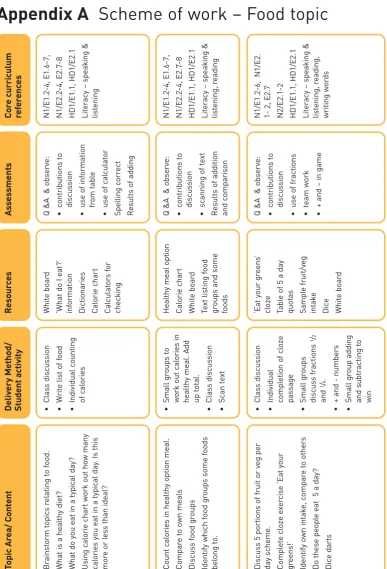
Appendix A: Food topic scheme of work
24
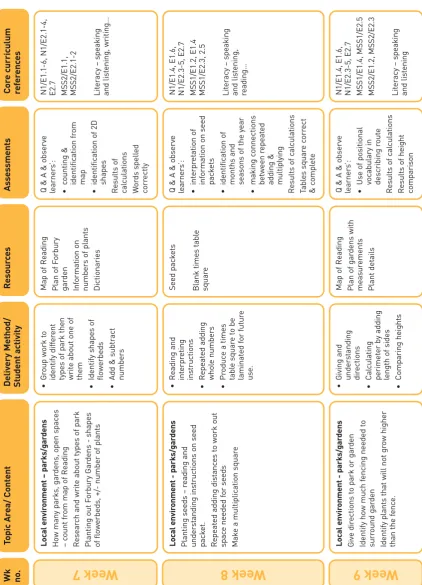
Appendix B: Environment topic scheme of work
28
Introduction
This booklet is aimed at tutors working with learners from Entry Level 1 to Level 2. It is not a text book, or a list of recipes for how to teach particular topics. Instead, it suggests an approach to topic based teaching that we have found effective in enabling learners to build their mathematical skills.
Many learners may feel that listening to the tutor and completing their own individual worksheets is the main way of learning. However, we believe that learners learn more if they actually enjoy the activity, have a chance to discuss what they do, explain their work and reach a shared understanding. There is now widespread recognition for the value of collaborative work in developing conceptual understanding (Collaborative Learning in Mathematics: A Challenge to Our Beliefs and Practices, Malcolm Swan, NRDC and NIACE, 2006).
The activities outlined in this booklet work best as shared tasks. This approach may be unfamiliar to many learners, particularly those whose previous mathematics was learned in a traditional, formal class.
Learning is generally most effective when learners are working collaboratively. The task can be pitched a bit higher, just outside an individual learner’s comfort zone, so that it needs a second opinion; it may also involve practical equipment that needs a second pair of hands. An explanation of the benefits and ground rules is important for all learners before starting collaborative tasks, so that each group member gets a chance to express an opinion and challenge what others say.
In this context the tutor is not so much an instructor as someone asking the right kind of questions to move discussions on, and does not immediately confirm correct answers. The tutor will want to spend time listening to the discussion in small groups, and may join in, but should try not to replace whole class lectures with small group ones.
As with all learning situations, the tutor will have to make some snap decisions about how to react to situations that develop, particularly those where a group agrees about something which is in fact incorrect. Comparison with the work of other groups where learners have to justify their conclusions can be a more powerful checking strategy than simple validation from the tutor.
Why use topic based teaching?
Our learners may not have done well in traditional mathematics classes at school; they may feel worried, inadequate or just anxious about returning to learning. Topic based teaching gives a different, less threatening, feel to mathematics classes. Learners can get more involved in the sessions especially if they have helped choose the topic. The mathematics may be outside their comfort zone, but they do understand or relate to the chosen topic. They may have something to contribute from their life experience or can find relevant resources.
Working with a topic they have chosen stimulates learners’ imagination. They discover that they need to do a particular calculation to find out something that they want to know. Topic based teaching does not disguise the mathematics; it just supplies the relevant mathematics at an appropriate point.
Topic based teaching can also help learners’ literacy. Many learners who have problems with numeracy also have problems with their literacy. Indeed, poor literacy can hinder their mathematical capabilities. Planning activities that develop both numeracy and literacy is beneficial. The language of mathematics must not be a barrier to learning.
Choosing a topic
Probably the most worrying thing for tutors about to start topic-based teaching is how to choose a topic. This can be easier than it seems, particularly once you know your learners.
The first time you start with a new group of learners, it is a good idea to have a few topics in mind. These topics must generate a lot of mathematics but will overlap with literacy. For example, you might consider using family health, sport, or something that is happening in your local area. You can bounce ideas around with colleagues to see how you can work with the topics. Team
meetings are an ideal place to explore topics as ideas can be generated by and shared with other tutors. If you are not part of a team, networking by phone or email can help.
Having too many topics is easier to deal with than having too few. You can get more detail from the learners about their particular choice of topic and then you may find that you can group topics together. At this stage, you are not looking for mathematics-specific ideas. The generation of mathematics activities will largely depend on you. If a topic appears too narrow to generate much mathematics, ask for ideas for widening the topic.
Eventually you will end up with a list of say three or four topics and learners can vote on which one to do first, or you can give yourself the casting vote since you have to facilitate the mathematics.
If your learners are not comfortable with discussion, they may not generate many topics. In this case, you could use pyramid discussions; start
discussions in very small groups and gradually join groups together, making sure that at each stage of the discussion a limited list of topics are agreed by all group members.
If you do not know your learners well, listen to them before the session has started. Do they talk to each other? What do they talk about? Maybe this could highlight a common interest that you could use.
Once you have selected your topic, you are ready to plan the mathematics.
Planning
Generating ideas
Develop a mind map (working with another tutor if possible) of all the ideas relating to mathematics that come out of the chosen topic. For example, see the tutor’s mind map on page 20. Roughly match the ideas you have generated to the levels of the curriculum you will need for your learners. Identify any major gaps.
Now look to fill specific gaps; for example, if you need a session on equivalent fractions and your topic is football, you might look at how the game splits up. Consider half of the match in terms of minutes - 45/90. Now cancel down. At lower levels “a game of two halves” might start to have some meaning for your learners. There are other possibilities for fractions within football – depending on the level of your learners; you can look at ticket prices, attendance at games, home supporters versus away supporters, distance to matches and so on.
learners may come up with ideas that you have not considered or may endorse an idea you want to try. For example, in a topic on shopping for entry 1 and entry 2 learners, we were not going to work on writing cheques (numbers in words) as many people don’t have bank accounts. However, our learners specifically asked to be taught how to write cheques, so we changed our plan to include this.
Timing
You need to recognise that some topics are limited in their scope while others can run for many weeks. It depends on how the learners react to the work and how their ideas flow. When you are planning out the topic, if learners are not coming up with ideas, this is a warning that the topic may not work well or may be very limited in its scope.
Try to allow a topic to develop; if you had originally planned it for 6 weeks and it looks like running on, let it. Only stop a topic if the learners or you have lost interest, if there is no useful mathematics coming out of it or if the course is coming to an end.
Scheme of work
Develop your scheme of work from the ideas you and your learners have generated and mapped to the curriculum. Once developed, you don’t need to slavishly stick to it. As your learners play with the ideas, they will want to explore some in greater depth. You should adapt your scheme of work as you go along. Don’t be afraid to scribble all over it. Do remember to keep a record of the changes you make whether electronically or on a paper copy.
Resources
Many tutors feel that topic-based teaching will be very intensive in terms of needing to create resources for the learners. This need not be so. You can use resources that are readily available, rather than creating worksheets or resources from scratch.
Realia
One way of ensuring that all the resources you use are relevant, up-to-date, topical and have meaning for your learners is to use realia. Ask your learners to find and collect what you need. This helps them to develop as independent learners and also ensures that what you use in the class is what they see in the real world. It also helps them to realise that learning is continuous and to relate their learning in class to the real world.
Games and activities
Through Mathematics ringbinder ). Many other games or activities require only a few starter materials. Once learners have the idea, they can develop the game or activity at their own level. This builds in differentiation and also enables you to see progress. Learners very rarely make life too easy for themselves – if they do, you can challenge them to make it harder for themselves.
Fieldwork and trips
Try to build in opportunities for local fieldwork or trips in your scheme of work. These enable your learners to do mathematics in the real world. For example, a class working on sport might visit the local sports centre. The learners plan how and when to get there (route, timing, fares) and arrange the trip with the centre. At the centre, they can look at capacity (number of pitches, courts, halls etc), cost of facilities including hire of equipment, season tickets or special deals, catering arrangements especially amounts sold, calendar of events, opening times, and so on. On return they can work with the data they collected and present it in a suitable way.
Using ICT and the Internet
If you have access to ICT and to the Internet in class, you can add another dimension to your topic based teaching. Your learners of all levels can use the Internet to research the topic; you can plan the websites that they should visit.
If your learners collect data on a field trip or as a result of an investigation, they can use various computer packages to manipulate and present their data. We have found MS Word, Powerpoint and Excel particularly useful in this context.
Your role
Facilitator or tutor?
Our aim is to encourage independent learning. This tends to mean that a lot of the time you will be acting as a facilitator rather than as a tutor. However, you need to act as a tutor to ensure that the content of the course meets the needs of the learners and extends their capabilities. You know their current
mathematical abilities and you know what they need to learn according to the Adult Numeracy Core Curriculum.
During topic based teaching you will find that you spend a lot of time
encouraging discussion. By standing back and listening to the discussions (and only intervening if absolutely necessary) you can identify conceptual errors and misunderstandings, and encourage reluctant learners to join in.
concepts or exploring different approaches to problems. This may result in them taking the topic in a completely new direction. They are then taking control of their own learning.
If this new direction looks as if it would be valuable to their learning, don’t feel constrained by your lesson plan or scheme of work. Run with the ideas as far as possible but remember to record the changes in your session evaluation.
Alternatively, if learners find they have a lack of ideas or cannot raise much enthusiasm for discussion of a particular topic, it may be time to find another topic.
You will be helping your learners to drive their ideas forward. Another way you can help them is to get them involved in doing their own research for the topic. They could use the Internet, visit libraries or collect information relevant to the topic from elsewhere.
Making connections
Meaningful connections help to make sense of mathematics and to make it easier to learn. We can use the knowledge and experience that adult learners already have, within their chosen topic.
Topic based teaching allows you to integrate many mathematics topics; for example, the food topic we explore on page 16 incorporates number, decimals, measure, percentages, ratio, shape and data handling.
Although the core curriculum identifies various skills as elements at each level, this should not be seen as a set of hard and fast rules. If learners are
encouraged to understand and explore concepts, their investigations may well spread across more than one ‘level’. For example, negative numbers do not appear in the entry level curriculum, but learners see negative numbers on frozen food packaging.
Topic based teaching enables you to differentiate within a class; in fact learners themselves may do the differentiation for you, in what they choose to
investigate. You can influence this further by engineering the groups in which learners work. Sometimes groups can be level based and other times groups can be formed to give a mix of levels.
This flexibility of topic based teaching also makes it easy to adapt for other classes which may have a different mix of learner levels.
Meeting targets
feel that you have not covered an element of the curriculum or that your learners would benefit from more work on it, you can manipulate the topic to include it. Alternatively, you can wait until it falls naturally into another topic, or you can just teach it anyway.
In the same way you can add exam preparation when necessary. Your learners will probably have a good understanding of much of the curriculum from their topic based explorations but they will need practice in exam type questions. Here the benefits of building their literacy skills hand in hand with their mathematics skills become really apparent.
What’s stopping you?
Many tutors when faced with the idea of teaching mathematics in a topic based way have concerns. We have considered some of the most commonly raised concerns below and offer some strategies for addressing them.
Planning
You may have colleagues who teach at other levels of mathematics, or who teach English to similar learners. You may belong to a team which has team meetings. You may have contacts with tutors at other institutions through email (the National Centre for Excellence in the Teaching of Mathematics (NCETM) has useful discussion boards see ncetm.org.uk). All of these people can be used to bounce ideas around. Failing all of these, family members, particularly young teenagers are full of ideas.
Also, regardless of their skill levels, you can plan with your learners; this way you can be sure of getting their interest.
You are likely to choose the first topic for this group of learners so you can get some ideas into your scheme of work for the first few sessions. This will give you an idea of the elements of the curriculum that you have yet to cover and you can create placeholders in your scheme of work for the remaining elements. Later when you choose more topics with your learners, you can adjust your scheme of work to fit.
My boss says I have to have a complete scheme of work for all of the next year of the course. I haven’t even chosen topics yet and I don’t know what I’ll be doing when. How can I cope?
Most topics will enable you to cover a wide range of mathematics. After you have developed a scheme of work, matched it to the curriculum and identified any gaps, you can teach a session to fill a gap or pick a new topic to do so. In any case, as you change your scheme of work to follow the learners’ developing interests and ideas, you will probably find that the gaps disappear. Of course, teaching the complete curriculum in the traditional way does not guarantee that learners will pass their exams.
Be careful of how you develop the topic that you and the learners have chosen. Your role as the tutor is to be aware of the learners’ mathematics needs and as you gain experience of this way of teaching you will find ways to pull
mathematics out of the most unlikely situations. If you find that the topic is a little barren, don’t be afraid to find an alternative topic.
Teaching
You can’t. The session will go where it goes, guided by the learners’ needs. As long as valuable learning is taking place and learners’ needs are being met, don’t worry. Make sure that you bring the learning out in a well structured plenary so that learners are reminded of what they have achieved. Also make sure that you evaluate the session afterwards so that you can annotate your scheme of work and add the unachieved objectives to a future session.
Remember that your role is to facilitate the learning. You won’t be just standing there. You will be observing and listening to learners. You can assess their learning by careful use of questioning. You can also assess them by listening to their discussions with other learners. This will give you a clear indication of their level of understanding.
I’m not teaching, I’m just standing there
How can I make sure the session goes where I want it to go?
How can I make sure that I can get enough mathematics into the topic? How can I get the right mix of mathematics into the topic?
This is a different style of teaching and learning. Although it appears that learning is slower, the learners develop a greater depth of understanding because they are driving their own learning forwards. You may also find that the learning lasts longer.
Although the learners are not formally completing worksheets or exercises, they are getting practice. They are examining and exploring concepts and applying them to situations that they are likely to encounter in real life. They are practising but maybe not always in class.
Use the abilities of the learners to help you. Mixed ability groups work well in discussions. More able learners have an opportunity to reinforce their own understanding by helping and coaching less able learners.
Vary the groups and the tasks within the overall topic – some elements may need to be taught in ability groups. For example, you could have one group adding and subtracting to check change while another group calculates % discount.
Learners can develop additional resources and problems to stretch themselves and each other. Just be careful that they don’t push each other too hard.
This style of teaching gives you an opportunity to develop learners’ understanding of the language of mathematics. Otherwise, it’s more about helping learners to interpret the way that written problems are set; this is important to their mathematics. If you are lucky enough to have an English teaching colleague to team-teach with you, there are other opportunities that can be exploited.
Learners often feel more comfortable doing worksheets because it is what they expect to do in a mathematics class. However, you are trying to create
independent learners and so you need to encourage them to try new ways of working.
What if the learners prefer to do worksheets? What if I’ve never taught English before? How can I teach a topic-based class?
How do I work with so many different levels in my class? The learners aren’t getting any practice
Time
In the short term, the planning load is greater. In particular, planning the questions you want to ask takes time. However, as you get more experienced with this way of teaching you will find that you want to plan more with the learners themselves. Also, as you don’t have to spend as much time preparing and marking worksheets, you will have more time available for planning.
You will find that you create fewer worksheets and scaffolding forms for your learners. Learners can make their own resources with guidance from you. Rather than preparing a game, learners can develop their own. You can use realia such as food packets. You don’t have to collect these – ask learners to bring in what you need. This has the benefit of using realia that learners actually use rather than what we, the tutors, think they use.
Assessing understanding
On entry to a class all learners should complete diagnostic assessments so they and their tutors know their strengths and weaknesses and areas for development. Tutors can then plan appropriate activities and extensions to meet the needs of all class members.
This is particularly important where you may be working with learners whose mathematics skills are better than their English skills. If necessary, a Reader should be available for the diagnostic assessment so that the assessment of mathematics skills is not distorted by poor reading skills.
Modes of assessment
Traditionally, mathematics has been assessed summatively by the end of term test, or by the successful completion of examples or worksheets. Although we still need to use summative assessment to allow learners the chance to gain national accreditation, assessing them formatively by the use of appropriate questioning and observation may be more useful in assessing learners’ skills and achievements throughout the year.
We need to use questioning and observation (our formative assessment tools) to enable us to:
> build on learners’ existing knowledge
> identify misconceptions
> identify rote learning without understanding.
Class questions, which everyone has a chance to think about and answer, can provide a useful starting point for discussion. This is very effective with topic based teaching especially where a topic has been agreed with the learners. For example, tutors could ask “When you go shopping for food, what do you have to think about?” In this example, most learners will have experience of shopping or opinions on the question and so the discussion is likely to be lively.
This means that we need to provide a way for all learners to take part without the quieter members of the class being overwhelmed by the more confident. One way of doing this is to consider these questions in carefully constructed groups before taking a class consensus of all groups’ discussions. The tutor’s assessing role in this case is to listen and to observe, and only occasionally to intervene by offering encouragement or directing questions to quieter group members.
they need to think their answers through before expressing them. Also, listening to their explanations and to learners’ discussions between themselves can be a more powerful assessment tool than any number of written diagnostic tests.
We need not abandon summative tests; we can make them work for us. Learners can use existing questions as models to write their own questions for each other. They must be able to calculate the answers before they can pose the questions. This can lead them to writing their own questions without a model, using their own interests and life experience to make them real. This process also builds up learners’ confidence for when they are faced with the national summative tests towards the end of their course.
Tutors can use questions to find out whether a learner knows the answer to a specific closed question such as how much an item costs with a 30% discount. However, we can use questions much more imaginatively for formative assessment and to encourage mathematical thinking.
When a new area of mathematics emerges from the chosen topic, questions can help us to identify what learners already know, and some of the
misconceptions already deeply embedded in their learning.
For example, asking “How do you know if you have enough cash to buy your food shopping?” might tell you if learners know how to estimate or round, or if they can count their coins. If they have a rounding strategy, their explanation of it can give you insight into whether they understand the principle of
mathematical rounding or whether their understanding is purely practical or based on guesswork.
Alternatively, asking “How much water do you think is in that lock?” (or swimming pool if more convenient) might tell you if learners have any ideas about volume at all. How they discuss the problem, the questions they ask each other and you, and the way they set about tackling the practical task of taking measurements is all very informative.
We need to plan our questions. Asking questions without having considered possible responses is a dangerous business. Even so, learners inevitably spring surprises.
Questioning learners about why they are doing something is a good way of uncovering their thinking processes. Devil’s advocate questions (for example, “Two for the price of one is the same as 50% off isn’t it?”) or What if…? questions (for example, “What if the level of the river rises by 20 cms? How much water would there be in the lock then?”) can help to see if learners have developed a good understanding of a concept.
Learner questions are also important. Some learners may be comfortable asking questions of the tutor and of each other, but many are not. We should set up situations where they need to question each other. In all situations, make sure everyone has time to think before they respond.
Teaching to a topic - food
Choosing a topic
Although we would usually discuss possible topics with our learners and choose from a list generated by the learners, we did not do this with this topic. We chose this topic because everyone in class was talking about a TV
programme about school dinners, and also because there were many news items on the effects of the food you eat. We felt that since everyone has to buy and cook food, everyone would have some experience of the topic. There was also scope for a lot of mathematics in the topic.
Planning
Working in a teaching team, we produced a mind map of ideas relating to food. (The teaching team included both numeracy and literacy teachers.) See tutors’ mind map on page 20.
In the first session with the learners, we asked them to give us ideas related to food and produced another mind map. See learners’ mind map on page 19.
Our scheme of work developed from these two mind maps. We tried to bear in mind what our learners needed to be able to do (in terms of the numeracy core curriculum). So for E1 and E2 learners, we needed to practise adding,
subtracting, multiplying, rounding and so on. Many of these could easily be included in the topic, for example, working with money comes from the shopping aspects of food. Other elements of the curriculum needed more thought. See Scheme of Work on page 24.
Sample sessions – food topic
1 Ask learners to list what they ate yesterday including all meals, snacks and drinks. You can limit the scope of this exercise as required e.g. Entry Level 1 learners might only be asked “What did you have for breakfast?”
2 Give learners a calorie counting chart.
3 Add the calories consumed in a day. Although Entry 1 and Entry 2 level learners are not expected to handle larger numbers, the task has to reflect real life. Learners can use a calculator to check their workings.
4 Compare results in groups. Discuss. We found this generated many “what if?” questions as learners manipulated their lists of foods and calories – for example, “What if I used 2 spoons of sugar instead of 3 in each cup of tea?” “What if I hadn’t had that doughnut? It would be 400 less calories in a day.” The learners themselves generated the mathematics. We encouraged correct use of mathematical vocabulary (more, less, twice as much).
5 Extension activity: learners can create bar charts of calories for their group.
6 Extension activity: calculate daily intake as a percentage of recommended calories.
7 Extension activity: compare daily intake
with “a healthy diet” (internet search). www.scottishsport.co.uk is a useful site.
8 Extension activity: compare cost of learners’ actual diet from different supermarkets. They could use supermarkets’ online shopping tools to find out prices.
1 Split learners into groups. Allocate each group a different type of restaurant, for example, fast-food, coffee shop or snack bar, pub or restaurant.
2 Each group creates a menu for their restaurant (using ICT if
available), describing the food appropriately. Cost the food and price it for the menu (consider profit margins with L1 and L2 learners).
3 Groups present their menus and justify their pricings to the other groups.
4 Use each other’s menus to select a meal. Add costs, check change (E1 and E2 select coins, E2 and above, write cheques). Extension – use prepared waiter’s order lists to calculate cost of other meals e.g. 2 x chicken, 1 steak, 1 veg.
5 Design restaurant interior – create mind map of what would be needed. Estimate and measure length, width and height of room, calculate area of walls, floor, depending on level of learner.
6 Calculate amount of paint required, amount of carpet/ flooring. Cost these.
7 Decide what furniture is required and how many of each would fit. Draw floor plan. Cost this.
8 Measure windows for curtains or blinds and cost appropriate materials.
9 Opening hours. Work with times (am, pm, number of hours open). Staff costs – how many staff do you need, what type of staff (cleaners, waiters, chefs, managers) how much are they paid per hour, how many hours do they work, are they paid overtime or bonuses?
Assessing
The role-playing involved in the restaurant sessions gives rise to many opportunities for observing and formatively assessing learners’ progress in dealing with money and doing calculations of various sorts.
The small group presentations in many of the sessions give similar opportunities and additionally enable learners to show their skills in presenting data. The types of questions other learners ask give you an opportunity to assess their level of understanding. The responses to those questions also give you insight.This work also aims to build a deep understanding of the concepts and skills which will be assessed summatively at the end of the course.
1 Ask learners what types of special offers they have come across. For example, 2 for the price of 1, BOGOF (buy one, get one free), 50% off, half price, discount sales. Ask them to discuss what these offers mean and to explain to each other.
2 Give out supermarket offer sheets. Ask learners to calculate savings on food bills if they take advantage of the offers.
3 Examine the benefits of bulk buying.
4 Calculate the saving on sales goods with percentage discounts or the extra cost on items surcharged because they were bought with a credit card.
Session 3 - Special offers
Learner’s mindmap
McDonalds
Special offers
Shopping
Different supermarkets
Makro
VAT Cooking
Recipes Eating
Likes
Dislikes Diets
Calories Canteen Prices
Expensive
Snacks Fruit
Coke
Crisps
Teaching to a topic – the environment
Choosing and planning the topic
The environment topic came about due to learners’ comments when the local council announced the introduction of household recycling collections. This led to a discussion about a number of local and wider environment issues.
As with the food topic, we planned by mind mapping with other tutors and with the learners. We ended up with a series of short topics related by the common theme of the environment. This shows how easily you can adapt topic based teaching to the time you have available.
Our environment scheme of work (see Appendix B) is for E1 and E2 learners, with an emphasis on practising adding, subtracting, multiplying, handling data and so on. In what follows we examine how it could be developed for learners working at other levels.
For higher level learners, we need to introduce extra elements of the curriculum including more complex decimals, fractions, percentages, ratio, statistical measures, perimeter, area and volume.
Sample sessions – environment topic
We have included two sample sessions to show how to use the topic as a framework for generating the mathematics that you want to cover.
Tutor’s mindmap
Data Food miles
Special offers
Organic/free range etc
Costs Time
Directions
Internet shopping Buying
food/shopping
Fat
content Health &fitness Calories
Allergies Symmetry
Logo Advertising
Jamie Oliver school dinners Costs
Packaging
Labels
Food
Shapes Reading
information
Food groups
Length/width
Sweets
5-a-day What counts?
Fractions pro’s/cons
Recipes Reading instructions
Cooking times/temp Kg, lbs
+ / - / x Fractions
Eating out Restaurant Menus
The original scheme of work calls for the following activities:
How many parks, gardens, open spaces – count from map of Reading
Research and write about types of park
Planting out Forbury Gardens - shapes of flowerbeds, +/- number of plants
To modify this session for learners at Level 1 and Level 2, you might give learners the project of investigating the mathematics associated with a local park or garden.
Session 2 - Local environment - parks/gardens
The original scheme of work (see Appendix B) calls for the following activities:
Combine individual tally charts to produce a group chart
Produce a bar chart
Present and interpret the information from the bar chart
To modify this session for learners at Level 1 and Level 2, you might use some of the following activities:
Groups of learners collect information on local and national recycling rates. Ensure that this information includes a breakdown by type of recycled materials and year on year changes. The information will probably be given in metric tonnes but if not, there is an opportunity for conversion work.
Produce graphs or charts to present the information clearly. This may involve rounding, interpreting large numbers including decimals.
Interpret and analyse the data shown on the graphs and charts. In particular, use statistical measures to compare recycling rates amongst local authorities, find year on year percentage increase or decrease.
Present and justify findings to the rest of the class.
Assessing
The group work enables learners to discuss and compare ideas and gives you opportunities to observe and assess their progress.
The small group presentations of the investigation will show you how learners structure their work. These presentations will also illustrate learners’ thinking processes and their methods of calculation. The level of work achieved before your learners ask for advice will give you a sound understanding of their independence, confidence and mathematical ability.
Again, these activities aim to build skills and understanding ready for summative assessment at the end of the course.
This might include some of the activities below. Ideally, any data collection activities would form part of a session but if you don’t have access or you don’t have time, ask learners to do these activities in their own time.
Groups of learners plan their investigation.
Groups of learners estimate, pace and measure accurately and record the dimensions of the park, individual flowerbeds and any other features of note.
Calculate perimeter and area of whole park and lawns, paths and flowerbeds.
Calculate what fraction, percentage or ratio of the park is made up of flowerbeds, lawns and paths.
Produce a scale drawing of the park.
Extension activity: calculate the amount of compost required to mulch flowerbeds to a depth of 10cm. How much would this cost to buy? Compare prices from different suppliers.
Ways to help your learners
Let learners become too comfortable in their groups. Tell learners all the answers.
Give out proformas or writing frames for lower level learners; they learn by making up their own format for recording data and become more independent.
Allow “death by worksheet”.
Give endless drills and practice tests.
Don’t
Use the Internet as a resource – learners are happy to research
information in this way, but do support them especially if they have poor reading skills.
Encourage learners to make up questions for each other.
Make sure calculators are always available for learners to use to check their work, but encourage learners to estimate first and then check. Support learners in checking their own and each other’s work. Use silence; give lots of thinking time when you ask questions. Think about how groups are composed. This can encourage quiet learners to blossom and accomplished leaders to take a back seat. If an activity doesn’t work, be ready to abandon it or to take suggestions from your learners as to how it might be developed.
Encourage discussion in small groups, and also (only when learners become are confident), in larger groups.
Use group work and make sure that activities are enjoyable and stimulating.
Use their experiences to guide your choice of both topic and activities. Remember that these are adult learners, so find out what they are interested in.
Do
Don’t
Br ains to rm t opics r elating t o f ood.
What is a healthy diet? What do y
ou eat in a typic
al day?
Using c
a
lorie chart work out how many
ca
lories y
ou eat in a typic
al day
. Is this
mor
e or l
e
ss
than ideal?
• Clas
s discus
sion
• Writ
e lis
t of f
ood
• Individual c
ounting of c a lories Whit e boar d
‘What do I eat?’ inf
ormation Dictionaries Cal orie chart Cal culat or s f o r checking
Q &A & observ
e:
• c
ontributions t
o
discus
sion
• use of inf
ormation
fr
om t
abl
e
• use of c
a lculat or Spelling c orr ect
Results of adding
N1/E1.2-4, E1.6-7, N1/E2.2-4, E2.7-8 HD1/E1.1, HD1/E2.1 Lit
er
acy – speaking &
lis
tening
Count c
a
lories in healthy option meal.
Compar e t o own meals Discus s f ood gr oups
Identify which f
ood gr
oups some f
oods
bel
ong t
o
.
• Small gr
oups t
o
w
ork out c
a
lories in
healthy meal. Add up t
o
tal.
• Clas
s discus
sion
• Sc
an t
e
xt
Healthy meal option Cal
orie chart Whit e boar d Te xt lis ting f ood gr
oups and some
foods
Q &A & observ
e:
• c
ontributions t
o
discus
sion
• sc
anning of t
e
xt
Results of addition and c
omparison
N1/E1.2-4, E1.6-7, N1/E2.2-4, E2.7-8 HD1/E1.1, HD1/E2.1 Lit
er
acy – speaking &
lis
tening, r
eading
Discus
s 5 portions of fruit or v
eg per
day scheme. Compl
et
e cl
oze e
xer
cise ‘Eat y
our
gr
eens!’
Identify own int
ak e, c ompar e t o other s
Do these peopl
e eat 5 a day?
Dic
e darts
• Clas
s discus
sion
• Individual
compl
etion of cl
oze
pas
sage
• Small gr
oups discus s fr actions 1/ 2 and
1/4
.
• + and - number
s
• Small gr
oup adding and subtr acting t o win ‘Eat y our gr eens ’ cl oze Tabl
e of 5 a day
quot as Sampl e fruit/v eg int ak e Dic e Whit e boar d
Q &A & observ
e:
• c
ontributions t
o
discus
sion
• use of fr
actions
• t
eam work
• + and – in game
N1/E1.2-6, N1/E2. 1- 2, E2.7 N2/E2.1-2 HD1/E1.1, HD1/E2.1 Lit
er
acy – speaking &
lis tening, r eading, writing wor d s
Week 1
Week 2
Week 3
[image:26.496.46.434.60.630.2]Reading labels on back of f ood pack ets. Sort pack ets int o or der f
or quantity of
salt, c arbohydr at es, pr ot eins. Comment. T
ry using crisp pack
ets, pizza
packaging, r
eady made meals, drinks
et c. Compar e pric es, quantities • Using t abl es t o e xtr act inf ormation
• Discus
s and sort
number
s int
o or
der
• + and x quantities • + - pric
es, quantities F ood pack ets and bo xe s
Q &A & observ
e:
• c
ontributions t
o
discus
sion
• sorting number
s
int
o or
der
• int
erpr eting dat a • f oll o wing ins tructions
Results of c
a
lculations
N1/E1.1-6, N1/E2.1-5, E2.7 MS
S1/E1.5, MS
S1/E2.6
HD1/E1.1-2, HD1/E2.1, E2.3 Lit
er
acy – speaking &
lis tening, r eading
Week 4
Round pric es t o near es t 10p.School/ work dinner
s – c
ompar
e c
o
st
of
healthy/unhealthy school/work lunch bo
xe
s
•
Describe method of rounding l
earner s use mini-whit eboar ds to pr actise
• Identify healthy
lunchbo
x
• Identify unhealthy
lunchbo
x
• Cos
t lunchbo
xe
s
• Compar
e c o st s Mini whit eboar ds Mark er pens Pric e lis ts Int ernet shopping pric es
Q &A & observ
e:
• c
ontributions t
o
discus
sion
• r
ounding pric
es
• identifying healthy
& unhealthy f
ood
Results of t
o
tall
ed
lunchbo
x & pric
e
comparison
N1/E2.6 MS
S1/E2.2
HD1/E1.1-2, HD1/E2.1 Lit
er
acy – speaking &
lis
tening, r
eading
Week 5
Find ‘healthy r
ecipe.
Adjus
t ingr
edients f
or 5 peopl
e, 10
peopl
e, 20 peopl
e. (How c
an y
ou x 20?)
Cos t ingr edients (r ounded t o near es t 10p) • Discus
sion – what
mak
es a healthy
lunchbo
x?
• Small gr
oup find
recipe
• X5, x10, x20. • Add c
o st s Jamie’ s school dinner
s websit
e f o r recipe Multiplic ation squar es if needed
Q &A & observ
e:
• s
tr a tegies f o r multipl ying
• c
ontributions t
o
discus
sion
Results of multiplic
ation
Results of r
ounding
N1/E2.5-7 MS
S1/E2.2
HD1/E1.1, HD1/E2.1 Lit
er
acy – speaking &
lis
tening, r
eading
Week 6
Identify what is meant by supermark
et off er s. Ar e the
y a good deal?
Identify types of off
er
s.
Compar
e pric
es of diff
er
ent size
packages e.g. c
e
reals, washing powder,
choc olat e bar s • Small gr oup discus sion t o
identify and lis
t
supermark
et off
er
s
• W
ork out pric
es per
gr
am or per 100g
• W
ork out bes
t deals
• Use c
a lculat or s P aper /pens Cal culat or s F
ood packages, pric
e
lis
ts
Q &A & observ
e:
• c
ontributions t
o
discus
sion
• use of c
a
lculat
or
• identific
ation of bes
t
deals
Results of c
a
lculations
N1/E1.7, N1/E2.8 MS
S1/E1.5,
MS
S1/E2.2, E2.6
HD1/E1.1, HD1/E2.1 Lit
er
acy – speaking &
lis
tening, r
eading
F
ood packaging.
Why ar
e f
ood packages the shape the
y
ar
e?
What ar
e the shapes c
all
ed?
Mat
ching similar shapes
How many packages fit on shelf?
•
Discus
sion about
food packaging.
• Identify as many
shapes as pos
sibl e. Sort int o similar types. Pr operties
• Pr
actic
al measuring
to
work out how
many of diff
er
ent
shapes c
an fit on
one shelf
.
Exampl
es of f
ood
packaging of a v
ariety
of shapes and sizes (learner
s t
o
bring
some in) Rul
er
s
Q &A & observ
e:
• c
ontributions t
o
discus
sion
• naming shapes • identifying
pr
operties
Results of c
a
lculations
to
work out how many
fit ont o shelf MS S1/E1.4, MS S1/E2.5 MS S2/E1.1, MS S2/E2.1-2
HD1/E1.1, HD1/E2.1 Lit
er
acy – speaking &
lis tening, r eading
Week 8
Eating plac es1 F
a
st
f
ood, 2 .Snack bar, 3. Res
taur
ant
Plan menu f
or chosen v
enue. Describe
food and pric
e ac
cur
at
el
y.
• Use of adjectiv
es
• Use Int
ernet t
o
check pric
e
s
• Use MS-W
or
d t
o
design menus
• Pr
esent menus t
o re st of clas s Int ernet Sampl e menus
Q &A & observ
e:
• c
ontributions t
o
discus
sion
• using adjectiv
es
• pr
esent
ations
• l
earner Q&A
• pric
e c
omparisons
MS
S1/E2.2
HD1/E1.1, HD1/E2.1 Lit
er
acy – speaking &
lis
tening, r
eading,
writing
Week 9
Swap menus and ‘buy’ meals fr
om other s Add t o tal
Check change Writ
e cheque f
or t o ta l Round pric e t o near es t £ • Adding pric es and checking change
• Describe how t
o
writ
e a cheque
• Describe method of
rounding l
earner
s
use mini- whit
eboar ds t o pr actise Cal culat or s f o r
checking Coins Number
s as wor
d s sheet Mini-whit eboar ds Mark er pens
Q &A & observ
e:
• c
ontributions t
o
discus
sion
• r
ounding
• + & - Spelling of number
s
corr
ect
N1/E1.2, N1/E2.2 MS
S1/ E1.1,
MS
S1/E2.1-2
Lit
er
acy – speaking &
lis
tening, r
eading,
writing…
Week 10
Measuring – design r
e st aur ant int erior Es timat
e and measur
e r
oom l
ength,
width, height How much c
arpet? Measur e f or curt ains/blinds, pric e •
Using metric measur
es
• Using appr
opriat
e
measuring ins
truments
• W
orking out pric
es Rul er s, t ape measur es, Helium ball oon Cat al ogues Mat erial Pric e t ags
Q &A & observ
e:
• c
ontributions t
o
discus
sion
• es
timating
• measuring Results of c
a
lculations
MS
S1/E1.4,
MS
S1/E2.2, E2.5, E2.9
HD1/E1.1, HD1/E2.1 Lit
er
acy – speaking &
Time – opening hour
s
W
ork out s
taff c o st s • W
ork out opening
times and number of hour
s
• Number/type of
st
aff
• P
ay per hour
• Cal
culat e s taff c o st s Cl ocks Cal culat or s f o r checking
Q &A & observ
e:
• c
ontributions t
o
discus
sion
• use of c
a
lculat
or
s
for checking
Results of c
a
lculations
of time, s
taff c
o
st
s
N1/E1.7, N1/E2.8 MS
S1/E1.2,
MS
S1/E2.2-4
Lit
er
acy – speaking &
lis tening
Week 12
F ood mil es. Work out wher
e f
ood is fr
om. W
ork out
how f
ar it has tr
av ell ed t o get her e. F ood bo
x – how f
ar hav
e the ingr
edients tr av ell ed alt ogether . Compar e t o UK gr o wn bo x. Ext ension: W
ork out c
o
st
s
•
Discus
s what f
ood
mil
es ar
e
• Identify wher
e f
ood
is fr
om on map.
• Use mil
eage sc al e or c a lculat e the dis tanc
e by using
sc
al
e on map.
• Round mil
es t
o
near
es
t 100 mil
es
• T
o
tal number of
mil
es
Atlas, maps Food labels Inf
ormation about bo
x
schemes Rul
er
Cal
culat
or (if needed)
Q &A & observ
e:
• c
ontributions t
o
discus
sion
• use of maps,
atlases and sc
al
e
• use of c
a
lculat
or
Results of c
a
lculations
N1/E1.7, N1/E2.8 MS
S1/E1.4, MS
S1/E2.5
HD1/E1.1, HD1/E2.1 Lit
er
acy – speaking &
lis tening
Week 13
Visit t o c ant eenIdentify the origin of pr
oduc
e on sal
e
Pr
esent the dat
a t o other gr oups • Pr oduc e t all y chart to show fr equency of pr oduc e fr om the diff er ent c ountries
• Discus
s ways of
showing the dat
a
cl
earl
y
• Pr
oduc
e bar charts
to
show this dat
a
• Pr
esent the charts
to
the other gr
oups
Flip paper Rul
er s P aper f or t all y charts Mark er pens
Q &A & observ
e:
• c
ontributions t
o
discus
sion
• c
oll
ection of dat
a
• pr
esent
ations
Corr
ect bar charts,
tall
y charts
HD1/E1.1-3, HD1/E2.1-5 Lit
er
acy – speaking &
lis
tening
Recy
cling
Video about r
ecy
cling
What do y
ou think happens t
o rubbish? P o w erpoint pr esent
ation – wher
e would
you lik
e it t
o
go?
Compar
e individual r
ecy cling r a tes +/-Intr oduc e t all y charts • W a tch and
comment on video
• Writ
e a short
par
agr
aph.
• Discus
s f
eelings
• Add & subtr
act
number
s
•
Learners to collect recycling data
Video about r
ecy cling P o werP oint pr esent ation Dictionaries
Q &A & observ
e:
• c
ontributions t o discus sion W o rds spell ed corr ectl y
Results of + and
-N1/E1.1-6, N1/E2.1- 4,E2.7 HD1/E1.2, HD1/E2.3- Lit
er
acy – speaking
and lis tening, writing te xt…
Week 1
T opic Ar ea/ Content Deliv ery Method/ Student activity Resour c e s As ses sments Cor e curriculum re fe renc es Wk no. Recy cling Research – how t
o
get rid of rubbish.
Time – opening times of tip, dus
tbin
coll
ection times
Multiplic
ation – if x c
a rs each thr o w y
things away how much alt
ogether • Resear ch then writ e par agr aph
• Read and
under
st
and times in
anal
ogue and digit
al
form
• Multipl
ying whol
e
number
s
Int
ernet / l
eafl
ets
Dic
e (f
or x and y)
ca
lculat
or
s
Q& A and observ
e:
• use of c
a
lculat
or t
o
x
• t
eam work
• l
earner s’ int erpr et ations of
times & dat
es and of inf ormation e xtr act ed
N1/E1.7, N1/E2.8 MS
S1/E1.2,
MS
S1/E2.3-4
HD1/E1.1, HD1/E2.1 Lit
er
acy – speaking
and lis tening, r eading, writing t e xt.
Week 2
Recy clingCombine individual t
all
y charts t
o
pr
oduc
e a gr
oup chart
Pr
oduc
e a bar chart
Pr
esent and int
erpr
et the inf
ormation
fr
om the bar chart
•
Small gr
oups
-combine t
all
y chart
results & pr
oduc
e
bar chart
• Pr
esent in gr
oups t
o
clas
s
• Compar
e r
esults
Individual t
all
y charts
Plain paper Mark
er pens
Rul
er
s
Q& A and observ
e:
• t
eam work
• pr
esent ations Compl et e t all y chart Compl et
e bar chart
HD1/E1.1-3, HD1/E2.1-5 Lit
er
acy – speaking
and lis
tening
Local envir
onment – the canal
Riv
er/c
anal l
ock visit
Carry out surv
e
y of swans and ducks
Phot
os about c
anal lif
e - or
der
•
Es
timat
e (by
pacing) dimensions of l
ock and boats
• Count and k
eep
tall
y of number of
swans and ducks
• Compar
e pac
es
with measur
ed
lengths (back at coll
ege)
• Discus
s phot os and sort int o or der Clip boar ds Phot os Tape measur es Tall y chart
Q & A & observ
e learner s’ work: • sensibl e es timation • car
eful & ac
cur
at
e
measuring
•
counting & reco
rding • learner choic es Compl et e t all y chart (fr
om own dat
a)
N1/E1.1, N1/E2.1 MS
S1/E1.3-4,
MS
S1/E2.5
HD1/E1.2-3, HD1/E2.3-5 Lit
er
acy – speaking
and lis
tening
Week 4
Local envir
onment – the canal
Why do we hav
e l
ocks?
Writ
e about the l
ock St atis tics r elating t o l
ock – how many
boats fit int
o the l
ock? How much does
the depth of wat
er change? St atis tics r elating t o
swan and duck
surv e y. • Discus sion • Writ
e about how the
lock works • Addition, subtr action of whol e number s • H ow c
an we show
the inf ormation? http://www .s tarling10 1.btint ernet.c o.uk/c an als/l ckworks.htm# St atis tics about
lock/boats Swan & duck surv
e
y
results Dictionaries
Q & A & observ
e learner s’ : • p resent ations of dat a c oll ect ed • contribution t o discus sion • int erpr et ation of charts Compl et
e bar chart &
tall y chart W o rds spell ed corr ectl
y & positional
vo
cabulary used
N1/E1.1-6, N1/E2.1-4, 2.7 MS
S2/E1.2, MS
S2/E2.3
HD1/E1.1-3, HD1/E2.1-5 Lit
er
acy – speaking
and lis tening, writing te xt…
Week 5
Local environment – the canal
Blak
e’
s Lock museum – opening times
What is in it? c
o sts, r e st aur ant •
Find out, writ
e
about and c
a
lculat
e
co
st
of visit t
o
museum and of meal at the rest
aur
ant
Leafl
et about Blak
e’ s Lock museum/r es taur ant Cal culat or s
Q & A & observ
e learner s’ : • int erpr et ation of inf ormation fr om leafl ets •
use of c
a lculat or t o check answer s
Results of ca
lculations (c
os
t of
meal and change)
N1/E1.7, N1/E2.8 MS
S1/E1.1,
MS
S1/E2.1-2
HD1/E1.1, HD1/E2.1 Lit
er
acy – speaking
and lis
tening,
reading…
Local envir
onment – parks/gar
dens
How many parks, gar
dens, open spac
es
– c
ount fr
om map of Reading
Resear
ch and writ
e about types of park
Planting out F
orbury Gar
dens - shapes
of fl
o
w
erbeds, +/- number of plants
•
G
roup work t
o
identify diff
er
ent
types of park then writ
e about one of
them
•
Identify shapes of flo
w
erbeds
•
Add & subtr
act
number
s
Map of Reading Plan of F
orbury gar den Inf ormation on number
s of plants
Dictionaries
Q & A & observ
e
learner
s’
:
•
counting & identific
ation fr
om
map
•
identific
ation of 2D
shapes
Results of ca
lculations W o rds spell ed corr ectl y
N1/E1.1-6, N1/E2.1-4, E2.7 MS
S2/E1.1,
MS
S2/E2.1-2
Lit
er
acy – speaking
and lis
tening, writing…
Week 7
Local envir
onment - parks/gar
dens
Giv
e dir
ections t
o
park or gar
den
Identify how much f
encing needed t
o
surr
ound gar
den
Identify plants that will not gr
o
w
higher
than the f
enc
e.
•
Giving and under
st anding dir ections • Cal culating perimet
er by adding
length of sides
•
Comparing heights
Map of Reading Plan of gar
dens with
measur
ements
Plant det
ails
Q & A & observ
e
learner
s’
:
•
Use of positional vo
cabulary in
describing r
out
e
Results of c
a
lculations
Results of height comparison N1/E1.4, E1.6, N1/E2.3-5, E2.7 MS
S1/E1.4, MS S1/E2.5 MS S2/E1.2, MS S2/E2.3 Lit er
acy – speaking
and lis
tening
Week 9
Local envir
onment - parks/gar
dens
Planting seeds – r
eading and
under
st
anding ins
tructions on seed
pack
et.
Repeat
ed adding dis
tanc
es t
o
work out
spac
e needed f
or seeds
Mak
e a multiplic
ation squar
e
•
Reading and int
erpr eting ins tructions • Repeat ed adding whol e number s • P roduc
e a times
[image:32.496.46.469.85.671.2]tabl e squar e t o be laminat ed f or futur e use. Seed pack ets
Blank times t
abl
e
squar
e
Q & A & observ
e learner s’ : • int erpr et ation of inf
ormation on seed
pack
ets
•
identific
ation of
months and seasons of the y
ear • making c onnections between r epeat ed
adding & multipl
ying
Results of c
a lculations Tabl es squar e c orr ect & c ompl et e
N1/E1.4, E1.6, N1/E2.3-5, E2.7 MS
S1/E1.2, E1.4
MS
S1/E2.3, 2.5
Lit
er
acy – speaking
W eather W eather f o re ca st
– use int
ernet t
o
identify weather and r
ange of
temper
atur
es in l
o
cal ar
ea
Read and pr
oduc
e pict
ogr
ams
Set up r
ain gauge e
xperiment at c
oll ege • Use int ernet t o identify l o ca l w eather f o re ca st • Compar e temper atur es • D
raw & int
erpr et pict ogr ams • Discus s r e co rding of r ain gauge e
xperiment in ml
Int ernet ac ce ss Pict ogr am dat a
Blank paper Cont
ainer f
o
r r
ain
Measuring jug
Q & A & observ
e learner s’ : • int erpr et ation of w eather chart • temper atur e comparisons Compl et e pict ogr am MS S1/E2.8
HD1/E1.1-3, HD1/E2.1, E2.4-5 Lit
er
acy – speaking
and lis tening, r eading
Week 10
Powe r Identify current types of fuel – c
oal, gas,
el
ectricity, oil
Cos
ts – r
eading met
er
s, l
ooking at bills
•
Identify curr
ent
types of fuel and disadv
ant ages • H ow t o r ead a met er • Cal culat e c o sts • H ow t o r
ead a bill
Gas/el ectricity bills and e xampl es fr om int ernet
Q & A & observ
e learner s’ : • reading dials • reading bills
Results of c
o
st
ca
lculations
N1/E1.2, N1/E2.2 MS
S1/E1.1,
MS
S1/E2.1-2, E2.9
HD1/E1.1, HD1/E2.1 Lit
er
acy – speaking
and lis tening
Week 12
W eather W eather data – r
ainf
all - What c
auses
fl
ooding?
Identify r
esults of r
ain e
xperiment
How do the
y measur e r ain? St andar d and non-s tandar d c apacity measur es
Capacity using litr
es and millilitr
es • Discus s/r esear ch fl oods/dr ought • W
ork out c
apacity of
bottl
es & diff
er
ent
shaped 1 litr
e
cont
ainer
s
Bottl
es of wat
er et
c.
Cont
ainer
s
Measuring jugs Rain e
xperiment
Flip paper
Q & A & observ
e learner s’ : • e
stimating & measuring c
apacity • contribution t o discus sion • Making c onnections between s tandar d
and non- s
tandar d measur ements MS S1/E1.6, MS S1/E2.7, E2.9 Lit er
acy – speaking
and lis
tening
Powe
r
Diff
er
ent f
orms of pow
er – wind, wav
e, solar, hydr o-el ectric pow er, wat er mills
How much pow
er does a house need?
How much pow
er do applianc
es use?
•
Identify alt
ernativ
e
types of pow
er and amounts cr eat ed • W
ork out how t
o
ca
lculat
e how much
w
ould be needed by
a house
•
Play applianc
e
game (including ? and ? KW applianc
es)
Pie charts of types of power Applianc
e game Dic e Cal culat or s
Q & A & observ
e learner s’ : • contribution t o discus sion • int erpr eting pie charts • int erpr eting and
using ? and ?
•
cal
culations in
game
•
use of c
a
lculat
or
N1/E1.7, N1/E2.5, E2.7-8 N2/E2.1-2 HD1/E2.1 Lit
er
acy – speaking
and lis tening, r eading
Week 13
Powe r National environment - cl
one t o wns, urban f acilities P o st Offic
es disappearing, does this
aff ect y ou? P o st
age and weighing activity
• Discus sion about cl one t o wns. • Writ
e about how
you would f
eel if
ther
e was no P
o st Offic e nearby • Pricing pos tage and w
eighing &
measuring packages P o st age pric es P ackages Sc al es Dictionaries
Q & A & observ
e learner s’ : • contribution t o discus sion • w eighing • measuring • int erpr eting pos tage chart Spelling c orr ect
Results of pos
tage ca lculations MS S1/E1.3-5, MS S S1/E2.2, E2.5-6,
E2.9 HD1/E1.1-2, HD1/E2.1, E2.3 Lit
er
acy – speaking
and lis
tening, r
eading
Week 14
National envir
onment - beaches and
c oas t Wher e ar e the y?
What is the dis
tanc e t o near es t
beaches? How c
an we get ther
e?
•
W
ork out dis
tanc e • Cal culat e & compar e c o sts by
bus or tr
ain • Plan journe y using timet abl e
Maps & dis
tanc e charts Int ernet Timet abl es Cal culat or s
Bus and tr
ain pric
es
Q & A & observ
e learner s’ : • contribution t o discus sion •
reading of dis
tanc
e
charts
•
reading of timet
abl
es
Results of c
o st ca lculations and comparisons MS S1/E1.1-2, E1.4, MS S1/E2.1-5
HD1/E1.1, HD1/E2.1 Lit
er
acy – speaking
Christine leads the numeracy team in the Learning Skills department at Thames Valley University (formerly Reading College). She teaches Skills for Life numeracy classes, maths study skills sessions and numeracy teacher training courses. She has been a teacher researcher on two Maths4Life pathfinder projects - "Formative assessment in adult numeracy" and "Funds of knowledge".
Debb Bouch
and practical issues, and provides a series of topics which have already been used