Improving Children’s Behaviour and Attendance through
the Use of Parenting Programmes:
An Examination of Good Practice
Professor Susan Hallam, Lynne Rogers and Jacquelene Shaw
Institute of Education, University of London
Research Report
No 585
Improving Children’s Behaviour and Attendance through
the Use of Parenting Programmes:
An Examination of Good Practice
Professor Susan Hallam, Lynne Rogers and Jacquelene Shaw
Institute of Education, University of London
The views expressed in this report are the authors’ and do not necessarily reflect those of the Department for Education and Skills.
Acknowledgements
Table of Contents
Page
Executive summary iii
Chapter 1 Introduction 1
Chapter 2 Methodology 7
Chapter 3 Infrastructure, organization and funding 13
Chapter 4 The set up of programmes and referral procedures 23
Chapter 5 Participants and drop-outs 29
Chapter 6 Types of programmes 35
Chapter 7 Programme content 41
Chapter 8 Programme delivery, evaluation and staff training 49
Chapter 9 Impact of programmes on parents and families 55
Chapter 10 Impact of programmes on children 69
Chapter 11 Conclusions 77
References 83
Appendix 1 Summary of programmes visited 87
Executive Summary
Background
There is powerful evidence that attendance at school and academic performance are positively related and that those who are excluded and do not attend school regularly, whatever the reasons, are more likely to become involved in crime. Recently, much emphasis has been put on the role that parents can play in improving the attendance and behaviour of their children. The Anti-social Behaviour Act 2003 introduced new powers for Local Education Authorities (LEAs) to apply for a parenting order to help address children’s behaviour in school. This court order compels a parent to attend a parenting programme and to fulfil other requirements as determined necessary by the court for improving their child’s behaviour. The Crime and Disorder Act 1998 already allowed courts to make such orders following a successful prosecution for truancy under Section 444 of the Education Act 1996. Some LEAs encourage parents to attend such programmes on a voluntary basis when their child’s attendance or behaviour has given cause for concern. It is now possible for courts to order compulsory attendance at parenting programmes following exclusion from school as well as for irregular attendance.
Aims of the research
The purpose of this research was to examine when parenting programmes were most effective in the context of improving attendance and behaviour in school and to identify good practice.
• It explored who provided programmes, how they were funded, how they were quality assured and how effectiveness was evaluated.
• It examined a range of factors, including the curriculum, the organisation of programmes and the mechanism of referral to programmes to explore the relative effectiveness of different types of programmes on parents’ attitudes and behaviour and the impact of any changes in parenting on children.
The relative lack of education focused programmes which was established during the initial survey led to the issues being explored in relation to the more general parenting programmes that were available and their impact on parenting skills and subsequently children’s behaviour in a range of contexts.
Methodology
The research was undertaken in two phases. In phase 1, a survey of responsible LEA officers and parenting programme providers was undertaken (through telephone interviews or e-mail conversations) to establish the range of parenting programmes available, how they operated and were funded, their perceived success in changing parental behaviour and the impact on their children.
134 LEAs (89%) made some form of response to the survey. In some cases this was to report that they had no information, in others they indicated that the questionnaire was being passed on to a programme provider for completion. Questionnaires were sent to 296 providers. 158 responses were received (53%), of these 30 indicated that they had not yet run or no longer ran programmes.
were conducted with key staff to provide a detailed account of the programmes’
operation, funding, success, quality assurance and evaluation procedures. Parents were asked to complete questionnaires before and after programme participation to assess changes in their behaviour and attitudes and their perceptions of changes in their children. Interviews were undertaken with a sample of parents, children, their teachers and those supporting them to provide example case studies of the effects of the parenting programmes on children. Data were also collated for the children of participating parents relating to attendance, behaviour and exclusion where this was possible and appropriate.
142 parents from 20 programmes responded to the pre-programme questionnaire, 73 from 17 programmes to the post-programme questionnaire (51% of the initial sample). As the programmes were not randomly selected but were chosen as examples of varied practice and there was a lower response rate to the post-programme questionnaire the findings from these data need to be interpreted with caution. Interviews were
undertaken with 33 programme providers/facilitators, 52 parents, 12 children and 20 teachers or other LEA staff whose work was linked to the programmes in various ways or who supported the children whose parents were attending programmes.
Findings
Infrastructure, organisation and funding
The systems in place for co-ordinating and providing parenting programmes in LEAs were fragile. Provision was generally inadequate to meet need and often operated in an unco-ordinated way because of a lack of organisation at local level. Links between LEAs and providers were on the whole not well established and in many cases
communication was limited.
There were some examples of existing good practice where there were well established networks providing information to the public about what was available and where
voluntary and statutory bodies worked well together. Some LEAs acted to co-ordinate the activity of the various voluntary bodies, others offered support and some were developing their own programmes. The availability of parenting programmes depended on location. Overall, demand outstripped provision.
Over the country as a whole, responsibility for the provision of parenting programmes in relation to education lay with a wide range of personnel within LEAs most of whom had considerable responsibilities elsewhere. There was also a wide range of different types of providers.
Funding for the programmes came from a variety of sources and was reported to be insecure in the long and short term and inadequate to meet the need for programmes. This constituted a major difficulty for providers. Providers reported that if the provision of parenting programmes was to expand secure funding was essential.
To date relatively few compulsory parenting orders had been made relating to
education. Parents tended to be referred on a voluntary basis. This may change as a result of the Anti-social Behaviour Act. Most LEAs may not have the capacity in available programmes to cater for an increase of parents on compulsory orders.
The set up of programmes and referral procedures
Provision for parents self-referred, referred by others voluntarily or compulsorily was usually delivered within the same programmes. This appeared to be successful
particularly where compulsorily referred parents were offered individual support prior to the programme and the facilitators were skilled in supporting them during it. A few programmes were designed to cater for the needs of particular groups of parents but these were relatively rare, and where parents were experiencing serious difficulties one-to-one provision was often made. Decisions of this nature depended on the assessment of the individual case.
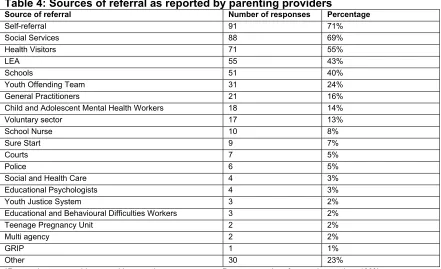
Referrals were made through a wide range of agencies. 33% of providers indicated that they had referrals relating to behaviour and attendance at school. The criteria for referral to parenting programmes related to parental need. Some providers excluded particular groups of very needy parents or required them to be receiving support from other agencies. Some programmes accepted any parents who genuinely wished to improve their parenting skills.
Participants and drop-outs
The low response rates to questions regarding participation in parenting programmes from LEAs and providers made it difficult to draw any conclusions about the type of parents attending parenting programmes. There was no reliable information about the numbers of parents who were referred voluntarily or self-referred, and the numbers of parents referred compulsorily were very small, particularly in relation to education. The data revealed wide differences in the overall number of parents attending
programmes. The figures from LEAs for those voluntarily or self-referred ranged from 0 to 350 while for providers from 0 to 800. This reflected the diverse nature of the types of programmes operating and also the size of the LEAs.
There was agreement that it was difficult to persuade parents to join parenting
programmes. Attendance at a programme was perceived by parents as indicating some kind of inadequacy. A change in culture was needed so that it became normal practice for parents to attend a parenting programme. Most providers in the survey reported substantial drop out rates, although the programmes that were visited had low rates. They followed up non-attendance and where parents were known to be experiencing family difficulties, particularly where they had been referred compulsorily, contact was made with them prior to attendance at the programme. This reduced their anxiety levels and gave providers an opportunity to assess the nature of their problems. Skilled facilitators were able to successfully engage parents in such a way as to reduce drop out.
Types of programmes
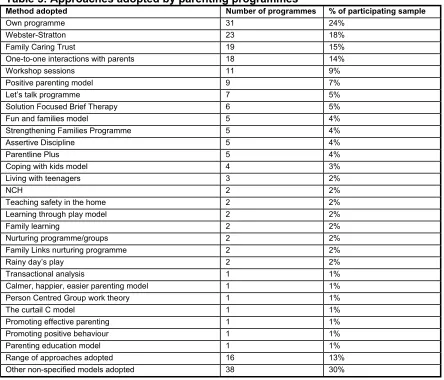
There was a wide range of models which could be used as the basis for developing parenting programmes. Increasingly, LEAs were developing their own parenting programmes with a focus on the child’s educational outcomes rather than more generalised outcomes relating to family functioning. This provision was sometimes, although not always, school based. In some cases parallel programmes were provided for children. There was a range of examples of good practice in relation to these LEA and school based programmes. This was complemented by parenting programmes provided by other providers from the voluntary sector, the two sectors increasingly working together.
Programme content
behaviourist techniques while concurrently improving relationships and communication in the family. Most programmes were based on facilitated discussion with parents drawing on each other for support and the development of strategies to implement. The support systems which parents developed were important outcomes of the
programmes. Crucial to the success of the programmes were the skills of the facilitators. Some programmes had developed parallel programmes for children. Where the focus was educational outcomes this was particularly appropriate as children’s behaviour was affected by circumstances at school over which the parent had no control.
Most programmes acted as brokers for other services and agencies but many were sceptical about the impact that other agencies had.
Programme delivery, evaluation and staff training
Most respondents in the survey indicated that programmes were delivered in community centres, although some were delivered in schools. At primary level, school based
programmes were welcomed by parents and staff, although there were sometimes difficulties with accommodation. Transport problems were minimal, links between home and school were increased and there was increased potential for monitoring the
educational impact on children.
Programmes varied in their length, timing and duration. Most sessions were held weekly at a range of different times of day and times of year. Programmes varied in length between 1 and 14 sessions although most were between 8 and 12 with sessions lasting 1 to 3 hours. It may be the total number of hours spent working together which is
important rather than the number of sessions per se. In addition, parents with greater needs at the start of a programme take longer to change their thinking and develop their skills than those with lesser needs.
Some LEAs provided a telephone helpline to support parents. Parents valued this. Some providers insisted that families with serious difficulties had ongoing support from other agencies while attending a programme.
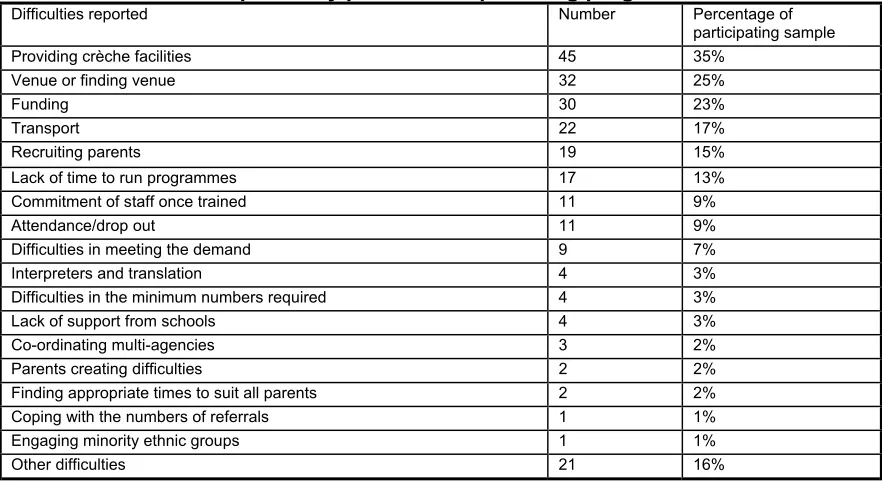
The provision for follow up sessions varied between programmes but all providers encouraged parents to develop their own self-help groups which would continue after the programme came to an end. Parents indicated a need for follow up work to the courses and ongoing support. The self-help groups were very successful, although there were sometimes difficulties with venues, transport and the provision of crèche facilities.
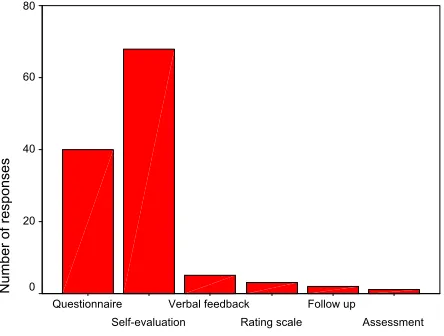
Most providers undertook systematic evaluation of the programmes through parent questionnaires in the final session. These provided positive indications of the outcomes. Some programmes went beyond this and assessed the perceived impact on the
behaviour of the children. Most did not. There is a need for systematic evaluation of the impact on children in the long and short term and on the impact on parents in the long term.
Unless programmes were run by LEAs, they had no direct control over the way parenting programmes operated or their quality. While many providers had evaluation systems in place the information derived from these was not always fed back to the LEA. Systematic monitoring of the quality of programmes is necessary.
Staff working on the programmes were recruited from a wide range of backgrounds. Many were hourly paid, although many were also highly qualified. Training was a
programme being implemented. Some training was accredited. There is no nationally recognised qualification framework for working with parents.
Impact on parents and families
The programmes, overall, were reported by parents to have a very positive impact. 97% of responding parents reported that the programmes were enjoyable and helpful. They contributed to increased confidence in interacting with and understanding their children. Conflict at home was reduced and family life was calmer and happier. Parents’ self-esteem and confidence improved, they developed support networks and some went on to attend further courses, gaining qualifications and employment.
The extent of change depended on the starting point of the parents. For those whose parenting skills were at a low level initially attendance at a single programme was insufficient and ongoing support was needed. For others a single programme was adequate in improving their parenting skills.
Some parents, having co-ordinated a follow up support group, went on to train as facilitators. Even where parents did not become long term engaged with the
programmes in this way many became advocates for parenting programmes in their local community. This enthusiasm could be an important vehicle through which to engage the most needy parents in the community who may be the most reluctant to attend parenting programmes.
Impact on children and their behaviour
In almost all cases parents reported improvement in the child’s behaviour at home and in interactions with the family. Although the data were limited, there was evidence of improved behaviour and attendance at school as a result of parents’ attendance at parenting programmes. However, improved parental control of children’s behaviour will not alleviate situations where problems are located specifically in the school
environment for instance where children are being bullied or relationships with teachers have broken down.
Where provision was school based head teachers were supportive of it and it was useful in providing a bridge between home and school which previously did not exist for some families. There were positive changes in the ways in which parents interacted with school staff and they reported being better able to support their child’s behaviour and attendance at school.
Recommendations
• There is a need for all Local Education Authorities to have a named person with responsibility for co-ordinating the provision of parenting programmes within the authority and for ensuring that that provision is of a high quality. Working with providers each LEA should be able to offer a ‘menu’ of parenting services from those available for all parents to those targeted at specific groups whose children may be presenting particular difficulties.
• Where parenting programmes have an educational focus, in order to foster better communication between parents and the school and enable closer
monitoring of the impact on children, it may be beneficial to hold them in schools. If an increase in the number of parents attending such programmes is
• Systems need to be put in place to monitor children’s attendance and behaviour when parents attend programmes and to facilitate long-term evaluation of the impact of programmes.
• Schools might consider having a key contact with responsibility for parenting issues and also providing training for school staff in developing relationships with parents. This would facilitate home and school working more closely together.
• LEAs need to ensure that programmes are available for the parents of pre-school, primary and secondary school pupils and that appropriate crèche facilities and transport are available.
• Strategies for engaging the most needy parents in parenting programmes need to be developed. These may utilise the enthusiasm of parents in the community who have already attended programmes. In addition, wider availability of programmes for all parents may reduce the stigmatization of attending a parenting programme.
• Where parents have been issued with compulsory orders contact should be made with them prior to the running of the programme to reduce any anxiety, enable them to express their anger and optimise the likelihood of their attending. Programme facilitators should offer additional support to these parents
throughout the programme and receive specific training in dealing with difficulties that may arise as a result of any negative attitudes expressed in the group work.
• Opportunities for follow up activities need to be made available. If this is through self-support groups appropriate venues need to be made available and
consideration given to the provision of crèche facilities and transport.
• There is a need to adopt common standards for parenting education as outlined by the National Parenting Education Support Forum. A national qualifications framework, to include core competencies, which acknowledges prior learning and experience needs to be developed. Modules addressing the skills and knowledge required to facilitate parenting programmes, which could be taken by staff already engaged in working with parents and children, could provide initial training and continuing professional development and provide an effective means of expanding provision.
Chapter 1
Introduction
1.1 The importance of access to full-time education
Non-attendance at school is not a new phenomenon. Since the education of children became compulsory it has often been the focus of political and media attention.
Recently with the imperative to raise academic standards it has become the focus of a range of government initiatives as there is evidence that there are relationships between poor attendance at school, for any reason, and academic performance (DfES 2001). In the long term persistent truants and those who are excluded from school tend to have lower status occupations, less stable career patterns and greater unemployment in comparison with others sharing similar backgrounds (Hibbett and Fogelman, 1990). Some, but not all may be involved in delinquency (Audit Commission, 1996; Cullingford, 1999). Reducing exclusion and improving attendance are therefore crucial for the individual pupil and for society as a whole.
1.2 Attendance
Attempts to improve attendance at school since national statistics have been available have had mixed results. In maintained secondary schools between 1995/96 and
2002/03 the percentage of authorised absence has varied from 8.4% in 1995/96 to 7.21 % in 2002/3 (measured as a percent of half day sessions missed). Unauthorised
absence has remained fairly stable at around 1% in most years. In primary schools unauthorised absence has varied from .5% in 1996/97 to .43% in 2002/03 while authorised absence has varied from 5.19% in 1999/00 to 5.71% in 1997/98. For 2002/03 it was 5.38%. (DfES 2002; 2003).
The causes of non-attendance are many and complex (Hallam and Roaf, 1995; Hallam, 1996). Pupils may not attend because of:
• illness or anxiety;
• holidays, special occasions, outside activities;
• family circumstances (helping at home, family needs or desires, extreme family pressures);
• issues within school (the environment, school requirements, school circumstances, attitudes towards school, relationships with teachers and peers, exclusion);
• attractions outside school (peer pressure, excitement of truanting, employment opportunities).
1.3 Exclusion
The ultimate sanction for poor behaviour in school is exclusion. This can be a fixed term or permanent exclusion. Anecdotal evidence suggests that exclusions also occur
without regard to official procedures, where parents are asked to keep a child at home for a few days. While the causes of exclusion are many and complex (Parsons, 1999; Munn et al., 2000; Osler et al., 2001), the reduction of exclusions depends on schools developing inclusive approaches to the curriculum and teaching, while also developing strategies for working with other agencies in supporting pupils who are at risk.
Successful interventions to reduce exclusion and improve behaviour often actively involve parents (Hallam and Castle, 1999).
1.4 Parenting orders and contracts
The Anti-social Behaviour Act 2003 introduced new powers for LEAs to apply for a parenting order to help address children’s behaviour in school. A parenting order compels a parent to attend a parenting programme and to fulfil other requirements as determined necessary by the court for improving their child’s behaviour, e.g. ensuring that the child arrives for school on time. Parenting orders are already available following prosecution for non-attendance. Under the Anti-social Behaviour Act they are available following a permanent exclusion or a second fixed term exclusion within 12 months. They will be used when a pupil has been excluded for serious misbehaviour and where parenting is considered a factor in the child’s behaviour and the parents are unwilling to engage with the LEA or school in attempting to bring about change on a voluntary basis. In the past, some LEAs encouraged parents who had not been issued with a parenting order but whose children were experiencing school attendance problems, to attend such programmes on a voluntary basis. The Anti-social Behaviour Act (2003) has enabled schools and Local Education Authorities to arrange parenting contracts which are voluntary and will involve the parent agreeing to carry out specific actions to improve their child’s attendance or behaviour in return for the LEA or school providing or arranging support, typically a parenting programme, with which the parent will be required to co-operate.
In all of these instances, the aim of parenting programmes is to encourage parents to satisfy their responsibilities by equipping them with skills to enable them to deal with their child’s behaviour or attendance problems. In providing parenting programmes it is therefore important to establish what works best in providing parenting programmes in education-related cases and to provide information on best practice in the running of such programmes.
1.5 Parenting programmes
In recent years there has been an increased recognition of the importance of parenting and the way in which parenting programmes can be an effective preventative service (Hoghughi, 1998; Desforges and Abouchaar, 2003). In a review of the literature
Most parenting programmes are based on one of two main approaches, behavioural or improving relationships. The former seem to be more effective in changing children’s behaviour while the latter seem to have more positive effects on the cohesive
functioning of families (Barlow, 1997). Practices in delivering parenting programmes in the UK in relation to the former are largely derived from the work in the USA of Webster-Stratton with conduct disordered young children and their families, the latter from Bavolek’s approach with dysfunctional families (Lloyd, 1999).
Evaluations of parenting programmes have largely relied on parental reports and there have been relatively few studies which have included independent observations of children’s behaviour. Where evaluations have relied on parental self–report, satisfaction has tended to be very high. Those studies that have adopted observational methods have indicated that parent education programmes are effective in improving the
behaviour of young children (Barlow, 1997; Barrett, 2003), although effective behaviour change at home does not always transfer to other environments including school (Firestone et al., 1980). While the evidence suggests that the effects can be successful in the long term, a large proportion of parents may still have difficulties with their
children. Some groups are particularly likely to experience problems – those characterised by their single parent status, maternal depression, lower social
programme status, and with a family history of alcoholism and drug abuse (Webster-Stratton and Hammond, 1990). There is also an acknowledgement that particular community factors can be important (Bronfenbrenner, 1979). Typically, in the region of 30% of parents drop out of parenting programmes (Forehand et al., 1983). These parents are often those in most need.
A recent extensive review of meta-analyses of a range of different types of parenting programme (Barrett, 2003) indicated that group-based programmes for parents of children with behaviour problems appeared to be successful in the reduction of emotional and behavioural problems in children of all ages. For children aged 0-3 the types of programme which were more successful were not clear, although for the parents of 3-10 year olds group programmes using behavioural approaches appeared most consistently effective. For children aged 10-17 the effects were not consistent in relation to reducing offending although there were more positive results in reducing other measures of delinquency and substance abuse. Programmes in the Parent and Child Series developed by Webster- Stratton and colleagues were effective particularly when training in child management was combined with training in other parenting skills, when teachers were involved and when the programme adopted a range of media for engaging parents including video, verbal, and written materials. Overall, the review concluded that group based programmes were as effective or more so than individual programmes except for the treatment of drug abuse where family therapy was more effective and for delinquent youths where some negative effects of group parenting programmes had been found.
Much of the research to date has concentrated on developing the parenting skills of those with young children. There has been much less systematic evaluation of the impact of parenting programmes with the parents of adolescents. In the UK, the most encompassing evaluation of such parenting programmes was undertaken by the Policy Research Bureau for the Youth Justice Board (Ghate and Ramella, 2002). This
The work with parents generally addressed issues related to dealing with conflict and challenging behaviour; learning to constructively supervise and monitor young people’s activities; setting and maintaining boundaries; communication and negotiation skills; and family conflict in general. Most existing courses for working with parents had to be adapted to meet the needs of this group of parents of disaffected adolescents. Many programmes offered a mix of group work and individually tailored one-to-one work. There was wide variation in the systems for referral and assessment. Parents on the programme, mainly single mothers, reported very high levels of need including debt and housing problems, health difficulties and problems with personal relationships. Most said that they particularly wanted help in managing difficult behaviour in their child. The young people whose parents attended the programmes were a difficult and needy group. Seventy two percent had emotional and behavioural difficulties. They were also prolific offenders.
Parents completing courses reported improved communication with their child; improved supervision and monitoring; reduction in conflict and better approaches to dealing with it when it occurred; better relationships; giving more praise and approval; being less critical and losing their temper less; feeling better able to influence behaviour; and feeling better able to cope with parenting in general. Exit ratings were very positive. Staff also indicated on a rating scale that that nearly half of the parents had benefited substantially. There was also evidence of positive change in the young people, including improved communication and mutual understanding, a reduction in conflict with parents and improved relationships. Reconviction rates reduced by nearly one third, offending dropped to 56% and the average number of offences was reduced by half. Of course, the parenting programme alone may not have been responsible for these changes, but it is likely to have made a contribution. An important additional positive outcome was the benefit to parental relationships with younger children.
To date, there has been relatively little research exploring the effectiveness of different types of parenting programmes with different groups of parents. There is a need for research considering the most effective programmes for single family parents, step families, families from different ethnic groups, parents of different ages, parents with children of different ages and parents with children experiencing different kinds of behavioural or attendance problems. Such evidence as there is suggests that ‘one size does not fit all’. Therefore, it is important to try to identify which interventions best match particular needs. The purpose of this research is to examine when parenting
programmes are most effective in the context of improving attendance and behaviour in school and to identify good practice.
There is powerful evidence that attendance at school and academic performance are positively related and that those who are excluded from school and do not attend school regularly, whatever the reasons, are more likely to become involved in crime. Recently, much emphasis has been put on the role that parents can play in improving the
attendance and behaviour of their children. Parenting orders can be issued by
1.6 Aims and Objectives of the Research
The overall aims of the research were:
1. To determine the provision of parenting programmes used by LEAs as a means of improving children’s behaviour and/or attendance at school including who provided the programmes, how they were funded, how they were quality-assured and how
effectiveness was evaluated. These issues are considered in Chapters 3 and 8. 2. To determine what type of parenting programmes were most effective in bringing about improvements in children’s behaviour and/or attendance at school. These issues are considered in Chapters 3, 4 and 6.
3. To examine whether parenting programmes work best for different types of family in terms of improving the child’s behaviour and/or attendance, for example:
What type of attitudes (towards their child’s behaviour/attendance and to the course) do parents hold prior to the course?
Which parents feel they have benefited most from parenting programmes?
Is the type of behaviour and/or attendance problem a factor in the effectiveness of a parenting programme? These issues are considered in Chapters 6, 9 and 10.
The research revealed very few parenting programmes which focused specifically on children’s behaviour and attendance at school. However, LEAs identified the
programmes that they did use and it was possible to address the research questions by reference to these programmes. Because of the paucity of data regarding the
educational outcomes for pupils it was not possible to evaluate the impact of each of these on pupils’ behaviour in school. Data were collected regarding parents’ beliefs and attitudes about their child’s behaviour and attendance at school prior to and after
Chapter 2
Methodology
This chapter sets out the research methodology for the two main phases of the research and describes the analyses undertaken.
2.1 Phase 1: Survey of LEAs and the programme providers with whom they
work
In Phase 1 data were collected from all LEAs in England to explore the different types of parenting programmes available (voluntary and compulsory), how they were funded, how they were quality assured and how their effectiveness was evaluated. Data were collected relating to perceived success in improving parenting practices and the perceived impact on pupils. Information was also sought regarding the length of time that parenting programmes ran and how these might impact on effectiveness.
2.1.1 Interviews with responsible LEA officers in England and providers of parenting programmes used by LEAs
Telephone interviews or e-mail conversations were conducted with responsible LEA officers in England to establish their use of parenting programmes and the providers that they used. The providers of these programmes were also contacted and
interviewed. The purpose of the interviews was to:
• obtain detailed information about the nature of any parenting programmes operating in the LEA either voluntary or compulsory;
• establish the nature of the relationship between the LEA and the parenting programme provider;
• establish how parents were referred to the programmes;
• establish the extent of take up of the programmes;
• establish the type of parents accessing the programmes and why they took part;
• establish which parents dropped out and why;
• obtain detailed information about the approaches and teaching methods used in the programmes;
• establish any differences in curriculum and organisation of programmes catering for parents of pupils with different types of problems, particularly behaviour and
attendance;
• establish the time scales involved in delivering different types of parenting programmes;
• explore the perceived effectiveness of different types of programmes on parents;
• explore the perceived effectiveness of different types of programmes on children;
• establish how the programmes were quality assured;
• establish how the programmes were evaluated and whether this presented any difficulties;
• explore the availability of data for monitoring the progress in school of the children of the parents attending the programmes;
• identify any difficulties experienced in providing the programmes;
• identify areas where there was perceived room for improvement in the provision of the programmes;
• identify any areas which appeared to be working particularly well;
• obtain detailed information about how the programmes were funded and the effectiveness of this.
Responses were received from 158 (53%), of these 30 indicated that they had not as yet run or no longer ran programmes. Where LEAs or parenting programme providers had data readily available relating to individual pupils whose parents were participating in the programmes (e.g. exclusions, attendance, behaviour, attainment) these were analysed to assess improvement.
On the basis of Phase 1 of the research, 23 examples of contrasting approaches to parenting programmes were selected for more in depth study. The selection of these examples made by the steering committee at the DfES and the research team was informed by the views of the quality assurance and advisory group set up at the Institute of Education. The selection took account of different types of programmes for parents of children with different types of problems, geographical area (rural, urban), level of deprivation in the LEA, and involvement in other programmes, e.g. Behaviour
Improvement Programme, Excellence in Cities. A brief description of each of the visited programmes is provided in the appendices.
2.2 Phase 2: Field Work
For each of the 23 programmes visited more detailed information was obtained regarding the structure and content of parenting programmes, how they were funded, how quality was assured and how their effectiveness was evaluated. Participating parents were asked to complete a short questionnaire before and after they had participated in the programme to assess changes in their attitudes and behaviours and that of their child. This was based on the questionnaires developed for ‘Positive
Parenting’ the evaluation of the Youth Justice Board’s Parenting Programme (Ghate and Ramella, 2002). The questionnaire collected information regarding the type of family, ethnicity, the particular reason for attending the programme, changes in attitudes and behaviour and statements evaluating the programme. The full questionnaire is included in the appendices.
The sample of parents was not random. They were attending programmes which had already been identified as examples of different types of ‘good’ practice. 142 parents from 20 programmes responded to the pre-programme questionnaire, 73 (51%) from 17 programmes to the post-programme questionnaire. The lower level of responding to the post-programme questionnaire was due to the absence of some parents from the
sessions where it was administered and the reluctance of some providers to ask parents to complete this questionnaire in addition to their own evaluation questionnaires. This difference in sample size between the pre and post responses may have biased the findings. Parents more favourably disposed towards the parenting programme were more likely to have responded to the request to complete the questionnaire. A database was created and the data analysed to compare the responses of parents to the
statements pre and post attendance at the programmes.
When parents dropped out of programmes they were contacted by the authors by telephone to establish the reasons for the drop out, their experiences of the programme and whether anything could have been done to enable them to continue. Only three parents dropped out from the programmes visited.
was identified contact was made to establish whether teachers were aware of the parent’s attendance at the programme and short interviews were undertaken with teachers.
2.2.1 Interviews with those responsible for and involved in running parenting programmes
The interviews with those responsible for and involved in running parenting programmes explored in greater depth the issues raised in the survey. Thirty-three interviews were undertaken with providers and facilitators. There was a focus on the experiences of specific groups of parents and any changes in their attitudes and behaviour towards their children. Staff perceptions of the reactions of the children to changes in parental behaviour were also sought. Interviews explored:
• the types of difficulties which the parenting programmes addressed;
• the perceived impact on families of the parenting programmes;
• particular aspects of the programmes which had a major impact on parents’ attitudes and behaviour;
• whether attending the programmes enabled parents to draw attention to particular needs which could then be met by other agencies;
• the perceived impact of the parenting programmes on the behaviour and attendance of the children whose parents were participating;
• perceptions of the likelihood of long term change in parents’ behaviour;
• any difficulties or obstacles experienced in running the programmes;
• any ways in which the programmes could be improved;
• aspects of the programmes which seemed to be working particularly well;
• any other perceived outcomes, positive or negative.
2.2.2 Interviews with other LEA personnel (e.g. EWOs, EPs, members of BESTs) or others working closely with the affected pupils
Interviews with those working closely with the affected pupils within the LEA explored:
• the types of difficulties experienced by the students whose parents were attending the programmes;
• the perceived impact on families of the parenting programmes;
• the perceived impact of the parenting programmes on the behaviour and attendance of the children whose parents were participating.
Interviewees were asked to provide illustrative examples of individual cases.
2.2.3 Interviews with parents
Case study interviews with parents explored:
• their experiences of the parenting programmes;
• whether, and to what extent, they felt that the programmes had been helpful in improving their parenting skills;
• how the programme had impacted on their behaviour in relation to their child;
• the extent to which they perceived the parenting programmes to have been helpful;
• any difficulties that they experienced;
• what they thought might be improved in the programmes;
• any unexpected benefits of attending the programmes in relation to other needs;
• the impact of the changes in their attitudes and behaviour on their child’s behaviour, self-esteem, confidence, attendance at school and school work;
• any change in the nature of their child’s plans for the future;
• whether they thought that the changes in their behaviour and parenting skills would be maintained in the long term and what might support this;
Telephone interviews were conducted with parents who had dropped out of the programmes to establish the reasons for this, to explore their perceptions of the parenting programme and what might have helped them to remain in it.
2.2.4 Interviews with teachers
Interviews with teachers/classroom assistants explored:
• the perceived impact of the parenting programme on the behaviour and attendance of the children whose parents were participating;
• the extent to which they believed that the parenting programme was successful for supporting the parents of particular groups of pupils;
• the extent to which the parenting programme appeared to be successful in assisting parents to support the academic and personal development of their children;
• any difficulties that they perceived with the parenting programme;
• any aspects which they believed had been particularly successful;
• what they thought could be improved in relation to the parenting programme and the way it impacted on pupils;
• the extent to which the parenting programme was likely to be successful in the long term in improving behaviour and attendance;
• the factors that they believed might be important in promoting success for the programme in the long term.
Interviewees were asked to provide examples of improvement in children’s behaviour and attendance relating to their parents’ involvement in parenting programmes and also examples where the programmes were unsuccessful.
2.2.5 Interviews with pupils
Depending on the nature of the purpose of the parenting programme, interviews were undertaken with pupils individually or with their parents. The interviews explored the experiences of the pupils in relation to their circumstances prior to their parents
attending the programmes; any changes in their parents’ attitudes and behaviour since they attended the programmes; what, in particular, they found helpful about the
changes; what other changes in their parents might have been helpful; current levels of support that they had in school (if any); the extent to which their parents had been influential in helping them improve their behaviour or attendance; the impact of returning to school on their schoolwork and social life; their plans for the future; any other
outcomes of their parents attending the parenting programmes.
The data from the interviews with involved LEA personnel, pupils, parents and teachers were used to provide example case studies of the success of the parenting programmes for different types of pupils. They were also used to identify the difficulties experienced, the ways the programmes might be improved and what might sustain behaviour change in parents and children in the longer term.
2.3 Analysis of the data
The qualitative data from the survey were coded to enable frequencies to be computed. SPSS was used to analyse the quantitative data relating to the survey of LEAs,
attendance and the responses to the questionnaires. The pre and post parenting programme questionnaires completed by a sample of parents were analysed using Wilcoxon Matched Pairs tests to assess whether the changes reported over the time of the parenting programme were statistically significant or could have occurred by chance.
and their parents and to provide validation of the survey and questionnaire analyses. A consultative conference was held with representatives of participating LEAs, providers of parenting programmes, the DfES and OfSTED to facilitate the validation, clarification and interpretation of findings.
Chapter 3
Infrastructure, Organisation and Funding
This chapter describes LEA infrastructure relating to parenting programmes, the
personnel with responsibility for managing the infrastructure within the LEA, and the way that parenting programmes were co-ordinated in the LEA. It provides contrasting
examples of good practice, outlines how parenting programmes were funded and considers the likely impact of the Anti-social Behaviour Act.
Overall, it was difficult to get LEAs to respond to the initial survey questionnaire.
Subsequent telephone calls revealed that most LEAs had not responded because they had few structures or personnel in place relating to parenting programmes. Many
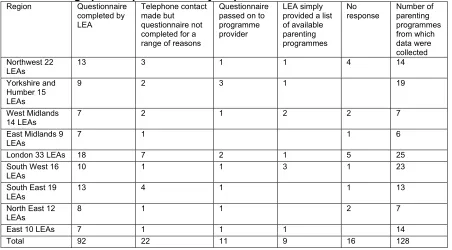
passed the questionnaire on to a specific parenting programme provider for completion. Some LEAs stated that they were unable to complete the questionnaire either because they did not have the available information or because they did not have time. Overall, 134 (89%) LEAs responded to requests for information, either by completing the questionnaire (92), undertaking a brief telephone interview (22), passing the
questionnaire onto a programme provider (11) or providing a list of programmes (9). In many cases, although LEAs responded, they supplied little or no information about parenting programmes. 61% of LEAs provided detailed information regarding the programmes available in their LEA. Table 1 provides a breakdown of responses from each region of the country and the number of programmes from which data were collected in each region. Questionnaires were also completed by 128 parenting programme providers 53% of those asked for information. These were contacted
[image:24.595.100.552.459.709.2]through the LEAs and are therefore representative of the types of programmes to which LEAs refer parents whose children have difficulties relating to behaviour or attendance at school.
Table 1: Geographical spread of survey responses
Region Questionnaire completed by LEA Telephone contact made but questionnaire not completed for a range of reasons
Questionnaire passed on to programme provider
LEA simply provided a list of available parenting programmes No response Number of parenting programmes from which data were collected Northwest 22 LEAs
13 3 1 1 4 14
Yorkshire and Humber 15 LEAs
9 2 3 1 19
West Midlands 14 LEAs
7 2 1 2 2 7
East Midlands 9
LEAs 7 1 1 6
London 33 LEAs 18 7 2 1 5 25
South West 16
LEAs 10 1 1 3 1 23
South East 19 LEAs
13 4 1 1 13
North East 12 LEAs
8 1 1 2 7
East 10 LEAs 7 1 1 1 14
3.1 Relationships between LEAs and parenting programmes
Although direct communication was established with all but 16 of the LEAs in England many were able to provide little information about the parenting programmes available in their area. Some were able to provide a list of parenting programmes but had little information about how the programmes operated, others were unable to complete the questionnaire because no information was available. Of those LEAs that did respond with information about parenting programmes, there was wide variability in the number of programmes reported. 32 LEAs (21%) listed one provider, 25 (17%) listed 2, 12 (8%) listed 3, 8 (5%) listed 5, 4 (3%) listed 4, 3 (2%) listed 6, while 7 and 8 were listed by only one LEA each. Overall, 64 LEAs (43%) provided no information about available
programmes.
There was variability in the personnel with responsibility for parenting programmes within LEAs. The three most commonly reported responsible personnel were a senior level Education Officer (45% of responding sample), an Education Welfare Officer or Social Worker (23%) or a Service Manager (12%). The latter was often working in relation to social inclusion. 5 LEAs (5%) had personnel for whom parents or families were a key focus. Other personnel mentioned by less than 2% of LEAs included the Head of Behaviour Support Services, Head of School Plus, and the Youth Offending Team.
Several LEAs reported that they were rethinking their structures to enable them to appoint personnel with dedicated responsibilities for parenting programmes. In some cases Home School Liaison Co-ordinators were taking on this role. For instance, in one LEA, this role included disseminating information throughout the county about parenting programmes and supporting colleagues in the running of the courses. The LEA officer took the lead responsibility for parenting orders that came from the Legal Intervention Team. The Home-School Liaison Workers were based at the Primary and Secondary PRUs, the latter being part of the Behaviour Support Team. In many LEAs, the increased need for having access to parenting programmes had led to the interface between independent providers and LEAs becoming closer.
3.2 Organisations responsible for overseeing the programmes
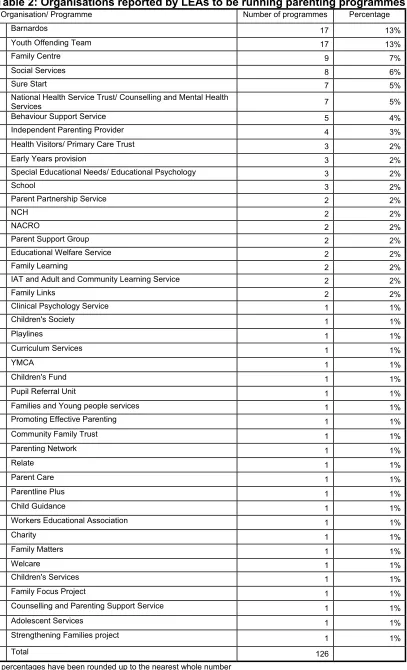
The providers of parenting programmes were asked to state under the auspices of which organisations their programmes operated. Only two providers did not respond to this question. The details of the responses are given in Table 3. There was wide variation in the organisations under the auspices of which the programmes operated. The largest providers in the participating sample were Barnado’s and Youth Offending Teams. Some respondents indicated the name of the programme rather than the particular overarching body. Details are provided in Table 2.
3.3 Co-ordination of parenting programmes
Table 2: Organisations reported by LEAs to be running parenting programmes
Organisation/ Programme Number of programmes Percentage
Barnardos 17 13%
Youth Offending Team 17 13%
Family Centre 9 7%
Social Services 8 6%
Sure Start 7 5%
National Health Service Trust/ Counselling and Mental Health
Services 7 5%
Behaviour Support Service 5 4%
Independent Parenting Provider 4 3%
Health Visitors/ Primary Care Trust 3 2%
Early Years provision 3 2%
Special Educational Needs/ Educational Psychology 3 2%
School 3 2%
Parent Partnership Service 2 2%
NCH 2 2%
NACRO 2 2%
Parent Support Group 2 2%
Educational Welfare Service 2 2%
Family Learning 2 2%
IAT and Adult and Community Learning Service 2 2%
Family Links 2 2%
Clinical Psychology Service 1 1%
Children's Society 1 1%
Playlines 1 1%
Curriculum Services 1 1%
YMCA 1 1%
Children's Fund 1 1%
Pupil Referral Unit 1 1%
Families and Young people services 1 1%
Promoting Effective Parenting 1 1%
Community Family Trust 1 1%
Parenting Network 1 1%
Relate 1 1%
Parent Care 1 1%
Parentline Plus 1 1%
Child Guidance 1 1%
Workers Educational Association 1 1%
Charity 1 1%
Family Matters 1 1%
Welcare 1 1%
Children's Services 1 1%
Family Focus Project 1 1%
Counselling and Parenting Support Service 1 1%
Adolescent Services 1 1%
Strengthening Families project 1 1%
Total 126
3.3.1 Case Study 1
In one County LEA, the Parenting and Family Learning Manager, who was part of the Early Years and Childcare Service, managed and supported projects which offered support to parents. A great many parenting programmes operated within the LEA run a by a wide range of different providers some on a voluntary basis. The most common was the Family Caring Trust which provided materials and guidebooks, and informal training through workshops. Some of these programmes were implemented through Family Centres, some by churches. The LEA periodically undertook a mapping exercise of the range of courses that were available. Health Visitors also organised a number of their own programmes often using Family Caring Trust as did the major hospital in the area. Overall, approximately 4000 parents a year attended a parenting programme, although even this level of provision was thought not to be sufficient, partly because attendance at most of these programmes had to be paid for by parents, although Family Links and Parent-Talk were free. The LEA would have liked to be able to run
programmes in every school partnership area at no cost to parents so that parenting programmes would eventually become something that were an integral part of school life.
In the LEA, the Parenting and Family Learning Manager acted as a co-ordinator for programmes, managed the Parenting Forum Co-ordinator, oversaw training for people who worked with parents, and managed the Parent-Talk project and a team of home-school link workers who supported families whose children were not attending home-school or who were underachieving because of home issues. Supervision for Family Links was offered and help in setting up projects in schools. This was funded by the Children’s Fund and targeted at deprived areas. Within the LEA the Family and Community Support Manager managed the Local Authority Family Centres, of which there were eight. There were service level agreements with nine others. Within the Community Learning Branch of the authority, which embraced adult education, youth work and early years and childcare, there was a Parent Education Development Team (PEDT). The budget for this group was largely from funding streams with a focused aim mainly from the Adult Education Department and the Early Years Childcare Service. There was no funding from the education budget. The PEDT was formed at a time of structural changes in the LEA and the International Year of the Family when such issues were high on the political agenda. The PEDT supported and advised on parenting
programmes focusing on training and development, and promoting quality rather than actually running programmes. The exception was the Parent-Talk programme, which was managed by PEDT and subsidised by community learning. The LEA had several levels of provision, Parent-Talk, Family Links, an early education partnership for pre-school children and the Family Nurturing Network. The latter emerged from the same organisation as Family Links but adopted a more clinical psychological approach and developed specific programmes for parents and children where there were difficulties with behaviour. The programmes were free-standing and rooted in the Webster-Stratton model.
sources, for instance the Building Links Parent support worker was funded in part by Lloyds TSB.
The parenting forum which brought together all those involved in parenting education within the LEA was a voluntary body that had a remit to promote the development of parenting education, influencing county policy with regard to parents and children. It acted as a network for sharing information:
‘The Parenting Forum was set up in order to co-ordinate, raise standards, promote quality and training and to encourage policies to change so that more funding could be secured for the future. What was really wanted was to get the main providers together and map out their areas of specialism in conjunction with the needs of parents to try to make sure that there was an entitlement in all areas of the county for this. As yet this has not been achieved – but there has been progress. It has taken the drive of social and health care, CAMHS to raise questions about the co-ordination of parenting programmes.’
Despite this degree of co-ordination and the high level of provision there were doubts as to whether it was sufficient to meet increasing demand.
3.3.2 Case Study 2
A metropolitan borough described a different approach to the development of parenting programme provision. Four years ago, a team of 12 from the LEA education team were trained to deliver a school based pupil nurturing programme and a parenting
programme. The team initially delivered the programme twice each term, but after 18 months the schools were felt to be ready to take on the responsibility. More facilitators were trained drawn from a range of agencies including school nurses and community workers. Initial funding came from the Education Action Zone. More recently, funding for training facilitators has come through the Behaviour and Education Support Team (BEST), the Behaviour Improvement Programme and Sure Start. Each BEST (there are 3 in this LEA) had staff who were trained to deliver the programmes. For many of the BEST this was part of their induction. The BESTs promoted the programme and encouraged parents to attend. The CAMHS worker also made use of the programme materials in individual work with parents. This was very successful. Across the LEA all primary schools had received information about the school based nurturing programme for pupils. Ideally, school staff were trained in the nurturing programme and
implemented this before the parenting programme was implemented, although this had not happened in practice. The school training involved two days of INSET. Schools were then primarily responsible for recruitment into the programme.
Both the pupil and parents programmes followed the Family Links Nurturing
Programme. The material for the programme was derived from the book “The Parenting Puzzle” – written by Family Links (Hunt and Mountford, 2003). The programme was based on ten sessions and focused on giving praise, family rules, self-esteem, choices and consequences, using “I” statements, nurturing ourselves, children’s development, sexual issues, problem-solving and taking stock. The Nurturing Programme, drawing on the work of Stephen Bavelok in the US, was based on four ideas (the Four Constructs): self-awareness and self-esteem, appropriate expectations, empathy and positive discipline. All the facilitators were very positive about the programme, the book and the training received. As an organisation, Family Links is well structured and has facilitators delivering the programme throughout the country. In each geographical area there is a Family Links Co-ordinator. In this LEA, the co-ordinator was also the Area Co-ordinator for BEST. The programme co-ordinator oversaw the work of the facilitators and
ensured that supervision was in place. The Education Action Zone bought in the supervision, but the LEA was exploring the possibility that some of the current
the duration of each course. The number of parents attending courses was monitored, the course was publicised within the LEA and the co-ordinator also spent time with schools which were proposing to implement the programme. Ideally, the parenting programme is school based and the school also implements the Nurturing Programme for pupils. However, in this LEA, although the LEA does have a nurturing programme, it was implemented in different schools to the parenting programme.
Two parenting programmes from this LEA were explored in more detail, one in an infant school and the other based in a community centre. The infant school programme was well appreciated by staff and there were no difficulties in recruiting parents. Most attending parents were self-recruited but in some cases the head teacher targeted and encouraged parents to attend whom she felt would benefit. Some of the parents attended the course twice, the first attendance addressed issues while the second enabled consolidation of ideas and deeper reflection on practice. These parents also acted as buddies/mentors for new parents to the group. Parents were offered incentives to attend - a £5 Boots token for attendance for the first four weeks, bubble bath in the nurturing yourself session and board games for parents to play with their families (Sure Start funded). On completing the course all parents were awarded a certificate, which was presented in the school assembly. Pupils reported feeling a great sense of pride when their mothers received a certificate. A crèche was provided (funded by Sure Start). This was seen as crucial in facilitating attendance.
The second programme visited was based in a community centre and drew in a wide range of parents and carers, including grandparents, and some who worked with children professionally, e.g. a teacher and a youth worker. Recruitment was through advertising within the community and the vicar (female), who facilitated the programme and encouraged her congregation to attend. The different experiences of attendees were reported to have engendered an interesting exchange of ideas based on
experiences with children of different ages. The programme ran during the evenings. Both facilitators felt that the programmes were life-changing experiences for
participants. Family life came to be viewed as being fun. The head teacher of the infant school was confident of the impact and cited recent difficulties at the related junior school where parents who had attended the course did not respond aggressively to a difficult situation but in measured terms. The groups were seen to empower parents who often went on to take other courses, e.g. computer studies, first aid. Parents’ self-esteem and self-beliefs had changed as a result of attendance and had become more positive.
3.3.3 Case Study 3
In contrast, one unitary authority had developed its own set of programmes, Parenting Plus, in conjunction with the Educational Psychologists, Primary Integration Team, a Teacher and the Co-ordinator of Adult Education. The programme had been running for four years and was being updated. The courses offered were:
• Coping with kids - A Fresh Start – for under 4’s
• Coping with kids - Getting it Right – for 4 – 8 years
• Coping with kids - We’re Good Enough Parents – for 8 – 16 years
Other courses offered included Confidence Building, The Importance of Play, and Healthy Eating. The programmes for the younger children were based on the Webster-Stratton model. The programmes were modified as necessary depending on the needs of the parents participating in each course. The facilitators of the courses assisted parents in identifying and contacting other agencies where necessary.
future plans made. This was completed with the tutor on a one-to-one basis. The course concluded with a celebration when certificates were given out. The ‘Coping with Kids’ course led to a Level 1 (ONC) accreditation. The programmes were promoted through outreach workers in the community, general advertising in the local newspaper, at health centres, in childcare settings and through national and local newsletters. Information was also sent out to parents already on the database.
Some courses were over subscribed and parents were on waiting lists. This was often because of the limited number of crèche places available within the facilities of the building being used. Each course catered for between 6 – 8 parents. Parents were referred through Social Services, YOT, EWS, Health, Young Persons Centre (drugs), Teenage Pregnancy, GPs, and CAMHS. Parents who were referred by support services did not engage with the course as fully as those who self-referred. The outcomes for the latter were usually more positive. The programmes were funded through Adult
Education, the Learning and Skills Council, Health and Social Care, and the Education Welfare Service. The funding was reported as being inadequate to meet needs.
3.3.4 Case Study 4
The issues arising in relation to providing parenting programmes in rural LEAs differed from those in urban areas. One rural County LEA was divided into 3 areas with three programmes each year provided jointly in each area by the YOT and EWS teams. There was a volunteer driver who took parents to the programmes. The provision of transport and crèche facilities was viewed as crucial in this rural environment. The venues for the programmes were moved around within each area to provide opportunities for different parents to attend more easily. Some of the parents had previously had bad experiences with outside agencies and held a very negative view of authority.
3.4 Raising the profile of parenting programmes
There was consensus among LEAs and programme providers that parenting
programmes should be given a higher profile. Parents needed to be made aware of the availability of programmes in such a way that it was clear that they were not only for parents who were experiencing difficulties with their children. Schools were seen as one avenue for disseminating information. Some LEAs were making progress towards this end:
‘One difficulty that is becoming less, particularly in areas where things happen quite regularly, is people’s perception of what a parenting programme is. Whether it is something for bad parents to go to. Now we have a culture in lots of parts of the LEA where this is not the case. (Parenting Programme Provider)
3.5 Funding
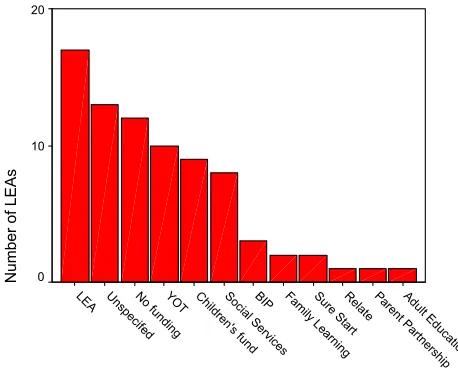
LEAs were asked how the parenting programmes were funded. 46 LEAs responded to this question (31%). Figure 1 illustrates the proportions of funding derived from different sources. 11% of all LEAs indicated that their funding came from the LEA, 9% did not specify the sources of their funding, 8% indicated that they had no funding, 7% indicated that funding came from Youth Offending Teams, 6% from the Children’s Fund, and 5% from Social Services. 2% received funding from the Behaviour Improvement
Figure 1: LEA reported sources of funding
Source of funding
Adult Education Parent Partnership Relate
Sure Start Family Learning BIP
Social Services Children's fund YOT
No funding Unspecifed LEA
Number of LEAs
20
10
0
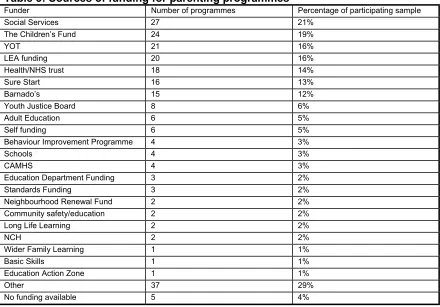
Providers were asked how their programmes were funded. The key funders were Social Services (21%), The Children’s Fund (19%), Youth Offending Team (16%), the LEA (16%) the NHS (14%), Sure Start (13%) and Barnado’s (12%). Other funding came from a wide range of sources (see Table 3).
The variability of sources of funding was confirmed in the field work. Concerns were expressed about the transitory nature of funding from the various sources, its lack of stability and the need to constantly seek out new sources. The single biggest issue raised with regard to funding was that it was inadequate to satisfy demand and need. Some providers indicated that as referrals were made by a range of agencies they should all contribute to the funding.
To overcome funding difficulties some programmes were exploring the use of peer-support which was less expensive. Another route was through Family Centres. This was less costly because staff were already experienced and could take on the facilitator role as part of their normal work. The more organisations where employees ran parenting programmes as part of their normal work the cheaper it became.
Some providers made a small charge for attendance at programmes unless parents were on income support in which case they did not pay. However, the success of
programmes in reaching some groups of parents was reported to depend on there being no charge for attendance. Those in most need often would be unable to pay and
Table 3: Sources of funding for parenting programmes
Funder Number of programmes Percentage of participating sample
Social Services 27 21%
The Children’s Fund 24 19%
YOT 21 16%
LEA funding 20 16%
Health/NHS trust 18 14%
Sure Start 16 13%
Barnado’s 15 12%
Youth Justice Board 8 6%
Adult Education 6 5%
Self funding 6 5%
Behaviour Improvement Programme 4 3%
Schools 4 3%
CAMHS 4 3%
Education Department Funding 3 2%
Standards Funding 3 2%
Neighbourhood Renewal Fund 2 2% Community safety/education 2 2%
Long Life Learning 2 2%
NCH 2 2%
Wider Family Learning 1 1%
Basic Skills 1 1%
Education Action Zone 1 1%
Other 37 29%
No funding available 5 4%
3.6 Impact of the Anti-social Behaviour Act
LEAs were unsure about the impact of the Anti-social Behaviour Act on the provision of parenting programmes. There was an expectation that it would lead to more compulsory orders. At the time of the research these were very few. There was concern that, if the number of referrals of any type increased dramatically, there would be insufficient places on programmes. 40 LEAs indicated that they were experiencing difficulties in relation to the provision of sufficient parenting programmes (27%), although 45% of providers indicated that there were sufficient programmes to satisfy demand. Associated reported difficulties included transport, venues for programmes, providing crèche
facilities and recruiting experienced facilitators. Eight LEAs reported that they had waiting lists for existing programmes. Despite this, some LEAs were broadly supportive of the move towards more compulsory orders:
‘I think the general impression of parenting orders is that they are not as damning as they might first feel. If you approach them in the right way, in a very supportive, non-judgmental way, and are prepared to be flexible to meet parents’ needs, they can benefit and do benefit. I don’t think it is necessarily a bad thing to have more parenting orders. If it gives some parents a push to attend a course then so be it. I’d much rather we did it voluntarily. But there are some parents who don’t listen.’ (Education Welfare