TO STUDY THE ATTENTION DEFICIT HYPERACTIVITY DISORDER (ADHD) AND TO EVALUATE THE COGNITIVE,
HYPERACTIVE AND IMPULSIVE BEHAVIOR AGAINST 6-OHDA HBr LESIONED SPRAGUE DAWLEY NEONATES
USINGHYPERAXE, CURCUMIN & QUERCETIN
Dissertation submitted to
THE TAMILNADU DR.M.G.R.MEDICAL UNIVERSITY, CHENNAI
In partial fulfillment for the award of the degree of MASTER OF PHARMACY
IN
BRANCH IV – PHARMACOLOGY
Submitted By
R ASHISH JAIN
REGISTRATION No: 261525001 Under the guidance of
DR.P.MURALIDHARAN,M.Pharm.,PhD. Department of Pharmacology
DEPARTMENT OF PHARMACOLOGY C.L.BAID METHA COLLEGE OF PHARMACY (AN ISO 9001-2008 CERTIFIED INSTITUTION)
CHENNAI– 600097
Dr.P.Muralidharan, M.Pharm., Phd
Prof & Head
Department of Pharmacology
CERTIFICATE
This is to certify that Project entitled To study the Attention Deficit
Hyperactivity Disorder (ADHD) and to evaluate the cognitive, hyperactive and
impulsive behavior against 6-OHDA HBr lesioned Sprague Dawley neonates
using HYPERAXE, CURCUMIN & QUERCETIN submitted by Regn No:
261525001 in partial fulfilment of the course for the award of the degree of Master
of Pharmacy in Pharmacology. It was carried out at the Department of
Pharmacology in C.L. Baid Metha College of Pharmacy, Chennai-97 under my
guidance during the academic year 2016-2017.
Place : Chennai
Prof.Dr. GRACE RATHNAM, M. Pharm.,
Ph.D., Principal
CERTIFICATE
This is to certify that Project entitled To study the Attention Deficit
Hyperactivity Disorder (ADHD) and to evaluate the cognitive, hyperactive and
impulsive behavior against 6-OHDA HBr lesioned Sprague Dawley neonates
using HYPERAXE, CURCUMIN & QUERCETIN submitted by Regn No:
261525001 in partial fulfilment of the course for the award of the degree of
Master of Pharmacy in Pharmacology. It was carried out at the Department of
Pharmacology in C.L. Baid Metha College of Pharmacy, Chennai-97. Under the
supervision of Professor Dr .P.Muralidharan during the academic year 2016-2017.
Place : Chennai
Date : (Prof. Dr. GRACE RATHNAM)
DECLARATION
Register No: 261525001 hereby declare that this dissertation entitled, To study
the Attention Deficit Hyperactivity Disorder (ADHD) and to evaluate the
cognitive, hyperactive and impulsive behavior against 6-OHDA HBr lesioned
Sprague Dawley neonates using HYPERAXE, CURCUMIN & QUERCETIN has
been originally carried out by me under the guidance and supervision of Prof.
Dr.P.Muralidharan, M.Pharm,. PhD, Head of the department of pharmacology
C.L. Baid Metha College of Pharmacy, Chennai-97 for the academic year
2016-2017. This work has not been submitted in any other degree at any other university.
Place : Chennai
ACKNOWLEDGEMENTS
Firstly I am very thankful to my respective guide Dr.P.MURALIDHARAN,
M.Pharm., Ph.D., Professor and Head Of Department in Department of
Pharmacology, C. L. BaidMetha College of Pharmacy, Chennai – 97. I am honoured to work under his guidance and have his precious guidelines, constant
encouragement and support throughout my research work. I am very obliged for the
patience with which he guided me at every step of my research work.
I consider it as a great honour to express my deep sense of gratitude and
indebtedness to our Principal, Dr. Grace Rathnam., M Pharm., Ph. D, of C.L Baid
Metha College of Pharmacy, Chennai-97 for providing the necessary facilities to
carry out this work.
I submissively express my deep sense of gratitude and sincere thanks to
Mr. Clement Atlee M.Pharm., Assistant Professor and Animal house in-charge,
Department of Pharmacology, C.L.Baid Metha College of Pharmacy, Chennai-97,
for his encouragement and timely provision of animals to carry out and complete
this work.
I wish to express my sincere thanks to Dr. P.Amudha M.pharm.PhD, Assistant
Professor of C.L. Baid Metha College of Pharmacy, Department of Pharmacology,
Chennai -97, for her guidance regarding my dissertationwork.
I wish to express my sincere thanks to Dr. T.Purushoth Prabhu M.pharm.PhD,
Professor and Head Of Department in Department of Pharmacognosy, C. L.
BaidMetha College of Pharmacy, Chennai – 97.for his guidance regarding my
dissertationwork.
I extend my special thanks to Mr.Srinivasa Ragavan, M.Com, store in-charge and
attender Mr. Anand, Mr. Rajaram, C.L.Baid Metha College of Pharmacy,
Chennai, for their timely help and supply of all necessary chemicals required for
my project work and i also extend my thanks to our security incharge
I extend my sincere thanks to Chief Librarian M. Rajalakshmi, C.L.Baid Metha
College of Pharmacy in helping me to utilize the library facilities for references.
I cannot ignore the support and help which I continuously received from my dear
Mom and Dad Kusum & Rajender and my dear friends M. Pharmacy classmates
Monica shetty, Ramya kuttivelu, keerthi, Neha, Kajol, Akshit, Muthukumaran,
Harika and my brother Anand whose help, moral support helped me in completion
of my project work.
Last but not least on behalf of humanity I want to thank personally to all those
animals which were involved in this study.
My humble thanks to Almighty, who gave me strength and confidence all along.
LIST OF CONTENTS:
S.NO CONTENTS PAGE NO
1
INTRODUCTION 1
1.1. NEURODEVELOPMENTAL DISORDER 3
1.2. CAUSE 3
1.3.CHILDREN NEURODEVELOPMENTAL AND
INTELLECTUAL DISORDER 4
2
REVIEW AND LITERATURE 6
2.1ATTENTION DEFICIT HYPERACTIVITY
DISORDER 6
2.2HISTORY 7
2.3 CAUSES 9
2.4.ADHD STATISTICS 11
2.5.SIGNS AND SYMPTOMS 13 2.6. ADHD AND RELATED DISEASES OR
CONDITIONS 15
2.7. DIAGNOSIS 16
2.8. DETECTION TECHNIQUES 18
2.9. PATHOPHYSIOLOGY OF ADHD 19
2.10. ADHD DRUG CLASSIFICATION 30
2.11. TREATMENT 31
3
ANIMAL MODELS OF ADHD 55
3.1 INTRODUCTION 55
3.2 SHR 56
3.3.PSYCHOSTIMULANTS 59
3.4.OTHER ANIMAL MODELS OF ADHD 60 3.5 INSIGHT PROVIDED BY ANIMAL MODELS OF
ADHD 62
4 LITERATURE REVIEW FOR ADHD 63
5
6-OHDA HBRLESIONED NEONATES AS AN
EXPERIMENTAL ANIMAL MODEL 72
5.1.MECHANISM OF ACTION OF 6-OHDA 72
5.2.STANDARD PROCEDURE TO INDUCE
6
REVIEW AND LITERATURE OF PLANTS 73
6.1.ALLIUM SATIVUM 73
6.2.BENINCASA HISPIDA 74
6.3.CELASTRUS PANICULATUS 77
6.4.CENTELLA ASIATICA 77
6.5.CURCUMIN 79
6.6.QUERCETIN 81
7
PLANT PROFILE 83
7.1.ALLIUM SATIVUM 84
7.2.BENINCASA HISPIDA 88
7.3.CELASTRUS PANICULATUS 93
7.4.CENTELLA ASIATICA 95
7.5.CURCUMIN 98
7.6 QUERCETIN 100
8 SCOPE OF THE WORK 103
9 PLAN OF WORK 104
10
MATERIALS AND METHODS 107
10.1.COLLECTION, IDENTIFICATION &
AUTHENTICATION OF PLANT MATERIALS 107
10.2. METHOD AND PREPARATION OF EXTRACTS 108
10.3.PERCENTAGE YIELD 110
10.4.PREPARATION OF HYPERAXE 110
10.5.PREPARATION OF CURCUMIN 110
10.6.PREPARATION OF QUERCETIN 110
11 CHEMICALS USED 111
12 PRELIMINARY PHYTOCHEMICAL ANALYSIS 114
13
13.ACUTE TOXICITY STUDIES 117
13.1. PROCEDURE 117
14
EXPERIMENTAL ANIMALS 118
14.1.HUSBANDRY 118
14.2.CONDITIONS 118
14.3.HOUSING 118
14.5.MODIFIED DIET FOR ADHD SD NEONATES 118
15
EXPERIMENTAL DESIGN 119
15.1.INTRODUCTION 119
15.2.PROCEDURE 119
15.3.METHOD DEVELOPMENT 119
15.4.PROCEDURE 119
15.5.GROUPING 120
16
METHODS OF ASSESSMENT 121
16.1.ASSESSMENT OF IMPULSIVE BEHAVIOR &
HYPERACTIVITY 121
16.2.ASSESSMENT OF COGNITIVE BEHAVIOR 122 16.3.ASSESSMENT OF SKELETAL MUSCLE
ACTIVITY 123
16.4.OTHER PARAMETERS 124
17
NEUROTRANSMITTERS ESTIMATION 126
17.1.PREPARATION OF TISSUE EXTRACTS 126
17.2.ESTIMATION OF DOPAMINE 127
17.3.ESTIMATION OF SEROTONIN 128
17.4.ESTIMATION OF NOREPINEPHRINE 129
18
ESTIMATION OF ANTIOXIDANT ENZYME 130
18.1. ESTIMATION OF SUPEROXIDE DISMUTASE
(SOD) 130
18.2. IN VITRO NITRIC OXIDE RADICAL (NO)
SCAVENGING ASSAY 131
19 IN VITRO CELL LINE 132
20 METHODS FOR HISTOPATHOLOGICAL STUDY 133
21 STATISTICAL ANALYSIS 133
22 TABLES AND GRAPH 134
23 RESULTS 151
24 DISCUSSION 160
25 CONCLUSION 163
LIST OF FIGURES:
FIGURE NO HEADING PAGE NO
1 NEURODEVELOPMENT PROCESS IN
HUMAN
4
2 ADHD STATISTICS BASED ON
GEOGRAPHICAL LOCATION 12
3
DISTRIBUTION OF ADHD AMONG
DIFFERENT AGE GROUPS IN MALES AND
FEMALES
13
4 ADHD: DECONSTRUCT THE SYNDROME
INTO DIAGNOSTIC SYMPTOMS
20
5 CORE SYMPTOMS HYPOTHETICALLY
LINKED TO MALFUNCTIONING
PREFRONTAL CORTEX
20
6 ASSESSING SUSTAINED ATTENTION AND
PROBLEM SOLVING WITH THE N-BACK
TEST
21
7
ASSESSING SELECTIVE ATTENTION WITH
THE STROOP TASK. 21
8 IMPULSIVE IS MODULATED BY THE
ORBITOFRONTAL CORTEX 22
9 MOTOR HYPERACTIVITY IS MODULATED
BY THE PREFRONTAL CORTEX. 23
10 ADHD CORE SYMPTOMS 25
11 ADHD COMORBID SYMPTOMS 26
12 BASELINE NE AND DA NEURONAL FIRING
IS TONIC 26
13 SALINCE PROVOKES PHASE DA
NEURONAL FIRING IN REWARD CENTRES. 28
14 ADHD AND DEFICIENT AROUSAL 29
15 IMPORTANCE OF NE AND DA LEVELS IN
PFC IN ADHD 33
17 MECHANISM OF ACTION OF
METHYLPHENIDATE
35
18 MECHANISM OF ACTION OF
AMPHETAMINE 37
19 ATOMOXETINE IN ADHD WITH WEEK
PREFRONTAL NE AND DA SIGNALS 40
20
CHRONIC TREATMENT WITH
ATOMOXETINE IN ADHD AND
COMPARING THE MOLECULAR ACTIONS
OF ATOMOXETINE AND BUPROPION
44
21 NON-PHARMACOLOGICAL THERAPIES
FOR ADHD
45
22 NON-PHARMACOLOGICAL TREATMENT
APPROACHES 46
23 PSYCHOEDUCATION–OVERVIEW 47
24 TYPES OF PSYCHOEDUCATION 48
25 FIGURE OF ALLIUM SATIVUM 81
26 FIGURE OF BENINCASA HISPIDA 85
27 FIGURE OF CELASTRUS PANICULATUS 89
28 FIGURE OF CENTELLA ASIATICA 92
29 CHEMICAL STRUCTURE OF CURCUMIN 95
30 CHEMICAL STRUCTURE OF QUERCETIN 97
31 CHEMICAL STRUCTURE OF GLYCOSIDES 98
32 PREPARATION OF EXTRACTS BY THE
SOXHLET APPARATUS 105
33 PREPARATION OF EXTRACTS BY
DISTILLATION
106
34 NORMAL SH-SY5Y CELL LINE HYPERAXE 153
35 SH-SY5Y CELL LINE HYPERAXE
1000µG/ML 153
[image:11.612.54.562.60.714.2]37 SH-SY5Y CELL LINE HYPERAXE 125µG/ML 153
38 SH-SY5Y CELL LINE HYPERAXE 62.5µG/ML 153
39 NORMAL SH-SY5Y CELL LINE CURCUMIN 154
40 SH-SY5Y CELL LINE 1000µG/ML 154
41 SH-SY5Y CELL LINE 250µG/ML 154
42 SH-SY5Y CELL LINE 125µG/ML 154
43 SH-SY5Y CELL LINE 62.5µG/ML 154
44 HISTOPATHOLOGY CONTROL 155
45 HISTOPATHOLOGY NEGATIVE CONTROL 155
46 HISTOPATHOLOGY ATOMOXETINE 155
47 HISTOPATHOLOGY
ATOMOXETINE+QUERCETIN
155
48 HISTOPATHOLOGY HYPERAXE LOW DOSE 156
49 HISTOPATHOLOGY CURCUMIN LOW
DOSE 156
50 HISTOPATHOLOGY HYPERAXE HIGH
DOSE
156
51 HISTOPATHOLOGY CURCUMIN HIGH
LIST OF TABLES:
TABLE NO HEADING PAGE NO
1 STATISTICAL OF MENTAL DISORDERS 0 7
2 PHYTOCHEMICAL SCREENING OF
HYPERAXE
134
3 EFFECT OF HYPERAXE IN ACUTE TOXICITY
STUDIES
135
4 EFFECT OF HYPERAXE, CURCUMIN,
QUERCETIN IN ACTOPHOTOMETER
136
5 EFFECT OF HYPERAXE, CURCUMIN,
QUERCETIN IN ELEVATED ZERO MAZE
137
6 EFFECT OF HYPERAXE, CURCUMIN,
QUERCETIN IN MORRIS WATER MAZE
138
7 EFFECT OF HYPERAXE, CURCUMIN,
QUERCETIN IN POLE CLIMBING TEST
139
8 EFFECT OF HYPERAXE, CURCUMIN,
QUERCETIN IN ROD WALKING TEST
140
9 EFFECT OF HYPERAXE, CURCUMIN,
QUERCETIN IN ROTA ROD
141
10 EFFECT OF HYPERAXE, CURCUMIN,
QUERCETIN IN DARK-LIGHT
COMPARTMENT
142
11 EFFECT OF HYPERAXE, CURCUMIN,
QUERCETIN IN MARBLE BURYING
BEHAVIOR
143
12 EFFECT OF HYPERAXE, CURCUMIN,
QUERCETIN IN DOPAMINE
144
13 EFFECT OF HYPERAXE, CURCUMIN,
QUERCETIN IN SEROTONIN
145
14 EFFECT OF HYPERAXE, CURCUMIN,
QUERCETIN IN NOREPINEPHRINE
15 EFFECT OF HYPERAXE, CURCUMIN,
QUERCETIN IN SUPEROXIDE DISMUTASE
(SOD)
147
16 EFFECT OF HYPERAXE, CURCUMIN,
QUERCETIN IN NITRIC OXIDE (NO)
148
17 EFFECT OF HYPERAXE ON SH-SY5Y CELL
LINE
149
18 EFFECT OF CURCUMIN ON SH-SY5Y CELL
LINE
LIST OF GRAPHS:
GRAPH NO
HEADING PAGE
NO 1 Effect of Hyperaxe, Curcumin, Quercetin in Actophotometer 136 2 Effect of Hyperaxe, Curcumin, Quercetin in Elevated Zero
Maze
137
3 Effect of Hyperaxe, Curcumin, Quercetin in Morris water maze
138
4 Effect of Hyperaxe, Curcumin, Quercetin in Pole Climbing test
139
5 Effect of Hyperaxe, Curcumin, Quercetin in Rod walking test 140 6 Effect of Hyperaxe, Curcumin, Quercetin in Rota rod 141 7 Effect of Hyperaxe, Curcumin, Quercetin in Dark-Light
Compartment
142
8 Effect of Hyperaxe, Curcumin, Quercetin in Marble burying behavior
143
9 Effect of Hyperaxe, Curcumin, Quercetin in Dopamine 144 10 Effect of Hyperaxe, Curcumin, Quercetin in Serotonin 145 11 Effect of Hyperaxe, Curcumin, Quercetin in Norepinephrine 146 12 Effect of Hyperaxe, Curcumin, Quercetin in Superoxide
dismutase (SOD)
147
13 Effect of Hyperaxe, Curcumin, Quercetin in Nitric Oxide (NO)
148
ABBREVATIONS:
5CSRT Choice Serial Reaction Time Task
5-HIAA 5 Hydroxy Indole Acetic Acid
6-OHDA HBr 6-Hydroxydopamine hydrogen bromide
a.m ante meridiem
AD After Death
ADD Attention Deficit Disorder
ADHD Attention Deficit Hyperactive Disorder
AIDS Aquired Immuno Deficiency Syndrome
AMPA α-amino-3-hydroxy-5-methyl-4-isoxazolepropionic acid
APA American Psychiatric Assosiation
ASD Autistic Spectrum Disorder
ATP Adenosine Tri-Phosphate
BDNF Brain-derived neurotrophic factor
C Celcious
Ca Calcium
CAMP Cyclic Adenosine Mono-Phosphate
CAR Conditioned avoidance response
cm Centimeter
CNS Central Nervous System
COMT Catechol-O-methyltransferase
CPCSEA Committee for the Purpose of Control And Supervision of Experiments on Animals
CS Conditioned Stimulus
DA Dopamine
DACC Dorsal Anterior Cingulate Cortex
DAT Direct Antiglobulin Test
DBH Dopamine beta-hydroxylase
DOI Digital Object identifier
DRD Dopa-Responsive Dystonia
DSM Diagnostic and Statistical Manual of Mental Disorder
EDTA Ethylene Diamine Tetra Acetic Acid
EEG Electroencephalogram
ER Extended release
FDA Food and Drug Administration
FMRI Functional magnetic resonance imaging
GHS Globally Harmonized System
Gs Stimulatory Gprotien
Hcl Hydrochloric acid
HCN Hyperpolarization-activated Cyclic Nucleotide-gated
HKD Hyper kinetic disorder
HTR head-twitch response
IAEC International AnimalmEthical Committee
ICD Interntional classification of diseases
ICV Intra Cerebro Ventricular
IP Intra Peritonial
IQ Intelligent Quotient
KO Knock out
LC Locus coeruleus
LPHN Latrophilin
LTP Long term potentiation
luc Illuminance
M Molarity
MA milli Ampere
MAOA Monoamine oxidase
MEG Magneto encephalography
ml milliliter
Mm milli Molar
MOA Mechanism of action
mRNA messenger Ribo Nucleic Acid
N,S,E,W North, South, East, West
NA Nor-Adrenaline
NADPH Nicotinamide adenine dinucleotide phosphate
NC North Carolina
NDRI Norepinephrine Dopamine reuptake Inhibitor
NE Norepinephrine
NET Norepinephrine reuptake Inhibitor
NHE Naples High Exitability rat
NIRSI Near Infrared Spectroscopic Imaging
NMDA N-methyl-D-aspartate receptor
NO Nitric Oxide
NRI Norepinephrine reuptake inhibitor
NW North West
OECD Oraganisation for Economic Co-operation and Developement
OFC Orbbito Frontal Cortex
PCB Polychlorinated biphenyls
PET Positron Emission Tomography
PFC prefrontal cortex
Ph Power of Hydrogen/ Potential of Hydrogen
p.o Per os
PND Post Natal Day
RDC Research Domain Criteria
ROS Reactive Oxygen Species
S South
SD Sprague Dawley
SEM Standarad Error mean
SERT Serotonin transporter
SHR Spontaneously hypertensive rats
SNAP synaptosomal nerve-associated proteins
SNRIs Serotonin–norepinephrine reuptake inhibitor
SOD Super Oxide Dismutase
SR Sustained Release
SSRIs Selective serotonin reuptake inhibitor
Std Standard
SW South west
TAAR Trace amine-associated receptor
TPH Tryptophan hydroxylase
US Unconditioned stimulus
US United States
USA United States of America
USDD United States Department of Defense
VMAT Vesicular monoamine transporter
VTA Ventral Tegmental Area
W Watts
WHO World Health Oranganization
WKHA Wistar Kyoto hyperactive rats
WKY Wistar-Kyoto normotensive
XR Extended Release
α Alpha
To Study The Attention Deficit Hyperactivity Disorder (ADHD) And To Evaluate The Cognitive, Hyperactive And Impulsive Behavior Against 6-OHDA HBr Lesioned Sprague Dawley Neonates Using HYPERAXE, CURCUMIN & QUERCETIN.
Department of Pharmacology Page 1
1. INTRODUCTION
Nature is the delightful example for the phenomena of symbiosis. Natural products
originated from plants, animals, metals and minerals serving as the basis for the treatment of
human disease. Medicinal plants based on tradition system of medicine have been playing an
incredible role in providing diagnosis and treatment of human beings especially in developing
countries. Utilization of herbal drug has also increased in developed countries. [1]
Herbal drug is the oldest form of health care known to mankind. Herbs have been used
by all the cultures throughout the history. In modern civilization herbal drug is an integral part
of the development. Primitive man observed and appreciated the great diversity of plants
available to him. The most use of medicinal plant has been developed through observation of
wild animal by trials and errors. As time moved on, each tribe added the medicinal power of
herbs in their area based on their knowledge. They collected the information on herbs based
on the method and well-defined it in herbal pharmacopoeia. Indeed, well into the 20th century
most of the pharmacopoeia of scientific medicine was derived from the herbal lore of native
place. Much of the drugs commonly use now a day is of herbal origin. Most civilized country
USA dispensed about 25% of prescription which contains at least one active ingredient
derived from plant materials. Some are made from plant extract others are synthesized to
mimic the natural plant compounds.[2]
From last five thousand years human being have relied on natural product as the
primary source of medicines. However, the last two centuries have brought an explosion to
understand how the natural products are produced and how they react with other organisms.
The World Health Organization (WHO) estimates that 80% of the world health populations
presently use herbal medicines for some aspect of primary health care.[3]
In recent years synthetic drugs are showing more adverse effect, to overcome this
problem researchers are trying to avoid this risk of those drugs. Whenever a drug is
prescribed to a patient they are facing risk of side effect, so long term use of these drugs,
patient should be careful. But in herbal medicine the toxic effects are negligible, so the uses
of herbal drugs are growing up. Indians, Chinese are using plants as medicine, as whole plant
To Study The Attention Deficit Hyperactivity Disorder (ADHD) And To Evaluate The Cognitive, Hyperactive And Impulsive Behavior Against 6-OHDA HBr Lesioned Sprague Dawley Neonates Using HYPERAXE, CURCUMIN & QUERCETIN.
Department of Pharmacology Page 2
India is known as an herbal garden in world and the largest producer of herbal
medicines. India recognizes more than 3000 plants as medicinal use. It is estimated that more
than 6000 plants in
India are in use in traditional and herbal system of medicines. Herbal medicines are
used in various forms in indigenous system such as Unani, Ayurveda, and Siddha.[5]
Around 25,000 effective herbal formulations are used in traditional and folk medicine
in India. The demand for plant products is increased throughout the world and the
pharmaceutical companies are currently carrying out research on plant material for the
potential medicinal components. Even though they are not able to prove the therapeutic
effects of many plants, research continues to screen the active ingredients which form the
basis of drugs to fight disease like psychological disorder, neurodevelopmental disorder,
diabetes, cancer, AIDS and various more chronic diseases. [6]
In past years, the use of herbal drugs against various diseases is commonly non-toxic
and have less side effects has developed. Even the World Health Organization (WHO) has
recommended the effective use of plants in conditions wherever modern drugs are not safe.[7]
Sometimes, herbal preparation produces a good therapeutic response when given in
combination with allopathic drugs.
The CNS disorders cause a range of complex, distress and life threatening symptoms
some of which are not at all responsive. They generally leave the patient unable to function
normally Neuro transmitters cause neuro disorders such as ADHD, ASD, Parkinsonism
disease, myasthenia gravis, epilepsy, anxiety myotropic lateral disease, multiple sclerosis.[8]
It is very important to use these medicines in a rational way. On basis of traditional
knowledge about medicinal use of plant as therapeutic agents a rational approach has been
developed to use medicinal plants as lead for discovery of active molecules e.g. Gingko biloba
extract can be as CNS stimulant.[9]
In the modern research literature a number of clinical and experimental studies
examine the potential herbs and formulae for ADHD and related conditions. The herbal
literature contains herbal treatments for disorders that have symptoms and signs similar to
those of ADHD by combining and systematically evaluating the data derived from the modern
and classical literature, it is expected that the herbs and formulae with the greatest potential
To Study The Attention Deficit Hyperactivity Disorder (ADHD) And To Evaluate The Cognitive, Hyperactive And Impulsive Behavior Against 6-OHDA HBr Lesioned Sprague Dawley Neonates Using HYPERAXE, CURCUMIN & QUERCETIN.
Department of Pharmacology Page 3
Considering the advantages of herbal drugs over the modern medicine and very keen
to conserve the Indian traditional use of herbal products, the current project is designed,
choosing the medicinal plant against autism spectrum disorder, the neuro-developmental
disorder, where no proper evidence has been registered in use of herbal medicine.
1.1. NEURODEVELOPMENTAL DISORDER:[10, 11]
Impairment growth and development of brain or central nervous system are known as
neurodevelopment disorders. This term refers to a disorder of brain function that affects
emotion, memory, self-control and ability of learning and that unfolds the individual grows.
This term is exclusively used as a synonym of Inattention and Attention deficit hyperactivity
disorder.
It is considered as neuro-developmental in origin and that has neuro- developmental
consequence when occurs in infancy or childhood. This includes:
Inattention and Attention deficit hyperactivity disorder such as Asperger syndrome. Intellectual disability (ID) or intellectual and development disability (IDD). Fetal alcohol spectrum disorder.
Traumatic brain injury including congenital injuries which causes cerebral plasy.11 Motor disorders such as developmental coordination disorders, stereotypic movement
disorder. Communication, speech and language disorder. Genetic disorder such as Fragile- X disorder.
Down syndrome. Schizophrenia.
Neuro-developmental disorders are associated with widely varying degrees of difficulty which
are significant mental, physical, emotional and economical consequence for individual and
their family and society also.
1.2. CAUSE:[12, 13]
The development of brain is tightly regulated and genetically encoded process with
clear influence from environment. This suggest that any deviation from this program early in
life can result in neurodevelopment disorders and depending on specific timing, might lead to
distinct pathology later in life. Because of that there are many causes of neurodevelopmental
disorder, which can range from deprivation, genetic and metabolic diseases, immune disorder,
To Study The Attention Deficit Hyperactivity Disorder (ADHD) And To Evaluate The Cognitive, Hyperactive And Impulsive Behavior Against 6-OHDA HBr Lesioned Sprague Dawley Neonates Using HYPERAXE, CURCUMIN & QUERCETIN.
Department of Pharmacology Page 4
Some neurodevelopmental disorders are autism and other pervasive developmental
disorders are considering multifactorial syndrome.
Various causes of neurodevelopment disorder: Immune disorder.
Infectious disorder. Deprivation
Genetic diseases. Metabolic diseases.
In early prenatal stage neurodevelopment start with a complex neurological
development which begins with creation of neurons and radial glia and continue to develop in
postnatal stage. This process will complete after 3yrs old.
Migration of neurons, which occurs from the second to the six month of gestation and again
within the cerebellum postnatal, is a very important and complex process.
1.3 Children neurodevelopmental and intellectual disorder[14,15] Neurodevelopmental Process
• Abnormalities in maturation may underlie neurodevelopmental disorder.
Increased pruning with childhood–onset schizophrenia; decreased with autism 1 in 6
children in the industrialized countries:[16]
To Study The Attention Deficit Hyperactivity Disorder (ADHD) And To Evaluate The Cognitive, Hyperactive And Impulsive Behavior Against 6-OHDA HBr Lesioned Sprague Dawley Neonates Using HYPERAXE, CURCUMIN & QUERCETIN.
Department of Pharmacology Page 5
Cerebral palsy Autism
Decreased IQ( intelligence quotient )
ADHD ( attention deficit hyperactivity disorder) Learning disabilities
Developmental delay
In industrialized countries neuro-developmental disorders occurs commonly. It has
been figured that 15% of children’s are having learning disability, autism, ADHD, and
developmental delay. The prevalence is much higher in abnormal children. Although some
cases are linked to identify the exposure e.g.; fetal alcohol, tobacco smoke, low birth weight
To Study The Attention Deficit Hyperactivity Disorder (ADHD) And To Evaluate The Cognitive, Hyperactive And Impulsive Behavior Against 6-OHDA HBr Lesioned Sprague Dawley Neonates Using HYPERAXE, CURCUMIN & QUERCETIN.
Department of Pharmacology Page 6
2. REVIEW AND LITERATURE:
2.1 ATTENTION DEFICIT HYPERACTIVITY DISORDER:
ADHD is a neuro-developmental disorder and clinically heterogeneous disorder
characterized by trio symptoms namely hyperactivity (excessive activity), inattention
(problems in paying normal attention), and impulsivity (difficulty in having normal behavior
or controlling behavior). ADHD is not just a childhood disorder it also occurs in adults. But
most often the symptom of ADHD begins in childhood continues through adolescence and
adulthood.
Some studies shows that hyperactivity improves as a child grows but the problems
with inattention and impulsivity continue through the adolescence and into the adulthood.
Symptoms of ADHD usually occur when a person is below twelve to thirteen years of
age and these symptoms should be present for at least six months or more than that. These
symptoms create problems in day to day activities such as some tasks in schools or inability to
grasp the theories or lectures or normal activities also interferes with the activities at home or
recreational activities.
They (Symptoms) may also result in poor school performance. Some children may
also find some task interesting due to symptoms of ADHD. Children with ADHD can be
easily observed in home, clinics, and schools or at any other place. Due to inattention it causes
distraction, daydreaming, difficulty in producing normal activity on a single task for
prolonged period. Due to impulsivity it causes problems, disrupts classrooms, and causes
misunderstanding with the peers. Due to hyperactivity it leads to excessive behavior than a
normal person such as fidgeting, limitless talking which is difficult to tolerate in schools and
they are also frustrating to guardians or protector or parents or ancestors, These peoples have
difficulty in attaining normal sleep pattern,
Mostly adolescence with ADHD are at higher risk of drug abuse, nicotine dependence,
low self-esteem, lack of confidence, mental struggle (or) conflict with parents, poor
To Study The Attention Deficit Hyperactivity Disorder (ADHD) And To Evaluate The Cognitive, Hyperactive And Impulsive Behavior Against 6-OHDA HBr Lesioned Sprague Dawley Neonates Using HYPERAXE, CURCUMIN & QUERCETIN.
Department of Pharmacology Page 7
2.1.1 DSM-IV, V:[17, 18]
It affects about 5–7% of children when diagnosed via the DSM-IV criteria and 1–2%
when diagnosed via the ICD-10 criteria. As of 2015 it is estimated to affect about 51.1 million
people.Rates are similar between countries and depend mostly on how it is diagnosed. ADHD
is diagnosed approximately three times more often in boys than in girls, although the disorder
is often overlooked in girls due to their symptoms differing from those of boys.About 30–50%
of people diagnosed in childhood continue to have symptoms into adulthood and between 2–
5% of adults have the condition.
According to American Psychiatric Association Diagnostic and Statistical Manual of
Mental Disorders, Fifth edition: DSM-5 Washington: American Psychiatric Association,
2013.
Table no: 1
Place Children Age (in
years)
Percentage with
ADHD
Year
U.S 2-5 2,37,000 2011–2012
U.S 2-5 ↑50% 2007–2008
U.S 4-17 11% 2011–2012
U.S 4-17 ↑7.8% 2003
U.S 4-17 ↑9.5% 2007
U.S 4-17 11% 2011–2012
Nevada 4-17 5.6%
-Kentucky 4-17 18.7%
-2.2 HISTORY:[19]
The medical literature has described symptoms similar to ADHD since the 19th
century. ADHD, its diagnosis, and its treatment have been considered controversial since the
1970s. The controversies have involved clinicians, teachers, policymakers, parents, and the
media. Topics include ADHD's causes and the use of stimulant medications in its treatment.
Most healthcare providers accept ADHD as a genuine disorder in children and adults, and the
To Study The Attention Deficit Hyperactivity Disorder (ADHD) And To Evaluate The Cognitive, Hyperactive And Impulsive Behavior Against 6-OHDA HBr Lesioned Sprague Dawley Neonates Using HYPERAXE, CURCUMIN & QUERCETIN.
Department of Pharmacology Page 8
condition was officially known as attention deficit disorder (ADD) from 1980 to 1987 while
before this it was known as hyperkinetic reaction of childhood. It was originally called
hyperkinetic impulse disorder. It wasn’t until the late 1960s that the American Psychiatric
Association (APA) formally recognized ADHD as a mental disorder. Read more for a
timeline of ADHD.
2.2.1 EARLY 1900s:
ADHD was first mentioned in 1902. British pediatrician Sir George Still described “an
abnormal defect of moral control in children.” He found that some affected children could not
control their behavior the way a typical child would, but they were still intelligent.
2.2.2 THE INTRODUCTION OF BENZEDRINE:
The U.S. Food and Drug Administration (FDA) approved Benzedrine as a medicine in
1936. Dr. Charles Bradley stumbled across some unexpected side effects of this medicine the
next year. Young patients’ behavior and performance in school improved when he gave it to
them. However, Bradley’s contemporaries largely ignored his findings. Doctors and
researchers began to recognize the benefit of what Bradley had discovered many years later.
2.2.3 NO RECOGNITION:
The APA issued the first “Diagnostic and Statistical Manual of Mental Disorders”
(DSM) in 1952. This manual listed all of the recognized mental disorders. It also included
known causes, risk factors, and treatments for each condition. Doctors still use an updated
version today. The APA did not recognize ADHD in the first edition. A second DSM was
published in 1968. This edition included hyperkinetic impulse disorder for the first time.
2.2.4 THE INTRODUCTION OF RITALIN:
The FDA approved the psychostimulant Ritalin (methylphenidate) in 1955. It became
more popular as an ADHD treatment as the disorder became better understood and diagnoses
increased. The medicine is still used to treat ADHD today.
2.2.5 A CHANGING DEFINITION:
The APA released a third edition of the DSM (DSM-III) in 1980. They changed the
name of the disorder from hyperkinetic impulse disorder to attention deficit disorder (ADD).
Scientists believed hyperactivity was not a common symptom of the disorder. This listing
created two subtypes of ADD
To Study The Attention Deficit Hyperactivity Disorder (ADHD) And To Evaluate The Cognitive, Hyperactive And Impulsive Behavior Against 6-OHDA HBr Lesioned Sprague Dawley Neonates Using HYPERAXE, CURCUMIN & QUERCETIN.
Department of Pharmacology Page 9
• ADD without hyperactivity. 2.2.6 FINALLY, A NAME THAT FITS:
The APA released a revised version of the DSM-III in 1987. They removed the
hyperactivity distinction and changed the name to attention deficit hyperactivity disorder
(ADHD). The APA combined the three symptoms (inattentiveness, impulsivity, and
hyperactivity) into a single type and did not identify subtypes of the disorder. The APA
released the fourth edition of the DSM in 2000. The fourth edition established the three
subtypes used by healthcare professionals today: • combined type ADHD
• predominantly inattentive type ADHD
• predominantly hyperactive-impulsive type ADHD 2.3 CAUSES:[20]
Heredity is the most common cause of ADHD. Most of our information about the
heritability of ADHD comes from family studies, adoption studies, twin studies and molecular
genetic research.
2.3.1 FAMILY STUDIES:
If a trait has a genetic basis we would expect the rate of occurrence to be higher with
the biological family members (e.g., brown-eyed people tend to have family members with
brown eyes). Dr. Joseph Biederman (1990) and his colleagues at the Massachusetts General
Hospital have studied families of children with ADHD. They have learned that ADHD runs in
families. They found that over 25% of the first-degree relatives of the families of ADHD
children also had ADHD, whereas this rate was only about 5% in each of the control groups.
Therefore, if a child has ADHD there is a five-fold increase in the risk to other family
members.
2.3.2 ADOPTION STUDIES:
If a trait is genetic, adopted children should resemble their biological relatives more
closely than they do their adoptive relatives. Studies conducted by psychiatrist Dr. Dennis
Cantwell compared adoptive children with hyperactivity to their adoptive and biological
parents. Hyperactive children resembled their biological parents more than they did their
To Study The Attention Deficit Hyperactivity Disorder (ADHD) And To Evaluate The Cognitive, Hyperactive And Impulsive Behavior Against 6-OHDA HBr Lesioned Sprague Dawley Neonates Using HYPERAXE, CURCUMIN & QUERCETIN.
Department of Pharmacology Page 10
2.3.3 TWIN STUDIES:[20]
Another way to determine if there is a genetic basis for a disorder is by studying large
groups of identical and non-identical twins. Identical twins have the exact same genetic
information while non-identical twins do not. Therefore, if a disorder is transmitted
genetically, both identical twins should be affected in the same way and the concordance
rate—the probability of them both being affected—should be higher than that found in
non-identical twins. There have been several major twin studies in the past few years that provide
strong evidence that ADHD is highly heritable. They have had remarkably consistent results
in spite of the fact that they were done by different researchers in different parts of the world.
In one such study, Dr. Florence Levy and her colleagues studied 1,938 families with twins and
siblings in Australia. They found that ADHD has an exceptionally high heritability as
compared to other behavioral disorders. They reported an 82 percent concordance rate for
ADHD in identical twins as compared to a 38 percent concordance rate for ADHD in
non-identical twins.
2.3.4 MOLECULAR GENETIC RESEARCH:
Twins studies support the hypothesis of the important contribution that genes play in
causing ADHD, but these studies do not identify specific genes linked to the disorder. Genetic
research in ADHD has taken off in the past five years. This research has focused on specific
genes that may be involved in the transmission of ADHD. Dopamine genes have been the
starting point for investigation. Two dopamine genes, DAT1 and DRD4 have been reported to
be associated with ADHD by a number of scientists. Genetic studies revealed promising
results, and we should look for more information about this soon. Typically, a number of
genes are involved, many of which directly affect dopamine neurotransmission. Those
involved with dopamine include DAT, DRD4, DRD5, TAAR1, MAOA, COMT, and DBH.
Other genes associated with ADHD include SERT, HTR1B, SNAP25, GRIN2A, ADRA2A,
TPH2, and BDNF. A common variant of a gene called LPHN3 is estimated to be responsible
for about 9% of cases and when this variant is present, people are particularly responsive to
stimulant medication. The 7 repeat variant of dopamine receptor D4 (DRD4–7R) causes
increased inhibitory effects induced by dopamine and is associated with ADHD. The DRD4
To Study The Attention Deficit Hyperactivity Disorder (ADHD) And To Evaluate The Cognitive, Hyperactive And Impulsive Behavior Against 6-OHDA HBr Lesioned Sprague Dawley Neonates Using HYPERAXE, CURCUMIN & QUERCETIN.
Department of Pharmacology Page 11
mutation results in a wide range of behavioral phenotypes, including ADHD symptoms
reflecting split attention.
2.3.5 EXPOSURE TO TOXIC SUBSTANCES AS A CAUSE OF ADHD
Researchers have found an association between mothers who smoked tobacco
products or used alcohol during their pregnancy and the development of behavior and learning
problems in their children. A similar association between lead exposure and hyperactivity has
been found, especially when the lead exposure occurs in the first three years. Nicotine,
alcohol, and lead can be toxic to developing brain tissue and may have sustained effects on the
behavior of the children exposed to these substances at early ages. However, it is unlikely that
such exposure accounts for differences in brain development in the vast majority of children
and adolescents with ADHD.
2.3.6 INJURY TO THE BRAIN FROM TRAUMA, BRAIN TUMORS, STROKES OR
DISEASE
Injury to the brain can be the result of trauma (serious blow to the head), brain tumor,
stroke or disease. These factors can cause problems with inattention and poor regulation of
motor activity and impulses. While such circumstances can result in a diagnosis of ADHD,
the occurrence of such is atypical.
2.4 ADHD STATISTICS:[21]
Attention-deficit hyperactivity disorder (ADHD) or hyperkinetic disorder (HKD)
affects people of all ages, and ADHD prevalence rates are known to vary between children,
adolescents and adults.
Although there is no global consensus, meta-regression analyses have estimated the
worldwide ADHD/HKD prevalence at between 5.29% and 7.1% in children and adolescents,
and at 3.4% (range 1.2–7.3%) in adults.The prevalence of ADHD in very young children
(aged <6 years) or later in adult life (aged >44 years) is less well studied.
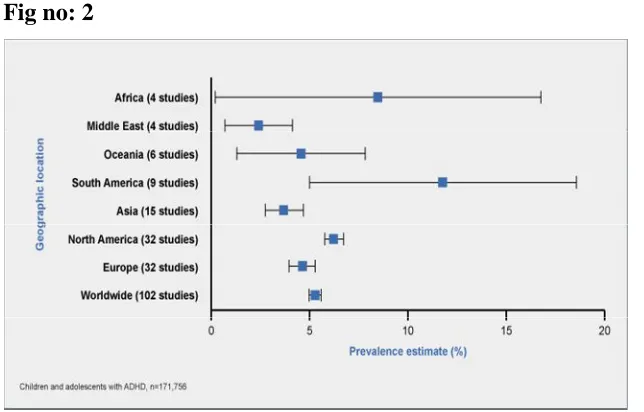
A meta-analysis of studies (n=102) of children and adolescents diagnosed with ADHD
found that the prevalence of ADHD in individuals aged ≤18 years varied between countries
To Study The Attention Deficit Hyperactivity Disorder (ADHD) And To Evaluate The Cognitive, Hyperactive And Impulsive Behavior Against 6-OHDA HBr Lesioned Sprague Dawley Neonates Using HYPERAXE, CURCUMIN & QUERCETIN.
[image:33.612.84.406.94.300.2]Department of Pharmacology Page 12
Fig no: 2
Geographical location was associated with significant variability between the
prevalence estimates from North America and both the Middle East (p=0.01) and Africa
(p=0.03), while no significant differences were reported for prevalence rates between North
America and Europe (p=0.40), South America (p=0.83), Asia (p=0.85) or Oceania (p=0.45).
This finding was confirmed in a meta-regression model using Europe as the comparator:
significant differences in prevalence were found between Europe and both Africa (p=0.05)
and the Middle East (p=0.03).
2.4.1 ADHD IN INDIA:
The prevalence rate of attention deficit hyperactivity disorder (ADHD), a condition
almost always associated with poor academic performance, was 11.3% among primary school
children; behavioral difficulties were found in 36.11% of the children with ADHD.
Although, research on ADHD in India suffers a severe lack of epidemiological studies, it is
estimated that the prevalence figures may not vary much from the rest of the world.There is a
huge gap between the needs and the services available for these children in India.
This is a cross sectional study of school aged children selected from four different schools in
To Study The Attention Deficit Hyperactivity Disorder (ADHD) And To Evaluate The Cognitive, Hyperactive And Impulsive Behavior Against 6-OHDA HBr Lesioned Sprague Dawley Neonates Using HYPERAXE, CURCUMIN & QUERCETIN.
Department of Pharmacology Page 13
Figure no 3: Distribution of ADHD among different age groups in males and females
[22]
2.5 SIGNS AND SYMPTOMS:
2.5.1 CLASSIFICATION OF ADHD BASED ON SYMPTOMS:
Three presentations of ADHD are defined in DSM-5™ based on the predominant
symptom pattern for the past 6 months:17
Combined presentation – all three core features are present and ADHD is diagnosed
when≥6 symptoms of hyperactivity/impulsivity and ≥6 symptoms of inattention have
been observed for≥6 months
Predominantly inattentive presentation–diagnosed if≥6 symptoms of inattention (but
<6 symptoms of hyperactivity/impulsivity) have persisted for≥6 months
Predominantly hyperactive/impulsive presentation – diagnosed if ≥6 symptoms of
hyperactivity/impulsivity (but <6 symptoms of inattention) have been present for ≥6
months.
2.5.2 MAJOR SYMPTOMS:[23]
• Inattention: getting distracted, having poor concentration and organizational skills • Impulsivity: interrupting, taking risks
To Study The Attention Deficit Hyperactivity Disorder (ADHD) And To Evaluate The Cognitive, Hyperactive And Impulsive Behavior Against 6-OHDA HBr Lesioned Sprague Dawley Neonates Using HYPERAXE, CURCUMIN & QUERCETIN.
Department of Pharmacology Page 14
2.5.3 SYMPTOMS TYPES:[23] 2.5.3.1 TYPE 1
PREDOMINANTLY INATTENTIVE ADHD
If you have this type of ADHD, you may experience more symptoms of inattention
than those of impulsivity and hyperactivity. You may struggle with impulse control or
hyperactivity at times. But these aren’t the main characteristics of inattentive ADHD.
People who experience inattentive behavior often: Miss details and are distracted easily Get bored quickly
Have trouble focusing on a single task
Have difficulty organizing thoughts and learning new information Lose pencils, papers, or other items needed to complete a task Don’t seem to listen
Move slowly and appear as if they’re daydreaming
Process information more slowly and less accurately than others Have trouble following directions
More girls are diagnosed with inattentive type ADHD than boys.
2.5.3.2 TYPE 2:
PREDOMINANTLY HYPERACTIVE-IMPULSIVE ADHD:
This type of ADHD is characterized by symptoms of impulsivity and hyperactivity.
People with this type can display signs of inattention, but it’s not as marked as the other
symptoms.
People who are impulsive or hyperactive often: Squirm, fidget, or feel restless
Have difficulty sitting still Talk constantly
Touch and play with objects, even when inappropriate to the task at hand Have trouble engaging in quiet activities
Are constantly “on the go” Are impatient
To Study The Attention Deficit Hyperactivity Disorder (ADHD) And To Evaluate The Cognitive, Hyperactive And Impulsive Behavior Against 6-OHDA HBr Lesioned Sprague Dawley Neonates Using HYPERAXE, CURCUMIN & QUERCETIN.
Department of Pharmacology Page 15
Blurt out answers and inappropriate comments
Children with hyperactive-impulsive type ADHD can be a disruption in the classroom.
They can make learning more difficult for themselves and other students.
2.5.3.3 TYPE 3:
COMBINATION ADHD:
If you have the combination type, it means that your symptoms don’t fit inattention or
hyperactive-impulsive behavior.
Most people, with or without ADHD, experience some degree of inattentive or
impulsive behavior. But it’s more severe in people with ADHD. The behavior occurs
more often and interferes with how you function at home, school, work, and in social
situations.
The National Institute of Mental Health explains that most children have combination
type ADHD. The most common symptom in preschool-aged children is hyperactivity.
The current severity of ADHD should also be specified:
Mild – few, if any, symptoms in excess of those required to make the diagnosis are present,
and symptoms result in no more than minor impairments in social or occupational
functioning.
Moderate–symptoms or functional impairment between ‘mild’ and ‘severe’ are present.
Severe – many symptoms in excess of those required to make the diagnosis, or several
symptoms that are particularly severe, are present; or the symptoms result in marked
impairment in social or occupational functioning.
2.6 ADHD AND RELATED DISEASES OR CONDITIONS:[24]
ADHD doesn’t increase a person’s risk for other conditions or diseases. But some
people with ADHD — especially children — are more likely to experience a range of
co-existing conditions. They can sometimes make social situations more difficult or school more
challenging.
Some co-existing conditions include: Learning disabilities
Conduct disorders and difficulties, including antisocial behavior, fighting, and
To Study The Attention Deficit Hyperactivity Disorder (ADHD) And To Evaluate The Cognitive, Hyperactive And Impulsive Behavior Against 6-OHDA HBr Lesioned Sprague Dawley Neonates Using HYPERAXE, CURCUMIN & QUERCETIN.
Department of Pharmacology Page 16
Depression Bipolar disorder Tourette’s syndrome Substance abuse Bed-wetting problems Sleep disorders
2.7 DIAGNOSIS:[18]
ADHD is diagnosed by a sorting of a being's immature in activity and psychological
exercise, including judgment out the effects of drugs, medications and additional scrutiny or
psychiatric problems as explanations for the symptoms. It oftentimes takes into calculate
feedback from parents and teachers with most diagnoses begun after a pedagogue raises
concerns. It may be viewed as the extreme end of one or more unbroken anthropomorphic
traits open in all fill. Whether someone responds to medications does not corroborate or
restrict out the designation. As imagery studies of the brain do not afford conformable results
between individuals, they are only old for research purposes and not designation.
In Northerly U.S.A., DSM-5 criteria are victimized for designation; spell Inhabitant
countries commonly use the ICD-10. With the DSM-IV criteria a diagnosis of ADHD is 3-4
nowadays much liable than with the ICD-10 criteria. It is grouped as neurodevelopmental
medicine change. Additionally, it is categorized as riotous activity disarray along with
oppositional unwilling condition, carry disarray, and antisocial personality change. A
diagnosing does not require a neurological disorder.
Related conditions that should be screened for countenance anxiety, depression,
oppositional intractable disorder, direct upset and acquisition and faculty disorders.
Remaining conditions that should be reasoned are added neurodevelopmental disorders, tics,
and sleep apnea.
CHARACTERISTIC AND STATISTICAL DRILL:
As with umpteen additional medicine disorders, prescribed diagnosing should be
prefabricated by a qualified athlete based on a set numerate of criteria. In the Federate States,
these criteria are defined by the Dweller Medicine Relationship in the DSM. Based on the
To Study The Attention Deficit Hyperactivity Disorder (ADHD) And To Evaluate The Cognitive, Hyperactive And Impulsive Behavior Against 6-OHDA HBr Lesioned Sprague Dawley Neonates Using HYPERAXE, CURCUMIN & QUERCETIN.
Department of Pharmacology Page 17
ADHD predominantly unalert typewrite (ADHD-PI) presents with symptoms
including beingness easily distracted, forgetful, daydreaming, disturbance, penurious
attention, and difficultness in completing tasks.
ADHD, predominantly hyperactive-impulsive type presents with undue restlessness
and irritation, hyperactivity, sweat waiting and remaining sitting, embryonic doings; harmful
behaviors may also be speak.
ADHD, one identify is a combining of the low two subtypes.
This segment is supported on presence of at minimal six out of nine long-term (long at
small six months) symptoms of inattention, hyperactivity-impulsivity, or both. To be
thoughtful, the symptoms staleness hump appeared by the age of six to seven and become in
more than one environment (e.g. at home and at school time or activity). The symptoms
staleness be not assume for a type of that age and there must be information that it is deed
culture, edifice or operate akin problems.
There are two main classification systems for diagnosing ADHD:
2.7.1 THE INTERNATIONAL CLASSIFICATION OF MENTAL AND BEHAVIORAL
DISORDERS 10TH REVISION (ICD-10):
The ICD-10 medical classification grouping refers to ADHD as hyperkinetic alter
(HKD), a statue widely misused in Accumulation and included in Indweller clinical guidelines
formulated with the Inhabitant Web for Hyperkinetic Disorders (EUNETHYDIS). This
sorting scheme defines HKD as an unrelenting and nonindulgent impairment of psychological
processing, characterized by "earliest onset; a combination of overactive, poorly softened
activity with asterisked inattention and deficiency of unrelenting extend curiosity; and
pervasiveness over situations and durability over clip of these behavioral characteristics".
2.7.2 THE AMERICAN PSYCHIATRIC ASSOCIATION’S DIAGNOSTIC AND
STATISTICAL MANUAL OF MENTAL DISORDERS–5TH EDITION (DSM-5TM) The DSM-5TM scrutiny sorting scheme for ADHD is publicized by the Earth
Psychiatric Relationship and is utilized in the USA and the break of the mankind. This
categorization system defines ADHD as "a continual ornament of inattention and/or
hyperactivity-impulsivity that interferes with process or usage".
To Study The Attention Deficit Hyperactivity Disorder (ADHD) And To Evaluate The Cognitive, Hyperactive And Impulsive Behavior Against 6-OHDA HBr Lesioned Sprague Dawley Neonates Using HYPERAXE, CURCUMIN & QUERCETIN.
Department of Pharmacology Page 18
These medical classification systems may be used solo or in meeting with an array of
rank scales, which often abstraction the scrap of ADHD upon author specialized areas of
running or dimension of lifespan.
2.8 DETECTION TECHNIQUES:[25]
2.8.1 BRAIN FUNCTIONING AND FUNCTIONAL IMAGING TECHNIQUES
Positron Emission Tomography (PET) Multichannel Electroencephalography (EEG) Magneto encephalography (MEG)
Near Infrared Spectroscopic Imaging (NIRSI) Functional Magnetic Resonance Imaging (fMRI)
2.8.1.1 POSITRON EMISSION TOMOGRAPHY (PET)
In PET the mortal is honours injected with a make lived hot tracer isotope. The tracer
is introduced into the body through a biologically live mote. After a ready period the hot
molecules are intent in the desired paper and the message is settled low a scanner to book
radioactive stuff of the tracer. In the impact of decay, the ammunition molecule produces an
antilepton which in play generates two photons soaring in oppositeness directions. The
detector can notice the photons to maneuver the locating of the emission. PET can detect the
execution feed or glucose intake rates, which are the mealy mouthed measures of the
brainpower state levels, by measuring the quantity of syndrome from a positioning. PET data
has gymnasium spatial document (some 1-10 mm) at the expenditure of low temporal finding.
For advance information delight refer to the credit
2.8.1.2 MULTICHANNEL ELECTROENCEPHALOGRAPHY (EEG)
The neurons communicate with each other by exchanging ionized particles through the
synapses. The communication process constitutes the main part of the brain activity which
causes an electrical current in the brain. EEG is a recording technique of brains electrical
current for a short period of time. EEG can record the neuronal activity in a very high
To Study The Attention Deficit Hyperactivity Disorder (ADHD) And To Evaluate The Cognitive, Hyperactive And Impulsive Behavior Against 6-OHDA HBr Lesioned Sprague Dawley Neonates Using HYPERAXE, CURCUMIN & QUERCETIN.
Department of Pharmacology Page 19
2.8.1.3 MAGNETO ENCEPHALOGRAPHY (MEG)
The flow of ionized particles through neurons produces a weak magnetic field in the
brain. MEG is a functional neuroimaging technique which can record the magnetic field
produced by the electrical current due to neuronal activity. The brain activity level is then
mapped with the recorded magnetic field. As the brain’s magnetic field is very weak it is
recorded using extremely sensitive magnetometers which use an array of superconducting
quantum interference devices (SQUIDs). Similar to EEG it has very high temporal resolution
and low spatial resolution.
2.8.1.4 NEAR INFRARED SPECTROSCOPIC IMAGING (NIRSI)
NIRSI is a non-invasive optical imaging technique which can be used as a functional
brain imaging method. NIRSI uses near infrared (from about 800 nm to 2500 nm)
electromagnetic signal to measure blood oxygenation changes in blood vessels of the brain by
measuring the absorption of the near infrared signal emitted by the source onto the brain
surface. The advantage of NIRSI is it is inexpensive, portable and can be used even when the
subject is moving. NIRSI and functional Magnetic Resonance Imaging (fMRI) produce
similar data as some previous studies have shown close spatial and temporal correlations
when the data is recorded using the two methods.
2.8.1.5 FUNCTIONAL MAGNETIC RESONANCE IMAGING (FMRI)
As we used fMRI data for solving the ADHD classification problem, we provide the
basic principles behind the data capturing method. The core concept of fMRI is based on the
idea of the Nuclear Magnetic Resonance (NMR) technology which has been around for a long
time.
NMR has a widespread application in the biomedical field for analyzing the
characteristics of bio-molecules. The basic principles of NMR are explained in the next few
sections without going into the mathematical details. The interested readers are referred to the
following document for further details
2.9 PATHOPHYSIOLOGY OF ADHD:[26]
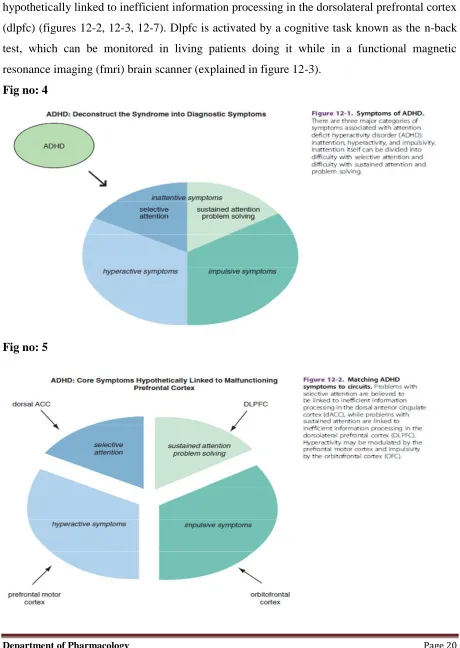
ADHD is noted for a trio of symptoms: inattention, hyperactivity, and impulsivity
(figure 12-1). It is currently hypothesized that all these symptoms arise in part from
abnormalities in various circuits involving the prefrontal cortex (figures 12-2 through 12-8).
To Study The Attention Deficit Hyperactivity Disorder (ADHD) And To Evaluate The Cognitive, Hyperactive And Impulsive Behavior Against 6-OHDA HBr Lesioned Sprague Dawley Neonates Using HYPERAXE, CURCUMIN & QUERCETIN.
Department of Pharmacology Page 20
executive dys- function and as the inability to sustain attention and thus to solve problems, are
hypothetically linked to inefficient information processing in the dorsolateral prefrontal cortex
(dlpfc) (figures 12-2, 12-3, 12-7). Dlpfc is activated by a cognitive task known as the n-back
test, which can be monitored in living patients doing it while in a functional magnetic
resonance imaging (fmri) brain scanner (explained in figure 12-3).
[image:41.612.83.543.93.741.2]Fig no: 4
To Study The Attention Deficit Hyperactivity Disorder (ADHD) And To Evaluate The Cognitive, Hyperactive And Impulsive Behavior Against 6-OHDA HBr Lesioned Sprague Dawley Neonates Using HYPERAXE, CURCUMIN & QUERCETIN.
[image:43.612.91.424.83.418.2]Department of Pharmacology Page 22
Fig no: 8
One can see how inefficient information processing in this particular DLPFC circuit
when put under a cognitive “load” can be associated with the same symptom in many
different psychiatric disorders. This is why diagnosis in psychiatry is now moving from
describing categorical syndromes that mix together many symptoms (as in the DSM and
ICD), towards characterizing single symptom domains such as executive dysfunction that cut
across many psychiatric disorders, sometimes called Research Domain Criteria (RDC) for
future diagnostic schemes that are set up to better correlate with neuroimaging and genetic
findings.
Another symptom of ADHD is selective inattention, or not being able to focus, and
thus differing from the executive dysfunction described above. The symptom of difficulty
focusing is hypothetically linked to inefficient information processing in a different brain area,
namely the dorsal anterior cingulate cortex (dACC) (Figures 12-2, 12-4, 12-7). The dACC can
be activated by tests of selective attention, such as the Stroop test (explained in Figure 12-4).
To Study The Attention Deficit Hyperactivity Disorder (ADHD) And To Evaluate The Cognitive, Hyperactive And Impulsive Behavior Against 6-OHDA HBr Lesioned Sprague Dawley Neonates Using HYPERAXE, CURCUMIN & QUERCETIN.
Department of Pharmacology Page 23
attention, or they activate this part of the brain very inefficiently and only with great effort and
easy fatigability.
Other areas of prefrontal cortex that are hypothetically not functioning efficiently in
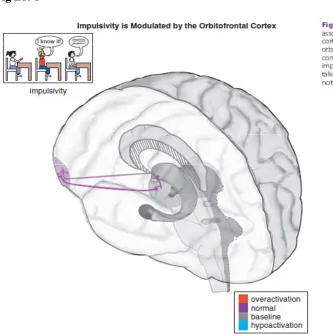
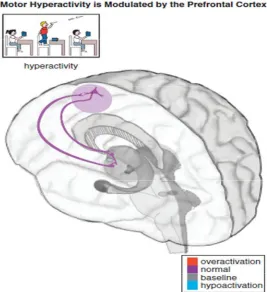
ADHD are the orbitofrontal cortex (OFC), linked to symptoms of impulsivity (Figures 12-2,
12-5, 12-7) and the supplementary motor area, linked to symptoms of motor hyperactivity
(Figures 12-2, 12-6, 12-7). The OFC is hypothetically linked to a wide variety of symptoms
that cut across several psychiatric conditions, including impulsivity in ADHD (Figures 12-2,
12-5, 12-7), impulsivity and violence in schizophrenia, suicidality in depression, impulsivity
in mania, and impulsivity/compulsivity in substance abuse. Impulsive symptoms in other
psychiatric conditions commonly comorbid with ADHD are also hypothetically related to the
orbitofrontal cortex, such as conduct disorder, oppositional defiant disorder, and bipolar
[image:44.612.105.372.348.640.2]disorder (Figure 12-8).
To Study The Attention Deficit Hyperactivity Disorder (ADHD) And To Evaluate The Cognitive, Hyperactive And Impulsive Behavior Against 6-OHDA HBr Lesioned Sprague Dawley Neonates Using HYPERAXE, CURCUMIN & QUERCETIN.
Department of Pharmacology Page 24
ADHD as a disorder of inefficient “tuning” of the prefrontal cortex by dopamine and
norepinephrine
ADHD patients generally cannot activate prefrontal cortex areas appropriately in
response to cognitive tasks of attention and executive functioning. Some studies suggest that
this is because dopamine (DA) and norepinephrine (NE) dysregulation in ADHD prevents the
normal “tuning” of pyramidal neurons in the prefrontal cortex. In the case of DA and NE
neurons, their normal firing at baseline is considered slow and “tonic,” stimulating a few
receptors on postsynaptic neurons and allowing for optimal signal transmission and
downstream neuronal firing (Figure 12-9). Modest levels of NE release will hypothetically
improve prefrontal cortical function by stimulating postsynaptic α2A receptors, but high
levels of NE release will lead to impaired working memory when α1 and β1 receptors are also
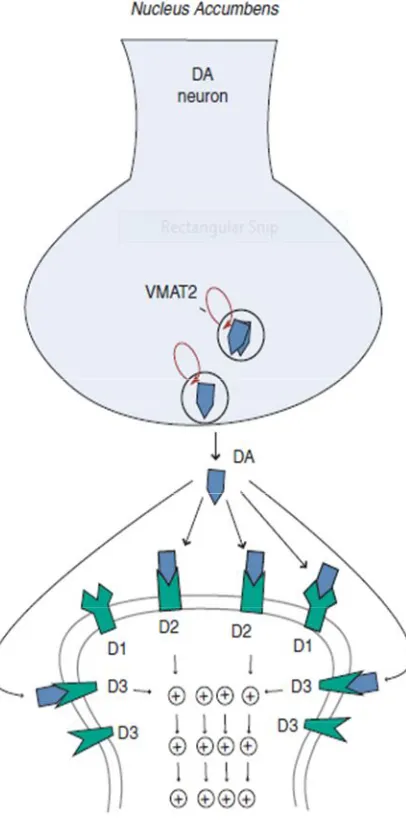
recruited (Figure 12-9). Similarly, modest levels of DA will first stimulate D3 receptors, as
these are more sensitive to DA than D1 or D2 receptors (Figure 12-9). Hypothetically, low to
moderate, but not high, levels of D1 receptor stimulation is beneficial to optimizing prefrontal
cortical functioning.
Dopamine neurons in particular can also exhibit bursts of firing, called phasic (Figure
12-10). Phasic DA release is thought to reinforce learning and reward conditioning, providing
the motivation to pursue naturally rewarding experiences such as education, recognition,
career development, enriching social and family connections, etc. When the phasic DA system
is hijacked by drugs, it can induce uncontrolled DA firing that reinforces the reward of drug
abuse, and lead to compulsive behaviors such as mindless self-destructive drug. Thus, finely
tuning the DA reward pathway in the nucleus accumbens and its connections to the amygdala
and prefrontal cortex by attaining a low level of phasic firing in relation to tonic firing will
theoretically lead to proper functioning of this complex system.
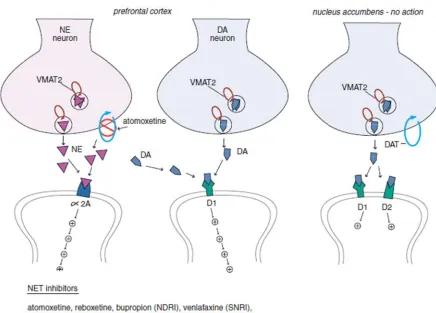
In ADHD, imbalances in NE and DA circuits in the prefrontal cortex hypothetically
cause inefficient information processing in prefrontal circuits, and thus the symptoms of
ADHD. At the level of NE and DA synapses in the prefrontal cortex, deficient signaling in
prefrontal cortical DA and NE pathways is reflected by decreased neurotransmission and thus
reduced stimulation of postsynaptic receptors (Figure 12-11). Agents that can lead to
increased release of these two neurotransmitters or increased tonic firing of these neurons will