EFFICACY OF ONE-LEGGED VS TWO LEG EXERCISE
TRAINING IN ENHANCINGAEROBIC CAPACITY OF
PATIENTS OF COPD
MADHA COLLEGE OF PHYSIOTHERAPY
(Affiliated to Tamil Nadu Dr.M.G.R. Medical University, Chennai32) Madha Nagar, Kundrathur, Chennai-600069
Tamil Nadu.
OCTOBER-2017
EFFICACY OF ONE-LEGGED VS TWO LEG EXERCISE
TRAINING IN ENHANCINGAEROBIC CAPACITY OF
PATIENTS OF COPD
ADVISOR
Prof.V.VIJAI KRISHNA, MPT., MIAP
Madha College of Physiotherapy Madha Nagar, Kundrathur
Chennai-600069
EXAMINERS
1.
2.
A Project submitted to
THE TAMIL NADU DR.M.G.R. MEDICAL UNIVERSITY, CHENNAI
In partial fulfillment for the requirement of the degree of
MASTERS OF PHYSIOTHERAPY
CERTIFICATE
This is to certify that the project title “EFFICACY OF ONE-LEGGED VS TWO
LEG EXERCISE TRAINING IN ENHANCINGAEROBIC CAPACITY OF PATIENTS OF COPD is a bonafide record of work done under by guidance supervision in the partial fulfillment for the degree of MASTER OF PHYSIOTHERAPY(M.P.T IInd Year - OCTOBER 2017) by RANJITH JOEL SIMEON.P Register Number: 27113242Post graduate student of Madha College of Physiotherapy.
GUIDE PRINCIPAL
ACKNOWLEDGEMENT
Firstly, I express my immense gratitude to MY GOD ALMIGHTY for his abundant grace and mercy that enabled me to venture in every part of my life. With a grateful heart I would also like to thank my thesis advisor and Principal Prof.
V.VIJAIKRISHNA MPT, MIAP. The door to Prof. V.VIJAIKRISHNA MPT, MIAP office was always open whenever I ran into a trouble spot about my research. He consistently steered me in the right the direction whenever he thought I needed it. I would also like to acknowledge Associate Prof S.NAGARAJ M.P.T, MIAP, PG CDE. as the reader of this thesis. Without his passionate encouragement this would not have been possible.
In addition, I am gratefully indebted to Associate Prof. MRS.MERCY CLARA
M.P.T., MIAP for her very valuable support and knowledgeable comments on this thesis.
INTRODUCTION
Chronic obstructive pulmonary disease (COPD) is the most common disorder affecting 10-15% of adult over the age of 40. COPD is a disorder characterized by the presence of air flow obstruction that is generally progressive may be accompanied by airway hyper reactivity and may partially reversible.
COPD patients shows marked decrease in the lung volumes and lung capacities leads to decrease arterial oxygen saturaisation level and over all it affects the aerobic and exercise tolerance capacity of the persons. In initial stage it produces hypoxemia and in later stage hypercapnia will occur.
The cornerstone of pulmonary rehabilitation is exercise training based on the premise that altering physiologic process will result in improved outcomes. Intensity and duration are important determinants of the physiologic adaptation that occur in response to exercise.
COPD patients are so limited by dyspnea,even at modest level of ventilation that their training is restricted to low intensity exercise. As a result, when undergoing exercise training they are usually unable to increase their peak oxygen uptake (vo2))
although this measuresis the recognized standard for confirming the physiologic effects of aerobic exercise training.COPD patients undergoing conventional two-legged training are unable to increase their peak (vo2) because of ventilator limitation.
STATEMENT OF THE STUDY
Effectiveness of ONE leg exercise training on improving aerobic capacity in patients with COPD.
NEED OF THE STUDY
In COPD exercise training is limited by dyspnoea and their aerobic capacity also decreased.COPD patients are unable to increase their peak oxygen uptake (vo2). It
is known that one leg exercise training improves aerobic capacity.
AIM OF THE STUDY
The aim of study is to find out the effectiveness of one – lag exercise training in improving aerobic capacity for patients with COPD against two – lag exercise training.
OBJETIVES OF THE STUDY
To find the effectiveness of one – legged exercise training in improving aerobic capacity for patients with COPD.
To find the effectiveness of two – legged exercise training in improving aerobic capacity for patients with COPD.
HYPOTHESIS
Alternate Hypothesis
There will be significant difference between one – legged and two – legged Exercise training in improving aerobic capacity for patients with COPD.
Null Hypothesis
OPERATIONAL DEFINITIONS
COPD
COPD is a disorder characterized by the presence of air flow obstruction that is generally progressive may be accompanied by airway hyper reactivity and may partially reversible.
VO2 MAX
O2 max (also maximal oxygen consumption, maximal oxygen uptake, peak
oxygen uptake or aerobic capacity) is the maximum capacity of an individual's body to transport and use oxygen during incremental exercise, which reflects the physical fitness of the individual.
SpO2
REVIEW OF LITERATURE
1. WHO
COPD is a disorder characterized by the presence of air flow obstruction that is generally progressive may be accompanied by air way hyper reactivity and may partially reversible.
2. THOMAS E.DOLMAGE (2005)
COPD patients undergoing conventional two-legged exercise training are unable to increase their peak Vo2because of ventilator limitation.
3. DAVIS CT, SARGEANT, (1974)
COPD Patients cannot tolerate conventional high intensity exercise for sufficient time to induce changes in peripheral muscle metabolism.
4. RICHARDSON et al (2007)
Reported that a metabolic reserve existed during single leg extension exercise .Rhythmic extension of one leg which used a working muscle mass of only 12.5% of the muscle mass required for cycling, required 80% of the ventilator capacity.
5. THOMAS E. DOLMAGE (2006)
6. ROGERS.GOLDSTEIN (2005)
One legged cycle training required no specific learning, and patients found it at least as comfortable as two legged training because leg fatigue is better tolerated than dyspnea. One legged cycle training does not preclude other strategies to improve exercise tolerance, such as supplemental oxygen, mechanically ventilated assistance.
7. MILLER, MR (2006)
One legged cycle training enhances the adaptive response of peripheral muscle, resulting in increased peak (Vo2), PPK, and peakVE.
8. ACEVEDOEO (2007)
COPD patients achieved more work when cycling with one leg. Despite the same load being applied to the muscle. One leg exercise placed same metabolic and functional demand on the targeted muscle, at a lower metabolic load, and hence a low ventilator load.
9. DOLMAGE (2008)
One leg exercise, at half the load of two legged exercise will place the same demand on the muscles, but as the total metabolic load, and therefore the ventilator load is less than two legged exercise.
10. WAGNER.P(1986)
DESIGN AND METHODOLOGY
RESEARCH DESIGN
Matched subject experimental design
STUDY SETUP
MIOT HOSPITALS, CHENNAI, GLOBAL HOSPITAL AND HEALTH CITY,CHENNAI
SAMPLING CRITERIA
Inclusion Criteria
1. Clinically stable COPDpatients 2. Male subjects
3. Age group 40-65
4. Subject with smoking abstinence
Exclusion Criteria
1. Subjects with other pulmonary disorders 2. Subjects with osteoporosis and tuberculosis 3. Subjects with hypoxemia at rest
4. Subjects with neurological conditions
All COPD patients, who fulfill the inclusion criteria, were included in this study
SAMPLE SIZE
Total sample size is 30.They were selected from the population by using convenient sampling procedure.
Group-I
Single leg exercise training(experimental group)
Group-II
Double legged exercise training(controlled group)
VARIABLES
Depandant Variables
VO2 Max
SpO2
Independent Variables
1. Single legged exercise training 2. Double legged exercise training
MATERIAL USED
METHODOLOGY
Group-I was receiving Single leg exercise training & GROUP-II was receiving double leg exercise training.
Before giving the independent variables for each group an assessment was taken and pre test scores of VO2 Max and Sao2 were recorded.
GROUP-I
Before starting the exercise program clear explanation about the training was explained to the subjects.
Single leg exercise training was given in Electro mechanically bracked cycle. The inactive foot was rested on a cross bar located midway on the ergo meter head tube. The first half of the training was given in right leg and the other half of training was given on the left leg. (15 minutes on each leg)
The intensity was set as 50% of the peak power and reduced as necessary to achieve 30 minutes of cycling. In the first week of the program subjects were trained at40% peak power. Once the subject reached 30 min for consecutive session, then the training workload was increased about 5%.
This training program was given three times per week for six months.
After the administration of Single leg exercise training the post test scores of VO2 Max and SaO2 were recorded. The other parameters mainly heart rate, blood
GROUP-II
Before starting the exercise program clear explanation about the training was explained to the subjects.
DATA ANALYSIS
INTRODUCTION
The present chapter deals with the important aspect of investigating data collected on VO2Max and SPO2 of 30 sampled subjects to answer research questions
through employing suitable statistical techniques.
A sample of 30 chronic obstructive pulmonary disease subjects matched on baseline characteristics were selected through simple random sampling and were divided into two equal groups of 15 in each. One group was treated with single leg exercise training and other group was treated with double leg exercise training. The data on VO2Max andSPO2 was carefully assessed and recorded through the reliable
and valuable instrument of radio telemetric bicycle ergo meter and pulse oximeter with full of accuracy.
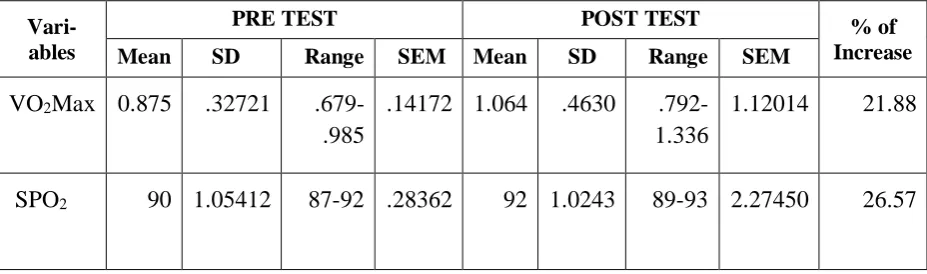
TABLE 4.1 MEAN, STANDARD DEVIATION, RANGE FOR GROUP I
Vari-ables
PRE TEST POST TEST % of
Increase
Mean SD Range SEM Mean SD Range SEM
VO2Max 0.875 .32721
.679-.985
.14172 1.064 .4630
.792-1.336
1.12014 21.88
SPO2 90 1.05412 87-92 .28362 92 1.0243 89-93 2.27450 26.57
The statistical outcomes of descriptive measures of VO2Max and SPO2 before
and after single leg training are glanced in Table 4.1.
The observed mean 0.875of with standard deviation of .32721 of VO2Max for
single leg training before the interventions is increased to the mean of 1.064 with standard deviation of .4630 of VO2Max after the intervention the percentage is
increased in 21.88% with the range changed from .679-.985 to .792-1.1336
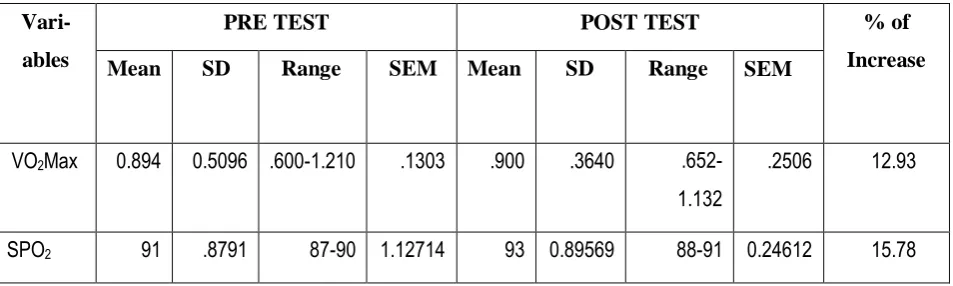
TABLE 4.2 MEAN, STANDARD DEVIATION, RANGE FOR GROUP II
Vari-ables
PRE TEST POST TEST % of
Increase
Mean SD Range SEM Mean SD Range SEM
VO2Max 0.894 0.5096 .600-1.210 .1303 .900 .3640
.652-1.132
.2506 12.93
SPO2 91 .8791 87-90 1.12714 93 0.89569 88-91 0.24612 15.78
The statistical outcomes of descriptive measures on VO2Max and SPO2 before
and after the administration of double leg training are glanced in Table 4.2. The meanVO2Max before intervention was 0.894 and standard deviation of
0.5096 and it increased to mean VO2Max as mean of .900 with standard deviation of .3640after the intervention the range also found to be increased from .600-1.210 to .652-1.132 and 12.93% of increase.
The mean SPO2 before intervention was 93 and standard deviation of 0.8791
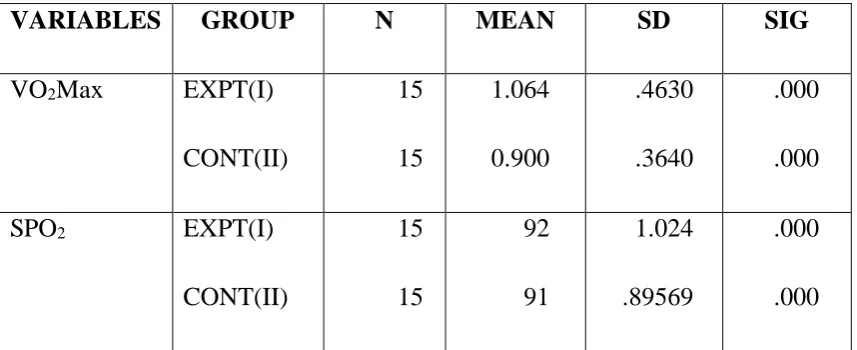
TABLE 4.3
VARIABLES GROUP N MEAN SD SIG
VO2Max EXPT(I)
CONT(II) 15 15 1.064 0.900 .4630 .3640 .000 .000 SPO2 EXPT(I)
CONT(II) 15 15 92 91 1.024 .89569 .000 .000
The table 4.3 shows the mean of VO2Max in Group I is1.064 and is Group II is
.900. The result shows that there is a significant difference between the groups
The mean SPO2inGroup I is 92 and in Group II is 91. The result shows that
4.1 COMPARISON OF MEAN OF VO2 MAX IN GROUP 1 AND
RESULTS
The study was done on 30 subjects, which consisted of 15 subjects each for 15days duration.
The results show that:
1. Mean value of independent variable between pre and post score of Group-I shows significant difference in improvement.
2. Mean value of different variable between pre and post scoreof Group-II shows less significant difference in improvement.
3. Paired’t’ tests value of pre and post score shows significant difference in experimental group.
4. Paired’t’ tests value of pre and post score shows less significant difference in control group.
5. In Paired’t’ tests of experimental group shows highly significant difference in improving Aerobic capacity on COPD patients.
6. The mean difference of experimental group shows significant difference in improving Aerobic capacity on COPD patients.
7. The mean difference of control group shows less significant difference in improving Aerobic capacity while comparing to experimental group.
30 subjects were taken to compare the effectiveness of single leg trainingverses double leg training. In this study the statistical analysis showed that effective in improving in lung function than conventional chest physiotherapy.
The result of the study showed thatsingle leg trainingshowed significant in aerobic capacity in COPD patients than double leg training.
Statistical mean value of single leg trainingofpre test and post test score were 0.875\90. to1.064\92 by experimental group.The post test score shows significant in aerobic capacity than the pre test score in COPD patients.
Statistical mean value of the double leg training of pre test and post test score were.894\91 to.900\93 by control group. The post test score shows less significant in aerobic capacity than the pre test score in COPD patients.The above mentioned statistical outcomes also supports the results of this study
One legged cycle training required no specific learning, and patients found it at least as comfortable as two legged training because leg fatigue is better tolerated than dyspnea. One legged cycle training does not preclude other strategies to improve exercise tolerance, such as supplemental oxygen, mechanically ventilated assistance(ROGERS.GOLDSTEIN (2005))
Sample size of the study was small to derive accurate conclusion.
The duration is six months and here the long term improvements in lung function with this improvement program are not obvious with this study.
SCOPE FOR FURTHER STUDY
Similar study can be concluded on large sample.
Duration of the study can be increased.
REFERENCES
1. Cardio Pulmonary Clinical Manual -Joanne Watchie1992 2. Pulmonary rehabilitation - John R Bach
3. Physiotherapy For Respiratory And Cardiac Problems -Jennifer A Proyor, S Ammani
4. Cardiopulmonary Rehabilitation -Elizabeth Dean 5. Tidy’s physiotherapy -Ann Thompson Et Al 6. Cardiopulmonary physical therapy -Scott Erwin
7. Cash’s text book of chest heart and vascular disorders- -Patricia A Downie 8. Pulmonary Rehabilitation - John E Hodgin
9. Chest physiotherapy in pulmonary patients - Favroux Et Al 1999
10.Principles and practices of pulmonary rehabilitation -Cassburi Petty 1993 11.Journals of physical therapy sciences
12.www.google.com 13.www.pubmed.com 14.www.apta.org
15.www.chest journels.com
PERFORMA
Name :
Age :
Gender : Male/Female Occupation :
Marital status : Single/Married/Widowed/Divorced Chief complaints :
a. Cough : b. Sputum : c. Wheeze : d. Duration : e. Dyspnea : f. Other chest illness : Past medical history : Occupational history :
Personal history : Smoking/Alcoholic Family history :
VITAL SIGNS
i. Heart rate : ii. Pulse : iii. Blood pressure : iv. Respiratory rate : v. Temperature :
ON OBSERVATION
General appearance :
Cyanosis : Central/Peripheral Breathing pattern :
Head and neck:
Facial expression, type and pattern of breathing jugular vein enlargement, hypertrophy accessory muscles of respiration.
Periphery : Clubbing of digits : Chest shape and posture :
Gait :
Chest expansion :
Axilla :
Xiphoid :
Subcostal : Position of trachea :
Fremitus :
PERCUSSION
AUSCULTATION :
1. Heart Sounds :
2. Breath Sounds :
INVESTIGATION :
1. Chest X ray : 2. Sputum culture sensitivity : 3. Bronchoscopy : 4. CT chest : 5. Pulmonary Function Test :
VARIABLES PRE TEST POST TEST
SPO2
MASTER CHART
Sl. No
Experimental Group Control Group
VO2 Max SPO2 VO2 Max SPO2
Pre- test Post – test Pre – test Post- test Pre- test Post- Test Pre- Test Post -test
1 0.5475 0.6010 88.9458 8
90.97 57
0.3854 0.536 90.1209 92.1043 1
2 0.6220 0.7450 89.0015 0
91.00 25
0.4789 0.597 90.2254 92.1547 8
3 0.7400 0.6840 89.0058 9
91.14 56
0.4701 0.645 90.3254 92.2048 7
4 0.7600 0.7980 89.1245 6
91.28 91
0.5874 0.715 90.5648 92.3457 1
5 0.8050 0.8450 89.2248 9
91.60 01
0.6487 0.725 90.6548 92.5645 7
6 0.8250 0.8840 89.3489 7
91.69 87
0.6954 0.825 90.7548 92.7845 6
7 0.8450 0.9750 89.4145 8
91.89 74
0.8457 0.892 90.8987 92.8974 5
8 0.8750 1.0640 89.9874 5
92.00 00
0.8940 0.900 91.000 93.0000 0
9 0.9210 1.1250 90.1478 5
92.29 99
0.9124 0.925 91.1247 93.1012 4
10 0.9540 1.1970 90.5897 4
92.35 64
o.9875 1.005 91.2487 93.1145 7
11 0.9560 1.2950 91.0278 9
92.45 67
1.1356 1.025 91.3662 93.3456 7
12 0.9220 1.3720 91.0378 9
92.68 97
13 1.0200 1.3920 91.0458 9
92.74 58
1.3256 1.183 91.5678 93.5698 4
14 1.1300 1.4560 91.0524 5
92.94 57
1.3947 1.140 91.7898 93.7456 8
15 1.2022 1.5270 91.0542 1
93.02 43
1.4036 1.264 91.8791 93.8956 9
INFORMED CONSENT FORM
I___________________ agree to participate in the research study conducted by Mr.P.RANJITH JOEL SIMEON, 2nd year, M.P.T., [CARDIO RESPIRATORY], MADHA COLLEGE OF PHYSIOTHERAPY entitled
“EFFECTIVENESS OF ONE-LEGGED EXERCISE TRAINING IN
IMPROVING AEROBIC CAPACITY OF PATIENTS WITH COPD” Patient. I acknowledge that the research study has been explained to me and I understand that agreeing to participate in the research means that I am willing to,
Provide information about my health status to the researcher[s].
Allow the researcher[s] to have access to my professional records pertaining to the purpose of the study
Participate in training program for duration of two weeks.
Make myself available for follow up.
Understand and follow the home advice[s] that will be provided.
I have been informed about the purpose; procedure[s], measurement[s], and risk[s] involved in the research and my queries towards the research and have been clarified.
I provide consent to the researcher to use the information ,video recording[s],for research and educational purpose only.
I understand that my participation is voluntary and can withdraw at any stage of the research project
Name of the participant Date