Research-Teaching Linkages:
enhancing graduate attributes
enhancing graduate attributes
Scottish Funding Council (SFC), Universities Scotland, the National Union of Students in Scotland (NUS Scotland) and the Quality Assurance Agency for Higher Education (QAA) Scotland. The Higher Education Academy has also joined that partnership. The Enhancement Themes are a key element of a five-part framework, which has been designed to provide an integrated approach to quality assurance and enhancement. The Enhancement Themes support learners and staff at all levels in further improving higher education in Scotland; they draw on developing innovative practice within the UK and internationally. The five elements of the framework are:
z a comprehensive programme of subject-level reviews undertaken by higher education institutions (HEIs) themselves; guidance is published by the SFC (www.sfc.ac.uk)
z enhancement-led institutional review (ELIR), run by QAA Scotland (www.qaa.ac.uk/reviews/ELIR)
z improved forms of public information about quality; guidance is provided by the SFC (www.sfc.ac.uk)
z a greater voice for students in institutional quality systems, supported by a national development service - student participation in quality scotland (sparqs)
(www.sparqs.org.uk)
z a national programme of Enhancement Themes aimed at developing and sharing
good practice to enhance the student learning experience, facilitated by QAA Scotland (www.enhancementthemes.ac.uk).
The topics for the Enhancement Themes are identified through consultation with the sector and implemented by steering committees whose members are drawn from the sector and the student body. The steering committees have the task of establishing a programme of development activities, which draw on national and international good practice. Publications emerging from each Theme are intended to provide important reference points for HEIs in the ongoing strategic enhancement of their teaching and learning provision. Full details of each Theme, its steering committee, the range of research and development activities as well as the outcomes are published on the Enhancement Themes website (www.enhancementthemes.ac.uk).
To further support the implementation and embedding of a quality enhancement culture within the sector - including taking forward the outcomes of the Enhancement Themes - an overarching committee, the Scottish Higher Education Enhancement Committee (SHEEC), chaired by Professor Kenneth Miller, Vice-Principal, University of Strathclyde, has the important dual role of supporting the overall approach of the Enhancement Themes, including the five-year rolling plan, as well as institutional enhancement strategies and management of quality. SHEEC, working with the individual topic-based Enhancement Themes' steering committees, will continue to provide a powerful vehicle for progressing the enhancement-led approach to quality and standards in Scottish higher education.
1 Executive summary 3
2 Introduction and background 6
2.1 The links between research and teaching 6
2.2 Research-teaching linkages in the Physical Sciences 9
2.3 Progression of the project 10
2.4 Case study on developing graduate attributes 11
2.5 Structure of the report 14
3 Case studies and snapshots 16
3.1 Telling students about research, encouraging an atmosphere
of independent learning 16
3.2 Implementation in first-year classes 22
3.3 Transferable and professional skills development 33
3.4 Communicating science 39
3.5 Learning through case studies 40
3.6 Research opportunities 47
3.7 Internships and placements 51
3.8 Project skills preparation, learning what research is 55
3.9 Group research project 62
3.10 Final-year research project 66
4 Discussion and recommendations 70
4.1 Discussion 70
4.2 Recommendations 71
5 References 73
Foreword
This Enhancement Themes project - Research-Teaching Linkages: enhancing graduate attributes - has over the last two years asked institutions, departments, faculties, disciplines, staff and students to reflect on the intended outcomes of HE, and has examined how links between research and teaching can help develop 'research-type' graduate attributes. The 'attributes' in question are the high-level generic attributes that are necessary to allow our graduates to contribute to and thrive in a super-complex and uncertain future where the ability to question, collate, present and make judgements, quite often with limited or unknown information, is increasingly important; key
attributes, it is argued, that are necessary for our graduates to contribute effectively to Scotland's civic, cultural and economic future prosperity.
The Enhancement Theme adopted a broad, inclusive definition of research to embrace practice/consultancy-led research; research of local economic significance; contributions to the work of associated research institutes or other universities; and various types of practice-based and applied research including performances, creative works and industrial or professional secondments.
The Enhancement Themes comprise one sector-wide project and nine disciplinary projects: Physical sciences; Information and mathematical sciences; Arts, humanities and social sciences; Health and social care; Business and management; Life sciences; Creative and cultural practice; Medicine, dentistry and veterinary medicine; and Engineering and the built environment. The aim of the projects was to identify, share and build on good and innovative practice in utilising research-teaching linkages to enhance the
achievement of graduate attributes at the subject level. The sector-wide project comprised an ongoing discussion within and between Higher Education Institutions, involving staff and students reflecting on and exploring research-teaching linkages, how they can be structured and developed to achieve 'research-type' attributes, and how students are made aware of the nature and purpose of these in order to fully articulate and understand their achievements as graduates.
Research-Teaching Linkages: enhancing graduate attributes has provided the sector with a focus for reflection on the nature and outcomes of HE - along with the opportunity to develop a rich array of resources and supportive networks to add to the student learning experience and enable our graduates to contribute effectively to Scotland's future.
Professor Andrea Nolan
1 Executive summary
W
Whhaatt iiss tthhiiss rreeppo
orrtt??
This report represents one of the outputs of the Physical Sciences discipline project of the Enhancement Theme on Research-Teaching Linkages: enhancing graduate attributes. It takes the form of an extensive series of case studies and snapshots of current practice from physics and chemistry throughout (and occasionally outside) Scotland, grouped according to practical ways of enhancing research-teaching linkages in the
undergraduate curriculum.
We have attempted to identify the breadth of what research-teaching linkages in the Physical Sciences in Scotland actually map on to, in terms of activities at the 'coalface' of undergraduate teaching and learning. Contrary to what we think may be the common consensus within departments, this is not just about the final-year honours project (though that quite rightly remains a capstone of the undergraduate research-teaching experience), even in subjects where undergraduate curricula are built on the principles of predominantly linear construction of subject knowledge.
W
Whhaatt ddo
oeess iitt cco
onnttaaiinn??
Our project made contact with all deans of undergraduate study and directors of teaching/learning in all physics and chemistry departments throughout Scotland. From these contacts we obtained detailed information about practices within the departments and illustrations of how they forged links between teaching and research in the broadest sense. The members of the project team were genuinely surprised at the range and quality of what was being done within the sector in Scotland to more closely integrate these two key activities.
We never expected to unearth so much when we began this project in early 2007 - a handful of case studies was our initial expectation. But we found a great deal more. So rather than lose some of the detail captured, we chose to expound as many case studies as we could. We also opted to retain other insights, presented in the form of brief snapshots of a particular activity, along with further contact details and online
information. The range of activities we uncovered is one reason why this document is as long as it is. We have tried to keep the wrapping around the case studies and snapshots to a minimum, as the most valuable part of this report is what they have to say. The accompanying project website (http://physci.rtl.googlepages.com) contains all the case studies and project documentation in a slightly more granular form.
W
Whhaatt aarree sso
om
mee o
off tthhee pprro
ojjeecctt ffiinnddiinnggss??
The project found several examples of ways to 're-invent' early-years practical laboratory work. It is often felt that early-years teaching in the Physical Sciences is one of the most difficult areas in which to integrate research-based activities, because of large class sizes and elementary (sometimes familiar) material. However, our case studies illustrated a variety of different ways in which this could be achieved. For example, the Physics Department at the University of Glasgow has replaced traditional laboratory work with 'experimental tutorials' that more closely couple the formally taught topics with practical activities.
We found a broad range of activities devoted to enhancing transferable or graduate skills. These were not bolted on as an afterthought to existing courses, but rooted firmly in the specific discipline context. The challenge in such courses is to develop these skills alongside extending physics or chemistry knowledge. A good example is the transferable skills module in the third year of the Physics programme at the University of St Andrews, which does exactly this while enhancing skills in finding and critically evaluating
information, communicating orally and in written form, teamwork and information technology (IT).
Several opportunities exist for students on physics and chemistry programmes to experience research first hand well before their final-year projects. These research opportunities may be extracurricular or part of timetabled classes, in term time or as internships and placements. A unique opportunity is described from Liverpool John Moores University, using the Liverpool Telescope - the world's largest fully robotic telescope. As part of a number of level 1 distance learning courses in astronomy, students can apply for observation time using the telescope, going through all stages of the research process of planning observations and collecting then reducing data before analysis.
The final-year honours project is still the capstone of research-teaching linkage in practically all physics and chemistry courses, and we have tried to synthesise what is done in this area across the sector. Prior to the honours project in the curriculum, we found a range of different project skills preparation activities. The emphasis in these was on developing the required skills through structured activities, enabling students to make the most of the project work that subsequently follows. In the School of Chemistry at the University of Edinburgh, the Training in Research Methods course exposes students to a series of activities and mini projects across a range of topic areas. The aim is to develop students'practical research skills and provide an introduction to the methods, techniques and instrumentation in different areas of chemistry.
W
Whho
o sshho
ouulldd rreeaadd tthhiiss rreeppo
orrtt??
We believe this report is of relevance to, and hope it will be read by, staff from different backgrounds and with different responsibilities. For physical sciences discipline-based academic staff, it provides a complete picture of what is being done where, much of which would be transferable and adaptable to different contexts. Equally, it is of relevance to staff in leadership roles within academic departments and to those who contribute to academic policy within institutions.
Much of what is described here is also of relevance to colleagues in similar subjects (such as engineering, other sciences, and mathematics) and to educational developers. Finally, Higher Education Academy (HEA) Physical Sciences Centre colleagues
2 Introduction and background
22..11
TThhee lliinnkkss bbeettw
weeeenn rreesseeaarrcchh aanndd tteeaacchhiinngg
'Universities need to set as a mission goal the improvement of the nexus between research and teaching....The aim is to increase the circumstances in which
teaching and research have occasion to meet' (Hattie and Marsh,1996).
This report is one of the outputs from the Physical Sciences discipline project of the Enhancement Theme on Research-Teaching Linkages: Enhancing Graduate Attributes. It sets out effective, practical ways in which research-teaching linkages can be useful in supporting and enhancing the acquisition of research-type graduate skills in the Physical Sciences in Scotland. Drawing on an extensive series of case studies, we survey the breadth of current practice in this area, providing practical insights for course developers and academic staff in the discipline.
But what is the relationship between teaching and research actually like in specific disciplines.Do the two co-exist peaceably, yet broadly independent of one another?Is the relationship more one of antipathy, where they compete for that precious
commodity of staff time and effort? Or are there ways to integrate them, each benefiting from the cross-pollination of the other?
'The questions of the students are often the source of new research. They often ask profound questions that I've thought about at times and then given up on, so to speak, for a while. It wouldn't do me any harm to think about them again and see if I can go any further now. The students may not be able to see the thing I want to answer, or the subtleties I want to think about, but they remind me of a problem by asking questions in the neighbourhood of that problem. It's not so easy to remind yourself of these things (Feynman, 1965 Nobel Laureate in Physics, 1986).
The reasons for wanting to forge closer links between the two core activities of a higher education institution (HEI) - the creation and dissemination of knowledge - are many and have been discussed elsewhere (Brew, 2006). There is a broad consensus that it is important that students learn how to learn in 'research mode', developing independent learning and exploration skills for the future. Another driver may be to dispel any view from outside HEIs that the often claimed benefits of closer linkage between research and teaching are no more than empty rhetoric. Many HEIs have mission statements stressing both research and teaching; articulating 'how' and evidencing 'what' is more difficult, and there is of course a subject-specific dimension as well.
We started our examination of research-teaching linkages in the Physical Sciences from the two-dimensional (2D) model of curriculum design and the research-teaching nexus proposed by Healey (2005) (see figure 1).
Figure 1: the research-teaching nexus, taken from Jenkins and Healey (2005, p.22)
According to this, teaching may be categorised into four non-exclusive quadrants, with dimensions relating to content and student engagement (University of Bath, 2007).
Starting bottom left, research-led teaching treats students as an audience. It can include, for example, students learning about the research in which the lecturer is involved, or research findings. The emphasis here is clearly on understanding the discipline content as opposed to research processes. General interest seminars or inspirational forward-look lectures are examples of this, as are parts of the core content of some lecture courses.
Research-oriented teaching places more emphasis on developing research processes and skills and an understanding of how knowledge is constructed in the discipline, as
opposed to simply learning 'certified' knowledge previously created. In practice, for many staff this can be usefully summarised as students acquiring 'a research ethos' and inquiry skills. Courses or modules which prepare students for a research project exercise are examples of such linkages.
Research-based teaching, or sometimes synonymously enquiry-based teaching or problem-based learning (PBL), is where the emphasis is placed on 'learning in research mode', even if the outcomes for students do not result in 'new' knowledge for the subject. Students are learning in a community of researchers, with learning tasks focused
Students as participants
Research-tutored Research-based
Research-led Research-oriented
Emphasis
on research
content
Emphasis
on research
processes
and problems
Curriculum emphasises learning focused on students writing and discussing papers or essays
Students as audience
Curriculum emphasises students undertaking inquiry-based learning
Curriculum is structured around teaching
subject content
on enquiry-based activities rather than accumulation of specific subject content. The role of staff in this mode is rather different from that in traditional 'lecturing'mode, and includes aspects of facilitator and partner to students undertaking such activities.
The final quadrant is research-tutored learning, where emphasis is placed on students as participants in the creation of research content. Typically, this might include practical experience in research laboratories, or where students learn about research findings in small-group discussions with a teacher.
'You will only see what you know to look for, and scientific training will give you much better eyes. Not because of the facts that you learn - they age quickly and you should always distrust them a little.... To a scientist, cramming facts is what practising scales is to a pianist: there is no way around it, but it's not enough' Gottfried Schatz, 2004).
One challenge we faced in this project was communicating this 'model' of ways to link research to subject colleagues, particularly when illustration by a particular course or activity they might be familiar with evidenced overlap with one or more quadrants. For example, the process of critical evaluation of research papers and reviewing existing (and sometimes conflicting) viewpoints from the discipline encompasses aspects of both research-tutored and research-oriented learning. We chose to simplify the 2D model and map onto a linear scale:
z learning about research - research-led z learning in research mode- research-based
z learning to do research - a hybrid of research-oriented and research-tutored (a pairing often seen in Physical Sciences teaching).
In addition to its simplicity, this linear scale allowed an additional fourth category which is absent from Healey's model - that of research-informedteaching, sometimes called the scholarship of teaching. In this, academics become involved in research into the way in which their subject is taught, with a process of deliberate and systematic enquiry into teaching and learning in the discipline.
In the case studies that form the bulk of this report, the focus is on the first three categories, which map onto Healey's quadrant model. In passing, we note the growth and increasing visibility of the fourth category. Many Scottish physics and chemistry departments now employ teaching-only staff, not as second-class academics who bear heavy teaching loads to free up research time for colleagues, but as staff given the time and space to apply a scientific approach to science education. Bringing the same kind of research ethos to bear on problems relating to pedagogy is driving forward innovations and curricular change at a far faster rate than willing-but-short-of-time academics alone can manage (Kelly, 2008).
22..22
RReesseeaarrcchh-tteeaacchhiinngg lliinnkkaaggeess iinn tthhee PPhhyyssiiccaall SScciieenncceess
Below we briefly describe the process the project team went through to make contact and gather data from around the Physical Sciences sector in Scotland. A starting point was to review what was currently visible in the published literature. This was much less than in some related disciplines such as bioscience, which has among other things a well-established undergraduate research journal (Bioscience Horizons), available freely online (http://biohorizons.oxfordjournals.org/). This publishes the best undergraduate bioscience research from the UK and the Republic of Ireland, from work based on final-year research projects.
Nonetheless, excellent examples of linkages in the Physical Sciences were to be found, including as follows.
z Chemists at the University of Glasgow have created 'interactive teaching units'in second-year classes. These cover topics such as finding replacement refrigerants and the industrial manufacture of titanium dioxide, a widely used whitener and pigment. A major aim of these exercises is to diversify the student learning experience by adopting the concepts of problem-based learning and providing students with the opportunity to develop their presentation skills in a variety of ways (Grant et al, 2005).
z Chemists at University College London (UCL) were involved in an ongoing pilot project aimed at full integration of teaching and research at undergraduate level. The chief innovation has been the mechanism of inheritance. Each year, students receive a body of work produced by the previous group of students and make improvements and additions to it; this process can be repeated until publishable materials are produced. This is part of a system of learning that enables students to function as a real and evolving community of researchers (Chang, 2005).
z In the Department of Physics at the University of Leicester, physicists have established a Journal of Special Topics, which aims to introduce students to the way in which scientific research is disseminated and developed. Groups of
students produce 'papers' for the journal. They coordinate the editorial process as well, producing three issues of the journal during the course (Raine, 2003). The same Department developed extensive resources for deploying problem-based learning in undergraduate Physics in a Fund for the Development of Teaching and Learning (FDTL4) project that ran from 2002-06 (Project LeAP - PBL in Astronomy and Physics). A Practice Guide to Problem-based Learning in Physics and
Astronomy published by the HEA Physical Sciences Centre provides a wealth of useful information and resources (Raine and Symons, 2005).
z Chemists at the University of Warwick have 're-invented' first-year undergraduate chemistry lectures, with the aim of putting learning through practical experience at the front of the undergraduate learning experience. This work is described in a case study within section 3.2.
z The Science Undergraduate Research Experience (SURE)
of projects are available in astrophysics, plasma physics, space science and condensed matter physics. Regular seminars involving students and staff are held on current research topics. At the end of the summer, all participating students produce a written report and give a brief presentation about their work. The scheme has attracted very positive feedback from staff and students alike.
z The Engineering and Physical Sciences Research Council (EPSRC) vacation bursary scheme (www.epsrc.ac.uk/PostgraduateTraining/VacationBursaries/default.htm) provides funding for undergraduates to gain first-hand experience of research in a UK university to help them to consider a research career. Students carry out a research project lasting around 10 weeks during the summer vacation. EPSRC has selected 31 universities to take part in the activity, based on their EPSRC research income.
z Many departments have adopted personal response systems in large-class lectures (for a recent review in the Physical Sciences, see Bates et al, 2006). While not strictly a linkage between teaching and research, these methods have proved remarkably effective in enhancing students' engagement with conceptually challenging material and their critical thinking and evaluation skills, all examples of attributes we would wish our graduates to attain.
22..33
PPrro
oggrreessssiio
onn o
off tthhee pprro
ojjeecctt
Before describing the way the project progressed and how that is reflected in the rest of this report, it is worth highlighting some of the discipline-specific aspects regarding the linking of teaching and research. Learning Physical Sciences, and science in general, is often thought of as a predominantly linear construction of understanding. One needs to understand classical (Newtonian) dynamics before considering special relativity, before general relativity. There are lots of building blocks to be assembled, often leading to the assumption that the only place in the undergraduate curriculum to 'work as a researcher'
is towards the end, when all the required blocks are firmly cemented in place. This, as we have found, is far from the truth of the broad range of activities we have researched.
In the first year of a physical sciences degree, despite pressures of large student numbers and finite space and resources, there are examples of based and research-oriented activities, such as teaching labs with open-ended problem-based learning rather than prescriptive 'recipes'. A number of interesting examples are described in section 3 of this report. Almost universally, the capstone experience is the final-year honours or master's project, to which a great deal of time, care and attention is devoted in all institutions. It is tempting in a report such as this to overlook the commonplace and focus on the novel, but here we try to capture a range of instances of the final-year project from across the sector in a case study on this topic.
material go unreported, we devised a briefer communication to include in this final report: a snapshot of a particular course or activity. Most of the case studies are drawn from Scottish institutions. However, through contacts via the Higher Education Academy Physical Sciences Centre and the Institute of Physics (IoP), we learnt about innovations and exemplars from south of the border, some of which are also included here.
The main body of this report (section 3) presents the case studies and snapshots in detail. One case study was contributed by a final-year MPhys undergraduate from the School of Physics at the University of Edinburgh; rather than tuck it away at the back of the report, we present it here, reflecting the importance of the development of graduate attributes to the Enhancement Theme. In the summer of 2007, this student undertook a summer vacation project to try to elucidate what some recent graduates thought were the attributes they took away from their degree. It produced a rich and varied illustration of the ways in which specific graduate attributes were fostered and developed during the degree programme.
22..44
C
Caassee ssttuuddyy o
onn ddeevveello
oppiinngg ggrraadduuaattee aattttrriibbuutteess
Case study: Graduate stories - a survey of perceptions of graduate attributes
Much effort is invested in trying to understand and enhance graduate attributes from the academic perspective; what we think will better improve the way we link research and teaching in undergraduate curricula to achieve enhanced graduate attributes. But what perspective do graduates have on this?While feedback is often sought on course-specific issues, it is less common to obtain detailed information at whole-programme level, or about specific skills and attributes taken away from a degree. In the summer of 2007, we undertook a survey of physics graduates from the University of Edinburgh to distil their views about the most important attributes they took away from their
university degree.
Contacts: Simon Bates and Cassie Philp
Email: [email protected], [email protected] Tel: 0131 650 5280
Institution: University of Edinburgh Discipline area: physics
Brief description of activity
This study attempted to uncover what graduates from the School of Physics at the University of Edinburgh thought were the most important attributes they acquired from their time at university. It also sought to discover why students chose to study physics, and if the course lived up to their expectations.
We undertook an online survey of about 200 physics graduates whose details were provided via the University of Edinburgh's alumni office. Of these, 32 completed a detailed questionnaire about their degree and career since graduation. The questionnaire required mainly free-text responses rather than quantitative tick-box answers, so that the details of graduates' opinions could be judged properly
(www.surveymonkey.com/sr.aspx?sm=weGA3hltX0j1kUTkJZrWfQyuPN7WXeUomBj69C7 KuzA_3d). From these responses, a subsection of graduates were interviewed via
telephone to gain a more complete idea of their opinions and give them the opportunity to expand on previous answers. The interview included questions that probed more into their career and university life to find out the parts they valued, the skills they gained and the parts of the course they felt could be improved upon.
In what way does the activity encourage linkages between teaching and research?
This project was somewhat different from the other case studies presented in this report, since it was not concerned with the undergraduate curriculum as such. However, the relevance to linkages between teaching and research is clear, through the attempt to discover what attributes graduates and employers valued and how well these are provided for within the current degree programmes (specifically at the University of Edinburgh, but of generic significance to others as well).
From the questionnaire it was clear that many respondents felt that it was very important to develop more strongly the links between teaching and research in the curriculum. One graduate observed that their exposure to research during their undergraduate study made it clear that at the forefront of the subject, knowledge and understanding were much more open and debatable than in the early years of the undergraduate programme:
'It is important, though, for lecturers to say explicitly what is still unknown and puzzling, such as wave/particle duality, relativity paradoxes, etc.'
Many felt that the part of their degree which most directly involved research was invaluable, whatever their future career choice. One graduate said that the most important thing he gained from his degree was the 'experimental techniques from a practical point of view, patience and appreciation of uncertainties'.
For some, the research experience was of direct relevance to succeeding in their chosen career:
'My degree was proof I could lead a research project on my own and make sure to make progress along the lines expected by my employer.'
Similarly, another graduate commented that it was the combination of the knowledge he had gained during his physics degree and the research experience he developed from it that led him to his career:
'…I was invited to join a major electronics company because of my physics degree and research experience.'
'I now do my own research so all the research experience I've gained at uni helps me every day.'
The same value appeared to be placed on the experience by those who did not go into careers directly using the subject knowledge of their degree:
'The degree has little direct impact now, but I believe that the project work, the presentations and challenges to work, and the logical methods were invaluable.'
Outcomes from the survey
The most useful aspect of the project was that it provided a well-rounded view of the attributes that physics graduates possess and would like to possess to be successful in a diverse range of workplaces. An investment banker said that having a physics degree
'demonstrates intelligence across disciplines and is valued by many employers'. Some of the most valued attributes were 'time management', 'study skills', 'perseverance to grasp difficult concepts', and 'the confidence to project ideas/thoughts to large groups
through the medium of presentations'. Some of these attributes would apply to graduates from any degree. Other attributes gained were more specific to physics:
'Apart from the obvious answers (development of analytical skills etc) I think the most important skill I developed during my time at university was the ability to keep an open mind and to be open to new theories and ideas.'
In the Physical Sciences, a great deal of emphasis is placed on the development of problem-solving skills and ability throughout the undergraduate degree. This phrase is seen on many module or course descriptors and learning outcomes but covers a wide range of more general attributes. Some of the survey responses helped to unpack what it actually means. One respondent described it as developing 'a clear, logical yet flexible approach to problem-solving', and that a student would 'gain the ability to think clearly and get to the roots of a problem, to generate ideas and to assess them in a sensible and systematic way'. Another focused on the requirement to be able to simplify complex problems: 'an ability and willingness to break a problem down to its smallest parts'. One respondent reinforced the primacy of problem-solving as the most important graduate attribute, suggesting that:
'Problem-solving is probably the most valuable skill for any scientific or engineering job.'
One of the hardest aspects of problem-solving is the ability to identify what is not yet known but needs to be known in order to go on to solve the problem. In a physical sciences degree, intimately linked to problem-solving is the ability to express oneself in the natural language of the discipline. In physics, this is the language of mathematics; hence the mathematical grounding that a physics degree provides was also seen as hugely important:
'The ability to understand difficult concepts, and to understand how physical systems can be described mathematically. Learning how to employ a rigorous scientific approach to problems is also very valuable.'
experience of how the mathematical ability of entrant undergraduates (the so-called
'maths problem') is making pre-honours teaching even more of a challenge.
In conjunction with the acquisition of subject-specific skills, the graduates in the survey all believed that promoting transferable skills during an undergraduate degree was essential:
'The most valuable skills I gained from my undergraduate career were all the transferable skills that are auxiliary to the core physics, maths and IT topics which were covered. Being numerically agile and having broad-ranging analytical skills have been particularly valuable, in addition to the ability to communicate complex topics clearly and concisely.'
These and other similar comments evidenced a clear understanding of the higher-level skills we would wish all our graduates to have.
It is also satisfying that most comments illustrated that graduates recognised and valued the ways in which the School of Physics had embedded the training in, and acquisition of, these skills into the curriculum. We suspect that this is not unique to this department or this institution, but is generally the case across the discipline. Graduates were
unanimous in their support for the project and the idea of closer curricular links between research and teaching. One graduate explained that the most important part of the skills gained from the degree was through the bridge from teaching to research, gaining 'an understanding of basic science through how research is carried out'.
We always knew that physics graduates went into a wide variety of different careers. First-destination statistics collated by the University each year have given us some indication of the breadth, but were often mapped onto wide categories ('managerial',
'professional' etc). The richness of information yielded by this survey confirmed that the majority who study the subject at undergraduate level go into a very wide range of careers. From this small sample, they included RAF pilot, energy consultant, investment banker, computer games programmer, weather presenter and product manager.
The information obtained has been used to produce flyers to advertise the University of Edinburgh to prospective students. In addition, some of the information already has, and will continue to be, used to inform current discussions about the structure of the courses and programmes at the University.
22..55
SSttrruuccttuurree o
off tthhee rreeppo
orrtt
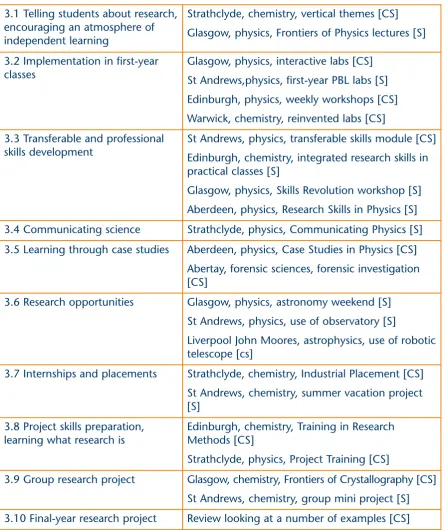
Table 1: list of case studies and snapshots
The discussion after the case studies (section 4) picks up common threads from them, and also from another output from the project. In December 2007, we held a workshop on 'Research-Teaching Linkages in the Physical Sciences', attended by 26 staff from physics and chemistry departments around Scotland and the rest of the UK (see
http://physci.rtl.googlepages.com/home). The outcomes from discussion groups at this workshop also fed into our discussion and final recommendations in this report.
The workshop was supported in part by the HEA Physical Sciences Centre. We gratefully acknowledge this and their support of the entire project and its findings.
3.1 Telling students about research, encouraging an atmosphere of independent learning
Strathclyde, chemistry, vertical themes [CS]
Glasgow, physics, Frontiers of Physics lectures [S]
3.2 Implementation in first-year classes
Glasgow, physics, interactive labs [CS]
St Andrews,physics, first-year PBL labs [S]
Edinburgh, physics, weekly workshops [CS]
Warwick, chemistry, reinvented labs [CS]
3.3 Transferable and professional skills development
St Andrews, physics, transferable skills module [CS]
Edinburgh, chemistry, integrated research skills in practical classes [S]
Glasgow, physics, Skills Revolution workshop [S]
Aberdeen, physics, Research Skills in Physics [S]
3.4 Communicating science Strathclyde, physics, Communicating Physics [S]
3.5 Learning through case studies Aberdeen, physics, Case Studies in Physics [CS]
Abertay, forensic sciences, forensic investigation [CS]
3.6 Research opportunities Glasgow, physics, astronomy weekend [S]
St Andrews, physics, use of observatory [S]
Liverpool John Moores, astrophysics, use of robotic telescope [cs]
3.7 Internships and placements Strathclyde, chemistry, Industrial Placement [CS]
St Andrews, chemistry, summer vacation project [S]
3.8 Project skills preparation, learning what research is
Edinburgh, chemistry, Training in Research Methods [CS]
Strathclyde, physics, Project Training [CS]
3.9 Group research project Glasgow, chemistry, Frontiers of Crystallography [CS]
St Andrews, chemistry, group mini project [S]
3 Case studies and snapshots
33..11
TTeelllliinngg ssttuuddeennttss aabbo
ouutt rreesseeaarrcchh,, eenncco
ouurraaggiinngg aann aattm
mo
osspphheerree o
off
iinnddeeppeennddeenntt lleeaarrnniinngg
Case study: Integrated transferable skills
This case study describes a series of classes on transferable skills, which feature in years one, two, three and five of our courses. The first is a Scottish Credit and Qualifications Framework (SCQF) level-7 class of five credits (approximately one-twentieth of a full-time year) entitled Transferable Skills 1. This is followed by an SCQF level-8 class (five credits), Transferable Skills 2; an SCQF level-9 class (five credits), Transferable Skills 3; and finally an SCQF level-11 class (five credits), Transferable Skills 5.
All classes are compulsory for chemistry students (approximately 150 students per year). They cover topics such as IT skills, oral and written presentation skills and group working skills. Up to 12 staff are involved, but only to a minimal extent. The bulk of the teaching is carried out by two members of academic support staff trained to PhD level. The
activity is supervised by an academic member of staff, the Transferable Skills Coordinator.
Contact: Debbie Willison Email: [email protected] Tel: 0141 548 2282
Institution: University of Strathclyde Discipline area: chemistry
Brief description of course
In year one, the activities centre on IT skills (three hours of instruction and six of independent work) and personal development planning (PDP) (three hours of independent work). The IT skills component aims to teach students a basic level of
familiarity with items such as file management, word-processing and spreadsheets, search catalogues and online information sources, and where and how to seek assistance for IT support issues. The PDP component encourages students to reflect on their strengths and weaknesses and identify strategies to address weaknesses and build on strengths.
The year two activities are chemical drawing, scientific writing and teamworking. Following initial tutorial sessions, students are required to independently complete a series of individual chemical drawing tasks, which are assessed by the course tutors (two hours of instruction and six of independent work). The scientific writing skills workshop is designed to prepare students for a range of scientific writing tasks, which they will encounter as students and ultimately as professional chemists. Topics covered include style (correct use of language), conventions (figures, tables and references), proof reading and thesis/report writing. A written assignment is assessed by the course tutors (three hours of instruction and 10 of independent work).
strategy for their team and making a broad range of decisions under tight time
deadlines. They are assessed by the course tutors during the course of their assignment. This assessment is based on the individual and team performance of each student (four hours of instruction and 10 of independent work).
The year three activities are oral and poster presentations, and a quality systems
workshop; PDP is also revisited. After a brief introductory session outlining good practice in oral presentations, each student prepares and delivers an oral presentation on two separate experiments from the third-year laboratory classes. Each presentation is assessed by the course tutors (four hours of instruction and eight of independent work).
The poster presentation exercise gives students the opportunity to develop the above skills, and to extend and use their teamworking abilities in a new and chemically related context. Within teams of five or six, students produce a poster describing an important area of science; the topics available to them relate to significant breakthroughs made in the recent past. Each team has an academic member of staff as their supervisor for the unit, and each poster is prepared within a limited time period. Students are assessed by the course tutors, their peers and an invited panel of experts. This assessment is based on the individual and team performance of each student (two hours of instruction and 14 of independent work). A prize is awarded to the best poster.
The final component is a quality systems workshop to introduce students to the issues associated with the validity of analytical measurements and to consider and assess the purpose of formal systems of accreditation (Good Laboratory Practice, UK Accreditation Service, International Organisation for Standardisation). In groups of three or four, in these interactive workshops (two hours of instruction) students are required to role play, devise strategy and summarise and report back their deliberations. Students encounter many of the issues covered in this exercise in their industrial placement year, so this is an important introduction. During the course of the exercise each student completes a workbook, which is assessed by the tutor.
Activities in the final year centre on oral presentations, and PDP is again revisited in preparation for employment. Following an introductory session on the important aspects of oral presentations, students plan and prepare a short talk. Within small groups and in the presence of academic tutors, each individual presentation is videotaped. In turn, the whole group reviews each presentation and offers opinions and constructive criticism. Staff tutors also provide written assessments (three hours of instruction and six of independent work).
Following completion of the final-year research project, each student prepares and delivers a 20 to 25-minute presentation on their research programme. This talk is
delivered to a cross-section of their peers and academic staff. Students are also expected to answer questions on and around their research topic. Presentations are assessed by academic members of staff (six hours of contact time and 20 of independent work).
Linkages between teaching and research
weaknesses. This reflective attitude can be adapted to research as they mature. The chemical drawing package in the second year allows students to learn how best to use this platform to present research findings. The scientific writing activity also assists them in developing concise methods for presenting research findings. The teamworking exercise teaches them not only to work as part of a team, but also to manage their time, decide on a strategy to move activities forward and assess and select analytical
techniques based on their findings and experience. These are all skills used in research, regardless of discipline.
The poster presentations and oral presentations in the third year give students the opportunity to present a piece of science in a concise and hopefully clear way. The aims of the posters, in particular, are to be attractive and factually correct, but also to
stimulate interest in funding the particular area of science presented. The quality systems workshop again allows students to work as a team, devise strategy and report their findings, in a similar way in which a research group might report back to their
supervisor. The final-year presentation on the research project allows students to reflect on how research is approached and how it should be presented.
Course history
The course has been running in its current format for about five years. Many of the activities were originally part of other classes but when the Department of Pure and Applied Chemistry carried out a course review in 2000, it was agreed to develop the current system in which a number of transferable skills are incorporated into a 'string'of easily identifiable classes. This was in recognition that many people - and employers in particular - view transferable skills as extremely important.
A number of other classes obviously use, and indeed build on, the skills in these specific classes. Laboratory work, for example, benefits from the scientific writing and chemical drawing activities. Our industrial placement partners have indicated that many of the skills learned in years one to three are used when students spend their fourth year on a 12-month industrial placement. Students also complete a molecular modelling and data retrieval class in their third year; this extends the skills learned in the first year when they explore online library catalogues. The numerous presentation skills acquired as students approach their final year are also useful when they prepare their dissertation as part of their final-year project.
Course assessment
In the second year, the chemical drawing exercise is submitted and marked and students are provided with formative feedback about where they could improve their skills. This is the case for the scientific writing exercise too, but this also carries a mark and students must resubmit until their report is of an acceptable standard. As part of the team-skills exercise, assessment is formative and oral and all students must participate in the activity. A small prize (sponsored by industry) is awarded to the best team as agreed by the tutors. All three activities must be completed to gain a pass.
In the third year, the class tutors assess the oral presentations and provide formative feedback. This is also the case for the quality systems workshop, where feedback is provided on the workbooks submitted. Academic and peer review of the posters take place. While marks are not revealed, the best poster is selected and the team of students that produced it is presented with a prize (sponsored by industry). All three activities must be completed to gain a pass.
All feedback in the final year is formative, but a number of sponsored prizes are available in different areas of chemistry for the best research presentations. All students must participate to gain a pass.
Course evaluation
The development of this class in its current form arose from a departmental review of all undergraduate degrees in 2000. The Department felt that it was important to highlight these activities in specifically named classes rather than have them 'hidden' within other classes. The classes have been evaluated by the Royal Society of Chemistry (RSC), inasmuch as one of the main criteria when applying for course accreditation is that departments must indicate how they teach transferable skills. All four of our MSci degrees are accredited by the RSC.
Students are requested to complete evaluation forms for each class they undertake, and the feedback for these classes has always been extremely positive. Students enjoy these different types of activities, which complement their theory and practical classes.
Key aspects and transferability
These classes have been specifically designed to address a variety of transferable skills -particularly those highlighted by employers. In that regard, all aspects are useful and transferable. While a small number of activities are subject specific (for example chemical drawing exercise, quality systems workshop), many are generic and could easily transfer across disciplines (for example IT skills, PDP, poster and oral presentations, scientific writing, research presentation). The team-skills activity in the second year, while specifically chemistry-focused, could be adapted to other disciplines.
Course development and delivery issues
staff have more time to pursue their research interests. Additionally, students are taught transferable skills by support staff who are fully committed to the task and know the subject matter well. Since this is the sole responsibility of the support staff involved in these classes, they are keen to develop the classes further and are bringing forward ideas to enhance or modify the classes.
Effect on student experience
These classes have changed the student experience inasmuch as students now possess a range of transferable skills that make them attractive to prospective employers. This in turn increases their confidence, and student feedback has been extremely positive regarding all aspects of these classes. All MSci students in the Department spend the fourth year of their course on a 12-month industrial training placement (see University of Strathclyde case study in section 3.7), and the relationship with our industrial partners is good. These classes were designed in part to address issues raised by our industrial partners, who obviously feel that our students have desirable attributes since 90 have been placed in industry in the current academic year.
Strathclyde has taken the decision to move all classes to 20 credits. Our next challenge is to address how we continue to provide this valuable set of classes within the
new framework.
Further details
This work has previously been disseminated by a colleague at an RSC Analytical Chemistry Open Learning event. The Centre for Academic Practice and Learning
Enhancement at Strathclyde also runs Learning Enhancement Network events; this work has been disseminated at one of these gatherings.
Snapshot: Frontiers of Physics lectures
Level 1, approx 180 students, part of the 20-credit level 1 courses Physics 1X and Physics 1Y. (These courses are merging to become the 40-credit Physics 1 course from September 2008).
Contact: Martin Hendry
Email: [email protected] Tel: 0141 330 5685
Institution: University of Glasgow Discipline area: physics
The Frontiers of Physics course was introduced more than five years ago, offering (at that time) an attractive package of lectures on cutting-edge research topics designed to appeal to students taking our 'accelerated' level 1 Physics courses P1X* and P1Y*. Essentially, Frontiers of Physics replaced some lectures on dynamics and electricity and magnetism that largely duplicated material covered in the Advanced Higher Physics curriculum. Thus students taking the 'starred'(*) courses would follow a streamlined curriculum, supplemented by cutting-edge material. Following this route was entirely optional, but proved popular among more able students who came to the University with Advanced Highers.
and integrated into the regular Physics 1 courses, thus opening them up to the entire class. Since then, they have proved to be very popular with the class as a whole.
Three Frontiers of Physics topics are delivered each semester - two lectures per topic, making 12 lectures in total. Subjects covered span the full range of physics research within our Department and in the wider physics community. Examples of the topics covered in recent years include:
z searching for extra-solar planets
z quantum cryptography
z gravitational wave detection
z neutrino oscillations
z nanoscale physics.
The topics covered are reviewed each year, with changes continually introduced to the detailed syllabus to reflect the latest developments (for instance, the number of extra-solar planets detected and the range of methods used to detect them has evolved substantially, even over the few years these lectures have been running). Occasionally, new topics are introduced to reflect significant new advances or areas of substantial interest; examples of this for 2007-08 were new topics on dark matter and dark energy, and on the Large Hadron Collider.
In all cases the lectures are much more than simply a series of photographs and facts. They are delivered very much in the manner of a research seminar, with a lengthy introduction setting the background physics context to the topic. Theoretical arguments are developed carefully, even if some approximations and simplifications are introduced. For the Frontiers of Physics assessment component, students are expected to be able to derive simple results, carry out numerical calculations using them, and discuss their relevance to the wider physics context of the Frontiers of Physics theme.
Thus far, Frontiers of Physics has been assessed via degree exam questions (one per semester, selected by the external examiner), which students are given in advance. While this approach recognised the challenging nature of the material, in other respects it was less than satisfactory as some students could simply try to memorise a solution parrot fashion. In future, the Frontiers of Physics lectures will be assessed via a series of continuous assessment workshops (which will also examine the other level 1 Physics courses). This will ensure that all Frontiers of Physics topics are examined, which in turn should help to maintain good attendance at all Frontiers of Physics lectures.
The popularity of the Frontiers of Physics lectures can be attributed to several factors identified by students and staff. The material is undoubtedly stimulating and fascinating in itself, often covering topics students have read about before coming to university. Delivery of the lectures has generally been of very high calibre, as we have chosen Frontiers of Physics lecturers who are all enthusiastic and effective communicators. Above all, students have responded very positively to material which is still firmly at the cutting edge of physics with many open and intriguing questions - all the more so since the lectures are given by staff who are actively engaged in trying to answer those questions.
33..22
IIm
mpplleem
meennttaattiio
onn iinn ffiirrsstt-yyeeaarr ccllaasssseess
Case study: Experimental tutorials
This case study describes a Physics 1 laboratory class at SCQF level 7, which forms 20 per cent of the 40-credit Physics 1 course. It is compulsory for students studying physics in the first year (approximately 175 students per year). Staff involved: up to seven academic staff (lab head, deputy lab head and demonstrators); up to 30 post-docs and PhD students (demonstrators); two technicians.
Contact: Peter Sneddon
Email: [email protected] Tel: 0141 330 5312
Institution: University of Glasgow Discipline area: physics
Brief description of course
The Physics 1 laboratory class forms part of the level 1 Physics course taken by all
students intending to study physics to degree level, as well as those who simply have an interest in the subject.
The laboratory course has been radically redesigned to update the content and create direct links between the practical work covered there and the theory covered in the lectures. The aims of the revised lab course are to:
z demonstrate the basics of experimental physics
z develop skills required for the clear presentation of scientific results
z develop problem-solving techniques
z experimentally demonstrate concepts discussed in lectures
z encourage group work as a means of effective problem-solving.
The lab course is split over two semesters. The first-semester sessions are designed to highlight the links between the practical and theoretical sides of physics through the use of experimental tutorials (ETs). These take the form of a tutorial question which is then directly mirrored by a practical experiment. The same format is used in the second semester, but the focus is altered to introduce students to practical skills such as using more advanced laboratory equipment (for example digital oscilloscopes and spectrometers).
Semester 1
The material covered in the ETs falls into the same categories as the lecture courses: dynamics and relativity; thermal physics; optics, waves and lasers. 12 ETs run in semester 1 (two per week), with students attending one session of 2.5 hours per week for six weeks. The class is split into four groups, with students attending on one of Mondays, Tuesdays, Wednesdays or Fridays each week. Each day group is then split into two
To ensure that all students know something of the practical side of both ETs, the sessions end with presentations by pairs of students from each section to the whole group. While not the same as getting all students to attempt all the experiments themselves (which was tried initially but proved ultimately unworkable), this gives them some insight into both experiments. It is also an excellent opportunity for students to improve their presentation skills.
There are two additional exercises in the first semester. An IT exercise takes up the first 2.5-hour session of the year. It introduces students to the many uses packages such as Microsoft Word and Excel can have for modern physicists (for example drawing experimental diagrams, tabulating data, handling large data sets). This is designed to provide students with the skills they will need for the data-handling side of the ETs which follow, and for creating a good word-processed lab report.
A teamwork exercise takes up the final session of the semester. This sees students working in groups of about six to tackle two exercises: a theoretical one on various aspects of special relativity and a practical one in which they construct roller-coasters from kits. Both exercises are assessed by means of a presentation. In the roller-coaster exercise, students have to use their roller-coasters to illustrate various aspects of dynamics and kinematics.
Semester 2
The material covered in the ETs again falls into the same categories as the lecture courses (electricity and magnetism; quantum phenomena; properties of matter). Six ETs run in semester 2. They are collected into two groups of three, and students rotate through the ETs on a weekly basis, so that by the end of semester 2 they have all attempted all six ETs. No presentations are used in the second semester, as all students attempt all the experiments.
In addition to a better understanding of experimental equipment, the ETs in semester 2 are structured to include a greater level of error analysis. Students are given an
introduction to error analysis at the beginning of the semester, and are then encouraged to use this to better justify their results as the semester unfolds.
One of the overall aims when it came to writing the scripts for the ETs was to move away from prescriptive, recipe-like instructions, where students just work through a checklist of tasks. The practicalities of running a class for 170 or so students have restricted how open-ended we could make the instructions, but efforts have been made to give students more apparent freedom in how they tackle the exercises. For instance, if students are asked to test a simple theory by plotting a graph, they are not always explicitly told which graph to draw. Also, all ETs end with an additional work section. These additional sections expand on the work covered in the earlier sections and tend to be more open-ended in nature. They are designed for very able students, allowing them to gain extra credit.
Linkages between teaching and research
In the previous structure for the lab class, students recorded data manually in lab books. While there were benefits in teaching students how to record data in this fashion, it meant that they had to undertake a lot of repetitive tasks which, in the modern world of research physics, are better handled by computer. For example, in an experiment which involved calculating the period of oscillation of a mass on a spring, students used to have to manually count the number of times the mass bounced in a given time. The motion of the mass is now monitored by an ultrasound detector connected to a PC, which has removed the tedium from the data gathering. This form of data collection also allows students to explore graphically the relationship between the mass
displacement and the force on the support of the spring.
When it came to analysing the collected data, graphs used to be hand-drawn and gradients, for example, were calculated by hand. Again, there were benefits to this approach, but it was felt more important that students learned how to handle their data using modern techniques - particularly as the use of PC-based DAQ systems means that there are larger data sets to handle. Care was taken when writing the ET scripts to make sure that students understood what they were getting the PCs to calculate, as we were all too aware of the danger of the situation where students let the computer do all the thinking.
Course history
This revamped lab course began in September 2006. The original motivation was to update the content of the lab class and improve students' learning experience in the class. Anecdotal evidence of the previous structure suggested that students were finding the practical class a chore and, as a result, were not learning anything meaningful from it. The Physics 1 lab course leads on to a practical class in Physics 2 and 3, followed by project work in Physics 4 and 5.
Course assessment
The Physics 1 lab course is assessed in the following way:
z students write up a lab record for each experimental tutorial; these are all marked after each session
z students submit one lab report based on one of the records
z students submit a report on the IT exercise they complete at the beginning of the course.
In total, the above assessment contributes 20 per cent of the marks students gain for the Physics 1 course. The records are marked by the demonstrators assigned to each session (typically one member of academic staff, one post-doc and two PhD students); they generally spend an hour per session marking. The reports are marked by academic staff and post-docs, with each person getting around a dozen reports to mark.
Course evaluation
In 2006-07, the first year the lab course was run under the new format, students were given questionnaires at the end of each semester so we could find out what they
thought of the course. For semester 1, 60 per cent rated the course as excellent or good, with another 37 per cent rating it as fair. For semester 2, 61 per cent considered it
informally. The general view was that the lab course was a great success, greatly improving the level of student interest and interaction.
Key aspects and transferability
The most useful aspect of the course is that it encourages students to approach their practical work in a methodical manner. They become familiar with modern experimental techniques as used by actual research scientists, giving them an idea of how a qualified scientist works.
Another aspect of the course, which is of great transferable value, is the teamwork and presentation skills that students get the chance to practise. Being able to work in groups and then present concepts and ideas in a clear, concise manner are skills that benefit the students, whether or not they ultimately end up in a research environment.
Course development and delivery issues
The development of this course was greatly helped by the enthusiasm of the staff involved. The initial development of the ETs was a group effort involving all lecturers on the Physics 1 course. Without their contribution, such a major redesign would not have been possible. Similarly, without the backing of the Department as a whole - and a teaching-friendly Head of Department - we would not have received the necessary funding for such a wide-scale investment in new equipment and teaching spaces.
Implementation of the redesigned course was not without its problems though. Initially it was hoped that all students would attempt three ETs per session in semester 1, but this simply did not work. Reducing the workload to two ETs helped, but while we hoped that students would experience as diverse a range of experiments as possible, ultimately it was only really feasible to have them attempt one ET per session.
Effect on student experience
The revised lab structure has greatly improved the student experience. Students are far more active during the labs and seem to enjoy the work more, as evidenced by the ratings they have expressed (as noted above). Questionnaire feedback of students taking physics and astronomy also suggested that the new physics labs compared favourably with the astronomy labs. In the past, students always viewed physics as the 'poor sibling'
(this view was based on anecdotal evidence from speaking to students in later years of their degrees).
Further details
Early results from the new structure were presented at the Science Learning and Teaching Conference 2007 at Keele University (Sneddon, 2007).
Snapshot: First-year labs
Contact: Antje Kohnle
Email: [email protected] Tel: 01334 463 195
Institution: University of St Andrews Discipline area: physics
We developed and implemented an introductory problem-based learning lab in the second semester of our first-year Physics course. Students, in groups of three to four, were given a problem requiring the measurement of the wavelength-dependent transmission of sunglasses. The scenario involved students working in a firm producing sunglasses and checking claims of a rival firm that their sunglasses block virtually 100 per cent of UV and high-energy visible light. The student groups needed to come up with their own experiment, request the relevant apparatus, carry out the experiment and analyse the results. There was substantial variation in experiment design by the students: set-ups included a dual-band UV lamp, a mercury lamp with diffraction grating, a prism spectrometer and a white light source with colour filters. At the end of the lab afternoon, students were shown a spectrophotometer in one of our research labs.
An evaluation questionnaire showed that most students preferred this type of lab to
'traditional' labs because of its relevance to their everyday experience, the teamwork and the scope to design their own experiment. Students were able to apply the lab skills they had learned in the more traditional labs, and saw how the same problem would be solved in a real research environment. Though students were not doing real research, they were working in 'research mode', which means having to decide for themselves what they needed to measure, how they would go about doing this, and how to analyse and represent their data.
We are adding two more PBL labs into the first-year curriculum: one is centred on the ultrasound technology used to assist in reverse parking of cars, the other on mobile phone radiation.
For details of the module, see links from www.st-andrews.ac.uk/physics/Staff_Stud.shtml
Case study: Weekly workshop
This case study describes the role of weekly workshops - collaborative problem-solving sessions that occur in various pre-honours courses at the University of Edinburgh. They are taken by all students studying towards physics degrees, and are generally part of 20-credit SCQF level 8 courses. The sessions last two or three hours and are staffed by academics supported by a number of postgraduate demonstrators.
Contact: Simon Bates Email: [email protected] Tel: 0131 650 5280
Institution: University of Edinburgh Discipline area: physics
Brief description of course
undergraduate science teaching. The case study focuses on workshops as part of a first-year introductory course (Physics 1A: Foundations) taken by approximately 275 students each year, both those reading towards a physics degree and those taking it as an elective option.
The workshop sessions comprise groups of students (usually about five or six, allocated randomly at the start of the course and fixed for its duration) working on a variety of different activities each week. Activities differ within each course, but a major
component in all sessions is the time that students spend collaboratively each week working on a set of problems relevant to the course material for that particular week. The set will number anywhere between six and 15 problems, and students are advised to plan within their groups which problems they are going to tackle within the allocated time (the expectation being that other problems are done out of class). Typically, the questions are such that a group can reasonably expect to be able to tackle
approximately six within an hour.
None of the activities within the workshop are explicitly assessed (but the problem-solving ones feed into assessment - see below), and students are encouraged to make full use of the postgraduate tutors and staff members who facilitate these sessions. Students are advised not to spend workshop time generating perfect solutions to problems, but to 'work through'them, focusing on the process of how to solve them rather than attaining the final product (often, but not always, a numerical answer).
Linkages between teaching and research
The key educational aim of the workshops is to foster not just the 'hard' skills needed by the professional physicist, but also the more qualitative (or 'thinking') skills of value to all students, whatever their chosen career. Implemented within a group-working
environment, the workshops give students low-stakes opportunities to acquire and refine such skills as stating and defending a point of view, and presenting or explaining
material to peers (students are given flipcharts for their group problem-solving).
In these sessions, which students encounter during their very first semester at the
University, we are progressively moving them away from a view that problems within the subject are closed and solved by a rather formulaic approach, towards one where the student must develop a problem-solving strategy, and there is often more than one route that can solve the problem. Allied to this is the aim that our students should be actively engaged with the material (despite much of it being rather familiar in this course) and on a pathway towards more autonomous and independent learning. The overall design of the workshops and related assessment are geared to support this aim.
Course history
The workshop format was originally introduced into second-year courses six years ago, as part of a raft of measures to arrest a declining pass rate. It has subsequently been adopted widely across pre-honours courses in physics programmes and other disciplines besides physics.
Course assessment
following Wednesday. The scripts are collected prior to the Wednesday lecture,
distributed to staff and postgraduate student markers, and handed back to students at the beginning of the following week's workshops. All staff have a detailed marking sc