International Journal of Innovative Technology and Exploring Engineering (IJITEE) ISSN: 2278-3075,Volume-8 Issue-11, September 2019
Abstract: Cognitive network is the solution for today’s spectrum scarcity problem. The cognitive network allows secondary users to use free licensed bands on temporary basis to access network resources. The energy consumption for battery operated devices is most essential parameter to be considered to keep devices active for longer time span. This triggers the requirement of energy efficiency in cognitive radio network. The energy consumption due to sensing mechanism and energy consumption during communication sessions for leased time span are two aspects of consideration in cognitive network. This paper contributes for modification in protocol for energy efficiency in communication sessions to enhance the lifetime of devices. At the same time delay optimization for congestion control along with maximum resource access facility is considered while modifying the protocol. A multilayer strategy designed, is responsible for optimized energy, optimized delay and congestion avoidance as an additional outcome. The performance evaluation shows that proposed protocol mechanism is responsible for enhancing energy efficiency with controlled delays in communication sessions.
Index Terms: Modified AODV, energy efficiency, delay optimization, Clustering, cognitive network.
I. INTRODUCTION
Spectrum sensing for resource allocation to secondary users (SU) is essential need of cognitive radio network. The required information in this regard is sensing the presence of primary users (PUs) and thereby concluding the availability of spectrum for SUs. The sensing cycles required for this spectrum availability estimation directly reflects in terms of energy consumption for each sensing attempt. Also when resource utilization is being done, as being temporary member of the network, SUs are also required to sense the presence of PUs for using the spectrum without any missed information. Spectrum sensing and protocol based mechanisms are required to be treated as two different scenarios as far as overall network considerations concerned. The sensing mechanism optimization constitutes the spectrum allocation and using strategies while protocol is responsible for packet based efficiency management where entire communication of data packets along with control packets are responsible for energy consumption from a particular participant node in the network. The other side of the network is consisting of spectrum manager and controller in which sensing mechanism plays important role while resource allocation to SUs on temporary basis.
Revised Manuscript Received on September 05, 2019.
Mr. Shobhit Verma, ECE, Mody university, [email protected].
Dr. Vikas Raina, CSE, Mody university,
The energy efficiency in spectrum sensing and energy efficiency in overall communication, together when taken into account, may form total energy efficient cognitive network for all types of users (Pus and SUs).
On the other hand, it is essential to consider the other effects on different network performance parameters of the network while achieving energy efficiency. The required parameters in such cases can be throughput, packet delivery ratio and end to end delay. The performance of these parameters are also required to be sufficiently optimum while achieving energy efficiency. This paper focuses on the energy efficiency and overall delay performance optimization in cognitive network. The comparative analysis of proposed protocol design is done with existing cognitive network with AODV routing protocol and IEEE 802.22 based WRAN MAC protocol, which shows significant improvement in energy efficiency. Also, while achieving the energy efficiency, throughput and packet delivery ratio parameters performances are not dominated.
II. RELATED WORK
The cognitive network advancement and its need as per demand in communication technology have triggered the thoughts of various researches in the world for achieving energy efficiency with overall better performance of the network. The concept of resource allocation to secondary users for licensed band access have got variety of ideological solution given by various researchers. Some of the concepts and methods are addressed here which especially focus on energy efficiency in cognitive network as prior objective.
A. Rawat et al [1], have given a design of the protocol named as Fan Access Protocol. Sensing cycles and sensing strategy are considered along with traffic management for bursty traffic scenarios are considered while designing the protocol. The optimal shortest path routing along with network configuration scenarios are given. The clustering of the network is done using Realization, coordination and routing phases, which are optimized using particle swarm optimization based algorithm. The algorithm is responsible to optimize the location based traffic of all the nodes in dense network. The effect optimization is responsible for improving energy efficiency. The comparative analysis indicates significant improvement in the results. Muhammad Talha Zia et al [2], have provided survey of energy efficient cognitive network MAC protocols. The energy efficiency versus protocol mechanisms are considered while comparing various methods. In nuts and shell the paper provides the platform for thoughts for energy efficient design of MAC protocols in cognitive radio network.
Energy And Delay Optimized Protocol For
Cognitive Network
Zhutian Yang et al [3] have given a design of energy efficient MAC protocol. In the protocol named ECR-MAC uses auction based mechanism for choosing the spectrum is used. The preamble based broadcasting is responsible to gather the information related to the spectrum availability. The offer based next hop selection mechanism reduces significant spectrum sensing cycles and also facilitates each node for choosing the right hop for forwarding the packets. This reduces significant network overhead and hence reduces the energy consumption. The node density is considered as main effective parameter for accounting the energy consumption. The comparative analysis of various protocols show that the author’s protocol outperforms in terms of energy efficiency.
Faisal Fayyaz Qureshi et al [4], have given energy efficient MAC protocol in which packet aggregation scheme is used for energy efficiency in the network. This method is responsible to reduce network overhead by aggregating the packets from higher layers and sending them back to back when spectrum is made available for communication in time based sharing strategy. Due to this strategy throughput increases significantly compared to existing DSR and 802.11b MAC based network. The increment in throughput also guarantees the improvement in packet delivery ratio and energy efficiency.
Neha Shirke et al [5], have given clustering method for energy efficient routing in cognitive network. The protocol designed by authors consist of cluster membership expiry timer. When this timer expires, the cluster free node uses sensing mechanism to sense the presence of PU and if presence if found, this information gets propagated to the other neighbors through one hop hello packet mechanism. The one hello packet mechanism is responsible for gathering the information of routing table of cluster free nodes and hence presence of primary user. This way all the SUs get information regarding particular spectrum occupancy by PU. The performance evaluation is done for energy consumption which shows the improvement in energy efficiency. Along with these parameters throughput and end to end delay are also analyzed which also show efficient performance compared to other protocols.
Ashish Semwal et al [6], have given route selection mechanism in cognitive radio sensor network. The routing protocol which distance between the nodes, number of flows that node is busy with are the main parameters considered. For estimation and selection of nodes in a route the residual energy and required amount of energy are main parameters considered based on which particular node is considered being in the route.
Rana Asif Rehman et al [7], have given design of delay and energy aware routing protocol for cognitive network. The route request packet is responsible for estimating the energy consumption of the entire path from source to destination. The delay metric during propagation of this request packet is also used for selecting the right node in the route for minimizing the delays. This way energy efficient along with delay optimized route is selected and based on which entire energy efficiency is achieved along with optimized throughput and delay of entire network. The comparative analysis shows that author’s method outperforms in terms of various network performance parameters.
Ying Liang et al [8], have given flexible delay routing protocol useful in cognitive radio network. The data packet
structure is modified by authors by adding predate field which is responsible to exchange nodes related information while forwarding the packets amongst nodes in the route. The nodes which the delay threshold are allowed to participate in the route by utilizing every time fresh information obtained from predate field. This mechanism reduces the overall delay in the cognitive network and also shows better performance when compared with other protocols delay analysis.
III. PROPOSED WORK
The energy efficiency in cognitive network is important aspect to be considered while allocating services to SUs thereby keeping overall resource availability to all the SUs at optimum level and without affecting any of the PU for licensed resource access.
[image:2.595.304.513.301.406.2]In this work we are considering protocol mechanism modification for achieving energy optimization in cognitive network. Figure 1 shows the block diagram of the proposed work for modification of routing protocol adhoc on demand distance vector routing.
Figure 1: Block diagram of proposed system.
[image:2.595.311.548.468.620.2]The original AODV RREQ packet is modified as shown in figure 2. The fields Energy, X, Y and Delay are added in the packet at the bottom.
Figure 2: Modified RREQ packet structure
When node in the network sends RREQ for route request in broadcast manner, all the nodes in the network for this in broadcast manner until it reaches the destination.
Significance of Energy Field:
The Energy field in the packet structure is filled with total amount of energy used for transmitting and receiving current RREQ packet. The originator of RREQ first will fill this field with the value equal to the amount of energy required to broadcast this packet. At first, the value of Energy field can be given by,
Energy= Et1 …(1)
Modification in AODV RREQ packet structure
Adding energy consumption and distance
metric in RREQ
Optimal energy and distance based RREP
International Journal of Innovative Technology and Exploring Engineering (IJITEE) ISSN: 2278-3075,Volume-8 Issue-11, September 2019
When this packet is received by its immediate neighbors, The Energy field will be updated with new values given by,
Energy= Energyold + Er2+Et2
…(2) Where, Energyold = energy value already in the field of packet, Er2 = energy required by current node at the time of receiving this packet, and
Et2 = energy required to rebroadcast this packet further in the network until it reaches the destination.
As, the packet propagates in the network this energy field goes on updating until it reaches the destination.
Significance of X and Y fields:
Every node that receives RREQ will fill these fields with their location coordinate and then forward the packet to the next node towards destination. The packet based this information will be used to calculate the delay between previous RREQ sender node and receiving node to update the delay field in the packet.
While obtaining self-coordinate location information, each node interacts with Data link layer (MAC) layer. This way the proposed work comes under multilayer strategy.
Significance of Delay Field:
The information from X and Y fields are used by RREQ receiver node to estimate the delay in packet reception from RREQ sender. In this case RREQ sender is again the node who is originator of RREQ or RREQ forwarding node. As the X and Y field information which is location coordinate of previous node will be used to estimate the physical distance between sender and receiver of RREQ. Based on this distance delay is calculated as,
Delay= Distance x Standard packet traveling speed in terrestrial communication at carrier frequency.
…(3) The delay field is then updated at each RREQ reception as it travels through network form node to node up to destination node. The updating of Delay field can be given by,
Delay = Delayold + Delaynew
…(4) Where Delayold = value of Delay field when packet is received, Delaynew= value of Delay calculated by current RREQ receiver node.
This Delay is directly dependent on the two parameters. The first parameter is the physical distance between the two nodes i.e. sender and receiver and second is the amount traffic load already burdening the node that is involved in RREQ handling.
This way at the destination node similar process is repeated to update Energy and Delay values by adding its own calculated values. The final values btained in this manner are then used to add in the routing table of destination node.
At the destination that is intended receiver node of RREQ packet can only send the RREP route reply packet to requesting node in unicast manner as per AODV. The criteria for selecting the route to send RREP is modified in our proposed work.
Also, each node that is forwarding the RREQ up to destination node is also updating its own routing table information with Energy and Delay fields.
The information that is available in the routing table of destination node and all the RREQ forwarding nodes, also contains Energy and Delay as additional information about
entire path towards requesting node along with next hop information.
The RREP is then send via only selected node based on less Energy and Less Delay criteria. Amongst these two parameters it may happen that, less energy consuming path is causing more delay than little higher energy consuming path. In this situation, the K - medoid clustering method is used to sort the routing table information with vectors that contain hop count, delay and energy. The intention of using K-medoid clustering is to get pairwise distance values from the selected centroid. While clustering the centroid selection strategy is set in such fashion that, there are only two centroids out of which the first centroid is the vector which is having lowest energy compared all the energy values in the routing table and the first centroid is the vector which is having highest energy value.
This way it gives the distance based sorted data in two groups. Out of these two groups, first group is focused and from this minimum delay vector is chosen. This selected vector may show little higher energy consumption of the entire path than lowest value but at the same time it will also contribute to minimize the delay in end to end communication. The delay optimized selected route is not only energy optimized but also delay and congestion optimized compared to all the routes that come under second group associated with maximum energy.
This strategy of clustering based approach is balancing the selection criteria during energy and delay optimized route selection mechanism.
The algorithm 1 gives the pseudo code for RREQ propagation in the network and algorithm 2 gives the pseudo code for route selection mechanism that is used at destination as well as at each RREP forwarding node.
Algorithm1:
1. Get energy information for each packet transmission and reception
If (RREQ originator): Energy=Et; Else:
Energy=Energyoldn+Ern+Etn;
2. Get X and Y coordinate information from Data link layer
X=x; Y=y; 3. If (RREQ originator):
Delay field=0; Else:
Estimate delay; Delay=delay; 4. Forward RREQ
Algorithm2:
1. Get routing table vectored information with Energy, Delay and Hop count
2. Set centroid1= Minimum Energy vector 3. Set centroid2=Maximum Energy Vector 4. Cluster vectors using K-medoid
5. Select Minimum Delay routing information from clustered group1.
IV. RESULTS AND ANALYSIS
The proposed work is implemented in NS2 using cognitive radio network using IEEE802.22 protocol patch.
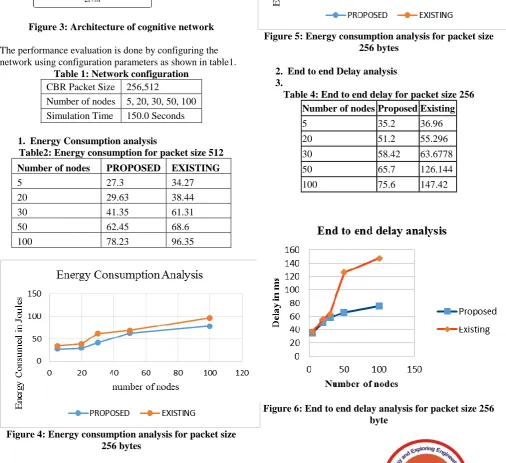
[image:4.595.47.266.121.317.2]The network architecture used for forming cognitive network is shown in figure 3.
Figure 3: Architecture of cognitive network
The performance evaluation is done by configuring the network using configuration parameters as shown in table1.
Table 1: Network configuration CBR Packet Size 256,512
Number of nodes 5, 20, 30, 50, 100 Simulation Time 150.0 Seconds
1. Energy Consumption analysis
Table2: Energy consumption for packet size 512 Number of nodes PROPOSED EXISTING
5 27.3 34.27
20 29.63 38.44
30 41.35 61.31
50 62.45 68.6
100 78.23 96.35
Figure 4: Energy consumption analysis for packet size 256 bytes
Table3: Energy consumption for packet size 512 Number of nodes PROPOSED EXISTING
5 28.35 37.93
20 36.45 54.92
30 41.23 59.37
50 72.34 75.23
[image:4.595.47.554.307.770.2]100 82.26 103.25
Figure 5: Energy consumption analysis for packet size 256 bytes
2. End to end Delay analysis 3.
Table 4: End to end delay for packet size 256 Number of nodes Proposed Existing
5 35.2 36.96
20 51.2 55.296
30 58.42 63.6778
50 65.7 126.144
100 75.6 147.42
International Journal of Innovative Technology and Exploring Engineering (IJITEE) ISSN: 2278-3075,Volume-8 Issue-11, September 2019
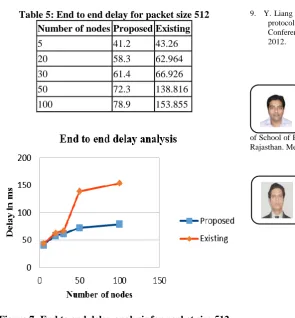
Table 5: End to end delay for packet size 512 Number of nodes Proposed Existing
5 41.2 43.26
20 58.3 62.964
30 61.4 66.926
50 72.3 138.816
100 78.9 153.855
Figure 7: End to end delay analysis for packet size 512 byte
Annotations:
1. It can be observed from energy consumption graph that compared to existing system, proposed system shows better results and hence less energy
consumption.
2. The proposed system is energy efficient with Optimum delay compared to existing protocol.
REFERENCES
1. R. J. Vidmar. (1992, August). On the use of atmospheric plasmas as electromagnetic reflectors. IEEE Trans. Plasma Sci. [Online]. 21(3). pp.
876—880. Available:
http://www.halcyon.com/pub/journals/21ps03-vidmar
2. Rawat and S. K. Verma, "Energy efficient protocol for cognitive sensor networks based on particle swarm optimization," 2016 International Conference on Advances in Computing, Communications and Informatics (ICACCI), Jaipur, 2016, pp. 1447-1452.
3. M. T. Zia, F. F. Qureshi and S. S. Shah, "Energy Efficient Cognitive Radio MAC Protocols for Adhoc Network: A Survey," 2013 UKSim 15th International Conference on Computer Modelling and Simulation, Cambridge, 2013, pp. 140-143.
4. Zhutian Yang, S. Ping, A. Nallanathan and Lixian Zhang, "ECR-MAC: An energy-efficient and receiver-based MAC protocol for Cognitive Sensor Networks in smart grid," 2016 IEEE International Conference on Communications Workshops (ICC), Kuala Lumpur, 2016, pp. 331-336.
5. F. F. Qureshi, "Energy efficient cognitive radio MAC protocol for adhoc networks," Wireless Telecommunications Symposium 2012, London, 2012, pp. 1-5.
6. N. Shirke, K. Patil, S. Kulkarni and S. Markande, "Energy efficient cluster based routing protocol for distributed Cognitive Radio Network," 2014 First International Conference on Networks & Soft Computing (ICNSC2014), Guntur, 2014, pp. 60-65.
7. E. Helal, A. Khattab and Y. A. Fahmy, "Energy-efficient cluster head selection for cognitive radio sensor networks," 2016 28th International Conference on Microelectronics (ICM), Giza, 2016, pp. 205-208. 8. R. A. Rehman, M. Sher and M. K. Afzal, "Efficient delay and energy
based routing in cognitive radio ad hoc networks," 2012 International Conference on Emerging Technologies, Islamabad, 2012, pp. 1-5.
9. Y. Liang and J. Wang, "A flexible delay and energy-efficient routing protocol for cognitive radio network," 2012 Third International Conference on Intelligent Control and Information Processing, Dalian, 2012.
AUTHORSPROFILE
Mr. Shobhit Verma, has done his Bachelor of Engineering degree in Electronics and Communication from GRKIST, Jabalpur in the year 2004.His master’s degree is in Digital Communication from SRIT, Jabalpur in the year 2009.He is a Ph.D. student in ECE department of School of Engineering and Technology, Mody University, Laxmangarh, Rajasthan. Member of IEI,ISTE .
[image:5.595.54.350.42.361.2]