International Journal of Innovative Technology and Exploring Engineering (IJITEE) ISSN: 2278-3075, Volume-8 Issue-12, October 2019
Abstract: The present research paper aims to reclassify the Egyptian Railway Network taking into consideration the safety and economy factors as Egyptian Railway suffers from track maintenance shortage. Lines are classified into several groups depending on dynamic load parameters to facilitate economic studies and comparisons between the worldwide railways.
Then, discussions of four Railway line classifications are studied as follows:
Theoretical classification of line Sections according to ENR, Actual classification of line sections according to ENR, UIC line classification and proposed classification of line sections for ENR by following the mentioned techniques.
Three objectives are studied to reclassify the Egyptian Railway tracks: determine the traffic loads for all line sections of ENR based on official train schedule for year 2019, the track classification should be continuously defined each year taking the load, train type and the running speed as the main three effective parameters. The present methodology deduce some conclusion and recommendations to ensure both track safety and economical operational.
Keywords : Egyptian Railway Network, Theoretical traffic load, Classification.
I. INTRODUCTION
Track maintenance (as compared to vehicle maintenance) is a rather complex activity due to the geographical spread of the asset. Unlike vehicles which can be brought to sheds or other common points for inspection while track inspection repair or data collection requires physical movement of man and material, adding to the cost and time involved in the task [1].
Track maintenance decisively affects both train safety and passenger comfort. Track maintenance expenses represent a significant percentage of total railway network expenses. Egyptian Railway suffers from track maintenance shortage, the following items summarize it:
1.
ENR does not possess a software maintenance program at this moment.2.
Regions, districts, zones and sections do not depend on technical base.3.
Track maintenance for single track is treated as that for the double track [2].Therefore, it is recommended to reclassify the Egyptian Railway Network taking into consideration the safety and economy factors.
To facilitate economic studies and comparisons between
Revised Manuscript Received on October 05, 2019.
* Correspondence Author
Akram S. Kotb , Construction and Building Eng. Department, Faculty of
the different railways, lines are classified into several groups depending on the following load parameters: [3]
The static axle load level, to which the dynamic increment is added, in principle determines the required strength of the track.
Tonnage borne (sum of the axle loads). Running speed.
The dynamic load component which depends on speed and horizontal and vertical track geometry also plays an essential part here[4]
Consequently, traffic loads are one of the key factors that have a direct bearing on track maintenance.
Various kinds of rail vehicles are running on a railway track such as; passenger cars (coaches), freight cars (wagons), mainline locomotives, and shunting engines. The algebraic sum of the rolling stock loads can’t give an accurate picture of the running load, because it does not take into account the way in which the load is applied, the running speed, and so on. Therefore, a complex parameter giving an accurate estimate of the passing traffic load is necessary. Union International de Chemins de Fer, UIC, proposed a method to calculate the theoretical traffic load for this purpose [4].
The most effective factor on the safety of trains is the irregularities in the railway track, which can affect the comfort of passengers. A novel framework has been proposed in order to identify patterns and rules for prediction of track irregularities by using characteristic deterioration of track. The proposed model has been validated using measured data of track irregularity [5].
Machine learning algorithms has been adopted for prognosis and diagnosis of rail defects to help the railway industry in carry out timely responses to failures. The machine learning approaches has been used in different maintenance tasks of railway track. A taxonomy has been provided in order to classify the literature based on the types of methods and data types. A shortcomings of proposed techniques has been presented and discussed [6].
II. STUDY OBJECTIVES
The present paper deals with the following objectives to realize maintenance management system for Egyptian Railway tracks:
1. Determine the traffic loads for all line sections of ENR based on official train schedule for year 2019 [5]. 2. The track classification should be continuously defined
each year taking the load, train type and the running speed as the main three effective parameters.
Akram S. Kotb
III. RAILWAY LINE CLASSIFICATIONS A. Theoretical ENR Classification
The Egyptian Railway Network is classified into three classes shown in table (I).
Table I: Theoretical ENR classification [7], [8]
Tracks of class Speed (S) Km/h daily load (W)1000
tons
I S >120 W > 40
II 90 < S <120 15 < W < 40
III S < 90 W < 15
B.Actual ENR Classification
The actual ENR classification does not depend on design speed, track type and traffic volume. It is totally different from the theoretical classification as shown in the table (I). ENR does not apply the last mention classification shown in table (II).
It divides the Egyptian Railway Network into three classes totally different from above-mentioned table.
[image:2.595.307.542.49.842.2]The following tables show the actual classification which does not depend on design speed, track type and traffic volume.
Table II-a: Actual classification: Class I [7], [8]
* These lines are considered as metro lines under the supervision of Greater Cairo Underground Metro Authority. ** This line is considered as suburban line.
*** This line was cancelled.
Table II-b: Actual classification: Class II [7], [8]
[image:2.595.54.282.371.657.2]International Journal of Innovative Technology and Exploring Engineering (IJITEE) ISSN: 2278-3075, Volume-8 Issue-12, October 2019
*** These lines were cancelled.
The classification is fixed yearly regardless the traffic, load and speed change. Calculations are made by hand. A software program does not exist. The classes are defined for 6236 km of tracks of the network and cover 48 routes, corresponding to complete corridors. No distinction is made, if sections within these corridors belong to a higher or lower class (speed differences or load differences). No distinction is made between both tracks of the same corridor for double track lines.
C. UIC Line Classification
The UIC classification is based on 6 groups, according to the value of their theoretical traffic (Tf). The following
formula is internationally accepted and is defined on the basis of the theoretical traffic load conforming UIC 714 leaflet[3] Tf = Sv. (Tv + Kt.Ttv) + Sm. (Km.Tm + Kt.Ttm)
Where, (Tf): theoretical traffic per ton per day
The following three parameters are the most effective ones.
First parameter: (the load)
Tv: The mean daily passenger tonnage in gross tons hauled. Tm: The mean daily freight tonnage in gross tons hauled.
Ttv: The mean daily tonnage of tractive units used in passenger
traffic, in tons.
Ttm: The mean daily tonnage of tractive units in freight traffic, in tons.
Second parameter: (train type)
Km: A coefficient allowing both for the influence of the load and wear effect of freight bogies, which normally corresponds to the following value:
1.15 for tracks handling heavy loads.
1.30 for traffic based primarily on 20 t axle loads (>50 % of traffic) or for a significant portion of traffic with 22.5 t axle load (> 25 % of traffic)
1.45 for traffic based primarily on 22.5 t axle load (> 50 % of traffic) or for traffic largely consisting of 20 t or heavier axle loads (> 75 % of traffic)
Kt: a coefficient equal to 1.40 that takes into account the traction motor axle wear factor.
Third parameter: (running speed)
Sv and Sm: coefficients which take into account train running
speeds as shown in table (III).
Sv relates to the speed of the fastest passenger train on the
section.
Sm relates to the speed of ordinary freight trains.
Table III: Speed Coefficients Sv and Sm According to the Running Speed
Table IV: UIC Classification Group According to Theoretical Traffic (Tf)
D. Proposed Classification of Line Sections to be Applied on ENR
accepted and that allows to compare data and statistics of ENR with the same data and statistics of other railway companies, a proposed classification can be adapted for the existing system similar to the UIC 714 leaflet.
The proposed classification should take into consideration the theoretical traffic on ENR network which has smaller range than that of UIC one to ensure uniformly distribution. The lines shall be classified into 3 groups, according to (Tf *
[image:3.595.307.550.161.268.2]Length) as shown in table (V)
Table V: Proposed Classification Group According to Theoretical Traffic (Tf
)
E. Calculations of Theoretical Traffic (Tf) based on ENR Official train Schedule on Year 2019
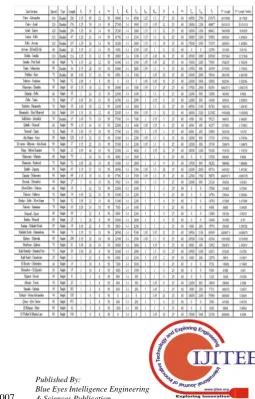
ENR divides its networks into 12 regions, 24 districts and 72 zones according to the geographical organization for maintenance and renewal purposes while it divides the network into 48 line sections for traffic and operating purpose. Table (VI) summarizes ENR network according to line sections and the corresponding running speed, track type, line length, daily passenger traffic (Np), number of cars per
passenger train (ncp), average passenger car weight (wcp),
average passenger locomotive weight (wlp) daily freight traffic
(Nf), number of cars per freight train (ncf), average freight car
[image:3.595.293.549.431.831.2]weight (wcf) and average freight locomotive weight (wlf).
F. Classification According to Actual ENR, Theoretical ENR, UIC Line and Proposed Line.
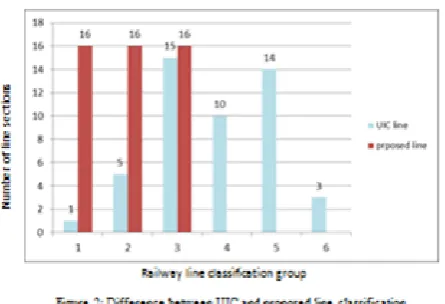
The four classifications can be summarized as shown in table VII, and the difference between Actual ENR classification and Theoretical ENR classification has been shown in figure 1. Also, the difference between UIC line classification and proposed line classification has been shown in figure 2.
Table VII: Comparison between the Classifications According to: Actual ENR, Theoretical ENR, UIC Line
and Proposed Line classification
*Lines belong to Lower Egyptian Railway Network and Ports. From the above-mentioned table VII, one concludes that there are no correlations between the four classifications that is due to unscientific base on which the classifications are adapted. On the other hand, the proposed classification takes into consideration the main three effective parameters: the load, train type and the running speed as well as the practical and special operational conditions for ENR.
From the above two figures, one concludes that there are no correlations between the four classifications that is due to unscientific base on which the classifications are adapted. On the other hand, the proposed classification takes into consideration the main three effective parameters: the load, train type and the running speed as well as the practical and special operational conditions for ENR.
Note:
1. The proposed classification is considered to be uniformly distributed to ensure the lines shall be classified into 6 groups, according to (Tf).
2. This classification should be varied from year to year according to the load, train type and the running speed as the main three effective parameters.
[image:4.595.317.540.51.203.2] [image:4.595.51.289.582.727.2]International Journal of Innovative Technology and Exploring Engineering (IJITEE) ISSN: 2278-3075, Volume-8 Issue-12, October 2019
IV. CONCLUSIONS AND RECOMMENDATIONS
1. According to the comparison of the four classifications (theoretical ENR, actual ENR, UIC line and proposed of track sections to be applied on ENR for year 2019), The statistical analysis shows that the classifications of the above-mentioned categories are totally different as shown in the two following examples:
* Aswan - El Sad El Ali line section has classified as first, third, fifth and third respectively
* Qaluib – Zagazig line section has classified as third, second, second and first respectively
2. The present methodology reveals the following recommendations to ensure both track safety and economic operation.
a)It is recommended to relate the required traffic volume and time with the available budget.
b)The line operational capacity according to the proposed classification
REFERENCES
1. Wribhu Tyagi, Railway Track Maintenance-Role and Scope of IT, A
white paper, TATA Consultancy Services, 2002. p4
2. Transcribe Technical, Railway Track Renewal Strategy Study, Egypt
National Railways Restructuring Project, 2007
3. UIC Code 714 R Classification of lines for the purpose of track
maintenance, International Union of Railways, 3rd edition, 1989
4. Kemal SelcukOgut, Theoretical Traffic Loads and Classification of
Turkish Railway Network according to the Track Maintenance, ARI the Bulletin of the Istanbul Technical University Volume 54, Number 3, November 2004, p90
5. Lei Bai, Rengkui Liu, Quanxin Sun, Futian Wang and Feng Wang,
Classification-learning-based framework for predicting railway track irregularities, J Rail and Rapid Transit 2016, Vol. 230(2) 598–610
6. Muhammad Chenariyan Nakhaee, Djoerd Hiemstra , Mariëlle
Stoelinga, and Martijn van Noort, The Recent Applications of Machine Learning in Rail Track Maintenance: A Survey, Rssrail, 2019 7. تمبعنا ةرادلاا -ميغشتنا ًهع تببقرهن تيزكرمنا ةرادلاا -رصم ذيذح ككسن تيمىقنا تئيهنا
لواذجنا طيطختن
تيسبسلاا تينبنا عبطق -
ًهبقنا هجىناو يرحبنا هجىنا ثاربطقنا ريسم لواذج ىينىي لوأ نم ءاذتبا
2019
8. Egypt National Railways, Permanent Way Department, Guideline for
the maintenance of tracks and turnouts, 1994, Chapter 3, pp3
AUTHORS PROFILE Akram Soltan kotb, [email protected]
Associate Professor of Transportation & Railway Engineering, Arab Academy for Science & Technology & Maritime Transport, College of Engineering & Technology, Construction & Building Engineering Dept., Cairo, Egypt.
Member of the JOINT RAILWAY EXPERTS TEAM between AFRICAN UNION and PEOPLE’S REPUBLIC OF CHINA for AFRICA INTEGRATED HIGH SPEED TRAIN INITIATIVE
Executive Director of the Center of Engineering Consultant at the College of Engineering and Technology (Cairo Branch), Arab Academy for Science & Technology & Maritime Transport
![Table II-a: Actual classification: Class I [7], [8]](https://thumb-us.123doks.com/thumbv2/123dok_us/8168642.251633/2.595.54.282.371.657/table-ii-a-actual-classification-class.webp)