International Journal of Innovative Technology and Exploring Engineering (IJITEE)
ISSN: 2278-3075, Volume-9 Issue-2, December 2019
Abstract: Methodical support is an integral part of educational process. Under the conditions of reforming Russian educational system, its updating becomes an objective necessity. Teachers’ methodological activity as a whole acquires new features and needs improvement which is of particular interest to researchers, thus actualizing the need to consider this issue. In this article the authors reveal the essence of teachers’ methodological activities considering importance of this process both for teachers and for students. Since methodological activity in educational framework acquires new meaning, additional development in this area is required to form methodological support at a high level. Therefore, the purpose of the article is to improve methodological support to perfect students' competencies development. The authors proposed updated methodological support in the courses of general professional cycle. To test effectiveness of the proposed development the authors conducted a study. Improvement of methodological support in the framework of updated educational process contributed to improvement of students' competencies development. The obtained results confirmed effectiveness of updated methodological support in the courses of general professional cycle.
Keywords : methodological activity, methodological provision, students, competences, methodological recommendations.
I. INTRODUCTION
Methodological activity is the activity of a teacher in the
development and improvement of methodology for teaching a
course, that is, it is a set of skills with clearly defined
specificity in the structure of professional pedagogical
activity (Kutepov et al, 2017). The objectives of
methodological activity are the development of the most
rational methods and methods of teaching and educating
Revised Manuscript Received on December 05, 2019.
Сыротюк С. Д., Federal State Budget Educational Institution of Higher Education «Togliatti State University» Email: [email protected]
Vaganova O. I.. Minin Nizhny Novgorod State Pedagogical University, Nizhny Novgorod, Russian Federation, Email: [email protected]
Smirnova, Z.V. Minin Nizhny Novgorod State Pedagogical University,
Nizhny Novgorod, Russian Federation, Email:
Kaznacheeva S.N. Minin Nizhny Novgorod State Pedagogical University, Nizhny Novgorod, Russian Federation Email:
Prokhorov M. P Minin Nizhny Novgorod State Pedagogical University,
Nizhny Novgorod, Russian Federation Email:
Chelnokova E.N. Minin Nizhny Novgorod State Pedagogical
University, Nizhny Novgorod, Russian Federation Email:
Mironov A. G. Krasnoyarsk state agrarian university Email: [email protected]
students; increasing the level of general pedagogical and
methodological teachers‟ personal style and organizational
forms that affect formation of personality and implementation
of educational process (Ilyashenko et al, 2018). Goals express
the content and subject-semantic orientation (Smirnova et al,
2017). They denote target characteristics of educational
concepts and technologies that the teacher uses in practice
(Ilyashenko et al, 2018). Individual methodical style is
expressed in characteristics of teacher‟s activities, which
manifest themselves in the context of any teacher‟s content,
motives and characteristics (Smirnova et al, 2018) as well as
organizational forms, methods and means (Ilyashenko et al,
2018). This component is expressed in the ability to find
optimal combination of forms, methods and means in
different learning environments (Manikandan et al, 2018).
Methodical activities contribute to the development of each
teacher and entire teaching staff skills (Barber et al, 2013). All
methodological activities can be divided into two
components: educational and methodical work; scientific and
methodological activities (Smirnova et al, 2018) as well as
educational and methodological activities (Tsyplakova et al,
2016). Its goal is to study and develop pedagogical
experience, teaching staff professional development,
mentoring support for young professionals, improving the
effectiveness of used methods and means of teaching
(Abramova et al, 2018) and scientific and methodological
activities (Vaganova et al, 2018). It includes study, analysis,
development of advanced pedagogical experience and
innovative technologies, their introduction into educational
practice of an average professional educational institution (in
process of experimental activity), publication of printed
works for internal and external use, organization of scientific
and practical conferences and seminars for teaching staff and
students ( Vaganova et al., 2019). The following functions of
methodical activity are distinguished (Aygul et al, 2018). The
epistemological function displays description and explanation
of pedagogical phenomena and processes (Vaganova et al,
2017): namely, the study of certain learning technologies and
understanding pedagogical potential for existing methods of
solving problems (Ajeenkya et al, 2014). The design function
is to plan ahead and design learning content, prepare learning
activities (Bicheva, 2017) and also determining the most
effective methodological techniques for solving educational
and cognitive tasks (Lubov et al, 2019). Reflexive one is
expressed in the analysis of one‟s activity, that is, in
assessment of one‟s own characteristics, in ability to see one‟s
own strengths and weaknesses (Braine et al, 2013).
Methodological Support Improvement as
Condition for Students' Competences
Development
Sirotyk
S. D.,
Vaganova O. I., Smirnova, Z.V, Kaznacheeva S.N., Prokhorov M. P., Chelnokova
Regulatory function contributes to compliance with
educational standards requirements, curricula and conditions
for implementation into educational process (Markova et al,
2018). In the process of studying vocational training methods,
future teachers acquire only basic methodological skills
(Pavlov et al, 2016). The whole system of methodological
activity is formed and improved in the process of teachers‟
practical activity (Perova et al, 2017). The development of
learning activities occurs through methodological skills
development (Vaganova et al, 2017). The higher the level of
pedagogical methodical activity is, the higher the level of
students readiness for professional activity is, the better his
competences development is (Natalie et al, 2019).
II. METHODOLOGY
In 2017, the authors analyzed methodological support in
courses of general professional cycle of the major
“Construction and maintenance of buildings and structures”,
after which in 2018 it was decided that it was necessary to
update it in order to improve students' competencies
development (Lubov et al, 2018). Methodological
recommendations for students‟ practical work at Nizhny
Novgorod Construction College have become part of the
updated methodological support. To identify the impact of the
updates, the authors conducted a study. Student achievements
in the courses of general professional cycle in 2017 and in
2018 were under analysis. It was recorded that in 2018
percentage of positive assessments increased significantly.
2.1. The result of the study to update methodological
support
In order to carry out their job responsibilities at a high
level in future, future builders should master the basics of
their professional field of activity. First of all, they need to
master the development of architectural and construction
drawing skills. Therefore, in the article we provide updated
guidelines for the course "Engineering Graphics" at Nizhny
Novgorod Construction College. The guidelines contain
recommendations
and
tasks
for
practical
work
implementation. We have proposed instructions for several
practical tasks. Each instruction contains name, purpose of
work, task for work, and also the order of its implementation.
Table 1 presents all the topics in which guidelines
development was made.
Table 1. List of practical tasks with the number of hours
to complete the work
№ Job title Number of hours
to complete the work
1 Drawing fonts 2
2 Conjugation and Dimensioning 2
3 Building a comprehensive drawing of
models in a visual image
2
4 Construction of the third projection of the
part according to two given projections and their axonometric projection
2
5 The construction of three images on two
given and the implementation of simple cuts. Building an isometric view of the part with a quarter cut.
4
6 Construction of three types of parts for two
given with the execution of a stepped section.
4
7 Drawing of the section of the basement of a
residential house
4
8 Floor Plan 8
[image:2.595.311.552.474.569.2]Next, we present detailed guidelines for some practical
assignments. Title of work: Drawing fonts. Objective:
Acquisition of skills in writing letters and numbers in a
drawing font in accordance with the requirements of GOST
2.304-81; Task: On an A4 sheet of paper, make a drawing
font. All letters and numbers must be handwritten. The task is
performed in one version. Methodological instructions: a font
is an outline of alphabet letters, numbers and signs.
Requirements for the font: must be clearly executed, clear and
easy to read, all signs and letters must be neat (Ilyashenko et
al, 2018). For high-quality execution of the inscriptions it is
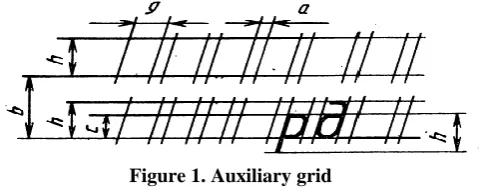
necessary: to build an auxiliary grid (Figure 1); maintain
individual elements of the font sequence: if there are rounds in
a letter, then first draw them, and then smoothly connect the
rounds with straight lines; maintain a uniform spacing
between letters and equal spaces between words. Most often
in engineering graphics fonts are used with the following
sizes: 10; 7; five; 3.5 millimeters. When writing a drawing
font, you should be guided by the following rules: The height
of letters, numbers and symbols in a drawing should be at least
3.5 millimeters. Perform letters and numbers in parts
(Bulaeva et al, 2018). The movement of the hand when
drawing rectilinear elements of letters will be executed from
top to bottom or from left to right, and rounded - by moving
down and to the left or down and to the right. Similar elements
of various letters, numbers and signs must be performed in the
same way in order to develop automatic skills. It is necessary
to withstand the initially defined slope of the font using the
grid (Smirnova et al, 2017). There must be strict adherence to
the design of each letter and ratio of height and width of the
letter. It is necessary to maintain the distance between the
letters so that visually they look the same. It is important to
make a high-quality drawing in order to make it easy to read,
so that it appears clear and precise. Be sure to draw letters and
numbers carefully.
Figure 1. Auxiliary grid
International Journal of Innovative Technology and Exploring Engineering (IJITEE)
ISSN: 2278-3075, Volume-9 Issue-2, December 2019
[image:3.595.334.529.64.178.2]The distance between them is taken according to part
dimensions, it is also necessary to take into account the
distribution of the image in the drawing field. We draw arcs of
circles, circles and straight lines whose positions are
determined by given dimensions and it does not require
additional constructions (Arkhipova, et al 2018). Perform
geometric constructions and mates. Preliminary constructions
should be made with thin lines with a solid pencil (T or 2T).
We apply external and dimension lines, we write dimensional
numbers in the fifth font. It is necessary to check whether the
drawing is correctly made before drawing a pencil with a TM
or M. First, we draw an arc of circles and circles and then we
draw a straight line. Outline the inner frame of the drawing.
Dimensioning: in construction drawings, dimensions are
applied in accordance with GOST 2.307- 68 * and taking into
account the requirements of GOST 21.101-97. Dimensions
are applied in the form of a closed circuit without indicating
measurement units. Dimensional lines in construction
drawings are limited by serifs - short strokes 2-4 millimeters
long, which are held with a slope to the right at an angle of 45º
to the dimension line. Dimensional lines stand for 1-3 mm
extremal extension lines. The dimension number is placed
above the dimension line at a distance of 1 millimeter. The
extension line stands for dimensional at 1-5 millimeters. The
distance from the outline of the drawing to the first dimension
line should be at least 10 millimeters. The distance between
parallel dimension lines should be at least 7 millimeters, and
from the dimension line to the level of the coordination axis -
4 millimeters. When specifying diameter, radius of a circle or
angle, the dimension line in construction drawings is limited
by arrows (Figure 2).
Figure 2. Dimensioning
Recommendations developed by us for each assignment detail
the procedure and take into account many issues that may
arise in work course. They are the basis for the development
of student autonomy and as a result of its creative component
development which will help increase his competitiveness in
labor market in future. In addition, we posted general
guidelines on how students perform practical work in
e-course of the subject under consideration. Access to them
for students was open around the clock and they could test
their knowledge at any time and fill in the gaps by contacting
the resource. In order to identify the updated methodological
support effectiveness, we conducted a study. We analyzed the
test records of students enrolled in the major "Construction
and maintenance of buildings and structures" in 2017 and in
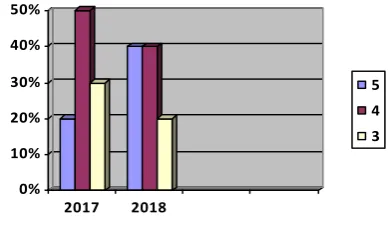
2018. The results are shown in chart 1.
0% 10% 20% 30% 40% 50%
2017 2018
5 4 3
Chart 1. The results of students' grades analysis in the
course of general professional cycle in 2017 and in 2018.
In 2017, 20% of students had rating of „‟5‟‟ – “excellent”;
50% of students had rating of „‟4‟‟ – “good”; 30% of students
had rating of „‟3‟‟ – “satisfactory”. The results of test analysis
of records in 2018 were significantly higher: excellent grades
for 40% of students, good grades also for 40% of students and
satisfactory grades have only 20% of students. After updating
methodological support, we were able to record increase in
the level of competencies development.
As we can see, in the second group the percentage of
satisfactory grades is significantly lower than in the first
group.
From
this
it
should
be
concluded
that
recommendations we have introduced have positive effect.
III. RESULTS
After analyzing methodological support in 2017, we
decided on the need to improve it in 2018. It was proposed to
update methodological support in the courses of general
professional cycle of the major "Construction and
maintenance of buildings and structures". Since it is
extremely important for students to master the basics of
professional activity, we focused on students' competence
“Development of architectural and construction drawings”
development in the article. Therefore, the article reflects the
guidelines for practical work in the course “Engineering
Graphics”.
After analyzing the statements for 2017-2018, we
determined that the percentage of high grades increased
significantly in 2018. The percentage of excellent grades rose
from 20% to 40%. Students have improved their performance
since the updated methodological support was introduced.
We can say that this update affects students' competencies
development. That is, methodological support is an essential
condition for competencies development.
IV. SUBCHAPTER
The study showed that methodological support is one of
the conditions for increasing the level of students' training and
more efficient development of necessary competencies.
V. CONCLUSIONS
The goal of this work to improve methodological support
and students' competencies development was achieved. The
use of updated teaching materials in educational process
should be developed. Thus, we will improve the process of
technical school students‟
VI. SUBCHAPTER
Since the results of the updates turned out to be positive, we
can talk about the need to continue to improve
methodological support in educational process at Nizhny
Novgorod Construction College.
REFERENCES
1. Bulaeva M.N., Vaganova O.I., Koldina M.I., Lapshova A.V., Khizhnyi
A.V. Preparation of bachelors of professional training using MOODLE. Popkova E.G. (ed.) The Impact of Information on Modern Humans.
Springer, 2018. Vol. 622, pp. 406-411.
https://doi.org/10.1007/978-3-319-75383-6_52
2. Ilyashenko L.K., Prokhorova M.P., Vaganova O.I., Smirnova Z.V.,
Aleshugina E.A. Managerial preparation of engineers with eyes of students. International Journal of Mechanical Engineering and Technology (IJMET) Volume 9, Issue 4, April 2018, pp.1080-1087.
3. Ilyashenko, L.K., Smirnova, Z.V., Vaganova, O.I., Prokhorova, M.P.,
Abramova, N.S. The role of network interaction in the professional training of future engineers. International Journal of Mechanical Engineering and Technology (IJMET) Volume 9, Issue 4, April 2018, pp. 1097-1105.
4. Ilyashenko, L.K., Vaganova, O.I., Smirnova, Z.V., Prokhorova, M.P.,
Gladkova, M.N. Forming the competence of future engineers in the conditions of context training. International Journal of Mechanical Engineering and Technology (IJMET) Volume 9, Issue 4, April 2018, pp. 1001-1007.
5. Ilyashenko, L.K., Vaganova, O.I., Smirnova, Z.V., Sedykh, E.P.,
Shagalova, O.G. Implementation of heurist training technology in the formation of future engineers (2018) International Journal of Mechanical Engineering and Technology, 9 (4), pp. 1029-1035.
6. Kutepov, M.M., Vaganova, O.I., & Trutanova, A.V. (2017). Possibilities
of health-saving technologies in the formation of a healthy lifestyle.
Baltic Humanitarian Journal, 6(3), 210-213.
https://elibrary.ru/item.asp?id=30381912 (in Russian).
7. Lubov Kiryalovna Ilyashenko, Pedagogical Conditions of Formation of
Communicative Competence of Future Engineers in the Process of Studying Humanitarian Disciplines, International Journal of Civil Engineering and Technology, 9(3), 2018, pp. 607-616.
8. Manikandan and M. Muthumeenakshi, Role of Engineering Education in
Sustaining the Economic Development of India, International Journal of Mechanical Engineering and Technology 9(3), 2018, pp. 706-710.
9. Abramova N.S., Vaganova O.I., Kutepova L.I. Development of
educational and methodological support in the context of the implementation of information and communication technologies. Baltic Humanitarian Journal. 2018. t. 7. no. 2 (23). pp. 181-184. https://elibrary.ru/item.asp?id=35327269 (in Russian).
10. Ajeenkya D., Patil Y., Dr. Gagandeep Nagra and Dr. Gopal R. A Study
on Total Quality Management in Higher Education. International Journal of Management. 2014. no. 5(5). p. 1-6.
11. Arkhipova, M.V., Belova, E.E., Gavrikova, Y.A., Lyulyaeva, N.A.,
Shapiro, E.D. Blended learning in teaching EFL to different age groups (2018) Advances in Intelligent Systems and Computing, 622, pp. 380-386. DOI: 10.1007/978-3-319-75383-6_49.
12. Aygul Zufarovna Ibatova and Natalia Viktorovna Ippolitova,
Structuring the Content of Disciplines in Higher School Using a Block-Modular Rating System for Future Oil and Gas Engineers, International Journal of Civil Engineering and Technology, 9(3), 2018, pp. 394–399.
13. Barber, M., Donnelly, K., Rizvi, S., & Summers, L. (2013). An avalanche is coming. Higher Education and the revolution ahead, 73. http://www.studynet2.herts.ac.uk/intranet/lti.nsf/0/684431DD8106AF 1680257B560052BCCC/$FILE/avalanche-is-coming_Mar2013_1043 2.pdf
14. Bicheva I.B.; Filatova O.M. Formation of the teacher-leader in the educational process of the university. Vestnik of Minin University; 2017; no. 3(20); pp. 5. https://doi.org/10.26795/2307-1281-2017-3-5 (in Russian).
15. Braine, G. (2013). Non-native educators in English language teaching.
Routledge. https://www.taylorfrancis.com/books/9781135461867
16. Markova S.M., Sedykh E.P., Tsyplakova S.A., Polunin V.Y.
Perspective trends of development of professional pedagogics as a
science. Advances in Intelligent Systems and Computing. 2018. vol. 622; pp. 129-135. https://doi.org/10.1007/978-3-319-75383-6_17.
17. Pavlov, A., Kindaev, A., Vinnikova, I., & Kuznetsova, E. (2016). Crop
insurance as a means of increasing efficiency of agricultural production in Russia. International Journal of Environmental and Science Education, 11(18), 11863-11868.
18. Perova, T. V., Kuznetsova, E. A., Vinnikova, I. S., Kaznacheeva, S. N.,
& Chelnokova, E. A. (2017). Essence of the role and characteristics of the operating conditions of enterprises before and after the transition to market relations from a macroeconomic position. International Journal of Applied Business and Economic Research, 15(12), 103-112.
19. Smirnova ZH.V., Gruzdeva M.L., Krasikova O.G. Open electronic
courses in the educational activities of the university. Vestnik of Minin
University, 2017, no. 4(21), p. 3.
https://doi.org/10.26795/2307-1281-2018-6-3-9 (in Russian).
20. Smirnova Zh.V., Krasikova O.G. Modern tools and technologies for
assessing learning outcomes. Vestnik of Minin University. 2018. Vol. 6, no. 3. Р. 9. DOI: 10.26795/2307-1281-2018-6-3-9.
21. Vaganova O.I., Gladkov A.V., Trutanova A.V. Formation of
professional competencies of bachelors in the conditions of e-learning. Baltic Humanitarian Journal. 2017. vol. 6. no. 2 (19). pp. 190-193. https://elibrary.ru/item.asp?id=29415561 (in Russian).
22. Vaganova O.I., Ilyashenko L.K. The main directions of implementation
technologies of student-centered education in high school. Vestnik of Minin University. 2018. vol. 6, no. 3. p.2 DOI: 10.26795 / 2307-1281-2018-6-3-2 (in Russian)
23. Smirnova ZH.V., Vaganova O.I., Trutanova A.V. Final state
certification as a way to comprehensive assessment of competences. Karelian Scientific Journal, 2017, vol. 6, no. 3(20), pp. 74-77., https://elibrary.ru/item.asp?id=30453035 (in Russian).
24. Smirnova Zhanna V., Mukhina, M.V., Kutepova, L.I., Kutepov, M.M.,
Vaganova, O.I. Organization of the research activities of service majors trainees (2018) Advances in Intelligent Systems and Computing, 622, pp. 187-193.
25. Tsyplakova S.A., Grishanova M.N., Korovina E.A., Somova N.M.
Theoretical bases of designing of educational systems. Azimuth of Scientific Research: Pedagogy and Psychology. 2016. vol. 5. no. 1 (14). pp. 131-133 (in Russian).
26. Vaganova O.I., Koldina M.I., Trutanova A.V. Development of the
content of vocational and pedagogical education in the context of the implementation of the competence approach. Baltic Humanitarian Journal, 2017, vol. 6, no. 2(19), pp. 97-99 (in Russian).
27. Vaganova, O. I., Smirnova, Zh. V., Markova, S. M., Chaikina, Zh. V., &
Bulaeva, M. N. (2019). Organization of partnerships for additional educational services on the example of the interaction of the educational institution with the health and cultural centre. Perspektivy nauki i obrazovania – Perspectives of Science and Education, 39 (3), 500-514. doi: 10.32744/pse.2019.3.38
28. Natalie V. Kamenez, Zhanna V. Smirnova, Olga I. Vaganova, Natalia V.
Bystrova and Julia M. Tsarapkina, Development of Instructing Techniques in Professional Training, International Journal of Mechanical Engineering and Technology, 10(02), 2019, pp. 899–907
29. Lubov K. Ilyashenko, Zhanna V. Smirnova, Olga I. Vaganova, Elena A.
Chelnokova and Svetlana N. Kaznacheeva, Methods of Conducting Practical Training on the Subject "Power Sources for Welding", International Journal of Mechanical Engineering and Technology, 10(02), 2019, pp. 908–917
AUTHORS
PROFILE
Sirotyk Svetlana Dmitrievna, Candidate of Pedagogical Sciences, Department of Undergraduate (Economic and Management Programs) Federal State Budget Educational Institution of Higher Education «Togliatti State University»
Russia, 445020, Samara region, Tolyatti, st. Belarusian, house 14 E-mail: [email protected]
https://orcid.org/0000-0003-4256-4982
Vaganova Olga Igorevna, Candidate of Pedagogical Sciences, Associate Professor of the Department of Vocational Education and Management of Educational Institutions, Minin Nizhny Novgorod State Pedagogical University, Nizhny Novgorod, Russian Federation. Research Interests: Designing the content of vocational training. The implementation of modern
educational technologies in the
International Journal of Innovative Technology and Exploring Engineering (IJITEE)
ISSN: 2278-3075, Volume-9 Issue-2, December 2019
Education: Volga State Engineering and Pedagogical Institute, specialty "Vocational training", 2000.
Professional development: Project management and fundraising in research and innovation and innovative activities of the university Moscow, Russian State Social University 2012 ,.
Advanced training: The use of information and communication technologies in professional activities (Internet technology module for interactive interaction in e-learning), Nizhny Novgorod, 2015 Theme of the dissertation research: Methods for estimating the amount of educational material to be memorized in the course of mathematics in secondary schools.
Smirnova Zhanna Venediktovna, candidate of pedagogical sciences, associate professor of the department of service technologies and technological education, Minin Nizhny Novgorod State Pedagogical University, Nizhny Novgorod, Russian Federation.
Scientific interests: development of the content of vocational training. The introduction of modern educational technologies in the educational process. Education: Nizhny Novgorod State Pedagogical University, 2007 Professional development: project management and fundraising in the scientific and innovative and innovative activities of the university. Moscow, Russian State Social University 2012 ,
Further training: the use of information and communication technologies in professional activities (Internet technology module for interactive interaction in e-learning), Nizhny Novgorod, 2018 Thesis: The preparation of a master of professional education in the structure of an engineering and pedagogical university
Kaznacheeva Svetlana Nikolaevna, candidate of pedagogical sciences, associate professor of the Department of Innovative Management Technologies of the Minin Nizhny Novgorod State Pedagogical University, Nizhny Novgorod, Russian Federation
Research interests: development of cognitive activity, personnel management, marketing
Education: Nizhny Novgorod Commercial Institute; Commerce; 1998 year Professional development: Development of cognitive activity of university students Further training: advanced training in the program "Project Management in the Educational Activities of the University", NGPU named after K. Minin, 2014, advanced training in the program "Psychology and Pedagogy of Higher Education". NGPU named after K. Minin, 2015. advanced training program "Pedagogy and Psychology of Potential Opportunities for Persons with Disabilities and Higher Disabilities at the University", NGPU named after K. Minin, 2018 advanced training on the program "Innovative Management Technologies" , NGPU named after K. Minin, 2018.
Prokhorova Maria Petrovna, Candidate of Pedagogical Sciences, Associate Professor, Department of Innovative Management Technologies, Nizhny Novgorod State Pedagogical University named after Kozma Minin. Research interests: Innovative processes in vocational education Innovative training of teachers Management of innovative activities in vocational education Education: VGIPU, Vocational Training (Economics and Management), 2006 Professional Development: Training Professional Education Teachers for Innovation Activities at the University
Further training: 2008 - additional professional education, program "Business Administration of Innovation Projects", GOU DPO Nizhny Novgorod Research and Information Center
2012 - advanced training, the program "Information Technologies in the Management of the Quality of Education", FSBEI HPE NGPU im. K. Minina.
Chelnokova Elena Nikolaevna, Candidate of Pedagogical Sciences, Associate Professor, Department of Innovative Management Technologies, Minin Nizhny Novgorod State Pedagogical University, Nizhny Novgorod, Russian Federation. Scientific interests: tutoring Education: BSPI (Biysk State Pedagogical Institute), Faculty of Philology, 1986. Professional development: Communications in management, Professional ethics and etiquette, an introduction to professional management activities Marketing services. Further training: Program "The use of ICT in professional activities". NGPU, 2016Additional professional program "Innovative Management Technologies". NGPU them. K. Minina, 2018. Additional professional program "Pedagogy and Psychology of Potential Opportunities for Persons with Disabilities and Disabilities at the University". NGPU them. K. Minina, 2018.
Mironov Aleksei Gennadievich (Krasnoyarsk, Russia), Mironov A.G. Associate Professor of the Department of Psychology, Education and Human Ecology, candidate of Agricultural Sciences, docent
Krasnoyarsk state agrarian university e-mail: [email protected]
SPIN-code: 9873-0365, AuthorID: 236213 ORCID ID