Abstract: Advance in extraction of mineral resources is one of the most prioritized problems of mining industry in Russia and other countries. Herewith, drilling and blasting operations are the most important mining stages, the relevant expenses reach up to 50% of total mining costs. Drilling tool is the most important and highly loaded element of drilling assembly determining the efficiency of blasthole drilling. Existing designs of drill bits of Russian and foreign manufacturers are nondismountable, that is, are beyond repair or reclaim, especially in field conditions. For instance, in the case of failure of one bearing support, the drill bit fails and is rejected. Despite numerous types of drilling tools, their stressed state has been studied sufficiently only for serially fabricated drill bits. Therefore, it is important to study strength properties of dismountable drilling tools which provide the maximum operation lifetime of the basic parts (body and coupling). Complete information about loads acting on the main elements of drill bits is required to improve designs of dismountable drilling tools. This work analyzes stress and strain state of dismountable drill bits with spherical cutters (RSShD) using finite element models in ANSYS software environment. Predictions are made for the cases of maximum loads exerted by highly efficient drilling rigs on the drill bit and heterogeneous distribution of these loads over elements of the drill bit. Distributions of equivalent stress fields occurring in drill bit body, bearing supports and cutters are presented. Drill bit operability in various operation modes is analyzed.
Keywords: blasthole drilling; axial load; drilling tool; drill bit; prediction model; stress and strain state; equivalent stress; yield strength.
I. INTRODUCTION
A
dvance in extraction of mineral resources is one of the most prioritized problems of mining industry in Russia and other countries. Herewith, drilling and blasting operations are the most important mining stages, the relevant expenses reach up to 50% of total mining costs.Continuous increase in demand for various mineral resources
Revised Manuscript Received on December 05, 2019.
* Correspondence Author
Konstantin Anatol'evich Bovin*, Siberian Federal University, Krasnoyarsk, Russia.
Andrey Olegovich Shigin, Siberian Federal University, Krasnoyarsk, Russia.
Dmitry Yuryevich Kritsky, Siberian Federal University, Krasnoyarsk, Russia.
Alexander Igorevich Erofeev, Siberian Federal University, Krasnoyarsk, Russia.
Vitaliy Aleksandrovich Yarkov, Siberian Federal University, Krasnoyarsk, Russia.
requires for increase in production of mineral feedstock which, in its turn, stipulates increase in scope of drilling and blasting operations (especially at deposits of ore mineral resources). In this regard, it is important to improve the existing and to develop innovative types of highly efficient drilling rigs and tools.
Drilling tool is the most important and highly loaded element of drilling assembly determining the efficiency of blasthole drilling.
At present roller drilling is mostly used in Russian quarries [1–2] equaling to 80–85% of all drilling operations (for iron ore and nonferrous metals, presented mainly by hard rocks, the portion of roller drilling is 90–95%, for coal mines – about 60%).
It should be mentioned that the existing designs of drill bits of Russian and foreign manufacturers are nondismountable, that is, are beyond repair or reclaim, especially in field conditions. For instance, in the case of failure of one bearing support, the drill bit fails and is rejected [3].
Aiming at increase of operation lifetime and production rate of rolling drilling tools, the Chair of mining machinery (Siberian Federal University) developed design of dismountable drilling cutter of spherical type (RSShD) [4–5]. This is a challenging design, it can be improved on the basis of complete information about stressed state of main elements.
Stress and strain state of drilling tool is characterized by certain factors comprised mainly of design features and active loads [6–7].
The pattern of load distribution and accommodation depends mainly on drill bit cutting structure (spherical cutters in our case) based mainly on drill bit type and rock properties [8]. Despite numerous types of drilling tools, their stressed state has been studied sufficiently only for serially fabricated drill bits. Therefore, it is important to study strength properties of dismountable drilling tools which provide the maximum operation lifetime of the basic parts (body and coupling) [9–10].
II. PROPOSEDMETHODOLOGY
A. General description
Strength predictions of dismountable drill bit of spherical type were based on finite element model in ANSYS environment with maximum forces and moments (Pax=750 kN , Mimp=6.5 kNm) generated
by modern high efficient
Stressed State of Elements of Dismountable
Drilling Tool with Spherical Cutters: Simulation
in Software Environment
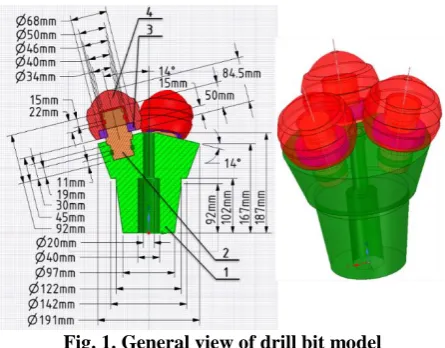
possible to combine finite element grid generated in a certain group (part/component) of geometrical objects. Using this principle, the body 1 with both parts of the axles 2 were combined into one group (part/component), and the cutters 4 with the bearings 3 were combined pairwise into the second, the third, and the fourth group (part/component).
[image:2.595.315.538.48.222.2] [image:2.595.132.516.311.460.2]Fig. 1. General view of drill bit model
Figure 2a illustrates finite element model of drill bit. The main elements of this model are comprised of ten nodal tetrahedrons and the axles are generated by 20 nodal hexagonal elements. The finite element model was built by
Tetrahedrons method with local fine grid for higher
detalization [13].
a b
Fig. 2. Finite element model of drill bit with spherical cutters: a – model of finite elements; b – finite elements of the model.
The finite element model was built in ANSYS Workbench using Solid 186 parabolic solid finite elements having up to 20 nodes with three degrees of freedom in each (three linear movements), their general view is illustrated in Fig. 2b.
As for the new drill bit design, RSShD, the absence of extending elements (except for cutters) and, as a consequence, the absence of areas of sharp variation of cross section result in the fact that the drill bit operates as a single unit. External impacts are implied onto solid body, which leads to insignificant stresses in the considered predicted cases.
In order to obtain reliable predications, it is preferable to apply the elements with the quality of at least 0.4 [12–15], however, in this problem the number of elements of low quality (0.3–0.4) does not exceed 140, which is less than 0.06% of the total number of elements (253204), thus, this model can be applied for predictions.
[image:2.595.308.548.514.644.2]The model is loaded by the force Pax (750 kN) acting towards the axis Z of global coordinates, as well as by the moment Mimp (6,5 kNm) acting around the same axis. Pax and Мimp are applied to the edge of drill bit body. The loading conditions of the model are illustrated in Fig. 3.
a b
Fig. 4. Boundary conditions of drill bit loading: a – rotation of drill bit, b – rotation of cutters. According to the problem specification, each cutter is
capable to rotate freely on the axle. This condition was simulated using Joint function. When this function is activated, the movements and rotation angles of nodes on joint surfaces are linked. In this case Revolute Joint was selected [13], where only rotation around the Z axis of Joint local coordinates is free from movements. Simulation of this condition is illustrated in Fig. 4b as exemplified by mating of
cylindrical surfaces of the axle and the bearing of one of the cutters. Other matings were simulated similarly.
[image:3.595.39.542.351.454.2]The drill bit elements were made of the following materials: body – 14KhNZMA–Sh steel, bearing support – 50KhN steel, spherical cutters – 16KhNZNMA–Sh, drill bit structure – VK8V sintered carbide alloy. The properties of these materials [16] are summarized in Table 1.
Table 1. Properties of materials used for fabrication of drill bits [16]
Properties Designation
Material
Body Axle Cutters
14KhNZMA–Sh 50KhN 16KhNZNMA–Sh
Ultimate stress, MPa u 885 885 835
Ultimate short-term strength, MPa st 980 1,080 930
Elasticity modulus, MPa Е 2.14∙10–5 2.15∙10–5 2.16∙10–5
Poisson coefficient v 0.25 0.27 0.26
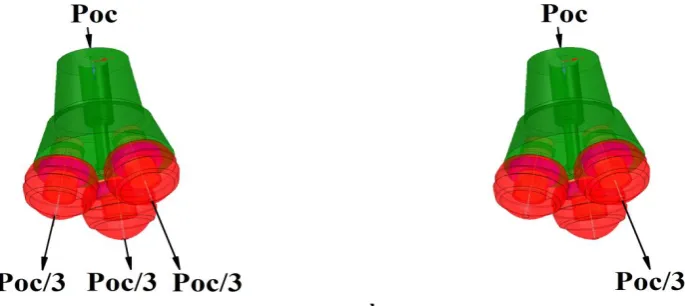
The studies of strength of drilling tools [17–19] demonstrated that major portion of load from drilling assembly to drilling bit during its operation (accounting for continuous variation of properties of borehole bottom: continuities, roughness, cracks, etc.) could be transferred to the borehole bottom via three, two, and sometimes one rock destructing element. As a consequence, load is distributed heterogeneously over the elements of drilling tool.
C. Algorithm
[image:3.595.128.471.574.727.2]Taking this into account, the strength properties of dismountable drill bits with spherical cutters could be sufficiently studied by simulation of two cases of drill bit loading. The first case: when overall load is uniformly distributed over three spherical cutters, the second case: overall load is applied to one spherical cutter as illustrated in Fig. 4.
a b
a b
Fig. 5. Distribution of fields of equivalent stresses of body: a – the load is distributed uniformly over three cutters; b – the load is applied to one cutter.
Analysis of data in Fig. 5 demonstrates that the distribution of fields of equivalent stresses is uniform. Maximum active stresses occur at points of contact between body and axles equaling to 320.86 and 855.33 MPa for the first and the second loading case, respectively. The obtained stresses are lower than the allowable values (by 5–10%) and do not
exceed the ultimate stress (u) and the ultimate short-term strength of the body material (st) (Table 1).
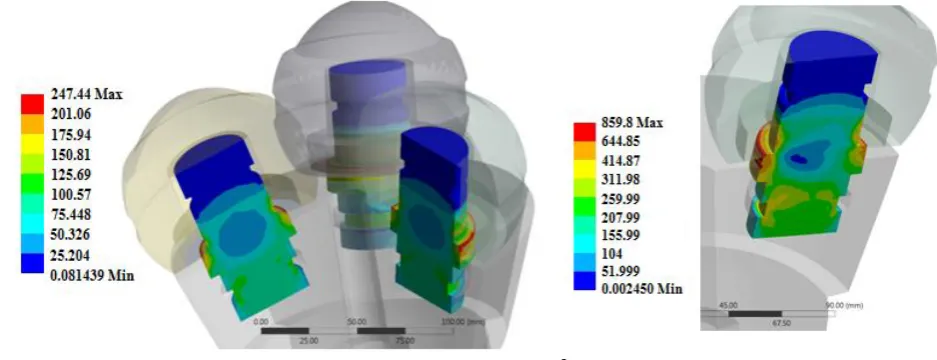
Figure 6 illustrates distribution of fields of equivalent von Mises stresses over the axles.
[image:4.595.69.538.458.638.2]a b
Fig. 6. Distribution of fields of equivalent stresses over the axes: a – the load is distributed uniformly over three axles; b – the load is applied to one axle.
a b
Fig. 7. Distribution of fields of equivalent stresses across spherical cutter: a – the load is distributed uniformly over three spherical cutters; b – the load is applied to one spherical cutter.
According to the data in Figs. 6 and 7, it is possible to obtain conclusion similar to Fig. 5. Maximum stresses in axles occur in the areas of their contact with cutter bearing, and their rated values are 247.44 and 859.8 MPa for the first and the second cases of loading, respectively. Maximum stresses in spherical cutters occur in the areas of their contact with the bearing, and their rated values are 348.71 and 815.51 MPa for the first and the second cases of loading, respectively. It should be mentioned that the obtained stresses are lower than the allowable values (by 5–10%) and do not exceed the ultimate stress (u) and the ultimate short-term strength of the body material (st) (Table 1).
IV. DISCUSSION
According to the predictions (Figs. 5–7), it can be seen that the highest stresses occur upon action of overall load onto one spherical cutter. However, the obtained stresses are lower than the allowable values (by 5–10%), thus, operability of the drill bit in terms of strength and bearing capacity is verified.
The difference in load distribution (Fig. 4) is that upon action of overall load on one spherical cutter, one side is loaded more than the others.
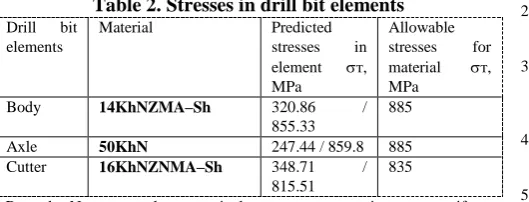
Table 2 summarizes the stresses occurring in drill bit elements as well as the allowable stresses for the materials of drill bit elements.
Table 2. Stresses in drill bit elements Drill bit
elements
Material Predicted stresses in element т, MPa
Allowable stresses for material т, MPa
Body 14KhNZMA–Sh 320.86 / 855.33
885
Axle 50KhN 247.44 / 859.8 885 Cutter 16KhNZNMA–Sh 348.71 /
815.51
835
Remark: Numerator shows equivalent stresses occurring upon uniform distribution of the applied load over three spherical cutters, nominator shows stresses occurring upon action of all loads onto one spherical cutter.
High level of equivalent stresses in drill bit axles can be attributed to the fact that they are installed at certain angle (а = 5–7°), therefore, one side of the axle is loaded to a higher extent. However, in the course of predictions, it is
stresses in the axles as well as in their installation positions in drill bit body, which would allow reducing maximum stresses in the axles and simplifying assembling of the drill bit
In order to reduce maximum stresses occurring in the spherical cutters, it is recommended to provide bevel or edge smoothing in the place of cutter mating with bearing
V. CONCLUSION
The following conclusions can be made on the basis of the analysis of loaded and stressed state of dismountable drill bits with spherical cutters (RSShD–244,5):
1. The considered drill bit withstands the applied loads without generating segments with critical stresses in the bit design, hence, it is characterized by sufficient strength and wear resistance.
2. Predictions of stress and strain state of the considered drilling tool with spherical cutters evidence that the RSShD tools are suitable for efficient operation upon rock drilling operations with the hardness factor f = 8–12, taking into account operation variables used in the work corresponding to specifications of drilling rigs.
REFERENCES
1. A. Sapińska–Śliwa, R. Wiśniowski, M. Korzec, A. Gajdosz, T. Śliwa, “Rotary – percussion drilling method – historical review and current possibilities of application”, AGH Drilling, oil, gas, 32(2), 2015, pp. 313–322.
2. E.I. Abdelrasoul Mohamed, “Distribution and Implementation of Drilling Machines At The Quarry Benches”. Revista Minelor, 20, 2014, pp. 12–17.
3. L. Linxia, P. Radu, “Machinery time to failure prediction – Case study and lesson learned for a spindle bearing application. PHM 2013 – 2013”, IEEE International Conference on Prognostics and Health Management, Conference Proceeding, 2013. pp. 1–11.
4. A.V. Gilev, Doctoral thesis: “Scientific and engineering foundations of development of specialized drilling tools and their application at quarries”. Krasnoyarsk, 2005.
[image:5.595.44.309.599.700.2]“Determination of drilling and blasting parameters considering the stress–strain state of rock ores”, Naukovyi Visnyk Natsionalnoho Hirnychoho Universytetu, 2019, pp. 37–41.
11. B. Vasiliev, O. Kalashnikov, A. Oleynikova, A. Ivanovsky, N. Grudinin, “Research of frequency converters energy characteristics of drilling rigs”, IOP Conference Series: Earth and Environmental Science, 87, 2017.
12. K.A. Basov, “ANSYS dlya konstruktorov” [ANSYS for designers]. Moscow: DMK–Press, 2016.
13. T. Stolarsk, Y. Nakasone, S. Yoshimoto, “Engineering analysis with ANSYS software”, Cambridge University Press, 1985, p. 453. 14. K.A. Bovin, A.V. Gilev, A.O. Shigin, V.T. Chesnokov, A.A. Shigina,
“The research of loaded condition of the demountable cutting–rotary drilling tool elements with a two–row cutting structure”, International Journal of Mechanical Engineering and Technology, 10(02), 2019, pp. 1179–1186.
15. M.K. Thompson, J.M. Thompson, “ANSYS Mechanical APDL for Finite Element Analysis”, USA: Butterworth–Heinemann, 2017, p. 466.
16. Yu.G. Dragunov, A.S. Zubchenko, Yu.V. Kashirskii, A.F. Degtyarev, V.V. Zharov, M.M. Koloskov, A.S. Orlov, V.N. Skorobogatykh, “Marochnik stalei i splavov” [Grade guide for steels and alloys]. Moscow, Mashinostroenie, 2015.
17. V.D. Butkin, “Proektirovanie burovykh dolot dlya otkrytykh gornykh, zemlyanykh i stroitel'nykh rabot” [Development of drill bits for open–cast mining operations, excavation and construction]. Moscow. MaksPress, 2005.
18. J. Majerníkova, E. Spisak, “Increasing durability of cutting tools”, Advances in Science and Technology Research Journal, 11(4), 2017, pp. 141–146.