Appendix : UK Grid Services and Activities
e-Science Gap Analysis
30 June 2003
Geoffrey Fox, Indiana University
David Walker, Cardiff University
Part V: Appendix (Section 14) UK Grid Services and Activities ... 6
A.1.
Summary of Services, Tools and Utilities ... 6
A.1.1 Tabular Classification of UK e-Science Services Tools and Utilities... 6
A.1.2 Caveat to Table 1 ... 10
A.2.
Contributions to Report... 11
A.2.1 Different Types of Grid and their Federation ... 11
A.2.1.1 Jini as an Infrastructure for Building Grids... 11
A.2.1.1.1 Steven Newhouse (Imperial College) ... 11
A.2.1.1.2 Mike Kirton (QinetiQ) ... 11
A.2.1.2 JXTA as an Infrastructure for Building Grids ... 11
A.2.1.2.1 Alistair Dunlop (Capital Radio Group)... 11
A.2.1.2.2 Ian Taylor (Cardiff University) ... 12
A.2.1.2.3 Ian Sommerville (Lancaster University) ... 12
A.2.1.3 Microsoft .NET ... 13
A.2.1.3.1 Omer Rana (Cardiff University) ... 13
A.2.1.3.2 Simon Cox (Southampton University)... 13
A.2.1.4 Selected Snapshots of Current Activities... 14
A.2.1.4.1 Dynamic Configuration and Autonomic Computing (Ian Sommerville, Lancaster University)... 14
A.2.1.4.2 Grids and Virtual Private Networks (Matthew Dovey, Oxford e-Science Centre) ... 14
A.2.2 e-Science Runtime and Hosting Environemnt... 15
A.2.2.1 Selected Snapshots and Current Activities... 15
A.2.2.1.1 Invocation Framework (Mike Surridge, IT Innovations)... 15
A.2.2.1.2 ICENI (Steven Newhouse, Imperial College) ... 16
A.2.2.1.3 Messaging Infrastructure ... 16
A.2.2.1.4 Lightweight Middleware Technologies (Geoffrey Coulson, Lancaster University) ... 17
A.2.3 Security Infrastructure ... 18
A.2.3.1 Grid Security: Problems and Potential Solutions ... 18
A.2.3.1.1 Requirements and Issues ... 18
A.2.3.1.2 Possible Solutions ... 19
A.2.3.1.3 Implementation Issues... 19
A.2.3.1.4 Recommendations... 20
A.2.3.1.5 Other Issues ... 20
A.2.3.2 Possible Future Projects... 21
A.2.3.2.1 Harden VOMS from EDG (David Boyd, Rutherford-Appleton Laboratory) ... 21
A.2.4 Workflow ... 21
A.2.4.1 Selected Snapshots of Current Activities... 21
A.2.4.1.1 Workflow at Southampton (Luc Moreau) ... 21
A.2.4.1.2 Workflow at Newcastle (Paul Watson)... 21
A.2.4.1.3 Workflow at Cardiff (Yan Huang) ... 22
A.2.4.1.4 Workflow at IT Innovations (Mike Surridge) ... 22
A.2.4.2 Possible Future Projects... 23
A.2.4.2.1 Newcastle Workflow Engine (Paul Watson, North-East Regional e-Science Centre) ... 23
A.2.5 Notification Service ... 23
A.2.5.1 MyGrid and Wrapped JMS ... 23
A.2.5.1.1 Luc Moreau (Southampton University) ... 23
A.2.5.1.2 Paul Watson (North-East Regional e-Science Centre) ... 23
A.2.6 Metadata and Semantic Grid ... 24
A.2.6.1.1 UDDI Evaluation (Omer Rana, Cardiff University) ... 24
A.2.6.1.2 Unicore and MDS (John Brooke and Donald Fellow, Manchester Computing) ... 24
A.2.6.1.3 RGMA (David Boyd, Rutherford-Appleton Laboratory) ... 26
A.2.6.1.4 Semantic Grid (Nigel Shadbolt, Southampton University)... 26
A.2.6.1.5 SDT Semantic Discovery Toolkit (Luc Moreau, Southampton University)... 27
A.2.6.1.6 Metadata Management (Kerstin Kleese, Daresbury Laboratory) ... 27
(a) General Scientific Metadata Format ... 27
(b) CCLRC Data Portal... 27
A.2.6.2 Possible Future Projects... 28
A.2.6.2.1 Semantic Grid Expectations (Nigel Shadbolt, Southampton University) ... 28
A.2.6.2.2 Intergrid service registry (Mike Surridge, IT Innovation)... 28
A.2.6.2.3 Provenance Specification (Luc Moreau, Southampton University) ... 28
A.2.6.2.4 SRB Evaluation (Kerstin Kleese, Daresbury Laboratory)... 28
A.2.7 Information Grid Technology including OGSA-DAI ... 29
A.2.7.1 Current OGSA-DAI ... 29
A.2.7.1.1 Norman Paton (University of Manchester) ... 29
A.2.7.1.2 Dave Berry (National e-Science Centre)... 30
A.2.7.1.3 Paul Watson (North-East Regional e-Science Centre) ... 30
A.2.7.2 Selected Snapshots of Current Activities... 30
A.2.7.2.1 Environmental Grids (Bryan Lawrence, Rutherford-Appleton Laboratory) ... 30
A.2.7.2.2 AstroGrid (Tony Linde, Leicester University) ... 31
A.2.7.2.3 The Storage Resource Broker (Kerstin Kleese, Daresbury Laboratory)... 32
A.2.7.3 Possible Future Projects... 34
A.2.7.3.1 Capital Radio (Alistair Dunlop, Capital radio Group) ... 34
A.2.7.3.2 Futures of OGSA-DAI (Norman Paton, University of Manchester)... 34
A.2.7.3.3 Environmental DataGrid (Bryan Lawrence, Rutherford-Appleton Laboratory) ... 34
A.2.7.3.4 AstroGrid (Tony Linde, Leicester University) ... 35
A.2.8 Compute/File Grids: Scheduling Access to Mass Storage, Replica
Management and Virtual Data ... 36
A.2.8.1 Possible Future Projects... 36
A.2.8.1.1 Hardening of EDG Replica Technology (David Boyd, Rutherford-Appleton Laboratory)36 A.2.8.1.2 Hardening of EDG Compute Resource Broker (David Boyd, Rutherford-Appleton Laboratory) ... 36
A.2.8.1.3 Hardening of EDG Storage Element (David Boyd, Rutherford-Appleton Laboratory) ... 36
A.2.9 Other Technology Areas ... 37
A.2.9.1 Selected Snapshots of Current Activities... 37
A.2.9.1.1 Grid Economies (Jon MacLaren, Manchester Computing) ... 37
A.2.9.1.2 Improve Collaboration (Access Grid) Technology (Nigel Shadbolt, Southampton University)... 37
A.2.9.1.3 Computational Steering (John Brooke, Manchester Computing) ... 38
A.2.9.1.4 Data Access Services (Keith Haines, University of Reading) ... 38
A.2.9.1.5 GridSite and SlashGrid (David Boyd, Rutherford Appleton Laboratory)... 39
A.2.9.1.6 Computational Markets (Steven Newhouse, Imperial College) ... 39
A.2.9.1.7 Virtual Organisation Management (VOM) Portal (Steven Newhouse, Imperial College)40 A.2.9.2 Possible Future Projects... 40
A.2.9.2.1 Deployment of some appropriate amalgam of GridWeaver and LCFG for e-Science wide fabric management ... 40
A.2.9.2.2 Research topics at Edinburgh (Dave Berry, Edinburgh University)... 40
(a) System Configuration... 40
(b) Mobile Code... 41
(c) Datamining and Visualization... 41
(d) OGSA-DAI... 41
(e) Data Curation... 41
A.2.9.2.3 Development of a Gridmake linked perhaps to LCFG (Jon Crowcroft, Cambridge University)... 42
A.2.9.2.4 Support for the Software Development (Jon Crowcroft, Cambridge University)... 42
(a) “Grid Debug”... 42
(b) “Grid Log”... 43
A.2.9.2.5 Broad-based Visualisation Services (Ken Brodlie, Leeds University) ... 43
A.2.9.2.6 Visualisation and Computational Steering at Cardiff (Nick Avis, Cardiff University) ... 43
(b) Computational Steering... 44
(c) Use of National HPC resources ... 44
A.2.9.2.7 Grid Visualisation Services at CCLRC (Lakshmi Sastry, Rutherford Appleton Laboratory) ... 45
(a) GAPtk visualisation server... 45
(b) Application programming interfaces ... 45
(c) Applications... 46
A.2.10 Portals and Problem-Solving Environments ... 46
A.2.11 Grid-Network Interface ... 46
A.2.11.1 Selected Snapshots of Current Activities in Monitoring and Management ... 46
A.2.11.1.1 Peter Clarke (University College London)... 46
A.2.11.1.2 David Hutchison (Lancaster University)... 48
A.3.
Domain-Specific and Project-Specific Services ... 49
A.3.1 DAME services ... 49
A.3.2 Comb-e-Chem Services ... 50
A.3.3 ICENI services ... 51
A.3.3.1 Execution Services ... 52
A.3.3.2 Scheduling Services ... 52
A.3.3.3 Software Services... 52
A.3.3.4 Application Services ... 52
A.3.3.5 Security Services ... 52
A.3.3.6 Fabric Services ... 52
A.3.3.7 Data Services ... 52
A.3.3.8 Economic Services ... 53
A.3.3.9 Collaboration Services... 53
A.3.3.10 Performance Services ... 53
A.3.3.11 ICENI Grid Middleware Framework ... 53
A.3.4 Geodise Services ... 54
A.3.4.1 Generic Services ... 55
A.3.4.1.1 Geodise Computational Toolbox for Matlab (Matlab/Globus) ... 55
A.3.4.1.2 Geodise Computational Toolbox for Jython ... 55
A.3.4.1.3 Computation Toolkit for Matlab (Matlab/ Condor) ... 55
A.3.4.1.4 Geodise Condor .NET Web Service ... 55
A.3.4.1.5 XML Toolbox for Matlab... 56
A.3.4.1.6 Database Toolbox ... 56
A.3.4.1.7 GUI Application for Workflow Construction and Life Cycle Management... 56
A.3.4.1.8 Short Message Service Used in Grid Computing Environment... 57
A.3.4.1.9 Ontology Services ... 57
A.3.4.2 Geodise-specific services ... 57
A.3.4.2.1 Optimisation Ontology ... 57
A.3.4.2.2 User Ontology ... 57
A.3.4.2.3 Linux and Windows ProE... 58
A.3.4.2.4 CFD Solvers (University of Oxford, Professor M Giles) ... 58
A.4.
XML Schema ... 58
A.4.1 XML Schema for Service Workflow Language (SWFL)... 58
A.4.1.1 Current draft schema (Yan Huang, Cardiff University) ... 58
A.5.
Examples of Grids... 61
A.5.1 Industrial Grids ... 62
A.5.1.1 DAME (Jim Austin, York University) ... 62
A.5.1.2 Geodise (Simon Cox, Southampton University) ... 62
A.5.2
Military and Defense Grids (
Mike Kirton, QinetiQ)
... 63
A.6.
Contributors and Interviewees ... 63
A.7.
Material from Pilot Projects... 66
A.7.1 DAME Distributed Aircraft Maintenance Environment ... 66
A.7.1.2 Acronyms... 69
A.7.1.3 Introduction ... 70
A.7.1.4 Purpose and Scope ... 70
A.7.1.5 Service Architecture... 71
A.7.1.5.1 DAME Diagnostic Service Architecture... 71
(a) Maintenance Engineer... 73
(b) Maintenance Analyst... 73
(c) Domain Expert... 73
(d) Collaborative Working Environment ... 73
(e) Workflow Subsystem ... 73
(f) DataAcqusitionSystem. ... 73
(g) DataStore-G... 73
(h) DataTranslationService-G... 73
(i) GenericDataMiner-G. ... 73
(j) GenericDigitalSignalProcessor-G... 73
(k) DataVisualiser-G... 73
(l) CBRAnalyis-G ... 73
(m) Database-G... 73
(n) Model-G ... 73
A.7.1.5.2 DAME Diagnostic Demonstration Service Architecture... 74
(a) Collaborative Working Environment... 76
(b) Workflow Subsystem... 76
(c) QUOTE / GSS. ... 76
(d) EngineDataStore-G. ... 77
(e) AURA-G... 77
(f) XTO-G ... 77
(g) XTOOutputDataVisualiser-G ... 77
(h) CBRAnalysis-G... 77
(i) SDM-G ... 78
(j) EngineModel-G... 78
A.7.1.6 Main Use Cases and Example Workflows... 79
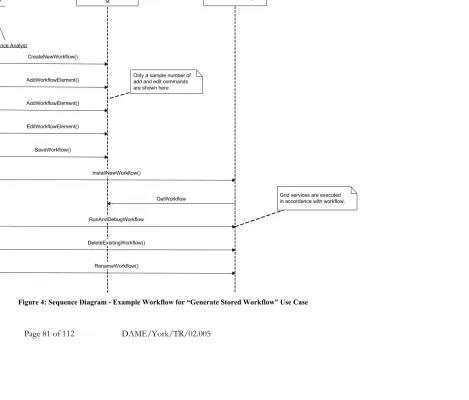
A.7.1.6.1 Example Workflow for New DAME Use Case: Generate Diagnostic Workflow Script... 80
A.7.1.6.2 Example Workflow for DAME Use Case 1: Perform Brief Diagnosis / Prognosis... 82
A.7.1.6.3 Example Workflow for DAME Use Case 2: Perform Detailed Diagnosis / Prognosis .... 84
A.7.1.6.4 Example Workflow for DAME Use Case 3: Perform Detailed Analysis ... 86
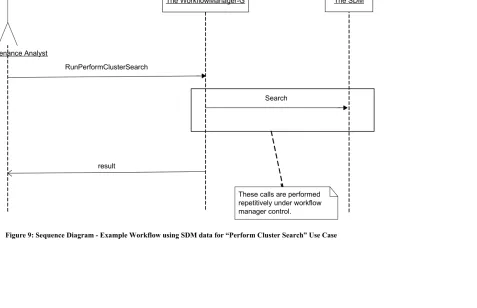
A.7.1.6.5 Example Workflow for DAME Use Case 4: Perform Cluster Search... 88
A.7.1.6.6 Example Workflow for New DAME Use Case: Develop New Detection Algorithm... 91
A.7.1.7 Service Summaries... 93
A.7.1.7.1 Collaborative Working Environment Services ... 93
A.7.1.7.2 Workflow Subsystem Services ... 93
A.7.1.7.3 EngineDataStore-G Services... 94
A.7.1.7.4 AURA-G Services... 94
A.7.1.7.5 XTO-G and XTOOutputDataVisualiser-G Services... 95
A.7.1.7.6 CBRAnalysis-G Services ... 96
A.7.1.7.7 SDM-G Services... 97
A.7.1.7.8 EngineModel-G Services ... 97
A.7.1.8 References ... 98
A.7.2 Discovery Net: e-Science Service Delivery Roadmap ... 99
A.7.2.1 Objectives ... 99
A.7.2.2 Application Services: ... 100
A.7.2.2.1 Introduction... 100
A.7.2.2.2 Overview of Application Service Operation Environment... 101
A.7.2.3 Service Composition Environment... 102
A.7.2.3.1 Workflow Construction, Storage and Execution... 102
A.7.2.3.2 Workflow-based Service Registration and Deployment ... 102
A.7.2.4 Support for Service Construction... 104
A.7.2.5 Discovery Net Deployment System ... 105
A.7.2.6 DPML Discovery Process Markup Language ... 107
A.7.3 myGrid... 108
A.7.3.1 Introduction ... 108
A.7.3.2.1 Service Registry ... 108
A.7.3.2.2 Semantic Service Discovery Service ... 108
A.7.3.2.3 Service Ontology ... 108
A.7.3.2.4 Service Description & Publication Tool ... 109
A.7.3.2.5 Notification Service... 109
A.7.3.2.6 Workflow Enactment Service... 109
A.7.3.2.7 Workflow Editor ... 109
A.7.3.2.8 Information Repository ... 109
A.7.3.2.9 E-Science Gateway Service ... 109
A.7.3.2.10 E-Science Workbench ... 109
A.7.3.2.11 E-Science Web Portal ... 109
A.7.3.2.12 Distributed Query Processing Service ... 109
A.7.3.2.13 E-Science Application Framework ... 109
A.7.3.3 Bioinformatics-specific Components... 110
A.7.3.3.1 Bioinformatics Ontology... 110
A.7.3.3.2 SOAPLAB... 110
A.7.3.4 Miscellaneous Components... 110
A.7.3.4.1 AntMerge: build-file construction tool... 110
A.7.4 The eDIKT Project and OGSA-DAI ... 111
A.7.4.1 OGSA-DAI vs eDIKT::eldas... 111
Part V: Appendix (Section 14) UK Grid Services and Activities
A.1. Summary of Services, Tools and Utilities
A.1.1
Tabular Classification of UK e-Science Services Tools and Utilities
Area Service Informant Project Reference Notes
Mike Surridge, IT Innovation myGrid A.2.2.1.1 Distinguishes “workflow enactor core” and invocation framework.
e-Science runtime and
hosting environment Invocation framework
Steven Newhouse, Imperial
College ICENI A.2.2.1.2 LauncherFrameworkService Application of policies to
services Steven Newhouse, Imperial College ICENI A.3.3.5 DomainSecurityService Identification of users
connecting to service Steven Newhouse, Imperial College ICENI A.3.3.5 A.2.9.1.7 IdentityManagerService Security infrastructure
VO management tools and
membership service (VOMS) David Boyd, Rutherford Laboratory European DataGrid A.2.3.2.1 Yike Guo, Imperial College DiscoveryNet A.7.2.3 Simon Cox, Southampton
University
Geodise A.3.4.1.7 Outputs workflow as Matlab script for execution in Matlab environment. GUI also allows jobs to be submitted and cancelled.
Carole Goble, University of
Manchester MyGrid A.7.3.2.7 Workflow editor Composition
Yan Huang, Cardiff University JISGA and GSiB A.2.4.1.3 Mike Surridge, IT Innovation myGrid A.2.4.1.1
A.2.4.1.4 Luc Moreau also involved at Southampton University. Paul Watson, Newcastle NEReSC A.2.4.1.2 Part of Core Grid Middleware proposed
by Paul Watson (NEReSC).
Yan Huang, Cardiff University JISGA A.2.4.1.3 Also includes discovery and invocation. Enactment
Yike Guo, Imperial College DiscoveryNet A.7.2.2
Yan Huang, Cardiff University JISGA A.4.1.1 SWFL, an extension of WSFL Yike Guo, Imperial College DiscoveryNet A.7.2.6 DPML
John Brooke, Manchester
Computing EuroGrid/GRIP A.2.6.1.2 Workflow language based on Unicore Protocol Layer and Abstract Job Object. Workflow
Description language/schema
Steven Newhouse, Imperial
Area Service Informant Project Reference Notes
Representation conversion Yan Huang, Cardiff University JISGA and GSiB A.2.4.1.3 Converts between workflow diagram, SWFL description, and Java harness code. Workflow (continued)
Case-Base Reasoning Workflow Advisor
Jim Austin, University of York DAME A.3.1 Decides which of several diagnostic workflows to use in given situation. Luc Moreau, Southampton
University myGrid A.2.5.1.1 Wrapped JMS Notification
Paul Watson, Newcastle NEReSC A.2.5.1.2 Part of Core Grid Middleware proposed by Paul Watson (NEReSC).
Notification service
Geodise Short Message
Service (SMS) Simon Cox, Southampton University Geodise A.3.4.1.8 Sends text message to mobile phone about job status or results from execution environment.
Provenance Luc Moreau, Southampton University
myGrid A.2.6.2.3
Ontology support for services, and bioinformatics ontology
Carole Goble, University of Manchester
myGrid A.7.3 OWL ontology to describe services
Ontology services Simon Cox, Southampton
University Geodise A.3.4.1.9 Used to inform workflow construction. General Scientific Metadata
Schema Kerstin Kleese, Daresbury Laboratory CLRC DataPortal A.2.6.1.6 Resource brokering John Brooke, Manchester
Computing EuroGrid/GRIP A.2.6.1.2 GRIP broker based on Unicore Luc Moreau, Southampton
University myGrid A.2.6.1.5 Service Directory Toolkit Steven Newhouse, Imperial
College
ICENI A.3.3 ComponentRepositoryService
Yike Guo, Imperial College DiscoveryNet A.7.2.3.2 Service deployment and
publication
Carole Goble, University of Manchester
myGrid A.7.3 Includes a Service Registry that federates multiple registries in a VO, and a Service Description and Publication Tool for semantically annotating services. The registry also supports semantic service discovery based on OWL.
Gateway service to VO Carole Goble, University of Manchester
myGrid A.7.3 e-Science Gateway Service gives API and point of access to myGrid resources in VO Grid monitoring David Boyd, Rutherford
Laboratory European DataGrid A.2.6.1.3 Relational Grid Monitoring Architecture (R-GMA). A service meta-data look-up service
Metadata and Semantic Grid
Service discovery Steven Newhouse, Imperial
Area Service Informant Project Reference Notes Metadata and Semantic
Grid (continued)
Scheduling service Steven Newhouse, Imperial College
ICENI A.3.3.2 SchedulingFrameworkService
Storage Resource Broker (SRB)
Kerstin Kleese, Daresbury Laboratory
Collaboration between DL and SDSC
A.2.6.2.4 and A.2.7.2.3
Gives uniform interface to access to heterogeneous distributed data sources. Divided into Core SRB and MCAT. Norman Paton, University of
Manchester OGSA-DAI A.2.7.1.1 A.2.7.1.2 A.2.9.2.2(d)
Registration, creation, and use of Grid Data Services.
See also Dave Berry OGSA-DAI services
Paul Watson, Newcastle NEReSC A.2.7.1.3 Part of Core Grid Middleware proposed by Paul Watson (NEReSC).
Carole Goble, University of Manchester
MyGrid A.7.3.2.12 Based on OGSA-DAI, and used to federate myGrid information repositories in VO Distributed query processing
service
Paul Watson, Newcastle NEReSC A.2.7.1.3 Part of Core Grid Middleawre proposed by Paul Watson (NEReSC).
Advanced Uncertain Reasoning Architecture (AURA-G)
Jim Austin, University of York DAME A.3.1 Enables fast searches of very large databases.
Data staging service Mike Surridge, IT Innovation Comb-e-Chem A.3.2 Based on Grid Resources for Industrial Applications (GRIA) system.
MySpace directory service Tony Linde, Leicester University
AstroGrid A.2.7.2.2 Virtual directory service of data items located anywhere on Grid.
Storage service Simon Cox, Southampton University
Geodise A.3.4.1.6 Storage and retrieval of files.
Metadata storage and query
service Simon Cox, Southampton University Geodise A.3.4.1.6 Allows metadata to be associated with files and used in queries. Authorization service Simon Cox, Southampton
University Geodise A.3.4.1.6 Grants access rights based on authorization database. Information Grid
technologies
Location service Simon Cox, Southampton
University Geodise A.3.4.1.6 Locates files by mapping handle to location. Grid interface to mass storage David Boyd, Rutherford
Laboratory European DataGrid A.2.8.1.3 Storage Element gives access to data on disk and tape over WAN with Control Interface, Data Interface, and Command Line Interface.
Replica location service and metadata catalogue
Replica optimisation service Replica storage handler
David Boyd, Rutherford
Laboratory European DataGrid A.2.8.1.1 Compute/File Grids
Resource broker David Boyd, Rutherford Laboratory
Area Service Informant Project Reference Notes Grid Access Data Service
(GADS) Keith Haines, Reading University GODIVA A.2.9.1.4 Gives access to spatial data sets through web portal. John Brooke, Manchester
Computing RealityGrid A.2.9.1.3 A.2.9.2.5 A.2.9.2.6
Steering Grid Service migrating from Unicore to GT2 and GT3.
Ken Brodlie, Leeds University gViz A.2.9.2.5 Computational steering and
visualisation
Nick Avis, Cardiff University A.2.9.2.6 Interactive supercomputing Grid-debug, Grid-log, and
Grid-make Jon Crowcroft, University of Cambridge A.2.9.2.3 A.2.9.2.4 Some proposed systems tools for Grid environments GridSite and SlashGrid David Boyd, Rutherford
Laboratory
GridPP and European DataGrid
A.2.9.1.5 GridSite is for Web site maintenance, and SlashGrid is for adding file systems to Unix systems and to give access to remote resources using Grid protocols.
Logging facility Tony Linde, Leicester
University AstroGrid A.2.7.2.2 Log events with custom identifiers. Geodise Matlab Toolbox Simon Cox, Southampton
University Geodise A.3.4.1.1 Globus job submission and control, file transfer, and proxy certificate management from within a Matlab environment. Geodise Jython Toolbox Simon Cox, Southampton
University
Geodise A.3.4.1.2 Globus job submission and control, file transfer, and proxy certificate management from within Jython.
Matlab/Condor Toolkit Simon Cox, Southampton
University Geodise A.3.4.1.3 Computation toolkit linking Matlab to Condor/ Geodise Condor/.NET Web
service Simon Cox, Southampton University Geodise A.3.4.1.4 .NET Web service enabled interface to the Condor system XML Toolbox for Matlab Simon Cox, Southampton
University Geodise A.3.4.1.5 Converts from Matlab format to XML, and vice versa. Other technology areas
Case-Based Reasoning Analysis service
Jim Austin, University of York DAME A.3.1 A.7.1
Uses CBR to suggest most likely diagnosis.
Interaction with services and
metadata Carole Goble, University of Manchester myGrid A.7.3 e-Science Workbench based on NetBeans. e-Science Portal is alternative with smaller footprint for handheld devices.
Portals and Problem-Solving Environments
Searching and accessing
metadata Kerstin Kleese, Daresbury Laboratory CLRC DataPortal A.2.6.1.6 Parallel search and exploration of distributed heterogeneous metadata catalogues.
Domain specific services Comb-e-Chem specific
Area Service Informant Project Reference Notes Geodise specific services Simon Cox, Southampton
University Geodise A.3.4.2 Optimisation User ontology ontology Linux and Windows ProE
CFD solvers Domain specific services
(continued) DAME specific services Jim Austin, University of York DAME A.3.1 A.7.1 Extract Tracked Order service (XTO-G), XTO Output Data Visualiser service, Engine Data Store,
Simulated Service Data Manager
A.1.2
Caveat to Table 1
A.2. Contributions to Report
A.2.1
Different Types of Grid and their Federation
A.2.1.1
Jini as an Infrastructure for Building Grids
A.2.1.1.1 Steven Newhouse (Imperial College)
ICENI has been developed over the last three years by what is now the Grid Middleware group within the London e-Science Centre. An initial prototype was demonstrated at the first UK e-e-Science Programme’s All Hands Meeting in September 2002 and at SuperComputing 2002 in November. This prototype was built using Java as the primary programming language and Jini as the underlying service oriented infrastructure. Jini not only provides easy integration with the Java language, but it also provides several desirable features for building a grid middleware. Fundamental to Jini, through its use of Java’s Remote Method Invocation (RMI), is the declaration of a service interface. This interface is registered into Jini’s Lookup Server with a ‘lease’ declaring the duration of the service’s availability. Clients search the look up server for service instances based on the service type. The use of leases within Jini is recognition of the transient nature of services within a distributed (grid) environment. The event notification architecture within Jini allows any service failure to be trapped and handled. To use Jini within ICENI it was necessary to incorporate methods to hold and search additional service meta-data than that provided in the standard Jini model.
References: [ICENI] [Jini]
A.2.1.1.2 Mike Kirton (QinetiQ)
Jini technology from Sun Microsystems provides a distributed software environment that facilitates the dynamic inter-operation of devices, services and applications on a network (http://www.jini.org). The DARPA Control of Agent-Based Systems programme (http://coabs.globalinfotek.com) used Jini as the basis for the development of the CoABS Grid, which had the aim of demonstrating the run-time integration of heterogeneous agent, object and legacy software components into military applications. The CoABS Grid makes use of two important components of Jini:
• look-up services, which are used to register and discover agents and other services; multiple look-up services can be run for robustness and scalability;
• entries, which are placed in look-up services by agents to advertise their capabilities.
The CoABS Grid uses the underlying Jini infrastructure to provide a message-passing service for agents; a logging service to log both message traffic and other information; a security service to provide authentication, encryption and secure communication; and event notification when agents register, de-register, or change their advertised attributes. In demonstrations of the CoABS Coalition Agents Experiment (http://www.aiai.ed.ac.uk/project/coax) up to fifteen laptops were connected via the CoABS Grid with the system incorporating in the region of seventy heterogeneous agent systems and agent-wrapped legacy military systems.
References: [Jini] [CoaxGrid] [CoABS-A] [CoABS-B]
A.2.1.2
JXTA as an Infrastructure for Building Grids
A.2.1.2.1 Alistair Dunlop (Capital Radio Group)
JXTA is a collaborative research project that is defining a set of protocols to enable P2P computing. Attempting to define standards in P2P computing is acknowledgement of the proliferation of different systems that now fall into this area.
also numerous reference implementations for JXTA with work in developing reference implementations for most popular languages. JXTA also has many developers (going by the number of downloads) and there are many products being developed using this platform. In this sense it is inevitable that many Grids based on JXTA will appear over time. They may even be the next killer application. JXTA is however, not all things to all people. Many of the semantics of Globus Grid computing are absent from JXTA, or quite different in JXTA. This does not invalidate either approach. Users will ultimately dictate what services are required from Grids -many users are already experimenting with P2P in the form of JXTA and are finding success. This is certainly not a technology that can be ignored.
References: [JXTA] [CapitalRadio]
A.2.1.2.2 Ian Taylor (Cardiff University)
The current JXTA reference implementation of the JXTA protocols is written in Java. Other implementations are available but generally have limited functionality e.g. the JXTA C version currently only implements edge-peer functionality and cannot act as relays or rendezvous nodes. The Java implementation generally has been tested within a limited application domain and, in our opinion not advanced enough to build production P2P Grids. For example, discovery in JXTA works reasonably for a limited number of advertisements i.e. if you discovered peers by using pipes and each peer had just one input and one output pipe then for a limited number of peers, the current implementation works well. However, if you attempt to create more pipes per peer or if you attempt to advertise and discover pipes from a large number of peers e.g. >100, then the process is very slow and prone to failure. This initial setting up of the network is fundamental to creating scalable applications and is not stable in the current version.
Giving these noted problems, JXTA does still remain a viable option for building Grids if such problems with the implementation are resolved. JXTA also address several issues not considered currently within the Grid community. One significant is the nature of a JXTA peer. A JXTA peer can be a client, a server, a relay or a lookup server (i.e. a rendezvous node). In Web Services, the lookup server is located on a third party machine e.g. using UDDI or similar. Furthermore, JXTA peers can be dynamically organized as the network grows in a number of ways and employ the advantages of small world networks, where a large number of nodes can be connected in such a way as to minimize the number of hops a packet takes in order to traverse the network.
Organization of JXTA peers is independent to the underlying physical devices and connectivity and arranged within a virtual network overlay. Peers are not required to have direct point-to-point network connections and can spontaneously discover each other on the network to form transient or persistent relationships called peer groups that define specific behaviour for its peers. Current web services and OGSA specifications do not address these issues to a comprehensive degree. Much can be learned from the P2P research in this respect. OGSA, for example, is presently more concerned with the secure creation or deployment of services and their organization with respect to their transient nature. Another key feature of JXTA is the ability to traverse NAT translation systems and firewalls. In contrast, JXTA does not address how a service is created, it simply assumes such services already exist (as they do with file-sharing software for example). The dynamic creation of JXTA services would not be possible without the aid of an external toolkit, such as Globus.
References: [JXTA] Triana-A]Triana-B]
A.2.1.2.3 Ian Sommerville (Lancaster University)
JXTA is a communications middleware for to-peer application development and is a set of open, generalised, peer-to-peer protocols that allows any connected device to communicate, collaborate and share resources on an ad-hoc, pervasive, peer-to-peer virtual network. The JXTA protocols define the basic building blocks to allow development of peer-to-peer applications and networks; -
Peer Discovery Protocol - Enables peers to discover peer services on the network Peer Resolver Protocol - Allows peers to send and process generic requests Rendezvous Protocol—Handles the details of propagating messages between peers
Peer Information Protocol—Provides peers with a way to obtain status information from other peers on the network Pipe Binding Protocol—Provides a mechanism to bind a virtual communication channel to a peer endpoint
Endpoint Routing Protocol—Provides a set of messages used to enable message routing from a source peer to a destination peer
holds addressing information about other peers and any other critical information, the way JXTA handles this cache appears to be inefficient, and we have experienced extreme amounts of disk thrashing as the cache is periodically maintained/updated.
JXTA is very Java specific. It operates at a higher level of abstraction than the current OGSA proposals and, in this respect, could have some advantages for use as a basis for grid construction. The basic application assumptions reflected in the Globus middleware where an application and/or its data are downloaded to remote computers for execution can easily be supported in JXTA for Java applications. However, for applications in other languages some kind of wrapping would probably be necessary.
The latest versions of JXTA are stable and usable and a short-term research project to investigate its use for building grids would be justified.
References: [JXTA]
A.2.1.3
Microsoft .NET
A.2.1.3.1 Omer Rana (Cardiff University)
The .NET platform provides a useful way to construct Grid Systems that make use of the emerging interest in Web services. Various tools are available for reducing the complexity of implementing a Web services, and providing support for messaging between such services. Visual Studio .NET provides a development environment for writing such services in C# and J# (Microsoft’s version of Java), for instance. The importance of such tools is essential to enable a wider adoption and usage of Web services-oriented Grid software.
The .NET platforms also support a number of additional features that could be useful to construct Grid systems, particularly for enabling a number of different platforms to interact. The “Common Language Runtime” (CLR) in .NET provides an execution environment that can be ported to a number of different machine architectures, and supports the execution of programs written in a variety of different languages. The CLR adopts a similar approach to the Java Virtual Machine, for enabling code developed on one machine to be ported (without re-compilation) to another. The .NET platform also provides a Just-In-Time (JIT) compiler that allows dynamic performance improvements during the execution of a program, and is facilitated in this by the CLR. Microsoft is also aiming to make a version of the CLR open-source, to enable community input into this activity.
References: [ECMA.NET] [Mono.NET]
A.2.1.3.2 Simon Cox (Southampton University)
Microsoft .NET is an XML Web services platform that provides comprehensive support for major open-standard Web services technologies. It enables users to create new Web services, or transform existing programs to Web services in a relatively simple manner and provides comprehensive cross-language support. Grid services that provide resources such as compute, data and application, especially those available from Windows platform, can be constructed based on the .NET platform and be accessed transparently. The latest enhancement package to .NET also provides the much desired Grid features such as security management and improved performance on data transmission. In addition, together with Microsoft Internet Information Server (IIS) and the Active Directory technology, .NET can be used to create the hosting environment for transient Web services proposed in OGSA.
It has proved straightforward to construct and integrate together Windows based web-services constructed using .NET and those from a variety of Linux web-service construction tools. This is occasionally necessary where codes only run on Windows, and is desirable where there is a requirement to improve resource utilisation on idle (Windows-based) desk-top PCs. Particular examples of use of .NET include providing a .NET interface to Condor and wrapping a number of database services using .NET (Geodise Project).
In August, 2000, Microsoft Corporation, Hewlett-Packard and Intel Corporation co-sponsored the submission of specifications for the Common Language Infrastructure (CLI) and C# programming language to the international standardization organization ECMA- this work is active and ongoing (http://www.dotnetexperts.com/ecma/).
Furthermore, the Mono project (http://www.go-mono.com/) is bringing the .NET platform to Linux. Early demonstrators of this in action (at University of Southampton) include construction and deployment of peer-to-peer systems build on Windows and deployed on Linux. .NET is thus able to provide both language and cross-operating system support.
A.2.1.4
Selected Snapshots of Current Activities
A.2.1.4.1 Dynamic Configuration and Autonomic Computing (Ian Sommerville, Lancaster University)
Dynamic re-configuration is the process of changing an executing system without stopping execution and with minimal re-computation after the system has been reconfigured. It can take two forms:
1. Replacing executing modules in the system with different modules. This is required for non-stop systems where the software must be upgraded without taking the system out of service.
2. Changing the platform nodes on which modules of the system are executing.
This latter form if dynamic re-configuration is the most relevant for the Grid, at least in the foreseeable future. There are two forms of this dynamic reconfiguration that are relevant for the grid.
1. Application restructuring to take advantage of additional execution platforms that may become available. For example, if a parallel application can run on any number of nodes, then the number of nodes actually used may change during the execution depending on availability, cost, etc. This is required to realise the far-sighted vision of the Grid.
2. Load re-allocation where executing jobs are moved in execution from one node to another. This might be because a node has failed or shows signs of failure, because a cheaper resource has become available or as part of an overall load balancing strategy.
Load re-allocation is currently the task of system managers and usually involves stopping a job before moving it to another node. If we are to develop an autonomic computing system, we need to automate this process and allow the system itself to allocate and re-allocate jobs to nodes.
The problems of dynamic re-configuration are non-trivial and current grid middleware does not provide any support whatsoever for this process. The most promising technology to apply here is probably reflective middleware where the middleware can have awareness of its own actions. There is then the possibility of developing strategies for dynamic re-allocation.
It is unlikely that current techniques of dynamic re-configuration are applicable without change to the Grid; reflective middleware is still a research topic. Therefore, my view on this is that further research into dynamic re-configuration and the Grid is required before the middleware ‘gap’ can be filled.
A.2.1.4.2 Grids and Virtual Private Networks (Matthew Dovey, Oxford e-Science Centre)
The UK e-Science GRID is one of the first GRID's to attempt to deploy Globus outside of a private network. A number of security issues have emerged in the design of GT2 when deployed over large public networks such as the internet. Essentially the problems reside in two areas:
i) the use of port mapping - whereby a well known port is used to negotiated a transient high level port used for the rest of the client/server session
ii) a requirement for a client to have a fixed IP Address for notification services
In practice, many institutions make use of technologies such as port blocking routers, firewalls, NAT (Natural Address Translation) and DHCP (Dynamic Host Configuration Protocol) to improve the security and manageability of their networks. GT2 is not compatible with these technologies because IP addresses are allocated dynamically, are routed through a “proxy” public IP addresses or the particular ports used by GT2 are blocked.
One solution would be to use VPNs (Virtual Private Networks) to create the private network environment that Globus is designed for. VPN’s use tunneling technologies so that clients behave as if on a single private network, even though traffic may pass over public internets. There are currently two VPN technologies - PPTP and L2TP which tunnel the network traffic in different ways. L2TP is the more secure and it can use IPSec to encrypt the data, and hence can make use of certificate based PKI. There are currently two VPN technologies – PPTP (Point to Point Tunneling Protocol) and L2TP (Layer 2 Tunneling Protocol) which tunnel the network traffic in different ways. L2TP is the more secure and it can use IPSec to encrypt the data, and hence can make use of certificate based PKI (Public Key Infrastructure). VPNs can also provide a solution to the fixed IP Address issue. Although the client machine may have a dynamically assumed or NAT IP Address, the VPN server could allocate a static (virtual) IP Address. If the VPN is based on L2TP/IPSec then this could be allocated by using a GRID certificate to authorise and authenticate the end user.
There are however a number of issues with VPNs:
i) firewalls may block the ports or protocols required by PPTP or L2TP. However, the required policy for the firewall management of participating institutions is far simpler (as only the ports and protocols for the VPN will be required to be open)
ii) vendor interoperability is still an issue, for instance in Oxford we have not managed to use the Microsoft VPN client to attach to our Cisco VPN server. This has potential impact if the GRID is to support heterogeneous platforms.
iv) Access to local resources - by default a VPN client will route all requests to IP Addresses outside the local subnet over the VPN. This may cause problems if the user wishes to access resources on a local firewall protected WAN (Wide Area Network). If the resource is outside the immediate subnet but within the WAN firewall the VPN client will attempt to route the request over the VPN and outside the firewall, hence the request maybe blocked by the WAN firewall. It is theoretically possible to manually configure the client routing tables to cope with this, but in practice this depends on the VPN client/platform and can be difficult for a novice to setup correctly.
v) Possible problems if the user is required to use multiple VPNs. It is possible that is the user needs to access multiple GRIDs simultaneously or is a member of multiple VOs that they may need multiple access to multiple VPNs simultaneously. VPNs are becoming common outside of GRID applications (for example as a mechanism for protecting wireless networks) and it might be that a user needs to simultaneously access a GRID VPN as well as non-GRID VPNs. In theory, it is possible to establish simultaneous VPN connections, however this can require expert manipulation of the routing tables to get working correctly. Problems can arise if different vendor VPN clients are installed on the same machine, for example it has been observed that Microsoft VPN connections no longer work when the Cisco VPN client is installed (but work once the Cisco client has been uninstalled).
References: [Pierce03A]
A.2.2
e-Science Runtime and Hosting Environemnt
A.2.2.1
Selected Snapshots and Current Activities
A.2.2.1.1 Invocation Framework (Mike Surridge, IT Innovations)
Users of the grid will access its capabilities via client-side applications – grid browsers or more sophisticated problem solving environments. To develop such applications one must have an API for calling operations that are themselves provided by grid services. Much attention has been given to standardizing grid protocols, and more recently grid service functionality, but it is also crucial to provide a good invocation framework. The key is for the invocation framework to be capable of handling arbitrary grid services, just as web browsers can access arbitrary web “pages”.
IT Innovation has worked on this problem over many years in a series of EU 4th Framework and 5th Framework distributed computing projects, mainly based on CORBA. Recently the results of this work have been distilled out to provide a web service invocation framework for MyGRID, which was further, refined and made secure for Comb-e-Chem. The basic invocation interface generates and transmits SOAP messages based on:
• the URI of the WSDL document defining the service;
• the PortType containing the desired operation;
• the operation name; and
• the operation argument values.
IT Innovation’s framework is therefore similar to the Web Service Invocation Framework (WSIF) developed by the web service community. WSIF provides a wider range of service invocation methods based on SOAP, RMI or JMS protocols. The main differences are that IT Innovation’s software:
• is more stable, being based on earlier (CORBA) dynamic invocation frameworks;
• handles UDDI lookups as well as straightforward web service invocation;
• supports digital signing and authentication of SOAP messages using methods defined in the W3C SOAP
Digital Signature Extension Note;
• handles HTTP and HTTPS proxies transparently and correctly.
The software is available under LGPL terms, and is being used by two EU grid projects (GRIA and GEMSS) as well as the UK MyGRID and Comb-e-Chem projects. IT Innovation intends to develop the framework in GEMSS to add in-line support for WS-Security/WS-Policy extensions.
A.2.2.1.2 ICENI (Steven Newhouse, Imperial College)
Following our experiences with the initial ICENI prototype and the emerging needs from collaborators within the UK e-science programmes pilot projects recent effort within the LeSC Grid middleware group has concentrated on the redevelopment and refactoring of ICENI. Its architecture is described below:
This approach allows the application developer to implement an ICENI service using an architecture neutral interface thereby providing a consistent interface between underlying service implementations. The meta-data annotating the service may be exposed to the underlying service architecture as appropriate. The service and discovery interfaces within ICENI may be realised through a number of service oriented infrastructures such as Jini, OGSA or Jxta. Alternatively, the services may be accessed through a portal infrastructure. In each case the same service implementation and meta-data is reused. We currently have an implementation of the ICENI service API working with Jini as the underlying service architecture where Jini services may be exposed to an OGSA (Open Grid Services Architecture) environment, and are prototyping pure Jxta and OGSA implementations.
Within ICENI we separate out the description of our architecture into two abstractions:
• a resource which has a capability for action and a defined behaviour and performance if invoked
• a service which exposes the resource abstraction through an initial service level agreement (SLA).
This information is all encapsulated within an extensible meta-data schema. As the Grid community moves towards service oriented architectures and services become pervasive, a user will potentially be exposed to a plethora of services. Within this context they will only wish to see the services that they are able to access. Therefore, from a user’s perspective the virtual organisation becomes a view (or slice) of the service registry that they have access to. Likewise an administrator will have a different view of a service registry – the services that they are able to administer – than a user.
The ICENI middleware also provides an infrastructure to define and deploy an augmented component programming model being developed within LeSC to tackle issues relating to effective application deployment within the Grid. Software components are annotated with meta-data relating to their interface, their behaviour (both inter and intra component workflow) and performance. The ICENI scheduling framework is used to provide an optimal mapping of the components onto the grid resources by using this meta-data. Once deployed these components appear as services within the ICENI framework.
Part of the standard service interface within an ICENI services is the ability to create new service instances through a Factory paradigm. This is an action that may be invoked on a service and is therefore subject to the configuration using the previous access rules. We currently envisage two factory methods: the first creates a new service instance with a set of access rules specified by the user alone, while in the second service instance the user’s access rules are verified before checking those of the service administrator. We thereby present a very flexible approach to building ‘ad hoc’ virtual organisations through the sub-contracting (or delegation) of service access to entities known to the user, but not necessarily the service owner. This approach allows very flexible, extensible and dynamic organisations to be built but reduces the control that an administrator has on the ‘ultimate end user’. This is obviously a matter for deployment configuration.
References: [ICENI] [Jini]
A.2.2.1.3 Messaging Infrastructure
publish-subscribe methodology with XML Schema based topics; can link to Network performance modules and traverse (some) firewalls. Systems like IBM’s MQSeries, Microsoft’s Pastry and JXTA exhibit similar capabilities. Note this low-level publish-subscribe capability is different from that needed by the OGSA higher level notification schemes.
References: [NaradaBrokering] [MQSeries]
A.2.2.1.4 Lightweight Middleware Technologies (Geoffrey Coulson, Lancaster University)
Recent research in the middleware community has investigated lightweight and flexible approaches to the implementation and deployment of system software in general, and middleware in particular. This ‘lightweight middleware’ research has two main goals: i) to facilitate the construction , deployment and evolution of (middleware) platforms and services in their full generality, and ii) to facilitate the run-time management, adaptation, and dynamic reconfiguration of such platforms and services. By ‘platforms and services’ we mean both low-level, fundamental, ‘platforms’ (or ‘runtimes’) such as the software underpinning Web-Service invocation, CORBA-style invocation, media-streaming, tuple-space platforms, etc., and higher-level ‘services’ such as security, persistence, meta-data lookup, workflow, etc. Further, this research addresses the construction, deployment, evolution, and management of both existing (standardised) platforms (e.g., OGSA, EJB, JXTA etc.) and novel, niche platforms and services that might be useful for particular application areas or deployment environments (e.g. involving alternatives to the SOAP protocol when sending bulk, structured data over a wireless network or doing multipeer communication). Essentially, the research is working on toolkit support for developing, deploying and managing middleware and system software of all kinds.
The approach most commonly taken in this work is to build systems in terms of a well-founded, lightweight, low-level, runtime component model. Such component models add very little in terms of performance overhead and memory footprint. As an example of such a model, we briefly describe Lancaster University’s OpenCOM [Clarke01A]. OpenCOM is language independent (i.e. components written in various languages can be combined arbitrarily), and system independent (it runs on Windows and UNIX platforms and even on bare hardware—this latter is achieved by recursively implementing parts of the OpenCOM runtime itself in terms of OpenCOM components). OpenCOM supports three main concepts: components, reflection, and component frameworks. Components serve as basic building blocks for constructing systems by composition (as advocated for example by Szyperski [Szyperski98A]). Reflection then provides means to discover the structure and behaviour of component compositions and to adapt , extend, and evolve these at run-time. Finally, component frameworks have the role of imposing domain-specific structure on component compositions, and ensuring architectural integrity during periods of adaptation/ reconfiguration. Examples of such ‘domains’ (taken from the Lancaster work) could be a ‘pluggable’ protocol stack framework, a framework implementation of the CORBA Portable Object Adapter, a framework implementation of application level multicast, or a framework for local resource management of threads, memory, and communication endpoints.
Typically, these component models only comprehend the scope of a single address space. The idea is that where inter-address space communication is required, the required middleware to achieve this is itself built in terms of components. This enables great flexibility in deploymentFor example, a component framework implementing the IIOP protocol can be dynamically deployed into an address space to enable a set of ‘application’ components to interact. Subsequently, a set of components that implement a SOAP engine can be incrementally deployed if communication with a web service becomes necessary. Note that in this approach, the boundary between ‘operating system’, ‘middleware’ and ‘application’ is blurred: all of these are simply sets of components that are combined and deployed as required to meet an application need.
It is important to emphasise that existing commercial component models such as EJB and the CORBA Component Model are not what we are talking about. These are used to build applications only; they are too heavyweight and prescriptive to implement systems themselves. The same applies to the Grid-oriented component models that have so far been developed, e.g. ICENI from Imperial College [ICENI].
The main forum for this ‘lightweight middleware’ research is the ACM/IFIP/USENIX ‘Middleware’ series of conferences. Apart from the OpenCOM work mentioned above, other examples of research efforts following a similar approach are as follows: THINK [Fassino02A] and Knit [Reid00A] are component models that have been used to build operating systems; Knit has additionally been applied in programmable networking environments, as has Click [Kohler99A]; K-Components [Dowling03A] is a component model that has been used primarily for real-time middleware; LegORB and Universal Inter-Connect (UIC) [Roman00A] are used to build middleware for ubiquitous computing environments; JavaPod [Bruneton00A] is a Java-specific solution for building middleware.
heterogeneous, and dynamic environments than are today’s monolithic and ‘black box’ solutions. For example it has the potential to facilitate the provision of QoS-aware, adaptive, and self-managing platforms, to help provide structure and architecture in large scale systems, to facilitate the seamless coexistence of alternative platforms, and to support principled evolution of the middleware software base. However, considerable research is required to reap these potential benefits of the approach in the Grid environment.
A.2.3
Security Infrastructure
A.2.3.1
Grid Security: Problems and Potential Solutions
This section was written by Howard Chivers of York University and is available as York Department of Computer Science, Yellow Report YCS-2003-354 from http://www.cs.york.ac.uk/ftpdir/reports/ [Chivers03A]. The full report includes a bibliography that is omitted in these notes.
A.2.3.1.1 Requirements and Issues
Grid security requirements can be divided into project specific and generic. Generic requirements include some that apply to existing systems, but are stretched by scalability and administration complexity, and some that are new to highly distributed systems, such as remote delegation and distributed authorisation. This discussion is mostly about generic requirements.
This is a wide topic; the Grid Security Architecture provides the rationale for the original grid requirements, a recent review of security issues in large distributed systems indicates that there are many issues still to be considered.
The purpose of this section is to set the context for current problems, and how they might be resolved, so the following is a brief summary of generic requirements, from the point of view of the main stakeholders: users and resource providers.
Users are either individual end users, or individuals responsible for projects that may be ‘virtual’ (span several organisations). Typical requirements are:
• speed – to introduce new users or groups into a system quickly.
• flexibility - about the privileges provided to a group or individual.
• privacy – to constrain the flow and use of private data in a system, including data used for authentication.
• security – to be able to set up a grid with agreed security features (e.g. only allow data to flow to certain processing sites).
• delegated action – to allow the system to carry out a range of functions for the user when the user is not present.
• limits – to be able to place limits on the overall amount of resource consumed by particular groups or users.
Resource managers need:
• to be assured that their system is safe from software run by remote users.
• to ensure that their system is not misused, for example as a platform to attack other systems.
• to be able to charge for services.
• to have a chain of accountability for actions that allows technical and administrative investigation and resolution of problems.
The Globus system has attempted to address these requirements, but has had to balance early delivery against security features, leading to the set of current issues that are widely cited:
Grid-map (mapping of global to local user IDs). This is difficult to manage (distribution of user authorisation data), static, and requires every co-operating resource provider to have entries for every user that might use that resource.
Management. Each resource provider needs an agreement with each organisation that might host users or invoke processing (e.g. to establish the management process following system misuse). Some recovery requirements, such as revocation of certificates, are a concern because of their relative inflexibility, poor timeliness, and the high cost of re-establishing the system if a group or organisation, rather than an individual, is compromised.
rather than ‘inside’ an organisation). However, even when this problem is solved (which it may be by web-services) the execution of remote software will still leave system administrators uneasy about the potential for system misuse.
Proxies. The security weaknesses are well known (potentially exposed keys and the risk if they are compromised). These are mitigated by time limits, which themselves pose problems for some applications. The nature of a proxy (confers a subset of the user’s authority) is a more fundamental problem for some types of application.
Uniformity. Industrial partners often express the concern that the uniform vision of grid processing will restrict their ability to apply problem specific security policies. Similar concerns are expressed by projects that manage health related data.
The common factor in these problems is ‘scalability and flexibility’, particularly in authorisation and policy management. The firewall question is slightly different, and there are other problems cited, such as software quality and the need for management mechanisms to publish vulnerability warnings and patches, that are not included here.
A.2.3.1.2 Possible Solutions
The use of a user’s identity as the basis for delegation in distributed systems has venerable roots in existing security practice. However, it is the fundamental source of the cited scalability and flexibility problems. To solve these issues requires an acceptance that in very large distributed systems it will be impossible to base authorisation on individual user identity: the security policy for any given machine must not require a list of all possible remote users.
It is straightforward (in theory) to group users into roles; remote processing can then be authorised on behalf of groups. An individual user’s session can be given temporary authority by an authorisation service acting for the group and individual accountability can still be traced via a session pseudonym. Remote machines need only to associate privileges with temporary accounts assigned to the group. This scheme, which is similar to those developed by CAS and Shibboleth, can deal with some of the issues: user names are managed locally, providing more flexibility in forming and changing groups, sessions are identified pseudonymously enhancing the prospect of privacy.
This scheme uses the idea of federation to group objects (in this case users) with similar properties (e.g. roles), and thereby factor the users x machines problem into manageable parts. An everyday example of federation is the consumer supply chain, which federates both suppliers (using distributors who act as middlemen) and users (shops). The concept of federation can be applied more generally than identification and authorisation, to solve a wider range of security issues:
• Federation as a focus for system management would limit the number of bipartite agreements in which
participating resource providers would need to engage.
• Federation as a focus for services would allow security (and other QoS) properties to be offered by different ‘distributors’, allowing the tailoring of security to users’ needs.
• The notion of a session pseudonym can be extended to a ‘ticket’ (or capability), allowing a user federation to establish arbitrary agreements with a distribution federation about the rights that may be granted by any particular ticket. This allows the construction of very flexible forms of delegation, since a federation would invoke services based on its own identify, rather than any delegation from a user.
Although the initial example federated users, these possibilities also motivate the need to federate resources.
It may be useful to define a grid under these circumstances as a temporary binding between a federation of users and one or more federations of resource providers to deliver an agreed set of services. ‘The Grid’, meaning all possible grids, is a difficult security concept – it is hard to see how everything would have or need uniform security requirements, whereas it would be possible to establish security properties of a specific federation of resources, with a binding to a user federation representing an agreed security policy.
Although this has been described as a four-layer scheme (users, user federations, resource federations, resources) it is likely that resource federations could well require the services of other resource federations to achieve further factoring, for either scalability or functional reasons.
These federations are physical (both technical and organisational) entities, not merely notional sets of users or resources.
Conclusion. It is possible to factor grid security requirements into manageable domains by federation, and this technique is capable of mitigating many of the problems perceived in current grid software.
A.2.3.1.3 Implementation Issues
A complete authorisation/policy management system in a distributed system will need a range of components (user policy manager, authentication and authorisation databases, ‘policy agreement’ management tool, accountability and accounting tools as well as plug-in authorisation tools for web servers and operating systems). These components are linked by protocols (which themselves need security services at the transport layer) and message content definitions. Without detailed study it is hard to estimate the extent that existing components and protocols can be adapted to work in this way; it seems likely that web-services standards will eventually provide a sufficient transport capability, and that SAML (perhaps with grid additions) will similarly provide policy message content. Some existing authorisation tools should be adaptable, as will tools to map operating system temporary identities to group accounts.
A.2.3.1.4 Recommendations
• Research the problem of security scalability in distributed systems.
• Carry out a feasibility study on the extent that an initial federated security capability could be introduced from a mixture of existing and new security tools.
• Implement security infrastructure projects in the same way as grid applications: a coherent group of projects demonstrating an integrated capability, not a set of independent mechanism-oriented projects.
• Ensure that any resulting projects include customer facing integration & service elements to ensure interoperability and quality.
A.2.3.1.5 Other Issues
Local User Identification: Federation will usefully push the question of user identification back to a local problem, but it will still be necessary to consider the transportability of user identification between systems. The main issue is ‘single sign on’ and the extent to which a user’s local logon can be integrated with access to a (cross organisational) user federation. The question of private key management, and other forms of identification will remain.
Recommendations:
• Work is still needed on user identification, user-friendly management of private information (e.g. private PKI keys), single-sign-on integration, and the transportability of policy and identification information between systems.
Project Specific Requirements: The UK e-science project list reveals some immediate security concerns, in order of prominence:
• Health
• Industrial data confidentiality, and the management of data provenance
• Safety
In grid terms, safety is a local problem; it mostly relates to the safety of specific experiments or facilities, and it is sufficient to ensure that the safety of each such system is self-contained. It is possible that general grid processing may be relied on for safety critical functions (e.g. to provide warning of bad weather or equipment malfunction), at this stage in the evolution of the grid, and for some time to come, such processing will remain advisory rather than critical, and can be discounted as an issue.
Data confidentiality and provenance introduces few fundamental security problems, but it does mean that some grids will emerge with special confidentiality or integrity constraints. This implies that not all processing will be exactly alike, and future grid architectures will need to offer types or qualities of security services as attributes, in a similar way that resource providers will offer quality of service for communication or processing. This has been discussed above as a generic issue. From the project perspective, it is often possible to simplify the security implementation by incorporating risk management in the design process, rather than trying to add security mechanisms after the fact, and this should be encouraged.
Health data poses an altogether different problem. The subject of privacy is under-explored and international solutions originating in the US are generally poorly regarded within the European/UK legislative frameworks. Privacy in systems that use the emerging trust management or authorisation services will depend on the semantics of the system services they authorise, and modeling the behaviour of complex services is an open question. This area requires fundamental research about the nature of the problem, requirements, security models, design methods, and how to use available implementation mechanisms and services.
Recommendations:
• Place requirements on projects to
o carry out security analysis in parallel with system design.
• Ensure that future grids are structured to offer security services, as well as functional services.
• Research the privacy/heath problem and the question of providing security in service based systems.
References: [Chivers03A] [Pierce03A]
A.2.3.2
Possible Future Projects
A.2.3.2.1 Harden VOMS from EDG (David Boyd, Rutherford-Appleton Laboratory)
European DataGrid (EDG) has developed and put into production tools for managing Virtual Organisations (VO) via a convenient web interface, for allowing users to digitally sign Acceptable Use Policies (AUP) via the web, for publishing VO membership and for automatically constructing local access control policy files. This system is used with a Pool Accounts extension to Globus to allow users to "join the Testbed" without any manual intervention by site administrators - for example, to verify AUP acceptance or to create new accounts. The system also includes a Virtual Organisation Membership Service (VOMS), which permits users to obtain signed attributes proving VO membership and roles, and Grid Access Control Lists (GACL) and a toolkit to manipulate them, which are used to specify policies controlling access to resources in terms of certificate identities and VO memberships.
All of the authorisation tools are potentially portable to other Unix variants, and would quickly benefit from being packaged for these platforms. Some development work in generalising the web interfaces to the VO management and AUP web systems would allow them to be applied to non-Particle Physics projects. Developing more detailed end-user documentation, including overviews of the security implications of different uses of the system, would make the VO and Pool Accounts approach more attractive to sites which have traditionally relied on static accounts and non-digitally signed AUP documents. GACL policy files and toolkit are designed to interoperate with other Grid authorisation systems, and this is an active area of co-ordination through the GGF Authorization Working Group (co-chaired by one of the GridPP developers) Consequently, this work would be ideally placed to influence this standards process, and produce software extensions to the EDG tools, to add support for other authorisation systems favoured by other UK Grid projects.
References: [GridPP] [GGFAuth] [EDGWP2VOMS]
A.2.4
Workflow
A.2.4.1
Selected Snapshots of Current Activities
A.2.4.1.1 Workflow at Southampton (Luc Moreau)
Under development by IT Innovations as part of the myGrid project. The Workflow enactment engine is a standalone component able to execute workflows expressed in a syntax close to IBM WSFL language.
o It will support dynamic discovery and invocation of services;
o It will support parallel execution of multiple threads;
o It will be deployable as a Web Service.
References: [ITInnovation] [MyGrid-A] [WSFL]
A.2.4.1.2 Workflow at Newcastle (Paul Watson)
The ability to capture and enact computations is important for all the e-Science projects. Existing development of a workflow execution engine in the myGrid project (by IT Innovations) is the basis for the Workflow Enactment Grid Service (WEGS) for the Core Grid Middleware. The current myGrid enactment engine is based on Web Services, and so NEReSC is porting it to be a Grid Service.
The WEGS in the initial release of the Core Grid Middleware will accept workflows written in the Web Services Flow Language (WSFL). However, NEReSC is already evaluating the possibility of providing support for the Business Process Execution Language for Web Services (BPEL4WS) in addition to WSFL.
NEReSC is planning to follow the work of the GGF working groups in the important area of workflow/business process composition and intends to provide support for the Grid workflow standard when that is available.