• No results found

Multiparticle phase shift analysis in peripheral production experiments: Lessons from the Past

N/A
N/A
Protected

Academic year: 2020

Share "Multiparticle phase shift analysis in peripheral production experiments: Lessons from the Past"

Copied!
9
0
0

Loading.... (view fulltext now)

Full text

(1)

Multiparticle phase shift analysis in peripheral production experiments:

Lessons from the Past

Geoffrey Fox

Indiana University

Computer Science, Informatics and Physics

Community Grid Computing Laboratory,

501 N Morton Suite 224, Bloomington IN 47404

[email protected]

Abstract

We recall some of our understanding of meson resonance production in high energy

collisions from 20 years ago and its implications for a new generation of high statistics

experiments. We discuss S-matrix theory, duality and Regge exchanges. We briefly

mention some computing issues.

Introduction

Some 20 years ago, I switched from particle physics to largely working in computer

science. At that time, I was part of teams completing analysis of three experiments at

Fermilab; one [1] E260 saw hadron jets at “high” transverse momentum (perhaps 5

GeV/c); another [2] E350 studied triple-Regge theory and measured the

ρ

and A2

trajectories out to –t = 2 (GeV/c)

2

; a third [3] E110 studied meson resonance production

at 50 to 200 GeV/c with

π

-

and K

-

beams. Progress has of course been dramatic in the

area of the first experiment with results in general agreement with QCD now seen up to

some 50 GeV/c transverse jet momentum. In the final two experiments, we were studying

the soft limit of strong interactions. Here there has been some progress in understanding

resonance structure – both from high statistics experiments and more importantly major

advances in understanding quark model spectroscopy. However progress in

understanding peripheral production has been limited except for diffractive reactions

where the Pomeron phenomenology [4] has advanced based on deep inelastic diffractive

data. In reading this article, please note I am recalling understandings that I had some 20

years ago. I apologize for any mistakes.

Some Partial Wave Analysis Issues

(2)

Study of resonances in electron-positron collisions e

+

e

-

M* is clean compared to the

hadron case but suffers from both limited statistics and selection rules that imply that

many important resonances cannot be produced in this fashion. Study of M* in e

+

e

-

M* X does not have selection rule restrictions but has many of the obfuscatory effects of

the hadron case compounded by modest statistics. Thus for much spectroscopy, study of

it via production in Baryon-Baryon and Photon-Baryon collisions is attractive.

We can divide such spectroscopy in three broad classes of increasing analysis

complexity:

2

Ö

2 reactions: These are clearly very clean but limited to a few well known

reactions such as π N

Ö

π N , γ N

Ö

π N and π N

Ö

η N. Correspondingly this

approach can only tackle baryon resonances. Analyses of 2

2 reactions with good

enough statistics are largely uncontroversial at the partial wave analysis level.

However the interpretation in terms of resonances may be impossible if they have

small couplings to the two-body channels.

2

Ö

3 or more final particle reactions where we are interested in resonances

decaying to full final state: Examples are π N

Ö

π π N,

p p annihilation etc. (in this

case, one is looking at M*X but with well defined s-channel quantum numbers)

where the full final state is partial wave analyzed. Here we have several new technical

complications such as a large increase in the number of degrees of freedom. In

particular realistic ways approaches to 3 particle final states usually require resonance

assumptions which have intrinsic uncertainties. There are some dynamical effects

(such as π exchange) which can not be studied in π N

Ö

π N and so their effect on

the PWA is unclear. They could be serious as π exchange populates higher partial

waves than the exchanges seen in π N

Ö

π N.

2

Ö

(state to be analyzed) plus one or more other particles (peripherally

produced) – this in particular includes case of peripheral production of meson states

by π and γ beams. Here there are a further set of problems due to confusion of “other

processes apart from resonance of interest” forming full final state. Further it is not

very easy to unambiguously define amplitudes to be analyzed. The latter remark

assumes the very large number of degrees of freedom precludes solving all these

problems by a general parameterization and “just fitting”.

The latter difficult case is the one we are interested in! We comment on some of the

issues in the following.

S-Matrix Unitarity and Phenomenology

oach was

o

g

am that

etermine

The S-Matrix appr

t 1

2

3

4

u 1

2

4

3 s 1

2

3

4

Fig. 1: 2 Æ2 Scattering with s t

and u channel exchanges

very popular 30 years ag

and established a set of

“true principles” which

appeared to be very stron

constraints on the scattering

amplitude. The dre

(3)

the amplitude proved impossible to turn into reality. Further no way was discovered to

guarantee that known “truths” were satisfied. For example we understood as in figu

that a single analytic function described the three reactions of the s t and u channels

resonances in the s channel were “created” by the forces in the t and u channel whose

resonances become Regge Poles and not traditional (fixed) poles when viewed as

exchanged particles or forces. The Veneziano model gave an elegant sample amplitude

(see paper by Donnachie in these proceedings) illustrating how the Regge Poles

(resonances) in one channel are not added to the exchange poles but rather they are

different ways at looking at the same amplitude. This “duality” is clearest for mesons like

the A1 produced in reactions like π

-

p

Ö

π

-

π

-

π

+

p. As shown in figure 2, the meson

production (figure 2(a)) and the

π

exchange (figure 2(b)) descriptions are not necessarily

alternatives; they could be different (dual) ways of looking at the same physics with the

π

exchange force producing the A1 in elastic

π

ρ

scattering. Formulating

re 1,

. The

ise

hter

duality as a prec

rule is not easy. One good but incomplete way is to impose finite energy sum rules.

Another less quantitative condition comes from quantum number connections between

dual trajectories. The Pomeron and classic quark model exchanges are dual to different

families of resonances (background for the Pomeron). Further for leading and daug

trajectories there are clear expectations of spin and other quantum numbers for Regge

poles related by duality.

Fig. 2( a): Peripheral Production of A1

P omeron Exchange π -p p π+

π- A1

π -P omeron Exchange p p π ππ

-Fig. 2( b): Deck Model for A1

3 π“enhancement”

The constraint of unitarity is well understood mathematically but there are no

straightforward ways of parameterizing amplitudes consistent with both unitarity and

analyticity. In the two-body case (figure 3(a)), many formalisms such as the K matrix can

guarantee unitarity but

not analyticity and

particular exchange

particles. For the

3-body case, figure 3(b),

Fadeev equations can

guarantee unitarity in

the sub channels but it

is not clear this is “a

good idea” as perhaps it

is more important to

respect analyticity as

opposed to unitarity.

ƒ

ƒ Impose unitarity in sImpose unitarity in s1212 s

s1313ss2323for 3 particle for 3 particle PWA

PWA

ƒ

ƒ This is “final state This is “final state interactions” interactions”

ƒ

ƒ Unitarity in sUnitarity in s123123not a not a strong constraint strong constraint s s123 1 2 3 s12 s23 s13 ƒ

ƒ Impose unitarity in s for Impose unitarity in s for 2 particle PWA

2 particle PWA a)

[image:3.612.183.432.257.391.2]

b)

[image:3.612.92.387.552.682.2]

Fig. 3: Direct Channel Constraints in a) 2

(4)

Such “conflicts” and formulations that express “part of the truth” are typical of S Matrix

theory. There are similar “difficulties” in the spin formalism – namely in choosing the

frames to be used for quantizing particle helicities. There are t-channel (reasonable for

analyticity and respects exchanges), s-channel (best for analyticity) and transversity (best

for selection rules but mixes amplitudes with different kinematic and hence analyticity

factors.

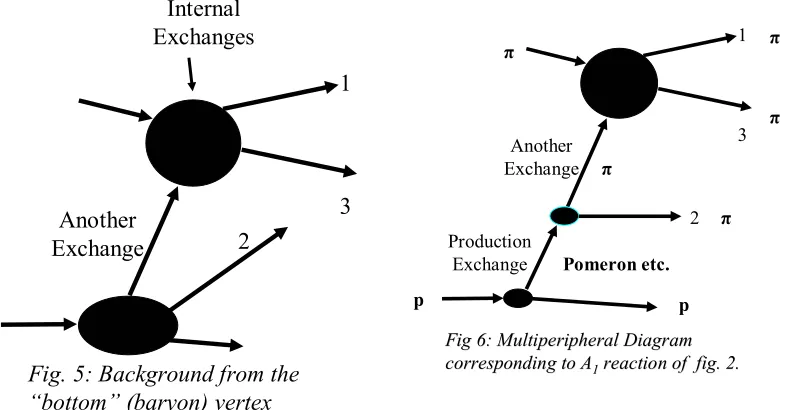
We are looking at mesons M* produced by a mechanism similar to that of figure 4 with

typically a multiparticle decay (here 3

particles). The A1 production of Figure

2(a) is a special case of this. One will

do better if this particular diagram is

“big” as it would be if production

exchange is one of the well understood

trajectories with either a large c

(

π

exchange) or an intercept

α

(0) that

is higher than background exchanges

Pomeron (

α

(0) = 1) and

ρ

,

ω

, A2 (

α

(0)

= 0.5) fall into this second class. Even

though this diagram is hard enough

analyze, there are many backgroun

such as that corresponding to dia

like those of figure 5. Here one of the

supposed decay products of the top

vertex really comes from the bottom baryon vertex. Actually these are not necessarily

distinct for multiperipheral diagrams like that of fig. 6 link the “bottom” and “top” vertex

This is labeled for A1 production diagram but the role of multiperipheral diagrams is

general. The intercept of the exchanged Reggeons in figure 6 is important; if as drawn the

poles are the Pomeron and the

π

, then the “middle produced particle labeled 2” will be

pushed to the top vertex. In contrast, if both exchanged links had the same intercept (f

Internal

Exchanges

s

12

1

2

3

s

23

s

13

[image:4.612.95.524.159.432.2]

Production

Exchange

Fig. 4: Peripheral Production of a

3-body final state

M*

oupling

.

to

ds

grams

.

Internal Exchanges

1

2

3 Another

Exchange

Fig. 5: Background from the “bottom” (baryon) vertex

1

2 3 Another

Exchange

Production Exchange

π π

π π

π

p p

[image:4.612.101.496.430.635.2]

Pomeron etc.

Fig 6:

Fig 6: MultiperipheralMultiperipheralDiagramDiagram corresponding

(5)

exchange for “production exchange” and A2 for “another exchange” for example) then

the middle produced particle 2 is truly equally associated with both vertices.

e

re

There are many other difficulties concerning unitarity. As mentioned above, we have

ways of enforcing this but they do not respect crossing (duality) and analyticity very

precisely in complicated

cases. Unitarity suggests one

looks at the rescattering

diagrams like figure 7 where

the rescatter can either be in

“production process” or

within final state decay or

with some mixture. It is not

well understood if the

Reggeon expansion should b

applied before or after

“unitarization”. If one

unitarizes a Regge amplitude,

then one generates cuts in the

angular momentum plane.

However Reggeons are

properties of the full amplitude and are not necessarily “Born terms” in some potential

theory. Thus maybe the cuts generated by box diagrams such as those in figure 7 are

deceptive. There is well known evidence suggesting cuts; examples include measured

polarization in

π

-

p

Ö

π

0

n and less convincingly phenomenology of

π

exchange. For

partial wave analysis, diagrams such as those of figure 7 a

extremely difficult to include in an amplitude

parameterization. The

π

-

p

Ö

ρ

0

n reaction is dominated

by

π

exchange but measurements of the

ρ

density matrix

elements violate the predictions of a naïve factorizable

π

exchange. One can trace difficulties to vanishing of

helicity-flip

π

p n at t=0. The related reaction

π

+

p

Ö

ρ

0

++

has a very clean

π

exchange description compatible

with simple Regge pole predictions. The features of the

first reaction can be gotten by “absorption” (Regge cut) calculations but it is not easy to

explain the normalization of the observed corrections. Instead a simple analyticity

argument explains the data with proper normalization. This model (due to Williams)

formally implies a companion pole (the conspirator) of opposite naturality in the angular

momentum plane. It is not clear if the conspirator is truly a pole or rather as is perhaps

more likely a phenomenological approximation to a different structure such as angular

momentum plane cuts. The situation is sort of clear but frustrating. There are a set of

“truths” which we do not understand how to make seamlessly compatible. In different

reactions and different kinematic regions, one must agilely use the appropriate truth.

This one is som Regge cut but n channel”

Internal Exchanges

1

2

3

Production Exchange

Fig 7: Rescattering Background

π

p

n

π

ρ

Fig 8:

ρ

production by

π

exchange

(6)

others. The quark model and QCD can give useful predictions as to both particle spectra

and branching ratios. Selection rules are always good including those reflecting

conservation of quark content. Regge theory has a few spectacular successes in

describing high energy scattering. For example the linear

ρ

and A2 exchange degenerate

trajectories with

α

=0 dip for

ρ

and spin flip nucleon coupling typically behave largely as

simple Regge poles should. Recent results on the Pomeron and indeed a deeper

discussion of nearly all the issues discussed here can be found in [4]. Some areas like

π

exchange, polarization (sensitive to phases of the amplitude) and absorption (cuts) are

more phenomelogical in their description. Some exchanges are known to be big or small

and this phenomenology is uniformly successful. Finite energy sum rules can be used to

express truths such as small high energy amplitudes for reactions like backward

π

+

π

-scattering) must translate to (amplitude) cancellation at low

π

π

energies (

ρ

A0

interference in the s channel)

In parameterizing amplitudes and fitting them to data (whether for PWA or otherwise),

one must remember that it will be difficult to believe results sensitive to uncertainties in

these “partial” theories.

Partial Wave Analysis

Let us see in more detail how the above “wisdom” can be applied to PWA. One can of

course analyze production either in terms of a density matrix or an amplitude. The

density matrix makes no assumptions but it is not possible to use it for detailed analysis

to disentangle produced resonances. Thus most high statistics experiments expect to use

an amplitude expansion. Amplitudes require assumptions but are the only easy way to

express “truths” like analyticity; they also enforce rank and positivity conditions for the

density matrix elements. The down side is that any realistic amplitude expansion makes

assumptions and these could lead to biased results. The nature of our “truths” is that they

do not allow amplitudes to be formulated in a way that allows increasing sophistication to

be “switched on” by increasing the

richness of parameterization. As

already discussed we don’t know how

to simultaneously satisfy constraints.

Rather one must make reasonable

assumptions and check a posteriori

how other “truths” are satisfied.

Hardest of all one must estimate the

impact of violations on ones

conclusions. This requires multiple

fits, good visualizations to examine

validity of a given parameterization and new ways to synthesize them together. Just

increasing number of partial waves is not in general a satisfactory approach as it doesn’t

directly translate into “satisfying truths”.

1

2

3

Reggeon

Exchange

Beam

Fig. 9: Production as a Beam-Reggeon

Scattering Amplitude

(7)

has obvious complications from multiple exchanges and cuts which would change

expected form of final density matrix.

One can expect this picture and indeed

amplitude-based production PWA

analysis to be most reliable when the

underlying Reggeon phenomenology is

convincing. This is the usual culprits:

ρ

ω

and exchange degenerate A2 f2

families as well as the diffractive

Pomeron are probably OK. The

π

exchange with adjustment for its

conspirator should also be reliable. In

contrast B1 exchange (

π

exchange

degenerate partner) is not expected to be

very clean. Note the factorization picture

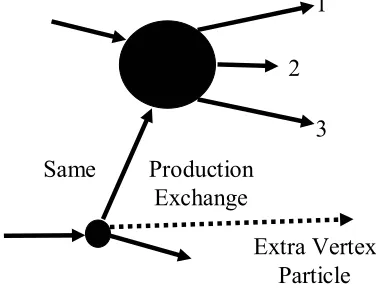
says it doesn’t matter what happens at the bottom vertex. Indeed ref. [2] showed that the

same Regge

ρ

exchange picture describes π

-

p

Ö

π

0

n, π

-

p

Ö

π

0

inclusive, and π

-

p

Ö

π

0

plus any neutral. It is perhaps useful to increase statistics by loosening vertex related

trigger.

1

2

3

Production

Exchange

[image:7.612.99.287.112.256.2]

Extra Vertex

Particle

Same

Fig. 10: Factorization at “Bottom” Vertex

In designing the PWA analysis process, we should have a framework that allows all

“truths” to be examined and selected “truths” to be included explicitly. This requires

attention to spin formalism, unitarity (rescattering), Regge exchange phenomenology and

the PWA expansion and parameterization. In the spin formalism, one must consider:

Amplitude Parameterization – is this practical if (potential) rank high as with

photon beams and/or non-factorizing exchanges?

Density Matrix Formalism – how does this cope with explicit contributions,

analyticity etc.

Transversity versus helicity and s versus t spin formalism needs to be considered

– there is a trade-off of analyticity versus selection rules

For unitarity, one can use current approaches building in two-particle unitarity (final state

interactions) but their integration with other “truths” is not easy. One should use both

explicitly unitary and explicitly analytic (etc.) approaches and compare results. For a

non-unitary parameterization, one can estimate the violation and examine the impact of this

on the fit. When considering exchange contributions, one can identify all allowed (by

normal Regge phenomenology) exchanges and catalog where they are expected to be

large due to coupling constant values and/or values of

α

(t,u). One can use the usual

duality type arguments to identify related s t and u channel exchanges i.e. find where you

might expect the direct and crossed descriptions to be related. One should develop

models for exchange contributions using simple phenomenological Regge theory but I

would have little hope this is very reliable except for Pomeron,

ρ

and A2 etc. exchanges

but even these won’t be so good as to be used quantitatively at low direct channel

(8)

exploits fully analytic structure but possibly it is easier to explicitly include high partial

waves rather than choose an expansion that maximizes convergence. This is particularly

useful if we can estimate magnitude from known couplings at exchanged particle poles.

Considering the Beam-Reggeon reaction of interest, this will often include internal

exchanges such as the

π

exchange for which we have little experience from traditional

π

N direct channel analyses. Considering dispersion Relations and other analyticity

constraints, we should certainly enforce “helicity dependent” kinematic zeroes. Further

we should use visual inspection and finite energy sum rules to look at duality predictions.

We could present data and fits in a way to highlight effects (e.g. we could look at fixed u

cross sections for reactions like

π

+

π

-

elastic scattering with no u channel exchanges).

Physics Summary

Unfortunately many confusing effects exist and there is no fundamental (correct) way to

remove most of them. Theory has failed to provide convincing parameterizable

amplitudes that one can use to fit/explain data. Rather the theory provides some

quantitative constraints (π pole, unitarity, kinematics …), and many qualitative truths

which overlap and whose effect can be estimated with errors from 10 to 100%. So one

should try to minimize effect of the hard (insoluble) problems such as “particles from

wrong vertex”, “unestimatable exchange effects”, sensitivity to slope of unclear Regge

trajectories, absorption etc. One can note many of the effects (exchanges) are intrinsically

more important in multiparticle case than in the well studied π N

Ö

π N reaction. We

must try to estimate impact of uncertainties from each effect on results. This needs

systematic very high statistic studies of relatively clean cases such as π N

Ö

π π N where

spectroscopy may be less topical but where one can examine uncertainties. We need to

first clarify impact of difficult issues and then apply this wisdom to new reactions and

new meson resonances. One can be optimistic as we have orders of magnitude more data

than when these issues were last looked at carefully.

Computational Issues in Analyzing PWA Data

We finish with a few remarks on computing issues associated with PWA analysis. The

Grid techniques (

http://www.grid2002.org

) being developed for LHC physics will be

useful but these largely address management of the data reduction problem. This is

important but as not as critical as the difficult physics analysis discussed above. In

considering PWA computing, we can perhaps assume unlimited computer time, disk

space and network bandwidth or perhaps more precisely that there are no significant

constraints from these issues.

One are of possible importance is the optimization (fitting) technique to match

parameterized amplitudes and experiment. Actually physics has been ahead historically

of the computer science field in area of multi-parameter fitting. It is possible that

“unlimited computer time” and better management of results could lead to new

approaches such as “ensemble fitting techniques” (e.g. genetic algorithms) which explore

parameter space more completely than traditional (Taylor expansion) least squares

(9)

could have “histograms” which automatically display ensemble and not a single “best fit”

– we have plenty of memory/disk space to store the data to be displayed. More generally,

we can think of our problem as data mining where we need to develop a suite of analysis

programs that look for and catalog anomalies in experiment, theory or the discrepancy

between them. We need to link this to the data management system so as to more

systematically categorize different fits. Perhaps we could develop new multi-dimensional

visualization (human data-mining) methods that improve dramatically on traditional

histograms. Perhaps we could develop some better “standard” displays supported in a

modern computer approach as a Web Services with portlet interfaces (this suggestion

betrays my current expertise). Here the printed version of Phys. Rev. Letters still has

something like a histogram playing role of an “icon”, which is active in on-line version

and can access the “new nifty display”.

In summary we can exploit modern computing technology for more reliable optimization

methods, the management of data before (as in GriPhyn and PPDG [5]) and especially in

our case after analysis. We should explore powerful multi-dimensional visualization

techniques and data mining to discover anomalies in data and/or fits and/or discrepancies

between fits and data. We need to design and build such an environment and as part of

the physics imperative apply to relatively well understood reactions to clarify the difficult

conflicting physics issues.

References

1.

Experimental groups at Caltech, UCLA, Chicago Circle, Fermilab and Indiana, ``Jet

Production in High-Energy Hadron-Proton Collisions,'' Nuclear Physics, B171, 38

(1980).

2.

Fox, G. C., Kennett R. G., Stone A. E. A., Barnes A. V., Walker, R. L., Dahl, O. I.,

Kenney, R. W., Ogawa, A, Pripstein, M, ``Inclusive

π

0

and

η

Production from Kaon,

Proton and Antiproton Beams in the Triple Regge Region,'' Nuclear Physics, B177, 1

(1981).

3.

Experimental groups at Caltech, Fermilab, Chicago Circle and Indiana, ``A Study of

the Reaction

π

-

p

π

-

π

+

n at l00 and 175 GeV/c'' Nuclear Physics, B232, 189 (1984).

4.

Sandy Donnachie, Günter Dosch, Peter Landshoff, Otto Nachtmann, „Pomeron

Physics and QCD“, Cambridge University Press, November 2002.

5.

Physics Grid at

http://www.griphyn.org/

and Particle Physics Data Grid

Figure

Fig. 3: Direct Channel Constraints in a) 2 strong constraintFig. 3: Direct Channel Constraints in a) 2 �� 2 and b) 2 2 and b) 2 �� 3  reactions3  reactions
Fig 6: Fig 6: MultiperipheralMultiperipheral
Fig. 10: Factorization at “Bottom” Vertex

References

Related documents

In this study, CHD4 rs74790047, TSC2 rs2121870, and AR rs66766408, were found to be common exonic mutations in both lung cancer patients and normal individuals exposed to high

Using American industrial production one quarter ahead and American interest rates as the external factors most likely to influence all European stock markets the two factors

(The Court dismissed the argument by the applicant, a French Muslim woman, that the law indirectly discriminated against Muslim women. The Court reasoned that although the law

with the science textbook: An object in motion tends to stay in motion unless acted upon by an external force.. After you kicked the ball (external force), it flies through the

In mitosis chromosomes separates and form into two identical sets of daughter nuclei, and it is followed by cytokinesis (division of cytoplasm). Basically, in

Thus, holding job requirements constant at a particular level (and therefore holding actual qualifications constant at the same level, since equation 4 is estimated only

Lifepaths 1st Term Length Benefits Special Rules Hazardous Duty Rank 2nd Term Length Benefits Special Rules Hazardous Duty Rank 3rd Term Length Benefits