Abstract: Students in higher learning institutes in Malaysia face some difficulties in expressing themselves in English language and show lack of competency in speech. They perform poorly in the English language during examination held in the university and also interviews. Based on the problems encountered by the weak students, it was deemed necessary to provide some form of guidance to enable the ESL students to speak confidently. The guidance comes in the form of a cooperative interactive learning module for teaching speaking to weak ESL students. The purpose of the study is to develop a cooperative interactive learning module as a teaching approach that could benefit ESL students at the university. This study also investigates the attitudes of the students before and after using the cooperative interactive learning module concerning speaking.The research comprises of two stages namely instructional design, ADDIE model (to develop the module). A quasi-experimental design was carried out to look at the effectiveness of the Cooperative Interactive Learning Module on students’ speaking skills. Cooperative Interactive Learning (CIL) Training Module was designed as a teaching and learning aid to assist educators to enable them to use some of the fundamental concepts of (CIL) in their everyday teaching to enhance ESL students’ speaking skills. The module consists of three units of hands on activities, current practices on (CIL) and prior knowledge, CL concepts, conceptualization of a structural and complex CIL approach. The findings revealed that the Cooperative Interactive Learning Module was effective for higher learning institutes students because it enhanced graduates’ communication skills that will enable them to understand written and spoken instruction, and express ideas in a variety of situations.
Keywords: Cooperative Interactive Learning Module (CIL), graduates students, Speaking Skills
I. INTRODUCTION
The new paradigm of education 4.0 era demands a shift in second language pedagogy from a teacher-centered learning model to a learner-centered model. This shift signals a new era in which English speaking instruction must create
Revised Manuscript Received on May 28, 2019.
Charanjit Kaur Swaran Singh, Faculty of Languages & Communication, Universiti Pendidikan Sultan Idris, 35900 Tanjong Malim, Perak DR, Malaysia
Tarsame Singh Masa Singh, English Language Unit, Language Department, Institute of Teacher Education, TuankuBainun Campus, 14000 Bukit Mertajam, Penang, Malaysia
Eng Tek Ong, Department of Educational Studies, Faculty of Human Development, Universiti Pendidikan SultanIdris, Malayia
Maria Shu Hong Bee Abdullah, Faculty of Languages & Communication, Universiti Pendidikan Sultan Idris, 35900 Tanjong Malim, Perak DR, Malaysia
opportunities for students to express themselves in speaking the language.Slavin (1995) define cooperative learning as a set of learning strategies through which students are given a chance to work on certain tasks related to their subject matter. According to Johnson, Johnson & Smith (1998), cooperative learning is also known as structured teaching procedure that provides students the opportunities to work in groups on certain activities in order to bring about the best out in a student to attain educational goals. Slavin (1995) expressed that in cooperative learning, each student work in small group to assist his or her peers in specific educational content.
Cooperative learning strategy promotes learner-centred model for teaching and learning purpose as opposed to the traditional teaching method. Johnson & Johnson (2002) divulged that cooperative learning approach obligates positive effects on educational outcomes. Several studies on cooperative learning revealed that the approach has positive effects on students’ proficiency (Pattanpichet, 2011); English reading comprehension (Bolukbas, Keskin, and Polat, 2011; Meng, 2010; Law, 2011) and English writing (Roddy, 2009). Cooperative and interactive learning approaches have been recognised as a promising tool to facilitate speaking skills. It serves as an alternative approach of teaching for promoting speaking and social interaction among students (Gomleksiz, 2007; Ning, 2011). Prior research suggests that cooperative and interactive learning approaches are of great effect on developing students’ speaking skills (Pattanpichet, 2011; Liao, 2009) and also in improving their attitudes towards learning (Slavin, 1995). Teaching ESL can be challenging when student engagement is lacking due to high teacher talk, scripted curriculum, or lack of interest. Fortunately, cooperative learning structures give students the engagement they desire while making the classroom student-centered and exciting (Kagan, 2015)
Interactive learning approach is also beneficial for all the educators as it allows to measure student accomplishments for example lecturers making use of interactive teaching approach is better equipped to assess how well students master a given subject material. It also allows some flexibility in teaching whereby educators can apply training methods that involve two-way communications which will enable him/her to make quick adjustments in processes and approaches.
Developing a Cooperative Interactive Learning
Module for Improving Speaking Skills of
Graduate Students
Interactive instruction enhances the learning process and also student motivation. Interactive learning approach provides students more opportunity to engage in group discussion which make learning more fun.
In Malaysia, however, English speaking instruction within the framework of cooperative interactive learning has not been tried yet at the tertiary level. In this study, the researchers developed a cooperative interactive learning module to assist ESL students’ to facilitate their English speaking skills. However, to the best of the researchers’ knowledge, the use of cooperative interactive learning module to enhance ESL students’ speaking skills has been out of the scope of any teaching approach/techniques research in Malaysia. Therefore, the researchers were motivated to carry out the present study. The findings contributed to fill in the gap in previous research and provide further insights into English Language teaching specifically using the cooperative interactive learning module to enhance ESL students speaking skills at public universities in Malaysia.
Problem statement
The Malaysia Blueprint 2013-2025 put emphasis on creating individuals who are able to converse confidently at the international level. The Ministry of Education stipulated speaking skills as one of the most important skills in the English Language Malaysian School Syllabus. Similarly, students in UniversitiPendidikan Sultan Idris face some difficulties in expressing themselves in English language and show lack of competency in speech. Students showed lack of interest to engage in speaking activities and also refuse to converse in English Language with their lecturers and fellow friends. Urr (1999) divulged speaking skills as one of the most difficult skill to conquer. Rodriges (2006) supports Urr (1999) views on the problems on acquiring speaking skills as in many cases language is only heard in the classroom and not practiced. The problem is also intensified when there is no support for its use outside the classroom. This has been attested to by a report which claims that students scored well in the written English Language examination paper did not perform well at interviews and resulted in their inability to secure a job (Rodriges, 2006).
Hence, many learners of English as a second language, especially at UniversitiPendidikan Sultan Idris level perform poorly in the language during examination held in the university and also interviews. Based on the problems encountered by the weak students of English, it was deemed necessary to provide some form of guidance to enable the ESL students to speak confidently. The guidance comes in the form of a cooperative interactive learning module for teaching speaking to weak ESL students.
Research Objectives
The purpose of the study is to develop a cooperative interactive learning module as a teaching approach that could benefit ESL students at the university level, particularly where the students’ speaking ability is poor. This study will provide the impetus to explore further the use of the cooperative interactive learning module to help the weak students to speak. Therefore, the current study is planned with certain objectives in mind.
The objectives of the study are:
To develop a cooperative interactive learning module to enhance ESL students’ speaking skills
To investigate the attitudes of the students before and after using the cooperative interactive learning module concerning speaking
Research questions
This research will be conducted in order to answer the following questions:
1. What are the factors that contribute to the learning of ESL students’ speaking skills to develop the module?
2. What are students’ attitude towards the Cooperative Interactive Learning (CIL) module developed for improving speaking skills?
Cooperative and Interactive Learning
students are made to feel more responsible and confident towards other members of the group. This leads to students taking responsibility to make decisions for the group. Also, the findings showed that the instructor must always show love and respect towards the students so that they will feel loved and comfortable in the learning process. Students must be trained to feel accountable so that they can move forward in terms of contributing their ideas and sharing materials related to the lesson that is being conducted. Son when the students are immersed in cooperative learning approach, students with inhibited feelings will also feel secure to participate in group dynamics without feeling fear or intimidated by the instructors or their peers. It can be concluded that different learners have different learning styles and adverse attitudes as they come with their prejudices. So it is very crucial to have a structured cooperative learning approach to develop constructive and supportive peer relationships. Learning in the 21st century today requires students to be engaged in the learning process. We have learners who are very competitive therefore cooperative learning approach is believed to be more practical in terms of engaging learners in the classroom environment to assist them to interact more often with one another in group dynamics. Ica, Mardian&Oktavia (2017) carried out a study using the cooperative Learning Model Talking Stick Type on low level proficiency students who lacked the interest and motivation to communicate in English Language. The researchers used Cooperative Type Talking Stick Learning Model to teach drama. Cooperative learning Model Type Talking Stick was used to execute the planning, development and assessment stage of the lesson. Findings revealed that the cooperative learning approach used was very effective as students showed positive attitude towards speaking activities and presented quality work for assessment. Students showed some interest to work with peers and also collaborated with the teachers during the planning, developmental, closing, assessment and reflection stage.
Abdul Rahman &Masuwai (2014) conducted a study on using the interactive lecture model to transform standard traditional teaching to active learning as to avoid students being dependent on the lecturers and passive learners. Several research suggest that active learning promotes and activates students’ learning. In this study, the researchers tested a variant on interactive lecture model known as the CDEARA Model that was developed through a module and also a training workshop. The CDEARA Model developed was reported to be systematic and purposeful as it integrated simple activities and strategies called the Interactive Lecture tools. Findings revealed that the implementation of the CDEARA Model designed was operative and practical. According to Abdul Rahman &Masuwai (2014), interactive lecture refers to lecture is a combination of lecture that incorporates activities that allows students to engage during the lecture, encompassing student-teacher, student-student, materials-student and students’ interaction with technology. Interactive lecture has been reported to be using a teacher centred approach as it blends other approaches including Project Based Learning and Problem Based Learning. When lecturers blend the interactive lecture with Project Based Learning and Problem Based Learning, it creates a positive experience platform for the lecturers to transform traditional
lecture to a more student centred interactive lecture. This approach is also similar to Multimedia Lecture as it divides the lecture hour through a series of mini-lectures combined with many other activities which is also referred as the Interactive Lecture tools to assist students deep understanding and the also the development of higher order thinking skills. Therefore, the researchers in this study has come up and developed a CDEARA Model that has six steps of implementation including assess, reflect, apply, engage, deliver and connect. The CDEARA Model developed is novel as it allows students to co-construct knowledge by relating to new information explicit at the connect stage of the model. Some examples of Interactive Learning tools include think-pair-share, questioning, KWL chart, group discussion, two minute paper, reflection, (Mazur, 1997) and others. Findings also revealed that the training module developed based on the CDEARA Model was effective for the participants of the workshop as they found the facilitator was very knowledgeable and well-versed in delivering and training using the interactive learning tools which they can use in their own context of teaching in the future.
II. METHODOLOGY
Phase I (ADDIE Model)
The study was conducted in two phases. The first phase wascompleted with needs’ analysis specifically identifying speaking problems faced by students in UPSI. The ADDIE model approach was used by the researchers to create the content to develop the Cooperative Interactive Learning (CIL) moduleAnalysis: fundamental concepts of CIL module was designed as a teaching and learning aid to assist educators for teaching and learning purposes to enhance ESL students’ speaking skills.Design: The module consisted of three units of hands on activities, current practices on CIL and prior knowledge, CIL concepts, conceptualization of a structural and complex CIL approach.Development: The development of CIL content and additional graphics were added to make the module look interestingImplementation & Evaluation: The CIL module was implemented to a group of undergraduate students enrolled in the English language proficiency (UPSI). The researcher conducted a pre-test and post-test to look at the effects of the CIL module used on students’ speaking skills.
Phase II (Quasi-experimental research design)
students were asked if they have worked cooperatively and interactively in their lesson. Students were asked to rate themselves on the way they have worked. For this study, an intact sample was used where no random sampling was involved. The sample consisted of a class of 45 students who will be undertaking Diploma programme during the special semester.
Content of the module
Cooperative Interactive Learning (CIL) Training Module was designed as a teaching and learning aid to assist educators to enable them to use some of the fundamental concepts of CIL in their everyday teaching to enhance ESL students’ speaking skills. The module consisted of three units of hands on activities, current practices on CIL and prior knowledge, CIL concepts, conceptualization of a structural and complex CIL approach. Cooperative interactive learning module will be designed systematically according to sequenced content and hands-on activities that model the 21st century learning.
Procedure
A quasi-experimental study was carried in the second phase for eight weeks at one of the universities in Malaysia. Forty-five Diploma students with mixed ethnicity and gender had volunteered to be involved in the study. The students were exposed and trained to receive instruction about working in cooperative interactive learning groups and practicing before the actual study was carried out. The students were given training specifically to implement the cooperative interactive learning in the classroom in the following areas: developing a classroom climate for cooperative learning, team building techniques, and social skill for team work. The researcher instructed the students to be into three cooperative interactive learning groups with each group comprising of four students, taking into consideration individual student needs and differences including learning styles and student personalities. Each student in the group was given an opportunity to select a role, and instructed each group to be seated in a circle. The researcher explained the value of cooperative interactive learning through the development of their personality, their ability to make decisions, and showing respect to their fellow peers. The groups were also asked to write the name of their respective groups. Subsequently, the students were given a treatment using the cooperative interactive learning module instruction and the comparison group did not receive instructions in this manner. The comparison group was taught using lecture and individual assignments. For each lesson, course goals and values for each goal, course content, preparation of teaching and learning materials, and the time allocated for each task were created. The 45 students were divided three groups of 15 students each. The experimental group has nine cooperative groups and each group consisted of five students. The comparison group consisted 40 students and they were taught using the traditional method of teaching. Cooperative interactive learning structures are educational methods that put emphasis on organizing the collaboration of individuals in a classroom. This means students are asked to work together as a team to resolve a problem, complete a task or complete a common goals. The researcher used the following instructional methods:
1-Think-Pair-Share: The researcher posed a question to the class and the students thought about their responses. Then students paired with a partner to talk over their ideas. Finally, students shared their ideas with the class.
2- Three-minute review: The researcher stopped any time during a lecture or discussion and allowed teams three minutes to review what they had heard with their group. Students in their groups could ask questions to the other members or answer questions of others.
3-Group discussion: The researcher posted a question on the board, then all group members actively engaged in a conversation about the question. Then, I went from group to group and sat in for a few minutes to listen to the conversation. Finally, I chose one of the members from each group to share their answer in front of the whole class.
The purpose of this study was to develop a cooperative interactive learning module to enhance ESL students’ speaking skills and to investigate students’ attitudes on the cooperative interactive learning module developed on ESL students’ speaking skills in one of the universities in Malaysia. The gathered data was analyzed through the use of descriptive statistics. Additionally, data was collected from a survey that used a Likert-type scale and was given to the experimental group. The survey included 20 questions, which were divided into three sections: the impact of using cooperative learning on classroom participation and interaction, individual students' feelings and social skills, and learning outcomes.Then, the participants in the experimental group were handed a set of questionnaire that consisted of 20 items which attempts to ascertain participants’ perceptions after the treatment using cooperative interactive learning module. The questionnaire was adapted from one previous study (Johnson & Johnson, 1999, 2013). In their study, they obtained 0.817Cronbach alpha coefficient, inferring that the questionnaire had a high degree of internal consistency reliability. In this study, after the researcher had adapted and finalised the questionnaire, two experts in this field were requested to validate the items. Then, a pilot study was conducted prior to validating the questionnaire.
Three groups of four students from a different university were chosen as a subject for the pilot study. The respondents from this university were selected based on similar characteristics that they have with the actual participants in the current study. From the pilot study, the questionnaire had obtained 0.817Cronbach alpha coefficient implying that this questionnaire had a high degree of internal consistency reliability.
III. FINDINGS
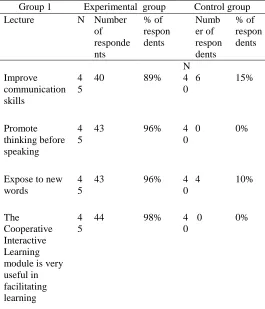
promoted their thinking before speaking during the discussion session in their lecture, 43 (96%) shared exposed to new words, and 44 (98%) felt the cooperative interactive learning module very useful in facilitating their learning. In contrast, the control group showed far fewer observed actions in the classroom. Only 6 of 15 (15%) improve their communication skills, none of the respondents shared on promoting thinking before speaking, 4 of 40 (10%) were exposed to new words and none shared the strategy used was very useful in facilitating learning. Table 1 indicates the results for the experimental and control groups in lesson 1.
Table. 1 Results for Experimental and Control Group Group 1 Experimental group Control group
Lecture N Number
of responde nts
% of respon dents
Numb er of respon dents
% of respon dents
N Improve
communication skills
4 5
40 89% 4
0
6 15%
Promote thinking before speaking
4 5
43 96% 4
0
0 0%
Expose to new words
4 5
43 96% 4
0
4 10%
The Cooperative Interactive Learning module is very useful in facilitating learning
4 5
44 98% 4
0
0 0%
To identify the change in students’ attitudes learning before and after using the cooperative interactive learning module, the study uses paired sample t-test which can be seen in Table 1. The findings of the study have demonstrated that there is significant change of attitude (t(28) = 5.67, p< 0.05). In this case, this shows positive changes in students’ attitudes in learning before being exposed to the cooperative interactive learning module (M = 3.65, SD = 1.89) and after being exposed to the cooperative interactive learning module (M = 5.25, SD = 2.02). The findings suggest that using the cooperative interactive learning module has made students more positive speaking more confidently.
Table. 2.Attitude Change (before-after) Paired Sample t- Test
Att Mean SD t value df p
Pre Test 3.65 1.89 5.67 28 0.028*
Post Test
5.25 2.02
* sig at p < 0.05
Overall, the experimental group had shown a positive attitude toward cooperative interactive learning strategies, as measured by the survey items. Item 2, which measured the effect of cooperative learning in enhancing class participation, showed the biggest difference in mean responses, as 89% (40 of 45) of the experimental group "Strongly Agree", and it had a mean response of 1.2. The other items showed that the students in the experimental group had a positive overall response when asked about their opinions of the effect of cooperative interactive learning module on their participation and interaction in the classroom. Cooperative interactive learning module developed has been found to be effective as it prepares the students to work cooperatively preparing them for the world of work and the team building necessary to succeed. The module created an opportunity for the students to work in groups and assist the members so that they can feel connected to each other to monitor their learning.
IV. DISCUSSION
Cooperative and interactive learning approaches have been recognised as a promising tool to facilitate speaking skills. It serves as an alternative approach of teaching for promoting speaking and social interaction among students (Gomleksiz, 2007; Ning, 2011). Prior research suggests that cooperative and interactive learning approaches are of great effect on developing students’ speaking skills (Pattanpichet, 2011; Liao, 2009) and also in improving their attitudes towards learning (Slavin, 1995). Teaching ESL can be challenging when student engagement is lacking due to high teacher talk, scripted curriculum, or lack of interest. Fortunately, cooperative interactive learning structures give students the engagement they desire while making the classroom student-centered and exciting (Kagan, 2015). The findings of this study concur with Molla&Muche (2018). Their findings revealed significant differences in the pretest and posttest results of the students’ laboratory proficiency by teaching methods.
The results demonstrate that there was significant learning gain obtained via CLAD followed by cooperative discussion group (CDG). Ghaith (2018) reported teachers valued cooperative learning as an important pedagogy for achieving communicative competence and social cohesion. The participants preferred more concrete Jigsaw cooperative learning methods as it’s more compatible to classroom practices and easier to implement.
V.CONCLUSION
impacts on the students’ participation, specifically helping them to speak better in the class, promote thinking before speaking, learn more new words from peers, facilitate better learning and creation of more opportunities for speaking.
ACKNOWLEDGMENT
We acknowledge with great appreciation the kind gesture of Universiti Pendidikan Sultan Idris for providing us the University Research Grant Scheme (Coded: 2018-0106-106-01). Equally, we would like to express our gratitude to all the participating Diploma in English students for their willingness to participate and share their views on the use of the Cooperative Interactive Learning Module developed to improve their speaking skills.
REFERENCES
1. Baloche, L. & Brody, C. M. (2017). Cooperative learning: Exploring challenges, crafting innovations. Journal of Education for Teaching, 43(3), 274-283.
2. https://doi.org/10.1080/02607476.2017.1319513
3. Bertram, G. (2002). The importance of oral language in the school curriculum. Effective
4. Communication. Ministry of Education, New Zealand Government. 5. Cooperative Learning: Theory, Principles From
Https://Www.Researchgate.Net/Publication/254097701_cooperative_lear ning_theory_principles_and_techniques [Accessed Apr 12 2018]. 6. EyayuMolla and MeseretMuche, “Impact of Cooperative Learning
Approaches on Students’
7. Academic Achievement and Laboratory Proficiency in Biology Subject in Selected Rural Schools, Ethiopia,” Education Research International, vol. 2018, Article ID 6202484, 9 pages, 2018.
https://doi.org/10.1155/2018/6202484.
8. Ghaith, G. M. (2018). Teacher perceptions of the challenges of
9. implementing concrete and conceptual cooperative learning. Issues in Educational Research, 28(2), 385-404.
http://www.iier.org.au/iier28/ghaith.pdf
10. Gomleksiz, M. N. (2007). Effectiveness of cooperative learning (jigsaw II) method on
11. teaching English as a foreign language to engineering students (Case of Firat University,
12. Turkey). European Journal of Engineering Education, 32(5), 613-625. 13. Jacobs, George. (2004). Cooperative learning: theory, principles, and
techniques.
14. Johnson, D. W. & Johnson, R. T. (2015). Theoretical approaches to cooperative learning.
15. In R. Gillies (Ed.), Collaborative learning: Developments in research and practice (pp. 17-
16. 46). New York: Nova.
17. Liao, H. C. (2009). Cooperative learning and EFL education: The past, the present, and the
18. future. Journal of National Taichung University: Humanities & Arts, 23(2), 87-108.
19. Kagan, S., & Kagan, M. (2015). Kagan Cooperative Learning: Dr. Spencer Kagan and Miguel
a. Kagan. San Clemente, CA: Kagan Publishing.
20. Kagan, S. (1994). Cooperative learning. San Clemente, CA: Kagan Publications.
21. Myles, (2002). Second Language Writing and Research: The Writing Process and Error
22. Analysis in Student Texts. Retrieved on 16.4.2018 from http://tesl-ej.org/ej22/al/html
23. Ning H., & Hornby, G. (2010). The effectiveness of cooperative learning in teaching English
24. to Chinese tertiary learner. Effective Education, 2(2), 99-116.
25. Park Ji Yong. (2008). iLED: interactive Learning Experience Design. MERLOT Journal of
26. Online Learning and Teaching Vol. 4, No. 3, September 2008 357. Queensland University of Technology Brisbane, QL AU
27.Pattanpichet, F. (2011). The Effects of using collaborative learning to enhance students’
a. English speaking achievement, Journal of College Teaching & Learning, 8(11), 1-10.
28.Sharan, Y. (2010). Cooperative learning for academic and social gains: Valued pedagogy,
29.problematic practice. European Journal of Education, Research Development and Policy, 300-313. 45(2),
https://doi.org/10.1111/j.1465-3435.2010.01430.x
30.Slavin, R. E. (2014). Cooperative learning in elementary schools. Education 3-13:
a. International Journal of Primary, Elementary and Early Years Education, 43(1), 5-14.
31. https://doi.org/10.1080/03004279.2015.963370
32.lavin, R.E. (1995). Cooperative Learning: Theory, Research and Practice, Second Edn.
33.Ur, P. (1996). A course in language teaching. Cambridge: Cambridge University Press. Boston,
a. MA: Allyn and Bacon.
34. http://tep.uoregon.edu/pdf/assessment/Student-Engagement-Techniques.pdf
35.
https://www.sdera.wa.edu.au/media/1235/teaching-and-learning-strategies.pdf
36.Yang, Ai-shih V. (2005). Comparison of the effectiveness of cooperative learning and