Abstract: One of the current conditions of the modern world is an overabundance of information. Therefore, the requirements for it are tightened, and only useful and reliable information is of value. The interaction of counterparties in different markets acquires special meaning.
Sustainable and efficient development of business and the economy as a whole requires constant interaction between market participants through the exchange of various resources, the starting point for which is information. The potential investors, lenders, buyers, suppliers, partners, and others can only be attracted by the objective information about your production, business, and financial activities.
Therefore, nowadays the most important task in terms of the development of accounting information is the preparation of market-oriented reporting by best-selling companies. First of all, it is necessary to ensure the correct presentation of the basic components of the financial statements: assets, capital, cash flows and financial results. These data form the determination base for the reliable strategic value of the business, the expected cash flows, benefits, and the position held by the company in the market. The reporting should include such indicators as efficiency, dynamics of business development, business activity, and indicators characterizing the use of inventories.
Thus, the modern market-oriented reporting of economic entities should be a targeted accounting information system on the real value of the various elements of fixed and working capital (assets) and economic expectations of the business (future income and profits).
Index Terms: market-oriented reporting concept, digital economy, synergistic approach, the evolution of accounting methods and procedures, standardization, economic statistics
Revised Manuscript Received on August 05, 2019
G.I. Lukyanenko, Ph.D., associate professor of the Accounting, Analysis and Audit Department of the Financial University under the Government of the Russian Federation, Moscow, Russia
O.V. Antonova, Ph.D., associate professor of the Accounting, Analysis and Audit Department of the Financial University under the Government of the Russian Federation, Moscow, Russia
I.Y. Glebkova, Ph.D., associate professor of the Accounting, Analysis and Audit Department of the Financial University under the Government of the Russian Federation, Moscow, Russia
N.I. Golysheva, Ph.D., associate professor of the Accounting, Analysis and Audit Department of the Financial University under the Government of the Russian Federation, Moscow, Russia
I.O. Yurasova, Ph.D., associate professor of the Accounting, Analysis and Audit Department of the Financial University under the Government of the Russian Federation, Moscow, Russia
I. INTRODUCTION
For each company, there are occasionally moments when it more or less needs external financing. Therefore, organizations should pay attention to information about their activities in financial statements, which can be interesting and useful for lenders and investors.
The most significant financial statements for users are data on the capital and value of the company. According to Khorin, who is the professor at the Moscow State University, it is necessary to revise the current interpretations of the concept of capital regarding its accounting understanding. Expanding the essence of this problem, Khorin cites the categories of value from investment theory, such as the amount of discounted characteristics of future values of economic benefits or the amount of current discounted cash flows, which is equal to the modern cost of capital [6]. To formulate recommendations on the compilation of market-oriented reporting, the professor analyzed the traditional market approach to financial statements. Obviously, in the market approach, there is a change in all components of the reporting starting from the core value of the business to the goals, elements, and reporting requirements.
In the traditional approach, the profit indicator was placed on the basis of reporting but in today's market conditions, significance shifts to indicators of strategic value and future economic benefits, which in turn changes all the above reporting components.
Definitely, now it makes no sense to consider accounting as a systematic set of data on the financial and economic activities of the organization. Currently, it should provide an external user-oriented system of data on controlled assets and managed economic expectations [7, 8, 11, 14].
The elements that form the basis of market-oriented reporting are: incorporated, investment value, customer capital, risk-based value, and unidentifiable goodwill. It is noteworthy to mention that to determine the value of a company, it makes sense to use not only the net present value indicator but also to evaluate the influence of a number of important factors, such as the possibility of refinancing, the need for foreign loans in the future to cover negative financial results, efficiency, internal rate of return, profitability index, payback period, and etc [13, 15]. Taking into account these aspects
Technology Application of the Concept of
Market-Oriented Reporting in Accounting and
Statistics
can significantly change the amount of future economic benefits and affect the investor's decision on the investment expediency.
II. METHODSANDMATERIALS
A. GENERAL DESCRIPTION
In the concept of market-oriented reporting, the strategic value of the company and the economic benefits that will be available in the future have core value [16]. The target setting is to present information to users about the company's position in the market in terms of its competitiveness, including its cost and risks. For this, the reporting should include such indicators as discounted cash flow, shareholder value, customer capital, financial value, investment value, risk-based value, and unidentified goodwill. The goal of the company’s activity also changes within the framework of this concept from making a profit to maximizing the company's value. Based on this, the report on the value of the company and the report on the risks gain the greatest importance.
The methodological basis for the compilation of market-oriented reporting relies to a lesser extent on traditional accounting postulates (requirements, assumptions, restrictions), formed by national legislation, and to a greater extent on scientifically-based procedures and supranational standards.
B. ALGORITHM&FLOWCHART
There are several parameters that make up market-oriented reporting:
- information of both financial, non-financial, and non-monetary nature;
- completeness of all controlled and managed assets and liabilities, off-balance sheet assets and contingent liabilities;
- present value estimation using discounted cash flows;
- multi-format information representation of information, but in generally understandable and generally recognized terms;
- accounting based on supranational and generally recognized rules and principles.
Currently, the requirements for the separation of the property of a legal entity are also changing in terms of reflecting more reliable information in the balance sheet. In other words, the balance should reflect only the property of the organization to which it has the right of ownership. Initially, this meant a more accurate presentation of information about the property of the company that is separate from the property of its owners. The organizations use the various property when carrying out their activities, including that for which they have no property rights. Based on this, the controlled and managed assets should be indicated in the balance in order to form a more accurate and realistic view of the company's assets.
This way the economic resources of the organization must be represented by both balance sheet assets and off-balance sheet assets which are controlled and managed by it based on
specific concluded agreement. Although they are not part of the company's property and are used by the company as separate types of resources, the unidentifiable intangible assets also should be shown in the reporting. These include human, innovative and organizational capital.
III. RESULTSANDDISCUSSION
The shareholder value of a company is a possible income that will be received by shareholders in as dividends and share price growth. From the point of view of the company's management, shareholder value is the ratio of the expected free cash flow and the weighted average cost of capital [17]. This concept of shareholder value added (hereinafter - SVA) and, accordingly, the indicator was developed by L.E.K. Consulting company and is still used today in carrying out the valuation.
SVA refers to indicators that are based on the concept of residual income. Its essence lies in the fact that the added value for shareholders is formed if the return on investment (ROIC) exceeds the weighted average cost of capital (WACC). It is also important to see how management activity affects the company as a whole. All their actions should be aimed at the growth of the company's profits and additional benefits for shareholders, that is defined as equity increment.
The indicator of shareholder value added can also be expressed through the difference of capitalized changes in the current value of operating cash flow and the current value of investments in long-term and short-term capital, which became the reason for this change. To determine the shareholder value, the following formula can be used:
Company value = Market value of invested capital at the beginning of the period + Accumulated value of SVA of the forecast period + Market value of securities and other investments
To find SVA in this formula, there are two options for calculating it [1].
Option 1:
SVA = Change in the value of invested capital, where: Value of invested capital = accumulated a present value of cash flow + present value of residual value
Option 2:
SVA = present value of residual value - the current value of strategic investments, where:
Residual value = capitalized net profit change (NOPAT) The present value of strategic investments = the current value of the change in invested capital
Another important indicator of the company's value is its investment value. It implies an amount of cash, which reflects the usefulness of a particular investment object for a particular person or group of persons taking into account their objectives for the further use of the subject of assessment and shows how this object can meet the needs of an individual investor.
The peculiarity of the investment value is that it takes into account the possible increase
from the use of know-how, plans for its organization, and etc. This indicator is a set of knowledge, opportunities, and expectations of current and potential owners regarding the future profitability and risks of the company.
The calculation of the investment value is necessary in order to compare it with the market value of the investment object and make the best decision regarding the feasibility of investing in it. In this regard, it is important to distinguish between market and investment value. These values are different but their monetary value may coincide under certain circumstances.
It is not taken into account the presence of certain sellers or buyers in the market when finding the market value of the object. The appraiser calculates the transaction price under typical market conditions. But in the case of determining the investment value of the object, it is important to take into account the individual characteristics of the investor and his requirements, such as:
- tax status, and the number of taxes paid by the enterprise;
- degree of forecast development;
- the number and the total amount of material costs; - valuation of future material incomes and flows; - rate of return;
- Determination of the number and degree of risks typical for this project by deposits [3].
As a result, the investment attractiveness of the valuation object for the investor will be high only if the value of the investment exceeds the market value.
The above factors influence the choice of assessment method, which will allow us to more fully grasp all significant risks. The income approach is the best method, which is able to take into account all factors. The utility of investment implementation for an investor or manager is expressed through potential return on invested capital, which reflects the investment value.
Going back to the risks of the company, it should again emphasize its importance in determining the value of the business. For any firm, the risks are the probability of unforeseen loss of income, property, cash, the absence or reduction of the projected profit as a result of the occurrence of uncontrolled events by the organization.
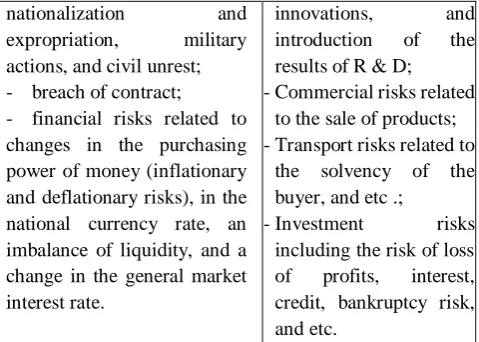
[image:3.595.311.551.50.221.2]In assessing the value of the company, an expert identifies exactly those risks that may affect the most the final assessment. But first, they must be divided into two groups: external and internal (see Table 1) [2, 9, 10].
Table 1. Types Of Business Risks External risks Internal risks
- natural risks related to natural disasters and the ecology;
- general economic risks related to changes in the macroeconomic situation,
unfavorable market
conditions, changes in the competitive environment, and industry characteristics; - political risks related to
-Production risks
related to a decrease in labor productivity, loss of working time, cost overruns or lack of necessary materials;
-technical and
technological risks
related to the
introduction of new technologies,
nationalization and
expropriation, military actions, and civil unrest; - breach of contract; - financial risks related to changes in the purchasing power of money (inflationary and deflationary risks), in the national currency rate, an imbalance of liquidity, and a change in the general market interest rate.
innovations, and
introduction of the results of R & D; -Commercial risks related
to the sale of products; -Transport risks related to
the solvency of the buyer, and etc .;
-Investment risks
including the risk of loss of profits, interest, credit, bankruptcy risk, and etc.
In order to calculate the cost based on risk, it is necessary to determine the quantitative assessment of the identified risks. One of the options may be the absolute expression of risk through the size of losses in the material or value measurement.
In relative terms, the risk is defined as the magnitude of possible losses and referred to a certain base for which it is more convenient to take either the property status of an entrepreneur, or the total cost of resources for this type of business, or the expected income (profit) of a business. The appraiser also uses various methods of technical analysis, such as analysis of retrospective data and extrapolation of the results.
As a result, a quantitative assessment of risk in relative terms can be calculated by the ratio of possible losses to the estimated cost or profit.
Customer capital can be defined as a type of intellectual capital of an organization, which is manifested in the loyal behavior of its customers and in the favorable influence of this factor on the development of the company. The size of customer capital is influenced by the number of customers, how tied they are to the company and, of course, their solvency. There is a combination of indicators that allows assessing customer capital, such as the enterprise’s share in the market, the “brand” mark-up on the company's goods, customer satisfaction, turnover, the company's share in customer purchases, and etc.
At the heart of customer capital management lies a constant control over the data characterizing the profitability and degree of consolidation of existing and potential customers of the company. For this purpose, regular customer surveys are conducted, and sales statistics and changes in customer behavior are analyzed. As a result, the latter are divided into different groups depending on what proportion of customer capital they form.
The formation of customer capital occurs due to marketing, quality and design of goods, discounts, bonuses, events for customers, friendliness of staff, and etc. Two goals are being accomplished using these tools such as increase customer capital and stimulate profitable for the company customer behavior.
Currently, there are various methods for assessing and maximizing the lifetime
Author-3 Photo
Author-1 Photo scientific literature and practice. Let’s consider,
for example, an aggregated approach to calculating the customer lifetime value estimate (CLV), which was proposed by Berger and Nasr (hereinafter the BN approach) [5]. The BN approach proposes a basic model for assessing a customer’s lifetime value based on three assumptions:1) sales of goods and services are carried out once a year, 2) customer retention costs are annual and the customer retention rate does not change over time and 3) the profit received from the buyer remains unchanged during the entire period of cooperation with a company [Berger, Nasr, 1998]. Based on these assumptions, the following CLV calculation formula was developed:
CLV = {GC × S[ri/(l+d)i]}-{M × ∑[ ri -l(l+d)i-0.5]} , where: n is a number of years;
d -annual discount rate;
GC -annual profit received from the buyer; М -the annual cost of customer retention; r -customer retention rate.
Later on, the authors of this approach decided to develop the above assumptions and admitted that the cycle of purchasing goods can be both more and less than one year. Then the CLV formula was modified as follows:
CLV = ∑π(t)×[rt(l+d)t]nt=0,
where π(t) - profit per customer per year t, which can be estimated separately using the appropriate equation for the profit curve.
IV. CONCLUSION
Nowadays the formation of market-oriented reporting is a prerequisite for companies if they want their business to develop most efficiently and generate income for its owners. For all market participants, there is a need for more complete, expanded information about the company and its activities, which would give an idea of the future economic benefits from the interaction with this organization when making not only investment decisions, but also decisions on cooperation, making deals, and purchasing goods.
In this article, there were reviewed the main parameters of market-oriented reporting which allow satisfying the stakeholders in terms of information about the activities of the company. These include shareholder value, investment value, customer capital, risk-based value, unidentifiable goodwill. The most significant for users of financial statements are data on the capital and value of the company. But it is also important to reflect in the reporting such indicators as the availability of refinancing opportunities, the need for external loans in the future to cover negative financial results, efficiency, internal rate of return, profitability index, payback period, and etc. Taking into account these aspects can significantly change the value of future economic benefits and influence the investor's decision on the appropriateness of investments.
REFERENCES
1. Busov, V.I. Enterprise (Business) Value Assessment: A Textbook for Academic Baccalaureate/ V.I. Busov, O.A. Zemlyansky; V.I. Busova. - 2nd ed., edit. - M.: Publishing Urait, 2018.
2. Kasyanenko T. G., Makhovikova G. A. Analysis and risk assessment in business: a textbook and a workshop for undergraduate and graduate programs - 2nd ed., Pererab. and add. - M.: Publishing Urait, 2018.
3. Petrov A.M. Modern concepts of accounting and reporting: a textbook - M.: University textbook: INFRA-M, 2018.
4. Kovalev, V. V., About goodwill "dog, cat" and not only: On the question of far-fetched categories, classifications and algorithms. Bulletin of St. Petersburg University. Series 5: Economy, - 2016. 5. Makarova I.V. Formation of the customer capital of an organization:
theoretical foundations and model assessment tools // Internet magazine “SCIENCE” Vol. 8, No. 4 (2016).
6. Khorin A.N. Market-oriented financial reporting: a statement of value, - Accounting, 2016.
7. Burtseva, K. Y., Vokina, E. B.,&Shnaider, O. V.(2015).
Interconnection between internal control and the assessment of risk of financial stability loss by educational institutions. Actual problems of economics,172(10),410-418.
8. Zorina, V. S., Melnik, M. V.,&Tsypkin, A. N.(2018). Peculiarities of the coherence time of a spectral supercontinuum generated in microstructured fibers with two zeros in the group-velocity dispersion. Journal of Optical Technology, 85(9), 535-540.
9. Ragulina, J. V., Suglobov, A. E.,&Melnik, M. V.(2018). Transformation of the role of a man in the system of entrepreneurship in the process of digitalization of the Russian Economy. Quality - Access to Success, 19(S2), 171-175.
10. T.P. Karpova, A.M. Petrov, O.V. Antonova. Directions of Accounting Development in the Conditions of Digitalization / Jour of Adv Research in Dynamical & Control Systems, Vol. 10, 07-Special Issue, 2018,pp.(117-125)
11. Lymar, M.P., Kevorkova, Z.A., Petrov, A.M The convergence of national and international accounting standards: Chinese experience. / International Journal of Civil Engineering and Technology. Volume 9, Issue 13, December 2018, Pages 82-94
12. Kevorkova, Z.A., Petrov, A.M., Savina N.V. Towards liabilities of corporate systems. International Journal of Civil Engineering and Technology. Volume 10, Issue 2, February 2019, Pages 1582-1593 13. Akhmadeev, R.G. , Bykanova, O.A. , Philippova, N.V. , Vashchekina,
I.V. , Turishcheva, T.B. (2018) Macroeconomic indicators and their impact on the foreign debt burden: The case of BRICS countries. International Journal of Economics and Business Administration, 6 (2), pp. 68-82.
14. Akhmadeev, R.G., Bykanova, O.A., Morozova T.V., Safonova E.G., Turishcheva, T.B., Lehoux, L. (2018) Evaluation of Financial and Analytical Activities of the Biggest Car Makers of the Russian Federation. Jurnal Pengurusan, 54, pp. 18 -36
15. Philippova, N.V., Akhmadeev, R.G., Bykanova, O.A., Chaykovskaya, L.A. (2018) Social equity: A route to progressive taxation of individuals. European Research Studies Journal, 21 (4), pp. 317-330. 16. Chernysheva Natalia A., Perskaya Victoria V., Petrov Alexander M., Bakulina Anna A. Green Energy for Belt and Road Initiative: Economic Aspects Today and in the Future / International Journal of Energy Economics and Policy. 2019, 9(5), 178-185
17. Bogoviz, A.V., Mishchenko, V.V.,Zakharov, M.Y.,Kurashova, A.A., Suglobov, A.E.Strategy of provision of wireless future's security Studies in Computational Intelligence 826, с. 941-947
AUTHORSPROFILE
G.I. Lukyanenko – Associate Professor of the Accounting, Analysis and Audit Department of the Financial University under the Government of the Russian Federation (Moscow), PHD. She is the author of more than 50 scientific publications like monographs, textbooks, articles created both personally and in collaboration in the last 30 years.
Author-5 Photo
Author-5 Photo
Author-5 Photo
I.Y. Glebkova - Associate Professor of the Accounting, Analysis and Audit Department of the Financial University under the Government of the Russian Federation (Moscow), PHD. She is the author of more than 49 scientific publications like monographs, textbooks, articles created both personally and in collaboration in the last 29 years.
.
N.I. Golysheva - Associate Professor of the Accounting, Analysis and Audit Department of the Financial University under the Government of the Russian Federation (Moscow), PHD. She is the author of more than 65 scientific publications like monographs, textbooks, articles created both personally and in collaboration in the last 27 years.