Abstract: Isomerization process is considered one of the main processes used to produce high octane rating gasoline with improved environmental conditions and less emissions. The main keys of performance in isomerization units are the product yield, paraffin isomerization number (PIN) and octane number (RON). In this article we present a multi-response optimization strategy for an industrial naphtha continuous isomerization-process that aims to maximize RON, PIN and yield. Data of 53-runs including feed compositions as well as operating conditions; reactor temperature, benzene content, liquid hour space velocity, feed PIN, hydrogen to hydrocarbon ratio, feed octane number, C7+ content, inlet reactor temperature and iC5/C5P ratio are collected from a refinery company over a period of two months to test the effect of each variable and their interaction over each response individually using analysis of variance (ANOVA). Model reduction is applied for the three models in order to exclude any insignificant data and improve the model’s accuracy. Finally, the optimum operating conditions for the process are selected using numerical optimization in Design Expert 11 by comparing with the real industrial data runs to give the maximum yield, PIN and RON which are 99.992, 122 and 86 respectively. Benzene content is selected to be 1.807 wt%, reactor temperature;143oC, LHSV; 0.882 h-1, feed PIN; 64.611, H2/HC; 0.07, feed RON; 74.408, C7+;
4.06 wt%, inlet reactor temperature; 116oC and iC5/C5P ratio 45.768.
Keywords : Isomerization, multi-response optimization, Penex process, response surface methodology.
I. INTRODUCTION
D
ue to the rapidly increasing requirements for gasoline and petrochemicals over the past decades, upgrading light hydrocarbons has been the center of attention due to the rising commercial applications. Stringent rules and regulations have been forced over several regions to encourage clean fuels. The new gasoline composition regulations all over the world included lead phase down, oxygen content requirements and benzene minimization. According to Jones and Pujado, the EPA (U.S. Environmental Protection Agency) has set a regulation of minimizing the gasoline pool’ benzene amount to 0.62 volume%. The isomerization reaction of light naphtha helps to meet the required specification in the market in addition to rising market’s share of different gasoline grades. Naphtha with low-octane number is refined to produceRevised Manuscript Received on September 05, 2019. * Correspondence Author
Donia Abdel Nasser Fathy, Fresh Graduate from Chemical Engineering Programme, The British University in Egypt, El Shorouk City, Cairo, Egypt. Email: [email protected]
Moustafa Aly Soliman*, Professor of Chemical Engineering, The British University in Egypt, El Shorouk City, Cairo, Egypt. Email: [email protected]
isomerate of high-octane rating about 80 to 93. Two of the most widely used techniques are UOP’s Penex for pentane and hexane paraffins isomerization and Butamer which isomerizes normal butane to iso-butane [1].
There are two empirical methods of measuring octane number; research (RON) (ASTM Method 2699) and motor (MON) (ASTM 2700). Both techniques use the same engine type for testing but with different operating conditions. RON is always larger than MON because RON measures the performance of the engine with frequent acceleration, however MON measures the performance on highway and at heavy load conditions. [1]. The isomerization reactions are exothermic. According to Le Chatelier’s Principle, these reactions are favored at low temperature values [2]. The temperature elevation is due to the side reactions of benzene saturation, naphthene ring hydrocracking and coking which are highly exothermic. However, the branched paraffin isomers’ thermodynamic equilibria are favored at low temperature as shown in figure (1) [3]. Isomerization reactions’ rate is relatively slow, hence long residence time is used to achieve an optimum conversion. Since isomerization always occurs along with hydrocracking, yield decreases. Paraffins with several branches are easily hydrocracked than mono-branches [4]. The heat of reaction of isomerization, benzene saturation, hydrocracking and naphthene ring opening are 2200, 50,000, 11,000 and 11,000 kcal/kmol respectively. According to the previous values, it is shown that benzene saturation reaction is highly exothermic and consequently it reduces the isomerate’s yield. Thus, the benzene content in the feedstock should be limited [5].
Figure.1.Pentane Equilibria
For an economic operation, maintaining high catalyst activity at low operating temperatures is essential. The most common commercial catalyst used by UOP is I-8 which has been used since 1981. Nowadays, the current most used catalysts are UOP I-82 and I-84 [1].
Recently, three catalysts types
A multi-Response Optimization for Isomerization
of light Naphtha
are used in the naphtha isomerization units and all of the three contain platinum [6].
The feed to the isomerization unit contains benzene, olefins, in addition to heavy hydrocarbons (C7+), X-factor term is used to identify their content according to the following equation:
X-factor = (wt.% Methyl cyclopentane) + (wt.% Benzene) + (wt.% cyclohexane) + (wt.%C7
+ )
The performance of the isomerization plants can be determined by several methods such as the isomerate yield (>97%), product research octane number (RON) and the paraffin isomerization (PIN) which can be evaluated using the following equation:
PIN = (product’s isopentane) / (∑Product’s C5 Paraffins) + C (2,2 DMB and 2,3 DMB in product) / (∑product’s C6
paraffins)
For a 1 number increase of the feed’s X-factor, the PIN is expected to decrease about 0.5 numbers due to the catalyst ability to absorb C6 cyclic compounds as well as C7
+ and convert the active sites. Hence, higher temperatures will be used to get the optimum catalyst performance [3].
During the optimization process, the outlet temperatures are maintained to obtain maximum reaction rate and manipulate the lag reactor equilibrium concentrations. This will lead to product iso ratio maximization and economic optimum conditions. In addition to this, maximum yield of isomerate octane barrels can be obtained with high octane number [3]. In order to maximize the liquid yield, some refineries require high benzene and reformer benzene precursors; MCP and CH in the feed due to the regulations concerning reducing the benzene content in the total gasoline pool. Hence, the benzene content in the reformate and the gasoline pool is reduced with no high-octane requirement in the isomerate produced. However, some other refineries prefer maximizing the product octane number over the liquid yield [3].
The inlet lead and lag reactor temperatures are adjusted and optimized at the beginning of each run. By varying the lead inlet temperature, the outlet temperature as well as the iso ratios are monitored. The most significant controlling iso-ratio to determine the optimum temperature is the iso-pentane and hence similar methodology is applied for the lag reactor [6].
II. RESPONSE SURFACE METHODOLOGY
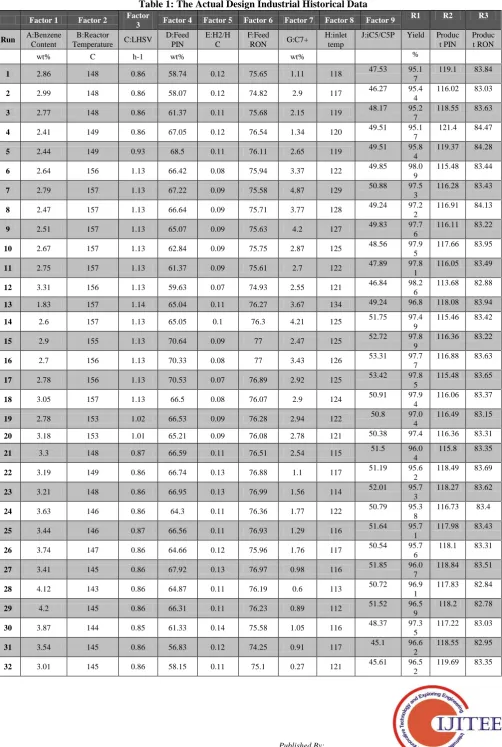
A multi-response optimization strategy for an industrial naphtha continuous isomerization process that aims to obtain high isomerate yield, PIN and RON is proposed. First, by using design expert 11 software, three quadratic models of three responses which are; product yield, product PIN and product RON are analyzed. Nine factors were used via several runs in order to detect the significance of each factor on each obtained model as shown in table 1. The factors are benzene content, reactor temperature, LHSV, feed PIN, H2/HC ratio, feed RON, C7+ content, inlet reactor temperature and iC5/C5P ratio (ratio of isopentane to all C5 paraffins %). Trials are applied to reduce the model by excluding some runs in order to obtain high predicted and adjusted R squared values and improve the models. Second, the optimum conditions are obtained by numerical optimization to give the maximum responses. The variables are coded from A to J
respectively. Firstly, naphthene content in the feed composition was added in the model design, however it showed an insignificant effect on the three responses which contradicts Shehata et al.’s paper. This can be explained due to using different catalyst or different operating conditions. After applying model reduction for all the three responses, the analysis for each one is obtained with logit transform in order to set an upper and lower boundary for the response values. The industrial data for analysis included 53 runs after reduction for a period of operation of two months. The data is
Table 1: The Actual Design Industrial Historical Data
Factor 1 Factor 2 Factor
3 Factor 4 Factor 5 Factor 6 Factor 7 Factor 8 Factor 9
R1 R2 R3
Run A:Benzene
Content
B:Reactor
Temperature C:LHSV
D:Feed PIN
E:H2/H C
F:Feed
RON G:C7+
H:inlet temp
J:iC5/C5P Yield Produc
t PIN
Produc t RON
wt% C h-1 wt% wt% %
1 2.86 148 0.86 58.74 0.12 75.65 1.11 118 47.53 95.1
7
119.1 83.84
2 2.99 148 0.86 58.07 0.12 74.82 2.9 117 46.27 95.4
4
116.02 83.03
3 2.77 148 0.86 61.37 0.11 75.68 2.15 119 48.17 95.2
7
118.55 83.63
4 2.41 149 0.86 67.05 0.12 76.54 1.34 120 49.51 95.1
7
121.4 84.47
5 2.44 149 0.93 68.5 0.11 76.11 2.65 119 49.51 95.8
4
119.37 84.28
6 2.64 156 1.13 66.42 0.08 75.94 3.37 122 49.85 98.0
9
115.48 83.44
7 2.79 157 1.13 67.22 0.09 75.58 4.87 129 50.88 97.5
3
116.28 83.43
8 2.47 157 1.13 66.64 0.09 75.71 3.77 128 49.24 97.2
2
116.91 84.13
9 2.51 157 1.13 65.07 0.09 75.63 4.2 127 49.83 97.7
6
116.11 83.22
10 2.67 157 1.13 62.84 0.09 75.75 2.87 125 48.56 97.9
5
117.66 83.95
11 2.75 157 1.13 61.37 0.09 75.61 2.7 122 47.89 97.8
1
116.05 83.49
12 3.31 156 1.13 59.63 0.07 74.93 2.55 121 46.84 98.2
6
113.68 82.88
13 1.83 157 1.14 65.04 0.11 76.27 3.67 134 49.24 96.8 118.08 83.94
14 2.6 157 1.13 65.05 0.1 76.3 4.21 125 51.75 97.4
9
115.46 83.42
15 2.9 155 1.13 70.64 0.09 77 2.47 125 52.72 97.8
9
116.36 83.22
16 2.7 156 1.13 70.33 0.08 77 3.43 126 53.31 97.7
7
116.88 83.63
17 2.78 156 1.13 70.53 0.07 76.89 2.92 125 53.42 97.8
5
115.48 83.65
18 3.05 157 1.13 66.5 0.08 76.07 2.9 124 50.91 97.9
4
116.06 83.37
19 2.78 153 1.02 66.53 0.09 76.28 2.94 122 50.8 97.0
4
116.49 83.15
20 3.18 153 1.01 65.21 0.09 76.08 2.78 121 50.38 97.4 116.36 83.31
21 3.3 148 0.87 66.59 0.11 76.51 2.54 115 51.5 96.0
4
115.8 83.35
22 3.19 149 0.86 66.74 0.13 76.88 1.1 117 51.19 95.6
2
118.49 83.69
23 3.21 148 0.86 66.95 0.13 76.99 1.56 114 52.01 95.7
3
118.27 83.62
24 3.63 146 0.86 64.3 0.11 76.36 1.77 122 50.79 95.3
8
116.73 83.4
25 3.44 146 0.87 66.56 0.11 76.93 1.29 116 51.64 95.7
1
117.98 83.43
26 3.74 147 0.86 64.66 0.12 75.96 1.76 117 50.54 95.7
6
118.1 83.31
27 3.41 145 0.86 67.92 0.13 76.97 0.98 116 51.85 96.0
7
118.84 83.51
28 4.12 143 0.86 64.87 0.11 76.19 0.6 113 50.72 96.9
1
117.83 82.84
29 4.2 145 0.86 66.31 0.11 76.23 0.89 112 51.52 96.5
9
118.2 82.78
30 3.87 144 0.85 61.33 0.14 75.58 1.05 116 48.37 97.3
5
117.22 83.03
31 3.54 145 0.86 56.83 0.12 74.25 0.91 117 45.1 96.6
2
118.55 82.95
32 3.01 145 0.86 58.15 0.11 75.1 0.27 121 45.61 96.5
2
33 2.7 145 0.86 58.33 0.1 75.37 1.23 116 46.45 96.8 5
119.63 84.09
34 2.7 147 0.86 58.33 0.11 75.37 1.23 118 46.45 95.8
5
119.63 84.09
35 2.88 148 0.85 62.35 0.1 76.17 1.01 118 49.69 97.2 117.7 83.5
36 3.25 146 0.85 59.96 0.09 74.72 1.05 117 47.9 97.4
6
117.53 83
37 2.96 147 0.86 61.1 0.1 75.08 1.15 118 49.79 96.3
3
118.16 83.26
38 3.32 147 0.86 59.66 0.11 74.91 1.22 115 48.98 97.3
7
117.38 83.28
39 3.24 146 0.86 60.48 0.12 75.2 1.06 117 49.15 96.6
8
116.75 83.13
40 3.15 147 0.86 61.74 0.1 75.53 1.64 115 48.44 95.8
5
116.66 83.53
41 3.53 145 0.85 58.57 0.13 74.9 0.6 114 46.03 97.7
4
119.46 83.7
42 4.3 147 0.84 60.87 0.12 74.77 1.01 112 47.64 98.6 116.66 82.71
43 4.74 154 1 58.26 0.09 74.59 1.53 124 47.73 97.6
8
114.52 82.42
44 3.53 152 1.01 57.73 0.08 75.24 2.13 119 47.42 97.7
1
112.11 82.76
45 2.85 153 1.01 63.9 0.08 75.71 2.85 123 48.72 97.5
2
115.36 83.38
46 2.59 153 1.01 60.35 0.07 75.55 1.93 121 46.5 98.0
9
117.81 83.91
47 2.58 154 1.02 58.11 0.07 75.08 2.92 118 46.38 98.1
3
115.36 83.7
48 2.77 153 1.01 59.73 0.07 75.47 2.1 117 47.05 98.2
2
113.64 83.15
49 3.18 153 1.01 58.01 0.08 74.94 3.21 116 46.07 97.9
3
113.62 82.75
50 2.15 153 1.02 60.66 0.1 76.26 1.63 121 46.74 97.7
8
118.36 83.93
51 3.17 153 1.01 63.2 0.08 75.68 3.93 121 49.76 97.8
3
115.09 83.06
52 3.22 155 1.01 60.46 0.08 75.2 3.31 123 47.7 97.7
4
114.98 83.12
53 3.22 156 1.01 60.46 0.08 75.2 3.31 123 47.7 97.8
9
114.98 83.12
III. RESULTS AND DISCUSSION
The predicted model is examined for adequacy to avoid any possible errors with the normality assumptions. After 53 runs have been applied where the product yield, PIN and RON have been reported for each run for a period of two month working days in naphtha isomerization unit, a regression model has been developed to show the empirical relationship among the yield response and the nine process variables.
a. Yield Response
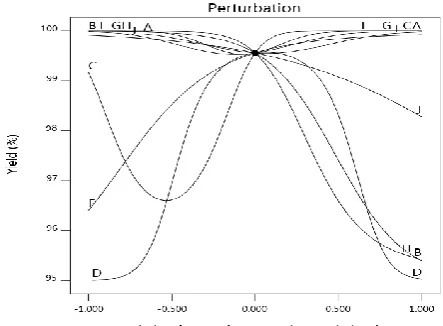
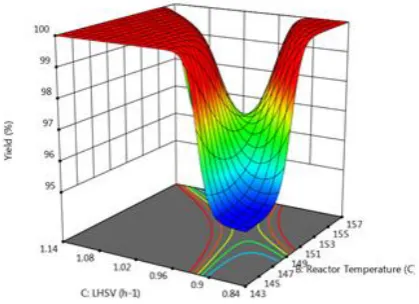
The ANOVA has been applied to validate the RSM model depending on the p-values and F-test as shown in table 2 which are <0.0001 and 43273.36 respectively stating that the developed quadratic model is highly significant. According to the ANOVA model reduction, parameters with p-value higher than 0.05 have been excluded. The accuracy of the developed model is represented by R2 values which is a unity for the yield response indicating ideal similarity between the predicted and the actual values. The adjusted R2 and predicted R2 values are 1 and 0.9942 respectively with a difference less than 0.2 are shown in table 3. The adequacy precision value which represents the measurement of the range (signal) of versus its relative error (noise) predicted response values validating an adequate signal is higher than 4 to be 836.1157. Therefore, the predicted model can be used to navigate space. The model performance could be checked by many techniques. First in figure (2), the predicted versus the actual value shows good agreement and correlation. In addition to this, in figure (3), the perturbation plot shows that all factors have a significant effect on the yield response where the factors show a curvature with no steep lines.
Table 2: ANOVA Results for Yield Response Sourc
e
Sum of Square
s
df Mean
Squar e
F-value p-
value
Model 59.23 5
0
1.18 43273.3
6
< 0.000
1
Significan t
Table 3: Yield Response Fit Statistics
Std. Dev. 0.0052 R² 1.0000
Mean -0.5342 Adjusted R² 1.0000
C.V. % 0.9795 Predicted R² 0.9942
Adeq Precision 836.1157
Figure 2. Yield Response Actual Versus Predicted
Figure 3. Reactor Temperature and LHSV Two Factor Interaction on Yield Response
[image:5.595.39.287.348.733.2]Figure 4. Yield Response Perturbation Curve
[image:6.595.50.287.473.725.2]Figure 5. Temperature Effect on Yield at Low and high LHSV Values
Figure 6: Effect of H2/HC Ratio on the Product Yield Response
B. PIN Response
The quadratic equation is represented as follows:
Logit (Product PIN) = Ln[(Product PIN - 112.00)/(122.00 - Product PIN)] = -442.53140 +63.11522 A -1.63394 B -1299.55334 C + 0.368789 D -7745.58475 E + 91.92662 F - 49.01562 G -1.05509 H - 78.24086 J - 0.373512 AB + 67.54897 AC -0.815661 AD +215.49168 AE -1.42187 AF + 1.25347 AG - 0.401225 AH + 2.16666 AJ +18.06828 BC - 0.428957 BD +53.80705 BE +0.465028 BF + 0.971135 BG - 0.034295 BH + 0.406007 BJ+19.60201
CD-1305.07112 CE -10.22137 CF - 15.75189 CG + 2.32047 CH -28.40578 CJ -13.67716 DE +1.03883 DF -0.177573 DG -0.124835 DH -0.179163 DJ -14.76996 EG +7.01112 EH +2.23262 EJ -1.52861 FG + 0.213441 FJ + 0.969278 GJ + 0.253900 HJ + 0.699986 A² - 0.151490 B²-430.40073 C² -0.040655 D² +1079.40873 E² -1.45663 F²
-1.12963 G²
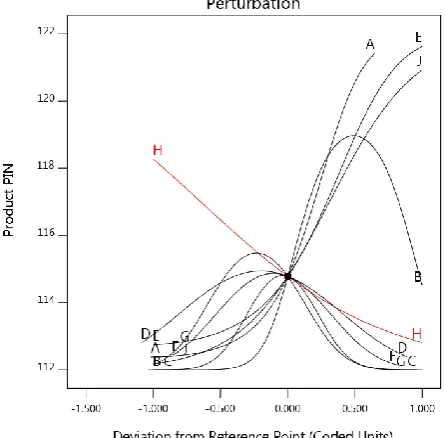
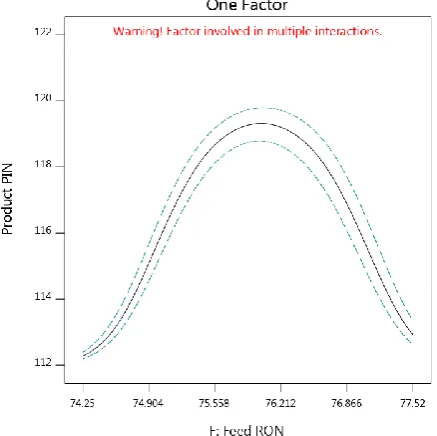
Similarly, the ANOVA has been applied to validate the RSM model depending on the p-values and F-test as shown in table 4 which are <0.0001 and 38538.87 respectively stating that the developed quadratic model is highly significant. According to the ANOVA model reduction, parameters with p-value higher than 0.05 have been excluded. The accuracy of the developed model is represented by R2 values which is a unity for the PIN response indicating ideal similarity between the predicted and the actual values. The adjusted R2 and predicted R2 values are 1 and 0.9973 respectively with a difference less than 0.2 are shown in table 5. The adequacy precision value which represents the measurement of the range (signal) of versus its relative error (noise) predicted response values validating an adequate signal is higher than 4 to be 1406.9103. Therefore, the predicted model can be used to navigate space. The PIN developed model has been validated by the following graphs; in figure (7), the predicted versus actual values graph has given a precise agreement, , in figure (8), the perturbation plot showed a curvature trend for all the process variables indicating their high sensitivity over the response except for the inlet reactor temperature (H) which is almost a steep line.
[image:6.595.291.559.589.839.2]Table 4: ANOVA Results for PIN Response
Table 5: Fit Statistic for PIN Response
Std. Dev. 0.0053 R² 1.0000
Mean -0.0541 Adjusted R² 1.0000
C.V. % 9.81 Predicted R² 0.9973
Adeq Precision 1406.9103
Source Sum
of
Squar
es
df Mean
Squar
e
F-value p-value
Model 53.17 49 1.09 38548.87 <
0.0001
signific
Figure 7: PIN Response Predicted Versus Actual
Figure 8: PIN Response Perturbation Curve Effect of Process Variables and Their Interaction As defined the paraffin isomerization number (PIN) is the total of iso-pentane to total pentane and the fraction of di-methyl butane to total hexanes in the product. Therefore, iC5/C5P is the most significant factor over the response; such that by increasing this ratio, the PIN increases as shown in figure (9). Also, the benzene content has a significant effect on the PIN response, where as stated in the liteature; that for each 1 value increease in the x-factor , the PIN decreases to half due to the ability of the catalyst to abosrob C6 cyclic compounds along with C7
+
converting the active sites therefore high temperature are more desired to reach the optimum performance. Thus by increasing the benzene content, the x-factor increases and as shown in figure (10); the PIN number decreases.
The interaction between the iC5/C5P and the benzene content is shown in figures (11) and (12), it is proven that the dominating paramter is the iC5/C5P ratio where the red line represnets the maximum value, hence regardless of the increase in the benzene content, the PIN will increase however if the the iC5/C5P ratio is low represented by the black line, any increase in the benzene content will lead to a decrease in the product PIN.
Another parameter that is also highly significant on the PIN response is the feed research octane number, as shown in figure (13), by increasing the feed research octane number, the product PIN will increase to a certain limit then it will decrease again. This is highly dependent on the interaction between the feed RON variable and the feed PIN, where at high values of feed RON, by increasing the feed PIN, the product PIN increases, and vice versa at low feed RON values, by increasing the feed PIN. The product PIN decreases until it becomes constant. This is presented in figures (14) and (15).
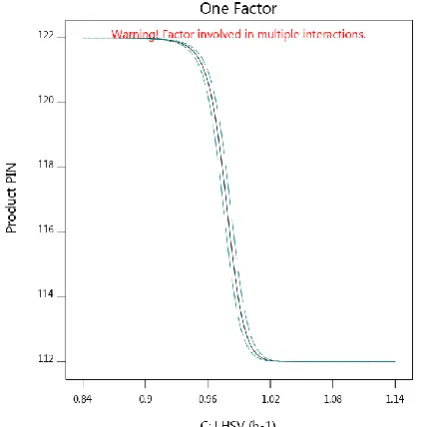
[image:7.595.314.546.370.597.2]Finally, the product PIN is also affected by the LHSV values, such that at constant inlet lead reactor temperature, the product PIN is inversely proportional to the LHSV values. As shown in figure (16), by fixing the inlet reactor temperature at 124.1oC, as the LHSV values increase, the product PIN is decreased.
Figure 10: Effect of Benzene Content on PIN Response
[image:8.595.66.281.282.504.2]Figure 11: The Interaction Effect Between iC5/C5P and Benzene Content on the Product PIN Response
Figure 12: 3D Interaction Effect of Benzene Content and iC5/C5P on the Product PIN
[image:8.595.329.520.301.500.2]Figure 13: Feed RON Effect on the Product PIN Response
[image:8.595.322.540.546.712.2]Figure 14: Feed RON and Feed PIN Interaction on PIN Response
[image:8.595.77.275.564.711.2]Figure 16: Effect of LHSV on the Product PIN Response
C. Research Octane Number Response
The design expert software has developed a regression formula representing an empirical formula relating the product research octane number with the process parameters. A polynomial quadratic equation has been conducted fitting the industrial data as follows where the product RON is the independent response.
Logit(Product RON) = Ln[(Product RON - 80.00)/(86.00 - Product RON)] = -1612.29315 + 67.11221 A + 61.40084 B -1065.35659 C +55.90016 D +2551.79071 E -72.05533 F -94.39825 G -21.37074 H -14.35034 J -0.455423 AB +15.77641 AC -0.300463 AD -14.15042 AE -0.832563 AF -0.263880 AG + 0.374376 AH +0.713781 AJ - 8.02870 BC +0.139485 BD +14.49046 BE -1.24102 BF -0.301972 BG +0.013594 BH +0.068272 BJ -3.96576 CD +82.22134 CE +26.76844 CF +15.21533 CG +0.898176 CH +14.42550 DE -1.09713 DF -0.133164 DG -0.023349 DH +0.265803 DJ -76.17775 EF -29.10979 EG +1.61248 EH -8.38653 EJ +2.07018 FG +0.317199FH +0.015873 GH -0.423545 GJ -0.110472 HJ -1.57862 A² +0.089962 B² +158.47496 C² -0.001945 D² +2034.26633 E² +1.77696 F² -0.123941 G² ANOVA has been used to validate the developed RSM model via F-test and p-values which were found to be 72007.06 and <0.0001 respectively as shown in table 6 stating that the previous model has high statistical significance. The F-test compares the sources’ mean square to the residual mean square. The ANOVA has showed that the nine process variables are all highly significant as well as their two-factor interaction with p-values <0.0001. In table 7, the fit statistic data shows a great agreement with the ANOVA results where the model has R2 and adjusted R2 value of unity and a predicted R2 value of 0.9924, the difference between both the adjusted and predicted values is less than 0.2, therefore this developed model is able to represent and predict further data. The adequacy precision is 1301.0795 which is higher than 4
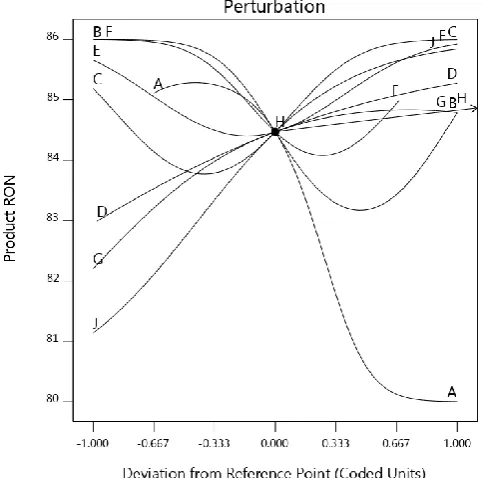
[image:9.595.64.277.53.267.2]representing a large signal to noise ratio. In the diagnostics section, the model performance has been checked by two plots; first in figure (17), the predicted versus actual values are plotted fitting the straight line, in figure (18), the perturbation plot shows the significance of the process variables over the RON response where all variables are represented with a curvature except for benzene content (A), inlet temperature (H) and iC5/C5P (J).
Table 6: ANOVA Results for Research Octane Number Response (RON)
Sourc e
Sum of Square
s
df Mean
Squar e
F-valu e
p-value
Model 4.74 5
0
0.0947 72007.0
6 < 0.000
1
significan t
[image:9.595.305.549.194.256.2]Table 7: RON Fit Statistics Table
[image:9.595.305.548.229.628.2]Figure 18: Product RON Perturbation Plot
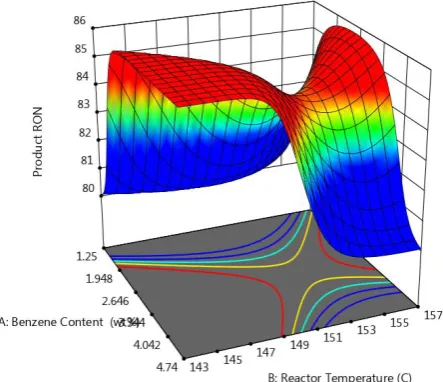
Effect of Process Variables and Their Interaction The RON produced from this Penex isomerization unit ranges from 82.42 to 84.47. First the benzene content in the naphtha feed. As shown in figure (19),as the benzene content in the feed increases, the product RON undergoes a significant decline. This can be explained due to higher possibility of benzene saturation reactions which is highly exothermic favored at low temperature values, therefore the benzene content must not exceed certain limit which is about 5%. This issue can be adjusted by controlling the reactor temperature, thus by increasing the benzene content the reactor temperature should be decreased for optimum results and higher product RON. In figure (20), the interaction effect between the product RON and the reactor temperature is represented, where the red line represents the maximum value for reactor temperature and the black line represents the minimum value, at high reactor temperature (157oC), by increasing the benzene content, the octane number increases until certain limit where more benzene saturation reactions occur and hence the product RON undergoes a rapid decrease. While at low reactor temperature (143oC), by increasing the benzene content in the feed, the product RON is not affected, and it continues to reach the desired values. The same effect is represented by the 3D surface interaction shown in figure(21). Validating these results, the effect of reactor temperature on the product research octane number RON has been tested, where it shows an agreement with the previously stated results. As shown in figure (22), at high benzene content values, by increasing the reactor temperature the product RON decreases.
[image:10.595.51.293.62.301.2]Figure 19: Effect of Benzene Content on Product Research Octane Number RON
[image:10.595.310.556.335.588.2]Figure 21: 3D Surface Interaction Between Benzene Content and Reactor Temperature
Figure 22: Effect of Increasing the Reactor Temperature on the Product RON at High Benzene Content
D. Optimization
The goal is to find the optimum values for the isomerization process variables; benzene content, reactor temperature, LHSV, feed PIN, H2/HC, feed RON, C7+, inlet reactor temperature and iC5/C5P which give the highest product yield, PIN and RON values. Using design of experiments’ numerical optimization, each process variable’s desirability is combined to definite value and the then optimum operating conditions are selected based on the desired goal set in the criteria. Some limitations and restrictions were set for the process variables to reach the optimization aim, all the process variables are set to be in range value between their minimum and maximum values in order to meet higher yield and product RON except for H2/HC and inlet
reactor temperature which were set in target of 0.07 and 116oC respectivelyas Said et al [6] optimization’s study for a similar plant indicated that H2/HC should be as low as possible and the optimum lead reactor inlet temperature
should be about 116 C . Accordingly, the response variables; product yield, PIN and RON were set to be maximum with the highest importance to the product RON (+++++), followed by product yield (+++) then product PIN (+) so that the highest values can be obtained. In the designed 53 runs, run 4, 33, 12, 42 and 48 gave the highest yield with the corresponding product PIN and RON, comparing the operating conditions and process variables of these runs with the optimized solutions obtained by the Design Expert; solution 3, 5 and 82 as shown in table 8. The three solutions gave high yield percentages which are 99.984. 99.999 and 99.992 with product PIN 121.996, 122 and 122 and product RON to be 85.885, 85.992 and 86. According to the interaction of variables discussed in the previous section, the selected optimum solution is 82, this can be explained, first according to the yield response, low LHSV value (0.882) and optimum reactor temperature (143.28) gave high product yield percentage. Second, according to PIN, both solutions 5 and 82 gave PIN equals to 122. However, the controlling response here is the product RON which requires minimizing the reactor temperature to avoid benzene saturation reactions in case of high benzene content in the feedstock. Therefore, benzene content of 1.807 is selected with an operating reactor temperature of 143.28oC to perform better than temperatures of solutions 3 and 5. The optimization gave maximum allowable product yield, PIN and RON is 99.992, 122 and 86 with a corresponding desirability of 1 with the operating conditions.
Table 8: Optimization Results and Comparison of Different Runs
Run 4 Run 33 Run 12 Run 48 Run 42 Solution 3 Solution 5 Solution
82 Benzene
Content 2.41 2.7 3.31 2.77 4.3 1.48 1.476 1.807
Reactor Temperatur
e (oC)
149 145 156 153 147 154.535 149.313 143.28
LHSV (h-1) 0.86 0.86 1.13 1.01 0.84 0.885 0.867 0.882
Feed PIN 67.05 58.33 59.63 59.73 60.87 62.644 65.126 64.611
H2/HC 0.12 0.1 0.07 0.07 0.12 0.07 0.07 0.07
Feed RON 76.54 75.37 74.93 75.47 74.77 76.358 76.606 76.408
C7+ (wt.%) 1.34 1.23 2.55 2.1 1.01 1.707 4.275 4.06
Inlet Temperatur
e (oC)
120 116 121 117 112 116 116 116
iC5/C5P 49.51 46.45 46.84 47.05 47.64 47.416 48.479 45.768
Yield 95.17 96.85 98.26 98.22 98.6 99.984 99.999 99.992
Product PIN 121.4 119.63 113.68 113.64 116.66 121.996 122 122
Product
RON 84.47 84.09 82.88 83.15 82.71 85.885 85.992 86
IV. CONCLUSION
All in all, the main goal of this research is to monitor and determine the effect of the process variables over three main responses; product yield, product research octane number and product isomerization number in addition to developing three quadratic models representing the relation between the nine process variables and each individual response and finally select the optimum industrial conditions for the process. 9 variables for 53 independent runs were designed using the response surface methodology (RSM), Design Expert 11. The first response; product yield model was developed with R squared and adjusted R squared equal to unity. The product yield was found to be improved by maximizing the reactor temperature and lowering the liquid hour space velocity (LHSV) as the product yield is highly dependent on the LHSV value used corresponding to the reactor temperature. On the other hand, at the same temperature value, by increasing the LHSV, the yield decreases. The second response, product PIN model was developed with adjusted R squared equals to 1 and predicted R squared equals to 0.9973. The iC5/C5P ratio is the most significant variable over the PIN response such that the PIN increases by increasing this ratio, in addition to this, benzene content int the feedstock plays a role where by increasing the benzene content, the x-factor increases and hence the PIN decreases. The product PIN is also affected by the LHSV value where at certain fixed inlet lead reactor temperature, by increasing the LHSV, the product PIN decreases. Finally, the product RON model was developed with adjusted R squared and predicted R squared equals to 1 and 0.9924 respectively. The product RON has shown a significant decline at high benzene content in the feedstock due to occurrence of benzene saturation reactions. The interaction between the reactor temperature and benzene content has proven that by increasing the benzene content, the octane number increases until certain limit where more benzene saturation reactions occur and hence the product RON undergoes a rapid decrease. However, at low reactor
temperature, by increasing the benzene content in the feed, the product RON is not affected, and it continues to reach the desired values. Finally, the obtained models were numerically optimized to produce high octane number gasoline with higher product yield and PIN which are 86, 99.992 and 122 respectively with the following operating conditions; benzene content ranging from 1.48 to 1.807, reactor temperature from 143.28 to 149oC, LHSV from 0.86 to 0.88, feed PIN from 62 to 65, H2/HC to be 0.07, feed RON from 76.3 to 76.6, C7+ wt.% from 1.7 to 4 %, inlet temperature of 116oC and iC5/C5P from 45 to 47.
REFERENCES
1. S. Jones and P. R. Pujado, Handbook of Petroleum Processing., Dordrecht, The Netherlands: Springer International Publishing, (2006).
2. M. A. Fahim, T. A. Alsahhaf and A. Elkilani., Fundamentals of
Petroleum Refinig, Khaldeya, Kuwait.: Elsevier, (2010).
3. Vukovic., "Reactor Temperature Optimization of the Light Naphtha Isomerization Unit," Goriva i maziva, vol. 3, no. 52, pp. 195-206, (2013).
4. Valavarasu and B. Sairam, "Light Naphtha Isomerization Process: A Review," Petroleum Science and Technology, vol. 6, no. 31, pp. 580-595, (2013).
5. S. R. Naqvi, A. Bibi, M. Naqvi, T. Noor, A. Nizami, M. Rehan and M.
Ayoub, "New trends in improving gasoline quality and octane through
naphtha isomerization: a short review," Applied Petrochemical
Research, vol. 8, no. 3, pp. 131-139, (2018).
6. M. M. Said, T. S. Ahmed and T. M. Moustafa., "Predictive Modeling
and optimization of Industrial Penex Isomerization Unit-A Case Study, Energy & Fuels.," American Chemical Society., vol. 28, no. 12, p. 7726–7741, (2014).
7. W.M. Shehata, M.F. Mohamed, F.K. Gad, "Monitoring and modelling
AUTHORSPROFILE
Donia Abdel Nasser Fathy, earned her bachelor’s degree in chemical engineering from the British University in Egypt.