Abstract—Taekwondo is one among the foremost common martial arts that has a many of followers all around the globe. Usually, a taekwondo work part takes place throughout a hall or massive high areas among the presence of a trainers’. This can be foremost common coaching (training) approach for Taekwondo. However, this method has few drawbacks in approaching independent coaching. Taekwondo trainees would like independent coaching to enhance their skilled and performance. Even though there have some kinds of advantageous taekwondo work materials obtainable on the market an internet, most of them need as far as three-dimensional visual image. This paper presents the Virtual Taekwondo Training Environment (VT2E) model, a new supplementary self-reliant taekwondo coaching approach. The objective of this paper is to regardless of whether or not the intervention of the new taekwondo work approaches by virtual reality contributed to the trainees’ satisfaction in self-directed training. The study was administered among a sample of forty six World Taekwondo Federation (WTF) trainees. Pearson Correlation and Regression analyses were used to verify the results of participating, Presence, Utility and Easy Use on trainees’ satisfaction in using the VT2E example. The results offer empirical support for the positive and statistically necessary links within Utility and Easy Use and trainees’ satisfaction for taekwondo training. Be that as it may participating and Presence didn’t have positive and important relationships with learners’ satisfaction for independent coaching.
Index Terms— Martial Arts, Taekwondo Training, Self-reliant coaching,Virtual Reality.
I. INTRODUCTION
Taekwondo is some among the foremost standard ancient martial arts that is begun in Korea and has turned into a recent international sport that advanced into several components of
Revised Manuscript Received on March 08, 2019
N.A. Mohd Jelani, Nur Ain Mohd Jelani School of Multimedia Technology and Communication, Universiti Utara Malaysia.
A.N. Zulkifli, Abdul Nasir, Zulkifli School of Creative Industry Management and Performing Art, Universiti Utara Malaysia. [email protected]
S. Ismail, Salina Ismail School of Multimedia Technology and Communication, Universiti Utara Malaysia.
M.F. Yusoff, Mohd Fitri Yusoff School of Creative Industry Management and Performing Art, Universiti Utara Malaysia
the globe [1], [2]. Other than, taekwondo had been positioned among the authority of Olympic Games’ sports since the Sydney 2000 Games [3]. In taekwondo coaching, there are 2 ways by which to search out and also apply taekwondo. The primary approach is to search out with their mentor within the classroom or extra coaching club that is standard technique of taekwondo coaching that’s wide used these today. The trainer can justify and demonstrate the taekwondo movement at that point the learners can pursue their trainer. One among the issues featured by most trainees is absence of your opportunity to attend coaching classes [4], [5] and generally the coaches’ aren’t offered [5].According to [6], training will be difficult when it involves large groups. Although training with a large group has the advantage of reducing the fees charged [7], but it also has their weakness in terms of quality performance in training [8]. Since the coaching within the classroom or further coaching club involves an oversized gathering of trainees, not all trainees can outwardly pursue the demonstration by the trainer since they’re standing far off away or they may be obstructed by completely different learners [7]. Probably some of them just follow their fellow trainees’ movements without actually seeing them directly from the trainer. When involving complex body movements, the trainees should be able to fully understand their trainer’s movements before they are able to perform them on their own. The second approach is independent coaching by using existing supplementary coaching materials. Though there are varied supplementary coaching materials like DVD/CD (video), YouTube (online video), web sites and books, but several of them aren’t sufficiently effective and not refined enough. The utilization of books as coaching supplements isn’t enough as a result of the books lack of interactive components and also the info is static that produces, it tough to follow in terms of movements [9]. Undeniably, YouTube offers a large number and available for a variety of skills of video training, but the use of video as a medium of training is still limited [10]. A major drawback within the usage of videos that shortage of the 3-Dimension (3D) and feedback [5], [10], [11]. According to [12], VR can provide a higher degree of N.A. Mohd Jelani, A.N. Zulkifli, S. Ismail, M.F. Yusoff
A Study of Trainees Satisfaction using the
Virtual Taekwondo Training Environment
interactivity compared to videos making virtual worlds look real, sounds real and realistically to viewer’s actions.
In order to further explore some of the issues faced by the taekwondo trainees, a preliminary study has been conducted among 52 taekwondo trainees as respondents. A convenient sampling technique was applied. The study was carried out at a selected taekwondo training centre in Kota Bahru, Kelantan. Since training in the classroom is the conventional method used for taekwondo training, the preliminary study was conducted to determine other forms of supplementary training materials that are used by the trainees. The questions are mainly focused on self-directed taekwondo training. The study indicated that 36 out of 52 (69.2%) respondents conducted self-directed training at home. 25 (48%) of the respondents indicated that they needed some form of supplementary taekwondo training materials to further understand and practice the movements. The supplementary training materials that were referred by trainees include DVD/CD (video) – 9.6%, YouTube – 38.5%, Internet websites – 28.8%, and books – 13.5%. The study also indicated 32 (61.5%) of the respondents were willing to use the supplementary training material based on interactive VR technology if it is available. The results of preliminary examination clearly indicated the importance of a self-reliant taekwondo coaching among the trainers and they are facing problems while performing self-directed training at home since they do not have a proper supplementary training material to guide them.
Therefore, it’s terribly necessary to possess a higher supplementary coaching material to direct and enhance the independent coaching quality and execution level. Consequently, a brand new supplementary coaching material supported on VR technologies has been planned. A VT2E model have been structured (designed) and produced (developed) for that reason and also the client analysis have been directed among the sample of WTF Taekwondo learners.
II. LITERATUREREVIEW
VR has been introduced since the 1980s and 90s, that shows the achievements in various fields [13]. VR will be outlined as a 3D environment generated by computer-generated simulation which enables interaction with clients (users) in a exceedingly globe [14], [15], [16]. Meanwhile, [17] describe VR as a computer-generated simulation that can provide Virtual Environment (VE) to the user. In recent years, the advancements within the 3D computer graphics technology and also the latest emergence of powerful devices will bring a plenty of interest in VR applications [18]. [19] Expressed which the utilization of VR permits clients to completely control to virtual environment (VE), flexibility, repeatability, give the environment realism within an inexpensive cost and might understand "immersive" in coaching environment.
Additionally, VR have the flexibility to beat the issues associated with real world [20]. The most favourable position of VR is its ability in creating data in 3-dimension (3D) that permits clients to take at and move with the knowledge that couldn’t be achieved with different media [21]. VR has the
capability to make low cost and zero risk system in various fields [22]. Other than that, VR has proved self-made in several fields of coaching, as well as military applications [23], therapeutic (medical) [24], and education and coaching [25], [26].
VR in Training
Nowadays, coaching and learning are wide utilized in VR technologies [27], [28], [29]. VR has been wide utilized in coaching and offers good success in varied coaching fields. The expanding new innovation within the VR application has inspired several specialists (researchers) and industries to grow new frameworks particularly in coaching [30]. VR model is changing into most powerful tool in coaching since it gives a variety of benefits that incorporate; it permits continual practices, and it allows self-directed coaching [31]. VR has the capability of increasing physical training by recording every movement and then can be played back with unlimited times, as a self-directed guide training and evaluation [32]. VR also can provide immediate feedback from the virtual instructor [33]. Besides that, VR technologies provide a lot of benefits such as user can view and playback images in real-time 3D display, user can freely control a computer monitor with the angle of image 360 degrees, rewind, fast forward, pause, zoom in and zoom out, user can improve the feeling of presence and user can get the depth information [34].
There are several previous studies that are conducted regarding to VR in coaching. [32] Planned a VR motion coaching framework that tracks full body for dynamic Chinese Self-defense martial art Tai Chi to enhance their coaching performance. [35] Planned a dance coaching framework which tracks full body supported Motion Capture (Mo-Cap) and VR that might control clients to enhance their abilities execution. [36] Designed a coaching paradigm as instrument for performing arts that integrate VR technology and MoCap. The VR innovation with prime quality and higher style can give user satisfaction [37].
III. DESIGNANDDEVELOPMENTOFTHEVT2E PROTOTYPE
3D Character, Applying Motions to a 3D Character) and iv) VE (Placing of Objects in the Environment, Scene Lighting, Camera and Save data). In the development process, four software has been used which include; Autodesk 3DS Max 2010, Autodesk Motion Builder 2013, Qualisys Track Manager and Quest3D 4.2.2. The modelling and animation processes were created using the Autodesk 3DS Max 2010, the MoCap was created using the Qualisys Track Manager and the VE was created using the Quest3D 4.2.2. Figure 1 shows the flow chart of design and development process that has been involved in the VT2E prototype.
IV. METHOD
Participants
This examination has been conducted among forty six respondents consisting of each gender that were chosen dependent on the convenient testing approach. Seventeen of respondents were male (37%) and twenty nine are feminine (63%). The scope of this respondent’s age was from eighteen to thirty-nine years previous, and that they are one of the WTF taekwondo trainees on Universities Utara Malaysia (UUM). Before the evaluation was conducted, a brief description of how to use of the VT2E prototype was given. After that, they got about forty-five minutes to use the VT2E paradigm before the analysis was applied.
Fig.1 Design and Development Process for VT2E Prototype
Measurement
The variables of these examinations are Satisfaction. [38] State which satisfaction is that response or reaction of the clients once their expertise of employing framework that brought the clients into good emotion’s. Clients feel discontented if their desires aren’t accomplished, anyway they might be glad with a framework once having higher expectations and willing to utilize it may correspondingly inside what’s to come [38]. As declared by [37], it is able to produce user’s satisfaction with the success of the VR technology. The self-dependent variables during this study are participating, Presence, quality and Easy. Participating (Engaging) suggests that the user isn’t simply distracted and might completely concentrate on an activity [39]. According to [40], engaging refers to the feelings that appear to each user when they are involved directly in the environment. Presence defines to the abstract expertise of “being there” in one atmosphere or place, regardless of whether inside the global
Instrument
The client analysis has been conducted by utilizing a collection of form that was created and adapted from previous analysis to make sure the validity of the instrument. The form uses the 5-point Likert scale starting from 1 (completely dis-agree) to 5(completely dis-agree). The form comprises of 2 areas; statistic information and trainees’ satisfaction of using the VT2E method. The form consists of all the measurements and things for Participating, Presence, Usefulness, Easy Use and Satisfaction. The things for Participating were adjusted from [45], presence from [41], Usefulness from [46], Easy Use from [43] and Satisfaction from [47].
Procedure
To evaluate the trainees’ satisfaction on utilizing the VT2E mode, the learners were assembled in one place to provide a short clarification and demonstration on the way to use the VT2E model. The clarification and demonstrations were conducted employing a massive screen projection system. Before to the analysis, the trainees got close to forty-five minutes to use the VT2E prototype. This was to make sure that the trainees perceive on a way to use the example and aware of the functions and interface of the model. Then, they got group of the VT2E analysis form for the analysis.
V. RESULTS
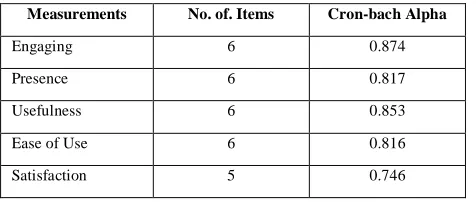
[image:4.612.41.279.504.605.2]To Descriptive statistics, correlation, and regression investigates are utilized to test information. The SPSS versions twenty one for Window 7 were employed in order to calculate the Cronbach Alpha quantities. As given in Table 1, the outcomes indicated which that the Cronbach alpha values for Engaging/ Participating, Usefulness, Easy Use and Satisfaction are 0.874, 0.817, 0.853, 0.816, and 0.746 severally. In keeping with [48], any Cronbach Alpha price bigger than 0.7 is reliable.
Table. 1 Cronbach Alpha Values for over-all Measurement
Descriptive Statistics
Means and also standard deviations of all measurements were appeared in Table 2. The results showed that the mean scores are 4.18 for Participating, 3.90 for Presence, 4.22 for Usefulness, 4.25 for Easy Use and 4.14 for Satisfaction. Quality (Usefulness) has greatest mean score of 4.22 whereas Presence got bottom mean score of 3.90 among all the measurements.
Table. 2 Descriptive Statistics for All Measurements
Measurements and Items Mean SD
Engaging 4.18
1. VT2E keeps me totally absorbed in the
self-directed Taekwondo training.
4.02 .577
2. VT2E hold my attention. 4.28 .584 3. VT2E excites my curiosity. 4.26 .743
4. VT2E arouses my imagination. 4.22 .696
5. VT2E is fun. 4.26 .612
6. VT2E is intrinsically interesting. 4.04 .698
Presence 3.90
1. I had got a sense of presence (i.e. being there).
3.87 .718
2. The quality of the image increases my emotion of presence.
3.93 .772
3. I thought that field of view improved my sense of presence.
3.93 .611
4. I felt being there and part of the virtual environment
3.89 .605
5. I had a great sense of scale in the virtual environment.
3.98 .683
6. I often know where I was in the virtual environment.
3.85 .729
Usefulness 4.22
1. Using VT2E in my coaching would enable
s me to accomplishing tasks to more quickly.
4.15 .631
2. Using VT2E would improve my training performance.
4.20 .582
3. Using VT2E in my training would increase my productivity.
4.02 .715
4. Using VT2E would enhance my
effectiveness on the training.
4.20 .542
5. Using VT2E would make it easier to do
my training.
4.35 .604
6. I would find VT2E useful in my training. 4.41 .617
Ease of Use 4.08
1. Learning to be operate VT2E would be
easy for me
4.04 .665
2. I would have find it easy to get VT2E to
do what I want it to do.
4.07 .680
3. My interaction within VT2E would be easy, clear and understandable.
4.11 .605
4. I would have find VT2E to be flexible to
interact with me
4.02 .577
5. It would be easy for me to become skillful at using VT2E.
4.09 .694
6. I would find VT2E easy to use. 4.15 .666
Satisfaction 4.14
1. I was satisfied with that this type of computer-based coaching experiences.
4.07 .574
2. I was satisfied with that overall training effectiveness.
4.11 .605
3. I was satisfied with that training approach in this type of computer-based training environment.
4.09 .725
4. I was satisfied with this type of computer-based coaching environment.
4.11 .567
5. I found the VT2E contents meet my
needs.
4.33 .668
Correlation
Correlation may be a helpful statistics that is meant to work out the link between 2 variables [49]. During this experiment, the Pearson
correlation (parametric) co-efficient
(r) Measurements No. of. Items Cron-bach Alpha
Engaging 6 0.874
Presence 6 0.817
Usefulness 6 0.853
Ease of Use 6 0.816
were executed as a statistical technique that can show how strong the relationships within the reliant variables quantity (Satisfaction) and therefore the self-reliant variables (Participating (Engaging), Presence, Usefulness and Easy Use). [50] Mentioned that the value for the Pearson correlation should be between -1 and +1. Table 3 shows the correlation co-efficient within Satisfaction, Engaging, Presence, Usefulness, and also Easy Use within quality of the linear links. The outcomes demonstrate which Participating, Presence, Usefulness (utility) and Easy use completely and also significantly correlative to Satisfaction. The correlation values for Participating, Presence, Usefulness, and Easy Use are .41, .38, .57, and .54 severally. Every one of the qualities demonstrated that they’re powerfully correlative to Satisfaction and therefore the correlation for every factor (variable) is critical at the 0.01 level.
Table. 3 Pearson Correlation Co-efficient Analysis
Measurements SAT ENG PRE USE EOU Satisfaction 1
Participating (Engaging)
0.408* *
1
Presence 0.380* *
0.637* *
1
Usefulness 0.568* *
0.672* *
0.585* *
1
Easy Use 0.537* *
0.422* *
0.442* *
0.536* *
1
Note: Correlation is most important at the level of 0.01 (1-tailed) **
Regression
The regression (multivariate) analyzes are that the more generally utilized statistics tools for assessing the connections between factors [51]. During that investigation, many
correlation analyses are directed to check
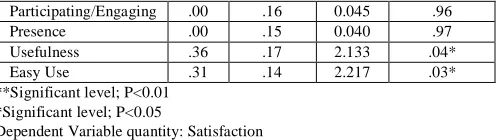
participating/Engaging, Presence, Easy Use and Usefulness measurements to impact learners’ Satisfaction. Table 4 depicts consequences of multivariate analysis. The R2 price is 0.398 that demonstrate changes within the learners’ satisfaction relating to independent coaching throughout the VT2E model. The predictors within the investigation are the self-reliant
factors of this examination that embrace
Participating/Engaging, Presence, Usefulness and Easy use. Additionally, the one-followed check was used to measure link within variables to check the hypotheses. Consistent with [52], the suitable important p-value ought to be lower than 0.05 whereas T-value ought to be higher than 1.645. During this study, it had been discovered which the free variables statistically considerably predicted that needy variable quantity, F (4.41) = 6.783 and therefore the regression demonstrate are suited to the information.
Table 4. REGRESSION ANALYSIS
Measurements Beta Standard Errors
T-values
Significant ( P-values)
Participating/Engaging .00 .16 0.045 .96
Presence .00 .15 0.040 .97
Usefulness .36 .17 2.133 .04*
Easy Use .31 .14 2.217 .03*
**Significant level; P<0.01 *Significant level; P<0.05
Dependent Variable quantity: Satisfaction
N=46; R Sq., 0.398; Adjusted R Sq., 0.340; F = (4, 41) 6.783
Hypothesis Testing
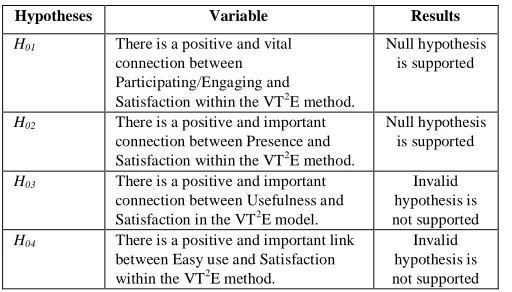
So as to review learners’ satisfaction of utilizing VT2E method as a beneficial coaching material for independent Taekwondo coaching, the discoveries of analyses of invalid hypotheses are expressed to be work out link between Participating/Engaging, Presence, Usefulness and Easy use and also Satisfaction.
Hypothesis01: There is no crucial connection within
Participating/Engaging and Satisfaction within VT2E method.
Hypothesis02: There is no important link between Presence and
Satisfaction within VT2E method.
Hypothesis03: There is no vital link between Usefulness and
Satisfaction in the VT2E method.
Hypothesis04: There is no important link between Easy use and
Satisfaction in the VT2E method.
As hypothesized in H01, there’s no important link between
Participating/Engaging and Satisfaction within the VT2E method. Supported that the results of multivariate analyzes as in Table 4, Participating doesn’t have an positive and important link with Satisfaction with Beta = 0.00, t = .045 and p = 0.96. Since the important price is 0.96 that is higher than 0.05, the null hypothesis is supported. Participating isn’t important however it’s absolutely related to Satisfaction as appeared in Table 3.
As hypothesized in H02, there is no important link between
Presence and Satisfaction in the VT2E method. Based on Table 4, Presence doesn’t have a positive and vital link with Satisfaction with Beta = 0.00, t = .040 and p = 0.97. Since the importance price is 0.97 that is bigger than 0.05, the null hypothesis is supported. Presence isn’t important however it’s absolutely correlative to Satisfaction as appeared in Table 3. As hypothesized in H03, there’s no fundamental connection
within Usefulness/utility and Satisfaction within VT2E method. Supported on Table 4, there is a positive and statistically important connection between Usefulness and Satisfaction with Beta = 0.36, t = 2.13 and p = 0.04. Since that the importance price is 0.04, the invalid theory isn’t supported. As hypothesized in H04, there’s a major connection between
Table. 5 Summary of Hypotheses Testing Results
VI. CONCLUSION
Taekwondo is one of among foremost familiar martial arts and also became the national sport since the early 1960s. It has been well received among schools, colleges, universities and public and private sectors across the country. Recognizing the importance of enhancing the participation and performance in taekwondo training, the potential is reflected in the use of VR which gives many benefits. Therefore, this study is to help in
the improvement and enhancement of the present
supplementary coaching materials through the event of the VT2E method which will helps trainees in independent taekwondo coaching. The main purpose of the user analysis of VT2E method is to check learners’ satisfaction supported on these Participating/Engaging, Presence, Usefulness and also Easy Use in utilizing VT2E model.
The results have tested that there are vital links between Easy Use and Usefulness with learners’ satisfaction in using the VT2E method as a strengthening coaching material for self-reliant taekwondo coaching. This result according to previous studies by [53], [54], [55], [56] that indicated each Usefulness and Easy Use have a major relationship with Satisfaction. However, Participating and Presence isn’t considerably associated with Satisfaction. During this regard, the outcomes consistent with the investigation by [57], [58], [59] wherever Presence failed to have a major link with learning results. Evidently, it’s relevancy with Participating/Engaging that demonstrates the abnormal state of presence can have an effect on the Participating in VE [60].
ACKNOWLEDGMENT
Our most profound inclination goes to the Universiti Utara Malaysia for supporting us by funding this analysis and in addition for various supports and facilities only if that has inspired analysis technique on this year.
REFERENCES
1. T. S.-Y. Langford, "Building A Sustainable Business Model: An Analysis of Martial Arts Organizations from a System and a System of Systems Perspective," California State University, East Bay, 2014.
2. S. S. Fong, S. S. Ng, and L. M. Chung, "Health through martial arts training: Physical fitness and reaction time in adolescent Taekwondo practitioners," 2013.
3. M. Haddad, I. Ouergui, N. Hammami, and K. Chamari, "Physical Training in Taekwondo: Generic and Specific Training," Performance Optimization in Taekwondo: From Laboratory to Field, pp. 85, 2015. 4. N. A. Sani, M. A. Hendrawan, and F. Samopa, "Development Of Basic
Taekwondo Training System Application Based On Real Time Motion Capture Using Microsoft Kinect," ISICO 2015, 2015.
5. J. C. Chan, H. Leung, J. K. Tang, and T. Komura, "A virtual reality dance training system using motion capture technology," IEEE Transactions on Learning Technologies, vol. 4, pp. 187-195, 2011.
6. J. W. Lussier and S. B. Shadrick, "Components of effective training," DTIC Document 2006.
7. T. Komura, B. Lam, R. W. Lau, and H. Leung, "e-Learning martial arts," presented at International Conference on Web-Based Learning, 2006. 8. N. Gotoda, K. Matsuura, K. Nakagawa, and C. Miyaji, "Design of tennis
training with shot-timing feedback based on trajectory prediction of ball," presented at Naka Workshop Proc. of ICCE2013, 2013.
9. J. Falah, S. Khan, T. Alfalah, S. F. Alfalah, W. Chan, D. K. Harrison, and V. Charissis, "Virtual Reality medical training system for anatomy education," presented at Science and Information Conference (SAI), 2014, 2014.
10. F. Anderson, T. Grossman, J. Matejka, and G. Fitzmaurice, "YouMove: enhancing movement training with an augmented reality mirror," presented at Proceedings of the 26th annual ACM symposium on User interface software and technology, 2013.
11.K. Witte, P. Emmermacher, N. Bandow, and S. Masik, "Usage of virtual reality technology to study reactions in karate-kumite," International Journal of Sports Science and Engineering, vol. 6, pp. 017-024, 2012. 12.S. Aukstakalnis and D. Blatner, Silicon Mirage; The Art and Science of
Virtual Reality: Peachpit Press, 1992.
13.J. Seibert, "An exploratory study on virtual reality head mounted displays and their impact on player presence.," 2014.
14.G. H. Cho, G. Hwangbo, and H. S. Shin, "The effects of virtual reality-based balance training on balance of the elderly," Journal of physical therapy science, vol. 26, pp. 615-617, 2014
15.W. Xiaoling, Z. Peng, W. Zhifang, S. Yan, L. Bin, and L. Yangchun, "Development an interactive VR training for CNC machining," presented at Proceedings of the 2004 ACM SIGGRAPH international conference on Virtual Reality continuum and its applications in industry, 2004. 16.M. F. Levin, "Can virtual reality offer enriched environments for
rehabilitation?," Expert review of neurotherapeutics, 2014.
17.J. Goulding, W. Nadim, P. Petridis, and M. Alshawi, "Construction industry offsite production: A virtual reality interactive training environment prototype," Advanced Engineering Informatics, vol. 26, pp. 103-116, 2012.
18.H. J. Yap, Z. Taha, H. K. Choo, and C. K. Kok, "Virtual Reality-based Training System for Metal Active Gas Welding," 2014.
19.E. D. Ragan, D. A. Bowman, R. Kopper, C. Stinson, S. Scerbo, and R. P. McMahan, "Effects of field of view and visual complexity on virtual reality training effectiveness for a visual scanning task," IEEE transactions on visualization and computer graphics, vol. 21, pp. 794-807, 2015.
20.D. Villani, C. Repetto, P. Cipresso, and G. Riva, "May I experience more presence in doing the same thing in virtual reality than in reality? An answer from a simulated job interview," Interacting with Computers, vol. 24, pp. 265-272, 2012.
21.B. Z. Perez, M. M. Marin, and E. I. Perez, "Developing a virtual environment for safety training," presented at Electronics, Robotics and Automotive Mechanics Conference (CERMA 2007), 2007.
22.L. Liu, G. X. Yin, K. Sha, and B. Gao, "Analysis of the Virtual System of Sports Scene Based on Virtual Reality Technology," presented at Applied Mechanics and Materials, 2014.
23.G. M. Reger, A. A. Rizzo, and G. A. Gahm, "Initial development and dissemination of virtual reality exposure therapy for combat-related PTSD," in Future Directions in Post-Traumatic Stress Disorder: Springer, 2015, pp. 289-302.
Hypotheses Variable Results
H01 There is a positive and vital
connection between Participating/Engaging and Satisfaction within the VT2E method.
Null hypothesis is supported
H02 There is a positive and important
connection between Presence and Satisfaction within the VT2E method.
Null hypothesis is supported
H03 There is a positive and important
connection between Usefulness and Satisfaction in the VT2E model.
Invalid hypothesis is not supported H04 There is a positive and important link
between Easy use and Satisfaction within the VT2E method.
24.P. Dev and W. L. Heinrichs, "Learning medicine through collaboration and action: collaborative, experiential, networked learning environments," Virtual Reality, vol. 12, pp. 215-234, 2008.
25.M. Pérez-Ramírez and N. J. Ontiveros-Hernández, "Virtual reality as a comprehensive training tool," WILE-MICAI. Guanajuato, Mexico, 2009. 26.V. S. Pantelidis, "Reasons to use virtual reality in education and training
courses and a model to determine when to use virtual reality," Themes in Science and Technology Education, vol. 2, pp. 59-70, 2010.
27.G. H. Cho, G. Hwangbo, and H. S. Shin, "The effects of virtual reality-based balance training on balance of the elderly," Journal of physical therapy science, vol. 26, pp. 615-617, 2014.
28.J. C. Yang, C. H. Chen, and M. C. Jeng, "Integrating video-capture virtual reality technology into a physically interactive learning environment for English learning," Computers & Education, vol. 55, pp. 1346-1356, 2010. 29.A. Casu, L. D. Spano, F. Sorrentino, and R. Scateni, "RiftArt: Bringing Masterpieces in the Classroom through Immersive Virtual Reality.," presented at Eurographics Italian Chapter Conference, 2015.
30.P. Xia, A. n. M. Lopes, M. T. Restivo, and Y. Yao, "A new type haptics-based virtual environment system for assembly training of complex products," The International Journal of Advanced Manufacturing Technology, vol. 58, pp. 379-396, 2012.
31.Y. Li, K. Brodlie, and N. Phillips, "Web-based VR training simulator for percutaneous rhizotomy," Studies in health technology and informatics, pp. 175-181, 2000.
32.P. T. Chua, R. Crivella, B. Daly, N. Hu, R. Schaaf, D. Ventura, T. Camill, J. Hodgins, and R. Pausch, "Training for physical tasks in virtual environments: Tai Chi," presented at Virtual Reality, 2003. Proceedings. IEEE, 2003.
33.J. Bailenson, K. Patel, A. Nielsen, R. Bajscy, S.-H. Jung, and G. Kurillo, "The effect of interactivity on learning physical actions in virtual reality," Media Psychology, vol. 11, pp. 354-376, 2008.
34.B. Bideau, R. Kulpa, N. Vignais, S. b. Brault, F. Multon, and C. Craig, "Using virtual reality to analyze sports performance," IEEE Computer Graphics and Applications, vol. 30, pp. 14-21, 2010.
35.J. C. Chan, H. Leung, J. K. Tang, and T. Komura, "A virtual reality dance training system using motion capture technology," IEEE Transactions on Learning Technologies, vol. 4, pp. 187-195, 2011.
36.K. Hachimura, H. Kato, and H. Tamura, "A prototype dance training support system with motion capture and mixed reality technologies," presented at Robot and Human Interactive Communication, 2004. ROMAN 2004. 13th IEEE International Workshop on, 2004.
37.T. S. Mujber, T. Szecsi, and M. S. Hashmi, "Virtual reality applications in manufacturing process simulation," Journal of materials processing technology, vol. 155, pp. 1834-1838, 2004.
38.B.-g. Oh and S.-h. Lee, "Impact of Factors Related to Taekwondo Participants' Exercise Experience on Their Satisfaction with Acceptance of WOM Information, and Spread by WOM," Indian Journal of Science and Technology, vol. 8, pp. 46, 2015.
39.M. P. Arnone, R. V. Small, S. A. Chauncey, and H. P. McKenna, "Curiosity, interest and engagement in technology-pervasive learning environments: a new research agenda," Educational Technology Research and Development, vol. 59, pp. 181-198, 2011.
40.A. Bierbaum, C. Just, P. Hartling, K. Meinert, A. Baker, and C. Cruz-Neira, "VR Juggler: A virtual platform for virtual reality application development," presented at Virtual Reality, 2001. Proceedings. IEEE, 2001.
41.B. G. Witmer and M. J. Singer, "Measuring presence in virtual environments: A presence questionnaire," Presence: Teleoperators and virtual environments, vol. 7, pp. 225-240, 1998.
42.D. A. Bowman and R. P. McMahan, "Virtual reality: how much immersion is enough?," Computer, vol. 40, 2007.
43.F. D. Davis, "Perceived usefulness, perceived ease of use, and user acceptance of information technology," MIS quarterly, pp. 319-340, 1989 44.C. Lee, C. Chai, T. Teo, and D. Chen, "Preparing pre-service teachers’ for
the integration of ICT based studentcentred learning (SCL) curriculum," Journal of Education, vol. 13, pp. 15-28, 2008.
45.J. Webster, L. K. Trevino, and L. Ryan, "The dimensionality and correlates of flow in human-computer interactions," Computers in human behavior, vol. 9, pp. 411-426, 1993.
46.F. D. Davis, "User acceptance of information technology: system characteristics, user perceptions and behavioral impacts," 1993.
47.S. W. Chou and C. H. Liu, "Learning effectiveness in a Web-based virtual learning environment: a learner control perspective," Journal of computer assisted learning, vol. 21, pp. 65-76, 2005.
48.[48] E. M. Van Raaij and J. J. Schepers, "The acceptance and use of a virtual learning environment in China," Computers & Education, vol. 50, pp. 838-852, 2008.
49.H. Taherdoost, S. Sahibuddin, and N. Jalaliyoon, "Smart card security; Technology and adoption," International Journal of Security, vol. 5, pp. 74-84, 2011.
50.J. Pallant, SPSS survival manual: McGraw-Hill Education (UK), 2013. 51.N. R. Draper and H. Smith, Applied regression analysis: John Wiley &
Sons, 2014.
52.B. H. Cohen, Explaining psychological statistics: John Wiley & Sons, 2008.
53.J. Blackledge and M. Barrett, "Evaluation of a prototype desktop virtual reality model developed to enhance electrical safety and design in the built environment," 2012.
54.P.-C. Sun, R. J. Tsai, G. Finger, Y.-Y. Chen, and D. Yeh, "What drives a successful e-Learning? An empirical investigation of the critical factors influencing learner satisfaction," Computers & education, vol. 50, pp. 1183-1202, 2008.
55.E. A.-L. Lee, K. W. Wong, and C. C. Fung, "How does desktop virtual reality enhance learning outcomes? A structural equation modeling approach," Computers & Education, vol. 55, pp. 1424-1442, 2010. 56.J. B. Arbaugh, "Virtual classroom characteristics and student satisfaction
with internet-based MBA courses," Journal of management education, vol. 24, pp. 32-54, 2000.
57.Z. Merchant, E. T. Goetz, W. Keeney-Kennicutt, O.-m. Kwok, L. Cifuentes, and T. J. Davis, "The learner characteristics, features of desktop 3D virtual reality environments, and college chemistry instruction: A structural equation modeling analysis," Computers & Education, vol. 59, pp. 551-568, 2012.
58.K. Mania and A. Chalmers, "The effects of levels of immersion on memory and presence in virtual environments: A reality centered approach," CyberPsychology & Behavior, vol. 4, pp. 247-264, 2001 59.R. Moreno and R. E. Mayer, "Learning science in virtual reality
multimedia environments: Role of methods and media.," Journal of educational psychology, vol. 94, pp. 598, 2002.