R E S E A R C H A R T I C L E
Open Access
How do case managers spend time on
their functions and activities?
Emily (Chuanmei) You
1,2*, David Dunt
2and Colleen Doyle
3,4*Abstract
Background:Case management has been a widely accepted approach to practice in various care settings. This study aimed to explore how community aged care case managers allocated their time to case management functions, how frequently they performed specific case management activities, and what factors influenced the frequency of their activities.
Methods:The study involved 154 survey participants, or 17.1 % of the target case managers in the State of Victoria, Australia. Key information collected included participants’socio-demographic characteristics, proportions of time allocated to six core case management functions, and frequency ratings of 41 specific activities within seven case management functions. Ordinal regression analyses were performed to determine significant factors associated with participants’frequency ratings of their activities.
Results:Participants allocated the largest proportion of time to care coordination (22.0 %), and the smallest proportion of time to outcome evaluation (8.0 %). Over 70 % of the participants assigned high frequency ratings to 31 of the 41 case management activities. The remaining ten activities, including all four outcome evaluation activities, three needs assessment activities, one care planning activity, one care coordination activity, and one general functions-related activity were less commonly performed very frequently. The regression analyses indicated that some case manager and client factors were significantly associated with frequency ratings of nine of the ten activities aforementioned. The two main findings of the regression analyses were: First, emphasising achieving more case management goals was significantly associated with higher frequency of three outcome evaluation activities; second, longer work experience was significantly associated with higher frequency of one care coordination activity and one outcome evaluation activity.
Conclusions:The frequent performance of most case management activities and relative absence of factors influencing their frequency suggest a uniformity of practice in community aged care case managers’practice. What is not clear is whether the frequency of these activities (in particular less frequent performance of outcome
evaluation activities) conforms to expectations.
Keywords:Activities, Case management, Community aged care, Functions, Influencing factors
Background
Case management has been a widely accepted approach to practice in community care settings, such as primary health care, community mental health, and community aged care [1]. In Australia, there have been three publicly
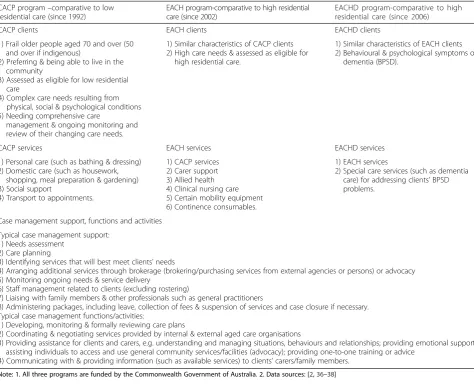
funded community aged care case management programs/ packages (Community Aged Care Package—CACP, Ex-tended Aged Care at Home—EACH and Extended Aged Care at home Dementia—EACHD) that provide different levels of services to community-dwelling frail older Aus-tralians. Case managers manage services for a number of CACP, EACH and/or EACHD clients to ensure that they access case management support and case-managed care services (one client uses one care package) [2] (see Table 1). The literature has consistently agreed that primary case management functions include needs assessment, * Correspondence:[email protected];[email protected]
1
Institute for Health and Ageing; School of Nursing Midwifery & Paramedicine, Australian Catholic University (in partnership with Villa Maria Catholic Homes), Victoria, Australia
3School of Nursing Midwifery & Paramedicine, Australian Catholic University (in partnership with Villa Maria Catholic Homes), Victoria, Australia Full list of author information is available at the end of the article
care planning, implementation, coordination, and moni-toring and review [3, 4]. It is difficult, however, to reach consensus on specific case management activities within these functions across care settings and health systems of different countries. Some U.S. studies have investigated different numbers and types of case management activities in various community care settings, or in one particular care setting, such as community mental health and com-munity nursing [5–9]. In addition, a British study has investigated eight case management elements adopted by practice nurses working in the community [10].
Some studies have indicated that outcome evaluation is also an important case management function [11–13], but there are debates on whether it is an independent function or it overlaps or is part of the monitoring and review function in individual case managers’ practice [13]. While some empirical studies (examining frequency ratings of different case management activities) have re-ported that in their practice case managers perform out-come evaluation activities less frequently than the other
case management activities [5, 8, 9], some empirical [13] and commentary studies [12, 14] have revealed that case managers do not perform outcome evaluation adequately because they lack time, knowledge of goals/outcomes and goal setting, capacities, and organisational support.
There has been a paucity of studies based in commu-nity aged care that focus on how case managers allocate time to the primary case management functions, or how frequently they undertake those functions and specific case management activities. Some studies have reported that case managers spend considerable time on care coordination as well as more time on initial assessment compared with monitoring and review [14–16]. However, these studies examined different case management function domains (such as direct care, indirect case management, and program management), and/or were based in other care settings but not specifically in community aged care.
[image:2.595.59.534.98.486.2]In light of the case management approach being employed in various care settings and case management in community aged care having different features in terms of Table 1Case-managed community aged care programs/packages in Australia
CACP program–comparative to low residential care (since 1992)
EACH program-comparative to high residential care (since 2002)
EACHD program-comparative to high residential care (since 2006)
CACP clients EACH clients EACHD clients
1) Frail older people aged 70 and over (50 and over if indigenous)
2) Preferring & being able to live in the community
3) Assessed as eligible for low residential care
4) Complex care needs resulting from physical, social & psychological conditions 5) Needing comprehensive care
management & ongoing monitoring and review of their changing care needs.
1) Similar characteristics of CACP clients 2) High care needs & assessed as eligible for
high residential care.
1) Similar characteristics of EACH clients 2) Behavioural & psychological symptoms of
dementia (BPSD).
CACP services EACH services EACHD services
1) Personal care (such as bathing & dressing) 2) Domestic care (such as housework,
shopping, meal preparation & gardening) 3) Social support
4) Transport to appointments.
1) CACP services 2) Carer support 3) Allied health 4) Clinical nursing care 5) Certain mobility equipment 6) Continence consumables.
1) EACH services
2) Special care services (such as dementia care) for addressing clients’BPSD problems.
Case management support, functions and activities
Typical case management support: 1) Needs assessment
2) Care planning
3) Identifying services that will best meet clients’needs
4) Arranging additional services through brokerage (brokering/purchasing services from external agencies or persons) or advocacy 5) Monitoring ongoing needs & service delivery
6) Staff management related to clients (excluding rostering)
7) Liaising with family members & other professionals such as general practitioners
8) Administering packages, including leave, collection of fees & suspension of services and case closure if necessary. Typical case management functions/activities:
1) Developing, monitoring & formally reviewing care plans
2) Coordinating & negotiating services provided by internal & external aged care organisations
3) Providing assistance for clients and carers, e.g. understanding and managing situations, behaviours and relationships; providing emotional support; assisting individuals to access and use general community services/facilities (advocacy); providing one-to-one training or advice
specific target populations, interventions, and approaches to delivering services, how community aged care case man-agers distribute their time across different functions and activities is of considerable interest [17]. In addition, given the complexity and busy nature of the case management profession, it is of paramount importance for case man-agers to make the best use of their time in those functions and activities they value. This may improve their work effi-ciency and the outcome of care [14, 18].
There has been even less research exploring factors that affect case management functions and activities. Some research and review studies have reported that client factors (such as some socio-demographic charac-teristics and health condition), case manager factors (such as professional backgrounds and length of employ-ment), organisational factors (such as financial restrictions and other organisational policies), and system factors (such as available system resources) influence case man-agers’performance of specific functions and activities [3, 19–22], or the overall case management practice [13]. Such great variability in the factors that influence case managers’practice indicates the necessity to examine sig-nificant factors associated with case managers’ functions and/or activities by empirical research.
This study aimed to investigate Australian community aged care case managers’functions and activities, and sig-nificant factors associated with their activities. The research questions included: How do case managers allocate time to case management functions? How frequently do case man-agers undertake specific case management activities? What are the significant factors associated with case managers’ frequency of performance of their activities? Is outcome evaluation performed frequently by case managers?
We hypothesised that individual characteristics (such as age, gender, caseloads, professional backgrounds etc.), clients’characteristics (such as percentages of clients liv-ing with dementia, livliv-ing alone etc.) and organisational factors (including size and attributes) would be signifi-cantly associated with case managers’ frequency of per-formance of their activities.
Methods
This study was part of a larger project (case manage-ment practice, goals and outcomes in community aged care: perspectives of case managers in Australia) imple-mented between November 2010 and April 2014 [13]. The quantitative research presented here involved a sur-vey of case managers working for community aged care organisations in Victoria Australia.
Conducted between September 2012 and February 2013, the survey collected information on participants’ characteristics, proportions of their time allocated to case management functions, and their frequency ratings (never, seldom, occasionally, often, and very often) of 41
activities within seven case management functions, includ-ing needs assessment (ten activities), care planninclud-ing (eight activities), care plan implementation (three activities), care coordination (six activities), monitoring and review (five activities), outcome evaluation (four activities), and gen-eral functions (five activities).
Study setting and population
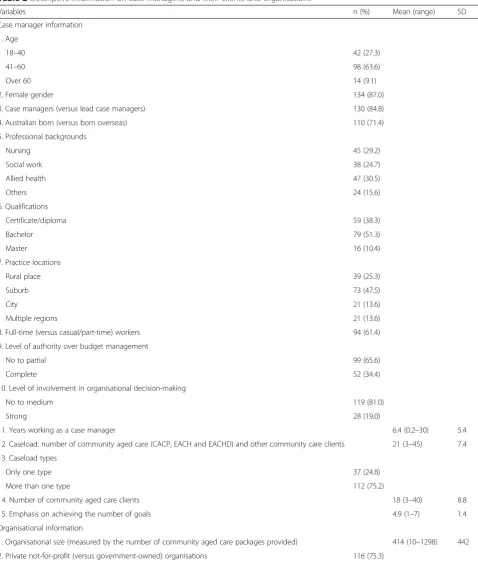
Eligible participants for the survey were case managers who managed a number of CACP, EACH, and/or EACHD clients in Victoria. Because there was no official data about the case management workforce at the na-tional and state levels, we calculated the study popula-tion in Victoria by using the total number of community aged care clients (13,468 in June 2011) and the ratio of clients to case managers (15:1) [23]. Therefore, the esti-mated study population at this period of time was 898 (13468/15). However, we may have overestimated this number because we found that case managers on aver-age manaver-aged 21 clients (see Table 2).
Survey recruitment and the study sample
To invite all 898 case managers to participate, we con-tacted all 110 community aged care organisations in Victoria via email, phone, mail and fax. We also made presentations in some organisations to invite participa-tion. Ultimately, 154 case managers (17.1 %) from 55 or-ganisations (50 %) participated.
Development of the survey questionnaire
The development of the survey questionnaire was informed by a comprehensive literature review (journal articles, government and professional bodies’guidelines, and available job descriptions of case managers in some organisations [2, 4, 5, 24–26]), discussions among the authors, consultations with the Melbourne School of Population and Global Health Human Ethics Advisory Group, and a pilot survey (prior to the formal survey) with five experienced case managers.
Measures of this study
Dependent variables
Dependent variables were frequency ratings of 41 case management activities.
Independent variables
Based on the literature review [3,8,19–21] and available information, independent variables included in ordinal logistic regression analyses were:
Organisational factors: attributes and size. Case manager factors: age, gender, job titles, birthplaces, practice locations, years working as a case manager, professional backgrounds,
Table 2Descriptive information on case managers, and their clients and organisations
Variables n (%) Mean (range) SD
Case manager information
1. Age
18–40 42 (27.3)
41–60 98 (63.6)
Over 60 14 (9.1)
2. Female gender 134 (87.0)
3. Case managers (versus lead case managers) 130 (84.8)
4. Australian born (versus born overseas) 110 (71.4)
5. Professional backgrounds
Nursing 45 (29.2)
Social work 38 (24.7)
Allied health 47 (30.5)
Others 24 (15.6)
6. Qualifications
Certificate/diploma 59 (38.3)
Bachelor 79 (51.3)
Master 16 (10.4)
7. Practice locations
Rural place 39 (25.3)
Suburb 73 (47.5)
City 21 (13.6)
Multiple regions 21 (13.6)
8. Full-time (versus casual/part-time) workers 94 (61.4)
9. Level of authority over budget management
No to partial 99 (65.6)
Complete 52 (34.4)
10. Level of involvement in organisational decision-making
No to medium 119 (81.0)
Strong 28 (19.0)
11. Years working as a case manager 6.4 (0.2–30) 5.4
12. Caseload: number of community aged care (CACP, EACH and EACHD) and other community care clients 21 (3–45) 7.4 13. Caseload types
Only one type 37 (24.8)
More than one type 112 (75.2)
14. Number of community aged care clients 18 (3–40) 8.8
15. Emphasis on achieving the number of goals 4.9 (1–7) 1.4
Organisational information
authority over budget management, level of involvement in organisational decision-making, caseload managed (number of community aged care and other community care clients), number of community aged care clients managed, caseload types (one vs. more than one type), and emphasis on achieving the number of case management goals. Client factors: born in Australia, living with dementia, living alone, having carers, having high care needs, and level of involvement in case management processes.
Data analysis
In the larger project, the following formula was used to calculate the adequate sample size:n= N × Z2× r × (1-r)/ ((N-1) × E2+ Z2× r × (1-r)) [27]. “n” is the estimated minimum sample size; “N” is the estimated population size 898 (see above); “r” is the response rate (50 %) of our interest;“Z”is the critical value (1.96) for the confi-dence level (95 %);“E”is the margin of error. While re-searchers normally use a margin of error of 5 % (hence n= 269), we used 8 % (hencen= 129). This might reduce the reliability of the survey results; however, 8 % falls be-tween the acceptable levels of margin of error (4–8 %) [28]. In addition, it was more practical for us to recruit a smaller number of participants.
Descriptive statistics, F tests, and ordinal logistic regression analyses were conducted using PASW 19.0. Since case management practice is multifaceted and at-tracts professionals from a wide range of professional backgrounds such as nursing and social work [29], we hypothesised that professional backgrounds might be associated with case managers’ performance of their activities. Therefore, we analysed participants’frequency ratings of 41 activities by profession.
To determine significant factors (significance level set at 0.05) associated with frequency ratings of each activity, we conducted two steps of regression analyses. First, we performed univariate regression analyses to
identify potential significant factors (significance level set at 0.1) associated with frequency ratings of each ac-tivity. Next, we performed multivariate regression ana-lyses (only examining those potential significant factors) to identify the final significant factors associated with frequency ratings of each activity. Eventually, we identi-fied significant factors for nine activities. We reported 95 % confidence intervals and proportional odds ratios for the significant results.
The project was approved by the Melbourne School of Population and Global Health Human Ethics Advisory Group, The University of Melbourne (approval number 1237778).
Results
On average, organisations involved in the survey provided 414 community aged care packages (range: 10–1298; SD = 442). Most (75.3 %) were private not-for-profit orga-nisations. Case managers were generally middle-aged females from a range of professional backgrounds, and the majority of them (75.2 %) managed mixed types of clients (see Table 2).
Proportions of time allocated to different case management functions
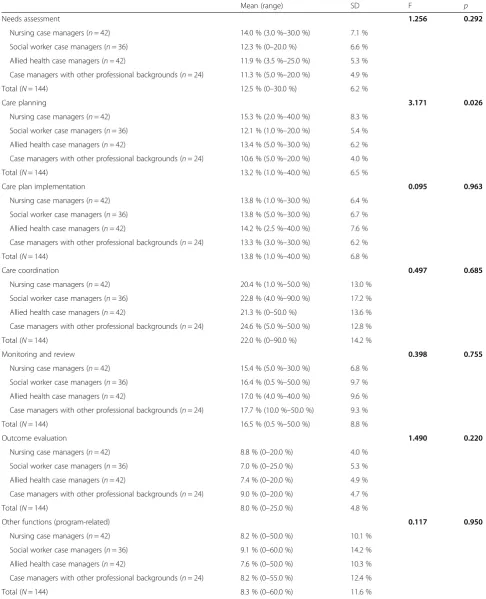
Participants on average allocated 22 % of time to care coordination and 16.5 % to monitoring and review per month (see Table 3). They allocated about 13 % of time to care plan implementation, care planning, and needs assessment respectively. By contrast, they allocated only 8 % of time to outcome evaluation and other program-related functions respectively.
[image:5.595.56.540.100.246.2]Table 3 also shows that professional backgrounds were not significantly associated with case managers allocat-ing their time to most functions except care plannallocat-ing. For the latter, nursing case managers on average allocated significantly a higher proportion of their time (F= 3.17;p= 0.026).
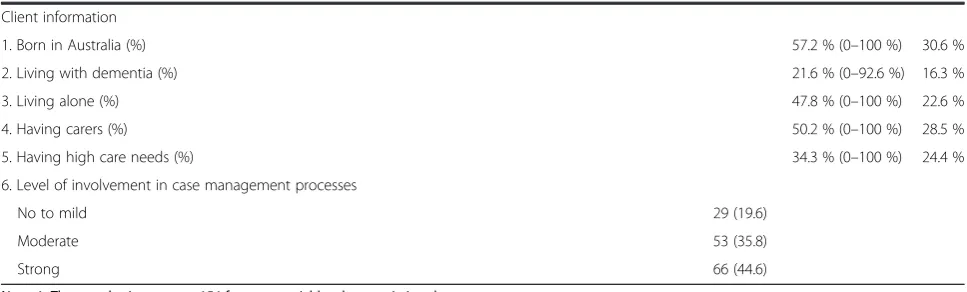
Table 2Descriptive information on case managers, and their clients and organisations(Continued)
Client information
1. Born in Australia (%) 57.2 % (0–100 %) 30.6 %
2. Living with dementia (%) 21.6 % (0–92.6 %) 16.3 %
3. Living alone (%) 47.8 % (0–100 %) 22.6 %
4. Having carers (%) 50.2 % (0–100 %) 28.5 %
5. Having high care needs (%) 34.3 % (0–100 %) 24.4 %
6. Level of involvement in case management processes
No to mild 29 (19.6)
Moderate 53 (35.8)
Strong 66 (44.6)
Table 3Proportions of time allocated to case management functions per month
Mean (range) SD F p
Needs assessment 1.256 0.292
Nursing case managers (n= 42) 14.0 % (3.0 %–30.0 %) 7.1 %
Social worker case managers (n= 36) 12.3 % (0–20.0 %) 6.6 % Allied health case managers (n= 42) 11.9 % (3.5 %–25.0 %) 5.3 % Case managers with other professional backgrounds (n= 24) 11.3 % (5.0 %–20.0 %) 4.9 %
Total (N= 144) 12.5 % (0–30.0 %) 6.2 %
Care planning 3.171 0.026
Nursing case managers (n= 42) 15.3 % (2.0 %–40.0 %) 8.3 %
Social worker case managers (n= 36) 12.1 % (1.0 %–20.0 %) 5.4 % Allied health case managers (n= 42) 13.4 % (5.0 %–30.0 %) 6.2 % Case managers with other professional backgrounds (n= 24) 10.6 % (5.0 %–20.0 %) 4.0 %
Total (N= 144) 13.2 % (1.0 %–40.0 %) 6.5 %
Care plan implementation 0.095 0.963
Nursing case managers (n= 42) 13.8 % (1.0 %–30.0 %) 6.4 %
Social worker case managers (n= 36) 13.8 % (5.0 %–30.0 %) 6.7 % Allied health case managers (n= 42) 14.2 % (2.5 %–40.0 %) 7.6 % Case managers with other professional backgrounds (n= 24) 13.3 % (3.0 %–30.0 %) 6.2 %
Total (N= 144) 13.8 % (1.0 %–40.0 %) 6.8 %
Care coordination 0.497 0.685
Nursing case managers (n= 42) 20.4 % (1.0 %–50.0 %) 13.0 %
Social worker case managers (n= 36) 22.8 % (4.0 %–90.0 %) 17.2 % Allied health case managers (n= 42) 21.3 % (0–50.0 %) 13.6 % Case managers with other professional backgrounds (n= 24) 24.6 % (5.0 %–50.0 %) 12.8 %
Total (N= 144) 22.0 % (0–90.0 %) 14.2 %
Monitoring and review 0.398 0.755
Nursing case managers (n= 42) 15.4 % (5.0 %–30.0 %) 6.8 %
Social worker case managers (n= 36) 16.4 % (0.5 %–50.0 %) 9.7 % Allied health case managers (n= 42) 17.0 % (4.0 %–40.0 %) 9.6 % Case managers with other professional backgrounds (n= 24) 17.7 % (10.0 %–50.0 %) 9.3 %
Total (N= 144) 16.5 % (0.5 %–50.0 %) 8.8 %
Outcome evaluation 1.490 0.220
Nursing case managers (n= 42) 8.8 % (0–20.0 %) 4.0 %
Social worker case managers (n= 36) 7.0 % (0–25.0 %) 5.3 % Allied health case managers (n= 42) 7.4 % (0–20.0 %) 4.9 % Case managers with other professional backgrounds (n= 24) 9.0 % (0–20.0 %) 4.7 %
Total (N= 144) 8.0 % (0–25.0 %) 4.8 %
Other functions (program-related) 0.117 0.950
Nursing case managers (n= 42) 8.2 % (0–50.0 %) 10.1 %
Social worker case managers (n= 36) 9.1 % (0–60.0 %) 14.2 % Allied health case managers (n= 42) 7.6 % (0–50.0 %) 10.3 % Case managers with other professional backgrounds (n= 24) 8.2 % (0–55.0 %) 12.4 %
Frequency ratings assigned to specific activities within different functions
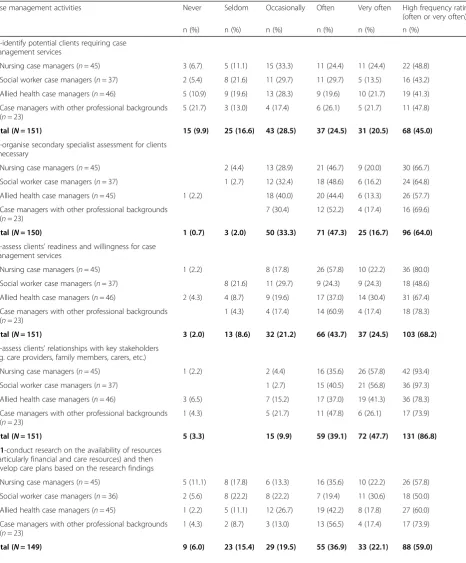
Over 70 % of participants assigned high frequency ratings (often or very often) to 31 of the 41 activities (see Additional file 1).
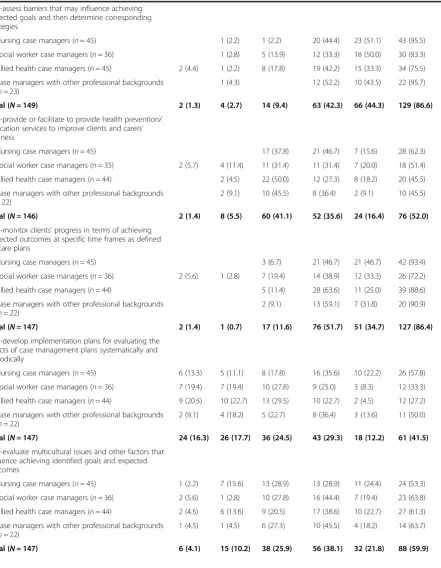
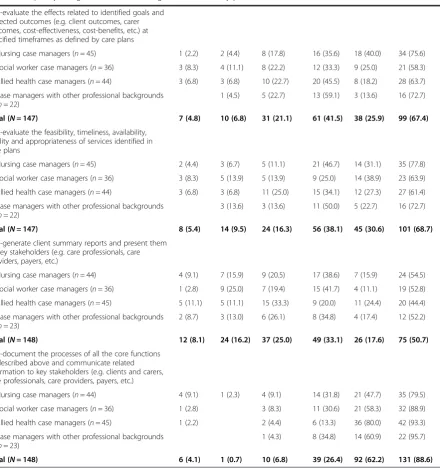
Less than 70 % of the participants assigned high frequency ratings to the remaining ten activities which are presented in Table 4. These included three needs as-sessment activities (F1, F2, and F3), one care planning activity (F11), one care coordination activity (F22), all four outcome evaluation activities (F33, F34, F35 and F36), and one general functions-related activity (F37). The three activities that were less commonly conducted very frequently were: “F1-identify potential clients for case management programs (45.0 %),” “F33-develop im-plementation plans for evaluating the effects (41.5 %),” and “F37-generate client summary reports and present them to key stakeholders (50.7 %)”.
Through presenting the data by profession, we identi-fied four key findings: First, higher proportions of nurs-ing case managers assigned high frequency ratnurs-ings to 27 activities (see Additional file 1), in particular “F3-assess client readiness and willingness”, “F22-provide or facili-tate to provide health prevention/education services”, “F33-develop implementation plans for evaluating the effects”, and“F36-evaluate service feasibility, timeliness, etc”. However, much lower proportions of nursing case managers assigned high frequency ratings to“F34-evaluate multicultural issues and other influencing factors for goal attainment” and “F38-document the processes and com-municate information to key stakeholders”. (See Table 4).
Second, lower proportions of allied health case man-agers assigned high frequency ratings to 18 activities (see Additional file 1), in particular “F3-assess client readiness and willingness”, “F13-assess barriers hinder-ing goal attainment,” and “F33-develop implementation plans for evaluating the effects”. (See Table 4).
Third, close to average proportions of social work case managers assigned high frequency ratings to most activities (see Additional file 1) except “F3-assess client readiness and willingness (far below average)”,“F29-monitor clients’ health progress (far below average)”, and “F7-assess client relationships with key stakeholders (far above average) (see Table 4).
Fourth, higher proportions of case managers with other professional backgrounds assigned high frequency ratings to 10 activities (see Additional file 1), in particu-lar“F11-conduct research on resources and then develop care plans”. (See Table 4).
Significant factors associated with frequency ratings of nine activities
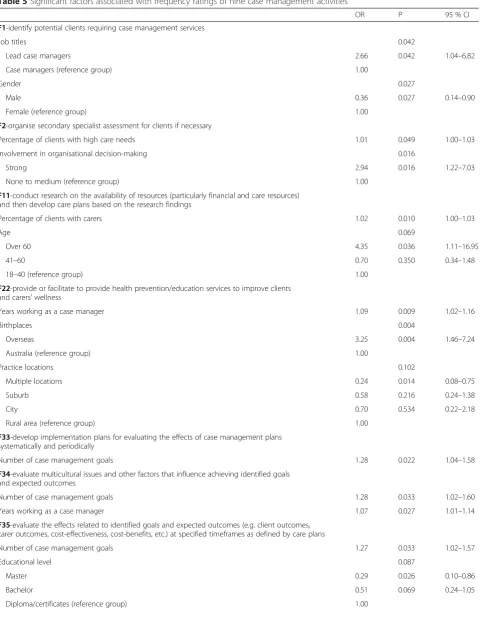
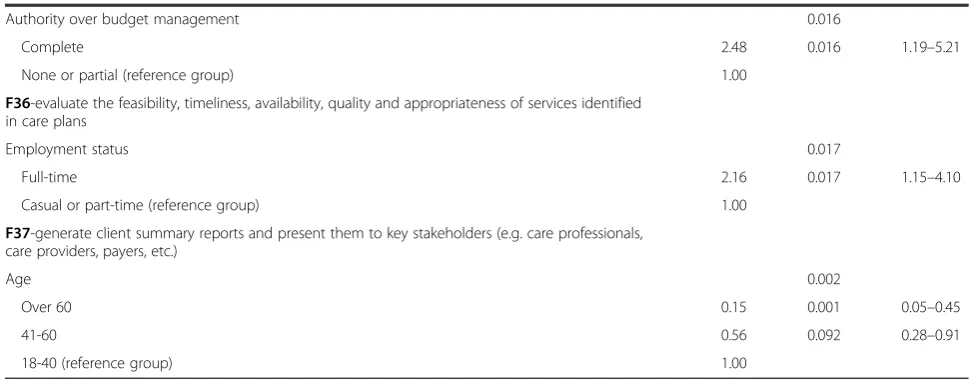
The two steps of regression analyses determined poten-tial significant factors (see Additional file 1) and final significant factors (see Table 5) associated with frequency ratings of nine activities. The significant results are sum-marised below:
Two needs assessment activities
Lead case managers (OR = 2.66) and female participants (OR = 2.78) were more likely to assign high frequency ratings to “F1-identify potential clients for case manage-ment programs.”Participants having greater percentage of clients with high care needs (OR = 1.01) and participants with stronger involvement in organisational decision-making (OR = 2.94) were more likely to assign high frequency ratings to “F2-organise secondary specialist assessment for clients”.
One care planning activity
Participants having higher percentage of clients with carers (OR = 1.02) and participants aged over 60 (OR = 4.35) were more likely to assign high frequency ratings to“F11-conduct research on resources and then develop care plans”.
One care coordination activity
Participants working longer as case managers (OR = 1.09) and participants born overseas (OR = 3.25) were more likely to assign high frequency ratings to“F22-provide or facilitate to provide health prevention/education”.
One general functions-related activity
[image:7.595.58.538.100.189.2]Participants aged over 60 (OR = 0.15) were less likely to assign high frequency ratings to “F37-generate client summary reports and present them to stakeholders”.
Table 3Proportions of time allocated to case management functions per month(Continued)
Other functions (not program-related) 0.185 0.907
Nursing case managers (n= 42) 5.0 % (0–77.0 %) 12.4 %
Social worker case managers (n= 36) 3.9 % (0–15.0 %) 4.6 % Allied health case managers (n= 42) 5.3 % (0–60.0 %) 10.4 % Case managers with other professional backgrounds (n= 24) 4.4 % (0–15.0 %) 4.7 %
Total (N= 144) 4.7 % (0–77.0 %) 9.2 %
Table 4Frequency ratings of some case management activities by profession
Case management activities Never Seldom Occasionally Often Very often High frequency rating (often or very often)
n (%) n (%) n (%) n (%) n (%) n (%)
F1-identify potential clients requiring case management services
Nursing case managers (n= 45) 3 (6.7) 5 (11.1) 15 (33.3) 11 (24.4) 11 (24.4) 22 (48.8)
Social worker case managers (n= 37) 2 (5.4) 8 (21.6) 11 (29.7) 11 (29.7) 5 (13.5) 16 (43.2)
Allied health case managers (n= 46) 5 (10.9) 9 (19.6) 13 (28.3) 9 (19.6) 10 (21.7) 19 (41.3)
Case managers with other professional backgrounds (n= 23)
5 (21.7) 3 (13.0) 4 (17.4) 6 (26.1) 5 (21.7) 11 (47.8)
Total (N= 151) 15 (9.9) 25 (16.6) 43 (28.5) 37 (24.5) 31 (20.5) 68 (45.0)
F2-organise secondary specialist assessment for clients if necessary
Nursing case managers (n= 45) 2 (4.4) 13 (28.9) 21 (46.7) 9 (20.0) 30 (66.7)
Social worker case managers (n= 37) 1 (2.7) 12 (32.4) 18 (48.6) 6 (16.2) 24 (64.8)
Allied health case managers (n= 45) 1 (2.2) 18 (40.0) 20 (44.4) 6 (13.3) 26 (57.7)
Case managers with other professional backgrounds (n= 23)
7 (30.4) 12 (52.2) 4 (17.4) 16 (69.6)
Total (N= 150) 1 (0.7) 3 (2.0) 50 (33.3) 71 (47.3) 25 (16.7) 96 (64.0)
F3-assess clients’readiness and willingness for case management services
Nursing case managers (n= 45) 1 (2.2) 8 (17.8) 26 (57.8) 10 (22.2) 36 (80.0)
Social worker case managers (n= 37) 8 (21.6) 11 (29.7) 9 (24.3) 9 (24.3) 18 (48.6)
Allied health case managers (n= 46) 2 (4.3) 4 (8.7) 9 (19.6) 17 (37.0) 14 (30.4) 31 (67.4)
Case managers with other professional backgrounds (n= 23)
1 (4.3) 4 (17.4) 14 (60.9) 4 (17.4) 18 (78.3)
Total (N= 151) 3 (2.0) 13 (8.6) 32 (21.2) 66 (43.7) 37 (24.5) 103 (68.2)
F7-assess clients’relationships with key stakeholders (e.g. care providers, family members, carers, etc.)
Nursing case managers (n= 45) 1 (2.2) 2 (4.4) 16 (35.6) 26 (57.8) 42 (93.4)
Social worker case managers (n= 37) 1 (2.7) 15 (40.5) 21 (56.8) 36 (97.3)
Allied health case managers (n= 46) 3 (6.5) 7 (15.2) 17 (37.0) 19 (41.3) 36 (78.3)
Case managers with other professional backgrounds (n= 23)
1 (4.3) 5 (21.7) 11 (47.8) 6 (26.1) 17 (73.9)
Total (N= 151) 5 (3.3) 15 (9.9) 59 (39.1) 72 (47.7) 131 (86.8)
F11-conduct research on the availability of resources (particularly financial and care resources) and then develop care plans based on the research findings
Nursing case managers (n= 45) 5 (11.1) 8 (17.8) 6 (13.3) 16 (35.6) 10 (22.2) 26 (57.8)
Social worker case managers (n= 36) 2 (5.6) 8 (22.2) 8 (22.2) 7 (19.4) 11 (30.6) 18 (50.0)
Allied health case managers (n= 45) 1 (2.2) 5 (11.1) 12 (26.7) 19 (42.2) 8 (17.8) 27 (60.0)
Case managers with other professional backgrounds (n= 23)
1 (4.3) 2 (8.7) 3 (13.0) 13 (56.5) 4 (17.4) 17 (73.9)
Table 4Frequency ratings of some case management activities by profession(Continued)
F13-assess barriers that may influence achieving expected goals and then determine corresponding strategies
Nursing case managers (n= 45) 1 (2.2) 1 (2.2) 20 (44.4) 23 (51.1) 43 (95.5)
Social worker case managers (n= 36) 1 (2.8) 5 (13.9) 12 (33.3) 18 (50.0) 30 (83.3)
Allied health case managers (n= 45) 2 (4.4) 1 (2.2) 8 (17.8) 19 (42.2) 15 (33.3) 34 (75.5)
Case managers with other professional backgrounds (n= 23)
1 (4.3) 12 (52.2) 10 (43.5) 22 (95.7)
Total (N= 149) 2 (1.3) 4 (2.7) 14 (9.4) 63 (42.3) 66 (44.3) 129 (86.6)
F22-provide or facilitate to provide health prevention/ education services to improve clients and carers’ wellness
Nursing case managers (n= 45) 17 (37.8) 21 (46.7) 7 (15.6) 28 (62.3)
Social worker case managers (n= 35) 2 (5.7) 4 (11.4) 11 (31.4) 11 (31.4) 7 (20.0) 18 (51.4)
Allied health case managers (n= 44) 2 (4.5) 22 (50.0) 12 (27.3) 8 (18.2) 20 (45.5)
Case managers with other professional backgrounds (n= 22)
2 (9.1) 10 (45.5) 8 (36.4) 2 (9.1) 10 (45.5)
Total (N= 146) 2 (1.4) 8 (5.5) 60 (41.1) 52 (35.6) 24 (16.4) 76 (52.0)
F29-monitor clients’progress in terms of achieving expected outcomes at specific time frames as defined by care plans
Nursing case managers (n= 45) 3 (6.7) 21 (46.7) 21 (46.7) 42 (93.4)
Social worker case managers (n= 36) 2 (5.6) 1 (2.8) 7 (19.4) 14 (38.9) 12 (33.3) 26 (72.2)
Allied health case managers (n= 44) 5 (11.4) 28 (63.6) 11 (25.0) 39 (88.6)
Case managers with other professional backgrounds (n= 22)
2 (9.1) 13 (59.1) 7 (31.8) 20 (90.9)
Total (N= 147) 2 (1.4) 1 (0.7) 17 (11.6) 76 (51.7) 51 (34.7) 127 (86.4)
F33-develop implementation plans for evaluating the effects of case management plans systematically and periodically
Nursing case managers (n= 45) 6 (13.3) 5 (11.1) 8 (17.8) 16 (35.6) 10 (22.2) 26 (57.8)
Social worker case managers (n= 36) 7 (19.4) 7 (19.4) 10 (27.8) 9 (25.0) 3 (8.3) 12 (33.3)
Allied health case managers (n= 44) 9 (20.5) 10 (22.7) 13 (29.5) 10 (22.7) 2 (4.5) 12 (27.2)
Case managers with other professional backgrounds (n= 22)
2 (9.1) 4 (18.2) 5 (22.7) 8 (36.4) 3 (13.6) 11 (50.0)
Total (N= 147) 24 (16.3) 26 (17.7) 36 (24.5) 43 (29.3) 18 (12.2) 61 (41.5)
F34-evaluate multicultural issues and other factors that influence achieving identified goals and expected outcomes
Nursing case managers (n= 45) 1 (2.2) 7 (15.6) 13 (28.9) 13 (28.9) 11 (24.4) 24 (53.3)
Social worker case managers (n= 36) 2 (5.6) 1 (2.8) 10 (27.8) 16 (44.4) 7 (19.4) 23 (63.8)
Allied health case managers (n= 44) 2 (4.5) 6 (13.6) 9 (20.5) 17 (38.6) 10 (22.7) 27 (61.3)
Case managers with other professional backgrounds (n= 22)
1 (4.5) 1 (4.5) 6 (27.3) 10 (45.5) 4 (18.2) 14 (63.7)
Four outcome evaluation activities
Participants focusing on achieving more case manage-ment goals (OR = 1.28) were more likely to give high frequency ratings to“F33-develop implementation plans for evaluating the effects”. Participants focusing on achieving more case management goals (OR = 1.28) and participants working longer as case managers (OR = 1.07) were more likely to assign high frequency ratings to “F34-evaluate multicultural issues and other influencing factors for goal attainment”. Participants focusing on achieving more case management goals (OR = 1.27) and participants having
complete authority to manage budgets (OR = 2.48) were more likely to assign high frequency ratings to “F35-evaluate the effects related to goals and out-comes”. Participants working full time (OR = 2.16) were more likely to assign high frequency ratings to“ F36-evalu-ate service feasibility, timeliness etc”.
Discussion
[image:10.595.69.510.96.565.2]Unsurprisingly, we found that case managers allocated the largest proportion of time to care coordination. In practice a large part of case managers’ daily activities is
Table 4Frequency ratings of some case management activities by profession(Continued)
F35-evaluate the effects related to identified goals and expected outcomes (e.g. client outcomes, carer outcomes, cost-effectiveness, cost-benefits, etc.) at specified timeframes as defined by care plans
Nursing case managers (n= 45) 1 (2.2) 2 (4.4) 8 (17.8) 16 (35.6) 18 (40.0) 34 (75.6)
Social worker case managers (n= 36) 3 (8.3) 4 (11.1) 8 (22.2) 12 (33.3) 9 (25.0) 21 (58.3)
Allied health case managers (n= 44) 3 (6.8) 3 (6.8) 10 (22.7) 20 (45.5) 8 (18.2) 28 (63.7)
Case managers with other professional backgrounds (n= 22)
1 (4.5) 5 (22.7) 13 (59.1) 3 (13.6) 16 (72.7)
Total (N= 147) 7 (4.8) 10 (6.8) 31 (21.1) 61 (41.5) 38 (25.9) 99 (67.4)
F36-evaluate the feasibility, timeliness, availability, quality and appropriateness of services identified in care plans
Nursing case managers (n= 45) 2 (4.4) 3 (6.7) 5 (11.1) 21 (46.7) 14 (31.1) 35 (77.8)
Social worker case managers (n= 36) 3 (8.3) 5 (13.9) 5 (13.9) 9 (25.0) 14 (38.9) 23 (63.9)
Allied health case managers (n= 44) 3 (6.8) 3 (6.8) 11 (25.0) 15 (34.1) 12 (27.3) 27 (61.4)
Case managers with other professional backgrounds (n= 22)
3 (13.6) 3 (13.6) 11 (50.0) 5 (22.7) 16 (72.7)
Total (N= 147) 8 (5.4) 14 (9.5) 24 (16.3) 56 (38.1) 45 (30.6) 101 (68.7)
F37-generate client summary reports and present them to key stakeholders (e.g. care professionals, care providers, payers, etc.)
Nursing case managers (n= 44) 4 (9.1) 7 (15.9) 9 (20.5) 17 (38.6) 7 (15.9) 24 (54.5)
Social worker case managers (n= 36) 1 (2.8) 9 (25.0) 7 (19.4) 15 (41.7) 4 (11.1) 19 (52.8)
Allied health case managers (n= 45) 5 (11.1) 5 (11.1) 15 (33.3) 9 (20.0) 11 (24.4) 20 (44.4)
Case managers with other professional backgrounds (n= 23)
2 (8.7) 3 (13.0) 6 (26.1) 8 (34.8) 4 (17.4) 12 (52.2)
Total (N= 148) 12 (8.1) 24 (16.2) 37 (25.0) 49 (33.1) 26 (17.6) 75 (50.7)
F38-document the processes of all the core functions as described above and communicate related information to key stakeholders (e.g. clients and carers, care professionals, care providers, payers, etc.)
Nursing case managers (n= 44) 4 (9.1) 1 (2.3) 4 (9.1) 14 (31.8) 21 (47.7) 35 (79.5)
Social worker case managers (n= 36) 1 (2.8) 3 (8.3) 11 (30.6) 21 (58.3) 32 (88.9)
Allied health case managers (n= 45) 1 (2.2) 2 (4.4) 6 (13.3) 36 (80.0) 42 (93.3)
Case managers with other professional backgrounds (n= 23)
1 (4.3) 8 (34.8) 14 (60.9) 22 (95.7)
Total (N= 148) 6 (4.1) 1 (0.7) 10 (6.8) 39 (26.4) 92 (62.2) 131 (88.6)
Table 5Significant factors associated with frequency ratings of nine case management activities
OR P 95 % CI
F1-identify potential clients requiring case management services
Job titles 0.042
Lead case managers 2.66 0.042 1.04–6.82
Case managers (reference group) 1.00
Gender 0.027
Male 0.36 0.027 0.14–0.90
Female (reference group) 1.00
F2-organise secondary specialist assessment for clients if necessary
Percentage of clients with high care needs 1.01 0.049 1.00–1.03
Involvement in organisational decision-making 0.016
Strong 2.94 0.016 1.22–7.03
None to medium (reference group) 1.00
F11-conduct research on the availability of resources (particularly financial and care resources) and then develop care plans based on the research findings
Percentage of clients with carers 1.02 0.010 1.00–1.03
Age 0.069
Over 60 4.35 0.036 1.11–16.95
41–60 0.70 0.350 0.34–1.48
18–40 (reference group) 1.00
F22-provide or facilitate to provide health prevention/education services to improve clients and carers’wellness
Years working as a case manager 1.09 0.009 1.02–1.16
Birthplaces 0.004
Overseas 3.25 0.004 1.46–7.24
Australia (reference group) 1.00
Practice locations 0.102
Multiple locations 0.24 0.014 0.08–0.75
Suburb 0.58 0.216 0.24–1.38
City 0.70 0.534 0.22–2.18
Rural area (reference group) 1.00
F33-develop implementation plans for evaluating the effects of case management plans systematically and periodically
Number of case management goals 1.28 0.022 1.04–1.58
F34-evaluate multicultural issues and other factors that influence achieving identified goals and expected outcomes
Number of case management goals 1.28 0.033 1.02–1.60
Years working as a case manager 1.07 0.027 1.01–1.14
F35-evaluate the effects related to identified goals and expected outcomes (e.g. client outcomes, carer outcomes, cost-effectiveness, cost-benefits, etc.) at specified timeframes as defined by care plans
Number of case management goals 1.27 0.033 1.02–1.57
Educational level 0.087
Master 0.29 0.026 0.10–0.86
Bachelor 0.51 0.069 0.24–1.05
to frequently communicate and negotiate with care pro-fessionals, clients and families, and significant others, so as to coordinate right services at the right time for cli-ents [16].
Contrary to the literature [10, 14, 15], we found that case managers allocated a higher proportion of time to monitoring and review (16.5 %) than needs assessment (12.5 %). In addition, the majority of case managers (over 70 %) assigned high frequency ratings to all five monitoring and review activities but not all needs assess-ment activities. Further research is needed to determine reasons for different findings identified by our study.
We found that case managers allocated the lowest pro-portion of time to outcome evaluation, and assigned lower frequency ratings to all four outcome evaluation activities compared with most other case management activities. These findings are partially consistent with those U.S. studies discussed in the Background section [5, 8, 9], though bear in mind that they focused on vari-ous care settings and examined different numbers and types of outcome evaluation activities. It is worth con-ducting new research to explore the reasons for these findings.
We found that a very low proportion of case managers assigned high frequency ratings to“identify potential cli-ents requiring case management services”. This finding might reflect the fact in the Australian context that Aged Care Assessment Teams rather than case managers as-sess a person’s eligibility for a case management program [2]. We also found that a very low proportion of case managers assigned high frequency ratings to “generate client summary reports and present them to key stake-holders”. We were unable to refer this finding to the literature. New research might explore this issue further.
Interestingly, the majority of case managers assigned high frequency ratings to 31 of the 41 case management activities, implying that there is considerable consistency in case managers’frequency performance of most activ-ities in their practice examined by this study.
It is not surprising to find that emphasising achieving more case management goals was significantly associ-ated with higher frequency ratings of three outcome evaluation activities. Researchers have argued that case managers’ activities should be outcome/goal-directed (e.g. achieving various client and organisational goals) [13, 30], and undertaking outcome evaluation activities will facilitate case managers to achieve desired goals and outcomes [13, 31].
We found that longer work experience was signifi-cantly associated with case managers’ higher frequency ratings of two activities: “provide or facilitate to provide health prevention and education services to improve cli-ents and carers’wellness”and“evaluate multicultural is-sues and other factors that influence achieving identified goals and expected outcomes”. These findings partially support previous studies, revealing that experienced case managers are more likely to adopt dementia care prac-tice (case screening, using assessment tools and under-taking interventions) [22] and are more culturally responsive (regarded as an advanced capacity) in prac-tice [32]. However, it is difficult to interpret those find-ings that some case manager factors (such as age and practice locations) and some client factors (such as hav-ing high care needs and havhav-ing carers) were only signifi-cantly associated with frequency ratings of one activity, respectively.
[image:12.595.54.539.99.290.2]Our study showed that higher proportions of case managers with a nursing background (compared with
Table 5Significant factors associated with frequency ratings of nine case management activities(Continued)
Authority over budget management 0.016
Complete 2.48 0.016 1.19–5.21
None or partial (reference group) 1.00
F36-evaluate the feasibility, timeliness, availability, quality and appropriateness of services identified in care plans
Employment status 0.017
Full-time 2.16 0.017 1.15–4.10
Casual or part-time (reference group) 1.00
F37-generate client summary reports and present them to key stakeholders (e.g. care professionals, care providers, payers, etc.)
Age 0.002
Over 60 0.15 0.001 0.05–0.45
41-60 0.56 0.092 0.28–0.91
18-40 (reference group) 1.00
social work, allied health and other professional back-grounds) assigned high frequency ratings to most activ-ities (27 in 41). Since nursing case managers have more medical knowledge and skills, and are more medically task-oriented and goal-oriented, they might be more capable of undertaking some activities (such as medical assessments and outcome evaluation) or more willing to perform some activities (such as health prevention and education) that they can make the best use of their knowledge and skills [13]. Conversely, our study found that lower proportions of allied health case managers assigned high frequency ratings to many activities (18 of 41). These indirectly support previous findings that organisations expect allied health case managers to apply their expertise in undertaking some non-typical case management activities (such as functioning assessments and psychotherapies) to contribute to their team and im-provements in clients’health [13, 15].
Limitations
The low participant response rate (17.1 %) may impact on participant representativeness of this study. Besides those strategies we used to invite participation (calls, emails, mails, fax and site visits), it is worth exploring more strategies to increase the response rate in future studies.
Because we contacted organisations to invite their case managers to participate in our study, some individuals might have participated out of organisational influence. Thus the quality of the information they provided might have been affected.
Quantitative studies emphasise reliability and validity. Constrained by resources and time, we only focused on improving the validity. These included determining the sample frame and calculating the sample size prior to the survey, endeavouring to increase the response rate, designing the questionnaire based on existing evidence and expert consultations, and piloting the questionnaire.
Lastly, we did not collect individual clients’ informa-tion or more organisainforma-tional informainforma-tion, limiting our ability to identify other client and organisational factors that might be significantly associated with case man-agers’practice.
Implications
Without existing evidence, this study sets a precedent in exploring how community aged care case managers allocated their time (measured by proportions) to different case management functions and specific case management activities (measured by frequency ratings). These findings were generated from a sample of front-line case managers’ perceptions and therefore can pro-vide practical guidance for case managers’practice.
The significant correlation of longer work experience and the possible correlation of professional backgrounds with case managers’frequency performance of their ac-tivities suggest that having a professional background may be related to reporting more frequent interventions. Further research is needed to determine the meaning of reporting more frequent interventions, and the benefits to clients of having a professional case manager.
The survey questionnaire and findings can assist organi-sations and governments to develop practice guidelines and standards for case managers working in community aged care sectors [8, 33, 34]. Moreover, the questionnaire has the potential to be converted into an assessment tool. This can be further used to measure functions and activ-ities of case managers working in commuity aged care and similar care settings [8, 34]. The survey findings can also assist organisations to design case managers’job descrip-tions. The latter will facilitate case managers to set profes-sional boundaries in the delivery of case management interventions and services, and benefit the organisations in candidate selection and staff members’orientation and ongoing development [35].
Conclusions
Both the frequent performance of most case manage-ment activities and relative absence of associated signifi-cant factors are interesting new findings adding to the literature on case management practice. These findings suggest a uniformity of practice in community aged care case managers. Whether outcome evaluation activities by nature should be performed less frequently or are underperformed by individual case managers could be the topic of further research in the area.
Additional file
Additional file 1: Table S1.Potential significant factors associated with
frequency ratings of nine case management activities.Table S2.Frequency ratings of all 41 case management activities by profession. (DOCX 59 kb)
Abbreviations
CACP:Community Aged Care Package; EACH: Extended Aged Care at Home; EACHD: Extended Aged Care at Home Dementia.
Competing interests
The authors declare that they have no competing interests.
Authors’contributions
All authors have contributed to this manuscript significantly. EY, DD and CD conceived the analysis presented here. EY drafted the manuscript. DD and CD were involved in analysing the data and revising the manuscript. All authors have read and approved the final version of the manuscript. In addition, all authors have approved the submission and agreed to be accountable for all aspects of the work.
Authors’information
for Health & Ageing) &Villa Maria Catholic Homes. Her research interests include health care, aged care, population ageing, and policy issues in health and aged care fields. DD is a Professor at the Centre for Health Policy, Melbourne School of Population and Global Health, The University of Melbourne. He is a public health specialist and medically trained epidemiologist, with expertise in health program evaluation and health service research. CD is a Professor at Australian Catholic University & Villa Maria Catholic Homes, and a Principal Research Fellow at the National Ageing Research Institute. She has expertise in aged care research and health program evaluation.
Acknowledgements
The authors wish to thank the Leading Age Services Australia (LASA), Aged and Community Services Australia (ACSA), Case Management Society of Australia (CMSA), and case managers and lead case managers of aged care organisations in Victoria Australia for their support of this research. The authors also wish to thank Dr Lucy Busija, the Senior Research Fellow Biostatistics at the Institute for Health and Ageing of Australian Catholic University, for her advice on statistical issues of this study.
Author details
1Institute for Health and Ageing; School of Nursing Midwifery & Paramedicine, Australian Catholic University (in partnership with Villa Maria Catholic Homes), Victoria, Australia.2Centre for Health Policy, Melbourne School of Population and Global Health, The University of Melbourne, Victoria, Australia.3School of Nursing Midwifery & Paramedicine, Australian Catholic University (in partnership with Villa Maria Catholic Homes), Victoria, Australia.4National Ageing Research Institute, Victoria, Australia.
Received: 3 February 2015 Accepted: 7 March 2016
References
1. Cooper BJ, Roberts DDY. National case management standards in Australia– purpose, process and potential impact. Aust Health Rev. 2006;30(1):12–6. 2. DoHA. In: D.o.H.a.A. (DOHA), editor. Community packaged care guidelines:
incorporating community aged care packages. Canberra: Department of Health and Ageing (DOHA), The Commonwealth of Australia; 2011. p. 266. 3. Fraser KD, Estabrooks C. What factors influence case Managers’resource
allocation decisions? A systematic review of the literature. Med Decis Making. 2008;28(3):394–410.
4. CMSA. National standards of practice for case management. Castle Hill: Case Management Society of Australia (CMSA); 2013.
5. Tahan HA, Downey WT, Huber DL. Case managers’roles and functions: commission for case manager certification’s 2004 research, part II. Lippincotts Case Manag. 2006;11(2):71–87.
6. Marty D, Rapp CA, Carlson L. The experts speak: the critical ingredients of strengths model case management. Psychiatr Rehabil J. 2001;24(3):214–21. 7. Abdallah LM. Evercare nurse practitioner practice activities: similarities and
differences across five sites. J Am Acad Nurse Pract. 2005;17(9):355–62. 8. Park E, Huber D, Tahan H. The evidence base for case management
practice. West J Nurs Res. 2009;31(6):693–714.
9. Tahan H, Huber D, Downey W. Case managers’roles and functions: commission for case manager certification’s 2004 research, part I. Lipincotts Case Manag. 2006;11(1):4–22.
10. Evans C, Drennan V, Roberts J. Practice nurses and older people: a case management approach to care. J Adv Nurs. 2005;51(4):343–52.
11. Moxley DP. Outcomes and alternative cultures of case management. J Aust Case Manage. 2003;5(1):3–11.
12. Treiger TM. COLLABORATE©: a universal competency-based paradigm for professional case management, part I: introduction, historical validation, and competency presentation. Prof Case Manag. 2013;18(3):122–35. quiz 136–137. 13. You EC. Case management practice, goals and outcomes in community
aged care: perspectives of case managers in Australia. In: Centre for health policy, Melbourne school of population and global health. Melbourne: The University of Melbourne; 2014.
14. Diem E, et al. Looking beyond caseload numbers for long-term home-care case managers. Care Manag J. 2001;3(1):2–7.
15. Jacobs S, et al. Care managers’time use: differences between community mental health and older people’s services in the United Kingdom. Care Manag J. 2006;7(4):169–78.
16. Kane RL, et al. How EverCare nurse practitioners spend their time. J Am Geriatr Soc. 2001;49(11):1530–4.
17. You EC, Dunt D, Doyle C. Case managed community aged care: what is the evidence for effects on service use and costs? J Aging Health. 2013;25(7):1204–42. 18. Almes SM, et al. On-the-job training won’t cut it any more, experts say.
Hosp Case Manag. 2013;21(7):89–91.
19. Corazzini K. How state-funded home care programs respond to changes in medicare home health care: resource allocation decisions on the front line. Health Serv Res. 2003;38(5):1263–81.
20. Fraser K, et al. Factors that influence case managers’resource allocation decisions in pediatric home care: an ethnographic study. Int J Nurs Stud. 2009;46(3):337–49.
21. Parry Jones B, Soulsby J. Needs-led assessment: the challenges and the reality. Health Soc Care Community. 2001;9(6):414–28.
22. Shyu Y-I, et al. Factors associated with dementia care practices among community health nurses: results of a postal survey. Int J Nurs Stud. 2013;50(9):1219–28.
23. DoHA. 2010–2011: report on the operation of the Aged Care Act 1997. Canberra: Department of Health and Ageing, The Commonwealth of Australia; 2011.
24. Tahan H, Huber D. The CCMC’s national study of case manager job descriptions: an understanding of the activities, role relationships, knowledges, skills, and abilities. Lipincotts Case Management. 2006;11(3):127–44.
25. Case Management Society of America. Standards of practice for case management. Arkansas: Case Management Society of America; 2010. 26. CMSUK. CMSUK standards&best practice guidelines. Sutton: Case
Management Society UK (CMSUK); 2009.
27. Raosoft Inc. Sample size calculator. 2004 [cited 2015 24 November]; Available from: http://www.raosoft.com/samplesize.html. Accessed 24 Nov 2015.
28. DataStar. What every researcher should know about statistical significance. Waltham: DataStar, Inc; 2008.
29. Henning S, Cohen E. The competency continuum: expanding the case manager’s skill sets and capabilities. Prof Case Manag. 2008;13(3):127–48. 30. King IM. King’s theory of goal attainment in practice. Nurs Sci Q. 1997;10(4):180. 31. Moss MT. Practical implementation of outcomes oriented case
management. Semin Perioper Nurs. 1994;3(1):40–5.
32. Werkmeister Rozas L, Klein W. Cultural responsiveness in long-term care case management: moving beyond competence. Care Manag J. 2009;10(1):2–7. 33. Aliotta SL, et al. The impact of CMSA’s case management adherence
guidelines and guidelines training on case manager-reported behavior change. Prof Case Manag. 2007;12(5):288–95.
34. Tahan H. CCMC’s research uncovers latest trends in case management practice. Lipincotts Case Manag. 2006;11(2):65–6.
35. Tonges MC. Job design for nurse case managers. Intended and unintended effects on satisfaction and well-being. Nurs Case Manag. 1998;3(1):11–23. quiz 24.
36. AIHW. Aged care packages in the community 2009-10: A statistical overview. Canberra: Australian Institute of Health and Welfare (AIHW); 2011 [cited 2016 10th, March]; Available from: http://www.aihw.gov.au/WorkArea/ DownloadAsset.aspx?id=10737419858. Accessed 10 March 2016.
37. DoHA. In: DOHA, editor. EACH dementia specified care and services. Canberra: Department of Health and Ageing, Commonwealth of Australia; 2005.
38. DoHA. In: DOHA, editor. Specified care and services for Extended Aged Care at Home (EACH). Canberra: Department of Health and Ageing, the Commonwealth of Australia; 2005.