Theses Thesis/Dissertation Collections
11-4-2010
Feasibility study of a novel method for real-time
aerodynamic coefficient estimation
Phillip Gurbacki
Follow this and additional works at:http://scholarworks.rit.edu/theses
This Thesis is brought to you for free and open access by the Thesis/Dissertation Collections at RIT Scholar Works. It has been accepted for inclusion in Theses by an authorized administrator of RIT Scholar Works. For more information, please [email protected].
Recommended Citation
Real-Time Aerodynamic Coefficient Estimation
by
Phillip M. Gurbacki
Thesis submitted to the Faculty of the Department of Mechanical Engineering in
the Kate Gleason College of Engineering at Rochester Institute of Technology
in partial fulfillment of the requirements for the degree of
Master of Science
in
Mechanical Engineering
Approved by:
Dr. Agamemnon Crassidis -Thesis Advisor
Department of Mechanical Engineering
Dr. Tuhin Das
Department of Mechanical Engineering
Dr. Jason Kolodziej
Department of Mechanical Engineering
Dr. Edward Hensel
Department Head of Mechanical Engineering
Rochester, New York November 4, 2010
Keywords: Real-Time Estimation, Parameter Estimation, Sliding Observer,
Lyapunov Estimation, Nonlinear System Identification, Sliding Mode Control
Feasibility Study of a novel method for
Real-Time Aerodynamic Coefficient Estimation
I, Phillip M. Gurbacki, hereby grant permission to the Wallace Memorial Library of
Rochester Institute of Technology to reproduce my thesis in the whole or part. Any reproduction will not be for commercial use or profit.
Date: Signature:
I would like to thank all of the faculty and staff members in the Mechanical Engineering
department at the Rochester Institute of Technology for providing me with an exceptional
educational experience. Specifically, I would like to thank Dr. Agamemnon Crassidis for not
only for being my thesis advisor, but for his continued support throughout my career at RIT.
Without his guidance and patience, this work and my success would not have been possible. I
would also like to acknowledge both Impact Technologies, LLC and Moog, Inc whose guidance
and funding have allowed me to complete the classes and research required for graduation.
Finally, I would like to thank my family members and friends for their continued support and
encouragement in all stages of my life.
Tommy: “You know, a lot of people go to college for seven years.”
Richard: “I know. They’re called doctors.”
Tommy Boy. Dir. Peter Segal. Paramount Pictures, 1995.
In this work, a feasibility study of a novel technique for the real-time identification of
uncertain nonlinear aircraft aerodynamic coefficients has been conducted. The major objective of this paper is to investigate the feasability of a system for parameter iden-tification in a real-time flight environment. This system should be able to calculate
aerodynamic coefficients and derivative information using typical pilot inputs while en-suring robust, stable, and rapid convergence. The parameter estimator investigated is
based upon the nonlinear sliding mode control schema; one of the main advantages of the sliding mode estimator is the ability to guarantee a stable and robust convergence. Stable convergence is ensured by choosing a sliding surface and function that satisfies the
Lyapunov stability criteria. After a proper sliding surface has been chosen, the nonlinear equations of motion for an F-16 aircraft are substituted into the sliding surface yielding an estimator capable of identifying a single aircraft parameter. Multiple sliding surfaces
are then developed for each of the different flight parameters that will be identified. Sliding surfaces and parameter estimators have been developed and simulated for the pitching moment, lift force, and drag force coefficients of the F-16 aircraft. Comparing
the estimated coefficients with the reference coefficients shows rapid and stable conver-gence for a variety of pilot inputs. Starting with simple doublet and sin wave commands, and followed by more complicated continuous pilot inputs, estimated aerodynamic
coef-ficients have been shown to match the actual coefcoef-ficients with a high degree of accuracy. This estimator is also shown to be superior to model reference or adaptive estimators, it is able to handle positive and negative estimated parameters and control inputs along
with guaranteeing Lyapunov stability during convergence. Accurately estimating these aerodynamic parameters in real-time during a flight is essential for advanced control systems that require the estimated parameters as inputs.
Acknowledgements iii
Abstract iv
Contents v
List of Figures viii
List of Tables xii
Nomenclature xiii
1 Introduction 1
1.1 Intelligent Flight Control System . . . 1
1.2 Parameter Estimation . . . 3
1.3 Fault Tolerant and Adaptive Control . . . 4
1.4 Overview and Motivation for Present Work . . . 5
2 System Model Definition 7 2.1 Proof of Concept . . . 7
2.1.1 First Order Model . . . 7
2.1.2 First Order Nonlinear Model . . . 8
2.1.3 Second Order Model . . . 8
2.1.4 Second Order Nonlinear Model . . . 8
2.2 Aircraft Model . . . 9
2.2.1 Nonlinear Model . . . 9
Rigid Body Equations . . . 9
Euler Kinematic Equations . . . 12
Stability Axis Coordinate System . . . 14
Stability Derivative Equations . . . 15
2.2.2 Aircraft Trim Conditions . . . 17
2.2.3 F-16 Trim Specifications . . . 17
2.2.4 NASA Dryden Wind Gust Model . . . 18
3 Real-Time Parameter Identification 19 3.1 Model Reference Adaptive Control . . . 19
3.1.1 Aircraft MRAC PID Derivation . . . 20
3.2 Sliding Mode Controller . . . 21
3.2.1 Sliding Mode Control . . . 21
3.2.2 Sliding Mode Parameter Estimation . . . 22
3.2.3 Lyapunov Theorem for Global Stability . . . 25
3.3 Proof of Concept Parameter Identification Development . . . 26
3.3.1 First Order Model Implementation . . . 26
3.3.2 First Order Nonlinear Model Implementation . . . 28
3.3.3 Second Order Model Implementation . . . 31
3.3.4 Second Order Nonlinear Model Implementation . . . 33
3.3.5 Summary of Equations . . . 35
First Order Model Equation Summary . . . 36
First Order Nonlinear Model Equation Summary . . . 36
Second Order Model Equation Summary . . . 36
Second Order Nonlinear Model Equation Summary . . . 37
3.4 Aircraft Parameter Identification Development . . . 38
3.4.1 Longitudinal Parameters . . . 38
Cm PID Development . . . 39
CLPID Development . . . 43
CD PID Development . . . 49
3.4.2 Equation Summary . . . 51
Cm Equation Summary . . . 51
CLEquation Summary . . . 52
CD Equation Summary . . . 53
4.1.1 First Order Model Results . . . 55
4.1.2 First Order Nonlinear Model Results . . . 60
4.1.3 Second Order Model Results . . . 65
4.1.4 Second Order Nonlinear Model Results . . . 71
4.1.5 Second Order Nonlinear Sensor Noise Analysis . . . 76
4.2 Aircraft Model Results . . . 83
4.2.1 Longitudinal PID . . . 83
Cm . . . 83
∆ ˆCmα Results . . . 84
∆ ˆCmq Results . . . 93
CL . . . 100
∆ ˆCLα Results . . . 100
CD . . . 107
∆ ˆCDα Results . . . 107
Longitudinal Results Summary . . . 112
4.2.2 Comparison with Model Reference Estimator . . . 116
Scenario 1, ∆ ˆCmq =.01 . . . 116
Scenario 2, ∆ ˆCmq =−.01 . . . 118
5 Conclusion & Future Work 119 5.1 Conclusion . . . 119
5.2 Future Work . . . 120
Bibliography 121
1.1 Schematic of the Real-Time PID Role for IFCS Research [1] . . . 2
2.1 Illustration of Stability Axis and Aircraft Body Axis [17] . . . 14
2.2 Plot of Wind-Gust Along xb Axis Over Time . . . 18
3.1 Model Reference Adaptive Control Overview . . . 19
3.2 Parameter Estimation Overview . . . 23
4.1 First Order Results Case 1, State Tracking and Parameter Convergence . . . 56
4.2 First Order Results Case 2, State Tracking and Parameter Convergence . . . 57
4.3 First Order Results Case 3, State Tracking and Parameter Convergence . . . 58
4.4 First Order Results Case 4, State Tracking and Parameter Convergence . . . 59
4.5 First Order Results Case 5, State Tracking and Parameter Convergence . . . 60
4.6 First Order Nonlinear Results Case 1, State Tracking and Parameter Convergence 61 4.7 First Order Nonlinear Results Case 2, State Tracking and Parameter Convergence 62 4.8 First Order Nonlinear Results Case 3, State Tracking and Parameter Convergence 63 4.9 First Order Nonlinear Results Case 4, State Tracking and Parameter Convergence 64 4.10 Second Order Model Results Case 1, State Tracking and Parameter Convergence . 66 4.11 Second Order Model Results Case 2, State Tracking and Parameter Convergence . 67 4.12 Second Order Model Results Case 3, State Tracking and Parameter Convergence . 68 4.13 Second Order Model Results Case 4, State Tracking and Parameter Convergence . 69 4.14 Second Order Model Results Case 5, State Tracking and Parameter Convergence . 70 4.15 Second Order Nonlinear Model Results Case 1, State Tracking and Parameter Con-vergence . . . 72
4.16 Second Order Nonlinear Model Results Case 2, State Tracking and Parameter Con-vergence . . . 73
4.17 Second Order Nonlinear Model Results Case 3, State Tracking and Parameter
Con-vergence . . . 74
4.18 Second Order Nonlinear Model Results Case 4, State Tracking and Parameter Con-vergence . . . 75
4.19 Parameter Estimation Overview, Including Noise . . . 76
4.20 Second Order Nonlinear Model Noise Analysis Case 1, State Tracking and Param-eter Convergence . . . 78
4.21 Second Order Nonlinear Model Noise Analysis Case 2, State Tracking and Param-eter Convergence . . . 80
4.22 Second Order Nonlinear Model Noise Analysis Case 3, State Tracking and Param-eter Convergence . . . 82
4.23 ∆ ˆCmα Test Case 1, PID Aircraft Control Commands . . . 85
4.24 ∆ ˆCmα Test Case 1, Converging Upon ∆Cmα . . . 85
4.25 ∆ ˆCmα Test Case 1, Aircraft State Tracking . . . 86
4.26 ∆ ˆCmα Test Case 2, PID Aircraft Control Commands . . . 87
4.27 ∆ ˆCmα Test Case 2, Converging Upon ∆Cmα . . . 87
4.28 ∆ ˆCmα Test Case 2, Aircraft State Tracking . . . 88
4.29 ∆ ˆCmα Test Case 3, PID Aircraft Control Commands . . . 89
4.30 ∆ ˆCmα Test Case 3, Converging Upon ∆Cmα . . . 89
4.31 ∆ ˆCmα Test Case 3, Aircraft State Tracking . . . 90
4.32 ∆ ˆCmα Test Case 4, PID Aircraft Control Commands . . . 91
4.33 ∆ ˆCmα Test Case 4, Converging Upon ∆Cmα . . . 91
4.34 ∆ ˆCmα Test Case 4, Aircraft State Tracking . . . 92
4.35 ∆ ˆCmq Test Case 1, PID Aircraft Control Commands . . . 94
4.36 ∆ ˆCmq Test Case 1, Converging Upon ∆Cmq . . . 94
4.37 ∆ ˆCmq Test Case 1, Aircraft State Tracking . . . 95
4.38 ∆ ˆCmq Test Case 2, PID Aircraft Control Commands . . . 96
4.39 ∆ ˆCmq Test Case 2, Converging Upon ∆Cmq . . . 96
4.40 ∆ ˆCmq Test Case 2, Aircraft State Tracking . . . 97
4.41 ∆ ˆCmq Test Case 3, PID Aircraft Control Commands . . . 98
4.42 ∆ ˆCmq Test Case 3, Converging Upon ∆Cmq . . . 98
4.43 ∆ ˆCmq Test Case 3, Aircraft State Tracking . . . 99
4.44 ∆ ˆCLα Test Case 1, PID Aircraft Control Commands . . . 101
4.46 ∆ ˆCLα Test Case 1, Aircraft State Tracking . . . 102
4.47 ∆ ˆCLα Test Case 2, PID Aircraft Control Commands . . . 103
4.48 ∆ ˆCLα Test Case 2, Converging Upon ∆CLα . . . 103
4.49 ∆ ˆCLα Test Case 2, Aircraft State Tracking . . . 104
4.50 ∆ ˆCLα Test Case 3, PID Aircraft Control Commands . . . 105
4.51 ∆ ˆCLα Test Case 3, Converging Upon ∆CLα . . . 105
4.52 ∆ ˆCLα Test Case 3, Aircraft State Tracking . . . 106
4.53 ∆ ˆCDα Test Case 1, PID Aircraft Control Commands . . . 108
4.54 ∆ ˆCDα Test Case 1, Converging Upon ∆CDα . . . 108
4.55 ∆ ˆCDα Test Case 1, Aircraft State Tracking . . . 109
4.56 ∆ ˆCDα Test Case 2, PID Aircraft Control Commands . . . 110
4.57 ∆ ˆCDα Test Case 2, Converging Upon ∆CDα . . . 110
4.58 ∆ ˆCDα Test Case 2, Aircraft State Tracking . . . 111
4.59 Combined PID Elevator Input . . . 113
4.60 Combined PID Parameter Convergence . . . 114
4.61 Combined PID Aircraft State Tracking . . . 115
4.62 Model Reference Scenario 1, PID Aircraft Control Commands . . . 116
4.63 Scenario 1, Model Reference and SMC Estimator Convergence Comparison . . . . 117
4.64 Scenario 2, SMC Estimator Convergence . . . 118
A.1 First Order Model Simulation Diagram . . . 124
A.2 First Order Nonlinear Model Simulation Overview . . . 125
A.3 First Order Nonlinear System Model . . . 126
A.4 First Order Nonlinear Estimated System Model . . . 127
A.5 First Order Nonlinear Model Parameter Estimation Block . . . 128
A.6 Second Order Model Simulation Overview . . . 129
A.7 Second Order Model Parameter Estimation Block . . . 130
A.8 Second Order System Model . . . 131
A.9 Second Order Nonlinear Model Simulation Overview . . . 132
A.10 Second Order Nonlinear Model Parameter Estimation Block . . . 133
A.11 Second Order Nonlinear System Model . . . 134
A.12 Aircraft PID Simulation Overview . . . 135
A.13 Aircraft Model Overview . . . 136
A.15 F-16 Aircraft Nonlinear Aerodynamic Model . . . 138
A.16 Aircraft Parameter Estimation Block . . . 139
A.17 Cmα Estimation Overview . . . 140
2.1 Nomenclature for the Forces, Moments, and Rates for the Aircraft Fixed Body Axis
System . . . 10
2.2 F-16 Trim Conditions . . . 17
4.1 First Order Model Test Case Table . . . 56
4.2 First Order Nonlinear Model Test Case Table . . . 60
4.3 Second Order Model Test Case Table . . . 65
4.4 Second Order Nonlinear Model Test Case Table . . . 71
4.5 Second Order Nonlinear Model Noise Analysis Constants Table . . . 77
4.6 Second Order Nonlinear Model Noise Analysis Case Table . . . 77
4.7 Cˆmα Test Case Table . . . 84
4.8 Cˆmq Test Case Table . . . 93
4.9 CˆLα Test Case Table . . . 100
4.10 CˆDα Test Case Table . . . 107
4.11 Combined Parameter Estimation Results Table . . . 112
α,β true angle of attack and side-slip angle
¯
c,b,c aircraft mean aerodynamic chord, wing span, and wing area
¯
q dynamic pressure
¯
xcg, ¯ycg, ¯zcg aircraft center-of-gravity location relative to the aircraft reference point
δe,δa,δr aircraft elevator, aileron, and rudder deflection
η strictly positive gain used to prevent divide by zero condition in estimator
λ strictly positive gain used in sliding surface of estimator
φ,θ,ψ aircraft roll, pitch, and heading angles
CD,CL,Cm aerodynamic drag force, lift force, and pitching moment coefficients
Cl,Cn,CY aerodynamic rolling moment, yawing moment, and side force coefficients
g acceleration due to gravity
h altitude
Ixx,Iyy,Izz moment of inertia about x, y, and z body fixed axes reference frames,
respec-tively
Ixy,Ixz,Iyz products of inertia
m mach number
nx,ny,nz components of acceleration along x, y, and z body fixed axes at c.g., respectively
p,q,r components of angular velocity along x, y, and z body fixed axes, respectively
V aircraft’s true velocity
Introduction
1.1
Intelligent Flight Control System
The Intelligent Flight Control System (IFCS) flight research project has been established
at the NASA Dryden Flight Research Center to create a revolutionary technological breakthrough in aircraft flight controls that can efficiently optimize aircraft performance in both normal and faulty flight conditions. Modifying in real time the flight control
laws of an aircraft that has been damaged in flight (battle damage, weather, or system failure) will enable a pilot to maintain control and safely land an aircraft that has suffered major damage. Along with maintaining control during a major failure the IFCS can
im-mediately adjust to maintain the best possible flight performance during an unexpected failure. When an aircraft has a major control surface or airframe damage the flight control system’s design integrity is compromised and can cause the aircraft to become
uncontrollable or unstable. The primary goal of the IFCS project is the development of adaptive and fault-tolerant flight control systems leading to unprecedented levels of safety and survivability for both civil and military aircraft. Real-time parameter
iden-tification (PID) of the aerodynamic coefficients, stability, and control derivatives of the damaged aircraft is necessary for the correct updates to be made to the control laws to ensure proper aircraft operation under faulty conditions. One of the major drawbacks
of the current IFCS system PID is the reliance on programmed excitation command signals being sent to each individual surface to determine control surface effectiveness. When implemented on a high performance fighter jet, designed to have a human pilot
on board, the excitation to the control system would have to override the pilot inputs
for approximately ten seconds [1]. Once the aerodynamic coefficients are identified they are passed along to the adaptive online-learning neural network known as the Dynamic Cell Structure (DCS) [2]. The DCS continuously chooses a set of stability and control
derivatives for the current flight condition and damage level, once this information is available it is passed to the reconfigurable flight control system. Figure 1.1 shows the real time PID role in the complete IFCS system, this figure shows the interaction of the
[image:16.612.143.493.244.540.2]identified aerodynamic coefficients with the entire IFCS [3].
Figure 1.1: Schematic of the Real-Time PID Role for IFCS Research [1]
The goal of this work is to develop and implement a novel real-time PID algorithm that can be used by the IFCS or similar fault tolerant adaptive control systems. The algorithm will be developed for multiple aerodynamic coefficients on the Lockheed Martin
Successful identification of aerodynamic parameters and integration with an adaptive
control system will ensure proper control of the aircraft under adverse flight conditions.
1.2
Parameter Estimation
The sliding mode parameter estimator that is proposed is based on common sliding mode control theory. A standard sliding mode controller generally solves for the u (input) in
the systems equation and determines the proper input which will linearize the system and provide for a more controllable plant. The use of sliding mode control as an estimator in this paper is being proposed as a means to identify parameters inside of a given system
while guaranteeing Lyapunov stability and convergence. There has been a large amount of research in the field of parameter estimation, specifically with the use of sliding estima-tion schemes. The use of a sliding surface and lows pass filtering for on-line disturbance
estimation has been successfully implemented in previous research and estimation results have been shown to be quite accurate and desirable [4]. The current use of sliding mode controllers and observers, where they are employed, and the implementation techniques
used will be discussed in this section.
Sliding mode parameter estimation is distinctly different from sliding mode observers, both use the same underlying sliding mode control philosophy, however, sliding mode
observers are generally used to observe system states, where parameter estimation is concerned with identifying a systems parameters. Sliding mode observers have been developed for fault reconstruction [5], rotor position and velocity estimation [6], and
fault actuator estimation [7]. In all three of these cases sliding mode theory has been used to observe states of a given system, for the fault identification papers, the states observed were used in the fault detection and isolation in the system. A large focus of
the previous work is on the situation when the system states are not all available and creating new developments in the use of sliding mode observer theory for decoupling the effects of fault signals from the response of the system estimated outputs. The example
of a sliding observer shown in [6] observes the rotor position and velocity of a switched reluctance motor, in this case the systems states are identified through the use of a linear state-space model of the motor. The convergence of the observer is considered when
measurement. It is found that the sliding-mode observer is well suited to fixed-point
arithmetic and that it has robust convergence properties under the conditions that arise in practical applications.
A variety of motor and rotating machinery applications have successfully incorporated
a sliding mode controller and observer into their operation, the switching nature of the sliding observer proves to be useful in a continuously rotating environment [8][9][10]. These works show the derivations of sliding mode observers for motor and rotor flux
applications, they also show robustness against modeling uncertainty and noise. The work that has been reviewed is significantly different than the parameter estimation
technique as proposed in this work. There are many sliding observers that identify system states; however none of them follow the same derivation technique as proposed in Section 3.2.2.
1.3
Fault Tolerant and Adaptive Control
Intelligent flight control systems can do much to improve the operating characteristics
of aircraft, and they provide an interesting, practical, and well documented framework within which intelligent control concepts can be developed. Adaptive control systems involve the modifying of control laws used by a controller to address changes in the
system parameters, usually these changes can be slowly time-varying. For example, as an aircraft flies, its mass will slowly decrease as a results of fuel consumption, a control law that adapts to this change in fuel level is essential to achieve maximum performance
from the aircraft [11]. Other types of parameter changes could be due to failures in the system, both slowly time-varying and instantaneous changes. Each of these cases require a measure of the changing variable, in the case of the fuel consumption a simple fuel level
sensor would suffice, however in more complex systems a simple sensor will not provide the desired information. Where a sensor cannot be used, estimating parameters is a potential option for a measure of system change. The system capability to determine a change in
parameter from nominal and then change the control system is the foundation of adaptive control. When the parameter is changed due to a system failure, the reconfiguration of the system based on the detection of the failure is considered a fault tolerant control
1.4
Overview and Motivation for Present Work
As aircraft characteristics have changed, and more importantly as the technology has allowed, an increased share of the aircraft’s intelligent operation has relied on proper functioning of electromechanical sensors computers, and actuators [13]. It has become
possible to apply machine intelligence to flight control. The transition toward automat-ing control intelligence has been evolutionary, with adaptive control systems in use for a long time and advancing toward state of the art complete autonomous UAV’s [14].
The parameter estimation for aircraft aerodynamic coefficients presented in this work will provide a great foundation for the development of an aircrafts adaptive and fault tolerant control system. The understanding of how the aircraft is currently behaving
compared to the expected behavior provides a tremendous amount of information to an intelligent system and will allow for the highest level of aircraft performance under adverse conditions [15]. In addition to the modification of the aircraft control laws the
estimated parameter information can be used to track the health of the system. As parameters diverge from the nominal value this divergence can be used to understand failure progressions and help to detect or predict failures in the aircraft.
The primary focus of this work will be in the area of real-time parameter estimation. The parameter estimation method that will be investigated will be based on the nonlinear
sliding mode control architecture. Understanding of sliding mode control along with how it can be used as a parameter estimation technique will be the first phase of the study, followed by application to nonlinear aircraft models and simulations. The work is
intended to prove the theory and supply initial results for a novel parameter estimation technique using sliding mode theory. Results will be compared with state-of-the art model reference parameter estimation techniques. The inputs to the aerodynamic model
A description of the estimation development objectives are listed below:
1. Analyze the proposed estimation technique on first order, second order, and non-linear proof of concept models.
2. Develop a real-time sliding mode aerodynamic coefficient estimator for a Lockheed Martin F-16 nonlinear aircraft model, specifically the pitching moment coefficient Cm, the lifting force coefficient CL, and the drag force coefficientCD.
• Derive the estimation equations
• Simulate the estimators
• Analyze the performance of the estimators
System Model Definition
Multiple different systems are used to analyze the capability and performance of the PID algorithm, a variety of linear, nonlinear, and second order systems have been constructed
and developed to test the identification methodology and implementation. Outlined in Section 2.1 are the basic equations that have been used to prove out and rapidly develop the estimator prior to implementation on the aircraft model. Section 2.2 then
shows the development of the nonlinear F-16 aircraft model, outlining the rigid body and Euler kinematic equations, stability axis coordinate system, stability derivatives, and the aircraft trim conditions.
2.1
Proof of Concept
2.1.1
First Order Model
The first model that was used for PID algorithm development is shown in Equation 2.1, this is a first order linear system with unknown parameter ˆa and input u. A PID algorithm has been developed and the derivation for this system can be found in Section
3.3.1 and simulation and analysis results can be seen in Section 4.1.1.
˙
x=−ˆax+u (2.1)
2.1.2
First Order Nonlinear Model
After PID was successfully implemented for the first order model, a PID algorithm was
developed for the first order nonlinear system of equations defined by Equation 2.2. This system of equations includes a nonlinear sin(y) function along with multiple states x andy. The parameter that is estimated in this system of equations is ˆa, the input to the
system is u, B and C are both constants, and sin(ωt) is a forcing function input.
˙
x=−aˆsin(y)x+Bu ˙
y=−Cyx+ sin(ωt)
(2.2)
A PID algorithm has been developed and the derivation for the first order non linear system can be found in Section 3.3.2 and simulation and analysis results can be seen in
Section 4.1.2.
2.1.3
Second Order Model
For the successful implementation of this parameter estimator on the aircraft system,
multiple parameters need to be estimated simultaneously, a PID algorithm that estimates two parameters was developed for the second order system defined by Equation 2.3. The parameters that are estimated in this system are ˆa1 and ˆa2, the input to the system is u.
¨
x=−ˆa2x˙ −ˆa1x+u (2.3)
A PID algorithm has been developed and the derivation for the second order system can be found in Section 3.3.3 and simulation and analysis results can be seen in Section
4.1.3. The derivation and results are for both the ˆa1 and ˆa2 parameters.
2.1.4
Second Order Nonlinear Model
Multiple parameters need to be estimates simultaneously on a nonlinear system, a PID
algorithm that estimated multiple parameters was developed for the second order non-linear system defined by Equation 2.4. The parameters that are estimated in this system are ˆa1 and ˆa2, the input to the system isu.
¨
A PID algorithm has been developed and the derivation for the second order nonlinear
system can be found in Section 3.3.4 and simulation and analysis results can be seen in Section 4.1.4. The derivation and results are for both the ˆa1 and ˆa2 parameters.
2.2
Aircraft Model
2.2.1
Nonlinear Model
Rigid Body Equations
A nonlinear model was developed for three-dimensional simulation of the Lockheed
Mar-tin F-16 aircraft, the model will be used for the PID development as well as analysis and verification of the estimators capability. The aircraft equations of motion were derived from first principles and simulated in the MATLAB and Simulink environment. Table 2.1
displays a list and definition of variables used in the derivation of the nonlinear aircraft model. Newton’s second law is used to derive the rigid body equations of motion, the law states that the time rate of change of the momentum of the body is equal to the
summation of all the esternal forces and the time rate of change of angular momentum is equal to the summation of the external moments acting on the body. Newton’s second law is reporesented by the following vector equations [16].
P~
F= dtd (m~v)
P ~
M = dtdH~
(2.5)
In Equation 2.5, ~Fis the net vector force on the rigid body,m is the mass of the aircraft, ~v is the velocity, M~ is the net moment vector of the system, and H~ is the angular
momentum, referenced to the coordinate frame. The scalar force and moment equations of Equation 2.5 are expressed below in Equation 2.6.
Fx= dtd(mu) Fy = dtd(mv) Fz = dtd(mw)
L= dtdHx M = dtdHy N = dtdHz
(2.6)
The force components of the x, y, and z axes are represented by Fx, Fy, and Fz;
Table 2.1: Nomenclature for the Forces, Moments, and Rates for the Aircraft Fixed Body Axis System
Parameter Name Roll Axisxb Pitch Axisyb Yaw Axiszb
Aerodynamic force components X Y Z
Aerodynamic moment components L M N
Angular rates p q r
Velocity components u v w
Moment of inertia Ixx Iyy Izz
Products of inertia Iyz Ixz Ixy
components along the x, y, and z axes are represented by L, M, and N; moment of momentum components are also represented as Hx, Hy, and Hz, respectively.
When each of the individual mass elements of the aircraft are considered, Newton’s second law can be written as Equation 2.7 where~vc is the velocity of the center of mass
of the airplane andd~r/dtis the velocity of the element relative to the center of mass, δm.
X
δ~F=F~ =d dt
X ~
vc+ d~dtr
δm (2.7)
The assumption will be made that the mass of the aircraft remains constant and since~r is measured from the center of mass, the summation P
~rδm is equal to zero and
Equation 2.7 can be reduced to Equation 2.8 which relates the external force on the airplane to the motion of the vehicle’s center of mass.
~
F=md ~vc
dt (2.8)
In a similar fashion, the moment equation referring to moving center of mass for a differential element can be derived, for the differential element of mass ,δm, the moment equation can be written as Equation 2.9.
δ ~M= d dtδ ~H=
d
dt(~r×~v)δm (2.9) Where the velocity of mass element, ~v, in Equation 2.9 is equal to the expression in Equation 2.10.
Now it is assumed that~vc is constant and substituting Equation 2.10 into Equation
2.9 and re-arranging results in the moment equation defined in Equation 2.11.
~
H=X~rδm×~vc+
X
[~r×(~ω×~r)]δm (2.11)
Equation 2.11 can be written in matrix form as shown in Equation 2.12 where p, q, and r are the angular rates about the x,y, andz axes, respectively.
~ H =
Ixx −Ixy −Ixz
−Ixy Iyy −Iyz
−Ixz −Iyz Izz
p q r (2.12)
The matrix in Equation 2.12 is the inertia tensor for the aircraft, each of the different
components of the matrix are defined in Equation 2.13.
Ixx =
R R R
(y2+z2)δm Ixy =
R R R xyδm
Iyy =
R R R
(x2+z2)δm I xz =
R R R xzδm
Izz =R R R (x2+y2)δm Iyz =R R R yzδm
(2.13)
The terms Ixx, Iyy, and Izz are the mass moments of inertia of the body about the
x,y, andz axes, respectively. The other three terms defined in Equation 2.13 are called the products of inertia. Both the moments and products of inertia are defined based on the shape of the aircraft and the manner in which the mass is distributed. In a fixed
reference frame, if the aircraft rotates these terms will change. The axis system is fixed to the aircraft to assume the mass moments of inertia remain constant for a given aircraft. The derived force and moment equations of motion are defined in Equations 2.14 and
2.15 for the aircraft fixed axis system.
~ F= Fx Fy Fz =
m( ˙u+qw−rv) m( ˙v+ru−pw) m( ˙w+pv−qu)
~ M= L M N =
Ixx −Ixy −Ixz
−Ixy Iyy −Iyz
−Ixz −Iyz Izz
˙ p ˙ q ˙ r =
qr(Iyy −Izz) + (q2 +r2)Ixy −prIxy+pqIxz
pr(Izz −Ixx) + (r2 +p2)Ixz−pqIyz+qrIxy
pq(Ixx−Iyy) + (p2+q2)Ixy −qrIxz+prIyz
+M~ external
(2.15)
The equations of motion that are defined in Equations 2.14 and 2.15 have been derived for a generic aircraft, the F-16 aircraft mass and inertia tensor values will be used for
accurate modeling of the F-16 aircraft. The components of the force and moment acting on the airplane are composed of aerodynamic, gravitational, and propulsive contributions; these components are covered in detail in the Stability Derivative Equations, Section
2.2.1.
Euler Kinematic Equations
The equations of motion derived in Section 2.2.1 are for the body fixed axis system, these equations can not be used to describe the position and orientation of the aircraft
relative to a moving body axis frame. In order to track the orientation of the aircraft to the earth fixed axis system a standard method for angular transformations will be used and described in this section. The orientation relative to the earth fixed axis system
can be described by three consecutive rotations, these angular rotations are called the Euler angles. The Euler angle rotation is a standard sequence of applying rotations for aerospace axis references. The rotations are applied about the primary, secondary, and
tertiary axis (xb, yb, zb) in that specific order.
Equation 2.16 defines the transformation matrix for each of the three rotations and Equation 2.17 shows how the rotation matrices are applied in order to transform the
R1 =
1 0 0
0 cosφ sinφ 0 −sinφ cosφ
R2 =
cosθ 0 −sinθ
0 1 0
sinφ 0 cosθ
R3 =
cosψ sinψ 0
−sinψ cosψ 0
0 0 1
(2.16)
TE→V =R1·R2·R3
TV→E =R3·R2·R1
(2.17)
The transformation equations in matrix form for converting from the earth fixed axis
system to the body fixed axis system (and vice-versa) are shown in Equations 2.18 and 2.19. Singularities in the matrix exist in Equation 2.19 when the pitch angleθapproaches 90 degrees. This singularity can be avoided b using a quaternion transformation, the
quaternion transformation is not necessary for this application because the pitch angle during estimation maneuvers will never approach 90 degrees.
p q r =
1 0 −sinθ 0 cosφ cosθsinφ
0 −sinφ cosθcosφ ˙ φ ˙ θ ˙ ψ (2.18) ˙ φ ˙ θ ˙ ψ =
1 sinφtanθ cosφtanθ 0 cosφ −sinφ
Stability Axis Coordinate System
The stability axis coordinate system provides the foundation for the nonlinear equations
of motion for the aircraft. The stability axis system is based on the three aircraft states; the true velocity, VT, the angle of attack,α, and the the sideslip angle, β. The aircraft’s
true velocity is the magnitude of the body fixed axis velocity components, the angle of
attack is defined as the pitch angle of the aircraft relative to the oncoming wind, and the sideslip angle is also measured relative to the oncoming wind.
Equations 2.20 provides the transformation from the body fixed axis system to the
stability axis system and Equation 2.21 provides the transformation from the stability axis to the body fixed axis system.
Figure 2.1: Illustration of Stability Axis and Aircraft Body Axis [17]
α= arctan wu β = arcsin u VT
VT =
√
u2+v2+w2
(2.20)
u=VT cosαcosβ
v =VT sinβ
w=VT sinαcosβ
(2.21)
equation 2.23 represent the drag, thrust, side, and lift forces acting on the aircraft. The
drag, side, and lift forces are assumed to act along the stability axis while thrust acts along the aircraft body axis, xb.
˙
α=q−(pcosα+rsinα) tanβ− LOM VTcosβ+
g
VTcosβ (cosθcosφcosα+ sinθsinα)
˙
β =psinα−rcosα+V1
T (Y OMcosβ+DOMsinβ) +
g
VT (cosθsinφcosβ+ sinθsinβcosα−cosθcosφsinβsinα)
˙
VT =Y OMsinβ−DOMcosβ+
g[(cosθcosφsinα−sinθcosα) cosβ+ cosθsinφsinβ]
(2.22)
DOM = D−Tmcosα; Y OM = Ym; LOM = L+Tmsinα
D= ¯qSCD; Y = ¯qSCY; L= ¯qSCL
(2.23)
Stability Derivative Equations
The external forces and moments that were referenced in the previous section are
com-posed of aerodynamic, gravitational, and thrust contributions. Equation 2.24 gives the components of the aircraft weight force, where θ is the pitch angle and φ is the bank angle of the aircraft.
W=mg
sinθ
sinφcosθ cosφcosθ
(2.24)
Equations 2.25 and 2.26 define the force and moment vectors, where ¯q is dynamic pressure defined in equation 2.27,S is the wing span reference area, ¯c is the wing mean
aerodynamic chord, andbis the wing span. The force and moment coefficients are shown as a C() with a subscript, these are determined by the summation of contributions to
Faerodynamic = Drag Side Lif t = ¯ qSCD ¯ qSCY ¯ qSCL (2.25)
Mexternal =
L M N = ¯ qSbCl ¯ qScC¯ m
¯ qSbCn (2.26) ¯
q= 12ρ(VT)2 (2.27)
Equation 2.28 gives the components of force and moment coefficients, the coefficients
are defined by nonlinear lookup tables based on the F-16 aircraft states and configura-tion. Equations 2.29 and 2.30 represent linear approximations of the nonlinear lookup tables, these are incorporated into the modeling of the aircraft but are not used during
parameter estimation. The variables δa, δe, δf, andδr are the control sufrace deflections
corresponding to the aileron, elevator, flap, and rudder control surfaces.
Longitudinal Axis : CD =f(α, δe)
CL=f(α,α, q˙ b, δe, δf, VT)
Cm =f(α,α, q˙ b, δe, VT)
Lateral Directional Axis : CY =f(β, δr)
Cl=f(α, β, pb, rb, δa, δr, VT)
Cn=f(α, β, pb, rb, δa, δr, VT)
(2.28)
CD= CD0 +CDαα+
c 2VT
CDqq+CDα˙α˙
+CDδeδe+CDδfδf
CY =CY0 +CYββ+
b 2VT
CYpp+CYrr
+CYδaδa+CYδrδr
CL=CL0 +CLαα+
c 2VT
CLqq+CLα˙α˙
+CLδeδe+CLδfδf
(2.29)
Cl =Cl0 +Clββ+
b 2VT
Clpp+Clrr
+Clδaδa+Clδrδr
Cm =Cm0 +Cmαα+
c 2VT
Cmqq+Cmα˙α˙
+Cmδeδe+Cmδfδf
Cn =Cn0 +Cnββ+
b 2VT
Cnpp+Cnrr
+Cnδaδa+Cnδrδr
2.2.2
Aircraft Trim Conditions
Trim is defined as the lack of rotation about an aircraft’s center of gravity when not
performing flight maneuvers [16]. The trim conditions for the F-16 aircraft are given in this section, a MATLAB script was used to identify the proper trim conditions for the aircraft. The trim condition identification routine was executed in the following manner;
first a Simulink model of the F-16 aircraft was run with an initial guess of trim conditions, after this initial guess the aircraft states are varied slightly and the model in run after each change in parameter. This process stops once the trim index (defined in Equation
2.31) is within a specified tolerance.
trim index = q
˙ V2
T + ˙α2 + ˙β2+ ˙p2+ ˙q2+ ˙r2 (2.31)
2.2.3
F-16 Trim Specifications
The F-16 model defined in Section 2.2 was trimmed at an altitude of 20,000f t and a desired airspeed of 675f t/sec. The values that have been defined as the trim condition
for all testing are defined in Table 2.2. These values will be used as the initial starting point, prior to any command input or parameter estimation routine.
Table 2.2: F-16 Trim Conditions Altitude (f t) 2.0000e+04
Mach 6.5130e-001 VT (f t/s) 6.7527e+002
α (deg) 3.5970e+000
β (deg) 0
φ(deg) 0
θ(deg) 3.5970e+000
2.2.4
NASA Dryden Wind Gust Model
NASA Dryden has developed a time-based wind gust model that will be used to
sim-ulate winds in all three axis of the nonlinear aircraft model. The equations that are implemented for this simulation are described below, the magnitude of the wind gust in any direction is defined by Equation 2.32. There are three parameters that need to be
defined for each of the three axis of wind, the first parameter is theUwindwhich is the end
magnitude of the wind gust, in f t/sec. The second parameter that must be defined is the U wind dwhich is the time to reach the peak wind from when the wind gust begins.
The final parameter that needs to be defined is the U wind T d which is the time delay for the wind gust that will be applied. An example output of the wind model is shown in Figure 2.2, for this exampleUwind was defined as 20f t/sec, U wind d was 6 seconds,
andU wind T d was 2 seconds. The wind gust generator is modeled in Simulink and can be applied in any of the thee axis of the aircraft.
|Uwind|
2 ·
h
1− cosπt U wind d
i
for U ≤U wind d
|Uwind| for U > U wind d
(2.32)
Real-Time Parameter Identification
3.1
Model Reference Adaptive Control
The idea behind Model Reference Adaptive Control (MRAC) is to create a closed loop
controller with parameters that can be updated to change the response of the system. The output of the system is compared to a desired response from a reference model and the control parameters are updated based on this error. The overarching objective is
parameter convergence that allows the plant response to match that of the reference model response.
Figure 3.1: Model Reference Adaptive Control Overview
Figure 3.1 shows the block diagram of a MRAC system, the reference model block is the block that creates the desired states, yref, the controller block is the control system
for the plant that can have internal parameters updated, the adjustment mechanism
is the block that creates updated controller parameters from the plant and reference
model error, and the plant is the system that is being controlled. This type of parameter updating process can be used to estimate parameters of a system if the basic system model is understood. Instead of feeding the updated parameters into a control system,
they will be fed into the model and then compared to the actual system plant. The parameters that are updated will then match the actual parameters in the plant and will track if they are to change over time. The parameter identification derivation based on
the MRAC technique is shown in Section 3.1.1.
3.1.1
Aircraft MRAC PID Derivation
This section will show the MRAC derivation for the F-16 aircraft model shown in Section 2.2. The first step in the MRAC PID estimator development process is to define the difference between the plant output and the reference model output. This difference will
be used as a metric to compare both systems and determine if they are acting the same. For the aircraft model this tracking error e is defined in Equation 3.1.
e = (p−pm) + (q−qm) + (r−rm) (3.1)
From this error equation, a cost function is created for the aircraft parameter that will be estimated. This cost function is shown as Equation 3.2.
J( ˆCmq) =
1 2
h ˆ
p2−p2m+qˆ2−q2m+rˆ2−r2mi (3.2) To find out how the parameter ˆCmq will be updated, an equation for the change in
the parameter is developed where the goal is to minimize the cost function. The cost function will be minimized because a differential equation (Equation 3.3) is set up to
move in the direction of the negative gradient of the cost function shown in Equation 3.2.
˙ˆ
Cmq =−λ
h ˆ
pp˙ˆ−pmp˙m
+qˆq˙ˆ−qmq˙m
+rˆr˙ˆ−rmr˙m
i
(3.3)
3.2
Sliding Mode Controller
This description and explanation of sliding mode control and the example derivation of control law are given in the following section as provided by Slotine and Li [18]. A similar approach is used in the development of the parameter estimation routine used for
nonlinear aircraft parameter identification. The state tracking and robust convergence attributed to the sliding mode controller make it an exceptional candidate for parameter estimation, in this section a brief background on sliding mode control is presented along
with an explanation of how sliding mode control theory will be applied to parameter estimation.
3.2.1
Sliding Mode Control
Sliding mode control is a form of robust control based on the concept that controlling a 1st-order system is easier than controlling a nth-order system. This notion is applicable to both nonlinear and uncertain systems. Simplification in the representation and
nota-tion of the problem allows for nth-order systems to be represented by 1st order systems where it can be shown that desired controller performance can be achieved, this controller performance comes with the cost of increased controller complexity and activity. An
ex-planation of this transformation and control input derivation is shown below considering a general system given by Equation 3.4. The variable x(n) is the scalar output, x is the
state-variable (given by Equation 3.5) and u is the control input.
x(n) =f(x) +b(x)u (3.4)
x=hx x . . . x˙ (n−1)iT (3.5) Sliding mode controllers are designed to be state tracking control schemes, in this
example the goal of the controller is for system state variablexto trackxd. The tracking
error is represented by ˜x, which is defined in Equation 3.6.
˜
x = x−xd=
h ˜
The time-varying surface, s(t), which is better know as the sliding surface, is defined
by Equation 3.7. the variableλ is a strictly positive constant.
s(x;t) =d dt +λ
n−1 ˜
x (3.7)
Equation 3.8 shows the sliding surface for a second order system, where n= 2.
s= ˙˜x+λx˜ (3.8)
The derivative of the sliding surface, ˙s, is given by Equation 3.9.
˙
s = ¨x−x¨d+λx˙˜ (3.9)
Setting the derivative of the sliding surface equal to zero ensures that once the sliding surface has been reached, the system remains there and the error will reduce to zero.
Applying this condition, the control input can then be determined. For the case of the 2nd-order system given by Equation 3.10, the sliding surface can be determined using the steps from Equation 3.7 through Equation 3.9.
¨
x=f(x) +u (3.10)
The sliding surface is the same as in Equation 3.9, as n = 2 in this example. Substi-tuting Equation 3.10 into Equation 3.9 and solving for zero, yields the control input u.
These steps are shown in Equation 3.11.
˙
s =f(x) +u−x¨d+λx˙˜= 0
u=−f(x) + ¨xd−λx˙˜
(3.11)
3.2.2
Sliding Mode Parameter Estimation
Using the sliding mode control process, shown in Section 3.2.1, as a foundation, a pa-rameter estimator can be developed that can be used for both positive and negative
3.3 and 3.4, and the simulation results for these estimators can be found in Section 4. An
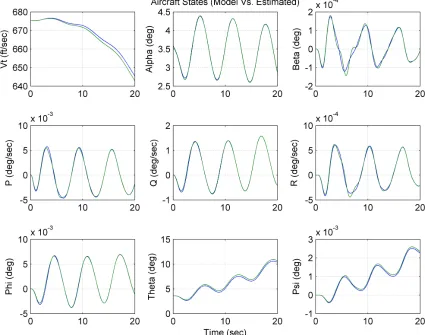
overview diagram of the estimation process is shown in Figure 3.2. The reference model will be run in the Simulink environment for testing but when the estimator is deployed it will use signals from the actual aircraft, the estimated model will run the parameters
that are identified in the parameter estimator block, and the parameter estimator will run taking into account the system inputs and both model and reference states. The resulting output of this system will be parameters that have converged upon the actual
parameters inside of the reference system.
Figure 3.2: Parameter Estimation Overview
The sliding mode control development shown in Section 3.2.1 is focused primarily on the calculation and identification of the control input, u. This goal changes significantly
when a parameter estimator is developed, the primary goal in the estimator development is the calculation and identification of one of the system parameters. So instead of developing an equation foru, like the one shown in Equation 3.11, an equation for one of
the system parameters will be developed instead. The main change in the sliding mode control process is the development of the sliding surface, when developing the sliding surface for the parameter estimator, the parameter that needs to be estimated must be
from Section 3.2.1, Equation 3.4 is re-written here as Equation 3.12.
x(n) =f(x) +b(x)u (3.12) Equation 3.12 will be used as the system equation for an example parameter estima-tor development, it is assumed that the function f(x) has a parameter a that will be
estimated. The sliding surface for a second order system that will be developed for the parameter estimation routine is shown as Equation 3.13.
s= ˙˜x+λx˜ (3.13)
The derivative of the sliding surface, ˙s, is then given by Equation 3.14, an additional [K( ˙x− ˙xd) +η] ˙ˆa term has been added to the sliding surface derivative, this additional
term is included so that an equation for ˙ˆa can be defined. TheK value in this equation will be determined to provide Lyapunov stability and guarantee convergence.
˙
s= ¨x−x¨d+λx˙˜−[K( ˙x− ˙xd) +η] ˙ˆa (3.14)
Setting the derivative of the sliding surface equal to zero ensures that once the sliding surface has been reached, the system remains there and the error will be reduced to zero. Applying this condition, the unknown parameter can then be estimated. The η variable
has been added to prevent a divide by zero condition during numerical simulation, this is an extremely small positive value. For the case of the 2nd-order system given by Equation 3.10 and the derivative of the sliding surface is given in Equation 3.13. Substituting
Equation 3.10 into Equation 3.13 and solving for zero, yields the unknown parameter, ˙ˆa. These steps are shown in Equations 3.15 and Equation 3.16.
˙
s=f(x) +u−x¨d+λx˙˜−[K( ˙x− ˙xd) +η] ˙ˆa= 0 (3.15)
˙ˆ
a= −f(x)−u+ ¨xd−λx˙˜ K( ˙x− ˙xd) +η
(3.16)
The variableηis used to prevent a divide by zero condition, this is a very small positive constant. The variable K will be defined by an equation that will guarantee Lyapunov
used to estimate the unknown parameter, this process will be used to derive estimation
equations for all of the systems defined in Section 2.
3.2.3
Lyapunov Theorem for Global Stability
One of the main advantages of the sliding mode estimator that is proposed in this paper
is the ability to guarantee stability and robustness; this will ensure proper convergence to the parameter that is being estimated. We are interested in designing a sliding parameter estimator such that a stable sliding mode is generated as well as asymptotic stability
for the estimator. The method described in this section is based on the selection of a Lyapunov function [19]. The estimator sliding function should be chosen such that
the candidate Lyapunov function satisfies Lyapunov stability criteria. Lyapunov global stability is stated in the following theorem.
Assume there exists a scalar function V of S, with continuous first order derivatives
such that
• V(S) is positive definite
• dVdt(S) is negative definate
• V (S)−>∞ askSk −>∞
3.3
Proof of Concept Parameter Identification
De-velopment
PID Derivations are shown in this section for each of the proof of concept system models that have been defined in Chapter 2. The novel parameter identification method that has been developed is based upon the sliding mode control system development shown in
Section 3.2, the parameter estimator is developed to guarantee a robust and stable con-vergence to the estimated value by following a traditional sliding surface and Lyapunov function. For each of the proof of concept system models a step by step development
process will be shown, with the end result being an estimation equation for each of the parameters that are being estimated.
3.3.1
First Order Model Implementation
Parameter identification derivation for the first order system described in Section 2.1.1 is show, consider the system equation is defined as Equation 3.17 with uncertain parameter ˆ
a.
˙
x=−ˆax+u (3.17)
The candidate Lyapunov function is defined by Equation 3.18
V = 12s2 ≥0 (3.18)
The Lyapunov function described in Equation 3.18 is positive semi-definite for all time, the sliding surface is then defined as Equation 3.19. xm and ˙xm are the measured states
from the reference system.
s= 12 x2−x2m+λ Z
1 2
x2−x2m (3.19)
To ensure no movement off of the sliding surface set ˙s= 0, shown in Equation 3.20. An additional [K(xx˙ −xmx˙m) +η] ˙ˆa term has been added to the sliding surface derivative,
this additional term is included so that an equation for ˙ˆa can be defined. The K value
in this equation will be determined to provide Lyapunov stability and guarantee conver-gence. The η parameter in the sliding surface derivative is added to prevent a divide by zero condition in the numerical simulation.
˙
s = (xx˙ −xmx˙m) +λ12
Substitute equation 3.17 into Equation 3.20 yields Equation 3.21
˙
s=−ˆax2+ux−xmx˙m+λ12
x2−x2m−[K(xx˙ −xmx˙m) +η] ˙ˆa = 0 (3.21)
Re-arranging and solving for ˙ˆa yields Equation 3.22.
˙ˆ
a= 1
K(xx˙ −xmx˙m) +η
h
ux−ˆax2−xmx˙m+λ12
x2−x2mi (3.22) Equation 3.22 defines the equation that will be programmed into MATLAB and Simulink
to determine ˆa. To satisfy the Lyapunov theorem of global stability as defined in Section 3.2.3, gains need to be chosen so that Equation 3.23 is true, ensuring stability and convergence.
˙
V =ss <˙ 0 (3.23)
A more convenient choice still satisfying Equation 3.23 is Equation 3.24.
ss˙≤ −(K+η)|s| (3.24)
Where K and η are strictly positive values. Consider the actual system defined by Equation 3.25.
˙
x=−ax+u (3.25)
Substituting Equation 3.25 into Equation 3.20:
˙
s=−ax2+ux−xmx˙m+λ12
x2−x2m−[K(xx˙ −xmx˙m) +η] ˙ˆa = 0 (3.26)
Now substituting Equation 3.22 into Equation 3.26:
˙
s= ˆax2−ax2 (3.27)
Substituting Equation 3.27 into Equation 3.24:
K|s| ≤h(a−ˆa)x2is−η|s| (3.28) The parameter a is unknown but assumed to be bounded and defined by the Equation 3.29.
alow ≤a≤aupp (3.29)
Assume the parameter a is the geometric mean of the bounds defined in Equation 3.29
Applying Equation 3.30 to Equation 3.29 to create a ratio ofa and ˆa results in Equation
3.31.
α≤ a
ˆ a ≤α
−1 (3.31)
Where:
α=qaupp/
alow (3.32)
Equation 3.28 can be re-written as Equation 3.33.
K|s| ≤
ˆ a
a ˆ a −1
x2
s−η|s| (3.33)
Comparing the right side of the equality constraint of Equation 3.31 which is taken to be the upper bound limit and the most conservative estimate for the unknown parameter to Equation 3.33 results in Equation 3.34.
K|s| ≤hˆaα−1−1x2is−η|s| (3.34) Equation 3.34 can be satisfied by Equation 3.35.
K|s| ≤ ˆa
α−1−1x2
|s| −η|s| (3.35)
The resulting value for the gainK using the equality constraint of Equation 3.35 becomes Equation 3.36.
K = ˆa
α−1−1x2
−η (3.36)
Using both Equation 3.22 and Equation 3.36 in the MATLAB and Simulink simulation environment, results of the parameter estimation performance can be seen in Section
4.1.1.
3.3.2
First Order Nonlinear Model Implementation
Parameter identification derivation for the first order nonlinear system described in Sec-tion 2.1.2 is show, consider the system equaSec-tion as defined in EquaSec-tion 3.37 with uncertain
parameter ˆa.
˙
x=−aˆsin(y)x+Bu ˙
y=−Cyx+ sin(ωt)
(3.37)
The candidate Lyapunov function is defined by equation 3.38
The Lyapunov function described in Equation 3.38 is positive semi-definite for all time,
the sliding surface is then defined as Equation 3.57.
s = 12(x2−x2 m) +λ
R 1 2(x
2 −x2 m)
+12(y2 −y2 m) +λ
R 1 2 (y
2−y2 m)
(3.39)
To ensure no movement off of the sliding surface set ˙s= 0, shown in Equation 3.40. An
additional [K{(xx˙ −xmx˙m) + (yy˙−ymy˙m)}+η] ˙ˆa term has been added to the sliding
surface derivative, this additional term is included so that an equation for ˙ˆa can be defined. TheK value in this equation will be determined to provide Lyapunov stability
and guarantee convergence. The η parameter in the sliding surface derivative is added to prevent a divide by zero condition in the numerical simulation.
˙
s= 0 = (xx˙ −xmx˙m) +λ12(x2−x2m)
+ (yy˙−ymy˙m) +λ12(y2−ym2)
−[K{(xx˙ −xmx˙m) + (yy˙−ymy˙m)}+η] ˙ˆa
(3.40)
Substitute equation 3.37 into Equation 3.40 and re-arrange yields Equation 3.41
˙ˆ
a= K{(xx˙−x 1
mx˙m)+(yy˙−ymy˙m)}+η[−ˆasin(y)x
2+Bux−
xmx˙m+λ12 (x2−x2m) +Cy2x+ysin(ωt)−ymy˙m+λ12(y2−ym2)]
(3.41)
Equation 3.41 defines the equation that will be programmed into MATLAB and Simulink to determine ˆa. To satisfy the Lyapunov theorem of global stability as defined in Section 3.2.3, gains need to be chosen so that Equation 3.42 is true, ensuring stability and
convergence.
˙
V =ss <˙ 0 (3.42)
A more convenient choice still satisfying Equation 3.42 is Equation 3.43.
ss˙≤ −(K+η)|s| (3.43)
Where K and η are strictly positive values. Consider the actual system defined by Equation 3.44.
˙
x=−asin(y)x+Bu ˙
y=−Cyx+ sin(ωt)
(3.44)
Substituting Equation 3.44 into Equation 3.40:
˙
s=−asin(y)x2+Bux−x
mx˙m+λ12 (x2−x2m)
+Cy2x+ysin(ωt)−y
my˙m+λ12(y2−y2m)
−[K{(xx˙ −xmx˙m) + (yy˙−ymy˙m)}+η] ˙ˆa = 0
Now substituting Equation 3.41 into Equation 3.45:
˙
s= (ˆa−a) sin(y)x2 (3.46) Substituting Equation 3.46 into Equation 3.43:
K|s| ≤h(a−ˆa) sin(y)x2is−η|s| (3.47)
The parameter a is unknown but assumed to be bounded and defined by the Equation 3.48.
alow ≤a≤aupp (3.48)
Assume the parameter a is the geometric mean of the bounds defined in Equation 3.48
a=√alowaupp (3.49)
Applying Equation 3.49 to Equation 3.48 results in Equation 3.50.
α≤ a
ˆ a ≤α
−1
(3.50)
Where:
α=qaupp/
alow (3.51)
Equation 3.47 can be re-written as Equation 3.52.
K|s| ≤
ˆ a
a ˆ a −1
sin(y)x2
s−η|s| (3.52)
Comparing the right side of the equality constraint of equation 3.50 which is taken to be
the upper bound limit and the most conservative estimate for the unknown parameter to Equation 3.52 results in Equation 3.53.
K|s| ≤ aˆ
α−1−1sin(y)x2
|s| −η|s| (3.53)
The value ofK using the equality constraint of Equation 3.53 becomes Equation 3.54.
K = aˆ
α−1−1sin(y)x2
−η (3.54)
Using both Equation 3.41 and Equation 3.54 in the MATLAB and Simulink simulation
3.3.3
Second Order Model Implementation
Parameter identification derivation for the second order system described in Section
2.1.3 is shown, consider the system equation as defined in Equation 3.55 with uncertain parameters ˆa1 and ˆa2.
¨
x=−ˆa2x˙ −ˆa1x+u (3.55)
The candidate Lyapunov function is defined by Equation 3.56
V = 12s2 ≥0 (3.56)
The Lyapunov function described in Equation 3.56 is positive semi-definite for all time,
the sliding surfaces for both parameters ˆa1and ˆa2 are then defined as Equation 3.57. Two
sliding surfaces are built for the two parameters that are being estimated, sliding surface s1 is for estimating parameter ˆa1 and sliding surface s2 is for estimating parameter ˆa2.
s1 = 12( ˙x2−x˙2m) + 1 2λ1
R
(x2−x2 m)
s2 = 12( ˙x2−x˙2m) + 12λ2
R
(x2−x2m)
(3.57)
To ensure no movement off of the sliding surface set all ˙s = 0, shown in Equation
3.58. An additional [K(xx˙ −xmx˙m) +η] ˙ˆa term has been added to the sliding surface
derivative, this additional term is included so that an equation for ˙ˆa can be defined. The K value in this equation will be determined to provide Lyapunov stability and guarantee
convergence. The η parameter in the sliding surface derivative is added to prevent a divide by zero condition in the numerical simulation.
˙
s1 = ( ˙xx¨−x˙mx¨m) +λ1(xx˙ −xmx˙m)−[k1(xx˙ −xmx˙m) +η] ˙ˆa1 = 0
˙
s2 = ( ˙xx¨−x˙mx¨m) +λ2(xx˙ −xmx˙m)−[k2(xx˙ −xmx˙m) +η] ˙ˆa2 = 0
(3.58)
Substitute Equation 3.55 into Equation 3.58 and re-arrange yields Equation 3.59
˙ˆ
a1 = k1(xx˙−x1mx˙m)+η [ ˙xu−ˆa2x˙2−ˆa1xx˙ −x˙mx¨m+λ1(xx˙ −xmx˙m)]
˙ˆ
a2 = k2(xx˙−x1mx˙m)+η [ ˙xu−ˆa2x˙
2−ˆa
1xx˙ −x˙mx¨m+λ2(xx˙ −xmx˙m)]
(3.59)
Equation 3.59 defines the equation that will be programmed into MATLAB and Simulink to determine ˆa1 and ˆa2. To satisfy the Lyapunov theorem of global stability as defined
in Section 3.2.3, gains need to be chosen so that Equation 3.60 is true, ensuring stability
and convergence.
˙
A more convenient choice still satisfying Equation 3.60 is Equation 3.61.
ss˙≤ −(K+η)|s| (3.61)
Where K and η are strictly positive values. Consider the actual system defined by Equation 3.62.
¨
x=−a2x˙ −a1x+u (3.62)
Substituting Equation 3.62 into Equation 3.58:
˙
s1 =−a2x˙2−a1xx˙ +ux˙ −x˙mx¨m+λ1(xx˙ −xmx˙m)−[k1(xx˙ −xmx˙m) +η] ˙ˆa1 = 0
˙
s2 =−a2x˙2−a1xx˙ +ux˙ −x˙mx¨m+λ2(xx˙ −xmx˙m)−[k2(xx˙ −xmx˙m) +η] ˙ˆa2 = 0
(3.63)
Now substituting Equation 3.59 into Equation 3.63:
˙
s1 = ˙s2 = (ˆa1−a1)xx˙+ (ˆa2−a2) ˙x2 (3.64)
Substituting Equation 3.64 into Equation 3.61:
K|s| ≤h(a1−ˆa1)xx˙ + (a2−ˆa2) ˙x2
i
s−η|s| (3.65)
The parameter a is unknown but assumed to be bounded and defined by the Equation 3.66.
alow ≤a≤aupp (3.66)
Assume the parameter a is the geometric mean of the bounds defined in Equation 3.66
a=√alowaupp (3.67)
Applying Equation 3.67 to Equation 3.66 results in Equation 3.68.
α≤ a
ˆ a ≤α
−1 (3.68)
Where:
α=qaupp/
alow (3.69)
Equation 3.65 can be re-written as Equation 3.70.
K|s| ≤
ˆ a1 a 1 ˆ a1 −1
xx˙ + ˆa2
a 2 ˆ a2 −1 ˙ x2
Comparing the right side of the equality constraint of Equation 3.68 which is taken to be
the upper bound limit and the most conservative estimate for the unknown parameter to Equation 3.70 results in Equation 3.71.
K|s| ≤ ˆa1
α−11−1xx˙ + ˆa2
α−21−1x˙2
|s| −η|s| (3.71)
The value ofK using the equality constraint of Equation 3.71 becomes Equation 3.72.
K = ˆa1
α−11−1xx˙ + ˆa2
α−21−1x˙2
−η (3.72)
Using both Equation 3.59 and Equation 3.72 in the MATLAB and Simulink simulation environment, results of the parameter estimation performance can be seen in Section 4.1.3.
3.3.4
Second Order Nonlinear Model Implementation
Parameter identification derivation for the second order nonlinear system described in Section 2.1.4 is show, consider the system equation is defined as Equation 3.73 with uncertain parameters ˆa1 and ˆa2.
¨
x=−ˆa2x˙ −ˆa1x2+u (3.73)
The candidate Lyapunov function is defined by Equation 3.74
V = 12s2 ≥0 (3.74)
The Lyapunov function described in Equation 3.74 is positive semi-definite for all time, the sliding surfaces for both parameters ˆa1and ˆa2 are then defined as Equation 3.75. Two
sliding surfaces are built for the two parameters that are being estimated, sliding surface
s1 is for estimating parameter ˆa1 and sliding surface s2 is for estimating parameter ˆa2.
s1 = 12( ˙x2−x˙2m) + 1 2λ1
R
(x2−x2 m)
s2 = 12( ˙x2−x˙2m) + 12λ2
R
(x2−x2m)
(3.75)
To ensure no movement off of the sliding surface set all ˙s = 0, shown in Equation 3.76. An additional [K(xx˙ −xmx˙m) +η] ˙ˆa term has been added to the sliding surface
convergence. The η parameter in the sliding surface derivative is added to prevent a
divide by zero condition in the numerical simulation.
˙
s1 = ( ˙xx¨−x˙mx¨m) +λ1(xx˙ −xmx˙m)−[k1(xx˙ −xmx˙m) +η] ˙ˆa1 = 0
˙
s2 = ( ˙xx¨−x˙mx¨m) +λ2(xx˙ −xmx˙m)−[k2(xx˙ −xmx˙m) +η] ˙ˆa2 = 0
(3.76)
Substitute Equation 3.73 into Equation 3.76 and re-arrange yields Equation 3.77
˙ˆ
a1 = k1(xx˙−x1mx˙m)+η[ ˙xu−ˆa2x˙2 −aˆ1x2x˙ −x˙mx¨m+λ1(xx˙−xmx˙m)]
˙ˆ
a2 = k2(xx˙−x1mx˙m)+η[ ˙xu−ˆa2x˙2 −aˆ1x2x˙ −x˙mx¨m+λ2(xx˙−xmx˙m)]
(3.77)
Equation 3.77 defines the equation that will be programmed into MATLAB and Simulink
to determine ˆa1 and ˆa2. To satisfy the Lyapunov theorem of global stability as defined
in Section 3.2.3, gains need to be chosen so that Equation 3.78 is true, ensuring stability and convergence.
˙
V =ss <˙ 0 (3.78)
A more convenient choice still satisfying Equation 3.78 is Equation 3.79.
ss˙≤ −(K+η)|s| (3.79)
Where K and η are strictly positive values. Consider the actual system defined by Equation 3.80.
¨
x=−a2x˙ −a1x2+u (3.80)
Substituting Equation 3.80 into Equation 3.76:
˙
s1 =−a2x˙2−a1x2x˙ +ux˙ −x˙mx¨m+λ1(xx˙ −xmx˙m)−[k1(xx˙ −xmx˙m) +η] ˙ˆa1 = 0
˙
s2 =−a2x˙2−a1x2x˙ +ux˙ −x˙mx¨m+λ2(xx˙ −xmx˙m)−[k2(xx˙ −xmx˙m) +η] ˙ˆa2 = 0
(3.81)
Now substituting Equation 3.77 into Equation 3.81:
˙
s1 = ˙s2 = (ˆa1−a1)x2x˙ + (ˆa2−a2) ˙x2 (3.82)
Substituting Equation 3
![Figure 1.1: Schematic of the Real-Time PID Role for IFCS Research [1]](https://thumb-us.123doks.com/thumbv2/123dok_us/114499.10951/16.612.143.493.244.540/figure-schematic-real-time-pid-role-ifcs-research.webp)