MEETING REPORT
Increasing women’s engagement in vector
control: a report from Accelerate To Equal
project workshops
Kacey C. Ernst
1, Erika Barrett
1, Accelerate to Equal Kenyan and Indonesian Working Groups, Elizabeth Hoswell
2and Mary H. Hayden
2,3*Abstract
Workshops with academic, national and local government, and community stakeholders were held in Kenya (2017) and Indonesia (2018) to understand the role and perceptions of women in vector control and to identify strategies for accelerating involvement of women in sustained support for vector control interventions at multiple levels/sectors.
Keywords: Gender equity, Vector control, Women, Stakeholder workshop
© The Author(s) 2018. This article is distributed under the terms of the Creative Commons Attribution 4.0 International License (http://creat iveco mmons .org/licen ses/by/4.0/), which permits unrestricted use, distribution, and reproduction in any medium, provided you give appropriate credit to the original author(s) and the source, provide a link to the Creative Commons license, and indicate if changes were made. The Creative Commons Public Domain Dedication waiver (http://creat iveco mmons .org/ publi cdoma in/zero/1.0/) applies to the data made available in this article, unless otherwise stated.
Background
Involving women in programmes to improve the well-being of their family and community can improve gen-der equity and lead to more sustainable programming [1–3]. Concerted efforts have been made in sectors such as forestry and agriculture to increase women’s participa-tion and leadership roles. Evidence suggests that when policies and programming explicitly empower women in these sectors, overall improvements in food security and nutrition and sustainable resource management have been achieved [4]. Yet gender mainstreaming, the process by which a gender-based lens is focused on the prepara-tion, design, implementaprepara-tion, and evaluation of programs and policies, has not been systematically incorporated into vector control. Prior to broad-scale implementa-tion of gender-based policies, it is critical to develop an understanding of the barriers and opportunities to engag-ing women more fully in vector control programmes. This must be done across all potential levels of engage-ment including: the household-level in which women are empowered to carry out vector-control activities within their own homes, the community-level in which women carry out paid or unpaid vector control activities with
residents to build collective action at the local level, and finally, the professional level in which women engage in regional or national-level vector-control efforts.
Following implementation of survey and field-based research in Indonesia and Kenya, collaborators from the “Accelerate to Equal: Engaging Women in Vector Con-trol” project held stakeholder workshops in Lake Naiva-sha, Kenya in December 2017 and Bali, Indonesia in March 2018 to understand the current role and percep-tions of women in vector control, and to identify poten-tial strategies for accelerating involvement of women in sustained support for malaria control interventions at multiple levels and sectors. In previous work, current vector control professionals identified lack of awareness of opportunities, cultural barriers, and household obliga-tions as leading barriers to engagement in vector control efforts in the community [5]. Addressing cultural barri-ers and reducing household obligations were perceived as being the most difficult to address.
The stakeholder workshops engaged multi-sectoral stakeholders to align findings from field and survey investigations in Kenya and Indonesia with current vec-tor control initiatives. Stakeholder input was sought to refine models for framing the barriers and opportunities for women in vector control. They were also used to iden-tify specific steps that could be implemented to increase women’s participation in vector-control activities at
Open Access
*Correspondence: [email protected]
3 Trauma, Health and Hazards Center, University of Colorado, Colorado
Springs, CO, USA
household, community, and professional levels. Deci-sion-makers and other stakeholders came together from the national level (ministries of health and environment, as well as women’s empowerment groups and similar stakeholders in Kenya) and from the local level (vector control, women’s empowerment, women community leaders) to a provide a mechanism for capacity build-ing, which included a researcher-stakeholder dialogue and promotion of coordination among local and national practitioners/decision-makers.
Methods
Participant recruitment
Eligible participants fell within one or both of two cat-egories; (1) an individual currently working in a vector-control programme and/or (2) an individual currently working in gender equity or women’s empowerment. Two stage-recruitment was conducted. First, direct recruit-ment was conducted via an email invitation to contacts within the health ministries, non-governmental organi-zations, and commercial organizations. Upon confirma-tion of participaconfirma-tion, individuals working in community programmes were asked to invite at least one commu-nity partner to participate in the workshop to provide both a top-down and bottom-up perspective of engaging women in the community.
Workshop implementation
A semi-structured approach was taken for the work-shops. Both workshops began with introductions of all participants and organizers. To provide all participants with common knowledge, research results of previously conducted household surveys, focus groups, and key informant interviews were briefly presented. The meet-ing then transitioned into workmeet-ing groups that discussed benefits, barriers, and strategies to engage women in vec-tor control. Specific implementations are provided below for each country.
Kenya
The “Accelerate to Equal: Engaging Women in Vector Control workshop” was held in Lake Naivasha, Kenya on December 4, 2017.
After the initial introductions and research presenta-tion, participants broke into groups of approximately 4–5 participants to discuss and identify key benefits and barriers to women working in vector control at three lev-els; household (H), community (C), and professional (A). After a report back from each group, participants were then randomly assigned into new groups to brainstorm solutions and strategies to overcome the identified bar-riers. The solutions were displayed for the whole group, and the group then selected the top strategy focus for
each level (H, C, A) with one short-term and one long-term strategy. Participants subsequently self-selected into working groups to identify key activities, outputs, and resources needed for each strategy. The small groups then presented their ideas to the broader group for feed-back and discussed challenges to implementation of the proposed solutions.
Indonesia
The “Accelerate to Equal: Engaging Women in Vector Control workshop” was held in Bali, Indonesia on March 5th and 6th, 2018.
After the initial introductions and research presenta-tion, the organizers used a modified technology of par-ticipation (ToP) (http://top-facil itati on.com/empow ering -tools /conse nsus-works hop-metho d/) workshop strat-egy to build consensus about the benefits and barriers to women working in vector control for each level (H, C, A). After consensus was achieved among the large group, participants then went back to their small groups to iden-tify solutions to the barriers at each level. After a report back, the participants then self-selected into working groups for interventions and strategies at each level (H, C, A). All groups developed components that contributed to a larger system. While this was not the initial intention of the workshop, there were enough similar themes and discussion threads that a single system could be created that would facilitate a model for community-led vector control with a female-centric focus. Professional trans-lators provided simultaneous translation to facilitate exchange among participants who spoke only Bahasa or English. The small groups then presented their ideas to the broader group for feedback and discussed challenges to implementation of the proposed solutions.
Identification of themes
Workshop outcomes Overview
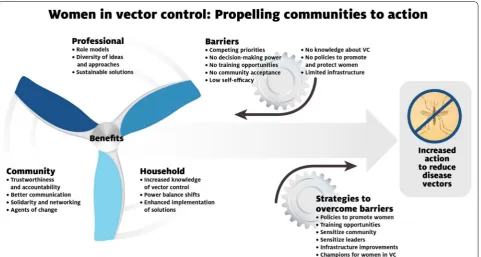
A framework for the benefits, barriers, and strategies to engage women in vector control activities was developed (Fig. 1). Benefits were identified for engaging women at the household, community and professional levels. Bar-riers and strategies were identified that crossed all levels.
Benefits
Both working groups concluded that engaging women in vector control would deliver two broad categories of benefits; first, it was widely held that engaging women at all levels would lead to more sustainable vector-control strategies; and second, there were potential benefits for the women themselves through economic and/or social empowerment. Women were perceived as having more knowledge about their household, includ-ing both the household members and the household environment. As participants from Kenya stated, “when it comes to decisions on vector control, women make faster decisions because of a better understanding of household and surroundings” (Table 1). They were also perceived as being the ones who would most likely implement household level measures of protection. At the community level, women were perceived as having better communication skills, and being more accounta-ble and trustworthy than male counterparts. They were
more likely to take part in group activities and have networks on which to rely for implementation projects. At the professional level, including more women was perceived as being important to generate a diversity of ideas. Stakeholders also reported the importance of having women in leadership roles to mentor and inspire the next generation (Fig. 1, Table 1).
Barriers
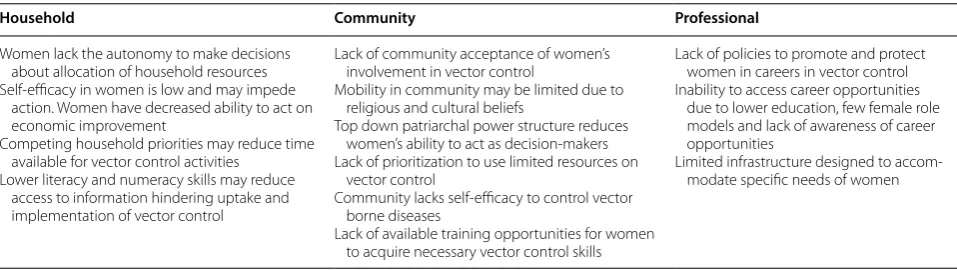
Despite the significant benefits, stakeholders also rein-forced the idea that there were significant barriers to women’s participation. It was recognized that women’s roles in vector control would be impeded by cultural norms and competing priorities as primary caretakers of the household (Fig. 1, Table 2). Lack of voice in the community was also considered a significant barrier. As also stated in Kenya, “they [women] are not involved in decision-making processes. The chief calls a meeting, and the men come. The women miss these meetings”. Additional barriers included gaps in policy, specifically addressing women’s needs as vector-control person-nel, resource constraints on carrying out action, lack of awareness and knowledge about effective strategies to control vectors, and no defined career paths or mentors for women in vector control (Fig. 1, Table 2).
[image:3.595.60.542.440.697.2]Strategies
Strategies were recommended within four domains. First, to advocate for more women in decision-making through access to information. Women are more likely to play a key role in the decision-making process when they are informed about vector control strategies. Determining key gaps in knowledge and understanding and providing curriculum to fill those gaps at a community level is one proposed strategy. This should be coupled with sensitiza-tion materials that depict women engaging in vector con-trol to overcome cultural norms that may prevent women from engaging. Role models and champions should be identified that can reinforce the importance of women as leaders in vector control. Finally, existing programmes should review their current policies for recruitment to ensure they are targeting women. Several specific strat-egies that the groups considered had high potential for success included conducting systematic assessments of gender gaps in current programmes and developing met-rics to track progress, enhancing women’s knowledge about vector control through community-delivered cur-riculum, using multimedia strategies to normalize wom-en’s role in vector control, and developing mentoring and training programmes for women (Fig. 2).
Participants from both workshops suggested creating a repository of standard tools and templates that were flexible enough to be tailored to specific community needs. Participants felt that no one-size would fit all for solutions and that different disease systems were unique and should be addressed as such; i.e., engaging women in different arenas of vector control will differ by disease model and vector of interest.
Workshop attendees felt that engagement of women should address the secondary benefit of empowering women by providing some incentives, which could focus on economic benefits for participation, recognition at the community level, or even tokens of appreciation.
Participants noted that specific interventions were deemed secondary to providing a system that could be developed to flexibly adapt to new interventions as they became available so that a monumental effort to try something new is not necessary with each interven-tion. Women were perceived as critical to implementing new strategies by building community consensus and awareness.
As a culminating activity, both Kenyan and Indonesian participants generated word clouds of key words that represented important workshop concepts (Fig. 3). Table 1 Key benefit themes of engaging women in vector control at household, community, and professional levels
Household Community Professional
Enhancing women’s knowledge will increase household awareness of vectors and the diseases they carry
As the household caretakers, women will better integrate appropriate vector control into house-hold activities
Women have a greater vested awareness of and interest in family well-being
Engagement in paid vector control activities shifts the household power balance towards equality
Women are more trustworthy and accountable which enhances community buy-in
Women are better communicators which increases visibility and acceptance of proposed programs Improved solidarity and networking among
women strengthens community organizations Women act as agents of change to prioritize and
improve overall community health
More comprehensive representation in programmes and policies leads to diversity of ideas and approaches
Women understand the community and are more likely to administer programmes that are accepted and sustained
When breaking the glass ceiling, women serve as role models for enhanced gender equity
Table 2 Key barriers to engaging women in vector control at household, community, and professional levels
Household Community Professional
Women lack the autonomy to make decisions about allocation of household resources Self-efficacy in women is low and may impede
action. Women have decreased ability to act on economic improvement
Competing household priorities may reduce time available for vector control activities
Lower literacy and numeracy skills may reduce access to information hindering uptake and implementation of vector control
Lack of community acceptance of women’s involvement in vector control
Mobility in community may be limited due to religious and cultural beliefs
Top down patriarchal power structure reduces women’s ability to act as decision-makers Lack of prioritization to use limited resources on
vector control
Community lacks self-efficacy to control vector borne diseases
Lack of available training opportunities for women to acquire necessary vector control skills
Lack of policies to promote and protect women in careers in vector control Inability to access career opportunities
due to lower education, few female role models and lack of awareness of career opportunities
[image:4.595.58.539.100.218.2] [image:4.595.57.536.258.393.2]Advocate for more women in decision-making through access to information
•Conduct a needs assessment on existing knowledge gaps
•Develop curriculum geared towards information access at the household level
Develop sensitization and advocacy materials
•Promote job ads which depict women conducting vector control activities •Develop school-based curriculum that
includes women as leaders in vector-control
•Develop school and community theater programs that depict women in leadership roles
•Use social media platforms to disseminate messaging and or television/ radio platforms
Identify key community influencers and champions of women in vector control
•Hold sensitization workshops at multiple levels with key employers
•Increase commitment by government officials and private industry to enact gender equity in vector control •Identify existing women leaders who can
act as mentors and role models
Prioritize women’s employment in vector control
•Conduct a review of vector control positions and identify gaps in gender equity •Develop training opportunities that will
make women more competitive for job openings
•Require reporting for vector control programs to provide information on the ratio of men to women who are employed
Normalizing women’s roles in vector control
Fig. 2 Strategies to overcome barriers to women engaging in vector control activities
[image:5.595.58.543.88.399.2] [image:5.595.59.541.430.693.2]•fast, convenient online submission
•
thorough peer review by experienced researchers in your field
• rapid publication on acceptance
• support for research data, including large and complex data types
•
gold Open Access which fosters wider collaboration and increased citations maximum visibility for your research: over 100M website views per year
•
At BMC, research is always in progress. Learn more biomedcentral.com/submissions
Ready to submit your research? Choose BMC and benefit from: Conclusion
Women play integral roles in their communities as edu-cators, caregivers, and agents of change. These roles highlight the importance of engaging women in effec-tively designing and implementing culturally accept-able and sustainaccept-able vector control interventions and empowering them as key decision-makers from the outset. Women are instrumental in building commu-nity awareness and acceptance of interventions and will do so more efficiently when they combine science-based knowledge of the disease systems being addressed with their local knowledge of the community toward prioritiz-ing and improvprioritiz-ing health overall in their communities. Empowering women at household, community and pro-grammatic levels to fully participate in vector control will promote gender equity towards a goal of policy-driven and sustainable improvements in all sectors.
Abbreviations
H: household; C: community; A: professional; ToP: technology of participation.
Authors’ contributions
MH, KE and EB organized and conducted the workshop and contributed to the analysis and write-up of the workshop data. EH organized the workshop. All authors read and approved the final manuscript.
Author details
1 Mel and Enid Zuckerman College of Public Health, University of Arizona,
Tucson, AZ, USA. 2 National Center for Atmospheric Research, Boulder, CO,
USA. 3 Trauma, Health and Hazards Center, University of Colorado, Colorado
Springs, CO, USA.
Acknowledgements
The authors would like to thank the participants of the Accelerate to Equal Kenyan and Indonesian Working Groups for their time and the energy they put into the ensuring the success of the workshops. Accelerate to Equal Ken-yan Working Group Participants: Hawa Abdillahi (HealthRight International), Vitalis Akora (Africa Center for Health Systems Research & Management), Helen Amegbletor (PMI AIRS Project, Ghana), Rosemary Ayiera (Cervical Health Net-work, Makerere University), Guyah Bernard (Maseno University), Zeddy Bore (PMI AIRS Project, Kenya), Chuchu Cowan (SOWED Kenya), Abraham Rono (HealthRight International), James Sang (National Malaria Control Program), Tom Wabwire (African Development and Emergency Organization), Caroline Murerwa (PS Kenya), Margaret Mwangi (NEPHAK), Kiambo Njagi (National Malaria Control Program), Peter Njoroge Ng’ang’a (ICIPE), Lilian Odipo Omondi (Nyabondo IVM Project), Caroline Otieno (Nyabondo IVM Project), Bruno Otsyula (African Development and Emergency Organization). Accelerate to Equal Indonesian Working Group Participants: Eggi Arguni (Eliminate Dengue Project Yogyakarta, University of Gadjah Mada), Pak Triwibowo Ambargarjito (Vectorborne Disease Research and Development, Donggala), Mike Bangs
(International SOS), Claus Bogh (Sumba Foundation), Elisabeth Dodok (Com-munity Member Southwest Sumba), Martha Hebi (Local NGO Southwest Sumba), Elsa Herdiana (University of Gadjah Mada), Sarah Hobgen (Charles Darwin University Kampung Raja), Say Piau Lim (Bayer Corporation), Baning Rahayujati (Disease Prevention and Control Division KulonProgo District), Tri Ramadhani (Community Development Vector Control), Susi Soviana (Bogor Agricultural University), Asep Suryaman (Center for Health Policy and Social Change), Susilowati Tana (Center for Health Policy and Social Change), Marieti Wala (Community Member Southwest Sumba).
Competing interests
The authors declare that they have no competing interests.
Availability of data and materials
The datasets used and/or analysed during the current study are available from the corresponding author on reasonable request.
Consent for publication
Not applicable.
Ethics approval and consent to participate
Not applicable.
Funding
The authors would like to thank the Bill and Melinda Gates Foundation for funding.
Publisher’s Note
Springer Nature remains neutral with regard to jurisdictional claims in pub-lished maps and institutional affiliations.
Received: 20 August 2018 Accepted: 4 September 2018
References
1. Elmendorf ML, Isely RB. Public and private roles of women in water sup-ply and sanitation programs. Society for Applied Anthropology. 1983.
https ://www.jstor .org/stabl e/44126 002.
2. Rahman SA. Women’s involvement in agriculture in northern and south-ern Kaduna State, Nigeria. J Gend Stud. 2008;17:17–26.
3. Agarwal B. Gender and forest conservation: the impact of wom-en’s participation in community forest governance. Ecol Econ. 2009;68(11):2785–99.
4. Food and Agriculture Organization of the United Nations. Women in for-estry: challenges and opportunities. http://www.fao.org/3/a-i3924 e.pdf. Accessed Aug 2018.