RIT Scholar Works
Theses
Thesis/Dissertation Collections
2007
Artfully Concealed
Athesia V. Benjamin
Follow this and additional works at:
http://scholarworks.rit.edu/theses
This Thesis is brought to you for free and open access by the Thesis/Dissertation Collections at RIT Scholar Works. It has been accepted for inclusion in Theses by an authorized administrator of RIT Scholar Works. For more information, please [email protected].
Recommended Citation
Rochester,
A ThesisSubmitted to theFacultyof The Collegeof
Imaging
Artsand SciencesFine Arts Studio Department In
Candidacy
fortheDegreeofMASTER OF FINE ARTS
ARTFULL Y CONCEALED
By
Athesia V. Benjamin
In this work, I attempted to create a series of self-portraits in which I am not
recognized or identified. I am intrigued withthe ideaofusing my form and likeness as
thegroundworkfor the painting,yetgradually
distancing
myselfas the subject until I amabsent from the final work. In this, I have redefined my function as subject matter and
painter, and redefined the meaning ofself-portraiture formyself. In my absence, I have
created characters behind which I can hide as I take on new identities.
My
purpose inthese paintings is the same as
'x'
in a math equation. Even in my attempt to be
anonymous, thesepaintingshave become amazinglyautobiographical. Inthepaintings in
which I am dressed as a surgeon (which I consider my most successful in terms ofmy
being
unidentified), I unintentionally take onissues about hospitals, sickness, and death,whichhave been recurring themesin my life this year. The earliest ofthis thesis series
are clearly traditional self-portraits and were created before I came to my final thesis
Chief Advisor:
Alan Singer
Signature:
Date:
Associate Advisor:
Tina Lent, Ph.D
Signature:
Date:
Associate Advisor:
Robert N. Heischman
Signature:
Date:
Department Chairperson:
Donald Arday
Signature:
Title of thesis or dissertation:
fJ ,--f£
11
7
(~c.edu
Name of author:
a
~
s,"",,6
N
CU-vt..--4--. Degree:fo1ccs-tc/Y
.
-
-1'
~~A
rh
Program: S~UvIh
f-College:
It)7
17-
+
;
~
5~
_
)"
I understand that I must submit a print copy of my thesis or dissertation to the RIT Archives, per current RIT guidelines for the completion of my degree. I hereby grant to the Rochester Institute of Technology and its agents the non-exclusive license to archive and make accessible my thesis or dissertation in whole or in part in all forms of media in perpetuity. I retain all other ownership rights to the copyright of the thesis or dissertation. I also retain the right to use in future works (such as articles or books) all or part of this thesis or dissertation.
Print Reproduction Permission Granted:
I,
Athesia Benjamin
,
hereby grant permission to the Rochester Institute Technology to reproduce my print thesis or dissertation in whole or in part. Any reproduction will not be for commercial use or profit.Signature of Author:
Athesia Benjamin
Date: _ _ _ _ _Print Reproduction Permission Denied:
I, , hereby deny permission to the RIT Library of the Rochester Institute of Technology to reproduce my print thesis or dissertation in whole or in part.
Signature of Author: _ _ _ _ _ _ _ _ _ _ _ _ _ _ _ _ _ Date: _ _ _ _ _
Inclusion in the RIT Digital Media Library Electronic Thesis
&
Dissertation (ETD) Archive
I,
Athesia Benjamin
,
additionally grant to the Rochester Institute of Technology Digital Media Library (RIT DML) the non-exclusive license to archive and provide electronic access to my thesis or dissertation in whole or in part in all forms of media in perpetuity.I understand that my work, in addition to its bibliographic record and abstract, will be available to the world-wide community of scholars and researchers through the RIT DML. I retain all other ownership rights to the copyright of the thesis or dissertation. I also retain the right to use in future works (such as articles or books) all or part of this thesis or dissertation. I am aware that the Rochester Institute of Technology does not require registration of copyright for ETDs.
I hereby certify that, if appropriate, I have obtained and attached written permission statements from the owners of each third party copyrighted matter to be included in my thesis or dissertation. I certify that the version I submitted is the same as that approved by my committee.
BENJAMIN,ATHESIA V. (MFA.,
Painting)
Artfully
Concealed, March,2007AbstractoftheMFAdocumentcompleted atRochester InstituteofTechnology
Thesis Exhibitionsupervised
by
Professor Alan SingerNo. of pagesintext: 36
The
following
document isasummaryofthe developmentofmyworkduring
two years in the MFA painting program at Rochester Institute of Technology. The
process intrinsic to thesis development eventually brought me to my final concept of
obscuring my
identity
asaway todevelop
abody
offigurativepaintings.Along
withtheeleven pieces created
during
thistwo-year period,I havethoroughly studiedthis specifictopicwithin thecontext ofcontemporaryand historicalart and identified artistswith like
Thisthesis is dedicatedto Afa, Cathy, Eric, Kenneth and Velvia. Thank youforeach of
your individual contributions towards
helping
me complete this degree. You all havecreated anamazing web of supportforme,onethatInever wanttotake forgranted.
I'd like to acknowledge my thesis committee; Tina Lent, Bob Heischman, and Alan
Singer, foryour encouragement, patience and guidance throughout the yearsthat I have knowneachofyou. Iam grateful formentorssuchasyou.
March9th,2007
Athesia Benjamin: Thesis Paintings
Givers ofGoodThings Plate 1
Self-portraitin Yellow Shirt 2
Responsein Blue 3
Crying
4You Can 't See Me 5
Tradition 6
Trabaja 7
War 8
Arrow 9
Stat 10
Afa 'sSelf-portrait 1 1
Thesis Exhbition 12-15
Introduction Page 14
The Work 15
First Thesis Topic Submitted 24
Real-life Situationsthat Influenced Work 25
Influential antecedents and
contemporary references inself-portraiture 27
TechnicalIssues 30
The Future oftheIdea 35
Works Cited 37
Athesia
GiversofGood Things
2003
OilonCanvas
Self-portrait inYellow Shirt
2003
OilonCanvas
ResponseinBlue
2003
OilonCanvas
Crying
2003OilonCanvas
Athesia Benjamin
You Can't See Me
2003
OilonCanvas
Tradition 2003
OilonWood Panel
Trabaja
2004
OilonWood Panel
War
2004
OilonWood Panel
Arrow
2004
OilonWood Panel
Stat
2004
OilonCanvas
Afa's
Self
portrait2004
OilonWood Panel
Thesis Exhibition: Left
Bevier
Gallery
Plate13
ThesisExhibition: Centerview
BevierGallery
Plate15
Thesis Exhibition: Far-rightside view
The self-portrait,an image ofavisual artist
by
that artist, offers adensity
of meaning beyond aesthetic value. Its complexity rests within a mixture ofthe artist with the art, the public with the private, the subjectwith the object, the historical with the psychological, andthe truth with
the lie. -Susanna
Coffey
(Maxwell26)Embarking
on the path of self-portraiture from thebeginning
of my graduatecareer allowed me the opportunity to work in that specific genre almost exclusively and
to study the historical antecedents with the intentions of attempting to contribute to the
tradition. The early paintings of the thesis series adhere to the tenets oftraditional
self-portraiture. Those visual attributes that could characterize self-portraits throughout
history
include a centrally-placed figure within the picture plane, more often anemotionless or serious expression, and a background that could be described as
atmospheric and non-descript. The difference between my early works andthe final few
pieces ofthe thesis series, however, differ because I began to
intentionally
disguise mylikeness until my identity was obscured in the final painting. In this, I recreated my
functionas subject matter and painter simultaneously, and redefined the meaningof
self-portraitureformyself andthe viewer. Inplaceofmylikeness, Icreatedcharacters whose
identities Icould explore.
My
presence inthese paintings couldbe analogous to "x" in amath equation,where
"x"
isthe unknown,butcouldbe manythings.
With a body of work so personal, I was concerned that the viewer might
misunderstandthework as
being
narcissistic andtrivial, andthatconcern prompted metoquestionthenotion ofnarcissismandego, especiallyas itpertains to theartist. I began to
accept its potential as an area of psychological investigation and as a natural, but
narcissism, or self-love as a formof resistance from the tyranny ofmediocrity and as a
site of
solace."
(Maxwell 46) The resolution that I arrived at for my thesis deliberately
reflects our human narcissism, while paradoxically
being
the antithesis of the same, inthat I am not easily identified.
My
culminating work explores theartists'
life-long
relationship with her own gaze, but at the same time, subscribes to a certain
psychological subject matter within figurative art, specifically within contemporary self
portraiture: and that is the act ofassuming a character role. In the paintings that reflect
my thesis topic, I was able to exchange my
identity
for another and become somewhatanonymous.
TheWork
The
feeling
ofhaving finally
arrived at a concept that could be the catalyst forprovocative work was incredible, especially when compared to the lack of direction and
frustration I experienced my first year.
During
that first year, I experimented withnon-figurative subjects, alternativepainting formats, andnew painting mediums, but at the end
of
Spring
Quarter, I didn't feel anycloserto adefinitetopic. I feltsomewhatunproductivein terms of producing finished, show pieces, but that time proved to be valuable in the
developmentofmywork.
One thing I was sure of was my desire to work with the figure, and
during
winter quarter ofthatfirst year, IpaintedGiversofGood Things (Plate 1),adoubleportrait
ofmyparents. My ambition to worklarge isevidentin this piece, butwhatis also evident,
andfrustrating, isthatIwasn't yet adept at workingwithsuch large forms. Thefigures are
larger than life, but the torsos come to an abrupt and awkward end at the bottom of the
Quarter forthe sole purpose ofviewing art andseeking outinspiration. As aresult, Givers
of Good Things was the last painting in which the placement of the figures was so
unresolved.
A single painting in Forum
Gallery
(NYC) ultimately inspired the first twopieces of my thesis series. The painting was a larger-than-life, three-quarter length
self-portrait
by
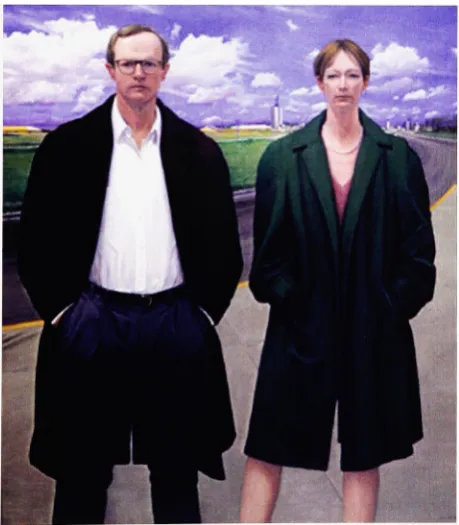
William Beckman (Figure 1). What struck me the most about Beckman'spaintingwas how he croppedthe life-size figures just below theknees, without sacrificing
the impact and strength of the piece. On that
Spring
day, I left the ForumGallery
[image:25.573.104.334.351.614.2]encouragedto attemptanotherlarge figure, large formatpainting.
Figure 1
William Beckman
American Modern (Overcoats)
1999
Oilon Panel
48"
canvas and began Self-portrait in Yellow Shirt (Plate 2). This six-week
long
endeavor was a direct and immediate visual response to my recent
discovery
in NewYork City. Upon completing that, I challenged myself to paint another self-portrait,
Response in Blue, (Plate 3) with the same dimensions, to be completed within the
restriction of one week.
By
the end of thatSpring
quarter, I had completed fiveself-portraitsinall.
Iconsider Self-portrait in Yellow ShirtandResponse in Blue to bethe centerpieces
ofmy thesis work, because they were catalysts for the resulting paintings, and they also
visually anchored the othereight paintings in my thesis show exhibition (Plates 12-15).
ThefirstpiecethatIpainted
during
theFall ofmy final year wasCrying (Plate 4). Inthispiece, I began working with a significantly different color palette compared to my
previous paintings. The colors are unsaturated, due to the inclusion of black in my
palette. On the advice of one my professors years before, I never used black in any
painting, but
during
this time, I begantoexperimentwithivory
black whenmixingcolorsforthe inanimateelementsinthesepieces, such asclothing,props orbackgroundspace.
Looking
back, I can clearly see how nearly every painting was somehow influencedby
the painting that preceded it. That wasdefinitely
the case withCrying
and thesubsequent piece, You Can't See Me (Plate 5). For example, the large geometric
expansesin
Crying
could beseen as maquettes forthe more built-up, architectural spacein You Can 't See Me. Also,the twopieces were painted fromthe same pools ofpaint, so
the palettes are almost identical. The marked difference in You Can 't See Me is thatthe
figure is now engaged in an action, as opposedto
being
static andfrozen as mypreviousfigures were. I went into this piece with the same intentions for the figure that I had
some
difficulty
and frustration in painting the facial features, particularly the eyes, Iattempted to solve my problem
by
simply covering my eyes with my hand. I meantthistobe merelyalast-ditchsolutionto whatwas
becoming
adisproportionedface, but foundthat this simple gesture added asense ofmystery andinterestto thepainting.
Before I began the sixth paintingofthis series, Idid some research on
artists'
use of
gestures in self-portraiture. Ilearnedthat a precedenthad been setforgestures similarto
mine, most notably
by
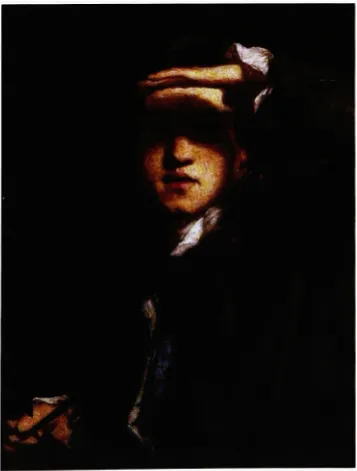
18th century English artist Joshua Reynolds (Figure 2). In thispainting,Reynolds holds his hand upto hiseyes, but insteadofcompletely coveringthem
as I did in You Can 't SeeMe,he is actually shielding them, in whatseems to bean effort
to better see the viewer. His action suggests that somewhere beyond the picture plane is
some source of intense light or illumination, and that is confirmed
by
the strong castshadow ofhis hand
falling
acrosshis face.Figure2
Joshua Reynolds Self-portrait OilonCanvas
[image:27.573.150.329.433.669.2]deference to self-portraitists who hadalsobecome aware ofthe power and symbolismin
gestures. In direct response to my discovery, the sixth piece in this series, Tradition
(Plate6), depicts thefigure shielding hereyes. As Imentionedearlier,
Reynolds'
gesture
isa universal symbolthatrepresents protectingones eyes fromthe sun. In mypainting, I
attemptedtoaccountforthissuggestionofintense light
by having
the two mainelements,being
thefigure andtheground,on opposite ends ofthe value scale.The next piece in this series is titled Trabaja (Plate 7), which means work, in
Spanish. This painting is
directly
influencedby
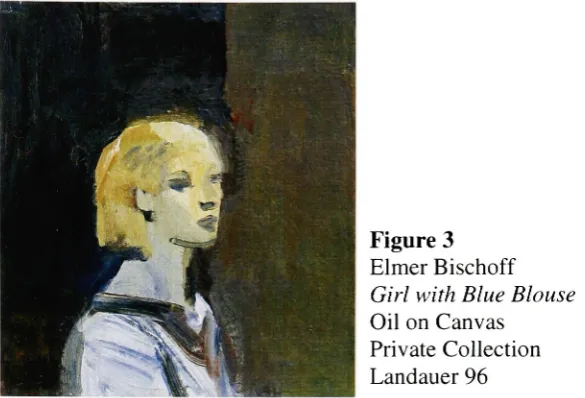
the work of Elmer Bischoff (Figure 3).Bischoff began his career as an abstract expressionist painter in California
during
the1950's. Heis as muchknown for hislarge,colorful abstracts ashe is for his sudden
mid-career shift to painting the figure and other objective subjectmatter. The painting that I
created was a direct result of
having
researched and studied Bischoffs work. Thepositioning of the figure in space and the indication ofthe interior are not unlike one of
Bischoffs'
laterworks. Also, I attempted to capture the sense ofurgency that is evident
in hisbrushwork,whichcouldbe seen as a vestige ofhisearlierabstractions. In an effort
to create consistency between these paintings, I again make use of the harsh contrast
between a saturated primarycolor (in this case, thebright red ofthe shirt), and the dark
gray-blue oftheground.
GirlwithBlue Blouse OilonCanvas
Private Collection Landauer 96
War (Plate8) couldbeviewed asthe first paintingthatconformed tomy declared
thesis topic of disguised self-portraits. In this piece, the figure is dressed in a surgeon's
uniform,
holding
a shovel over one shoulder, with the other arm in a sling. This is thefirst of two pieces in which I displayed the figure dressed as a doctor or surgeon. The
impetus for this painting was actually the shovel that the figure is holding. Due to the
exceptionally
icy
winterthat year, I wasusingthis shovel tobreak up large chunks oficein my driveway. Oneevening, Inoticedthis shovel, not asrepresentingthemanuallabor
that I associated with it, but as an object that had symbolic and aesthetic potential. I
further challenged myself with this prop
by
the way I chose todisplay
it -over myshoulder withaforeshortenedview ofthehandle.
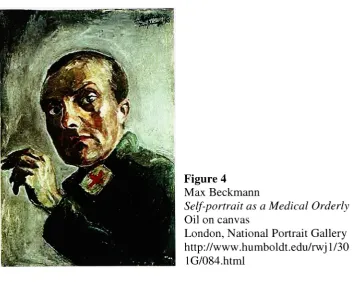
Another artist who depicted himself as a medical professional is German artist Max
Beckmann. Self-portrait as a Medical
Orderly
(Figure 4) was created in response toBeckmann's experiencesas amedicin the German army
during
WWI. Inwhat seems tobe an effort to purge his
being
of the death and trauma he witnessed, here he depicts [image:29.573.163.456.51.250.2]this case, represent of the saddest, darkest aspects of war (Selz 21). Born February 12,
1884, in Leipzig, Saxony, the heart of Germany, Max Beckmann was a proponent of
objectiveand figurative painting (Selz 5). Ibecame acquaintedwithhis work as astudent
at the School of Visual Arts where I had the chance to view his large, allegorical
triptychs. It wasn't until some years later that I learned of the scores of self-portraits
Beckmann created throughout his career -some very traditional, while others are purely
fanciful andtheatrical.
Figure4
Max Beckmann
Self-portraitasaMedicalOrderly Oilon canvas
London,National Portrait
Gallery
http://www.humboldt.edu/rwj
1/30lG/084.html
The smallest painting of my thesis series is a 6 x 6"
oil on wood portrait of my
daughter, Afa (Plate 9). I originally intended for this piece to simply serve as a respite
from mymore serious thesis work, hence the small dimensions and monochromaticblue
palette. Although this painting is clearly not a self-portrait, images of my daughter, as
[image:30.573.136.490.294.576.2]personal
body
ofpaintings.My
parents embodythevalues and ideas thathave helped toshape me, and images of my daughter represent a variation of those non-physical
characteristics.
The largestpainting of this thesis work, titled Stat (Plate 10), is aconvergence of
allthe separate elements that makeup myconcept ofdisguised self-portraits. The figure
is completely disguised, the piece is large format, and I had to rely on the subject/image
creating techniques, (a combination of observation, photographic referencing, and
memory painting) that I developed throughout this thesis process. The idea for this
paintingcame about afterI learnedthat my daughter hadseen some inappropriate images
on television while atdaycare. In anger, I
impulsively
threw our small-screenTV. ontothe asphalt behind our apartment. Before placing the broken television on the curb, I
became curious about the contents behind the screen and proceeded to take it apart.
Stimulated
by
the circuitry and colors I found inside, I brought the television into thestudio thenext day. It seemed natural that I use the same surgeon's costume that Iwore
forthepreviouspainting,sinceIhad, inasense,
'dissected'
the television. Ialso felt like
Ibroke some new groundinterms oftheexpressiveness ofthefigure.
Up
untilthispoint,myexploration of expression in these paintings was limited to the emotional face ofthe
figure in Crying. For the most part, the figures in these paintings served as an
expressionless iconic form, or subject, within which I could explore color relationships,
the act of painting, and composition. In this piece, though, the figure steps out of that
capacity and is now
"alive,"
and in action. As mentioned before, I touched on facial
expression in a previous painting. Now, I was exploring the implications of physical
process of
disabling
themonster,which isabenefitto society.The final painting ofthis
body
ofwork is "Afa'sSelf-portrait,"
and it as an image
ofmy daughter painting herownself-portrait asI lookon. This painting is roughly based
on a photomontage created from reference photos that I took while Afa was painting in
my studio.
Looking
beyond the obvious visual content ofthis piece, this painting aptlyrepresents an important part of my creative process that developed since
having
mydaughter, and that is constantly, (and subconsciously), maintaining an attitude of
openness, withthe understandingthat inspirationfor my paintings can come at anytime,
at anyplace. Once I becameaparent, it isunderstandable that myapproach and process
would have to undergo some necessary adaptation. I was no longer able to work on a
piecefor hours at atime,or pour overbooksthat wouldinform my ideas. This necessary
adaptation tookits form in a greater reliance on the spontaneous andeveryday film-stills
oflife.
Early
on,as an undergraduateart student and newmom, I subconsciously learnedto lookfor ideas andinspiration in my everyday life withmy daughter. Thosethings that
would be categorized as mundane had now become creative fodder for my work. I
realized early on that the documentary-style method that I always used in approaching
my art had become stronger and more evident because of motherhood. This piece has
come to represent that modification that occurred in my process, and that can clearly be
seen in the content. In the painting (Plate 11), Afa is represented twice, in the studio
space and in the reflection ofthe mirror. I am also in the mirrors'
reflection, and I am
simplywatching mychildpaint, asI haddoneso manytimes. Thiswas notthefirst time
I had observed her and then been suddenly inspired to create. Once I realized the
potential of this scene I was watching, I began to take reference images. Although I
consider
leaving
it in itsunder-painting stage. I had created a precedent for my use of monochromatic blue inanother portrait ofAfa, and Ienjoyed theclarity ofcontent when
color was not afactor,soIagreed with
leaving
thispiecein its"unfinished"
state.
One common threadthat runs through the major pieces in this series is my use of simple abstract elements in the spaces not occupied
by
the figure. I have always soughtto have my work represent the observable and factual, but I have also always had
admiration for artists with an opposite preference, such as color-field painters Mark Rothko and RichardDiebenkorn, and minimalist artists like Anne Truitt. With the level
ofvisual studying that my work entails, I've found thatIappreciate that rest forthe eyes
that is afforded when observing expanses of color without much interference
by
shape andform. I begantouse thebackground and"empty"
spacesofmypaintingsto workout
my abstractinclinations,especially concerning geometry within minimalistpainting, and areasof pure color.
First Thesis Topic Submitted
Although I had hit awave ofproductivitybypainting myownlikeness, I hadtrouble
viewingself-portraiture as a validthesis topic. I wasafraidthat theviewer woulddismiss
the work as self-centeredness on display.
Succumbing
to this self-doubt resulted in mymomentary dismissal ofexploring self-portraiture. As an alternative topic, I submitted a
proposal that wouldvisually explore the Italian painting term tenebroso, orextreme and
dramatic light and dark. In this, I was further encouraged to research the film genre of
to whatevertopic I
finally
settled on. Interestingly,the major componentsofthefilmnoirthesis idea, i.e., light and dark, scene development and theater, were fundamental to my
final topicofdisguisedself-portraits.
It is important to note that select paintings created
during
that first year wereincluded in my show, although they were unrelated in many ways to the core
body
ofwork. I felt that the inclusion of these pieces was essential, as it made evident the
sequencingofmysometimes struggled process.
Real-life SituationsthatInfluencedwork
Many artists have had the experience ofcreating apiece, or a
body
of work, tolater discover that the art has made a subliminal visual commentary about their real-life,
personal events. I experiencedthat in the creation of some ofthe pieces in this
body
ofwork.
During
the summer aftermy firstgraduate year, aclosefamily
friend became verysick, suffered throughthe summer months, andthen died in August of thatyear. I was a
first-hand witness to this woman's three-monthdecline. I drove herto
Strong
Memorialhospital the night she fell ill, wrote her obituary when she died, and mine was the only
carin theprocessionto her burial. Ascan beimagined, Ispent many hoursthat summer
just observing, thinking, and
discussing
issues of sickness and health, and hospitalprocedures.
up-close way, and to make it even more poignant, she was my mother's friend and
contemporary.
Itwas
long
afterI had finishedthepaintings WarandStatthatIrealized therehadbeen a strong, psychological, but subconscious transference of the events over that
summer into my work. I was made most aware of this when I later reflected on the
medical doctorcostumes and accessories I chosetowear. InStat, thefigure is performing
an operation on the television,
donning
asurgical mask, latex gloves andhospital scrubs.Also, the facial expression is intense, and even distressed, making it appear to be one of
the dramatic life-or-death situations that take place in hospitals, but that we otherwise
only see on television. In the painting War, the figure is wearing the same hospital
scrubs,
holding
a shovelinonehand, withtheother armin a sling. Aftersome reflection,I was shocked
by
the undeniable connection between the events ofthat summer and themedical andhospitalreferencesthatI included in mypaintings.
The first painting I created when I came back to my studio that September,
Crying, was my only conscious attempt to comment on this very emotional and also to
make the experience relevant to the task athand-creating a
body
of work. I wantedthispaintingto communicatemy sadness aboutthe experience, and
by
attempting that, Icameto recognize animportant aspect ofself-portraiture, and that is that a face functions as a
majorcommunicator, strong-and sometimes even silent.
Painting
an image of myselfinintense emotion moved me beyond the traditional dead-pan face that I had always
Under the best of circumstances, revelations about oneself are a very
tricky business. We all have aspects of ourselves that we feel should
remain hidden and under cover, for fear of how others will react if the dreaded truths become disclosed. For the artists, it stands to reason that
the process of creating self-portraits which disclose conscious or
unconscious aspects of the self would take place in the safe and solitary
confines ofthe studio. There, onemight use a mirrortocreateareflection
of self-representations, parts or fragments of the self -self-esteem,
narcissistic aspects, yearnings, needs, wants, traumas, physical or
psychological idiosyncrasies, etc.-to make public and private disclosures intheself-portrait. (Maxwell 5)
It seems as though the preceding statement would
likely
apply to the mostcontemporary self-portraits in history. Before the 19th century, the purpose of
self-portraits was similar to that of early portraiture, in which the final painting served as
documentation or proof ofthe artists'
life and existence. In the case ofmaster painter
Rembrandt van Rijn, he created countless self-portraits, not only to chart the physical
changes ofhislife, butalsotomark significant(oftentragic)lifeevents.
First, more than any other artist before or since, Rembrandt turned his
gaze on himself. He painted, etched, and sketched almost a hundred self-portraits in his sixty-three years. Taken as a whole, they amount to an intimate autobiography, intendedorotherwise,thatbegan in his youth and
endedonly in his death. (Housden 12)
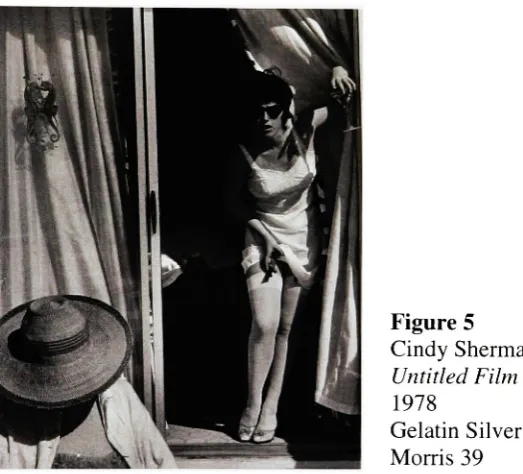
The contemporaryartist who Imost relatetowithin thecontext ofmy thesistopic
is photographer
Cindy
Sherman. I've been acquainted with Sherman's work for quite afew years, but it wasn't until the final few months of my graduate experience that I
realized the connection between herwork and mine. Born in New
Jersey
and raised onLong
Island,Cindy
Sherman is one of the best examples of an artist who haspainted self-portraits),
eventually moved on to find her niche as aphotographer, but not
before
failing
herintroductory
photography course at the State
University
College atBuffalo, New York (Cruz Smith, and Jones 1). Her "Untitled Film Stills"
series, for
which sheis probablybestknown,allfeature herasthemain characterin whatappearsto
[image:37.573.143.405.241.478.2]bemoviestills, butyet, she claimsherworkisnot aboutheratall.
Figure 5
Cindy
Sherman Untitled Film Still #7 1978Gelatin Silverprint
Morris 39
She takes pictures in which she appears as a model...She makes up
stories without beginnings or endings,
leaving
the narrative to theimagination of the viewer. Sherman doles out just enough information
to
imply
somethingby
setting up the "action," thenhands theballofftotheviewer. (Morris 12)
What
Cindy
Sherman has done with her photography is what most artists aspireto: to create intriguing,
interesting
art with the resources most available, while allowingcontemplating our own emotions -not
hers."
(Morris 63) In the late 80's, Sherman
produced another notable
body
of work inspiredby
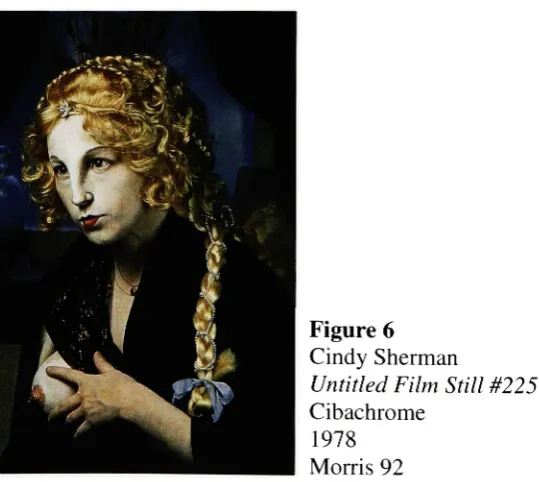
famous paintings from art history,titled the
History
Portraits. In these, Sherman poses as the main figures in herinterpretationofhistorical works. Iconsiderthese to be hermost dramatic piecesin that
she makes full use of make-up, prostheses, costumes and props to recreate these
figurative artworks. Even as a young child, Sherman displayed a propensity for the
theatrical. Forfun, she woulddress up asan old
lady
and walk aroundherneighborhood,completely
fooling
her neighbors. I can relate to the refreshing anonymity that thatactivitywould afford.
After studyingthe lifeand work of
Cindy
Shermanand otherartistswith a similaraesthetic, I am left with the conclusion that most of us aspire to two extremes: to be
knownandrecognized,butalso,attimes,tobeunrecognized and anonymous.
Figure6
Cindy
ShermanUntitledFilm Still#225 Cibachrome
1978 Morris 92
[image:38.573.154.424.432.673.2]As Iworked onthese paintings, I foundmyselfspending moretime preparingand
mixing the colors on my palette. I had always been aware of the direct relationship
between the palette and the painting, but working on such alarge scale simply brought
those issues to the forefront. I spent a great deal of time mixing and altering the colors
thatIwantedtoworkwith, often creating hueandvalue variations ofamain colorforuse
during
a single painting session. I realized that I was spending just as much timepreparing my palette as I was actually applying those colors to the canvas, and, as a
result, myuse of colorinthesepaintings seemedmore mature thanin anyprevious work.
I had made the decision early on that I would attempt to paint larger than I ever
had, so it goes withoutsaying thatmy tools -brushes, palette, palette knives- would also
have to be larger than I was used to working with. Some of the brushes that I used to
create these pieces (especially for the large expanses of color in the backgrounds) were
comparable to the size ofhouse painting brushes. In order to utilize these larger tools, I
was forced to become aware of the role that physical energy and exertion played when
working on such a large scale. The term "Sunday Painter" probably wouldn't denote a
relaxing activity if the canvasses were larger than four feet. In working so large, my
paintingpreparation would begin
long
before I arrived at the studio. I would attempt topreserve my energyearlier in the
day
to assure alengthy
painting session later on.My
new realization of the relationship between canvas size and energy expended made me
reconsidertheActionpaintingstyle ofthe50's.
AlsocalledAbstractExpressionism, this style"often emphasizedthe physical act
ofpainting itselfas an essential aspect ofthe finished
work."
was drawn to the aforementioned figurative work ofElmer Bischoff and the other
Bay
Area AbstractExpressionists ofthe50's.
The three
Bay
Areaartists"returned"
to the figure paradoxically to save
what was salvageable in abstraction.
They
strove to preserve not onlythe technical achievements of "action
painting,"
with its sensuously
loaded brushand sumptuouscolor, butits idealistic aims andconvictions
as well. (Jones36)
After
having
readthrough thegraduatehandbook, Iwasveryconscious (andabitanxious) about the requirement to create "groundbreaking
work."
Although I was
encouraged
by
the early direction and development of my self-portraiture, I felt thataspiring to create groundbreaking work was probably too
lofty
an ambition for anygraduate student andprobably outside ofmy reach, given the richtradition ofthe genre.
However, when I
finally
settled on my topic and began to work through my ideas, Irealized that I might have
inadvertently
stumbled upon an area of focus that could bedeemed groundbreaking within contemporary painting. That place that I ultimately
arrived at, nearly
halfway
into my final year, was a direct result of some technical,practical, and subjective conditions, some of which I placed on myself and some which
wereamatter ofcoincidence. The majorcondition was that the workwouldbe realistic,
but loose inapplication, andfigurative.
I knew from early on that I would not be working with a model. I wasn't sure
how I could resolve this, seeing as how I wanted to work with the figure, but I didn't
wantthe success ofmythesistobedependenton a model's whims and availability.
who wasn't significantto my workormy life somehow. Sculptor Alan Rath describes a
similar sentimentconcerninghisown work:
When I first startedputting facesin my sculptures,Iusedmyown face for
the same reason I had used my own hand or nose in other sculptures: the
model was easily available and cooperative. It was unintentional that the
sculptures wouldportrayme and myown feelings. I hadassumedthat the
depictedsituations are commonplace and I was merely standing in forthe
"every
man."(Maxwell68)
Another condition
inadvertently
helped to shape and mold the foundation ofthethesiswork. I
initially
viewedthe lackofnatural light inthepaintingstudios asadefinitehandicap, but in the end, that actuallyproved to have been abenefit to the work; both in
my understandingof what informs myparticular aesthetic aswell as
heavily
contributingto the mood ofthe entire
body
of work. I first became aware ofthe role and importanceoflight in myworkasan undergraduate, and as anMFAcandidateIfelt limited in whatI
could do withjust the fluorescent lights available in my studio. The summer
following
my firstgraduate year, Igained permission to accessthe
drawing
andpaintingstudiosonthe third floor just to have available the option of a natural light source. I also removed
thefluorescent bulbs in mystudio space andbroughtin flood lamps inorderto haveeven
more control over the light in the paintings. Out of frustration with the limits and
weakness of the flood lamps, I eventually bought a work
lamp
that emitted a type ofultravioletlight. This accessorywould proveto beas importanttomy workasmypaints
andbrushes. As Imentioned, I always soughttotightlycontrolthelight in my paintings,
andI didnot expectthis
lamp
to produce thedifferent, cooler lightthatit did. In mixingand preparing colors to paint, I surprisingly found myself working with an alternative,
contrastthatI achievedbetweenthefigure's shirt againstthe
deep
coolblue- violet ofthebackground inSelf-portrait in Yellow Shirt is intense, due to the warm nature ofthebulb
illuminating
theyellow shirt.Ifanyone were to walk into my studio after I declared this thesis topic, it would
have appearedthatImight possibly be workingon some strangetheaterproduction. The
box-like shape ofthe studio space, the darkness cut
by
a sole light, even the objects, or"props"
lying
around, all came together to produce thefeeling
of witnessing aperformance on an intimate stage.
Looking
back on my process and the culminatingwork, I realizedhow my involvementwith theater
during
my high school years was nowinforming
my painting aesthetic.During
my teen years, my acting experience consistedmainly ofmonologues, and
looking
back to the space that Icreatedfor these paintings, Ibelieve I subconsciouslyreconnectedto my manyexperiences of
being
alone on stage.Duringthatfinal graduate year, I was much more aware ofmy studio space as an
entity and presence in the work. In the ambiguous scenes that I ultimately created, the
geometrycreated
by
thingsin mystudio,andtheatmosphere createdby
a sole light in thedarkspace, both became supportingcharacters.
Not only did I find myselfreferencingtheater
lighting
in these paintings, but alsothe scene changes that occur throughout a theatrical production. As a cast member in
plays, Iremember
being
soimpressedby
theelaborate sets createdfor some productions.I believe that this influence found its way to the forefront of my mind as I developed
these paintings. As I worked, I
loosely
referenced the walls, ceiling, and corners of mystudioforthebackgroundsoftheself-portraits.
arranging my spacefrompaintingtopaintingforfreshinspiration.
One particular issue ofnecessity was honed as I worked through these paintings,
and due to it, I developed askill thateventuallyproved tobe crucialto my chosentopic.
Prior to
developing
my thesis, my work had always been dependent upon an actualrepresentation ofmy subject matter, whetherit was painting from life or working from a
photo reference. The onlyelements in mypaintingsthat were not
directly
observed werethegeo-abstract elements thatI often includedto indicate space. Inorder to
fully
realizemy vision of
becoming
a different character, I had to be able to paint myselfin action,and notas a static and stoicfigure, whichseems to bethe traditioncommonto many
self-portraits. While working on Stat, it is evident that I am very conscious of this new way
ofworking. I was
developing
formyself awayto observe more efficiently, committhatobservation to my short-term memory, and then create from that impression. I would
assume aparticularpose, quickly scan the area of observation and make mental notes of
the shape, light, and colorinthat area. Then Iwould breakfrom mypose inorder to mix
mycolor and paintbasedonthe fresh memoryof whatI hadjustobserved. Ifirst became
aware ofthis while attemptingto paint Crying. I urgently wantedto paint myselfwith a
convincing expression of despair, without
having
to objectively study a photograph. Iwould make the expression and then quickly scan my face, neck and shoulders
(every
area affected
by
this intense expression). I now had a method in which to further revealthe fundamental characteristics of whatever I was observing, and that is my continual
what was going on to the canvas was the direct and unmediated version of what I was
observing.
TheFuture ofthe Idea
Sincethe 70's, I've been usingself-portraits as a vehicleto convey
different situations andconditions. Forme, using a self-portrait is
much like an actor who plays a role or character on stage -it enables me to empathize with the victim I
portray." -Luis Cruz
Azaceta( Maxwell 16)
My
thesis exhibit consisted ofthe paintings done undermy thesis topic, but alsoof work created throughout the entire process. I feel as though I could have benefited
fromone more yearto complete this thesis work -inorderto thentryto exhaustthis new
idea. Iconsideronlytwoofthe finalthreepaintingstohave beenexecutedundermytitle
ofdisguisedself-portraits. Withthetime and opportunityto create more work underthis
topic, I would push the ideaeven further by, for example,
deliberately
staging scenes topaint. Iwould move between very direct images and extremelyambiguous images. One
ofthe next phases ofthis work would be
investigating
whatmypersonal symbol systemis
-and work at
incorporating
thatsymbol setintotheimages.Working
in the genre of self-portraiture is, to me, the visual equivalent ofmaintaining a written journal or diary. I can't think of a more
interesting
way todocument events throughout one's life, while utilizing the same vehicle to purge one's
subconscious mind. Were this work of disguised self-portraiture to continue, it would
become more deliberately autobiographical in every way (i.e. environment,
supporting
props and objects) while moving even farther away from myself and my likeness. I
represent my race and gender. These steps would further challenge the notion of what
Beckman,William. American Modern. 1999
http://www.forumgallery.com/adetail.php?id=80&imagenum=ll
Calabrese, Omar. Artists'
Self-portraits. New York: Abbeville PressPublishers, 2006.
Cruz, Amanda,Smith,ElizabethandJones, Amelia."CindyShermanRetrospective." New York:
Thames andHudson Inc, 1997. p. 1.
Housden,Roger. How Rembrandt Reveals Your Beautiful Imperfect Self. New York: Harmony
Books,2005.
Jones,Caroline A. BayArea Figurative Art: 1950-1965. Berkeley: UniversityofCaliforniaPress,
1990
Landauer,Susan. Elmer Bischoff: The Ethics of Paint. Berkeley: UniversityofCaliforniaPress,
2001.
Maxwell,Douglas. Inside Out: PsychologicalSelf-Portraiture. Connecticut: Aldrich Museumof
ContemporaryArt, 1995.
Morris, Catherine. The Essential CindySherman. New York: HarryN. Abrams, Inc, 1999.
Athesia Benjamin was born in Albany, New York on March 28, 1979 to Velvia Rose
Benjamin and Kenneth Benjamin ofJamaica, West Indies. She was raisedin Rochester,
New York, and as a child, began taking art classes at the Memorial Art Gallery. She
earned her high school diploma from the School of the Arts and attended the School of
Visual Arts in New York City, New Yorkfortwo years. Aftertransferring to Rochester
Institute ofTechnology, she earned aBachelor in Fine Arts degree in 2000. Sheentered
theArt Education program at RIT and obtained New York State k-12 art certification in
May
of2001.2007
AthesiaBenjamin