City, University of London Institutional Repository
Citation
:
Furnari, S. (2007). Modeling Multidimensional Fit through Boolean Algebra: New Methods for Combinative Organization Design. In: Golzio, L. E. and Fabbri, T. M. (Eds.), Relazioni di Lavoro e Forme Organizzative: Nuovi Modelli Progettuali. (pp. 19-38). Rome, Italy: Carrocci.This is the unspecified version of the paper.
This version of the publication may differ from the final published
version.
Permanent repository link:
http://openaccess.city.ac.uk/3054/Link to published version
:
Copyright and reuse:
City Research Online aims to make research
outputs of City, University of London available to a wider audience.
Copyright and Moral Rights remain with the author(s) and/or copyright
holders. URLs from City Research Online may be freely distributed and
linked to.
City Research Online: http://openaccess.city.ac.uk/ [email protected]
Modeling Multidimensional Fit through Boolean Algebra:
New Methods for Combinative Organization Design
1Santi Furnari
Cass Business School, City University London
Introduction
The fit among the components of an organizational system has been shown to crucially affect
firm performance since the origin of organization science. Despite the importance of fit has been
consistently emphasized in organization research, the notion of fit has been changing over time.
While early contingency studies worked out a dicotomous notion of fit as "pairwise" association
between two variables, such as the "internal fit" between strategy and structure (Chandler, 1962) or
the "external fit" between structure and environment (March and Simon, 1958; Lawrence and
Lorsch, 1967), over time the focus of organization design research has gradually shifted to a
multidimensional notion of fit, understood as the relationship among sets of elements or activities.
Examples of this new notion of fit have been widespread over the last two decades across strategy,
organization and economics-oriented design research. For instance, configurational researchers
empirically discovered that patterns or profiles of organizational attributes (namely, "organizational
configurations" or "gestalts"), rather than single structural variables, are related to firm performance
(Miller and Friesen, 1984; Meyer et al, 1993), while economists created mathematichal frameworks
to model the existence of complementarities among firm practices (Milgrom and Roberts, 1995).
Although multidimensional fit presents an attractive concept across different fields, its formal
operationalization into design propositions on how to design better organizations has been facing
theoretical and methodological concerns (Grandori and Furnari, 2006). As a result,
multidimensional fit remains a rather underdeveloped construct and the empirical evidence on the
impact of mutidimensional fit on performance has been equivocal (Ferguson and Ketchen, 1999).
This paper contributes to the development of the multidimensional fit concept by introducing
Boolean Comparative Analysis (BCA), a new methodology that, we'll argue, is suited to formalize a
more satisfactory model of multidimensional fit than those currently available in the literature.
The paper is organized as follows. The first two sections are devoted, respectively, to a brief
1
literature review and the introduction of the BCA methodology. A final section uses an example
drawn from the combinative perspective on organization design (Grandori, 1997; 2001; Grandori
and Soda, 2006; Grandori and Furnari, 2006) to develop a Boolean model of multidimensional fit.
From Dicotomous to Multidimensional Fit: Genesis of a Metamorphosis and its Pathologies
The concept of fit has been first emphasized in early contingency studies. These studies
proposed a dicotomous notion of fit as "pairwise" relationship between two variables, such as firm
structure and uncertainty (Lawrence and Lorsch, 1967). The bivariate models of fit proposed by
contingency theorists have been undergone two significant criticisms worth emphasizing here.
First, the functional form of the relationship has been shown to be rather imprecise. While most
of the contingency theoretical propositions do not specify how the interaction between the pair of
variables should be modelled (e.g. whether the interaction term is to be formalized as a
multiplicative, maximing or harmonic function), the correlational statistical procedures commonly
used by contingency researchers de facto imposed an assumption of linearity and simmetry on the
relationships studied in the contingency framework (Schoonoven, 1981). This simmetrical property
of contingency arguments is important because it led to an overemphasis on simmetrical
combinations of values (high-high vs low-low) as potential sources of fit.
A second critique has taken the lead from the evidences that organizations often operate in
contexts of multiple, co-existing, often conflicting contingencies and that organizations' structures
and practices are often interconnected rather than isolated components.
Drawing on these evidences, many scholars questioned the rather reductionist contingency
emphasis on bivariate relationships, suggesting a systemic and holistic view of the
structure-environment-strategy triad, where configurations of elements, rather than isolated variables, relate
to differences in firm outcomes. Theoretically, configurationists attribute the increased effectiveness
of a configuration to the internal consistency among the patterns of relevant contextual, structural
and strategic factors (Doty, Glick and Huber, 1993). Expanding the number and type of elements to
be considered as components of the "object" to be designed (what in contingency was the structure)
and emphasizing the internal consistency, or internal fit, among the elements of a configuration as
the core precitor of performance, configurational studies imply a shift from a dicotomous to a
multidimensional notion of fit, understoodas the relationship among sets of elements.
The notion of multidimensional fit is central also to recent design-oriented contributions from
Milgrom and Roberts (1995). In this perspective, multidimensional fit among elements of an
organizational combination has been defined as complementarity, where ‘attributes are
complementary if doing (more of) any one of them increases the returns to doing (more of) the
others’ (ibidem,1995).
Although the concept of multidimensional fit is central and appealing in recent organization
design research, the theoretical development and formal operationalization of this concept has
remained unsatisfactory in both configurationism and complemenatrity-based views. The reasons
why we believe these perspectives need to be developed are best illustrated in a recent study
providing a comprenshive critical treatment on the topic (Grandori and Furnari, 2006: pp. 2-7 ).
Thus, we refer to this study for a extended review of the problems encountered in configurationism
and complementarity-base views, limiting to address those problems very briefly here below.
Theoretically, the primary concern with both configurationism and complementarity-based
views is the underspecification of some general combinatory laws specifying what elements are
expected to be complementary or "internally consistent" if combined together. The lack of a
combinatory theory is manifested also in the rather post-hoc and empiricist approach of both these
research strems: "whatever elements are observed to be combined in practice with superior results
are said to be complementary (or internally consistent); hence the explanatory law is inferred from
the very pattern it should explain" (Grandori and Furnari, 2006: 6).
A straightforward consequence of this limit has been the equivocal empirical evidence obtained
in configurational and complementarity-based research. Indeed, while research cast doubt on the
link between configuration membership and performance (Delery and Doty, 1996; Ferguson and
Ketchen, 1999), the core finding of Milgrom and Roberts' study (1995) -the clustering of elements
into the classical dicotomy "mass production" vs "modern manufacturing"- has been going through
a consistent series of empirical falsifications, such as internal (Zenger and Hesterly, 1997; Foss,
2003) and external (Grandori, 1997; Child, 2002) hybrids, "swift" organization forms (Meyerson et
al, 1996; Grandori and Soda, 2004) and a plethora of combinations of teamwork, incentives and
knowledge management practices (Laursen and Manke, 2001; Cohendet et al., 2004).
Further, despite the neglect of multiple contingencies in contingency theory has been one of the
main issue advanced by configurationists, the problem of how different sets of co-existing
contingencies can influence organizational combinations has not been explicitly modelled neither in
configurationism nor in complementarity research. Similarly, in both these perspectives there has
been no attempt to model what distinctive combinations of elements can be employed to purse
that some of the elements of the configuration can be found to be internally consistent or
complementary just because they are coping with different, yet co-esisting, contingencies or with
the pursue of different goals simultaneously (Grandori and Soda, 2006;Grandori and Furnari, 2006).
Methodologically, while both complementarity-based view and configurationism stressed the
importance of multiple interaction effects among a set of elements, both these approaches have
largely relied on linear methods, which are not well suited to take into account many interaction
effects simulatenously. For instance, interaction effects have been included into OLS models to
study organizational configurations (Baker & Cullen, 1993; Dess et al., 1997; Miller, 1988).
However, three-way interactions currently constitute the empirical limit of interpretable regression
analysis (Ganzach, 1998), while theoretically there is no reason why an organizational combination
should be limited to three elements only. Moreover, linear interaction effects assume that the
estimated relationship is relevant for all cases under examination. Thus, they are in explicit contrast
with the idea of equifinality. Similarly, the Milgrom and Roberts (1995)' test of supermodularity is
based on bivariate comparisons of elements' pairs, thus it may not detect complementarities and
substituitabilities due to the simultaneous presence and/or absence of more than two elements in the
same combination (Grandori and Furnari, 2006).
Further, linear methods are not suited to detect easily asymmetry in multidimensional
relationships among a set of variables2. This, quite implicit, reliance on linearity perpetuates the
symmetry assumption originally hidden in contingency theory, extending it to multidimensional
relations. As a consequence, the internal organization elements of a configuration have been
frequently clustered around two or more low-low vs high-high poles, interpreting deviations from
the poles as misfits to be avoided (Baligh, Burton et al., 1996). This has contribued significantly to
reinforce an archetypic view of organizational forms and design, as the Milgrom and Roberts'
(1990) proposed dicotomy between "modern manufacturing" and "mass production" seems to
confirm (Grandori and Furnari, 2006).
2
Criteria for a "Good" Model of Multidimensional Fit
We have briefly examined the theoretical and methodological flaws of the current formalizations of
multidimensional fit. Here below we use these flaws to define a check-list specifiying five criteria
to be met by a "good" model of multidimensional fit:
1. Combinatory Rules
What are the rules regulating the relationships of a set of organizational elements? What
elements are more likely to be complementary or equifinal under a given set of
contingencies and in order to pursue a set of goals? Any model of multidimensional fit is
should be grounded on theory answering these questions.
2. Asymmetry
Asymmetrical combinations of elements (low-high, med-high, med-low) have been radically
underestimated as potential cases of fit or misfit by current theories. Part of the reason of
this underestimation has been the predominant use of linear methods in empirical studies.
A "good" model of multidimensional fit should be able to detect asymmetry more reliably.
3. Multiple Interaction Effects among Organizational Elements
With the avaliable variety of linear methods, we are not able to take into account reliably
combined interaction effects among more than three elements (Ganzach, 1998). A "good"
model of multidimensional fit should be able to uncover reliably multiple (more than three)
simultaneous interaction effects among the elements of an organizational combination.
4. Multiple Contingencies
How multiple contingencies impact on complementarities and substituitabilities among
elements of an organizational combination? A "good" model of multidimensional fit should
show how interaction effects change across multiple combinations of contingencies.
5. Multifunctionality
What purposes are different combinations of organizational elements best suited to?
A "good" model of multidimensional fit should uncover how the interaction effects among
Boolean Comparative Analysis: a New Methodology for Multidimensional Fit
In this section we'll argue that through Boolean Comparative Analysis it is possible to formalize a
model of multidimensional fit to meet the criteria defined above. More specifically, we are going to
show how, given a set of theoretically grounded combinatory rules (criterion no.1 above), Boolean
Comparative Analysis is suited to handle asymmetry, multiple interaction effects, mutiple
contigencies and multifunctionality. In order to do that, we first introduce this new methdology,
illustrating in a separate section a Boolean model of multidimensional fit with the use of an
example.
Introducing Boolean Comparative Analysis
One of the most important advance in late 80's comparative sociology has been the use of
Boolean algebra to formalize a systematic methodology for cross-case comparisons known as
Boolean Comparative Analysis (BCA hereon) or Qualitative Comparative Analysis (Ragin, 1987).
In BCA hypotheses are conceptualized in terms of set relationships. Suppose we hypothesize
that teamwork will foster firm innovation outcome. The causal condition is "adoption of teamwork"
and the outcome to be explained is "innovation". The firms of our sample can be interpreted as
members or not members of two sets: the "set of firms adopting teamwork" and the "set of firms
with high innovation. Thus, we may state our hypothesis in terms of set relationship as "the set of
firms adopting teamwork will be a subset of the set of firms with high innovation". Labeling the
former set "T" and the latter one "I", our hypothesis can be formally stated as:
I
T
The same hypothesis can be expressed through a Boolean logical statement such as:
T ---> I
where, following Boolean algebra notation, ---> denotes the logical implication operator, capital
letters indicate the presence of a causal condition or outcome in a given case (the case is member of
case (the case is not a member of the set)3. Thus, the above statement could be also read as "the
presence of T implies the presence of I".
Starting from this basic settlement, the typical objective of a Boolean analysis is to determine
the simultaneous presence and absence causal conditions under which a certain outcome is present.
In order to do that, cases are formalized as combinations of elements through the use of Boolean
algebra operators "AND" ("*") and "OR" ("+"). For example, suppose we suspect the adoption of
teamwork would not be sufficient per se to foster firm innovation outcome without an economic
individual rewarding system (IR). This hypothesis could be formalized as following:
T * IR --> I
Where "*" denotes the logical boolean operator "AND". Thus, the above statements could be read
as: the occurrence of outcome I requires the presence of both elements T and R. This means that
organizational elements connected by AND are complementary between each other: they both are
necessary to achieve an outcome. Let's now suppose that there are two other complementary
elements that can also produce the outcome, say, K and FR, representing respectively knowledge
management and firm-based reward systems. Then, the Boolean expression will be:
T * IR + K * FR --> I
where "+" denotes the logical operator "OR". The above statement could be read as: if any of the
two combinations is present, the outcome will occur. This means that elements connected by "OR"
can be interpreted as substitutable and equifinal combinations for a given outcome. Starting from
these formalizations, BCA employs logical minimization algorithms and probabilitisc tests in order
to identify the necessary and sufficient combinations of elements to achieve given outcomes4.
The description of the above features make clear that BCA is well suited to address at least two
of the five criteria defined above for a good model of multidimensional fit, namely asymmetry and
multiple interaction effects. Indeed, BCA incorporates, by design, a concept of "chemical"
3
In standard Boolean analysis, the membership of cases into sets is coded as "1" (present) or "0" (absent). This requires data to be in binary form. A further advance of standard boolean logic is the introduction of fuzzy-set methods, where cases are coded on a 0 to 1 scale according to their degree of membership in a set (Ragin, 2000).
causation, where the outcome is seen as the result of the conjuncture of multiple present/absent
elements. Thus, the number of elements to interact can be multiple (more than three) and it would
be easy to detect asymmetrical combinations of elements5.
A Boolean Algebra Model of Muldimensional Fit: an Example from Combinative Design
In this paragraph we introduce a Boolean Algebra model of multidimensional fit by the use of an
example6 inspired by two recent empirical studies in the combinative design perspective (Grandori
and Soda, 2006; Grandori and Furnari, 2006). The paragraph is structured as following. In the first
section, we illustrate the setup of the example, defining the basic elements of the problem at stake.
In the second section, we illustrate how BCA can help formalize the combination of organizational
elements across multiple contingencies when the objective function to be performed is only one.
In the third section, instead, we'll consider the case of organizational combinations perfoming
multiple functions in presence of a single contingency. Finally, we'll examine how Boolean Algebra
can help the analysis of interaction effects among organizational elements in presence of both
multiple contingencies and multiple functions.
Example Setup
The starting point of the example is a set activities and resources which need to be coordinated due
to interdependence and resource constaints of various origins (specificity, rarity, etc) on their use.
Activities and reources can be defined at various levels of analysis, such as the production system
of a firm, the value chain of an industry, the task structure of a work unit, the boundaries of a
network of firms. Whatever level of analysis we chose, the problem at stake is the same: to compare
the advantages and costs of different combinations of organizational elements across multiple
contingencies and functions. One way to solve this problem is to hypothesize that the set of
organizational elements is a portfolio of coordination mechanisms that can be classified in different
"classes" as they have different properties in information processing and conflict resolution respects
(Grandori, 1997; 2001). In the example we hypothesize that at least four general classes of elements
5 Due to the reliance on present/absent dummies of BCA, asymmetry in the "intensity of use" of elements in a combination is be easily detected. However, the development of fuzzy-methods should counterbalance this limit. 6
are available (market-like, bureaucratic, communitarian and democratic elements) and that those
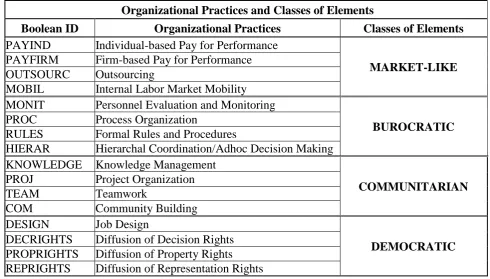
classes can ben embodied in the practices reported in Table 17:
Organizational Practices and Classes of Elements
Boolean ID Organizational Practices Classes of Elements
PAYIND Individual-based Pay for Performance
MARKET-LIKE
PAYFIRM Firm-based Pay for Performance
OUTSOURC Outsourcing
MOBIL Internal Labor Market Mobility MONIT Personnel Evaluation and Monitoring
BUROCRATIC
PROC Process Organization
RULES Formal Rules and Procedures
HIERAR Hierarchal Coordination/Adhoc Decision Making KNOWLEDGE Knowledge Management
COMMUNITARIAN
PROJ Project Organization
TEAM Teamwork
COM Community Building
DESIGN Job Design
DEMOCRATIC
[image:10.595.51.542.133.412.2]DECRIGHTS Diffusion of Decision Rights PROPRIGHTS Diffusion of Property Rights REPRIGHTS Diffusion of Representation Rights
Table 1 - Organizational Practices and Classes of Elements
These classes of elements are different in how they solve conflict and handle information
processing under condition of efficiency; and their differences are known thanks to economic and
organization design contributions (March and Simon, 1958; Thompson, 1967; Lawrence and
Lorsch, 1967; Williamson, 1991; 1993; Herbst, 1976; March, 1996). Drawing on these known
differences in the general properties of the elements, a set of combinatory rules regulating their
effective combination can be hypothesized. We hypothesize the following basic combinatory rule to
underly our example: elements belong to the same class are quasi-substituable because they
perform similar functions, elements belonging to different classes are complementary because they
perform different functions (Grandori and Furnari, 2006). Further, we assume that the system whose
activities and resources need to be coordinated can pursue three different objective functions, or
goals (Grandori and Furnari, 2005):
1) Efficiency, a proxy of cost minimizing;
2) Innovation, a proxy of value generation and discovering new activities/resources;
3) Justice, a proxy of the distribution of value with allocative efficiency and justice.
Finally, drawing on a slightly adapted version of Grandori and Soda' model (2006) we asssume
three relevant contingencies, which correspond to different types of uncertainty:
1) C-Uncertainty (or Contingency Uncertainty): uncertainty about which contingency will
occur, but with known classes of contingencies and relations with best actions;
2) A-Uncertainty (or Action Uncertainty): uncertainty on the relevant actions to be
performed in a given setting;
3) E-Uncertainty (or Epistemic Uncertainty): uncertainty on what the relevant actions and
contingencies are.
We further assume that, whatever of these three contingencies (or combination of them) will occur,
there exist some level of resource tension in the system to be coordinated.
Organizational Combinations and Mutiple Contingencies
With this setup in mind, we can start developing our example in Boolean terms, coding each
element of our problem -whether organizational practices, contingencies or objective functions- in
two states: present (=1) or absent (=0).
Let's start assuming the set of activities we need to coordinate is confronted with only one type
of uncertainty, say, "contingency uncertainty". In a similar situation, the application of formal
procedures, coupled with a moderate use of monetary incentives to cope with some level of
resource contraints should be sufficient to yield efficiency. We can express this situation in the
following boolean statement8:
(C-UNCERTAINTY) * (RULES) * (PAYIND + PAYFIRM) ----> EFFICIENCY (1)
Factoring the contingency factor in the above statement, we can see that at least two equifinal
combinations, each composed by two complementary organizational elements, can be used to
8 We do not report the absence of elements in the boolean formulas we'll show along the example. However, we believe the formalization of boolean formulas as combination of absence and presence conditions is most valuable for design purposes, given its ability to make asymmetry evident at a eye glance.
achieve efficiency under contingency uncertainty: formal procedures coupled with individual
economic incentives or formal procedures coupled with firm-based economic incentives. Moreover,
this statement suggests the distinction between the "core" (or necessary) elements from the
substituable elements that should be added to the core for the combination to be sufficient to
achieve the outcome. This reading would suggest the following: under condition of contingency
uncertainty, procedures can be identified as a core (necessary) element of highly efficient
combinations; however, this element per se is necessary but not sufficient to achieve high
efficiency, if not combined with either individual-based or firm-based incentives, which can be
thought as substituable elements. In this perspective, substituable elements should not be thought of
as less important than core elements. Indeed, without at least one of them, the formula will not
produce the outcome (that is, it will be not efficient). Substituable elements have just more
alternatives in a formula than necessary elements, but they are at least as important as necessary
ones for determining the occurrence of the outcome. Moreover, from a design perspective
substituability delimits the area of potential trade-offs among elements, suggesting the designer to
choose among substituable elements on the basis of a comparison of their relative costs more than
their (supposedly quasi-equal) advantages. Thus, substituable elements can be powerful in crafting
the "attention space" of organizational designers.
Suppose now that variations in evironmental conditions occur and that the actions required to
cope with them are not easily classifiable: the system should be now cope with both contingency
and action uncertainty at a time. In a situation like this, it should be necessary to add new elements
to the former organizational combination in order to achieve efficiency. Candidate elements can be,
for instance, some level of hierarchical decion-making to define priorities in the use of resources
and activities, together with the distribution of decision rights among the actors of the system in
order to allow them to adjust independently through ad hoc communication and information
exchange. This new organizational formula for efficiency can be expressed as following:
(C-UNCERTAINTY*A-UNCERTAINTY) * (RULES * HIERAR * DECRIGHTS)
[(PAYIND + PAYFIRM)] -- > EFFICIENCY (2)
Factoring the two contingency factors, we can easily identify the two equifinal combinations, each
composed by four complementary elements, that can be used to achieve high efficiency under the
simultaneous presence of both contingency and action uncertainty. Again, equifinalities and
necessary/sufficient elements): the combination of formal procedures, hierarchical decision-making
and the distribution of decision rights constitutes the "necessary core" of the higly efficient
formulas, with econmic incentives to serve as substituable attributes.
If we further add epistemic uncertainty to the contingency factors, we would need to rethink the
organizational formula to include some element enabling the discovery of what are the relevant
actions and contingencies. Candidate elements can be: teamwork joint-decision making or some
knowledge management mechanisms. As a consequence, the revised formula would look like:
(C-UNCERTAINTY * A-UNCERTAINTY * E-UNCERTAINTY) *
(RULES * HIERAR * DECRIGHTS) [(PAYIND + PAYFIRM) * (TEAM + KNOW)]
-- > EFFICIENCY (3)
The combination of procedures, hierarchal decision-making and distribution of decision rights is not
sufficient per se to foster high efficiency in condition of extreme uncertainty. In order to do so,
these elements should be combined with four other combinations of substituable elements, which
can be read as: either individual pay for performance or firm-based pay for performance combined
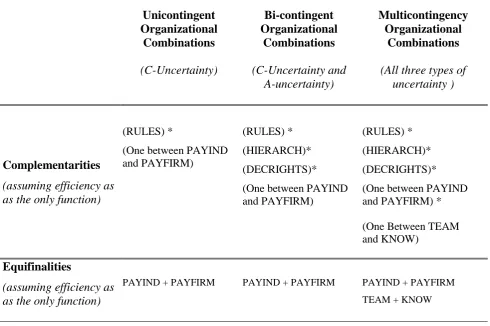
with either teamwork or knowledge management practices. We may summarize the results of this
Unicontingent Organizational
Combinations
(C-Uncertainty)
Bi-contingent Organizational
Combinations
(C-Uncertainty and A-uncertainty)
Multicontingency Organizational
Combinations
(All three types of uncertainty )
Complementarities
(assuming efficiency as as the only function)
(RULES) *
(One between PAYIND and PAYFIRM)
[image:14.595.54.545.98.424.2](RULES) *
(HIERARCH)*
(DECRIGHTS)*
(One between PAYIND and PAYFIRM)
(RULES) *
(HIERARCH)*
(DECRIGHTS)*
(One between PAYIND and PAYFIRM) *
(One Between TEAM and KNOW)
Equifinalities
(assuming efficiency as as the only function)
PAYIND + PAYFIRM PAYIND + PAYFIRM PAYIND + PAYFIRM TEAM + KNOW
Organizational Combinations and Multifunctionality
Let's recall for a moment the Boolean statement no. 1, introduced in the previous paragraph:
(C-UNCERTAINTY) * (RULES) * (PAYIND + PAYFIRM) ----> EFFICIENCY (1)
What happens if the outcomes to be achieved are both efficiency and innovation? Although the
system of activities in question is confronted only with "contingency uncertainty" -thus, it can be
thought of as a quite routinized system- neverthless we may want to foster some level of product or
process innovation in the system, without loosing efficiency along the way. To do so, we may need
to infuse in the above organizational formula new types of elements, whose properties can facilitate
the combination of competences, such as teamwork and knowledge management devices.
(C-UNCERTAINTY)*
(RULES) * [(PAYIND + PAYFIRM) * (TEAM +KNOW)]
----> EFFICIENCY*INNOVATION (4)
Suppose now we would like our system to achieve not only efficiency and innovation, but also an
acceptable level of allocative justice. In this case, a infusion of more democratic mechanisms is like
to be necessary, such as an enlarged representance of stakeholders in firm governance:
(C-UNCERTAINTY)*
(RULES)* (REPR) [(PAYIND + PAYFIRM)* (TEAM + KNOW)]
----> EFFICIENCY*INNOVATION*JUSTICE (5)
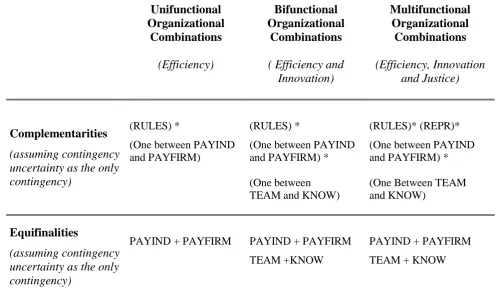
From the above statement, we may deduce that, even when a system is confronted with a single
contingency, effective combinations may combine different types elements due to
Unifunctional Organizational Combinations (Efficiency) Bifunctional Organizational Combinations
( Efficiency and Innovation) Multifunctional Organizational Combinations (Efficiency, Innovation and Justice) Complementarities (assuming contingency uncertainty as the only contingency)
(RULES) *
(One between PAYIND and PAYFIRM)
(RULES) *
(One between PAYIND and PAYFIRM) *
(One between TEAM and KNOW)
(RULES)* (REPR)*
(One between PAYIND and PAYFIRM) *
(One Between TEAM and KNOW)
Equifinalities
(assuming contingency uncertainty as the only contingency)
PAYIND + PAYFIRM PAYIND + PAYFIRM
TEAM +KNOW
PAYIND + PAYFIRM
[image:16.595.47.547.83.389.2]TEAM + KNOW
Table 3 - Organizational Combinations and Multifuncionality
Organizational Combinations across Multiple Contingencies and Functions
Let's suppose now we would like to discover what organizational combinations are best suited
to pursue all the three functions (efficiency, innovation and justice) at once when all the three types
of uncertainty are simultaneously in place. In this case, we can hypothesize the effective
organizational formula will encompass the necessary elements included in both formulas 3 and 5.
Thus, the resulting formula may look like:
(C-UNCERTAINTY * A-UNCERTAINTY * E-UNCERTAINTY) *
(RULES * HIERAR * DECRIGHTS * REPR) [(PAYIND + PAYFIRM) * (TEAM + KNOW)]
-- > EFFICIENCY*INNOVATION*JUSTICE (6)
This formula shows that higly multifunctional organizational combinations able to cope with
multiple simultaneous contingencies at once could be characterized by a reinforced core of
burocratic and democratic mechanisms, which should be completed by at least one element of
Implications for the Study of Complementarities and Substituabilities
The examples reported above show that BCA is well suited to take into account aymmetry,
multiple interaction effects, multiple contingencies and multifunctionality. Thus, this methodology
is promising for addressing the limitations encountered in available operationalizations of
multdimensional fit, both in configurationism and complementarity view.
Finally, we would like to stress a final theoretical implication by arguing that the use of these
methods can help to discriminate the distinctive sources of complementarities and substituabilities
among the elements of an organizational combination. Both complementarity view and
configurationism interpret the empirical co-occurrence of elements under performance as the neat
evidence of endogenous value-reinforcing effects among the co-occuring elements.
However, endogeneity can be one explanation which need to be tested against competing theoretical
explanations. For example, the joint application of a set of practices can be due the
multi-contingency, multi-task nature of the system under analysis, "so that the payoff of combining
mechanisms is partially due to the effectiveness of each single practice in solving different
problems" (Grandori and Furnari, 2006). Indeed, as the boolean formulas above show, even simple
system of action can be characterized by a variety of heterogenous coordination mechanisms under
effectiveness (Grandori and Soda, 2006). The desidered level of multifunctionality of a system can
complicate the matters further, constituting another competing source of complementarities and
equifinalities), well distinct from endogeneity. Neverthless, quite surprisingly, there have been no
systematic attempts to test these competing explanations against each other.
BCA provides a well established formal methodology to address this problem through the use of
set theory. Indeed, the elements to be combined or substitued under multiple contingencies can be
thought as a first set of elements. Presumably, portions of this first set will be shared by a second set
of elements, representing organizational elements to be combined or substitued in order to achieve
multiple goals at the same time. Endogeneity will be seriously challenged as theoretical argument to
explain why the elements of these two sets combine or substitute within each set. Plausibly, in this
case, multi-contingency and multifunctionality would be more robust sources of
complementarity/substituability. This does not mean that the endogeneity explanation should be
completely disregarded or that the endogeneity-effect can not interact with the other two
hypothesized sources. On the contrary, when complementarity and substituability among elements
were systematically detected to confront the same single contingency or pursue the same single
function, an endogenous interaction effect is more likely to be in place. In this context, BCA and set
at the level of various contingencies/functions, separately considered, are persistent as an increasing
number of contingencies/functions is added to the model. When unstable patterns of
complementarity or equifinality across contingencies/functions will be detected. This can help to
clarify further the relationship between interaction effects and conflicting or reinforcing
contingencies/functions. In this way, the elements empirically found to combine or substitute
among each other under effectiveness, could be described as elements of three different, yet
interelated, sets as in the picture showed below. The intersection of these sets will constitute the
[image:18.595.68.539.332.613.2]core of the multifunctional multicontingency highly performing organizational combinations.
References
Baligh H. H., Burton R. M., Obel B. (1996), Organizational consultant: creating usable theory for organizational design, Vol. 42, no 12: 1648-1662.
Baker D. D., & Cullen J. B. (1993), Administrative reorganization and configurational context: The contingent effects of age, size, and change in size, Academy of Management Journal, 36: 1251- 1277.
Black J. A., & Boal K. (1994), Strategic resources: Traits, configurations and paths to sustainable competitive advantage. Strategic Management Journal, 15: 131-148.
Child J. (1977), Organizational Design and Performance: Contingency Theory and Beyond,
Organization and Administrative Sciences, 8: 169-183
Child J. (2002), A configurational analysis of international joint ventures, Organization Studies, 23: 781–815.
Chandler A. (1962), Strategy and Structure, Cambridge, MA, MIT press.
Cohendet P. et al. (2004), Matching communities and hierarchies within firms, Journal of Management and Governance 8/1: 27-48.
Delery J. E. and Doty D. H. (1996),‘Models of theorizing in strategic human resource management: Test of universalistic, contingency and configurational performance predictions, Academy of
Management Journal, 39: 802-835
Dess, G. G., Lumpkin, G. T., & Covin, J. G. (1997), Entrepreneurial strategy making and firm performance: Tests of contingency and configurational models, Strategic Management Journal,
18(9): 677-695.
Doty, D. H., Glick, W. H. & Huber, G. P. (1993). Fit, equifinality, and organizational effectiveness: A test of two configurational theories. Academy of Management Journal, 36: 1196-1250.
Drazin, R., & Van de Ven, A. H. (1985), Alternative forms of fit in contingency theory.
Administrative Science Quarterly, 30: 514-539
Harrison J.S., Freeman R.E. (2004), Democracy in and around organizations, Academy of Mangement Executive 18/3, Special Topic.
Ferguson, T.D., & Ketchen, D.J. (1999), Organizational configurations and performance: The role of statistical power in extant research. Strategic Management Journal, 20: 385-395
Fiss P.C. (2006) A set-theoretic approach to organizational configurations, Academy of Management Review, forthcoming.
Galia F. (2006), Incentives,competencies and knowledge: evidence from France and theoretical integration., paper presented at DIME Conference, March 30-31, Lisbon
Grandori A. (1997), Governance structures, coordination mechanisms and cognitive models,
Journal of Management and Governance, vol. 1, no. 1, 1997, pp. 29-47.
Grandori A. (2001), Organization and Economic Behavior, London, Routledge.
Grandori A., Furnari S. (2006), The chemistry of organization: combinatory structural analysis and design, CRORA working paper series, no.18
Grandori A., Soda G. (2006), A relational approach to organization design, Industry and Innovation, 13/2:151-172 .
Gresov C. (1989), Exploring fit and misfit with multiple contingencies, Administrative Science Quarterly, 34: 431-453.
Gresov C., Drazin R. (1997), Equifinality: Functional equivalence in organization design, Academy of Management Review, 22: 403-428.
Herbst P.G. (1976), Alternatives to Hierarchies, Leiden, Martinus Nijhoff.
Laursen K., Manke V. (2001), Knowledge strategies, firm types and complementarity in human resource practices, Journal of Management and Governance 5/1:1-22.
Lawrence P., Lorsch J. (1967), Organization and environment. Harvard Business School.
March J.G. (1996), Democratic governance, New York: The Free Press.
March J.G., Simon H.A. (1958), Organizations, New York: Wiley
Meyer A.D., Tsui A.S., Hinings C.R. (1993), Configurational approaches to organizational analysis,
Academy of Management Journal, 36/6: 1175-1195.
Meyerson D, Weick K.E., Kramer R.M. (1996), Swift trust and temporary groups, in Kramer R.M., Tyler T. R. (eds.), Trust in Organizations: Frontiers of Theory and Research, Thousand Oaks Sage: 166-95.
Miles R. E., Snow C. C. (1978), Organization strategy, structure, and process, New York: McGraw-Hill.
Milgrom P., Roberts J., (1995), Complementarities and fit: Strategy, structure and organizational change in manufacturing, Journal of Accounting and Economics19: 179-208.
Miller D., Friesen P.H. (1978), Archetypes of strategy formulation, Management Science, , 24, no. 9: 921-933
Miller D. (1988), Relating Porter’s business strategies to environment and structure: Analysis and performance implications. Academy of Management Journal, 31: 280-308.
Mintzberg H. (1979), The structuring of organizations: A synthesis of research. Englewood Cliffs, NJ: Prentice-Hall.
Porter M. (1980), Competitive strategy, New York: Free Press.
Porter M. (1996), What is Strategy?, Harvard Business Review, 74 (6): 61-78
Ragin C. C. (1987), The comparative method: Moving beyond qualitative and quantitative strategies. Berkeley, CA: University of California Press.
Rivkin J. (2000), Imitation of complex strategies. Management Science, 46: 824-844
Schoonhoven, C. B (1981), Problems with Contingency Theory: Testing Assumptions hidden within the language of Contingency "Theory", Administrative Science Quarterly, 26: 349-377
Whittington R., Pettigrew A., Peck S., Fenton E., Conyon M. (1999), Change and
complementarities in the new competitive landscape: A European panel study 1992-1996,
Organization Science, 10/5: 583-600.
Williamson O.E. (1991), Comparative economic organizations: the analysis of discrete structural alternatives, Administrative Science Quarterly, 36: 269-296
Williamson O.E. (1993), The Evolving Science of Organization, Journal of Institutional and Theoretical Economics, 149: 36-63.
Thompson J. D. (1967), Organizations in Action, McGraw-Hill, New York.