City, University of London Institutional Repository
Citation
: Randell, R., Wilson, S., Woodward, P. and Galliers, J. R. (2010). Beyond
handover: supporting awareness for continuous coverage. COGNITION TECHNOLOGY & WORK, 12(4), pp. 271-283. doi: 10.1007/s10111-010-0138-3This is the accepted version of the paper.
This version of the publication may differ from the final published
version.
Permanent repository link:
http://openaccess.city.ac.uk/4593/Link to published version
: http://dx.doi.org/10.1007/s10111-010-0138-3
Copyright and reuse:
City Research Online aims to make research
outputs of City, University of London available to a wider audience.
Copyright and Moral Rights remain with the author(s) and/or copyright
holders. URLs from City Research Online may be freely distributed and
linked to.
Beyond handover: supporting awareness for
continuous coverage
Rebecca Randell¹, Stephanie Wilson², Peter Woodward² and Julia Galliers²
¹Leeds Institute of Molecular Medicine, University of Leeds, Wellcome Trust Brenner Building, St James's University Hospital, Leeds LS9 7TF
²Centre for HCI Design, City University London, UK
Tel: 0113 3438509
Abstract Hospitals are required to operate as a continuous system because patient care cannot be temporarily suspended and handover is seen as a key method for enabling this. This paper reports a study of handover in a medical admissions unit. We draw on the notion of awareness as conceptualised within the Computer Supported Cooperative Work literature to explore the role played by a variety of cognitive artifacts in supporting continuous coverage. While such awareness is typically characterised as being ‘effortless’, our study reveals that maintaining awareness in a context such as the medical admissions unit is effortful due to invisible work. We suggest that the notion of awareness is beneficial for exploring the practices of continuous coverage because it moves attention away from the moment of handover, instead encouraging consideration of the variety of practices through which clinicians display their work to, and monitor the work of, colleagues on different shifts. We argue that efforts to support continuous coverage should focus on improving awareness by increasing the visibility of information.
1. Introduction
Hospitals are open twenty-four hours a day, 365 days a year. They are required to operate as a continuous system because patient care cannot be temporarily suspended. As a result, hospital work is continuous, requiring what we will refer to as ‘continuous coverage’: the continuous availability of staff to undertake the activities involved in patient care.
Continuous coverage in the hospital is possible because of patterns of shift work, where one person or team is replaced by another who is considered, from the perspective of the organisation, to be their functional equivalent (Zerubavel 1979). However, this presents challenges in terms of the coordination of hospital work. In characterising the nature of collaboration, we can distinguish between synchronous collaboration, where participants in the collaboration are present at the same time (although not necessarily in the same place) allowing for immediate feedback, and asynchronous collaboration, where participants in the collaboration work at different times, introducing a delay in feedback. Collaboration between teams on different shifts is largely asynchronous.
Shift handover, a brief handover period of synchronous collaboration allowing for two way communication between teams on consecutive shifts, is seen as a key tool in ensuring continuous coverage. Handovers take place in a range of settings that require continuous operation, with varying levels of formality. For example, previous work reports on shift handovers within a NASA Space Center, nuclear power generation plants, railroad dispatch centres, and ambulance dispatch centres (Patterson et al. 2004). Other settings that require continuous operation include news services, police and fire services, and gas, electricity, water and telephone suppliers. Within healthcare, handover can be defined as the transfer of responsibility for a patient or group of patients from one person or group to another, typically accompanied by the sharing of information about the those patients (Junior Doctors Committee 2004).
The question of how to get handover ‘right’ is of escalating importance with shorter working hours for doctors and an increase in shift patterns of working. In the UK, doctors’ working hours were first reduced in 1991 by the New Deal for Junior Doctors, which limited junior doctors’ hours to 72 hours on duty and 56 hours of actual work (Jagsi and Surender 2004). Their hours have been further reduced by the European Working Time Directive (EWTD) to 48 weekly duty hours. Similar regulations have been introduced in the United States. These changes mean more frequent handovers and greater cross-coverage (where a patient is covered by a doctor who is not primarily responsible for their care).
This paper presents results from of a study of shift handover in a medical admissions unit (MAU). In analysing the collected data, we drew on the notion of awareness from the Computer Supported Cooperative Work (CSCW) literature. The key argument of this paper is that awareness is a useful concept for exploring practices for continuous coverage, and considering how to provide technological support for continuous coverage, on the basis that it moves attention away from the moment of handover. Instead, it encourages consideration of the variety of practices through which clinicians display their work to, and monitor the work of, colleagues on different shifts.
The following section presents the background and theory for this paper, firstly reviewing previous studies of handover and then considering the CSCW literature on awareness. We then present the methods of the study and the findings. In the discussion, we consider the nature of awareness within the MAU and the role that cognitive artifacts play in supporting that, the implications this analysis has for the design of technology to support handover, and the more general benefits of awareness as a concept for the analysis of practices for continuous coverage.
2. Background and theory
2.1 Previous studies of handover
previously cared for the patient (Kerr 2002). The ‘partial’ nature of handovers has been highlighted; shift handovers have been found to be given at high speed, using abbreviations and jargon that assume knowledge on the part of the listener (Ekman and Segesten 1995; Payne et al. 2000). Thus, we should see handovers not as reports but as conversations that demonstrate recipient design, where the speaker designs their talk in ways which display an orientation to the listeners (Nemeth et al. 2006).
While most studies of handover focus on the verbal handover itself, some authors point to the fact that there are a number of activities that surround the handover. Payne et al. (2000) describe the informal exchanges of patient information between the outgoing nurse and the incoming nurse. Similarly, Strange (1996) describes how, while waiting for the handover to begin, staff who have had days off will enquire whether the ward has been busy or which patients have been transferred. Kerr (2002) describes the updating of documents in preparation for the handover (the ‘pre-handover’ phase) and the collecting of information from documents afterwards (the ‘post-handover’ phase).
Shift handover should be viewed within the context of what we know about collaboration within and between healthcare teams more generally. Collaboration is an essential feature of hospital work (Strauss et al. 1997). Such collaboration involves both formal and ‘on the fly’ communication (Albolino et al. 2007) and breakdowns in information flow are common. For example, within the outpatient surgery preoperative process, Schultz et al. (2007) describe the difficulties that clinicians experience in accessing necessary patient information. These difficulties lead to clinicians spending significant time trying to access the necessary information, with negative consequences for patient care. Xiao et al. (2008) describe the challenges in surgical units of keeping all relevant parties informed of changes, because clinicians are widely distributed and busy with other tasks, and the disruptive nature of synchronous communication mechanisms.
2.2 Cognitive artifacts
The concept of cognitive artifacts comes from the theoretical perspective of Distributed Cognition (Hutchins 1995) and is used to refer to the potentially broad range of artifacts that provide representations of information used in support of cognition within a particular system (Nemeth et al. 2006). Distributed Cognition is concerned not only with the content of cognitive artifacts and how these are transformed in the accomplishment of work, but also the characteristics of those artifacts (e.g. physical durability, functional durability), their physical configuration and the impact this has on the distribution of access to information (Hutchins 1995). Cognitive artifacts may be endogenous, meaning that they are constructed by users in order to facilitate or support their work, or they may be
While cognitive artifacts may support the work of individuals, Distributed Cognition is concerned with how cognition is distributed amongst teams, their tools and their environment, and thus the role that cognitive artifacts play in supporting teamwork. While some cognitive artifacts are personal, presenting information typically to a single user and thereby displaying a low level of openness, others are public, making information synchronously accessible to a collocated team (Garbis 2002). The level of openness of a cognitive artifact depends not only on the design of that artifact, but also the practices that surround its use and the organisational setting.
The role of cognitive artifacts in supporting clinical work has been reported in a number of studies. For example, Wears et al. (2006) and Xiao et al. (2008) both characterise whiteboards as cognitive artifacts, describing their use in supporting communication and problem-solving in emergency rooms and operating rooms respectively. A number of qualitative studies highlight the use of a range of cognitive artifacts to support handover specifically. Documents found to support handover range from formal, legal documents to informal ‘scraps’ (Payne et al. 2000). The use of handover sheets, either printed or handwritten, have been found in a variety of settings (Randell et al. 2008). These artifacts may incorporate locally developed practices for highlighting particular information, such as using a different colour for recording what is perceived as particularly important information (Ekman and Segesten 1995). Such artifacts function as both public and private documents, having relevance for the whole ward while also acting as a personal workspace that staff use in organising their work (Wilson et al. 2006; Randell et al. 2008). Status boards are another form of cognitive artifact that has been found to be used in support of handover (Wears et al. 2006). Features of the status board that are considered to lead to their successful and continued use include their malleability, informality, accessibility and the fact that they are locally owned.
summary of the patient’s main information; an event sheet listing every patient mentioned during weekend handovers, when they were mentioned and why; and a patient list printed from one of the hospital’s patient information systems, broken up according to patient location (Alem et al. 2007). The acceptability of other standardised tools has also been explored, with an organisational readiness checklist, a suggested organisational policy and a handover protocol being the tools considered most useful (Quin et al. 2009). However, others point to the potential unintended consequences of standardising handover practices (Patterson 2008).
2.3 Awareness
In conducting the analysis presented in this paper, we have used the notion of awareness as it is characterised in the CSCW literature as a sensitising concept. While the concept of situation awareness (SA) is defined as “the perception of the elements in the environment within a volume of time and space, their comprehension and meaning, and the projection of their status in the near future” (Endsley 1988), the concept of awareness as it is used in CSCW is concerned with the practices through which actors display their activities to, and monitor the activities of, colleagues in order to support their collaborative work (Heath et al. 2002; Schmidt 2002). As such, awareness is seen as essential for effective collaborative work. Such awareness is typically characterised as being ‘effortless’ (Schmidt 2002), and workplace studies point to the way in which, when colocated, cooperating actors are able to align and integrate their activities through such mutual display and monitoring (Heath et al. 2002). For example, in their classic study of a London Underground control room, Heath and Luff (1992) describe how personnel with different roles and responsibilities monitor each other’s conduct and make visible their own activities, enabling them to identify contingencies which may have consequences for their own activities or those of their colleagues. Such awareness is referred to as by-product awareness, being generated in the course of activities (Simone and Bandini 2002). This is in contrast to add-on awareness, where colleagues do additional work in order to display to colleagues the status of the work and their activities and/or to monitor the work of colleagues. Examples of add-on awareness include the creation and updating of representations of the work, such as Gantt charts, and explicit communication about the status of the work, such as emails regarding the progress of a particular activity.
the course of their work but also making that work visible to colleagues. Through making work visible, cognitive artifacts increase awareness amongst collocated teams, thereby supporting collaboration.
Concern for awareness in CSCW initially grew out of acknowledgement that, when collaborating remotely, access to awareness information is limited, impacting the ability to coordinate actions (Gutwin et al. 1996). Emphasis has been placed on approaches to supporting awareness within groupware systems that do not require additional effort on the part of users, by-product awareness rather than add-on awareness (Dourish and Bellotti 1992). These studies provide descriptions of different levels and forms of awareness, including workspace awareness, concerned with knowledge about others’ interaction with a shared workspace (Gutwin et al. 1996; Gutwin and Greenberg 2002), and activity awareness, which extends the notion of workspace awareness to provide information on interrelated activities in individual workspaces (Nomura et al. 1998; Hayashi et al. 1999). While early development work focused on office settings and activities such as collaborative writing, recent work has explored a wider range of settings and activities. Within healthcare, collaboration within a surgical department has been explored and three types of necessary awareness information have been suggested: social awareness, such as the location and activities of colleagues; spatial awareness, relating to what is happening in a particular location; and temporal awareness, about past, present and future activities (Bardram et al. 2006).
Such concern for supporting awareness has largely focused on physically distributed collaborative work. As such, we know little about the practices used by those who are temporally distributed to maintain awareness of each other’s work, as in the case of clinicians working on different shifts, or how to provide technological support for such temporally distributed collaboration. In the following sections, we describe the methods and findings from our study of handover in an MAU, focusing on how cognitive artifacts are used to support awareness across shifts.
3. Methods
3.1 Data collection
findings of previous studies, we made no prior assumptions about what constitutes a cognitive artifact and paid attention to both formal and informal representations (Payne et al. 2000).
In undertaking the observations we sought to be as non-intrusive as possible, so as to reduce any influence generated by the presence of the researchers. Thus, rather than shadowing particular staff members, we positioned ourselves in particular locations, such as at the nurses’ station and in the doctors’ room, where we could observe what was happening without drawing too much attention to our presence. Special attention was given to the interpretations and concerns of those in the setting (Emerson et al. 1995), with interviews being conducted with staff members to gain their perspective on the work of handover. However, these interviews were ad hoc and informal in nature, again motivated by the desire to reduce any influence generated by the presence of the researchers. The observations were undertaken by two of the authors (RR and PW).
While the observation protocol provided guidance on data collection, it was not intended to limit the data collection; following in the ethnographic tradition, the researchers kept the scope of the notes wide, on the basis that what previously seemed insignificant may come to take on new meaning in light of subsequent events (Hammersley and Atkinson 1995). As previous studies of handover highlight the situated nature of handover practices, we considered it important to take the time to understand the work of the setting.
Initial observations were carried out over a two-week period in November 2007. This was followed by a further two-week period of observation in March 2008, focusing on the practices of the acute medicine team based on this ward. Following each period of observation, fieldnotes were written up and entered into Atlas.ti, software for indexing and analysis of qualitative data.
Research Ethics Committee approval was obtained for this study and written consent was obtained from both staff and patients that participated in the study.
3.2 Analysis
The analysis presented in this paper focuses on the use of cognitive artifacts within the setting and particularly the role of the doctors’ list. To analyse the data gathered on cognitive artifacts and their use, we used Framework Analysis, an analytical approach developed for conducting applied qualitative research (Ritchie and Spencer 1994). This involves moving through the stages of familiarisation, identification of a thematic framework, indexing, charting, and mapping and interpretation.
the characteristics of those artifacts, their physical configuration and the impact this has on the distribution of access to information and subsequent processing.
4. Findings
Drawing on the work of Hutchins (1995) and following the example of Garbis (2002), we present our findings according to three levels of detail. At the first level, we describe the setting and provide a general overview of the work in the MAU. At the second level, we turn to consider the cognitive artifacts that are used and the role that they play within the setting. At the third level, we present a detailed analysis of the use of a particular cognitive artifact, the doctors’ list, considering the ways in which it is accessed and transformed.
4.1 The medical admissions unit
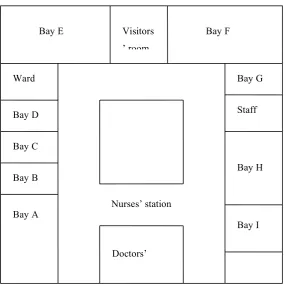
The MAU is a 28-bed ward in a large inner city hospital. Patients who come to Accident & Emergency (A&E) and who are considered to require hospital admission are brought to the MAU for initial assessment before being transferred to an appropriate ward or being discharged. As such, the MAU is characterised by frequent movement of patients into and out of the ward. There is a wide range of patients in terms of age and medical condition.
Fig. 1 Layout of the MAU
Fig. 2 The nurses’ station
Fig. 3 The doctors’ room
Doctors’ room Bay A
Bay C Bay D Ward office
Bay E Visitors ’ room
Bay F
Bay G
Staff room
Bay H
Bay I Nurses’ station
[image:11.595.153.440.72.358.2] [image:11.595.71.450.392.533.2] [image:11.595.70.286.582.739.2]There are a range of clinical and non-clinical staff working on the ward: the ward medical staff (referred to as the acute medicine team), nursing staff, health care assistants (HCAs), physiotherapists, occupational therapists, pharmacists and the ward clerk. Patients are also visited by staff from teams that are not based on the ward, such as the cardiac team. There are typically three nurses and three HCAs on each shift and one charge nurse.
The day acute medicine team is organised into two sub-teams, each typically consisting of one specialist registrar (SpR), a senior house officer (SHO) and one or two house officers (HOs). One of these teams is referred to as the ‘on-take team’, responsible for clerking patients as they are admitted, and the other team is referred to as the ‘second on team’, responsible for attending to patients previously admitted. The consultant on duty changes each week and the consultant sees all patients on the first ward round following the patient’s admission. At night, the acute medicine team consists of one SpR and one SHO, responsible for both clerking patients and attending to patients on the MAU and elsewhere in the hospital.
The junior doctors (the SHOs and HOs) arrive on the ward at 7:30 a.m. At 8 a.m., the consultant and the night team arrive and the post-take ward round (PTWR) begins, where all patients who were admitted overnight or the previous day are seen. This is attended by the on-take team, the consultant and the night team. The PTWR happens in two stages; first they see all patients admitted overnight so that the night team can present these patients, providing a verbal handover, and then leave; then they see all patients admitted the previous day. During the PTWR, whoever clerked the patient typically presents them to the consultant. This takes place in the corridor, outside the appropriate bay. They normally describe the presenting complaint, as well as often giving social information, such as how much the patient smokes and drinks. They say what they think the possible diagnosis is and what they propose as a care plan. They then go into the bay to see the patient, where the consultant does a physical examination of the patient and asks the patient about their complaint. When they come out of the bay and back into the corridor, the consultant says what he thinks the diagnosis is and what should be done next in terms of treatment and/or investigations.
At the same time as the PTWR, the second on team do another ward round, seeing all patients who have been on the ward for more than 24 hours and so have been seen by the consultant on a previous ward round.
following day. It is attend by the consultant, the on-take team, the second on team, the charge nurse, the pharmacist, the occupational therapist and the physiotherapist.
Following the ward round and board round, there are jobs to be done by the junior doctors, such as ordering and following up investigations. The on-take team may clerk patients either while they are in A&E or once they are brought to the MAU, depending on the speed at which patients are moved. The second on team spend the rest of day moving between the MAU and the High Dependency Unit (HDU) where they are also responsible for patients.
At 8 p.m., the night acute medicine team team take over responsibility for patients on the ward, following a verbal handover from the on-take SpR and SHO.
4.2 Cognitive artifacts within the medical admissions unit
Previous studies of collaborative work in healthcare describe the variety of artifacts that are used to support hospital work (Bossen 2002; Fitzpatrick 2004). Within the MAU, there are a range of electronic and paper-based cognitive artifacts that provide different information, and different views of that information, about patients on the ward. Rather than attempting to describe all of these artifacts, we focus on describing those artifacts that are used by the acute medicine team.
The primary repository of patient information is the medical record. The medical records for all patients on the ward are stored in two trolleys, one placed either side of the entrance to the doctors’ room. These are used not only by the acute medicine team but by all members of clinical staff on the MAU. Before the ward round, the on-take team and the second on team gather together the medical records for the patients that they need to see, placing them on small mobile stands that are wheeled around the ward during the ward round.
As described above, during the PTWR whoever clerked the patient typically presents them to the consultant. In doing this, they refer to the patient history that they recorded in the medical record. Following the consultant’s examination of the patient, when the consultant says what s/he thinks the diagnosis is and what should be done next, the HO fills in the PTWR form which is then placed in the medical record.
would sometimes return to the doctors’ room during the ward round to look at x-rays and CT scans. The nurses were no longer charting patients’ vital signs on paper but were recording them on PDAs, so the doctors were also able to use the tablet PCs to access the patients’ vital signs, rather than looking at the paper chart which was previously kept at the end of the patient’s bed. Both of these changes were introduced as part of a project within the ward to improve access for staff to patient information.
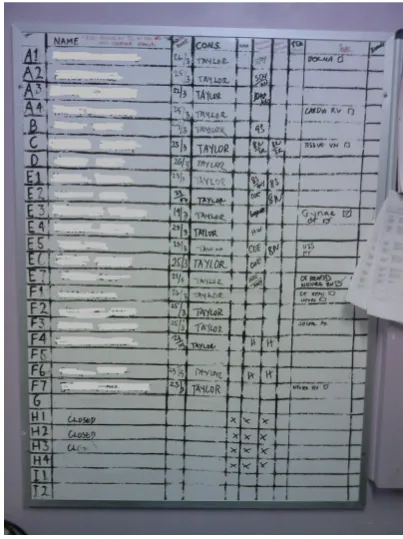
While the medical record and the electronic cognitive artifacts provide detailed information about individual patients, we can identify two cognitive artifacts in the MAU that attempt to provide an overview of patients on the ward. In the doctors’ room there is a whiteboard which lists all the patients in the ward, according to bed number (Figure 4). The board records the patient’s name, the date that they were admitted, the consultant that they are under the responsibility of, the date that they are expected to be discharged, the ward that they should be sent to, and any investigations that are required. It is updated throughout both day and night shifts by the MAU charge nurse, removing patients as they are discharged or moved to another ward and adding patients as they are brought to the MAU. In the board round, the charge nurse stands at the whiteboard and records on the whiteboard the decisions that are made about which wards patients should be moved to and investigations that are required.
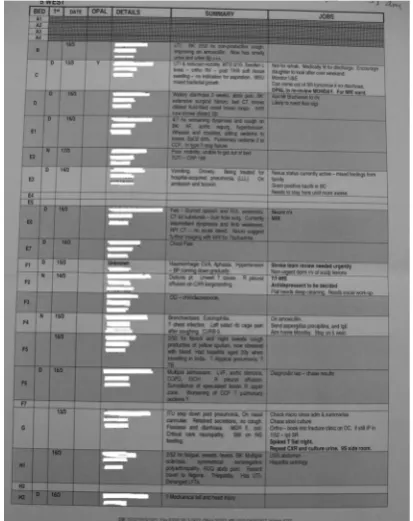
[image:14.595.70.272.418.688.2]The acute medicine team also use what is referred to as the ‘doctors’ list’ to provide an overview of patients on the ward (Figure 5). The doctors’ list is a Word document with three tables. The first table provides details of all patients on the MAU. The second table provides details of all patients on the HDU, as many of the patients on the HDU are also under the responsibility of the acute medicine team. The final table has details of ‘outliers’, patients who are under the responsibility of the acute medicine team but who, due to a shortage of empty beds, have been placed on other wards. For each patient, the bed number, whether they were admitted during the day or at night, date of admission, name, hospital number and date of birth is given, along with a ‘summary’ (the presenting complaint, possibly a diagnosis, and sometimes the results of investigations that have been carried out) and ‘jobs’ (e.g. blood results to ‘chase’, a specialist review that needs to be done, activities to be done before the patient can go home). As well as the electronic copy stored on one of the computers in the doctors’ room, each member of the acute medicine team has their own paper copy that they can annotate and refer to throughout the shift.
Fig. 5 The doctors’ list
The following section describes in more detail how the doctors’ list is used and transformed throughout the day.
4.3 The role of the doctors’ list
[image:15.595.70.277.331.592.2]and effort in updating the doctors’ list. When they first arrive on the ward in the morning, the junior doctors update the doctors’ list by using the whiteboard to gather the names of the patients that have been admitted, to see which patients have left the ward, and to see if any patients have moved to another bed within the ward. Names of new patients are added to the doctors’ list and a sticker with the patient’s name, hospital number and date of birth (a page of which are printed when the patient is admitted) is taken from the patient’s medical record. The date of birth and hospital number is copied from the sticker onto the doctors’ list. Once the doctors’ list has been updated, a copy is printed for each member of the acute medicine team. During the day shift, copies of the doctors’ list are used by all members of the acute medicine team, including the consultant, as well as by the pharmacists.
As noted above, in preparation for the ward round, the junior doctors gather together the medical records for patients to be seen, putting them in the order in which patients will be seen. A grey background on a row of a table on the doctors’ list indicates that a patient needs to be seen on the PTWR, so that both the on-take team and the second on team know which patients they need to see. The doctors’ list also helps to order the PTWR because it indicates which patients were admitted overnight; these patients are seen first so that the night team can hand them over and then leave.
During the ward round, junior doctors make notes on their printed copies of the doctors’ list, regarding jobs that need to be done. Following the ward round (often during the board round), the junior doctors update the electronic copy of the doctors’ list with details of jobs as they were decided on during the ward round, also adding ‘summary’ details for patients admitted overnight if they have not been added already. However, the updated doctors’ list does not get printed at that point and the junior doctors continue to refer to the copy of the doctors’ list that they printed out at the beginning of the shift. The list supports the junior doctors’ work through the remainder of the shift, as they refer to it to check what tasks they need to do and then tick those tasks that they have completed.
It is typically not until later in the afternoon that the doctors’ list gets updated again. Again, the whiteboard is used to see which patients are on the ward and which have left. Jobs that have been completed can be removed from the list. The junior doctors check lab results using the lab results system; if the results are not there, a note is added to the doctors’ list to ‘chase’. Certain jobs are written in bold to draw the night acute medicine team’s attention to them. A grey background is added to those rows that give details of patients who have been admitted that day, indicating that they need to be seen on the PTWR the following morning.
of the on-take team that is providing the information will have the patient’s hospital number and date of birth. Afterwards, the junior doctor updating the list has to make sure that there is a hospital number and date of birth recorded for each patient on the doctors’ list. If the patient is already on the ward, these are accessed using the stickers in the patient record, as in the morning. Otherwise, the junior doctor searches the lab results system, using the patient’s name, as the patient’s hospital number and date of birth will be on any entries for them. The following fieldnote extract describes this process:
7:15 p.m. The house officer (HO) is updating the electronic copy of the doctors’ list. She updates four entries, looking at her paper copy of the doctors’ list and the annotations that she has made on it through the shift. The on-take SpR comes to the ward and tells the HO they’ve got 20 new patients. The SpR at first reads out the details from a sheet of paper while the HO types but he then puts down the sheet so that she can just copy from it. The sheet of paper has a list of patient names, some with stickers, some details, although most of the details he gives appear to be from memory. It feels very rushed – the SpR moves on to talk about the next patient while the HO is still typing. The HO has to insert more rows into one of the tables.
7:33 p.m. The update is done and the SpR leaves the ward, taking his scrap of paper with him. The HO writes down the names of some of the new patients (ones that are now on the ward) on a scrap of paper and says to me that she will ‘grab some stickies’. She comes back with stickers and from these she gets the patient hospital number and date of birth and enters these onto the doctors’ list. She then enters a summary for one patient – she doesn’t use any notes and so it seems that this is from memory. Where outliers have been moved to the MAU, she cuts and pastes from the outliers list to the appropriate places on the MAU list. She then makes a second trip to get stickers.
For patients that are not yet on the ward, she looks them up on ICE [the software used within the hospital for accessing lab results] and from here copies their hospital number and date of birth onto a scrap of paper. She does this for four patients. She then types these into the doctors’ list. She searches ICE for a name she was given by the SpR, but in fact the spelling was incorrect. She corrects the spelling of the name on the list and adds the date of birth and hospital number. She then searches ICE again for another two patients.
She then answers the phone – it is the on-take SHO. The SHO gives names of 10 patients and the HO checks that she has them on the list. There appear to be three that she doesn’t have – she takes the names and then, after speaking on the phone, adds them to the doctors’ list. She finishes updating the sheet at 7:55 p.m. and prints 7 copies.
(Fieldnotes, Monday 17th March 2008, RR)
medicine team with a summary of all patients on the MAU, with details of any jobs to be done, which the team can refer to if called to see any patients on the MAU overnight.
5. Discussion
We have described the cognitive artifacts used by the acute medicine team on the MAU, paying particular attention to the doctors’ list. We can consider the doctors’ list as a cognitive artifact designed to provide awareness, as understood in the CSCW literature, across shifts. In this section, we consider the role that cognitive artifacts play in supporting awareness amongst temporally distributed teams, what awareness means within the context of the MAU and the challenge of maintaining awareness within this setting, and the potential of awareness as a concept for exploring continuous coverage.
5.1 Cognitive artifacts as tools for awareness
In Section 2, we described studies from CSCW that had explored the role of cognitive artifacts in the creation of awareness amongst collocated teams. Here we consider the role that cognitive artifacts play in the creation of awareness amongst temporally distributed teams in the MAU and the features of those artifacts that appear relevant to the creation of that awareness.
In our account of the work of the medical admissions unit, we see both formal and informal methods for communication between temporally distributed teams. The PTWR and the handover at the end of the day to the night team both provide formal opportunities for temporally distributed teams to communicate about the status of patients on the MAU and tasks that need to be undertaken. However, these opportunities for verbal communication are not adequate for ensuring continuous care. The junior doctors need to know which patients are on the ward before they receive the verbal handover from the night team on the PTWR, in order to be able to prepare for the PTWR. At this time, the night team is elsewhere in the hospital. The preparation of the doctors’ list not only helps to organise the PTWR, but it also provides a resource that can be referred to and used to organise work through the shift. Similarly, before handing over to the night team, informal communication within the team is necessary, because new patients will have been admitted. This informal communication is used to update the doctors’ list, establishing a picture of the current state of the ward before handing over to the night team.
clerked. The whiteboard is a public artifact, in the sense that it makes information synchronously visible to a whole range of staff members.
Similarly, the doctors’ list, both in its electronic version and the paper copies, plays a pivotal role in supporting awareness across shifts, although the features are rather different to those of the whiteboard. While much work on awareness has highlighted the benefits of situated displays (Bardram et al. 2006; Cheverst et al. 2007), a key feature of the doctors’ list is the mobility of the paper copy, essential when the work of the team is distributed across the hospital. This allows access to the necessary information as it becomes relevant, for example, when called to see a particular patient. Such paper copies also enable members of the acute medicine team to add notes to their copy that are relevant specifically to them and to use them as tools to coordinate their work. In this sense, the doctors’ list is both personal and public. The ability to adapt the doctors’ list to these different roles suggests malleability and informality, qualities previously highlighted as important for cognitive artifacts (Wears et al. 2006).
5.2 Multiple levels of awareness
Previous work on awareness in the CSCW literature suggests different areas of awareness. For example, Bardram et al. (2006), based on their study of collaborative work in a surgical ward, talk of the need for social, spatial and temporal awareness. However, such studies tend to focus on physically distributed collaborative work, raising the question of what awareness is required when collaborative work is distributed across time. What we see in the MAU is awareness of what we could refer to, in the broader sense of the term, as workspace awareness but at multiple levels of detail. There is the high level awareness obtained by a quick glance at the whiteboard. However, for work to be ongoing, for care to be continuous, oncoming staff need to know not only which patients are on the ward and where they are located, but also jobs that need to be completed in relation to those patients and a summary of the patient’s condition, in order to support completion of the tasks, and it is this level of awareness that is provided by the doctors’ list.
It is interesting to note that information about who did what is absent from both the whiteboard and the doctors’ list. This is in contrast to previous studies of awareness amongst physically distributed colleagues, which emphasise the need for information about the activities of individual colleagues. Because of the concept of functional equivalence on which continuous coverage relies, who did what is not important for awareness (although it may be important for accountability).
5.3 Awareness as effortful
in subsequent shifts. Thus it is add-on awareness, rather than by-product awareness. The nature of asynchronous collaboration means that collaborators do not observe their colleagues at work, their work is invisible to them. In other contexts, one can imagine that evidence of the work may remain, for example, a product of the work, such as a report, completed or not, or a by-product, whether that is a messy desk, the presence of books relating to a particular topic, or ideas sketched out on a whiteboard. However, in the context of the MAU, evidence of work done, and therefore awareness of what needs to be continued (e.g. samples submitted to the lab, results of which need to be chased up) are often hidden within the virtual spaces of the hospital.
The challenge of awareness in the MAU is increased by lack of integration amongst the virtual spaces, leading to a complex pattern of information flows. The charge nurse updates the whiteboard but also has to update the bed management software, which takes the patient’s date of birth and hospital number from the patient administration system (PAS). Junior doctors take the patient name from the whiteboard and then use either the medical record or lab results system to access the date of birth and hospital number. Information about whether or not a lab result is ready is contained within the lab results system but the junior doctors have to search for the patient in the system in order to make this information visible on the doctors’ list.
done in the previous shift and to display their work to those who will be carrying on the work in subsequent shifts.
5.4 Awareness as a concept
As stated before, handover is seen as a key tool in ensuring continuous coverage. An assumption in the literature on handover is that, without the information communicated in the handover, the ability to assess the status of the patient and to plan care is compromised (Dowding 2001). However, rather than focusing on the information that is verbally communicated in the handover, the analysis presented in this paper has focused on the cognitive artifacts that provide awareness across shifts.
Previous studies of handover point to other purposes, beyond supporting continuity of care, that handovers serve, such as providing training, team cohesion and support for staff (Kerr 2002; Behara et al. 2005). Others have pointed to the ‘surveillance’ aspect of handovers, where oncoming staff members assess the completeness of the work of those handing over (Manias and Street 2000). We suggest characterising the primary goal of handover as being that of ensuring adequate awareness, which in turn enables continuous coverage. This goal is not restricted to handovers that take place within healthcare, being relevant for handovers that take place in any organisation that requires continuous operation, such as the police and fire services, industrial plants and gas, electricity, water and telephone suppliers.
Such a perspective is beneficial because it moves attention away from the moment of handover, itself a form of add-on awareness, instead encouraging consideration of the variety of practices through which those in the setting display their work to, and monitor the work of, colleagues on different shifts. As noted in the introduction to this paper, handover is not a foolproof method for ensuring continuity and its role in adverse events has previously been highlighted. Therefore, moving attention away from the moment of handover, instead increasing visibility of information within the system as a whole, may be a more beneficial approach. While we have focused on handover within the hospital setting, we hope that others will explore the relevance of these ideas to other organisations that require continuous coverage.
Acknowledgements
References
Albolino, S., R. Cook and M. O’Connor (2007). Sensemaking, safety, and cooperative work in the intensive care unit. Cognition, Technology & Work 9(3): 131-137.
Alem, L., M. Joseph, S. Kethers, C. Steele and R. Wilkinson (2007). Supporting weekend handover in a medical ward: a case study. Handover: Collaboration for Continuity of Work - ECSCW'07 Workshop, Limerick, Ireland.
Australian Commission on Safety and Quality in Health Care (2009). The OSSIE Guide to Clinical Handover Improvement. Sydney, ACSQHC.
Bardram, J. E., T. R. Hansen and M. Soegaard (2006). AwareMedia: a shared interactive display supporting social, temporal, and spatial awareness in surgery. Proc. CSCW 2006, Banff, Alberta, Canada, ACM.
Behara, R., R. Wears, S. Perry, E. Eisenberg, M. L., M. Vanderhoef, M. Shapiro, C. Beach, P. Croskerry and K. Cosby (2005). A Conceptual Framework for Studying the Safety of Transitions in Emergency Care. Advances in Patient Safety 2: 309-321.
Bhabra, G., S. MacKeith, P. Monteiro and D. D. Pothier (2007). An experimental comparison of handover methods. Ann R Coll Surg Engl 89: 298-300.
Bossen, C. (2002). The parameters of common information spaces: the heterogeneity of cooperative work at a hospital ward. Proceedings of the 2002 ACM conference on Computer supported cooperative work. New Orleans, Louisiana, USA, ACM.
Cabitza, F., M. Sarini, C. Simone and M. Telaro (2005). When once is not enough: the role of redundancy in a hospital ward setting. Proc. GROUP'05 Sanibel Island, Florida, USA, ACM.
Cheverst, K., A. Dix, D. Fitton, M. Rouncefield and C. Graham (2007). Exploring Awareness Related Messaging Through Two Situated-Display-Based Systems. Human-Computer Interaction 22(1): 173 - 220.
Dourish, P. and V. Bellotti (1992). Awareness and coordination in shared workspaces. Proc. CSCW '92 Toronto, Ontario, Canada, ACM.
Dowding, D. (2001). Examining the effects that manipulating information given in the change of shift report has on nurses' care planning ability. Journal of Advanced Nursing 33(6): 836-846.
Ekman, I. and K. Segesten (1995). Deputed power of medical control: the hidden message in the ritual of oral shift reports. Journal of Advanced Nursing 22(5): 1006-1011.
Emerson, R., R. Fretz and L. Shaw (1995). Writing Ethnographic Fieldnotes. University of Chicago Press, Chicago.
Endsley, M. R. (1988). Design and evaluation for situation awareness enhancement. Proceedings of the Human Factors Society 32nd Annual Meeting, Santa Monica, CA, Human Factors Society.
Fitzpatrick, G. (2004). Integrated care and the working record. Health Informatics Journal 10(4): 291-302.
Gandhi, T. K., A. Kachalia, E. J. Thomas, A. L. Puopolo, C. Yoon, T. A. Brennan and D. M. Studdert (2006). Missed and Delayed Diagnoses in the Ambulatory Setting: A Study of Closed
Garbis, C. (2002). Exploring the Openness of Cognitive Artifacts in Cooperative Process Management. Cognition, Technology & Work 4: 9-21.
Gawande, A. A., M. J. Zinner, D. M. Studdert and T. A. Brennan (2003). Analysis of errors reported by surgeons at three teaching hospitals. Surgery 133: 614-21.
Grainge, C., E. Traer and J. Fulton (2005). Do weekend plan standard forms improve communication and influence quality of patient care? Postgrad Med J 81: 524-525.
Grayson, D., S. Boxerman, P. Potter, L. Wolf, C. Dunagan, G. Sorock and B. Evanoff (2005). Do Transient Working Conditions Trigger Medical Errors? Advances in Patient Safety 1: 53-64.
Gutwin, C. and S. Greenberg (2002). A Descriptive Framework of Workspace Awareness for Real-Time Groupware. Comput. Supported Coop. Work 11(3): 411-446.
Gutwin, C., M. Roseman and S. Greenberg (1996). A usability study of awareness widgets in a shared workspace groupware system. Proc. CSCW '96, Boston, Massachusetts, United States, ACM.
Hammersley, M. and P. Atkinson (1995). Ethnography: principles in practice. Routledge, London.
Hayashi, K., T. Hazama, T. Nomura, T. Yamada and S. Gudmundson (1999). Activity awareness: a framework for sharing knowledge of people, projects, and places. Proc. ECSCW '99, Copenhagen, Denmark, Kluwer Academic Publishers.
Heath, C. and P. Luff (1992). Collaboration and Control: Crisis Management and Multimedia Technology in London Underground Line Control Rooms. Journal of Computer Supported Cooperative Work 1(1): 24-48.
Heath, C., M. S. Svensson, J. Hindmarsh, P. Luff and D. vom Lehn (2002). Configuring Awareness. Comput. Supported Coop. Work 11(3-4).
Hughes, J. A., D. Randall and D. Shapiro (1992). Faltering from ethnography to design. Proceedings of the 1992 ACM conference on Computer-supported cooperative work, Toronto, Ontario, Canada, ACM.
Hutchins, E. (1995). Cognition in the wild. MIT Press, Cambridge, MA.
Jagsi, R., B. T. Kitch, D. F. Weinstein, E. G. Campbell, M. Hutter and J. S. Weissman (2005). Residents Reports on Adverse Events and Their Causes. Archives of Internal Medicine 165: 2607-2613.
Jagsi, R. and R. Surender (2004). Regulation of junior doctors' work hours: an analysis of British and American doctors' experiences and attitudes. Social Science & Medicine 58: 2181-2191.
Jones, P. H. and C. P. Nemeth (2005). Cognitive Artifacts in Complex Work. Ambient Intelligence for Scientific Discovery.152-183.
Junior Doctors Committee (2004). Safe handover: safe patients. London, British Medical Association.
Kerr, M. P. (2002). A qualitative study of shift handover practice and function from a socio-technical perspective. Journal of Advanced Nursing 37(2): 125-134.
Manias, E. and A. Street (2000). The handover: uncovering the hidden practices of nurses. Intensive and Critical Care Nursing 16: 373-383.
Nemeth, C. P., M. O'Connor, P. A. Klock and R. I. Cook (2006). Discovering Healthcare Cognition: The Use of Cognitive Artifacts to Reveal Cognitive Work. Organization Studies 27(7): 1011-1035.
Nomura, T., K. Hayashi, T. Hazama and S. Gudmundson (1998). Interlocus: workspace configuration mechanisms for activity awareness. Proc. CSCW '98, Seattle, Washington, United States, ACM.
Patterson, E. S. (2008). Structuring flexibility: the potential good, bad and ugly in standardisation of handovers. Qual. Saf. Health Care 17: 4-5.
Patterson, E. S., E. M. Roth, D. D. Woods, R. Chow and J. O. Gomes (2004). Handoff strategies in settings with high consequences for failure: lessons for health care operations. International Journal for Quality in Health Care 16(2): 125-132.
Payne, S., M. Hardey and P. Coleman (2000). Interactions between nurses during handovers in elderly care. Journal of Advanced Nursing 32(2): 14.
Petersen, L. A., T. A. Brennan, A. C. O'Neil, E. F. Cook and T. H. Lee (1994). Does Housestaff Discontinuity of Care Increase the Risk for Preventable Adverse Events? Annals of Internal Medicine 121(11): 866-872.
Quin, D. M., A. L. Moulden, S. H. Fraser, O. K. Lee and P. McGarrity (2009). Evaluation of the acceptability of standardised clinical handover tools at four Victorian health services. Med J Aust. 190(11 Suppl): S141-3.
Randell, R., P. Woodward, S. Wilson and J. Galliers (2008). Public yet private: the status, durability and visibility of handover sheets. 21st IEEE International Symposium on Computer-Based Medical Systems, Jyväskylä, Finland.
Ritchie, J. and L. Spencer (1994). Qualitative data analysis for applied policy research. Analyzing qualitative data. In: A. Bryman and R. G. Burgess. Routledge, London.
Schmidt, K. (2002). The Problem with 'Awareness': Introductory Remarks on 'Awareness in CSCW'. Comput. Supported Coop. Work 11(3): 285-298.
Schultz, K., P. Carayon, A. Hundt and S. Springman (2007). Care transitions in the outpatient surgery preoperative process: facilitators and obstacles to information flow and their consequences. Cognition, Technology & Work 9(4): 219-231.
Simone, C. and S. Bandini (2002). Integrating Awareness in Cooperative Applications through the Reaction-Diffusion Metaphor. Comput. Supported Coop. Work 11(3): 495-530.
Strange, F. (1996). Handover: an ethnographic study of ritual in nursing practice. Intensive and Critical Care Nursing 12: 106-112.
Strauss, A. L., S. Fagerhaugh, B. Sucze and C. Wiener (1997). Social Organization of Medical Work. Transaction Publishers, New Brunswick, New Jersey.
Turner, P., M. C. Wong and K. C. Yee (2009). A standard operating protocol (SOP) and minimum data set (MDS) for nursing and medical handover: considerations for flexible standardization in developing electronic tools. Stud Health Technol Inform. 143: 501-6.
Wilson, S., J. Galliers and J. Fone (2006). Not All Sharing Is Equal: The Impact of a Large Display on Small Group Collaborative Work. Proceedings of the 2006 20th anniversary conference on Computer supported cooperative work, Banff, Alberta, Canada, ACM.
Xiao, Y., P. Hu, J. Moss, J. de Winter, D. Venekamp, C. Mackenzie, F. Seagull and S. Perkins (2008). Opportunities and challenges in improving surgical work flow. Cognition, Technology & Work 10(4): 313-321.