City, University of London Institutional Repository
Citation:
Acharya, V. V. & Volpin, P. (2010). Corporate Governance Externalities. Review of Finance, 14(1), pp. 1-33. doi: 10.1093/rof/rfp002This is the accepted version of the paper.
This version of the publication may differ from the final published
version.
Permanent repository link:
http://openaccess.city.ac.uk/6745/Link to published version:
http://dx.doi.org/10.1093/rof/rfp002Copyright and reuse: City Research Online aims to make research
outputs of City, University of London available to a wider audience.
Copyright and Moral Rights remain with the author(s) and/or copyright
holders. URLs from City Research Online may be freely distributed and
linked to.
Corporate Governance Externalities
∗Viral V. Acharya
(London Business School, New York University Stern School of Business and CEPR) and
Paolo F. Volpin
(London Business School, ECGI and CEPR)
Abstract
When firms compete in the managerial labor market, the choice of corporate governance by a firm affects, and is affected by, the choice of governance by other firms. Firms with weaker governance offer managers more generous incentive compensation, which induces firms with good governance to also overpay their management. Due to this externality, overall level of governance in the economy can be inefficiently low. Poor governance can in fact be employed by incumbent firms to deter entry by new firms. Such corporate governance externalities have important implications for regulatory standards, ownership structure of firms, and the market for corporate control.
JEL classification: G34, J63, K22, K42, L14.
Keywords: executive compensation, externality, entry, regulation, governance standards, ownership
structure, private equity, hedge funds, shareholder activism.
∗Viral V. Acharya is from London Business School, New York University Stern School of Business and CEPR.
Paolo F. Volpin is from London Business School, ECGI and CEPR. We thank Franklin Allen, Ramin
Baghai-Wadji, Marc Gabarro, Marco Pagano, Zacharias Sautner and seminar participants at the Corporate Governance
Symposium held in Oxford, ECGI Best Paper Competition held in Stockholm, European Finance Association
2008 meetings, Law and Finance seminar at NYU-Stern, London Business School, University of Cambridge,
Corporate Governance Externalities
Abstract
1. Introduction
It is a commonly held view that corporate governance regulation is needed to solve a commitment problem. Adopting the terminology of Tirole (2006), entrepreneurs face topsy-turvy incentives when raising capital. They would like to promise high governance standards
at the IPO stage to raise more and cheaper capital. However, after they have raised capital, if they can, they will weaken the governance standards to extract more private benefits of control from their captive shareholders. Because of entrepreneurs’ incentive to renege on their promises, investors would require a higher cost of capital and restrict funding ex ante. In such a setting, regulation can potentially help because it provides entrepreneurs with the means to commit to high governance standards. This approach to corporate governance has been very successful in explaining the cross-country differences in corporate financial policy (see La Porta et al , 2000, for a survey). In particular, differences in investor protection have been shown to be a very important determinant of differences in ownership structure, financial development, dividend policy, earnings management, mergers and acquisitions.
However, recent literature shows that individual companies can choose governance arrangements beyond what is required by law and regulation, and that these corporate rules have a deep impact on valuation. Black (2001), for example, finds that Russian companies with good governance ratings are a hundred times more valuable than peers with poor corporate governance ratings. Gompers et al. (2003) develop a governance index for firms in the United States and find that better-governed companies perform better on the stock market. Durnev and Kim (2005) show that the positive relation between individual firm governance quality and valuation is systematic across a large set of countries and firms.
choose inefficiently low levels of governance because they do not internalize the benefit that their own choice of governance has on competitors. The source of the inefficiency is a coordination problem between firms arising from the fact that they are independent entities not owned by the same shareholders. Market-based mechanisms and possibly also some regulatory standards may alleviate this inefficiency.
In our model, managers can be incentivized to behave in the interest of their
shareholders through a combination of incentive contracts and corporate governance. With weak governance, shareholders must pay their managers highly generous compensation packages that act as efficiency wages to solve the agency problem. With strong governance, shareholders can pay lower wages because they have good auditing and monitoring to punish managers if they misbehave. If their firm was not in competition for managers with other firms, shareholders would simply choose governance efficiently by trading off its benefits (in terms of lower wages) and costs (to set up auditing and monitoring technology). Core et al. (1999) and Fahlenbrach (2008) report direct evidence in support of this view that CEO compensation is a substitute for other governance mechanisms. Fahlenbrach (2008), in particular, finds that there is more pay for performance in firms with weaker corporate governance, as measured by less board independence, more CEO-Chairman duality, longer CEO tenure, and less ownership by institutions.
However, if the firm is competing for managerial talent with other companies, the choice of governance in one firm is affected by the governance quality of its competitors. The reason is that the manager’s outside option is to work for competitors. If competitors have poor governance, they will pay managers more. This makes a manager’s outside option more valuable and thus forces the first firm to pay higher wages as well (to meet manager’s
participation constraint). Because of this externality, the marginal benefit from better
The resulting under-investment in corporate governance is larger the greater the competition for managers and the greater the managerial bargaining power in setting compensation.
This externality view of governance can help understand whether the implementation of corporate governance should be left to markets or whether some regulatory intervention is desirable. Given that companies may under-invest in governance if left to their own choices, regulatory standards (such as the Sarbanes Oxley Act in the United States) can potentially help raise governance towards efficient levels. However, setting regulatory standards appropriately would require intimate knowledge of the nature and extent of governance externality, and it is possible that regulators may not have incentives or relative advantage in acquisition of such knowledge (again, the Sarbanes Oxley Act may be a case in point in terms of “over-regulating” governance). Hence, market-based mechanisms that enable firms to internalize the governance externality may potentially be more effective.
An improvement in governance levels can arise, for example, because of the discipline imposed by firms’ need to raise external capital. If firms need capital to invest, for example, via a public offering, firms are forced to choose a high level of governance to meet investors’ demand (formally, to meet investors’ participation constraint). Explained simply, a higher governance level lowers a firm’s cost of capital. Thus, on the one hand, the presence of firms that need to raise external capital represents a positive externality for competitors. On the other hand, because of competition in the market for scarce managerial talent, incumbent firms can block entry of new firms altogether by setting sufficiently low levels of governance and imposing a negative externality on potential entrants. The role of poor corporate
governance as a strategic deterrent to entry strengthens the case for regulatory governance standards, even if such standards may be imperfect due to imprecise information about firms in the economy.
governance – for instance, monitoring and replacement of management – is a responsibility of the board of directors and ultimately of shareholders. Hence, ongoing governance may be a consequence of the initial choice of ownership structures. When the largest shareholder owns a small equity stake, he will prefer to pay a higher wage (which is a cost shared with other shareholders) than to invest in corporate governance (which comes at a private cost). In other words, diffused shareholders lack incentives to incur costs of implementing governance, and may also not possess the best governance technology. Moreover, because of competition in the managerial labor market, dispersed ownership in some firms weakens the ability of firms with concentrated ownership to implement efficient governance and results in higher overall pay for performance. Thus, the externality in the choice of corporate governance manifests as an externality in the choice of ownership structures, causing firms’ founders to choose
inefficiently low levels of ownership concentration. The gains to be made from improving upon firms’ governance choices should create a market for activism whereby agents such as private equity houses and hedge funds raid firms through acquisition of large, concentrated equity stakes and effect governance changes.1 Our framework can also potentially explain why these activist agents are structured and organized in the specific forms they are.2
There is evidence consistent with the model’s predictions. First, even though firms can choose their own corporate governance, they seem to choose similar governance standards
within countries. Bergman and Nicolaievsky (2007) show that listed companies in Mexico do
not improve governance beyond what is required by the law. Doidge et al. (2007) find that,
1 See, for example, the seminal work of Jensen (1989) and Kaplan (1989) on leverage buyouts and private equity.
Evidence on activism by hedge funds is documented in Brav et al. (2008). A detailed case study of activism by a
pension fund is described by Becht et al. (2008).
2 Note, however, that the market for corporate control works well as a mechanism to improve corporate
governance only to the extent that raiders can withhold a sufficiently large fraction of the takeover gains.
after controlling for country characteristics, firms do not differ much in their governance levels.3 Second, the choice of better governance by firms appears to exert positive externalites on the economy. Bris and Cabolis (2006) find that when a firm in a given industry is acquired by firms from countries with stronger governance practices (and better accounting standards), there is a significant increase in the value of that industry, as measured by its Tobin’s Q.
While the discipline provided by the need to raise external capital and the market for corporate control add value even under the topsy-turvy view of corporate governance, it is important to emphasize that in our model these mechanisms generate a positive externality for competing firms because they reduce managers’ outside options and their rents. This, in turn, increases the marginal value of governance and leads companies which do not need to raise capital and are not takeover-targets to choose better governance as well. This potentially beneficial effect on corporate governance of requiring firms to disgorge their excess cash and raise capital when needed, and of shareholder activism and private equity, has received little attention in academic and policy debates and is worthy of future empirical investigation.
In terms of related literature, our overall approach to corporate governance is no different from the traditional economic approach to regulation (e.g., Stigler, 1971 and Peltzman, 1976). In this literature, there is an externality arising from some choice by firms that imposes a cost on others in the economy, for example, carbon emissions that lead to pollution. In our setting, weak governance of a firm manifests itself as excessive managerial rents, and through the labor market competition, it raises compensation costs for other firms too, lowering their incentives to invest in better governance. In other words, there is a market failure in governance choices of firms, and mechanisms such as market discipline imposed by capital issuances and takeovers, as well as regulatory standards, can help address this failure.
This is much in the same vein as the fact that environmentally conscious customers and taxes on pollution can help in reducing carbon emissions.
Our approach also fits conceptually well with the recent work of Hermalin and
Weisbach (2006), who provide a framework for assessing corporate governance reforms from a contracting standpoint and suggest that “[A] set of necessary conditions under which
governance reform can be welfare-improving [are] : 1) There is asymmetric information at the time of contracting; or 2) Governance failures impose externalities on third parties; or 3) The state has access to remedies or punishments that are not available to private parties.” We formalize the second point of Hermalin and Weisbach by relying on competition in the managerial labor market as the channel that generates a wage-related externality in firm-level governance choices.
A similar point as ours on the externality of governance choices is made
independently by Dicks (2008). In his model, as in Gabaix and Landier (2008), firms are ranked by size and more talented managers are matched in equilibrium to larger firms. Because the equilibrium outside option of a manager working for a firm is to work for the firm ranked below it, managers of large firms are paid relatively more. Given this, larger firms stand to gain more from investing in governance than smaller firms. Conversely, smaller firms do not internalize the benefit of their governance for larger firms. Unlike our paper, however, Dicks does not explore market solutions to the externality problem. Nielsen (2006) also emphasizes externalities in governance choices in a setting where governance improves publicly disclosed information about a firm and helps in better inference and managerial assessment in competing firms.
solutions to the under-investment in governance focusing on the role of discipline imposed by capital issuance. In section 5, we extend the model to consider the role of firm ownership structure. Section 6 presents testable empirical predications of the model. Section 7 concludes.
2. Basic Model
A simple agency model is useful to grasp the basic intuition of our argument. Its structure is similar to the efficiency wage model by Calvo and Wellisz (1978). To start with, consider one firm operating for one production period (subdivided into 5 event dates) and hiring one manager. We assume universal risk neutrality and no discounting.
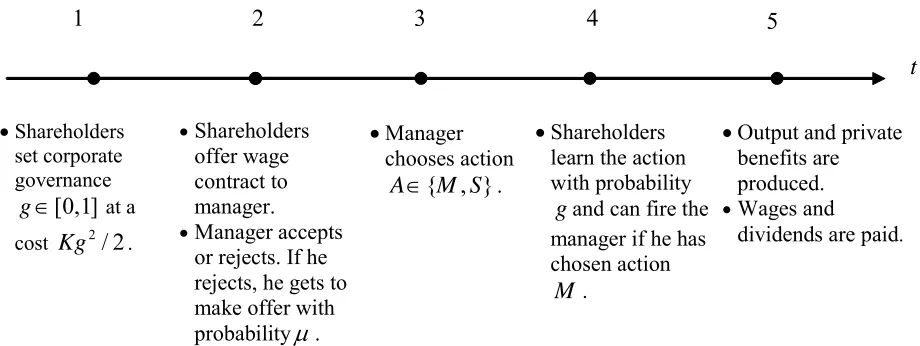
2.1. SEQUENCE OF EVENTS
The timeline of the model is shown in Figure 1. At t=1, the founder chooses the level of corporate governance g∈[0,1] incurring a non-pecuniary costKg2/ 2. The measure of
corporate governance g is the probability that shareholders have enough information/power
to intervene and fire the manager if they so desire.
At t=3, the manager chooses an action A between two non-verifiable
actions:A∈{ , }M S . Action M is preferred by the manager: it produces a private benefit
0
B> for the manager and zero profit for shareholders. Action S is preferred by shareholders:
it produces profits Y with probability e>0(and 0 with probability 1−e), and no private
benefits of control for the manager.
At t=4, shareholders learn (with probabilityg) the action chosen by the manager and
can fire him if he has chosen action M. If a manager is fired, he will lose any private benefits
of control.
At t=5, the output and private benefits are produced and wages and dividends are paid. Output is verifiable.
Assumption 1: There is an internal solution to the choice ofg. This is guaranteed by the
assumption thatK ≥B.
Assumption 2: Action S is socially optimal:B<eY.
Assumption 3: The manager has limited liability and no initial wealth.
2.2. SOLUTION
Given assumption 3, shareholders pay a wage 0 if output is 0 and pay a positive wage w
action M , he will enjoy a private benefit of control but only if he is not fired, that is only
with probability1−g.4 Hence, the incentive compatibility constraint for the manager is:
(1 )
≥ −
ew g B. (1)
To write down the manager’s participation constraint, one needs to consider the payoff if the manager rejects the offer. We assume that with probabilityμ, the manager can make a take-it-or-leave-it offer to the firm and will bid for the entire surpluseY. Otherwise, he will
receive a final take-it-or-leave-it-offer from the firm. This final offer will satisfy the incentive compatibility constraint with equality. Hence, the final offer will be worth (1−g B) in rational
expectation.
The contract offered by the firm will therefore satisfy the participation constraint:
(1 )(1 ) .
μ μ
≥ + − −
ew eY g B (2)
Shareholders choose g and w to minimize their costs subject to the incentive compatibility
constraint (1) and the participation constraint (2):
2 ,
min / 2
subject to (1) and (2)
w gew+Kg (3)
Given this setup, we obtain the following result:
4 We assume that the manager will be fired only if shareholders can prove that he selected action
M (hence only
with probability g). This is in fact the result of a tie-breaking assumption as shareholders are indifferent between
firing and not-firing the manager. One can imagine that shareholders can recover some of the private benefits
extracted by the manager. Hence, they have the ex-post incentive to fire the manager if they can show that
.
A=M As being fired may have a cost for managers, when shareholders do not know the action or when they
PROPOSITION 1. The choice of governance level is given byg* (1= −μ) /B K, which is
increasing in the private benefit B, decreasing in the cost of corporate governance K, and
decreasing in the managerial bargaining powerμ.
Proof. Because of assumption 2, the incentive compatibility constraint (1) is always satisfied
when the participation constraint (2) is satisfied. It follows that the participation constraint is strictly binding. Therefore, problem (3) simplifies to:
2
mingμeY+ −(1 μ)(1−g B) +Kg / 2. (4) From the first order condition (which is necessary and sufficient because the objective
function is strictly convex), we obtain the expression for choice ofg. ■
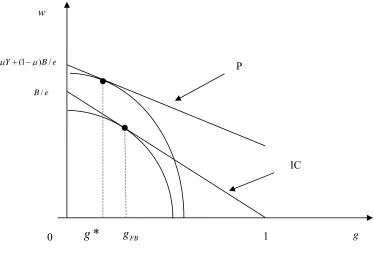
Figure 2 illustrates the result above in the space( , )g w . Shareholders’ indifference curves are
bell-shaped isocost curves defined as [ 2/ 2]/
w= C−Kg e for different levels of cost C (the
figure shows just two of them as an example). They represent the trade-off between executive compensation and corporate governance. The incentive compatibility constraint (IC) is a downward-sloping line with slope −B e/ crossing the y-axis at w=B e/ and the x-axis
atg=1. The participation constraint (P) is the flatter downward-sloping line with slope (1 μ) /
− − B e crossing the y-axis atw=B e/ +μ(Y−B e/ )>B e/ .
If managers had no bargaining power (μ=0), shareholders would choose the optimal level of governance along the incentive compatibility constraint. The chosen level of
governance (gFB) is the point where the IC curve is tangent to the indifference curves. If
with stronger managers (with greater bargaining power) will have poorer corporate
governance standards. Evidence consistent with this result is discussed in Bebchuk and Fried (2004).
So far, we have assumed that shareholders want their manager to choose action S at
any cost. However, this may not be true. The firm value if the manager chooses S
is ( − )− 2/ 2
e Y w Kg . This must be compared with the value if the manager exerts low effort,
in which case shareholders do not benefit from paying any wages or exerting governance. Hence, the value of the firm is 0. The participation constraint for shareholders is satisfied if
2
( − )≥ / 2
e Y w Kg or ifw≤ −Y Kg2/ 2e. In Figure 2, this participation constraint would be a
curve parallel to the indifference curve crossing the y-axis atw Y= . Since the managerial
participation constraint P is crossing the y-axis inw=B e/ +μ(Y−B e/ )<Y, the shareholders’
participation constraint is met.
3. Model with Externality
productivity of the first manager is as in the basic case described above. The productivity of the second manager to be hired by a firm is lower: if he chooses action S, his output is y<Y
with probabilitye. The critical assumption is that there is greater capacity to employ
managers (four positions overall) compared to the available pool of talented managers (two), or in other words, managerial talent is scarce.
3.1. TIMELINE
At t=1, the two firms (firm 1 and firm 2) choose non-cooperatively the quality of their
corporate governance. Let g and g be the levels of governance chosen by firm 1 and firm 2,
respectively. We allow the cost of implementing governance to differ (exogenously, for now) between the two firms. Firm 1 incurs a cost 2/ 2
Kg ; while firm 2’s cost isK g2/ 2,
whereK≤K. The latter assumption implies that firm 1’s optimal level of governance is not
smaller than firm 2’s.
At t=2, the market for managerial talent operates as follows. Each manager is
randomly matched to a firm. Each firm makes a take-it-or-leave-it offer to its manager. If the manager rejects the offer, one of three mutually exclusive things can happen: (i) With
probability π >0, the manager is matched to the other firm and receives a take-it-or-leave-it offer from it; (ii) With probability μ ≥0 (where π μ+ ≤1), the manager himself can make a take-it-or-leave-it offer to the initial firm; and, (iii) In all other cases (with probability
1− −π μ), the original firm makes a second take-it-or-leave-it offer. If the second offer is also rejected, then the manager and firms obtain a reservation utility normalized to 0.
shareholder can fire the manager with probability g; and at t=5, the output and private
benefits are produced and the wage is paid.
3.2. SOLUTION
Consider first the manager initially matched with firm 1 and the take-it-or-leave-it offers between these players. The model is solved by backward induction starting from the second round of labor negotiations, or in other words, starting with the point at which the manager has rejected the firm’s offer in the first round.
Given that after the second round the manager’s and the firm’s reservation utilities are zero, (each) firm will choose a wage at the second round that satisfies the incentive
compatibility constraint with equality (w= −(1 g B e) / and w= −(1 g B e) / ). The manager
will instead bid for the entire surplus eY if he has the chance to make a take-it-or-leave-it
offer. Hence, the participation constraint for the manager as relevant for the first round of labor negotiations is given by
(1 ) (1 )(1 )
ew≥π −g B+μeY+ − −π μ −g B, (5)
where the three terms correspond respectively to the second-round take-it-or-leave-it offer made by firm 2, the manager, and firm 1. It is important to notice that the reservation utility in (5) is strictly decreasing ing. In other words, the reservation utility of firm 1’s manager
improves if firm 2 has weaker corporate governance.
The shareholders’ problem is similar to the basic case: each firm chooses w and g to
minimize + 2/ 2
ew Kg subject to the incentive compatibility constraint (1) and the
participation constraint (5).
internalize the effect that their choice of governance has on the wage paid by other firms. First, we derive the best-response curves for the two firms.
LEMMA 1. Firm 1’s choice of governance level g is weakly increasing in the choice of
governance level of firm 2 g and strictly increasing over a range of values forg. Specifically,
[
]
1
1 2
2
(1 ) / ( )
( ) /( ) ( / )( ) /( ) ( ), ( )
/ ( )
B K if g g K
g g g B eY B if g g K g K
B K if g g K
π μ
π π μ μ π μ
− − < ⎧
⎪
=⎨ + − − + ∈
⎪ >
⎩
, (6)
where g K1( ) (1≡ − −π μ π μ)( + ) /(B πK)+μ(eY−B) /(πB) <
2( ) ( ) /( ) ( ) /( ) g K ≡ π μ+ B πK +μ eY−B πB .
Proof. If the participation constraint is not binding, that is, if
(1−g B) >π(1−g B) +μeY+ − −(1 π μ)(1−g B) , (7) then the firm’s problem simplifies to:
2
min (1g −g B) +Kg / 2. (8) The solution of problem (8) is simplyg=B K/ . After replacing g=B K/ into (7), this
inequality simplifies tog >(π μ+ ) /(B πK)+μ(eY−B) /(πB).
If the participation constraint is binding, that is,
if (1−g B) <π(1−g B) +μeY+ − −(1 π μ)(1−g B) , then the firm’s problem becomes:
2
min (1g − −π μ)(1−g B) +Kg / 2 (9) The solution of problem (9) isg= − −(1 π μ) /B K. Substituting this expression into the
participation constraints, it follows that g< − −(1 π μ π μ)( + ) /(B πK)+μ(eY−B) /(πB) must
For intermediate values ofg, the firm chooses to meet the participation constraint
with equality: g=πg/(π μ+ ) ( / )(− μ B eY−B) /(π μ+ ) .■
Symmetrically, the best response function for firm 2 is:
1
1 2
2
(1 ) / ( )
( ) /( ) ( / )( ) /( ) ( ), ( )
/ ( )
B K if g g K
g g g B eY B if g g K g K
B K if g g K
π μ
π π μ μ π μ
⎧ − − <
⎪
⎡ ⎤
=⎨ + − − + ∈⎣ ⎦
⎪ >
⎩
, (10)
where g1(.) and (.)g2 functions are defined in Lemma 1.
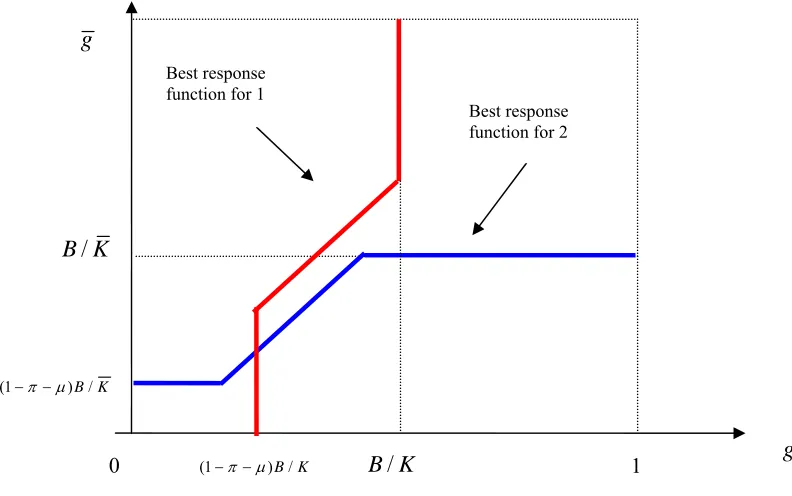
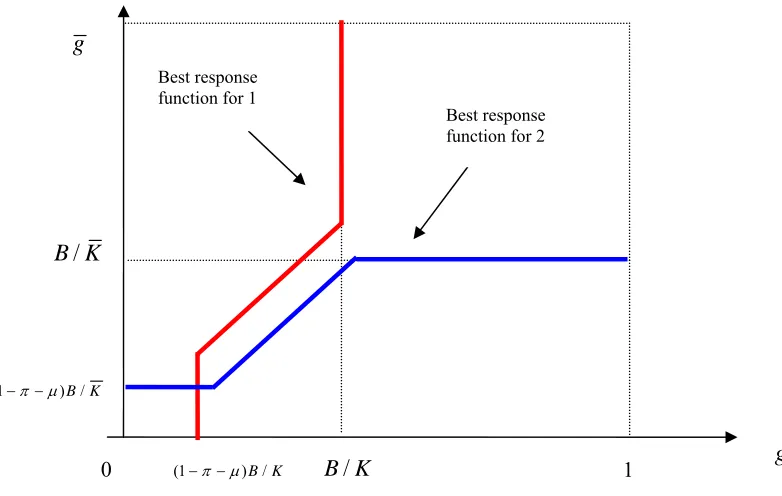
It is important to notice that the choice of governance level is (weakly) increasing in the quality of corporate governance in competing firms. Hence, companies with good corporate governance create a positive externality on other firms, or in other words, governance choices of firms are strategic complements.
Second, we can show that at least one of the firms chooses a lower level of corporate governance than in the case without competition for managers found in Proposition 1.
PROPOSITION 2. In equilibrium, firm 1 chooses a level of governance given
byg = − −(1 π μ) /B K , which is strictly increasing in the private benefitB, and decreasing in
the cost of corporate governanceK , managerial bargaining power μ and the extent of
competition for managers π.
Proof. From Lemma 1 we already know that firm 1 will never choose g< − −(1 π μ) /B K
because these values of g are not part of firm 1’s best response function. Consider now the
case thatg > − −(1 π μ) /B K . For this to be an equilibrium, we know from Lemma 1 that g
has to be greater than g (given the participation
best-response function for firm 2 given in expression (10), it must be that (1− −π μ) /B K>g.
Therefore, by combining the two inequalities, we obtain
that (1− −π μ) /B K > > − −g (1 π μ) /B K , which is a contradiction since K≤K by
assumption. Hence, it must be thatg= − −(1 π μ) /B K . ■
The intuition for this result is that firm 1 is competing for managers with firm 2. Because firm 2 faces higher governance costs than firm 1, in equilibrium firm 2 will choose lower governance intensity than firm 1. Hence, firm 1 will have to pay higher wages to retain its manager than it would do in the absence of competition.
Finally, we can derive firm 2’s governance choice:
PROPOSITION 3. Firm 2’s corporate governance is at its first-best level if there is a large
difference in the cost of governance between the two firms; it is lower than optimal and a decreasing function of the governance cost for firm 1 if the difference in governance cost between the two firms is intermediate; and it is strictly lower than in the case without competition if the two firms face similar costs of governance. Specifically,
(
1 1 2 2 / ( ) (1 ) ( ), ( ) ( ) ( )(1 ) / ( ),
B K if K K K
B eY B
g if K K K K K
K B
B K if K K K K
π μ μ
π μ π μ
π μ ⎧ < ⎪ − − − ⎪ ⎡ ⎤ =⎨ − ∈⎣ ⎦ + + ⎪ ⎪ − − ∈ ⎤ ⎦ ⎩ , where 2
1( ) (1 ) /[( ) /( ) ( ) /( )] K K ≡ − −π μ π μ π+ K +μ eY −B πB <
2 2( ) 1/{( ) /( ) ( ) /[(1 )( )]} K K ≡ π μ π+ K +μ eY−B − −π μ πB .
Proof .The result follows from substituting g= − −(1 π μ) /B K in the best-response function
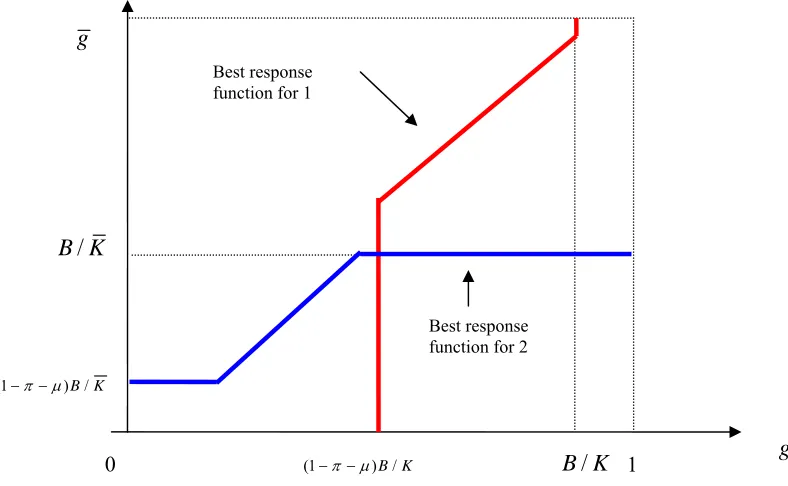
The results obtained in Propositions 2 and 3 are graphically illustrated in Figures 3A-3C. The three figures plot the reaction curves of each firm to the choice of governance level in the other firm as derived in expression (6) and (10) in each of the three cases described in Proposition 3. The equilibrium is determined by the intersection of the two curves. In Figure 3A, we consider the case in which there is a large difference in governance costs between the two firms (K<K K1( )). In this case, firm 2 (the one with higher cost of governance) is at its first best level of corporate governance. The intuition is that in that case firm 1’s choice of corporate governance level is so high that the participation constraint for the manager working in firm 2 is not binding. Figure 3C illustrates the symmetric case, in which the difference in governance costs between the two firms is very small (or there is no such difference at all): K∈
(
K K K2( ), ⎤⎦. The intersection of the two curves is obtained at( (1B − −π μ) / , (1K B − −π μ) / )K . In that case, both firms choose an inefficiently low level
of corporate governance. Finally, Figure 3B shows the intermediate case, when the difference in costs is not too large: K∈ ⎣⎡K K K K1( ), 2( )⎤⎦. In this case, firm 2’s choice of governance level is strictly increasing in that of firm 1 as a result of strategic complementarity between the choices of governance levels in the two firms.5
It is interesting to notice that the inefficiency increases if the two firms are more similar to each other in terms of governance costs. In fact, when the firms have the same or very similar costs of governance, both of them choose an inefficiently low level of corporate governance. However, if firm 1 incurs significantly lower costs of corporate governance than firm 2, in equilibrium firm 2 chooses the efficient level of corporate governance.
5 The uniqueness of the equilibrium disappears if μ = 0. In that special case, the reaction curves would overlap
4. Regulation and Entry
In this section, we explore if the lack of efficient levels of governance would lead to regulatory standards and market responses aimed at capitalizing on gains to be made from improving upon firm-level governance.
A possible solution to the externality problems described in Section 3 is for a regulator to introduce governance standards that increase the minimum level of corporate governance that companies must choose. For instance, in the model presented in Section 3, if companies are perfectly symmetric (i.e., if they face the same costs of implementing governance), then regulation can trivially solve the externality problem: A simple requirement that g ≥B K/ would push companies to the first best.
However, this is not true if the two companies are not identical. Consider for example two companies where firm 1 faces a low cost of governance compared to firm 2, i.e.
1( )
K<K K . In such a case (as found in Propositions 2 and 3 and shown in Figure 3A), firm 1
has a level of governance that is lower than its optimal level while firm 2 is at its optimal level of governance. Hence, regulation to increase governance would make firm 1 better off and firm 2 worse off. In other words, in the presence of heterogeneity among firms, enforcing a minimum governance level is not always Pareto improving because “one size does not fit all.”
considerations, such as capture by corporate lobbyists or by institutional investors, depending upon the immediate past of governance problems.6
Given such limitations of regulation, we turn now to the analysis of one possible market solution. We consider the role of firms that either need to raise additional external capital (through a seasoned equity offering) or are new to capital markets (and raise external capital through an initial public offering). In order to attract capital, they must choose high governance standards. This represents a positive externality for the competitors.
4.1 RAISING CAPITAL
So far, we have assumed that companies do not need to raise capital. This is a limiting assumption given that most of the literature on corporate governance emphasizes that the key benefit of high governance standards is the reduction in the cost of external capital (Shleifer and Vishny, 1997). In this section, we consider such a possibility by modifying our
benchmark model as follows.
Consider two companies: an incumbent firm (firm 2) and a potential entrant (firm 1) competing for managers. Each firm can hire one or two managers each with productivity as in the basic case described in Section 3. That is, with action S, the expected output of the first manager to be hired is eY while that of the second manager to be hired is ey(y<Y ). The
only difference between these two firms is that the entrant firm needs to raise external capital
I to enter. With interest rate normalized to zero, investors provide I if and only if the value
of the firm is at least as great as I : that is, the investor participation constraint (IP) is given
6 It is also important to notice that in our model managerial compensation is a simple transfer of resources while
the investment in corporate governance is a costly investment of resources. Hence, if the government is driven
by the desire to maximize the social surplus, the optimal decision would be to mandate the lowest level of
byeY−ew≥I. We assume that I >eY− +B B2/K, that is, the investor participation
constraint is not satisfied if the entrant firm chooses the first-best governance level of the incumbent. To simplify notation, we also assume that μ=0 and that the two firms face the same costs of investing in corporate governance, K=K.
We will consider two alternative scenarios on the choice of governance level by the two firms. In Section 4.2, we assume that the entrant and the incumbent firm choose corporate governance contemporaneously. In Section 4.3, we consider the case in which the incumbent firm chooses governance first and can thus act as a Stackelberg leader. We will show that in this second case the incumbent may strategically under-invest in corporate governance to deter entry.
4.2 CHOICE OF GOVERNANCE LEVEL
The incumbent (firm 2) faces the same problem as in Section 3. Therefore, his reaction function is as described in equation (10) where K is set equal to K and μ=0:
[
]
(1 ) / (1 ) /
( ) (1 ) / , /
/ /
B K if g B K
g g g if g B K B K
B K if g B K
π π
π
− < − ⎧ ⎪ =⎨ ∈ − ⎪ > ⎩ (11)
In contrast, the entrant (firm 1) needs to satisfy the additional investor participation constraint. The problem faced by the founder of the entrant firm is therefore:
2 ,
min / 2
s.t. (IC) (1 )
(P) (1 ) (1 )(1 ) (IP)
w gew Kg
ew g B
ew g B g B
ew eY I
π π + ≥ − ≥ − + − − ≤ − (12)
It is important to notice that the entrant can enter only if the managerial participation constraint holds jointly with the investor participation constraint. Hence, firm 1 cannot be set up if the governance level chosen by the competitor is sufficiently low. This implies that a necessary condition for entry is that eY− ≥I π(1−g B) (where we have assumed g=1 to
[image:24.595.170.442.487.554.2]maximize the chances that the investment can be financed) or g≥ −1 (eY−I) /(πB).
Figure 4 describes the entrant’s problem. The figure plots the incentive compatibility condition (IC) and the investor participation constraint (IP) in the space ( ,g ew). The (IC)
condition is a downward-sloping line with slope −B while the (IP) is a horizontal line drawn
at ew=eY−I. Three hypothetical managerial participation constraints are drawn for different
levels ofg : these are downward-sloping lines with slope (1− −π)B and intercept (1π −g B) .
Depending on g, three cases can emerge:
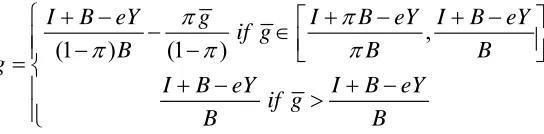
LEMMA 2.There is no entry ifg I B eY B
π π
+ −
< . Otherwise, there is entry and the choice of
governance level of the entrant firm g is decreasing in g. Specifically,
,
(1 ) (1 )
I B eY g I B eY I B eY
if g
B B B
g
I B eY I B eY
if g
B B
π π
π π π
⎧ + − − ∈⎡ + − + − ⎤
⎪ ⎢ ⎥
⎪ − − ⎣ ⎦
= ⎨
+ − + −
⎪ >
⎪⎩
Proof. The proposition can be derived with the help of Figure 4. For high values of g, such
that g > + −(I B eY) /B, the managerial participation constraint lies below the investor
participation constraint. This case is represented in Figure 4 by the participation constraint (1). The equilibrium is at point B where the incentive compatibility constraint intersects the
at point C, where the investor participation constraint meets the managerial participation constraint. Here governance is such that
(1 ) (1 )
I B eY g
g
B
π
π π
+ −
= −
− − . In this case, g decreases
with g: to keep the value of the outside option constant, the entrant needs to over invest in
governance to make up for the incumbent’s under investment. Finally, for very low values of
g– case (3) in Figure 4 – the firm cannot meet both the investor and the managerial
participation constraints for any feasible level of governanceg∈[0,1]. Hence, firm 1 cannot enter. This happens if g < +(I πB eY− ) /(πB). ■
To find the equilibrium we combine the results in Lemma 2 with the incumbent’s response function given in equation (11). Notice that there is a discontinuity in the optimal response curve for the entrant: The entrant does not enter (and therefore chooses g=0) for g just
below (I+πB eY− ) /(πB) and enters (and chooses g =1) for g = +(I πB eY− ) /(πB). The
following proposition characterizes the solution:
PROPOSITION 4. There is no entry if the cost of entry is large (I >IH ≡eY−πB+πB2/K).
In such a case, the incumbent chooses g =B K/ . Otherwise, the entrant chooses a level of
governance, which is higher than the incumbent’s and is increasing in the entry cost. Specifically, the equilibrium choice of corporate governance is:
2 ( / )
( , ) ,
(1 )
I B eY B K B
g g
B K
π π
⎛ + − − ⎞
= ⎜ − ⎟
⎝ ⎠.
Proof. Let us start with the observation that the equilibrium choice of governance ( , )g g must
be such that g≥g. This is because the only difference in the maximization problems
upper-bound on the wage it can pay. This wage is weakly increasing in the governance of the firm itself (via the manager’s incentive compatibility and participation constraints). Hence, the equilibrium choice of governance must be such that g≥g. This implies that the
equilibrium is found on the downward-sloping section of the reaction function of the entrant,
that is, min 1,
(1 ) (1 )
I B eY g
g
B
π
π π
⎧ + − ⎫
= ⎨ − ⎬
− −
⎩ ⎭. The incumbent’s reaction function is instead as
described in equation (12). By solving the system of equations, two cases emerge. First, if B 1 eY I
K πB
−
< − , orI >πB2/K+eY−πB, the entrant cannot enter and the incumbent
chooses the level of governance without fear of competition (as in the case in which π =0): /
g =B K. Second, if I ≤πB2/K+eY−πB, the entrant can enter but only if the incumbent
chooses the optimal level of corporate governance. Hence, g =B K/ and
(1 ) (1 ) (1 ) (1 )
I B eY g I B eY B
g
B B K
π π
π π π π
+ − + −
= − = −
− − − − . ■
Note that the equilibrium level of corporate governance is strictly greater than in the case when the two firms do not need to raise capital (derived in Proposition 3). In the symmetric case of Proposition 3, we have thatg = = −g (1 π) /B K. Here, if there is entry,
theng> =g B K/ > −(1 π) /B K; if there is no entry, g =B K/ > −(1 π) /B K.
Figures 5A and 5B illustrate the best-response curves for the incumbent and the entrant with and without entry. In Figure 5A, the cost of entry is low, I ≤IH, there is entry
and the equilibrium is found at the intersection of the best-response curves. As shown in Proposition 4, the equilibrium lies on the downward sloping part of the best-response curve of the entrant and is such that g =B K/ and g= + −(I B eY−πB2/ ) /[ (1K B −π)].
governance. This can be seen in Figure 5B where the reaction curve for firm 1 intersects the vertical line g=1 at a value of g that is greater than the first best level of governance for the
incumbent, B K/ . In this case, there is no entry and the incumbent is free to choose the
desired level of governance, g =B K/ . As shown in Proposition 4, the case of blocked entry is characterized by the condition that I >IH =eY− −[1 ( / )]B K πB. This inequality implies
that entry is blocked when either the cost of entry (I), the degree of competition for managers
(π), the cost of monitoring (K) or the managerial bargaining power (μ) are sufficiently high;
or the quality of the investment (eY) is sufficiently low. The intuition is that large values of
K and μ reduce the level of corporate governance chosen by an incumbent without
competition; while a large value of I or more competition for managers (high π) or a low
quality investment (low eY) increase the level of corporate governance required by a new
firm to enter. The impact of the private benefits of control (B) is ambiguous, as it increases
both the governance level chosen by the incumbent and the corporate governance required by the entrant.
4.3. STRATEGIC CONSIDERATIONS: POOR CORPORATE GOVERNANCE AS A BARRIER TO ENTRY
An important assumption in the preceding analysis has been that the incumbents cannot act strategically. This is because incumbents and entrants were allowed to choose governance only contemporaneously. However, since firm 1 (the entrant) can enter only if the incumbent chooses a sufficiently high level of corporate governance (g≥ −1 (eY−I) /πB), the
from blocking entry comes from the fact that if there is no entry the incumbent can hire both managers for a total output of e y Y( + ).
To analyze these strategic considerations, we assume that the incumbent chooses (and can credibly commit to) the level of corporate governance before the entrant does. Because this new assumption does not affect the choice of corporate governance by the entrant, the entrant’s response function is as described in Lemma 2. However, the problem faced by the incumbent changes substantially.
There are three cases to consider. First, sometimes entry cannot be blocked. This happens when the cut-off level of governance to block entry (I+πB eY− ) /πB is smaller
than 0, or I<eY−πB. In such a case, the equilibrium looks the same as that in the second
part of Proposition 4. Second, the level of corporate governance that is necessary to block entry (g < +(I πB eY− ) /πB) may be higher than the level of corporate governance that
would be chosen without competition (B K/ ). If /B K < −1 (eY−I) /πB, or I >IH, then
entry is blocked because the incumbent faces no cost to keep the entrant out. Given that blocking entry comes with the benefit of hiring two managers instead of one, the incumbent will trivially choose g =B K/ and block entry. This is as in the first part of Proposition 4.
The third more interesting case emerges when the incumbent faces a trade-off because [ , H]
I∈ eY−πB I . In this case, the incumbent must compare the benefits of blocking entry
(coming from greater scale due to the elimination of competition in the market for managers) and its costs (coming from low corporate governance). Specifically, if entry is deterred, the incumbent firm will be able to hire two managers instead of one but will have to pay them more than in the absence of an entry threat. This is because he needs to choose a low level of corporate governance to keep the entrant out (g < +(I πB eY− ) /πB), which is reflected in
high managerial compensation (w>(eY−I) /eπ ). In this case, the upper-bound of the
[
( ) 2( ) /]
2 ( )2 N
K B I eY
e y Y eY I U I
B π π π + − ⎛ ⎞⎛ ⎞ + − − −⎜ ⎟⎜ ⎟ ≡
⎝ ⎠⎝ ⎠ (13)
This is obtained by substituting g= +(I πB eY− ) /πB and w=(eY−I) /eπ into the
incumbent utility function
[
( ) 2]
2/ 2e y Y+ − w −Kg .
If the incumbent allows entry, then he can behave as a Stackelberg leader and choose the wage and corporate governance level knowing that the entrants will choose a governance level on the downward sloping part of the reaction function (as described in Proposition 4),
that is, /(1 )
(1 )
B I eY
g g
B π π
+ −
= − −
− . For such values of g, the participation constraint is always
satisfied (since g>g). Hence, the incumbent’s problem becomes: 2
,
min / 2
s.t. (IC) (1 )
w gew Kg
ew g B
+
≥ − (14)
After substituting for the incentive compatibility condition, problem (14) simplifies to
2
min (1g −g B) +Kg / 2 (where we dropped terms that do not depend on g). From the first
order condition of this problem, the solution is g =B K/ . The associated utility for the
incumbent is:
2
2 E
B
eY B U
K
− + ≡ (15)
Thus, the decision whether to block entry or not is down to the comparison of expressions (13) and (15). It is easy to observe that UN >UE (and entry will be blocked) if
the cost of entry (I) is sufficiently high (I >Iˆ), where ˆI is such thatUN( )Iˆ =UE. In fact,
N
U is strictly increasing in I (the first derivative of UN with respect to I is
2 / [1 ( / ) / 2] 0π − K B g > becauseg<B K/ ). The impact of other variables (the private
benefits of control B , the cost of monitoring K and the quality of the investment eY) is
and the corporate governance required by the entrant. We can summarize this discussion with the following proposition:
PROPOSITION 5.There is entry only if I≤min{ , }IH Iˆ . In case of entry, the equilibrium
choice of governance is: ( , ) ,
(1 ) (1 )
I B eY B B
g g
B K K
π
π π
⎛ + − ⎞
=⎜ − ⎟
− −
⎝ ⎠.
Interestingly, the region of parameters where entry is blocked is greater than in Proposition 4. The intuition is that in this case the incumbent can strategically choose a lower corporate governance level so as to block entry.
It is interesting to notice that if Iˆ< ≤I IH , there is a strong case for regulation. In fact,
by setting a minimum governance standard g= +(I πB eY− ) /πB the government will allow
for entry and increase the overall output in the economy (even though firms will be
individually smaller than the size of incumbent firms in absence of regulation). With entry, the firms produce an output equal to2eY; without entry, the output is (e y Y+ ) 2< eY. Hence,
regulation generates extra output e Y( −y), at a cost
2
2 2
2 (1 ) (1 )
K B I B eY I B eY B
K B B K
π π
π π π
⎧⎡ + − ⎤ ⎡ + − ⎤ ⎫
⎪ ⎪
⎛ ⎞ ⎛ ⎞ −⎛ ⎞ + −
⎢ ⎥
⎨ ⎬
⎜ ⎟ ⎜ ⎟ ⎜ ⎟ ⎢ − − ⎥
⎝ ⎠ ⎝ ⎠⎪⎩⎢⎣ ⎝ ⎠ ⎥⎦ ⎣ ⎦ ⎪⎭
, where the first term is the extra
cost of the investment in governance for the incumbent firm and the second term is the cost of governance for the entrant. Hence, this form of regulation is welfare-enhancing if the gain in output is sufficiently large.
The model presented in the previous section assumes that the costs of setting up a corporate governance system are shared by all shareholders who decide collectively their desired level of governance by trading off its costs and benefits. Although this may apply to some
governance variables (like the choice of the firm’s auditing system and the drafting of its charter), in other cases (for example proxy proposals and more generally shareholder activism) individual shareholders have to take action at their own costs in order to improve the firm’s governance. For the latter, the ownership structure of a firm can have a crucial impact on the choice of corporate governance. In this section, we extend the model to allow for such an impact and show that the choice of ownership structure may be the deeper economic choice through which there is an externality across firms. The basic setting of our extension is fairly standard in corporate finance: the choice of ownership structure is the result of a trade off between the benefits coming from concentrated ownership (in terms of better monitoring) and its costs (in terms of lack of risk diversification or liquidity).7
We also discuss the role of the market for corporate control in the form of activists such as private-equity funds and hedge funds which raid firms, take on significant equity stakes, and thereby have incentives to improve governance. Because of the governance externality, all competitors are better off when firms with poor corporate governance are taken over and their governance is improved. Under some conditions that we characterize below, it is profitable for raiders to engage in such activism, and in these cases, the market for corporate control helps to reduce underinvestment in corporate governance.
5.1. SEQUENCE OF EVENTS
7 The setting is similar to the one in Leland and Pyle (1977), Admati, Pfleiderer and Zechner (1994), Bolton and
The only change from the model presented in Section 3 is the addition of a stage t=0, when the founder of firm 1 (firm 2) chooses the fraction α (α ) to sell to a large outside
shareholder who will later engage in corporate governance at a cost 2
/ 2
Kg (K g2/ 2). We
assume that such a shareholder requires a compensation for holding a large stake in the company. For instance, he needs to be compensated for the lack of liquidity (or it could alternatively be a compensation for the idiosyncratic risk he bears), given by 2/ 2
Aα for firm
1 and 2/ 2
Aα for firm 2, where A and A are the costs associated with lack of liquidity for
the large shareholder in firm 1 and 2, respectively. The rest of the game is as in Section 3. To help with the presentation of the analysis, we assume that the two companies are ex-ante identical:A=A and K =K.8
5.2. CHOICE OF GOVERNANCE
The outside shareholder in firm 1 chooses g and w to minimize their costs subject to the
incentive compatibility constraint (1) and the participation constraint (5):
2 ,
min / 2
s.t.
( ) (1 )
( ) (1 ) (1 )(1 )
w g ew Kg
IC ew g B
P ew g B eY g B
α
π μ π μ
+
≥ −
≥ − + + − − −
(16)
Given this setup, we obtain the best-response function for firm 1 by replacing K with K/α
in Lemma 1.
The choice of governance by firm 1 is:
8 Because of ex-ante symmetry we expect to find that the two firms have the same choice of ownership structure
(α α= ) in equilibrium. However, we want to prove that the only equilibrium features such ownership structure
[
]
1
1 2
2
(1 ) / ( / )
( ) /( ) ( / )( ) /( ) ( / ), ( / )
/ ( / )
B K if g g K
g g g B eY B if g g K g K
B K if g g K
α π μ α
π π μ μ π μ α α
α α
− − < ⎧
⎪
=⎨ + − − + ∈
⎪ >
⎩
, (17)
where the functions g1(.) and (.)g2 are defined in Lemma 1. The choice of governance is
increasing in the quality of corporate governance of the competing firm and in the ownership stake held by the outside shareholder (α).
This result highlights a second reason (beside the externality in the managerial labor market) why the level of corporate governance is less than optimal in equilibrium: the monitor does not fully internalize the value of investing in corporate governance. In fact, when
choosing between monitoring and paying an efficiency wage, he prefers the latter because he can share the costs with other shareholders.
Symmetrically, we can derive the best response function for firm 2. Following
Proposition 2, the equilibrium levels of corporate governance obtain as the intersection of the two best-response curves and are described in Lemma 3 in the Appendix.
5.3. CHOICE OF OWNERSHIP STRUCTURE
At t=0, the founder chooses α to minimize the sum of three costs: the wage bill to be paid by all shareholders,w, the costs of corporate governance, Kg2/ 2, and the liquidity cost, Aα2/ 2,
borne by the outside shareholder:
2 2
minα w+Kg / 2+Aα / 2, (18)
where ew=min{(1−g B) , (1π −g B) +μeY+ − −(1 π μ)(1−g B) } and ( , )g g are defined in
As a benchmark, it is useful to consider first the case without externality. In such a case, g=αB K/ andw= −(1 g B e) / ; thus problem (18) is solved to yield
2/( 2 )
FB B B AK
α α= ≡ + . With externality, we obtain that the degree of ownership concentration is lower than this optimal value ofα .
PROPOSITION 6.The equilibrium ownership structure isα α α= = *, where
2
2 2
(1 )
*
(1 ) FB
B
B AK
π μ
α α
π μ
− −
≡ <
− − + wheneverπ μ+ >0.
Proof. See Appendix. ■
Intuitively, the externality in the choice of corporate governance translates into an externality in the choice of ownership structure. The reason is that the marginal benefit of concentrated ownership decreases if competitors have poor governance standards. In the Appendix we derive the reaction functions in the choice of ownership structure. The equilibrium level of ownership is obtained in a similar manner to Figure 3C as the intersection of the reaction functions of the two firms, with the difference that the two axes, and by implication also the first-best and equilibrium values, correspond now to ownership levels rather than governance levels. They intersect only atα α α= = *.
5.4 MARKET FOR CORPORATE CONTROL
Can a raider generate improved governance and create value simply by concentrating ownership? At first glance, the answer seems to be yes. If, starting from the symmetric solution found in Proposition 5, ownership concentration in firm 1 increases byΔ, then the level of governance increases byΔ ⋅ − −(1 μ π) /B K. The value created for shareholders of
firm 1 equals the wage saving associated with the better governance regime, and is given by (1 )2 2/ 0
B K
μ π
Δ − − > . Moreover, the improvement in governance due to the takeover may increase the value of firm 2 as well given that the wage paid by firm 2 is decreasing in g
(causing a positive spill-over effect) and may also increase the marginal value of investing in governance for firm 2 (as the governance choices across firms are strategic complements).
However, the critical issue is whether the raider will profit from this and therefore whether he will have the incentives to engage in activism. Without deriving analytical solutions for this case, it is clear that the raider will take over the firm only if he can internalize a fraction large enough of the benefits of the takeover. For this to happen, the market for corporate control must be relatively uncompetitive so that the raider can capture some of the value created by the takeover and free-riding in the market for corporate control has to be limited.
Moreover, a raider with liquidity preference AR and cost of governance KR will bid
for the firm only if he has an advantage over regular shareholders, either due to lower
monitoring costs (KR <K) and/or due to lower costs of illiquidity (AR < A). In other words,
requirement can be achieved by raiders investing resources in monitoring (for example, through more intense engagement with firm management). The second requirement can be met by raiders organizing themselves in the form of large closed funds with a long investment horizon. The observation may explain the organizational form chosen by private equity funds and hedge funds.
Note that raiders can improve governance even in the topsy-turvy view of corporate governance: the threat of a takeover can provide the necessary commitment device to managers to implement high levels of governance. However, in the context of our model, raiders also generate a positive externality for competing firms because they reduce the outside option for managers in terms of rents earned. This, in turn, increases the marginal value of governance for non-target companies and leads them to choose better governance as well. This governance externality suggests that the desirability of activists should not be assessed simply on the basis of their own performance, but must also take account of the discipline they indirectly impose on non-target firms. This is an important conclusion reached in our model that does not follow under the topsy-turvy view of governance.
6. Empirical Implications
and monitoring to punish managers if they misbehave. Hence, the first basic prediction of our model is as follows:
PREDICTION 1. Executive compensation and pay-for-performance are negatively correlated with the quality of corporate governance standards. In other words, executive compensation
is a substitute for other governance systems.
There is some evidence consistent with this first prediction. Core at al. (1999) find that CEOs at firms with weaker governance structures receive greater compensation. However, their result is also consistent with an agency explanation à la Bebchuk and Fried (2004). In our model the negative correlation between compensation and governance is not due to the fact that managers have greater control of the compensation committee and can award themselves more generous pay in firms with weaker governance. Rather, it follows from the result that pay-for-performance is a substitute for other governance mechanisms. One way to distinguish between the two explanations is to check whether companies with weaker corporate
governance adopt more high-powered incentive schemes, whereby compensation is in the form of efficiency wages (as in our model) rather than inefficient transfers to top management (as in Bebchuk and Fried (2004)).
A recent paper by Fahlenbrach (2008) provides evidence in support of Prediction 1. He finds that there is more pay for performance in firms with weaker corporate governance, as measured by less board independence, more CEO-Chairman duality, longer CEO tenure, and less ownership by institutions. His evidence is difficult to reconcile with an agency-based explanation. However, note that more analysis is necessary to distinguish between ours and an agency-based explanation.
governance choose very similar governance levels in equilibrium. In fact, as formalized in Proposition 3, when the difference in governance costs is small both firms choose the same
low level of corporate governance. When the difference in these costs is large, the firm with lower governance cost will choose a higher level of governance than the other firm. However, the difference in governance levels between the two firms is smaller than it would be in the case without externality.
PREDICTION 2. There is little variation in voluntary corporate governance arrangements across firms within an economy, especially within the same industry.
Again, there is some evidence consistent with this prediction of our model. In fact, even though firms can pick their own corporate governance, they seem to choose similar
governance standards within countries. Bergman and Nicolaievsky (2007) show that listed
companies in Mexico do not improve governance beyond what is required by the law. Doidge, Karolyi and Stulz (2007) find that, after controlling for country characteristics, firms do not differ much in their governance levels. These findings are, however, not conclusive evidence because there is an obvious alternative explanation. Firms may not invest in voluntary corporate governance standards because they are not credible signals.
A more direct test of our model would require studying the effect on competing firms of an exogenous shock that forces one firm to improve governance standards. In such a case, our model predicts that competitors in the industry should also improve their governance standards.
While there is some evidence consistent with this prediction, more analysis is clearly needed. There is an extensive literature on horizontal mergers finding that rivals of acquisition targets earn significant abnormal returns at the announcement of the acquisition. The proposed explanation for this result is that a horizontal merger reduces competition in the product market (Eckbo, 1983) and increases the probability that competitors will also be acquired at a premium (Song and Walkling, 2000). Our model suggests an alternative explanation: the takeover brings about an improvement in corporate governance in the target firms which leads other firms to invest more in corporate governance as well.
Consistent with our explanation, Bris and Cabolis (2006) find that when a firm in a given industry is acquired by firms from countries with stronger governance practices (and better accounting standards), there is a significant increase in the value of such industry, as measured by the industry’s Tobin’s Q. This evidence suggests that there is a positive
externality on firms of improvements in the corporate governance by a competitor. However, it does not show explicit evidence of strategic complementarity in governance choices, that is, it does not show that the governance of the rival firms improves. Servaes and Tamayo (2007) report some evidence that rival firms respond by improving their corporate governance. They find that after the control threat, rival firms increase leverage, cut capital expenditures and reduce free cash flows.
A related empirical prediction is that internal corporate governance is better in
countries (or sectors) with a more competitive market for corporate control. Cremers and Nair (2005) have found evidence that is consistent with this prediction. The established
interpretation for this evidence is that managers choose better corporate governance to fend
off the threat of a hostile takeover, as we argued above and as suggested by Manne (1965) and Jensen (1993), and many others. Our model offers an alternative interpretation for this
evidence. The market for corporate control alleviates the externality problem faced by
explanations is whether it is shareholders or managers who are more active in the choice of corporate governance. Our interpretation is more appropriate in settings where shareholders choose governance, while Manne’s and Jensen’s interpretation holds when managers make the choice.
7. Concluding Remarks
We have taken the view in this paper that corporate governance is – at least to some extent – a choice of individual firms but one that affects and is affected by the choice of other
competing firms. The primary channel for this externality in our model was the assumption that giving incentives to management and investing in better governance are substitutes. The result of this externality is an underinvestment in corporate governance in the economy at large, especially by incumbent firms blocking entry. We investigate implications of this externality for the choice of ownership structures and conclude that the underinvestment in governance may in fact be rooted in the ownership structure of firms, which may end up being inefficiently dispersed.