
New compounds and structures in the solid
state
Edmund J. Cussen
DOI: 10.1039/b612878pThis chapter reviews the 2006 literature on new compounds and structures in the solid state.
1.
Highlights
A number of striking structures have been reported across the full compositional range of solid state compounds. The technical advances in characterisation techni-ques and innovative combinations of observations have permitted the determination of some structures of unparalleled complexity and highlights include the room temperature polymorph of ZrP2O7 and the most complex zeolite structure yet reported, TNU-9. A number of potentially useful new compounds have been identified including new phases for second harmonic generation and a new silico-germanate zeolite that exceeds the state-of-the-art as a catalyst for several indust-rially important processes. In addition to these studies the reports of a two-dimensional ferromagnet or an air- and moisture-stable intermetallic phase that shows a strong resemblance to the host/guest chemistry of zeolites indicate that the structure of the solid state continues to be a source of challenging and interesting chemistry.
2.
Oxides
The perovskite structure continues to yield new compounds that provide excellent models for understanding the effects of structure on physical properties. The perovskites Ca2VMoO6 and Sr2VMoO6 could be anticipated to show analogous behaviour to the cation-ordered semi-metallic phase Sr2FeMoO6. However, neither Ca2VMoO6or Sr2VMoO6show any evidence for cation ordering between vanadium and molybdenum and this allows Sr2VMoO6to form a cubic perovskite [Pm3m;a= 3.91581(3) A˚] and Ca2VMoO6to crystallise with a GdFeO3-type distortion of this structure [Pnma;a= 5.46613(8),b= 7.6822(1),c= 5.40335(7) A˚].1Measurements of the magnetic susceptibility and electrical conductivity of these compounds are both characteristic of a fully delocalised electronic system and this consideration suggests that the oxidation states of the transition metals in these compounds exhibit non-integer oxidation values that are intermediate between V4+/Mo4+ and V3+/ Mo5+. The conductivity implies strong energetic overlap between thet2gorbitals of both cations and suggests that a single crystal sample of Sr2VMoO6should exhibit the highest conductivity of any metal oxide. By contrast, compounds in the system Ba2LnMoO6show complete ordering betweenLn
3+
and Mo5+over the octahedral
WestCHEM, Department of Pure and Applied Chemistry, The University of Strathclyde, Glasgow, Scotland, UK G12 8PT. E-mail: [email protected]; Fax: +44 141 548 4822; Tel: +44 141 548 2797
sites of the perovskite structure and hence crystallise with a rock-salt ordered pattern ofLnO6and MoO6octahedra in a cubic lattice [Fm3m].2,3These compounds show localised electronic behaviour with negligible electronic conductivity.2Whilst most compounds do not show a well-defined magnetic transition at temperatures down to 2 K, Ba2NdMoO6undergoes antiferromagnetic ordering at 15 K. Low temperature neutron diffraction experiments show that this anomalous behaviour arises from a structural distortion to triclinic symmetry [I1;a= 5.9790(2) A˚,b= 5.9840(2) A˚, c= 8.6024(2) A˚,a= 89.854(2)1,b= 90.056(5)1,g= 90.003(5)1)].3This structural
transition is driven by a Jahn Teller distortion arising from the triply degenerate ground state of Mo5+(4d1) in octahedral coordination geometry. This distortion is propagated through the structure and results in a negative thermal expansion of 0.32% in the c parameter on cooling from room temperature to 3.5 K.
Jahn–Teller distortions are also observed in the Ruddlesden-Popper phases LaxSr2xMn1/2Cu1/2O4(x= 0.75, 1, 1.25, 1.5).4These structures are conceptually related to perovskite and can be considered to contain sheets of Mn/CuO6perovskite separated by layers of rock salt to yield highly anisotropic electronic properties. All compounds showed chemical disorder of copper and manganese over a single crystallographic site. The octahedrally coordinated site shows considerable distor-tion in the oxide anion posidistor-tion which increases with increasingxup to a maximum for La1.5Sr0.5Mn1/2Cu1/2O4which exclusively contains the Jahn–Teller active cations Mn3+and Cu2+on this position. For lower values ofxpositional disorder in the apical oxide position indicates a local variation in structure to accommodate the random distribution of the Jahn–Teller inactive Mn4+ species on this site. The magnetic behaviour of these compounds is complex with some evidence of ferro-magnetic coupling at high temperatures before the formation of antiferromagneti-cally-ordered phases at lower temperatures for LaSrMn1/2Cu1/2O4, PrSrMn1/2 -Cu1/2O4and NdSrMn1/2Cu1/2O4.
A number of new lithium containing garnet phases have been reported5,6and are the subject of detailed study due to the observation of fast Li+conduction,E105S cm1, in this structure. Neutron diffraction has been used to generate the first precise description of the garnet phases Li5La3Ta2O12and Li5La3Nb2O12that contain an additional two lithium cations beyond the conventional garnet stoichiometry.7The compounds crystallise in the space group [Ia3d] that is commonly observed for garnets albeit with considerably expanded lattices,aE12.80654(11) A˚ for Li5La3 -Ta2O12. This expansion opens additional octahedral interstitial sites in the structure and the lithium partially occupies these distorted sites in addition to a partial occupancy of the conventional tetrahedral site. This occupational disorder suggests possible mechanisms for the observed fast Li+conduction.
Ionic mobility has been exploited to derive new materials from the Ruddlesden– Popper phase K2La2Ti3O10. This compound contains a triple layer of perovskite separated by rock salt layers that contain apparently mobile K+and reaction of this material with PPh4Br in the solid state leads to formation of K2O and the stability of this product drives the formation of novel layered phases.8 The product of this reaction is controlled by the reaction stoichiometry as shown below:
K2La2Ti3O10+ PPh4Br-KLa2Ti3O9.5+ KBr +12PPh3O +12PPh3+12Ph2 (1)
K2La2Ti3O10+ 2PPh4Br-La2Ti3O9+ 2KBr + PPh3O + PPh3+ Ph2 (2)
sequence of reactions initially converts the Ruddlesden–Popper starting material to a Dion–Jacobson phase where the interlayer rock salt pattern is replaced by a CsCl motif which requires translation of the La2Ti3O10block. Further extraction of K2O translates these blocks again to give the original arrangement but with the interlayer region vacant and heavily distorted TiO6octahedra.
A low temperature topotactic synthetic process has also yielded the unusual layered phase LiTiNbO5.
9
This was formed by ion exchange of Li+for H+in the layered phase HTiNbO5, itself formed by ion exchange from the KTiNbO5parent. HTiNbO5contains infinite layers of TiNbO5units containing metal oxide octahedra linked by a mixture of edges and corners. Reaction of this compound with the eutectic composition of LiOH and LiNO3at 2001C gave LiTiNbO5. The structure of this product maintains the sheets of the parent phase with an adjustment in the arrangement of the layers as shown in Fig. 1. The layered structure allows the reversible electrochemical intercalation of 0.8 lithium per formula unit.
A new series of layered phases have been identified based on intergrowth of perovskite and CdI2structure types to give compositions Ban+1ConO3n+3(Co8O8).10 Then= 1 andn= 2 phases Ba2Co9O14and Ba3Co10O17both crystallise in the space groupR3m[a= 5.6958(4),c= 28.909(4) A˚ anda= 5.6901,c= 35.937(5) A˚ for n= 1 andn= 2, respectively]. These structures can be considered to be composed of close packed layers of either BaO3or oxide anions with cobalt occupying octahedral interstitial sites; the former leads tonperovskite layers and the latter leads to the CdI2structure. The structures are complicated with additional cobalt occupying the tetrahedral interstices at the interface between these two structure types. Both compounds undergo antiferromagnetic transitions around 50 K.
The series RuSr2Nd1.8xY0.2CexCu2O10dhas been prepared by careful control of
composition, temperature and oxygen partial pressure during synthesis.11 These compounds contains square pyramidal coordinated copper sites separated by corner sharing with a central RuO6 octahedron. The Ru and Cu sublattices undergo separate magnetic ordering transitions at 160 and 60 K, respectively and nega-tive magnetoresistance is observed below the Ru ordering temperature. The magnetoresistance shows a strong correlation with the doping level in RuSr2 -Nd1.8xY0.2CexCu2O10dwhich can be further tailored by the choice of lanthanide;
[image:3.442.131.313.415.576.2]substitution of Nd3+ by a small lanthanide causes a unprecedented change from negative to positive magnetoresistance driven by the progressive reduction in cation size.
Treatment of the Ruddlesden–Popper phase YSr2Mn2O7with sodium hydride has yielded a topotactically reduced phase YSr2Mn2O5.43(3)which can be reacted with the starting material to give the intermediate phases YSr2Mn2O6.54(3) and YSr2Mn2O5.96(3).
12
The perovskite double layer and tetragonal symmetry (I4/ mmm) of the starting material is preserved throughout these reactions. For small levels of oxide deficiency the anion vacancies are distributed evenly through the three crystallographically distinct oxide positions, but as the anion vacancy concentration is increased a clear preference for vacancies in the MnO2layer of the perovskite block emerges. This is driven by the inflexible bonding requirements of Sr2+/Y3+ compared to the variable requirements of Mn2+/Mn3+/Mn4+. The behaviour of the related triple layer perovskite LaSr3Fe1.5Co1.5O10.1 has also been studied under reducing conditions. This compound exhibits a completely disordered distribution of iron and cobalt over the two crystallographically distinct sites in the I4/mmm structure. Heating this compound under 5% H2 in N2 reveals the presence of a stable reduced phase in the range 500 o T/1Co 800 giving a stoichiometry of
LaSr3Fe1.5Co1.5O8.25. However, reaction with CaH2in a sealed tube affords a more dramatic reduction to yield LaSr3Fe1.5Co1.5O7.49and hence a mean oxidation state of only +2 for the transition metals.13As in the YSr2Mn2O7dsystem, the oxide is
withdrawn from the centre of the perovskite block and in this case the extreme reduction leads to a remarkable three-coordinate environment for Fe2+and Co2+ shown in Fig. 2. The exceptionally short Fe/Co–O distances, 1.787(7) A˚, observed in this material are necessary in order for only three oxide anions to stabilise the cation charge.
The system BaMnO3d shows a wide range of perovskites containing various
ratios of face- and corner-sharing octahedral sites. The 4H phase contains an equal proportion of each type of linkage and a study of the 4H phases BaMnO3d(0rd r0.35) and Ba0.5Sr0.5MnO3d(0rdr0.21) has located the anion vacancies in the
shared faces17rather than in the corner linkages as had previously been believed. This has important consequences for the magnetic properties of hexagonal perovs-kites containing manganese. It is argued that the observed vacancy distribution is a function of the different strengths of the Mn–O bonds in the structure. Purely face-linked polyhedra are reported forLn3xNaxNaBO6(Ln= La, Pr, Nd;B= Rh, Pt) giving one-dimensional crystal structures.18 In these compounds the chains are composed of an alternating arrangement of trigonal prisms and octahedra occupied by Na+and Rh2+2x, respectively. One dimensional connectivity also exists in the complex structure of Na2Te3Mo3O16.19This compound contains trimers of MoO6 octahedra linked to form chains by corner linking with TeO3and TeO4polyhedra. All three of the metal oxide polyhedra show large polarisations with Mo–O distances varying from 1.727(7) to 2.213(7) A˚ within the octahedra. The non-centrosymmetric space group [I2;a= 7.3373(10),b= 11.2668(16),c= 8.2369(18) A˚,b= 97.387(3)1] propagates these displacements through the structure leading to a net polarisation and second harmonic generation 500 times greater than that ofa-SiO2.
The Mn4+compound Ba
4YMn3O11.5contains a mixture of cubic and hexagonal stacking of BaO3layers leading to the formation of face-sharing Mn3O12trimers separated by YO6octahedra in a rhombohedral structure containing 12 layers in the repeat unit [R3m;a = 5.78752(3),c= 28.6213(3) A˚].20 The anion vacancies are found exclusively in the layer that links the trimers to the YO6units leading to 40% of yttrium being in an unusual five coordination environment. This material shows
[image:5.442.135.313.37.255.2]an internal barrier layer capacitance between resistive grains and even more resistive grain boundary regions.
The perovskite phase of YbMnO3can be stabilised by annealing the common layered polymorph of this material at 5 GPa and 11001C. Characterisation of this material at ambient pressure reveals that due to the small size of the Yb3+cation this perovskite is exceptionally distorted with an average Mn–O–Mn angle of only 141.91.21 The Mn3+ moments order antiferromagnetically at 43 K with Yb3+
moments ordering in a separate transition around 4 K. The spinel phase LiMn2O4 has been widely studied as a potential intercalation electrode for operation in secondary lithium batteries. The chemistry of this system has been extended by the report of a high pressure polymorph which adopts the CaFe2O4structure.22This transformation is favoured by the 6% reduction in volume associated with the adoption of the CaFe2O4structure containing a mixture of edge- and corner-linked MnO6octahedra and lithium in unusual 8-coordination. The structural transforma-tion is associated with the formatransforma-tion of a lithium-rich impurity and so the stoichiometry of the high pressure phase is estimated to be close to Li0.92Mn2O4. Measurements of magnetisation and specific heat suggest an electronic transition at 10 K to a spin glass phase.
A novel cuprate has been synthesised at elevated pressure and found to be metastable at ambient temperature and pressure. Eu2CaCu2O6contains a new type of copper oxygen plane, CuO3, composed of edge sharing between pairs of CuO4 squares to give isolated Cu2O6units.23 The structure is built up by alternation of these layers with Eu2Ca planes that contain a fully ordered arrangement of Ca
2+
and Eu3+over crystallographically distinct square antiprismatic coordination sites. The magnetic properties of this compound are dominated by the strong interactions between Eu3+. However, the strong antiferromagnetic coupling in this material does not lead to spin freezing above 6 K, suggesting the presence of considerable magnetic frustration.
A number of potentially useful ferroelectric materials have been synthesised using elevated pressure. BiAlO3 prepared under 6 GPa and 1000 1C forms a non-centrosymmetric perovskite that survives quenching to room temperature and pressure.24 The second harmonic generation effect observed for this compound supports the assignment of the non-centrosymmetric space groupR3cthat was made on the basis of powder diffraction data. The displacement of Al3+and O2from the positions in the centrosymmetric structure leads to a calculated polarisation of 32mC cm2. By contrast, the structure of BiGaO3under similar conditions contains chains of GaO4tetrahedra separated by six coordinate Bi3+in a centrosymmetric arrange-ment [Pcca; a= 5.4162(2), b= 5.1335(3), c = 9.9369(5) A˚].24 Similar reaction conditions have been used to stabilise the perovskite phase Bi2ZnTiO6.
25 This exhibits the same structural distortion as the ferroelectric material PbTiO3although the metric tetragonal distortion in Bi2ZnTiO6is considerably larger with ac/aratio of 1.211 at room temperature. The displacement of the Zn/Ti cations from the centre of the octahedra is so large that they are considered to reside in square-based pyramidal coordination and this leads to an exceptionally large static polarisation which is more than double that observed in PbTiO3.
polymorphs and theephase transforms to thea-Bi2O3on heating to 4001C. The
highly ordered structure ofe-Bi2O3leads to negligible ionic mobility. By contrast the oxide ion conductivity ofd-Bi2O3can be enhanced by stabilising this structure by addition of low concentrations of lanthanides and ReVIIto give phases Bi12.5Ln1.5 -ReO24.5.27The structure is described in the space groupFm3m(a= 5.6000(7) A˚ for Ln= Nd) although the large displacement parameters observed for both cations and anions indicates the presence of considerable local disorder and strain in the lattice. The interstitial oxide anion in these compounds is displaced from the position occupied in related phases stabilised by doping with smaller lanthanides and this may be the origin of the exceptional ion mobility; these phases are the best low temperature isotropic oxide ion conductors yet reported.
3.
Oxyanions
The utilisation of various oxyanions to produce continuous, often highly complex, structures has continued apace. The study of condensed borates is strongly moti-vated by the non-linear optical behaviour ofa-BiB3O6. Thebandgpolymorphs both crystallise in the centrosymmetric space groupP21/nand so are unable to reproduce the useful behaviour ofa-BiB3O6. The application of a high pressure synthetic route in this system has led to the identification and structural characterisation of a new non-centrosymmetric modification of this structure,d-BiB3O6.28Heating stoichio-metric quantities of the component oxides under 5.5 GPa and 8201C gave a single
crystal that was stable under ambient conditions. The structure could be modelled in the space group Pca21 and contains layers of corner sharing BO4 units that are themselves linked by chains of BO4to give a three dimensional connectivity that is similar to that of g-LnB3O6. The crucial difference in d-BiB3O6 arises from the reduction in coordination number for the metal frome.g.ten in CeB3O6to seven in d-BiB3O6due to the sterically active lone pair of Bi
3+
. This structural distortion is responsible for the non-centrosymmetric structure and leads to a considerable second harmonic generation effect.Ab initiostructure solution from neutron powder diffraction data has identified the structures of two new noncentrosymmetric borate oxidesMBi2B2O7(M= Ca, Sr).29Both compounds are composed of layers of BO3 triangles linked by shared corners, with the interlayer regions containing alkaline earth cations residing in trigonal prisms composed of oxide anions and Bi2O groups. The calcium compound exhibits lower symmetry [Pna21; a = 8.9371(5), b = 5.4771(3), c = 12.5912(7) A˚] than the strontium analogue [P63; a = 9.1404(4), c= 13.0808(6) A˚] due to the crystallisation of disorder which is manifested on a local scale in SrBi2B2O7by large displacement parameters. The Bi3+ cations are displaced from the centre of the six-coordinate site and CaBi2B2O7shows modest second harmonic generation.
Incorporation of Pb2+ and Bi3+ into a borate could be anticipated to lead to strong second harmonic generation but the new structure formed by PbBiBO7is centrosymmetric [P21/n; a = 7.473(1), b = 7.517(1), c = 7.609(1) A˚, b = 91.48(1)1].30 Pb2+ and Bi3+ are both located in heavily distorted six-coordinate
the structure [P212121] and results in efficient second harmonic generation. Moreover this material is transparent across the range 400–2000 nm and so may find application in the UV, visible and near IR region of the spectrum as a non-linear optical material. Similar structural considerations lead to the presence of highly distorted TeIV environment in Ba2TeO(PO4)2.32 This material contains a one-dimensional structure composed of PO4tetrahedra and TeO5 polyhedra although the dipole associated with the latter are cancelled by an inversion centre [P1]. Interestingly, dipole calculations show that the more directional lone pair of TeIV leads to a larger dipole moment that Bi3+analogues.
ZrP2O7has been widely studied due to the observed isotropic negative thermal expansion above 566 K. The room temperature structure of this compound has been problematic, but was solved in 2006 independently by two groups that approached the problem in different ways. A low temperature, hydrothermal preparation of this compound yielded untwinned microcrystals suitable for analysis at a synchrotron source.33Simultaneously the space group [Pbca;a= 24.7437, b= 24.7258,c= 24.7407 A˚] and structure were identified by atour de forceof structure solution from a combination of neutron powder diffraction and solid state NMR.34The structure contains 136 crystallographically unique atoms with additional complexity arising from the apparently higher metric symmetry of the unit cell. The structure contains relatively regular ZrO6and PO4units in a rock salt arrangement, as observed in the high temperature structure, with subtle variation in the angles between these units. A new phase LiGd(PO3)4contains chains of corner sharing phosphate linked by GdO8and LiO4units and modest ionic conductivity.
35
Ion mobility has been utilised to synthesise Fe0.5TiO(PO4) by reaction of metallic iron with Cu0.5TiO(PO4) to give a three-dimensional structure composed of TiO6 and FeO6 octahedra linked by shared faces linked to phosphate groups by shared apices.36The Ti4+cations are significantly displaced from the centre of the octahedra but the centrosymmetric space groupP21/cprecludes interesting optical properties.
Oxide anion mobility has been observed in Ca3(SiO4)O and Ca2.93Mg0.07(Si0.98 -Al0.02O4)O0.99(vacancy)0.01.37The subtle doping in the latter compound avoids the complications of high-temperature structural transitions manifested in undoped Ca3(SiO4)O and allows the identification of complex conductivity involving oxide, proton and n-type conduction under various atmospheres. A family of uranium phosphate fluorides A(UO2)F(HPO4)xH2O (A = Cs, Rb, K) adopt a range of layered structures containing UO5F2 pentagonal bipyramids. The alkali metals reside in the interlayer space and are readily exchangeable in all three compounds.38 Alkali metal mobility has also been reported in the three dimensional borophos-phates Na5(H3O){MII3[B3O3(OH)]3(PO4)6}2H2O (MII = Mn, Co, Ni).39 These isostructural compounds contain [M(PO4)2]
4layers connected by B
3O7OH units. Na+is distributed over sites within the walls of the 12-ring and 6-ring channels in the structure and shows thermally-activated mobility which is comparable to related phosphates but considerably lower than fast Na+conductors such as b-alumina. The metal phosphate layers distribute the paramagnetic cations over the points of a Kagome´ lattice at a separation ofE6 A˚. These compounds are paramagnetic from 4 K to room temperature although the absence of a magnetic transition may be due to the extremely weak nature of the antiferromagnetic coupling in these compounds rather than arising from geometric frustration.
gives rise to irregular hexagonal channels running through the structure which accommodate Na+in a slightly larger site than in other cobalt phosphates. The presence of site vacancies on these sites are believed to ease Na+hopping along the channels resulting in ionic conductivity above 600 K. Similarly, Cs2Cu3P4O14 contains a framework composed of square planar CuO4linkedvia corner sharing by P2O7units with Cs+found in an 8-coordinate site in the pseudo-one-dimensional channels.41The CuO4units are linkedviatwo bridging phosphate groups to form linear trimeric clusters of CuO4with an intermetallic distance of 2.71(1) A˚. At high temperature this material is a paramagnet which exhibits modest antiferromagnetic coupling. However, on cooling the material there is a weak ferromagnetic transition at 14 K.
An unusual layered structure has been identified in a new aluminophosphate, SIZ-6, synthesized by using an ionic liquid as both reaction medium and structure directing agent in a hydrothermal reaction.42The aluminium shows a mixture of largely regular tetrahedral and octahedral coordination environments and an additional site which is mostly five-coordinate but is associated with a site that is partially occupied by oxygen that results in this aluminium being six-coordinate in 20% of these sites. This introduces considerable disorder into the coordination sphere of the adjacent phosphorus atom. The resultant layers are 13.5 A˚ thick and contain rings formed from 4, 6 and 8 nodes that suggest that this material may demonstrate porosity to small molecules. The layers carry a single negative charge that is balanced by one 1-ethyl-3-methylimidazolium cation in the interlayer space and are held together by relatively strong hydrogen bonding between H2PO4groups in adjacent layers.
A zinc phosphite, [C4H12N)2][Zn3(HPO3)4] has been reported which contains channels which are considerably larger than any voids previously observed in any metal phosphite.43This charged framework is composed of ZnO4 tetrahedra and HPO3pseudo-pyramids in a strictly alternating arrangement. The structure contains 24- and 8-ring channels and the dimensions of the former, 11.0 11.0 A˚2, are considerably larger than the 16-ring channels previously identified as the largest channels in metal phosphites. The framework charge is balanced by eight CH3(CH2)3NH3+ cations that are located in each 24-ring window. The smaller 8-ring channels are unoccupied and the dimensions of these voids, 3.4 3.4 A˚2, suggest that these may provide useful porosity. The framework collapses with the thermal decomposition of then-butlylammonium cations that occurs on heating the material above 1601C.
Hydrothermal reaction has afforded crystals of the chiral silicate Na3 Tb-Si3O93H2O [P212121; a = 7.0280(14), b = 11.757(2), c = 13.503(3) A˚]. The chirality is imparted to the structure by a remarkable L-Co(en)32+-like unit of TbSi6O9as shown in Fig. 3.45The negative charge of the [TbSi3O9]3is balanced by Na+occupying the 9-ring channels that run through the structure with an aperture of 3.17.0 A˚ and it is anticipated that ion-exchange may provide a route to new structurally-related compounds. The incorporation of lanthanum into bismuth silicate has stabilised a tetragonal structure in the system Bi2xLaxSiO5 (x E 0.1).46 This structure is composed of alternating layers of [(Bi/La)2O2]2+ and [SiO3]2and can be considered to be related to then= 1 Aurivillius structure by replacement of the perovskite slab with a sheet of corner-sharing tetrahedral SiO4 units. The cation occupational disorder in this compound introduces positional disorder in the oxide sublattice and distortion in the silicon environment that means that these units can be considered to consist of anion deficient octahedra, [SiO4 -(vacancy)2]. It is argued that the positional disorder in the stereoactive lone pair associated with Bi3+in this compound causes the higher symmetry [I4/mmm;a= 3.8307(1),c= 15.227(1) A˚] compared to the orthorhombic phase Bi2SiO5in which the effect of the lone pair is crystallographically propagated through the structure.
Synchrotron X-ray powder diffraction data have been combined with high quality high-resolution transmission electron microscopy images to solve the extremely complex structure of the highly silaceous zeolite TNU-9 (|H9.3|[Al9.3Si182.7O384]) which contains 24 topologically and crystallographically distinct Si/Al atoms [C2/m; a= 28.2219,b= 20.0123,c= 19.4926 A˚,b= 92.331] and is the most complex
zeolite structure yet known.47 This material contains a three-dimensional 10-ring channel system that is similar to the structure of ZSM-5. An alternative solution to the challenge of structure solution from powder diffraction data is demonstrated by the approach shown in determining the structure of Na2[(VO)2(HPO4)2 -C2O4]2H2O.
48
This forms a vanadium phosphate framework by linking vanadium oxide octahedra and hydrogenphosphate tetrahedra togetherviashared vertices to give infinite chains. These chains are linked together by bridging oxalate anions to give a two-dimensional structure with water and Na+located between the resultant layers. The low symmetry of the structure [P21;a= 6.3534(1),b= 17.1614(3),c= 6.5632(1) A˚] was identified using a direct methods analysis of X-ray powder diffraction data to generate a plausible structural model and then using additional
[image:10.442.102.341.436.565.2]information on the number of symmetry-inequivalent sodium positions obtained from NMR to distinguish the correct space group from alternative models. The availability of NMR data was vital in excluding the plausible alternative space group P21/m. The presence of paramagnetic species in the material and the fact that decomposition occurred under the conditions of magic angle spinning make it particularly impressive that this crucial information could be extracted from the spectra.
A two-dimensional structure is also observed in the vanadate Ba2.5(VO2)3 -(SeO3)4H2O with layers composed of VO5 square pyramids and SeO3 trigonal pyramids.49 The vanadium environment shows considerable variation in V–O distances attributed to the presence of VQO bonding. Bond valence sums indicate
that the cation environments are plausible for V5+and Se4+. Despite the presence of both polyhedral distortion and the stereoactive lone pair this material has no role as a second harmonic generation due to the adoption of a centrosymmetric space group [P3]. The related composition La(VO2)3(TeO6)3H2O shows a three dimensional structure containing VO4 tetrahedra and TeO6 octahedra.49 The octahedra are largely regular and share all six vertices with VO4 tetrahedra which act as linear bridging connectors between the octahedral units. Despite the noncentrosymmetric symmetry of this compound [R3c] this material shows negligible second harmonic generation.
The layered cobalt hydroxysulfate Co5(OH)6(SO4)2(H2O)4 contains divalent octahedrally-coordinated cobalt in brucite layers.50These are linked by an unusual pillaring arrangement of O3SO–Co(H2O)4–OSO3,i.e.the pillars contain paramag-netic species. This material orders ferromagparamag-netically below TC = 14 K and this temperature can be increased at a rate of 0.12 K kbar1 by the application of pressure. The magnetic structure shows alignment of the Co moments within the layer along the b-direction whilst the magnetic moment of the pillars remain randomised. The resultant magnetic ordering is purely two-dimensional and this material is classed as a single layer magnet.
The compoundsA8[(UO2)4(WO4)4(WO5)2] (A= Rb, Cs) are isostructural and contain chains of composition [UO2)4(WO4)4(WO5)2]4 consisting of WU4O25 pentamers that are linked by WO5 and WO4 units of square pyramidal and tetrahedral geometry, respectively. A mixture of tungsten coordination environ-ments are also present in the related compound Rb6[(UO2)2O(WO4)4].
51 The uranium oxide fluoride [N(CH3)4][(UO2)2F5] contains a three-dimensional open framework built from UO2F5units.52These pentagonal bipyramidal units are linked by edge-sharing to produce infinite chains running along the [010] and [100] directions of the unit cell. Interconnectivity in the [001] direction is provided by bridging UO2F5units. This results in ten-membered ring channels of dimensions 2.48.8 A˚2which compose 45% of the volume but are partially occupied by the templating tetramethyl ammonium cation. Attempted ion exchange reactions showed that these cations remain immovable and it is argued that the small window size of the channels results in these cations being sealed inside the voids in the structure.
4.
Intermetallics
A number of beautiful structures and intriguing physical properties have been reported for intermetallic compounds. The first ternary Li–Na–Ba compound has been reported and contains remarkable Li26clusters.
53
the Li–Na system and the large structural differences observed in the Na–Ba and Li–Ba systems make this observation of Li13Na29Ba19unexpected. The stabilisation of this stoichiometry in a single phase is achieved by the formation of Li26clusters from interpenetrating icosahedra. This cluster type has been predicted from gas-phase calculations but this is the first report of a solid containing such a homoatomic cluster. The cubic structure is built up from a face-centred array of Li26units with all of the octahedral and half of the tetrahedral interstitial sites filled with BaBa4Na12 units. The excess Ba and Na atoms fill remaining voids in the structure.
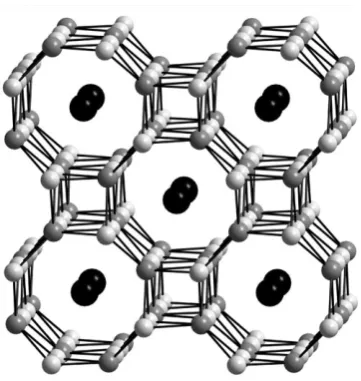
An unusual alkali metal environment, for an intermetallic phase, has also been reported in the 1-dimensional structures of AAu4In2 (A = K, Rb).54 These isostructural compounds contain both 8-member and 4-member tunnels along the cdirection of the unit cell [I4mcm] composed of an Au–In framework as shown in Fig. 4. The octagonal channels are occupied by the alkali metals and consequently this structure is highly reminiscent of zeolite chemistry. Most remarkably, this material is stable at room temperature to both air and moisture even in concentrated hydrochloric acid. The mixed compounds KxRb1xAu4In2have been prepared and show increasing disorder in the alkali metal with increasing Rb+content. However, the limited impact of these substitutions on the structure of the tunnel wall suggest very weak interactions between the alkali metal and the framework structure and this is supported by linear muffin-tin-orbital calculations. Combined with the chemical stability of these compounds, this finding suggests that a wide range of experiments analogous to those commonplace in zeolite chemistry may be feasible. Substitution of magnesium, gold or zinc for indium in a hypothetical K23In105 lattice has afforded three new ternary compounds.55These all consist of complex networks of In12 icosahedra and triply fused In(Mg, Au, Zn)28 icosahedra. This anionic framework is bridged by K atoms to give a clathrate type II network. In each case a line phase is observed and it is argued that the bonding within the cluster containing the doping metal is optimised at the observed compositions.
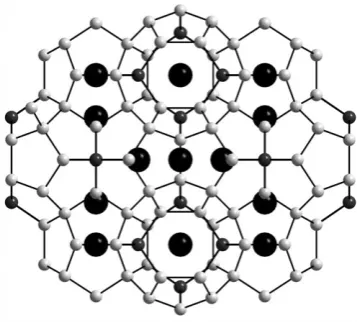
[image:12.442.131.312.385.576.2]A clathrate type I structure has been reported for Ba8Al13Si31.56This compound contains a covalently bonded framework of aluminium and silicon which accom-modates barium in the voids as shown in Fig. 5. Aluminium and silicon are observed on all three crystallographic sites, although the careful application of neutron diffraction and NMR shows that there is a site preference leading to majority aluminium occupation of one of the sites. Ba8Al14Si31shows metallic conductivity and a Seebeck coefficient of49mV K1at room temperature. The series of doped compounds Ba8Cu6xGe40+x(0rxr0.7) have been prepared in the search for a
material with enhanced thermoelectric properties.57The reaction of stoichiometric amounts of Ba6Ge25and copper provided an excellent degree of control over the Cu:Ge ratio of the resultant compounds which adopt the type I clathrate structure discussed above. In the case of Ba8Cu6Ge40the copper atoms reside exclusively on the sites favoured by aluminium in Ba8Al13Si31. These compounds are semiconduct-ing for small values of x but become increasingly metallic with reducing Cu concentration and surprisingly show only a small variation in carrier concentration and mobility in response to varying composition. It is argued that this arises from the presence of vacancies on the Ge/Cu sublattice arising because of a narrow phase width.
The effect of larger vacancy concentrations has been studied in the systems SmGe2x and GdGe2x and has identified new vacancy-ordered materials of
composition Sm3Ge5 and Gd3Ge5.58 The former exists in two polymorphs; a- Sm3Ge5 forms a unique structure [P62c;c= 6.9238(11), c= 8.491(3) A˚] and b-Sm3Ge5is isostructural with Gd3Ge5and adopt the Y3Ge5structure which is itself a vacancy ordered modification of thea-ThSi2structure. The structure ofa-Sm3Ge5 can be considered to be derived from defective layers of germanium with samarium occupying the interlayer space. The regular removal of 1
6of the atoms from the
graphene Ge sheets results in the formation of fused 12-member rings and this reduces the coordination number of samarium from twelve to ten and gives a distorted pentagonal antiprismatic environment. Variation in the stoichiometry of the elemental reagents and indium flux led to the preparation of either theaorb
[image:13.442.131.310.393.554.2]polymorph. The structure of the latter, and of Gd3Ge5, is composed of three-dimensional framework of germanium with the Sm3+ or Ga3+ occupying the irregular hexagonal channels in the framework that exhibits a vacancy ordering pattern that avoids destabilisingly short Ge–Ge separations. All three compounds exhibit a transition to an antiferromagnetically ordered phase at a temperature in the range 10rT/Kr30.
The ternary phase SrLiSb is isostructural with the calcium analogue and adopts the anti-PbCl2 structure in contrast to the hexagonal symmetry of BaLiSb. Anti-mony is in nine coordination to four lithium and five strontium atoms giving isolated Sb3 anions and a diamagnetic Zintl phase.59 Three isostructural compounds A2Ca10Sb9(A= (Li1/2Mg1/2), (Mg), (Li0.69Ca0.31) have been reported which contain a 5:2 mixture of Sb3 and Sb2
4 anions.60
The structure is rather complex and involves a large range of bonding environments for antimony with between six and nine cation neighbours combined with the presence of Sb–Sb dimers. The phase LiMgCa10Sb5(Sb2)2 is an ideal Zintl phase and the physical properties (highly insulating and diamagnetic) support this. Therefore the other two compositions demonstrate modest adjustments in the electron populations being 1 electron rich (Mg2Ca10Sb9) and 0.4 electrons poor (Li0.69Ca0.31Ca10Sb9) per formula unit.
The bonding in CaMn2Sb2and SrMn2Sb2can also be rationalised as following the Zintl theory of bonding, although these compounds show metallic conductivity and a contribution of the bands arising from the Mn d-orbitals to the bonding that is incompatible with this. Both phases adopt the CaAl2Si2 structure with a zig-zag double layer of [MnSb]2between sheets of alkaline earth metal as shown in Fig. 6.
61
Strong antiferromagnetic interactions lead to complex magnetic ordering below 250 and 265 K for CaMn2Sb2 and SrMn2Sb2, respectively. A magnetic structure is proposed on the basis of spin polarised calculations that suggest considerable stability results from an antiferromagnetic structure provided by ferromagnetic coupling within each of the sheets within the bilayer and an antiferromagnetic relationship between these two layers.
The compound TbRhIn5has been studied62as an analogue of the heavy fermion phase CeRhIn5 which shows an unusual combination of magnetic order and superconductivity. TbRhIn5adopts the HoCoGa5structure making it isostructural with the Ce analogue and so contains alternating layers of TbIn3cuboctahedra with
[image:14.442.131.313.431.575.2]RhIn2 rectangular. This material undergoes an antiferromagnetic transition and exhibits a simultaneous discontinuity in the metallic conductivity at 48 K but does not exhibit superconductivity. The relatively high Ne´el temperature indicates that the strong coupling of paramagnetic centres viathe conduction electrons leads to dominance of the electronic properties by these RKKY interactions and so explains the absence of heavy fermion behaviour.
The stuffed Mn5Si3structure exhibited by the compounds U3ScSb5and U3TiSb5is highly anisotropic and this has a strong impact on the electronic properties of these materials. These compounds contain uranium coordinated to nine antimony atoms to give tricapped trigonal prismatic geometry that reside between chains composed of face-sharing Sc/TiSb6octahedra that are aligned along thec-direction of the unit cell [P63/mcm;a= 9.2145(2),c= 6.1938(2) A˚].
63
Although this structure has been observed for a range of compositions it is noteworthy that U3ScSb5has the most expanded structure and is the most electron poor member of the series. Both compounds order ferromagnetically at 130 K and 160 K for U3ScSb5and U3TiSb5, respectively with the ordered moments aligned along the [120] direction. The co-incidence of these magnetic transitions with a large, anisotropic discontinuity in the conductivity illustrates the importance of the conduction electrons in mediating the magnetic exchange interactions.
5.
Halides, chalcogenides, nitrides
The transition metal oxyhalide FeTe2O5ClxBr1x contains dense layers of edge
sharing FeO6octahedra giving tetrameric units of [Fe4O16]20which are linked by [Te4O10X2]6groups that provide a strong magnetic buffer between the layers.64The halide and the stereoactive lone pair of TeIVare projected into the interlayer space and the layers are only weakly connected with their neighbours by van der Waals interactions. The arrangement of Fe3+ ions within the tetrameric units forms a rhomboid composed of two almost equilateral triangles linked viaa shared edge. This triangular arrangement, combined with antiferromagnetic coupling within the tetramer, leads to magnetic frustration within the clusters. Consequently Ne´el temperatures of around 11 K are observed despite the presence of antiferromagnetic interactions an order of magnitude stronger than this temperature suggests.
The compositions Rb2KCrF6 and Rb2KGaF6 adopt the elpasolite structure at room temperature with an ordered arrangement of potassium and chromium or gallium over the octahedral sites of the perovskite parent structure. A single crystal study of both of these compounds has determined that on cooling below room temperature these phases undergo structural transitions. These transitions are driven by a striking increase in the coordination number of some of the K+from six to seven giving a pentagonal bipyramidal arrangement around 80% of the potassium sites.65Interestingly, this rearrangement does not occur in a cooperative manner, as is commonly observed in perovskites, and instead suggests strong parallels with the structural chemistry of tungsten bronzes.
observation of disorder in the guest ions suggests that modification by ion-exchange may yield a new route to related inclusion compounds. Crystal structures that can be considered as a composite of the chemical components have also been reported for the family of compounds Ba2F2SnS3, Ba2F2SnSe3, Sr2F2SnS3and Sr2F2SnS3.66The structures of all four compounds are built up from stacking of layers of fluorite [(Ba/Sr)2F2] and distorted rock salt [Sn(S/Se)3]. Crucially the electronic properties of these materials derive from the behaviour of these component parts; the fluorite acts as a charge-donor which is balanced by the charge-acceptor nature of the rock salt layer. The interaction between the layers is thus largely ionic in character.
The homologous series Srn+1MnnO3n1Cu2mSm+1 is built up from Cu2S2 anti-fluorite layers and Srn+1MnO3n1layers that resemble a section of variable thickness from the perovskite structure.67These materials show properties that are associated with both of these parent structures but also permit the tuning of the properties of one layer by adjusting the chemistry of the other. The structures of Sr2MnO2Cu3.5S3 and Sr2MnO2Cu5.5S4show that the Cu-S blocks can contain copper disorder that is similar to that observed in the fast-ion conducting phase a-Cu2S. Indeed this mobility has been exploited to carry out a reductive topotactic replacement of copper by lithium in Sr2MnO2Cu1.5S2 and Sr2MnO2Cu3.5S3 to give Sr2MnO2 -Li1.86(3)S2and Sr2MnO2Li3.8(1)S3, respectively.68The parent compounds Sr2MnO2 -Cu1.5S2and Sr2MnO2Cu3.5S3are examples of metamagnets; they are antiferromag-netically ordered in zero applied field below ca. 30 K, but a ferromagnetically ordered phase can be stabilised by application of an appropriately large magnetic field. Magnetic measurements on Sr2MnO2Li3.8(1)S3show that lithiation, and the associated reduction of Mn2.5+ to Mn2.2+, destroys both the low-field antiferro-magnetic and high-field ferroantiferro-magnetic states. Tetrahedral CuS4 units are also reported in KCaEr2CuS5.69 This compound contains highly localised copper in chains which alternate with ErS6 to give a layered structure with K+ and Ca2+ located in 8- and 6-coordinate interlayer sites.
Ion exchange reactions of K6Sn[Zn4Sn4S17] have provided access to new phases containing Cs+and NH
4+.70The parent material has three types of microporous cavity. The largest of these provides an excellent match in size for Cs+and exchange reactions carried out using a single crystal clearly show that the single Cs atom per formula unit that is exchanged into the structure uniquely occupies this position as shown in Fig. 7. Competitive ion-exchange reactions involving a mixed solution of CsCl and RbI showed that this site uniquely selects Cs+, with Rb+being exchanged onto a smaller site in the structure. All three sites are interconnected and the smallest site shows a good selectivity for NH4+ which migrates through the larger sites in order to access this thermodynamically preferable position. This strong selectivity for caesium even in low concentrations compared to rubidium and ammonium suggests that this material may find applications in 137Cs recovery from nuclear waste.
Sr4GaN3O and Sr4GaN3(CN)2have been prepared from sodium melt at 9001C and both contain triangular [GaN3]6–unit in slabs of [Sr4GaN3]2+that are packed in a herringbone pattern.71 Strontium cations in adjacent slabs are coordinated by either oxide or carbodiimide to form pillared structures. There is considerable positional disorder in the pillaring oxide anion; reflecting the underbonded nature of this environment. The common observation of slabs in these phases suggest that this motif may be useful in the design of related intergrowth structures.
identified for the first time and the presence of solid solutions between this compound and the isostructural ternary phases Sr2NCl and Sr2NBr have been established with complete mixing of halides over a single crystallographic site.72All compounds are diamagnetic and insulating. A rock salt structure of g-Mo2N has been proposed and the high pressure treatment of this compound has produced a sample suitable for neutron powder diffraction experiments. These have unambigu-ously established that the nitride is exclusively located in the octahedral interstitial sites of a face-centred cubic lattice of molybdenum with a disordered distribution of the 50% vacancies on nitride position.73
Single crystals of MnSiN2have been prepared for the first time by using a slight excess of manganese to permit dissolution of Si3N4in molten manganese under a nitrogen atmosphere and subsequent growth of transparent red crystals from the metallic droplet.74 This has permitted a refinement of the structure previously proposed and a thorough investigation of the magnetic properties. The nitride anions form a slightly distorted pseudo-hexagonally close-packed array with an ordered arrangement of Mn2+and Si4+over the tetrahedrally-coordinated inter-stitial sites in the structure to give an orthorhombic phase [Pna21] closely related to wurtzite. Extremely strong antiferromagnetic interactions exist and lead to anti-ferromagnetic order below a broad transition at 490 K although the Mn2+spins remain strongly coupled to at least 700 K. A second magnetic transition at 442 K is associated with canting of the magnetic moments leading to the emergence of a net magnetisation.
References
1 P. Karena, A. R. Moodenbaugh, J. Goldberger, P. N. Santhosh and P. M. Woodward, J. Solid State Chem., 2006,179, 2120.
2 A. C. Mclaughlin,Solid State Commun., 2006,137, 354.
3 E. J. Cussen, D. R. Lynham and J. Rogers,Chem. Mater., 2006,18, 2855. 4 E. E. McCabe and C. Greaves,Chem. Mater., 2006,18, 5774.
5 V. Thangadurai and W. Weppner,J. Solid State Chem., 2006,179, 974.
6 M. P. O’Callaghan, D. R. Lynham, G. Z. Chen and E. J. Cussen,Chem. Mater., 2006,18, 4681.
7 E. J. Cussen,Chem. Commun., 2006, 412.
[image:17.442.72.375.30.173.2]8 Z. S. Go¨nen, D. Paluchowski, P. Zavalij, B. W. Eichhorn and J. Gopalakrishnan,Inorg. Chem., 2006,45, 8736.
9 J.-F. Colin, V. Pralong, V. Caignaert, M. Hervieu and B. Raveau,Inorg. Chem., 2006,45, 7217.
10 J. Sun, M. Yang, G. Li, T. Yang, F. Liao, Y. Wang, M. Xiong and J. Lin,Inorg. Chem., 2006,45, 9151.
11 A. C. Mclaughlin, L. Begg, C. Harrow, S. A. J. Kimber, F. Sher and J. P. Attfield,J. Am. Chem. Soc., 2006,128, 12364.
12 M. A. Hayward,Chem. Mater., 2006,18, 321.
13 A. Bowman, M. Allix, D. Pelloquin and M. J. Rosseinsky,J. Am. Chem. Soc., 2006,128, 12606.
14 H. M. Palmer, A. Snedden, A. J. Wright and C. Greaves,Chem. Mater., 2006,18, 1130. 15 M. L. Ruiz-Gonza´lez, R. Corte´s-Gil, J. M. Alonso, A. Hernando, M. Vallet-Regı´ and J.
M. Gonza´lez-Calbet,Chem. Mater., 2006,18, 5757.
16 M. Giot, P. Beran, O. Pe´rez, S. Malo, M. Hervieu, B. Raveau, M. Nevriva, K. Knizek and P. Roussel,Chem. Mater., 2006,18, 3225.
17 J. J. Adkin and M. A. Hayward,J. Solid State Chem., 2006,179, 70.
18 R. B. Macquart, W. R. Gemmill, M. J. Davis, M. D. Smith and H.-C. z. Loye,Inorg. Chem., 2006,45, 4391.
19 E. O. Chi, K. M. Ok, Y. Porter and P. S. Halasyamani,Chem. Mater., 2006,18, 2070. 20 X. Kuang, C. Bridges, M. Allix, J. B. Claridge, H. Hughes and M. J. Rosseinsky,Chem.
Mater., 2006,18, 5130.
21 Y. H. Huang, H. Fjellva˚g, M. Karppinen, B. C. Hauback, H. Yamauchi and J. B. Goodenough,Chem. Mater., 2006,18, 2130.
22 K. Yamaura, Q. Huang, L. Zhang, K. Takada, Y. Baba, T. Nagai, Y. Matsui, K. Kosuda and E. Takayama-Muromachi,J. Am. Chem. Soc., 2006,128, 9448.
23 Q. Xu, T. Klimczuk, J. Jansen, R. J. Cava and H. W. Zandbergen,Chem. Mater., 2006,18, 4585.
24 A. A. Belik, T. Wuernisha, T. Kamiyama, K. Mori, M. Maie, T. Nagai, Y. Matsui and E. Takayama-Muromachi|,Chem. Mater., 2006,18, 133.
25 M. R. Suchomel, A. M. Fogg, M. Allix, H. Niu, J. B. Claridge and M. J. Rosseinsky, Chem. Mater., 2006,18, 4987.
26 N. Cornei, N. Tancret, F. Abraham and O. Mentre´,Inorg. Chem., 2006,45, 4886. 27 R. Punn, A. M. Feteira, D. C. Sinclair and C. Greaves,J. Am. Chem. Soc., 2006,128,
15386.
28 J. S. Knyrim, P. Becker, D. Johrendt and H. Huppertz,Angew. Chem., Int. Ed., 2006,45, 8239.
29 J. Barbier and L. M. D. Cranswick,J. Solid State Chem., 2006,179, 3958.
30 X. Chen, J. Zuo, X. Chang, Y. Zhao, H. Zang and W. Xiao,J. Solid State Chem., 2006,
179, 3191.
31 F. Kong, S.-P. Huang, Z.-M. Sun, J.-G. Mao and W.-D. Cheng,J. Am. Chem. Soc., 2006,
128, 7750.
32 K. M. Ok and P. S. Halasyamani,J. Solid State Chem., 2006,179, 1345.
33 H. Birkedal, A. M. K. Andersen, A. Arakcheeva, G. Chapuis, P. Norby and P. Pattison, Inorg. Chem., 2006,45, 4346.
34 G. W. Stinton, M. R. Hampson and J. S. O. Evans,Inorg. Chem., 2006,45, 4352. 35 H. Ettis, H. Naı¨li and T. Mhiri,J. Solid State Chem., 2006,179, 3107.
36 S. Benmokhtar, A. E. Jazouli, J. P. Chaminade, P. Gravereau, A. Wattiaux, L. Fourne`s, J. C. Grenier and D. Waal,J. Solid State Chem., 2006,179, 3709.
37 J. M. Porras-Va´zquez, A´. G. D. L. Torre, D. Maerrero-Lo´pez, E. R. Losilla and M. A. G. Aranda,Dalton Trans., 2006, 2691.
38 K. M. Ok, J. Baek, P. S. Halasyamani and D. O’Hare,Inorg. Chem., 2006,45, 10207. 39 M. Yang, J. Yu, J. Di, J. Li, P. Chen, Q. Fang, Y. Chen and R. Xu,Inorg. Chem., 2006,45,
3588.
40 R. Baies, O. Pe´rez, V. Caignaert, V. Pralong and B. Raveau,J. Mater. Chem., 2006,16, 2434.
41 K. G. S. Ranmohotti, X. Mo, M. K. Smith and S.-J. Hwu,Inorg. Chem., 2006,45, 3665. 42 E. R. Parnham, P. S. Wheatley and R. E. Morris,Chem. Commun., 2006, 380.
43 J. Liang, J. Li, J. Yu, P. Chen, Q. Fang, F. Sun and R. Xu,Angew. Chem., Int. Ed., 2006,
45, 2546.
44 A. Corma, M. J. Dı´az-Caban˜as, J. L. Jorda´, C. Martı´nez and M. Moliner,Nature, 2006,
443, 842.
46 S. Georges, F. Goutenoire and P. Lacorre,J. Solid State Chem., 2006,179, 4020. 47 F. Gramm, C. Baerlocher, L. B. McCusker, S. J. Warrender, P. A. Wright, B. Han, S. B.
Hong, Z. Liu, T. Ohsuna and O. Terasaki,Nature, 2006,444, 79.
48 J. F. Colin, T. Bataille, S. E. Ashbrook, N. Audebrand, L. L. Polle`s, J. Y. Pivan and E. L. Fur,Inorg. Chem., 2006,45, 6034.
49 T. Sivakumar, K. M. Ok and P. S. Halasyamani,Inorg. Chem., 2006,45, 3602. 50 M. B. Salah, S. Vilminot, G. Andre´, M. Richard-Plouet, T. Mhiri, S. Takagi and M.
Kurmoo,J. Am. Chem. Soc., 2006,128, 7972.
51 E. V. Alekseev, S. V. Krivovichevc, W. Depmeier, T. Armbruster, H. Katzke, E. V. Suleimanov and E. V. Chuprunova,J. Solid State Chem., 2006,179, 2977.
52 K. M. Ok, M. B. Doran and D. O’Hare,J. Mater. Chem., 2006,16, 3366.
53 V. Smetana, V. Babizhetskyy, G. V. Vajenine and A. Simon,Angew. Chem., Int. Ed., 2006,
45, 6051.
54 B. Li and J. D. Corbett,J. Am. Chem. Soc., 2006,128, 12392. 55 B. Li and J. D. Corbett,Inorg. Chem., 2006,45, 8958.
56 C. L. Condron, J. Martin, G. S. Nolas, P. M. B. Piccoli, A. J. Schultz and S. M. Kauzlarich,Inorg. Chem., 2006,45, 9381.
57 S. Johnsen, A. Bentien, G. K. H. Madsen, B. B. Iversen and M. Nygren,Chem. Mater., 2006,18, 4633.
58 P. H. Tobash, D. Lins, S. Bobev, N. Hur, J. D. Thompson and J. L. Sarrao,Inorg. Chem., 2006,45, 7286.
59 S. Gupta and A. K. Ganguli,J. Solid State Chem., 2006,179, 1318. 60 A. K. Ganguli, S. Gupta and J. D. Corbett,Inorg. Chem., 2006,45, 196. 61 S. Bobev and J. Merz,Inorg. Chem., 2006,45, 4047.
62 W. M. Williams, L. Pham, S. MaQuilon, M. Moldovan, Z. Fisk, D. P. Young and J. Y. Chan,Inorg. Chem., 2006,45, 4637.
63 A. Mar, O. Tougait, M. Potel, H. Noe¨l and E. B. Lopes,Chem. Mater., 2006,18, 4533. 64 R. Becker, M. Johnsson, R. K. Kremer, H.-H. Klauss and P. Lemmens,J. Am. Chem.
Soc., 2006,128, 15469.
65 F. J. Zu´n˜iga, A. Tressaud and J. Darriet,J. Solid State Chem., 2006,179, 3607. 66 R. K. Li and Y. Yu,Inorg. Chem., 2006,45, 6840.
67 Z. A. Ga´l, O. J. Rutt, C. F. Smura, T. P. Overton, N. Barrier, S. J. Clarke and J. Hadermann,J. Am. Chem. Soc., 2006,128, 8530.
68 O. J. Rutt, G. R. Williams and S. J. Clarke,Chem. Commun., 2006, 2869.
69 H.-Y. Zeng, H. Mattausch, A. Simon, F.-K. Zheng, Z.-C. Dong, G.-C. Guo and J.-S. Huang,Inorg. Chem., 2006,45, 7943.
70 M. J. Manos, K. Chrissafis and M. G. Kanatzidis,J. Am. Chem. Soc., 2006,128, 8875. 71 P. M. Mallinson, Z. A. Ga´l and S. J. Clarke,Inorg. Chem., 2006,45, 419.
72 A. Bowman, R. I. Smith and D. H. Gregory,J. Solid State Chem., 2006,179, 130. 73 C. L. Bull, T. Kawashima, P. F. McMillan, D. Machon, O. Shebanova, D. Daisenberger,
E. Soignard, E. Takayama-Muromachi and L. C. Chapon,J. Solid State Chem., 2006,179, 1762.
![Fig. 1The [TiNbOthat the oxide octahedra are rich in Ti and Nb, respectively.5]� sheets observed in LiTiNbO5](https://thumb-us.123doks.com/thumbv2/123dok_us/1714818.124862/3.442.131.313.415.576/fig-tinbothat-oxide-octahedra-respectively-sheets-observed-litinbo.webp)

![Fig. 3The framework of Narepresented by light and dark polyhedra, respectively. The [TbSiL3TbSi3O9 is composed of TbO6 octahedra and SiO4 tetrahedra6O9] unit forms a chiral-Co(en)33+ unit.45](https://thumb-us.123doks.com/thumbv2/123dok_us/1714818.124862/10.442.102.341.436.565/framework-narepresented-polyhedra-respectively-tbsil-composed-octahedra-tetrahedra.webp)

![Fig. 7Krepresented as light grey spheres and zinc and tin as small and larger dark grey spheres.Exchange of Cssites giving the structure shown on the right with Cs and K represented by large black and lightgrey spheres.6Sn[Zn4Sn4S17] contains a framework {Sn[Zn4S17]}6� illustrated (left) with sulfur+ for one equivalent of K+ shows a preference for the largest of the three cation70](https://thumb-us.123doks.com/thumbv2/123dok_us/1714818.124862/17.442.72.375.30.173/krepresented-structure-represented-lightgrey-framework-illustrated-equivalent-preference.webp)
