A pluralistic framework for counselling and psychotherapy: implications for research
Mick Cooper1 and John McLeod2
1
Counselling Unit, University of Strathclyde, Glasgow ([email protected])
2
Tayside Institute for Health Studies, University of Abertay Dundee ([email protected])
Published in:
Counselling and Psychotherapy Research 7(3), 135-143, 2007.
ABSTRACT
Historically, training, research and practice in counselling and psychotherapy have been dominated by unitary theoretical models. Although integrative and eclectic positions have been developed as alternatives, these have not been successful in generating research, and have resulted in a further proliferation of competing models. In this paper we introduce a ‘pluralistic’ framework for counselling and
psychotherapy and discuss the implications of this framework for research. The basic principle of this pluralistic framework is that psychological difficulties may have multiple causes and that there is unlikely to be one, ‘right’ therapeutic method that will be appropriate in all situations – different people are helped by different processes at different times. This pluralistic framework operates as a meta-theory within which it is possible to utilise concepts, strategies and specific interventions from a range of therapeutic orientations. The framework is structured around three domains – goals, task and methods – by which therapeutic processes can be
conceptualised, critically examined and empirically investigated. These domains, and the relationships between them, are outlined; and the collaborative relationship at the heart of the pluralistic framework is discussed. The pluralistic framework provides a means for empirical research directly to inform practice, and potential lines of
empirical inquiry are outlined, along with findings from a recent study of counselling in schools.
Title: A pluralistic framework for counselling and psychotherapy: implications for research
[W]e were struck by the ‘either/or’ position that many researchers and clinicians seem to take with regard to the variable(s) responsible for change. While some authors seemed to emphasise the importance of relationship above all, others focused on the effects of participant (therapist or patient) factors, and still others drew attention to the salience of certain treatment procedures and models. It struck us that all of these groups of scholars had lost sight of the possibility that relationship, participant factors, and treatment procedures were effective and interactive; that the conjunction should be ‘and’ not ‘or’ when describing the things that produce change. (Castonguay and Beutler, 2006, p. v).
From 2002 to 2004, two of the key international figures in current psychotherapy research, Louis Castonguay and Larry Beutler, chaired a task force charged by the American Psychological Association and the North American Society for
Psychotherapy Research with the task of identifying the effective principles of psychotherapeutic change. Their conclusion, above, was that there are many things that produce change. However, even if it is accepted, in principle, that therapy should be practiced in a way that is open to multiple pathways of change, the question remains: how are we to accomplish this?
Within the United Kingdom, unitary models of counselling and
psychotherapeutic theory and practice continue to dominate. Within the BACP, less than 25% of therapists are trained in an integrative approach (Couchman, 2006, personal communication); and the UK Council for Psychotherapy (UKCP) has recently re-structured along model-specific lines. An orientation-based
conceptualisation of counselling and psychotherapy is also apparent in recent UK government directives, with Department of Health and NICE Guidelines explicitly recommending particular therapeutic orientations for particular forms of
psychological distress (Department of Health, 2001). However, many commentators have pointed toward basic weaknesses in unitary models of theory and practice (Feltham, 1997; Hollanders, 1999, 2003; Norcross & Grencavage, 1989). In
particular, the pervasive finding that different therapeutic orientations are equivalent in their effectiveness (Wampold, 2001) suggests that no single therapeutic approach has a superior grasp of the truth.
In response to these challenges, some psychotherapists and counsellors have moved towards more integrative approaches to theory and practice. Stricker and Gold (2003) describe three contrasting modes of therapy integration: ‘theoretical
Despite the undoubted value of integrationist and eclectic perspectives, there are a number of difficulties with existing attempts to move beyond unitary models of therapy. First, as Downing (2004) has pointed out, many of these attempts to
transcend a unitary model of pathology and practice – particularly theoretical and assimilative integration – end up re-advocating exactly that: albeit with elements synthesised from a variety of sources. For example, the influential Cognitive Analytic Therapy (CAT) approach, developed by Ryle (1990), was formulated as an attempt to bring together ideas from cognitive psychology and psychodynamic psychotherapy, but has itself become a unitary approach. Similarly, Egan’s (1994)
Problem-Management approach, although incorporating elements from a wide variety of sources, is ultimately based on a very specific model of the change process.. Even eclectic approaches, like Lazarus’s multimodal therapy, are built upon relatively unitary models of personality and therapeutic change (Nelson-Jones, 2006). Closely related to this, existing models of integration are not fully responsive to the possibility that different clients may need very different things at different times. Here, eclectic approaches have more potential to meet clients’ individual needs; but such models raise the problem that, in the end, a practitioner needs to be able to draw on some kind of principles for deciding which technique to implement in which situation. The existence of such principles then implies that the therapist is, implicitly adhering to a theory or model, but one that is not explicitly articulated, and thus not open to critical scrutiny and development. Existing integrationist and eclectic approaches have also not proved to be fertile in stimulating research, and as a result have not generated the kind of cumulative body of knowledge that is associated with mainstream unitary orientations such as psychoanalytic, experiential or cognitive-behavioural therapy.
Building on recent work (Cooper, 2005; Cooper and McLeod, 2006), the aim of this paper is to introduce a new approach to conceptualising counselling and psychotherapeutic theory and practice - pluralism - and to discuss the implications of this framework for research. Unlike singular models and systematic forms of
integrationism, a pluralistic framework is open to an infinitely wide range of ways of engaging with individual clients. Unlike an eclectic approach, however, the pluralistic meta-theory outlined here provides a framework through which this multitude of practices and conceptualisations can be organised, contrasted and evaluated. While we acknowledge that, for many therapists, the idea of drawing on different methods to respond to the needs of different clients is by no means new (Polkinghorne, 1992), we hope that the present framework can serve to consolidate and advance such a stance. A brief overview of pluralistic thinking is offered, followed by an overview of the specific pluralistic framework being proposed. Implications for practice are then discussed, with a particular emphasis on the centrality of therapist-client
Pluralism
The philosophical assumption underlying this venture, pluralism, can be defined as ‘the doctrine that any substantial question admits of a variety of plausible but
mutually conflicting responses’ (Rescher, 1993, p.79). It is a philosophical standpoint closely aligned with postmodern thinking (e.g. Lyotard, 1984) which holds that the desire for consensus, a key aim of modernist, scientistic discourse, is doomed to fail. For Rescher (1993), all understanding is dependent on experience and it is inevitable that, in a complex and imperfect world, human beings will have a range of
experiences. Hence, Rescher argues, the normal human condition is ‘dissensus’ rather than consensus. More importantly, though, Rescher, like other postmodern thinkers (e.g. Levinas, 1969), argues that the quest for consensus is ethically problematic: closing off people to that which is most different and diverse in others. Pluralism, then, is not just an epistemological position, but an ethical and political commitment to respecting, valuing and being inclusive towards Otherness: of other worldviews, of other counsellors and psychotherapists and, as we shall explore later, of our clients. In this respect, it is possible to think of pluralism as a form of humanistic-existential ethic (Cooper, 2007, p.11) in which there is ‘a commitment to conceptualizing, and engaging with people in a deeply valuing and respectful way.’
With respect to counselling and psychotherapy, a pluralistic standpoint holds that a multiplicity of different models of psychological distress and change may be ‘true’ and that there is no need to try and reduce these into one, unified model. In other words, a client may be regarded as experiencing psychological distress because he or she is thinking in irrational ways (Ellis, 1962), or is not fully congruent with his or her self-experiences (Rogers, 1951), or because his or her emotion schemes are problematic (Greenberg, Rice, & Elliott, 1993) and there is no need to explain any of these processes by any of the others. Different explanations will be true for different people at different points in time and therefore different therapeutic methods will be most helpful for different clients at different instances. As Lambert (2004, p.809) has put it, there are ‘many ways to health’. In this respect, a pluralistic approach opens up possibilities for working creatively in ways that most closely reflect the needs of individual clients: a genuine ‘responsivity’ to clients’ wants (Stiles, Honos-Webb, & Surko, 1998). Finally, pluralism in counselling and psychotherapy reflects the
increasing degree of cultural diversity in clients and therapists, and the importance of developing therapeutic practice that embraces the multiplicity of beliefs that exist regarding healing and change (Pedersen, 1994).
such as wanting to get on better with his parents or wanting to find out more about himself. Other clients may have a range of other wants: such as learning to be more in control or learning to be more affectionate. Here, what is critical to the pluralistic framework is that, either across persons or within one person, these goals are not seen as being reducible to one theory-driven, meta-goal. That is, we cannot assume that it is ‘all about’ correcting dysfunctional cognitions or ‘all about’ aligning
self-experiences with the self-concept. From the pluralistic standpoint, there is no one goal or set of goals that is most fundamental to each and every person. Equally, what is critical to the pluralistic framework is that there is no one-to-one, exclusive
relationship between components within one domain and components within another. We cannot assume, for instance, that all people who want to overcome their
depression will achieve this through the task of deepening their levels of interpersonal relating (Mearns & Cooper, 2005). Many people might, but some people with
depression may be much more helped through the task of challenging dysfunctional cognitions; and, for others, re-configuring emotional schema may lie at the heart of their therapeutic work.
Goals
Given the ethical commitment of the pluralistic framework to valuing Otherness, its starting point is that clients are active, meaning-oriented beings with a right to self-determination. Hence, the focus of the framework is not ‘What do clients need?’ but ‘What do clients want?’ The pluralistic framework assumes that different clients may have very different wants from therapy, for instance: ‘to feel more secure,’ ‘to be able to cope better at work,’ ‘to feel sad less of the time.’ In many instances, a client’s goals may simply be the negation of a problem – for instance, to feel less depressed – but in other cases there may be no specific problem to overcome. For instance, a client may come to therapy to gain more insight into him or herself.
The identification of goals can be challenging for therapists. Clearly, not all clients who come to therapy are able to articulate their goals. Some clients may not feel safe enough to disclose their true goals, until they have developed sufficient trust in their therapist. In addition, it makes sense to think about levels of generality in relation to therapeutic goals. At a high level of generality, clients may express ‘life goals’ such as ‘I want to be able to commit myself to a loving relationship’ or ‘I want to have a life free from memories of abuse’. By contrast, other clients may identify much more specific goals, such as ‘I want to be less anxious when I am at work’ or ‘I want to decide whether to have an AIDS test’. One of the skills of a competent therapist is to be able to explore with a client the structure of their goals, and the extent to which the goals can be achieved within the time available for therapy. For instance, a client who begins his first session with a stress counsellor by saying that ‘I want to be less anxious when I am at work’ may disclose, after a couple of sessions, that his real aim is ‘to have a life free from memories of abuse’. However, it may be that the broader goal is not something that the stress counsellor may feel equipped to handle.
when a goal has been achieved (and affirming this accomplishment), and negotiating new and different goals that may emerge during the course of therapy. In this respect, it is important to emphasise that, in the pluralistic framework, goals are not
conceptualised as rigid and unvarying targets that clients should be pressurised to construct and pursue. Rather, the emphasis is on helping clients clarify and explore the goals that are already there, in terms of being implicit in the structure of the person’s engagement with his or her life space. The pluralistic approach is based on an assumption that clients, like all human beings, do things for reasons; and that the more that a therapist and client can know what it is that the client wants from therapy, the more they can work together to achieve it. In practice, therapists working within the pluralistic framework seek to maintain an on-going thread of goal-focused conversation with their clients, in which goals can emerge, be clarified, the language within which they are discussed can be sharpened, and the tangible outcomes
associated with specific goals can be monitored. This is a process that is attuned to the intentionality of the client, and accepts that within that intentionality the person may embrace multiple (and even contradictory) goals.
Tasks
The ‘tasks’ of the therapeutic process can be thought of as concrete, lower order goals: ‘a sequence of actions carried out by a person, in collaboration with a counsellor, in order to be able to get on with their life’ (McLeod, 2007, p.54). Process-experiential theorists (Elliott, Watson, Goldman, & Greenberg, 2004; Greenberg et al., 1993) have demonstrated the practical value of segmenting the concrete work of therapy into distinct tasks, with the therapy process being advanced through client and therapist collaborative action round the completion of these therapeutic tasks. For example, Sonia came into counselling because she had
experienced a traumatic bereavement in which her teenage son had been drinking and died in a road traffic accident. Although Sonia’s goal was ‘to come to terms with this and move on in my life’, the situation she was in seemed so all-encompassing and hopeless that she did not have any idea of where to start. Her counsellor invited her to talk about the issues that faced her, so they could develop a shared understanding of the challenges faced by Sonia. As they talked together, a number of discrete
therapeutic tasks emerged: dealing with the awful feelings that Sonia carried around with her; making sense of how her son could have done something so stupid; deciding whether she was ready to go back to work and end her sick leave; finding ways of accepting more support from her sisters; making emotional contact with her husband. These were just some of the tasks that were identified in the first session – further tasks arose later. By being able to flag up these tasks, and name them, Sonia and her counsellor were able to decide together where best to start, and how long the process might take.
The concept of task is central to the aim of demystifying therapy. Being able to identify the task in hand is the answer to the question ‘what is it that we are doing now?’ Being able to specify the tasks that are amenable to psychotherapeutic
A task has a beginning, middle and an end. The skill of counselling involves being able to set up a task, by agreeing on what the task is, then carrying out the task, and finally being able to know when the task has been successfully completed. A task perspective provides a way of determining the competencies that should be covered in training, and which a qualified counsellor might be expected to be able to deliver in practice. A preliminary list of basic counselling tasks might include:
• talking openly and meaningfully about current problems in living;
• exploring meaning – making sense of a problematic experience;
• problem-solving, planning and decision-making;
• changing behaviour;
• negotiating life transitions and developmental crises;
• expressing/letting go of feeling and emotion;
• finding, analysing and acting on information;
• enhancing self-care through use of personal, cultural and social resources.
In addition to these generic tasks, it is possible to identify particular tasks that are likely to occur in specific counselling settings. Worden (2001) has identified a set of tasks that typically occur in bereavement work, and Weaks, McLeod and Wilkinson (2006) have described therapeutic tasks associated with counselling in early dementia. Understanding the kinds of tasks most likely to be found with particular sets of clients represents an important research agenda, which has implications for the training of therapists working in specific areas, and also for the design of counselling
programmes designed to fit the needs of groups of clients. For example, a study by Gersons et al (2000) has reported remarkably high success rates in a therapy
intervention built around a series of tasks that were specifically tailored to the needs of police offers who had developed post-traumatic stress in the line of duty.
Methods
Methods are the specific, practical ways in which the therapist and client fulfil therapeutic tasks, and can be broken down into ‘client activities’ and ‘therapist activities’. For instance, in the case of Sonia, introduced earlier, the task of ‘dealing with these awful feelings’ could be tackled using a variety of different methods. Some of these methods might be derived from established theoretical traditions. From a humanistic-experiential orientation, for instance, the counsellor might undertake such activities as empathising with Sonia’s emotional pain, using experiential focusing techniques to help her to stay with her bodily ‘felt sense’, or inviting her to engage in an imaginary ‘two-chair’ dialogue with her son. From a cognitive-behavioural
an evening laughing and crying over photographs of her lost son. From the point of view of the pluralistic framework, any (or all, or none) of these methods may be effective for Sonia in allowing her to ‘deal with these awful feelings’. From a pluralistic perspective, the role of the therapist is not, as it would be in many approaches, to assess Sonia’s needs and then prescribe an intervention based on a unitary model. Instead, the therapist’s role is to facilitate an exploratory discussion around the possible methods that they might use together.
In relation to the use of methods, it is important to emphasise that the pluralistic framework does not require therapists to be omni-competent, and able to offer every intervention known to therapeutic science. All that any therapist can do is to offer what he or she knows, allow the client to talk about what they know, and then to arrive at an agreement around what each of them needs to do (client and therapist activities) to implement the method they have decided to use. In some situations, it may be that client and therapist decide that the therapist is not skilled in the most appropriate methods to help the client achieve their goals, and that an onward referral is therefore more appropriate. In this respect, it would be quite legitimate for a
therapist to consider their practice as ‘person-centred within a pluralistic framework’: that is, that they considered themselves most skilled in relational, non-directive techniques, and perhaps are not interested in working in more directive ways, but nevertheless are aware of the limits of their work, open to the value that others practices can have, and are willing to refer on, or maybe learn more about them, as and when appropriate.
Within this framework, there is no therapeutic method that is wrong, per se. However, there are certain methods (for instance, providing a client space to talk), that are likely to facilitate an extremely wide range of client tasks whilst others (such as giving clients advice) that are likely to facilitate only a small handful of client tasks. Hence, the framework does not simply advocate an ‘anything goes’ syncretism, but allows for the possibility that some therapeutic methods may be
counter-productive to the achievement of certain tasks for certain individuals at certain points in time. For instance, if a client’s goal is to feel better about himself, then being encouraged to see how dysfunctional his cognitions are may be counter-therapeutic, lowering his sense of self-worth. Another client, however, wanting to deal with problems in his life in a more realistic way, may find such a method of enormous value. The touchstone for assessing the value of a method is the client’s view of whether it is worth trying, and then whether it has been helpful.
outside of therapy by using some form of activity within their wider life-space. The framework therefore enhances the use in therapy of ‘extra-therapy’ factors (Hubble, Duncan and Miller, 1999) and cultural resources (McLeod, 2005).
A collaborative approach to therapy
The pluralistic framework, as discussed earlier, is based on a philosophical and ethical commitment to valuing multiple perspectives, and therefore holds that the client’s view on what is helpful and not helpful in therapy is as valid as the therapists. For this reason, at the heart of the present pluralistic framework is a collaborative relationship between therapist and client, in which both participants work together to help identify the tasks and methods that may help the client achieve their goals. Practice within the framework requires a therapist to engage in dialogue at each stage – agreeing on goals, identifying step-by-step tasks that will enable the fulfilment of these goals, deciding on the best method for tackling each task, and establishing what each partner will be expected to contribute within the application of a method. Each time this dialogue takes place, the client is relating directly with the therapist – they are doing something together. And each time they successfully negotiate their way into and through a domain, they build a relationship history that can serve as the foundation for further engagement with each other. The various choice points within the pluralistic framework therefore operate as sites for relational work.
The distinctive feature of pluralistic approach to therapy, in terms of what can be observed on video or read in a transcript, is the regular occurrence of episodes of what Rennie (1998) and Kiesler (1988) have described as ‘metacommunication’, or that Lee (2006) has described as ‘process contracting’. These episodes may extend over several minutes, for example when the dialogue involves deconstructing the meanings inherent in a goal statement, or the use of a diagnostic category, or when several options reveal themselves regarding possible methods that might be used in respect of a task. Alternatively, pluralistic metacommunication may comprise brief micro-episodes, such as the therapist asking ‘I know we have decided to spend a bit of time talking through this issue, to see whether we can develop a shared way of
making sense of it – I was just wondering, would it be helpful if I asked you some questions about the issue, or would it be better if I just gave you space to say what you need to say?’
Although such a collaborative approach to therapy is rooted in a set of ethical and philosophical principles, it is strongly supported by a range of empirical findings. First, research in the counselling and psychotherapy field indicates that one of the best predictors of therapeutic outcomes is the degree of consensus between therapists and clients on the goals and tasks of therapy. This has been demonstrated both directly (Tryon & Winograd, 2002), and through research on the ‘therapeutic alliance’
(Addis & Jacobson, 1996; Elkin et al., 1999; Gaston, Marmar, Gallagher, & Thompson, 1989). This indicates that a therapeutic approach which takes clients’ understandings and expectations into account and works collaboratively with them is likely to be of greater overall effectiveness. Finally, there is evidence to indicate that, when clients have an opportunity to talk about what happens in therapy and its aims prior to its commencement, attendance rates and outcomes tend to be improved (Hoehn-Saric et al., 1964; Van Audenhove & Vertommen, 2000).
Involving clients as active participants, however, does not mean that therapists should ignore their own knowledge, experience and expertise when it comes to identifying the most appropriate tasks and methods of therapy: submitting entirely to the will of the client. Indeed, while there is some evidence to suggest that clients who get the treatment they prefer have better alliances with their therapists (Iacoviello et al., 2007), there are a number of studies which suggests that clients who get their preferred form of therapy do not do any better than those who are randomly allocated to a particular approach (Bakker, Spinhoven, van Balkom, Vleugel, & van Dyck, 2000; King et al., 2000; Pohlman, 1972). It is also possible to imagine situations where clients seek to engage with methods that may have been helpful for them in the past, but are not longer producing any benefit. In these situations, the role of the therapist is to facilitate a collaborative conversation around the degree to which other methods might be more productive. A pluralistic standpoint holds that therapy is most likely to be effective when clients and therapists both draw on their particular bodies of knowledge and expertise, and the methods and tasks of therapy emerge through a collaborative, negotiated dialogue.
Implications for research
There is much work to be done in more fully articulating a pluralistic framework for counselling and psychotherapy practice, for example in relation to training and supervision, and in explicating the distinctive philosophical and social basis for this approach. A key aspect of this work lies in the domain of practice-relevant research. Central to the development of the pluralistic framework is an attempt to conceptualise therapy in a way that allows empirical research directly to enhance the activities of practitioners. We believe that one of the limitations of research into counselling and psychotherapy is that therapy research rarely generates concrete suggestions about what to do to be more helpful to clients. Whereas our medical and nursing colleagues can be informed by research that recommends, with confidence, that ‘drug X is more effective than drug Y for condition Z,’ and can therefore change their practice with confidence, the counselling and psychotherapy research literature has never really delivered practical knowledge of that level of specificity. In other words, we have made little headway in answering the
From a pluralistic standpoint, one of the first research priorities is to develop a more empirically-grounded taxonomy of therapeutic tasks. Once this has been
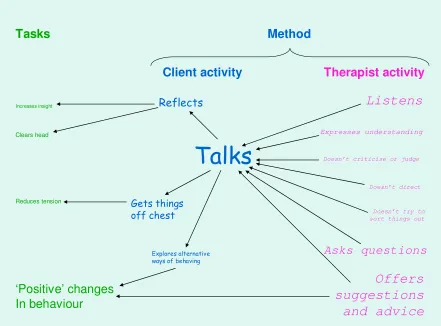
developed, it then becomes possible to take each task in turn, and begin to identify the many different client and therapist activities that might be undertaken to achieve that task. In the case of Sonia, mentioned earlier, some of the methods that might be relevant to the task of ‘resolving a difficult or painful emotion’ were described. It is not hard to imagine several other methods that could be valuable in respect of this task. What would a comprehensive map of ‘methods for resolving a painful emotion’ look like? Would the existence of this map be useful for clients and therapists, in terms of suggesting possible ways of working? We envisage such a map being supplemented by client and therapist accounts of how they used different methods, and their understandings of what worked, what did not work, and why. Figure 1 gives an example of such a client-informed map, which comes from a research study into children and young people’s experiences of counselling in schools (Cooper, 2004). This ‘process map’ is based on an analysis of in-depth interviews (Kvale, 1996) with nineteen former clients, and the relative font sizes in Figure 1 indicate how many clients were coded at each of the ‘nodes’. Hence, for instance, we can see that nearly all the clients said that it was very helpful for them to use the method of ‘talking about the problem’, and that this was facilitated by such therapist activities as listening and asking question, and client activities such as reflecting on what was said, and
exploring alternatives. The process map also shows that many of the clients felt it was helpful when the therapist offered them suggestions and advice (interestingly, the therapists in this study had described themselves as person-centred), which they reported as being effective in encouraging them to talk more. The column on the left side of the map indicates some of the tasks that were accomplished through ‘talking’. Although only the domains of methods and tasks are shown in this process map, it nevertheless illustrates how qualitative research can be used to build up a picture of what clients may find most helpful in therapy, and the kinds of therapist and client activities that may be most appropriate in helping clients to achieve specific tasks. Further research using this paradigm might seek to develop a more comprehensive description of client and therapist activities associated with successful ‘talking’ (for example, the use of questioning strategies), or might seek to expand the range of possible methods that contributed to the completion of a task such as ‘reducing tension’.
[Insert Figure 1 about here]
In developing such maps, what could be particularly important for the counselling and psychotherapy research field is that these may be most effectively achieved, not through complex statistical procedures, but through in-depth, qualitative investigations – an approach that many therapeutic researchers already favour.
Valuable data about task/method linkages can be collected through interviews with clients and therapists, written accounts, and case studies. In principle, all practitioners and clients can contribute to this effort.
For instance: two-chair work for expressing a painful emotion seems to be most effective under the following conditions: (a) a high level of trust; (b) the client does not have issues around shame and performance anxiety, (c) the therapist is
comfortable with here-and-now expression of strong emotion… and so on. Similarly, two-chair work may have the following side-effects: (a) if successful, may lead the client to think that less dramatic methods are ineffective and not worth trying, (b) if unsuccessful, may leave the client feeling confused; (c) may take up the whole of a session, and leave insufficient space for other tasks on that occasion. The idea here is not to produce a matrix of certainty, but to create a continually evolving map of possibilities.
A second area for research concerns the readiness of clients to get the best out of therapy. There is a paradox within the therapy world at the moment. Although there is substantial agreement around the propositions that therapy clients are active
participants in the process, and discerning consumers of treatments, and that extra-therapeutic factors play an important role in facilitating change (Bohart and Tallman, 1999), very little effort is made to educate clients, or members of the public who are potential clients, about how to make best use of therapy. This is a strange state of affairs. Therapy is an expensive and time-consuming activity. Yet, while people make extensive preparation in advance of taking part in other expensive and
time-consuming activities, for instance taking a vacation or redesigning their kitchen (and call on massive, commercially produced information sources, such as websites and newspaper supplements, to assist them in this preparation), there is no similar support structure available to people who are considering entering counselling or
psychotherapy. The absence of such materials may be due to the roots of therapy in traditional medical practice: if you are ill, you place yourself ‘in the hands of’ your doctor. Of course, this is no longer true for medicine – anyone with access to the web will do what they can to work out their diagnosis and treatment options well in advance of seeing a doctor. The pluralistic framework, by contrast, predicts that the more that the client understands the domains of the therapy process, the more they appreciate the collaborative nature of the work, and the more they reflect on their own preferences around methods, the better the therapy will be for them. The framework invites clients to think about tasks that they may be able to complete on their own, outside of therapy sessions, and those for which they feel they require face-to-face support and guidance.
A third element of the research agenda associated with the pluralistic framework is the question of therapy outcome research. In societal terms, outcome research is hugely important. Outcome research provides evidence, for health care systems, that legitimises expenditure on therapy of scarce financial resources. Further, in a world characterised by a high level of social change, where counselling and psychotherapy are continually being provided in new ways to new groups of clients, a commitment to outcome research reassures consumers that what they are being offered has survived a rigorous quality control procedure. However, doing
superiority of competing unitary models of therapy. To our mind, this is a futile endeavour. Wampold (2001), and other researchers who have analysed the findings of 50 years of psychotherapy research, have conclusively demonstrated that theoretical orientation makes only a marginal difference to outcome; and to pursue rivalrous inter-school ‘therapy wars’ when many socially disadvantaged people have only minimal access to psychological therapies would seem an abnegation of social responsibility. By contrast, an agreement within the profession to operate within the pluralistic framework would clear the decks for the pursuit of outcome research that is more socially meaningful, such as research that investigating the goals of particular client groups and assessed the effectiveness of specific task/method packages, drawn from multiple sources, in addressing these needs (i.e., tailored therapies).
If ‘brand name’ therapies are the Microsoft® Windows or Unix® Operating System of the therapy world, what we hope to develop here is the Linux: an ‘open-code’ system in whose development all researchers, practitioners and clients can participate. It is a framework with a set of clearly-defined rules, but within which there is enormous scope for expansion and development. Our vision is of an ever-growing body of knowledge into how counselling and psychotherapy works and of which methods are most suited to which clients at which points in time: not something which replaces unitary models of therapy, but something which exists in creative tension with them, informing and being informed by more specialised approaches to practice. Another computing metaphor is that of Wikipedia, the online encyclopedia that comprises a shared knowledge-based with distributed ownership alongside procedures for maintaining high standards of reliability and rigour. Here, as with our pluralistic framework, the key principles are inclusivity, transparency, egalitarianism, and a celebration of diversity and difference.
References
Baker, S. B., Daniels, T. G. and Greeley, A. T. (1990) Systematic training of graduate level counselors: narrative and meta-analytic reviews of three programmes. The Counseling Psychologist 18: 355-421.
Bohart, A. C., & Tallman, K. (1999). How Clients Make Therapy Work: The Process of Active Self-Healing. Washington: American Psychological Association. Bordin, E. S. (1994). Theory and research on the therapeutic working alliance: New
Directions. In A. O. Hovarth & L. S. Greenberg (Eds.), The Working Alliance: Theory, Research and Practice. New York: Wiley.
Bowlby, J. (1979). The making and breaking of affectional bonds. In The Making and Breaking of Affectional Bonds (pp. 150-201). London: Routledge.
Castonguay, L.G. & Buetler, L.E. (2006). Preface. In L. G. Castonguay & L. E. Beutler (Eds.), Principles of Therapeutic Change that Work (p. v). Oxford: Oxford University Press.
Couchman, A. (2006) Personal communication.
Cooper, M. and McLeod, J. (2006). ‘Establishing a counselling research clinic based on a pluralistic model of change,’ 12th Annual BACP Research Conference, Glasgow.
Downing, J. N. (2004). Psychotherapy practice in a pluralistic world: Philosophical and moral dilemmas. Journal of Psychotherapy Integration, 14(2), 123-148. Elliott, R., Watson, J. C., Goldman, R., & Greenberg, L. S. (2004). Learning
Emotion-Focused Therapy: The Process-Experiential Approach to Change. Washington DC: American Psychological Association.
Ellis, A. (1962) Reason and Emotion in Psychotherapy. New York: Lyle Stuart. Feltham, C. (1997) Challenging the core theroetical model. Counselling 8: 121-5. Gergen, K. (1999). An Invitation to Social Construction. London: Sage.
Gersons, B.P.R., Carlier, I.V.E., Lamberts, R.D. and van der Kolk, B.A. (2000) Randomized clinic trial of brief eclectic psychotherapy for police officers with posttraumatic stress disorder. Journal of Traumatic Stress, 13: 333-347. Greenberg, L. S., Rice, L. N., & Elliott, R. (1993). Facilitating Emotional Change:
The Moment-by-Moment Process. New York: Guilford Press.
Hill, C.E. and Lent, R.W. (2006) A narrative and meta-analytic review of helping skills training: time to revive a dormant are of inquiry. Psychotherapy: Theory, Research, Practice, Training, 43: 154-172.
Hollanders, H. (1999). Eclecticism and integration in counselling: implications for training. British Journal of Guidance & Counselling, 27(4), 483-500. Hollanders, H. (2003). The Eclectic and Integrative Approach. In R. Woolfe, W.
Dryden & S. Strawbridge (Eds.), Handbook of Counselling Psychology. London: Sage.
Hubble, M., Duncan, B. L., & Miller, S. D. (1999). The Heart and Soul of Change: What Works in Therapy. Washington, DC: American Psychological
Association.
Kiesler, D. (1988) Therapeutic Metacommunication: Therapist Impact Disclosure as Feedback in Psychotherapy. Palo Alto, CA: Consulting Psychologists Press. Kuhnlein, I. (1999) Psychotherapy as a process of transformation: the analysis of
posttherapeutic autobiographical narrations. Psychotherapy Research, 9: 274-288.
Lambert, M. J., Bergin, A. E., & Garfield, S. L. (2004). Overview, trends and future issues. In M. J. Lambert (Ed.), Bergin and Garfield's Handbook of
Psychotherapy and Behaviour Change (5th ed., pp. 805-821). Chicago: John Wiley and Sons.
Lee, A. (2006) Process contracts. In C. Sillls (ed.) Contracts in Cousnelling and Psychotherapy. (pp. 74-86). London: Sage.
Levinas, E. (1969). Totality and Infinity: An Essay on Exteriority (A. Lingis, Trans.). Pittsburgh, PA: Duquesne University Press.
Lilliengren, P. and Werbart, A. (2005) A model of therapeutic action grounded in the patients’ view of curative and hindering factors in psychoanalytic
psychotherapy. Psychotherapy: Theory, Research, Practice, Training, 3: 324-399.
McLeod, J. (2005) Counseling and psychotherapy as cultural work. In L.T. Hoshmand (ed) Culture, psychotherapy and counseling: critical and integrative
perspectives. Thousand Oaks, CA: Sage.
McLeod, J. (2007). Counselling Skill. Maidenhead: Open University Press.
Mearns, D. and Cooper, M. (2005) Working at Relational Depth in Counselling and Psychotherapy. London: Sage.
Miller, J. B., Jordan, J. V., Stiver, I. P., Walker, M., Surrey, J. L., & Eldridge, N. S. (2004). Relational awareness: Transforming disconnection. In J. V. Jordan, M. Walker & L. M. Hartling (Eds.), The Complexity of Connection: Writing from the Stone Center's Jean Baker Miller Training Institute (pp. 64-89). New York: Guilford Press.
Norcross, J., & Grencavage, L. (1989). Eclecticism and integration in counseling and psychotherapy: Major themes and obstacles. British Journal of Guidance and Counselling, 17, 227-247.
Pedersen, P.B. (1991) Multiculturalism as a generic approach to counseling. Journal of Counseling and Development, 70: 6-12.
Pistrang, C. and Barker, C. (1992) Clients' beliefs about psychological problems. Counselling Psychology Quarterly 5, 325-35.
Rennie, D.L. (1998) Person-centred counselling: an experiential approach. London: Sage.
Rescher, N. (1993). Pluralism: Against the Demand for Consensus. Oxford: Oxford University.
Rogers, C. R. (1951). Client-Centered Therapy. Boston: Houghton and Mifflin. Rogers, C. R. (1959). A theory of therapy, personality and interpersonal relationships
as developed in the client-centered framework. In S. Koch (Ed.), Psychology: A Study of Science (Vol. 3, pp. 184-256). New York: McGraw-Hill.
Ryle, A. (1990) Cognitive-Analytic Therapy: Active Participation in Change: A New Integration in Brief Psychotherapy. Chichester: Wiley.
Schneider, K. J. (2003). Existential-humanistic psychotherapies. In A. S. Gurman & S. B. Messer (Eds.), Essential psychotherapies (pp. 149-181). New York: Guilford Press.
Spinelli, E. (1994). Demystifying Therapy. London: Constable.
Stiles, W. B., Honos-Webb, L., & Surko, M. (1998). Responsiveness in
psychotherapy. Clinical Psychology-Science and Practice, 5(4), 439-458. Stiles, W. B., & Wolfe, B. E. (2006). Relationship factors in treating anxiety
disorders. In L. G. Castonguay & L. E. Beutler (Eds.), Principles of Therapeutic Change that Work (pp. 155-165). Oxford: Oxford University Press.
Stricker, G., & Gold, J. (2003). Integrative approaches to psychotherapy. In A. S. Gurman & S. B. Messer (Eds.), Essential psychotherapies (pp. 317-349). New York: Guilford Press.
Tryon, G. S., & Winograd, G. (2002). Goal consensus and collaboration. In J. C. Norcross (Ed.), Psychotherapy Relationships that Work: Therapist
Contributions and Responsiveness to Patients (pp. 109-125). Oxford: Oxford University Press.
Weaks, D., McLeod, J. and Wilkinson, H (2006) Dementia. Therapy Today, 17, 12-15.
Worden, W. (2001) Grief Counselling and Grief Therapy: a Handbook for the Mental Health Practitioner. London: Brunner/Routledge.
‘Positive’ changes In behaviour
Expresses understanding
Doesn’t criticise or judge
Doesn’t direct
Doesn’t try to sort things out
Asks questions
Offers
suggestions
and advice
Clears head
Increases insight
Reduces tension
Explores alternative ways of behaving
Reflects
Gets things off chest
Talks
Listens
Therapist activity
Client activity
[image:18.595.91.532.88.414.2]Tasks Method
Figure 1. Process map of children and young people’s experiences of helpful factors in counselling in schools