City, University of London Institutional Repository
Citation
:
Omidyeganeh, M. and Piomelli, U. (2011). Large-eddy simulation of
two-dimensional dunes in a steady, unidirectional flow. Journal of Turbulence, 12(42), pp. 1-31.
doi: 10.1080/14685248.2011.609820
This is the accepted version of the paper.
This version of the publication may differ from the final published
version.
Permanent repository link:
http://openaccess.city.ac.uk/6949/
Link to published version
:
http://dx.doi.org/10.1080/14685248.2011.609820
Copyright and reuse:
City Research Online aims to make research
outputs of City, University of London available to a wider audience.
Copyright and Moral Rights remain with the author(s) and/or copyright
holders. URLs from City Research Online may be freely distributed and
linked to.
City Research Online:
http://openaccess.city.ac.uk/
[email protected]
Large-eddy simulation of the flow over two-dimensional dunes
in a steady unidirectional flow
Mohammad Omidyeganeh and Ugo Piomelli∗
Department of Mechanical and Materials Engineering, Queen’s University, Kingston, Ontario, Canada K7L3N6
5
(Received 4 May 2011; final version received 23 July 2011)
We performed large-eddy simulation of the flow over a typical two-dimensional dune geometry at laboratory scale (the Reynolds number based on the average channel height and mean velocity is 18,900) using the Lagrangian dynamic eddy-viscosity subgrid-scale model. The results are validated by comparison with simulations and experiments 10
in the literature. The flow separates at the dune crest, generating a shear layer that plays a crucial role in the transport of momentum and energy, as well as the generation of coherent structures. The turbulent kinetic energy budgets show the importance of the turbulent transport and mean-flow advection in the bulk flow above the shear layer. In the recirculation zone and in the attached boundary layers, production and dissipation are 15
the most important terms. Large, coherent structures of various types can be observed. Spanwise vortices are generated in the separated shear layer due to the Kelvin–Helmholtz instability; as they are advected, they undergo lateral instabilities and develop into horseshoe-like structures, are tilted downward, and finally reach the surface. The ejection that occurs between the legs of the vortex creates the upwelling and downdrafting events 20
on the free surface known as “boils.” Near-wall turbulence, after the reattachment point, is affected by large streamwise Taylor–G¨ortler vortices generated on the concave part of the stoss side, which affect the distribution of the near-wall streaks.
Keywords:large-eddy simulations; environmental turbulent flows; turbulent boundary layers
25
1. Introduction
The flow over mobile sand beds in rivers has unique dynamics. Both the shape of the bed irregularities and their size influence the characteristics of the flow. When their dimensions become comparable to the water depth (the ratio of roughness to the depth is approximately 0.25−0.33 [1, 2]), large-scale turbulent structures are generated that affect flow dynamics 30
and sediment transport [3].
Among the most commonly found river-bed irregularities are dunes. A recent review of the dynamics of river dunes can be found in [4]; here, we only describe the fluid-dynamical features of dunes more relevant to this study. Dunes are created by small irregularities on a flat sand bed, which grow until a large-scale form is established. They also migrate 35
in the flow direction and rarely reach an equilibrium shape, unless the flow is steady and unidirectional. However, an equilibrium state for the near-bed flow over developing dunes is
∗Corresponding author. Email: [email protected]
ISSN: 1468-5248 online only
C
2011 Taylor & Francis
P1: WAR
TJOT_A_609820 style2.cls (JOT) August 11, 2011 18:29
2 M. Omidyeganeh and U. Piomelli
found by Coleman et al. [5] and it is shown by Venditti and Bauer [6] that flow characteristics are also the same for various flow conditions and dune geometries.
Generally, during the growth and movement of dunes, sand is lifted in the high-shear 40 regions, and redeposited in the separated-flow area. Both this mechanism and bedload flux contribute to the formation of dunes. Dune formation may affect navigation, erosion of bridge piles and other structures, as well as dispersion of contaminants. Dunes also have a strong effect on channel drag and on the mechanisms of flow discharge in a river, especially during floods. The flow over a dune itself affects the bed deformation, sedimentation 45 events, and has interactions with the free surface. Therefore, understanding the physics of the coherent motions present in this type of flow helps to understand the entrainment-deposition phenomena and bed formation. The strong interaction between the flow field, bed formation, and sediment transport phenomena emphasizes the need for comprehensive and collaborative research on flow simulation and bed deformation models, which are critical 50 in geophysics and river engineering.
An experimental study on transition of bed forms from a flat shape into equilibrium large-scale dunes in unidirectional flow was conducted by Robert and Uhlmann [1]. As the flow velocity increases on a flat bed, the interaction between the flow and the mobile bed in a thick layer close to the bed creates two-dimensional ripple-like irregularities. Zones 55 affected by sediment transport are extended to a much thicker region at higher discharge rates when irregular linguoid ripples are generated. These three-dimensional formations are transformed into two-dimensional dunes with increased average-flow velocity. At this time, the whole flow depth has been affected by sediment transportation. Initiation and development mechanisms of the irregularities that result in dune formation is also discussed 60 by Coleman and Nikora [7].
Mean-flow characteristics reported in laboratory experiments [8–12], field observations [6, 13–15], and two-dimensional mathematical models [16, 17] reveal that the flow includes a recirculation zone and a shear layer due to the separation at the crest, an internal boundary layer after the reattachment on the stoss side, a wake region behind the recirculation zone 65 which extends toward the downstream dune, accelerating and decelerating flow on the stoss and lee side of dune, and an outer region near the surface. Despite the fact that various bed forms and Reynolds numbers were adopted, these characteristics of the mean flow and statistics were common [6]. Statistical measurements [8, 9] of turbulent flow over two-dimensional fixed bed forms revealed the fact that scaling velocity moments with local 70 shear stress is inappropriate.
More detailed investigation on the turbulent structures were conducted using quadrant analysis [10]. Bennett and Best [10] concluded that Kelvin–Helmholtz instabilities in the shear layer are more likely to cause dune-related macroturbulence than turbulent boundary layer bursting, verifying the conclusions by Kostaschuk and Church [14]. 75
Laboratory measurements of flow statistics and quadrant activities conducted across ripple-dune transition [2] revealed that turbulence production increases as the bed shape is changed from ripples to two-dimensional dunes and decreases afterward until three-dimensional dunes are formed. Over dunes, ejection events are more frequent but weaker than sweeps, although all four quadrants contribute to mass and momentum 80 transport.
usually occur when a horizontally oriented vortex attaches to the surface [21]) in a high-Reynolds-number flow over dunes in the laboratory and in the Jamuna River, Bangladesh, and proposed a schematic model for the interaction of coherent structures with the flow surface that results in boils. These general patterns of flow on the water surface over a dune-covered bed had been observed previously (see, for instance, [22] and other references cited 95
in [4]) and are a dominant mechanism for sediment suspension [23, 24].
Wavelet analysis of field measurements [25] over the crest of a sand dune in R´ıo Paran´a in Argentina showed a strong correlation between the ejection events, caused by deceleration of flow on the lee side, and suspended sediments. Vortex shedding at the shear layer and wake flapping on the bed contribute to the formation of large-scale structures. 100
The frequency of large turbulent events is related to the reattachment flapping events. Analysis of the vorticity and velocity fields by Schmeeckle et al. [11] revealed coherent boil-like events similar to the boils observed in an open-channel flow over a smooth bed, but on a much larger scale (almost of the size of the flow depth). They observed spanwise rollers that grow in the separation region and later move downstream and begin to break 105
up into smaller vortices. During this process, rollers transport material from the separation area into the flow interior and suspend a large amount of sediment grains. Their results show intermittent detachment of the near-bed spanwise vortices, which move toward the surface and are responsible for the boils.
Although the uniqueness of the structures that cause the boils in flows over dunes has 110
been illustrated in laboratory measurements [4, 22, 26, 27] and field observations [28, 29], little is known of the generation, evolution, and distortion of these coherent structures. Several studies show that boil-generating structures start as a loop or horseshoe vortex [22, 27]. Best [4, 12] indicates that a vortex loop that touches the free surface causes the upwelling motion, that is, the boil. When the legs of the vortex loop attach to the surface, 115
vertical vortices are generated.
Kadota and Nezu [27] suggest that the vortices generated at the shear layer have different morphology than those created after reattachment. They observed strong upward-tilting streamwise eddies, called “kolk structures,” being generated at the reattachment point and rising to the surface. The spacing between kolks seemed to be narrower than that observed 120
in previous experiments [14, 22, 26]. The periodicity of such strong upwellings has been investigated by Babakaiff and Hickin [28], who showed their wavelength to increase at low relative roughness (i.e., dune height to flow depth) and become constant when the ratio exceeds 0.2.
Discussion on the generation of large vortex loops that cause the strong upwelling at 125
the surface is still inconclusive. Jackson [30] compared the frequency of bursting events and boils at the surface and concluded that boils are caused by these near-wall bursts. M¨uller and Gyr [22] proposed a mixing-layer analogy in which separated spanwise vortices at the crest undergo three-dimensional instabilities, which eventually cause hairpin-like vortices. The heads of these vortices are associated with low-speed fluid that rises up 130
P1: WAR
TJOT_A_609820 style2.cls (JOT) August 11, 2011 18:29
4 M. Omidyeganeh and U. Piomelli
performed flow visualization and conditional sampling at very low Reynolds numbers to support this argument. There are also qualitative descriptions of the mechanism in which vortex loops are generated [4, 11, 12] that essentially conform to one of the above models.
The flow over river dunes has also been studied numerically, by the solution of the 140 Reynolds-averaged Navier–Stokes (RANS) equations [32, 33] and large-eddy simulations (LES) [34–37]. We concentrate on LES, since RANS solutions are unable to capture the turbulent eddies that are the focus of the present work. Large-eddy simulation of turbulent flow and sediment transport over large-scale ripples were carried out by Zedler and Street [38]. They solved an advection–diffusion equation for the sediment transport that 145 is sufficiently accurate at low concentrations, but neglected the interaction of the sediment with the flow. They observed the lifting of sediment in high shear-stress regions that move downstream and upward.
Yue et al. [34] performed LES of the flow over typical two-dimensional dunes using a level-set function to account for the free-surface deformation. Periodic boundary condition 150 in streamwise and spanwise directions were applied. The domain had lengthLx =20hand
widthLz=7h, wherehis the dune height. Two flow depths at the crest were simulated:
6.6h and 3.24h, denoted as deep and shallow flows; the Reynolds number (based on the flow depth and the surface streamwise velocity at the crest) was 58,000 and 10,700 for the two cases, respectively. In general, the first- and second-order statistics were in 155 good agreement with the experiments by Balachandar et al. [39]. The simulations showed upward-tilted vortices close to the free surface in the shallow flow. Compared to the deep-flow simulation, more small-scale structures were present on the surface of the shallow flow, which gave the appearance of roughness at the free surface. The results showed that the interaction of the free surface and the flow structures is significantly affected 160 by the flow depth. The same authors subsequently performed LES in nearly the same configuration, and visualized periodically flapping spanwise rollers in the recirculation zone [35].
Stoesser et al. [36] also performed LES of flow over dunes with parameters similar to those used by Yue et al. [35]: the dune wavelength was 20h, the maximum depth was 4h, and 165
Re=25,000 based on maximum depth and average bulk velocity. The first- and second-order statistics agreed well with the experiments in the literature. The simulations showed rollers at the crest that expanded to the size of the dune height as they were convected toward the reattachment point. A few instantaneous snapshots of spanwise vorticity and velocity vectors highlighted the upward movement of vortices after the reattachment point. 170 They concluded that the boils on the surface were originally hairpin eddies generated in the reattachment region as a result of secondary instabilities of rollers that are elongated in the streamwise direction and tilted upward. However, the instantaneous visualizations of velocity fluctuations do not show a strong upwelling at the surface, but rather a structure more similar to the smaller, weaker boils that occur at the surface of open-channel flows 175 over flat surfaces [40].
experiments and simulations? Are the large-scale structures at the surface generated in the shear layer or in the attached region? What are the statistics and dynamics of these 190
structures? How do they interact with the surface? Another feature of interest in these flows, and one that has been studied considerably less frequently, is the near-wall turbulence structure. Are the near-wall eddies similar to those that occur in other canonical wall-bounded flows, or are they affected by separation, reattachment, curvature of the bed, and pressure gradient that occur on the upward-sloping surface (the “stoss” side)? The present 195
work tries to answer some of these questions. We focus on the dynamics of the large-scale and near-wall coherent structures to understand their signatures.
In the following, we begin by presenting the problem formulation and the numerical method used. Then, in Section 3, mean-flow statistics are compared with previous ex-periments and simulations in the literature to validate this work; then the large coherent 200
structures at the surface and the near-wall turbulence are investigated in more details. Concluding remarks and recommendations for future work will end the article.
2. Problem formulation
In LES, the velocity field is separated into a resolved (large-scale) and a subgrid (small-scale) field by a spatial filtering operation [41]. The nondimensionalized continuity and 205
Navier–Stokes equations for the resolved velocity field are
∂ui
∂xi =
0, (1)
∂ui
∂t + ∂uiuj
∂xj
= −∂P
∂xi
−∂τij
∂xj
+ 1
Reb
∂2u
i
∂xj∂xj
, (2)
whereReb =UbHb/ν,Hbis the average channel depth, andUbis the average velocity at
the location of average depth.x1,x2, andx3are the streamwise, wall-normal and spanwise
directions, also referred to asx,y, andz. The velocity components in these directions are, respectively,u1,u2, andu3(or u,v, andw). An overline denotes a filtered quantity, and
210
τij =uiuj −uiuj are the subgrid stresses, which were modeled using an eddy-viscosity
assumption
τij −δijτkk/3= −2νTSij = −2C
2
|S|Sij. (3)
Here,=2 (xyz)1/3is the filter size,Sij =(∂ui/∂xj+∂uj/∂xi)/2 is the resolved
strain-rate tensor and|S| =2SijSij 1/2
is its magnitude. The coefficientC is determined using the dynamic model [42] with the Lagrangian averaging technique proposed by 215
Meneveau et al. [43], and extended to non-Cartesian geometries by Jordan [44] and Armenio and Piomelli [45].
The governing differential Equations (1) and (2) are discretized on a nonstaggered grid using a curvilinear finite-volume code. The method of Rhie and Chow [46] is used to avoid pressure oscillations. Both convective and diffusive fluxes are approximated by 220
P1: WAR
TJOT_A_609820 style2.cls (JOT) August 11, 2011 18:29
6 M. Omidyeganeh and U. Piomelli
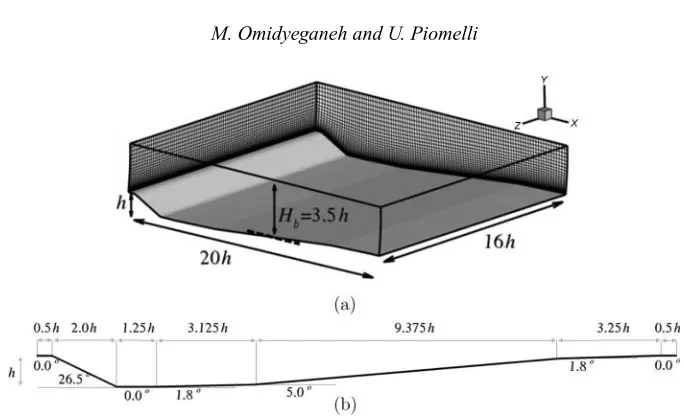
Figure 1. (a) Sketch of the physical configuration (every fourth grid line is shown), and (b) bed geometry.
procedure [47] is used for the temporal discretization. The Crank–Nicolson scheme is used for the wall-normal diffusive terms, and the Adams–Bashforth scheme for all the other terms. Fourier transforms are used to reduce the three-dimensional Poisson equation into a series of two-dimensional Helmholtz equations in wavenumber space, which are solved 225 iteratively using the BiConjugate Gradient Stabilized method. The code is parallelized using the Message-Passing Interface and the domain-decomposition technique, and has been extensively tested for turbulent flows [48–51].
Dunes are known to reach a periodic equilibrium shape [30, 52] in the case of steady unidirectional flows, with a wavelength equal to 5 or 6 times the flow depth, and height 230 equal to 1/4 of the flow depth. For this reason, most dune shapes studied experimentally and numerically are quite similar. We use the geometry studied by Balachandar et al. [52] and Stoesser et al. [36]. The computational configuration is sketched in Figure 1. Periodic boundary conditions are used in the streamwise (x) and spanwise (z) directions. The flow is driven by a pressure gradient that maintains a constant flow rate in time. The 235 free surface is assumed to be rigid and free of shear stress: the wall-normal velocity is set to zero, as are the vertical derivatives of the streamwise and spanwise velocity components. The surface deformation is reported to be small (less than 2.0% of the flow depth) in experiments [9, 18, 27] and simulations [35, 36]. Therefore, the free-slip condition is expected to have small effects on the statistics and on the evolution of significant 240 structures. The Reynolds number is 18,900 based on the channel average height and average velocity at the cross section with heighth.
[image:7.612.123.465.79.287.2]B/w in print, colour online
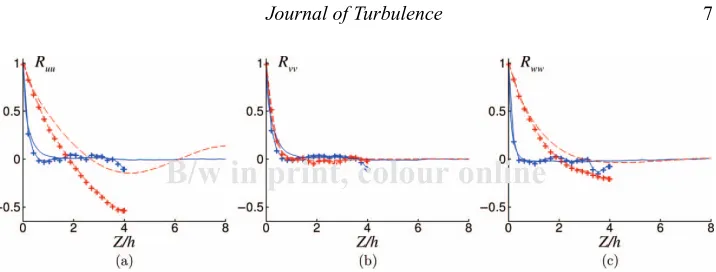
Figure 2. Spanwise velocity autocorrelation function at two points in thex–yplane (15h,1h) and (15h,3.75h); close to the wall; close to the surface; the lines correspond to the wide domain, lines and crosses to the narrow one. (a)Ruu, (b)Rvv, and (c)Rww.
and grid convergence of the statistics was verified: first- and second-order statistics were within 5% of each other for all resolutions. Only the results obtained with the intermediate grid resolution are shown in the following.
Since this study focuses on the larger flow structures, we examined the spanwise autocorrelation function
255
Rαα(r)=
uα(x, y, z)uα(x, y, z+r)
uα(x, y, z)uα(x, y, z) (4)
(whereui =ui− ui are the velocity fluctuations,·represents an average in time and
spanwise direction, and no summation is implied over Greek indices) to ensure that the domain width was sufficient to include the largest structures at the surface. This quantity is shown in Figure 2 for a calculation that used the same domain width as [36], and for one that is twice as wide. While the near-wall eddies can be resolved adequately by a smaller 260
domain, a domain of at least 8his necessary to allow the development of the larger coherent structures at the surface. As a result, we employed a computational domain that is twice as wide as that used in [36], and four times as wide as that employed by [37].
The equations were integrated in time for 100h/Ubtime units to remove transient effects.
Then statistics were accumulated over 1000h/Ubtime units. To increase the sample size,
265
averaging was also performed in the spanwise direction. To verify the adequacy of the sample, we compared statistics obtained using only half of the sample with those obtained using the complete sample, and found that the mean velocities differed by less than 0.1%, and the r.m.s. intensities by less than 0.5%.
3. Results 270
3.1. Mean flow
The accuracy of the simulations was first verified by a grid-refinement study and by com-paring statistics with simulation and experiment reported by Stoesser et al. [36]. Figure 3 shows contours of averaged streamwise velocity,u, wall normal velocity,v, pressure, p, and Reynolds shear stress,−uv. The flow separates at the dune crest and reattaches 275
[image:8.612.117.475.89.225.2]P1: WAR
TJOT_A_609820 style2.cls (JOT) August 11, 2011 18:29
8 M. Omidyeganeh and U. Piomelli
B/w in print, colour online
Figure 3. Contours of the average (a) streamwise velocity,u, (b) wall normal velocity,v, (c) pressure,p, and (d) Reynolds shear stress,−uv.
flow, a shear layer is generated after the crest that expands in the wake region toward the
next dune. 280
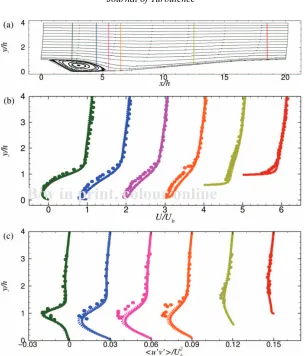
In Figures 3 and 4(a), streamlines are shown to visualize the averaged recirculation zone in the lee side. Comparison between this simulation and the literature, as well as the results of the grid refinement study, are shown in Figure 4.(a) The velocities are normalized with the bulk velocity at the last vertical line in Figure 4(a). Excellent agreement is obtained with the previous simulation, and between meshes, indicating that the intermediate grid results are 285 fine enough for convergence of statistics. Note that, as mentioned in the paper by Stoesser et al. [36], the experimental data is not reliable in the wake area due to some inconsistencies in the measurements (mass conservation is not satisfied). Also in Figure 4(c), the Reynolds shear stress is compared along six vertical lines specified in Figure 4(a). Overall good agreement is obtained with experiments and with the simulation by Stoesser et al. [36]. 290
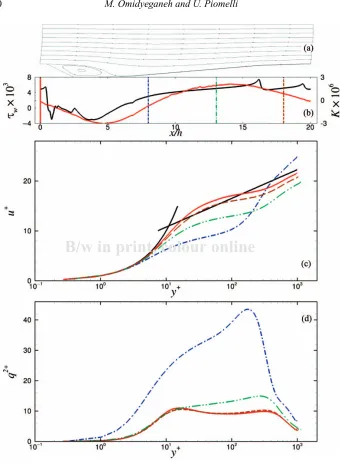
Figure 5 shows the streamwise development of the wall stressτwand the acceleration
parameter
K= ν U2
∞
dU∞
dx , (5)
as well as profiles of mean velocity andq2= u
iui (twice the turbulent kinetic energy
[image:9.612.122.469.94.406.2]B/w in print, colour online
Figure 4. (a) Average streamlines; the vertical lines indicate the position of the profiles in (b) and (c), from left to right:x/ h=2.5,4.5, 5.5, 6.5,12.5,18.5; (b) streamwise velocity profiles; (c) profiles of Reynolds shear stress. Each profile is shifted to the right for clarity. Present simulation, intermediate mesh; present simulation, fine mesh; LES [36];•experiment by Polatel cited in [36].
using the viscosityνand the local friction velocity (calculated at the samexlocation as the 295
lines)uτ =(τw/ρ)1/2, andy+=yuτ/ν. The wall shear stress becomes negative
immedi-ately downstream of the crest. Note the localized peaks that correspond to discontinuities in the slope of the dune. The acceleration parameter shows a region of adverse pressure gradient (from the dune crest tox/ h9) followed by a favorable pressure-gradient region.
Knever reaches the critical value where the flow is expected to begin to relaminarize [53], 300
Kcrit2.75×10−6. For the values of K encountered on the stoss side, the
pressure-gradient effects are not expected to be large, and the flow is dominated by the reattachment, and recovery toward equilibrium.
The average reattachment point is atx/ h5.7, close to the value predicted by Stoesser et al. [36], and in the range of other experiments and simulations [27, 37] (x/ h4−6), 305
[image:10.612.143.448.97.453.2]P1: WAR
TJOT_A_609820 style2.cls (JOT) August 11, 2011 18:29
10 M. Omidyeganeh and U. Piomelli
B/w in print, colour online
Figure 5. (a) Mean-flow streamlines; (b) wall stressτwand acceleration parameter K; (c) mean velocity profiles in wall units on the stoss side and on the dune crest; (d) profiles ofq2
in wall units on the stoss side and on the dune crest. The profiles are taken at the locations shown by vertical lines in part (b) (x/ h=0,8,13,18).
[image:11.612.124.469.92.560.2]some remnant of the detached shear layer can be observed (the contours of the Reynolds shear stress shown in Figure 3(d) also present the same feature), indicating that the effect of the separation is felt over distances longer than the dune wavelength, and that the flow 320
in one dune is affected by the separation in the preceding one.
3.2. Turbulent kinetic energy budgets The transport equation for the resolved TKE is
0= −Uj
∂k ∂xj
+P+T ++D+ε, (6)
where
P = −uiuj∂Ui ∂xj
, (7)
T = − ∂
∂xj
1 2u
iuiuj + uiτij
, (8)
= −1 ρ
ui∂p
∂xi
, (9)
D= 2
Reb
∇2k,
(10)
ε= −ν
∂ui ∂xj
∂ui ∂xj
+
∂ui ∂xj
τij
, (11)
are the production, turbulent transport, pressure transport, viscous diffusion, and dissipation, 325
respectively.
Figures 6 shows the terms in TKE budget, normalized byUb3/ h. Almost all terms are important in the wake and shear layer generated as a result of the separation of flow at the crest, while dissipation and production are the most important terms in the attached-flow regions. The mean-flow advects energy from the shear layer toward the wall, and also toward 330
the downstream dune. Due to a large streamwise velocity gradient around the reattachment point, the production term is negative there. A region with negative turbulent transport is located between two regions with positive transport, one near the wall and the other near the bulk flow. This behavior was also observed in the separated region of the flow in an S-shaped duct by Silva Lopes et al. [49]. A positive and a negative region of turbulent 335
P1: WAR
TJOT_A_609820 style2.cls (JOT) August 11, 2011 18:29
12 M. Omidyeganeh and U. Piomelli
B/w in print, colour online
Figure 6. Turbulent kinetic energy budgets: production, dissipation, mean-flow advection, turbulent transport, pressure transport, and viscous diffusion terms; mean-flow streamlines and the zero contour line are shown by black and magenta lines, respectively.
3.3. Turbulence structure 340
[image:13.612.142.446.93.544.2]B/w in print, colour online
Figure 7. Contours of streamwise velocity fluctuations on a plane parallel to the bed five wall units away from the solid wall. (a) Open channel; (b) dune.
high- and low-speed streaks, we observe streamwise-oriented stripes of low-speed streaks alternating with stripes of high-speed ones. This pattern is due to the presence of large longitudinal vortices on the stoss side of the dune. To visualize these structures, we show, in Figure 8 the secondary-flow streamlines and contours of wall-normal velocity fluctuations. 350
These quantities were averaged over a short time, approximately 20h/Ub, to visualize
better the large vortices, which tend to meander. We clearly observe very large structures, of the order of the flow depth. At least two pairs of counter-rotating vortices are present on average, and are similar to the structures that have been observed in experimental and numerical studies of the flow over concave surfaces [57–59]. The size of these eddies is 355
of the order of the flow depth, similar to what was observed in the flow over smooth wavy channel [60] and hills [61].
The two-point spanwise correlations on the stoss side, shown in Figure 9 for the streamwise and wall-normal velocity components (again averaged over a short time only), also show the signature of these large structures, as well as the streaky structures in the 360
near-wall region. Near the wall Rvv has a negative minimum, similar to the canonical
boundary layer behavior, and reflecting the effect of the quasi-streamwise vortices (the
B/w in print, colour online
[image:14.612.126.465.112.287.2] [image:14.612.146.448.548.669.2]P1: WAR
TJOT_A_609820 style2.cls (JOT) August 11, 2011 18:29
14 M. Omidyeganeh and U. Piomelli
B/w in print, colour online
Figure 9. Spanwise auto-correlations at three points on the stoss side atx/ h=12.8. Ruu; Rvv.
point where the minimum occurs corresponds to half of the streak spacing [62]).Ruu, on
the other hand, shows the structure typical of flows with two distinct length scales, in a ratio of approximately 4:1. Away from the wall the longitudinal vortices result in a negative peak 365 of the spanwise autocorrelation, which occurs for a separationz/ h=4, corresponding to the two vortex pairs observed in Figure 8.
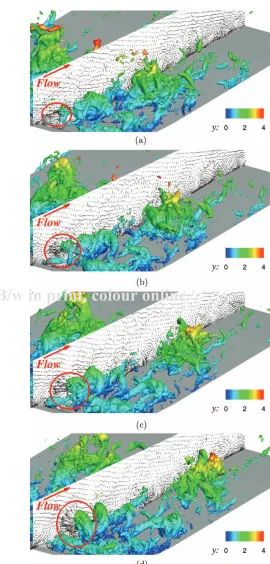
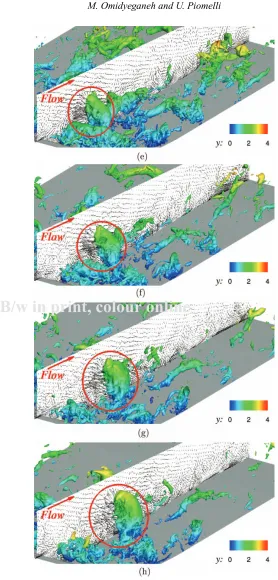
Figure 10 shows the outer-layer structures at an instant in time. Spanwise vortices are generated in the shear layer separating from the crest due to the Kelvin–Helmholtz instability. They are convected downstream and either interact with the wall or rise to the 370 surface, taking the form of large horseshoe-like structures. These structures may undergo an intense distortion, become one-legged, or be completely destroyed. The region behind the head (and between the legs) of horseshoe vortices is generally characterized by an intense Q2 event (whereu<0 and v>0), as shown in Figure 11, where the velocity fluctuation vectors in ax–y plane are also shown. Initially (Figure 11(a)), small ejections 375 occur after the crest that results in the generation of a small spanwise vortex, which grows as it is advected downstream (Figure 11(b)). It also becomes three-dimensional, taking a hairpin-like shape (Figures 11(b) and (c)). As it grows to dimensions comparable to (or
B/w in print, colour online
[image:15.612.136.453.86.251.2] [image:15.612.144.448.509.679.2]B/w in print, colour online
[image:16.612.144.414.106.670.2]P1: WAR
TJOT_A_609820 style2.cls (JOT) August 11, 2011 18:29
16 M. Omidyeganeh and U. Piomelli
B/w in print, colour online
[image:17.612.141.419.90.670.2]B/w in print, colour online
[image:18.612.141.415.102.669.2]P1: WAR
TJOT_A_609820 style2.cls (JOT) August 11, 2011 18:29
18 M. Omidyeganeh and U. Piomelli
larger than) the flow depth, a strong ejection occurs between the legs (Figure (c)). When interacting with other vortices, it may merge with them (Figure 11(d) and (c)), or destroy 380 them. If the structure survives it becomes larger and rises up along the shear layer (Figures 11(d)–(l)).
As illustrated in Figure 12, the same structure is elongated and tilted downward as it rises to the surface; eventually its tip touches the surface. This development is similar to that observed for horseshoe vortices in open-channel flow over a smooth bed, where Q2 events 385 happen between the vortex legs, while Q4 events (u>0 andv<0) are found outside the legs [63]. The vortex is originally vertical (see Figure 11), but is later tilted downward (see Figure 12) forming an angle between 40◦and 60◦with respect to thex–zplane (Figure 13). The signatures of Q2 and Q4 events are also illustrated by the three-dimensional vectors
on the inclinedplane in this figure. 390
As the vortex loop is convected downstream it becomes elongated and distorted. Its legs reach the surface, creating an upwelling, which expands and weakens. Figure 14 shows pressure-fluctuation isosurfaces at four instants. Since the tip of the structure is distorted faster, in the last image it is no longer visible with thepvalue used. The legs of the vortex loop remain coherent for a longer time, and generate vertical vortices around the boundaries 395 of the boil. This surface behavior was also observed by Best [12] in field and laboratory observations at larger Reynolds numbers.
As mentioned before, among the most characteristic events due to the coherent structures in the flow over dunes are the boils, upwelling motions at the water surface. Since in the present calculation the free-surface is rigid, we cannot observe true upwelling motions. 400 We can, however, still identify boil-like events through various surrogate quantities. First, we considered the pressure: since the boil occurs due to an upward motion, which in this calculation is limited by the rigid surface, we expect boils to be accompanied by significant positive pressure fluctuationsp. Second, by continuity the upwelling motion resolves into lateral motions on the surface; thus, the planar part of the velocity-fluctuation divergence, 405
∂u/∂x+∂w/∂z, is expected to be large and positive. The fluctuating velocity vectors in the free-surface plane are also expected to be oriented radially from the center of the boil. Finally, the TKEK= uiui/2, is expected to be large at the edge of the boil where the flow downdrafts (appearing as surface waves in observations by Best [12]). In Figure 15, we show contours of these quantities on the free surface, at a time corresponding to Figure 14(b). 410 We observe a region of negativepwhere the head of the horseshoe vortex contacts the surface and, immediately upstream of the contact point, the positivepregion associated with the impingement region. Consistent with the expected behavior, the planar divergence andKare large, and the velocity vectors are oriented radially.
If we compare the signature of boils in the flow over dunes with that over a smooth bed 415 (Figure 16), we observe the same qualitative features; the signature of the boils is, however, stronger for the dune flow (the values of pressure and TKE, and the vector magnitudes are higher in the dune geometry). Furthermore, at the surface of the open-channel flow over the smooth bed, the size of the boils that develop is smaller than for the flow over dunes: much larger and stronger boils are generated by the large horseshoe-like structures present when 420 water flows over dunes (Figure 17). Over a hundred snapshots, covering almost 400h/Ub
time units, have been observed for both geometries in order to examine the size of these events at the surface. Consistent with experimental observations [11], we find that in the dune case these events may be larger than the flow depth (∼8hin Figure 17), while when the bed is smooth they are at most in the size of the boils shown in Figure 16(d) (∼3h). 425
B/w in print, colour online
Figure 12. Convection of
[image:20.612.157.435.98.656.2]P1: WAR
TJOT_A_609820 style2.cls (JOT) August 11, 2011 18:29
20 M. Omidyeganeh and U. Piomelli
B/w in print, colour online
Figure 12. (Continued).
B/w in print, colour online
[image:21.612.150.435.112.669.2]B/w in print, colour online
Figure 14. Interaction of the vortex loop with the free surface. The time step between snapshots is 3h/Ub. The first snapshot is 3h/Ublater than the instant in Figure 13. The horseshoe vortex indicated by an arrow in (a) and (b) is reintroduced into the domain by the periodic boundary conditions in (c) and (d). Pressure isosurface levels arep= −0.08 in (a) and (b),−0.06 in (c) and−0.04 in (d).
vectors are the most reliable identifiers. We use a thresholdp>0.08, chosen from an exam of the probability density function (PDF) and cumulative density function (CDF) of the pressure at the surface averaged over the entire free surface and time (shown in Figure 18), 430
[image:22.612.142.418.101.563.2]P1: WAR
TJOT_A_609820 style2.cls (JOT) August 11, 2011 18:29
22 M. Omidyeganeh and U. Piomelli
B/w in print, colour online
Figure 15. Identification of a boil at the surface of flow over dune bed using (a) pressure fluctuations p, (b) planar fluctuating velocity divergence∂u/∂x+∂w/∂z, (c) turbulent kinetic energyK, (d) fluctuating velocity vectors.
Based on the considerations above, we identified a boil as a connected region in which the fluctuating pressure is greater than 0.08. We considered 10,000 flow realization, cov-ering a total time 1000h/Ub (50 flow-through times), and observed boils in 50% of the
fields considered. The spatial distribution of boils of a given threshold (Figure 19) is very 435 nonuniform: in the region betweenx =16hand 2h(over the latter part of the stoss side and the dune crest) the number of boils observed was much above the average value. Corre-spondingly, fewer boils appeared on the lee side and near reattachment. We also separated the boils that occurred for the first time from those that were present in previous realizations, and were advected from one realization to the next. The number of first occurrences is also 440 shown in Figure 19, and also shows a nonuniform distribution. The lifetime of the boils is of the order of one or two flow-through times (20–40h/Ub); however, as they are advected
downstream, the boils become weaker, and cannot be detected any longer with the same threshold (although they would still appear if thepthreshold is decreased).
[image:23.612.138.454.114.403.2]B/w in print, colour online
[image:24.612.131.400.108.663.2]P1: WAR
TJOT_A_609820 style2.cls (JOT) August 11, 2011 18:29
24 M. Omidyeganeh and U. Piomelli
B/w in print, colour online
Figure 17. Fluctuating velocity vectors at the free surface of dune geometry. The size of a boil at an instant is shown by a purple circle.
A more quantitative description of the turbulent events that occur in the flow over dunes can be obtained from quadrant analysis. We have considered the velocity fluctuation components parallel and normal to the mean-flow streamlines (which will be calledusand
unrespectively). Following [64], in Figure 21, we show the covariance integrands of parallel
and normal velocity fluctuations,usunP(us, un), whereP(f, g) is the joint PDF off and 455
g, along three vertical lines at the dune crest, near the time-averaged reattachment point and on the stoss side. They are compared with the same quantities measured at homologous points (the distance to the wall normalized by local depth,Di, being equal for the two cases)
in the open-channel flow over a flat bed.
In plane channel, the near-wall behavior is dominated by the streaky structures, which 460 result in an elongated shape of the covariance integrand (the streamwise fluctuations are larger than the wall-normal ones); a predominance of Q4 events (fourth quadrant,us >0
B/w in print, colour online
[image:25.612.152.435.91.344.2] [image:25.612.121.476.565.669.2]B/w in print, colour online
Figure 19. Number of boils observed in the computational domain over a time 1,000h/Ub at the surface. Total boils observed; boils observed for the first time. The thin lines represent the average value of the thick curve.
andun<0) is also expected (point 10 in Figure 21) [64]. In the dune flow, this behavior is observed in the attached flow near the crest (point 1) and on the stoss side (point 7); in the reattachment region a more symmetrical pattern is observed, due to the impingement 465
of shear-layer eddies. While the range of wall-parallel fluctuations is the same for the flow over dunes and over a flat wall, the wall-normal fluctuations are larger by a factor of approximately two. At mid-depth (points 2, 5, 8, and 11) ejections (us<0 andun>0) are more dominant both in the plane channel and over the dunes. The range of the normal fluctuations is again larger in the dune case than for the flat-bed open channel flow, and 470
very strong ejections are observed at points 5 and 8, which correspond to the maximum frequency of boil presence (Figure 19). These turbulent events are dominant in the shear
B/w in print, colour online
[image:26.612.128.468.87.297.2] [image:26.612.127.465.501.670.2]P1: WAR
TJOT_A_609820 style2.cls (JOT) August 11, 2011 18:29
26 M. Omidyeganeh and U. Piomelli
B/w in print, colour online
Figure 21. Covariance integrands ofuandv. Average distances from the wall are 0.02Difor points 1, 4, 7, and 10, 0.4Difor points 2, 5, 8, and 11, and 0.97Difor points 3, 6, 9, and 12.
layer [10, 65]. Strong ejections are also observed at the surface, especially over the stoss side and the dune crest (points 6 and 9).
Since large coherent vortices are associated with low pressure [66], the path of the 475 horseshoe-like vortices responsible for the boils can also be tracked by computing the probability of the instantaneous pressure being highly negative (less than−5prms). The
number of events at which this condition is met is shown in Figure 22(a). Strong horseshoes are convected downstream and upward toward the surface, and reach the free surface at the end of stoss side. This result is consistent with the quadrant analysis shown earlier, and 480 indicates that large boils at the surface are caused by attachment of horseshoe-like structures at the surface, and these structures are originally generated as a result of separation of the flow at the crest.
The pressure spectra at several points in the flow are shown in Figure 22(b). The Strouhal number is defined asSt=f h/Uo, whereUo is the free-stream velocity on the 485
crest (atx =0.5h). At points 1–5, which were chosen along the crest of the probability of
p<−5prmsevents, we observe a secondary spectral peak atSt 0.08, which reflects the
[image:27.612.124.464.94.407.2]B/w in print, colour online
Figure 22. (a) Contours of the number of occurrence of the eventp<−5prmsover 10,000 snapshots covering 1000h/Ubtime units; (b) pressure spectra at the points marked in (a); each curve is shifted downward by a factor of 10 for clarity.
with the hypothesis that the boil-generating horseshoe vortices are generated from the vortex shedding that occurs in the separated shear layer and supports the mechanism proposed by M¨uller and Gyr [22], rather than the near-wall [30] or reattachment point [27] conjectures. 495
4. Conclusions
[image:28.612.123.467.105.545.2]P1: WAR
TJOT_A_609820 style2.cls (JOT) August 11, 2011 18:29
28 M. Omidyeganeh and U. Piomelli
18,900). The mean flow separates at the crest and reattaches 5.2h downstream on the stoss side of the dune. Overall good agreement is obtained between this simulation and 500 experiments and simulations reported in the literature. After separation, the return-to-equilibrium is similar to that observed in other flows of this type (backward-facing step, for instance). The favorable pressure gradient on the upward slope does not play a major role in the recovery.
Turbulent kinetic energy budgets show the importance of turbulent transport and mean- 505 flow advection at the top of the shear layer caused by the separation of the flow at the crest. In the recirculation zone and in the attached boundary layers, production and dissipation are the most significant terms in the energy budgets.
Near-wall turbulence is strongly affected by the shape of the bed after the reattachment point. Disturbances on the concave part of the stoss side cause streamwise Taylor–Gortler 510 vortices to be generated. These vortices cause more coherent organized elongated streaks close to the wall in contrast to the streaks in turbulent boundary layer.
The flow over two-dimensional dunes has unique characteristics among open-channel flows because of the presence of spanwise vortices in the separated shear layer generated by the Kelvin–Helmholtz instability. We linked these vortices to the surface boils by 515 an examination of instantaneous flow visualizations, quadrant analysis, and through the pressure spectra.
Flow visualizations show the birth and evolution of large eddies, which are formed when the spanwise vortices in the shear layer undergo lateral instabilities that form an inclined horseshoe-like vortex. This is also supported by power spectra and conditional 520 sampling of the signatures of these vortices. This conclusion confirms the model proposed by M¨uller and Gyr [22]. Between the legs of these vortices, strong ejections occur (with
uvover 40 times and TKE over 15 times larger than the local mean). When these eddies reach the surface, the ejection causes a local stagnation point on the surface, with divergent streamlines, similar to those observed in the field when boils occur. The edges of the boil 525 are characterized by large values of the TKE, and are much larger than those normally observed in open-channel flow over a smooth bed.
Acknowledgements
This research was supported by the Natural Sciences and Engineering Research Council (NSERC) under the Discovery Grant program. The authors thank the High Performance Computing Virtual 530 Laboratory (HPCVL), Queen’s University site, for the computational support. MO acknowledges the partial support of NSERC under the Alexander Graham Bell Canada NSERC Scholarship Program. UP also acknowledges the support of the Canada Research Chairs Program.
References
[1] A. Robert and W. Uhlmann,An experimental study on the ripple-dune transition, Earth. Surf. 535 Proc. Landf. 26 (2001), pp. 615–629.
[2] R.J. Schindler and A. Robert,Flow and turbulence structure across the ripple-dune transition: An experiment under mobile bed conditions, Sedimentology 52 (2005), pp. 627–649.
[3] T. Itakura and T. Kishi,Open channel flow with suspended sediments, J. Hydr. Div. 106 (1980),
pp. 1325–1343. 540
[4] J.L. Best,The fluid dynamics of river dunes: A review and some future research directions, J. Geophys. Res. 119 (2005), pp. 1–21.
forms, Water Resour. Res. 29 (1993), pp. 3935–3953. 550
[9] S.R. McLean, M. Nelson J., and S.R. Wolfe,Turbulence structure over two-dimensional bed forms: Implications for sediment transport, J. Geophys. Res. 99 (1994), pp. 12729–12747. [10] S.J. Bennett and J.L. Best, Mean flow and turbulence structure over fixed, two-dimensional
dunes: Implications for sediment transport and bedform stability, Sedimentology 42 (1995), pp. 491–514.
555
[11] M.W. Schmeeckle, Y. Shimizu, H. Baba, and S. Ikezaki,Numerical and experimental investi-gation of turbulence over dunes in open-channel flow, Monthly Rep. Civ. Eng. Res. Inst. 551 (1999), pp. 2–15.
[12] J.L. Best,Kinematics, topology and significance of dune-related macroturbulence: Some obser-vations from the laboratory and field, inFluvial Sedimentology VII, M.D. Blum, S.B. Marriott, 560
and S. Leclair eds., Vol. 35, Special Publication of International Association of Sedimentolo-gists, Blackwell Publishing, Oxford, 2005, pp. 41–60. Q3 [13] K.M. Rood and E.J. Hickin, Suspended-sediment concentration and calibre in relation to
surface-flow structure in Squamish River estuary, southwestern British Columbia, Can. J. Earth. Sci. 26 (1989), pp. 2172–2176.
565
[14] R.A. Kostaschuk and M.A. Church,Macroturbulence generated by dunes: Fraser River, Canada, Sed. Geol. 85 (1993), pp. 25–37.
[15] R.A. Kostaschuk,A field study of turbulence and sediment dynamics over subaqueous dunes with flow separation, Sedimentology 47 (2000), pp. 519–531.
[16] S.R. McLean and J.D. Smith,A model for flow over two-dimensional bed forms, J. Hydr. Eng. 570
112 (1986), pp. 300–312.
[17] J.M. Nelson and J.D. Smith,Mechanics of flow over ripples and dunes, J. Geophys. Res. 94 (1989), pp. 8146–8162.
[18] T.B. Maddux, J.M. Nelson, and S.R. McLean,Turbulent flow over three-dimensional dunes: 1. Free surface and flow response, J. Geophys. Res. 108(F1) (2003).
575
[19] T.B. Maddux, S.R. McLean, and J.M. Nelson,Turbulent flow over three-dimensional dunes: 2. Fluid and bed stresses, J. Geophys. Res. 108(F1) (2003).
[20] J.G. Venditti,Turbulent flow and drag over fixed two- and three-dimensional dunes, J. Geophys. Res. 112 (2007).
[21] G.H. Matthes,Macroturbulence in natural stream flow, Eos. Trans. AGU 28 (1947), pp. 255– 580
265.
[22] A. M¨uller and A. Gyr,On the vortex formation in the mixing layer behind dunes, J. Hydr. Res. 24 (1986), pp. 359–375.
[23] M.W. Schmeeckle, Y. Shimizu, K. Hoshi, H. Baba, and S. Ikezaki,Turbulent structures and suspended sediment over two-dimensional dunes, inRiver, Coastal and Estuarine
Morphody-585
namics, Proceedings International Association for Hydraulic Research Symposium, Springer, New York, 1999, pp. 261–270.
[24] J.G. Venditti and S.J. Bennett,Spectral analysis of turbulent flow and suspended sediment transport over dunes, J. Geophys. Res. 105 (2000), pp. 22035–22047.
[25] D. Shugar, R.A. Kostaschuk, J.L. Best, D.R. Parsons, S.N. Lane, O. Orfeo, and R.J. Hardy,On
590
the relationship between flow and suspended sediment transport over the crest of a sand dune, Rio Parana, Argentina, Sedimentology 57 (2010), pp. 252–272.
[26] I. Nezu and H. NakagawaTurbulence in Open-Channel Flows, Balkema, 1993. Q4 [27] A. Kadota and I. Nezu,Three-dimensional structure of space-time correlation on coherent
vortices generated behind dune crests, J. Hydr. Res. 37 (1999), pp. 59–80. 595
[28] S.C. Babakaiff and E.J. Hickin,Coherent Flow Structures in Squamish River Estuary, British Columbia, Canada, inCoherent Flow Structures in Open Channels, P. Ashworth, S. Bennett, J.L. Best, and S. McLelland, eds., Wiley, 1996, pp. 321–342. Q5 [29] J.L. Best, R.A. Kostaschuk, and P.V. Villard,Quantitative visualization of flow fields associated
with alluvial sand dunes: Results from the laboratory and field using ultrasonic and acoustic
600
P1: WAR
TJOT_A_609820 style2.cls (JOT) August 11, 2011 18:29
30 M. Omidyeganeh and U. Piomelli
[30] R.G. Jackson,Sedimentological and fluid-dynamic implications of the turbulent bursting phe-nomenon in geophysical flows, J. Fluid Mech. 77 (1976), pp. 531–560.
[31] N.J. Cherry, R. Hillier, and M.E.M.P. Latour, Unsteady measurements in a separated and
reattaching flow, J. Fluid Mech. 144 (1984), pp. 13–46. 605
[32] C. Mendoza and H.W. Shen,Investigation of turbulent flow over dunes, J. Hydr. Eng. 116 (1990), pp. 459–477.
[33] J.Y. Yoon and V.C. Patel,Numerical model of turbulent flow over sand dune, J. Hydr. Eng. 122 (1996), pp. 10–18.
[34] W. Yue, C. Lin and V. Patel,Large eddy simulation of turbulent open-channel flow with free 610
surface simulated by level set method, Phys. Fluids 17 (2005), p. 025108.
[35] W. Yue, C.L. Lin and V.C. Patel,Large-eddy simulation of turbulent flow over a fixed two-dimensional dune, J. Hydr. Eng. 132 (2006), pp. 643–651.
[36] T. Stoesser, C. Braun, M. Garc´ıa-Villalba, and W. Rodi,Turbulence structures in flow over
two-dimensional dunes, J. Hydr. Eng. 134 (2008), pp. 42–55. 615
[37] D.G.E. Grigoriadis, E. Balaras, and A.A. Dimas,Large-eddy simulations of unidirectional water flow over dunes, J. Geophys. Res. 114 (2009).
Q6
[38] E.A. Zedler, and R.L. Street, Large-eddy simulation of sediment transport: Currents over ripples, J. Hydr. Eng. 127 (2001), pp. 444–452.
[39] R. Balachandar, C. Polatel, B.S. Hyun, K. Yu, C.L. Lin, W. Yue, and V.C. Patel,LDV, PIV and 620
LES investigation of flow over a fixed dune, inSedimentation and Sediment Transport, A. Gyr and W. Kinzelbach, eds., Kluwer, Dordrecht, 2003, pp. 171–178.
[40] S. Kumar, R. Gupta, and S. Banerjee,An experimental investigation of the characteristics of free-surface turbulence in channel flow, Phys. Fluids 10 (1998), pp. 437–456.
[41] A. Leonard,Energy cascade in large-eddy simulations of turbulent fluid flows, Adv. Geophys. 625 18A (1974), pp. 237–248.
[42] M. Germano, U. Piomelli, P. Moin, and W.H. Cabot,A dynamic subgrid-scale eddy viscosity model, Phys. Fluids A 3 (1991), pp. 1760–1765.
[43] C. Meneveau, T.S. Lund, and W.H. Cabot, A Lagrangian dynamic subgrid-scale model of
turbulence, J. Fluid Mech. 319 (1996), pp. 353–385. 630
[44] S.A. Jordan,A large-eddy simulation methodology in generalized curvilinear coordinates, J. Comput. Phys. 148 (1999), pp. 322–340.
[45] V. Armenio and U. Piomelli,A Lagrangian mixed Subgrid-Scale model in generalized coordi-nates, Flow Turbul. Combust. 65 (2000), pp. 51–81.
[46] C.M. Rhie and W.L. Chow,Numerical study of the turbulent flow past an airfoil with trailing 635
edge separation, AIAA J. 21 (1983), pp. 1525–1532.
[47] J. Kim and P. Moin,Application of a fractional step method to incompressible Navier–Stokes equations, J. Comput. Phys. 59 (1985), pp. 308–323.
[48] A. Silva Lopes and J.M.L.M. Palma,Simulations of isotropic turbulence using a non-orthogonal
grid system, J. Comput. Phys. 175 (2002), pp. 713–738. 640
[49] A. Silva Lopes, U. Piomelli, and J.M.L.M. Palma,Large-eddy simulation of the flow in an S-duct, J. Turbul. 7 (2006), pp. 1–24.
[50] S. Radhakrishnan, U. Piomelli, A. Keating, and A. Silva Lopes,Reynolds-averaged and large-eddy simulations of turbulent non-equilibrium flows, J. Turbul. 7 (2006), pp. 1–30.
[51] S. Radhakrishnan, U. Piomelli, and A. Keating,Wall-modeled large-eddy simulations of flows 645
with curvature and mild separation, ASME J. Fluids Eng. 130 (2008). Q7
[52] R. Balachandar, B.S. Hyun, and V.C. Patel,Effect of depth on flow over a fixed dune, Can. J. Civ. Eng. 43 (2007), pp. 1587–1599.
[53] P. Spalart,Numerical study of sink-flow boundary layers, J. Fluid Mech. 172 (1986), pp. 307–
328. 650
[54] B.F. Armaly, F. Durst, J.C.F. Pereira, and B. Sch¨onung,Experimental and theoretical investiga-tion of backward-facing step flow, J. Fluid Mech. 127 (1983), pp. 473–496.
[55] M. Kiya and K. Sasaki,Structure of large-scale vortices and unsteady reverse flow in the reattaching zone of a turbulent separation bubble, J. Fluid Mech. 154 (1985), pp. 463–491. [56] H. Le, P. Moin, and J. Kim,Direct numerical simulation of turbulent flow over a backward-facing 655
step, J. Fluid Mech. 330 (1997), pp. 349–374.
ically rough two-dimensional sinusoidal waves, J. Fluid Mech. 312 (1996), pp. 1–37.
[61] J. Fr¨ohlich, C.P. Mellen, W. Rodi, L. Temmerman, and M.A. Leschziner,Highly resolved
large-665
eddy simulation of separated flow in a channel with streamwise periodic constrictions, J. Fluid Mech. 526 (2005), pp. 19–66.
[62] J. Kim, P. Moin, and R.D. Moser,Turbulence statistics in fully developed channel flow at low Reynolds number, J. Fluid Mech. 177 (1987), pp. 133–166.
[63] R.J. Adrian,Hairpin vortex organization in wall turbulence, Phys. Fluids 19 (2007), p. 041301. 670
[64] L. Ong and J.M. Wallace,Joint probability density analysis of the structure and dynamics of the vorticity field of a turbulent boundary layer, J. Fluid Mech. 367 (1998), pp. 291–328. [65] J.M. Nelson, R.L. Shreve, S.R. McLean, and T.G. Drake,Role of near-bed turbulence structure
in bed load transport and bed form mechanics, Water Resour. Res. 31 (1995), pp. 2071–2086. [66] S.K. Robinson,Coherent motions in the turbulent boundary layer, Annu. Rev. Fluid Mech. 23 675
(1991), pp. 601–639.