City, University of London Institutional Repository
Citation
:
Pantelemidou, V., Herman, R. and Thomas, J. (2003). Efficacy of speech intervention using electropalatography with a cochlear implant user. Clinical Linguistics & Phonetics, 17(4-5), pp. 383-392. doi: 10.1080/0269920031000079958This is the unspecified version of the paper.
This version of the publication may differ from the final published
version.
Permanent repository link:
http://openaccess.city.ac.uk/2221/Link to published version
:
http://dx.doi.org/10.1080/0269920031000079958Copyright and reuse:
City Research Online aims to make research
outputs of City, University of London available to a wider audience.
Copyright and Moral Rights remain with the author(s) and/or copyright
holders. URLs from City Research Online may be freely distributed and
linked to.
City Research Online: http://openaccess.city.ac.uk/ [email protected]
EFFICACY OF SPEECH INTERVENTION USING
ELECTROPALATOGRAPHY WITH A COCHLEAR IMPLANT USER
Vasiliki Pantelemidou*, Ros Herman*, Jane Thomas+
*City University, London
+
Greenwich Health Care, London
Address for correspondence:
Ros Herman, Department of Language & Communication Science, City University, Northampton Square, London EC1V OHB, UK
Email: [email protected]
Abstract
Electropalatography (EPG) has become relatively well established as a safe and convenient technique for use in the assessment, diagnosis and treatment of children and adults with articulation disorders (Gibbon, Dent & Hardcastle 1993; Gibbon, Hardcastle & Dent 1995; Gibbon, Hardcastle, Crampin, Reynolds, Razzell & Wilson 2001). EPG’s wide applicability is reflected in the range of different cases that has been researched in recent years. Some research has been carried out using EPG therapy for deaf1 individuals who use hearing aids (Crawford 1995; Parsloe 1998), however there are no similar studies for cochlear implant users. The purpose of this single case study is to explore the technique of EPG as a therapeutic intervention to treat voiceless velar stop consonant sound production in a deaf child cochlear implant user. EPG therapy was offered as a last resort when traditional therapy failed to achieve specific changes.
During therapy, a list of familiar words was practised, using the visual feedback provided by EPG. The client’s articulation was assessed using objective (EPG printouts) and subjective (listener ratings) measures at four assessment points. Changes were found to be statistically significant. Generalisation of the newly-acquired skills to untaught words containing voiceless velars was also observed. The results are discussed in the broader context of implications of this type of therapy with deaf clients.
Keywords: cochlear implant users, EPG, voiceless velar stops
____________________________________________________________________________
1
Introduction
Cochlear implants provide auditory feedback which can significantly assist the acquisition of
spoken language in deaf children (Tobey 1993; Osberger, Robbins, Todd, Riley & Miyamoto
1994). Many studies have demonstrated significant improvements in speech perception skills
following implantation (Geers & Moog 1991; Busby, Tong & Clark 1993), whereas the effects
of a cochlear implant on speech production are less well documented (Robinshaw 1996). The
question therefore arises whether speech perception gains resulting from improved pure tone
thresholds lead to corresponding gains in speech production.
Rehabilitation following cochlear implantation is routinely implemented, however the merits of
different types of therapy approaches seeking to effect change have generally not been
documented. Therapy typically comprises traditional auditory and production based
approaches. In addition, a range of visual feedback devices is available to clinicians, however
there has been relatively little research on the benefit conveyed by their use. One potentially
valuable adjunct to therapy involves providing visual feedback of articulatory behaviour using
the technique of electropalatography (EPG).
EPG is a computerised–based system. It records details of the location and timing of tongue
contacts with the hard palate during speech (Hardcastle & Gibbon 1997). EPG has the facility
to provide real time visual feedback of tongue-palate contacts, which can be used to monitor
and physically practise new articulatory gestures as part of a speech therapy program. It can
record alveolar, post-alveolar, palatal and velar placements, and register specific characteristic
patterns for a wide range of consonants. The general strategy in using this system is to compare
the patterns of tongue contact for a pathological speaker with those of a normal speaker and to
interpret the differences in terms of linguapalatal patterns. By imitating the prescribed patterns
of contact on the EPG display screen, a child who is deaf may be encouraged to use tactile and
proprioceptive sensory feedback information as associative learning stimuli, substituting for the
auditory speech stimuli used by hearing children.
EPG has been used successfully to treat disorders ranging from dyspraxia (Hardcastle &
Edwards 1992), dysarthria (Wood & Hardcastle 1999), cleft palate (Gibbon et al 2001;
1995) to speech problems related to deafness (Fletcher & Hasegawa 1983; Dagenais &
Critz-Crosby 1991; Fletcher, Dagenais, & Critz-Crozby 1991a; Dagenais, Critz-Crozby, Fletcher &
McCutcheon 1994; Crawford 1995; Parsloe 1998). However, no research to date has been
based on children who have cochlear implants. Despite this lack of research, various factors
suggest that EPG might have a positive effect in this case. First, EPG utilizes a client’s visual
information processing skills, which are often strong in deaf children. Second, studies on deaf
children with hearing aids have proven successful. Third, EPG can display the exact place of
articulation, which is highly significant for a velar closure, as the tongue’s location within the
mouth for this sound is not visually accessible.
Methodology
Subject
The subject was F, a girl aged 8;9 at the beginning of the research. F was referred to the
Department of Language & Communication Science at City University, London, by her
speech and language therapist for remediation of her velar stop consonant production using
EPG. F has a profound bilateral sensori-neural hearing loss, present from birth. She received
a cochlear implant three years previously, which she wears consistently at school and at
home. F takes responsibility for her implant and reliably monitors the quality of sound she
receives through it.
F’s average pure tone audiogram is 40 dB (500Hz-4KHz). Perceptually, F is able to
discriminate differences in stress, voicing, syllable number, all vowel contrasts and some
specific consonant contrasts. Regarding velars, F is able to discriminate auditorily both the
voiced /g/ and the voiceless /k/.
F communicates primarily using speech alongside signing when communicating with hearing
people. Her speech is unintelligible out of context to inexperienced listeners, although good
use of lip patterns are an aid to speech intelligibility. F has received regular intervention
targeting her speech intelligibility and despite having made progress in many areas, was
unable to modify her production of velar stop consonants. This was in spite of having good
of therapy targeting velar consonants over the previous eighteen months. Production of velar
nasals was appropriate.
Procedure
A single case study design was used to investigate the efficacy of EPG intervention. The
subject was assessed four times on her production of 30 single words containing voiced and
voiceless velar stop consonants. The first assessment (pre-assessment 1) took place at the
beginning of the study, prior to a short course of traditional auditory and production based
therapy. Assessment data were audio recorded, but no EPG recordings were made at this
assessment point. The subject was reassessed (pre-assessment 2) a second time after this
therapy period, prior to commencing EPG therapy. At this and each subsequent assessment
point, audio and EPG recordings were taken. The third assessment (post-assessment 1) was
carried out after EPG therapy (12 training sessions). The final assessment (post-assessment 2)
took place one month later after a period of no therapy in order to gain some measure of
generalisation.
The assessment data was analysed using the EPG printouts from pre-assessment 2,
post-assessment 1 and post-post-assessment 2. In addition, audio tapes were rated by 10 untrained
listeners from all four assessment points. No control subjects were used in this study, but the
subject had undergone therapy aimed at improving velar production before the research
commenced.
Materials
The target stimuli consisted of thirty familiar words, twenty of them including /k/ and ten of
them including /g/, presented to the subject in picture and written form and recorded on a tape
recorder and on the EPG3 computer programme. The target words were chosen because they
are all simple monosyllabic words containing velar sounds in either initial or final position and
in singleton or consonant cluster contexts (see Table 1). No difference was apparent in F’s
production of these consonants in relation to their syllable position or singleton/consonant
Table 1: List of Target Words
Taught /k/ words Untaught /k/ words Untaught /g/ words
Cow Book Grass
Duck Coin Glue
Queen Brick Egg
Comb Cut Dog
Cat Coat Girl
Sock Kite Pig
Bike Kick Goat
Cake Cry Frog
Key Cup Gate
Car Talk Bag
The Electropalatograph (EPG)
In this study, the British Reading EPG3 system was used as described by Hardcastle, Gibbon &
Jones (1991). The primary component of EPG3 is an artificial palate. This is custom made to fit
against the individual’s hard palate, and is embedded with 62 electrodes which are exposed to
the lingual surface. Wires connect the artificial palate to the multiplexer, which the subjects
wears around the neck. The multiplexer interfaces directly with the EPG3 program on the
computer.
When the tongue touches any of the electrodes, a signal is conducted to a processing unit. The
tongue position is displayed on the computer screen in real time. Flashing lights indicate the
electrodes which the tongue touched. EPG does not record the part of the tongue which makes
contact with the palate, however it is possible to make inferences about contact points.
Therapy
Twice weekly treatment sessions each lasting 45 minutes were carried out. Therapy aimed at
velar region. The general aim was to use the EPG to help her achieve the correct articulation by
visual feedback initially and eventually by tactile and proprioceptive feedback. Usually half of
each session was devoted to the establishment of correct tongue positions using the EPG. The
rest was used to ensure that these positions could be maintained without the artificial palate or
visual feedback.
Results
Following intervention with EPG, an analysis of pre- and post-assessment data was made using
objective data (linguapalatal contact patterns) and subjective data (listener identifications). In
order to analyse the former, the frame of maximum contact from F’s lingual palatal contact
patterns was measured using percentage-correct scores for each word. In other words, the score
was determined by counting the number of correctly activated electrodes along the palate (17
correct electrodes) according to EPG /k/ and /g/ prototypes derived from the therapist’s
production (see Figure 1).
Figure 1: EPG prototype for k/g
The number of incorrectly activated electrodes was deducted from the number of the correct
ones to produce a final score for each word and the total for each word list was then calculated.
Analysis of data from the pre-therapy assessment 1 showed consistently minimal contact for
all /k/ targets, the results varying between 1-4/17. For the /g/ target, scores were higher and
varied between 10-12/17; however, despite better placement for some /g/ targets, many were
produced as pharyngeal implosives. Post therapy data (post 2 and post 3) revealed a
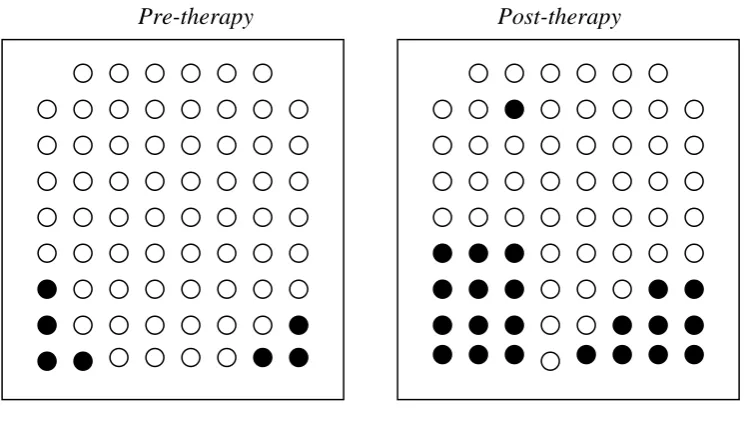
significant improvement. The EPG patterns showed that, in all of F’s productions, she had
contacted a high proportion of the correct electrodes, activating 12-15/17 electrodes for the
voiceless velar sound /k/ (see Figure 2) and similar numbers of correct electrodes for voiced
[image:8.595.129.507.287.498.2]velar /g/.
Figure 2: Pre and post therapy EPG displays showing maximum contact for /k/ in ‘car’
Pre-therapy Post-therapy
A 2-Factor Mixed Anova was conducted: the between factor was "words" with 3 levels (k
taught, k untaught and g untaught) and the within factor was "time" with 3 levels (pre 1, post
1, post 2). Both main effects were significant, for Words F(2,27)=105.59, p<.0001, for Time
F(2,54) = 472.67, p<.0001. A significant interaction was also found, for words x time
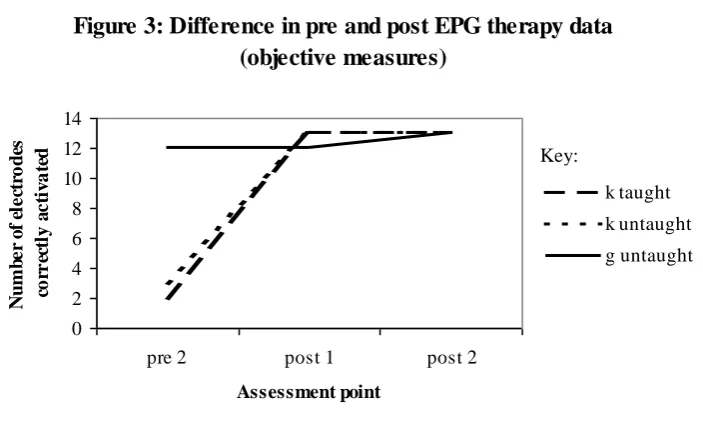
F(4,54)=104.54, p<.000. Figure 3 illustrates the differences observed between pre and post
therapy data.
Additionally, an analysis of simple main effects showed that there were significant changes in
the scores of the taught and untaught /k/ words (taught F(2, 54) = 396.13, p < 0.0001,
words. Furthermore, the three sounds did not differ significantly from each other after
[image:9.595.146.498.123.336.2]treatment but did before (F(2, 81) = 312.66, p < 0.0001).
Figure 3: Difference in pre and post EPG therapy data (objective measures) 0 2 4 6 8 10 12 14
pre 2 post 1 post 2
Assessment point N u m b e r o f el e ct ro d es co rr ec tl y a c ti v a te d k taught k untaught g untaught
In order to measure changes in perceived intelligibility post intervention, 10 untrained
listeners were asked to rate from 1-5 the words produced by the client at each assessment
point (1 = unintelligible, 5 = intelligible). The scores in the first and second pre-EPG
assessments ranged from 1-1.3/5 for the /k/ words, indicating low intelligibility. The scores
for the /g/ words ranged from 2.1-3/ 5, indicating nearly acceptable intelligibility. Pre EPG
therapy, F often produced an idiosyncratic /g/, a combination of pharyngeal and implosive /g/,
which can be auditorily interpreted as a near normal /g/ when produced within a word, even
though the manner and place of articulation are not correct.
The results indicated post EPG therapy ratings to be higher, suggesting improved
intelligibility of all velar sounds (see Figure 4). For the voiceless velar /k/ target, the scores
varied from 3-3.8/ 5; for the voiced target /g/ the scores varied from 2.6-3.6/5. The latter
indicates an improvement in intelligibility of /g/ targets, nonetheless a smaller one compared
to the improvement of the /k/ targets. Statistical analysis was conducted using a 2 Factor
Mixed Anova procedure. The between factor is "types of words" with 3 levels (k taught, k
untaught, g untaught) and the within factor is "time" with 4 levels (pre 1, pre 2, post 1, post
2). Both main effects are significant, for Words F(2,27)=28.29, p<.0001 for Time
F(3,81)=740.91, p<.0001. A significant interaction was observed, for words x time
F(6,81)=96,79, p<.0001.
The analysis of simple main effects explains the interaction. There are significant changes in
intelligibility for all three sounds (/k/ taught F(3, 81) = 471.77 p < 0.0001, /k/ untaught F(3,
81) = 471.36 p < 0.0001 and /g/ untaught F(3, 81) = 21.36 p < 0.0001). The fact that the/g/
targets have improved suggests that listener ratings may be a more sensitive measure of real
change than the EPG, even though their improvement is much less than the /k/ targets. This is
[image:10.595.140.495.210.410.2]also supported in the simple main effects where the pre therapy measure show significant
Figure 4: Intelligibility ratings pre and post EPG therapy by untrained listeners (n=10)
0 1 2 3 4 5
pre 1 pre 2 post 1 post 2
Assessment point M ea n g ro u p r a ti n g o f in te ll ig ib il it y k taught k untaught g untaught
differences favouring the /g/ targets (pre 1: F(2, 108) = 108.27 p < 0.0001, pre 2: F(2, 108) =
126.42 p < 0.0001) but the post therapy measures show significant differences favouring the
/k/ targets (post 1: F(2, 108) = 13.87 p < 0.0001, post 2: F(2, 108) = 11.90, p < 0.0001). This
demonstrates that the trained sounds were more intelligible than the untrained ones, even
though /g/ production was reasonably intelligible before treatment.
Discussion
This study has investigated the use of EPG as a therapeutic tool for the treatment of velar
plosives in a young cochlear implant user. The results can be summarized as follows:
A significant improvement was observed in production of voiced and voiceless velar
plosives immediately post EPG therapy, in both taught and untaught words, measured
by objective analysis of EPG printouts and listener ratings.
A significant improvement in production of voiced and voiceless velars was maintained
The findings of this case study raise a number of issues relating to the subject’s intelligibility
post EPG treatment, the subject’s response to EPG treatment, and the generalisation of newly
acquired skills.
Speech intelligibility post therapy
Responses from the listener judges indicated good intelligibility for all words post EPG
therapy, in comparison with conventional speech and language therapy. The post EPG therapy
productions were consistently rated with higher scores than the pre therapy ones. The
statistical tests performed show the overall mean of both post therapy assessment results for
taught and untaught words to be higher than the pre therapy results. Since the utterances were
all read rather than spoken spontaneously, no inferences can be made as to the intelligibility
of the subject’s spontaneous speech.
The listener ratings were also compared informally with the EPG printouts for certain words.
This analysis indicated that when productions were judged as accurate auditorily, the EPG
patterns reflected the same results. Conversely, when productions were identified perceptually
as distorted, the source of distortion was evident in the tongue contact patterns. This finding
indicates that improved consonant intelligibility had a strong correspondence with the new
linguapalatal contact patterns learned, which increases the validity of the subjective results.
Response to EPG treatment
EPG successfully resolved F’s velar placement problem at a single word level. According to
statistical analysis, pre EPG therapy printouts showed that there was hardly any contact across
the palate in the velar region; velar consonants were perceived auditorily as uvular fricatives
[h]. Post EPG therapy perceptual analysis revealed near normal production for velar plosives.
It is interesting to speculate on the reasons for F’s positive response to EPG therapy, where
traditional auditory and production based approaches failed. Two different explanations are
possible: the first has to do with the nature of the EPG technique and the second involves the
subject’s role in the therapeutic process.
Regarding the former, therapy using EPG shares some features of a conventional approach,
such as explanations, use of subject’s metalinguistic skills and use of supplementary sensory
channels. For deaf clients, auditory feedback is an important supplementary channel, however
can improve access to the full range of speech sounds, yet even then, F illustrates that
improved auditory access does not automatically lead to modified speech patterns. Therapy
using EPG can offer significant benefits in such cases. It provides a visual display which
enables the clinician to acquire more detailed information on the client’s tongue/palate contact
than is normally available. The therapist can break down tasks, like the establishment of a
new articulatory placement into smaller component steps. At the same time, it offers the client
important visual feedback for instantaneous monitoring of tongue contacts. EPG encourages
an active role in the discovery of the relationship between tongue movements and the
resulting sound heard and appears to be inherently motivating for subjects. This enables the
articulatory patterns to become more accessible to the subject, resulting in modifications of
tongue placement patterns.
An additional factor to consider relating to success in therapy is the subject. F was a bright
and motivated child with good family support. EPG gave F the opportunity to be active in the
therapeutic process. The fact that F was able to explore her mouth morphology was important
in enabling her to place her tongue more accurately.
Generalisation of Skills
Newly acquired speech skills can be described as learned only when they are used in naturally
occurring, connected speech. In F’s case, she did show a great improvement in her /k/
production in single words, to the extent that she increased her ability to produce target
sounds correctly both with and without looking at the visual prompts provided by the EPG.
During the period of EPG therapy, as F learned the articulatory pattern being modelled for the
voiceless velar /k/, improved intelligibility was reported to be evident at home as well.
However, it would be inaccurate to describe F’s skills as automatic or fully established
immediately following this short course of EPG therapy. Conventional auditory based therapy
is required to facilitate and ensure generalisation of new skills beyond single word production
and to contexts outside of the therapy setting.
This single case study has shown that EPG has a role to play in teaching velar sounds to a
cochlear implant user. Some generalization of these skills were also shown through the
subject’s production of untaught words including these sounds.
However, there are certain limitations. Firstly, these findings are based on a single case study,
so it is not possible to generalise findings to the population of deaf children. It is likely that
various factors, such as parental support or the subject’s increased awareness and motivation,
might have positively influenced the outcome of this study. Similar studies with more subjects
are required to confirm the generalisability of these findings. Secondly, the study took place
over a 3-month period, hence, no longer-term effects of therapy could be measured. Thirdly,
as mentioned before, spontaneous speech was not recorded.
Despite these limitations, this study does go some way towards supporting the use of visual
feedback therapy with EPG with cochlear implant users. We need to keep in mind that targets
for production work are unlikely to be fully generalised by deaf speakers unless further
therapy is provided which encourages the move from visual to auditory monitoring of speech
targets. Future studies should also investigate the longer term maintenance of skills and the
impact on the intelligibility of spontaneous speech.
References
Busby P.A, Tong T.C. & Clark G.M. (1993) Electrode position, repetition rate, and speech perception by early- and late-deafened cochlear implant patients. Journal of the Acoustical
Society of America, 93:1058-1067.
Crawford R. (1995) Teaching voiced velar stops to profoundly deaf children using EPG: Two case studies. Clinical Linguistics and Phonetics, 9, 255-270.
Dagenais P.A. & Critz-Crosby P. (1991) Consonant lingual-palatal contacts produced by normal-hearing and hearing-impaired children. Journal of Speech and Hearing Research, 34, 1423-1435.
Dagenais P.A., Critz-Crosby P., Fletcher G.S. & McCutcheon J.M. (1994) Comparing abilities of children with profound hearing impairments to learn consonants using electropalatography or traditional aural-oral techniques. Journal of Speech and Hearing Research, 37, 687-699.
Fletcher G.S. (1988) Speech production following partial glossectomy. Journal of Speech and
Hearing Disorders, 53, 232-238.
Fletcher G.S. & Hasegawa A. (1983) Speech modification by a deaf child through dynamic orometric modelling and feedback. Journal of Speech and Hearing Disorders, 48, 178-185.
Geers A.E. & Moog J.S.(1991) Evaluating the benefits of cochlear implants in an education setting. American Journal of Otology, 12:S116-S125.
Gibbon F., Dent H., & Hardcastle W. (1993) Diagnosis and therapy of abnormal alveolar stops in a speech-disordered child using electropalatography. Clinical Linguistics and Phonetics, 7, 247-267.
Gibbon F., Hardcastle W.J., Crampin L., Reynolds B., Razzell R. & Wilson, J. (2001) Visual feedback therapy using electropalatography (EPG) for articulation disorders associated with cleft palate. Asia Pacific Journal of Speech, Language and Hearing, 6, 53-58.
Gibbon F., Hardcastle W. J. & Dent H., (1995) A study of obstruent sounds in school-age children with speech disorders using electropalatography. European Journal of Disorders of
Communication, 30, 213-225.
Hardcastle W.J. & Edwards S. (1992) EPG-based descriptions of apraxic speech errors. In Kent R. (ed). Intelligibility in speech disorders: Theory, measurement and management. Philadelphia: John Benjamins. 287-328.
Hardcastle W.J. & Gibbon F. (1997) Electropalatography and its clinical applications. In M. Ball & C. Code (eds) Instrumental Clinical Phonetics. London: Whurr. 149-193.
Hardcastle W.J., Gibbon F.E. & Jones, W.J. (1991) Visual display of tongue-palate contact: electropalatography in the assessment and remediation of speech disorders. British Journal of
Disorders of Communication, 26,41-74.
Osberger M.A., Robbins S., Todd A., Riley M. & Miyamoto R. (1994) Speech production skills of children with multichannel cochlear implants. In I. Hochmair-Desoyer & E. Hochmair (eds) Advances in Cochlear Implants. Vienna: Manz. 503-507.
Parsloe R.(1998) Use of the speech pattern audiometer and the electropalatograph to explore the speech production/perception relationship in a profoundly deaf child. Journal ofLanguage
and Communication Disorders, 33, 109-121.
Robinshaw H.M. (1996) Aquisition of speech pre- and post-cochlear implantation: longitudinal studies of a congenitally deaf infant. European Journal of Disorders of Communication, 31, 121-139.
Tobey E. (1993) Speech production. In R. Tyler (ed) Cochlear Implants: Audiological
Foundations. Singular Publishing Group Inc. 257-316.
Whitehill T.L., Stokes S.F. & Man (1996) Electropalatography treatment in an adult with late repair of cleft palate. Cleft Palate Craniofacial Journal, 33, 160-168.
Wood S. (1993). An EPG study of stuttering. Speech Research Laboratory Work in Progress, University of Reading, 7, 107-134.
Wood S. (1995). An electropalatographic analysis of stutterers’ speech. European Journal of
Wood S. & Hardcastle W. J. (1999). Instrumentation in the assessment and therapy of motor speech disorders: A survey of techniques and case studies with EPG. In I. Papathanasiou (ed)