When Private Set Intersection Meets Big Data:
An Efficient and Scalable Protocol
∗
Changyu Dong
1, Liqun Chen
2, Zikai Wen
11Dept. of Computer and Information Sciences, 2Cloud & Security Lab,
University of Strathclyde, Hewlett Packard Labs, [email protected] [email protected] [email protected]
Abstract
Large scale data processing brings new challenges to the design of privacy-preserving protocols: how to meet the increasing requirements of speed and throughput of modern applications, and how to scale up smoothly when data being protected is big. Efficiency and scalability become critical criteria for privacy preserving protocols in the age of Big Data. In this paper, we present a new Private Set Intersection (PSI) protocol that is extremely efficient and highly scalable compared with existing protocols. The protocol is based on a novel approach that we calloblivious Bloom intersection. It has linear complexity and relies mostly on efficient symmetric key operations. It has high scalability due to the fact that most operations can be parallelized easily. The protocol has two versions: a basic protocol and an enhanced protocol, the security of the two variants is analyzed and proved in the semi-honest model and the malicious model respectively. A prototype of the basic protocol has been built. We report the result of performance evaluation and compare it against the two previously fastest PSI protocols. Our protocol is orders of magnitude faster than these two protocols. To compute the intersection of two million-element sets, our protocol needs only 41 seconds (80-bit security) and 339 seconds (256-bit security) on moderate hardware in parallel mode.
1
Introduction
In many countries, protecting data privacy is no longer optional but a legal obligation. Legisla-tion includes various US privacy laws (HIPAA, COPPA, GLB, FRC, etc.), European Union Data Protection Directive, and more specific national privacy regulations. It is a challenging task for organizations because they have to protect data in use and transmission. To this end, many security solutions have been proposed to enable privacy-preserving data processing. However, the amount of data to be processed and protected becomes increasingly large. For example, geneticists need to search 3 billion base pairs in personal genome to find genetic disorders that might cause diabetes or cancers, epidemiologists need to link multiple medical databases that contain millions of patients’ records to identify risk factors for diseases, and online retailers
want to correlate petabytes of their transaction records with customers’ social network activi-ties, hoping to increase customer satisfaction. Any privacy-preserving data processing service is not cost free and this has brought us new challenges: how to meet the increasing requirements of speed and throughput of modern applications, and how to scale up smoothly when data being protected is big? With the prevalence of large scale data processing, efficiency and scalability become critical criteria for designing a privacy-preserving protocol in the age of “Big Data”.
The subject of study in this paper is the Private Set Intersection (PSI) problem. Namely, two parties, a client and a server, want to jointly compute the intersection of their private input sets in a manner that at the end the client learns the intersection and the server learns nothing. The PSI problem has been extensively studied for two reasons, firstly set intersection is a foun-dational primitive and secondly it has many practical applications. For example, PSI has been proposed as a building block in applications such as privacy preserving data mining [4], human genome research [6], homeland security [15], Botnet detection [34], social networks [33], lo-cation sharing [36] and cheater detection in online games [11]. Many PSI protocols have been proposed, e.g. [22, 31, 24, 17, 25, 28, 12, 15, 14, 29, 5, 26]. PSI protocols are often criticized as being impractical because the performance becomes unacceptable when the input size or the security parameter becomes large, and it is difficult to improve the performance by just adding hardware proportionally. The criticism is not unfounded. Currently two protocols claim to be the fastest PSI protocol: the RSA-OPRF-based protocol by De Cristofaro et al [15, 16] and the garbled circuit protocol by Huang et al [26]. Both protocols have a highly optimized imple-mentation. We obtained the source code from the authors of these two protocols and tested the performance. To compute the intersection of two 1,048,576-element (220) sets, De Cristofaro’s
protocol needs 10.6 minutes at 80-bit security, but requires a much longer time at 256-bit secu-rity. We estimate the time to be approximately 131 hours from tests with smaller sets. The tests with million-element sets on Huang’s protocol were unsuccessful because the Java Virtual Ma-chine ran out of memory on the client computer that has 16 GB RAM. From tests with smaller sets, we estimate that Huang’s protocol requires 27 hours and 51 hours respectively to compute the intersection at 80-bit and 256-bit security. Clearly to use PSI in real world applications, we need more practical protocols.
Contributions We present a new PSI protocol that is much more efficient than all the already existing PSI protocols. The protocol is designed based on a novel two-party computation ap-proach, which makes use of a new variant of Bloom filters that we call garbled Bloom filters, and we refer the new approach as oblivious Bloom intersection. The ideas of garbled Bloom filters and oblivious Bloom intersection are general and have their own interests.
capacity provided by current multi-core CPUs, GPGPUs (General-purpose graphics processing unit) and cloud computing. As a result, the protocol is particularly suitable for Big Data oriented applications that have to process data in a parallelized and/or distributed way.
We have implemented a proof of concept prototype of the basic protocol. To compute the intersection of two million-element sets, it needs only 41 seconds (80-bit) and 5.65 minutes (256-bit) on two moderate computers in parallel mode.
Organization The paper is organized as follows: in section 2, we review the related work, in section 3 we introduce the notations and building blocks, in section 4, we present the gar-bled Bloom filter data structure, the semi-honest protocol, analyze the security and provide a simulation-based proof, in section 5 we show how to extend the basic protocol to achieve secu-rity against malicious adversaries, in section 6 we show a prototype of the basic protocol and the performance evaluation result, in section 7, we conclude the paper.
2
Related Work
The concept and first protocol of Private Set Intersection were introduced by Freedman et al in [22]. Their protocol is based on oblivious polynomial evaluation. Along this line, Kiss-ner and Song [31] proposed protocols in multiparty settings, Dachman-Soled et al [17], and Hazay and Nissim [25] proposed protocols which are more efficient in the presence of mali-cious adversaries. Hazey and Lindell [24] proposed another approach for PSI which is based on oblivious pseudorandom function (OPRF) evaluation. This approach is further improved by Jarecki and Liu [28, 29] and De Cristofaro et al [15, 14]. There are also a number of variants of PSI protocols, which aim to achieve more features than the original PSI concept. Camenisch and Zaverucha [12] proposed a PSI protocol which requires the input sets to be signed and cer-tified by a trusted party, Ateniese et al [5] proposed a PSI protocol that also hides the size of the client’s input set. Among the above protocols, the most efficient protocol is the protocol by De Cristofaro et al [15, 14]. It has linear complexity and requiresO(n)public key operations, where n is the size of the set. The performance of this protocol is affected significantly by
n and the security parameter. Recently, Huang et al [26] presented a semi-honest PSI proto-col based on garble circuits. This protoproto-col requires O(nlogn)symmetric key operations and a small number of public key operations. The authors demonstrated that in certain cases this protocol is significantly more efficient than the previous PSI protocols. At low security settings, De Cristofaro’s protocol [15] is the fastest but at high security settings, Huang’s protocol [26] is more efficient.
Recently a few PSI protocols based on Bloom filters were proposed. In [32], the parties AND their Bloom filters by a secure multiplication protocol and each party obtains an intersec-tion Bloom filter. They then query the resulting Bloom filter to obtain the intersecintersec-tion. However the protocol is not secure because the intersection Bloom filter leaks information about other party’s sets. In [30], Bloom filters are used in conjunction with the Goldwasser Micali homo-morphic encryption.The semi-honest version of the protocol requires kn hash operations and
(klog2e+kl+k + 2l)n modular multiplications, where k and l are parameters controlling false positive. Our basic protocol requires2(k+klog2e)nhash operations and a few hundred
communication overhead than ours, as each bit in the Bloom filter and the encrypted elements has to be expanded to a group element. The version secure in the malicious model requires a trusted party to certify the client’s set, thus is hard to compare fairly with our enhanced protocol.
3
Preliminaries
3.1
Notations
A function µ(·) isnegligible inn, or justnegligible, if for every positive polynomialp(·) and any sufficiently largen it holds thatµ(n) ≤ 1/p(n). Aprobability ensembleindexed byI is a sequence of random variables indexed by a countable index setI. Namely,X ={Xi}i∈I where eachXiis a random variable. Two distribution ensemblesX ={Xn}n∈NandY ={Yn}n∈Nare
computationally indistinguishable, denoted by X ≡c Y if for every probabilistic polynomial-time (PPT) algorithmD, there exists a negligible functionµ(·)such that for everyn∈N,
|P r[D(Xn,1n) = 1]−P r[D(Yn,1n) = 1]| ≤µ(n)
For a set X, we denote by x ←r X the process of choosing an element x of X uniformly randomly.
3.2
Bloom Filters
A Bloom filter [9] is a compact data structure for probabilistic set membership testing. A Bloom filter is an array ofmbits that can represent a setSof at mostnelements. A Bloom filter comes with a set of k independent uniform hash functions H = {h0, ..., hk−1} that each hi maps elements to index numbers over the range[0, m−1]uniformly. In the rest of the paper, we use
(m, n, k, H)-Bloom filter to denote a Bloom filter parameterized by(m, n, k, H), useBFS to denote a Bloom filter that encodes the setS, and useBFS[i]to denote the bit at indexiinBFS. Initially, all bits in the array are set to 0. To insert an element x ∈ S into the filter, the element is hashed using the k hash functions to get k index numbers. The bits at all these indexes in the bit array are set to 1, i.e. set BFS[hi(x)] = 1 for0 ≤i ≤ k−1. To check if an itemyis inS,yis hashed by thekhash functions, and all locationsyhashes to are checked. If any of the bits at the locations is 0 ,yis not inS, otherwiseyisprobablyinS.
Because the hash functions are deterministic, ifyis encoded in the filter then in the query phase everyBFS[hi(y)]must be 1, so a Bloom filter never yields a false negative. However, a false positive is possible, i.e. it is possible thaty is not in the setS, but allBFS[hi(y)]are set to 1. The probability that a particular bit in the Bloom filter is set to 1 isp= 1−(1−1/m)kn, and according to [10], the upper bound of the false positive probability is:
ǫ=pk×(1 +O(k
p
r
lnm−klnp
m ) (1)
which is negligible ink.
In practice we often need to build a Bloom filter with a capped false positive probability, i.e. it represents any set of at mostnelements from a universe in a manner that allows false positive probability to be at most ε. The efficiency of such a Bloom filter depends on the parameters
the base of natural logarithms. The optimal number of hash functions isk = (m/n)·ln 2 and ifm is also optimal then the optimalk islog21/ε. In the rest of the paper, we always assume optimalkandmunless otherwise stated.
A standard Bloom filter trick is that if we have two(m, n, k, H)-Bloom filters that each en-codes a setS1 andS2, we can obtain another (m, n, k, H)-Bloom filterBFS1∩S2 by bit-wisely ANDing BFS1 andBFS2. The resulting Bloom filter has no false negative, which means the query result of any element y ∈ S1 ∩ S2 against BFS1∩S2 is always true. The false positive probability of the resulting Bloom filter is no higher than either of the constituent Bloom fil-ter [38]. Note that due to collisions, it is possible that thejth bit is set inBFS1 by an element in
S1−S1∩S2 andjth bit is set inBFS2 by an element inS2−S1∩S2. Therefore the resulting Bloom filter usually contains more 1 bits than the Bloom filter built from scratch usingS1∩S2.
3.3
Secret Sharing
Secret sharing is a fundamental cryptographic primitive. It allows a dealer to split a secret s
into n shares such that the secret s can be recovered efficiently with any subset of t or more shares. With any subset of less than t shares, the secret is unrecoverable and the shares give no information about the secret. Such a system is called a (t, n)-secret sharing scheme. An example of such a scheme is Shamir’s secret sharing scheme [41].
Whent =n, an efficient and widely used secret sharing scheme can be obtained by simple
⊕(XOR) operations [40]. The scheme works by generatingn−1random bit stringsr1, ..., rn−1
of the same length as the secret s, and computingrn =r1⊕, ...,⊕rn−1 ⊕s. Each ri is a share of the secret. It is easy to see thatscan be recovered by computingr1⊕, ...,⊕rnand any subset of less thannshares reveals no information about the secret.
3.4
Oblivious Transfer
Oblivious transfer [39, 20] allows a sender to send part of its input to a receiver in a manner that protects both parties. Namely, the sender does not know which part the receiver receives and the receiver does not learn any information about the other part of the sender’s input. Generally, an oblivious transfer protocol can be denoted as OTm
l . The notation means the sender holds
m pairsl-bit strings(xj,0, xj,1)(0 ≤ j ≤ m−1), while the receiver holds anm-bit selection
string r = (r0, ..., rm−1). At the end of the protocol execution, the receiver outputs xj,rj for
0≤j ≤m−1.
3.5
The Semi-honest Model
We prove the security of the basic protocol in the presence of static semi-honest adversaries. In the model, the adversary controls one of the parties and follows the protocol specification exactly. However, it may try to learn more information about the other party’s input. The definitions and model are according to [23].
A two-party protocolπ computes a function that maps a pair of inputs to a pair of outputs
f : {0,1}∗
× {0,1}∗
→ {0,1}∗
× {0,1}∗
, where f = (f1, f2). For every pair of inputs
x, y ∈ {0,1}∗
, the output-pair is a random variable(f1(x, y), f2(x, y)). The first party obtains
f1(x, y)and the second party obtainsf2(x, y). The function can be asymmetric such that only one party gets the result. It is captured asf(x, y)def= (f1(x, y),Λ), whereΛdenotes the empty string.
In the semi-honest model, a protocolπ is secure if whatever can be computed by a party in the protocol can be obtained from its input and output only. This is formalized by the simulation paradigm. We require a party’s viewin a protocol execution to be simulatable given only its input and output. The view of the party i during an execution of π on (x, y) is denoted by
viewπi(x, y)and equals(w, ri, mi
1, ..., mit)wherew ∈ (x, y)is the input ofi, ri is the outcome ofi’s internal random coin tosses andmi
j represents thejth message that it received.
Definition 1. Let f = (f1, f2) be a deterministic function. We say that the protocol π se-curely computesf in the presence of static semi-honest adversaries if there exists probabilistic polynomial-time algorithmsS1 andS2 such that
{S1(x, f1(x, y))}x,y c
≡ {viewπ1(x, y)}x,y
{S2(y, f2(x, y))}x,y c
≡ {viewπ
2(x, y)}x,y
4
The Basic Protocol
In this section we present the basic protocol that is secure in the semi-honest model. Concep-tually the protocol is very simple: the client computes a Bloom filter that encodes its setC and the server computes a garbled Bloom filter (see below) that encodes its set S. Then they run an oblivious transfer protocol so that the client obtains a garbled Bloom filter that represents the intersection and the server learns nothing. Then the client queries the intersection garbled Bloom filter and obtains the intersection.
4.1
Garbled Bloom Filters
We introduce a new variant of Bloom filters called garbled Bloom filters (GBF). A garbled Bloom filter is the garbled version of a standard Bloom filter. From a high level point of view, there is no difference between a garbled Bloom filter and a Bloom filter: it encodes a set of at mostn elements in an array of lengthm, it supports membership query with no false negative and negligible false positive. To add an element, the element is mapped by k independent uniform hash functions intok index numbers and the corresponding array locations are set. To query an element, the element is mapped by the same k hash functions intok index numbers and the corresponding array locations are checked.
whereλis a security parameter. In the rest of the paper, we use(m, n, k, H, λ)-garbled Bloom filter to denote a garbled Bloom filter parameterized by (m, n, k, H, λ), we denote a garbled Bloom filter encoding a setSbyGBFS and denote theλ-bit string at indexibyGBFS[i].
To add an elementx∈ Sto a garbled Bloom filter, we split the element intok λ-bit shares using the the XOR-based secret sharing scheme as described in section 3.3. The element is also mapped intokindex numbers and we store one share in each locationhi(x). Note this is a very loose description, the actual process is more complicated. To query an element y, we collect all bit strings athi(y)and XOR them together. If the result isy theny is inS, otherwisey is not in S. The correctness is obvious: if y ∈ S, the XOR operation will recover y from itsk
shares which are retrievable from the garbled Bloom filter by their indexes. Ify 6∈ S, then the probability of the XOR result is the same asyis negligible inλ. The algorithm to encode a set into a garbled Bloom filter and the algorithm to query an element are given in Algorithm 1 and 2.
Algorithm 1:BuildGBF(S, n, m, k, H, λ)
input : A setS,n, m, k, λ,H={h0, ...hk−1}
output: An(m, n, k, H, λ)-garbled Bloom filterGBFS
1 GBFS= newm-element array of bit strings;
2 fori= 0tom−1do
3 GBFS[i]=NULL; // NULL is the special symbol that means ‘‘no value’’
4 end
5 for eachx∈Sdo
6 emptySlot =−1, finalShare=x; 7 fori=0tok-1do
8 j =hi(x); // get an index by hashing the element
9 ifGBFS[j]==NULLthen
10 ifemptySlot ==−1then
11 emptySlot=j; // reserve this location for finalShare
12 else
13 GBFS[j] r
← {0,1}λ
; // generate a new share
14 finalShare=finalShare⊕GBFS[j];
15 end
16 else
17 finalShare=finalShare⊕GBFS[j]; // reuse a share
18 end
19 end
20 GBFS[emptySlot]=finalShare; // store the last share
21 end
22 fori= 0tom−1do
23 ifGBFS[i]==NULLthen
24 GBFS[i] r
← {0,1}λ
;
25 end 26 end
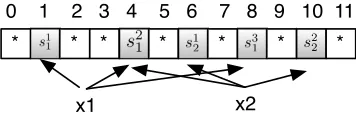
In Algorithm 1, we first create an empty garbled Bloom filter and initialize each location to NULL (line 1-4). To add x ∈ S, we split x into k shares on the fly and store the shares in GBFS[hi(x)] (line 5-21). Note that in this process, some location j = hi(x) may have been occupied by a previously added element. In this case we reuse the existing share stored at GBFS[j](line 16-18). For example, in Figure 1 we first add x1 toGBFS and split it into 3 shares s1
x1 x2 * s1
1 * * s21 * s12 * s
3
1 * s22 *
[image:8.612.209.387.57.116.2]0 1 2 3 4 5 6 7 8 9 10 11
Figure 1: Add elements into a garbled Bloom filter
reuse the string s2
1 as a share of x2, i.e. x2 = s21 ⊕s12 ⊕s22. This is because if we replace s2
1 with another string, x1 will not be recoverable in the query phase. Reusing shares will not
cause security problems as far as the protocol concerns, we will show in Theorem 3 that the probability of getting all shares of an element that is not in the intersection in our protocol is negligible. After adding all elements in S, we generate and store random λ-bit strings at all locations that are still NULL (line 22-26). Algorithm 1 will succeed with an overwhelming probability, as stated in Theorem 1. When m and k are optimal, the success probability in Theorem 1 is approximately1−2−k.
Algorithm 2:QueryGBF(GBFS, x, k, H)
input : A gabled Bloom filterGBFS, an elementx,k,H ={h0, ...hk−1}
output: True ifx∈S, False otherwise
1 recovered={0}λ; 2 fori=0tok-1do 3 j=hi(x);
4 recovered=recovered⊕GBFS[j];
5 end
6 ifrecovered==xthen 7 return True;
8 else
9 return False; 10 end
Theorem 1. Algorithm 1 will succeed with a probability at least1−p′k×(1+O(k p′
q
lnm−klnp′
m ))
wherep′
= 1−(1−1/m)k(n−1).
Proof. Algorithm 1 fails whenemptySlotremains−1 after the inner loop (line 20). This hap-pens when adding an element to the GBF, all locations the element hashes to have been occupied by previously added elements. Because in this case, at mostn−1elements have been added to the GBF, the probability of a particular position is occupied is at mostp′
= 1−(1−1/m)k(n−1).
The probability of allk locations have been occupied can be obtained in the same way as the
false positive probability of an(m, n, k, H)-BF, which is at mostp′k×(1 +O(k p′
q
lnm−klnp′
m )). The success probability is then 1 minus the probability of failure.
• The collision probability of a GBF is the probability whenyis not inS, but it hashes to the same set of index numbers as somex∈ S. A collision does not cause false positive: therecoveredstring (Algorithm 2) isxbut notyso the query result is still false. However it revealsx. The collision probability is negligible in k. Loosely, we can use the upper bound of the false positive probability of a Bloom filter as the upper bound of the collision probability of a garbled Bloom filter. Note that collisions do not affect the security of our protocol, but may be a concern if a GBF is used in other protocols.
• The false positive probability of GBFS is the probability when y is not in S but the
recoveredstring equalsycoincidentally. This probability is at most2−λ.
More formally, we have the following theorem:
Theorem 2. Let GBFS be an (m, n, k, H, λ)-garbled Bloom filter, (i) ∀y 6∈ S, x ∈ S :
P r[(Lk−1
i=0 GBFS[hi(y)]) =x]≤ǫ, whereǫis the maximum false positive probability in
equa-tion (1). (ii)∀y6∈S :P r[(Lk−1
i=0 GBFS[hi(y)]) =y]≤2−λ.
Proof. We start from the collision probability. Let BFS be the(m, n, k, H)-Bloom filter that encodes the same set S asGBFS. Now for anyy 6∈ S, we query y against bothGBFS and
BFS. Whenever the GBF query results in a collision, the Bloom filter query must return a false positive. This is because by definition, y hashes to the same set of index numbers as some
x ∈ S, so all locations are set to 1 in BFS byx, therefore the Bloom filter query returns true, buty6∈S so this is a false positive. Since a GBF collision implies a Bloom filter false positive, the collision probability is bounded by the false positive probability of the Bloom filter.
Let’s consider the false positive probability of a GBF. A false positive occurs when y is not in S but the recovered string equals y. The recovered string is GBFS[h0(y)]⊕ . . . ⊕
GBFS[hk−1(y)]. Each constitution string GBFS[hi(y)] is either a share of certain elements or a random string. Wheny6∈S, there are three cases:
Case 1: All constitution strings are shares of the same element inS. We denote the probability of this case asp1. In this case for surerecovered6=ybecausey6∈S.
Case 2: The constitution strings are shares of several elements inS. We denote the probability of this case asp2. In this case we can divide the constitution strings into several groups of size at mostk−1, each group contains the shares of a particular element. From the security of the XOR-based secret sharing scheme, the XOR result of each group should be a uniformly random string. Therefore therecoveredstring is a uniformly random string.
Case 3: At least one of the constitution strings is a random string. The probability of this case asp3 = 1−p1−p2. In this case therecoveredstring is also a uniformly random string.
In all three cases, a false positive occurs if recovered=y. In case 1, the false positive proba-bility is 0. In the other two cases, the false positive probaproba-bility is2−λ. LetB denote the event that a false positive occurs, and leta1, a2, a3 denote the events that case 1, case 2, case 3 occurs
respectively, by the law of total probability, the false positive probability is:
P r[B] = P r[a1]P r[B|a1] +P r[a2]P r[B|a2] +P r[a3]P r[B|a3] = 0·p1+ 2−λ·
p2+ 2−λ·
p3
= 2−λ
(1−p1)≤2−λ
4.2
Produce an Intersection GBF
In this section we show how to produce an intersection garbled Bloom filter from an(m, n, k, H, λ)-garbled Bloom filter and an(m, n, k, H)-Bloom filter. The idea is quite similar to creating an intersection Bloom filter by ANDing two Bloom filters.
Let’s say we have an(m, n, k, H)-Bloom filterBFCthat encodes a setCand an(m, n, k, H,
λ)-garbled Bloom filterGBFS that encodes a setS. We use Algorithm 3 to build the intersec-tion garbled Bloom filterGBFC∩S.
Algorithm 3:GBF Intersection(GBFS, BFC, m)
input : An(m, n, k, H, λ)-garbled Bloom filterGBFS, an(m, n, k, H)-Bloom filterBFC, m
output: An(m, n, k, H, λ)-garbled Bloom filterGBFC∩S
1 GBFC∩S= new m-element array of bit strings;
2 fori=0tom-1do 3 ifBFC[i] == 1then
4 GBFC∩S[i] =GBFS[i];
5 else
6 GBFC∩S[i] r
← {0,1}λ
;
7 end 8 end
The intuition of the algorithm is this: if an elementxis inC∩S, then for every positioni
it hashes to, BFC[i]must be a 1 bit andGBFS[i] must be a share ofx. Therefore by running the algorithm, all shares ofxare copied to the new garbled Bloom filter. That is, all elements in
C∩Sare preserved in the new garbled Bloom filter. On the other hand, ifxis not inC∩S, then with a high probability, at least one share will not be copied. Or in other words, elements not inC∩S are eliminated from the new garbled Bloom filter. Thus the new garbled Bloom filter is indeed a garbled Bloom filter that encodes the intersection. Formally, we have the following theorem:
Theorem 3. LetGBFC∩S be an(m, n, k, H, λ)-garbled Bloom filter produced in Algorithm 3.
For0≤i≤k−1, letaibe the event thatGBFC∩S[hi(x)]equals theith share ofx, we have (i)
∀x∈C∩S:P r[a0∧. . .∧ak−1] = 1, (ii)∀x6∈C∩S: P r[a0∧. . .∧ak−1]is negligible ink.
Proof. The first part: we can see from the algorithm that for any elementx ∈ C∩S, all the shares will be copied fromGBFStoGBFC∩S because the corresponding locations inBFC are all set to 1.
The second part: Firstly, GBFC∩S does not encode any element x 6∈ S because GBFS contains no share of any element x 6∈ S. Secondly, for any element x ∈ S −C ∩S, the probability of all its shares are copied fromGBFStoGBFC∩S isǫ, whereǫis the upper bound of the false positive probability of an (m, n, k, H)-BF. This is because if all shares of x are copied to GBFC∩S then it means all locations that xhashes to inBFC are set to 1. However
x 6∈ C∩S and consequentlyx 6∈ C, then it implies a false positive when we query xagainst
BFC and the probability isǫ.
Theorem 4. Given setsC, Sand their intersectionC∩S, letGBFC∩S be an(m, n, k, H, λ
)-garbled Bloom filter produced by Algorithm 3 fromGBFS andBFC, letGBFC′∩S be another
(m, n, k, H, λ)-garbled Bloom filter produced by Algorithm 1 usingC∩S, we haveGBFC∩S c
≡
GBF′
C∩S.
Proof. GivenGBFC∩S, we modify it to getGBFC′′∩S. We scanGBFC∩S from the beginning to the end and for each locationi, we modifyGBFC∩S[i]using the following procedure:
1. IfGBFC∩S[i]is a share of an element inC∩S, then do nothing. 2. Else ifGBFC∩S[i]is a random string, do nothing.
3. Else if GBFC∩S[i] is a share of an element in S −C ∩S, replace it with a uniformly randomλ-bit string.
The result isGBF′′
C∩S. EveryGBFC∩S[i]must fall into one of these three cases, so there is no unhandled case.
Now we argue that the distribution ofGBF′′
C∩S is identical to GBF
′
C∩S. To see that, let’s compare each location inGBF′′
C∩S andGBF
′
C∩S. From Algorithm 1 and the above procedure, we can see thatGBF′′
C∩S andGBF
′
C∩S contain only shares of elements inC ∩S and random strings. Because GBF′′
C∩S andGBF
′
C∩S use the same set of hash functions, for each0 ≤ i ≤
m −1, GBF′′
C∩S[i] is a share of an element in C ∩S iffGBF
′
C∩S[i] is a share of the same element; GBF′′
C∩S[i] is a random string iffGBF
′
C∩S[i]is a random string. The distribution of a share depends only on the element and the random strings are uniformly distributed. So the distribution of every location inGBF′′
C∩S andGBF
′
C∩Sare identical therefore the distributions ofGBF′′
C∩S andGBF
′
C∩S are identical.
Then we argue that the distribution ofGBF′′
C∩S is identical toGBFC∩S except for a negli-gible probabilityη.
Case 1, GBFC∩S encodes at least one elements inS−C∩S. In this case the distribution of
GBF′′
C∩S differs from the distribution ofGBFC∩S. From Theorem 3, the probability of each element inS−C∩Sbeing encoded inGBFC∩S isǫ. Since there ared=|S|−|C∩S|elements inS−C∩S, the probability of at least one element is falsely contained inGBFC∩S is:
η= d X i=1 d i
·ǫi =
d X
i=1
d(d−1)...(d−i+ 1)
i(i−1)...1 ·ǫ
i ≤ d X
i=1
(dǫ)i ≤2dǫ (2)
As we can seeηis negligible ifǫis negligible.
Case 2:GBFC∩S encodes only elements fromC∩S. In this case, each element inS−C∩S may leave up tok−1shares inGBFC∩S. The only difference betweenGBFC∩S andGBFC′′∩S is that in GBF′′
C∩S, all “residue” shares of elements in S −C ∩S are replaced by random strings. From the security of the XOR-based secret sharing scheme, the residue shares should be uniformly random (otherwise they leak information about the elements). Thus the procedure does not change the distribution when modifyingGBFC∩S intoGBFC′′∩S. So the distributions ofGBFC∩S andGBFC′′∩S are identical. The probability of this case is at least1−η.
SinceGBF′′
C∩S ≡ GBF
′
C∩S always holds and GBFC∩S ≡ GBFC′′∩S holds in case 2, we can conclude thatP r[GBFC∩S ≡GBFC′∩S]≥1−ηthus
|P r[D(GBFC∩S) = 1]−P r[D(GBFC′∩S) = 1]| ≤η
this is appropriate: since η is bounded by 2dǫ, will the security be weakened? For example if λ = 80 andd = 220, will the security be weakened to about 60-bit rather then desired
80-bit? The answer is no. Loosely speaking, a bigger dmeans that an adversary can distinguish
GBFC∩S andGBFC′∩S with a smaller number of attempts, but in each attempt the amount of computation required to distinguish the two also increases. Therefore the total amount of work needed to distinguish the two remains unchanged. We demonstrate it through the following game: an adversary can query an oracle with two sets S and C of its choice. The oracle randomly choosesb ← {r 0,1}, ifb = 1, it returnsGBFC∩S, ifb = 0, it returnsGBFC′∩S.The adversary can repeatedly query the oracle. At the end of the game, it challenges the oracle and outputs b′
. It wins the game if b′
= b. The advantage is |P r[b′
= b]− 1
2|. As we show in
Theorem 5, the advantage depends only onǫ, notη.
Theorem 5. For an adversary runs in time t, the adversary’s advantage in the above game is no more thanO(t)·ǫ.
Proof. In each oracle query, the adversary has a probability ofη to distinguishGBFC∩S and
GBF′
C∩S. Therefore if it makes q oracle queries, the advantage will be q·η. The number of oracle queries the adversary can make ist/td, wheretdis the time needed to check whether the GBF encodes an element that is not in the intersection. As there is no way other than querying the GBF to decide, the best the adversary can do is to query all elements inS−C∩S against the GBF. Thereforetd=|S−C∩S| ·tg =d·tg, wheretgis the time of a GBF query. Therefore the advantage of the adversary is: q·η= t
td ·η≤
t
d·tg ·2dǫ=O(t)·ǫ.
4.3
Oblivious Bloom Intersection
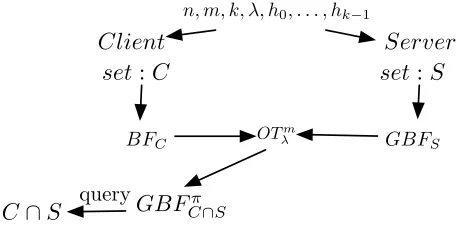
The idea of the basic protocol is shown in Figure 2. That is, to run Algorithm 3 by two parties using oblivious transfer. Thus we call it oblivious Bloom intersection. The protocol runs as follows:
1. The server’s private input isS, the client’s private input isC. The auxiliary inputs include the security parameter λ, the maximum set sizen, the optimal Bloom filter parameters
m, k and H = {h0, ..., hk−1}. The parameter k is set to be the same as the security
parameterλ.
2. The client generates an(m, n, k, H)-BF that encodes its private setC, the server generates an (m, n, k, H, λ)-GBF that encodes its private set S. The client uses its Bloom filter as the selection string and acts as the receiver in an OTm
λ protocol. The server acts as the sender in the OT protocol to send m pair of λ-bit strings (xi,0, xi,1) where xi,0 is a
uniformly random string andxi,1 isGBFS[i]. For0≤i≤m−1, ifBFC[i]is 0, then the client receives a random string, ifBFC[i]is 1 it receivesGBFS[i]. The result isGBFCπ∩S. 3. The client computes the intersection by querying all elements in its set againstGBFπ
C∩S.
At the end of step 2, the client receives a new garbled Bloom filter GBFπ
C∩S. The OT protocol does exactly what we want to achieve in Algorithm 3.
Theorem 6. Given an(m, n, k, H, λ)-Garbled Bloom filterGBFS and an(m, n, k, H)-Bloom
filterBFC. the garbled Bloom filterGBFCπ∩S is equivalent to a garbled Bloom filterGBFC∩S
Client Server
set:C set:S
GBFS
BFC
queryGBFπ C∩S
C∩S
OTm λ
[image:13.612.183.411.57.171.2]n, m, k, λ, h0, . . . , hk−1
Figure 2: The basic PSI protocolπ∩
Proof. Let’s run the algorithm and protocol simultaneously and use the same random coins for the random strings that are to be placed in GBFπ
C∩S and GBFC∩S. From the description
of the algorithm and the protocol, we can see that for 0 ≤ i ≤ m−1, ifBFC[i] = 1, then
GBFπ
C∩S[i] = GBFC∩S[i] = GBFS[i]; ifBFC[i] = 0, thenGBFCπ∩S[i] = GBFC∩S[i] = ri whereri is a uniformly random strings. Therefore the two garbled Bloom filters are equivalent.
Informally, the correctness of the protocol follows from Theorem 3 and 6. The protocol produces a garbled Bloom filter that encodes C∩S, then by querying it the client can obtain the correct intersection except for a negligible probability. To see why the protocol is secure, notice that the only messages being sent in the protocol are the messages in the OT protocol. The client’s privacy is protected because the server learns no information aboutBFC in the OT execution. The server’s privacy is protected because the client receives onlyGBFπ
C∩Sfrom the server and it contains only information about elements inC∩S.
The reader may have noticed that the OT protocol can also be used to AND two Bloom filters in a similar way and create an intersection Bloom filterBFC∩S on the client side. Then do we really need the garbled Bloom filter? Can the server just encode its set into a Bloom filter and run the protocol? The quick answer is we do need the garbled Bloom filter. BFC∩S leaks information about the server’s set because it contains more 1 bits than the Bloom filter built from scratch using C ∩S. The expected number of additional 1 bits is (tS−t∩)(tC−t∩)
m−t∩ , where
tS, tC, t∩ are the number of 1 bits in BFS, BFC and the the Bloom filter built from scratch usingC∩Srespectively [38]. The additional knowledge the client gets is the additional 1 bits inBFC∩S.
The protocol makes a single call toOTm
λ , so the efficiency depends largely on the efficiency of the underlying OT protocol. If we use the semi-honest OT extension protocol from [27] and the Naor-Pinkas OT [35], then:
Computational complexity: To build BFC orGBFS, each party needsk·n hash operations. Then the server needsλpublic key operations and the client need2λpublic key operations for the Naor-Pinkas OT, and both parties needm =knlog2e≈1.44knhash operations for the OT extension.
Memory complexity: The client needs to keep a copy of the Bloom filter and a copy of the in-tersection Garbled Bloom filter which in total need at most(λ+1)mbits. This can be optimized to(λ/2 + 1)mbits because the client can throw away the string received whenBFC[i] = 0and leave GBFπ
PK ops SK ops Memory Comm. Huang’s O(λ) O(nlogn) O(nlogn) O(nlogn)
De Cristofaro’s O(n) O(n) O(n) O(n)
[image:14.612.126.470.56.118.2]The Basic Protocol O(λ) O(n) O(n) O(n)
Table 1: Asymptotic Costs Comparison: n is size of the input sets,λis the security parameter, PK (SK) ops means public (symmetric) key operations.
Communication complexity: The main data sent in the protocol is a bit matrix required by the OT extension and the strings sent by the server in the OT extension. In total 2λ·m bits. All other communication costs are much less significant and can be ignored.
A quick asymptotic costs comparison of Huang’s, De Cristofaro’s and our basic protocol is shown in Table 1.
4.4
Security Analysis
Now we sketch the security proof of the basic protocol. The basic protocol is secure in the semi-honest model. The main theorem is stated below:
Theorem 7. LetC, Sbe two sets from a predefined universe,f∩ be the set intersection function
defined as:
f∩(C, S) = (fC(C, S), fS(C, S)) = (C∩S,Λ).
Assuming the underlyingOTm
λ protocol is secure, then the basic PSI protocolπ∩ in Section 4.3
securely computesf∩in the presence of semi-honest adversaries.
Proof. (sketch) If theOTm
λ is secure then the simulators for the sender and receiver are guaran-teed to exist, we can use them as subroutines when constructing our simulators.
Server’s viewWe start from the case in which the server is corrupted. We construct a simulator
SimS that receives the server’s private input and output and generates the view of the server in
the protocol. GivenS, the simulatorSimSuniformly chooses its random coinsrsand generates the garbled Bloom filter GBFS that encodes its set S. Then SimS invokes the simulator of the OT sender SimOTsnd that is guaranteed to exist. SimS obtains SimOTsnd’s view for the OT
protocol. Finally SimS outputs the simulated view: (S, rS,SimOT
snd(GBFS,Λ)). We then need to show that the view is indistinguishable from a view in an execution of π∩. A view of the
real protocol execution contains the input S, the random coins and the messages in the OT protocol. In the simulated view, the input set S is the same as in the view of a real execution, the outcome of internal random coins rs is uniformly random thus the distribution is the same as in a real execution. As the OT protocol is secure, then the distribution of the view produced bySimOTsnd(GBFS,Λ) should be indistinguishable from the view in a real execution of the OT
protocol. Thus we conclude the simulated view is indistinguishable from a real view.
Client’s viewWe construct a simulatorSimC that is given the client’s private inputC and the
output C∩S. SimC chooses its random coins rc. It then generates the Bloom filter BF C to encode its set and the garbled Bloom filter GBFC∩S from scratch using Algorithm 1. It then invokes the simulator of the OT receiverSimOTrec withBFCandGBFC∩S. SimCobtains the view
for the OT protocol. FinallySimC outputs the simulated view: (C, rc, GBF
C∩S,SimOTrec(BFC,
Server’s input: SetS Client’s input: SetC
Auxiliary input: the security parameterλ, parameters for BF and GBFn, k =λ, m= 2kn, H = {h0, . . . , hk−1}, a secure block cipherE.
1. The client generates a Bloom filter BFC. The client then generatesm λ-bit random strings, sayr0, ...rm−1. The client sends the random strings to the server.
2. The server generates the garbled Bloom filterGBFS. The server generates a random keysk
for the block cipherE. For0 ≤i ≤m−1, the server computes ci = E(sk, ri||GBFS[i]). The server also uses a(m/2, m)-secret sharing scheme to splitskintomshares(t0, ..., tm−1).
3. The server and the client engage in an OT protocol that is secure against malicious parties. The client usesBFC as the selection string and the server uses as input two sets of stringsci andti (0 ≤i≤m−1). As a result of the protocol, ifBFC[i] = 1, the client receivesci; if
BFC[i] = 0,the client receivesti.
4. The client recovers sk from the shares it received in the OT. The client creates a garbled Bloom filter GBFC∩S of size m as follows. For 0 ≤ i ≤ m −1 if BFC[i] = 0 then
GBFC∩S[i] ← {0r ,1}λ; ifBFC[i] = 1, the client decrypts ci and gets di = E−1(sk, ci), checks whether the firstλ-bit equalsrithat is sent in step 1. If yes then skip the firstλbits in
diand copy the secondλbits toGBFC∩S[i]. Otherwise output⊥and terminate. Finally, the client queriesGBFC∩Swith its own setCand outputsC∩S.
Figure 3: The Enhanced PSI protocol
the garbled Bloom filterGBFπ
C∩S, and the messages in the OT protocol. In the simulated view, the input setC andrc should be indistinguishable from the counter parts in the real view. The garbled Bloom filterGBFC∩Sis indistinguishable fromGBFCπ∩Sas we have shown in Theorem 4 and 6. The rest parts in the views are the simulated OT messages and the OT messages in the real execution. As the OT protocol is secure, then they should be indistinguishable. Thus we conclude the simulated view is indistinguishable from a real view.
Combine the above, we conclude that:
{SimS(S, fS(C, S)}C,S≡ {c viewπS(C, S)}C,S
{SimC(C, fC(C, S))}C,S ≡ {c viewπC(C, S)}C,S
and finish our proof.
5
The Enhanced Protocol
In this section, we present a fully secure PSI protocol whose security holds in the presence of malicious parties. The protocol is shown in Figure 3. The security model and proof can be found in the Appendix.
input during the protocol execution but it cannot prevent a malicious client from mounting a full universe attack.
In a full universe attack, a malicious client encodes the full universe of all possible elements in its Bloom filter and uses it in the PSI protocol to learn the server’s entire set. A Bloom filter can easily represent the full universe by setting all the bits to 1. This is a special feature of Bloom filters and it causes a problem when we try to construct a simulator for the client in the malicious model. Namely, when the adversary uses the all-one Bloom filter, the simulator needs to enumerate all elements in the universe and send them to the trusted party in the ideal process. Without making any assumptions, the universe is potentially too large and a polynomial time algorithm may fail to enumerate all elements.
To prevent the full universe attack, we add a step to make sure that the client’s Bloom filter is not all-one. More specifically, the server uses a symmetric key block cipher to encrypt strings in its garbled Bloom filter before transferring them to the client. It forces the client to behave honestly by splitting the key intomshares using a(m/2, m)-secret sharing scheme. The client uses the bit array in its Bloom filter as the selection string to receive the intersection garbled Bloom filter and the shares of the key. If the bit in the selection string is 0, the client receives a share of the key; if the bit is 1, the client receives an encrypted string in GBFS. The intuition is that if the client cheats by using an all-one Bloom filter, it will not be able to gather enough shares to recover the key, and thus will not be able to decrypt the encrypted garbled Bloom filter. In the protocol we set m = 2kn in order to make sure that the client’s Bloom filter has at least m/2 0 bits to receive enough shares to recover the key. Since the client has at most
n elements and each element needs to be hashed k times, then the number of 1 bits in BFC will never exceed kn = m/2, consequently the number of 0 bits will always be at leastm/2. Although in this settingmis not optimal, the overhead is acceptable given the optimal number ofmis about1.44kn.
The added step will not affect the client’s privacy, but may affect the correctness of the protocol if a malicious server sends wrong shares of the key or uses a different key to encrypt its garbled Bloom filter. The client cannot detect it because the key is random and the strings in the garbled Bloom filter look random. To prevent this malicious behavior, we also require the client to send m λ-bit random strings (r0, ..., rm−1)to the server before the OT. For each
GBFS[i], the server encryptsri||GBFS[i](||means concatenation) and sends the ciphertext in the OT. After the transfer, the client can recover the key and decrypt the received ciphertexts. If the server is honest, then the client can correctly decrypt using the key it recovered andrishould present in the decrypted message. For each garbled Bloom filter string the client received, the probability of the server getting away with cheating is2−λ.
Efficiency In [27] a fully secure version of the OT extension protocol is given. It uses the cut-and-choose approach to ensure a malicious party can cheat with at most2−Ω(λ)probability. The
major overhead of the fully secure protocol is introduced by the non-optimal m and cut-and-choose, which increase the communication and computation complexity of the semi-honest one by a factor of1.4λ. Overhead introduced by other parts of our protocol is small. The additional computational overhead in our protocol includes: the server needs to perform m encryptions and to use the threshold secret sharing scheme to split the key, the client needs to perform
Ours De Cristofaro’s Huang’s
80 SHA-1, NIST P-192 curve RSA 1024, SHA-1 1024-bitp, 160-bitq, SHA-1
128 SHA-1 (filter), SHA-256 (OT), NIST P-256 curve
RSA 3072, SHA-1 3072-bitp, 256-bitq, SHA-1
192 SHA-1 (filter), SHA-384 (OT), NIST P-384 curve
RSA 7680, SHA-1 7680-bitp, 384-bitq, SHA-256
256 SHA-1 (filter), SHA-512 (OT), NIST P-521 curve
[image:17.612.90.501.56.167.2]RSA 15360, SHA-1 15360-bitp, 512-bitq, SHA-256
Table 2: Security parameters and settings
6
Implementation and Evaluation
6.1
Implementation
We have implemented a prototype of the basic protocol in C. The source code (and its Java port) is released online1. It uses OpenSSL (1.0.1e) for the cryptographic operations. We currently use keyed SHA-1 to build/query Bloom filters and garbled Bloom filters2. Namely eachh
i(x) is instantiated assha1(si||x) modm, wheresi is a unique salt. We implement the semi-honest OT extension protocol [27] on top of the Naor-Pinkas OT protocol [35]. The hash functions in the OT extension protocol are instantiated depending on the security parameter. When hash values need to be truncated, the truncation follows the steps specified by the NIST [18]. We use the NIST elliptic curve groups overFp[37] for the public key operations required by the
Naor-Pinkas OT protocol. We use elliptic curve groups because they are much faster than integer groups at high security levels.
The C prototype has two executables, one for the client and one for the server. The client and server communicate through TCP. The prototype can work in two modes: pipelined and parallel. In the pipelined mode, on each side, the computation is done in a single thread, an additional thread transmits data in parallel when possible. Parallel data transmission enables the server or the client to start working immediately without waiting for the other party to complete its computation. The parallel mode extends the pipeline mode by utilizing all CPU cores and distributing tasks on all cores evenly. Our test result shows that the parallel mode can improve the performance significantly on multicore systems. This is due to the fact that the computation in our protocol is dominated by independent hashing. Namely, on each side, n independent set elements each needs to be hashed k times to build the Bloom filter or the garbled Bloom filter, also hashing of m matrix rows are needed in the OT extension protocol. As the data to be hashed is independent, this is a perfect SPMD (single program multiple data) scenario. The program detects the number of cores available, decides the number of threads, evenly allocates a portion of data to each thread, and then launch the threads to execute the tasks in parallel. The hash values are then consumed by main threads that run the protocol. This approach requires only minimal changes to the program structure. For example, only one line (line 8) needs to be changed in Algorithm 1. Namely instead of hashing the element, the algorithm reads from an array a precomputed index number.
1
http://personal.cis.strath.ac.uk/changyu.dong/PSI/PSI.html
2Cryptographically strong hash functions are not necessary here. Later we will change to more efficient hash functions e.g. MurmurHash
6.2
Performance Evaluation
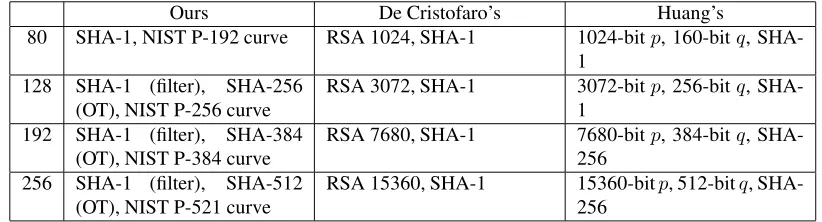
In this section we show the performance evaluation results of our prototype. All experiments were conducted on two Mac computers. The server is a Mac Pro with 2 Intel E5645 6-core 2.4GHz CPUs, 32 GB RAM and runs Mac OS X 10.8. The client is a Macbook Pro laptop with an Intel 2720QM quad-core 2.2 GHz CPU, 16 GB RAM and runs Mac OS X 10.7. The two computers are connected by 1000M Ethernet. The security settings of the experiments in this and the next section are summarized in Table 2. In all experiments we set BF/GBF parameter
k =λso the false positive probability of a BF is at most2−λ, we setmto be the optimal value
knlog2e. For example, at 80-bit security k = λ = 80, and when n = 220, m = 120795960.
We use randomly generatedintsets in the experiments. We measure the total running time of the protocol. The measurement starts from the client sending the request and ends immediately after the client outputting the intersection. The time includes all operations such as building the Bloom filter, building the garbled Bloom filter, the full OT extension protocol (including the underlying Naor-Pinkas OT), data transmission, and the client-side query for obtaining the intersection. We do not, however, include the time for initialization tasks, e.g. to generate random sets, to interpret the command line arguments, and to setup sockets.
We first show the performance of the prototype working in the pipelined mode. In the pipelined mode, all computation on each side is done in a single thread. We vary the set size (n) from 210 to 220 and security parameters (λ and k) from80to 256. The result is shown in
Figure 4a. We can see the running time increases almost linearly in the set size at each security level. And for each increase in security parameter, the running time increases only by a factor of approximately 2. We also measured the time for each individual step of the protocol. In the experiments, we fix the set size (220) and vary only security levels. The result is shown in Figure
4b. We can see the protocol running time is dominated by the OT execution. This suggests that with a more efficient OT protocol, the total running time can be further reduced.
Then we show the performance of the parallel mode. In the parallel mode, we use multiple threads for computation. The result is shown in Figure 4c. The total running time in the parallel mode is much less than in the pipelined mode. At 80-bit security, million elements set inter-section can be done in 41 seconds. In the highest security setting, the same computation can be done in 339 seconds – that is less than 6 minutes. A comparison of the performance in the two modes is shown in Figure 4d. The client has 4 cores and the server has 12 cores, and we can see that the parallel mode is about 5 times faster than the pipelined mode. This shows that our protocol can fully take the advantage of the multicore architecture. We believe the ability to easily scale up to multiple cores is a clear advantage of our protocol and makes the protocol suitable for large scale private data processing.
The performance of our protocol can even beat some inefficient plain algorithms in some settings. For example, Figure 4d shows the time needed for a single threaded C program to compute the intersection of two unencrypted random sets (n = 220) by pairwisely comparing
the elements. It needs 429 seconds in the best case whenC =S, and needs 844 seconds in the worst case whenC∩S =∅.
6.3
Performance Comparison
80 128 192
256 1,024 4,09616,384 65,536262,144 1,048,576 0 200 400 600 800 1000 1200 1400 1600 1800 Set Size Security Level T ime (Se c)
(a) Performance: the pipelined mode
(b) Running time of each step in the pipelined mode 80 128 192 256 1,024 4,096 16,38465,536 262,1441,048,576 0 50 100 150 200 250 300 350 Set Size Security Level T ime (Se c)
(c) Performance: the parallel mode
80 128 192 256
0 200 400 600 800 1000 1200 1400 1600 1800 Security Level T im e (Se c ) set size=1,048,576 parallel pipelined
unencrypted pairwise comparison (best case) unencrypted pairwise comparison (worst case)
[image:19.612.301.504.59.218.2](d) A comparison of running time in the two modes
Figure 4: Performance of our basic protocol
Java). They are previously the fastest PSI protocols and the code has been optimized by the authors. We test the two protocols on the same hardware and OSes that we use for testing ours. De Cristofaro’s C implementation is compiled with OpenSSL 1.0.1e and GMP 5.1.1 using gcc. The RSA public exponent is 3 in all tests. We run Huang’s Java code using Java 1.7.0 12. The element bit length in Huang’s protocol is set to 32. As it is unfair to compare the perfor-mance of Huang’s Java code with our C code, we ported our C code to Java and measured the performance.
We measured the total running time of the protocols. De Cristofaro’s code outputs running time so we use the output directly3. Huang’s code has no such output, and we measure the
running time of theexecution()function in theP rogramclass.
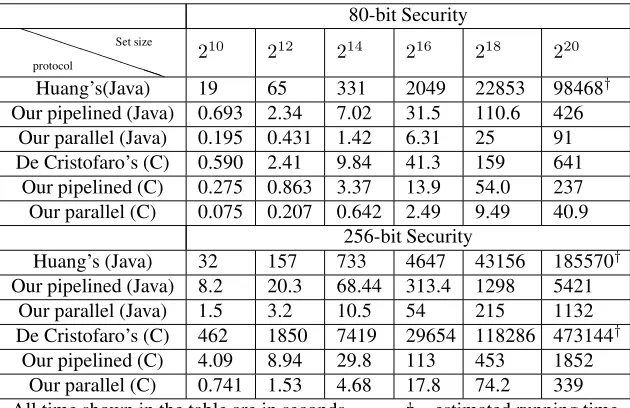
The comparison in Table 3 shows that in all settings, both modes of our protocol are faster than the other two protocols. Both De Cristofaro’s implementation and Huang’s implementation
3We exclude the running time of the last step in the protocol. In this step the client searches the hash values received in the protocol to
80-bit Security P P P P P P PP protocol Set size 210 212 214 216 218 220
Huang’s(Java) 19 65 331 2049 22853 98468†
Our pipelined (Java) 0.693 2.34 7.02 31.5 110.6 426 Our parallel (Java) 0.195 0.431 1.42 6.31 25 91 De Cristofaro’s (C) 0.590 2.41 9.84 41.3 159 641
Our pipelined (C) 0.275 0.863 3.37 13.9 54.0 237 Our parallel (C) 0.075 0.207 0.642 2.49 9.49 40.9
256-bit Security
Huang’s (Java) 32 157 733 4647 43156 185570† Our pipelined (Java) 8.2 20.3 68.44 313.4 1298 5421
Our parallel (Java) 1.5 3.2 10.5 54 215 1132 De Cristofaro’s (C) 462 1850 7419 29654 118286 473144†
[image:20.612.139.454.55.259.2]Our pipelined (C) 4.09 8.94 29.8 113 453 1852 Our parallel (C) 0.741 1.53 4.68 17.8 74.2 339 All time shown in the table are in seconds. †– estimated running time
Table 3: Performance comparison
10240 262144
2000 4000 6000 8000 10000 12000 14000 Set size
Bandwidth consumption (MB)
De Cristofaro Our Huang
(a) Bandwidth Consumption: 80-bit security
10240 262144
0.5 1 1.5 2 2.5 3 3.5 4
x 104
Set size
Bandwidth consumption (MB)
De Cristofaro Our Huang
(b) Bandwidth Consumption: 256-bit security
Figure 5: Bandwidth Consumption Comparison
pipeline the protocol execution, which is exactly what we do in the pipelined mode. Therefore the performance of these three can be compared directly4. The performance of De Cristofaro’s protocol is close to ours at 80-bit security and is faster than Huang’s. But when the security parameter increases to 256-bit, it becomes much slower than our protocol and Huang’s. This is because De Cristofaro’s protocol is based mainly on public key operations, while ours and Huang’s protocols rely on mostly symmetric key operations. Put aside differences caused by languages and implementation, our protocol is faster than Huang’s because it requires the same number of public key operations but significantly less symmetric key operations. For example, at 80-bit security with220input size, our protocol requires 0.4 billion symmetric key operations,
while Huang’s requires 8.5 billion (1.7 billion non-free gates, each requires 4 symmetric key operations to build and another 1 to evaluate).
We skip the test with the biggest input size (220) on De Cristofaro’s protocol at 256-bit
security because it would take too long. The running time of De Cristofaro’s protocol is linear
4
[image:20.612.101.494.309.455.2]in the input size, our estimation is that it would need 131 hours to finish. This estimation is based on the result of test with218-element sets at the same security level. The JVM on the
client computer ran out of memory (16 GB) when we testing Huang’s protocol with220-element
sets at 80-bit security. The test was repeated twice and both times we got the same error. We could not finish the test but base on the test result of input size218, we estimate the test would
need 27 hours. This estimation is somehow far from the time reported by the authors, that is 6 hours. However the test had been running for more than 24 hours before the JVM threw the error. Therefore we believe the estimation is reasonable. We observed excessive paging activities during the test on the client computer because the JVM occupied all free memory (14 GB). This may account for the difference between our estimation and the authors’ measurement. Because at 256-bit security Huang’s protocol requires even more memory, we skip the test with
220input size and estimate the running time to be 51 hours from test result of input size218.
We also measured bandwidth consumption of the protocols. As we couldn’t finish the tests with the other protocols using 220 input size, the largest input size we used in the experiment
was218. The results are shown in Figure 5. As we can see, the bandwidth consumption of De
Cristofaro’s and our protocol is almost linear. Our protocol consumes more bandwidth than De Cristofaro’s protocol but less than Huang’s protocol.
6.4
Further Parallelization
GPGPUsFor many personal computers, a readily available massive parallel computing device is the graphic cards. Modern GPUs have hundreds of processing cores and can provide ample computation cycles and high memory bandwidth to massively parallel applications. The com-putation in our protocol can be easily parallelized and therefore is an ideal application for GPU acceleration. We have started implementing the protocol on top of OpenCL [3]. A test on our GPU version of SHA-1 shows that on an ATI Radeon HD 5770 graphic card, it only takes 37.5 milliseconds to perform 1 million hash operations. This is about 5 times faster than a single 2.4 GHz CPU core.
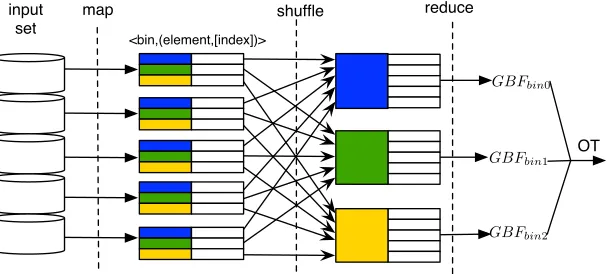
Extremely Big Data Set & Cloud ComputingIn practice, to process extremely big data set, we have to distribute the task on multiple computers. New computing paradigms such as cloud computing make it possible to execute such distributed tasks “on demand”. Our protocol can be easily deployed on cloud platforms. Here we show how to do it with the semi-honest protocol. The fully secure protocol case is similar. From a high level point of view, the client and the server throw their elements into bins using an hash function. Each side hasbbins and each bin contains about⌈n
b⌉elements. Then they build Bloom filters and garbled Bloom filters for each bin. The parameterkis still determined by the desired false positive probability, the parameter
input set
map
<bin,(element,[index])>
shuffle reduce
GBFbin1
GBFbin2 OT
[image:22.612.144.448.58.195.2]GBFbin0
Figure 6: MapReduce on the server side
pair such that the key is the bin number and the value is a tuple consists of the element and k
index numbers. The MapReduce framework shuffles and groups together the values returned by the map function that have the same key. The reduce function generates a garbled Bloom filter of a certain bin and outputs it for OT. We are currently experimenting with Hadoop [1] to implement the protocol in MapReduce.
7
Conclusion and Future Work
In this paper we presented a highly efficient and scalable PSI protocol based on oblivious Bloom intersection. The protocol depends mostly on efficient symmetric key operations and the op-erations can be parallelized easily. We presented two variants of the protocol: the basic one is secure in the semi-honest model and the enhanced one is secure in the malicious model. The performance evaluation and comparison results show that our protocol is orders of magnitude faster than the previously fastest protocols. The results also show that our protocol can fully utilize the parallel processing capability provided by the multicore architecture. The efficiency and scalability make our protocol suitable for large scale privacy preserving data processing.
As discussed in Section 6.4, we are in the process of prototyping the protocol on GPGPUs and MapReduce. The preliminary results of this work is encouraging. We hope more paral-lelization options could enable more applications in various computing environments.
In the field of cryptographic protocols, we have seen many examples that a new protocol improves performance of previous work by using a better algorithm. It is different in this work: the performance gain comes mainly from a better data structure. We would like to continue our research along this line. Namely we will investigate, adapt and design better data structures, so that they can be used in the design of more efficient cryptographic protocols.
References
[1] Hadoop. http://hadoop.apache.org/.
[2] Murmurhash. https://code.google.com/p/smhasher/. [3] Opencl. http://www.khronos.org/opencl/.
[5] G. Ateniese, E. D. Cristofaro, and G. Tsudik. (if) size matters: Size-hiding private set intersection. InPublic Key Cryptography, pages 156–173, 2011.
[6] P. Baldi, R. Baronio, E. D. Cristofaro, P. Gasti, and G. Tsudik. Countering gattaca: efficient and secure testing of fully-sequenced human genomes. In ACM Conference on Computer and Communications Security, pages 691–702, 2011.
[7] D. Beaver. Correlated pseudorandomness and the complexity of private computations. InSTOC, pages 479–488, 1996.
[8] M. Bellare and P. Rogaway. Random oracles are practical: A paradigm for designing efficient protocols. InACM Conference on Computer and Communications Security, pages 62–73, 1993. [9] B. H. Bloom. Space/time trade-offs in hash coding with allowable errors. Commun. ACM,
13(7):422–426, 1970.
[10] P. Bose, H. Guo, E. Kranakis, A. Maheshwari, P. Morin, J. Morrison, M. H. M. Smid, and Y. Tang. On the false-positive rate of bloom filters. Inf. Process. Lett., 108(4):210–213, 2008.
[11] E. Bursztein, M. Hamburg, J. Lagarenne, and D. Boneh. Openconflict: Preventing real time map hacks in online games. InIEEE Symposium on Security and Privacy, pages 506–520, 2011. [12] J. Camenisch and G. M. Zaverucha. Private intersection of certified sets. InFinancial
Cryptogra-phy, pages 108–127, 2009.
[13] R. Canetti. Security and composition of multiparty cryptographic protocols. J. Cryptology, 13(1):143–202, 2000.
[14] E. D. Cristofaro, J. Kim, and G. Tsudik. Linear-complexity private set intersection protocols secure in malicious model. InASIACRYPT, pages 213–231, 2010.
[15] E. D. Cristofaro and G. Tsudik. Practical private set intersection protocols with linear complexity. InFinancial Cryptography, pages 143–159, 2010.
[16] E. D. Cristofaro and G. Tsudik. Experimenting with fast private set intersection. InTRUST, pages 55–73, 2012.
[17] D. Dachman-Soled, T. Malkin, M. Raykova, and M. Yung. Efficient robust private set intersection. InACNS, pages 125–142, 2009.
[18] Q. Dang. Sp 800-107 (rev. 1). recommendation for applications using approved hash algorithms. Technical report, Gaithersburg, MD, United States, 2012.
[19] J. Dean and S. Ghemawat. Mapreduce: Simplified data processing on large clusters. InOSDI, pages 137–150, 2004.
[20] S. Even, O. Goldreich, and A. Lempel. A randomized protocol for signing contracts. Commun. ACM, 28(6):637–647, 1985.
[21] M. Fischlin, A. Lehmann, T. Ristenpart, T. Shrimpton, M. Stam, and S. Tessaro. Random oracles with(out) programmability. InASIACRYPT, pages 303–320, 2010.
[22] M. J. Freedman, K. Nissim, and B. Pinkas. Efficient private matching and set intersection. In EUROCRYPT, pages 1–19, 2004.
[23] O. Goldreich. The Foundations of Cryptography - Volume 2, Basic Applications. Cambridge University Press, 2004.
[24] C. Hazay and Y. Lindell. Efficient protocols for set intersection and pattern matching with security against malicious and covert adversaries. InTCC, pages 155–175, 2008.
[25] C. Hazay and K. Nissim. Efficient set operations in the presence of malicious adversaries. In Public Key Cryptography, pages 312–331, 2010.
[26] Y. Huang, D. Evans, and J. Katz. Private set intersection: Are garbled circuits better than custom protocols? InNDSS, 2012.
[27] Y. Ishai, J. Kilian, K. Nissim, and E. Petrank. Extending oblivious transfers efficiently. InCRYPTO, pages 145–161, 2003.
[28] S. Jarecki and X. Liu. Efficient oblivious pseudorandom function with applications to adaptive ot and secure computation of set intersection. InTCC, pages 577–594, 2009.
[30] F. Kerschbaum. Outsourced private set intersection using homomorphic encryption. InASIACCS, pages 85–86, 2012.
[31] L. Kissner and D. X. Song. Privacy-preserving set operations. InCRYPTO, pages 241–257, 2005. [32] D. Many, M. Burkhart, and X. Dimitropoulos. Fast private set operations with sepia. Technical
Report 345, Mar 2012.
[33] G. Mezzour, A. Perrig, V. D. Gligor, and P. Papadimitratos. Privacy-preserving relationship path discovery in social networks. InCANS, pages 189–208, 2009.
[34] S. Nagaraja, P. Mittal, C.-Y. Hong, M. Caesar, and N. Borisov. Botgrep: Finding p2p bots with structured graph analysis. InUSENIX Security Symposium, pages 95–110, 2010.
[35] M. Naor and B. Pinkas. Efficient oblivious transfer protocols. InSODA, pages 448–457, 2001. [36] A. Narayanan, N. Thiagarajan, M. Lakhani, M. Hamburg, and D. Boneh. Location privacy via
private proximity testing. InNDSS, 2011.
[37] NIST. Recommended elliptic curves for federal government use, 1999.
[38] O. Papapetrou, W. Siberski, and W. Nejdl. Cardinality estimation and dynamic length adaptation for bloom filters. Distributed and Parallel Databases, 28(2-3):119–156, 2010.
[39] M. O. Rabin. How to exchange secrets by oblivious transfer. Technical Report TR-81, Harvard Aiken Computation Laboratory, 1981.
[40] B. Schneier. Applied cryptography - protocols, algorithms, and source code in C (2. ed.). Wiley, 1996.
[41] A. Shamir. How to share a secret. Commun. ACM, 22(11):612–613, 1979.
A
The OT Extension Protocol
The OT extension protocol by Ishai et al [27] is used in our protocol to reduce anOTm
l protocol to an an OTλ
m protocol and then to λ invocations of an OTλ1 protocol. To make the paper self-contained, we take the protocol description from [27] and include it here. The following notation will be used: we denote vectors by bold letters, denote the jth row of a matrix M as
mj and itsith column asmi. The notationb·vwherebis a bit andvis a binary vector, should be interpreted as: it evaluates to 0 ifb = 0and tovifb = 1.
ReducingOTm
l toOTmλ
Input ofS(sender): mpairs(xj,0, xj1)ofl-bit strings,1≤j ≤m.
Input ofR(receiver): mselection bitsr= (r1, . . . , rm).
Common Input : a security parameterλ.
Oracle : a random oracleH : [m]× {0,1}k→ {0,1}l
Cryptographic Primitive: An idealOTλ
mprimitive.
1. Sinitializes a random vectors∈ {0,1}λandRa randomm×λbit matrixT. 2. The parties invoke theOTλ
mprimitive, whereSacts as a receiver with inputsandR as a sender with inputs(ti,r⊕ti),1≤i≤λ.
3. LetQdenote them×λmatrix of values received byS. (Note thatqi = (si·r)⊕ti andqj = (rj·s)⊕tj). For1≤j ≤m,Ssendsyj,0, yj,1whereyj,0 =xj,0⊕H(j,qj) andyj,1 =xj,1⊕H(j,qj ⊕s)
4. For1≤j ≤m,Routputszj =yi,rj ⊕H(j,tj).
ReducingOTλ
mtoOTλλ