Theses Thesis/Dissertation Collections
2011
An Analysis of the implementation-potential of the
threaded engram database model
Sourabh Mehta
Follow this and additional works at:http://scholarworks.rit.edu/theses
This Thesis is brought to you for free and open access by the Thesis/Dissertation Collections at RIT Scholar Works. It has been accepted for inclusion in Theses by an authorized administrator of RIT Scholar Works. For more information, please [email protected].
Recommended Citation
An Analysis of the Implementation-Potential of the
Threaded Engram Database Model
By
Sourabh Mehta
Thesis submitted in partial fulfillment of the requirements for the
degree of Master of Science in Information Technology
Rochester Institute of Technology
B. Thomas Golisano College
of
Computing and Information Sciences
Rochester Institute of Technology
B. Thomas Golisano College
Of
Computing and Information Sciences
Master of Science in Information Technology
Thesis Approval Form
Student Name: Sourabh Mehta
Thesis Title:
An Analysis of the Implementation-Potential of the
Threaded Engram Database Model
Thesis Committee
Name
Signature
Date
Prof. Stephen Zilora
11/28/2011
Chair
Prof. Dianne Bills
11/28/2011
Committee Member
Prof. Edward Holden
11/28/2011
Copyright 2011 Sourabh Mehta
TABLE OF CONTENTS
ABSTRACT ... 9
TOPIC STATEMENT/HYPOTHESIS ... 11
MEMORY: A HISTORICAL PERSPECTIVE ... 12
Ebbinghaus ... 13
Semon... 14
McGeoch ... 16
Peterson and Peterson ... 18
Jenkins and Dallenbach ... 19
Permanent Memories ... 20
Penfield ... 20
Distinctions between Long-Term Memory (LTM) and Short-Term Memory (STM) ... 22
Role of Natural Language Mediators ... 24
Underwood ... 25
Hellyer ... 27
Relationship between short-term and long-term memory ... 28
K. Joy and S. Dattatri ... 29
HUMAN MEMORY MODELS ... 29
Atkinson-Shiffrin memory model ... 29
Baddeley and Hitch- Working memory ... 37
Memory-prediction model ... 45
ANALYSIS OF THE MEMORY MODELS ... 56
PROPOSED IMPLEMENTATION METHODOLOGY ... 68
PROPOSED ARCHITECTURE OF THE TED MODEL ... 69
IMPLEMENTATION TECHNIQUES ... 83
CONCLUSION ... 90
FUTURE WORK ... 90
WORKS CITED... 95
APPENDIX A- A SAMPLE LEARNING CURVE ... 105
APPENDIX B- A SAMPLE FORGETTING CURVE ... 106
APPENDIX C- RETENTION INTERVAL FOR SHORT-TERM MEMORY ... 107
APPENDIX D- RETENTION INTERVAL FOR LONG-TERM MEMORY ... 108
APPENDIX E- PICTORIAL EXAMPLE OF SEMANTIC INTERFERENCE ... 109
ABSTRACT
The row-and-column orientation of the Relational Database Model is optimized for the storage of “data,” but is not optimized for the storage of “information.” This capstone project, researches
the different human memory models, in-order to understand how memories are formed and how
independent memories are linked together. The memory models explored include the
Atkinson-Shiffrin memory model, Baddeley's model of working memory, and the Memory-Prediction
model. The results of this investigation of human memory serve as a foundation for the design
and implementation of a new database model, called the Threaded Engram Database (TED)
model.
TOPIC STATEMENT/HYPOTHESIS
The Relational Database Model was first introduced in 1969 by E.F. Codd in an IBM Research
Report titled, "Derivability, Redundancy, and Consistency of Relations Stored in Large Data
Banks.” Over the past few decades, the model has become the de facto standard for data
management and is generally used whenever an individual or organization needs to store a large
amount of information in an efficient and organized manner. Today, there are numerous widely
successful products in the marketplace, such as Oracle, IBM’s DB2, and Microsoft SQL Server,
all of which are based upon the relational database model. However, the explosive increase in
web services and document types over the past decade has begun to highlight the limitations of
this model.
The widespread use of the Internet has led to the advent of Web services like Hulu
(http://www.hulu.com/), YouTube (http://www.youtube.com/), Flickr (http://www.flickr.com/),
etc. which provide us with instant access to videos, music, and photos. Also, organizations are
rapidly adopting the latest available computing technologies and are generating data in a variety
of formats: Word documents, Web pages, emails, etc. All of this “unstructured data” is generally
stored in relational databases despite the fact that the relational database model was not
originally designed to store unstructured data. Although database vendors have definitely made
great strides in trying to come-up with new data types like Large Objects (LOB), Character
Large Objects (CLOB), and Binary Large Objects (BLOB), the storage and retrieval of
unstructured objects from any relational database is far from efficient. Additionally, the
definition of relationships in a relational database is limited to the foreign keys that have to be
created and maintained by the database administrator. These foreign key relationships are
real world. Furthermore, the simplistic, table-based structure utilized by relational databases
makes it extremely difficult to represent relationships that span across multiple levels of a
hierarchy (Bloor 5).
This capstone thesis will draw inspiration from human memory models for the design and
implementation of a new database model called the Threaded Engram Database (TED) Model
(Zilora).
Hypothesis Statement: Human memory models can serve as the basis for the design of a new
database model. The implementation of this database model can be accomplished using a flexible
logic programming language like Prolog, neural networks, or a combination of both.
MEMORY: A HISTORICAL PERSPECTIVE
The interest in, and study of, human memory is not of recent origin, rather there has been slow
but gradual progress towards the understanding of human memory over the past few centuries.
As such, it is important to review the basic concepts and ideas which are common across the
memory models explored in this capstone.
The earliest available reference to the study of human memory dates back to the twentieth
century when Aristotle (384 BC – 322 BC), in trying to understand memory, compared the
human mind to a tabula rasa (Latin for blank slate), in his treatise titled “de Anima” (English
translation: On the Soul [sic]) Aristotle postulated that a newborn child does not possess any
innate ideas, or intellect, and only has the capacity to receive new ideas on the basis of his
senses. Although numerous philosophers and thinkers weighed in either for or against Aristotle’s
treatise, little empirical progress was made in understanding the workings of human memory
1909) designed and executed experiments to deduce the learning and forgetting curves associated
with learning new information (Mastin; Rafed).
Ebbinghaus
Based upon prior experiments, Ebbinghaus knew that people can easily memorize long lists of
words provided that the words are familiar to them and that they can form some sort of
association between the words. For example given a list of words such as root, stem, branch, and
leaf, a person can easily memorize the word list by associating these descriptive words with a
“plant,” thus defeating the purpose of the memory experiment. Therefore, Ebbinghaus created a
list of two thousand three hundred nonsense syllables, such as NOG, BOL, BAF, etc., containing
a consonant-vowel-consonant combination which would normally not be associated with any
commonly used words. He then performed memory experiments on himself, wherein he
memorized a subset of the nonsense syllables and recorded the number of syllables he was able
to recall at specific time intervals, such as after twenty minutes, an hour, a day, etc. Based upon
the results of his experiments, Ebbinghaus was able to generate an exponential learning curve
showing that when we engage in repetitious learning to memorize new information, we learn the
most during our initial attempts, but the incremental amount of information retained in our
memory decreases with an increase in the number of repetitions. See Appendix A for a sample
learning curve. Secondly, his experiment allowed him to generate an exponential forgetting
curve that depicted the speed with which we forget newly learned information. He found that
forgetting occurs most rapidly during the first twenty minutes after our learning the new
information and then gradually levels off over a period of time. See Appendix B for
amount of new information that needs to be learned will cause a proportional increase in the
amount of time it will take to learn the new information (Ebbinghaus 51; Plucker; Adams).
The research and experiments performed by Ebbinghaus greatly extended the scientific
knowledge base. The empirical experimentation and methodological innovations used by
Ebbinghaus in his experiments helped establish a de facto standard that was then followed by the
rest of the scientific community. Additionally, the results of Ebbinghaus’s experiments helped
establish that while meaningful stimuli are fairly easily to memorize, due to the fact that they can
be easily associated with preexisting knowledge or experiences, memorizing meaningless stimuli
is far more difficult since no associations can be made prior knowledge. Thus, Ebbinghaus
provided empirical proof for the widely held belief that it is much harder to learn information
that has no relevance to a person. However, despite proving the importance of preexisting
knowledge and experiences in learning new information, Ebbinghaus never postulated the
mechanism which is used to store new experiences or form new associations with pre-existing
knowledge (Plucker).
Semon
While Ebbinghaus’s application of the scientific method in his studies was primarily responsible
for ushering the study of human memory from the field of philosophy into the realm of science,
it was the work of Richard Wolfgang Semon (1859 – 1918) that was responsible for providing
the scientific community with a viable model for the storage and recall of memory in the nervous
system. Semon first proposed the hypothetical concept of a “trace” or an “engram” in a book
titled, “Die Mneme.” He used it to describe the physical and chemical changes that occur in the
nervous system, whenever we experience new stimuli (Semon). He postulated that the stored
stimuli. He introduced the concept of “ecphoric stimulus,” to describe the cue that can be used to
trigger the recall of a specific memory. According to Semon, this ecphoric stimulus could be a
partial section of the very same trace or another trace that is very similar to the trace that needs to
be recovered.
Prior to the Semon’s introduction of the concepts of “trace” and “ecphoric stimulus,” researchers
studying human memory were focused on trying to understand the processing that takes place
when a memory is formed, by following the logical (stepwise) process that they thought led to
the formation of memories. Semon adopted a markedly different approach when studying human
memory by initially abandoning the study of the steps that lead to the physical encoding of
memory; rather, he focused on the question of “How are memories actually stored?” Semon’s
theory was well received by the scientific community, and he was responsible for starting
extensive research to detect traces and discover the reasoning behind trace decay or forgetting
("Richard Semon: Define, Explore, Discuss").
There were a few key limitations in the work done by Semon. Firstly, Semon provided no
empirical basis for his assertion that memories are stored as traces. While his proposed theory
certainly doesn’t lack merit, the fact that is isn’t backed up by specific observations or
experiments means that there is no way for scientists to either prove or disprove this theory.
Secondly, building upon the previous limitation, since there is no way to prove the existence of a
trace, there is essentially no viable way to test and see if the ecphoric stimuli do indeed work and
McGeoch
Up until 1932, trace decay was believed to occur primarily due to the spontaneous decay of the
memory trace, over the time period during which it is disused (not accessed or retrieved), thus
leading to a person forgetting the requisite information. However, in 1932, John A. McGeoch
(1897 - 1942) challenged this assumption by questioning the validity of blaming an independent
variable like time for trace decay, and he proposed that interference is what causes loss of
retention. His argument against trace decay deserves special mention and is reproduced verbatim
below:
“Even were disuse and forgetting perfectly correlated, it would be fruitless to refer the
forgetting to the disuse as such. Such reference is equivalent to the statement that the passage of
time, in and of itself, produces loss, for disuse, literally interpreted, means only passivity of
time. In scientific descriptions of nature time itself is not employed as a causative factor nor is
passive decay with time ever found. In time iron, when unused, may rust, but oxidation, not
time, is responsible.” (McGeoch 539)
McGeoch’s theory of interference for forgetting states that retention loss occurs primarily
because of competing stimuli or responses that a person might have acquired or experienced
either before the memory test, i.e. proactive inhibition, or during the time period between
memorizing the list and being tested for recall, i.e. retention interval. Numerous experiments
have been performed over the years to ascertain the cause and effect of different types of
interference on human memory (McGeoch).
The classic format followed for the proactive interference experiments is that a test subject is
provided with a sequence of letters, such as AC, AB, and asked to memorize the AC sequence
retention period, during which the subject is presented with the prefix of the letter sequence, in
this case A, and is asked to state the first suffix that comes to mind. The subjects are supposed to
respond with the suffix C, but it was found that since the AB sequence constitutes sequential
alphabets in the English Language, the subject’s experience “proactive inhibition” and state AB,
rather than AC as the answer. Similarly, in a retroactive inhibition interference experiment, a test
subject is asked to memorize a sequence of letters, such as AB, but the subject is exposed to a
conflicting sequence of letters, such as AC, during the retention period. Upon completion of the
retention period, the test subject is tested by providing them with the prefix of the letter sequence
and is asked to state the first suffix that comes to mind. If the subject responds with AC as the
letter sequence, it proves that retroactive inhibition has taken place and caused a retention loss of
the initial stimuli (Adams 69; McGeoch).
McGeoch is one of the most successful and recognized figures in the memory research area of
verbal learning. His assertion that the passage of time cannot be used as a viable means to
explain the occurrence of trace decay and his postulation that it is the activities that occurred
during this passage of time that is responsible for trace decay were responsible for nudging the
scientific community towards the study of “interference” and the numerous ways in which it can
negatively influence the retention of given trace in our memory. A key limitation in McGeoch’s
work is that, although he did postulate that the passage of time cannot be used as the cause for
the occurrence of trace decay, his discounting of time as a variable that had no effect on trace
decay was erroneous. This is so because, time is generally used as an independent variable
against which scientific processes are usually measured and all experiments generally revolve
around it. As a result, the current belief is that time cannot entirely be discounted as a causative
Peterson and Peterson
McGeoch’s experiment inspired Lloyd R. Peterson and Margaret J. Peterson to design and
execute a simple, but elegant, experiment that tested the retention interval of short-term memory
(STM). In this experiment, the test subjects were asked to memorize a single three-unit
consonant syllable, such as QFZ, followed by the backwards counting of numbers. This
backwards counting of three digit number in threes (e.g. 333, 330, 327, etc.) defined the retention
period and was used to ensure that the subjects did not get the chance to rehearse the assigned
syllable during that time period. At the end of the retention period (the interval of which varied
between three, six, nine, twelve, fifteen or eighteen seconds) the subject was asked to recall the
consonant that they had memorized. The results of this test showed that the subjects experienced
rapid forgetting as the retention interval increased from three to eighteen seconds. See Appendix
C for a graph of these short-term retention interval results. This loss of retention over such a
short period of time provided empirical proof of the existence of STM (Adams 107; L. Peterson
and M. Peterson).
Prior to Peterson and Peterson’s retention interval experiment, scientists were of the opinion that
forgetting (or trace decay) generally takes place over a period of hours; however, by means of
their landmark study, Peterson and Peterson were able to prove that that under the right
conditions subjects could forget almost all of a learned stimulus in as little as eighteen seconds.
Their experiments with the retention interval of short-term memory were responsible for reviving
interest in the study of, and experimentation with, STM and exploration of the relationship
Jenkins and Dallenbach
Similar experiments were performed by John G. Jenkins and Karl M. Dallenbach (1895 - 1969)
in 1924, to gain empirical evidence of the presence of long-term memory. In these experiments,
the subjects were asked to memorize a list of ten nonsense syllables, until they were able to
correctly repeat the list verbatim. The test subjects were then separated into two groups. The first
group stayed awake, whereas the other group had to sleep in the lab for the duration of a
“retention interval.” The hypothesis in this experiment was that the test subjects that stayed
awake would be exposed to much more interference than the group that spent the retention
interval sleeping. The retention intervals that the scientists used were one, two, four and eight
hours. At the end of each retention interval the subjects were asked to recite the nonsense lists
from memory. See Appendix D for retention interval for long-term memory graph. The scientists
found that the test subjects who spent the retention time sleeping in the lab retained almost twice
the amount of nonsense syllables, as compared to the test subjects that spent the time awake, thus
leading the authors to conclude that “forgetting is…the interference, inhibition, or obliteration of
the old by the new” (Adams 183; Jenkins and Dallenback 612).
While the affect of interference on STM was extensively studied and was fairly well
documented, it wasn’t until Jenkins and Dallenback performed this landmark experiment that the
effect of interference on LTM became evident. Their study was able to empirically establish that
interference was not merely a STM phenomenon; rather, it tends to afflict both STM and LTM
equally. Their findings were supported by the experimental results of the scientific community
and were responsible for augmenting the understanding of the working of LTM, as well as, the
Permanent Memories
Although it is generally accepted that interference does indeed play a role in memory retention
loss, it is important to note that the acceptance of the effects of interference on human memory
does not discount the theory of memory trace. Rather, it can be argued that interference merely
acts as an agent to inhibit the activation of a memory trace by means of a given stimulus. The
proponents of this inhibition theory of human memory maintain that human memory is
essentially permanent, and that forgetfulness only occurs because of inhibition of the underlying
traces, which are essentially intact and can be accessed by removing the inhibitory barrier
surrounding the trace (Adams 29). In his 1896 essay, “The Aetiology of Hysteria,” Sigmund
Freud (1856 - 1939) proposed the concept of repressed memories or motivated forgetting,
wherein an individual either consciously or unconsciously tries to forget, or inhibit, unwanted,
hurtful or traumatic memories. There are numerous real life examples wherein victims of
traumatic events either don’t remember anything, or only parts of the event, although they were
conscious and alert throughout the occurrence of the event. However, when these victims are
questioned under hypnosis, or by means of visualization; group therapy; or trance writing, they
are able to retrieve their repressed memories (Carroll).
Penfield
While the theory of permanent memory provides some fairly interesting implications for memory
research and its application potential, only the works of Wilder Penfield (1891 - 1976), a clinical
surgeon, provide any empirical verification of the permanence of memory. In 1959, while
conducting a craniotomy, Penfield stimulated a patient's temporal lobe and was able to recreate
the patient’s childhood experience which generally accompanied their epileptic attacks. One of
“It [the memory recalled by the patient] may produce the picture, but the picture is usually not
static. It changes, as it did when it was originally seen and then the individual perhaps altered the
direction of his gaze. It follows individual observed events of succeeding seconds or
minutes…The thread of continuity, in evoked recollections, seems to be time. The original pattern
was laid down in temporal succession. And it is the thread of temporal succession that later seems
to hold the elements of evoked recollection together” (Penfield 24).
Penfield was able to perform the same experiment and replicate the results in more than 1000
craniotomies. He used his observations to propose a mechanism for the storage of human
memory that incorporated the physical structures of brain (Penfield).
According to the Penfield’s observations, the stimulation of the temporal lobes was the primary
cause of a complete and realistic recall of childhood memories, including acute recall of all
colors, sounds and emotions the test subject felt at that point in time. Based on this evidence, he
labeled the temporal lobes as the “interpretive cortex,” although he did realize that the memories
evoked by the temporal cortex are not actually stored in the temporal cortex, since the complete
removal of the temporal cortex didn’t cause a person to lose his recall of the event in question
(Penfield).
While numerous authors proposed various mechanisms and methodologies for the coding,
storage and retrieval of memories – be it STM or LTM – no viable evidence has ever been found
to support any of these hypotheses. Penfield’s innovative and systematic study of the effects of
electrical stimulation on the brain provides us with an empirically verified hypothesis that
memories might actually be permanent. However, even though the hypothesis of permanent
memories has always been a minor theme in psychological literature, it has never been pursued
existence of STM and LTM. One of the primary reasons for this sidelining of the permanent
memory hypothesis is the change in the legal and ethical environment. While it was once
acceptable to electrically stimulate the temporal lobes of a patient to see what response, if any,
occurs, this very same act is now illegal. Additionally, since a disproportionately large
proportion of the scientific community has been focused on research into short-term and
long-term memory, the research into the permanent memory hypothesis has faded into obscurity
(Adams 37).
Distinctions between Long-Term Memory (LTM) and Short-Term Memory (STM)
Throughout the history of psychology, exploration of human memory had been based on the
assumption that our brain treats both immediate and past events equally, and that all memories
are stored in the same way and in the same location. However, the interference experiments
performed by Peterson and Peterson, as well as, Jenkins and Dallenbach proved that while we
generally don’t experience a difference in the way that we access and retrieve information from
our memory, there really are two distinct memory stores, namely short-term memory and
long-term memory. The following is the empirical and experimental evidence which helped confirm
the dual-store memory hypothesis:
I. Physiological Evidence- There is empirical evidence of the distinctions between long-term
and short-term memory. Numerous experiments have been performed on people who have
experienced damage to the hippocampus through lesions or accidents, or whose
hippocampus was removed to resolve life threatening seizures. These test subjects were
found to have impaired learning of new information, when compared to the control subjects
In their paper titled, “Loss of recent memory after bilateral hippocampal lesions,” Brenda
Milner (born 1918) and William B. Scoville (1906 – 1984) outline the case of a patient
whose hippocampus was excised to treat his frequent severe seizures. A few months after
the operation, the authors interviewed the patient and found that although he had retained
his long-term memories, he wasn’t able to learn new information. So much so that, even
though his parents had moved to a new home ten months prior to the authors interviewing
the patient, he had still not learned the new address and could not be trusted to find his way
home on his own. As such, there was a severe disconnect between his short-term and
long-term memory. Though he retained his long-long-term memory, he wasn’t able to create new
memories (Scoville and Milner 14; Adams 42).
II. Interference- Different types of interference tend to affect STM and LTM differently.
Interference in the STM tends to occur primarily due to the acoustic similarity of items
being learned, whereas interference in LTM tends to occur primarily due to the semantic
similarity of two experiences or items in memory.
A prime example of acoustic similarity affecting STM memory occurs when a subject is
asked to memorize letters that sound similar, such as B, C, P, T, V, F, M, N, S, and X
(Conrad). Researchers found that test subjects frequently forgot, or got confused, when
trying to remember these letters. This is markedly different from semantic-similarity-based
interference in LTM in which conceptually similar words or pictures can lead to
interference. Examples of semantic interference occurs when a subject is exposed to a
picture of a cat titled as a “house,” a castle titled as a “house,” a picture of an actual house,
remembers (Van Maanen and Van Rijn 324). See Appendix E for pictorial example of
semantic interference.
III. Capacity- Numerous experiments performed between 1910 and 1960 have determined that
the STM can only store a few items, somewhere in the range of seven to ten items, whereas
LTM’s capacity is considered to be so large that it has yet to be quantified empirically. This
large variation in memory capacities is commonly cited as the leading difference between
LTM and STM (Adams).
Role of Natural Language Mediators
Although the experiments and observations outlined in previous sections empirically prove that
interference plays a role in retention loss, it is important to remember that these experiments only
test retention loss with regard to rote memorization, whereas most of what we learn on a daily
basis occurs by means of Natural Language Mediators (NLM). Experiments performed by
Underwood and Schulz, Clark, Lansford and Dallenbach, and Bugelski provide ample evidence
of the use of NLMs when assimilating new information into memory. NLMs occur whenever a
test subject is asked to memorize something, be it an alphabetic sequence, a word, or a sentence.
The subject automatically tries to mediate, or form associations, between the stimulus and
response, thus helping them remember any new information (Adams). We frequently use various
forms of NLM in our daily lives, but rarely ever notice doing so because they are second nature
to us. The use of mnemonics such as “My Very Easy Method Just Sped Up Naming Planets” to
learn the names of the nine planets in our solar system, the use of a sing-along rhyme to learn the
multiplication tables, or memorizing the list of groceries by associating the required items with
the fridge, bedroom, or bathroom are all forms of NLMs that we utilize on a daily basis.
use; these NLMs might reside temporarily in our STM or may be stored permanently in our
LTM, where they may be recalled when required.
NLMs play a very important role in helping us expand the capacity of STM and store more
information in it. Additionally, NLMs might play a very important role in helping us not only
link new information to preexisting knowledge, but they (NLMs) might also serve to tear down
the barriers that are created by interference and renew the information that is stored in our LTM.
Underwood
Numerous “free recall” experiments have been performed to observe the effects of NLM on
STM and LTM. In these experiments, the test subjects are provided a scrambled list of words
that belong to the same conceptual categories or contain associations among each other. The
subjects are allowed to read the list to commit it to memory, and are then asked to recall the
contents of the list in whatever order they want. The scientists observed that the test subjects
would rearrange the contents of the list into clusters of words based upon the conceptual
categories or associations (Adams 153). A key experiment illustrating this concept was
performed by Benton J. Underwood (1915 – 1994) in 1964, when he presented his test subject
with four lists of words. Two of these word lists contained words that were of the same
conceptual category and had strong associations among each other, whereas the other two lists
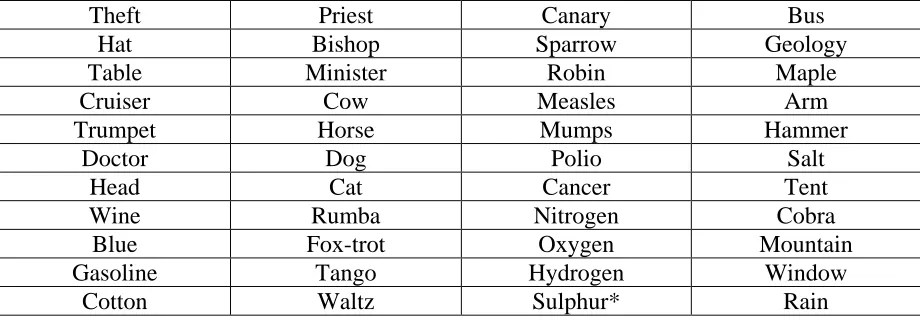
contained words that were completely unrelated to one another. The following is an excerpt of
the list of words that were utilized by Underwood in his experiment:
Word List 1 Word List 2 Word List 3 Word List 4
Apple Bob France Daisy
Football Bill England Wall
Emerald Joe Russia Bee
Trout John Germany Second
Theft Priest Canary Bus
Hat Bishop Sparrow Geology
Table Minister Robin Maple
Cruiser Cow Measles Arm
Trumpet Horse Mumps Hammer
Doctor Dog Polio Salt
Head Cat Cancer Tent
Wine Rumba Nitrogen Cobra
Blue Fox-trot Oxygen Mountain Gasoline Tango Hydrogen Window
Cotton Waltz Sulphur* Rain
*
This is the British spelling of Sulfur.
Table 1: Lists of words used by Underwood in his free recall experiment in 1964
Underwood found that thirty-eight percent of his test subjects were able to perfectly recall Word
Lists 2 and 3, whereas only three percent of his test subjects were able to perfectly recall Word
Lists 1 and 4. None of the test subjects were informed that Word Lists 2 and 3 had four
categories of four words each, but all subjects were able to deduce the same and none of them
provided more than four words per category during the recall test.
Based on the results of the experiment, Underwood concluded that the test subjects utilized
category clustering and used a category as the smallest unit or “chunk” in their memory to learn
the word lists. Since Underwood did not explicitly tell the test subjects that there were four items
for each concept and a total of sixteen items in the experiment, he postulated that the test subjects
utilized an editing process, which he called a “selector mechanism,” to separate words from the
list into multiple categories.
Underwood’s proposal that a central editing process was responsible for the sorting and
clustering of words from the wordlist was highly controversial and was immediately challenged
by multiple scientists who argued that what was being called an “editing process” under the
[image:27.612.67.527.72.232.2]example helps explain this. If we present the word “table” to a test subject and asking him to
verbalize the first word that comes to mind, the test subject may reply with top” or
“table-cloth” or “dining table.” This response is commonly known as the primary response of a stimulus
and is the product of the test subject’s lifetime of learning which led to the creation of the given
stimulus-response associations in LTM. According to Underwood’s opponents, the instantaneous
word association formed by the test subjects in his experiment had little to do with the use of a
selector mechanism or a complicated editing process, rather, they categorized their wordlists
based upon simple word association.
Hellyer
Overt practice is another factor that plays an important role in helping us remember new
information. While the use of NLMs is one way that we can remember a shopping list, the
continuous verbal or visual repetition of the shopping list will also accomplish the same goal. In
1962, Hellyer performed a comprehensive study of the effect of the number of overt repetitions
on the memory of test subjects. In the study, Heller presented the subjects with a three-unit
consonant syllable, and asked them to repeat the syllable one, two, four, or eight times, so as to
ensure sufficient overt practice. During the retention period of three, nine, eighteen, or twenty
nine seconds, the subjects indulged in digit naming to ensure that they weren’t able to spend
additional time reciting or memorizing the new information. Hellyer found that an increase in the
number of repetitions was directly proportional to the decrease in forgetfulness.
Prior to Hellyer’s experiment, the scientific community was not in agreement on whether the
amount that a subject practices a stimulus influences the associative strength of the item and
increases its resistance to forgetting. The commonly held belief was that rehearsal only stalls the
information, since once the last repetition is complete, the decay process will continue on as
before. However, by means of his experiments, Hellyer was able to conclusively prove that
practice definitely slows down the rate of forgetting and his experiments paved the way for
further research into the affect of repetition on STM and LTM.
Relationship between short-term and long-term memory
While it is fairly easy to classify STM and LTM as two different memory structures that operate
on different principals, it is critical to realize that these distinctions of the workings of memory
are done solely to simplify the study and understanding of memory. In actuality, LTM and STM
are irrevocably interlinked and neither can exist independently without the other. The recognition
of a picture, a word, or even a fragment of a song, all require extensive interaction between STM
and LTM. The recognition of the fact that the word lists presented in the Underwood study
contained words that belonged to specific categories requires the interaction of STM with LTM
to ascertain whether the words relate to any overall concepts or categories which can actually be
used to memorize the word list.
The preceding sections outline the research performed by various scientists that have provided a
comprehensive understanding of the basics of human memory and played a critical role in
designing the memory component of the TED model in this capstone. The following section
outlines another paper that played a critical role in understanding the implementation potential
and methodologies that can be utilized to implement the concepts learned from human memory
K. Joy and S. Dattatri
The Association for Computing Machinery paper, “Implementing a fuzzy relational database
using community defined membership values” by K. Joy and S. Dattatri, explores the limitations
of using the relational database model. According to the authors, the data stored in a relational
database is extremely precise, or “grounded in black-and-white,” whereas data in the real world
is never really precise. In this paper, Joy et al. designed and executed a research project that
implemented a fuzzy relational database which allowed the authors to represent imprecise data,
such as the description of a picture or a person, using imprecise attributes based upon the
feedback of the users. They did this by incorporating a “membership value” that would represent
the truthfulness of the different image descriptions (Joy and Dattatri 268). This innovative use of
fuzzy relations to describe imprecise or incomplete data in a database helped provide the initial
stimulus for using a neural network, or a logic based language, to define the threads that connect
the engrams in the TED Model.
HUMAN MEMORY MODELS
Numerous memory models have been proposed by scientists over the years. The following
memory models were extensively studied for the purposes of this capstone: Atkinson-Shiffrin
memory model (Atkinson and Shiffrin), Baddeley’s model of working memory (Baddeley and
Hitch) and the Memory-prediction model (Hawkins and Blakeslee).
Atkinson-Shiffrin memory model
In 1968, Richard C. Atkinson and Richard M. Shiffrin proposed a model for human memory in a
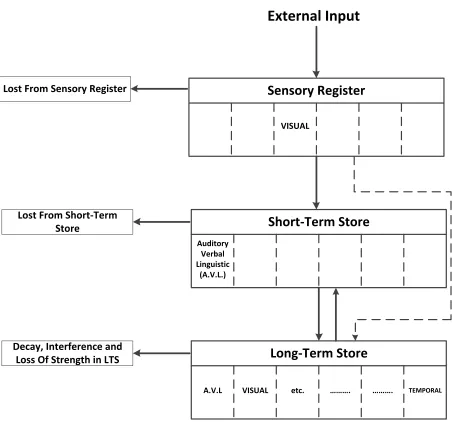
paper titled, “Human Memory: A proposed system and its control processes.” A graphic
workings, reproduced from the “Human Memory” article, by Atkinson and Shiffrin (93), can be
seen below in Figure 1.
Sensory Register
Lost From Sensory Register
External Input
VISUAL
Auditory Verbal Linguistic
(A.V.L.)
Short-Term Store
Lost From Short-Term Store
A.V.L
Long-Term Store
Decay, Interference and Loss Of Strength in LTS
[image:31.612.74.527.133.555.2]VISUAL etc. ………. ………. TEMPORAL
Figure 1: The Atkinson and Shiffrin Memory Model
Atkinson and Shiffrin postulated that memory can be divided into three different components:
I. Sensory Register- We are exposed to thousands of new stimuli on a daily basis. At any
assimilating a plethora of information around us, but we generally pay attention to only a
small section or segment of these inputs and ignore the rest. Our senses generally store this
assimilated information for a very short period of time in the sensory register, before any
cognitive processing is undertaken by our brain, thus allowing us to be aware of our
surroundings while focusing on a given task (Atkinson and Shiffrin 94). Each of our senses
has its own sensory register, which are described briefly below:
A. Echoic Memory or Store- Auditory sensory memory is generally referred to as echoic
memory, and is believed to last for three or four seconds. A key example that illustrates
the working of echoic memory occurs when we are in a crowded room and overhear
someone talking about us. We can generally recall the whole sentence in which our
name was used, despite the fact that we were not actually paying attention to that
conversation a second or so ago (“Sensory Memory”).
B. Iconic Memory or Store- Visual sensory memory is generally referred to as iconic
memory, and is believed to last for approximately 250ms. We can easily experience
the effects of iconic memory if we stare at any given picture or even our immediate
surroundings for a few seconds, and then close our eyes. We’ll find that, even after
closing our eyes, we can still see the picture for a fleeting second before it fades away
into oblivion (“Psychology Glossary”).
C. Haptic Memory or Store- The sensory memory of touch is generally referred to as
the haptic store. The capacity of the haptic store can vary depending upon the stimuli
and can vary from between two to ten seconds. A classic example that illustrates the
working of the haptic store occurs whenever we sit on a couch for a while and then
few seconds before gradually fading away. This post-activity tactile sensation is
caused by the haptic store.
II. Short-Term Memory – The small section of sensory input that we pay attention to, or
focus on, arrives into the Short-Term Memory (STM). As discussed in the previous
sections, the STM’s capacity to store information is fairly limited. In 1956, George A.
Miller, a cognitive psychologist at the Princeton University, published a paper titled, “The
Magical Number Seven, Plus or Minus Two: Some Limits on Our Capacity for Processing
Information,” in which he postulated that our STM is capable of storing seven, plus or
minus two, chunks of information in it. In his paper, Miller acknowledged that there isn’t a
specific definition of “chunk.” A chunk could be a single alphabet, a word, a phrase or even
a sentence. The following is an excerpt from the paper, wherein he explains the ever
changing nature of a chunk in STM:
“A man just beginning to learn radio-telegraphic code hears each dit and dah as a separate
chunk. Soon he is able to organize these sounds into letters and then he can deal with the
letters as chunks. Then the letters organize themselves as words, which are still larger
chunks, and he begins to hear whole phrases…I am simply pointing to the obvious fact that
the dits and dahs are organized by learning into patterns and that as these larger chunks
emerge the amount of message that the operator can remember increases correspondingly. In
the terms I am proposing to use, the operator learns to increase the bits per chunk” (Miller
91).
This chunking of information for ease of learning was also seen in the experiments
performed by Underwood in 1964, wherein he observed that the test subjects rearranged
the contents of the word lists provided to them into clusters of words based upon
conceptual categories, or associations. Although mentioned previously, it is important to
duration of time that it can store new information. As shown by Peterson and Peterson in
1959, we can only retain information in our STM for eighteen to twenty seconds, after
which we experience rapid forgetting, unless we verbally or visually rehearse the
information. This rehearsal generally takes place in the rehearsal buffer of our STM. An
image, reproduced from the “Human Memory” paper (Atkinson and Shiffrin 113),
outlining the role of the rehearsal buffer, as well as its position in the memory system can
[image:34.612.91.451.265.685.2]be seen below in Figure 2.
As seen in the Figure 2 above, input from the sensory register, as well as LTM, enters the
STM where it is stored in the rehearsal buffer. The rehearsal buffer contains a set number
of slots, wherein the incoming information can be stored. The number of slots available,
as well as the size of the slots, depends primarily upon the type of information being
stored. Based upon the experimental results of Wickelgren, Atkinson and Shiffrin believe
that the lower limit on the capacity of the rehearsal buffer is usually in the range of five to
eight slots. This is in keeping with Milner’s experimental results, wherein he found that
STM’s capacity was generally limited to seven, plus or minus two, chunks of
information. Once this capacity is reached, and the buffer is full, the rehearsal buffer
utilizes the First-In-First-Out (FIFO) methodology to add new information. As such, the
oldest chunk of information is discarded, before a new chunk of information is
incorporated into the rehearsal buffer. The use of this process ensures that every new
chunk of information spends as much time as possible in the rehearsal store, thus
resulting in a long-term trace being built for that chunk of information in the LTM. A key
example that can be used to illustrate this fact is that whenever we try to memorize a new
phone number, we repeat the number several times. This repetition of the telephone
number helps it remain in the rehearsal buffer of the STM for a longer period of time, and
ensures that its trace is not only built, but also strengthened in LTM (Atkinson and
Shiffrin 114).
The visual or verbal rehearsal of information is not the only means by which information
can be transferred from STM to LTM. Atkinson and Shiffrin put forth the proposal that
information transfer from the STM to LTM is an “unvarying feature of the system.” They
subjects were required to repeat sequences of digits. They found that if a given sequence
was presented to the test subjects every few trials, it was gradually learned (stored in
LTM), despite the fact that the test subjects could easily perform the given task by
rehearsing the sequences in their STM. As such, any and all information that is attended
to when stored in the STM is also transferred to LTM (Atkinson and Shiffrin).
While the previously described sections on STM explain what happens whenever we are
exposed to new stimuli or information through any of our senses, exposure to familiar
stimuli leads to a very different response. For example, when we are exposed to the
picture of a cat, a definite sequence of events is set into motion. Firstly, the image of the
cat is registered in the iconic store (the sensory register of our eyes), following which, the
sensory register tries matching the image of the cat with the contents of the short-term
memory. If the exact or even a similar pattern is found in our short-term memory, we
recognize that this is the image of a cat. However, if the sensory register doesn’t find any
pattern match in the STM, it conducts a similar search in the LTM. If a match for the
“cat” pattern is found in the LTM, the pattern will be immediately copied over to the
STM and we will simultaneously recognize that we are seeing the image of a cat. It is
important to note that in the case that the pattern of the cat is found in LTM, the original
pattern of the cat is not moved or removed from the LTM to STM; rather, the pattern is
copied over from our LTM to our STM. Alternatively, if a pattern match is not found in
the LTM, then the unknown pattern is copied over from our sensory register to the STM
where it continues to reside temporarily until we learn what the unknown pattern is, or
III. Long-Term Memory- Information that we rehearse, concentrate on, or are repeatedly
exposed to is transferred from the STM into the Long Term Memory (LTM). Contrary to
the sensory register and the STM, wherein the capacity and length of information storage is
restricted, the LTM has a virtually limitless capacity (Adams). Whenever new information
is introduced in the STM, we generally relate this new information to some preexisting
concepts, words, phrases or items that already exist in our memory. This can be explained
further by expanding upon the example of the exposure to a picture of a cat from the
previous section. Assuming that a person has never heard of or seen a cat, but has actually
seen a dog, he may react to form a tentative association between a cat and dog using the
following logic:
“I see a furry animal that is a pet, just like a dog. Both dogs and cats are furry, have four legs
and a tail. Dogs bark, but cats meow. Cats eat mice, but dogs don’t. Dogs are generally larger
than cats.”
Although the above described description is highly subjective, and could vary
from person to person, it would definitely help categorize the cat using a variety
of key concepts. Thus, the next time the same person sees a cat, his sensory
register would initiate a search in LTM and find that the furry animal in front of
him meets the characteristics of a cat, and as such all the cat-related information
would be transferred from his LTM to STM. This use of Natural Language
Mediation (NLM) for learning of new information is well documented and has
been verified empirically in experiments performed by Underwood and Schulz,
The Atkinson and Shiffrin memory model was one of the first viable memory models that
attempted to explain the workings of human memory and was responsible for directing or
redirecting the attention of the scientific community towards the exploration of a holistic
memory model that would account for most, if not all, of the experimental results and
observations accumulated over a period of decades by numerous scientists and
philosophers. Although the memory model proposed by Atkinson and Shiffrin was
certainly a viable model, the critics were quick to point out that it was primarily a
theoretical model and did not address the issue of which parts of the brain were
responsible for the existence and functioning of each of the proposed memory
components. Additionally, critics such as Alan D. Baddeley and Graham Hitch argued
that the short-term memory component proposed by Atkinson and Shiffrin was primarily
a storage area that did not perform any processing of the information that it holds,
whereas a multitude of experiments have shown that we continuously process and
manipulate information in both our STM and LTM. However, despite these and other
limitations, the Atkinson and Shiffrin model deserves special recognition primarily
because it attempted to explain the complete workings of the human memory at a time
when most of the scientists were focused on the study of the individual components of
human memory.
Baddeley and Hitch- Working memory
In 1974, Alan D. Baddeley and Graham Hitch, both professors of psychology at the University of
Stirling,Scotland, proposed that the Short Term Memory (STM) component of the
The following observations and experiments led the authors to propose a modification of the
existing memory model:
I. Atkinson and Shiffrin’s memory model stipulated that learning generally occurs whenever
an item is held in STM, and that the longer an item stays in STM the greater the chance that
it will be transferred from STM to LTM. However, the experimental results provided
evidence that was contrary to Atkinson and Shiffrin’s model. Scientists found that the key
feature that decided whether an item transitioned from STM to LTM was the depth to
which the item was processed. Therefore, if a person merely glanced at a sentence and
noticed that the first alphabet of a word was in upper case, he wouldn’t spend a lot of time
processing this information, and as such it was unlikely that the item would be transferred
to LTM. But if the person reads the word, notices that the first alphabet is capitalized and
that it rhymes with some other word in his vocabulary, then it becomes increasingly likely
that this word association will be transferred to his LTM, and that he would be able to
recall or recognize it in the future (Baddeley).
II. According to Atkinson and Shiffrin’s memory model, STM is crucial for long term
learning of new concepts, ideas and experiences. Baddeley and Hitch found that patients
that suffered from STM issues were still able to form LTMs despite the fact that they
weren’t able to calculate the change while shopping, and faced other cognitive problems on
a daily basis. Baddeley and Hitch conducted further research in this realm to accurately
ascertain the relationship between STM and LTM. For their experiments, they had their test
subjects learn new material, and conducted reasoning or comprehension tests while
simultaneously reciting gradually increasing digit sequences to block or occupy their STM.
some decrement in learning, especially as the length of the digit sequences increased, it was
not as significant as it should have been if LTM was as dependent upon STM as the
Atkinson-Shiffrin model suggested (Baddeley; Baddeley and Hitch).
The working memory model, as proposed by Baddeley and Hitch, uses STM as an active
information processor wherein information is not only stored, but is also manipulated to make
the most use of it. This stands in stark contrast to the Atkinson-Shiffrin memory model, in which
the STM is merely a passive store where information is stored, but is never manipulated or
worked with (Neezes). An example that can illustrate this difference would be that of a person
shopping for furniture in a store. In the Atkinson-Shiffrin model, if the person sees a couch, he
will simply be temporarily storing the couch as a “chunk” in his STM; whereas in the working
memory model, the person would use his visuospatial memory to move the furniture around in
his apartment and figure out the best location to place the couch.
The structure of working memory is markedly different than that of the Atkinson-Shiffrin
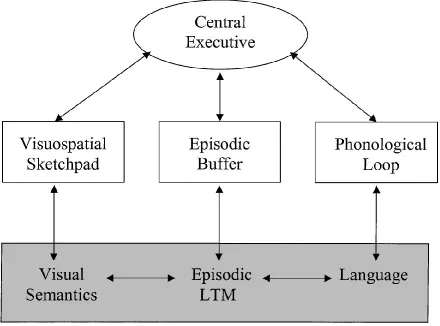
model’s STM. Baddeley and Hitch’s working memory model contains a central controlling
mechanism, called the “Central Executive,” which manages the attention of a person. The central
executive has three subsidiary systems namely the phonological loop, the visuospatial sketchpad,
and the episodic buffer. An image of the working memory model, reproduced from Alan
Baddeley’s paper titled “The episodic buffer: a new component of working memory?” can be
Figure 3: Working Memory Model (Baddeley)
Initially, in their paper titled “Working Memory,” Baddeley and Hitch had only included three
components in their working model, namely the “central executive,” the “phonological loop,”
and the “visuospatial sketchpad.” However, subsequent research and experiments by the authors
revealed an important weakness in the model: it didn’t provide for a means to integrate the
information gathered through the phonological loop and the visuospatial sketchpad. As such, a
new component termed the “episodic buffer” was added to the working memory model
(Baddeley). The following is a detailed description of each of the components of the working
I. The Central Executive- This component forms the most important part of the working
memory model as it is responsible for controlling the attention of a person, as well as, the
flow of information to and from the phonological loop and visuospatial sketchpad. It is
speculated that the central executive is also responsible for all reasoning and decision
making activities that are undertaken by us (Narayanan).
According to Baddeley, the proposed workings of the central executive are identical to that
of the Supervisory Attentional System (SAS) that was proposed by Norman and Shallice
(6). Also per Norman and Shallice, most of our daily activities, such as driving a car, riding
a bike, walking, etc., are governed by habitual processes which are guided by
environmental clues. However, the occurrence of any unexpected or novel situations,
which we haven’t experienced before and are not a part of our habitual processes, requires
the use of SAS (Norman and Shallice 6). An example of the SAS in action during a novel
occurrence would be the actions we take when our car skids in the snow. When we drive
our car on a daily basis, we depend on our habitual processes which allow us to drive home
without paying too much attention to the minute details of our surroundings. But if we are
driving home and our car skids, our attention to our surroundings is heightened and we
begin maneuvering our car with as much precision as possible to recover from the skid.
These emergency actions are generally not a part and parcel of our habitual process and are
governed by SAS.
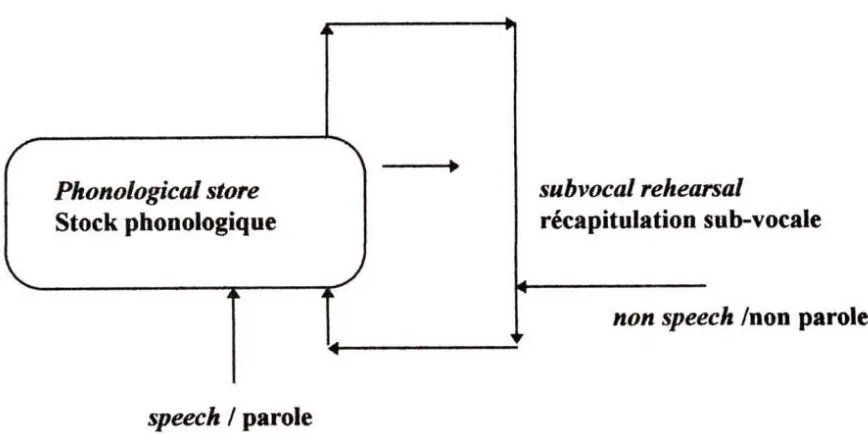
II. Phonological Loop- The phonological loop uses a rehearsal mechanism to maintain
acoustic or spoken information, so as to prevent the trace from decaying (Pezzulo). A
titled, “The structure and functioning of phonological short-term memory,” can be seen
[image:43.612.86.520.130.347.2]below in Figure 4.
Figure 4: Structure and functioning of the phonological loop
As seen in Figure 4 above, the phonological loop is comprised of the following two parts.
A. The Phonological Store- The phonological store receives input from two main
sources. Firstly, thorough auditory input, i.e. by means of our ears. Any and all
spoken language that we hear is directly stored in the phonological store. Secondly,
by means of our long term memory. Anytime we feel that a piece of music is stuck in
our head, we are generally listening to it by means of the phonological store
(Baddeley and Hitch). Any information that enters the phonological store generally
decays after a period of about two seconds, unless it is rehearsed by means of the
Articulatory Control System (Walsh).
B. Subvocal rehearsal or Articulatory Control System- The articulatory control
in the phonological store. This is done by means of subvocal rehearsal, or silently
repeating the information in our minds, without actually verbally reciting the
information. An example for the same would be that of a person repeating a list of
grocery items to himself, to ensure he doesn’t forget it. Secondly, it enables us to
convert visual information into phonetic information that can be transferred into the
phonological store. A good example of the conversion of visual information to
phonetic information would be a test subject reading the letter “A.” Although the
alphabet is essentially just a simple shape, the test subject would convert this shape to
the phonetic pronunciation of the letter ’A,’ which will then be store in his phonetic
store (Walsh; Gupta and MacWhinney 510).
III. Visuospatial Sketchpad- The visuospatial sketchpad is used for the storage, as well as the
manipulation, of visual and spatial information. It receives input from both the eyes and
long-term memory. According to Logie, the visuospatial sketchpad can be divided into the
following two subcomponents.
A. Visual cache- The visual cache is used for the storage of information such as visual
form and color of images that a person is exposed to (Eysenck and Keane 199).
B. Inner Scribe- The inner scribe is the visuospatial component that deals with spatial
information that a person is exposed to. Its function is similar to that of the Articulatory
Control System, in that it rehearses the information in the visual cache, and is
responsible for the transfer of information from the cache to the central executive
(Eysenck and Keane 199). Additionally, it has been theorized that the inner scribe is
responsible for the planning and execution of our body and limb movements too
IV. Episodic Buffer- The episodic buffer was the fourth component that was added to the
working memory model (Baddeley). It is called the episodic buffer because it is primarily
responsible for the integration of information over space and time. It is a temporary storage
system that can be accessed and controlled by the central executive through the medium of
conscious awareness. The central executive uses the episodic buffer to integrate
information from the phonological loop and the visuospatial sketchpad with LTMs. As
such, it is theorized to play a very important role in the feeding and retrieving of
information from LTM. Additionally, the episodic buffer is also speculated to be
responsible for the chunking of information in STM (Miller).
Baddeley proposed that the episodic buffer uses a common multi-dimensional code, to
enable it to interface with the visuospatial sketchpad and the phonological loop, both of
which utilize different sets of codes to process the incoming information (Baddeley).
Although the exact size of the buffer hasn’t been established, it has been theorized that the
buffer size should be fairly limited, so as to reduce the amount of resources that would be
utilized to process the different sets of codes retrieved from the different components of the
working memory model.
Although the Working Memory model represents a marked improvement over the Atkinson and
Shiffrin model in representing human memory components and their associated processes, it (the
Working Memory Model) shares some of the same limitations as that of the Atkinson and
Shiffrin Memory model. Firstly, the Working Memory model postulates that the STM can be
divided into various specialized components, however, no physical evidence is provided to
validate these claims. Neither the original “Working Memory” article by Baddeley and Hitch,
attempted to explain which sections of the brain are used for the specialized processing activities
that are proposed by this model. Secondly, the Working Memory model only focuses on the
functionality of the STM, while steadfastly ignoring the LTM. No attempt is made to explain the
functioning of LTM nor is there any explanation as to how information is transferred from the
various components of Working Memory into LTM and vice-versa. Thirdly, when proposing the
Working Memory model in 1974, Baddeley believed that there were further subsystems that
have yet to be identified and he believed that these subsystems would be discovered as further
research was conducted, however these subsystems have yet to be identified despite the model
being in existence for over 40 years. As such, although the Working Memory model serves as a
marked improvement over the Atkinson and Shiffrin model and is generally accepted as a better
model, it has some serious limitations which will have to be addressed before it can achieve
broader recognition amongst the scientific community.
Memory-prediction model
Jeff Hawkins’s book, “On Intelligence: How a New Understanding of the Brain will Lead to the
Creation of Truly Intelligent Machines,” explains why we need to understand the workings of the
human brain, to build truly intelligent machines. Hawkins delves deeply into the physiology of
the human brain and explains, by means of his “Memory-Prediction Framework,” how our brain
combines our thoughts with sensory perceptions to form predictions about future events.
According to Hawkins, there are three essential criteria that have to be met to ensure a proper
understanding of the brain.
I. Inclusion of time in brain function- Our brains are constantly processing rapidly
we experience an event or process any information, we generally remember at least part of
the information and can always refer back to it in the future. This time based storage of
information helps us associate new information with preexisting knowledge and learn new
concepts. As such, it is imperative that a time component be included when trying to
understand the workings of the brain (Hawkins 25).
II. Feedback- Researchers have found that for every connection feeding information forward
from our senses into the neocortex, there are roughly ten connections feeding backwards
into our senses. While we generally expect that we are mostly feeding information from our
senses into the brain, this really isn’t the case. We receive ten times the amount of feedback
from our brain to our senses. Hawkins postulated that this feedback mechanism must be
extremely important to the brain and should definitely be explored (25).
III. Physical Structure of the Brain- Most memory models, and research into the workings of
the human brain, ignore the actual structure of the brain and try to compare its workings to
a preexisting object or tool (for e.g. a computer). According to Hawkins, a proper
understanding of the workings of memory and the brain is only possible by taking into
account the physical architecture of the brain (25).
Our neocortex is divided into multiple functional regions. Each functional area serves as a
semi-independent unit that specializes in certain aspects of perception or thought. These functional
areas are arranged in a functional hierarchy. It is important to note that a functional hierarchy
does not imply that one functional area is physically above or below another, rather it merely
refers to the connections that exist between one functional area and another. Thus, although two
functional areas might be on the same level physically, the hierarchically lower functional area
Whenever we are exposed to any external stimuli, the sensory information enters the primary
sensory area of the cortex. The primary sensory area forms the lowest functional area of the
neocortical hierarchy, and it is here that raw sensory information is initially processed, before
being passed up the hierarchy. Hawkins provided an example of our sense of vision to illustrate
this fact. Every time we see anything, our eyes pass-on the visual information to our cortex
through the primary visual area, V1. The V1 area is responsible for the processing of the visual
information’s low level features, such as the presence of edges, binocular disparity (the
difference in the image seen by the left and right eye which helps in ascertaining information
about depth), basic color and contrast information. Once this basic processing of visual
information is completed, V1 feeds the information into the next hierarchical area, such as V2,
V3, V4, V5, etc. where additional processing of the visual information takes place. As we go
higher up the visual cortex, we reach the functional areas that have visual memories of familiar
objects such as faces, animals, furniture, etc (Hawkins 45).
Each of our senses has its own cortical hierarchy, wherein the sense specific information is
processed. All of our senses then pass on the processed information to the “association areas,”
which are higher up in the cortical hierarchy. The association areas are primarily responsible for
combining the input from the different senses and forming a single experience. For example,
when we watch TV we are receiving multiple inputs through our senses. We see visual images
on the TV screen, hear the audio associated with the visual images, and assuming that we are
sitting on a couch, our somatosensory system senses the touch, temperature and pressure of our
body on the couch. All three of these senses pass on this information to the association area, via
such, we experience that the audio and video images are in-sync and that we are sitting
comfortably on the couch (Hawkins 46).
According to Hawkins, the associative area is easily able to integrate the wide variety of inputs
provided to it from all of our senses primarily because the neocortex uses a single underlying
algorithm for all its functions. This theory of a single underlying algorithm is based upon Vernon
Mountcastle’s observation that despite the wide variety of functional areas and operations
performed by the neocortex, the overall structure of the cortex is remarkably similar. The
auditory region of the cortex is similar to the motor region of the cortex, which is again similar to
visual region of the cortex. Thus, the specialization of the cortex is dependent upon which of the
five senses it is actually connected to. This is the reason why the human neocortex is considered
to be very flexible. A prime example of its flexibility occurs in individuals who are born deaf.
Scientists have found that people who are born deaf