OFFPRINT
Echo enabled harmonic generation free
electron laser in a mode-locked configuration
J. R. Henderson
and
B. W. J. McNeil
EPL,
100
(2012) 64001
Please visit the new website
A L
E T T E R SJ
O U R N A LE
X P L O R I N GT H E
F
R O N T I E R S O FP
H Y S I C SAN INVITATION TO
SUBMIT YOUR WORK
www.epljournal.org
The Editorial Board invites you to submit your letters to EPL
EPL is a leading international journal publishing original, high-quality Letters in all
areas of physics, ranging from condensed matter topics and interdisciplinary research
to astrophysics, geophysics, plasma and fusion sciences, including those with
application potential.
The high profile of the journal combined with the excellent scientific quality of the
articles continue to ensure EPL is an essential resource for its worldwide audience.
EPL offers authors global visibility and a great opportunity to share their work with
others across the whole of the physics community.
Run by active scientists, for scientists
EPL is reviewed by scientists for scientists, to serve and support the international
scientific community. The Editorial Board is a team of active research scientists with
an expert understanding of the needs of both authors and researchers.
IM
PA
CT
F
AC
TO
R
2
.7
53
*
*As ranked
by ISI 2010
www.epljournal.org A LE T T E R S JO U R N A L EX P L O R I N G
T H E FR O N T I E R SO F PH Y S I C S
Quality – The 40+ Co-Editors, who are experts in their fields, oversee the entire peer-review process, from selection of the referees to making all final acceptance decisions
Impact Factor – The 2010 Impact Factor is 2.753; your work will be in the right place to be cited by your peers
Speed of processing – We aim to provide you with a quick and efficient service; the median time from acceptance to online publication is 30 days
High visibility – All articles are free to read for 30 days from online publication date
International reach – Over 2,000 institutions have access to EPL, enabling your work to be read by your peers in 100 countries
Open Access – Articles are offered open access for a one-off author payment
Details on preparing, submitting and tracking the progress of your manuscript from submission to acceptance are available on the EPL submission website
www.epletters.net.
If you would like further information about our author service or EPL in general, please visit www.epljournal.org or e-mail us at [email protected].
Six good reasons to publish with EPL
We want to work with you to help gain recognition for your high-quality work through worldwide visibility and high citations.
2.753
*
* As listed in the ISI® 2010 Science Citation Index Journal Citation Reports
IMPACT FACTOR
500 000
full text downloads in 2010
OVER
30 DAYS
16 961
average receipt to onlinepublication in 2010
citations in 2010 37% increase from 2007
1
2
3
4
5
6
www.epljournal.org
EPL is published in partnership with:
IOP Publishing EDP Sciences
European Physical Society Società Italiana di Fisica “We’ve had a very positive
experience with EPL, and not only on this occasion. The fact that one can identify an appropriate editor, and the editor is an active scientist in the field, makes a huge difference.”
Dr. Ivar Martinv
EPL Compilation Index
Visit the EPL website to read the latest articles published in
cutting-edge fields of research from across the whole of physics.
Each compilation is led by its own Co-Editor, who is a leading
scientist in that field, and who is responsible for overseeing
the review process, selecting referees and making publication
decisions for every manuscript.
•
Graphene
•
Liquid Crystals
•
High Transition Temperature Superconductors
•
Quantum Information Processing & Communication
•
Biological & Soft Matter Physics
•
Atomic, Molecular & Optical Physics
•
Bose–Einstein Condensates & Ultracold Gases
•
Metamaterials, Nanostructures & Magnetic Materials
•
Mathematical Methods
•
Physics of Gases, Plasmas & Electric Fields
•
High Energy Nuclear Physics
If you are working on research in any of these areas, the Co-Editors would be
delighted to receive your submission. Articles should be submitted via the
automated manuscript system at
www.epletters.net
If you would like further information about our author service or EPL
in general, please visit
www.epljournal.org
or e-mail us at
[email protected]
Biaxial strain on lens-shaped quantum rings of different inner radii, adapted from Zhang et al 2008 EPL 83 67004.
Artistic impression of electrostatic particle–particle interactions in dielectrophoresis, adapted from N Aubry and P Singh 2006 EPL74 623.
Artistic impression of velocity and normal stress profiles around a sphere that moves through a polymer solution, adapted from R Tuinier, J K G Dhont and T-H Fan 2006 EPL
75 929.
www.epl journal.org
A L
E T T E R S
J
O U R N A L
E
X P L O R I N G
T H E
F
R O N T I E R S
O F
P
H Y S I C S
Image: Ornamental multiplication of space-time figures of temperature transformation rules
December 2012
EPL,100(2012) 64001 www.epljournal.org
doi:10.1209/0295-5075/100/64001
Echo enabled harmonic generation free electron laser
in a mode-locked configuration
J. R. Henderson1,2 and B. W. J. McNeil1
1SUPA, Department of Physics, University of Strathclyde - Glasgow, G4 0NG, UK, EU
2ASTeC, STFC Daresbury Laboratory and Cockcroft Institute - Warrington, WA4 4AD, UK, EU
received 8 October 2012; accepted in final form 27 November 2012 published online 3 January 2013
PACS 41.60.Cr– Free-electron lasers
PACS 42.55.Vc– X- andγ-ray lasers
PACS 42.65.Re– Ultrafast processes; optical pulse generation and pulse compression
Abstract – Echo Enabled Harmonic Generation (EEHG) is a method of harmonic up-shifting proposed to extend the temporal coherence properties of Free Electron Lasers (FEL) at shorter wavelengths where coherent laser seed fields are not available. Previous theoretical studies of EEHG have applied periodic boundary conditions to the electron distribution in phase space. It is shown that when these periodic boundary conditions are removed a temporal comb of enhanced electron microbunching is revealed. By matching this comb structure in the electron microbunching to the radiation modes that are generated in a Mode-Locked Optical Klystron (MLOK) FEL configuration, a train of short radiation pulses can be generated.
Copyright cEPLA, 2012
Introduction. – X-ray Free Electrons Lasers [1]
(FEL) are now generating high-brightness, X-ray pulses that are opening up many new areas of science in fields as diverse as the creation of warm dense matter [2], high energy pumping of atoms to population inversion to create an atomic X-ray laser [3] and the making of “molecular movies” of biological processes [4]. The latter processes require femtosecond timescale pulses to investigate transient molecular structure in, e.g. protein nanocrystallography [5] and single virus imaging [6], succinctly described as “dynamic biology” [4].
The general capability of capturing and possibly altering faster electronic processes that guide chemical pathways in the attosecond regime, would help further transform this research area to include imaging of catal-ysis, graphene, carbon nanotechnology and nanostructure development [7] and the nascent field of quantum biol-ogy [8]. This imaging of the faster electronic motion at the quantum level is ultimately the key to a more complete understanding of the functioning of complex molecular and biological systems [9]. There is therefore considerable interest in developing high-brightness, X-ray attosecond duration pulses that would allow the study of these ultra-fast atomic and molecular processes. This letter proposes a method of achieving this by combining the two previously unrelated FEL methods of Echo
Enabled Harmonic Generation (EEHG) [10,11] and the Mode-Locked Optical Klystron (MLOK) [12].
The method of EEHG manipulates electron pulse phase space using two temporally coherent, long wavelength seed lasers and two dispersive chicanes. The electrons are first modulated by a seed laser in an undulator and then dispersed in a chicane. This process is then repeated and a fine microbunching of the electron beam is created at a shorter wavelength while retaining a high level of the temporal coherence from the long wavelength lasers. When propagated through a final radiator undulator, the electron beam emits X-rays at the shorter wavelength of the electron microbunching and with an improved temporal coherence over that generated by self-amplified spontaneous emission which starts from intrinsic shot-noise in the electron beam [13]. Previous models of EEHG have used periodic boundary conditions applied to the electron phase space and simulation codes that average the electron and radiation properties over a radiation wavelength.
In this letter, these limiting assumptions are removed by using the unaveraged FEL simulation code of [14] with the macroparticle loading algorithm of [15]. Using this model, simulations of EEHG up to before the final undulator reveal a frequency comb of modes in the electron microbunching parameter, with adjacent modes
J. R. Henderson and B. W. J. McNeil
being separated by the second seed laser frequency. This frequency comb may then be matched to and seed a MLOK undulator-chicane lattice as the final radiator stage of the process to generate a seeded Attosecond Pulse Train (APT).
EEHG pre-radiator stage. – To demonstrate the
process, EEHG was simulated with the following parame-ters for a cold beam with no intrinsic shot-noise. A uniform “flat top” current profile electron pulse was used with elec-tron energy Er= 1.2 GeV, charge Q= 100 pC and initial
pulse length of 12µm (which is equivalent to a current of 2.5 kA). The first and second seed laser wavelengths areλ1,2= 240 nm with the final radiating resonant
wave-lengthλr= 10 nm. The electron energy modulation in the
first and second modulating stages are ΔE1 = 750 keV
(ΔE1/ρEr = 0.625) and ΔE2 = 150 keV (ΔE2/ρEr =
0.125) respectively, where the bracketed terms are scaled with respect to the FELρ-parameter [1] of the final radi-ator stage. The dispersive strength of the correspond-ing chicanes are R(1)56 = 8.25 mm and R
(2)
56 = 0.34 mm.
The electrons are modelled by macroparticles [15] each assigned a weightNjcorresponding to the number of
elec-trons the macroparticle represents. A FEL parameter of
ρ= 10−3was used as a typical value for the simulations at
this resonant wavelength.
Each of the two modulation-dispersion processes of EEHG prior to the radiator stage were simulated by applying an energy modulation to the electron distribution and then dispersing the distribution using the following transformations applied to the initial distribution:
γj(n+1)=γ
(n)
j + Δγn+1sin(z(
n)
j kn+1), (1)
zj(n+1)=z
(n)
j +R
(n+1) 56
γ(jn+1)−γr
γr
, (2)
where n= 0,1, and bracketed superscripts (0,1,2) refer-ring to the initial conditions, and to the exit from the first and second modulation/dispersive stages, respectively;γ
is the electron energy in units of the electron rest-mass energy and Δγ is the energy modulation.
Applying the four transforms of eqs. (1) and (2) develops a microstructure in the electron pulse that contains signif-icant microbunching at higher harmonics of the seed radi-ation fields used to modulate the electron beam energy.
In demonstrating the principle of EEHG, the work of [10,11] applied periodic boundary conditions in the posi-tion of the electrons across a region of the longitudinal
z-axis. Here, no such boundary conditions are applied and the electron positions are transformed according to (2). The removal of the boundary condition has little effect around the centre of the electron pulse where the disper-sive effects are symmetric. The effects of the two modu-lation and dispersive sections are seen in fig. 1 and result in a phase space that is very similar to that of reported
−500 0 500
0.9995 1 1.0005 1.001 z (nm) γ / γr
−500 0 500
0.5 1 1.5
2x 10
5
Nj
z (nm)
0 5
x 105 N
[image:6.595.307.546.84.245.2]j
Fig. 1: Electron phase space (top) and histogram of electron numbers (bottom) about the centre of the electron pulse at
z= 0. The particle density is increased for the high and low
energy electrons as is indicated by the top right plot.
5500 5600 5700 5800 5900 6000 0.9998 1 1.0002 1.0004 1.0006 1.0008 z (nm) γ / γr
55000 5600 5700 5800 5900 6000 1
2 3
x 105
Nj
z (nm)
0 2 x 10⁵ N
j
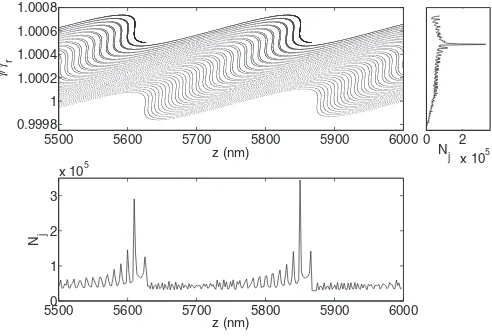
Fig. 2: Electron phase space (top) and histogram of electron numbers (bottom) at the head of the electron pulse. The particle density is increased for the higher energy electrons as is indicated by the top right plot. Single current bands can
be seen in the region around z= 5600–5615 nm with double
current bands aroundz= 5620–5830 nm.
in [10,11]. The higher and lower energy electrons, from the extrema of the energy modulated beam, form tight (single) “current bands”, whereas electrons close to the initially unmodulated beam energy form a looser (double) current band structure. This is not the case towards the head and tail of the electron pulse where dispersion causes predominantly single current bands formed by the higher and lower energy electrons, respectively. This effect is seen for the case of the head of the electron pulse in fig. 2.
The underlying process is detailed in fig. 3 which shows the effects of the EEHG process upon the higher energy electrons of the initially modulated beam. The higher energy electrons are seen to form relatively tight energy bands which are then transformed into single current bands around the maxima following the second energy modulation. This creates a series of higher energy current
[image:6.595.303.549.313.481.2]EEHG mode-locked FEL
−200 −100 0 100 200 0.9995 1 1.0005 1.001 z (nm) γ / γr
8100 8200 8300 8400 8500 1.0002 1.0004 1.0006 1.0008 z (nm) γ / γr
8100 8200 8300 8400 8500 1.0002 1.0004 1.0006 1.0008 z (nm) γ / γr
[image:7.595.48.346.83.264.2]8100 8200 8300 8400 8500 1.0002 1.0004 1.0006 1.0008 z (nm) γ / γr
Fig. 3: Both single and double current-bands can be seen to evolve during the pre-radiator EEHG process (left-to-right, top-to-bottom): 1) first beam energy modulation, 2) first chicane dispersion, 3) second beam energy modulation, 4) second chicane dispersion. Notice the relatively large shift in the electron positions inz due to the first chicane.
bands at the head of the electron pulse separated by the wavelength of the second seed laser. At the tail of the electron pulse, the EEHG process causes similar single current bands to be formed, but around the minima of the second energy modulation. Thus, dispersion causes the high (low) energy electrons to be dispersed to the head (tail) of the pulse and also a phase difference of π(λ2/2)
between the current bands at the head and tail.
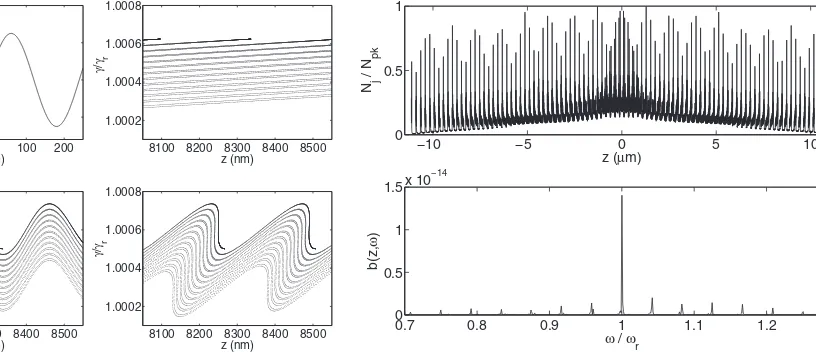
A histogram of the full electron number distribution is shown in fig. 4 together with a (unitary) Fourier transform of the electron bunching parameter about the resonant frequency ωr of the final radiator stage. The Fourier
bunching parameter is simply derived from the driving term of the scaled wave equation of [15] and may be written as
b(z, ω) =√1
2π 1 np Nm j=1
Nje−iz(kr+ku)ei(ωr−ω)tj, (3)
where np is the peak linear electron density, Nm is the
total number of macroparticles used in the simulation,ku
is the undulator wavenumber,tj=−zj/cβ is the arrival
time of the macroparticle at the undulator entrance at
z= 0 andβ=vz/c is the mean scaled speed of the
elec-tron pulse along the undulator z-axis. It is seen that a well-defined modal structure is present in the elec-tron bunching parameter with mode separation given of Δω/ωr= 10/240≈0.042 corresponding to the seed
modu-lation frequency. The modes are relatively well phase-matched as seen from the well-defined peaked periodic microstructure in the electron density histogram.
EEHG radiator. –The pre-bunched electron
distrib-ution above was propagated through two different undula-tor systems, a simple undulaundula-tor and an undulaundula-tor-chicane
−10 −5 0 5 10 0
0.5 1
z (µm)
Nj
/ N
pk
0.7 0.8 0.9 1 1.1 1.2 1.3 0
0.5 1 1.5x 10
−14
ω / ωr
b(z,
ω
)
Fig. 4: Histogram of electron numbers (top) normalised with respect to the peak, and the Fourier transform of the bunching parameterb(z, ω) for the full electron beam distribution show-ing the modal structure at the end of the EEHG pre-bunchshow-ing process.
system of the MLOK type, both tuned to the resonant frequencyωrusing the unaveraged simulation code of [14].
The transformations of (1,2) may be rewritten in the universal scaling of [16] as used in the simulations as
p(jn+1)=p
(n)
j + Δp
(n+1)sin
¯
z1(nj)
2ρhn+1
, (4)
¯
z1(nj+1)= ¯z
(n) 1j + 2ρD
(n+1)p(n+1)
j , (5)
where Δp(1,2)= Δγ(1,2)/ργ
r; D(1,2)=krρR(1 ,2)
56 ; h1,2=
ωr/ω1,2 and β≈1 is assumed. At the beginning
of the undulator: ¯z≡2ρkuz= 0; ¯z1j=−2krρctj and
pj= (γj−γr)/ργr.
Performing the Fourier transform with respect to ¯z1
defines the scaled frequency as ¯ω=−ω/2ρωr so that
b(¯z,ω¯) =b(z, ω)c
lc
expiωz c
, (6)
wherelc=λr/4πρis the cooperation length [16].
Simple undulator. EEHG was first simulated in a
simple undulator configuration of scaled length ¯z= 1.1. The scaled radiation and electron pulse parameters are plotted in fig. 5. It is seen that while the radiation gener-ated had some temporal structure, no modal structure is present in Fourier space with emission confined to the reso-nant frequency. This is consistent with the previous results of [10,11].
MLOK undulator. Here an MLOK undulator-chicane
lattice is constructed so that the radiation modes will match the properties of the electron bunching above. Using the notation of [12], each undulator has four periods so that a radiation wavefront will propagate four resonant
[image:7.595.122.530.86.262.2]J. R. Henderson and B. W. J. McNeil
0 10 20 0 0.5 1 ¯ z1 Nj /N pk
0 10 20 0 0.005 0.01 ¯ z1 |A| 2
0.8 1 1.2 0
2 4 6
ω / ωr
b (¯ z ,¯ ω )
0.8 1 1.2 0
0.01 0.02 0.03 0.04
ω / ωr
[image:8.595.49.281.84.259.2]PSD
Fig. 5: Electron and radiation pulse at saturation in a simple
undulator at ¯z≈1.1 for the normal EEHG case. Plots on the
left are: top, normalised electron number histogram (bin size =
λr/5); bottom, Fourier transform of bunchingb(¯z,ω¯). On the right: top, radiation field amplitude|A|2 as a function of ¯z
1; bottom, scaled Power Spectral Density (PSD) showing that emission at resonance dominates.
0 10 20
0 0.5 1 ¯ z1 Nj /Npk
0 10 20 30
0 0.005 0.01 0.015 ¯ z1 |A| 2
0.8 1 1.2
0 2 4 6
ω / ω
r b (¯ z ,¯ ω )
0.8 1 1.2
0 0.5 1
x 10−3
ω / ω
r
PSD
19.5 20 20.5
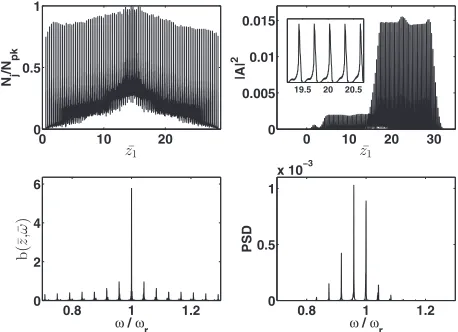
Fig. 6: As fig. 5, but for the MLOK undulator at saturation (¯z≈0.6). The inset (top, right) shows more detail expanded
in ¯z1. A well-defined set of phase-matched radiation modes
has developed resulting in a train of short radiation pulses.
In unscaled units the individual pulse widths are∼106
atto-seconds (FWHM) and separated by∼0.8 femtoseconds
corre-sponding to ¯s= 0.3 in scaled units of ¯z1.
wavelengths through the electron pulse in each undula-tor. Each chicane delays the electron pulse by a further twenty wavelengths so that the total slippage of a resonant wavefront in traversing one undulator-chicane module is
s= (4 + 20)λr= 240 nm, which is equal to the second seed
laser wavelength,λ2. In the scaled units of ¯z1 this
corre-sponds to ¯s=s/lc≈0.3. In this way the relative slippage
between radiation and electrons in each undulator-chicane module matches the strong periodic electron microbunch-ing. It is seen from the inset of fig. 6 that this matching
generates a periodic train of short radiation pulses (corre-sponding to full width half-maximum duration of∼106 as) separated by the second seed laser wavelength. This pulse train is equivalent in frequency space to the observed set of modes equally spaced by the frequency of the second seed laser, Δω/ωr≈0.042. It is easily shown from the
FEL resonance relation [1] that the frequency range of radiation emission due to the electron energy modulations Δγ1,2 is negligible in comparison with the mode spacing
when (Δγ1+ Δγ2)/γr≪Δω/2ωr. Here, this condition is
satisfied as (Δγ1+ Δγ2)/γr≈4×10−2Δω/2ωr. Note that
peak powers generated by the higher energy electrons at the head of the radiation pulse train envelope are greater than those generated at the tail by the lower energy elec-trons. While the higher energy electrons lose energy and fall into resonance to emit strongly, those at lower energies continually fall away from resonance and strong radiation emission. The visibility of radiation pulse train structure is defined asV = (|A|2
max− |A|2min)/(|A|2max+|A|2min), were
the maximum and minimum values are defined between two adjacent peaks. The effect of introducing an energy spread σE in the initial electron pulse energy decreases
the visibility gradually from V = 0.93 at 1 keV (σE/ρEr
= 0.0008) toV = 0.78 at 150 keV (σE/ρEr= 0.125).
Conclusions. – By removing previous simplifying
assumptions in EEHG modelling, a previously unreported temporal structure in the electron pulse microbunching was revealed. This structure can be matched to a mode-lock FEL (MLOK) configuration which can generate trains of ∼106 attosecond (FWHM) duration pulses at 10 nm wavelength. The parameters used here are similar to those used previously to demonstrate EEHG. However, there are no intrinsic reasons why the resonant wavelength and pulse durations cannot be scaled down further into the hard X-ray.
∗ ∗ ∗
The authors would like to thankLawrence Campbell
and David Dunning for helpful discussions. This work received support from STFC Memorandum Of Agreement No. 4163192.
REFERENCES
[1] McNeil Brian W. J. and Thompson Neil R., Nat. Photon.,4(2010) 814.
[2] Vinko S. M. et al.,Nature,482(2012) 59. [3] Rohringer N. et al.,Nature,481(2012) 488.
[4] Spence J. C. H., Weierstall U.andChapman H. N., Rep. Prog. Phys.,75(2012) 102601.
[5] Chapman H. N.et al.,Nature,470(2011) 73. [6] Seibert M. M.et al.,Nature,470(2011) 78.
[7] Flavell W. R.,Proceedings of IPAC2012, New Orleans, U.S.A. (Joint Accelerator Conferences Website (JACoW)) 2012, paper WEI04.
[8] Olaya-Castro A., Nazir A. and Fleming G. R., Philos. Trans. R. Soc. A,370(2012) 3613.
[image:8.595.50.279.366.532.2]EEHG mode-locked FEL
[9] Dixit Gopal, Vendrell Oriol and Santra Robin, Proc. Natl. Acad. Sci. U.S.A.,109(2012) 1636.
[10] Xiang D. and Stupakov G., Phys. Rev. ST Accel. Beams,12(2009) 030702.
[11] Xiang D., Huang Z.andStupakov G.,Phys. Rev. ST Accel. Beams,12(2009) 060703.
[12] Thompson N. R. and McNeil B. W. J., Phys. Rev. Lett.,100(2008) 203901.
[13] Bonifacio R., De Salvo L., Pierini P., Piovella N.
andPellegrini C.,Phys. Rev. Lett.,73(1994) 1. [14] McNeil B. W. J., Robb G. R. M. and Jaroszynski
D. A.,Opt. Commun.,165(1999) 65.
[15] McNeil B. W. J., Poole M. W.andRobb G. R. M., Phys. Rev. ST Accel. Beams,6(2003) 070701.
[16] Bonifacio R., McNeil B. W. J.andPierini P.,Phys. Rev. A,40(1989) 4467.