1
Learning Capability
The Effect of Existing Knowledge on Learning
1Viktor Dörfler
Abstract
It has been observed that different people learn the same things in different ways – increasing their knowledge of the subject/domain uniquely. One plausible reason for this disparity in learning is the difference in the existing personal knowledge held in the particular area in which the knowledge increase happens. To understand this further, in this paper knowledge is modelled as a ‘system of cognitive schemata’, and knowledge increase as a process in this system; the effect of existing personal knowledge on knowledge increase is ‘the Learning Capability’. Learning Capability is obtained in form of a function, although it is merely a representation making use of mathematical symbolism, not a calculable entity. The examination of the function tells us about the nature of learning capability. However, existing knowledge is only one factor affecting knowledge increase and thus one component of a more general model, which might additionally include talent, learning willingness, and attention.
Keywords: learning; theory of knowledge; knowledge model; explicit knowledge; knowledge context; systems thinking
Introduction
This paper examines a particular contributor to knowledge increase, namely how the existing knowledge affects the process of knowledge increase. Polányi’s (1962) conception of personal knowledge is used as the starting point, not focusing on the tacit-explicit duality but on the Polányian notion that the personal transcends the objective-subjective dichotomy and thus that the knowledge cannot properly be divorced from the knower. Therefore, only the knowledge increase of the individual is examined. This can be considered a valid starting point because the increase of personal knowledge of the individual is the basis of all organisational knowledge. Thus, all inquiry into knowledge increase must start from the individual.
Different types of knowledge call for different types of knowledge increase; events need to be (externally) experienced, skills need to be practised, hunches need to be internally experienced, and the “second-hand facts and rules” can be learned. (Dörfler et al., 2008) This
1 This is a post-peer-review, pre-copyedit version of an article published in Knowledge Management
Research & Practice (KMRP). The definitive publisher-authenticated version: Dörfler, Viktor (2010) Learning Capability: The Effect of Existing Knowledge on Learning, KMRP, 8(4): 369-379. DOI:
2 last type is what De Bono (1973: 12-14) calls “second-hand” or “passed-on” learning. The essence of such learning is that the new knowledge is received in a ready form; it does not necessarily involve knowledge creation (although it does not exclude it).
Existing personal knowledge resides in the memory, which is arguably the reason why Simon (1996: 85 ff) called the memory “the environment for thought”. In human memory knowledge is stored in the form of cognitive schemata. More precisely, when at rest the cognitive schemata are in the long-term memory (LTM), and when we use them, they are temporarily in the short-term memory (STM), also called “working memory” (Baddeley, 1998, 2001). This has direct consequences on the nature of the present inquiry: the cognitive schemata are not very accessible for examination. We can neither put them under a microscope nor measure their weight or size. The only possibility is through indirect examination, i.e. by drawing conclusions about their features on the basis of observing their (inter)actions. This is similar to measuring in quantum physics; e.g. we are unable to directly measure the mass of an electron, but we can conclude it by knowing how much (kinetic) energy it transmits in a collision. This indirect examination of cognitive schemata is only possible when the schemata are in STM – i.e. when they are active. This nature of cognitive schemata imposes a limitation on this research (and in fact, on any research on cognitive schemata): the capacity of the working memory is limited. Only 7±2 cognitive schemata can operate simultaneously (Baddeley, 1994; Miller, 1956), which means that this is the maximum size of knowledge that we can examine at the same time. And this is only a tiny fraction of knowledge.
The aim of this paper thus is to heighten our understanding of knowledge increase; particularly the effect of existing knowledge on how we learn. This may enable us in improving the teaching-learning process in a variety of ways, e.g. grouping learners who we can expect to learn similarly or adjusting the delivery of knowledge to particular learners, etc. However, the most likely use of the model presented in this paper is to serve as a starting point for forthcoming inquiries into knowledge and knowledge increase.
In the first section of this paper personal knowledge is described as a system of cognitive schemata. This description makes it possible to analyse knowledge as a system. Thus based on this analysis some features of knowledge are identified from the perspective of learning (in the second section of the paper). Mathematical symbolism, including matrices, functions, integrals, differentials, is adopted for the description of the knowledge system but it is used only as a language to give more elegant and easy-to-handle description of the model: its use does not imply calculations. On the basis of this mathematical/systemic/cognitive description of knowledge as system, the ‘Learning Capability’ is described as a function, though this only means the symbolic conceptualisation of the function, not something that we could compute numerically. Then the behaviour of the function is examined along the lines of mathematical logic, but the presented curves of the function are only pictures about the nature of learning capability though without the exactness of the quantitative calculations.
Knowledge as System of Cognitive Schemata
3 (1963) and later conclusively by Floridi (2004), all authors either avoid the definition completely, engaging in a long discussion instead (e.g. Polányi, 1962; Russell, 1948); or provide a description of its features (e.g. Davenport & Prusak, 2000; Sveiby, 1997) rather than a definition; or they use metaphors (e.g. Boulding, 1966; Tsoukas, 2005) thus presenting an intuitive interpretation in the place of strict understanding.
In the present section knowledge is described as a system of cognitive schemata. The first subsection revisits the conception of cognitive schemata. It does not aim at completeness but rather focuses on what will be relevant for the model and the analysis. In the second subsection the system thinking (as in Ackoff, 1971; von Bertalanffy, 1969; Boulding, 1956; Capra, 1996; Checkland, 1999b; László, 1972) is applied on the conception of cognitive schemata in order to describe personal knowledge as a system, and knowledge increase as a process in this system. The third subsection introduces a mathematical symbolism to the previous description, so providing a language for examining knowledge and knowledge increase.
Cognitive Schemata
The concept of cognitive schemata as basic building blocks of knowledge was first introduced by Bartlett (1932: 199 ff). There are several other terms used for the particulars of knowledge beside cognitive schemata, each with similar meanings. Simon (1974, 1976) calls them “chunks” to emphasize the phenomenon of chunking (see later in this section). Minsky (1975) talks about “frames”. Rumelhart and Norman (1988: 536) also mention “units” and “scripts” but they also use the term “schemata”. For this paper Mérő’s (1990: 84) formulation of cognitive schemata is adopted:
“Cognitive schemata are units meaningful in themselves with independent meanings. They direct perception and thinking actively, while also being modified themselves, depending on the discovered information. Cognitive schemata have very complex inner structures, various pieces of information are organized in them by different relations. The various schemata are organized in a complex way in our brains; in the course of their activities they pass on information to each other and also modify each other continuously.”
4 become part of the meta-schema but do not exist as standalone units any longer, but they can be re-created on other occasions. This is how a good mathematician, who ‘forgot’ how to do integrals, can learn it again very quickly and without any additional input.
A class experiment illustrates the essence of the conception of chunking well. First we ask for a volunteer who knows the national anthem, and then ask what the 10th word of it is. After
a few seconds we continue: “So you do not know it after all?” It is important in this demonstration not to ask for a word before the 9th (STM capacity limit) and not to wait too
long before concluding (so not to allow time to recite it and count the words). Cognitive schemata may be anything that we store as a single whole: a letter, a word, a sentence, a poem, etc. The national anthem is a single schema, which is the reason that the student cannot respond immediately; first (s)he has to take it apart, to re-create lower-level schemata. The example also illustrates how the same schema may belong to various meta-schemata; e.g. the same word in various poems.
It is probably trivial to note that the person at a higher knowledge level will have more schemata in a particular discipline (speaking a language better involves knowing more words/expressions), but based on the phenomenon of chunking we can also expect higher level meta-schemata at higher knowledge levels. This is a qualitative rather than quantitative difference. In terms of numbers Simon (e.g. Prietula & Simon, 1989: 121; Simon, 1996: 51-110; Simon & Gilmartin, 1973) estimated that at the highest level of knowledge one has around 50,000 cognitive schemata. Using a different method for approximation, Mérő (1990) arrived at a similar number of a few tens of thousands. As it was said earlier that cognitive schemata reside in the long term memory, it is reasonable to assume that the estimated number is the capacity limit of the LTM.
This description of knowledge by means of cognitive schemata follows closely the mainstream of cognitive psychology. In the next section the systems approach is adopted. By doing so the knowledge becomes a system of cognitive schemata and the processes of knowing (such as the learning) become system processes.
Knowledge System and Knowing Process
To impose as little initial constraint to the systems model of knowledge as possible, von Bertalanffy’s (1969: 55) very simple system definition is adopted as a starting point:
“A system can be defined as a set of elements standing in interrelations.”
5 relationships between the cognitive schemata, the hierarchy of the knowledge system is tangled. This means that, for instance, concept A may be more general than concept B, which is in turn more general than concept C – but concept C may be more general than concept A by means of different relationships. (Hofstadter, 2000; Mérő, 1990, 1998) There is a bidirectional input-output process between the personal knowledge and the available knowledge (environment); i.e. the individual acquires knowledge from what is available or, if (s)he creates new knowledge, adds to the available knowledge. Adopting the systems approach also means that it is accepted that a larger whole may have emergent properties that cannot be derived from the properties of the constituents. (E.g. von Bertalanffy, 1969; Boulding, 1985; Checkland, 1999a)
It is also possible to say something about the complexity of the knowledge system from a systemist point of view. Boulding described the levels of complexity of systems in two different models. In his most famous 9-level model (Boulding, 1956) – quoted by both von Bertalanffy (1969: 28-29) and Checkland (1999b: 105) – levels of complexity are described using metaphorical examples: (1) framework, (2) clockwork, (3) thermostat, (4) cell, (5) plant, (6) animal, (7) human, (8) social organisation, and (9) transcendental. As this paper investigates only human knowledge, the corresponding complexity level is the human or level 7. The higher level of complexity always includes the features of the lower levels, which means that the knowledge system features: circular relationships, such as feedbacks (3-thermostat); exchange with the environment and self-organisation (4-cell); functional organisation and equifinality (5-plant); purposiveness and awareness (6-animal). Maturana and Varela (1979) describe the living systems (cell) as “autopoietic”, which means ‘self-making’. This, beyond self-organisation, also includes defining one’s own boundaries – which is also typical for the system of knowledge. Maturana and Varela actually equate life and cognition.
There are two uniquely human features of the knowledge system: meta-cognition, i.e. knowledge about knowledge (László, 2001: 92 ff) and self-consciousness (beyond simple awareness). These two facets enable humans to learn from others’ experiences. This is what De Bono (1973: 12-14) calls second-hand learning or passed-on learning (without going through the time-consuming and occasionally painful trial-and-error process of first-hand learning) – and this learning is the topic of the present inquiry.
6 process of knowledge increase. Knowledge, not being a system isolated from our other characteristics, such as emotions, feelings, moods, etc., is clearly an ecological system, and as we are continuously in the process of knowing, it is also clearly evolutionary system (see Bateson, 1972; 1980 for detailed discussion). The present study, however, only focuses on acquiring a particular piece of new knowledge and thus knowledge is regarded as a demographic system (i.e. only the population of cognitive schemata is considered) rather than ecological (which would also include feelings, emotions, etc. which are here omitted). This is a limitation but such analysis would exceed the possibilities of this paper and thus it remains a topic for future research. (See Dörfler & Szendrey, 2008 for preliminary results.)
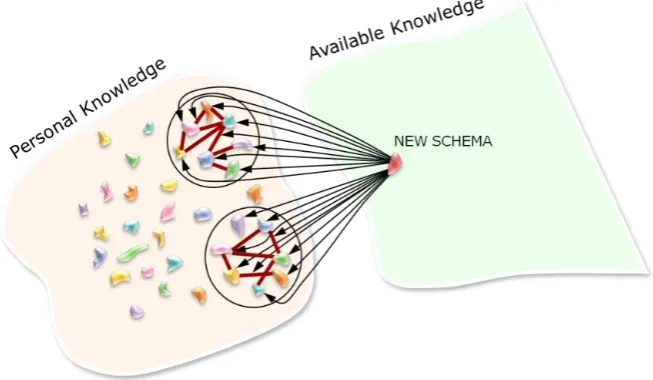
[image:6.595.140.467.446.636.2]Let us now examine the process of learning (absorbing new knowledge from available knowledge). The personal knowledge at the beginning of the process is the existing knowledge, while at the end of the process it becomes the increased knowledge. It is important to note that the knowing processes are constructive; e.g. Neisser (1967: 9 for perception and 285 for remembering) uses Hebb’s example of comparing the perceiver/rememberer to a palaeontologist – where we perceive fragments of bones and we see a dinosaur. This constructive nature of knowledge is responsible for the knowledge increase becoming a highly complex non-additive process. Based on the previous systemic description of knowledge, the process of learning may be described in the following way (Figure 1): The new knowledge is absorbed from the available knowledge; if the learner does not have any existing knowledge to which the new knowledge can be connected, nothing happens and there will be no knowledge increase. If there are multiple meta-schemata (subsystems) into which the new knowledge can be incorporated it will be incorporated into all of them; this may result in overlapping or merging of the meta-schemata.
Figure 1: The process of knowledge increase
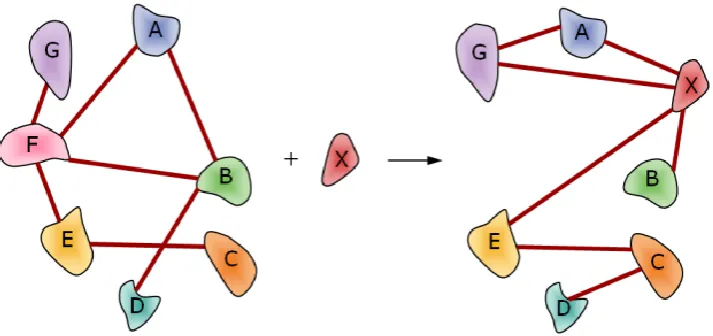
7 schema X connects to the group of schemata A-B-C-D-E-F-G. It connects itself to schemata A, B, E and G; it displaces F dismissing its connections to A, BE and G as well. Due to the effect of the new schema, G establishes connection with A; C connects to D; the connection between B and D breaks off.
Figure 2: Absorbing the new knowledge
If there were no other ways of knowledge increase apart from the above (i.e. receiving knowledge from others), the available knowledge would become static because the sum knowledge of all individuals would little by little equal the available knowledge. This is, however, not what we see. ‘Creatives’ are people who create new knowledge which adds to the available knowledge: this happens by the creatives being able to increase their personal knowledge by rearranging their existing schemata. The in-depth analysis of the creative knowledge increase is beyond the scope of this paper although, as it will be noted later, the model presented here may be appropriate for including this type of knowledge increase as well.
The knowledge system as presented in this section is re-described in the following section using notations typically used in mathematics. This enables denser and an easier-to-handle formulation. However, as it was said earlier, this does not imply undertaking calculations. The mathematical symbolism is a way of thinking; moreover, it has its own nature and this will prove fruitful in the present modelling.
Describing Knowledge with Mathematical Symbolism
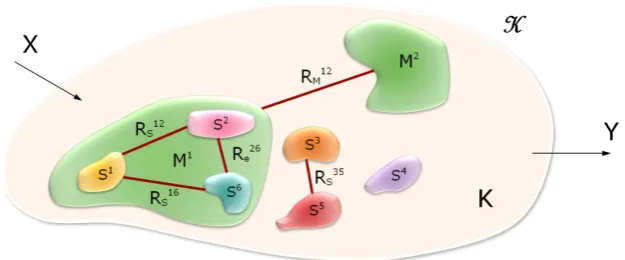
Using the mathematical notations typical for describing systems, the knowledge system can be described the following way (Figure 3):
𝐾 denotes the examined object, i.e. the personal knowledge, (some additional markings for it: existing knowledge 𝐾0; increased knowledge 𝐾1; new knowledge
∆𝐾)
K denotes the environment, that is the available knowledge.
8
𝑆𝑖, 𝑖 = (1, … , 𝑛) denotes the elements of the knowledge system. These are the cognitive schemata (n being the number of schemata); we can also use a vectorial notation: 𝑆.
𝑅𝑆𝑘,𝑙, 𝑘, 𝑙 = (1, … , 𝑛) denotes the nn array of relationships between the schemata (elements); we can also use a matrix notation 𝑅𝑆.
𝑀𝑗, 𝑗 = (1, … , 𝑚) denotes the subsystems, which are the meta-schemata (m being the number of meta-schemata); we can also use a vectorial notation 𝑀.
𝑅𝑀𝑘,𝑙, 𝑘, 𝑙 = (1, … , 𝑚) denotes the mm array of relationships between the meta-schemata (subsystems); we can also use a matrix notation 𝑅𝑀.
𝑅 is an (n+m)(n+m) array that we can get by combining 𝑅𝑆 and 𝑅𝑀. Thus 𝑅
[image:8.595.139.452.302.432.2]denotes the relationships between all elements and subsystems, i.e. all schemata and meta-schemata.
Figure 3: Schemata, relations, and meta-schemata in the knowledge system
Several remarks need to be made about these denotations based on the previous descriptions of the knowledge system. There are three levels of structures that would also be needed for a full systemic description. The micro-structure describes the structures of the subsystems; these are contained in the meta-schemata and thus do not require additional denotations. The macro-structure of knowledge would be the structure of the whole personal knowledge, and the global structure would contain, apart from the macro-structure, also the interaction with the environment. It was noted earlier that schemata can only be investigated while they are in STM, which has a limitation of 7±2 cognitive schemata. Everyone knows more than 7±2 things at meta-schema-level, e.g. we can talk, write, ride a bicycle, make coffee, etc. As we have more meta-schemata than we can simultaneously retrieve into our STM, the macro-structure and the global macro-structure of knowledge cannot be examined.
9
Model of Learning Capability
Now the apparatus has been set up to construct the model of learning capability. This will be done starting from a snapshot-like description of the existing and the increased knowledge and followed by an examination of the process of getting from one to the other. In order to start describing learning capability, the following small reversal is needed: because problems can be interpreted as knowledge gaps, all knowledge can be interpreted as covering a particular problem area (in harmony with the conception of autopoiesis). This line of logic will be used to arrive at the model of learning capability. At the end of the first subsection the learning capability will be obtained in form of a function (although not a calculable one). Once its variables are identified, the behaviour of the function is examined along each variable one by one in the second subsection. In this way, the nature of the learning capability is examined.
Description of Learning Capability
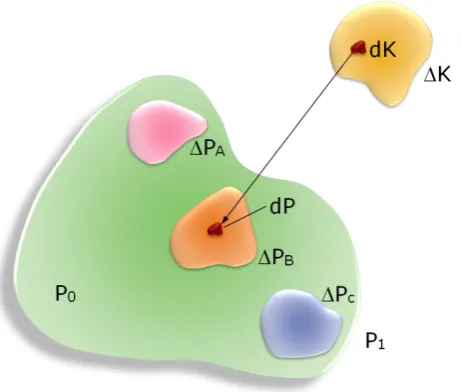
[image:9.595.184.415.460.656.2]If we define problem as knowledge gap, we can visualise problem solving as covering the problem area with the required knowledge. Some parts of it are covered with the existing knowledge (𝐾0) and the uncovered area can be covered with the new knowledge (∆𝐾). When the new knowledge is absorbed we obtain the increased knowledge (𝐾1). The problem area does not have sharp boundaries, neither does the knowledge. If we start from the problem area (partly covered with 𝐾0), we cannot be sure at the beginning of the process whether 𝐾1 will cover it. However, for each piece of knowledge an applicable problem area can be found. Therefore the examination can be conducted backwards, starting from the increased knowledge (𝐾1) and considering the problem area (𝑃1), which is covered with 𝐾1 at the end. (Figure 4)
Figure 4: Knowledge increase over a problem area
Let 𝐾0 be the (existing) knowledge that can cover a 𝑃0 problem area, ∆𝐾 new knowledge that
covers the ∆𝑃 problem area, and 𝐾1 the increased knowledge that covers the 𝑃1 problem area. Then the problem area can be described as:
10 If the knowledge was simply additive, then the increased knowledge would simply form as:
𝐾1 = 𝐾0 + ∆𝐾 [2]
But, as we have seen earlier, knowledge is not simply additive. Our schemata exist only through their relationships (cf Bateson, 1980); we cannot have a schema which is not connected to any other ones. This also means that, as was said earlier, we can only learn things that can be connected to our existing knowledge. And if a schema is connected to other schemata, then it is certain that they will affect each other. Three mathematical metaphors could be considered at this point to describe the knowledge increase: union, summation, and integrals. The union and the summation have the advantage of simpler appearance, which might make them more appealing, especially to the non-mathematicians. However, they give a wrong impression of additivity. The union would probably be more correct in this respect, as it only talks of sets of elements, it does not exclude that the elements are inter-related (so it is consistent with the previous systemic description). However, it does not emphasise the inter-relatedness. The summation could work as well, if a function or operator was also introduced, describing the systemic changes caused by the acquisition of new knowledge. However, the summation gives a direct impression of additivity, something that should be avoided. The third choice would be the integral metaphor, which is probably the least intuitively obvious out of the three for a non-mathematician. However, the integral metaphor has great advantages: it does not imply additivity; it is more about a particular ‘whole’ than the other two possibilities; it focuses the attention on the process of integrating new knowledge into existing knowledge; it reflects the relation between the problem area and the knowledge. In this way, knowledge of a particular subject becomes an integral over the corresponding problem area and also allows that the same problem area can be covered by different knowledge systems. By adopting the integral metaphor, any knowledge can be described as an integral over the corresponding problem area:
𝐾 = ∫ 𝑓(𝐾)
𝑃
𝑑𝐾
[3]
Here, 𝑑𝐾 is an infinitesimal unit of knowledge, and 𝑓(𝐾) is (for the moment) an unknown function representing the complex interaction between the elements of knowledge (existing and new). Using the previous notations, the existing knowledge can be presented as:
𝐾0 = ∫ 𝑓(𝐾)𝑑𝐾 𝑃0
where lim
𝑃→𝑃0
𝑓(𝐾) = 1 [4]
11 knowledge. The creation of this new knowledge also changes the problem area and, most importantly, the personal knowledge is changed:
𝐾0∗ = ∫ 𝑓∗(𝐾)𝑑𝐾 𝑃0∗
≠ 𝐾0 because lim 𝑃→𝑃0∗
𝑓∗(𝐾) ≠ 1 [5]
Here we have seen an additional advantage of the integral-metaphor over the other two solutions: this metaphor can also describe the knowledge creation which the other two could not – or not as easily. The increased knowledge can be described in a similar manner as an integral over the 𝑃1 problem area:
𝐾1 = ∫ 𝑓(𝐾) 𝑃1
𝑑𝐾 ≠ 𝐾0+ ∆𝐾 [6]
This function may include various aspects of the process of knowledge increase but, as the present inquiry is only concerned with the effect of existing knowledge, we can substitute it with the function of Learning Capability, while considering all other aspects (such as the willingness, the attention, or the talent) to be constant. These aspects are not neglected; they are investigated elsewhere (see e.g. Dörfler, 2003, 2004). For distinction, 𝑓(𝐾) is replaced by 𝐶(𝐾) for Learning Capability.
𝐾1 = ∫ 𝐶(𝐾)
𝑃1
𝑑𝐾 [7]
This function will not be determined in the form of an equation; however, important conclusions could be made about its character. It was stated earlier that the elements of knowledge as system are the cognitive schemata (𝑆), with relationships among them (𝑅), and some of these relationships are organized into structures, described by the meta-schemata (𝑀). Thus the following working hypothesis is used:
𝐶(𝐾) = 𝐶 (𝑆, 𝑅, 𝑀) [8]
However, it must not be forgotten that the knowledge increase is a process, which happens over time. We may observe that different people acquire the same new knowledge at different speeds and also that one person acquires different pieces of new knowledge at different speeds. Therefore it is reasonable to consider the partial differentials of the mentioned variables by time as well. For these the following notations will be used:
𝑆̇ =𝜕𝑆
𝜕𝑡, 𝑅̇ = 𝜕𝑅 𝜕𝑡, 𝑀̇ =
𝜕𝑀
𝜕𝑡, where 𝑡 is time [9]
12 𝑆: Are there any schemata to which the new knowledge can be connected; because we can absorb only the new schemata which can be connected to existing ones. Thus, the schemata are to be considered in the function.
𝑆̇: In the present paper the elementary schemata are considered to be permanent. We either have a schema for something or we do not; a changed schema is interpreted as a new schema. Hence the speed of change of schemata has no significance; and thus this variable has no effect on the function.
𝑅: The relationships between the schemata are changing at a great pace; the relationships that are more stable are described by the structures, i.e. by meta-schemata. Therefore the existing relations between the existing schemata are not considered for a stand-alone variable.
𝑅̇: The speed of change of relationships is of high importance. It is crucial how fast these relationships evolve if we have schemata to which the new knowledge can be connected. Thus the speed of changing the relationships is taken into account. 𝑀: It is important to know if there is a structure into which the new knowledge fits, and, as said previously, the more stable relationships are described by meta-schemata which are not yet considered. Consequently the meta-meta-schemata are accepted as a variable.
𝑀̇: The creation and the modifications of meta-schemata happen with enlightenment, that is to say, in zero time. Suddenly the new image is formed. Therefore the speed of change of meta-schemata is not considered.
Applying these considerations to the 𝐶(𝐾) function:
𝐶(𝐾) = 𝐶 (𝑆, 𝑆̇, 𝑅, 𝑅̇, 𝑀, 𝑀̇) ≈ 𝐶̂ (𝑆, 𝑅̇, 𝑀) [10] What do these considered variables mean?
Does the person have schemata to which the new knowledge can be connected? Thus is (s)he capable of learning it at all?
At what speed is the person able to incorporate the new schema among the existing ones? How fast will (s)he learn it?
What kind of structure (meta-schema) will incorporate the new schema? How deep will the learning be?
The function of Learning Capability answers these questions. In the 𝐶(𝐾) function the variables depend on the particular new knowledge the person is absorbing, and thus the new knowledge should be considered as the independent variable:
13 So far it has been identified which are the relevant variables for the function of Learning Capability. The next step is to examine the behaviour of the 𝐶(∆𝐾) function according to the particular dependent variables, i.e. 𝑆(∆𝐾), 𝑅̇(∆𝐾), and 𝑀(∆𝐾). To this end curves can be drawn that show the character of the function.
Analysis of Learning Capability
To draw a picture of the function of Learning Capability, which has three factors, we would need a four-dimensional plot. Instead, therefore three two-dimensional plots will be used. Each plot shows the Learning Capability changing as the function of one variable only, while the other two are fixed (i.e. considered constant). It must be emphasized here that these are not exact plots of the function but only conceptions. In other words, they resemble visual aid that facilitates understanding.
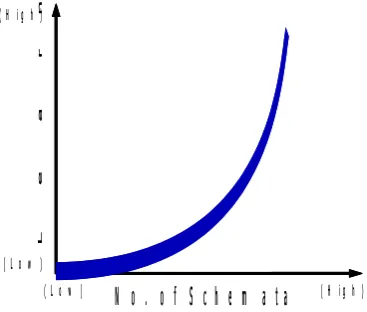
[image:13.595.205.389.475.631.2]Number of schemata to which the new knowledge can connect: The learning capability by the number of cognitive schemata in the discipline is similar to an exponential function. (Figure 5) It has been observed (Ericsson, 1996; Simon, 1995) that a talented disciple needs about 10 years to achieve the highest knowledge level from starting at the level of a novice. This means that it takes around two years to increase the number of schemata by an order of magnitude (Mérő, 1990). Therefore the picture applies only to the person who is sufficiently talented to absorb the new knowledge. The picture is also consistent with the exponential law from general system theory (GST), as described by von Bertalanffy (1969: 61-62), i.e. that the growth is proportional to the number of elements of the system. It could be argued that the Learning Capability should be more like a logistic function of cognitive schemata as there is a limit to the LTM. However, we have only a vague idea about this limit (see earlier) so, with the possible exclusion of the highest knowledge level, the exponential character appears to be appropriate.
Figure 5: Learning Capability by the number of schemata
Speed: The faster one changes the relationships among one’s cognitive schemata, the faster one will absorb the new knowledge. Therefore the first part of the Learning Capability as a function of speed is linear. However, above a certain level the increase of speed of changing relationships does not bring any further increase to the absorption of new knowledge. This is because other limitations will take place, such as the speed of perception, the delivery speed of the new knowledge, various redundancies, etc. Thus the curve will flatten out with a horizontal asymptote. (Figure 6)
N o . o f S c h e m a t a
L e a r n i n g C a p a b i l i t y
( H i g h ) ( L o w )
( L o w ) ( H i g h )
N o . o f S c h e m a t a
L e a r n i n g C a p a b i l i t y
( H i g h ) ( L o w )
14
Figure 6: Learning Capability by the speed of changing relationships
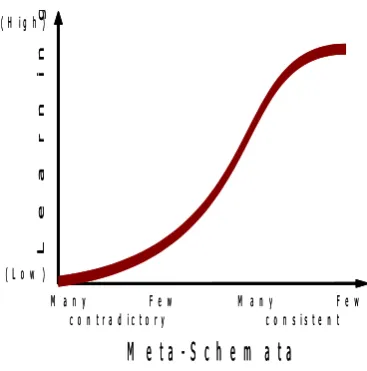
Meta-schemata to which the new knowledge can connect: Meta-schemata, which contradict the discipline or the paradigm to which the new knowledge belongs, block the absorption of the new knowledge (contradictory pieces of knowledge in the same area do not easily coexist). The more such meta-schemata, the stronger the blockade will be. By decreasing the number of contradictory schemata and increasing the number of consistent meta-schemata, the learning capability suddenly increases. The worst is to have many contradictory meta-schemata, though it is best only to have a few consistent ones (rather than many of them). This can be explained by two reasons:
The first reason can be found in the hierarchical nature of the meta-schemata. If the person who is receiving the new knowledge has many meta-schemata to which the new knowledge can be connected, then these are probably low-level meta-schemata. In other words, as each one of the high-level meta-schemata covers a large area, and there is a finite space, there cannot be many of them in the area of the new knowledge. This in turn means that indirectly this variable also provides consideration of the complexity of meta-schemata, not only their number. The second reason is that the learner having a large number of meta-schemata to which the new knowledge can connect is likely to feel anxiety due to trying to establish many connections at the same time. (Cf Csíkszentmihályi, 2002: 74)
Figure 7: Learning Capability by the meta-schemata
L e a r n i n g C a p a b i l i t y
( H i g h ) ( L o w )
( L o w ) ( H i g h )
S p e e d
L e a r n i n g C a p a b i l i t y
( H i g h ) ( L o w )
( L o w ) ( H i g h )
S p e e d
L e a r n i n g C a p a b i l i t y
( L o w ) ( H i g h )
M e t a - S c h e m a t a
F e w M a n y F e w M a n y
c o n t r a d i c t o r y c o n s i s t e n t
L e a r n i n g C a p a b i l i t y
( L o w ) ( H i g h )
M e t a - S c h e m a t a
F e w M a n y F e w M a n y
[image:14.595.205.389.529.715.2]15 Similar to the previous picture, the function finally flattens out with a horizontal asymptote. (Figure 7) This picture is consistent with the logistic law from GST, i.e. about the growth of population in a system with limited resources. At the same time, the previous statement, that having fewer consistent meta-schemata is better than having many of them, can also be understood from a system indicating competition (von Bertalanffy, 1969: 62-66), i.e. meta-schemata competing to absorb the new knowledge.
The presented explanation for the behaviour of the function of Learning Capability necessarily loses some of the complexity of the real-world learning. It had to be simplified because it is not possible to draw pictures in four dimensions; thus it is impossible to consider all three variables at the same time. These variables are not entirely independent from each other. For instance, on higher levels of knowledge we have more cognitive schemata in a particular area (variable 𝑆) while, at the same time, having higher-level meta-schemata in that area (variable 𝑀). And because each of these higher-level meta-schemata tends to cover a larger area, there will be fewer meta-schemata in the area of expertise. To put it more simply: it is impossible to find someone with only a small number of schemata in a particular area who, at the same time, has high-level meta-schemata in this same area. This does not make the preceding examination any less valid or less significant, though it is possible that we could have learned more if we could consider all the variables at the same time.
Conclusions
16 ongoing, research project, the first results of which were presented at a conference (Dörfler, Baracskai & Velencei, 2009). The model, also explains some previously recognized phenomena, e.g. why it is better to have few consistent meta-schemata when acquiring new knowledge, or why the learner at the high-end of advanced knowledge learns significantly more slowly than the beginner.
The limitation of the model is that talent is not considered, i.e. the model only applies to the talented learner. There are two possibilities for including the talent, the first is to modify the present model in that sense, and the other is to develop a separate model for examining the impact of talent on knowledge increase. The advantage of the second version is that the two models could be used separately as well as together, whichever version makes sense in a particular situation. In both cases the investigation must start from defining talent in a cognitive-systemist view. As the knowledge increase of the master fundamentally differs from the knowledge increase at other knowledge levels, the model does not describe the master’s learning.
The supposed validity of the model is for the (classroom-type) learning. The possibility to extend the validity to the other types of knowledge increase (practising, experiencing events and inner experiencing) remains future work.
Because for most of the modelling in this paper a GST-type approach was adopted, it is also worth considering whether the model can be extended to all other sorts of systems that are sufficiently complex; or, indeed, what the limitations to such generalisation would be. The consideration that the meta-schemata form and re-form by enlightenment means that the structural changes are considered to be transient. This means that it might be possible to use the model for any kind of system in which the structural changes occur very fast, or where we are not interested in the process of transition from old structure to new. However, the above rationale is not sufficient for this, as it was only concerned with what was considered: a fuller argument must also examine what was not considered in this paper. Examining the possibility of such extension means that the whole modelling process should be repeated from scratch, perhaps using a different starting point. This could be interesting, for instance, in business process reengineering (BPR): the organizational structure of a supplier for a company changes within a short time and the company is interested in how the existing state of the supplier affects the final state. Such substantial extension is, of course, only a possibility for now and its examination requires substantial further research.
References
Ackoff, RL (1971) Towards a System of Systems Concepts, Management Science, 17(11): 661-671.
Baddeley, AD (1994) The Magical Number Seven: Still Magic After All These Years?, Psychological Review, 101(2): 353-356.
Baddeley, AD (1998) Working Memory, Comptes Rendus de l'Academie des Sciences - Series III - Sciences de la Vie, 321(2-3): 167-173.
17 Baracskai, Z (1999) A profi vezető nem használ szakácskönyvet (The Master of Leadership), "Szabolcs-Szatmár-Bereg megyei Könyvtárak" Egyesülés, Nyíregyháza, Hungary. [PublishedinHungarian]
Bartlett, SFC (1932/1967) Remembering: A Study in Experimental and Social Psychology (2nd
ed.), Cambridge University Press, Cambridge.
Bateson, G (1972/1987) Steps to an Ecology of Mind: Collected Essaysin Anthropology, Psychiatry, Evolution, and Epistemology, Jason Aronson, Northvale, NJ.
Bateson, G (1980) Mind and Nature: A Necessary Unity, Bantam Books, New York, NY.
von Bertalanffy, L (1969/2003) General System Theory: Foundations, Development, Applications (14th paperback ed.), George Braziller, New York, NY.
de Bono, E (1973/1976) Practical Thinking, Penguin Books, London, UK.
Boulding, KE (1956) General Systems Theory: The Skeleton of Science, Management Science, 2(3): 197-208.
Boulding, KE (1966) The Economics of Knowledge and the Knowledge of Economics, The American Economic Review, 56(1/2): 1-13.
Boulding, KE (1985) The World as a Total System, Sage Publications, Beverly Hills, CA.
Capra, F (1996) The Web of Life: A New Synthesis of Mind and Matter, Flamingo, London, UK. Chase, WG & Simon, HA (1973) Perception in Chess, Cognitive Psychology, 4(1): 55-81. Checkland, PB (1999a) Soft Systems Methodology: a 30-year Retrospective, PB Checkland & J
Scholes Soft Systems Methodology in Action, John Wiley & Sons, Chichester, UK: A1-A66.
Checkland, PB (1999b/2003) Systems Thinking, Systems Practice, John Wiley & Sons, Chichester, UK.
Csíkszentmihályi, M (2002) Flow (2nd ed.), Rider, London, UK.
Davenport, TH & Prusak, L (2000) Working Knowledge: How Organizations Manage What They Know (paperback ed.), Harvard Business School Press, Boston, MA.
Dörfler, V (2003) The Model of Learning Willingness, ECKM 2003: 4th European Conference on
Knowledge Management, 18-19 September 2003, Oxford, UK: 275-284.
Dörfler, V (2004) Factors of Attention, BICABR 2004: Bangkok International Conference on Applied Business Research, 1-3 December 2004, Bangkok, Thailand.
Dörfler, V, Baracskai, Z & Velencei, J (2009) Knowledge Levels: 3-D Model of the Levels of Expertise, AoM 2009: The Sixty-ninth Annual Meeting of the Academy of Management, 7-11 August 2009, Chicago, IL.
Dörfler, V, Baracskai, Z, Velencei, J & Ackermann, F (2008) Intuition: A New Knowledge Model for Knowledge Management, AoM 2008: The Sixty-eight Annual Meeting of the Academy of Management, 8-13 August 2008, Anaheim, CA.
Dörfler, V & Szendrey, J (2008) From Knowledge Management to Cognition Management: A Multi-Potential View of Cognition, OLKC 2008: International Conference on Organizational Learning, Knowledge and Capabilities, 28-30 April 2008, Copenhagen,
Denmark. Electronic version:
http://www.viktordorfler.com/webdav/papers/MultipotentialCognition.pdf
18 Gobet, F & Simon, HA (1996a) Recall of Random and Distorted Chess Positions: Implications
for the Theory of Expertise, Memory & Cognition, 24(4): 493-503.
Gobet, F & Simon, HA (1996b) Templates in Chess Memory: Mechanism for Re-calling Several Boards, Cognitive Psychology, 31(1): 1-40.
Hofstadter, DR (2000) Godel, Escher, Bach: An Eternal Golden Braid (2nd ed.), Penguin Books,
London, UK.
László, E (1972) The Systems View of the World: The Natural Philosophy of the New Developments in the Sciences, George Braziller, New York, NY.
László, E (2001) A rendszerelmélet távlatai (Perspectives of System Theory), Magyar Könyvklub, Budapest, Hungary. [Publishedin Hungarian]
Maturana, HR & Varela, FJ (1979) Autopoiesis and Cognition: The Realization of the Living, Kluwer Academic Publishers, Dordrecht, Netherlands.
Mérő, L (1990) Ways of Thinking: The Limits of Rational Thought and Artificial Intelligence, World Scientific, New Jersey, NJ.
Mérő, L (1998) Moral Calculations: Game Theory, Logic, and Human Frailty, Springer-Verlag New York Inc., New York, NY.
Miller, GA (1956) The Magical Number Seven, Plus or Minus Two: Some Limits on Our Capacity for Processing Information, Psychological Review, 63(2): 81-97.
Minsky, ML (1975) A Framework for Representing Knowledge, PH Winston The Psychology of Computer Vision, McGraw-Hill, New York, NY: 221-242.
Neisser, U (1967) Cognitive Psychology, Meredith Publishing, New York, NY.
Plato (360 BC) Theaetetus. Electronic version:
http://eserver.org/philosophy/plato/theaetetus.txt (accessed 16/08/2007)
Polányi, M (1962/2002) Personal Knowledge: Towards a Post-Critical Philosophy, Routledge, London, UK.
Prietula, MJ & Simon, HA (1989) The Experts in Your Midst, Harvard Business Review, 67(January-February): 120-124.
Prigogine, I (1997) The End of Certainty: Time, Chaos and the New Laws of Nature, The Free Press, London, UK.
Rumelhart, DE & Norman, DA (1988) Representation in Memory, RC Atkinson, RJ Herrnstein, G Lindzey & RD Luce Stevens' Handbook of Experimental Psychology (2nd edition, Vol.
2: Learning and Cognition), John Wiley & Sons, New York, NY: 511-587.
Russell, BA (1948/2003) Human Knowledge: Its Scope and Limits, Routledge, London, UK. Simon, HA (1974) How Big Is a Chunk? Science, 183(4124): 482 - 488.
Simon, HA (1976) The Information Storage System Called "Human Memory", HA Simon (1979) Models of Thought, Yale University Press, New Haven, CT: 62-83.
Simon, HA (1995) The information-processing theory of mind, American Psychologist, 50(7): 507-508.
Simon, HA (1996) The Sciences of the Artificial (3rd ed.), The MIT Press, Cambridge, MA.
Simon, HA & Barenfeld, M (1969) Information-Processing Analysis of Perceptual Processes in Problem Solving, Psychological Review, 76(5): 473-483.
Simon, HA & Gilmartin, K (1973) A Simulation of Memory for Chess Positions, Cognitive Psychology, 5(1): 29-46.
Sveiby, K-E (1997) The New Organizational Wealth: Managing & Measuring Knowledge-Based Assets, Berrett-Koehler Publishers, San Francisco, CA.