T h e o p e n – a c c e s s j o u r n a l f o r p h y s i c s
New Journal of Physics
Reference frames for Bell inequality violation in the
presence of superselection rules
T Paterek1, P Kurzy ´nski1,2, D K L Oi1,3 and D Kaszlikowski1,4,5 1Centre for Quantum Technologies, National University of Singapore,
3 Science Drive 2, 117543 Singapore, Singapore
2Faculty of Physics, Adam Mickiewicz University, Umultowska 85,
61-614 Pozna´n, Poland
3SUPA Department of Physics, University of Strathclyde, Glasgow G4 0NG,
UK
4Department of Physics, National University of Singapore, 2 Science Drive 3,
117542 Singapore, Singapore E-mail:[email protected]
New Journal of Physics13(2011) 043027 (12pp) Received 11 January 2011
Published 19 April 2011 Online athttp://www.njp.org/
doi:10.1088/1367-2630/13/4/043027
Abstract. Superselection rules (SSRs) constrain the allowed states and operations in quantum theory. They limit preparations and measurements and hence impact our ability to observe non-locality, in particular the violation of Bell inequalities. We show that a reference frame compatible with a particle number SSR does not allow observers to violate a Bell inequality if and only if it is prepared using only local operations and classical communication. In particular, jointly prepared separable reference frames are sufficient for obtaining violations of a Bell inequality. We study the size and non-local properties of such reference frames using superselection-induced variance. These results suggest the need for experimental Bell tests in the presence of superselection.
5Author to whom any correspondence should be addressed.
Contents
1. Introduction 2
2. Scenario 3
3. Reference frames prepared locally 4
4. Reference frames prepared jointly 4
5. Minimal separable reference frames 5
6. Local and global twirling 6
7. Separable reference for maximal violation 7
8. Non-locality of reference states 8
9. Experiments 8
10. Conclusions 9
Acknowledgments 10
Appendix. Derivation of correlation formula (6) 10
References 11
1. Introduction
Symmetries impose powerful constraints on physics, leading Wick et al to suggest that the associated conserved quantities lead to additional restrictions on quantum theory, the so-called superselection rules (SSRs) [1]. They conjectured that superselection prevents the existence of coherent superpositions of charge, for example. However, Aharonov and Susskind [2] showed that the ability to observe superpositions depends on having a shared reference frame relative to which the system can be prepared and measured. More generally, elements of quantum theory require reformulation in the presence of SSRs. Quantum entanglement and various forms of non-locality are particular examples of phenomena that are affected by the presence of SSRs, and a vast body of literature already exists on these topics [3]–[22].
Here, we focus on Bell inequality violation in the presence of SSRs. We concentrate on the bi-partite case where both the entangled principal system and any ancilla/reference frame are subject to particle-number superselection. In particular, we examine the role of the measurement apparatus or reference frame used by the two observers (our prototypical Alice and Bob). We find that reference frames prepared using only local operations that satisfy SSRs and classical communication (SSR-LOCC)cannotreveal the non-locality of an entangled system. However, jointly prepared but separable reference frames can be used to violate a Bell inequality with an entangled principal system. By imposing separability of the reference frame, we deduce that violation is due to the measured entangled state; the reference allows the observers to carry out measurements that lead to a violation of the Bell inequality. In such cases, the reference is said to activate Bell violation.
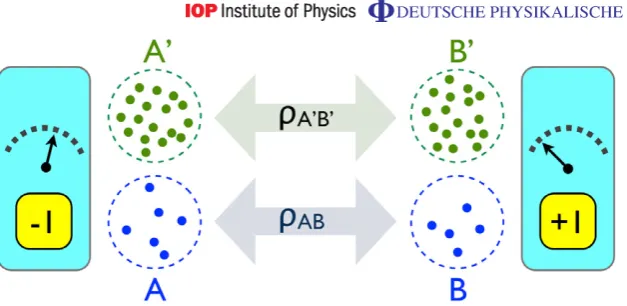
Figure 1. The Bell experiment in the presence of particle-number SSR. Two observers share in advance a reference system in a separable state ρA0B0. The experiment begins with an emission of a principal system in a state
ρA B. According to the SSR both ρA0B0 and ρA B are incoherent mixtures of
states with well-defined total number of particles. Alice (on the left) has now access to subsystems A and A0 and similarly Bob (on the right) has access
to B and B0. Both local subsystems are next measured by
superselection-constrained observables, described by projections onto states with well-defined total number of particles in the subsystems. In a given experimental run, one of many observables is measured at each site, the choice of which is depicted by a tuneable knob (arrow) on the measuring device. Finally, one of many measurement results is obtained as depicted by a number on the yellow screen (e.g.−1 for Alice, +1 for Bob). In short, for this scenario a violation of a Bell inequality can be observed if and only if the reference state ρA0B0 is prepared jointly, and the more particles in the reference state the larger the violation.
reference as measured by superselection-induced variance (SIV) [5,6]. This holds in particular for measurements of single-particle states and is a clear proof that such states can exhibit non-locality [7]–[18]. We also discuss related single-photon experiments [21,22] and conclude that there is still the need for new experiments.
2. Scenario
We begin with the description of a Bell experiment in the presence of particle-number superselection. Consider the situation as shown in figure 1. A source distributes to Alice and Bob an entangled pure state of N particles,
|ψiAB= N
X
n=0
cn|niA|N−niB, (1)
where |cn|2 is the probability that Alice finds that she has n particles. Under particle-number
superselection, all states and measurements commute with the particle-number operator Nˆ. Ordinarily, all that Alice and Bob can do is simply count the number of particles each receives. In order to do more than this, they share in advance a joint reference frame in the state
before state (1) is distributed to Alice and Bob they share no entanglement. By making joint SSR respecting measurements on each of their respective halves of the entangled system and reference frame ({A,A0}for Alice,{B,B0}for Bob), they hope to be able to demonstrate a Bell
inequality violation.
3. Reference frames prepared locally
We first show that reference frames prepared using only local operations satisfying SSRs and classical communication (SSR-LOCC) cannot activate violation of any Bell inequality. The proof is straightforward.
All such reference states commute with localparticle-number operators and therefore are of the form
ρSSR−LOCC A0B0 =
X
k,l
pkl|kiA0hk| ⊗ |liB0hl|, (2)
where k (l) counts particles in the reference frame of Alice (Bob). These states contain only classical correlations between fixed local number of particles as measured by quantum discord and similar quantities [23]–[26].
Consider for the moment that the reference frame is in the pure state |kiA0|liB0. We can express the initial joint state of the system and reference frame as P
ncn|n,kiAA0|N−n,liBB0
grouping subsystems accessible to Alice and Bob, respectively. Note that every term of this superposition contains a different number of local particles, i.e.n+kfor Alice andN−n+lfor Bob. As local SSR observant measurements project onto states with a well-defined number of local particles, only one term in the superposition can contribute to the probability of a corresponding result. This, however, is exactly the same as making the measurements on a state in a mixture of |n,kiAA0|N−n,liBB0 with probability |cn|2, and this separable state clearly admits a local hidden variable model. If one replaces |cn|2 in this model with |cn|2pkl
all measurement results obtained with a general mixed reference state (2) are reproduced. Therefore, no Bell inequality can be violated.
4. Reference frames prepared jointly
We now show that all reference frames that cannot be prepared via SSR-LOCC are useful for Bell violation. We begin with the characterization of such references. We can express all reference states in the general form
ρA0B0= X
N0
pN0ρN0, (3)
where pN0 is the probability of N0 particles in the reference frame and ρN0 is any state with a fixed total number of particles N0, i.e. ρA0B0 is an arbitrary mixture of pure states of the form
|φiA0B0 = PN0
i=0ri|iiA0|N0−iiB0. Since we assume thatρA0B0 cannot be prepared via SSR-LOCC, it necessarily contains off-diagonal elements in the particle-number basis. All such states have a non-vanishing expectation of
where R+=PN−1
a=0 |a+1iha|and R−=
PN
b=1|b−1ihb|for some1>1. To see this, note that V is proportional to the average value of the sum PN0−1
i=0 ri∗+1ri over the pure states|φiA0B0 in the decomposition ofρA0B0. Therefore,V vanishes if the sums vanish for all the pure states. For states|φiA0B0 that have coherences in the particle-number basis, this only occurs if the signs of the productsri+1∗ri alternate for some values ofi leading to cancellation in the sum. In such a
case however, we can always choose a larger1 to skip the terms that lead to the cancellation. Thus, a stateρA0B0 can be prepared via SSR-LOCC if and only ifV=0 for all values of1>1.
As we now show, all reference states with the non-vanishing coherence parameterVenable observers to choose measurements that lead to a violation of the Clauser–Horne–Shimony–Holt (CHSH) inequality [27]. Consider an entangled principal system in the state
|ψiAB= √1
2(|2iA|2 +1iB+|2 +1iA|2iB). (5) We show in appendixthat there always exist dichotomic local measurements compatible with the SSR whose outcomes on the joint state of the principal system and reference frame are correlated as
E(αk, βl)= −cos(2αk)cos(2βl)+Vsin(2αk)sin(2βl), (6)
where the angle αk (βl) parameterizes the kth (lth) setting of Alice (Bob). We insert this
expression into the CHSH parameter
S≡E(α1, β1)+E(α1, β2)+E(α2, β1)−E(α2, β2), (7)
and find values of αk and βl for which S is higher than the local realism bound S62.
Namely, we choose α1=0, α2=π/4, and parameterize the settings of Bob by a single angle β ≡β1= −β2, leading to
S= −2 cos(2β)+ 2Vsin(2β). (8)
To find its maximum, note that S has the form of a scalar product between the vector wE = (−2,2V) and an arbitrary normalized vector Ev=(cos(2β),sin(2β)). Therefore, there always exists an angleβ such thatvEis parallel towE and the maximum of the scalar product is given by the length ofwE:
S=2√1 +V2. (9)
To summarize, all reference frames that cannot be prepared via SSR-LOCC have a non-vanishing coherence parameterV and consequently allow observers to carry out measurements on entangled states that lead to a violation of the CHSH inequality:
S>2 for allV6=0. (10)
An identical conclusion holds for the single-particle entangled principal system. The calculations are the same as long as the reference frame does not contain any vacuum.
5. Minimal separable reference frames
Relaxing for a moment the separability requirement, equation (4) shows that the minimal reference has only one particle in total. Namely, any state |φiA0B0 =r0|0iA0|1iB0+r1|1iA0|0iB0 withr1r0∗ 6=0 has a non-vanishing parameterV. However, the application of the PPT criterion for entanglement [28, 29] reveals that |φiA0B0 is entangled for all r1r0∗ 6=0. When entangled states are used as references, it is unclear whether the violation of a Bell inequality is due to the entanglement of the principal system or the reference frame.
For this reason we consider a reference frame with at most two particles:
ρA0B0 = p00|00iA0B0h00|+p11|11iA0B0h11|+pφ|φiA0B0hφ|, (11) where as before|φiA0B0 =r0|0iA0|1iB0+r1|1iA0|0iB0. Since the definition of equation (4) involves only the real part of the off-diagonal elements, we choose the coefficients r0 andr1 to be real, i.e. V= pφr0r1, and we have used 1=1 in equation (4). The application of the PPT criterion reveals that the stateρA0B0 is separable if and only if
p00p11> pφ2r02r 2 1 =V
2. (12)
Therefore, for all separable reference frames activating the violation,V6=0, there must be some mixture of the two-particle state (p11>0). Note that the same argument applies to p00and one concludes that separable reference states of the form (11) enabling the violation must contain some vacuum. This is a consequence of the fact that an arbitrary mixture of any pure two-qubit entangled state with ‘colored noise’|11ih11|is always entangled [30,31].
6. Local and global twirling
A useful mathematical tool that illustrates and generalizes the results presented so far is the twirling operation. TwirlingT eliminates the coherences that are not compatible with SSR:
T(ρ)≡X
n
5nρ5n, (13)
where 5n is a projector on a subspace with a fixed number of particles n. This operation
describes the lack of a reference frame enabling access to the phase information of the probability amplitudes.
The usefulness of twirling is best illustrated by considering states that can be prepared via SSR-LOCC. A simple proof demonstrates that they cannot activate CHSH violation. A SSR-LOCC reference frame commutes with local particle number operators and therefore it is invariant under the action of local twirlings, ρASSR−LOCC0B0 =(TA0⊗TB0)(ρSSR−LOCCA0B0 ). This implies for the coherence parameter
V∼ TrR+⊗R−ρASSR−LOCC0B0
= Tr(R+⊗R−)(TA0⊗TB0)ρSSR−LOCC
A0B0
= TrTA0(R+)⊗TB0(R−)ρSSR−LOCC
A0B0 =0, (14)
where the last equality follows from the fact that TA0B0(R±)=0 because R± contain only off-diagonal elements in the particle-number basis.
Note that the operator R+⊗R− conserves total particle number and therefore is invariant
ρSSR
A0B0 =T(ρA0B0), where nowρA0B0 need not have a fixed number of particles. Therefore, Tr{R+⊗R−ρASSR0B0} = Tr{R+⊗R−T(ρA0B0)} =Tr{T(R+⊗R−)ρA0B0}
= Tr{R+⊗R−ρA0B0}, (15)
where we have used the cyclic property of trace. This means that in order to calculateV for an SSR respecting reference frameρASSR0B0, we can use in equation (4) any stateρA0B0 whose twirling givesρASSR0B0.
7. Separable reference for maximal violation
Twirling allows further study of separable reference frames. Note that the minimal reference frame of two particles we have derived in equation (11) activates the violation but does not lead to maximal violation. Indeed, the highest value ofVfor entangled reference states (11) is 12 and for separable reference states equation (12) implies V6 14, whereas the maximal violation of the CHSH inequality allowed by quantum theory S=2√2 [32] requiresV=1. Note also that the Tsirelson bound of S=2√2 implies that|V|61.
Here we show that there are separable reference frames allowing maximal violation of the CHSH inequality with an entangled state. First note that all separable states satisfying SSR are of the formρsepSSR=T(ρsep), withρsep=Pjpj|a0jiha0j| ⊗ |b0jihb0j|where|a0ji|b0jineed not have a
fixed number of particles. This follows from the fact that global twirling is an LOCC operation (but not SSR-LOCC) and as such cannot produce entanglement. We now derive the separable reference frames that maximize the coherence parameterV. Since equation (4) is linear inρA0B0,
V is maximal for a pure product state |a0i|b0i. Moreover, due to the fact that only the real part enters (4), it is sufficient to consider states with real coefficients |a0i =PN
n=0an|ni and |b0i =PM
m=0bm|miwithan,bm∈R. For such pure statesV= fNgM where
fN ≡ ha0|R+|a0i = N−1
X
n=0
anan+1, (16)
gM ≡ hb0|R−|b0i = M−1
X
m=0
bmbm+1, (17)
with N and M denoting the dimensionality of the reference frames of Alice and Bob, respectively, i.e. the maximal number of particles in their reference frames, and we put1=1. To find the maximum ofV, it is now sufficient to optimize fN, because gM has the same form
and optimization over Bob’s state is independent of that over Alice’s. Note that for states with real coefficientsha0|R+|a0i = ha0|R−|a0iand therefore f
N = 12ha0|(R++R−)|a0i. The only
non-vanishing elements of matrix R++R− are a strip of identities above and below its diagonal, and therefore it is a Hermitian matrix. The maximal value of fN is attained for|a0ibeing the
eigenvector of R++R−with the highest eigenvalue. The amplitudes of the optimal state read
an=
r 2
N+ 2sin π(
n+ 1)
N+ 2
, withn=0,1, . . . ,N, (18)
and its maximal eigenvalue gives
max fN =cos
π
N+ 2
For small reference frames containing at most one particle on both sides N =M =1, we find
V6 14 in agreement with the results of section5on minimal reference frames. If the reference frames of Alice and Bob are both unbounded, equation (19) implies thatV→1 and the violation of the CHSH inequality approaches its maximum. Practically, for N =M ≈30 particles in each reference frame,V≈0.99.
The reference frames for violation of Bell inequality were also studied in [33] in the context of directional reference frames, finding that in the limit of unbounded reference frame, maximal violation can be achieved. We stress that in our case the corresponding limit is twofold: to maximally violate CHSH inequality the reference frame has to be prepared jointly, and it should be unbounded.
8. Non-locality of reference states
Let us now discuss the relation betweenV and the non-locality of reference frames as captured by SIV [5]. We show that violation of the CHSH inequality is a witness of non-zero SIV in the reference frame and that the amount of SIV in small reference frames gives an upper bound on the CHSH violation.
The SIV of a pure state|φiis defined as the variance of local number of particles
1
4V(φ)≡ hφ|N 2
A⊗I|φi − hφ|NA⊗I|φi2. (20)
The factor of 4 is introduced for normalization: one unit of SIV is defined for the state
1 √
2(|n,n+ 1i+|n+ 1,ni). Since SIV is symmetric with respect to permutation of the parties,
one can equally consider the variance of the local particle number on Bob’s side (NB). Pure states that have non-zero SIV cannot be prepared via SSR-LOCC and this is the property of reference frames we are interested in. However, such pure states are always entangled, whereas we insist on separability of the reference frame. Therefore, we must consider mixed states. Just like entanglement, for mixed states another measure of SIV is required. We shall use the variance of formation defined as [5]
VFSSR(ρ)= min
{pi,φi} X
i
piV(φi), (21)
where the ensembles of pure states {φi}obey SSRs. As a measure of the off-diagonal terms in
the density matrix, we can considerV, or equivalently Bell inequality violation, as a witness of non-zero SIV. Moreover, it was shown in [6] that for states (11) the variance of formation reads
VFSSR(ρ)>4p2φr02r12=4V2with realr0andr1. Accordingly, one can directly relate SIV toV as |V|6
p VSSR
F (ρ)
2 . (22)
Therefore, the corresponding states with vanishing SIV have also vanishingV.
9. Experiments
Bell inequality under an SSR, these experiments may be seen as such for (an induced) photon-number SSR [19]. In the proposal of [7], a single photon is directed onto a balanced beam-splitter producing (it is hoped) a non-local state of one photon. In each output port of this first beam-splitter there is another balanced beam-splitter with a (reference) coherent state directed at its second input port (see figure 1 of [7]). One considers correlations between the number of photons registered in detectors placed in the output ports of the second set of beam-splitters.
The experimental realizations [21, 22] differ from the proposal [7] in that the secondary beam-splitters may be unbalanced. Note that in principle the possible measurement results are unbounded, and therefore the CHSH inequality cannot be applied. It turns out that the correlation functions violate the CHSH inequality only for a small mean number of photons in the coherent states, in which case the events of having many photons in the detectors are rare and the CHSH inequality becomes applicable. This, however, opens up an effective detection loophole that allows for a local hidden variable model.
Let us denote by ra (rb) the reflectivity of the first (second) beam-splitter supplied with a
coherent state. The corresponding transmittances are: tn=1−rn with n=a,b. It is assumed
that both coherent states have the same mean number of photonsn¯and relative phaseϕ=α−β. The correlation function between the number of photons measured behind the two beam-splitters reads
Eϕ= (ra−ta)(rb−tb)(n¯−1)+ 4
√
rarbtatbsinϕ
¯
n+ 1 . (23)
Using this expression in the CHSH parameter, one finds that the proposal of [7] is optimal in the sense that it is best to choose balanced beam-splittersra=rb= 12. Any other values ofra andrb
lead to smaller values of the CHSH parameter. In particular, the assumption of [21] that after the beam-splitter a photon may have equal likelihood to have come from a single-photon ‘beam’ or a coherent state, i.e.rn¯ =t, leads to no violation for all values ofn¯. For the balanced beam-splitters the inequality is violated ifn¯ <√2−1, which translates into the critical probability of vacuum in the coherent state Pvac≈ 2
3. Using such coherent states it is quite rare to measure two
photons in a setup and one may utilize this effective detection loophole to explain the observed results with, e.g., the model of Gisin [34].
We therefore hope that this research will stimulate further experiments testing Bell violation in the presence of SSRs. Ideally one would use systems with natural SSRs such as massive particles or charges. However, studies of partial superselection can also be performed through controlled decoherence, as decoherence between different subspaces can be seen as a type of SSR.
10. Conclusions
containing up to two particles. We linked the violation to the amount of non-locality in the reference frame as captured by SIV. It would be interesting to study how other subfields of quantum theory, e.g. quantum tomography, are modified in the presence of superselection.
Acknowledgments
We acknowledge discussions with ˇC Brukner, B Hessmo and J Vaccaro. We are grateful to an anonymous referee for pointing out a problem in a previous version of the manuscript which eventually led us to stronger results. This research was supported by the National Research Foundation and the Ministry of Education in Singapore. DKLO acknowledges support from the Quantum Information Scotland network (QUISCO).
Appendix. Derivation of correlation formula (6)
Assume for the moment that the reference system is in a pure state
|φiA0B0 =
N0
X
i=0
ri|iiA0|N0−iiB0. (A.1)
Since it cannot be prepared via SSR-LOCC, we haver∗
i+1ri 6=0 for somei and1>1.
Consider the principal system in a state |ψi =√1
2(|2iA|2 +1iB+|2 +1iA|2iB)such that
the initial state of the principal system and reference together reads
|ψφi =X i
ri √
2(|2,iiAA
0|2 +1,N0−iiBB0+|2 +1,iiAA0|2,N0−iiBB0), (A.2)
where we grouped in kets subsystems accessible to Alice and Bob, respectively.
We present local dichotomic measurements compatible with particle-number SSR, which lead to the correlation function (6) of the main text. Alice measures a local observable parameterized by angleα:
A= N0 X
a=−1
|α(a)ihα(a)| −
N0 X
a=−1
| ¯α(a)ih ¯α(a)|, (A.3)
where the eigenstates are defined as follows:
|α(a)i =cosα|1,a+1+ 1iAA0+ sinα|2,a+1iAA0, (A.4)
| ¯α(a)i =sinα|1,a+1+ 1iAA0−cosα|2,a+1iAA0 (A.5)
fora= −1, . . . ,−1;
|α(a)i =cosα|2 +1,aiAA0+ sinα|2,a+1iAA0, (A.6)
| ¯α(a)i =sinα|2 +1,aiAA0−cosα|2,a+1iAA0 (A.7)
fora=0, . . . ,N0−1;
|α(a)i =cosα|2 +1,aiAA0+ sinα|3 +1,a−1iAA0, (A.8)
for a=N0−1+ 1, . . . ,N0. These observables are compatible with the SSR because all the
eigenstates contain a fixed total number of particles 2 +a+1. The reason behind the three different cases is that the reference subsystem cannot contain more than N0 particles and less
than zero. They are also chosen to form an orthonormal set of vectors. To obtain the observables of Bob one just needs to replace A→B, A0→B0,α→β anda→b.
We reverse the equations for the eigenvectors and write the initial state of the principal system and the reference as
|ψφi =X i
ri √
2{(sinα|αi−1i −cosα| ¯αi−1i)(cosβ|βN
0−ii+ sinβ| ¯βN0−ii)
+(cosα|αii+ sinα| ¯αii)(sinβ|βN0−i−1i −cosβ| ¯βN0−i−1i)}. (A.10)
The probabilities of the results corresponding to different eigenvectors are
Pab≡ |hα(a)β(b)|ψφi|2=12|ra+1sinαcosβ+racosαsinβ|2δb,N0−a−1,
Pab¯ ≡ |hα(a)β(¯ b)|ψφi| 2
=12|ra+1sinαsinβ−racosαcosβ|2δb,N0−a−1,
Pab¯ ≡ |h ¯α(a)β(b)|ψφi|2=12| −ra+1cosαcosβ+rasinαsinβ|2δb,N0−a−1,
Pa¯b¯ ≡ |h ¯α(a)β(¯ b)|ψφi|2=1
2| −ra+1cosαsinβ−rasinαcosβ| 2δ
b,N0−a−1.
Note that for everyathere is only onebfor which the corresponding probability does not vanish, and it is easy to verify that indeedPaN,0b=−1(Pab+Pab¯+Pab¯ +Pa¯b¯)=1. Finally, the correlation
function is the average of the product of dichotomic local results
Eφ(α, β)=
N
X
a,b=−1
(Pab+Pa¯b¯−Pab¯ −Pab¯). (A.11)
Plugging in the formulae for the probabilities, we obtain
Eφ(α, β)= −cos(2α)cos(2β)+Vsin(2α)sin(2β), (A.12)
where V=PN0−1
a=0 Re(ra∗+1ra). Alternatively V can be expressed using operators R+=
PN0−1
a=0 |a+1iha|and R−=
PN0
b=1|b−1ihb|with the help of whichV=Re(hφ|R+⊗R−|φi).
This calculation holds for arbitrary pure state |φiA0B0 of the reference. Therefore, for the reference in an arbitrary mixed state ρA0B0 =Pφ pφ|φiA0B0hφ| the correlations formula reads
E(α, β)=X
φ
pφEφ(α, β), (A.13)
and therefore it is of the same form as equation (A.12), but with the modified coherence parameter
V=Re[Tr(R+⊗R−ρA0B0)]. (A.14)
References
[1] Wick G C, Wightman A S and Wigner E P 1952Phys. Rev.88101 [2] Aharonov Y and Susskind L 1966Phys. Rev.1551428
[5] Schuch N, Verstraete F and Cirac J I 2004Phys. Rev. Lett.92087904 [6] Schuch N, Verstraete F and Cirac J I 2004Phys. Rev.A70042310 [7] Tan S M, Walls D F and Collett M J 1991Phys. Rev. Lett.66252 [8] Hardy L 1994Phys. Rev. Lett.732279
[9] Greenberger D M, Horne M A and Zeilinger A 1995Phys. Rev. Lett.752064 [10] Björk G, Jonsson P and Sánchez-Soto L L 2001Phys. Rev.A64042106 [11] van Enk S 2005Phys. Rev.A72064306
[12] Bartlett S D, Doherty A C, Spekkens R W and Wiseman H W 2006Phys. Rev.A73022311 [13] Dunningham J and Vedral V 2007Phys. Rev. Lett.99180404
[14] White G A, Vaccaro J A and Wiseman H M 2009Phys. Rev.A79032109 [15] Aharonov Y and Vaidman L 2000Phys. Rev.A61052108
[16] Terra Cunha M O, Dunningham J A and Vedral V 2007Proc. R. Soc.A4632277 [17] Ashhab S, Maruyama K and Nori F 2007Phys. Rev.A75022108
[18] Ashhab S, Maruyama K and Nori F 2007Phys. Rev.A76052113 [19] Bartlett S D, Rudolph T and Spekkens R W 2007Rev. Mod. Phys.79555 [20] Heaney L and Anders J 2009Phys. Rev.A80032104
[21] Hessmo B, Usachev P, Heydari H and Björk G 2004Phys. Rev. Lett.92180401 [22] Babichev S A, Appel J and Lvovsky A I 2004Phys. Rev. Lett.92193601 [23] Ollivier H and Zurek W H 2001Phys. Rev. Lett.88017901
[24] Henderson L and Vedral V 2001J. Phys. A: Math. Gen.346899 [25] Luo S 2008Phys. Rev.A77022301
[26] Modi K, Paterek T, Son W, Vedral V and Williamson M 2010Phys. Rev. Lett.104080501 [27] Clauser J F, Horne M A, Shimony A and Holt R A 1969Phys. Rev. Lett.23880
[28] Peres A 1996Phys. Rev. Lett.771413
[29] Horodecki M, Horodecki P and Horodecki R 1996Phys. Lett.A2231
[30] Badziag P, Brukner ˇC, Laskowski W, Paterek T and Zukowski M 2008Phys. Rev. Lett.100140403 [31] Laskowski W, Paterek T, Brukner ˇC and Zukowski M 2010Phys. Rev.A81042101
[32] Tsirelson B S 1980Lett. Math. Phys.493