C
2012. The American Astronomical Society. All rights reserved. Printed in the U.S.A.
IMPLICATIONS FOR THE ORIGIN OF GRB 051103 FROM LIGO OBSERVATIONS
J. Abadie1, B. P. Abbott1, T. D. Abbott2, R. Abbott1, M. Abernathy3, C. Adams4, R. Adhikari1, C. Affeldt5,6, P. Ajith1,
B. Allen5,6,7, G. S. Allen8, E. Amador Ceron7, D. Amariutei9, R. S. Amin10, S. B. Anderson1, W. G. Anderson7, K. Arai1,
M. A. Arain9, M. C. Araya1, S. M. Aston11, D. Atkinson12, P. Aufmuth5,6, C. Aulbert5,6, B. E. Aylott11, S. Babak13,
P. Baker14, S. Ballmer1, D. Barker12, S. Barnum15, B. Barr3, P. Barriga16, L. Barsotti15, M. A. Barton12, I. Bartos17,
R. Bassiri3, M. Bastarrika3, J. Bauchrowitz5,6, B. Behnke13, A. S. Bell3, I. Belopolski17, M. Benacquista18,
A. Bertolini5,6, J. Betzwieser1, N. Beveridge3, P. T. Beyersdorf19, I. A. Bilenko20, G. Billingsley1, J. Birch4, R. Biswas7,
E. Black1, J. K. Blackburn1, L. Blackburn15, D. Blair16, B. Bland12, O. Bock5,6, T. P. Bodiya15, C. Bogan5,6,
R. Bondarescu21, R. Bork1, M. Born5,6, S. Bose22, M. Boyle23, P. R. Brady7, V. B. Braginsky20, J. E. Brau24, J. Breyer5,6,
D. O. Bridges4, M. Brinkmann5,6, M. Britzger5,6, A. F. Brooks1, D. A. Brown25, A. Brummitt26, A. Buonanno27,
J. Burguet-Castell7, O. Burmeister5,6, R. L. Byer8, L. Cadonati28, J. B. Camp29, P. Campsie3, J. Cannizzo29,
K. Cannon1,68, J. Cao30, C. Capano25, S. Caride31, S. Caudill10, M. Cavaglia32, C. Cepeda1, T. Chalermsongsak1,
E. Chalkley11, P. Charlton33, S. Chelkowski11, Y. Chen23, N. Christensen34, S. S. Y. Chua35, S. Chung16, C. T. Y. Chung36, F. Clara12, D. Clark8, J. Clark37, J. H. Clayton7, R. Conte38, D. Cook12, T. R. C. Corbitt15, N. Cornish14, C. A. Costa10, M. Coughlin34, D. M. Coward16, D. C. Coyne1, J. D. E. Creighton7, T. D. Creighton18,
A. M. Cruise11, A. Cumming3, L. Cunningham3, R. M. Culter11, K. Dahl5,6, S. L. Danilishin20, R. Dannenberg1, K. Danzmann5,6, K. Das9, B. Daudert1, H. Daveloza18, G. Davies37, E. J. Daw39, T. Dayanga22, D. DeBra8,
J. Degallaix5,6, T. Dent37, V. Dergachev1, R. DeRosa10, R. DeSalvo1, S. Dhurandhar40, I. Di Palma5,6, M. D´ıaz18,
F. Donovan15, K. L. Dooley9, S. Dorsher41, E. S. D. Douglas12, R. W. P. Drever42, J. C. Driggers1, J.-C. Dumas16,
S. Dwyer15, T. Eberle5,6, M. Edgar3, M. Edwards37, A. Effler10, P. Ehrens1, R. Engel1, T. Etzel1, M. Evans15, T. Evans4,
M. Factourovich17, S. Fairhurst37, Y. Fan16, B. F. Farr43, D. Fazi43, H. Fehrmann5,6, D. Feldbaum9, L. S. Finn21,
M. Flanigan12, S. Foley15, E. Forsi4, N. Fotopoulos7, M. Frede5,6, M. Frei44, Z. Frei45, A. Freise11, R. Frey24,
T. T. Fricke10, D. Friedrich5,6, P. Fritschel15, V. V. Frolov4, P. Fulda11, M. Fyffe4, J. Garcia12, J. A. Garofoli25,
I. Gholami13, S. Ghosh22, J. A. Giaime4,10, S. Giampanis5,6, K. D. Giardina4, C. Gill3, E. Goetz31, L. M. Goggin7,
G. Gonz ´alez10, M. L. Gorodetsky20, S. Goßler5,6, C. Graef5,6, A. Grant3, S. Gras16, C. Gray12, R. J. S. Greenhalgh26,
A. M. Gretarsson46, R. Grosso18, H. Grote5,6, S. Grunewald13, C. Guido4, R. Gupta40, E. K. Gustafson1, R. Gustafson31,
B. Hage5,6, J. M. Hallam11, D. Hammer7, G. Hammond3, J. Hanks12, C. Hanna1, J. Hanson4, J. Harms1, G. M. Harry15,
I. W. Harry37, E. D. Harstad24, M. T. Hartman9, K. Haughian3, K. Hayama47, J. Heefner1, M. A. Hendry3, I. S. Heng3, A. W. Heptonstall1, V. Herrera8, M. Hewitson5,6, S. Hild3, D. Hoak28, K. A. Hodge1, K. Holt4, T. Hong23, S. Hooper16, D. J. Hosken48, J. Hough3, E. J. Howell16, B. Hughey15, S. Husa49, S. H. Huttner3, D. R. Ingram12, R. Inta35, T. Isogai34, A. Ivanov1, W. W. Johnson10, D. I. Jones50, G. Jones37, R. Jones3, L. Ju16, P. Kalmus1, V. Kalogera43, S. Kandhasamy41,
J. B. Kanner27, E. Katsavounidis15, W. Katzman4, K. Kawabe12, S. Kawamura47, F. Kawazoe5,6, W. Kells1, M. Kelner43,
D. G. Keppel5,6, A. Khalaidovski5,6, F. Y. Khalili20, E. A. Khazanov51, N. Kim8, H. Kim5,6, P. J. King1, D. L. Kinzel4,
J. S. Kissel10, S. Klimenko9, V. Kondrashov1, R. Kopparapu21, S. Koranda7, W. Z. Korth1, D. Kozak1, V. Kringel5,6,
S. Krishnamurthy43, B. Krishnan13, G. Kuehn5,6, R. Kumar3, P. Kwee5,6, M. Landry12, B. Lantz8, N. Lastzka5,6,
A. Lazzarini1, P. Leaci13, J. Leong5,6, I. Leonor24, J. Li18, P. E. Lindquist1, N. A. Lockerbie52, D. Lodhia11, M. Lormand4,
P. Lu8, J. Luan23, M. Lubinski12, H. L ¨uck5,6, A. P. Lundgren25, E. Macdonald3, B. Machenschalk5,6, M. MacInnis15,
M. Mageswaran1, K. Mailand1, I. Mandel43, V. Mandic41, A. Marandi8, S. M ´arka17, Z. M ´arka17, E. Maros1,
I. W. Martin3, R. M. Martin9, J. N. Marx1, K. Mason15, F. Matichard15, L. Matone17, R. A. Matzner44, N. Mavalvala15,
R. McCarthy12, D. E. McClelland35, S. C. McGuire53, G. McIntyre1, J. McIver28, D. J. A. McKechan37, G. Meadors31,
M. Mehmet5,6, T. Meier5,6, A. Melatos36, A. C. Melissinos54, G. Mendell12, R. A. Mercer7, S. Meshkov1, C. Messenger5,6,
M. S. Meyer4, H. Miao16, J. Miller3, Y. Mino23, V. P. Mitrofanov20, G. Mitselmakher9, R. Mittleman15, O. Miyakawa47, B. Moe7, P. Moesta13, S. D. Mohanty18, D. Moraru12, G. Moreno12, K. Mossavi5,6, C. M. Mow-Lowry35, G. Mueller9,
S. Mukherjee18, A. Mullavey35, H. M ¨uller-Ebhardt5,6, J. Munch48, D. Murphy17, P. G. Murray3, T. Nash1, R. Nawrodt3, J. Nelson3, G. Newton3, A. Nishizawa47, D. Nolting4, L. Nuttall37, B. O’Reilly4, R. O’Shaughnessy21,
E. Ochsner27, J. O’Dell26, G. H. Ogin1, R. G. Oldenburg7, C. Osthelder1, C. D. Ott23, D. J. Ottaway48, R. S. Ottens9,
H. Overmier4, B. J. Owen21, A. Page11, Y. Pan27, C. Pankow9, M. A. Papa7,13, P. Patel1, M. Pedraza1, L. Pekowsky25,
S. Penn55, C. Peralta13, A. Perreca11,69, M. Phelps1, M. Pickenpack5,6, I. M. Pinto56, M. Pitkin3, H. J. Pletsch5,6,
M. V. Plissi3, J. Podkaminer55, J. P ¨old5,6, F. Postiglione38, V. Predoi37, L. R. Price7, M. Prijatelj5,6, M. Principe56,
S. Privitera1, R. Prix5,6, L. Prokhorov20, O. Puncken5,6, V. Quetschke18, F. J. Raab12, H. Radkins12, P. Raffai45,
M. Rakhmanov18, C. R. Ramet4, B. Rankins32, S. R. P. Mohapatra28, V. Raymond43, K. Redwine17, C. M. Reed12,
T. Reed57, S. Reid3, D. H. Reitze9, R. Riesen4, K. Riles31, P. Roberts58, N. A. Robertson1,3, C. Robinson37,
E. L. Robinson13, S. Roddy4, J. Rollins17, J. D. Romano18, J. H. Romie4, C. R ¨over5,6, S. Rowan3, A. R ¨udiger5,6, K. Ryan12,
S. Sakata47, M. Sakosky12, F. Salemi5,6, M. Salit43, L. Sammut36, L. Sancho de la Jordana49, V. Sandberg12,
V. Sannibale1, L. Santamar´ıa13, I. Santiago-Prieto3, G. Santostasi59, S. Saraf60, B. S. Sathyaprakash37, S. Sato47,
B. F. Schutz13,37, P. Schwinberg12, J. Scott3, S. M. Scott35, A. C. Searle1, F. Seifert1, D. Sellers4, A. S. Sengupta1,70,
A. Sergeev51, D. A. Shaddock35, M. Shaltev5,6, B. Shapiro15, P. Shawhan27, T. Shihan Weerathunga18,
D. H. Shoemaker15, A. Sibley4, X. Siemens7, D. Sigg12, A. Singer1, L. Singer1, A. M. Sintes49, G. Skelton7, B. J. J. Slagmolen35, J. Slutsky10, R. Smith11, J. R. Smith2, M. R. Smith1, N. D. Smith15, K. Somiya23, B. Sorazu3, J. Soto15,
F. C. Speirits3, A. J. Stein15, J. Steinlechner5,6, S. Steinlechner5,6, S. Steplewski22, M. Stefszky35, A. Stochino1, R. Stone18, K. A. Strain3, S. Strigin20, A. S. Stroeer29, A. L. Stuver4, T. Z. Summerscales58, M. Sung10, S. Susmithan16, P. J. Sutton37, G. P. Szokoly45, D. Talukder22, D. B. Tanner9, S. P. Tarabrin5,6, J. R. Taylor5,6, R. Taylor1, P. Thomas12,
K. A. Thorne4, K. S. Thorne23, E. Thrane41, A. Th ¨uring5,6, K. V. Tokmakov52, C. Torres4, C. I. Torrie1,3, G. Traylor4,
M. Trias49, K. Tseng8, D. Ugolini61, K. Urbanek8, H. Vahlbruch5,6, B. Vaishnav18, M. Vallisneri23,
C. Van Den Broeck37, M. V. van der Sluys43, A. A. van Veggel3, S. Vass1, R. Vaulin7, A. Vecchio11, J. Veitch37,
P. J. Veitch48, C. Veltkamp5,6, A. E. Villar1, C. Vorvick12, S. P. Vyachanin20, S. J. Waldman15, L. Wallace1,
A. Wanner5,6, R. L. Ward1, P. Wei25, M. Weinert5,6, A. J. Weinstein1, R. Weiss15, L. Wen16,23, S. Wen4, P. Wessels5,6,
M. West25, T. Westphal5,6, K. Wette5,6, J. T. Whelan62, S. E. Whitcomb1, D. White39, B. F. Whiting9, C. Wilkinson12,
P. A. Willems1, H. R. Williams21, L. Williams9, B. Willke5,6, L. Winkelmann5,6, W. Winkler5,6, C. C. Wipf15,
A. G. Wiseman7, G. Woan3, R. Wooley4, J. Worden12, J. Yablon43, I. Yakushin4, K. Yamamoto5,6, H. Yamamoto1,
H. Yang23, D. Yeaton-Massey1, S. Yoshida63, P. Yu7, M. Zanolin46, L. Zhang1, Z. Zhang16, C. Zhao16, N. Zotov57,
M. E. Zucker15, J. Zweizig1 (The LIGO Collaboration)
and
M. A. Bizouard64, A. Dietz65, G. M. Guidi66,67, and M. Was64 1LIGO–California Institute of Technology, Pasadena, CA 91125, USA
2California State University Fullerton, Fullerton, CA 92831, USA 3University of Glasgow, Glasgow G12 8QQ, UK 4LIGO–Livingston Observatory, Livingston, LA 70754, USA
5Albert-Einstein-Institut, Max-Planck-Institut f¨ur Gravitationsphysik, D-30167 Hannover, Germany 6Leibniz Universit¨at Hannover, D-30167 Hannover, Germany
7University of Wisconsin–Milwaukee, Milwaukee, WI 53201, USA 8Stanford University, Stanford, CA 94305, USA 9University of Florida, Gainesville, FL 32611, USA 10Louisiana State University, Baton Rouge, LA 70803, USA
11University of Birmingham, Birmingham B15 2TT, UK 12LIGO–Hanford Observatory, Richland, WA 99352, USA
13Albert-Einstein-Institut, Max-Planck-Institut f¨ur Gravitationsphysik, D-14476 Golm, Germany 14Montana State University, Bozeman, MT 59717, USA
15LIGO–Massachusetts Institute of Technology, Cambridge, MA 02139, USA 16University of Western Australia, Crawley, WA 6009, Australia
17Columbia University, New York, NY 10027, USA
18The University of Texas at Brownsville and Texas Southmost College, Brownsville, TX 78520, USA 19San Jose State University, San Jose, CA 95192, USA
20Moscow State University, Moscow 119992, Russia 21The Pennsylvania State University, University Park, PA 16802, USA
22Washington State University, Pullman, WA 99164, USA 23Caltech-CaRT, Pasadena, CA 91125, USA 24University of Oregon, Eugene, OR 97403, USA 25Syracuse University, Syracuse, NY 13244, USA
26Rutherford Appleton Laboratory, HSIC, Chilton, Didcot, Oxon OX11 0QX, UK 27University of Maryland, College Park, MD 20742, USA
28University of Massachusetts-Amherst, Amherst, MA 01003, USA 29NASA/Goddard Space Flight Center, Greenbelt, MD 20771, USA
30Tsinghua University, Beijing 100084, China 31University of Michigan, Ann Arbor, MI 48109, USA 32The University of Mississippi, University, MS 38677, USA 33Charles Sturt University, Wagga Wagga, NSW 2678, Australia
34Carleton College, Northfield, MN 55057, USA 35Australian National University, Canberra, 0200, Australia 36The University of Melbourne, Parkville, VIC 3010, Australia
37Cardiff University, Cardiff CF24 3AA, UK
38University of Salerno, I-84084 Fisciano (Salerno), Italy and INFN (Sezione di Napoli), Italy 39The University of Sheffield, Sheffield S10 2TN, UK
40Inter-University Centre for Astronomy and Astrophysics, Pune 411007, India 41University of Minnesota, Minneapolis, MN 55455, USA 42California Institute of Technology, Pasadena, CA 91125, USA
43Northwestern University, Evanston, IL 60208, USA 44The University of Texas at Austin, Austin, TX 78712, USA
45E¨otv¨os Lor´and University, Budapest 1117, Hungary 46Embry-Riddle Aeronautical University, Prescott, AZ 86301, USA 47National Astronomical Observatory of Japan, Tokyo 181-8588, Japan
49Universitat de les Illes Balears, E-07122 Palma de Mallorca, Spain 50University of Southampton, Southampton SO17 1BJ, UK 51Institute of Applied Physics, Nizhny Novgorod 603950, Russia
52University of Strathclyde, Glasgow G1 1XQ, UK
53Southern University and A&M College, Baton Rouge, LA 70813, USA 54University of Rochester, Rochester, NY 14627, USA 55Hobart and William Smith Colleges, Geneva, NY 14456, USA
56University of Sannio at Benevento, I-82100 Benevento, Italy and INFN (Sezione di Napoli), Italy 57Louisiana Tech University, Ruston, LA 71272, USA
58Andrews University, Berrien Springs, MI 49104, USA 59McNeese State University, Lake Charles, LA 70609, USA
60Sonoma State University, Rohnert Park, CA 94928, USA 61Trinity University, San Antonio, TX 78212, USA 62Rochester Institute of Technology, Rochester, NY 14623, USA 63Southeastern Louisiana University, Hammond, LA 70402, USA 64LAL, Universit´e Paris-Sud, IN2P3/CNRS, F-91898 Orsay, France
65Laboratoire d’Annecy-le-Vieux de Physique des Particules (LAPP), Universit´e de Savoie,CNRS/IN2P3, F-74941 Annecy-Le-Vieux, France 66INFN, Sezione di Firenze, I-50019 Sesto Fiorentino, Italy
67Universit`a degli Studi di Urbino “Carlo Bo”, I-61029 Urbino, Italy Received 2012 February 6; accepted 2012 May 26; published 2012 July 19
ABSTRACT
We present the results of a LIGO search for gravitational waves (GWs) associated with GRB 051103, a short-duration hard-spectrum gamma-ray burst (GRB) whose electromagnetically determined sky position is coincident with the spiral galaxy M81, which is 3.6 Mpc from Earth. Possible progenitors for short-hard GRBs include compact object mergers and soft gamma repeater (SGR) giant flares. A merger progenitor would produce a characteristic GW signal that should be detectable at a distance of M81, while GW emission from an SGR is not expected to be detectable at that distance. We found no evidence of a GW signal associated with GRB 051103. Assuming weakly beamedγ-ray emission with a jet semi-angle of 30◦, we exclude a binary neutron star merger in M81 as the progenitor with a confidence of 98%. Neutron star–black hole mergers are excluded with>99% confidence. If the event occurred in M81, then our findings support the hypothesis that GRB 051103 was due to an SGR giant flare, making it one of the most distant extragalactic magnetars observed to date.
Key words: gamma-ray burst: individual (GRB 051103) – gravitational waves – stars: magnetars Online-only material:color figures
1. INTRODUCTION
GRB 051103 was a short-duration, hard-spectrum gamma-ray burst (GRB) which occurred at 09:25:42 UTC on 2005 November 3 (Hurley et al.2010) and was possibly located in the nearby galaxy M81, at a distance 3.63±0.14 Mpc from Earth (Golenetskii et al.2005; Durrell et al. 2010). A preliminary quadrilateral error box obtained by the third interplanetary network (IPN3) of satellites was consistent with a source in the M81 group (Golenetskii et al.2005). The refined 3σ error ellipse, shown with a solid black line in Figure1, has an area of 104 arcmin2, and excludes the possibility that the GRB’s source
was the inner disk of M81 (Hurley et al.2010). The location of the progenitor of GRB 051103 is, however, consistent with the outer disk of M81.
Two other galaxies are noted to lie within the original error box: PGC028505 (distance estimated at 80 Mpc; Lipunov et al. 2005) and PGC2719634 (distance unknown). PGC2719634 lies on the 18% confidence contour of the refined ellipse and constitutes a plausible host galaxy. PCG028505, however, lies on the 0.03% contour and is unlikely to be the host. Furthermore, PGC028505 was observed in theRandVbands but no evidence for brightening due to an underlying transient source was found
68Now at the Canadian Institute for Theoretical Astrophysics, University of Toronto, Toronto, Ontario M5S 3H8, Canada.
69Now at the Department of Physics, University of Trento, I-38050 Povo, Trento, Italy.
70Now at the Department of Physics and Astrophysics, University of Delhi, Delhi 110007, India.
(Klose et al.2005) and it is not thought to be a plausible host of GRB 051103 (Hurley et al. 2010; Lipunov et al. 2005). Observations of the original quadrilateral error box in optical and radio concluded that GRB 051103 was not associated with any typical supernova atz0.15 (Ofek et al.2006). None of the known supernova remnants in M81 fall within the refined elliptical error region.
The progenitors of most short-duration GRBs are widely thought to be the coalescence of a neutron star–neutron star (NS–NS) or neutron star–black hole (NS–BH) binary system (see, for example, Nakar 2007 and references therein). With the right combination of binary masses and spins, the neutron star matter is believed to be tidally disrupted leading to the formation of a massive torus. Accretion of matter from this torus onto the final post-merger object leads to the formation of highly relativistic outflows along the axis of total angular momentum of the system (e.g., Setiawan et al. 2004; Shibata & Taniguchi2006; Rezzolla et al.2011). Internal shocks in the relativistic jet give rise to the promptγ-ray emission observed in short, hard GRBs.
These binary systems also produce a characteristic gravitational-wave (GW) signal in the last few seconds before coalescence that is detectable by the current generation of inter-ferometric GW detectors, such as those of the Laser Interferom-eter Gravitational-wave Observatory (LIGO; Abbott et al.2004,
2009a), toO(10) Mpc. Thus, if M81 was indeed the host of a
Figure 1.Central region of the M81 group, showing the original error trapezium (red dashed line) from the IPN and the refined 3σ error ellipse (solid black). The blue boxes are the regions studied in the optical. Figure from Hurley et al. (2010) Copyright (c) 2010 RAS.
(A color version of this figure is available in the online journal.)
overlapped the spiral arms of M31 (which is 770 kpc from Earth). LIGO was able to exclude a compact binary progenitor in M31 at>99% confidence (Abbott et al.2008a) and placed a lower limit of 3.5 Mpc on its distance at 90% confidence.
Up to 15% of short GRBs might be giant flares from soft gamma repeaters (SGRs) in the local universe (Tanvir et al. 2005; Chapman et al.2009). SGRs are believed to be magnetars; neutron stars with extremely large magnetic fields (B∼1015G).
However, only a few percent of short GRBs are thought to share the SGR-like properties exhibited by GRB 051103 (Frederiks et al.2007). For example, the light curve exhibits the steep rise (∼4 ms) and decaying tail observed in the initial pulses of SGR giant flares (Frederiks et al. 2007; Ofek et al. 2006; Hurley et al.2010). At the distance of M81 the characteristic late-time weaker, oscillatory phase expected of an SGR giant flare, which follows the rotation of the underlying neutron star, would not be detectable (Hurley et al.2010). Second, the spectrum of GRB 051103 shows the hard-to-soft evolution characteristic of SGR giant flares (Frederiks et al.2007). Also, if we assume that the source was in M81, then the isotropic electromagnetic energy release is approximately 3.6×1046erg (Golenetskii et al.2005),
consistent with the energy release (∼4×1046erg) of the SGR
1806−20 giant flare (Hurley et al.2005). We note that a number of UV-bright regions contained within the elliptical error box indicate star-forming regions in the outer disk of M81 which may host magnetars (Ofek et al.2006; Hurley et al.2010). If confirmed, the identification of an SGR in M81 would be one of the most distant of only a handful of suspected extragalactic SGR flares observed to date, which include GRB 790305 (Evans et al.1980), GRB 050906 (Levan et al.2008), and GRB 070201 (Mazets et al.2008).
Several searches for GWs associated with magnetar events have already been performed (Abbott et al.2007,2008b,2009c; Abadie et al.2011). No evidence of a GW signal was found in these searches, including the 2004 giant flare from the Galactic magnetar SGR 1806−20, which is a factor of ∼300 closer
to Earth than M81 (Abbott et al. 2008b). A detectable GW signal from a magnetar giant flare in M81 would therefore probably require>105 more energy in the GW emission over SGR 1806−20.
At the time of GRB 051103, the LIGO detectors were in final preparations for their fifth science run, S5, which began the following day. For this reason, the data from around the time of GRB 051103 have not been included in previous searches associated with GRBs or SGRs in S5 data. Nonetheless, data taken by the LIGO 2 km detector in Hanford, WA (H2) and the LIGO 4 km detector in Livingston, LA (L1) are available. Motivated by interest from the astronomical community and the potential for a GW detection, we have performed a search using the established data analysis pipelines from the S5 searches.
The data were calibrated as described in Abadie et al. (2010a). The validity of the calibration was established by comparing records of the detector configuration at the GRB epoch to those near the start of the science run, and estimates of the calibration uncertainty are accounted for in the GW searches. Data quality studies and techniques for vetoing problematic segments were similar to those used during S5 (Abbott et al.2009b). These detector characterization studies have established that the data are of science quality and equivalent to that shortly after the official start of S5.
In this paper, we report on the LIGO search for GWs as-sociated with GRB 051103, and the resulting implications for the origin of this GRB. Three independent analysis packages, designed for different purposes, were used. In Section2, we de-scribe the method and results of searching for theoretically pre-dicted gravitational waveforms emitted during compact binary mergers. In Section3, we describe the results of two searches using analyses which are designed to be sensitive to unmodeled short-duration (1 s) bursts of GWs. The first is an analysis designed to search for GW bursts from magnetar flares. The second performs a search for generic GW bursts from GRBs in the sensitive band of the LIGO instruments. Finally, we sum-marize our findings in Section4.
2. SEARCH FOR GWS FROM A COMPACT BINARY PROGENITOR
2.1. Search Method
The method used to search for the GW signal from binary coalescence is identical to that reported in Abadie et al. (2010b): matched filtering is used to correlate theoretically motivated template waveforms with the data streams from the detectors.
The GW signal from binary coalescence is expected to precede the prompt γ-ray emission by no more than a few seconds. We therefore search for GW signals whose end time lies in anon-sourcewindow of [−5,+1] s around the reported GRB time. The significance of candidate GW signals is estimated from the background distribution of 324off-sourcetrials, each 6 s long (the number of which is dictated by the quality of the data around the time of the GRB).
The form of the GW signal from compact binary coalescence depends on the masses (mNS, mcomp) and spins of the neutron star
binary with negligible spins is 3%. Although the template bank used ignores spin, we later evaluate our sensitivity to spinning systems and verify that such systems are still detectable. It is assumed that at least one member of the binary is a neutron star with mass 1M mNS 3M. For the companion object,
we test masses in the range 1M mcomp 25Mto allow
the possibility of either an NS–NS or an NS–BH merger. We note that black hole masses greater than 25Mseem likely to “swallow” the neutron star whole, without tidally disrupting the neutron star and forming a sufficiently massive accretion disk to power a GRB jet (Belczynski et al.2008).
If the matched-filter S/N exceeds a threshold, then the template masses and the time of the maximum S/N are recorded. Thesetriggersbetween detectors are then tested for coincidence in their time and mass parameters (Robinson et al.2008). This significantly reduces the number of background triggers that arise from matched filtering in each detector independently. Further background suppression is achieved by applying signal consistency tests, specifically aχ2test (Allen2005) and ther2 veto (Rodriguez2007). The S/N andχ2from a single detector
are combined into an effective S/N (Abbott et al.2008c), which is then summed in quadrature across detectors to form the combined effective S/N which is used as the ranking statistic.
The distribution of effective S/Ns can vary significantly across the range of masses being searched, with shorter, higher mass templates more susceptible to non-stationary background noise. Consequently, we split up the search space by mass and re-rank triggers in each mass bin by their likelihood of having arisen due to a GW signal. This is defined as the efficiency with which we detect plausible GW signals divided by the false-alarm probability, for a given combined effective S/N. The false-alarm probability is the probability of obtaining a candidate louder than that observed in the on-source trial in the same region of mass space from noise alone; it is measured using the off-source trials. The detection efficiency is computed by adding simulated GW signals to the data from off-source trials and counting the fraction which are recovered by the detection pipeline.
2.2. Search Results
The matched-filter search found no evidence for a GW signal produced by compact binary coalescence at the time of GRB 051103. The most significant candidate event in the on-source region around the time of the GRB had a false-alarm probability of 76%. That is, there was a 76% chance of observing a candidate this loud or louder in any given off-source trial due to an accidental coincident noise fluctuation in each detector.
The null-detection result allows us to compute the frequentist confidence with which we may exclude binary coalescence in M81 as the progenitor for this GRB. We used the approach of Feldman & Cousins (1998) to compute regions in distance where GW events would, with a given confidence, have produced re-sults inconsistent with our observations. The Feldman–Cousins confidence regions are computed by analyzing a family of sim-ulated GW signals, with a choice of priors for the intrinsic pa-rameters motivated by astrophysical observations. Results are quoted explicitly in terms of either a fiducial NS–NS or NS–BH merger.
In the case of NS–NS mergers, masses are drawn from a Gaussian distribution with mean 1.4M, standard deviation 0.2Mand truncated at [1.0,3.0]M. The dimensionless spins,
a=J c/GM2, whereJis the spin angular momentum andMis
the mass, are uniformly distributed within [0.0,0.4]. The upper bound is chosen to be compatible with the spin of the fastest
observed millisecond pulsar (Hessels et al.2006). Our fiducial NS–BH systems have black hole masses drawn from Gaussian with mean 10.0M, standard deviation 6.0M, and truncated at [2.0,25.0]M. To reflect the greater uncertainty arising from a lack of observed NS–BH systems, the neutron star mass is drawn from a Gaussian distribution with mean 1.4M and standard deviation 0.4M. Black hole spins are distributed uniformly within [0.0,0.98]. Additionally, population synthesis studies of NS–BH mergers appear to indicate that the tilt angle (the angle between the BH spin direction and the NS orbital axis) must be
<45◦ in most systems to allow for tidal disruption of the NS and formation of a sufficiently massive torus able to power the GRB (Belczynski et al.2008). Recent numerical simulations of NS–BH mergers lend support to this restriction and find that the tilt angle is likely<60◦(Rantsiou et al.2008; Foucart et al. 2011). We restrict the tilt angle to be<60◦.
The outflows from the accretion jets in a GRB are directed along the rotational axis of the final object. Relativistic beaming and collimation due to the ambient medium confines the jet to a semi-angle θjet. The observation of prompt γ-ray emission
is, therefore, indicative that the inclination of the total angular momentum with respect to the line of sight lies within the jet cone. Estimates ofθjetare based on jet breaks observed in X-ray
afterglows and vary across GRBs. Indeed, many GRBs do not even exhibit a jet break. However, studies of observed jet breaks inSwiftGRB X-ray afterglows find a mean (median) value of
θjet = 5◦.4(6◦.4), with a tail extending almost to 25◦ (Racusin et al.2009). In at least one case where no jet break is observed, the inferred lower limit is 25◦ and could be as high as 79◦ (Grupe et al.2006). In order to probe the range of predicted jet opening angles, we perform separate sets of simulations where the inclination of the total angular momentum is restricted to jet semi-angles of 10◦,20◦, . . . ,60◦, and 90◦, allowing an estimate of exclusion confidence as a function of jet semi-angle.
Systematic errors are treated identically to those in Abadie et al. (2010b): amplitude calibration uncertainty and Monte Carlo counting statistics from injections are the dominant errors. Amplitude calibration uncertainty is accounted for by multiply-ing exclusion distances by 1.28×(1+δcal), whereδcalis the
over-all fractional uncertainty in amplitude calibration, estimated at 25%. This is significantly larger than typical science run cal-ibration uncertainties (see, e.g., Abadie et al.2010a) as fewer calibration measurements were available from this pre-science run time. The factor of 1.28 corresponds to a 90% pessimistic fluctuation, assuming Gaussianity. We incorporate Monte Carlo uncertainties from the computationally limited number of sim-ulations by stretching the Feldman–Cousins confidence regions to cover a probability interval CL+1.28√CL(1−CL)/n, where CL is the desired confidence limit andnis the number of simu-lations used in constructing the interval.
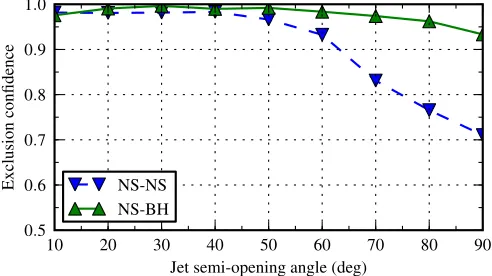
Figure2shows exclusion confidence for NS–NS and NS–BH mergers as a function of jet semi-angleθjet, assuming a distance to M81 of 3.63 Mpc. If we assume isotropic γ-ray (i.e., unbeamed) emission from GRB 051103, then the possibility of NS–NS coalescence in M81 as its progenitor is excluded with 71% confidence. Taking a fiducial jet semi-angle of
θjet=30◦, exclusion confidence rises to 98%. NS–BH mergers with isotropic emission are excluded at 93% confidence, rising to>99% forθjet=30◦.
10 20 30 40 50 60 70 80 90 Jet semi-openingangle (deg)
0.5 0.6 0.7 0.8 0.9 1.0
Excl
u
sion
confidence
[image:6.612.321.566.57.198.2]NS-NS NS-BH
Figure 2. Exclusion confidences for the two classes of compact binary coalescences considered in the matched-filter analysis as a function of jet semi-opening angle and assuming a distance of 3.63 Mpc to GRB 051103. The estimate is based on simulations where neutron star masses are Gaussian distributed with mean 1.4Mand standard deviation 0.2M. Black hole masses are also Gaussian distributed with mean 10.0Mand standard deviation 6.0M. The reduced confidence below 30◦is purely due to numerical corrections for limited simulation size.
(A color version of this figure is available in the online journal.)
are excluded with 90% confidence out to a distance of 2.1 Mpc, rising to 5.2 Mpc forθjet=30◦. The corresponding distances for
NS–BH coalescences are 5.3 Mpc and 10.7 Mpc, respectively. For comparison, the closest short-duration, hard-spectrum GRB with an optical afterglow and a well-established redshift is GRB 080905A with z = 0.1218, which corresponds to a luminosity distance of approximately 560 Mpc (Rowlinson et al.
2010).
The increase in exclusion confidence for smaller jet angles is due to the fact that the average amplitude of the GW signal from compact binary coalescence is smaller for systems whose orbital plane is viewed “edge-on” (where the detector receives the flux from just one GW polarization) than for systems viewed “face-on” (where the detector receives the flux from both GW polarizations); small jet angles imply a system closer to face-on.
3. SEARCH FOR A GW BURST
3.1. Search Methods
We perform two searches for a GW burst associated with GRB 051103. As discussed previously, there is evidence that a fraction of short GRBs are caused by nearby magnetar flares, so we perform a search tailored to the expected GW signal arising from such a flare. Additionally, we perform a search for a generic GW burst in the time around the GRB.
TheFlare pipeline (Kalmus et al. 2007; Kalmus 2008) targets neutron star fundamental mode (f-mode) ringdowns as well as unmodeled short-duration GW signals. It has been used previously to search for GWs associated with Galactic magnetar bursts including the 2004 December giant flare from SGR 1806−20 (Abbott et al.2008b,2009c; Abadie et al.2011). As in the previous magnetar searches, we use an on-source region of [−2,+2] s about the GRB 051103 trigger, and an off-source region of 1000 s on either side of the on-off-source region to estimate the significance of on-source events.
Flareproduces a time–frequency pixel map from the condi-tioned and calibrated detector data streams in the Fourier basis, groups pixels using density-based clustering, and sums over the group to produce events. The data from each of the two detectors are combined by including detector noise floor measurements and antenna responses to the source sky location as
weight-10 20 30 40 50 60 70 80 90
Jet semi-openingangle (deg) 0
2 4 6 8 10 12
90%
Excl
u
sion
(Mpc)
[image:6.612.46.292.59.197.2]NS-NS NS-BH DM81
Figure 3.90%-confidence exclusion distance as a function of jet semi-angle for binary coalescences, given LIGO observations at the time of GRB 051103. (A color version of this figure is available in the online journal.)
ing factors in the detection statistic. We divide the search into three frequency bands: 1–3 kHz, wheref-modes are predicted to ring; and 100–200 Hz and 100–1000 Hz, where the detectors are most sensitive. In thef-mode band, we use a Fourier trans-form length of 250 ms, which we find to be optimal forf-mode signals expected to decay exponentially with a timescaleτ in the 100–300 ms range (Benhar et al.2004).
TheX-Pipeline analysis package (Sutton et al. 2010) searches for generic GW bursts in data from arbitrary networks of detectors.X-Pipelinewas previously used in the search for GW bursts associated with GRBs in LIGO science run 5 and Virgo science run 1, in 2005–2007 (Abbott et al.2010). Since the analysis is not based on a specific GW emission model, we keep the search parameters broad to allow for a generic GW burst. In particular, we define our on-source region as the in-terval [−120,+60] s around the GRB trigger; this conservative window is large enough to accommodate the time delay between a GW signal and the onset of the gamma-ray signal in most GRB progenitor models. We use 1.5 hr of data on either side of the on-source region as the off-source region for background char-acterization. The frequency band of theX-Pipelinesearch is 64–1792 Hz.
X-Pipelinecombines the data streams from each detector with weighting determined by the sensitivity of each detec-tor as a function of frequency and sky position. This yields time–frequency maps of the signal energy in each pixel. Can-didate GW events are identified as the loudest 1% of pixels in the map. Each is assigned a significance based on its en-ergy and time–frequency volume, using aχ2 distribution with
two degrees of freedom. These candidates are then refined by comparing the degree of correlation between the H2 and L1 data streams, rejecting low-correlation events as background. Surviving events are ranked by their significance, then each is assigned a false-alarm probability by comparison to events from the off-source region.
3.2. Search Results
Neither theFlaremagnetar search nor theX-Pipeline anal-ysis yield evidence for a plausible GW burst signal associated with GRB 051103. Consequently, we place model-dependent 90%-confidence level upper limits on the isotropic energy emis-sion in GWsEGWassociated with this GRB.
four band- and time-limited white noise bursts with durations of 11 ms or 100 ms and spanning the 100–200 Hz and 100–1000 Hz bands. Uncertainties from detector calibrations and Monte Carlo statistics were folded into upper limit estimates as described in Abadie et al. (2011); additionally, we added a 4% uncertainty to account for the GRB 051103 error ellipse (Hurley et al.2009), which was estimated empirically by rerunning the search at the error ellipse extremes.
The best (lowest) upper limit onEGW was 2.0×1051 erg,
for 100–200 Hz white noise bursts lasting 100 ms. The lowest f-mode upper limit was 1.6×1054erg, for circularly polarized
ringdowns at 1090 Hz. These are the lowest frequency signals of each morphology; limits obtained for the other 10 simulated signals scale with the noise floor of the LIGO detectors as expected and the simulations provide a check of the robustness of the analysis to the large uncertainty in the frequency of a putative GW signal (for more details on the simulations used, see Abadie et al.2011).
The upper limits produced by the broadX-Pipelinesearch are computed in a similar way, although they make use of circularly polarized sine-Gaussian waveforms at 150 Hz and 1000 Hz (for details, including handling of uncertainties, see Abbott et al. 2010). We find upper limits onEGWof 1.2×1052erg at 150 Hz
and 6.0×1054 erg at 1000 Hz. We can convert these results
to lower limits on the distance to GRB 051103 as a function of EGW, giving 4.4 Mpc (EGW/0.01Mc2)1/2 at 150 Hz and
0.20 Mpc (EGW/0.01Mc2)1/2at 1000 Hz.
Even near the frequency of LIGO’s best sensitivity, our energy upper limits are several orders of magnitude larger than the maximum energy available for emission by SGRs in GWs ∼1046–1049 erg (de Freitas Pacheco1998; Ioka 2001; Owen 2005; Horvath2005; Corsi & Owen2011). Indeed, the energy actually emitted as gravitational waves may be much less than this (Kashiyama & Ioka2011; Levin & van Hoven2011). We are therefore unable to inform the hypothesis of an SGR progenitor for GRB 051103.
4. CONCLUSION
We analyzed data from the LIGO L1 and H2 GW detectors in a frequency band spanning 40 Hz–3 kHz, looking for a GW signal associated with the short-hard GRB 051103. Three data analysis pipelines were deployed, two of which are designed to search for unmodeled, short-duration (1 s) burst-like GW signals and one which performs a matched-filter analysis using templates based on the GW signal expected from compact binary mergers. No evidence was found for a GW signal associated with this GRB.
The sensitivity of the matched-filter search allows us to confidently exclude the hypothesis that the progenitor system was a compact binary merger progenitor in M81. Specifically, assuming an outflow jet semi-angleθjet =30◦, we exclude an NS–NS merger in M81 at 98% confidence. NS–BH mergers with similarly beamed emission are excluded at>99% confidence. Relaxing the assumption of beaming such that we include systems whose orbital plane is oriented edge-on to our line of sight, the confidences for NS–NS and NS–BH mergers fall to 71% and 93%, respectively. As a measure of the distance to which we are sensitive to such events, the 90%-confidence exclusion distances for NS–NS and NS–BH systems with beaming are 5.2 Mpc and 10.7 Mpc, respectively. Assuming no beaming, these distances drop to 2.1 Mpc and 5.3 Mpc.
The null result of the searches for an unmodeled burst of GWs allows us to set upper limits on the GW energy emission
of GRB 051103. These limits are in the range 1051–1055 erg,
depending primarily on the assumed GW frequency. These limits are several orders of magnitude greater than the maximum observed electromagnetic emission from SGRs,∼1046erg, and
the highest predictions of the available reservoir of energy available for GW emission, so we are not able to constrain the hypothesis of an SGR progenitor for GRB 051103.
We conclude then, that it is highly unlikely that the progenitor for GRB 051103 was a compact binary merger in M81. If the event indeed occurred in M81, it seems likely on the basis of LIGO observations that this was indeed one of the most distant SGR giant flares observed to date.
The authors thank A. Rowlinson and N. Tanvir for bring-ing GRB 051103 to our attention. The authors gratefully ac-knowledge the support of the United States National Science Foundation for the construction and operation of the LIGO Laboratory and the Science and Technology Facilities Coun-cil of the United Kingdom, the Max-Planck-Society, and the State of Niedersachsen/Germany for support of the construction and operation of the GEO600 detector. The authors also grate-fully acknowledge the support of the research by these agencies and by the Australian Research Council, the International Sci-ence Linkages program of the Commonwealth of Australia, the Council of Scientific and Industrial Research of India, the Is-tituto Nazionale di Fisica Nucleare of Italy, the French Centre National de la Recherche Scientifique, the Spanish Ministerio de Educaci´on y Ciencia, the Conselleria d’Economia, Hisenda i Innovaci´o of the Govern de les Illes Balears, the Royal Society, the Scottish Funding Council, the Scottish Universities Physics Alliance, The National Aeronautics and Space Administration, the Carnegie Trust, the Leverhulme Trust, the David and Lucile Packard Foundation, the Research Corporation, and the Alfred P. Sloan Foundation. This document has been assigned LIGO Laboratory document number LIGO-P10000097-v12.
REFERENCES
Abadie, J., Abbott, B. P., Abbott, R., et al. 2010a,Nucl. Instrum. Methods Phys. Res. A,624, 223
Abadie, J., Abbott, B. P., Abbott, R., et al. 2010b,ApJ,715, 1453
Abadie, J., Abbott, B. P., Abbott, R., et al. 2011,ApJ,734, L35
Abbott, B. P., Abbott, R., Acernese, F., et al. 2010,ApJ,715, 1438
Abbott, B. P., Abbott, R., Adhikari, R., et al. 2004,Nucl. Instrum. Methods Phys. Res. A,517, 154
Abbott, B. P., Abbott, R., Adhikari, R., et al. 2007,Phys. Rev. D,76, 062003
Abbott, B. P., Abbott, R., Adhikari, R., et al. 2008a,ApJ,681, 1419
Abbott, B. P., Abbott, R., Adhikari, R., et al. 2008b, Phys. Rev. Lett.,
101, 211102
Abbott, B. P., Abbott, R., Adhikari, R., et al. 2008c,Phys. Rev. D,77, 062002
Abbott, B. P., Abbott, R., Adhikari, R., et al. 2009a,Rep. Prog. Phys.,72, 076901
Abbott, B. P., Abbott, R., Adhikari, R., et al. 2009b,Phys. Rev. D,80, 102001
Abbott, B. P., Abbott, R., Adhikari, R., et al. 2009c,ApJ,701, L68
Allen, B. 2005,Phys. Rev. D,71, 062001
Belczynski, K., Taam, R. E., Rantsiou, E., & van der Sluys, M. 2008,ApJ,
682, 474
Benhar, O., Ferrari, V., & Gualtieri, L. 2004,Phys. Rev. D,70, 124015
Chapman, R., Priddey, R. S., & Tanvir, N. R. 2009,MNRAS,395, 1515
Corsi, A., & Owen, B. J. 2011,Phys. Rev. D,83, 104014
de Freitas Pacheco, J. A. 1998, A&A,336, 397
Durrell, P. R., Sarajedini, A., & Chandar, R. 2010,ApJ,718, 1118
Evans, W. D., Klebesadel, R. W., Laros, J. G., et al. 1980,ApJ,237, L7
Feldman, G. J., & Cousins, R. D. 1998, Phys. Rev. D,57, 3873
Foucart, F., Duez, M. D., Kidder, L. E., & Teukolsky, S. A. 2011,Phys. Rev. D,
83, 024005
Frederiks, D. D., Palshin, V. D., Aptekar, R. L., Golenetskii, S. V., Cline, T. L., & Mazets, E. P. 2007,Astron. Lett.,33, 19
Golenetskii, S., Aptekar, R., Mazets, E., et al. 2005, GCN Circ.,4197, 1
Hessels, J. W. T., Ransom, S. M., Stairs, I. H., et al. 2006,Science,311, 1901
Horvath, J. E. 2005,Mod. Phys. Lett. A,20, 2799
Hurley, K., Boggs, S. E., Smith, D. M., et al. 2005,Nature,434, 1098
Hurley, K., Rowlinson, A., Bellm, E., et al. 2010,MNRAS,403, 342
Hurley, K., Rowlinson, A., Bellm, E., et al. 2009,MNRAS,403, 342
Ioka, K. 2001,MNRAS,327, 639
Kalmus, P. 2008, PhD thesis, Columbia Univ.
Kalmus, P., Khan, R., Matone, L., & M´arka, S. 2007,Class. Quantum Grav.,
24, S659
Kashiyama, K., & Ioka, K. 2011,Phys. Rev. D,83, 081302
Klose, S., Ferrero, P., Kann, D. A., Stecklum, B., & Laux, U. 2005, GCN Circ.,
4207, 1
Levan, A. J., Tanvir, N. R., Jakobsson, P., et al. 2008,MNRAS,384, 541
Levin, Y., & van Hoven, M. 2011,MNRAS,418, 659
Lipunov, V., Kornilov, V., Kuvshinov, D., et al. 2005, GCN Circ.,4206, 1
Mazets, E. P., Aptekar, R. L., Cline, T. L., et al. 2008,ApJ,680, 545
Nakar, E. 2007,Phys. Rep.,442, 166
Ofek, E. O., Kulkarni, S. R., Nakar, E., et al. 2006,ApJ,652, 507
Owen, B. J. 2005,Phys. Rev. Lett.,95, 211101
Racusin, J. L., Liang, E. W., Burrows, D. N., et al. 2009,ApJ,698, 43
Rantsiou, E., Kobayashi, S., Laguna, P., & Rasio, F. A. 2008, ApJ,
680, 1326
Rezzolla, L., Giacomazzo, B., Baiotti, L., et al. 2011,ApJ,732, L6
Robinson, C. A. K., Sathyaprakash, B. S., & Sengupta, A. S. 2008,Phys. Rev. D,
78, 062002
Rodriguez, A. 2007, Master’s thesis, Louisiana State Univ.
Rowlinson, A., Wiersema, K., Levan, A. J., et al. 2010,MNRAS,408, 383
Setiawan, S., Ruffert, M., & Janka, H.-T. 2004,MNRAS,352, 753
Shibata, M., & Taniguchi, K. 2006,Phys. Rev. D,73, 064027
Sutton, P. J., Jones, G., Chatterji, S., et al. 2010,New J. Phys.,12, 053034
Tanvir, N. R., Chapman, R., Levan, A. J., & Priddey, R. S. 2005,Nature,