S
TRATHCLYDE
D
ISCUSSION
P
APERS IN
E
CONOMICS
D
EPARTMENT OF
E
CONOMICS
U
NIVERSITY OF
S
TRATHCLYDE
G
LASGOW
THE EFFECTS OF AGGLOMERATION ON WAGES:
EVIDENCE FROM THE MICRO-LEVEL
B
Y
BERNARD FINGLETON AND SIMONETTA LONGHI
1
The effects of agglomeration on wages: evidence from the
micro-level
Bernard Fingleton
1Simonetta Longhi
2This version, May 2011
Abstract : This paper estimates individual wage equations in order to test two rival non-nested theories of economic agglomeration, namely New Economic Geography (NEG), as represented by the NEG wage equation and urban economic (UE) theory , in which wages relate to employment density. The paper makes an original contribution by evidently being the first empirical paper to examine the issue of agglomeration processes associated with contemporary theory working with micro-level data, highlighting the role of gender and other individual-level characteristics. For male respondents, there is no significant evidence that wage levels are an outcome of the mechanisms suggested by NEG or UE theory, but this is not the case for female respondents. We speculate on the reasons for the gender difference.
Keywords : urban economics, new economic geography, household panel data.
JEL classifications : C21, C31, C33, D1, O18, R20, R12
1. Introduction
Recent papers have suggested that models deriving from urban economics (UE) may provide a better explanation of spatial variation in wage levels over short distances than the New Economic Geography (NEG) wage equation (Combes, Duranton and Overman, 2005, Brakman, Garretsen, and Van Marrewijk, 2009, Fingleton, 2011). Somewhat in contrast Fujita, Krugman and Venables(1999) emphasise the generality of the processes embodied in NEG, regardless of spatial scale, in other words NEG is a ‘one-size-fits-all’ model. This comes across from the Preface of the their seminal book, which emphasises ‘how a common approach …can be applied to a wide variety of issues in regional, urban and international economics’. However, although this ‘one-size-fits-all’ approach has been subject to criticism on empirical grounds, current evidence supporting the superiority of the rival UE model as a basis for modelling localised wage variation is compromised somewhat by being based on areal units which are unable to allow full identification of individual-level heterogeneity and its influence on wage levels. In order to build on, and advance beyond, the current state-of-the-art, and to revisit the debate surrounding the respective virtues of NEG and UE, in this paper we
1 Department of Economics, University of Strathclyde. Email [email protected]. Corresponding author. 2
2
examine data at the lowest possible level of spatial aggregation, namely the individual level, allowing us to take account of various individual level variables and also, by means of fixed effects in a panel data model, to also control for unobserved individual level heterogeneity. Our paper takes its cue from the observation by Garretsen and Martin (2011), in the recent special issue of the Journal of Economic Geography, that ‘geographical economists have started to expand their field by building on and incorporating new insights from adjacent fields like international economics, labour economics and urban economics, in order to take account, for instance, of firm and worker
heterogeneity, knowledge spillovers, different types of transport cost assumptions, the use of micro-data and more generally a much more detailed analysis of agglomeration economies’. Likewise, Ottaviano(2011), Venables(2011) and Combes et. al. (2011) emphasise the potential role to be played by ‘micro-heterogeneity’ across people (and firms) in our understanding of agglomeration economies.
An additional consideration is the problem of accounting for the endogeneity of key variables, an adequate solution to which has hitherto proved elusive or costly. Our analysis is based on data from the British Household Panel Survey, and in order to link households to centres of employment, we take advantage of the commuting flow data available in the UK 2001 census, but this introduces an additional endogenous element to our analysis. The question of the choice, validity and appropriateness of the instruments needed to produce consistent estimates remains an important and difficult-to-solve conundrum. We present in this paper what we believe are some novel solutions to the selection of instruments, using historical data from 1861 British census and data on the location of early railways, all of which we believe gave the impetus for additional urban development and the focal points for contemporary agglomeration processes.
2. Theory
The theory of the rival models has been recently sketched by Fingleton(2011). In this paper we use this summary of the rival theories as the background to our empirical analysis. Our first theory, namely UE, for our purposes is best represented in the work of Abdel-Rahman and Fujita (1990), and Fujita and Thisse(2002, page 102), although different set-ups leading to the same reduced form are given in Combes, Mayer, and Thisse (2008) and Brakman, Garretsen, and Van Marrewijk (2009). Assume that a final sector (C) exists in which the market structure is one of perfect competition. None the less increasing returns occur as a consequence of firms within the intermediate (monopolistic or M) sector providing inputs to the final sector. This is because firms in the M sector, which have the sole input labour, are characterised by a fixed labour requirement s and a marginal labour requirement a, thus giving increasing internal returns to scale. We assume, without loss of generality, that the final sector comprises a single firm, and that this has the following production function
1 1
((
C)
)
Q
E
I
L
(1) indicating that final sector production depends on the number of C labour units
E
C, on the level of composite services I from the M firms, and on the amount of landL. Assume that production is per unit area, so that L1, then if α < 1 the model includes the effects of congestion (Ciccone and Hall, 1996) on the level of production. Given that I is solely a function of the size of the labour force in the M sector,E
M, then it follows that31
((
C)
)
Q
E
I
E
(2)3
3
in which
E E
M
E
C,
is a complex function of constants
, , and s, and[1 (1 )( 1)]
with the elasticity of substitution in the CES production function for theintermediate sector equal to
1
. If the intermediate sector is relevant (
1), has somemonopoly power (
1) and congestion is sufficiently weak (
1
), then it may turn out that
> 1 and hence there are increasing returns to scale. Taking the wage rate as the derivativeC C
Q
Q
w
E
E
(3)then with
E E
C
,wE
Q
(4) andln( ) ln( )w
ln( ) ln( ) ln( )E
E . (5) Adding disturbances
to capture unobserved random effects, and with absorbing the constants, we can test the null hypothesis that
1 0 via the regression model1
ln( )
w
k
(
1)ln( )
E
(6) The major advantage of this reduced form, compared with the rival NEG theory, is the relatively small number of assumptions. As mentioned in Fingleton(2011), the requirement for the basic UE model is simply total employees per square km (E) and the wage rate w. However we are here working in a panel data context, and hence with time varying w and E.It is well known that the short-run equilibrium for the NEG model amounts to a handful of simultaneous equations (as shown by Fujita, Krugman and Venables, 1999), one of which is the so-called wage equation. This provides an alternative explanation of spatial variation in wage levels, although it is specifically written in terms of the M sector, which under the standard theory is taken to be ‘industry’. The basic wage equation is
1 1
1 1
[ ( ) ( ) ]
M
i r r ir i
r
w
Y G T P(7)
in which wMis M sector wages, which depends on market potential
P
, which is a function of incomeY
, of the M sector price indices G , of trade costsT
irbetween locations i and r, and ofthe elasticity of substitution,
. Prices G and incomesY
are given by1 1 1
( ) ]
[
irM
i r r
r
T
G
w
(8)(1
)
r M r C
r r r
Y
w
w
(9)The share of M workers in location i is denoted by
i and
i is the share of C workers. Also,
is4
Given these it is possible to solve the simultaneous equations to give the short run NEG equilibrium given by the wage equation (7).
We can turn this into a regression equation comparable to (6) by taking logs, and adding and disturbance
to take account of the fact that we typically would be working with overall, rather than sector specific, wages, hence1
ln
w
ln
P
(10)Note from the definition of Pin equation (7) that the NEG wage equation is significantly more complex than is the equivalent wage equation (6) from UE theory. Moreover it is by definition endogenous, since it depends onw.
Our solution to the system (7, 8, and 9) uses the same approach as described in
Fingleton(2006), but as we will be analysing panel data, we calculate Pi for each year of our study,
thus
i,
i,
and overall nominal wageswi ( approximatingw
iM ) are time varying, but
is constant over time and also for consistency with the earlier literature is set equal to 6.25. Likewise trade costs are time-invariant, equal to lnDirir ir
T e D with
D
irequal to the straight lineinterregional distance between regions i and r, and with
0.1
. One immediate concern, which makes explicit the difference between the UE and NEG theories, is the existence, definition and measurement of trade costs. For UE theory it is not an issue, they are irrelevant. For NEG theory, it is one of the problems that have to be solved. We do not delve deeply into this, but simply refer to the discussion in Garretsen and Martin (2010), Bosker and Garretsen(2010), Fingleton andMcCann(2007), Fingleton(2005), Redding and Venables(2004) and the related literature cited in these papers.
Moreover for both variables Pi and Ei there are additional issues of endogeneity which
need to be resolved to obtain consistent estimates of the panel wage equations, since as presently described, both employment density (UE) and market potential (NEG) relate to regions of
employment, not individual households. By taking account of commuting flows, we introduce an additional element of endogeneity as described below.
3. Data
The UK census gives data on commuting travel between 408 (pre-2009) unitary authority and local authority districts (UALADs) covering the surface area of Great Britain. These districts are one of the fundamental spatial building blocks of our analysis4. The census data are therefore a 408 by 408 interaction matrix of commuting frequencies. We normalise these frequencies by dividing each cell by its row total, so that the normalised commuting flows sum to 1 across rows. The matrix product of this n by n matrix (OD_2001) and an n by 1 vector gives an n by 1 vector of weighted averages with weights determined by relative commuting frequencies. The main diagonal of the matrix naturally contains the largest weights.
4 In practice we confine analysis to the 376 UALADs of England and Wales, although as described below we
5
We also utilize total employment by UALAD over the period 1998 to 2008, together with UALAD shares in M and C sectors, as defined in Fingleton(2006). The employment totals divided by each UALAD area (in sq km) gives the time-varying employment density variable (E) of the UE model. The matrix product of OD_2001 and E gives the first of our explanatory variables, E, which we prefer to E because our data are the outcome of home-based interviews. We are explaining wages by home location, so that what is important is the employment density of the employment centre to which the worker commutes, not employment density in the place of residence. Since we do not have precise knowledge of the specific commuting destination of individuals, we use the information given in the commuting matrix to obtain a per-UALAD weighted average of employment density by year with weights determined by the relative commuting frequency from the UALAD of residence to both itself and all other UALADs.
The UALAD shares in M and C sectors
i,
i, and
for each year from 1998-2008 arerequired to obtain our time-varying measure of market potential, and as with E the matrix product of OD_2001 and P gives the explanatory variable P. Again the important feature of this variable is that it measures access by resident households to market potential, with weights allotted according to relative commuting frequencies from household locations.
In our econometric analysis, we use E and P to explain spatial variation in individual residence-based wage levels5, as described subsequently. As a precursor, we also examine the correlation, at the UALAD level, between E and Pand mean weekly gross pay6 of full time7 workers for UALAD of residence (wage by home UALAD, or
w
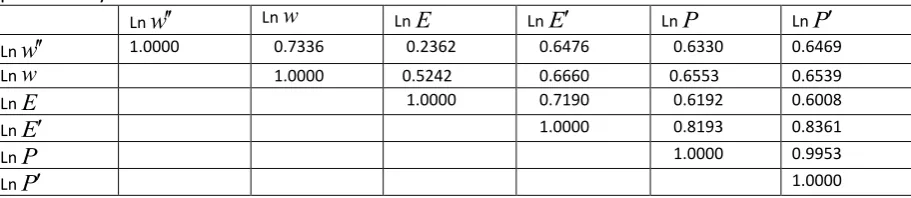
) for each year from 2002, and between E and Pand mean weekly gross pay of full time workers by workplace8 (w). The correlations give an initial rough indication of the relative explanatory power of our variables E and P. The correlation matrix9 (Table 1) shows that lnE is relatively weakly correlated with wage by home UALADln
w
, although it is more strongly correlated with ln w, reflecting the essential need to take account of commuting in explaining wage rate variation. The commuting weighted version of employment density (In E) shows the highest correlation with wages by home UALAD, reflecting the fact that what is important is employment density within commuting distance, not employment density in the home UALAD. While weighting by commuting frequency makes a big difference to the apparent explanatory power of employment density, its effect on market potential is very small, although it does marginally increase the correlation. This marginal impact is because a home location’s market potential depends on surrounding locations, so that leafy suburbs of big cities already possess high market potential prior to weighting. The fact that weighting bycommuting frequency makes very little difference to the market potential variable is indicated by the very strong linear correlation between lnP and lnP.
5
Given in our data from the British Household Panel Survey (BHPS), to be described subsequently.
6 From NOMIS. 7
30 or more hours per week.
8 These data require a small amount of interpolation to fill missing cells. For wages by place of employment,
we interpolate 24 cells out of 4488 for the period 1998 to 2008.
9
6
Table 1 : Correlations between home and work-based wages, employment density and market potential by UALAD
Ln
w
Lnw LnE LnE LnP LnP Lnw
1.0000 0.7336 0.2362 0.6476 0.6330 0.6469 Lnw 1.0000 0.5242 0.6660 0.6553 0.6539 LnE 1.0000 0.7190 0.6192 0.6008 LnE 1.0000 0.8193 0.8361 LnP 1.0000 0.9953LnP 1.0000
Our econometric analysis combines the UALAD data on employment density and market potential, namely the variables E and P, with individual level data obtained from the British Household Panel Survey10 (BHPS). The data set comprises 10 waves (waves 8 to 17) of interviews over the period 1998 to 2007 (the panel extends outside this time period, but data considerations limited our analysis to these 10 waves), so that overall we have information on 52,042 interviews for England and Wales11. The selection of variables from the BHPS is motivated by the typical
specification of a Mincerian wage equation, in which wages partly depend on experience and schooling. Many studies have used earnings data from the BHPS, most recently Francesconi et. al. (2011), who give many insights regarding the source and quality of the BHPS data, noting that the BHPS earnings data seems to be equally as reliable as the Family Resources Survey (FRS), which is a special income survey forming the basis of official UK income distribution estimates. They note that our preferred variable, ‘usual gross earnings’ (
w
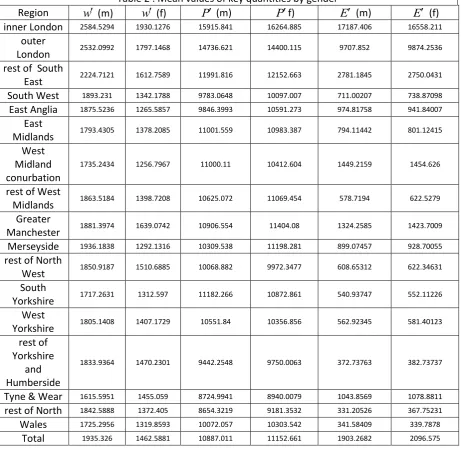
)12, which measures monthly not hourly earnings, is essentially based on the BHPS variables PAYGL and PAYU , and does include some imputation, but it ‘is a measure which is favoured by many analysts’. Table 2 gives the distribution by region of three key variables, where each region’s value is the mean, averaging over all respondents (differentiating between males and females) within the region and over time. The GORs (Government Office Regions) used in Table 2 are aggregations of UALADs. These are not thequantities that we use in our econometric models, but nevertheless these data are informative. The correlation between wages, market potential and employment density and the importance of gender and location are apparent from this table.
10
Available to registered users from the University of Essex Data Archive.
11 We have excluded the panel for Scotland because of data limitations. Also our analysis is restricted working
age people (16-59; 16-64) and to employees, thus excluding the self-employed.
12
7
Table 2 : Mean values of key quantities by gender
Region
w
(m)w
(f) P (m) Pf) E (m) E (f)inner London 2584.5294 1930.1276 15915.841 16264.885 17187.406 16558.211 outer
London 2532.0992 1797.1468 14736.621 14400.115 9707.852 9874.2536 rest of South
East 2224.7121 1612.7589 11991.816 12152.663 2781.1845 2750.0431 South West 1893.231 1342.1788 9783.0648 10097.007 711.00207 738.87098 East Anglia 1875.5236 1265.5857 9846.3993 10591.273 974.81758 941.84007
East
Midlands 1793.4305 1378.2085 11001.559 10983.387 794.11442 801.12415 West
Midland conurbation
1735.2434 1256.7967 11000.11 10412.604 1449.2159 1454.626
rest of West
Midlands 1863.5184 1398.7208 10625.072 11069.454 578.7194 622.5279 Greater
Manchester 1881.3974 1639.0742 10906.554 11404.08 1324.2585 1423.7009 Merseyside 1936.1838 1292.1316 10309.538 11198.281 899.07457 928.70055 rest of North
West 1850.9187 1510.6885 10068.882 9972.3477 608.65312 622.34631 South
Yorkshire 1717.2631 1312.597 11182.266 10872.861 540.93747 552.11226 West
Yorkshire 1805.1408 1407.1729 10551.84 10356.856 562.92345 581.40123 rest of
Yorkshire and Humberside
1833.9364 1470.2301 9442.2548 9750.0063 372.73763 382.73737
Tyne & Wear 1615.5951 1455.059 8724.9941 8940.0079 1043.8569 1078.8811 rest of North 1842.5888 1372.405 8654.3219 9181.3532 331.20526 367.75231 Wales 1725.2956 1319.8593 10072.057 10303.542 341.58409 339.7878
Total 1935.326 1462.5881 10887.011 11152.661 1903.2682 2096.575
In our wage equation, we capture the effect of experience via the BHPS variables age of respondent and age-squared (designated age and age2), anticipating a positive coefficient on age and a negative coefficient on age-squared, thus giving a quadratic relationship between experience (age) and wage level. Additionally, we include 8 Standard Occupational Classification dummies (SOC1 to SOC8), and dummy variables indicating whether the respondent has children (Kids) and whether the respondent is ‘married’ (Married)13. We also include 9 year dummies to capture year-specific national factors that might have an impact on wages (e.g. inflation etc.). Importantly, we also include region dummies in many specifications so as to correctly identify the effects of market potential and employment density separately from other unspecified sources of spatial economic heterogeneity. Other unobserved sources of individual heterogeneity are captured by the fixed effects in our model specification. This means that one important variable, gender (Male, female), is not identified. We give special attention to this variable by estimating our fixed effects panel
13
8
separately for men and for women. We therefore have data on 21 individual time-varying
explanatory variables and one dependent variable ln
w
. In order to be able to supplement this suite of explanatory variables by our two rival time-varying theory-derived measures of the individual’s ‘economic environment’, namely E and P, which are available for UALADs, it was necessary to link UALADs to respondents’ places of residence and also to the wave of the survey. Theconfidential information on respondent locations was accessible to us on licence and we were therefore, for each individual at each point in time, able to provide individual-specific measures of market potential and employment density.
An important consideration in our analysis is the endogeneity associated with E and P. This has several sources. For example, it is likely that commuting frequencies will be a consequence of wage levels, with high wage centres attracting more commuters. This in turn will influence our variables which are of course a weighted function of commuting frequencies. Moreover it is likely that measurement error will be factor, particularly in the values obtained for market potential, because this depends on an unknown parameter
, and on assumptions about the definition of C and M sectors (see Section 2). Moreover, the definition of market potential shows that it depends on wage levels, so that there is potentially a two-way interaction between our dependent andindependent variables. Although market potential is calculated using the wage data by UALAD of employment discussed above, nevertheless it is seems likely that endogeneity involving individual level wages and market potential will occur. Likewise, in the case of commuting-weighted
employment densityE , one might anticipate that this will be an effect of
w
as well as being a cause, since workers may be attracted to locations with high wages. In addition commuting frequencies will again depend on wages so the effect of wages is embodied within E for this reason also. Because of these considerations, to achieve consistent estimates, we need to rely on appropriate instrumental variables.4. Preliminary Estimates
Our preliminary analysis sets the scene for our more rigorous subsequent econometrics in which we endeavour to take full account of endogeneity. In this section we provide information that contributes to the overall understanding and conceptualization of the relationship betweenE, P and
w
. Our analysis compares the relative efficacy of (log) market potential and (log) employment density in explaining variations in individual (log) wages(lnw
), controlling for individual-level covariates ( time constant variables, plus a quadratic age function, dummies for children, ‘marriage’, occupational classification and panel wave). Of the time constant variables, we give specialattention to gender and we therefore split our analyses between male and female respondents in England and Wales in full time occupation. In all of our analyses we find that we are constrained to separate models for males and females because time-invariant variables such as gender are not identified in our fixed effects specifications14.
14
9
In order to obtain an initial insight, we ignore the endogeneity issues and fit fixed effects panel models (in effect OLS models fitted to deviations from individual means) which are
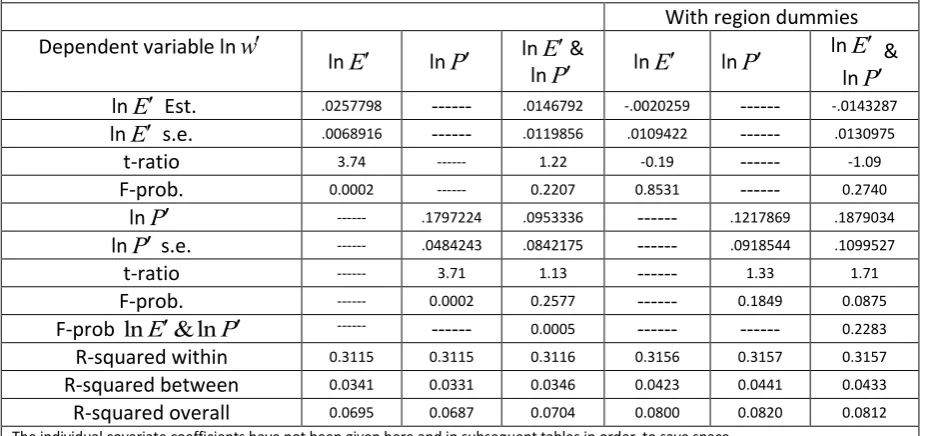
[image:10.595.66.529.341.559.2]summarised in Tables 3 and 4. They are simply presented as a precursor to valid inference on the basis of consistent estimates. Because our rivals are non-nested, this means that we are unable to constrain a parameter to zero to reduce from one to the other, allowing a simple test of the null that the constrained parameter is truly zero. To allow non-nested rivals to be tested, Hendry(1995) suggests a data generating process (DGP) in which both rival theories are combined as an artificial nesting model(ANM), of which both rivals are special cases. Given rivals A and B, we are interested in whether A encompasses, or explains the results of, B, and vice versa. So if dropping A from the ANM model produces a significant loss of fit, and dropping B does not, then in effect A is explaining the ANM results and therefore the B results embodied within the ANM.
Table 3 : Fixed effects panel estimates of key quantities : male full time employees, England & Wales With region dummies Dependent variable ln
w
lnE lnP lnE&
lnP lnE lnP
lnE & lnP lnE Est. .0257798 --- .0146792 -.0020259 --- -.0143287
lnE s.e. .0068916 --- .0119856 .0109422 --- .0130975
t-ratio 3.74 --- 1.22 -0.19 --- -1.09
F-prob. 0.0002 --- 0.2207 0.8531 --- 0.2740
lnP --- .1797224 .0953336 --- .1217869 .1879034 lnP s.e. --- .0484243 .0842175 --- .0918544 .1099527
t-ratio --- 3.71 1.13 --- 1.33 1.71
F-prob. --- 0.0002 0.2577 --- 0.1849 0.0875
F-prob lnE&lnP --- --- 0.0005 --- --- 0.2283
R-squared within 0.3115 0.3115 0.3116 0.3156 0.3157 0.3157
R-squared between 0.0341 0.0331 0.0346 0.0423 0.0441 0.0433
R-squared overall 0.0695 0.0687 0.0704 0.0800 0.0820 0.0812
10
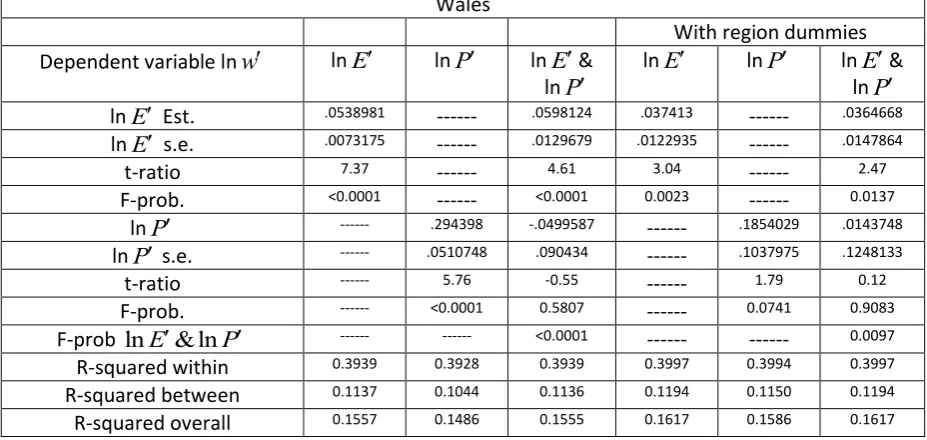
Table 4 : Fixed effects panel estimates of key quantities : female full time employees, England & Wales
With region dummies Dependent variable ln
w
lnE lnP lnE&lnP
lnE lnP lnE& lnP lnE Est. .0538981 --- .0598124 .037413 --- .0364668 lnE s.e. .0073175 --- .0129679 .0122935 --- .0147864
t-ratio 7.37 --- 4.61 3.04 --- 2.47
F-prob. <0.0001 --- <0.0001 0.0023 --- 0.0137
lnP --- .294398 -.0499587 --- .1854029 .0143748 lnP s.e. --- .0510748 .090434 --- .1037975 .1248133
t-ratio --- 5.76 -0.55 --- 1.79 0.12
F-prob. --- <0.0001 0.5807 --- 0.0741 0.9083
F-prob lnE&lnP --- --- <0.0001 --- --- 0.0097
R-squared within 0.3939 0.3928 0.3939 0.3997 0.3994 0.3997
R-squared between 0.1137 0.1044 0.1136 0.1194 0.1150 0.1194
R-squared overall 0.1557 0.1486 0.1555 0.1617 0.1586 0.1617
Both Tables 3 and 4 provide some initial evidence that each of our rivals seems to have a highly significant effect, as indicated by the t-ratios. In Table 3, when considered separately, both ln
E and lnP appear to be highly significant. However the right hand panels of Table 3 show that when region dummies15 are also included in the specification, thus giving a much tougher test, the individual significance of lnE and lnP disappears. This suggests that these variables are capturing spatially varying or ‘environmental’ effects aspects other than employment density or market potential, and controlling for these via the region dummies it is evident that lnE and lnP have no ‘effect’ on individual male wages. One would anticipate that If NEG theory was the dominant explanation of individual wage variation, it would retain significance given the presence of the employment density variable, with the latter failing to carry any additional explanatory information, but when they are combined together as an artificial nesting model (ANM) neither emerges as significant, either with or without the presence of region dummies. It is evident from Table 3 that for males neither rival encompasses the other; neither rival stands out as significant given the presence of the other. For male respondents, dropping lnE from the ANM inclusive of region dummies does not produce a significant loss of fit16, given the presence of lnP. Likewise dropping lnP gives a similar outcome although there is an indication of weak significance accepting a 10% level of risk (p = 0.087). Neither does eliminating both rivals simultaneously produce a significant loss
15
inner London, outer London, rest of South-East, South West, East Anglia, East Midlands, West Midlands conurbation, rest of West Midlands, Greater Manchester, Merseyside, rest of North West, South Yorkshire, West Yorkshire, rest of Yorkshire and Humberside, Tyne & Wear, rest of the North, Wales.
16
11
of fit17, so the lack of individual significance is evidently not the result of collinearity inflating standard errors and reducing significance.
When we consider female respondents, the results are remarkably different (Table 4). Without region dummies, both lnE and lnP are nominally highly significant, and the artificial nesting model strongly supports the hypothesis that lnE is the dominant variable and lnP does not seem to carry any significant additional explanatory information. Our more rigorous model which includes the region dummies reaffirms these outcomes, although lnP considered alone is only marginally significant ( p = 0.074). Even with region dummies, lnE retains its apparent significance in the presence of lnP, as shown by column 7 of Table 4. Given region dummies, dropping lnE produces a significant loss of fit18 whereas dropping lnP does not19.
Figure 1 : The 1845 rail network in England and Wales
5. Instruments
Our selection of instruments is conditioned by a number of factors. First, we need a sufficient number to allow overidentification and therefore to test the exogeneity of the
instruments. Given that we will simultaneously introduce both rival variables, E and P, in some of our model specifications, we need at least three excluded instruments. However we do not want
17 F( 2, 17972) = 1.48, Prob > F = 0.2283. 18 F( 1, 118408) = 6.08, Prob > F = 0.0137. 19
12
too many instruments, because of the possibility that a large number may overfit the endogenous variables and lead to incorrect inferential decisions (Roodman, 2009). In other words a multiplicity of instruments may fit the endogenous variable so well that the fitted values used in the second stage may still contain the endogenous component of variation that we are attempting to expunge, thus leading to bias. A second issue is similar to that encountered by the need to merge UALAD and BHPS data earlier, the problem of different spatial units. Thirdly, we wish to avoid weak instruments, which itself leads to bias and size distortion (Stock, Wright and Yogo, 2002, Stock and Yogo, 2005 ), so our instruments should be sufficiently correlated with the endogenous regressors E and
P
while remaining orthogonal to the disturbances.In order to try to ensure exogeneity, we chose our instruments from data gathered more than 130 years previously, partly by using data from the 1861 British Census20. The chosen instruments were selected to indicate those locations that were rapidly expanding as cities at the height of the industrial revolution, and as significant causes of present-day city locations we
anticipate that they will correlate strongly with market potential and employment density, which are at their maximum in the large densely populated cities of today. On the other hand, we do not expect our instruments to be causally related to current wage levels. We test these assumptions via the standard diagnostic tests reported subsequently.
The census variables adopted as instruments are population change from 1851 to 1861(pop_ch), the share21 of male employment in manufacturing in 1861 (m_manuf_sh), and the number of people born in Ireland per thousand population(irld_pt) in each location in 1861. The level of population change identifies rapidly growing locations of the mid-19th century, thus indicating where urbanization and localization externalities were strong, and where it was likely to continue into the future. The importance of rapid growth in this era is readily identified in the built environment of many of Britain’s major cities today, which possess a significant Victorian legacy. The boom industry of the mid 19th century British city was manufacturing, and we are able to also pick up the growth points in the urban system by means of the m_manuf_sh instrument. We complement this by the irld_pt instrument, which identifies the rapidly expanding centres of employment which were particularly the destinations of many people displaced by the Irish famine of 1845 and 1852.
One additional instrument is the number of railway lines existing in 1845 in each locality22. Figure 1 show the distribution of railways against the back ground of UALADs, and from this it is apparent that England and Wales already had a communications network linking the main urban centres, together with some more remote railway lines such as in Cornwall, that were related to mining activity. Nevertheless the distribution of railways largely reflects the distribution of the main urban centres and indicates potential growth points for future urban development.
20 The data are taken from a large dataset which has been assembled from a number of sources by David
Gatley. This is part of part of the Great Britain Historical GIS, developed by Ian Gregory.
21
As a share of the total of men working the following sectors identified in the 1861 Census : agriculture & farming, mining and brick-making, building, manufacturing, transport & storage, dealing, commercial service, general labour, public service and domestic service.
22
We are grateful to Robert Schwartz for providing these data, which was created by a team led by Jordi Marti-Hennebourg. More detail of these data is provided at
13
Thus far we have not examined the issue of matching the spatial units, the ‘districts’, used for the 1861 census variables and also the matching of the rail network vector, to the respondents’ household locations. To do this we use the UALAD boundary system as an intermediate stage, first mapping our district-based variables and our railway occurrence vector to UALADs and then
subsequently mapping the resulting UALAD-based variables to household locations, as was done for the variables E and P. The initial step is to translate the Census and railway data to the UALAD system of spatial units. First let us consider the 1861 Census data which is organised by 638 districts covering England and Wales and the Channel islands. Fortunately district grid references are
available, and in 156 cases we are able to match precisely districts and UALADs, which possess the same names and fairly precisely overlapping locations.
Given these 156 matching locations, we can estimate regression models in which the x and y UALAD coordinates are the dependent variables and (a cubic function of) the x and y coordinates of the 1861 Census districts are the explanatory variables. Both regressions, estimated by OLS, report R-squareds in excess of 0.99. Given the estimated regression coefficients, we then predict the x and y UALAD coordinates of all 636 Census districts on the basis of the cubic functions of their district coordinates. Given that both sets of spatial units, districts and UALADS, are now on the same coordinate system, we next calculate the distances between each district and (English and Welsh) UALAD, which is a 636 by 376 matrix.
This distance matrix is then the basis of the mapping of the 1861 Census variables into the UALADs, by first calculating a weighting matrix by taking the reciprocal of distance23 to the power 4 (chosen to ensure that remoter locations carry effectively zero weight), subsequently normalised so that rows sum to 1. The mapping is the outcome of the matrix product of this weighting matrix and the 636 by 1 vectors of Census variables, the result being 376 by 1 vectors giving 1861 Census variable values in each UALAD. In the case of the 1845 rail network, we use the intersect function of the GIS software package Arcview to give a count of the number of segments of railway than occurs within each UALAD. This picks out the major centres of industrial and mining activity in 1845, for example, Stockton-on-Tees, which was at the forefront of railway technology in the early industrial revolution, has 6 lines. There are 11 lines in the inner London boroughs, and 17 in the outer London boroughs, thus indicating that even by 1845 railway technology had diffused from early centres of innovation such as the Stockton-on-Tees to Darlington line24 to become a passenger and freight service connecting major cities of England and Wales.
6. Results using instrumental variables
The results presented above are preliminary in the sense that we did not take account of the endogeneity of lnE and lnP. In order to obtain consistent estimates of their effects, we
instrument lnE and lnP using the instrumental variables described above, namely population change (pop_ch), Irish-born residents per thousand ( irld_pt), the share of male workers in
manufacturing (m_manuf_sh) and the number of railway lines in 1845 (railines). Table 5 gives the
23 Zero distances were handled by mapping the variables in the coincident locations directly into the UALADs. 24
14
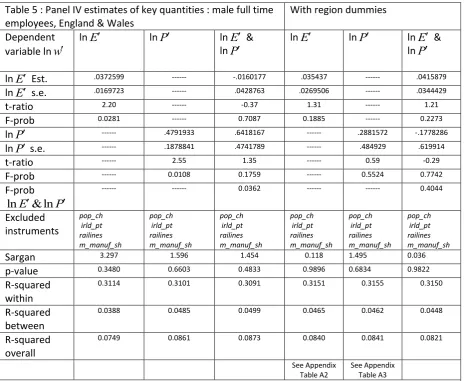
outcomes for male respondents, reaffirming our suggestion based on Table 3 that neither variable has a significant effect on male wages. While there is an indication of individual significance from the specifications without region dummies, the inclusion of dummies demonstrates that we cannot infer that individual male wage variations depend either on market potential or employment density.
The results for females remain distinctly different, as apparent from Tables25 6 and 7. Column 2 of Table 6 shows the outcome of estimating the lnE model using the instruments deemed to be exogenous. It is apparent that we fail to reject the Sargan null with a test size of 0.05, although the result is close to significance. Assuming the orthogonality of instruments railines, pop_ch and irld_pt, we infer that lnE is a significant cause of female wage variation. Column 3 of Table 6 indicates that lnP is also strongly associated with female wage variation, but in this case we cannot assume consistent estimation because of the rejection of the Sargan null of orthogonality. The fourth column of Table 6 shows the outcome of attempting to use orthogonal instruments. In this case we have constructed an additional instrument equal to the product of railines and pop_ch, namely rail_pch. Although our instruments now do pass the Sargan test, we believe there is a weak instrument problem. Our test statistic is the Cragg-Donald Wald F statistic which is referred to the critical values26 given by Stock and Yogo (2005). The test statistic equals 15.804 which lies between the critical values for 15% and 10% maximal size (nominal size plus size distortion), which are equal to 11.59 and 19.93 respectively. The indication of some size distortion suggests that we should not rely on the column 4 estimates in Table 6. Columns 5 and 6 provide more rigorous tests because of the addition of the regional dummies to the set of regressors. The regressor sub-set is seen to be orthogonal to the errors, and we see that both lnE and lnP retain their significance.
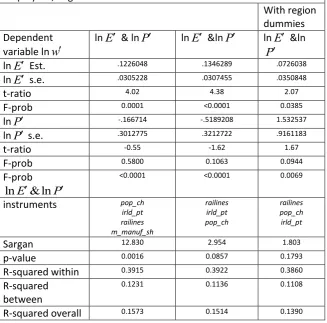
Table 7 shows the outcome of confronting the two non-nested rivals for the female wage data. Column 2 uses all four instruments and points to the dominance of lnE, but the instruments collectively fail the Sargan test. Column 3 employs an orthogonal subset of three instruments and points to the insignificance of lnP given the presence of lnE. The strongest evidence supporting the causality of lnE and its encompassing, possibly, of lnP is provided by column 4, where it’s significance is maintained despite the presence of the region dummies. On the other hand, we see that the p-value for the lnP t-ratio of 1.67 is 0.094, which hints that this variable may be carrying some additional explanatory information. It is apparent that UE theory is outperforming NEG theory for female employees, although the sign and near significance of lnP means that we cannot dismiss NEG entirely.
25 The results in these tables mainly use a sub-set of the four instruments in order to pass the Sargan test. 26 The critical values depend on the number of instruments and on the number of included endogenous
15
Table 5 : Panel IV estimates of key quantities : male full time employees, England & Wales
With region dummies
Dependent variable ln
w
lnE lnP lnE &
lnP
lnE lnP lnE & lnP
lnE Est. .0372599 --- -.0160177 .035437 --- .0415879
lnE s.e. .0169723 --- .0428763 .0269506 --- .0344429
t-ratio 2.20 --- -0.37 1.31 --- 1.21
F-prob 0.0281 --- 0.7087 0.1885 --- 0.2273
lnP --- .4791933 .6418167 --- .2881572 -.1778286
lnP s.e. --- .1878841 .4741789 --- .484929 .619914
t-ratio --- 2.55 1.35 --- 0.59 -0.29
F-prob --- 0.0108 0.1759 --- 0.5524 0.7742
F-prob
lnE&lnP
--- --- 0.0362 --- --- 0.4044
Excluded instruments pop_ch irld_pt railines m_manuf_sh pop_ch irld_pt railines m_manuf_sh pop_ch irld_pt railines m_manuf_sh pop_ch irld_pt railines m_manuf_sh pop_ch irld_pt railines m_manuf_sh pop_ch irld_pt railines m_manuf_sh
Sargan 3.297 1.596 1.454 0.118 1.495 0.036
p-value 0.3480 0.6603 0.4833 0.9896 0.6834 0.9822
R-squared within
0.3114 0.3101 0.3091 0.3151 0.3155 0.3150
R-squared between
0.0388 0.0485 0.0499 0.0465 0.0462 0.0448
R-squared overall
0.0749 0.0861 0.0873 0.0840 0.0841 0.0821
See Appendix Table A2
See Appendix Table A3
16
Table 6: Panel IV estimates of key quantities : female full time employees, England & Wales
With region dummies
Dependent variable ln
w
lnE lnP lnP•Note1 lnE lnP
lnE Est. .0978588 --- --- .0898075
---lnE s.e. .0206672 --- --- .0331926
---t-ratio 4.73 --- --- 2.71
---F-prob <0.0001 --- --- 0.0068
---lnP --- .9459282 3.234297 --- 2.26336
lnP s.e. --- .242684 1.125114 --- .8836997
t-ratio --- 3.90 2.87 --- 2.56
F-prob 0.0001 0.0040 0.0104
Excluded instruments
railines pop_ch irld_pt
railines pop_ch
rail_pch railines
railines pop_ch irld_pt
railines pop_ch
Sargan 5.561 6.526 1.054 4.699 0.024
p-value 0.0620 0.0106 0.3045 0.0954 0.8758
R-squared
within 0.3920 0.3846 0.2253 0.3988 0.3791
R-squared
between 0.1233 0.1117 0.0721 .1248 0.0970
R-squared
overall 0.1586 0.1440 0.0769 0.1632 0.1237
Note1 : Weak identification test (Cragg-Donald Wald F statistic):
15.804 See Appendix Table
17
Table 7: Panel IV estimates of key quantities : female full time employees, England & Wales
With region dummies Dependent
variable ln
w
lnE & lnP lnE &lnP lnE &ln P
lnE Est. .1226048 .1346289 .0726038
lnE s.e. .0305228 .0307455 .0350848
t-ratio 4.02 4.38 2.07
F-prob 0.0001 <0.0001 0.0385
lnP -.166714 -.5189208 1.532537
lnP s.e. .3012775 .3212722 .9161183
t-ratio -0.55 -1.62 1.67
F-prob 0.5800 0.1063 0.0944
F-prob
lnE&lnP
<0.0001 <0.0001 0.0069
instruments pop_ch
irld_pt railines m_manuf_sh
railines irld_pt pop_ch
railines pop_ch irld_pt
Sargan 12.830 2.954 1.803
p-value 0.0016 0.0857 0.1793
R-squared within 0.3915 0.3922 0.3860
R-squared between
0.1231 0.1136 0.1108
R-squared overall 0.1573 0.1514 0.1390
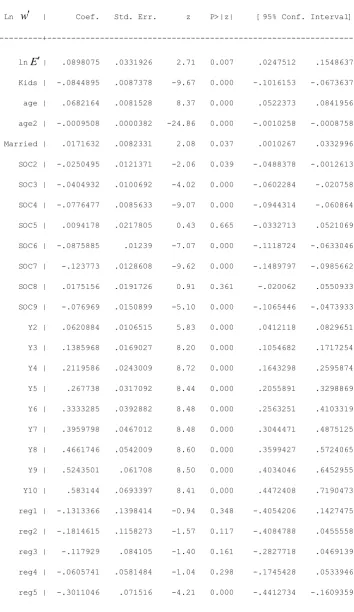
For the female data, we evaluate the effect of employment density on wages controlling for the other variables, using the preferred model summarised by Table 6, column 5 and detailed in Appendix Table A1. Employment density is a separate cause of wage variation distinct from the significant regional effects captured by the region dummies. We find that doubling employment density, which is equivalent to migrating from East Midlands to inner London, raises female wages by ln(2 0.0898075) = 6.22%. By comparison, having children reduces female wages by about 8% and ‘marriage’ raises wages by 1.7%. Also evident is the significant quadratic relationship between wages and age, as is typical of many wage equations (the test statistic equals 618.82 which is highly significant when referred to
22), and a significant occupational category effect ( 177.94
8,0.052)
.Also of course there are unobserved time-invariant effects such as start-of-period educational attainment which are picked up by the fixed effects of our panel model, and the regional dummies give 55.41
16,0.052 .18
dummies are also significant (test statistic 119.63 >
8,0.052 ). Although there is evidently no causaleffect of lnE per se, the collective significance of the region dummies ( 52.33
16,0.052)
indicatesthat the male respondent’s ‘environment’ does have an effect. Very similar results are obtained for the model with lnP, as shown in Table A3.
7. Conclusions
This paper has taken up the challenge to examine agglomeration process using micro level data as has been emphasized in the recent special issue of the Journal of Economic Geography. In particular we have responded to the focus given by the special issue editors, Garretsen and
Martin(2011), on the ‘need to work with micro-data’. Ours is we believe the first paper to actually do this in practice, and we have mixed findings. The evidence supporting the impact of market potential on wages, as envisaged by NEG theory, is very weak when we look at individual wage rate variations over small distances. In contrast the externalities associated with our rival urban economic theory appear to be more relevant as a cause of wage variation, but only for female workers. With regard to males, neither of the theoretical processes we have focussed on has an effect on wage levels. That is not to say that other mechanisms in the economic environment, within which each male respondent is embedded, do not have an effect, as shown by the highly significant set of regional dummies. As we have shown, the other factors affecting wage levels of males and females are also different. For women, a key issue is the impact of having children, which is clearly associated with reduced earnings. For both men and women, marriage seems to count, though more so for men, and occupational status and age also important factors for both groups. While there is a multiplicity of individual-level causes, some unobserved though controlled for, it remains the case that where you live also has a significant effect on wage levels. For women, given that the degree of proximity to dense employment centres is a significant factor affecting wages, we can speculate that despite working full time, on average more women than men carry out home-making duties, and therefore for women the spatial arrangement of job and home becomes a crucial issue. For men this is evidently less important. Indeed it is revealing that marriage is associated with higher wages, possibly because it motivates and permits men to earn more given that home-duties typically tend to be more the woman’s role. Thus for men, it appears that they can travel further and use this spatially flexibility to maximise incomes in a way that is less possible for more spatially constrained females.
8. References
Abdel-Rahman, H., Fujita, M. (1990) Product variety, Marshallian externalities, and city sizes. Journal of Regional Science, 30: 165-183.
Bosker, M., Garretsen, H. (2010) Trade costs in empirical New Economic Geography. Papers in Regional Science, 89: 485-511.
19
Ciccone, A., Hall, R. E. (1996) Productivity and the density of economic activity. American Economic Review, 86: 54-70.
Combes, P.P., G. Duranton and H.G. Overman (2005) Agglomeration and the adjustment of the spatial economy. Papers in Regional Science, 84: 311-349.
Combes, P-P., Mayer, T., Thisse, J.F. (2008) Economic Geography: the Integration of Regions and Nations, Princeton: Princeton University Press.
Combes, P.-P., Duranton, G., Gobillon, L. (2011) The identification of agglomeration economies. Journal of Economic Geography, 11: 253–266.
Fingleton, B. (2005) Towards applied geographical economics: modelling relative wage rates, incomes and prices for the regions of Great Britain. Applied Economics, 37: 2417-2428.
Fingleton, B. (2006) The new economic geography versus urban economics: an evaluation using local wage rates in Great Britain. Oxford Economic Papers, 58: 501-530.
Fingleton, B. (2011) The empirical performance of the NEG with reference to small areas. Journal of Economic Geography, 11: 267-279.
Fingleton B., Lopez-Bazo, E. (2003) Explaining the distribution of manufacturing productivity in the EU regions. In B. Fingleton (ed.) European Regional Growth. Berlin: Springer-Verlag, 375 – 410.
Fingleton, B., McCann, P. (2007) Sinking the iceberg? On the treatment of transport costs in new economic geography. In B. Fingleton (ed.) New Directions in Economic Geography. Cheltenham: Edward Elgar, 168-203.
Francesconi, M., Sutherland, H., Zantomio, F. (2011) A comparison of earnings measures from longitudinal and cross-sectional surveys: evidence from the UK. Journal of the Royal Statistical Society A, 174: 297-326.
Fujita, M., Krugman, P. R., Venables, A. J. (1999) The Spatial Economy : Cities, Regions, and International Trade. Cambridge, MA: MIT Press.
Fujita, M., Thisse, J-F. (2002) Economics of Agglomeration. Cambridge: Cambridge University Press.
Garretsen, H., Martin, R. (2010) Rethinking (new) economic geography models: taking geography and history more seriously. Spatial Economic Analysis, 5(2): 127-160.
Garretsen, H., Martin, R. (2011) The Journal of Economic Geography a decade on : where do we go from here? Journal of Economic Geography, 11: 207-213.
Gatley, D. (1996) A User Guide to the 1861 Census and Vital Registration Data Base. Staffordshire University: The Knowledge, Organizations and Society Research Group.
20
Hausman, J.A., Taylor, W.E. (1981) Panel data and unobservable individual effects. Econometrica, 49: 1377-1398.
Hendry, D.F. (1995) Dynamic Econometrics. Oxford: Oxford University Press Oxford.
Ottaviano, G. I. P. (2011) ‘New’ new Economic Geography: firm heterogeneity and agglomeration economies. Journal of Economic Geography, 11: 231–240.
Redding, S. J., Venables, A. J. (2004) Economic geography and international inequality. Journal of International Economics, 62: 53-82.
Roodman, D. (2009) A note on the theme of too many instruments. Oxford Bulletin of Economics and Statistics, 71: 135-158.
Schaffer, M. (2010) Xtivreg2: Stata module to perform extended IV/2SLS, GMM and AC/HAC, LIML and k-class regression for panel data models. Statistical Software Components, Boston College. Department of Economics, http://econpapers.repec.org/RePEc:boc:bocode:s456501.
Schaffer, M.E., Stillman, S. (2010) Xtoverid: Stata module to calculate tests of overidentifying restrictions after xtreg, xtivreg, xtivreg2 and xthtaylor.
http://ideas.repec.org/c/boc/bocode/s456779.html.
Stock, J.H., Yogo, M. (2005) Testing for Weak Instruments in Linear IV Regression, in Identification and Inference for Econometric Models. In D.W.K Andrews and J.H. Stock (eds) Essays in Honor of Thomas Rothenberg. Cambridge: Cambridge University Press, 80-108.
Stock, J. H., Wright, J. H., Yogo, M. (2002) A survey of weak instruments and weak identification in generalized method of moments. Journal of Business & Economic Statistics, 20(4): 518–29.
21
[image:22.595.92.447.165.778.2]9. Appendix
Table A1: Specification and estimates for the dominant model of female wages
---
Ln w | Coef. Std. Err. z P>|z| [95% Conf. Interval] ---+---
22
[image:23.595.78.446.404.783.2]reg6 | -.1625923 .0578139 -2.81 0.005 -.2759054 -.0492793 reg7 | -.1207753 .0797112 -1.52 0.130 -.2770065 .0354558 reg8 | -.0556856 .0563296 -0.99 0.323 -.1660897 .0547185 reg9 | -.0760971 .0773657 -0.98 0.325 -.2277311 .075537 reg10 | .0407252 .0840304 0.48 0.628 -.1239715 .2054218 reg11 | -.0317677 .0572576 -0.55 0.579 -.1439906 .0804552 reg12 | -.1575003 .0712416 -2.21 0.027 -.2971313 -.0178694 reg13 | -.1022551 .0681211 -1.50 0.133 -.23577 .0312599 reg14 | .0472133 .066794 0.71 0.480 -.0837005 .1781272 reg15 | .1652104 .0908338 1.82 0.069 -.0128205 .3432414 reg16 | .0311142 .0663279 0.47 0.639 -.098886 .1611145 ---
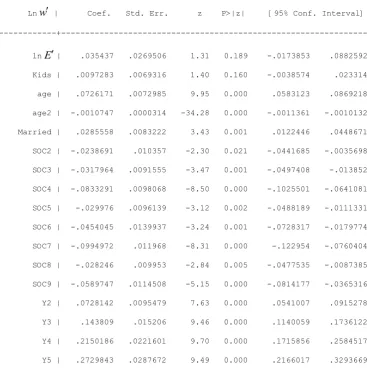
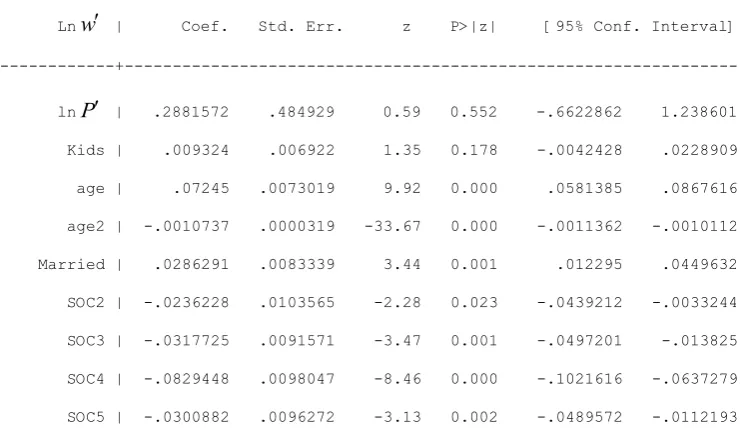
Table A2: Specification and estimates for the UE model of male wages
---
Lnw | Coef. Std. Err. z P>|z| [95% Conf. Interval] ---+---
23
[image:24.595.77.449.553.773.2]Y6 | .3321405 .0356019 9.33 0.000 .262362 .4019189 Y7 | .3988613 .0424756 9.39 0.000 .3156106 .4821121 Y8 | .4520638 .049251 9.18 0.000 .3555335 .5485941 Y9 | .5099758 .0560972 9.09 0.000 .4000273 .6199244 Y10 | .5819318 .0630571 9.23 0.000 .4583422 .7055215 reg1 | .0781511 .1154893 0.68 0.499 -.1482038 .304506 reg2 | .0533558 .0971714 0.55 0.583 -.1370968 .2438083 reg3 | .0892361 .0690706 1.29 0.196 -.0461397 .2246119 reg4 | .1190076 .0493276 2.41 0.016 .0223274 .2156879 reg5 | .1362026 .0592716 2.30 0.022 .0200324 .2523728 reg6 | -.0144762 .0481306 -0.30 0.764 -.1088104 .079858 reg7 | -.0427612 .0814623 -0.52 0.600 -.2024244 .1169021 reg8 | -.1040333 .0539435 -1.93 0.054 -.2097606 .0016939 reg9 | .0065891 .0654478 0.10 0.920 -.1216862 .1348644 reg10 | -.1702565 .0953716 -1.79 0.074 -.3571814 .0166684 reg11 | -.0648925 .0517183 -1.25 0.210 -.1662585 .0364735 reg12 | -.0837453 .0627043 -1.34 0.182 -.2066434 .0391528 reg13 | -.0048482 .0590585 -0.08 0.935 -.1206007 .1109044 reg14 | .0232937 .0530694 0.44 0.661 -.0807203 .1273077 reg15 | .0356238 .093512 0.38 0.703 -.1476564 .218904 reg16 | -.0002429 .0678508 -0.00 0.997 -.133228 .1327422 ---
Table A3: Specification and estimates for the NEG model of male wages
---
Lnw | Coef. Std. Err. z P>|z| [95% Conf. Interval] ---+---
24