1
Chapter 3
Data and Signals
2
To be transmitted, data must be
3
3-1 ANALOG AND DIGITAL
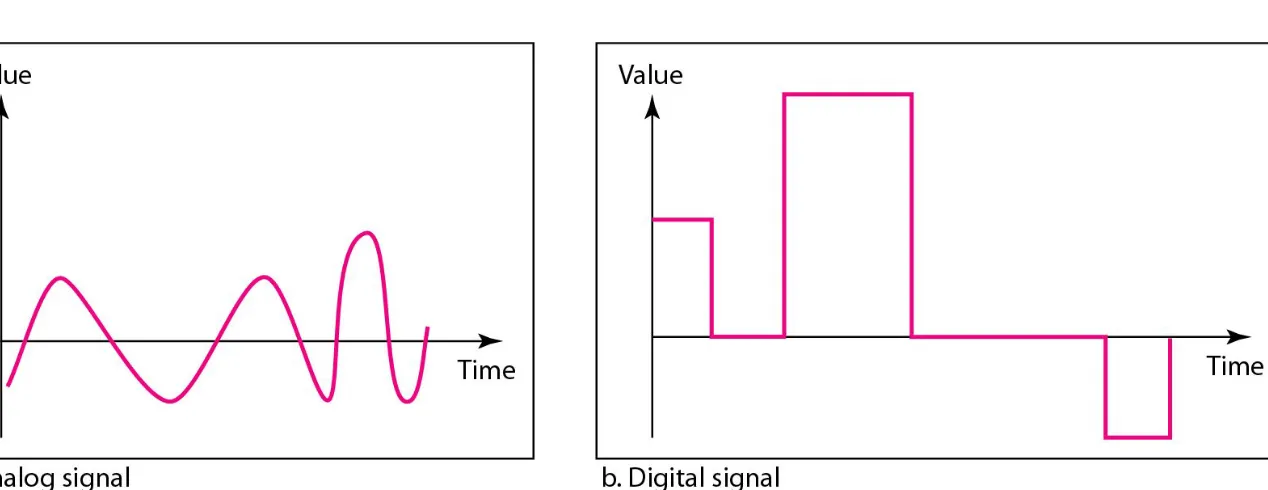
Data can be analog or digital. The term analog data refers to information that is continuous; digital data refers to information that has discrete states. Analog data take on continuous values. Digital data take on discrete values.
Analog and Digital Data Analog and Digital Signals
Periodic and Nonperiodic Signals
4
Note
Data can be analog or digital.
Analog data are continuous and take
continuous values.
5
Signals can be analog or digital.
Analog signals can have an infinite
number of values in a range; digital
signals can have only a limited
number of values.
6
[image:6.720.47.681.167.412.2]7
In data communications, we commonly
use periodic analog signals and
8
3-2 PERIODIC ANALOG SIGNALS
Periodic analog signals can be classified as simple or
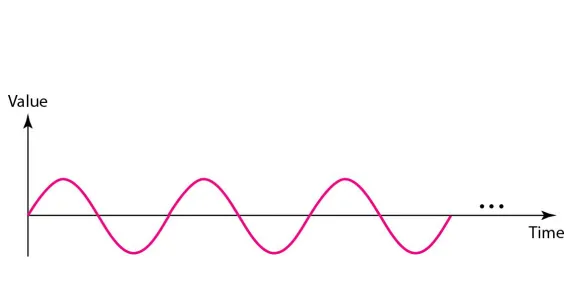
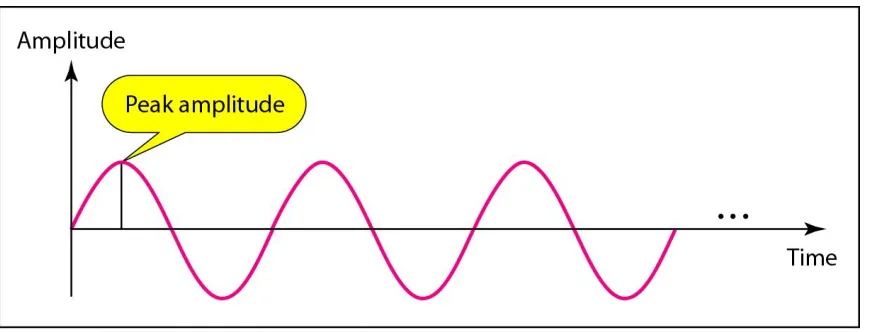
composite. A simple periodic analog signal, a sine wave, cannot be decomposed into simpler signals. A composite periodic analog signal is composed of multiple sine waves.
Sine Wave Wavelength
Time and Frequency Domain Composite Signals
Bandwidth
9
[image:9.720.79.650.127.413.2]10
We discuss a mathematical approach to
sine waves in Appendix C.
11
The power in your house can be represented by a sine wave with a peak amplitude of 155 to 170 V. However, it is common knowledge that the voltage of the power in U.S. homes is 110 to 120 V. This discrepancy is due to the fact that these are root mean square (rms) values. The signal is squared and then the average amplitude is calculated. The peak value is equal to 2½ × rms value.
12
Figure 3.3 Two signals with the same phase and frequency,
[image:12.720.145.580.105.271.2]13
The voltage of a battery is a constant; this constant value can be considered a sine wave, as we will see later. For example, the peak value of an AA battery is normally
1.5 V.
14
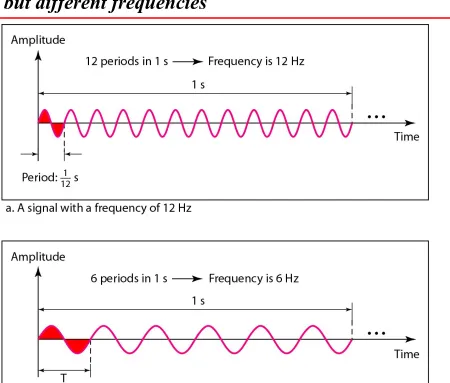
Frequency and period are the inverse of
each other.
15
Figure 3.4 Two signals with the same amplitude and phase,
[image:15.720.147.597.60.443.2]16
17
The power we use at home has a frequency of 60 Hz. The period of this sine wave can be determined as follows:
18
Express a period of 100 ms in microseconds.
Example 3.4
Solution
19
The period of a signal is 100 ms. What is its frequency in kilohertz?
Example 3.5
Solution
20
Frequency is the rate of change with
respect to time.
Change in a short span of time
means high frequency.
21
If a signal does not change at all, its
frequency is zero.
If a signal changes instantaneously, its
frequency is infinite.
22
Phase describes the position of the
waveform relative to time 0.
23
Figure 3.5 Three sine waves with the same amplitude and frequency,
[image:23.720.142.569.81.474.2]24
A sine wave is offset 1/6 cycle with respect to time 0. What is its phase in degrees and radians?
Example 3.6
Solution
25
[image:25.720.29.668.218.382.2]26
[image:26.720.73.643.114.278.2]27
28
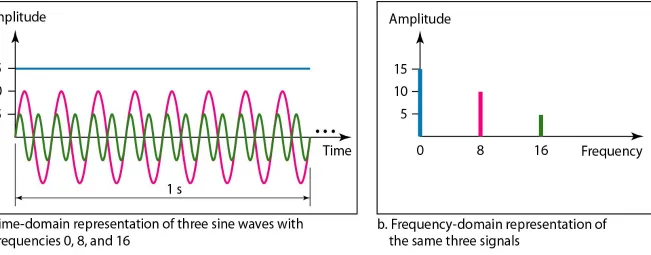
The frequency domain is more compact and useful when we are dealing with more than one sine wave. For example, Figure 3.8 shows three sine waves, each with different amplitude and frequency. All can be represented by three spikes in the frequency domain.
29
[image:29.720.39.690.155.410.2]30
A single-frequency sine wave is not
useful in data communications;
we need to send a composite signal, a
signal made of many simple sine waves.
31
According to Fourier analysis, any
composite signal is a combination of
simple sine waves with different
frequencies, amplitudes, and phases.
Fourier analysis is discussed in
Appendix C.
32
If the composite signal is periodic, the
decomposition gives a series of signals
with discrete frequencies;
if the composite signal is nonperiodic,
the decomposition gives a combination
of sine waves with continuous
frequencies.
33
Figure 3.9 shows a periodic composite signal with frequency f. This type of signal is not typical of those found in data communications. We can consider it to be three alarm systems, each with a different frequency. The analysis of this signal can give us a good understanding of how to decompose signals.
34
[image:34.720.31.699.152.421.2]35
Figure 3.10 Decomposition of a composite periodic signal in the time and
36
Figure 3.11 shows a nonperiodic composite signal. It can be the signal created by a microphone or a telephone set when a word or two is pronounced. In this case, the composite signal cannot be periodic, because that implies that we are repeating the same word or words with exactly the same tone.
37
38
The bandwidth of a composite signal is
the difference between the
highest and the lowest frequencies
contained in that signal.
39
40
If a periodic signal is decomposed into five sine waves with frequencies of 100, 300, 500, 700, and 900 Hz, what is its bandwidth? Draw the spectrum, assuming all components have a maximum amplitude of 10 V.
Solution
Let fh be the highest frequency, fl the lowest frequency, and B the bandwidth. Then
Example 3.10
41
42
A periodic signal has a bandwidth of 20 Hz. The highest frequency is 60 Hz. What is the lowest frequency? Draw the spectrum if the signal contains all frequencies of the same amplitude.
Solution
Let fh be the highest frequency, fl the lowest frequency, and B the bandwidth. Then
Example 3.11
43
44
A nonperiodic composite signal has a bandwidth of 200 kHz, with a middle frequency of 140 kHz and peak amplitude of 20 V. The two extreme frequencies have an amplitude of 0. Draw the frequency domain of the signal.
Solution
The lowest frequency must be at 40 kHz and the highest at 240 kHz. Figure 3.15 shows the frequency domain and the bandwidth.
45
46
An example of a nonperiodic composite signal is the signal propagated by an AM radio station. In the United States, each AM radio station is assigned a 10-kHz bandwidth. The total bandwidth dedicated to AM radio ranges from 530 to 1700 kHz. We will show the rationale behind this 10-kHz bandwidth in Chapter 5.
47
Another example of a nonperiodic composite signal is the signal propagated by an FM radio station. In the United States, each FM radio station is assigned a 200-kHz bandwidth. The total bandwidth dedicated to FM radio ranges from 88 to 108 MHz. We will show the rationale behind this 200-kHz bandwidth in Chapter 5.
48
Another example of a nonperiodic composite signal is the signal received by an old-fashioned analog black-and-white TV. A TV screen is made up of pixels. If we assume a resolution of 525 × 700, we have 367,500 pixels per screen. If we scan the screen 30 times per second, this is 367,500 × 30 = 11,025,000 pixels per second. The worst-case scenario is alternating black and white pixels. We can send 2 pixels per cycle. Therefore, we need 11,025,000 / 2 = 5,512,500 cycles per second, or Hz. The bandwidth needed is 5.5125 MHz.
49
3-3 DIGITAL SIGNALS
In addition to being represented by an analog signal, information can also be represented by a digital signal. For example, a 1 can be encoded as a positive voltage and a 0 as zero voltage. A digital signal can have more than two levels. In this case, we can send more than 1 bit for each level.
Bit Rate Bit Length
Digital Signal as a Composite Analog Signal Application Layer
50
Figure 3.16 Two digital signals: one with two signal levels and the other
51
Appendix C reviews information about exponential and
logarithmic functions.
Note
52
A digital signal has eight levels. How many bits are needed per level? We calculate the number of bits from the formula
Example 3.16
53
A digital signal has nine levels. How many bits are needed per level? We calculate the number of bits by using the formula. Each signal level is represented by 3.17 bits. However, this answer is not realistic. The number of bits sent per level needs to be an integer as well as a power of 2. For this example, 4 bits can represent one level.
54
Assume we need to download text documents at the rate of 100 pages per minute. What is the required bit rate of the channel?
Solution
A page is an average of 24 lines with 80 characters in each line. If we assume that one character requires 8 bits, the bit rate is
55
A digitized voice channel, as we will see in Chapter 4, is made by digitizing a 4-kHz bandwidth analog voice signal. We need to sample the signal at twice the highest frequency (two samples per hertz). We assume that each sample requires 8 bits. What is the required bit rate?
Solution
The bit rate can be calculated as
56
What is the bit rate for high-definition TV (HDTV)?
Solution
HDTV uses digital signals to broadcast high quality video signals. The HDTV screen is normally a ratio of 16 : 9. There are 1920 by 1080 pixels per screen, and the screen is renewed 30 times per second. Twenty-four bits represents one color pixel.
Example 3.20
57
Figure 3.17 The time and frequency domains of periodic and nonperiodic
58
59
A digital signal is a composite analog
signal with an infinite bandwidth.
60
61
62
Baseband transmission of a digital
signal that preserves the shape of the
digital signal is possible only if we have
a low-pass channel with an infinite or
very wide bandwidth.
63
An example of a dedicated channel where the entire bandwidth of the medium is used as one single channel is a LAN. Almost every wired LAN today uses a dedicated channel for two stations communicating with each other. In a bus topology LAN with multipoint connections, only two stations can communicate with each other at each moment in time (timesharing); the other stations need to refrain from sending data. In a star topology LAN, the entire channel between each station and the hub is used for communication between these two entities. We study LANs in Chapter 14.
64
Figure 3.21 Rough approximation of a digital signal using the first harmonic
65
Figure 3.22 Simulating a digital signal with first three
66
In baseband transmission, the required bandwidth is
proportional to the bit rate;
if we need to send bits faster, we need more bandwidth.
Note
In baseband transmission, the required
bandwidth is proportional to the bit rate;
if we need to send bits faster, we need
67
68
What is the required bandwidth of a low-pass channel if we need to send 1 Mbps by using baseband transmission?
Solution
The answer depends on the accuracy desired.
a. The minimum bandwidth, is B = bit rate /2, or 500 kHz.
b. A better solution is to use the first and the third harmonics with B = 3 × 500 kHz = 1.5 MHz.
c. Still a better solution is to use the first, third, and fifth harmonics with B = 5 × 500 kHz = 2.5 MHz.
69
We have a low-pass channel with bandwidth 100 kHz. What is the maximum bit rate of this
channel?
Solution
The maximum bit rate can be achieved if we use the first harmonic. The bit rate is 2 times the available bandwidth, or 200 kbps.
70
71
If the available channel is a bandpass
channel, we cannot send the digital
signal directly to the channel;
72
Figure 3.24 Modulation of a digital signal for transmission on a bandpass
73
An example of broadband transmission using modulation is the sending of computer data through a telephone subscriber line, the line connecting a resident to the central telephone office. These lines are designed to carry voice with a limited bandwidth. The channel is considered a bandpass channel. We convert the digital signal from the computer to an analog signal, and send the analog signal. We can install two converters to change the digital signal to analog and vice versa at the receiving end. The converter, in this case, is called a
modem which we discuss in detail in Chapter 5.
74
A second example is the digital cellular telephone. For better reception, digital cellular phones convert the analog voice signal to a digital signal (see Chapter 16). Although the bandwidth allocated to a company providing digital cellular phone service is very wide, we still cannot send the digital signal without conversion. The reason is that we only have a bandpass channel available between caller and callee. We need to convert the digitized voice to a composite analog signal before sending.
75
3-4 TRANSMISSION IMPAIRMENT
Signals travel through transmission media, which are not perfect. The imperfection causes signal impairment. This means that the signal at the beginning of the medium is not the same as the signal at the end of the medium. What is sent is not what is received. Three causes of impairment are attenuation, distortion, and noise.
Attenuation Distortion Noise
76
77
78
Suppose a signal travels through a transmission medium and its power is reduced to one-half. This means that P2 is (1/2)P1. In this case, the attenuation (loss of power) can be calculated as
Example 3.26
79
A signal travels through an amplifier, and its power is increased 10 times. This means that P2 = 10P1 . In this case, the amplification (gain of power) can be calculated as
80
One reason that engineers use the decibel to measure the changes in the strength of a signal is that decibel numbers can be added (or subtracted) when we are measuring several points (cascading) instead of just two. In Figure 3.27 a signal travels from point 1 to point 4. In this case, the decibel value can be calculated as
81
82
Sometimes the decibel is used to measure signal power in milliwatts. In this case, it is referred to as dBm and is calculated as dBm = 10 log10 Pm , where Pm is the power in milliwatts. Calculate the power of a signal with dBm = −30.
Solution
We can calculate the power in the signal as
83
The loss in a cable is usually defined in decibels per kilometer (dB/km). If the signal at the beginning of a cable with −0.3 dB/km has a power of 2 mW, what is the power of the signal at 5 km?
Solution
The loss in the cable in decibels is 5 × (−0.3) = −1.5 dB. We can calculate the power as
84
85
86
The power of a signal is 10 mW and the power of the noise is 1 μW; what are the values of SNR and SNRdB ?
Solution
The values of SNR and SNRdB can be calculated as follows:
87
The values of SNR and SNR
dB for a noiseless channel
are
Example 3.32
88
89
3-5 DATA RATE LIMITS
A very important consideration in data communications is how fast we can send data, in bits per second, over a channel. Data rate depends on three factors:
1. The bandwidth available
2. The level of the signals we use
3. The quality of the channel (the level of noise)
Noiseless Channel: Nyquist Bit Rate Noisy Channel: Shannon Capacity Using Both Limits
90
91
Does the Nyquist theorem bit rate agree with the intuitive bit rate described in baseband transmission?
Solution
They match when we have only two levels. We said, in baseband transmission, the bit rate is 2 times the bandwidth if we use only the first harmonic in the worst case. However, the Nyquist formula is more general than what we derived intuitively; it can be applied to baseband transmission and modulation. Also, it can be applied when we have two or more levels of signals.
92
Consider a noiseless channel with a bandwidth of 3000 Hz transmitting a signal with two signal levels. The maximum bit rate can be calculated as
93
Consider the same noiseless channel transmitting a signal with four signal levels (for each level, we send 2 bits). The maximum bit rate can be calculated as
94
We need to send 265 kbps over a noiseless channel with a bandwidth of 20 kHz. How many signal levels do we need?
Solution
We can use the Nyquist formula as shown:
Example 3.36
95
Consider an extremely noisy channel in which the value of the signal-to-noise ratio is almost zero. In other words, the noise is so strong that the signal is faint. For this channel the capacity C is calculated as
Example 3.37
96
We can calculate the theoretical highest bit rate of a regular telephone line. A telephone line normally has a bandwidth of 3000. The signal-to-noise ratio is usually 3162. For this channel the capacity is calculated as
Example 3.38
97
The signal-to-noise ratio is often given in decibels. Assume that SNRdB = 36 and the channel bandwidth is 2 MHz. The theoretical channel capacity can be calculated as
98
For practical purposes, when the SNR is very high, we can assume that SNR + 1 is almost the same as SNR. In these cases, the theoretical channel capacity can be simplified to
Example 3.40
99
We have a channel with a 1-MHz bandwidth. The SNR for this channel is 63. What are the appropriate bit rate and signal level?
Solution
First, we use the Shannon formula to find the upper limit.
100
The Shannon formula gives us 6 Mbps, the upper limit. For better performance we choose something lower, 4 Mbps, for example. Then we use the Nyquist formula to find the number of signal levels.
101
The Shannon capacity gives us the
upper limit; the Nyquist formula tells us
how many signal levels we need.
102
3-6 PERFORMANCE
One important issue in networking is the performance of the network—how good is it? We discuss quality of service, an overall measurement of network performance, in greater detail in Chapter 24. In this section, we introduce terms that we need for future chapters.
Bandwidth Throughput
Latency (Delay)
Bandwidth-Delay Product
103
In networking, we use the term
bandwidth in two contexts.
❏ The first, bandwidth in hertz, refers to
the range of frequencies in a composite signal or the range of frequencies that a channel can pass.
❏ The second, bandwidth in bits per
second, refers to the speed of bit transmission in a channel or link.
104
The bandwidth of a subscriber line is 4 kHz for voice or data. The bandwidth of this line for data transmission
can be up to 56,000 bps using a sophisticated modem to change the digital signal to analog.
105
If the telephone company improves the quality of the line and increases the bandwidth to 8 kHz, we can send 112,000 bps by using the same technology as mentioned in Example 3.42.
106
A network with bandwidth of 10 Mbps can pass only an average of 12,000 frames per minute with each frame carrying an average of 10,000 bits. What is the throughput of this network?
Solution
We can calculate the throughput as
Example 3.44
107
What is the propagation time if the distance between the two points is 12,000 km? Assume the propagation speed to be 2.4 × 10⁸ m/s in cable.
Solution
We can calculate the propagation time as
Example 3.45
108
What are the propagation time and the transmission time for a 2.5-kbyte message (an e-mail) if the bandwidth of the network is 1 Gbps? Assume that the distance between the sender and the receiver is 12,000 km and that light travels at 2.4 × 10⁸ m/s.
Solution
We can calculate the propagation and transmission time as shown on the next slide:
109
Note that in this case, because the message is short and the bandwidth is high, the dominant factor is the propagation time, not the transmission time. The transmission time can be ignored.
110
What are the propagation time and the transmission time for a 5-Mbyte message (an image) if the bandwidth of the network is 1 Mbps? Assume that the distance between the sender and the receiver is 12,000 km and that light travels at 2.4 × 10⁸ m/s.
Solution
We can calculate the propagation and transmission times as shown on the next slide.
111
Note that in this case, because the message is very long and the bandwidth is not very high, the dominant factor is the transmission time, not the propagation time. The propagation time can be ignored.
112
113
We can think about the link between two points as a pipe. The cross section of the pipe represents the bandwidth, and the length of the pipe represents the delay. We can say the volume of the pipe defines the bandwidth-delay product, as shown in Figure 3.33.
114
115
116