1 Preface
Sports has mass appeal and it is recognised as a very useful tool for sending out development- oriented messages. This is more so for children who have enough energy and tend to engage in several sporting activities in school and in the community. This explains why there is heightened emphasis on using sports to communicate behaviours in promoting good health in Ghanaian schools. Unfortunately, not all schools have access to engage in sports. Often the lack of play items poses the main challenge. It is against this background that cost effective, relevant and appropriate games and activities have been put together in this manual to accelerate the development of sports and to generate the interest of pupils. The games and activities are to support school children in developing life-long skills.
The games and activities in this manual are largely a collection of carefully selected traditional games and activities which are to be played not only for the benefit of physical education but also to help the children learn appropriate traditional values. Overall, children will be learning their rich cultural values and how they can apply them in their behaviours. Significantly, the flexibility in playing the games or activities will allow for the full participation of every school child, including those with disability.
Effective use of this manual is expected to contribute significantly to the school’s child-friendly dimension in creating a safe, healthy school environment. To make this happen, GES has harmonized six life skills education programmes – HIV prevention education, Water and Sanitation, Nutrition, Guidance and Counselling, physical education and disaster risk reduction (DRR) as critical topics under the enhanced school health programme (e-SHEP). Teachers will use either the integration and/or infusion method to deliver lessons in this manual. In this way, the teacher may not require dedicated time to teach lessons on any of the e-SHEP components.
The games and activities are participatory and teachers should be prepared to participate fully and also encourage all children to do same.
The manual has been organised under three thematic areas: 1. Life skills development
2. Health Education
2
Each thematic area has a number of games and activities. At the end of a game or activity, children will identify three main learning outcomes:
psychomotor skills learnt, life skills developed and
how the skills will be applied in real life situation.
The games and activities in the manual are not exhaustive. Teachers are encouraged to be innovative and introduce local games that can help to realise the intended behaviour change.
Charles Aheto-Tsegah
3 Acknowledgement
This manual has been developed by the SHEP Unit through the guidance of Mr Seth Odame Baiden, then Director of the Ghana Education Service Staff Development Institute (GESDI), Saltpond.
The initial draft was prepared under the supervision of Mr. Kingsley Atta, Headmaster of Mankessim Secondary Technical School, Mankessim. He was assisted by four Physical Education Tutors from the Colleges of Education namely:
1. Mr. Joseph Anthony Yawson (Akrokerri College of Education) 2. Mr. Samuel Huagie (Accra College of Education)
3. Mrs. Emily Bonney OLA College of Education)
The illustration work was done by Mr. Tweneboa Kodua Solomon (Wesley College of Education)
On behalf of GES and on my own behalf, I say thank you to all for the hard work, determination and commitment that you put in to ensure the development of the manual.
Subsequent to the development of the initial draft document, series of pre-testing were carried out in 14 districts in 5 regions. Much gratitude goes to the District Directors, trainers, teachers and school children for their invaluable input in the pre-testing exercise that preceded finalising this manual.
4 Principles of the manual
a. Key methods used in the manual and key learning outcomes
Activities in this manual are based on learning through fun. However, sight must not be lost on the learning outcomes which are essentially the purpose of the activities in the manual. The three learning outcomes (skills) which the teacher must assess with the pupils at the end of each activity relates to:
i. Psychomotor Skills refers to be developed include speed, co-ordination, reaction time, stamina
ii. Psychosocial Skills to be developed include teamwork, confidence, honesty, trust, integrity and respect
iii. Life application refers to the combination of the two skills (psychomotor and psychosocial skills). Here, the children are expected to identify how they will apply what they have learnt in real life situation. For example, students must be able to relate what they learnt to solving given situations. The capacity of the child to apply what they have learnt will be an indication of a shift towards sustainable behaviour change.
b. Precautionary measures for practical Physical Education lessons
i. Before the activity
1. The area must be cleared and free from all dangerous materials.
2. Materials and equipment to be used must be of good condition and tested before the activity.
3. Instructor must rehearse the activity before the lesson. 4. Demarcate the working area for each activity.
5. Provision of first aid materials
6. Inspect and ensure that the pupil/student/students’ physical appearance and attire are appropriate for the lesson e.g. finger nails, canvas, t-shirts, shorts, socks etc.
ii. During the activity
In the course of the activity, performers may experience injuries like wounds, sprains or strain and the following are some of first aids measures.
5 First aid treatment is as follows:
a. Stop bleeding by applying pressure to the wound b. Clean the area around the wound
c. Remove dirt or foreign body (if any)
d. Cover wounds with dressing material (cotton wool, gauze and bandage) e. Convey the victim to a clinic or hospital for treatment
Sprain: is the twisting or tearing of ligaments and tissues around a joint. First aid treatment is as follows:
a. Support the joint in the most comfortable position b. Apply cold compress
c. Elevate affected part if possible d. Arrange for medical aid
Strain: the overstretching or tearing of muscle fibres which usually occurs when performing strenuous activity.
First aid treatment is as follows:
a. Place the victim in a comfortable position and support the injured part. b. Apply cold compress
c. Arrange for medical aid
iii. After the activity
1. Clear the area and send the material back to the store room. 2. Dry the wet P.E kits
3. Wash down and get dressed for the next lesson.
C. Organisation of the manual
6
SECTION 1 – LIFE SKILLS DEVELOPMENT 9
Unit 1: Leadership 10
Activity 1: The Hawk and Chicken Activity 2: Follow my course Activity 3: Goalkeeping in football Activity 4: Service in volleyball
Unit 2: Good relationship 17
Activity 1: Tug of peace Activity 2: Horses and jockeys Activity 3: Sansankroma (Hawk) Activity 4: Sideline volleyball
Unit 3: Self Esteem/Positive Attitude, Respect and Honour Difference 23 Activity 1: Picking tails
Activity 2: Shooting in netball Activity 3: Number tug
Activity 4: Nana mma (Nana’s children)
Unit 4: Discrimination 30
Activity 1: Choose your partner Activity 2: Number game
Unit 5: Rights and Responsibilities 33
Activity 1: Playing netball Activity 2: Relay
Unit 6: Support for Others and Teamwork 37
Activity 1: Screening Activity 2: Astride vault
Activity 3: Ehene kwan nie (Which way is this?) Activity 4: Relay (Baton changing)
Activity 5: Football (4.4.2. formation) Activity 6: Volleyball
7
SECTION 2: HEALTH EDUCATION 47
Unit 1: Healthy Body for Life and Healthy Body for Sport People 48 Activity 1: My head, my shoulder, my knees, my toes
Activity 2: Yeni ahooden a yenko ntokwa (You need health for life) Activity 3: Antoakyeri (Don’t look back)
Activity 4: Ehene kwan nie (Where does this way lead to?) Activity 5: Pempenaa
Unit 2: Common Illness 58
Activity 1: Kwaakwaa (Cry of the crow) Activity 2: Kwaakwaa lobite (The Crow) Activity 3: Akpokplor le tsi me (Frog in the sea)
Unit 3: Sanitation and Personal Hygiene 61
Activity: This is the way
Unit 4: Drug/Substance Abuse 63
Scenario 1: The Ben Johnson’s story Scenario 2: The Marion Jones story
SECTION 3: DISEASE PREVENTION AND CONTROL 66
Unit 1: Preventing Sexually Transmitted Infection 67
Activity 1: Scoring runs Activity 2: Relay race
Activity 3: Pilolo (Hide and seek)
Unit 2: Preventing infection with the Human Immunodeficiency Virus (HIV) Activity 1: Scoring Runs
Activity 2: Relay racing Activity 3: Piloolo
Activity 4: Ehene kwan nie (Which way is this?) Activity 5: Anwhewakyire
8
SECTION ONE: LIFE SKILLS DEVELOPMENT Introduction
Life Skills are the basic skills that one needs for living. Life Skills Development aims at preparing the individual for independent life. (Life Skills for JHS Book 1 – CRRD – GES, 1993)
Life skills refer to the psychosocial competencies and interpersonal skills that help individuals to make informed decisions, solve problems, and think critically and creatively. In this section we will look at some basic skills and how they could be developed in the individual school child for self-actualization. The section will discuss the topics below.
Unit 1: Leadership
Unit 2: Good Relationships
Unit 3: Self Esteem and Positive Attitude Unit 4: Discrimination
Unit 5: Rights and Responsibilities
Unit 6: Support for Others and Teamwork
After going through these topics, the student will be able to: identify the role of a leader;
9
UNIT 1: LEADERSHIP
Leadership can be defined as one's ability to get others to follow willingly his/her vision. Every social group needs leaders e.g. school prefects, teachers, parents, church leaders, game captains, ‘abusuapanin’ (heads of families) and ministers of state are people who get others to follow them willingly.
This Unit will lead you through some sports related activities and discussions that will help you to:
identify some qualities of a good leader
explain qualities that are worth having as leaders
Activity 1: The hawk and the chicken game
It is a game performed to prepare the body for strenuous activity. It is commonly used by teachers of Physical Education (PE) in Ghana.
Objective: At the end of the activity, the student will be able to: explain basic leadership qualities
describe the importance of having confidence and trust in leaders Facility/Equipment/Material: Large working area to allow movement.
Description of Activity
The purpose of this activity is for the hen to protect its chicken from the hawk.
Students work in groups of four (4). The first group is the hen while the second and third groups are the chicken. The fourth group is the hawk. To begin this activity invite three students to stand in a straight line. The second and the third students (chicken) hook their hands in front of the first student (hen) and the second students respectively. The fourth student (hawk) stands facing the first student in the line. The fourth student tries to touch or tug him/herself to the third student in the line by moving either way, while the first student(hen) moves in his/her way to prevent him/her. The chicken moves to follow the hen. Activity is performed for about 60 seconds. Children later change roles.
Roles played by the hawk, hen and chicken Hawk – intruder/opponent
Hen – leader
10 Rules
The Hawk wins a point after a successful touch or tug within 30 seconds. However, the Hawk loses a point to the hen if it fails to touch or get tugged to the chicken. The winner is the one (pupil/student) with highest number of points.
Psychomotor skills developed Stamina and agility.
Psychosocial skills developed
What are the roles of the hen? - protect/inspire confidence/be steadfast/be committed/be creative /be purposeful and show good sense of judgment.
Other qualities the hen needs to save her chicken are – integrity, exemplary character, tolerance, openness, fairness, intelligent.
Those who are subordinates/dependents should show obedience and/or be responsible for their actions and inactions.
Application of the skills in real life situation - A leader should: lead exemplary life worthy of emulation
be trustworthy to inspire confidence
be knowledgeable to educate and protect those he/she leads Activity 2: Follow my course game
It is an activity performed to warm up or prepare the body for strenuous activity. It is commonly used by teachers of Physical Education in Ghana.
Objective: The student will be able to:
explain how to direct people to their destination demonstrate confidence and perseverance in others
11 Description of Activity
The purpose of this activity is for group members to follow the course of the leader and imitate whatever the leader does.
Pupil/student/students, in groups of four, form lines; each group forms a line. Leaders of each group have balls. Leaders briskly walk or run kicking balls around to determine the course of movement. Other students follow and imitate whatever the leaders do. After some distance and on command from the instructor, leaders leave balls and join the lines at the back for the next students to assume leadership control of the group. Where footballs are not used, the leaders briskly walk or run around performing various activities to be imitated by their followers.
Psychomotor skills developed
Stamina, endurance, coordination, agility and values such as cooperation, obedience and good sense of leadership.
Psychosocial skills the game developed
Perseverance, determination, obedience, honesty, tolerance etc.
Application of the skills in real life situation: This activity portrays the leader as a guide or director who helps to achieve the objectives of a group/organization. However, a leader may lead his/her group astray by misinforming, misguiding or giving wrong information. It is also possible for students to be misled by bad friends or peers into trouble. This requires that you learn to know what you want in life. This will help you to identify with the one who can help you realise what you want to achieve in life
Activity 3: Goalkeeping in a football game
12
the ball from entering the post. In most cases, the goalkeeper is “the last line of defence” of a team. The goalkeeper is also seen as “the first line of attack” for the team to succeed.
To accomplish these tasks the goalkeeper does the following:
tries to prevent the attacker from shooting to score by moving to narrow angles catches or fixes (punches) the ball
distributes ball to team-mates by throwing and kicking organises his/her defenders
Origin of the Game
The history of football, which includes goalkeeping as a role began in 1863 in England. (http://www.fifa.com/classicfootball/history/game/historygame1.html) Objectives: At the end of the activity, the student will be able to:
describe the role of a goalkeeper in relation to leadership explain the qualities a good leader
Facility/Equipment: large space, football, goalkeeper’s accoutrements. Description of Activity
1. Sub activity 1. Moving to narrow angle:
Three field players (A, B and C) stand about one metre away from the top of the penalty box; two (A and C) at the ends of the box and one (B) stands square to the post. Goalkeeper stands on goal line in the goal posts. Players pass ball among themselves in stationary position. On the whistle from the instructor, the player closer to the ball is required to shoot to score. Goalkeeper moves to and fro as ball is passed from player to player and when the shot is taken goalkeeper catches, fixes or kicks ball to prevent ball from entering the post.
Rules of the Game
13
Goalkeeper moves always from the goal line to narrow angle.
Goalkeeper scores points if he/she is able to prevent a ball from entering the post.
Sub activity 2. Distributing ball to team mates:
Players are positioned at various parts on the field. As directed by the instructor, goalkeeper throws or kicks ball to a particular player. Opponents could be introduced to influence the goalkeeper’s action.
Rules of the Game
A passed ball from goalkeeper must be within the reach of players.
Goalkeeper scores points if ball is within the reach of players but loses points if ball is
out of reach of players.
If opponent intercepts ball, goalkeeper loses 2 points.
Psychomotor skills developed: agility, strength and quick reaction time.
Psychosocial skills developed: Courage, coordination, alertness, sense of judgment and decisive decisions
Application of the skills in real life situation
The phrases “the last line of defence” and “the first line of attack” can be likened to the responsibilities of a leader. The leader’s decision, if well taken, would get others to follow his/her vision willingly.
Activity 4: Service in Volleyball
14
Origin of the Game: In 1895 volleyball was invented by William Morgan while serving as Physical Education Director at the Holyoke, Massachusetts. The game was originally called Volleyball, Mintonette. The current name was later adopted when after a demonstration game a spectator commented that the game involved much "volleying".
(http://inventors.about.com). Volley ball was adopted as an Olympic sport in 1964. Objectives: By the end of the lessons, the student twill be able to:
demonstrate how to serve the ball into the opponents’ court explain the role of a server in volleyball game
state the qualities of the server in relation to leadership Facility/Equipment: Volleyball court, volleyballs
Description of Activity:
One side of volleyball court is divided into zones. A server serves from the other end to zones to win points allocated to the zone. The serve is the only means of putting the game of volleyball into play; if the ball is well served the server’s team stands the chance of winning a point; failure to serve the ball well causes the team to lose a point. Again, good service causes continuity of the game.
4
2 1 Service line 3
4
Centre line (Net) Rules of the Game.
Serve from behind the service line.
Use any of the service techniques e.g. underarm and overhead Psychomotor skills developed: targeting and coordination
Psychosocial skills developed: courage, alertness, sense of judgment, decisive decisions.
Application of the skills in real life situation:
15 SUMMARY
In all the activities, there are leaders who give guidance or protection to others. In addition good leaders are confident, have exemplary character worthy of emulation, enthusiastic about their work, function in an orderly and purposeful manner in situations of uncertainty or creativity, show integrity and dedication. They are open and fair.
16
UNIT 2: GOOD RELATIONSHIP
Good relationship comes about when we live peacefully, have good friendship and communicate clearly with each other. Relationships are important if we want to live life to the fullest. In fact, good relationships should be our priority. That is why it is important to learn how to build good relationships. Good relationships will not only help us to meet our needs but will also make our lives more fulfilling.
Objectives: - At the end of the activities/games, children will be able to: describe what is good relationship
explain why news become distorted when not heard first hand Activity 1: Tug of Peace
Originally referred to as “Tug of War”, this activity is usually performed by the security services to develop strength and team work. Over time, a number of organizations such as Keep Fit clubs, churches, financial institutions and schools are using tug of peace as recreational activity in Ghana.
Objectives: At the end of the activity, the student will be able to: identify some factors that lead to conflict
describe steps for resolving conflict
explain the benefit of peaceful coexistence
Equipment: Rope and bands. Description of Activity:
The activity is intended for a team to pull opponents over a distance across a demarcated point.
Two teams of students (could also be mixed group) similar in number and weight align themselves at the end of a thick strong rope (about 10 centimetres in circumference). The rope is marked at the centre with a band. Two markings four meters (4m) either side of centre are also marked with bands.
The teams start with the rope’s centre line directly above a line marked on the ground. With a command, the pull commences.
Rules of the Activity
17
course of pull; or when a member lowers one elbow below the knee during a pull (“which is known as locking”).
After the activity both teams come together to congratulate each other and share fun.
Psychomotor Skills developed:
Strength in the arms and legs, coordination and balance.
Psychosocial skills developed: ask students the following questions: 1. How will you feel if your team wins? Happy, proud, jubilant etc.
2. What does it take to win the game? Cooperation, dedication and commitment etc. 3. What happens to the losing team? Sad, discouraged, demoralized etc.
4. What happens at the end of activity? e.g. teams come together to congratulate each other.
Application of the skills in real life situation
Pulling the rope is a competition but there is also togetherness and sharing of fun. Competitions must not lead to conflicts and destructions. We must resolve conflicts in a manner which helps people to live peacefully either in the family, community, society or nation etc.
Activity 2: Horses and Jockey
It is an activity performed to warm up or prepare the body for strenuous activity, or used to end a physical education lesson as a game.
18 Description of Activity:
Children of about equal weight and height and same sex stand in pairs; one stands about 2m behind the other facing the same direction. At a command the children behind are to run to mount their partners ‘horses’. The ‘horses’ then run to a marked line about 6m ahead and back. The activity is repeated for those behind to be in front to have their turn to be carried. The pair that is last in the race is eliminated.
Psychomotor skills the game develops:
Stamina, balance, coordination, speed and agility
Psychomotor skills developed: Teacher asks the following questions:
1. What happens in classroom when students do not have good interactions? Possible answer: There will be no cooperation, loyalty and commitment for team work.
2. When players are not friendly what happens in the team?
Possible answer: Players cannot trust, support, and cooperate etc. each other. For such a team it will be very difficult for them to win matches.
Application of the skills in real life situation
Friendship among students in a class/players in a team brings about togetherness to achieve a common goal.
Pupil/students/players must learn to understand and cooperate with each other for better co-existence and help each other to succeed
Activity 3: Sansankroma (Hawk) or Bantama akrakro
19 The activity is played by both males and females.
Objective: - At the end of this activity, the studentwill be able to: communicate effectively to foster good relationship
Equipment: - Stone or empty milk tins or bean bags. Description of Activity:
The game is about passing the marbles in a clockwise rotation following the rhythm of the song.
Children form a circle, each with an object. In a squatting position, children pass the object to one another in a right hand direction following the rhythm of the song.
Sansankroma, nena ewu, okyekyer nkokomba
Ose onnkεyε edwuma 2x
Nenã egya okyekyer nkokomba
Woekyinkyin, Woekyinkyin, Woekyinkyin Ose onnkεyε edwuma
Nenã ewu o! Nenã egya ewu o! Back to chorus
Rules of the Game
A student with two marbles at a time is eliminated Psychomotor skills developed
Engaging in this activity helps to develop hand-brain-eye coordination, quick response and alertness.
Psychosocial skills developed
It helps students to develop cooperation, concentration and commitment. Application of the skills in real life situation
20
Our communication must be clear as it is a vital factor of all interpersonal interaction and especially that of a group.
People must be able to articulate their feelings, express plans and goals, share ideas and see each other’s viewpoints
Some activities such as driving require effective hand-brain-eye and leg coordination Activity 4: Side-line Volleyball
This game is played like regular volleyball, with the addition of active side-line players. Objective: By the end this activity, pupil/students will be able to
Describe effective ways of communication to foster good relationship Equipment: volleyball net/ rope, playground, volleyball, uprights Description of Activity:
The game is played by two teams with eight to ten players per team. Four players stay on court and play the game using all volleyball rules. The rest become side line players and stay in their assigned positions. They cannot enter the court area, but they are permitted to pass any loose balls from either team, provided the balls have not touched the ground.
Rules of the game:
Side-line players cannot pass to each other.
A hit made by a side-line player is a free hit for his team and does not count as one of the team’s hits.
Rotate the court and side-line players after six points are scored and continue the game to fifteen points.
X O X O X X 0 O
X X O O
X X O O
X X O O
X O X O
Psychomotor: The game develops coordination, agility and power.
Psychosocial: The game promotes cooperation, commitment, understanding and alertness. Application of the skills in real life situation - The side-line players will have to be committed and cooperate with court players so that the team will win.
21 Summary
22
UNIT 3: SELF ESTEEM/POSITIVE ATTITUDE, RESPECT AND HONOUR DIFFERENCE There is the saying that ‘what you think about yourself determines how you feel about yourself’. This assertion is consistent with Burress’ (2008) definition of self-esteem. According to Burness, what you think, how much you like, accept, respect etc. of yourself will determine how you will feel about yourself. Where teachers, parents, friends for example, show understanding and willingness to help children, the child feels good about himself or herself. He/she will become confident with an overall positive impact on academic work and social relations etc. On the other hand where frustration, anger and disappointment etc. are manifest, the child may become timid, coward and will develop poor relationships, poor academic performance etc. Parents and teachers have the responsibilities for building self-confidence in their children. When this happens, the children will develop high self-esteem which will have tremendous impact on their success and independence in adulthood.
At the end of this activity, students will be able to:
i. describe positive attitude in relation to ‘try again even if you lose’ ii. explain the qualities of worthy losers
iii. describe ways in which people are similar and different
Activity 1: Picking Tails
It is an activity performed to warm up or prepare the body for strenuous activity. It is commonly used by teachers of Physical Education in Ghana. It originated in the Upper West Region of Ghana and it is played by the two major ethnic groups namely; the Dagaabas and the Sissalas. The Dagaabas call it mwaanga mu zuuri while the Sissalas call it mwama pin doho. Objective: At the end of the activity, the studentwill be able to:
i. describe positive attitude in relation to ‘try again even if you lose’ ii. explain the qualities of worthy losers
iii. describe ways in which people are similar and different
23 Description of Activity:
Students from free standing position within a restricted area. A handkerchief is tugged behind their shorts as tails. When a command is given, students jog within the restricted area to pick the tails of their mates while at the same time they prevent theirs from been picked. For a successful activity, students must wear long tails for easy picking. The activity lasts for about two (2) minutes.
Rules for Activity
1. Do not hold your tail to avoid being picked 2. Remain within demarcated area
3. The more tails you pick the more points you have
4. If you are able to keep your tail to the end you win a point Psychomotor skills developed:
It develops stamina, speed and agility in pupil/student/students Psychosocial Skills developed
Ask students to answer this question: What would you do if you want to pick others tails? Answer: Work hard, remain focus, gain recognition and self-respect
Application of the skills in real life situation
In real life situation, when you succeed in any activity you become happy and this increases your confidence to do more. On the other hand, for those who are not successful, they should not give up. They must have the understanding that they are not the only ones who have ever failed in any activity. By persevering and not giving up, the one who has failed today can become a successful person tomorrow.
People who develop positive self-esteem are able to: 1. take decisions on their own
24 3. control their emotions when in difficulty Activity 2: Shooting in Netball
Objective: the student will be able to: 1. explain what self-confidence is
2. describe personal feeling after a successful score
Equipment: Netball/footballs and netball post, or a design of the ring on the wall. Description of Activity:
In performing this activity, students are given balls to stand some distance away to shoot the target which is the ring of the goalpost or the design on the wall. Those who are able to score are asked to increase the distance while those who have difficulties are made to go closer. Allow students to perform on their own for some time before the teacher or instructor goes in to assist those who have difficulties. The goal post may be adjusted to cater for the lower primary students.
Rules of Activity - If a student scores from: 1. 3m distance, he/her earns 3 points 2. 2m distance, he/her earns 2 points 3. 1m distance, he/her earns 1point
Those who score will be asked to increase the distance while those with difficulties will be made to get closer.
Psychomotor skills developed
The activity develops endurance and hand-eye coordination. Psychosocial skills developed
25
Children’s answers may include: We become happy and are urged to do more for others to emulate. This will help boost confidence, develop self-respect and good decision making. Application of the skills in real life situation: In our daily life, there will be challenges. Despite these, one must keep trying to succeed and gain respect. You must learn not to give up when you are faced with challenges as they are bound to happen.
Activity 3: Number tug
It is an activity performed to warm up during practical Physical Education lesson. Objective: At the end of the activity, the student will be able to:
1. identify individual differences and challenges
2. explain how to appreciate and accept the way in which we are similar but different Equipment: Large working area to allow movement
Description of Activity:
Students run touching as many other students as possible. Teacher calls a number and students form groups of that number. Students who do not get any group to join perform some press ups or are evicted.
Rules of Game
Students who do not get any group to join perform some press ups or are evicted
Psychomotor skills developed
Stamina, agility, strength, coordination and balance Psychosocial skills developed
26 Application of the skills in real life situation Respecting individual difference helps to;
i. accept each other in a team ii. respect each other’s views
iii. build friendship and good relationship Activity 4: Nana mma or Nana Wo Ho?
English Equivalent: Nana’s children (Is Nana There?) Origin: Unknown
The activity is played in Akan speaking areas in Ghana. It is a traditional activity played to prepare the mind to solve difficult tasks or problems.
Objectives: the student will be able to: develop mental alertness
explain self-confidence in managing task and problem Facilities; Paper, Level smooth ground
Materials; 16 marbles (to represent the chief’s children)
Participants: 3 – 5 competitors and a leader Description:
27
Rules of the Activity: Nana mma (Nana wo ho?)
Starting point
Player - Nana wo ho? Leader - Daabi
Player - Nana wo ho a anka merepe ne ba baako asoma no. Leader - Wei
Player - Aane
The first marbles is picked. Continue Player - Nana wo ho? Leader - Daabi
Player - Nana wo ho a nka merepe ne ba baako asoma no. Leader - (tapping at the empty circle of the first marble) Woyi?. Player - daabi
Leader - woyi? Player - aane.
The second marble is picked. This continues till the third and fourth marble are picked before crossing the lines named as ‘asuo’ ‘bepo’ and ‘bemu’ to the next cells till all the marbles are picked
Rules of the activity:
- The competitor must not look at the diagram when playing.
- A set of marbles must be picked before crossing to the next set of marbles. - The overall winner is the one who is able to pick all the 16 marbles. Psychomotor the game develops
- Coordination - Endurance
Psychosocial Skills developed
- Fairness
- Respect for others
28 - Listening
- Critical Thinking
Application of the skills in real life situation: Children must
- Learn to be law-abiding
- Remain focus on whatever they decide to do - Endure difficult situations in order to achieve aims - Be courageous to move through life-changing events. Summary:
29
UNIT 4: DISCRIMINATION
Discrimination is the act or system of treating different groups or people in different ways. According to Gallahan et al (2001), discrimination is the prejudicial treatment of an individual based on their membership in a certain group or category. It involves the actual behaviours towards groups such as excluding or restricting members of one group from opportunities that are available to another group. From the moral philosophers’ view, discrimination can be seen as disadvantageous treatment or consideration. Discriminatory behaviours take many forms but they all involve some form of exclusion or rejection. Examples of discrimination include: racial, ethnic, gender, age, religious, physical and mental disability discrimination.
Objectives: - By the time you go through this chapter, you will be able to:
- discuss why people discriminate against others
- identify how to prevent discrimination among people
- describe how people feel when they are discriminated against - explain how to prevent discrimination
Activity 1: Choose Your Partner
Objectives: After doing this activity, students will be able to describe how it feels to be discriminated against.
Description of Activity
Students are put into two groups. They stand in a rank (shoulder-to-shoulder) facing behind two paralleled lines drawn about six meters (6m) apart. Students sing and when a student is called, he/she dances from one line to the other line to pick a partner and dances with him/her.
Psychomotor skills developed:
Coordination, balance, agility and develops high self-esteem. Psychosocial skills developed:
Respect for people for who they are – gender, ethnic group, religion, disability etc. Tolerance for people
Self-control Self-esteem
It develops obedience and confidence.
Application of the skills in real life situation:
30
1. What will you do if you are not chosen? - (cry, isolate myself from others, complain to my teacher or parents, stop coming to school).
2. How will you feel when you are chosen? - (good/happy/excited, proud and important)
3. What do you feel for those who are not chosen? - (worried, sorry, pity, unhappy). 4. Why are some people not picked? - (not sociable, lazy, timid, not neat, gender,
disability, ethnic /religious background).
When people are discriminated against it can affect them and may be seen in their social, physical, emotional etc. behaviours.
Activity 2: Number Game
Objective: After going through this activity, you will be able to explain why people discriminate against others.
Description of Activity:
Students stand behind two parallel lines about ten meters (10m) apart in a file. They face each other and number from left of file starting from one and keep their numbers. A bean bag is placed at a central point. Teacher calls a number (for example, Number 6) and children who bear this number run to the centre to pick the bean bag. If one of the children successfully picks the bean bag without being touched by his partner on opposite side, then he/she wins a point for his/her team
Rule of Activity
If he/she successfully picks the bean bag without being touched by his partner on opposite side, then he/she wins a point for his/her team
31
Psychosocial skills developed: Tolerance, alertness, obedience and confidence Application of the skills in real life situation:
Let us examine the following questions in real life situation:
1. What will you do if you are not chosen? - (cry, isolate myself from others, complain to my teacher or parents, stop coming to school).
2. How will you feel when you are chosen? - (good/happy/excited, proud and important)
3. What do you feel for those who are not chosen? - (worried, sorry, pity, unhappy).
4. Why are some people not picked? - (not sociable, lazy, timid, not neat, gender, disability, ethnic /religious background).
In real life situation, when people are discriminated against, they are affected socially and it could also affect their emotional development. In the school context, this could lead to dropping out or poor academic performance and unacceptable social behaviour. Summary
32
UNIT 5: RIGHTS AND RESPONSIBILITIES
Rights according to Roosevelt is “an abstract idea of that which is due to a person or governmental body by law or tradition or nature; "they are endowed by their Creator with certain unalienable Rights"; "Certain rights can never be granted to the government but must be kept in the hands of the people"; "a right is not something that somebody gives you; it is something that nobody can take away"
Responsibilities on the other hand is a form of trustworthiness; the trait of being answerable to someone for something or being responsible for one's conduct. It is a duty or obligation to satisfactorily perform or complete a task (assigned by someone, or created by one’s own promise or circumstances) that one must fulfil, and which has a consequent penalty for failure. Knowing your rights would therefore make one more responsible for any action he or she takes.
The objectives of this chapter are to:
i. introduce concepts of right and responsibility
ii. teach players an activity to harmonize individual needs and wants with obligations and contributions to building a whole team.
iii. identify the rights of each player and their responsibilities as members of a team. Activity 1: Playing Netball
Objectives: the student will be able to: 1. identify their right and responsibilities
2. identify the importance of each member of the team for success 3. describe the effect of not being responsible
Equipment: footballs/netball post, training bibs with the position written in them, and a well demarcated netball field.
Description of Activity
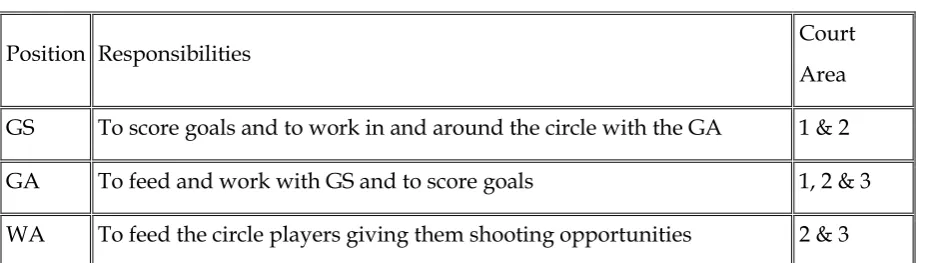
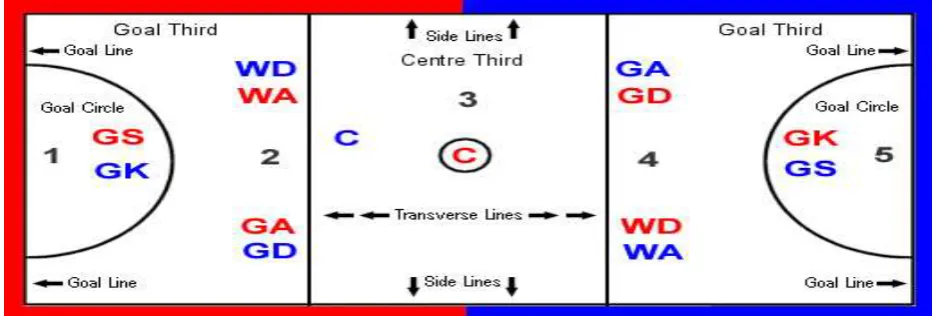
[image:33.595.69.532.620.751.2]Group students into teams and let them play the activity of netball with each player observing his or her role as seen in table 5.1 and figure 5.1 below;
Table 5.1
Position Responsibilities Court
Area
GS To score goals and to work in and around the circle with the GA 1 & 2
GA To feed and work with GS and to score goals 1, 2 & 3
33
C To take the Centre Pass and to link the defence and the attack 2, 3 & 4
WD To look for interceptions and to prevent the WA from feeding the
circle 3 & 4
GD To win the ball and reduce the effectiveness of the GA 3, 4 & 5
[image:34.595.70.540.244.402.2]GK To work with the GD and to prevent the GS from scoring goals 4 & 5
Figure 5.1: The Netball Field
Psychomotor Skills Developed:
The activity helps participants to develop stamina, agility, coordination and speed. Psychosocial Skills Developed:
Students will develop cooperation, respect for the rights of others and being responsible. Application of the skills in real life situation:
Can player (C) move to where the GS and GA are to shot and score? NO, why? Because that is not her responsibility
When people are aware of their rights and responsibilities, they are able to: 1. play their roles as parents, teachers and students in nation building 2. be responsible for our actions
3. respect the contribution from each and every member of the family, school, team or a society
Activity 2: Relay
It is a running event in athletics which involves four members performing as a team with a baton.
34
3. describe the benefit of coordinating with one another in a team Equipment: Batons or Sticks
Description of Activity
It is the act of giving and taking the baton from one member to another of the same team to cover a given distance. Students are put into groups of four. The first student starts with the baton and runs a given distance. He/she then hands over the baton to next running team mate. The exchange of batons continues till the 4th member of the team is reached with the baton to complete the race.
Key Rules
The baton or stick must be held throughout the race
Each team must run in a specific lane assigned to them
Psychomotor Skills Developed:
The relay activity is known to develop stamina, agility, coordination and speed Psychosocial Skills Developed:
Relay activity builds cooperation, respect for ones rights, team spirits and sense of responsibility.
Application of the skills in real life situation:
In real life everybody needs to respect individual difference in order to; i. accept each other in a team
ii. accept each other’s view point in team building
35 Summary
36
UNIT 6: SUPPORT FOR OTHERS AND TEAMWORK
Support can be explained as providing the necessity of life for a person, family, etc. it may also be explained as giving aid or courage to a person. Words such as aid, help, and assistance can be used in place of support. In sports support comes in various forms in terms of the various disciplines for instance, first aid, may be provided to an injured player on the field of play. Providing support for others means that providing help for other people.
Teamwork activities help athletes to work together better, which may carry to the playing field. A more cohesive group of players increases the chances of success in a team sport. It is generally accepted that there are five components of teamwork; communication, positive attitudes, motivation, discipline and the idea egos.
Objective: the student will be able to:
identify the supporters in their own life identify the importance of working in a team Activity 1: Screening
Screening is blocking move of an offensive player, by standing in front of a defender to free a teammate to shoot, receive a pass, or drive in to score. It is usually done in basketball. Objective: the student will be able to:
identify the need to support one another
describe the skills required to support one another explain the effect of refusing to support someone in need Materials / Equipment: Basketball, open space
Description of Activity
Students work in groups of three, thus the defender, the screener (the one who blocks the defender) and the cutter (the one who gets free from the defender).
In setting the screen, the offensive player will establish a position in front of the defensive player, so that his teammate can move towards him, change direction or dribble quickly very close to the blocked/ screened player, losing a few steps shoot into the net.
37
Psychomotor Skills developed:
Strength, agility and coordination. Psychosocial Skills developed:
Protection, appreciation, tolerance and discipline among team members Application of the skills in real life situations
For appearing to support there is the need for one to be tolerant, irrespective of tribal or religious differences. Again self-discipline is important- you need to discipline yourself when in need of support and must appreciate whatever support you get.
Activity 2: Astride vault
It is a gymnastic activity, which is performed worldwide. It involves performers going over obstacle by parting the legs
Objective: The student will be able to:
demonstrate solving problems with the support of leaders identify the benefits of a good leader
explain the importance of the benefits
Equipment: student mattress for landing, soft grassy land or bags of sawn dust Description of Activity:
The activity is about going over an obstacle with human support.
Students work in-groups of four. One stands with one foot in front and stoops to hold the ankle of the front foot. We will refer to him/her as ‘human support’. Performer runs from about
38
support with both legs. The other two students provide support from the sides of the human support by holding the upper arm of performer immediately he/she places hands at the back of human support. Later, the support is reduced to one and then to stand-by support, (where he/she goes in to support only when there is danger).
In an appropriate illustration – the human support must have one foot forward holding the ankle of the leg in front.
Psychomotor Skills developed Strength and stability (balance) Psychosocial Skills developed
What roles are the supporters performing? Protective role, confidence, trust, etc. Protection shows ……? love, commitment, integrity, honesty, faithfulness, etc.
Why will students perform without fear? Confidence and trust in the person providing support
Application of the skills in real life situation
In life it is important to realize that we are dependent on each other for success and that no individual can achieve his or her target without the support of another person.
This means that no matter how talented you are i.e. you could be extremely good at what you do, but without the support of persons such as relatives, relationships, friends, and school mates you may not achieve what you have set for yourself.
Activity 3: Ehene Kwan nie? (Which Way Is This?)
39
northern Ghana, in the Kussal community it is known as “Bobonsurla”. It develops strength as well as team spirit among children.
Objective: By the end of the activity the student will be able to:
work as a team within the circle to prevent the insider from coming out of the circle Description of the Activity
The activity is done by several children (twenty and above). The children form a circle and hold their arms to prevent anyone within the circle from going out of it. Five children stand in the middle of the circle. They begin to sing a song. After the song, the children in the circle try to push their way out of the circle. By so doing the other children who are holding their hands then hold them tightly to prevent those within the circle from moving out of it. Those in the circle persist so many times to go out of it by throwing their bodies on the arms of those who have formed the circle. This they do by asking them “Ehene kwan nie?” which means which way is this? Those who have formed the circle respond by mentioning any town they know.
Psychomotor skills developed
It helps to develop strength, stamina and stability. Psychosocial skills developed
It develops teamwork and appreciation. Application of the skills in real life situations
40
However, working successfully as a team is not as easy as it may seem. Effective teamwork certainly does not just happen automatically; it takes a great deal of hard work and compromise.
Teamwork can be all the difference in paving the way to a strong future. Everyone wants their team to be the best it can possibly be. Understanding the importance of teamwork is vital for moving ahead in a very competitive society.
Activity 4: Relay (Baton Changing)
The term relay means pass-on and, therefore, relay race involves holding and passing on of a baton from one team mate to the other. In a competitive athletic competition, the 4 by 100 metres and 4 by 400 metres are typical examples of relay races. In 4 by 100 metres relay, there are 4 athletes who cover 100 metres each, while in a 4 by 400 metres, each of the four athletes covers 400 metres.
Origin of the sport:
It is believed that baton changing which forms part of running event originated from ancient Greece.
Objective: By the end of the activities, the student will be able to:
demonstrate the transfer of the baton from one team mate to the other
demonstrate both the visual(primary level) and non-visual(JHS level) transfer Facility/Equipment:
Large playing area, baton sticks, clappers/whistles, Description of activities:
Students form groups of four as a team. Starters of the race of each team stands at the starting point. Second, third, and fourth athletes stand 6o meters away respectively.
Starters with batons, on command, run to transfer the baton to the second and it follows in that order till it reaches the fourth athlete to finish the race. The total distance to be covered by the four athletes is 240 meters.
The four-team member employs team work for the performance of their activity.
Note that the total distance to be covered depends on the size of the field available for use. Suggested distances to be covered by students:
10 to 11 years run 4 x 60meters 12 to 13 years run 4 x 80 meters
41
Rules:
A team is disqualified upon one false start (i.e. when one takes off before the whistle is blown)
Batons must be carried in the hand throughout the race Baton must not be transferred outside the changeover zone. The last hand that drops the baton must pick it.
Team members must run in their lanes throughout the race. Psychomotor skills developed:
The Psychomotor skills developed are: co-ordination, speed, agility, strength, flexibility, balance, reaction time, and power.
Psychosocial skills developed:
The Psychosocial skills developed are: self-confidence, team spirit, enjoyment, patience, responsibility and co-operation.
Application of the skills in real life situation:
In life, team work is a necessary tool for achievement of goals in establishments; however, it is important to know that in the processes of team work, one person’s failure can lead to the downfall of the entire team. Working together as a team brings about efficiency when it comes to performance than individual self-achievements.
Activity 5: Football (4-4-2 formation)
Football is one of the most popular participatory sports for both young boys and girls and has emerged as inter-school favourite. It is the most popular sports in the world and it is one of the most demanding. The activity to be discussed below is football formation which can be used effectively with teamwork.
42
defend their goal by working together as a team pass the ball to team mates
give a cover up in the absence of a team mate
Facility/Equipment: Large space for the activity, Footballs, whistle, stop watch. Description of activity:
Students form teams of eleven (11) players each with one (1) as the goalkeeper who is not counted in the formation. The activity indicates that four (4) players play at the back; four (4) in the middle and the remaining two play at the top near the opponents’ goal. This gives a formation of 4-4-2. The four (4) players playing the back defend the goal whereas the other four (4) in the middle link the defenders and the two attacking players upfront for scoring. One player from the front does not necessarily need to come back always to defend, as each of these players at various positions are expected to play their roles to make it a team.
Four players at the back use team work tactics to defend the goal as well as linking up the midfielders who, in turn, also work as a team to link up with the attackers for a goal to be scored.
Rules:
Put students into three groups. The first four of the formation, are the defenders, two at either side of the side line as full back and two in between them as centre backs to defend the goal.
The second four in the formation are the midfielders who are to link the defender and attackers
The last two in the formation are the attackers who are to score goals for the team to win. Psychomotor skills developed
43 Psychosocial skills developed
The Psychosocial skills developed by students are: enjoyment, team spirit, co-ordination, responsibility
Application of the skills in real life situation:
In life, team work is a necessary tool for achievement of goals, it is important to know that in the processes of team work, one person’s failure can lead to the downfall of the entire team. Working together as a team brings about efficiency than individual self-achievements. Activity 6: Volleyball
Volley ball is a team activity played by hitting an inflated ball back and forth over a high net. This sport is played by both boys and girls. The activity to be discussed below is the various positions in the volley ball for support.
Objectives: By the end of the activity, the student will be able to: identify at least three factors necessary to work in a team; describe at least, three benefits for being a good team player;
describe the qualities of at least, one person who they know as a good team player.
Facility/Equipment: Volleyball court, volley balls, whistles, net Description of activity:
Game is played both indoors and outdoors, with six players on each side at a time. There are three front line players and three back line players. The ball is rallied until a team wins a point. A rally is started by a serve over the net into the opponents’ court.
44 Rules:
It is a fault when ball to your side is returned without a minimum touch of two or maximum three touches from the side.
It also a fault when one player goes for a block. Psychomotor skills developed
Power, co-ordination, strength, time reaction, and flexibility. Psychosocial Skills developed
Team work, understanding, co-operation and tolerance. Application of the skills in real life situation:
Support is needed in anything one does and it is important we appreciate one another’s effort of support for success.
Activity 7: Basketball Origin of the sport
Netball was invented by Dr. James Naismith, a Canadian Physical Education teacher, who wanted an indoor sport to keep his students physically occupied during the winter months.. Basketball which began in England in the 1890s was derived from earlier versions of
basketball. http://en.wikipedia.org/History of netball
Objectives: By the end of the activity, the student will be able to: a) explain at least, two benefits of working in a team;
b) identify at least, two reasons a team may fail to win; c) describe personal commitment to making a team succeed Facility/Equipment: Netball court, whistle, net balls, bibs, Description of activity:
45
Rules:
A player may not roll the ball, run with it, throw it in the air and catch it again, run along bouncing it or drop it and pick it up.
A pass may not be thrown over a whole third
Players are not allow to hold the ball more than three seconds Players are to operate within their designated zones.
Psychomotor skills developed
Psychomotor skills developed by students include stamina, co-ordination, endurance, agility, balance
Psychosocial skills:
Cooperation, team work, communication Application of the skills in real life situation:
Providing support for others means providing for other people in difficulty and, therefore, it is important that individuals support each other in life irrespective of one’s status.
Summary
46 SECTION 2 HEALTH EDUCATION
The importance we attach to our health, to a large extent, determines how we behave. This becomes clearer when we realize that all of us want to be healthy. The maintenance and promotion of health is achieved through different combination of physical, mental and social well-being. Together, these are sometimes referred to as health triangle.
Health education is one way in which people can be helped to exhibit behaviours that have positive effect on their health. Health education provides knowledge, skills and attitudes that help the studentto exhibit positive health behaviours. In this Section, we will focus on how we can develop healthy bodies and be able to take part and enjoy sports. The section will discuss the topics below:
Unit 1: Healthy Body for Life and Healthy Body for Sport People Unit 2: Common Illness
47
UNIT 1: HEALTHY BODY FOR LIFE AND HEALTHY BODY FOR SPORTS PEOPLE If your health fails from relatively minor health issues such as pains and indigestion to major health problems that can threaten life, it can overshadow everything else that is going on in your life. This suggests that our health impacts on our happiness and stress levels. Making the commitment and taking on healthier habits can help prevent ill health.
Objectives: At the end of the lesson, the student will be able to:
explain the different parts of the body and the healthy habit that contributes to
making a person healthy;
demonstrate how lots of different things contribute to a healthy body;
describe at least two healthy things to promote lifelong wellness and athletic ability; identify the most important habit to promote good health in a sport person.
Below are suggested activities for healthy body for life and healthy body for sport which are also geared towards the overall development needs of every individual.
Activity 1: My head, my shoulder, my knees, my toes
Songs are useful tools in teaching various parts of the body in Ghanaian schools. It is performed by both boys and girls. It can be played both indoor and outdoor. The activity helps pupils to identify the various parts of the body and how useful they are to the human body.
Objective
identify the different parts of the body;
describe at least one habit that contributes to making a person healthy. Materials/Equipment: Working area for the activity.
Description of Activities:
The activity is about identifying the various parts of the body.
Pupil/students sing the song and perform actions relating to the different part of the body and the healthy habit that contribute to making a person healthy.
48
Rules:
Body parts must be touched as children sing.
Failure to touch body part relating the mentioned part of the body sends you out of the activity.
Psychomotor Skills
Psychomotor skills such as coordination, agility, coordination and flexibility are developed as children sing and touch the various part of the body.
Psychosocial Skills
Students appreciate their body parts and the usefulness of the parts.
What are some of the body parts you heard in the song? (Head, shoulder, knees, toes, etc.)
How can we take care of the body part mentioned? Song 1
My head, my shoulders, my knees, my toes -3x They all belong to Jesus
============================================================= Song 2
Brown girl in the ring} 3x Laa la la la la} 3x
She looks like a sugar in a pan laa la la la la! Show me your head laa la la la la Show me your eyes laa la la la la Show me your ears laa la la la la She looks like a sugar in a pan laa la la la la! 2ND VERSE 3RD VERSE Show me your show me your Nose hands
Mouth legs Neck toes
She looks like a sugar in a pan She looks like a sugar in a pan NB: verses 2 and 3 to follow same chorus pattern.
49 Application of the skills in real life situation
Pupil/students should be aware of their different body parts and how to take care of them to be healthy.
Activity 2: Yenni Ahooden A Yenko Ntokwa
The activity “Yenni ahooden a yenko ntokwa” as played by the Akans in Ghana literally means “you don’t fight if you are not strong”. Among the Ga’s it is called “ke obe hewale le anoo, in Dangme it is called “ke obe he wamio a nue kuno” while in the Volta region it is called “ne wo lame mese Ola, matenu awo kale wo”.The activity originated from the Ashanti region and spread throughout the Central, Western, Eastern, Brong Ahafo and Northern regions. It is usually played in moon-lit nights after children have finished their house chores. The activity is used to develop muscular strength and ability to endure. Objectives:
identify at least two health reasons some people cannot take part in games; describe your personal action(s) to prevent illness.
Equipment: The activity requires a large space for performance. Description of Activity:
The activity is about challenging one another to show strength. It can be played by both boys and girls. Pupil/students normally sit in a semi-circular formation. They clap their hands and sing a song. As the song goes on the children form two lines. Students and give
themselves numbers. Students mention numbers and stand in two pairs or four. Pairs raise one leg each facing each other and fold their arms. They stand in a challenge till one gets tired and drops the leg. The one who drops the leg losses and the child who is able to stand for a long time wins.
50 Song:
Yenni ahooden a yenko ntokwa. Yenko ntokwa ee!
Yenko ntokwa ee!
Yenko ntokwa ntokwa nwanwaa. Yenni ahooden a yemmo atwedee Yemmo atwedee ee!
Yemmo atwedee ee!
Yemmo atwedee nwanwaa. Rules
All arms should be folded One leg should be raised
The competitors are to stand still
Whoever drops the leg, or hops around looses
The one who stands whiles all others have dropped their legs wins. Psychomotor Skills
The activity develops in children muscular strength and muscular endurance due to their ability to stand on their one leg and for a longer period of time.
Psychosocial Skills Developed: obedience discipline tolerance endurance
Application of the skills in real life situation
Students will be able to perform activities both in school and at home with persistence to achieve their desired objectives.
Activity 3: Antoakyeri
Antoakyeri or anhwewakyiri (don’t look back) is an activity played by most ethnic groups and regions in Ghana. Literally, it means that “don’t look back”. It originated from the Central part of Ghana from the Fantes and later became a nationwide activity enjoyed by all children. The Ashantis call it “Antoakyire”, the Gas calls it “ka kwe ose”, and the Ewes of the Volta region call it “Mega kpo megbe o”. The activity can be played both indoor and outdoor.
Objectives: The student will be able to:
51
describe what must be done to prevent children from dropping out of school. Equipment: A stone or any other material and an open space to perform the activities. Description of Activity:
Ask between 8 and 20 students to form a circle. (You can form as many circle groups as possible). Ask them to squat while maintaining the circle. Ask the children to select one of them to start the game. The person selected will be responsible for placing an object behind the squatting playmates. The student stands behind the squatting circle with a piece of stone/rag. They begin singing and as they sing the person runs round the circle and searches to put the stone/rag behind one of the squatting playmates. All the children must be alert to recognise if the stone has been left behind them. Whoever has the stone/rag behind him/her must pick the object and run after the one who dropped it. If the one squatting does not find out until the one running meets him/her at the squatting position he/she receives a gentle tap on the shoulders. If he does not reach the student squatting, the one squatting picks up the task and continues the activity. It continues to allow as many of the children the opportunity to go round the circle.
The activity can be performed for five (5) to ten (10) minutes.
Song:
Antoakyire, antoakyire, Yee! Obi ba oo!, O bewu oo! Se wohwe w’akyire a Wabaa ko