Rochester Institute of Technology
RIT Scholar Works
Theses
Thesis/Dissertation Collections
9-28-2005
Black and deaf students: how can we, as educators
of the deaf, improve their educational experiences
Avery Dominquez
Follow this and additional works at:
http://scholarworks.rit.edu/theses
This Master's Project is brought to you for free and open access by the Thesis/Dissertation Collections at RIT Scholar Works. It has been accepted for
inclusion in Theses by an authorized administrator of RIT Scholar Works. For more information, please [email protected].
Recommended Citation
Black and Deaf students: How Can We, as Educators of the Deaf,
Improve their Educational Experiences?
MSSE Master's Proiect
Submitted to the Faculty of the Master of Science Program in
Secondary Education of Student who are Deaf or Hard-of-Hearing
National Technical Institute for the Deaf
Rochester Institute of Technology
By
Student 'Signature
tJVE~y
Ji>c;:J--??//J/Q?.U..E.
In Partial Fulfillment of the Requirements for the Degree of Master
of Science
Rochester, New York
M9
IQ/o5 (date)
Approved:
.9.Qo..
p~
~
Project Advisor
~
SSE Program Director S / I erI 0 S
1
-l
... .. ... --..
Abstract
In this qualitative study, seventeen black deaf college students and faculty/staff
from the National Technical Institute for the Deaf (NTID) shared their personal
experiences in educational setting, both residential and mainstream. These participants
also shared how they developed their awareness of their black identity, how they identify
themselves now, and who their role models were when growing up. Finally, these
participants gave suggestions regarding how to work with black deaf students for their
personal advancement; both socially and educationally
2
----Acknowledgement
First and always first, I thank God for making this happen and for blessing me with the
talent. I would like to thank the most important people in the MSSE program: Gerry
Bateman, Nora Shannon, Chris Kurz, and Lorrie Jo Turner for being there for me when I
needed them. There were times when I just wanted to give up and leave but I hung in
there. I would like to thank my mentor, Dr. Ila Parasnis, who helped me with my thesis
project. I know I told her many times that this project was really hard but she led me to
believe that I could do it. She is a wonderful lady and I truly learned a lot from her. I
would like to thank the Class of 2005 for helping me out when I was going through rough
times. We finally made it, yeah! I also would like to thank all the wonderful teachers in
the MSSE program that I've had. I can't really name all of them because there are so
many. I would like to say a special shout out to all of my black brothas and sistas from
the NTID community who participated in my project. None of this would have happened
if it weren't for you. Y'all really had my back. Last but not the least, I would like to
thank this special lady who has been my wonderful inspiration since 1993, Ms. Charlotte
Thoms. It was a pleasure working with her. Thank you.
The objective ofthis project is to identify the special needs of black children who
are deaf or hard-of-hearing and who are enrolled in residential school for the deaf or in
mainstream schools. Second objective is to develop recommendations for the educators
of the deaf students that would address the needs of black deaf children in the classroom
and outside the classroom. I have accomplished these objectives by doing interviews of
black deaf faculty/staff and students at National Technical Institute for the Deaf (NTID),
Rochester Institute of Technology (RIT). These participants have reflected on their own
schooling experiences and suggested what the black deaf and hard-of-hearing children
need.
Why is this topic important for the field of deaf education? According to the
previous research, 80 percent of minority deaf students including deaf black students
drop out of school before they receive their high school degree (parasnis, 1997).
According to Cohen (1993), minority deaf students including black deaf and
hard-of-hearing students on the average continue to score far below their white peers on
standardized tests and other educational measures. They are much more likely than white
students to drop out of high school or if they remain in school, to be tracked into
vocational rather than academic programs. The point is those minority deaf students who
do graduate from high school are less likely to enroll in college than white deaf students.
Why is that? It is possible that those minority students are not getting the support they
need throughout their education or their needs are not being accommodated.
Secondly this topic is important to the field of deaf education because not much is known
about how educators of students can provide a more supportive environment to keep
black deaf students in school.
It is known one reason for the high failure rates of some minorities is the
mismatch between the school culture and the social, cultural, and experiential
background of minority children (Polce, 1987). It is recognized that schools have long
neglected the effects of culture on cognition, attitude behavior, and personality (Pine &
Hilliard, 1990). Specifically, schools have failed to recognize that black Americans are
strongly influenced by their African heritage and culture (Hale-Benson, 1982). Educators
have resisted strongly the notion that the differences between black and white children's
cognitive functioning and learning styles are simply differences, not deficits (pine &
Hilliard, 1990). What is not well researched is how to provide an appropriate school
environment and experience for black deaf or hard-of-hearing children so they would
succeed in the educational system.
An improvement in the school performance of black American and other
culturally different children in schools will occur if the school curriculum and
environment are made to reflect more closely the particular learning styles and cultural
backgrounds of the students (Cohen, 1993). The cultural orientation of the
African-American home and community is different from that of the school and educators need to
understand that orientation and its relationship to the school performance of African
American children (Hale-Benson, 1982). We, as deaf educators, can apply this
information in the classroom so they can do better in school.
It is important to inform the students that their opinions and ideas matter in the
world. Most of the times black deaf and hard-of-hearing students feel like their opinions
are being ignored. This study is significant step to inform the students as well as their
educators about how black deaf people view themselves and their educational
experiences. Such information can be useful in increasing our understanding of the
5
----educational needs of black deaf children and in helping change the ----educational system for
the better.
Method
Participants
The participants were selected as follow. On Aprill, 2005, I attended to the
Ebony Club's 20thAnniversary Banquet. Ebony Club is a black deaf and hard-of-hearing
organization on the NTID campus. I showed up at the banquet and introduced myself to
most of the black deaf and hard-of-hearing students and faculty and staff who were there
and also explained to them why I was there. I explained to them that I was doing a
research for my master's thesis project and would like for them to be a part of my project.
I explained that the activity is voluntary and is stated in the consent form. No money
would be involved. I had a paper explaining the purpose of my project and for those
who were interested in participating in my project, I asked them to sign their names and
asked for their e-mail addresses so that I can contact them to set up the time and place to
meet up for the interview. The seventeen participants who agreed to be interviewed did
so as a voluntary activity and confidentiality was guaranteed. There were seven male and
four female students who were black hearing. Six black
deaf/hard-of-hearing faculty and staff (two females and four males) participated in this project as well.
Interview Procedure
All of the seventeen participants agreed to do the interview. I contacted each
participant bye-mail to discuss the best time to set up a place and time to meet on the
RIT campus. They all signed an adult consent form in which I stated the purpose of my
project and let them know that it was confidential meaning their names would not be
mentioned in my project. I informed them that I would only do interview related to their
6
---educational experiences. Most of all, they were asked to be honest with themselves. In
the adult consent form, I informed them that at anytime while doing interview if they feel
uncomfortable about it, they could resign without any penalty. The participants were
interviewed individually for about an hour and ten minutes using the list of interview
questions reported in Appendix A. As I went through the interview with each participant,
I took notes. I gave the written summary of the interviews to the participants to review
and received their consent to use the summary for my research.
Results and Discussion
Descriptive Information
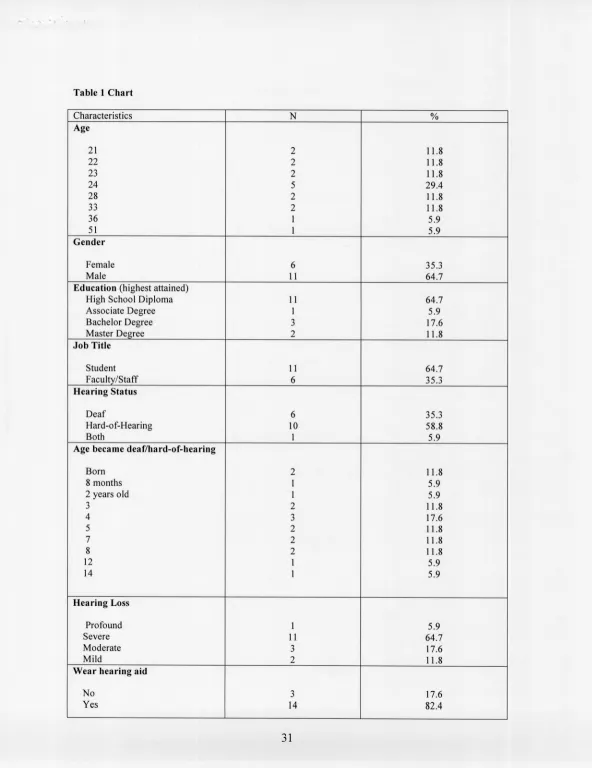
The descriptive information is listed in Table 1. I collected descriptive
information about each participants, their gender, how long have they been involve in the
deaf education, where they went to school, what is their educational background, age,
their job title, their hearing status, their highest degree received, at what age they became
deaf or hard-of-hearing, what their hearing loss was, whether they wore their hearing aid
daily, how well they understood speech, how well they spoke English, how skilled they
were in ASL, what age they learned how to sign, etc.
The seventeen participants ranged in age from 21 to 51. Their mean age was
27.1. When asked about their highest degree received, 64.7 percent received their high
school diploma; 5.9 received their Associate degree; 17.7 percent received their Bachelor
degree; and 11.8 received their Master degree. When asked about their job title, 64.7
percent were students and 35.3 were faculty/staff. The participants were asked how they
identified themselves; deaf or hard-of-hearing, 64.7 percent identified themselves deaf;
58.8 identified themselves as hard-of-hearing. Only 5.9 percent identified themselves as
7
--both meaning when they are surrounding by their hearing peers, they feel they are
hard-of-hearing and when surrounding by their deaf peers, they feel they are deaf.
When asked each participant at what age they became deaf/hard-of-hearing, 4
were deaf/hard-of-hearing before age 2, 7 between 3-5, and 6 between the ages of8-14.
Only 5.9 percent had profound hearing loss; 64.7 percent had severe hearing loss; 17.6
percent had moderate hearing loss; and 11.8 percent had mild hearing loss. Each
participant was asked if they wear their hearing aid daily and only 17.6 percent reported
that they did not wear hearing aid. 82.4 percent wear their hearing aid everyday.
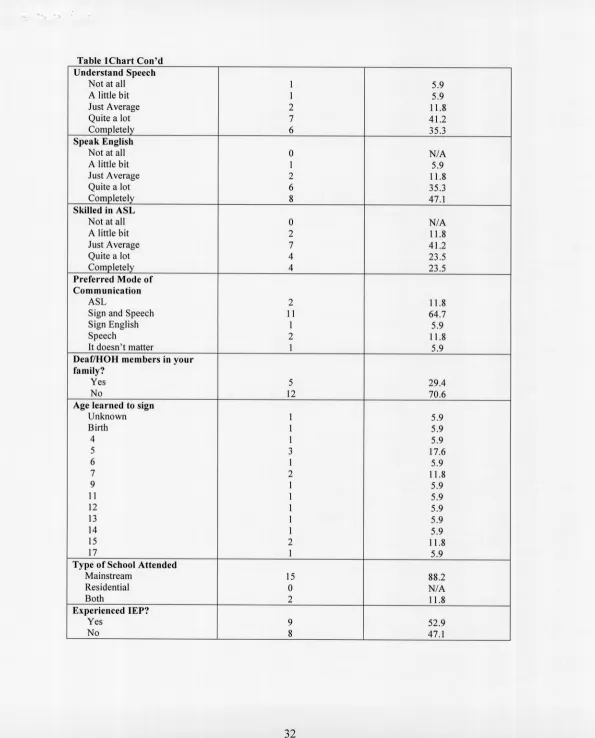
Each participant was asked how well he or she understands speech. 5.9 percent
said not at all; 5.9 percent said a little bit; 11.8 percent said just average; 41.2 percent said
quite a lot; and 35.3 percent said completely. When asked how well they speak English,
5.9 percent said just a little bit; 11.8 percent said just average; 35.3 percent said quite a
lot; 47.1 percent said completely. Each participant was asked about how skilled they are
in signing ASL. 11.8 percent said just a little bit; 41.2 percent said just average; 23.5
percent said quite a lot; and 23.5 percent said completely.
Each of the participant, they noted their own preference of communication. 11.8
percent preferred ASL; 64.7 percent preferred Sign and Speech; 11.8 percent preferred
Speech only; and 5.9 percent said it didn't matter. Only 29.4 percent had there are other
of-hearing members in the family. 70.6 percent, they were the only
deaf/hard-of-hearing person in the family.
Each participant was asked what age did they learned to sign. 5.9 percent said
unknown; 5.9 percent said they learned to sign very early because they came IToma deaf
family; 41.2 percent learned to sign between the ages of 4-7; 29.4 percent from 9-14 and
17.6 percent ITom 15-17 years of age.
Each participant was asked what type of school they attended. 88.2 percent said
they attended mainstream schools; none of the participant attended only residential
schools but 11.8 percent said they attended both mainstream and residential schools.
Each participant was asked if they knew about an Individualized Education Program
(IEP) when they were growing up. 52.9 percent said they have experienced IEP and 47.1
percent said they never heard of an IEP.
The descriptive information establishes that the participants came from diverse
backgrounds with varying range of language skills and hearing loss. Most of them used
hearing aids, and used sign and speech as their preferred communication. This
preference is consistent with how communication occurs most commonly at NTID/RIT.
Most participants went to the mainstream schools. This fact should be kept in mind while
reading their experiences with the school system and about the development of their
identity.
Now, I present a summary of the responses from the participants and the
suggestions that were made by the participants. Quotations excerpted from the
interviews are in italics.
Awareness of Black Identity
Each participant was asked the following questions: "When did you become
aware of your black identity? At what age? How did it happen? Did you have any
school experiences where you became aware of being black? What was your family's
role in developing your black identity?
NTID Male Students
"At the age of 9 or 10, that's when I became aware that I was black. In the elementary and junior high school were mainly white. The area the schools were in was in a white area. The schools I was in were in the rich area. I noticed the
way white people were living and how I was living so I knew I was different. In
my family, we always talk about family value. We never really talk about cultures
or racism. We really never talk down about other culture or anything.
""I noticed I was black when I was going to preschool. I was in school
surrounding around kids and I looked at all of the teachers and they were black
as well. My mother and grandmother kept telling me I'm black. If I was living
with myfather, he would have told me a different story, like I'm Hispanic only. "
"At the age of7, I used to play with white kids every summer where my parents signed me up for summer camp and I played with all the white kids. That's when I discovered I'm black. My parents have never talked to me about my black
identity because I was around them all the time.
""I don't remember what age I was aware of my blackness because I grew up in the black community. All of my friends were black. I knew the different between white and black. I don't even remember if my parents have sat with me and talk
about my black identity.
""As a small kid, I knew I was black because the environment I was living in. I grew up in the black community. Everybody in the family is black. My family has always talked to about me being black just to remind me who I am and where I
fi
"came rom.
"When I was in high school, I knew I was African but not emphasize because when I'm around deaf people, I forget my culture until I transferred here to NTID. I finally saw black deaf students here and that finally woke me up. One of my black deaffriends asked me why I dress like a white person. I explained how it happens, I hung out with white deaf students at CSUN and the number of black deaf students there were very small. From that conversation I was having with my friend, it made me realized I do have my African culture. From there, my
African pride started to growfa$ter than the identity as a deaf person.
""I know I'm black by the color but I don't' say I'm black, proud to be black blah
blah blah, I just don't. I am aware of my skin color since I was small. None of
my family members ever talked with me about my black identity. "
NTID Female Students
"When I was growing up, I really never thought of myself as black, you know just never look at it that way. I always wanted to have long beautiful hair and be light-skinned. As I've grown up, I appreciate myself more than I did before. I've become more mature and accept things the way they are. "
"I was aware that I'm black when I was a kid. I don't remember what age. There
was no heavy emphasizing. I know when I go to school; I hang out with my white
friends. I know I'm differentfrom them. It wasn't a problem for me. "
"I knew I was black all of my life and my skin color didn't really impact me until I came to NTID. Growing up in NYC, I used to be around black people until I came here to NTID, it was so different, too many white people here. I felt I had to be more careful because of my skin color. As a black person, Ifeel I can get into trouble in whatever I do."
"I don't remember what age I became aware that I'm black. Ijust
knoweverybody who surrounded me was black and I ~ew up in a black community.
"NTID Faculty/Staff(male and female)
"At high school, I went to a predominately black school where there were students of color everywhere. My friends were mostly black and the
neighborhood I grew up is predominately black and Spanish so my exposure to my identity was early on. The church where I ~ew up was all black but the true identity of my blackness was at college where I learned about black culture and their history. Ironically because NTID did not have many students of color when
I arrived.
""My mother had never really sat with me and talk about my black identity. I went to black day care plus I grew up in a black community. In the black day care,
they taught me about Kwanzaa and lot of black things in the black community.
""I became aware that I'm black when I was a kid. Whitestudents were picking
on me because what I had and they didn't. I don't remember what exactly what it
was but I knew it was a racism thing. I don't remember what age my parents had
talk to me about my black identity but I do remember my parents explained to me
about me about a slave movie called, "Roots". I had questions about why black
people were treated badly back in the slavery days."
"When I came to NTID, that's when I realized I'm black. When I was in high
school, 90 percent of the students were black and 10percents were white.
Nobody really pay attention to the color of skin. So when I came to NTID back in
1991, I think it's the people I saw. Peoplefrom different place, different
background, and didn't know where they camefrom. That's when I realized my
black identity. "
"My awareness on black identity increased when I was in college. I learned
almost all of the history of black culture after high school. I knew I grew up in
the black community, but it was never acknowledged until later in life."
"I became aware of my black identity about 7 years ago through Gallaudet' University. "
11
---Identity
All of the participants came from different background. They all have formed
their own identity based on their experience or environment when growing up. All 17
participants, they identified themselves black first importantly then identified themselves
deaf later on.
NTID Male Students
"Everywhere I go, I identify myself as a black person first, second a man, and third deaf I identified myself that way based on how I was raised. My
grandmother was the person who raised me and made me the person who I am today. Even when I get involve in the Deaf Community, I still feel the same, nothing has changed. "
I identify myself as a black man. I don't feel that I'm deaf because I don't have
enough deaf exposure. Right now, Ijust identify myself as a black man period
and nothing else. I'm half black and Hispanic. Right now, Ifeel closely to the
culture because I'm mostly around blackpeople than Hispanic people. Myfather
is Hispanic and my mother is black. "
"I identified myself as a black deaf person because that's how people look at me. I feel very proud to be black and deaf because I'm surrounding by other people just like me. I identified myself with both hearing and deaf cultures because I
have the ability to speak, hear, and signs. "
"I look to think of myself as a black, male, and hard of hearing because that's who I am. Think about it, I was born black. My hearing went down later on in
life.
""At NTID, I identified myself as a black deaf person. I speak for everybody else as a deaf person. When I'm out in the real world, I consider myself as a black person. They won't know if I'm deaf or hard of hearing until I tell them, I like to
test them to see if they notice I'm deaf or hard- of- hearing. Once they found out, they don't know how to ask questions. They just don't want to be bothered. "
"When I came from, the way I was raised, my knowledge, I would consider myself as an African first then deaf person. I was born in Africa and moved to America in 1987 and settled in California. "
"Sometimes I don't look like I have to think I'm deaf first or black. I'm just an Eritrean (it is a country where my family are from in Africa) but anyway I'm just a person who is proud to be deaf and proud to be the color I am right now. I would say I identified myself as a black deaf person. When I came to NTID, I
12
----became involve in the black and deaf culture. Before college, I was so much
involved in the hearing world. "
NTID Female Students
"I simply identified myself as a black person first, a woman second, and deaflast. Well growing up, my parents were very protective. My parents really never show it. Example: I tell my parents I want to go outside and play with my friends. My mother would say, no, you can't go outside because what
if
something happen to you. I have always thought it's because I'm black and turned out it was mydeafness. I really never thought of my deafness as a problem. I mean I did everything what the 'hearing' people were doing meaning talking on the phone
and listen to music.
""I identify myself as blackfemale first, then deaf My deafness isn't really the
issue until I'm placed in a situation where I don't have complete access to
information. Example would be going to church, there are no interpreters
provided and I don't be knowing what's going on. Also many people don't
recognize that I'm hard of hearing until I tell them. Their reactions were shock
because I can hear and speak very well. I'm in a little bit of both hearing and
deaf culture. "
"When I was growing up, I thought of myself as a deaf person because of my
family. The reason I said that because no one in myfamily signs and I didn't
understand them and they didn't understand me. My parents speak in Creole
language. Because of that, I feel deaf WhenI'm around my peers, Ifeel that I'm
in both worlds because I have the ability to speak and signs. "
"Everywhere I go, I identify myself as a black person period because that's all I've known. "
NTID Facultv/Staff(male and female)
"I see myself as a black person, woman of colorfirst. That's thefirst thing I see
when I look into the mirror. Deafness is an "invisible" disability, which I didn't
think ofit until I started having conversation where I started to sign. WhenI'm
out in the public, I'm very much aware of being blackfirst. If I'm in a group of
black people, then my awareness shifts to being a woman and deaf If the group
is black and deaf then my awareness to being a woman"
"I identified myself black first, woman, and hard of hearing because when I look into the mirror, that's what I see. "
"I identified myself black first, deaf second because that is just who I am. I
identified myself in the black and deaf cultures.
""I identified myself just black and deaf because it's obviously. I'll take that back, instead of saying black and deaf, I rather to be label as black and hard of hearing
13
---because that's my preference. It's obviously,people can see I wear hearing aid
and I can talk and hear. "
"I currently think of myself as a black deaf person. While I was raised in a deaf family, I considered myself as hard of hearing, which I actually was. I wanted to
be normal just like everyone else. I had some frustrating experiences in the hearing world, but I didn't stop living. While I grew up in the black community I was not taught about the pride of being a black deaf person. My deafness seemed to be the most important back then. My experience in collage boosted my self-esteem on my deafness. Communication was more important than my race. After being exposed to a large group of black deaf community and organization, I
identified myself a black deaf person.
""When I was growing up, I have always considered myself as hard-of-hearing because I only interact with hearing people. I kind of hid my deaf identity. At first, I see myself as deaf person since I wasn't sure of my identity until much later
when I entered Gallaudet University. Overtime, I learned more about my identity
and the deaf culture itself. Now I do consider myself blackfirst and deaf second.
"Role Models
When talking about role models, the participants agreed that it was important to
have someone to look up as idols, for inspiration and support.
NITD Male Students
"I didn't have a black role model when I was growing up and no deaf role model. There was no one to look up to so I really didn't care about that. "
"All of my life, my mother is the perfect role model for me. I really don't have
anybody to look up to. My mother was always therefor me.
""My dad was my role model. He was a hard working man. He did what he had
to do. Nobody can tell him anything. He was a big inspiration to a lot of people.
They look up to himfor help. I don't have any deaf role model because I didn't
know any when I was growing up."
"At the age of 16 or 17, my black role model was Morgan Freeman because in all of his movies, he plays positive characteristics, very intelligent and he showed that black men can be smart too. Black men can be rich and all the other great things that are mostly known as a white man's role. There were no deaf role models for him when I was growing up."
"I had no black or deaf role model when I was growing up. I was just being me. "
"When I was growing up, Bill Cosby was my black role model because he showed the world what black culture is all about based on value, legacy of slaves, showed
family bond like make sure that blackfamilies are the priority.
""Yes my black role model was my dad because he put food on the table, provided us shelter, and made sure we had the right education. I had no deaf role model when was growing up."
NTID Female Students
"My grandmother was my black role model because she raised a family like her younger siblings and raised her siblings' families, and raised her own children. She went to college at the age of 40 to pursuit her B.S. degree in social worker. My deaf role model is Claudia Gordan because she grew up in the same
neighborhood as I did. She fought hard for everything she has now. She is the first black female deaf lawyer in America."
"I really can't remember, I doubted if they were anybody I look up to whether if they were black, hearing, or deaf"
"I met a black hearing female interpreter. She changed me to be more serious in school, stayed away from bad things, don't hang out with the wrong crowd, made me think positive about myself, and made me believed that I can do anything I
want.
""My family was my black role model because they provided for me, supported me,
they installed my black culture in me and I cherish my black culture.
"NTID Faculty/Staff (male and female)
"My mother, MLK, and Harriet Tubman are my main role models because my
mother raised me as a single parent. Martin Luther King ended the segregation
and Harriet Tubman challenged herself with learning how to read and challenged
the laws by creating and helped other slaves to freedom. "
"My mother was my role model. I did not realize that until years later. My mother was a single mom raising me as best as she could under the
circumstances. The neighborhood where I grew up was not in the suburbs but we all felt safe where everyone on my block looked out for each other. They were my role models because they "had my back". Unfortunately I didn't know much about deaj culture when I was growing up. I didn't think we could make amazing
achievements. I mean look at us now.
""I never had a deaf role model when I was growing up. I had several black role models who were black engineers which leaded me an engineer major when I enrolled to RIT in 1989. "
"Yes I have black role models when I was growing up and it was singer, Michael
Jackson, Bill Cosby, and MLK. Michael Jackson shocked the world by beating
everybody on the Top Chart, even beat Elvis Presley. Bill Cosby because he
encouraged notjust black kids but everyone to get an education. MLK because
he got us where we are today. There were no deaf role models when I was
growing up."
"When I was growing up, my role models were Sidney Po iter and Bill Cosby. My parents were always my role models"
"I didn't have any black role models when I was growing up but I did have a deaf role model which was my second older brother who graduated from Gallaudet University from Virgin Islands"
Comfort Level
The participants reported that there were times when they were put in situations
where they were uncomfortable because of their race, identity, or disability when
growing up in schools or colleges.
NITD Male Students
"At NTID, being black wasn't the problem for me. When I first came to NITD back in 1999, a lot of profounded deaf students didn't really support me because they believe in ASL and no voice. I am very oral and hard-of-hearing. That made me more uncomfortable and made me not want to know about the Deaf Culture
here at NTID.
""I have never been in a situation where I was uncomfortable because I'm black or deaf"
"At NTID, Ifelt uncomfortable because the Teacher of the Deaf{TOD} doesn't
talk about black history, black culture, and I felt pretty much being ignored. "
"Here at NTID, I hate to see a group of white students chatting. And I wanted to be part of the chatting. They either stop talking or walk away like they don't want me to be part of their conversation. They don't even respect me a 100 percent. I believe it's all based on my skin color, not the communication access. I'm used to that, none of that will change the way I am today. "
"I had never felt uncomfortable is school or college just because I'm black or
deaf I neverhadproblemsin school.
""I have been in a situation where I was a little awkward here at NTID. One time I was in a class at RIT and there were hearing black students looking down at me
just because I'm deaf As for me, to avoid thatfeeling, Ijust act like I'm
hearing. "
"I had never been in a situation where I felt uncomfortable just because I'm deaf or black. I'm always just being me and mind my own business. I don't like when people think that deaf people can't do certain things then I have to prove them
wrong. For an example related to my experience, this guy who happened to be hearing thought I couldn't win a soccer position as Caption because of my deafness. Guess what? I proved him wrong, I won the position as a Caption for
the hearing soccer team here at RIT.
"NTID Female Students
"Yes, at RIT, I'm taking a class called Intro to Philosophy. In the class, Ifeel
intimidating because everybody is the class is hearing and I'm the only hard of
hearing in the class. Sometime I want to raise my hand and ask the teacher to go
back and repeat but I didn't because I'm shy. I didn't want students tofeel that
the teacher has to repeat everything to this deaf girl. In the beginning of the
quarter, I didn't sign upfor an appointment to meet with the teacherfor help not
untilrecently. I reallyneedhelpwithmy work.
""
In high school, I was challenged to socialize with hearing people. There were a
lot of clique happening at the school because my peers identify me as a deaf individual and it was hard to get accepted and stand out on my own. During that time in high school, I identified myself as hard of hearing and felt more
comfortable with hearing crowd and not the deaf crowd.
""When I went to high school, I was scare to wear my hearing aid and signs because I felt that hearing students would make fun of me because they never seen a deaf student before. After a while, I realized that people didn't treat me any different. Teachers introduced me to the students and informed them I'm deaf Students treated me as if I was the same as them. "
"I don't think I ever felt uncomfortable in school or college because of my
identity
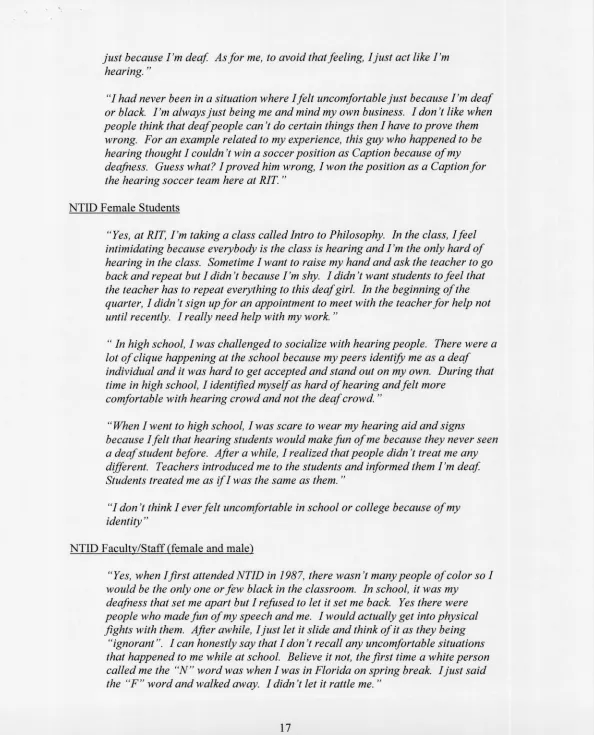
"NTID Facultv/Staff(female and male)
[image:18.618.18.612.20.755.2]"Yes, when Ifirst attended NTID in 1987, there wasn't many people of color so I
would be the only one orfew black in the classroom. In school, it was my
deafness that set me apart but I refused to let it set me back. Yes there were
people who madefun of my speech and me. I would actually get intophysical
fights with them. After awhile, I just let it slide and think of it as they being
"ignorant". I can honestly say that I don't recall any uncomfortable situations
that happened to me while at school. Believe it not, thefirst time a white person
called me the "N" word was when I was in Florida on spring break. I just said
the "F" word and walked away. I didn't let it rattle me. "
17
--"I've been in an awkward situation here at NTID where faculty members patronize me because I'm black and they thought I don't meet their standards"
"At RIT engineering, I have always felt uncomfortable because I was the only black deaf student in all of my classes. I didn't have anyone to team with or to be partner with. It's possible that I'm black and deaf"
"There are times where I have felt uncomfortable at NTID. One was where I was the only black student in the Industrial Drafting Technology major back in 1991. Another example would be whenever I'm in a class being the only black student there and all of them are white. The white students tell white jokes and it's hard for me to get involve with that (laughing). Because you don't know those kids,
should I laugh or not? Better not"
"I had felt uncomfortable about my deafness as well as my black identity. I experienced communication difficulties with hearing world and thought it I was better off a hearing person so I didn't have to deal with communication problems with hearing people. I thought being black was inferior. I went to mostly white schools and saw the difference in black schools. "
"Let me see ...1 don't remember. I don't think I ever felt uncomfortable in a situation just because I'm black or deaf"
School Experience
Each participant was asked the following questions:
a. Did you feel that you had full access to information? If yes, tell me what
the teachers did in the classroom that helped you have full access. If no,
tell me what you did not like about the way teachers taught.
b. If grew up in a mainstreamed school environment, explain what kind of
support services you had. For example, were there interpreters, note
takers, social workers? Were the IEP meetings satisfactory? Explain
c. If you were in a residential school, did you stay on campus? Was sign
language used on campus? Was it used in the classroom?
NTID Male Students
"I grew up in mainstream schools. I didn't have any support services. I was in
class with regular students. I was not in a self-contained room. I was what you
called it a resource room, a place where I go for help. The teachers didn't make
no different between me and other students (hearing). If I didn't understand what
was going on in the classroom. I would ask the teacherfor help after class. I was
passing all of my classes. "
18
---"The teachers would sign in class, sometime the teachers would use overhead
projector, show movies with closed captioning. I had ASL interpreters, sat in
front of the class, which I hated the most. I never had note takers in any of my
mainstream classes. "
"Teachers use sign language, overhead projector, Internet access, showed movie with ee, and had interpreters in the class. I was in the self-contained class most of the time. I had two mainstream classes and had interpreters, no note takers. "
"In mainstream before I went to high school, there were no interpreters or note takers provided for me. I had a resource room but never really went there for help. I never did my homework there. The only thing I did was met up my counselor there and talked about my schooling to see
if
I had problems with my homework or anything. Most of the time I understood my teachers and even if I didn't, I would go home and ask my mom for help. In high school, I enrolled a deaf and hard of hearing program called Miss Eight. I was placed in a self-contained class most of the time. The only mainstream classes I had were math, gym, and computer. There were no interpreters or note takers provided for me for my mainstream classes. TODs use sign in class, wrote on the board, andsometime they use overhead projector once in awhile. "
"All of my teachers sign, use books, wrote on board, and gave out notes. I was in a self-contained class most of the time. I was in regular classes like computer, science with an interpreter. I had gym class without interpreters because I didn't need it. "
"When growing up, I was in a self-contained class half of the day. TODs signed, showed overhead projector, and wrote on the blackboard. The other half of the day, I was in mainstream classes with my hearing peers. The only support services I had in mainstream classes a teacher aide who was also my interpreter.
I had no note takers provided at the time.
""I did hadfull access in schools. If I didn't understand what was going on in
class, I would get the interpreter right away or use the paper to communicate or
repeat if I didn't understand the information. I don't recall having gone any
trouble with my education related to access. I did had littleproblem with the
note-takers not showing upfor class or the handwriting being messy. I grew up
on mainstream schools and had sign language interpreters and note-takers. My
hearing teachers were aware of my deafness and treated mefairly just like they
treated their non-disabled students. There were times when interpreters didn't
show up in class on time, the teachers would wait until the interpreters show up
then proceed. If the interpreter didn't show upfor class, the teachers would go
and lookfor another interpreter to accommodate my needs. "
NTID Female Students
"From k_3rdgrade, I had no interpreter, no note-takers, or any support services
because I was in a Catholic school. In the Catholic school I was in, teachers
would write on the board, I sat infront of the class. If I miss out in class, I had a
friend in class would explain to me what's going on. In 3rdgrade, I transferred to
a mainstream school. I was in classes with regular students, again, there were no
interpreters/ note takers provided for me. I had a resource room. The resource
room is a place where I gofor help with my homework. After a year transferred
to a public school, I was put in a self-contained class called Mis Eight, where a
small classfull of deaf students and TODs. I stayed at MSSDfor a year and half
as I mentioned it before. I lived on campus as afreshman. At MSSD, everyone
signs inside and outside of the classrooms. As the matter offacts, the whole
campus signed ASL. That was myfirst exposure to ASL.
""In grade school, I was in mainstream classes where no interpreter or note takers
were provided. The teachers wrote on the board. About one or twice a week, I
would go to a resource room. I received help where I was struggling and did all
of my homework there. By the time, I got to high school; I was placed in a
self-contained classroom. I had interpretersfor my mainstream classes and half of
the time; I was in the self-contained classroom with TODs."
"In mainstream school, all of my life, I had interpretersfor all of my classes. I
feel that my interpreters gave mefull access to information. I wore the FM
system in all of my mainstream classes and was able to speak and sign. Yes I
have experienced being in self-contained class with small number of deaf students
for a short period of time. Yes I had a resource room where they help me with my
homework and materials that I was able to usefor my homework. Ifelt that the
resource room and interpreters were myfull accessfor my education. I went to
Lexington Schoolfor the Deaffor a short period of time because the schoolfelt I
wasn't deaf enough and was more qualified to be in mainstream classes. They
transferred me to public school that has a deaf program. I was put in a
self-contained classfor a while then put in mainstream classes. At LSD, we were
using ASL inside and outside of the classrooms. "
"When I was growing up in mainstream schools, I hadfull access to information.
I was never in a self-contained classroom. I had no support services when I was
growing up. I sat infront of my classes most of the time. In high school, I only
had one interpreterfor one class, which was computer. The rest of my classes, no
interpreter provided. "
NTID Faculty/Staff (male and female)
"I went to an elementary school which was oral (it wasn't working out for me) until middle school, a teacher realized I'm deaf, not hard of hearing. Teachers started to use sign language to accommodate my needs. After I learned sign language, I started to use interpreters for mainstream classes. They provided note
takersfor in classes but none of those werefully accessible because I didn't get
all the information I needed. "
"Yes I had totally access to information in class. The teachers voiced and signed. The teachers wrote on the board and used a lot of overhead projector. There was no power point back then. I grew up in mainstream school. I was in
self-contained class. My interpreters in my mainstream classes were also my TaD and that's how I received one on one support. "
"I was in mainstream schools for 12 year. I had no support services, there were no interpreters or note takers provided for me. I wasn't in a self-contained classroom. I was in mainstream classes all day. By the end of the day, I would go to a resource room and review all of the things I learned in all of my classes. I only went to St. Joseph School for the Deaf for two years. I didn't live on campus. I commuted back and forth. As for as I can remember, we all signed ASL inside
and outside of the classrooms.
""Yes I did. The TODs used everything in the classroom like overhead projector, wrote on the board, and signed. That's it. In high school where I was
mainstreamed with my hearing peers, I didn't have any interpreters or note taker not until I came to NTID back in 1991. Back to the mainstream classes,
if
I didn't understand what I was suppose to do, I would go up to the teacher after class is over. There was no resource room at my high school. Out of the whole school year, there were only one teacher who knows sign language and I had her forsocialstudies. She signedin classwhileI was there.
""In schools, I had access to information most of the time. I was able tofollow the
teachers who used oral method in classrooms. Teachers often wrote information
on the blackboard or used an overheadprojector to share information. WhenI
was in classes with hearing studentsfor Physical Education or technical classes, I
didn't have any interpreter. I used my audio logical and speech skills tofollow
classes in the best of my ability. The only support services I had was the deaf
program where teachers of the deaf taught only to deaf and hard of hearing
students. I never had an interpreter in the classroom. A couple of years I had 2
teachers who used sign language and speech in the classrooms. During
communication with parents, teachers used paper and pencil. "
"From elementary tojunior high, I hadfull access to information. I was in a
self-contained class. The teachers signed in class, we used overheadprojector, and
wrote on the blackboard. By the time, I arrive to Junior high, I was placed in
mainstream classes because I was the smartest kid in the self contained class. In
the mainstream classes, no sign language interpreters were provided. I had an
oral interpreter and it didn't benefit me because I grew up using ASL and all of
sudden, I get this oral interpreter which threw me off. "
During the interview with each participant, each was asked about his or her
experience with the Individualized Education Program (IEP) meetings. Some of the
participants didn't answer the question because they have no clue of what an IEP is. An
IEP is a written document that is developed for each public school child who's eligible
for special education. The IEP is created through a team effort and reviewed at least once
a year. Before IEP can be written, the child must be first eligible for special education.
By federal law, a multidisciplinary team must determine that he/she is a child with a
disability or more and requires special education and related services to benefit from the
general education program. According to the table chart on page 32, the statistic showed
that only 52.9 percent of the participants have experienced IEP. Some of their
experiences were good and some were not so good. Here are the comments that were
made about their experiences with IEPs:
NTID Male Students
"Yes, I have attended a few of my IEP meetings with my parents and it was satisfied. "
"I have attended IEP meetings with my parents and went a few times by myself The meeting was pretty good but they didn't encourage parents enough to come to the IEP
meetings.
""Yes, I have attended to IEP meetings with my mom before. During those meetings, they discussed the plan for the following year like where I plan to be and so on. Now the IEP meetings, it didn't really benefit me, it sucks. They talked and treated me like I'm a little kid. "
"Yes I have attended to my IEP meetings with my parents where they talk about your strength and weakness throughout my school year. They tell me areas where I need to improve, do reading more, need to behave more in class, be a leader of the whole class because the students really look up to me in class. Because of that, I had to be careful in what I do or say. "
"Yes, I have attendedfew of the IEP meetings with my parents and it wasn't a good thing. At the IEP meetings, TODs think they know what's best for me. The TODsfelt that I would be better off to mainstream classes instead of being in a self-contained classroom due to my intelligent. The only thing that I didn't like they didn't even ask me how I felt about it, never asked me about my inputs. However, in my junior year
in high school, I finally spoke up and told them I know what I wanted; only I know. I
told them I want to attend to a 4-year university, not going to some training school.
"NTID Facultv/Staff(male and female)
"Yes I have attended to IEP meeting before. I really can't say what I like and dislike
about the IEP meetings because it was 18 years ago. "
"I have experienced IEP meetings before. Some of the IEP meetings had no access
for me to understand what was going on. There were interpreters but they weren't
qualified interpreters"
Almost half of the participants had never known about IEP. Here are their comments:
NTID Female Students
"To be honest, I never attend to any of my IEP meetings. I don't remember
if
I hadany.
""As for the IEP meetings, I'm not so sure what they are. I don't think I ever attend to one. I did attend to Teacher/Parent Conference when teachers talk about my grade in class and my behaviors in class. "
"As for the IEP meetings, I don't recall attending any of my IEP meetings when I was growing up."
NTID Facultv/Staff(male and female)
"I never heard of IEP meeting before. My mother and I had never attended to any of IEP meetings. "
"As for the IEP meetings, I don't recall attending to that kind of meeting but we had Parent/Teacher Conference. "
Something is wrong with this picture. 47.1 percent of the participants had never
heard of the IEP. This suggests that these participants didn't know their rights as
disabled students. For example, 88.2 of the participants grew up in mainstream schools
and half of them had never had sign language interpreters or note-takers in their
mainstream classes. Is it possible that their rights have been denied? It is possible if no
one ever educated them about their rights as disabled students and informed them the
services that were available for them. At the least, something needs to be done in the
field of deaf that ensures that the deaf children and their parents know about their rights
to get educated, to have full access to information.
School System
Although the participants were successful in the schools they attended, they felt
that as they looked back, they realized that something was missing and wished they had
more services and opportunities when they were in schools. Here are their reflections
about their experiences with the school system. Here are the comments:
NTID Male Students
"They need more supportive teachers and not always following the school curriculum too much. Teachers need to open themselves more, do different methods to motivate students to learn. When I was growing up, all of my teachers were white, half of them were women and other half was men. I strongly believe that black deaf and hard-of-hearing children need minority deaf teachers. Just not black teachers but other minorities. "
"I feel that they need more black deaf teachers so they can help the children. They need to learn more about the black community, black history, black deaf
history, .and teach them the things that their parents never taught them.
""They need after school program giving to them. They need a one- on-one aide
inside and outside of the classroom.
""We need more black teachers, females and males. We need more educated minority deaf teachers. Related to communication, teachers should have more
than one language to make the class more interesting.
""They need to read more books. They need to improve their writing and reading
skills. If they learn how to read and write, they can easily graduatefrom high
school and enroll in college. They need tofollow the right path likefollowing the
right crowd in schoo/. "
"Obviously what the school systems need more black deaf role models. With black deaf teachers, black deaf and hard of hearing students will be motivated to learn or stay in school. Black deaf and hard of hearing need to have
communication at home which will lead them to do better in schoo/. So basically communication is the key. Schools need to offer a Black Culture class so they can feel they can be black, deaf, and successful. "
"It is good to have the Ebony Club here on the NTID/RIT campus. It really helps me a lot. It really helps me with my black identity. Most of all, the school systems
24
--need more black deaf teachers for role model for the sakes of the black deaf and
hard-of-hearing children.
"NTID Female Students
"They need more support and extra attention. Some kids aren't exposed to positive influential role model. Some blacks do not come from background where
they are reinforced and encouraged to do well in school and make sound, intelligent decisions. Not necessary to hand-hold and cuddle with the black and provide extra reinforcement so they can stay on top of their goals. "
"They need black deaf teachers so the students can look up to them as role model"
"The school systems need more black deaf teachers because we're lacking in that area. They need more black deaf organization to attend to they can feel
comfortable around their own people.
""They need support. They need to know it's ok to have problems. They should
have a club where black deaf and hard of hearing gofor supports. They should
have mentors to check up on the students like the Boys and Girls' Club. "
NTID Faculty/Staff(female and male)
"More teachers that look like them (black). How can we expose our kids to the beautiful culture of both black and deaf if we don't learn from someone who is alike? We also need to learn more about our black culture... this is very important because it will shape who you are as a person. Too often very little is taught about black culture except for the obvious! MLK, Malcolm X; the "famous" ones.
What about the ones who are not famous? But they made a large impact on our
people.
""The school systems need more black deaf role models who are involved in the
student community.
""They need a lot more black deaf role models. They need a lot of positive encouragement. Parents need proper information so they can better prepare for their children. Black deaf and hard of hearing children to communicate with their parents and peers more often."
"The school system is lacking black deaf professors so the students can look up to them as role models. It's also lacking support for diversity environment.
Example, if I'm a student right now, I'm looking for some supports from faculty from different diversity background. The reason for that is because most faculty
does not get involved with students who want to drop out. They do not interfere enough and give them a reason to stay. "
"Black Deaf and hard of hearing student of children need more support system to
improve their education. Often they don't receive good supportfrom their
families. A program committed to develop and increase the students' academic
and leadership skills in neededfor them. Change of attitudes by educators will
make a differencefor the children. Educators ought to carry positive attitude and
faith in believing that they can learn and succeed in education. More role models
(Black hearing or Black deaf educators) are neededfor them. The exposure of
role models will motivate the children to succeed as well. "
"In the school system, the black deaf and hard-ol-hearing students need to learn English the properly ways in order to advance their knowledge about reading and
writing.
"Recommendations
Here are all of the recommendations that were suggested by the black
deaf/hard-of-hearing students and faculty/staff here at NTID/RIT for the Teachers of the Deaf.
"For the teachers of the deaf, they need to them a better taste of reality. When I say, reality I mean let them experience the real world. A lot of deaf people don't know how to pay their credit card bills, car notes, and instead of having their parents taken care of their things, they should know how to do itfor themselves.
TOD needs to teach students not to limit themselves on what given. To encourage black deaf and hard of hearing to take advantage of the opportunity what's given to them. Not to limit themselves. TOD should encourage them to go to college, or go to a vocational school to have a better job. TOD needs to make sure that
they will graduatefrom high school.
""To teach black kids to focus more on their education stay in school, keep them motivate by telling them something they really want to hear. Example: talking to the students about classic book, tell stories which will interest the students to read and about to learn how to read and write. Teachers should do more activities to motivate the black deaf and hard of hearing students to learn. That will keep
them out of the street.
""TODs need to find out what their problems are in math, reading, writing, and the problems at home
if
there 's any. TODs need to get involve with their parents, make them your neighbor. TODs need to interact the students more often outside the classroom. And try something to fix the student's level and work him/her wayto the top.
""Teachers need to stop using books so much because books not always correct. Teachers should be teaching based on experience. Teachers should do my activities instead of too much lectures. Teachers need to be open to students more, not focus too much on their role as teachers. Teachers should dress nice everyday to capture students' attention. "
"For TODs like yourself, Avery, be the students' friend, not focus your role being a teacher all the time. Be flexible to your students, they will listen and learn from you. TODs need to have positive attitudes toward the students. Get to know your student importantly, find out what they like to read and find a book for them to
read related to their interests. Most of all have patients with your students.
""TODs should take a black culture class so they can understand where the students are coming from. Get involve in their life so the students can feel they're worth it. Need to develop relationship with students and their parents. And be courage, listen, and be more supportive. "
"For the TODs, don't look down on the black deaf and hard-of-hearing students. They need your special attentions. Treat them equally like you do your treat white students"
NTID Female Students
"Always teach them about the black culture, no matter what the subject you teach. Always form a relationship with your students, not exchange numbers, and go out on weekend like Michael Jackson does with the kids. Teachers should be open to their students, get to know your students more. Make the students feel comfortable to come to you with their problems or anything. Teachers need to be blunt to the students. For example: if a student is failing a class, tell the student that he/she if failing the class and need to bring the grade up. Most of the time, teachers tend to send out a warning to the advisor saying this student isfailing my
class instead of communicating with the students.
""The TODs need to recognize the warning signs of students who are having problems. Practice early intervention. Also keep close contact with the student
and the immediate parents about the student's progress. Be a role model and take the time to learn about the student as an individual person in meaning form a
rapport with the students.
""TODs should focus on their weakness so they can improve better. Example would be if their English is weak, help them improve their English skill like writing and reading. I believe that TODs should involve parents so that way they'll aware of what's going on with their deaf/hard of hearing child and it will keep the child motivate in schoo/. "
"TODs need to nurture them. Try to establish relationship with them. Get
involve, tofind out what's going on in their personal life. "
NTID Facultv/Staff(female and male)
"For the TODs, have better understanding of their cultures. Everyone have their own uniqueness. TODs need to be sensitive to that. Patience is also the key because it may take time for students to see the teachers really care about them. "
"Train TODs about black culturefor awareness. Also to bring role models into
the classroom setting this will give students "black" something to grow on in
knowing there's a chance to excel their best. Inspiring the students to develop a
mentoring connection. "
"TODs need tofind their bestpotential. Don't neglect them because they're
black orfrom the street. Teachers shouldfind good role model meaningfinding
someone who's black and deaf and successful to have them to do presentations. If
in English class, make sure they select a book related to their race instead of
forcing them to read The Great Gatsby, have them to read to read Native Son.
""For the TODs, don't look down on the students base on racism, just look at them as students period. If your student has a goal, you should be more involved helping the student reaches his/her goals. If the students are struggling or trying to understand a concept in class, TODs should spend some time trying to find ways to help the students understand it better. TODs should have some
knowledge about "Black Culture and Deafness.
""TODs need to encourage parent's involvement to be part of their children's education development. Establish sign language classes for parents to improve communication between students and family members. Set up panel of deaf/hard of hearing professionals sharing their success to students and parents.
Encourage or assist students to develop a leadership club or organization to develop leadership skills. And attend two professional development activities to enhance their awareness and knowledge for effective teaching to deaf and hard of
hearing.
""For TODs, just make sure all of the black deaf and hard-of-hearing students will have full access to its reading and writing because it will take them further with more chance to success in their education. Also, encourage them to continue reading daily to enrich their reading level. "
Conclusion
Seventeen black deaf college students and faculty/staff from the National
Technical Institute for the Deaf (NTID) shared their personal experiences in the
educational settings both mainstream and residential schools. The participants
identified the special needs of black children who are deaf or hard-of-hearing in
the school systems. The participants suggested recommendations for the teachers
of the Deaf on how to work with black deaf or hard-of-hearing children so they
can be successful in the school. The reflections of these participants are valuable
because they are based on their direct experience with the school system. These
participants have successfully completed their high school education and beyond
despite the barriers they had in having full access to information and knowledge.
Their insights and experience can be of significant help to those educators who
are committed to incorporate diversity in their curriculum.
29
--References
Cohen, Oscar P. (1993). Educational Needs of African American and Hispanic
Deaf Children and Youth. The Populations, 45-67.
Hale-Benson, J.E. (1982) Black children: Their roots, culture and
learning styles. Provo, UT: Brigham Young Press.
Parasnis,1. (1997). Cultural identity and diversity in deaf
education. American Annuals of the Deaf, 142(2), p.72-79.
Pine, G.J., & Hilliard, A. (1990). Rx for racism: Imperatives for
American schools, Phi Delta Kappan, 71, 593-600.
Polce, M.E. (1987). Children and learning styles. Thomas & J.
Grimes (Eds), Children's need: Psychological perspectives. Washington DC:
National Association of School Psychologists.
30
---Table 1 Chart
31
--Characteristics N %
Age
21 2 11.8
22 2 11.8
23 2 11.8
24 5 29.4
28 2 11.8
33 2 11.8
36 1 5.9
51 1 5.9
Gender
Female 6 35.3
Male 11 64.7
Education (highest attained)
High School Diploma 11 64.7
Associate Degree 1 5.9
Bachelor Degree 3 17.6
Master Degree 2 11.8
Job Title
Student 11 64.7
Faculty/Staff 6 35.3
Hearing Status
Deaf 6 35.3
Hard-of-Hearing 10 58.8
Both 1 5.9
Age became deaf/hard-of-hearing
Born 2 11.8
8 months 1 5.9
2 years old 1 5.9
3 2 11.8
4 3 17.6
5 2 11.8
7 2 11.8
8 2 11.8
12 1 5.9
14 1 5.9
Hearing Loss
Profound 1 5.9
Severe 11 64.7
Moderate 3 17.6
Mild 2 11.8
Wear hearing aid
No 3 17.6
[image:32.612.13.605.9.777.2]Table lChart Con'd
32
-
---Understand Speech
Not at all I 5.9
A little bit 1 5.9
Just Average 2 11.8
Quite a lot 7 41.2
Completely 6 35.3
Speak English
Not at all 0 N/A
A little bit 1 5.9
Just Average 2 11.8
Quite a lot 6 35.3
Completely 8 47.1
Skilled in ASL
Not at all 0 N/A
A little bit 2 11.8
Just Average 7 41.2
Quite a lot 4 23.5
Completely 4 23.5
Preferred Mode of Communication
ASL 2 11.8
Sign and Speech 11 64.7
Sign English 1 5.9
Speech 2 11.8
It doesn't matter I 5.9
Deaf/HOH members in your family?
Yes 5 29.4
No 12 70.6
Age learned to sign
Unknown 1 5.9
Birth 1 5.9
4 1 5.9
5 3 17.6
6 1 5.9
7 2 11.8
9 1 5.9
11 1 5.9
12 1 5.9
13 1 5.9
14 1 5.9
15 2 11.8
17 1 5.9
Type of School Attended
Mainstream 15 88.2
Residential 0 N/A
Both 2 11.8
Experienced IEP?
Yes 9 52.9
Appendix A
1.