Rochester Institute of Technology
RIT Scholar Works
Theses Thesis/Dissertation Collections
5-25-2006
Successful deaf readers: deaf professionals'
perspectives on their childhood learning-to-read
experiences
Sharon Cooke
Follow this and additional works at:http://scholarworks.rit.edu/theses
This Master's Project is brought to you for free and open access by the Thesis/Dissertation Collections at RIT Scholar Works. It has been accepted for inclusion in Theses by an authorized administrator of RIT Scholar Works. For more information, please [email protected].
Recommended Citation
Table of Contents
ABSTRACT
INTRODUCTION
LITERATURE REVIEW
Potential Factors Affecting the Reading Development of All Children
Concerns Regarding the Reading Skills of Many Deaf Children
Potential Factors Affecting the Reading Development of Deaf Children
METHOD
Research Topic
Participants
Procedure
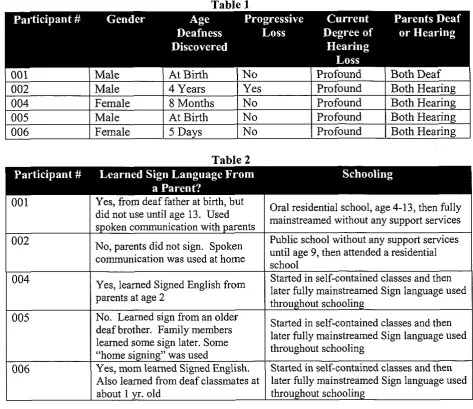
Tables 1 and 2
RESULTS
Theme 1: Participation in SportsIRecreation Activities
Theme 2: Availability of Reading Material at Home
Theme 3: Literacy~Educational Activities Supported at Home
Theme 4: The Communication Environment at Home
Theme 5: Parent Involvement in Education
Theme 6: Acceptance and Adaptation to Deafness
Theme 7: A Sense of High Expectations Regarding Educational Achievement
DISCUSSION
APPENDICES
ABSTRACT
The purpose of this project was to discover if there were any common themes or
factors that exist, or are perceived to exist, in the childhood reading experiences of
successful deaf readers serving as participants in this study. Despite the availability of
research concerning poor reading abilities among many deaf children, there has been little
exploration into the experiences of successful deaf readers. Through in-depth interviews,
detailed information was collected from five deaf adults holding Ph. D. degrees and
working in the field of education regarding their learning-to-read experiences. Information
was then analyzed and placed in thematic categories related to participation in
sportslrecreation activities, availability of reading material at home, literacy activities
supported at home, the communication environment at home, parent involvement in
education, and a sense of high expectations regarding educational achievements. This
paper includes insight from the participants themselves, conveying information to parents
and educators regarding potentially significant variables and useful strategies to consider
for practice in fostering the successful reading development of young deaf children.
INTRODUCTION
For centuries, there has been discussion regarding the poor reading skills of a large
percentage of deaf children. In recent times, reports have focused on the difficulties many
deaf students have with reading and writing English, scoring low on tests of reading
achievement and lagging behind their hearing peers in reading skills and academic
achievement in general (Wilbur, 2000; Lartz, 1999; Schimmel, Edwards & Prickett, 1999;
Winograd, & DeVille, 1994; Padden, 1990; Allen, 1986). Considering that an individual's
academic, social and occupational success is heavily dependent on their reading ability,
and that this success is likely to enhance the overall quality of life for individuals, it is
critical to support the continuous investigation of desirable factors and effective strategies
for teaching reading to deaf children so that they may become skilled readers. For many
deaf people, the most accessible doors to a world of knowledge and opportunity are opened
when reading from a book, magazine, encyclopedia, newspaper, or on the Internet.
Educators agree that it is essential for deaf children to have access to favorable leaming-to-
read experiences that will effectively develop and advance their reading skills. However,
considering the range of diversity among deaf children (or any children for that matter)
regarding personal characteristics, family backgrounds, and social experiences, it is
difficult, if not impossible, to know the appropriate combination of favorable experiences
for any one child. It would be inappropriate to suggest just one prescription for reading
success suitable to all children. As a result, educators and researchers continue to
investigate factors, and combinations of factors, in the hopes of more clearly understanding
what varieties may positively influence reading success to satisfy the individual needs of
children.
Deaf children have a unique situation in learning to read English because they do
not have complete access to spoken language as hearing children do. This is important to
understand considering that printed English is a representation of spoken English. Deaf
children have either limited, or no access to spoken English as they do not hear it around
them as hearing children can. Such severe limitations on language input complicate the
children often have much less difficulty in learning to read because they have auditorily
absorbed so much spoken English starting from birth, or even in the womb. By the time
hearing children begin to learn how to read, they already have a significant amount of
knowledge and understanding of the common sounds and strings of conventional English.
This knowledge is mostly acquired incidentally, and without effort, by simply living in a
world of sound. Therefore, hearing children have a much easier time in learning how the
sounds of English transfer to the printed word. In other words, they have already acquired
the principles in print-sound mapping. It is quite understandable then that one result of
having either no auditory input or fragmented access to spoken English is that many deaf
children have difficulty learning to read.
And yet, there are successful deaf readers. In fact, there are successfulprofoundly
deaf readers. With the understanding that English print represents the sounds of spoken
English, and given the seemingly endless reports of underachievement in the reading
abilities of deaf students, cases of successful profoundly deaf readers are both interesting
and unexpected. Of course their success is certainly ideal, and of paramount importance to
the educator is finding out how these individuals have exceeded in obtaining a mastery of
English print and what factors have contributed to their success. Involvement and input
from deaf people, especially regarding their experiences, insights, and opinions ought to
have significant weight in qualitative research that seeks to investigate and discover best
practices in deaf education. From this position, this project is designed with the objective
of collecting and analyzing detailed information obtained from successful deaf readers
themselves, through in-depth interviews. Through the shared experiences of the
the perceived elements of experience that have helped them to achieve a level of English
mastery that research reports most deaf people do not obtain. With emphasis on a
collaborative approach, deaf and hearing researchers and educators can collect valuable
insight from a considerably rich resource that will likely lead to measurable improvements
in the quality of deaf education, with a particular focus on the reading skill development of
deaf children.
LITERATURE REVIEW
Potential Factors Affecting the Reading Development of All Children
There are a variety of factors, investigated and suggested by researchers and
educators that are believed to have important effects on the reading development of all
children. Phonological skill, parental involvement, and intrinsic and extrinsic motivation
are a few of the more common factors discussed in literacy research.
In the article "Successful Readers: Motivation and Social Factors," Alexander,
Wigfield, and Oxford (2000), point out that research has shown reading achievement is
highly correlated with motivation. The authors discuss several factors believed to
stimulate motivation in reading and achievement in second language comprehension.
Positive parental support, a sense of competence, interest in content to be learned, and
opportunities to choose literacy activities are some of the elements that the authors
maintain will help to instill motivation in young children, and ultimately lead to reading
success.
In a 2004 report on current research in the field of literacy from the Center for
successful readers tend to be filled with literacy activities. Parents play the critical role in
initiating activities at home that will nurture successful learners. The authors suggest
several tips for parents to create a literacy rich environment that will establish a solid
foundation for learning to read. They are: offer authentic contexts that provide purpose,
expose children to vocabulary, read to children frequently, help children connect to the
text, talk about the stories, offer lots of opportunity for children to play with letters of the
alphabet and with language, read stories over and over again, and dramatize stories.
Armbruster, Lehr, and Osborn (2003), in their research sponsored by the National
Institute for Literacy, emphasize that a warm, loving relationship between a parent or a
caregiver and child is the key to helping children develop into successful readers and
writers. Like Cheak and Wessel (2004), the authors state that young children need a
variety of literacy opportunities and they provide many suggestions for activities in the
home. The authors assert that the necessary elements in providing opportunities for
children to become skilled and confident readers consist of building spoken language by
talking and listening, learning about print and books, learning about the sounds of spoken
language, learning about the letters of the alphabet, and listening to books read aloud.
In describing their 2004-07 project "Precursors to Reading Development and
Reading Disorder," Nation, Bishop, Angell, and Taylor state that in a broad sense, there
are two sets of skills that children need to become skilled readers. The first skill is
learning how to decode and recognize words and the second skill relates to reading
comprehension. The authors report that an important finding has been in the relationship
between word reading and phonological skills and phonological awareness. In fact, there
determining reading success in general. This postulation certainly makes the situation of
deaf children, particularly profoundly deaf children, more perplexing. The authors do
acknowledge though, that there is more to language than phonology. Nevertheless, their
point is well-taken that children with impoverished spoken language vocabulary may be at
a disadvantage when learning to read.
Concerns Regarding the Reading Skills of Many Deaf Children
The poor reading skills of many deaf children are clearly recognized and
unsurprising, particularly considering the fact that printed English represents spoken
English. In the field of deaf education, it is common to come across published articles
with statements such as these: "Most profoundly deaf children read poorly" (Goldin-
Meadow & Mayberry, 2001); "It is no secret that deaf children have difficulty reading
written English" (Schimmel, Edwards, & Prickett, 1999); "The majority of children who
are deaf read well below the national average for hearing students" (Lartz, 1999; Holt,
1993); "Most deaf or hard of hearing students do not read proficiently" (Luetke-Stahlman,
Hayes,& Nielson, 1996); and "The average literacy level of deaf adults in America is
below a fourth grade level" (CADS, 1991); "Over 30 percent of [deaf students] leave high
school functionally illiterate compared to a functional illiteracy rate of less than 1 percent
among their hearing peers" (Marschark, 1997). These examples represent just a handful of
countless comments and reports concerning the current status of reading ability among the
deaf and hard of hearing population. However, there are successful deaf readers - even
Potential Factors Affecting the Reading Development of Deaf Children
Goldin-Meadow and Mayberry (2001) addressed the issue of profoundly deaf
children learning to read, even without a deep understanding of the phonological code on
which printed language is based. The authors asserted that some profoundly deaf children
can still become good readers without the use of phonological encoding. They also
expressed that it is questionable as to whether those successful deaf readers who seem to
have phonological awareness developed this skill before or after learning to read. In
addition, the authors suggested that knowledge of ASL or any manual language may help
deaf children learn to read English.
The case of Jeffrey, a four and a half year old child in "A Deaf Child Learns To
Read," could be significant to the hypothesis above that knowledge of any manual
language may help deaf children learn to read English (Rottenberg, 2001). Despite not
sharing a first language with his hearing parents, Jeffrey became a confident and competent
early reader. After his deafness was discovered, just before his first birthday, his parents
began taking courses to learn Signed English. He was enrolled in a total communication
school program where Signed English was the primary mode of communication. Although
the use of manual communication may have been a significant factor in Jeffrey's reading
success, the author gave equal consideration to several other conditions in his learning
environment. Those identified components include early quality interactions with others,
engaging in daily literacy activities, having many opportunities to explore books and other
print materials at home and school, early introduction and availability of sign-print books,
ample reading materials in general, adult interaction with Jeffrey as he read, and non-
Rottenberg (2001) also highlighted some of the common qualities of successful
young readers in other case studies involving hearing children. She then pointed out that
the few case studies have revealed similar characteristics among early deaf readers. The
typical characteristics identified are curiosity, positive interactions with interested adults
during daily literacy events, and self-regulated reading behaviors of the children. Jeffrey
displayed each of these qualities as well.
In his book Psychological Developnzent of Deaf Children, Marschark (1993)
reviewed thirty years of research regarding the reading abilities of deaf children of deaf
parents compared to deaf children of hearing parents. Marschark found that, overall, deaf
children of deaf parents were generally better readers than deaf children of hearing parents
for reasons he attributed primarily to deaf parents being more sensitive to their children's
communication needs. However, of further interest, Marschark discovered that deaf
children who are better readers, regardless of parent hearing status, tend to be those who
were diagnosed with a hearing loss early, had early access to language (usually through
sign language), and were exposed to English. Additionally, he concluded that having a
parent who signs well seems to be more important in predicting reading success than
whether the parent is deaf or hearing. As in Jeffrey's case above (Rottenberg, 2001), use
of manual communication appears to be a potentially significant factor in promoting
reading success.
In The Family Environment and Achievement of Deaf Students: A Discriminant
Analysis, Barbara Bodner-Johnson (1986) examined family environment factors related to
the deaf child's school achievement, particularly within the academic content areas of
investigated the differences in the family environments between students whose skill
achievement in mathematics and reading was high, and those whose achievement was low.
The parents of 125 children across seven northeastern states were interviewed for the
purpose of identifying family characteristics and practices that relate to child academic
performance. Bodner-Johnson's study revealed that parent's adaptation to deafness and
press for achievement were primary discriminators between high and low reading
performance of their children. Deaf children who did well in reading tended to have
parents who integrated them into the family and who held them to high educational and
occupational expectations, to a greater degree than families of children with low reading
performance.
To clarify the focus on specific research variables in literacy-related studies, some
theorists make a distinction between "inside-out" skills and "outside-in" skills. Nation,
Bishop, Angell, and Taylor (2004) explained that the former refer to skills that are in areas
intrinsic to the child, while the latter are those skills that are provided by the environment.
Phonology and syntax are intrinsic, inside-out skills while vocabulary, reading experience,
and opportunity fall into the category of outside-in skills, those provided by the
environment. Such categorical thinking helped to determine the interview protocol for this
study as the research focuses primarily on environmental factors that may have positively
influenced the reading development of participants in this study. Additionally,
environmental factors identified by researchers in the literature review above have been
METHOD
Research Topic
The purpose of this research project was to learn about various aspects of the
learning-to-read experiences and environments of skilled readers who are deaf, through
interviews with the individuals themselves, to get a broad picture of factors that may have
been influential in fostering their reading success. In general, the focus of the research
interview was on the participants' learning-to-read experiences, insights, and opinions.
More specifically, in considering the proposed factors influencing literacy that were
reviewed in the literature above, the research interview sought to investigate the extent and
conditions of elements such as parental involvement in reading development, personal
motivation, and literacy experiences at home and school.
Participants
This project includes in-depth interviews with five successful deaf readers. The
criteria for subjects invited to participate in this study was that they a,) have a PhD, b.) are
deaf, and c.) work in the field of education. Participants have been identified as
"successful deaf readers" under the confident assumption that individuals who have
worked toward, and received a Ph.D. have also achieved an impressive level of mastery of
the English language that researchers report most deaf people do not attain. This
assumption is based on the understanding that the requirements for obtaining a Ph.D.
demand long and arduous work that involves an intense amount of reading and writing.
Above average reading ability is clearly a fundamental attribute for completing a PhD
program. In addition, a professional career in the field of education would likely require
For the purposes of this study, it was determined that a total of five subjects would
be interviewed. The names of deaf individuals satisfying the criteria were identified from
their known status in the Rochester area educational community by the researcher and
advisor to this project. To begin the sample selection process, an initial group of 6
potential subjects, three male and three female, were mailed formal letters of invitation to
participate in this research study. Each invitation letter was given a number (001, 002,
003, 004, 005, 006), to be used for identification and confidentiality purposes for subjects
interested in participating in the research. Individuals were asked to respond to the
researcher if they were interested in participating. Five out of the six individuals
responded to the invitation. The individual who received invitation number 003 did not
respond to participate in the study.
Procedure
The interview protocol was designed to elicit information about participants'
personal learning-to-read experiences and environments as well as their perceptions of
various aspects they believe have helped them become successful readers. The interview
guide approach (Patton, 1990) was chosen for the purpose of keeping data more
systematic than in an informal conversational interview, yet still flexible and open enough
so that the wording and order of questions could be varied to some extent. By using the
interview guide approach, as Patton explains, "the tone of the interview still remains fairly
conversational and informal."
Participants in this study were first asked to sign a consent form. All names have
been kept confidential with the assignment of an identification number. Participants were
questions in writing. The one-page background information form asked questions such as,
"At what age was your bearing loss discovered? Are any members of your family also
deaf! When and where did you learn sign language? Did you attend a school for the deaf
or a public school?" See Tables 1 and 2 below for a brief description of participant
[image:15.616.70.544.224.633.2]characteristics.
Table 1
Next, participants scheduled a one-time interview. A pilot interview between the
researcher and advisor to this project (who also satisfies the participant criteria) was
sense of how much time the interview process would require, and to get feedback on the
impression of questions asked. The results of the interview with the advisor were not
included in the actual research study. The five participant's individual interviews each
lasted between one hour and one hour and 15 minutes and were videotaped. Three out of
five of the interviews took place in the participant's work office, one took place in a
private videotaping room located on a college campus, and one took place in the
participant's home. An extensive list of questions was generated by the researcher and was
further refined through the input of Stephanie Polowe-Aldersley (April, 1996). The
interview consisted of questions requiring the participant to reflect on various aspects of
histher childhood learning-to-read experiences. Questions were asked primarily focusing
on early learning-to-read experiences at home and at school. A few examples of questions
that were asked are, "What type of readingllanguage activities took place at home when
you were a child? How would you describe your parents' involvement in your reading
development? How would you describe the communication environment at home? Was
your family a good resource for information to you? Have you ever taken advantage of
tutoring services for reading andlor writing? Overall, what do you think has helped you to
become a successful reader?" (See Appendix A and B for the complete listing of
background and interview questions.)
When all of the interviews were completed, data was analyzed to discover if there
were any common themes or factors that exist, or were perceived to exist, in the childhood
reading experiences and environments among the participants in this study. Each
videotape was transcribed for analysis. The researcher coded all transcriptions. Codes
RESULTS
During the analysis, information was placed into thematic categories. The results
are presented by seven major themes that emerged among the participant interviews.
These themes represent categories of similar experiences between three or more of the five
participants. For the purposes of associating quotes with subjects, the participant's
identification number is used.
Theme 1: Participation in Sports/Recreation Activities
This theme emerged out of the interviews with the males in the group. It was
interesting that this theme was discovered in three out of five participant's interviews since
the responses below were not a result of a direct question asked by the
interviewer/researcher. The topic was brought up by participants in the interview through
the flexibility of the interview guide approach and the flow of conversation with the
interviewer. It is important to note that while the two female participants did not mention
being involved in sports related activities, it does not imply that they were not involved in
such activities. This was not a specific question asked during the interview.
Participant 001: "I developed a passion for sports because of my father. I was involved in some activities in high school: football, baseball, track, golf, basketball in the community. A lot of sports activities but not school clubs. That was my way of interacting with hearing peers."
Participant 002: "I was a leader in my home neighborhood [mostly hearing kids]. I would say I was respected, maybe because I was a little older and I was very physically fit. I
exercised. I really took care of myself. We played a lot of sports games in the neighborhood. We'd play football, sometimes baseball. We played outside a lot. At the school for the deaf I was very involved in student activities, clubs, theater, and sports."
Participant 005: "I grew up with other hearing kids. I went to the Boys' Club of America for recreation. My 3 brothers and I went there after school. We grew up playing baseball, football, and basketball. I knew all of the kids, had played with them, and was friends with many. Some of them knew fingerspelling. They could communicate with me well because we did so many things together - sports, camps, Boys Club of America, etc..
.
Everyone inTheme 2: Availability of Reading Material at Home
Educators frequently emphasize that availability of reading material is an important
factor necessary for promoting literacy in children. From the background information
form and interview, it was found that four out of five of the participants had at least an
average amount of reading material at home. Participant 001 described in writing that as
he was growing up his home environment included many children's books as well as
encyclopedias, dictionaries, thesauruses, and atlases. The others described their situation
as follows:
Participant 002: "I remember being surrounded by books. Some books I inherited from my brother and sister. My parents bought some children's books, so there were books available. We had a set of encyclopedias at home. I remember looking through them and being fascinated with the pictures and information. That was probably the best exposure to reading for me. The world opened up for me and I could read whatever I was curious about."
Participant 004: "I had books everywhere. They were very accessible to me. I had a very language-rich environment. They [parents] would take me to the bookstore and buy me whatever I wanted. If I wanted many books, they would buy them for me. At the library, I would borrow 20 books at a time."
Participant 006: "I didn't have shelves full of books but I had a few that I would keep near my bed on the table. I had a children's dictionary and I was fascinated with the pictures. My mother bought it for me. I enjoyed that. My mother didn't have a lot of money so we had one dictionary and that was all."
Participant 005 explained that he grew up in a family with seven children, they
were very poor, and therefore they didn't have many books at home. However, his parents
did subscribe to the daily local newspaper.
Theme 3: Literacy/Educational Activities Supported at Home
Of the five participants, four described literacy and educational activities that were
supported at home. Participant 002 stated that he couldn't recall any family activities at
home related to language. However, he did remember that every so often he would read
the newspaper (current events and sports section) and magazines (Time, Newsweek,
National Geographic) that his parents received from subscriptions. The other participants
described activities that included other family members.
Participant 001: "When I was horn, mom knew early education was important. She would always read and tell me stories, orally. My mother was very easy to lipread. Her frequent stories were fascinating and wonderful! She was a wonderful storyteller - stories like nursery rhymes. I had a lot of early exposure. She'd read the stories and then talk about them. I often went with my mother to visit her friends and she would tell them stories about the books she was reading and I would be fascinated. My father was wonderful when it came to telling sports stories, playing board games and math games. We played a lot of board games. I loved Scrabble and Monopoly."
Participant 001 later describes another home activity that began around the time
when he was in grade, after moving from an oral residential school to a public school:
Participant 001: "My mother would make me read books for one hour everyday. After that hour then I could go out and play."
This participant also explained that he loved to go to the library. He would go
almost every night to do his homework or to look for additional information. He described
the library as his second home during high school and college. He felt very comfortable
working in the library, surrounded by books,
Participant 004: "At home my mom would always sit with me. Almost everyday for about an hour she'd read with me. Then, when we were finished reading, we would act out the stories. So I just loved it. At the library I would take out 20 books at a time and then I would lie down in my parents' bed and read them. I really enjoyed that. We went to the library about once a week."
Participant 005: "We lived only 2 blocks from the library. My oldest sister always took the
3 of us boys to the library with her because she would baby-sit us while our parents worked. My sister was a book worm so that's why she would always take us to the library with her. We went every week. I didn't borrow books but I would read magazines like Sports Illustrated. My sister took out lots of books. My brothers and I would play hide and seek, look at pictures, and hang out."
While participant 005 might not have found the library to be very exciting, it does
seem that it was an activity he accepted without question and ultimately found ways to
remain entertained while h e was there. The library became a familiar and comfortable
place to visit. Other activities that took place at home are also described.
Participant 005: "I also remember my family would often play Boggle. I always got the lowest amount of points. I usually got 3 or 4-letter words. I rarely got 5 or 6-letter words like the rest of the family. It was more competitive for them, but a challenge for me. Also when I was growing up, especially during elementary school, my 3 oldest sisters liked to play 'teacher'. In our basement we had 3 or 4 desks so it was like a classroom set up there. My sisters would always test me and my two older brothers on math skills. Not other subjects, it was always related to math. They would test our math facts and time us. They would give us star stickers and I would compete against my 2 older brothers. It helped me develop a strong foundation for math facts."
Participant 006: "I remember we labeled things around the house like the window would have a small label on paper: w-i-n-d-o-w. Lots of things around the house were labeled. I
Theme 4: The Comnzurzication Envirorznzent at Home
The participants did not all share similar communication environments at home. In
fact, there appeared to be three different types of environments among the five participants.
Despite the difference, each participant seemed to feel strongly, in one way or the other,
about the communication at home. The two participants who had at least one hearing
parent who signed well both described communication at home as very open where they
were frequently and actively engaged in conversation. At least one family member was
valued as a good rekurce for information. A third participant had a very unique situation
where he grew up in a signing environment with two deaf parents, but he never signed
himself until he was 13 years old. It seems he was more of an observer of the signing
environment while he actually lived his experience through speaking and lipreading.
Frequent and active exchanges with his mother were through oral communication. Despite
this method of communication that may seem somewhat perplexing to an outsider, this
participant described his communication environment as "wonderful, relaxed, open, free
flowing, and exchanging." He explained that he was frequently and actively engaged in
conversations at home, especially with mom. He felt she was a great resource for
information and he never felt isolated or left out of conversations, except with hearing
members of the family.
Participant 002, whose parents did not sign at all, and participant 005, whose
family members did not attempt to learn sign until much later, clearly had a different
feeling about communication at home.
them receptively. I don't remember being engaged in conversation. Not much access to communication. It was one-way communication."
Participant 002 later explained that he doesn't feel his parents were strictly in favor
of the oral method, but rather they were encouraged by other professionals to use oral
communication at home. He added that he believes his mother still grieves now over the
fact that they didn't learn sign language. Participant 005 shared similar feelings about the
communication at home while he was growing up.
Participant 005: "I did not feel like a full member of the family. My 2 brothers and I were close but not as much with my 3 older sisters and parents. For example, at the dinnrr table
while the rest of the family was talking, my brothers and I would have our own conversation with each other in sign. While they ate at the table, my brothers and I would go into the living room to eat and have our own conversations. I didn't feel the same bond with the rest of the family. Communication was frustrating with my parents. Even today I
wish they had learned to sign."
Theme 5: Parent Involvement in Education
Of the five participants, four specifically described their mother as being actively
involved in their education. Participants 001 and 004 explained that their mothers were
always thinking ahead and were very focused on their education. Participants 005 and 006
had similar experiences.
Participant 005: 'My father wasn't involved in our education but my mom was actively involved. She would meet with teachers to make sure that my [deaf] brother and I were progressing in school. She went to all the PTA meetings with teachers. She was very assertive related to getting rights for my brother and me, to get the best education."
Participant 002 did not share
&
experience similar to the others. However, hearticulately describes his home life from a valuable and illuminating perspective.
Participant 002: "I grew up with very caring and loving parents. That's important. I
always knew they cared, always, despite any isolation I felt. I always knew they cared. I don't remember my parents being very involved with my education. As I explained before, they were a middle working-class family: you go to school for the sake of going to school. Then when you're finished you're supposed to go to work. I don't think they saw the value in going to college because college cost a lot of money."
Theme 6: Acceptance and Adaptation to Deafness
Each participant conveyed that their parents displayed a sense of adaptation to their
deafness, although in different ways. Participant 001 was the only subject whose parents
were both deaf. His situation is unique considering that 90% of deaf children have
hearing parents. As deaf individuals themselves, his parents were already adapted to
deafness and were likely prepared for the possibility that their son might also be deaf. The
discovery of participant 001's deafness simply meant that he was even more like his
parents. He was "one of them." Therefore, his parents' reaction to his deafness would not
be similar to that felt by hearing parents who likely never anticipated that their child might
be deaf.
Participant 001: "My parents were very loving, my family was very close."
Participant 002's parents never learned sign language. Not learning sign language
might be perceived by some to imply that these parents did not fully adapt to their son's
deafness. However, participant 002 explains that his parents were advised to use speech
only to encourage their son to develop spoken communication skills and to function as a
as a result of his parents' not learning sign language, his parents seem to have shown their
acceptance and adaptation to his deafness in other ways.
Participant 002: "I was lucky. My parents were one of two families to visit me (at the school for the deaf) every other weekend. Many kids' parents did not come to visit them. My parents made the effort to visit me every other weekend with another family that lived in their neighborhood whose child was also at the school for the deaf. Looking back, that's a good example of how I know they cared. I was a valuable member of the family. They came every other weekend. That's 200 miles one way."
Participant 005 also stated that his parents did not use sign language as a primary
means of communicating with him. However, he conveyed a sense of his parents'
adaptation to his deafness through describing his mother's full support for his involvement
in activities with other deaf individuals.
Participant 005: "She encouraged my involvement with other deaf people. I started going to camp with other hearing kids through the Boys Club of America when I was 7 until 1
was about 9. Then I went to a deaf camp through the Lions Club when I was 9 and 10. When I was 11 I went to a Catholic deaf camp. When I was 12 I went to Sweden through the Children's International Summer Villages Program. They had a deaf group in the program. There were kids from 13 countries and there were 4 of us representing the US. We went to Sweden and stayed for 2 months. We met deaf students from England, Denmark, Poland, Finland, Kenya, and Italy."
Adaptation to his deafness also seemed apparent as he explained his mother's
active involvement in his educational progress. In addition, he emphasized that his mother
had the same expectations for all of her children, deaf or hearing.
Participant 004 described her parents' acceptance and adaptation to her deafness as
communicated through their pro-active behavior. When her deafness was discovered, her
parents did a lot of research. They became strong advocates for her and they were not
afraid to fight for her rights or to speak up when they felt they needed to. Her parents
didn't pity her, but rather encouraged her independence. In referring to the meaning of
Throughout the interview, participant 006 conveyed the sense that her mother
adapted positively to her deafness through describing her mother's motivation to learn sign
language, the open comn~unication environment at home, her mother's strong advocating
regarding her education and her high expectations she held for her daughter.
Theme 7: A Sense of High Expectations Regarding Educational Achievement
Whether at home or school, all five participants had someone in their life that held
them to high expectations regarding education and hard work.
Participant 001: "My parents were wonderful. They weren't high achievers but they worked hard and so I learned form them and internalized that. My mom had high expectations for me. My dad was satisfied."
Participant 001 continued to explain that his parents, especially his mother, were
always very encouraging, proud of him, and always believed he could "do it."
Participant 002 perceived the value in learning and high expectations after he left
the public school and entered a school for the deaf at the age of nine.
Participant 002: "I think I really grew when I went to the school for the deaf. That's when I started to feel like 'I can do it!' I was encouraged to do well and had good role models. I
realized that I could also go to college - clearly enlightenment. My parents were from a
blue-collar middle socio-economic class. Education was not really the top priority, but work was. At the school for the deaf, they truly valued education and thought I was smart and should go to college. Two different sets of values and of course I chose education."
When asked what particular qualities her parents had that she believes made her life
experience positive, participant 004 answered that one of the qualities was having high
expectations. In addition, she explained that her family never pitied her because of her
deafness. She was included as a full member of the family and her parents didn't expect
any less from her than they did from her older hearing sister. Participant 005 and 006
Participant 005: "My family had high expectations related to academics. All of my brothers and sisters and I, except my youngest brother who has Down's syndrome, have at least a master's degree. Even my mother and father have master's degrees. My mother never told me, 'You have to go to college!' It was just expected. Each of my brothers and sisters before me went so I had to. I had no choice, really. If I didn't go to college I would be looked down on. If I didn't go to college that would mean something was wrong with me. My mother had the same expectations for all of her children, deaf or hearing."
Participant 006: 'Teachers told my mother 'Don't expect your daughter to read beyond a
4Ih grade level.' Mom said, 'I disagree. I will not let that happen to my daughter. My daughter can and will read above a 41h grade level and will continue to progress.' Mom often argued with the teachers about that. Even the teachers of the deaf (public school) had low expectations. Mom wanted the same high expectations for me as others had for hearing students."
DISCUSSION
This research project began with the goal of investigating only the learning-to-read
experiences of five successful deaf readers. However, it was more difficult for the
participants to remember specific aspects of their learning-to-read experiences in early
childhood than originally anticipated during the design of the interview. For example,
several of the participants could not remember at what age they had learned to read. In
retrospect, what seemed to be a simple question is not an easy one. Unless our parents
have told us when we began reading it is unlikely we will remember on our own,
especially if it was learned earlier than later. Another question, important for the purposes
of the study, was found to be challenging and asked how and how often family members
read books with them. It is fair to say that an individual might not be able to clearly
remember activities that took place, say in their toddler years. Therefore, a complete
picture of the types of literacy activities that occurred at home in early childhood might not
have been elicited from participants for the reasons that memory serves everyone
references, it would probably be more reasonable to present these questions to the parents
of the subjects.
In looking at the whole of each completed interview, it might be more appropriate
to say that the stories shared describe elements of an even broader topic than reading
achievement. The five individuals interviewed did not only reach a level of English
mastery that research reports most deaf people do not obtain. They have also achieved a
high degree of academic and professional success. Therefore, it is not surprising that their
reflections described more than their learning-to-read experiences. Their stories also
revealed practices supported at home and school that the participants' believe can be
attributed to their successes in general.
As suggested in the literature review, there are a variety of factors that researchers
and educators believe can have a significant influence on the reading development and
academic success of all children. Looking at the themes identified in this study, it seems
that several of the factors proposed in the literature review were present in the childhood
experiences of the five participants in this research study. While the participants each
described unique life experiences, similar elements were perceived among their shared
stories.
The three male participants in this study were each actively involved in sports
related activities. Alexander, Wigfield, and Oxford
(2000),
although referring moredirectly to literacy related activities, state that a sense of competence is an essential factor
for instilling motivation in young children. While sports involvement is not clearly
associated with literacy, it may be argued that an overall personal sense of competence and
motivation and strive for achievement. Nettles, Mucherah, and Jones (2000), in their
article "Understanding Resilience: The Role of Social Resources" cite participation in
extracurricular activities, such as after-school sports, as access to an important social
resource that can have a positive influence on children's academic performance. Each of
the male subjects in this study clearly valued their involvement in sports-related activities
and described the experience in terms of the social value of interacting with others outside
of the home.
At home, in describing the literacy environment, only one participant defined her
surroundings as "language-rich". However, all reported that they had access to available
reading material as well as parents who could be considered reading role models. All
participants reported that at least one parent read at home, typically either from the daily
newspaper or magazines. Since children often emulate the behaviors of their parents, it
was likely a benefit to see a parent frequently reading whether for pure enjoyment or for
obtaining information. Most participants explained that their home environment included
at least some children's books as well as the newspaper and magazine. While the amount
of resources available varied among participants, it seems that each had some degree of
choice of reading material. Even participant 005 who explained that his family was very
poor and could not afford many books indicated that his family did subscribe to the daily
newspaper, which in itself is full of a variety of content to choose from. Participant 005
chose to read the sports section and the comics. Later, starting in middle and high school,
he became more interested in reading articles about current events. Having some degree of
opportunity and freedom to explore print material and choose topics of interest were
In addition to having available reading material, most of the participants described
various literacy activities supported at home. The activities described ranged from labeling
objects around the house to keeping a diary to playing Boggle. Activities that three or
more participants shared in their experiences included reading stories together, reading the
newspaper or magazines, and going to the library frequently.
When asked how they feel about reading today each participant replied with either
"I really enjoy reading today," "I love it!" or "I'm an avid reader." However, they didn't
all love to read as a child. Only two of the participants described a strong childhood
passion for reading and going to the library. One described herself as growing up with an
average interest in reading. Two participants stated that they would much rather be outside
playing sports and socializing with friends than reading a book. While it's not surprising
that children might choose to play outside and socialize over reading a book, it is
interesting to note that these two participants also described the communication
environment at home as frustrating. Their parents did not use sign language as a primary
means of communication and both expressed some sense of isolation in the family for not
being able to participate in all conversation and have meaningful exchanges. Therefore,
being outside as much as possible and playing games that fostered a sense of competence
and belonging with other children may have been more appealing than feeling isolated
inside the house with a book andlor a family member who couldn't communicate in sign.
It's also not surprising that some of participants have developed more positive attitudes
toward reading as adults. Completing a homework requirement to read 15-20 pages of
of personal interest and reading at your leisure. In addition, reading is probably more
enjoyable and relaxing for most people when there isn't an essay or test that follows.
Parental involvement is a factor that is frequently studied and written about in
literacy research. More specifically as it relates to a child's education, positive parental
support from caring parents who have high expectations for their children and who are
involved in their children's schooling are regarded as critical components in influencing
academic achievement (Nettles, Mucherah, & Jones, 2000). Each participant in the present
study expressed in their own way, directly or indirectly, that they had caring parents.
Participant 002 described his parents as loving, caring, and kind. While he does not
remember them being actively involved in his education, he points out that his parents did
make a very difficult and unselfish decision to send him (at nine years old) to a school for
the deaf that was located 200 miles away from home. Going to the school for the deaf was
described as "an enlightenment - finally the sun had risen!" Although he may not be able
to claim that his parents showed their support through active involvement in his education,
he expressed that he fully respects them for making the very difficult but caring decision
that ultimately changed his life. The other four participants described their mothers as
actively involved in their schooling. Three participants specifically described their
mother's activities as meeting with teachers periodically, attending parent-conference or
IEP meetings, and keeping track of their child's progress to ensure they were getting the
best education suited to their needs. These participants expressed that they respected and
appreciated the assertiveness and educational concern from their mothers.
Closely related to active involvement in education is the concept of high
achievement. Each of the participants was influenced by someone in their childhood who
had expectations for them to perform and achieve above the average. Similar to Bodner-
Johnson's study (1986), it was discovered that the parents of participants in the present
study accepted and adapted to their child's deafness and had high educational and
occupational expectations and standards for achievement.
This paper has focused on the "outside-in" skills developed in individuals through
the resources present in their immediate environment. Environmental factors and
experiences undoubtedly exert a powerful influence on individuals. However, it is
important to acknowledge the presence of innate factors that influence the personal
character and behavior of individuals. Three participants explicitly expressed that they
believe that some elements of their success are due to innate characteristics. For example,
participant 001 explained that, by nature, he has always been a very organized and goal
oriented person who doesn't like to fall behind. He described this aspect of his personality
as internal and innate, not influenced by his surroundings. He further explained that
personal characteristics can sometimes interfere with learning, even in an ideal
environment. For example, a child with Attention Deficit Hyperactivity Disorder (ADHD)
might have difficulty in performing some tasks and developing certain skills.
Although each theme found in the data analysis was not always consistent across
all five participants, it is apparent that some complex combination of these factors had a
positive degree of influence and a significant role in fostering the achievements of each
individual. There was no single factor that could predict the reading success, or the
academic and professional success of the five participants. The combination of elements
faith, and courage, their sense of competence, and their strong desire to achieve well above
the average.
When asked what qualities influential individuals in their life had that they believe
helped to make their learning experiences positive, participants answered with these
descriptions: caring, sincere, assertive, encouraging, patient, supportive, high expectations,
confident that I could succeed, showed a genuine interest in my educational development,
encouraged my independence, didn't pity me, down to earth, had a sense of humor,
answered my questions, acknowledged me as an individual.
At the end of the interview, each participant was asked hisher opinion on what
reasons they believe might explain why a significant number of deaf children today are
poor readers. The four individuals with hearing parents each strongly believed that too
many deaf children do not have full access to communication. Having access to
communication at home and at school could foster significant potential and achievements
by opening the doors not only to a world of knowledge and everyday incidental learning,
but to more meaningful and authentic communication exchanges. These are the roots that
develop human relationships. The impact of not having adequate access to communication
is tremendously detrimental to the education and overall well-being of any individual. In
addition, it was emphasized that acquiring a solid first language is critical for any child.
For many deaf children, this would mean learning sign language first (a language in which
they would have full visual access) before mastering English (a language in which deaf
children do not have full auditory access resulting in fragmented input).
A second reason suggested by three of the participants as contributing to the poor
have low expectations for deaf children. Deaf children are often mistakenly considered
less capable than hearing children and are consequently treated differently. Raising
expectations to appropriate levels would significantly benefit deaf children academically,
particularly in promoting the development of reading skills.
Additional reasons for the poor reading skills of many deaf children cited by two of
the participants were a lack of parental involvement and lack of deaf role models in young
deaf children's lives. During the interviews, three individuals clearly expressed that they
highly valued and cherished the opportunity to have deaf role models in their lives. The
presence of deaf role models contributed in developing their sense of identity, pride, and
confidence which has had a critical role in their pursuits and achievements.
Deaf people themselves are the most valuable resource to researchers and educators
who desire a deeper understanding of the impact and effects of societal factors impressed
upon deaf individuals. The importance of learning through the personal experiences,
insights, and opinions of deaf individuals could not be overemphasized. While themes
exist, or were perceived to exist in the lives of the participants in this study, their
individual anecdotes contributed to a deeper understanding and appreciation for the
diversity and uniqueness among the childhood experiences and environments of deaf
individuals. The personal reflections, insights and themes presented in this study provide a
reference of valuable and insightful information regarding potentially significant variables
and useful strategies for parents and educators to consider for practice in fostering the
Appendix A
Background Information Formidentification # 000
Gender: Male I Female Today's date:
At what age was your deafness discovered?
Have you had a progressive loss?
What is the degree of your hearing loss?
Did you use hearing aids or an FM system growing up? Do you use hearing aids now?
Are your parents, siblings, or any other relatives also deaf?
When and where did you learn sign language? Who did you learn sign language from?
Growing up, what was the primary means of communication used at home?
(For example: ASL, Signed English, Spoken Communication, Sign with Speech, Written)
Did you attend a school for the deaf or a public school?
If you attended a school for the deaf, was the school oral or manual? Did you live in the dorms or travel daily from home to school?
If you attended a public school, were you in classes with other hearing children? Were you in a separate class with deaf children only? Were support services available?
Appendix B
Videotape Interview QuestionsDo you remember how old you were when you started learning to read?
Did family members read books to you? Frequently, sometimes, never?
How were books read to you? Signed or read out loud? Was this an exciting experience for you?
Did you discuss the book before or after it was read to you?
Who taught you how to read? Family members or teachers?
Do you remember about how old you were when you learned to read?
Did you have a favorite book(s) as a child?
How would you describe the reading environment at home? Were there many children's books available to you? Did you have many opportunities to look at and read books?
Did you have reference books in the house, such as encyclopedias, dictionaries, thesauruses, or atlases?
How would you describe your parents' involvement in your reading development? Extremely involved, moderately involved, or not involved very much?
Were your parents actively involved in your education at school? How?
Do you remember any specific language-type of activities that took place at home? Make trips to the library?
Write notes back and forth? Make grocery lists together? Read the newspaper together?
Play word games? (Study word definitions for school or have spelling bees) Read magazines, comics, newspapers, or books regularly?
For your own enjoyment, did you ever keep a diary, journal, write poetry, creative stories, write articles for school newspapers?
Did your parents read often? Books, newspapers, magazines, etc..
.
As a child, were you extremely curious, somewhat curious, or not very curious?
At school, did you participate in class activities and discussions a lot, or were you more quiet and passive?
In general, how did you feel about homework assignments and projects? Did you generally enjoy the challenge, or did you find most of it boring?
As a child, after you learned to read independently, how would you describe yourself as a reader? Did you LOVE to read, enjoy it, think it was just okay, read well but didn't really enjoy it, or disliked reading?
As a child, were you involved in any special types of reading programs in school?
Is there anyone you feel really helped, inspired, or encouraged you to become a good reader?
Do you feel you had many good teachers who praised you and encouraged you or do you feel your teachers were more critical of your skills?
What qualities did influential individuals in your life have that you believe helped to make your leaming experiences positive?
Is there any particular situation or event that you remember as being very memorable in the process of leaming to read? Ex: a PAH! Experience?
Have you ever taken advantage or tutoring services for reading and/or writing?
As an adult, how do you feel about reading today? (For work and leisure)
What types of reading do you enjoy now?
Do you think that knowing sign language has made your understanding of English easier?
When you are confronted with challenging reading material today, what strategies do you use to better comprehend the text? Take notes, re-read, sign the information to yourself?
If you could go back in time and change your learning-to-read experiences, what would you change?
Overall, how would you summarize what has helped you to become a successful reader?
In general, what has motivated you to be a successful deaf professional?
REFERENCES
Alexander, P., Wigfield, A., & Oxford, R. (2000). Successful readers: Motivation and social factors. University Publications for the College of Education, University of Maryland, Maryland Literacy Research Center.
Allen, T. (1986). Patterns of academic achievement among hearing impaired students: 1974 and 1983. In A. Schildroth & M. Karchmer (Eds.), Deafchildren in America (pp. 161-206). San Diego: College-Hill.
Andrews, J.F., Winograd, P., & DeVille, G. (1994). Deaf children reading fables: Using ASL summaries to improve reading comprehension. American Annals of the Deaf; 139(3), 378-386.
Anthony, R. A. (1998-1 999). Use of metacognitive teaching to enhance English language literacy of deaf and hard of hearing adult learners. PAARN Monograph.
Armbruster, B.B., Lehr, F., Osbom, J.M. (2003). A child becomes a reader: Proven ideas forparents from research-birth to preschool. Second Edition. Washington, DC,
National Institute for Literacy.
Bodner-Johnson, B. (1986). The family environment and achievement of deaf students: A discriminant analysis. Exceptional Children, 52(5), 443-449.
CADS (1991). Center for Assessment and Demographic Studies. Stanford Achievement ~est-8"' edition: Hearing-impaired norms booklet. Washington, DC, Gallaudet Research Institute, Center for Assessment and Demographic Studies.
Cheak, M., & Wessel, J. (2005). Research in reading. Illinois Reading Council Journal, 33(1), 80-82.
Goldin-Meadow, S., & Maybeny, R. (2001). How do profoundly deaf children learn to read? Learning Disabilities Research & Practice, 16(4), 222-229.
Holt, J. (1993). Stanford Achievement ~ e s t - 8 ' h edition: Reading comprehension subgroup results. American Annals of the Deaf: 138(2), 172-175.
Lartz, M. (1999). Teaching hearing parents to read effectively to their hearing children who are deaf. Teaching Exceptional Children, 31(5), 43-46.
Marschark, M. (1993). Psychological developnzent of deaf children. New York: Oxford University Press.
Marschark, M. (1997). Raising and educating a deafchild. New York: Oxford University Press.
Nation, K., Bishop, D., Angell, P., &Taylor, J. (2005). Economic and Social Research Council (2004-2007) www.psych.ox.ac.uk/lcdmrojects/Early%20Rdg%20Dev.htm
Nettles, S.M., Mucherah, W., & Jones, D.S. (2000). Understanding resilience: The role of social resources. Journal of Education for Students Placed at Risk. 5(1&2), 47-60.
Padden, C. (1990). Deaf children and literacy: Literacy lessons. Geneva, Switzerland: The International Bureau of Education.
Patton, M. Q. (1990). Qualitative evaluation and research methods. (2nd Edition) Newbury Park, CA: Sage
Polowe-Aldersley, S. (December, 2005). Personal Communication
Rottenberg, C.J. (2001). A deaf child learns to read. American Annals of the Deaf: 146(3), 270-275.
Schirnmel, C. S., Edwards, Sandra G., Prickett, H.T. (1999). Reading?
...
Pah! (I Got It!): Innovative Reading Techniques for Successful Deaf Readers. American Annals of the Deaf; 144(4), 298-308.Swisher, M. V., (1989). The language learning situation of deaf students. TESOL Quarterly, 23(2), 239-257.