Rochester Institute of Technology
RIT Scholar Works
Theses
Thesis/Dissertation Collections
2-14-2001
A Study of human office support in the office
environment
Norman Fizz
Follow this and additional works at:
http://scholarworks.rit.edu/theses
This Thesis is brought to you for free and open access by the Thesis/Dissertation Collections at RIT Scholar Works. It has been accepted for inclusion in Theses by an authorized administrator of RIT Scholar Works. For more information, please [email protected].
Recommended Citation
ROCHESTER INSTITUTE of
TECHNOLOGY
A Thesis Submitted to the
Faculty
ofThe College of
Imaging
Arts and Sciencesin candidacy forthe degree of
Masterof Fine Arts
A
Study
of Human Office Support in theOffice EnvironmentBy
Norman Horsch Fizz
Approvals
Chief Advisor:
Craig McArt
DATE:
Associate Advisor:
Doug Cleminshaw
DATE: 01
lA..--=...-[S-Associate Advisor:
Kim Sherman
DATE:
'3. I
4- .
0
l
School Chairperson:
Nancy Ciolek
DATE:
3·/
J.
Of
I, Norman H. Fizz, hereby grant permission to the Wallace Memorial Library of
The Rochester Institute of Technology to reproduce my thesis in whole or in part.
Any reproduction will not be for commercial use or profit.
Copyright
by
Norman H. FizzTABLE
OF
CONTENTS
LIST OF ILLUSTRATIONS V
LIST OFTABLES VII
ACKNOWLEDGMENTS
VIIIGLOSSARY IX
CHAPTERS
I. INTRODUCTION 1
II. RESEARCH 4
III. GOALS 16
IV. CRITERIA 20
V. DEVELOPMENT 26
VI. CONCLUSION 42
APPENDIX 45
LIST
OF
ILLUSTRATIONS
Figure Page
1.
Standing
and Seated Man Spine Posture 62. Relaxed Man Angle Measurements 9
3. Recommended Seat Dimensions 10
4. Serber's Ergomax 13
5. Aeron Chair 13
6. Viennese Designed Sofa-Bed 18
7. Upright 20
8.
Kneeling
219.
Reclining
2110. Fixed Armrest in All Three Positions 22
1 1. ExplodedView of
Padding
and Knockdown Construction 2412. Seatwith Rocker 27
13. Full-size Plywood "Shaker" Rocker 28
14. Seat Motion Mappedto Paper 28
15. Computer-Aided Design
Rocking
Seat MotionMap
2816. Trackand Rail Mechanism 29
18. Four-BarMechanism 31
1 9. Four-BarSolution 32
20. Profiler 33
21. ProfilerCombined with Four-BarSolution in Reclined Position 33
22. Four-Bar Solution First
Working
Design 3423.
Seat,
Back and Kneeler/Leg-rest Pin andGroove Paths 3524. Side View of Mechanisms 36
25. Plywood Parts Cut Pattern 37
26. Tee-nut
Plug
Assemblage 3827. Back Rest Mechanicsand Fasteners 39
28. Thesis Chair Assembled in Task Position 40
29.
Rocking
Index 4130. Chairin Show 41
31. Finished Prototype 42
LIST OF TABLES
Table Page
1. Goals Defined
by
Category
16ACKNOWLEDGMENTS
First,
I would like to thank the thesiscommitteeChairmanCraig
McArt forhisconstant patience, wisdom and guidancethroughout the thesis process.
Special
thanks,
as well, tocommittee members Kim Sherman andDoug
Cleminshawfortheirmotivation through insightful questions and comments.
Iwould like toexpressappreciation to Richard Negus for
being
the extratwo hands neededto finish the prototype throughoutthe nightand early morning
and Stephen
Schaeffer,
Astrida Schaefferand Carl Nickerson fortheireruditeunderstandingand assistance with the written word and mental support.
Finally,
Iwould liketo thank my parents Sieglinde Field and Grant Fizz IIIfortheirneverending support.
GLOSSARY
Ischial:
Pertaining
to the lowest part ofthehip
bone,
on which thebody
restswhen sitting.
Ischemia:The restriction of blood flow inthe
body
from an outside pressure.Necrosis: The
decay
ordeath inbody
tissue.Seatpan:The part ofa chair which supportsthe
hip
and upperthigh.Waterfall: The front part ofthe seatpanwherethe seat material curves or rolls
awayfromthe area ofthe thigh behind the knee.
CHAPTER I
INTRODUCTION
Thisthesis isaboutseating, the problemsitcreates, and a solutionto those
problems.Thischapterwill provide an overview ofour
bodies,
a lookat ourworkand an analysisofthe problems created. Itwill explain my idea for asolution and
describe howthatsolution wasachieved.The chapterswhichfollowgo into further
detail aboutthe material presented.
PREMISE
Human anatomy has not changed much forthousands of years.
Muscles,
bones, back,
digestive tract, and physiologyare the same as that in placewhenwewere a nomadic culture.
During
the pastseveral thousand years, oursocietyand culture evolved
dramatically
fromahighly
mobile societyto a sedentaryone.An imbalance has emerged between our bodies andour workplaces.AsWestern
cultureproceeded towarda service based economy, the number ofjobs requiring
lengthy
seated positions at adesk increased.The change has created problemsforourbodiesand lifestyle.
PROBLEM
Sitting
forlong
periods of time is contraryto our physiological need tomove.This has resulted in stress on the
body,
affecting eating, moods, anddaily
Types/Examples
Discrepancies between ourbody's physiologyand the increased seated
time demanded
by
oursocietyhave led to back problems, reduced bloodcirculation, muscle
fatigue,
and skin anesthesia. Back problems range frommuscle straintodisc injuries such as disc herniation. Reduced blood flowcauses
numbness andtingling, particularlyin the buttocksand thighs. Muscle fatigue
resultsfrom a set of musclesworking constantlyto retain a position foran
extendedtime, much like
holding
one's arm outstraightfora minute or so. Skinanesthesia comesfrom maintaining a seated position on soft seatsforprolonged
periodsoftime.These individual problems leadto social problems which will be
explained in more detail later inchapter 2.
OBJECTIVE/HYPOTHESIS
More
body
movement and stimulation in theworkplace would assist insolving the problem. Aseat could be designed thatpromotes activityratherthan
restrictsit. Such aseatwould providetheworker with
body
supporttofacilitatethework while minimizingfatigue.
HOW
The solution involves researching the problem, setting standards,
defining
the specificsfora solution, andcreating thatsolution.Chapter2 presentsa report
on my research. It detailsthe subject matter introduced in thischapter. It includes
anthropometric recommendations, and a presentation ofother solutions. Chapter
3 outlines and organizesthe major goalsto be attained.The needs of the user
shapesthose objectives.The criteriachapter4 setsspecifics such as
dimensions,
shape, etc.,
defining
what is necessaryto attainthe goals listed in chapter3.Chapter5 explains the process used to
design, develop,
and create afunctioning
prototype seat.Thisseat displayswhat is necessary to diminish harm caused
by
CHAPTER
II
RESEARCH
This chapter reports on the research undertaken. It detailsthe subject
matterintroducedin thefirst chapter,
including
ergonomicguidelines, the extentofthe problem, and recommendations.
SEATING PROBLEMS
What arethe negative effects associated with sitting?
Prolonged sitting creates avariety of physiological problems.Sincethe
largestand most costlyseating problems relateto the human
back,
they
serve asthe focus forthisthesis.1
Evidenceshows prolonged sitting can cause complications ranging from
simple pain to serious health issues. Pain can bea signal offuture health
concerns. Forexample, "An Epidemiological
Study
ofAcute Herniated LumbarIntervertebral Discs"
found that "men who spend morethan 1/2 oftheworkday in
acarhave a 3 fold increasein disc herniation."2
Lower back problems aresecond
to heartconditions ascausesforhospitalvisitation, arethe
fifth-ranking
reasonforhospitalization,
andare thethird-ranking
reasonforsurgical procedures.3Thesecomplications, ifnotaffectingaperson
directly,
impactus as agroup1. Occupational Low Back Pain:Assessment, Treatment, andPrevention.(St.Louis: MosbyYear
Book, 1991), 251.
2.Kelsey, J.L.,"An EpidemiologicalStudyofAcute Herniated Lumbar Intervertebral Discs,"Rheum
RehabV\4(1975): 144.
through shared costs, like group insurance rates.Back pain, especially in the
lumbar region, causes agreat deal of absenteeism in thework place, anda
resulting lossof productivity.4
The total coststo governmentand
industry
arestaggering.The United Statesgovernment spendsbillionsthrough programssuch
as Medicare and Social
Security
Disiability
forlower back pain alone.Thecosttoindustry
canbearound$40billion in ayear,and isnot a recentproblem as we seein J. Antonakesarticle "ClaimsCosts Of Back
Pain,"
to the effectthat in "1980
Liberty
Mutual paid $217 millionfor compensating lower back pain, almost$1million eachworking day."5Wesharethese coststhrough social security
deductions atwork, through taxes, through higher insurance rates, andthrough
higherprices forgoodsand servicesprovided
by
industry.The current solutionsfor prolonged sitting problems at workare notthe
best suitedforhumans.Thiscreatesan economic burden fortheemployerand
the country, and possible health risksfortheemployees.
Why
are theresitting problems?Several factors lead to thecauses and costs of backpain.This section
focuses onthe clash between ourphysiologyand social culture.
Our bodies have not changed significantlysince our nomadic ancestors
walked around in search offood.Our genes and the genes of chimpanzeesdiffer
by
lessthan one percent.The difference, genetically, between ourselves andourancestors, walkingthe earth 100,000years ago, isnearnone.6The
body
isa4. Ibid.,95.
5. Ibid., 106.
nomadic
design,
meant to travelby
foot,
and to move throughoutthe day.Ourculture isdifferent now, and the
daily
environment involves inactivity. Ifwethinkabout ourworkday, mostof us would rememberspending it sitting or
being
confined to a limited space.The reason we sit still is due in part to theadoption of an erect posture theorem philosophy7
and in partto a focus on the
work
task,
not on the worker.Theseattitudes, called Taylorism,8were initiated inthe 1800's. Not until recent times has this paradigm beenchallenged.9
Kyphosis
Seated Man StandingMan
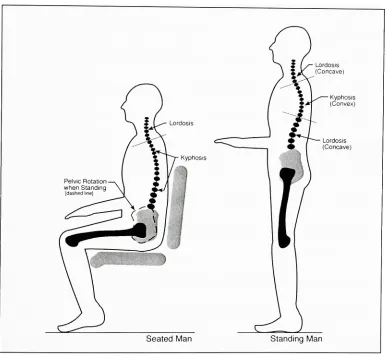
Figure 1.
Standing
and Seated Man Spine Posture7.Taylor, Mark,"InSearchof an IdealSeatedPosture,"
Workplace Erogonomics July/August (1996):11.
8. Knobel, Lance, Office Furniture (NewYork, NY: E.RDutton, 1987), 8. 9.Taylor, Mark,"In Searchof an IdealSeatedPosture,"
[image:16.532.53.440.246.604.2]Wethink ofsitting as a relaxed position, but ittakes a lotof workforour
body
to hold itself up. Here are afewthings occurring to one'sbody
while seated:To stand or sit erect is a complex
balancing
act (see Figure 1)."Almost 100 muscles are required to assist a seated workerin maintaining
balance. This is becausethe spine supports the worker's upper body. The
spine isflexible toallow movement, but it isthis very
flexibility
thatmakes itill-suitedforsupport. Ifthe spine is not supported, there isa natural
tendency
tolean forward. This position is known as lumbar kyphosis. Asthe
body
leansforward,
moretension is placed on the support muscles.Thiscan result infatigue, headaches,
and backaches. In addition the bones ofthe spine(vertebrae)
contain no nerves, sothe pain resulting from improperseating isnotfelt untilthe delicate discs betweenthe vertebrae have becomeworn."10
Sitting
in the most comfortable chairis notmuch better because it isstagnant seating. In his article, "Modern Designers Still Can't Makethe Perfect
Chair,"
Doug
Stewart quotesMary
PlumbBlade,
a retired professor of mechanicalengineering at Cooper Union and researcher into theproblem of sitting.
"Ifyou don'tmove, you quicklybegin to lose calciumin yourbones.A chairthat
fits you perfectly is probably damaging.... the
form-fitting
seats in NASA's firstspacecapsulesturned outto be
terribly
uncomfortableon the launch pad."11Sitting
forlong
periods can causetroubleas well.When yousit, the tissuebetween the bone andseat surface gets compressed.The blood can'tgetto the
softtissue overlyingthe bone because thevesselsflatten.Thisis called
ischemia,
meaning a lackofblood supplytoatissue. Ischemia can cause necrosis ordeath
of cells ortissues.The compressedtissue may resultin pressure on the nerves
and blood vessels with consequent
tingling
andnumbness.12
10. Metzger,EdwardA. 'TheImportanceofLumbar
Support,"
Workplace ErogonomicsJuly/
August(1996):14.
11. Stewart, Doug,"Modern Designers StillCan'tMake
the PerfectChair,"Smithsonianv17(April
1986):104.
8
Bending
your upperleg
relativeto the torso rotatesthepelvicbone,
whichchanges thecurve ofthe lowerspine (see Figure 1).13
A good example ofthis
change isshown
by
slumping forward. The change can be feltas the lower backmovesto theconvex position.This posture istheincorrect waytopick up objects
offthe
floor,
and isa cause of back injuriesas ittends topinch or squeezetheintervertebral discs. Ifthese discs
herniate,
they
can press againstthe nerves,resulting in sciatica.
ERGONOMIC RECOMMENDATIONS
Ergonomics engineersstudyand attempt to understand the
body
and howit relates to the world. Some studies provide guidelines and suggest solutionsfor
the seating dilemma.
Anthropometrics
Thisaspect of ergonomics isaboutthe measurementof man, or
anthropometrics, as it relatesto seating and rest.
The human spine
flexibly
supportsthe upperbody. Indoing
this there isanoptimal shapefor itto work properly, a double S-curve.
Looking
atthebody
fromthe side, the shape ofthe spine from the baseofthe skull to the upperribcage is
concave, called lordosis. The thoracicportion isconvex, called kyphosis.The
lumbar region, or small ofthe
back,
returnsto the lordotic posture (see Figure 1).Poorposture is shown as"Seated
Man"
in figure 1. The lumbarareais no
longerconcave. It reverses shape into kyphosis. This resultsfromthe rotation of
the pelvic bone caused
by
sitting. It actuallyslumps the back.14 Onecan feel thedifference in posture
by
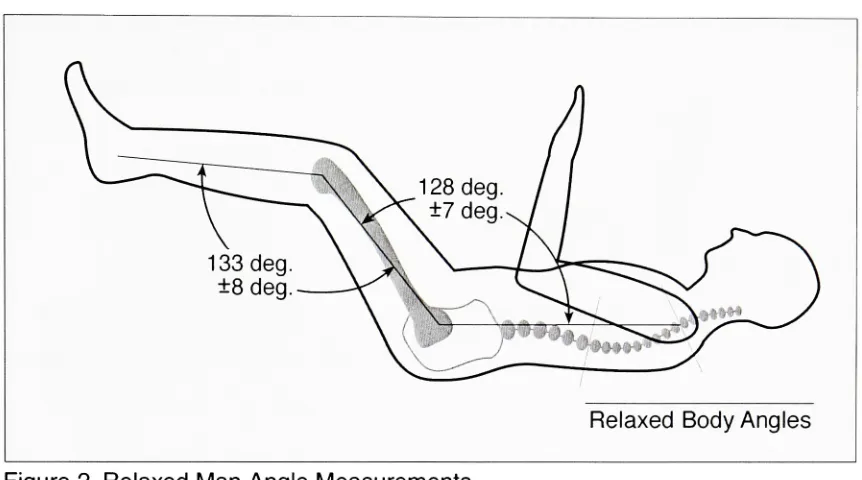
standing up and sitting down.Relaxed Man
Figure 2. Relaxed Man Angle Measurements
Figure 2shows some angle measurementsfroma studyon relaxed men in
space atzerogravity.15
Theangles shown are consideredtobethe natural resting
place wherethe muscles in the legsand back areequalized. Notice that the legs
are not 90 degrees to the body.The pelvic bone has not rotated andthe lumbar
curve is still lordotic.
Seating
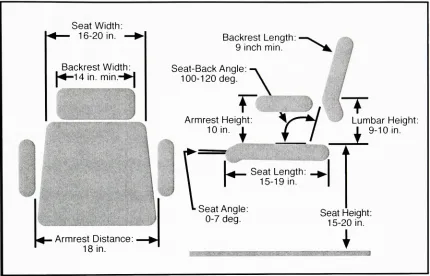
StandardsRecommended dimensionsfortask seating are shown infigure 3.This
information was compiledfrom Human DimensionsAndInteriorSpace
by
Julius14. Ibid.
[image:19.532.52.483.127.367.2]10
Panero and MartinZelnik16
andthe recommended dimensions forVDToperators
from AT&T Bell Laboratories.17
The prescribed standards are divided into three
parts: seat, armrests and backrest.
SeatWidth: 16-20 in.
Backrest Width:
|^-14 in. min.-M
Backrest Length: 9 inch min.
Seat-BackAngle: 100-120 deg.
r
ArmrestHeight:
\s
W
LumbaI
1
I9"1Lumbar Height: 0 in. SeatLength: 15-19 in. Armrest Distance: 18 in. Seat Angle:
0-7deg. Seat Height: 15-20 in.
I
Figure 3. Recommended Seat Dimensions
Seat
Theseat (sometimes referred toas seatpan) needsa minimumwidth of 16
inches and a length of 15 to 19
inches,
with a rollover(sometimes referred to aswaterfall) onthe frontedge. This rollover underthe knee jointprevents pain and
circulation losswhich resultsfrom pressure. Seat heightabove thefloor is an
adjustable 15to 20 inches.Theseatpan angle with respecttothe floor is between
0 and 7 degrees.
16.Panero,JuliusandMartin Zelnik. Human DimensionsandInterior Space.(NewYork: Billboard
[image:20.532.53.483.136.412.2]11
Armrests
Armrests should be 10inches above the seat and have a minimum
distance of 18 inches apart.
Backrest
A protrusion in the back rest 9 to 10 inchesfrom the seatwill restore a
concave shape
(lordosis)
inthespine.18The backangle rangesfrom 100
to
120,
relativeto the seat. Backsupport length isa minimum of9 inchesand width isa
minimum of 14 inches.
Recommendations
Professionals at
Steelcase,
an office furniture manufacturer, suggest awide range of solutions forproblemsof prolonged sitting. For
instance,
whilesitting, arms need free movement. Ifthe seat back istoo
broad,
itwill blockarmrotation. People have many sizes and shapes.Thechair needsto accommodatea
variety of users, and a solution to this isto makethe chairadjustable.19
Moving
Asstated
before,
thebody
is developed formovement. Prolonged staticseated positions can cause
pain.20
Dr. Joseph
Berg,
in a paper on Posture AndThe
Sedentary
Man,
affirmed thatchanging seating posture is very important todelay
muscle fatigue.21Therefore,
anyform ofbody
support in the workplaceneeds toeither provide forchanges in position or provideformotion.
18. Ibid, 350.
19. "Adjustability's Untapped Potential,"Workplace Erogonomics
May/June (1996):11.
20. OccupationalLow Back Pain:Assessment, Treatment, andPrevention,20.
12
Rocking
Researcher
Mary
PlumbBlade,
cited in "Modern Designers Still Can'tMakethe PerfectChair"
by Doug
Stewart,
recommends rocking as a one ofthetwo bestsolutionsforthe problems associatedwith sitting.22
This motion creates
both exercise and a calming effect. It providesa greaterrange of movement, the
previouslysuggested solution.
Onestudy
by
JanicePikna,
using afixed arm rocker, finds rocking benefitselderlywomen
by
providing aform of exercise. Encouragementof exercise in thismanner enhances the qualityof life and decreasespossible health costs.23
The motion ofrocking producesacalming effect.Bernice Steinbaumwrites
in her book The Rocker:An American Design Tradition:
"Itwould be wrong of usto lookuponthe rocker with nostalgia as simplya
piece of
Americana,
for it continuesto fulfill needstoday. There's even aBostondoctor who prescribes rockersforpatients asan important part of
convalescence".24
Anotherexample appears in Richard Knox'sarticle,"Rockof Aged:Chair's
Sway
May
SootheAiling
Elders,"where he quotesfromthe study,Rocking
ChairTherapy
ForNursing
Home Residents WithDementia,
presented atthe EasternNursing
ResearchSociety
inRochester, N.Y.,
by Nancy
Watson,
who statesthat"rocking
forat leastan hourand 10minutes aday
eases depressionand anxietyamong elderssuffering from Alzheimer's
disease.'25
22. Stewart, Doug,"Modern
Designers,"
104.
23. Pikna,JaniceKuiper,'TheAcuteCirculatory ResponsesofElderlyWomenToUpperand/or LowerExtremityExerciseInaSpecially DesignedRockingChair"(MSinNursing, Universityof Wisconsin, Milwaukee, December 1986):77.
24 Steinbaum, Bernice, TheRocker:AnAmerican DesignTradition, (New York:Rizzoh, 1992),10. 25. Knox, RichardA.,"RockofAged:Chair'sSway MaySootheAiling
Elders,"
BostonSunday
13
Figure4. Serber'sErgomax.
Left,
chair; right, example positions.[Reprinted,
by
permission, from Arlyn
Serber,
"American Ergonomics: Press Info,"chair, as
reproduced in
http://www.americanergonomics.com/press/ergomax.sit;
internet;
Fri,
29 Sept2000. and"Fig
6 ISOSPS-Integrated System of Postural
Support,"
positions, as reproduced in Ergomax CB andISOPS: A New Paradigmforthe
BiomechanicsofErgonomic Seating, (a pamphletfrom American Ergonomics
Corporation,
Novato,
CA).]
Tilt Tension
controlsresistancefeltwhen leaningbade
Q)Lumber Height Lumber Depth pad adjustsverticalry41/2 inches, forward 3/4 inch or1 1/4inches
0Arm Angle pivotsindependently 17.5degrees inwardto 15degrees
outward.'
ArmHeight
adjustsindependentlywithin 4-trich
range-TiltUmiter limitsrangeof recline.
i ForwardTitt
adjusts seatangle5 degrees forward.
Figure 5. Aeron Chair.
Left,
diagram of7 knobsforadjustment; right, chairfrontand corner.
[Reprinted,
by
permission, from LeeSullivan,
diagram on page 8 andchairs on page
23,
as reproduced in WearIt in Good Health TheAeronChair
by
[image:23.532.57.457.48.273.2] [image:23.532.55.480.403.638.2]14
OTHER
SOLUTIONS
Many
chairs designedtoday
attemptto resolve back problemsby
other meansthanjust pushingthe lumbarregion intothecorrect position.Thesolutions range from extremely mechanical backsupport devicescapable of multipleseating positionsto tilt-forward seats and mobile office arrangements.
Mechanical Backand Multiple
Body
Position SupportThere are a great number of mechanical monstrosities ofvarying
complexity available to the consumer.
They
alltry
tofind a perfect position ofsupport forthe body. The most extreme models are listed here. The most mechanical multiposture
body
support isSerber's Ergomax 1700 (see Figure4).26
The operation ofthis chairiscomplex enough to require aVHS video
explaining the use ofthe device'sstool, traditional, forward
leaning, kneeling,
kneeling
with backsupport, and reclining positions.Anotherchairthatfalls intothiscategory isthe popularAeron
Chair,
which has seven separate knobsandleversto adjust posture (see Figure 5).Toease user confusion an eight page how-to
booklet,
one pagediagramand multi-media compact computerdisk isprovided.Balans Chairs
The Balans
Chairs,
which usea simplerapproach, are described as "U-shaped, backless rocking stools in which the sitterhalfsitsand halfkneels,
thereby
forcing
the spine intoa healthfulposture."27
The
leg
anglesthese chairsrequireare thoseofthe relaxed man in figure3. Someconsiderthischairthe best
26.Null, RobertaL, Universal Design:CreativeSolutionsfor ADACompliance(Belmont, Califor nia:Professional Publications, 1996), 157.
15
solution todate for providing the natural lumbarshape oflordosis.As thearticle
"The Balans Chairand its
Semi-Kneeling
Position: An Egronomic ComparisonWith Conventional
Sitting
Position"inthe publication Spine relates, "Studiesofthe
so-called Balans
Chair,
which induces sitting in asemikneeling posture, showthatthis posture actually results in increased muscle activityoflumbarand cervical
muscles and increased blood flowto the feetcomparedto a standardchair."28
Doug
Stewart in hisarticle"Modern Designers Still Can't Makethe Perfect Chair"notes "when I spend a
day
in one, my shinssoon ached.Whenever I leanedforward to talk on the phone, my feet fell asleep.And
fidgeting
was nearlyimpossible."29
Office
Landscaping
Inthe mid-1950sthe theories and application of officedesign started to
change. European designers developed Burolandschaft (office
landscaping)
which shifted focus away from a grid-like arrangement of
desks,
towardan openlayoutwhich followed the movement of paperandthe flow oftasks.30American
designers George Nelsonand Robert Propst
jointly
developed Action Office forHerman Miller. This system offurnitureadvocated changing postures with
differenttasks.31
These changes in philosophystarted a reversal of
Taylorism,
refuting its sedentaryworkspace
ideology,
andincreasing
mobilityof anemployee'stasks.
28. OccupationalLowBackPain:Assessment, Treatment, andPrevention(St Louis: MosbyYear
Book, 1991),27.
CHAPTER
GOALS
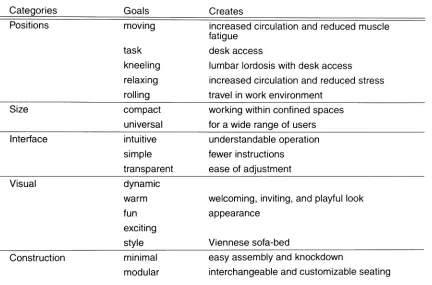
Table 1
lists,
defines,
and categorizesthe objectives developed fromtheprevious research.
They
are presented in orderof priority.Categories
Construction
Table1. Goals Defined byCategory
Goals Creates
Positions moving increasedcirculation and reduced muscle
fatigue
task deskaccess
kneeling lumbar lordosiswithdeskaccess
relaxing increasedcirculation and reduced stress
rolling travelinwork environment
Size compact workingwithinconfined spaces
universal fora wide range of users
Interface intuitive understandableoperation
simple fewer instructions
transparent ease of adjustment
Visual dynamic
warm welcoming, inviting, and playfullook
fun appearance
exciting
style Viennesesofa-bed
minimal
modular
easy assemblyandknockdown
interchangeableand customizableseating
POSITIONS
The
body
support should permitthe usertosit,kneel,
rock, recline, androll.
Drawing
onthe research, it isclearthat rocking creates movement which benefitsthe body. It ishighly
recommended as a waytoreduce muscle fatigueand increasecirculation.
Sitting
ina normaltaskposition allowstheusertoaccessthe desksurface and related work, such ascomputing. Because it isthe most
[image:26.532.57.489.201.486.2]17
common position, it isthe most understood
by
ergonomics engineers andaccepted
by
users.Kneeling
in the Balans position grantsthe same deskaccesswith the benefitofopening the angle between the back and
thigh,
thus providinglumbar lordosis.
Reclining
also assistswith openingthe same angle, encouragingcirculationand relaxation. Periodic shifting betweenthe two positionsclearly
encourages
body
movement and reduction of muscularfatigue,
which isnecessary.The inclusionof rolling assiststhe operator with moving within the
work environment.
SIZE
The chairneeds to interact withthe under-portion of a deskandfit in small
office spaces.
Designing
the chairto be compact will fitmore limited spacerequirements.
Making
the chair able to accommodate large andsmall peopleprovides proper supportforawide range of users.
INTERFACE
The userinterface should have intuitive operation, require aslittle
instruction as possible, and be transparent. Intuitive operation in that the interface
followsthe logicof the action, sothe user can easily graspthe action requiredto
adjusta position. Forexample, to move the back
forward,
pull up on theback;
tolower
it,
push it down.Thissimplifiestheamount of writtendirections and reducespossible user confusion.Transparent, in this case, meansthat the userdoes not
18
not
something
with whichthe user hasto interact.VISUAL
It is desirablethat the chairlookwarm, playful, and exciting to make it
attractiveto potential users.The visual logic or semantics should suggestthat it
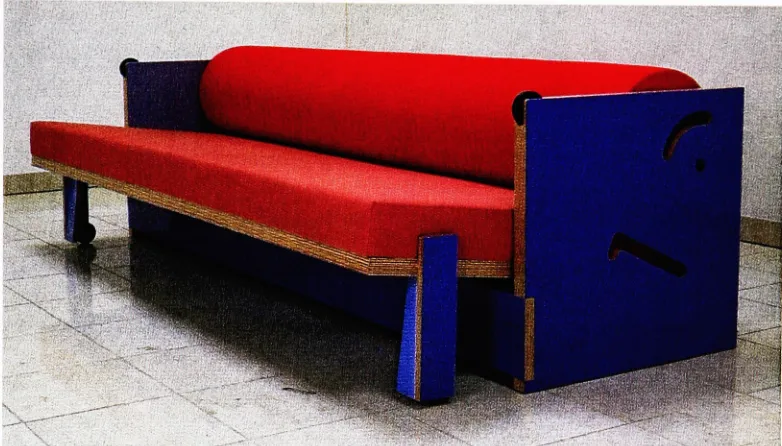
moves. An example ofthisstyle isaViennese designed sofa-bed (see Figure6).
Figure6. Viennese Designed Sofa-Bed
[Reprinted,
by
permission,fromAdolfKrischanitz,
"One-ShapedCouch,"
furniture,
as reproduced in Wien Mobel (Vienna Furniture).(Vienna,
Austria: DieSecession,
1989),
43.]
CONSTRUCTION
Construction ofthe sections
-seat,
back, feet,
andarmrests-should be
simpleforthe end user.Asimple, modulardesign naturally pointsto a knockdown
type of construction, withthe abilityto assemble, disassemble and reassemble a
[image:28.532.70.461.220.443.2]19
simple enoughthat the ownercould replace a section,and easy enoughto
construct, package, and ship forthefactory.
Modular design impliesthat the chair could be customized
by
simplychanging one partforanother, modified one. Forexample, a user who has
scoliosis and requires personalized back paddingcould changethe backsections
CHAPTER IV
CRITERIA
This chapter relatescloselyto the previous one.Where the prior chapter
defined
ideals,
this liststhe specifics needed to createthebody
support.Thesection headingsarethe same, andfollowthesame order asthe previouschapter
(see Table 1).
POSITIONS
The"thesis"chair should permitthe userto sit,
kneel,
roll, and recline. Ineach ofthese positions oractivitiesthe
body
should be ableto rock back andforth.
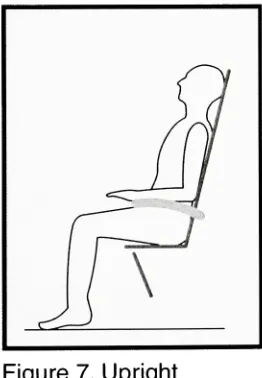
Figure 7. Upright
Hip
and backsupport, in an uprightposition, should providetask seating(see Figure7).The angles and sizes relateto the ergonomic recommendations
listed earlier(see Figure 3).
[image:30.532.55.186.378.567.2]21
Figure 8.
Kneeling
The chair, with kneeand ischialsupport (see Figure
8),
should createBalans-styleseating.This
kneeling
position should be the largestangle of 135from backto thigh (see Figure 2).
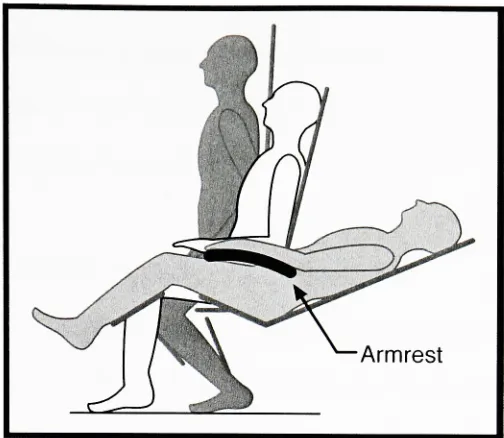
Figure 9.
Reclining
The chairshould promote relaxing
by
supporting the calf,hip,
thigh, backand head.The chair, with back reclined and adual purpose
footrest/kneeling
padextended (see Figure
9)
atthe appropriate positions (see Figure2),
providesthis [image:31.532.54.186.43.235.2] [image:31.532.54.257.349.538.2]22
Figure 10. Fixed Armrest in All Three Positions
An armrest should be available in every position (see Figure 10).The
placement is7 to 10 inchesabovethe upright seat position as noted in AT&T Bell
Laboratories'
recommended dimensions forVDT operators (see Figure 3).34The
arms should be fixed at this height and notdeviate from thatpoint relativeto the
chairandfloortoassist with rockingwhile reclined, providea supportfor changing
positions, and assist with getting in and out ofthe
body
support.SIZE
The footprintshould be lessthan 24 inches wide, and the base mustfit
under mostdesks. The
footrest/kneeling
section shouldtuck underthe seatwhennot in use to reducethe total space taken up
by
thebody
support.Figure 3 shows recommended seatdimensions. Inthis case, the seatpan
[image:32.532.52.304.53.272.2]23
heightand seat length need to be atthe lowerend ofthe recommendedsizes, at
15
inches,
to accommodate a greater range of users.Similarly,
the backrestlength oughttobethe higher recommendation, again to be usable
by
both largerand smaller people.
INTERFACE
A passive and intuitive interface is preferredforuserinteraction with the
body
support.The numberof moves requiredto change positionsmust be asfewas possible.The usershouldbe able todo alltheseoperations without
leaving
thechair. Forexample, to change from atask seated position to a
kneeling
oneshould only involve positioningthe knee pad unit and
kneeling
on it.Additionally,
the back rest should lockto sit and unlockto recline.Theseat must rotateforward
and back as necessarytochange from a seated position to a
kneeling
position.These operations should need little explanationto the user, and should relate
semanticallyto the
function,
as isthecase whenlifting
a part bringsthe unit up.VISUAL
The use of bright materials such as brushedaluminum, lightwood, and a
primary-colored seat
fabric,
can provide a playful aesthetic whilethe structureproperembodiesa seriousseating tool, notto be confused with an over-stuffed
recliner.The use oforganic, non-geometric, sweeping lines should provide visual
movement.The Viennese sofa
bed,
with itsvisual cuesto movement, mechanical24
Upholstery
PartA'
/"
Tee-Nuts
Uphoslstery
attachedto plywood with adhesive
Plywood
PartB
Figure 1 1. Exploded View of
Padding
and Knockdown ConstructionA fabric andfoam padgluedto a plywood structure make padded support partA. Part B isastructural memberofthe chair. Part Aattachesto Part Bwith bolts and
tee-nuts.
CONSTRUCTION
Sections are built ofindividual partswhich consistof aluminum, plywood,
laminate,
etc. andare fastened permanentlyeither with glue, permanentmechanical
fasteners,
orboth. Infigure 1 1, PartA represents an upholsteredsection, such as a seatpan, backrest orknee pad, exploded into itsconstituent
parts. Part B representsthe structuralframethatsupports and attaches Part Ato
the other components ofthe chair.
Sectionsconsist of major chairunits, likethe seatpan orthe legrest/
kneeling
pad, to reducethe numberofparts andtocreate large manageableparts [image:34.532.55.417.57.326.2]25
Final assemblyof sections intothe completed chair is done
by
the enduser, using knockdown hardware such ashexagon socket-headcap
bolts,
orsomething similar, and nuts installedwithinthe sections
during
manufacturing.Figure 1 1 shows Part A
being
attached to Part Bwith twobolts,
illustrating
thisconcept.
Becauseof this modularity, end users can custom orderparts to
supplement orreplace standard componentsforspecific applications such as the
CHAPTER
V
DEVELOPMENT
With goals set and criteria
determined,
designofthe prototype began. Thisprocessnaturallydivided into mechanical, visual, andfabrication phases.The
mechanical phase involved understanding,
defining
anddesigning
thebody
support device. The visual concerned creatingtwo-dimensional drawings ofthe
shape and aesthetic ofthe chair. Fabrication completedthe processwith afinal
constructionforpresentation.
MECHANICAL
The mechanical study included
developing
a physical solution.Thisaddressed
body
position, chair mechanics, andthe interaction between thebody
and the supportdevice.
Rocking
andKneeling
MechanicsThe firstexploration investigated seat angles and
body
position ofBalansseating.Thisencompassedgoingto localfurniturestores and measuring currently
manufactured products for
kneeling body
support.Concurrently,
quarter-size models ofdifferent types of rocking chairsweremade to betterunderstand and recreate the motions involved. These models
included a glider(Canadian rocker), a Shaker style rocker, and single pivot seat
found inthe most popular of swivel chairs.The results indicatedthe Shakerrocker
had the greatest range of motion and provided the properangle fora
kneeling
27
position attheapex ofthe forward rocking motion.
The next course of developmentstarted with a suggestion made
during
apresentation to the thesiscommittee.The ideawasnotto design a whole new
chair, buttocreate atiltmechanism toadd to existingchairs.Withthechallengeof
designing
atilt mechanism, an understandingwas needed ofthe actual seatmotion
during
rocking.Rocking
Motion and PathCurve
Shape
Rocker
placed [image:37.532.55.415.246.441.2]under seat
Figure 12. Seat with Rocker
The firstattempt at
duplicating
the rocking motion wasto makea smallcurveclose to the underside ofthe seat.Thiswas done
intuitively by drawing
andcuttingthe curvethatwould approximatethe motion ofthe seat(see Figure 12).
28
Seat Motion Mapped to
Paper
Pens Joined
to Seat Plane
Figure 13. Full-size Plywood "Shaker"
Rocker
Figure 14.Seat Motion Mapped to Paper
Back
Paths Marked
with Pens
Front
Seat Planes in 7 positions
[image:38.532.49.483.44.301.2] [image:38.532.53.441.345.610.2]29
A more empirical method of
understanding
the movement was necessary.Beforethe second attempt, afull-size plywood mock-up was madeto the
dimensions of a Shakerrocker (see Figure 13). The path ofthe seat plane's
motion was drawn on paper (see Figure
14),
measured, and entered intoMicroStation,
acomputer-aided design(CAD)
program (see Figure 15).Thisdefinedthe path the seat would follow.
Figure 16. Trackand Rail Mechanism
Left,
arrows pointtowheelsattachedto seat; center, arrows pointto the railcurves the wheels move upon; right, complete unit.
Using
CAD,
the curvesthrough whichthe seat moved while rockingwerereduced in scale so
they
could be placed undertheseat and become tracks uponwhich atest chair would ride (seethe center image of Figure 16).Amatching
plywood
trolly
with wheels was attached tothe seat (seethe left image of Figure16).
Working
together,these restricted the seat motionto the shape ofthetrack,so the seat successfully followedthe same motion asthe plywood mock-up.
However,
during
a demonstration forthe thesis chairmanthis mechanismfailed,
toppling
me over backwards.A highcenter ofgravity moving a large distanceovera single support pointmade of rails androllers causedthisfailure.
Additionally,
the [image:39.532.63.480.212.350.2]30
Body
PositionsThisdirection wastabled with the failure described on page29. A better
understandingofthe
body
in relationto thesupportdevicewas neededand, usingthe thesiscommittee chairman's advice, afinite definition of an anthropometric
seat and
body
position was created.Figure 17.Anthropometric Figure
Ananthropometricfigureofa5th occidentalpercentile male wasmadewith
paper, pivotedat the points indicated in Figure 17.35
Using
the papermodelbecame problematic
because,
although the model could be put in the seated,kneeling,
and reclining positions, itwasdifficult to visualize wherethebody
partswouldbewhenmoving between positions and when rocking.Thetwo-dimensional
35. HenryDreyfussAssociates, TheMeasureofManandWomen: HumanFactors in Design (New
[image:40.532.68.269.182.445.2]31
experimentwas convertedto a computer animation of positions with
body
movement (see Appendix).
Alias/Wavefront
Power Animatorassisted in creationofthe animation.The animation helped illustrate and provide afinite
measurement and motion path forthe seatsupports, but didnot
help
with creatinga mechanical solution.
Figure 18. Four-Bar Mechanism
Each bar
independently
pivots and slidesat arrows.Mechanical
Engineering
AdviceWiththe need formoreassistance, I was referred
by
thesiscommitteemember Kim Sherman to Kevin
Kockersberger,
Professorof MechanicalEngineering
at Rochester Institute ofTechnology.Analyzing
the animationconvertedtotwo-dimensional
illustrations,
he recommended experimentingwith a [image:41.532.61.330.183.377.2]32
Back Rotation
Fixed Point
Figure 19. Four-Bar Solution
Fixed Point
Seat Motion
Leg
Rest RotationWith experimentation, afewsolutions were developed. The best (see
Figure
19)
worked wellforthe desired reclining,kneeling,
and uprightbody
configuration, but it didnot rock. Italso presented an issue ofthe
leg
rest/kneepad
having
to passthrough theleg
when changing positions.The four-bar mechanism andsolution was demonstratedto the advisors.
Several solutionswere considered andjudged impractical.
Working
from afull-size mechanism such as a profiler wasdetermined asthe nextstep.A profilerisa
[image:42.532.59.395.45.252.2]33
Figure 20. Profiler Figure 21. Profiler Combined with Four-Bar
Solution in Reclined Position
(One side ofthe profilerhas been removed
for photo)
Profiler
A profiler was built (see Figure
20)
to hold a seat withthe dimensionsasshown in Figure 3.The anglesforthe relaxed and
kneeling
positionsweredetermined usingthe angles shown in Figure2 asguidelines.The four-bar
mechanism was combined with the profiler(see Figure 21).This produced a
partial solution, buta full solution needed resolutionsforthe transitionfrom sitting
to
kneeling,
for rocking andfor rolling.PositionTransition Difficulties
Kneeling Issues
The four-bar mechanism made the lowerlegs captive when
kneeling,
makingthe shift from
kneeling
to sitting awkward. Userswould have to getofftheseat, changethe position, andcarefully sitagain, placing their legs in the hole
created betweenthe two outside four-bar mechanisms and
kneeling
pad.This [image:43.532.60.481.43.301.2]34
centered on
including
rotating pads and redesigning the mechanism, but nonefittheset standards.
Figure 22. Four-BarSolution First
Working
DesignRocking
The primary focus returned to rocking with
kneeling
still unresolved.By
addinga stretcher and removing unneeded materialtofabricate rockerrunners,
the profilerbecame thefirstcompleted, working design without rolling (see Figure
22).Thiswas presented to peers and
faculty
with otherdemonstrations oftheintended
body
placement and motions.Rolling
The chief advisor,
Craig
McArt,
suggested a wheeled cradleto housethemechanism.Thiswould allowthe chairto roll and rock while maintaining fixed
[image:44.532.54.312.111.323.2]35
Resolving
Kneeling
IssuesAtthis point,
kneeling
again became theprimary focus.Moresketches and
ideaswere developed with poor results.A review of criteria helped provide ideas.
The most
promising
ofthese involved akneeling
pad/legrestthatwasindependentofthe four-barmechanism,to beattachedto and extend outfromthe bottom of
thechairthrough a pin and groove mechanism similarto the sofabed in Figure 4.
Groove Seatpan Pin-A pin Rotation
6>
Pin-Drop& Lock Points
Groove
Backrest
Rotation
^
Seat Rotation BackRecline
Path
Pin-c
^T
X
Grooves0
Kneeler Extend and Retract
Figure 23.
Seat,
Backand Kneeler/Leg-rest Pin and Groove PathsThis ledto a redesign ofthe back andseat mechanisms,
bringing
thedesign more in linewith the original criteria.The four-barsolution waschanged,
keeping
the ideaofthe pivotpoints, to three similarindependent mechanismsforthe
back,
the seat, andthe leg/knee support (see Figure 23).A mock-upwas [image:45.532.57.443.206.507.2]36
Conversion from CADtoAesthetic
The new, completelyworking, prototype was measured and modeled in
CAD. The mechanismswere refined and simplified with thecomputer. Scale plots
were made of themechanisms and usedforthe nextphase, that of aesthetic
development.
VISUALIZATION
Backrest
Armrest
Seatpan
Knee/Leg-rest
Figure 24. SideView of Mechanisms
Plotsofthe mechanisms were used as abasisfor
drawing
sideviews ofthebody
support components (Figure24). Afterseveraldrawings,
the preferredcontour was scanned intothe computer, addedto thecurrentCAD file and refined
to the final appearance.The aesthetic goals andcriteriaset in Chapters II and III
[image:46.532.58.448.224.503.2]37
FABRICATION
Constructionofthe prototype required
finding
materials, makingcut plans,cuttingand assemblingthe parts.These processes occurred
continuouslyand
simultaneously up to completion.
Material
The material choices werebased primarilyon aesthetics.Severalelements
were sampled and testedforstrength and durability. The final selectionswere
aluminum forthemechanical pieces, a Baltic birchsheet plywood forthe actual
structure, taperedhexagonal head boltswithembeddedTee-nuts and sockethead
capscrewsfor
fastening,
and Formica laminate as a bright durable outer coating.Collecting
the materials involvedfinding
suppliers, orderingand purchasing.Theavailabilityof supplies influenced the scheduleof work.
Cutting
and ConstructionChairLeg
Arm Support
[image:47.532.56.433.416.632.2]Knee/Legrest Part
38
Parallel tothis, the computer models were arranged intotwo-dimensional
patternsforchair parts and plotted full-size on paper(see Figure25).This paper
was attachedto Masonite and used to create templatesfora router.
The plywood was laminatedtogetherand the templates were attached.
Using
the guidingtemplates,
the plywood was cutby
a router.Then the Formicawas attachedto the chair parts and trimmed, again with a router.
Plug
partsWooden Dowel
Completed plug is
glued
into hole in
part
Figure26. Tee-nut
Plug
AssemblageThenext stepinvolvedmakingTee-nutplugsfor
fastening
knockdown bolts.These consisted of aTee-nut gluedand nailed into hollowed dowel (see Figure
26). Holes were drilled in the stretcher, carriage, arms, and
leg-body
supportsforthe plugs and bolts.The plugs were inserted and glued. Casterswere addedto
[image:48.532.55.391.218.507.2]39
assembled and measurements weretaken to make the mechanical pieces.
Figure 27. Back Rest Mechanicsand Fasteners
Hexagon Socket-Head
Cap
Screws are countersunk andfasten the back to therodswhichsupportthe plywood backrest.Attheright arethegroovesin whichthe
rods moveto recline the backrest.
The aluminum rod was cut usinga milling machine and metal lathe. These
rodswerethen addedto the prototype and usedto
lay
outthe plywoodupholsterysupports.The rodsand plywood were drilled and fastenedwith socket-head cap
screws (see Figure
27)
and Tee-nutsas in Figure 1 1.The exposed wood, otherthan wherethe upholsterywould be affixed, was
sanded and sealed.
Using
the plywood section ofthe seatpan,knee/leg
pad, andbackrest,
the cushion fabricwas cuttosize.Thefabricwas sewn togetherandstuffed with upholstery foam. Hand stitching finished the cushion, which wasthen
[image:49.532.56.344.75.307.2]40
[image:50.532.59.368.72.330.2]Assembling
Figure 28. Thesis Chair Assembled in Task Position
Withthe completion ofthe parts, the chairwas assembled andtested (see
Figure 28). Itworked exceptforsomeslippage wherethe rocker
leg
contactedthecarriage.Thisproblem was solved
by
creating index pins, (see Figure29)
as41
Carriage
L
Sectional ViewBottomofRocker
ConvexIndex
-Carriage Expanded Isometric View
Figure 29.
Rocking
IndexThefemaleconcave hole in the bottom ofthe rockermoves overthe male convex
indexpin inthe carriagesection, much likeonelink in abicyclechain moving over itsgear.Thisstopsthe rockerfrom sliding orchanging position.
Figure30. Chair in Show
Displayedwith explanations of positions and movement inthe background.
The final prototype was displayed in the Rochester Institute of
Technology
[image:51.532.57.300.301.590.2]CHAPTER
VI
CONCLUSION
Figure 31. Finished Prototype
Left,
3/4view oftaskseatposition; upperright, sideviewof kneelerposition; lowerright, side view of reclined position.
SUMMARY
There are health risksassociated with prolonged sitting.These risks range
from poor bloodcirculation, muscle
fatigue,
and lifestyleinhibiting
backpain to ahigherriskfor herniated discs in thespine.A primarycauseisstatic
body
support,which occurs in the workplace.This affects everyone
by
increasing
costs forhealth care and
increasing
risk ofinjury
for manyof us.The prototype (see Figure
31)
developed here isa solution.First,
it uses [image:52.532.60.476.130.433.2]43
the recommendationsset forth
by
human factors specialists.These includeprescribed seatdimensionsand multiple
body
positions.Second,
the thesis chair,through rocking, eliminates stagnation, which isa primarycause of all the
problems listed.
CRITIQUE
Even though thedesign of the thesischair has fulfilled thegoals set in
Chapter
2,
it needs more studyto resolve some unforeseen safetyhazards,
todevelop
better mechanisms, andto measure itseffectivenessfor enhancinghealth. Most ofthese matterswere noted
during
athesiscommittee critique attheexhibit.
Safety
Some unanticipated safety matters give riseto possible
bodily
injury. Theextremities are most
likely
to be endangered. Forinstance,
a shearing actionbetweenthe arm rests/supports andchair legsoccurs when rocking.The open
groovesfor pivoting the seatpan and the backrest can pinch or crushfingers.
Two less hazardous issuesconcern a weakness resulting in a left-to-right
motion in the arms and a potential with the inner
body
support for rocking overbackwards.These predicaments can be fixed withthe addition of a cross piece
placed behindthe seat and between the arms.
Furtherdevelopment
More development isrecommendedto explore improvementsforthe thesis
44
place. Research into differentmaterialsto reduce size and weight isadvised.
Some empirical
testing
would be useful indetermining
the levelof healthimprovementthis prototype provides.
FINAL REMARKS
Thisthesis definesthe problem with stagnantseating and providesa
designsolution toalleviate harm.The prototype illustrates that solution.With
somefurther study and modification, thischair would provide a design reference
APPENDIX
BIBLIOGRAPHY
"Adjustability's
Untapped Potential."Workplace Erogonomics
May
/June (1996):11."American
Ergonomics:
Press Info,"[WWW page]; availablefrom http://
www.americanergonomics.com/press/ergomax.sit;
Internet;
accessedFri,
29
Sep
2000."Back toComfort,"
[WWW page]; availablefrom http://www.redbank.com/
backtocomfort/products.html;
Internet;
accessedFri,
27 Mar 1998.Berg,
Joseph A. PostureandtheSedentary
Man.SanFrancisco,
CA:A.C.C.O.Convention,
18-19May
1968.Bridger,
RobertS. "Postural AdaptationstoaSloping
ChairandWork Surface."Human Factorsvol.30 (April 1988): 237-47.
Bridget,
Johnson,
and HowardSingerman,
ed.ArchitecturalSculpture. Los Angeles InstituteofContemporoary
Art,
1980."Brigger
Flip-Flop
Recliner,"[WWWpage]; availablefrom http://
www.backbenimble.com/brigflip.htm;
Internet;
accessed 27 March 1998.Butterfield,
Jan. The ArtofLightandSpace. NewYork: AbbevillePress,
1993.Clark,
ThomasStephen. The ErgonomicsofWorkspacesandMachines: A Design Manual.London,
Philadelphia:Taylor&Francis,
1984.Colpitt. Francis. MinimalArt:The CriticalPerspective. Ann
Arbor,
Michigan: UMI ResearchPress,
1990."Creative Supports,"[WWW page]; available from http://
www.creativesupports.com/seating.html;
Internet;
accessedFri,
27 March1998.
Davies,
Stephen. "The Simple Science ofSeating."
Technology
Reviewvol. 95 (Aug./Sept. 1992): p34-40."Ergonomic Specialties"[WWW page]; availablefrom http://www.ergospec.com/ off_sea.html;
Internet;
accessedFriday,
27 March 1998.Ergonomics: Low-Back
Pain,
CarpalTunnelSyndrome,
andUpperExtremity
Disorders in the Workplace. Philadelphia:Hanley
&Belfus,
Inc. 1992.Favata,
Ignazia. Joe ColomboandItalianDesign ofthe Sixties.Cambridge,
Massachusetts: MIT
Press,
1988.47
Foster,
Hal,
ed. Vision andVisuality
Seattle:Berg
Press,
1990.Graham,
Clare. CeremonialandCommemorative
Chairsin GreatBritain.London:Victoria & Albert
Museum,
1994.Gricco,
A."Sitting
Posture: An Old Problem and a New One."Ergonomics 29
(1986):345-362
"Hag
Balans," [WWWpage]; available from http://www.backbenimble.com/hagbalan.htm; Internet;
accessedFri,
27 March 1998.Hale,
Nathan Cabot. Abstraction in ArtandNature. New York: Watson-GuptillPublications,
1972.Henry
Dreyfuss Associates. The Measure ofManand Women: Human Factors inDesign. New York:
Whitney Library
ofDesign,
1993.Hockenberry,
Jack.A SystemsApproach toLong
Term TaskSeating
Design.Owatonna,
Minnesota:by
the author, 1981."JDI
Group
Ergonomic Workstation Chair,"[WWW page];available from http://
www.awa.com/jdi/index.html;
Internet,
accessedFriday,
27 March 98.Johnson,
Peter. The Phillips Guide toChairs. London: MerehurstPress;
NewYork,
NY: Riverside BookCo.Kelsey,
J.L. "An EpidemiologicalStudy
ofAcute Herniated Lumbar IntervertebralDiscs."
Rheum Rehabv14 (1975): 144.
Khatchadourian,
Haig. TheConcept ofArt. New York: New YorkUniversity
Press,
1971.
Knobel,
Lance. Office Furniture. NewYork: E.RDutton,
1987.Knox,
RichardA. "Rock ofAged: Chair'sSway May
SootheAiling
Elders." BostonSunday
Globe April 26 (1998):A1, A24.Krischanitz,
Adolf."One-Shaped Couch." Furniture.As reproduced in Wien Mobel (Vienna Furniture). Vienna: DieSecession,
1989.DieSprache der Kunst.Translated
by
EleonoraLouis,
Christian TheoSteiner,
andToni Stoos. Stuttgart: Dr. Cantz'sche
Press,
1993.Metzger,
Edward A. "The Importance of LumbarSupport."
Workplace
48
Moser,
Thomas. How toBuild Shaker Furniture. New York:Drake,
1 977.Neil,
Andrew. "The Value of Dynamic Movement."Workplace Erogonomics July/
August (1996):17-1 9.
Null,
Roberta L. UniversalDesign: Creative Solutionsfor ADA Compliance.Belmont,
California: ProfessionalPublications,
1996.OccupationalLow Back Pain:
Assessment, Treatment,
andPrevention. St. Louis:Mosby
YearBook,
1991.Panero,
Juliusand Martin Zelnik. Human Dimensions and Interior Space. NewYork: Billboard
Publications,
1979.Pikna,
Janice Kuiper. "The AcuteCirculatory
Responses ofElderly
Women ToUpperand/orLower
Extremity
Exercise In aSpecially
DesignedRocking
Chair."
MS in
Nursing,
University
ofWisconsin, Milwaukee,
December 1986.Romer,
Mike. RudThygesen,
Johnny
Sorensen:9006 Dage medDesign.Kobenhavn: Nyt Nordisk
Forlag
A.Busck,
1991."Sam ClarOffice Furniture,"[WWWpage]; availablefrom http://www.samclar.com/
chair.html;
Internet;
accessedFriday,
27 March 1998.Sanders,
Mark S.and ErnestJ. McCormick. Human Factors inEngineering
andDesign. New York:
McGraw-Hill,
1987.Schmidt,
Georg
and Robert Schenked. KunstundNaturform.Basel,
BasiliusPress
AG,
1960.Sears,
Barry. TheZone. NewYork,
New York: ReganBooks/HarperCollins,
1997.Serber,
Hector. ErgomaxCBandISOPS: A New Paradigm forthe BiomechanicsofErgonomic Seating, (apamphletfrom American Ergonomics
Corporation,
Novato,
CA).Steinbaum,
Bernice. The Rocker: An American Design Tradition. NewYork:Rizzoli,
1992.Stewart,
Doug. "Modern Designers Still Can't Makethe Perfect Chair."Smithsonianv17 (April 1986):96-102.
Taylor,
FrederickWinslow,
The Principles ofScientificManagement. New York:49
Taylor,
FrederickWinslow. ScientificManagement,
Comprising Shop
Management,
The Principles ofScientificManagement[and] Testimony
Before the Special House Committee. With aforeword
by
Harlow S. Person.New York:
Harper,
1947Taylor,
Mark:"In Search of an Ideal Seated Posture."WorkplaceErogonomics
July/August (1996):11-13.
Wanning,
Esther."Heal YourAching
Back." editedby
Michael Castleman. TheMother Earth Newsvol.93 May/June (1985):126-8.
WearItin Good Health TheAeron
Chair
by
HermanMiller.Zeeland,
MlUSA,