This is a repository copy of Hysteretic behavior of angular dependence of exchange bias in FeNi/FeMn bilayers.
White Rose Research Online URL for this paper: http://eprints.whiterose.ac.uk/3424/
Article:
Gao, T.R., Yang, D.Z., Zhou, S.M. et al. (4 more authors) (2007) Hysteretic behavior of angular dependence of exchange bias in FeNi/FeMn bilayers. Physical Review Letters. 057201. -. ISSN 1079-7114
https://doi.org/10.1103/PhysRevLett.99.057201
[email protected] Reuse
Items deposited in White Rose Research Online are protected by copyright, with all rights reserved unless indicated otherwise. They may be downloaded and/or printed for private study, or other acts as permitted by national copyright laws. The publisher or other rights holders may allow further reproduction and re-use of the full text version. This is indicated by the licence information on the White Rose Research Online record for the item.
Takedown
If you consider content in White Rose Research Online to be in breach of UK law, please notify us by
promoting access to White Rose research papers
Universities of Leeds, Sheffield and York
http://eprints.whiterose.ac.uk/
This is an author produced version of a paper to be/subsequently published in Physical Review Letters. (This paper has been peer-reviewed but does not include final publisher proof-corrections or journal pagination.)
White Rose Research Online URL for this paper: http://eprints.whiterose.ac.uk/ 3424
Published paper
Gao, T. R., Yang, D. Z., Zhou, S. M., Chantrell, R., Asselin, P., Du, J. and Wu, X. S. (2007) Hysteretic behavior of angular dependence of exchange bias in
FeNi/FeMn bilayers. Physical Review Letters, 99 (5). Art. No. 057201.
Hysteretic behavior of angular dependence of exchange bias in
FeNi/FeMn bilayers
T. R. Gao, D. Z. Yang, and S. M. Zhou
The State Key Lab for Advanced Photonic Materials Devices and Department of Physics,
Fudan University, Shanghai 200433, China
R. Chantrell
Physics Department, The University of York, York, YO10 5 DD, UK
P. Asselin
Seagate Research, 1251 Waterfront Place, Pittsburgh 15222, USA
J. Du and X. S. Wu
National Laboratory of Solid State Microstructures,
Nanjing University, Nanjing 210093, China
(Dated: September 8, 2007)
Abstract
For FeNi/FeMn bilayers, the angular dependence of exchange bias shows hysteresis between
clockwise and counterclockwise rotations, as a new signature. The hysteresis decreases for thick
antiferromagnet layers. Calculations have clearly shown that the orientation of antiferromagnet
spins also exhibits hysteresis between clockwise and counterclockwise rotations. This furnishes an
interpretation of the macroscopic behavior of the ferromagnetic layer in terms of the thermally
driven evolution of the magnetic state of the antiferromagnet layer.
PACS numbers: 75.30.Et, 75.30.Gw, 75.60.Jk
Among many key questions of
ex-change bias (EB) in ferromagnet
(FM)/antiferromagnet (AFM) bilayers,
the important role of AFM spins has been
studied extensively both theoretically and
experimentally [1–6]. The effect of AFM
spins on the EB is difficult to clarify due
to the zero net magnetization in the AFM
layer [7–10]. It is often inferred indirectly
through the motion of the FM magnetization
with the help of either micro-magnetic or
Re-ported results often disagree on the effect
of AFM spins on asymmetrical hysteresis
loops [2, 3, 9].
Although the angular dependence of EB
(ADEB), specifically the exchange field HE
and the coercivity HC, has been studied
extensively, no special consideration has
been made of the sense of rotation of the
applied magnetic field Ha [11]. It is assumed
a priori that the ADEB is identical for
clock-wise (CW) and counterclockclock-wise (CCW)
rotations. For FM/AFM bilayers, however,
rotational hysteresis of torque between CW
and CCW rotations, often exists even for Ha
larger than the saturation field of the FM
layer, because the exchange field acting on
AFM spins is smaller than the saturation
field of the AFM layer [12, 13]. Thus we
can surmise a similar effect on the ADEB
between CW and CCW rotations. In this
Letter, we reported on hysteresis of the
ADEB between CW and CCW rotations.
It decreases with increasing AFM layer
thickness tAFM. Calculations show that
thermally activated irreversible transitions of
the AFM spins are responsible for hysteresis
of the ADEB.
A 1 cm × 5 cm bilayer of
Fe20Ni80(=FeNi)(3 nm)/Fe50Mn50(=FeMn)
was deposited on Si(100) at ambient
tem-perature by DC magnetron sputtering from
FeNi and FeMn composite targets. The base
pressure was 2×10⁻⁵ Pa and the Ar pressure
0.33 Pa during deposition. Before deposition
of the bilayer, a 30 nm thick Cu buffer was
prepared to stimulate the EB [14]. Finally,
another 30 nm thick Cu layer was used to
avoid oxidation. Deposition rates of FeNi,
FeMn, and Cu layers were 0.3, 0.1, and 0.2
nm/s, respectively. In order to avoid the
run-to-run error, the FeMn layer takes a
wedged shape across the distance of 5 cm.
Each location along the wedge direction
corresponds to a specific tAFM. During
deposition, a magnetic field of about 130
Oe was applied parallel to the film plane to
induce the EB. Similar fabrication procedure
was described elsewhere [15].
X-ray diffraction showed intense and weak
peaks at 2θ= 43.3o and 50.6o, corresponding
to (111) and (200) preferred orientations of
Cu, FeMn, and FeNi layers, respectively.
Apparently, constituent layers are
poly-crystalline with texture. Before magnetic
measurements, the specimen was cut into
small pieces along the wedge direction
prepared at the same time but varying in
tAFM. No field-cooling was made to avoid
morphology degradation at the FM/AFM
interface. With a vector vibrating sample
magnetometer, mx and my were measured,
as components of the magnetic moment
parallel and perpendicular to Ha,
to the film plane, and mx corresponds to
conventional hysteresis loops. At left and
right coercivity, where mx = 0, my has
maximal values, namely, my−L and my−R.
We define my−AVE = (my−R+my−L)/2 and
the asymmetry factor δ = (abs(my−R) −
abs(my−L))/(abs(my−R) + abs(my−L)).
Dur-ing measurements of angular dependence of
hysteresis loops, Ha was set to zero during
the rotation of samples. All measurements
were performed at room temperature.
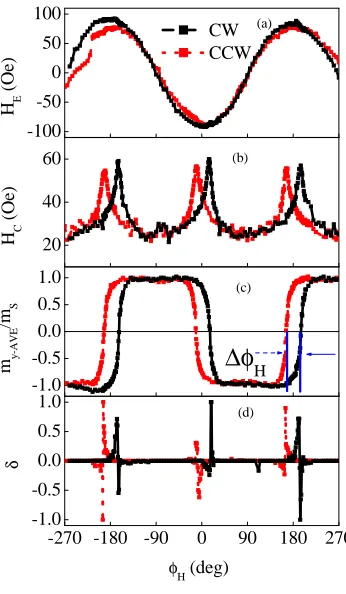
Figure 1 shows angular dependence
of HE, HC, my−AVE, and δ for typical
FeNi/FeMn bilayer with CW and CCW
rotations. φH is the orientation of Ha,
φH = 0 defined as the direction at which HE
in CW rotation has its maximum negative
value. Apparently, HC, my−AVE, and δ have
different angular dependence for CW and
CCW rotations. For example, φH is different
for my−AVE = 0 between CW and CCW
rotations. The angular difference is defined
as ∆φH, as shown in Fig. 1(c). It equals
28 degrees for tAFM=10 nm. As shown in
Fig. 1(a), HE has almost the same angular
dependence for CW and CCW rotations,
which will be analyzed below.
As discussed below, the results in Fig. 1
are caused by the hysteresis of ADEB. In
order to verify this, firstly another CW
rotation was measured directly after one
cycling of CW and CCW rotations. It
is found that the ADEB for the second
CW rotation is almost the same as that
of the first. Secondly, ∆φH is shown to be
independent of the increment of φH between
neighboring hysteresis loops. Finally, the
ADEB of CW and CCW rotations was
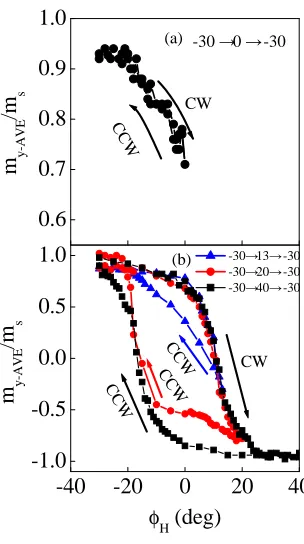
measured within different φH regimes. As
shown in Fig. 2(a), the angular dependence
of my−AVE is reversible for CW and CCW
rotations for small φH ranges. However, it is
irreversible for larger φH regimes, as shown
in Fig. 2(b). Unambiguously, the hysteretic
behavior of the ADEB is demonstrated.
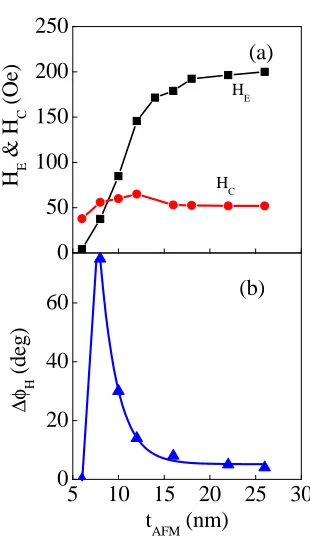
Figure 3(a) shows that HC changes
non-monotonically with tAFM, while HE changes
monotonically, similar to previous results [1].
Figure 3(b) shows that ∆φH also changes
non-monotonically with tAFM. For bilayers
with small tAFM, and also for single FM
layers, ∆φH = 0. For tAFM > 6 nm, ∆φH
sharply increases with increasing tAFM to
reach a maximum and then decreases.
We have developed a computational
model of the hysteretic phenomenon,
in-cluding thermal activation within the AFM
layer. The FM and AFM layers are modelled
as a granular microstructure produced using
a Voronoi construction (see for example
[16]). Each layer has the same
microstruc-ture, which describes realistic systems
where columnar growth is continuous across
consid-ered exchange-decoupled while neighboring
FM-FM and FM-AFM grains are strongly
exchange-coupled. The AFM layer is treated
using a kinetic Monte Carlo algorithm [17].
The coherent reversal of AFM spins is
governed by thermally activated processes,
i.e., the grains are allowed to reverse with a
probability psw given by the Arrhenius-N´eel
law [18]. In view of the hysteretic behavior
of the ADEB, we consider samples with
tAFM much smaller than the domain wall
thickness and thus neglect planar domain
wall in the AFM layer [19]. psw is determined
by the intrinsic energy barrier, determined
by the local anisotropy energy Eanis, and
the exchange field from the FM layer.
Eanis = a0tAFMKAFMsin2φAFM, where φAFM
is the angle between AFM spins and the
easy axis. The anisotropy constant KAFM is
single valued and the lateral area of AFM
grains a0 has a lognormal distribution with
a standard deviation σ= 0.3. The easy axes
of the AFM grains are assumed planar
ran-domly orientated. The interlayer exchange
energy is [20] Eexch = −a0c0JintSˆFM˙ ˆSAFM,
where Jint is the interface exchange
cou-pling constant, ˆSFM and ˆSAFM are the unit
vectors of the FM and AFM moments at
the interface, respectively. The contact
fraction c0 represents the net imbalance of
two sublattice magnetizations contacting
the FM layer. Determination of stationary
states from the total free energyEexch+Eanis
allows calculation of the energy barrier,
from which psw is determined. The FM
layer is treated in a standard micromagnetic
approach with the cell size being the grain
size. The FM grains are coupled with the
bulk exchange energy. The magnetic
equilib-rium state is determined by minimizing the
Gibbs free energy, which includes Zeeman,
exchange, anisotropy, magnetostatic terms,
and interlayer exchange coupling energy.
Minimization of the energy is achieved using
a Conjugate Gradient method. With strong
exchange-coupling between FM grains,
nonuniform magnetization reversal process
should occur.
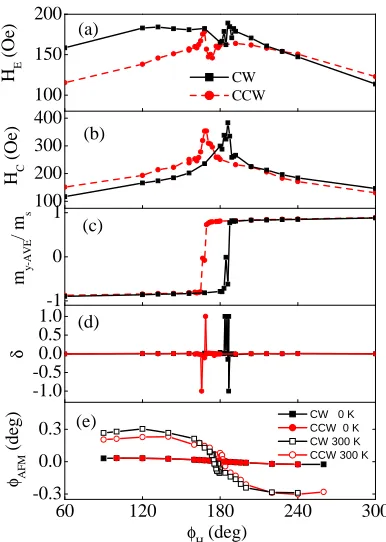
Figures 4(a)-4(d) show calculations for
a system with a median AFM grain size of
5 nm and σ = 0.3, tAFM=7 nm, tFM=3 nm,
KAFM = 4×10⁶ erg/cc, and KFM = 5×10³
erg/cc. For simplicity, it is assumed that
MFM = MAFM=750 emu/cc and the
ex-change field between FM-FM and FM-AFM
grains is 500 Oe. The present model
repro-duces major features of the experimental
results, except for HE, for reasons to be
discussed shortly.
The hysteresis of the ADEB can be
explained qualitatively. Consider a
hysteresis loop for the FM layer, i.e.,
S1(+MFM) → S2(−MFM) → S3(+MFM).
orien-tation of the AFM spins < φAFM > with
respect to the direction φH = 0o acquires
different values at states of S1 and S3 [21],
because AFM spins switch irreversibly
during the hysteresis loop of the FM layer.
Accordingly, the angular dependence of
< φAFM > at the state S1 should show
hysteresis between CW and CCW rotations,
resulting in an altered magnetic state after
CW and CCW rotations. This can be seen
from the results at 300 K in Fig. 4(e). On
setting the temperature of the AFM layer
to 0 K, thereby removing the thermally
activated transitions, the rotational
hystere-sis disappears. Therefore, the rotational
hysteresis of the ADEB is suggested to be
related to irreversible behavior of AFM spins
and induced by thermal activation.
The discrepancy of HE hysteresis
be-tween measured (Fig. 1(a)) and calculated
(Fig. 4(a)) results can be explained as
follows. The simulations assume a uniform
AFM layer, while a wedge shaped sample
is used in experiments. The magnetization
reversal process is expected to be
accom-panied by motion of single domain wall
for bilayers with wedged AFM layers [15],
and by multi-domain form for uniform
bilayers [22]. We have measured the ADEB
of an FeNi/FeMn bilayer with uniform layers
and found, as shown in Fig. 4(f)-4(i), the
angular dependence ofHEto show hysteretic
behavior between CW and CCW rotations.
Therefore, the disappearance of HE
hys-teresis in Fig. 1(a) is caused by the wedged
AFM layer and the associated magnetization
reversal mechanism. Moreover, the present
model can reproduce all features of uniform
bilayers.
The features of the measured results in
Fig. 3 can be qualitatively reproduced by
the theoretical model, as analyzed below.
For example, calculations have shown that
for tAFM = 2.5 nm, 7 nm, and 10 nm, ∆φH is
0o, 7o, and 0o, respectively, where the lateral
size of AFM grains is 5.0 nm. At smalltAFM,
all AFM grains are superparamagnetic, i.e.,
transitions are freely allowed between two
stable states. Thus, the HC enhancement
and ∆φH are negligible. For large tAFM,
the AFM layer becomes thermally stable.
However, some grains can be switched
by the exchange field from the FM layer
contributing a ’uniaxial’ anisotropy which
enhances HC and induces ∆φH. For large
enough tAFM, the intrinsic energy barrier
is increased further and psw is suppressed
thereby decreasing HC and ∆φH.
Mean-while, as the fraction of stable AFM grains
increases, HE increases monotonically. The
behavior of HE and HC is well explained by
the current model [23].
It is instructive to compare rotational
First, both reveal motion of AFM spins,
in different ways [13]. Secondly, since the
rotational hysteresis of torque also exists in
single FM layers [24], it is not unique for
FM/AFM bilayers. As a new experimental
evidence, however, the hysteresis of the
ADEB can exist only in FM/AFM bilayers
because no such a phenomenon exists in
single FM layers. As a new signature of the
EB, the rotational hysteresis of the ADEB
can better reflect the nature of the EB and
the motion of AFM spins, in comparison
with that of torque.
In summary, as a new signature of the EB,
rotational hysteresis of the ADEB between
CW and CCW rotations was studied for
FeNi/FeMn bilayers. For smalltAFM, there is
no hysteresis of the ADEB. It occurs for large
tAFM and increases with increasing tAFM to
reach a maximum. Finally it decreases.
Calculations show that the average
orien-tation of the AFM spins exhibits hysteresis
during CW and CCW rotations. This arises
from thermally activated transitions of the
AFM grains. The remarkable agreement
between theory and experiment gives strong
support to the granular model of EB in
polycrystalline bilayers.
Acknowledgement This work was
sup-ported by the National Science Foundation
of China, National Key Projects for Basic
Researches of China, Shanghai Science and
Technology Committee.
[1] J. Nogues and I. K. Schuler, J. Magn. Magn.
Mater. 192, 203(1999); A. E. Berkowitz
and K. Takano, J. Magn. Magn. Mater.
200, 552(1999)
[2] Z. P. Li et al, Phys. Rev. Lett. 96,
217205(2006)
[3] B. Beckmann et al, Phys. Rev. Lett. 91,
187201(2003)
[4] H. Ohldag et al, Phys. Rev. Lett. 91,
017203(2003)
[5] W. Zhu et al, Phys. Rev. Lett. 86,
5389(2001)
[6] A. Hoffmann, Phys. Rev. Lett. 93,
097203(2004); M. D. Stiles and R. D.
McMichael, Phys. Rev. B59, 3722(1999)
[7] A. Scholl et al, Phys. Rev. Lett. 92,
247201(2004)
[8] C. L. Chien et al, Phys. Rev. B 68,
014418(2003); F. Y. Yang and C. L. Chien,
Phys. Rev. Lett.85, 2597(2000)
[9] J. Camarero et al, Phys. Rev. Lett. 95,
057204(2005)
[10] E. Arenholz et al, Appl. Phys. Lett. 88,
072503(2006)
[11] T. Ambrose et al, Phys. Rev. B 56,
83(1997)
[12] O. de Haas et al, J. Magn. Magn. Mater.
[13] M. Tsunoda et al, J. Appl. Phys. 87,
4375(2000)
[14] R. Nakatani, Jpn. J. Appl. Phys. 33,
133(1994)
[15] S. M. Zhou et al, Phys. Rev. B 58,
R14717(1998)
[16] Handbook of Discrete and Computational
Geometry, edited by J. E. Goodman and
J. O’Rourke (CRC Press, New York, 1997).
[17] R. W. Chantrell et al, Phys. Rev. B 63,
24410(2000)
[18] L. N´eel, Ann. Geophys. (C.N.R.S) 5, 99
(1949)
[19] D. Mauri et al, J. Appl. Phys. 62,
3047(1987)
[20] E. Fulcomer and S. H. Charap, J. Appl.
Phys.43, 4190(1972)
[21] T. Hughes et al, J. Magn. Magn. Mater.
235, 329(2001)
[22] Z. Y. Liu and S. Adenwalla, Phys. Rev. B
67, 184423(2003)
[23] D. Choo et al, J. Appl. Phys. 101,
09E521(2007)
[24] I. S. Jacobs and F. E. Luborsky, J. Appl.
FIGURE CAPTIONS
Figure 1 Measured angular dependence ofHE
(a), HC (b), normalizedmy−AVE/ms(c), and
asymmetric factor δ (d) of FeNi(3
nm)/FeMn(10 nm) bilayer for CW and CCW
rotations. ms is the saturation magnetic
moment of the sample.
Figure 2 Measured angular dependence of
my−AVE/ms for FeNi(3 nm)/FeMn(10 nm) in
theφH region of -30→ 0→-30 (a), and
-30→ 13 →-30, -30→ 20 →-30, and
-30→ 40 →-30 (b) in the unit of degrees.
Figure 3 Measured dependence of −HE and HC
atφH= 0o(a) and ∆φH(b) on tAFM for FeNi (3
nm)/FeMn bilayers. The solid lines serve a
guide to the eye.
Figure 4 In left column, calculated angular
dependence ofHE(a), HC (b), my−AVE/ms (c),
δ (d) at 300 K, and < φAFM >at the stateS1
throughout CW (squares) and CCW (circles)
rotations at 0 K (solid symbols) and 300 K
(open symbols) (e) of FM/AFM bilayer. In
right column, measured angular dependence of
HE(f),HC (g), my−AVE/ms (h), and δ (i) for
typical uniform bilayer of FeNi (3 nm)/FeMn
-100 -50 0 50 100
-270 -180 -90 0 90 180 270
-1.0 -0.5 0.0 0.5 1.0 20 40 60
-1.0 -0.5 0.0 0.5 1.0
CW CCW
(a)
HE
(
O
e)
(d)
δ
φH (deg)
(b)
HC
(
O
e)
(c)
my
-A
V
E
/m
S
[image:11.595.86.259.98.395.2]∆φ
H-40 -20 0 20 40 -1.0
-0.5 0.0 0.5 1.0 0.6 0.7 0.8 0.9 1.0
-30→13→ -30 -30→20→ -30 -30→40→ -30
C C
W C
C W C
CW
CW (b)
m y
-A
V
E
/m
s
φH (deg)
-30 →0 → -30
C C
W
CW (a)
m y
-A
V
E
/m
[image:12.595.83.235.109.381.2]s
5 10 15 20 25 30 0
20 40 60 0 50 100 150 200 250
(b)
∆φ H
(
d
eg
)
tAFM (nm)
HC HE
(a)
H E
&
H
C
(
O
[image:13.595.82.237.105.373.2]e)
100 200 300 400 100 150 200
-1 0 1
-1.0 -0.5 0.0 0.5 1.0
60 120 180 240 300
-0.3 0.0 0.3
(b)
HC
(
O
e)
CW CCW
(a)
HE
(
O
e)
(c)
my
-A
V
E
/
ms
(d)
δ
CW 0 K CCW 0 K CW 300 K CCW 300 K (e)
φAF
M
(
d
eg
)
[image:14.595.86.279.95.366.2]φH (deg)