The DUNE Far Detector Interim Design Report
Volume 3: Dual-Phase Module
Deep Underground Neutrino Experiment (DUNE)
This document was prepared by Deep Underground Neutrino Experiment (DUNE) using the resources of the Fermi National Accelerator Laboratory (Fermilab), a U.S. Department of Energy, Office of Science, HEP User Facility. Fermilab is managed by Fermi Research Alliance, LLC (FRA), acting under Contract No.
Cover design: Diana Brandonisio, Fermilab Creative Services, July 2018
Authors
B. Abi,125R. Acciarri,54M. A. Acero,8M. Adamowski,54C. Adams,62 D. Adams,15P. Adamson,54 M. Adinolfi,14
Z. Ahmad,165 C. H. Albright,54L. Aliaga Soplin,54 T. Alion,152 S. Alonso Monsalve,20M. Alrashed,89 C. Alt,47
J. Anderson,5 K. Anderson,54 C. Andreopoulos,99 M. P. Andrews,54 R. A. Andrews,54 A. Ankowski,140
J. Anthony,27 M. Antonello,58 M. Antonova,68S. Antusch,10 A. Aranda Fernandez,34 A. Ariga,11 T. Ariga,11 D. Aristizabal Sierra,154E. Arrieta Diaz,150J. Asaadi,157 M. Ascencio,135D. Asner,15 M. S. Athar,1 M. Auger,11
A. Aurisano,32 V. Aushev,94 D. Autiero,79 F. Azfar,125A. Back,82 H. Back,126 J. Back,170 C. Backhouse,100
P. Baesso,14 L. Bagby,54 X. Bai,147 M. Baird,167 B. Balantekin,173 S. Balasubramanian,175 B. Baller,54P. Ballett,46
L. Balleyguier,79 B. Bambah,66 H. Band,175 M. Bansal,129 S. Bansal,129 G. Barenboim,68 G. J. Barker,170
C. Barnes,108 G. Barr,125 J. Barranco Monarca,60 N. Barros,132 J. Barrow,155 A. Bashyal,123 V. Basque,105
M. Bass,15 F. Bay,160 K. Bays,26 J. L. Bazo,135J. F. Beacom,122 E. Bechetoille,79 B. R. Behera,129L. Bellantoni,54
G. Bellettini,133 V. Bellini,28 O. Beltramello,20 D. Belver,21 N. Benekos,20 P. A. Benetti,130 A. Bercellie,139
E. Berman,54 P. Bernardini,164R. Berner,11H.-G. Berns,23 R. H. Bernstein,54 S. Bertolucci,74 M. Betancourt,54
V. Bhatnagar,129 M. Bhattacharjee,71 B. Bhuyan,71 S. Biagi,96 J. Bian,24 K. Biery,54 B. Bilki,81 M. Bishai,15
A. Bitadze,105T. Blackburn,152A. Blake,97 B. Blanco Siffert,51 F. Blaszczyk,13 E. Blaufuss,106 G. C. Blazey,113
M. Blennow,88 E. Blucher,30 V. Bocean,54 F. Boffelli,130 J. Boissevain,101 S. Bolognesi,19 T. Bolton,89
M. Bonesini,73 T. Boone,36 A. Booth,152C. Booth,143 S. Bordoni,20 A. Borkum,152 T. Boschi,46 P. Bour,39
B. Bourguille,67 S. B. Boyd,170 D. Boyden,113 J. Bracinik,12 D. Brailsford,97 A. Brandt,157 J. Bremer,20 S. J. Brice,54 C. Bromberg,109 G. Brooijmans,37 J. Brooke,14 G. Brown,157 N. Buchanan,36 H. Budd,139
P. C. de Holanda,49 T. Cai,139 D. Caiulo,79 P. Calafiura,98 A. Calatayud,135 J. Calcutt,109 C. Callahan,132
E. Calligarich,130E. Calvo,21 L. Camilleri,37 A. Caminata,56 M. Campanelli,100 G. Cancelo,54 K. Cankocak,81
C. Cantini,47 D. Caratelli,54 B. Carlus,79M. Carneiro,123 I. Caro Terrazas,36 T. J. Carroll,158M. P. Carvallo,151
M. Cascella,100 C. Castromonte,114 E. Catano-Mur,82 M. Cavalli-Sforza,67 F. Cavanna,54 E. Cazzato,10
S. Centro,128 G. Cerati,54 A. Cervelli,74A. Cervera Villanueva,68 T. Cervi,130 M. Chalifour,20 A. Chappuis,95
A. Chatterjee,157 S. Chattopadhyay,54 S. Chattopadhyay,165 J. Chaves,132 H. Chen,15 M.-C. Chen,24
S. Chen,159 D. Cherdack,36 C.-Y. Chi,37 S. Childress,54 K. Cho,92 S. Choubey,61 B. C. Choudhary,43
A. Christensen,36 D. Christian,54 G. Christodoulou,99 C.-A. Christofferson,147 E. Church,126 P. Clarke,48
T. E. Coan,150 A. Cocco,115 G. H. Collin,107 E. Conley,45 J. M. Conrad,107 M. Convery,140 R. Corey,147
L. Corwin,147 P. Cotte,19L. Cremonesi,100 J. I. Crespo-Anad´on,37 J. Creus Prats,20 E. Cristaldo,163 P. Crivelli,47
D. Cronin-Hennessy,112 C. Crowley,54 C. Cuesta,21 A. Curioni,73 D. Cussans,14 M. Dabrowski,15 D. Dale,76
H. Da Motta,18 T. Davenne,141 E. Davenport,157 G. S. Davies,78 J. Davies,152 S. Davini,56J. Dawson,4 K. De,157
M. P. Decowski,119 P. Dedin Neto,49I. de Icaza Astiz,152 A. Delbart,19 D. Delepine,60 M. Delgado,3 A. Dell,20
J. de Mello Neto,51D. DeMuth,166Z. Deng,159 S. Dennis,99 C. Densham,141 I. De Bonis,95 A. De Gouvˆea,120
P. De Jong,119P. De Lurgio,5S. De Rijck,158 A. De Roeck,20 J. J. de Vries,27 R. Dharmapalan,5 N. Dhingra,129 M. Diamantopoulou,7 F. Diaz,135 J. S. D´ıaz,78 G. Diaz Bautista,139 P. Ding,54 C. Distefano,96 M. Diwan,15
S. Di Domizio,56 L. Di Giulio,20 S. Di Luise,67 Z. Djurcic,5 F. Doizon,79 N. Dokania,151M. J. Dolinski,44
R. Dong,81J. dos Anjos,18 D. Douglas,109 G. Drake,5 D. Duchesneau,95K. Duffy,54 B. Dung,158 D. Dutta,61
M. Duvernois,173H. Duyang,145O. Dvornikov,63 D. A. Dwyer,98 S. Dye,63 A. S. Dyshkant,113 S. Dytman,134
M. Eads,113 B. Eberly,140D. Edmunds,109 J. Eisch,82 A. Elagin,30 S. Elliott,101 W. Ellsworth,64 M. Elnimr,24
S. Emery,19 S. Eno,106A. Ereditato,11 C. O. Escobar,54 L. Escudero Sanchez,27 J. J. Evans,105 A. Ezeribe,143
K. Fahey,54 A. Falcone,157 L. Falk,152 A. Farbin,157C. Farnese,128 Y. Farzan,75 M. Fasoli,73 A. Fava,54 J. Felix,60
E. Fernandez-Martinez,104 P. Fernandez Menendez,68 F. Ferraro,56 F. Feyzi,54 L. Fields,54 A. Filkins,172
F. Filthaut,119 A. Finch,97 O. Fischer,10 M. Fitton,141 R. Fitzpatrick,108 W. Flanagan,41 B. T. Fleming,175
R. Flight,139 T. Forest,76 J. Fowler,45 W. Fox,78 J. Franc,39 K. Francis,113 P. Franchini,170 D. Franco,175
J. Freeman,54 J. Freestone,105J. Fried,15 A. Friedland,140 S. Fuess,54I. Furic,55A. Furmanski,105 A. M. Gago,135
H. Gallagher,161 A. Gallego-Ros,21 V. Galymov,79 E. Gamberini,20 S. Gambetta,20 T. Gamble,143R. Gandhi,61
R. Gandrajula,109 S. Gao,15 D. Garcia-Gamez,105 S. Gardiner,23 D. Gastler,13 J. Gehrlein,104 B. Gelli,49
A. Gendotti,47 Z. Ghorbani-Moghaddam,23A. Ghosh,154 D. Gibin,128 I. Gil-Botella,21 C. Girerd,79 A. K. Giri,72
S. Glavin,132D. Goeldi,11 O. Gogota,94 M. Gold,117 S. Gollapinni,155K. Gollwitzer,54R. A. Gomes,57 L. Gomez,142
L. V. Gomez Bermeo,142 J. J. Gomez Cadenas,68 H. Gong,159 F. Gonnella,12 J. A. Gonzalez-Cuevas,163 M. Goodman,5 O. Goodwin,105 D. Gorbunov,80 S. Goswami,127 E. Goudzovski,12 C. Grace,98 N. Graf,134
N. Graf,140 M. Graham,140 E. Gramellini,175 R. Gran,111 A. Grant,42 C. Grant,13N. Grant,170 V. Greco,28
A. Guglielmi,128 B. Guo,145 S. Gupta,84 V. Gupta,71 K. K. Guthikonda,91 R. Gutierrez,3 P. Guzowski,105
M. M. Guzzo,49 A. Habig,111 R. W. Hackenburg,15 A. Hackenburg,175 B. Hackett,63 H. Hadavand,157
R. Haenni,11 A. Hahn,54 J. Haigh,170 T. Haines,101 J. Haiston,147 T. Hamernik,54 P. Hamilton,153 J. Han,134
T. Handler,155 S. Hans,15 D. A. Harris,54 J. Hartnell,152 T. Hasegawa,87 R. Hatcher,54 A. Hatzikoutelis,155
S. Hays,54 E. Hazen,13 M. Headley,148 A. Heavey,54 K. Heegerv,175 J. Heise,148 K. Hennessy,99 S. Henry,139
A. Hernandez,3 J. Hernandez-Garcia,104 K. Herner,54 J. Hewes,32 J. Hignight,109 A. Higuera,64 T. Hill,76
S. Hillier,12 A. Himmel,54 C. Hohl,10 A. Holin,100E. Hoppe,126 S. Horikawa,47 G. Horton-Smith,89M. Hostert,46
A. Hourlier,107 B. Howard,78 R. Howell,139 J. Huang,158 J. Hugon,102 P. Hurh,54 J. Hylen,54R. Illingworth,54
J. Insler,44 G. Introzzi,130 A. Ioannisian,176 A. Izmaylov,68 D. E. Jaffe,15 C. James,54 E. James,54C.-H. Jang,31
F. Jediny,39 Y. S. Jeong,6 A. Jhingan,129 W. Ji,15 A. Jipa,16 S. Jim´enez,21 C. Johnson,36 M. Johnson,54
R. Johnson,32 J. Johnstone,54 B. Jones,157 S. Jones,100 J. Joshi,15 H. Jostlein,54 C. K. Jung,151 T. Junk,54
A. Kaboth,141 I. Kadenko,94 F. Kamiya,52Y. Kamyshkov,155G. Karagiorgi,37D. Karasavvas,7 Y. Karyotakis,95
S. Kasai,93 S. Kasetti,102 K. Kaur,129B. Kayser,54 N. Kazaryan,176 E. Kearns,13 P. Keener,132 E. Kemp,49 C. Kendziora,54 W. Ketchum,54 S. H. Kettell,15 M. Khabibullin,80 A. Khotjantsev,80 D. Kim,20 B. Kirby,15
M. Kirby,54 J. Klein,132Y.-J. Ko,31 T. Kobilarcik,54B. Kocaman,160 L. W. Koerner,64 S. Kohn,22 G. Koizumi,54
P. Koller,11 A. Kopylov,80 M. Kordosky,172 L. Kormos,97T. Kosc,79 U. Kose,20V. A. Kosteleck´y,78K. Kothekar,14
M. Kramer,22 F. Krennrich,82 I. Kreslo,11 K. Kriesel,173 W. Kropp,24 Y. Kudenko,80V. A. Kudryavtsev,143
S. Kulagin,80 J. Kumar,63 L. Kumar,129 A. Kumar,129 S. Kumbhare,157 C. Kuruppu,145 V. Kus,39 T. Kutter,102
R. LaZur,36 K. Lande,132 C. Lane,44 K. Lang,158 T. Langford,175 F. Lanni,15 P. Lasorak,152 D. Last,132
C. Lastoria,21 A. Laundrie,173 I. Lazanu,16T. Le,161 J. Learned,63 P. Lebrun,54D. Lee,101G. Lehmann Miotto,20
M. A. Leigui de Oliveira,52 Q. Li,54 S. Li,15 S. W. Li,140 X. Li,151 Y. Li,15 Z. Li,45 H.-Y. Liao,89 S.-K. Lin,36
C-J. S. Lin,98 R. Linehan,140 V. Linhart,39J. Link,167 Z. Liptak,35 D. Lissauer,15 L. Littenberg,15 B. Littlejohn,69
J. Liu,146 T. Liu,150 L. LoMonaco,28 J. M. LoSecco,121S. Lockwitz,54 N. Lockyer,54T. Loew,98 M. Lokajicek,17
K. Long,77 K. Loo,86J. P. Lopez,35 D. Lorca,11T. Lord,170 M. Losada,3 W. C. Louis,101 M. Luethi,11K.-B. Luk,22
T. Lundin,54 X. Luo,175 N. Lurkin,12 T. Lux,67 V. P. Luzio,52 J. Lykken,54 J. Maalampi,86 R. MacLellan,146
A. A. Machado,52P. Machado,54C. T. Macias,78 J. Macier,54 P. Madigan,22 S. Magill,5 G. Mahler,15 K. Mahn,109 M. Malek,143 J. A. Maloney,40 F. Mammoliti,62 S. K. Mandal,43 G. Mandrioli,74 L. Manenti,100 S. Manly,139
A. Mann,161 A. Marchionni,54 W. Marciano,15 S. Marcocci,54 D. Marfatia,63 C. Mariani,167 J. Maricic,63
F. Marinho,162 A. D. Marino,35 M. Marshak,112 C. Marshall,98 J. Marshall,27 J. Marteau,79 J. Martin-Albo,125
D. Martinez,69 N. Martinez,137 H. Martinez,142 K. Mason,161 A. Mastbaum,30 M. Masud,68 H. Mathez,79
S. Matsuno,63 J. Matthews,102 C. Mauger,132 N. Mauri,74 K. Mavrokoridis,99 R. Mazza,73 A. Mazzacane,54
E. Mazzucato,19 N. McCauley,99 E. McCluskey,54 N. McConkey,143 K. McDonald,136 K. S. McFarland,139
C. McGivern,54A. McGowan,139 C. McGrew,151R. McKeown,172 A. McNab,105 D. McNulty,76 R. McTaggart,149
V. Meddage,89 A. Mefodiev,80 P. Mehta,85 D. Mei,146 O. Mena,68 S. Menary,177 H. Mendez,137D. P. Mendez,152
A. Menegolli,130 G. Meng,128 M. Messier,78W. Metcalf,102 M. Mewes,78 H. Meyer,171 T. Miao,54 J. Migenda,143
R. Milincic,63 J. Miller,154 W. Miller,112 J. Mills,161C. Milne,76 O. Mineev,80 O. Miranda,33 C. S. Mishra,54
S. R. Mishra,145A. Mislivec,112 B. Mitrica,65 D. Mladenov,20I. Mocioiu,131 K. Moffat,46N. Moggi,74R. Mohanta,66
N. Mokhov,54 J. Molina,163 L. Molina Bueno,47 A. Montanari,74 C. Montanari,130 D. Montanari,54
L. Montano Zetina,33 J. Moon,107 M. Mooney,36 C. Moore,54 D. Moreno,3 B. Morgan,170 G. F. Moroni,54
C. Morris,64W. Morse,15C. Mossey,54 C. A. Moura,52 J. Mousseau,108 L. Mualem,26 M. Muether,171 S. Mufson,78
F. Muheim,48 H. Muramatsu,112 S. Murphy,47 J. Musser,78 J. Nachtman,81M. Nalbandyan,176 R. Nandakumar,141
D. Naples,134 S. Narita,83 G. Navarro,3 J. Navarro,8 D. Navas-Nicol´as,21 N. Nayak,24 M. Nebot-Guinot,48 M. Needham,48 K. Negishi,83 J. Nelson,172 M. Nessi,20 D. Newbold,14 M. Newcomer,132 R. Nichol,100
T. C. Nicholls,141 E. Niner,54 A. Norman,54 B. Norris,54 J. Norris,76 P. Novella,68 E. Nowak,20 J. Nowak,97
M. S. Nunes,49 H. O’Keeffe,97 M. Oberling,5A. Olivares Del Campo,46 A. Olivier,139 Y. Onel,81 Y. Onishchuk,94
T. Ovsjannikova,80 S. Ozturk,20 L. Pagani,23 S. Pakvasa,63 O. Palamara,54 J. Paley,54 M. Pallavicini,56
C. Palomares,21 J. Palomino,151 E. Pantic,23 A. Paolo,64 V. Paolone,134 V. Papadimitriou,54 R. Papaleo,96
S. Paramesvaran,14 J. Park,167 S. Parke,54 Z. Parsa,15 S. Pascoli,46 J. Pasternak,77 J. Pater,105 L. Patrizii,74
R. B. Patterson,26 S. J. Patton,98 T. Patzak,4 A. Paudel,89 B. Paulos,173 L. Paulucci,52 Z. Pavlovic,54
G. Pawloski,112 P. Payam,75 D. Payne,99 V. Pec,143 S. J. M. Peeters,152 E. Pennacchio,79 A. Penzo,81
G. N. Perdue,54 O. l. G. Peres,49 L. Periale,47 K. Petridis,14G. Petrillo,140 R. Petti,145 P. Picchi,130L. Pickering,109
3
M. Popovic,54 R. Pordes,54 S. Pordes,54M. Potekhin,15R. Potenza,28 B. Potukuchi,84 S. Poudel,64 J. Pozimski,77
M. Pozzato,74 T. Prakasj,98 R. Preece,141 O. Prokofiev,54 N. Pruthi,129P. Przewlocki,116 F. Psihas,78D. Pugnre,79
D. Pushka,54 K. Qi,151 X. Qian,15 J. L. Raaf,54 R. Raboanary,2 V. Radeka,15 J. Rademacker,14V. Radescu,20
B. Radics,47 A. Radovic,172 A. Rafique,89 M. Rajaoalisoa,2 I. Rakhno,54 H. T. Rakotondramanana,2
L. Rakotondravohitra,2 Y. A. Ramachers,170 R. A. Rameika,54 M. A. Ramirez Delgado,60 J. Ramsey,101
B. J. Ramson,54 A. Rappoldi,130 G. L. Raselli,130 P. Ratoff,97 S. Ravat,20 O. Ravinez,114 H. Razafinime,2
B. Rebel,54 D. Redondo,21C. Regenfus,47 M. Reggiani-Guzzo,49T. Rehak,44 J. Reichenbacher,147D. Reitzner,54
M. H. Reno,81 A. Renshaw,64 S. Rescia,15 F. Resnati,20 A. Reynolds,125 G. Riccobene,96 L. C. J. Rice,113
K. Rielage,101K. Riesselmann,54 Y. - A. Rigaut,47 D. Rivera,132 L. Rochester,140 M. Roda,99 P. Rodrigues,125
M. J. Rodriguez Alonso,20 B. Roe,108 A. J. Roeth,45 R. M. Roser,54M. Ross-Lonergan,46 M. Rossella,130J. Rout,85
S. Roy,61 A. Rubbia,47 C. Rubbia,59 R. Rucinski,54B. Russell,175 J. Russell,140 D. Ruterbories,139M. R. Vagins,90
R. Saakyan,100 N. Sahu,72 P. Sala,110G. Salukvadze,20N. Samios,15F. Sanchez,67 M. C. Sanchez,82 C. Sandoval,3
B. Sands,136 S. U. Sankar,70 S. Santana,137 L. M. Santos,49 G. Santucci,151 N. Saoulidou,7 P. Sapienza,96
C. Sarasty,32 I. Sarcevic,6 G. Savage,54 A. Scaramelli,130 A. Scarpelli,4 T. Schaffer,111 H. Schellman,123 P. Schlabach,54 C. M. Schloesser,47D. W. Schmitz,30J. Schneps,161K. Scholberg,45 A. Schukraft,54 E. Segreto,49
S. Sehrawat,61J. Sensenig,132 I. Seong,24J. A. Sepulveda-Quiroz,82 A. Sergi,12 F. Sergiampietri,151 D. Sessumes,157
K. Sexton,15 L. Sexton-Kennedy,54 D. Sgalaberna,20 M. H. Shaevitz,37 S. Shafaq,85 J. S. Shahi,129
S. Shahsavarani,157 P. Shanahan,54 H. R. Sharma,84 R. Sharma,15 R. K. Sharma,138 T. Shaw,54 S. Shin,30
I. Shoemaker,146 D. Shooltz,109 R. Shrock,151 N. Simos,15 J. Sinclair,11 G. Sinev,45 V. Singh,9 J. Singh,103
J. Singh,103 I. Singh,129 J. Singh,129 R. Sipos,20 F. W. Sippach,37 G. Sirri,74 K. Siyeon,31D. Smargianaki,151
A. Smith,27A. Smith,45E. Smith,78 P. Smith,78 J. Smolik,39 M. Smy,24 E. L. Snider,54 P. Snopok,69 J. Sobczyk,174
H. Sobel,24M. Soderberg,153C. J. Solano Salinas,114 N. Solomey,171W. Sondheim,101 M. Sorel,68J. A. Soto-Oton,21
A. Sousa,32 K. Soustruznik,29 F. Spagliardi,125 M. Spanu,130 J. Spitz,108 N. J. C. Spooner,143 R. Staley,12
M. Stancari,54 L. Stanco,128A. Stefanik,54 H. M. Steiner,98J. Stewart,15 J. Stock,147 F. Stocker,20 S. Stoica,65
J. Stone,13 J. Strait,54M. Strait,112 T. Strauss,54 S. Striganov,54 A. Stuart,34 G. Sullivan,106 M. Sultana,139
Y. Sun,63 A. Surdo,164 V. Susic,10L. Suter,54 C. M. Sutera,28 R. Svoboda,23 B. Szczerbinska,156 A. M. Szelc,105
S. S¨oldner-Rembold,105 N. Tagg,124 R. Talaga,5 H. Tanaka,140 B. Tapia Oregui,158 S. Tariq,54 E. Tatar,76 R. Tayloe,78M. Tenti,74K. Terao,140 C. A. Ternes,68 F. Terranova,73 G. Testera,56A. Thea,141 L. F. Thompson,143
J. Thompson,143C. Thorn,15 A. Timilsina,15 S. C. Timm,54J. Todd,32 A. Tonazzo,4 T. Tope,54D. Torbunov,112
M. Torti,73 M. T´ortola,68 F. Tortorici,28M. Toups,54 C. Touramanis,99 J. Trevor,26 M. Tripathi,23 W. Tromeur,79
I. Tropin,54 W. H. Trzaska,86 Y.-T. Tsai,140 K. V. Tsang,140 A. Tsaris,54 S. Tufanli,175 C. Tull,98 J. Turner,46
M. Tzanov,102 E. Tziaferi,7 Y. Uchida,77 J. Urheim,78 T. Usher,140 G. A. Valdiviesso,50E. Valencia,172L. Valerio,54
Z. Vallari,151 J. W. F. Valle,68 R. Van Berg,132 R. Van de Water,101F. Varanini,128 G. Varner,63 J. Vasel,78
G. Vasseur,19 K. Vaziri,54G. Velev,54S. Ventura,128 A. Verdugo,21 M. Vermeulen,119 E. Vernon,15M. Verzocchi,54
T. Viant,47 C. Vignoli,58 S. Vihonen,86 C. Vilela,151B. Viren,15 P. Vokac,39T. Vrba,39 T. Wachala,118 D. Wahl,173
M. Wallbank,32 H. Wang,25J. Wang,23 T.-C. Wang,46 B. Wang,150 Y. Wang,151Z. Wang,159 K. Warburton,82
D. Warner,36 M. O. Wascko,77 D. Waters,100 A. Watson,12 A. Weber,125, 141 M. Weber,11 H. Wei,15 W. Wei,146
A. Weinstein,82 D. Wenman,173 M. Wetstein,82 M. While,147 A. White,157 L. H. Whitehead,20 D. Whittington,153
K. Wierman,126 M. Wilking,151 C. Wilkinson,11 J. Willhite,54 Z. Williams,157 R. J. Wilson,36 P. Wilson,54
P. Wittich,38 J. Wolcott,161 T. Wongjirad,161 K. Wood,151 L. Wood,126 E. Worcester,15 M. Worcester,15
S. Wu,47 W. Wu,54 W. Xu,146 C. Yanagisawa,151 S. Yang,32 T. Yang,54 G. Yang,151 J. Ye,150 M. Yeh,15
N. Yershov,80 K. Yonehara,54 L. Yoshimura,163 B. Yu,15 J. Yu,157 J. Zalesak,17 L. Zambelli,95 B. Zamorano,152
A. Zani,20 K. Zaremba,169 L. Zazueta,172G. P. Zeller,54 J. Zennamo,54C. Zhang,15 C. Zhang,146 M. Zhao,15 Y.-L. Zhou,46 G. Zhu,122 E. D. Zimmerman,35M. Zito,19 S. Zucchelli,74 J. Zuklin,17V. Zutshi,113 and R. Zwaska54
(The DUNE Collaboration)
1Aligarh Muslim University, Department of Physics, Aligarh-202002, India 2University of Antananarivo, BP 566, Antananarivo 101, Madagascar 3Universidad Antonio Nari˜no, Cra 3 Este No 47A-15, Bogota, Colombia
4APC, AstroParticule et Cosmologie, Universit Paris Diderot, CNRS/IN2P3, CEA/lrfu, Observatoire
de Paris, Sorbonne Paris Cit, 10, rue Alice Domon et Lonie Duquet, 75205 Paris Cedex 13, France
5Argonne National Laboratory, Argonne, IL 60439, USA 6University of Arizona, 1118 E. Fourth Street Tucson, AZ 85721, USA 7University of Athens, University Campus, Zografou GR 157 84, Greece
11University of Bern, Sidlerstrasse 5, CH-3012 Bern, Switzerland 12University of Birmingham, Edgbaston, Birmingham B15 2TT, United Kingdom
13Boston University, Boston, MA 02215, USA
14University of Bristol, H. H. Wills Physics Laboratory, Tyndall Avenue Bristol BS8 1TL, United Kingdom 15Brookhaven National Laboratory, Upton, NY 11973, USA
16University of Bucharest, Faculty of Physics, Bucharest, Romania
17Institute of Physics, Czech Academy of Sciences, Na Slovance 2, 182 21 Praha 8, Czech Republic 18Centro Brasileiro de Pesquisas F´ısicas, Rio de Janeiro, RJ 22290-180, Brazil
19CEA/Saclay, IRFU (Institut de Recherche sur les Lois Fondamentales de l’Univers), F-91191 Gif-sur-Yvette CEDEX, France 20CERN, European Organization for Nuclear Research 1211 Geneve 23, Switzerland, CERN
21CIEMAT, Centro de Investigaciones Energ´eticas, Medioambientales
y Tecnol´ogicas, Av. Complutense, 40, E-28040 Madrid, Spain
22University of California (Berkeley), Berkeley, CA 94720, USA 23University of California (Davis), Davis, CA 95616, USA 24University of California (Irvine), Irvine, CA 92697, USA 25University of California (Los Angeles), Los Angeles, CA 90095, USA
26California Institute of Technology, Pasadena, CA 91125, USA
27University of Cambridge, JJ Thomson Avenue, Cambridge CB3 0HE, United Kingdom 28University of Catania, INFN Sezione di Catania, Via Santa Sofia 64, I-95123 Catania, Italy
29Institute of Particle and Nuclear Physics of the Faculty of Mathematics and Physics of the
Charles University in Prague, V Holeˇsoviˇck´ach 747/2, 180 00 Praha 8-Libeˇn, Czech Republic
30University of Chicago, Chicago, IL 60637, USA 31Chung-Ang University, Dongjak-Gu, Seoul 06974, South Korea
32University of Cincinnati, Cincinnati, OH 45221, USA 33Cinvestav, Apdo. Postal 14-740, 07000 Ciudad de Mexico, Mexico 34Universidad de Colima, 340 Colonia Villa San Sebastian Colima, Colima, Mexico
35University of Colorado (Boulder), Boulder, CO 80309, USA 36Colorado State University, Fort Collins, CO 80523, USA
37Columbia University, New York, NY 10027, USA 38Cornell University, Ithaca, NY 14853, USA
39Czech Technical University in Prague, Bˇrehov´a 78/7, 115 19 Prague 1, Czech Republic 40Dakota State University, Madison, SD 57042, USA
41University of Dallas, Irving, TX 75062-4736, USA
42Daresbury Laboratory, Daresbury Warrington, Cheshire WA4 4AD, United Kingdom 43University of Delhi, Department of Physics and Astrophysics, Delhi 110007, India
44Drexel University, Philadelphia, PA 19104, USA 45Duke University, Durham, NC 27708, USA
46University of Durham, South Road, Durham DH1 3LE, United Kingdom 47ETH Zurich, Institute for Particle Physics, Zurich, Switzerland 48University of Edinburgh, Edinburgh EH8 9YL, UK, United Kingdom 49Universidade Estadual de Campinas, Campinas - SP, 13083-970, Brazil 50Universidade Federal de Alfenas, Po¸cos de Caldas - MG, 37715-400, Brazil 51Universidade Federal do Rio de Janeiro, Rio de Janeiro - RJ, 21941-901, Brazil
52Universidade Federal do ABC, Santo Andr´e, SP 09210-580, Brazil
53UEFS/DFIS - State University of Feira de Santana, Feira de Santana - BA, 44036-900, Brazil 54Fermi National Accelerator Laboratory, Batavia, IL 60510, USA
55University of Florida, PO Box 118440 Gainesville, FL 32611-8440, USA 56University of Genova, 16126 Genova GE, Italy
57Universidade Federal de Goias, Goiania, GO 74690-900, Brazil 58Laboratori Nazionali del Gran Sasso, I-67010 Assergi, AQ, Italy 59Gran Sasso Science Institute, Viale Francesco Crispi 7, L’Aquila, Italy
60Universidad de Guanajuato, Gto., C.P. 37000, Mexico 61Harish-Chandra Research Institute, Jhunsi, Allahabad 211 019, India
62Harvard University, 17 Oxford St. Cambridge, MA 02138, USA 63University of Hawaii, Honolulu, HI 96822, USA 64University of Houston, Houston, TX 77204, USA
65Horia Hulubei National Institute of Physiscs and Nuclear Engineering, Strada Reactorului 30, M˘agurele, Romania 66University of Hyderabad, Gachibowli, Hyderabad - 500 046, India
67Institut de Fisica d’Altes Energies (IFAE), Campus UAB, Facultat Ciences Nord, 08193 Bellaterra, Barcelona, Spain 68Instituto de Fisica Corpuscular, Catedratico Jose Beltran, 2 E-46980 Paterna (Valencia), Spain
69Illinois Institute of Technology, Chicago, IL 60616, USA
5
72Indian Institute of Technology Hyderabad, Hyderabad, 502285, India 73Sezione INFN Milano Bicocca and University of Milano Bicocca, Milano, Italy
74INFN Universit degli Studi di Bologna, 40127 Bologna BO, Italy
75Institute for Research in Fundamental Sciences (IPM), Farmanieh St. Tehran, 19538-33511, Iran 76Idaho State University, Department of Physics, Pocatello, ID 83209, USA
77Imperial College of Science Technology & Medicine, Blackett
Laboratory Prince Consort Road, London SW7 2BZ, United Kingdom
78Indiana University, Bloomington, IN 47405, USA
79Institut de Physique Nucleaire de Lyon (IPNL), Rue E. Fermi 4 69622 Villeurbanne, France 80Institute for Nuclear Research of the Russian Academy of Sciences (INR
RAS), 60th October Anniversary Prosp. 7a Moscow, 117312, Russia
81University of Iowa, Department of Physics and Astronomy 203 Van Allen Hall Iowa City, IA 52242, USA 82Iowa State University, Ames, Iowa 50011, USA
83Iwate University, Morioka, Iwate 020-8551, Japan 84University of Jammu, Physics Department, JAMMU-180006, India
85Jawaharlal Nehru University, Jawaharlal Nehru University, New Delhi 110067, India 86University of Jyvaskyla, P.O. Box 35, FI-40014, Finland
87High Energy Accelerator Research Organization (KEK), Ibaraki, 305-0801, Japan 88KTH Royal Institute of Technology, Roslagstullsbacken 21, SE-106 91 Stockholm, Sweden
89Kansas State University, Manhattan, KS 66506, USA
90Kavli Institute for the Physics and Mathematics of the Universe (WPI), Kashiwa, Chiba 277-8583, Japan 91Department of Physics, K L E F, Green Fields, Guntur - 522 502, AP, India
92Korea Institute for Science and Technology Information, Daejeon, 34141, South Korea 93National Institute of Technology, Kure College, Hiroshima, 737-8506, Japan
94Kyiv National University, 64, 01601 Kyiv, Ukraine
95Laboratoire d’Annecy-le-Vieux de Physique des Particules, CNRS/IN2P3
and Universit´e Savoie Mont Blanc, 74941 Annecy-le-Vieux, France
96INFN - Laboratori Nazionali del Sud (LNS), Via S. Sofia 62, 95123 Catania, Italy 97Lancaster University, Bailrigg, Lancaster LA1 4YB, United Kingdom
98Lawrence Berkeley National Laboratory, Berkeley, CA 94720, USA 99University of Liverpool, L69 7ZE, Liverpool, United Kingdom 100University College London, London, WC1E 6BT, United Kingdom
101Los Alamos National Laboratory, Los Alamos, NM 87545, USA 102Louisiana State University, Baton Rouge, LA 70803, USA 103University of Lucknow, Lucknow 226007, Uttar Pradesh, India
104Madrid Autonoma University, Ciudad Universitaria de Cantoblanco 28049 Madrid, Spain 105University of Manchester, Oxford Road, Manchester M13 9PL, United Kingdom
106University of Maryland, College Park, MD 20742, USA 107Massachusetts Institute of Technology, Cambridge, MA 02139, USA
108University of Michigan, Ann Arbor, MI 48109, USA 109Michigan State University, East Lansing, MI 48824, USA 110INFN Milano, INFN Sezione di Milano, I-20133 Milano, Italy
111University of Minnesota (Duluth), Duluth, MN 55812, USA 112University of Minnesota (Twin Cities), Minneapolis, MN 55455, USA 113Northern Illinois University, Department of Physics, DeKalb, Illinois 60115, USA
114Universidad Nacional de Ingenier´ıa, Av. Tupac Amaru 210, Lima 25, Peru
115Istituto Nazionale di Fisica Nucleare - Sezione di Napoli, Complesso Universitario di Monte S. Angelo, I-80126 Napoli, Italy 116National Centre for Nuclear Research, A. Soltana 7, 05 400 Otwock, Poland
117University of New Mexico, 1919 Lomas Blvd. N.E. Albuquerque, NM 87131, USA 118H. Niewodniczanski Institute of Nuclear Physics, Polish Academy of Sciences, Cracow, Poland
119Nikhef National Institute of Subatomic Physics, Science Park, Amsterdam, Netherlands 120Northwestern University, Evanston, Il 60208, USA
121University of Notre Dame, Notre Dame, IN 46556, USA
122Ohio State University, 191 W. Woodruff Ave. Columbus, OH 43210, USA 123Oregon State University, Corvallis, OR 97331, USA
124Otterbein University, One South Grove Street Westerville, OH 43081, USA 125University of Oxford, Oxford, OX1 3RH, United Kingdom
126Pacific Northwest National Laboratory, Richland, WA 99352, USA 127Physical Research Laboratory, Ahmedabad 380 009, India
128University of Padova, Dip. Fisica e Astronomia G. Galilei and INFN Sezione di Padova, I-35131 Padova, Italy 129Panjab University, Chandigarh, 160014 U.T., India
130University of Pavia, INFN Sezione di Pavia, I-27100 Pavia, Italy 131Pennsylvania State University, University Park, PA 16802, USA
134University of Pittsburgh, Pittsburgh, PA 15260, USA
135Pontificia Universidad Cat´olica del Per´u, Apartado 1761, Lima, Peru 136Princeton University, Princeton, New Jersey 08544, USA
137University of Puerto Rico, Mayaguez, 00681, USA
138Punjab Agricultural University, Department of Math. Stat. & Physics, Ludhiana 141004, India 139University of Rochester, Rochester, NY 14627, USA
140SLAC National Acceleratory Laboratory, Menlo Park, CA 94025, USA
141STFC Rutherford Appleton Laboratory, OX11 0QX Harwell Campus, Didcot, United Kingdom 142University Sergio Arboleda, Cll 74 -14 -14, 11022 Bogot´a, Colombia
143University of Sheffield, Department of Physics and Astronomy, Sheffield S3 7RH, United Kingdom 144University of Sofia, 5 James Bourchier Blvd., Sofia, Bulgaria
145University of South Carolina, Columbia, SC 29208, USA 146University of South Dakota, Vermillion, SD 57069, USA
147South Dakota School of Mines and Technology, Rapid City, SD 57701, USA 148South Dakota Science And Technology Authority, Lead, SD 57754, USA
149South Dakota State University, Brookings, SD 57007, USA 150Southern Methodist University, Dallas, TX 75275, USA 151Stony Brook University, Stony Brook, New York 11794, USA
152University of Sussex, Brighton, BN1 9RH, United Kingdom 153Syracuse University, Syracuse, NY 13244, USA
154Universidad Tecnica Federico Santa Maria, Department de Fisica, Casino 110-V, Valparaiso, Chile 155University of Tennessee at Knoxville, TN, 37996, USA
156Texas A&M University (Corpus Christi), Corpus Christi, TX 78412, USA 157University of Texas (Arlington), Arlington, TX 76019, USA
158University of Texas (Austin), Austin, TX 78712, USA 159Tsinghua University, Haidian District, Beijing 100084, China 160TUBITAK Space Technologies Research Institute, TR-06800, Ankara, Turkey
161Tufts University, Medford, MA 02155, USA
162Universidade Federal de S˜ao Carlos, Araras - SP, 13604-900, Brazil
163Universidade Nacional de Asuncion, 585540/2 Interno 1068 CC: 910, Asunci´on, Paraguay 164Universit`a del Salento - INFN, Via Provinciale per Arnesano, 73100 - Lecce , Italy 165Variable Energy Cyclotron Centre, 1/AF, Bidhannagar Kolkata - 700 064 West Bengal, India
166Valley City State University, Valley City, ND 58072, USA 167Virginia Tech, Blacksburg, VA 24060, USA
168University of Warsaw, Faculty of Physics ul. Pasteura 5 02-093 Warsaw, Poland 169Warsaw University of Technology, Nowowiejska 15/19, 00-665 Warszawa Poland, Poland
170University of Warwick, Coventry CV4 7AL, United Kingdom 171Wichita State University, Physics Division, Wichita, KS 67260, USA
172William and Mary, Williamsburg, VA 23187, USA 173University of Wisconsin (Madison), Madison, WI 53706, USA 174Wroclaw University, Plac Maxa Borna 9, 50-204 Wroclaw, Poland
175Yale University, New Haven, CT 06520, USA
Contents i
List of Figures vii
List of Tables 1
1 Design Motivation 3
1.1 Introduction to the DUNE Dual-Phase Far Detector Module Design . . . 3
1.2 Dual-Phase (DP) LArTPC Operational Principle . . . 3
1.3 Motivation for the DP Design . . . 4
1.4 Overview of Dual-Phase Design . . . 6
1.5 Detector systems . . . 9
1.5.1 Charge Readout Planes . . . 9
1.5.2 Readout Electronics and Chimneys . . . 11
1.5.3 Cathode, Field Cage and HV System . . . 12
1.5.4 Photon Detection System . . . 13
1.5.5 Data Acquisition . . . 13
1.5.6 Cryogenics Instrumentation and Slow Controls . . . 14
2 Charge Readout Planes 16 2.1 Charge Readout Planes (CRP) Overview . . . 16
2.1.1 Introduction . . . 16
2.1.2 Design Considerations . . . 18
2.1.3 Scope . . . 19
2.2 CRP Design . . . 20
2.2.1 Mechanical structure . . . 21
2.2.2 Extraction Grid . . . 22
2.2.3 Large Electron Multiplier (LEM) . . . 23
2.2.4 Anode . . . 24
2.2.5 Instrumentation . . . 25
2.2.6 Suspension System and Drive . . . 26
2.3 Production and Assembly . . . 28
2.3.1 G10 and Invar Frame Production . . . 28
2.3.2 LEM and Anode Production . . . 29
2.3.3 Tooling . . . 33
2.4 Interfaces . . . 36
2.4.1 TPC Electronics . . . 37
2.4.2 Instrumentation and HV Feedthrough Flanges . . . 37
2.4.3 Cryostat and Detector Support Structure . . . 37
2.4.4 HV and Slow Controls . . . 39
2.5 Installation, Integration and Commissioning . . . 39
2.5.1 Transport and Handling . . . 40
2.5.2 Calibration . . . 41
2.6 Quality Control . . . 41
2.7 Safety . . . 41
3 TPC Electronics 43 3.1 TPC Electronics System Overview . . . 43
3.1.1 Introduction . . . 43
3.1.2 Design Considerations . . . 45
3.1.3 Scope . . . 47
3.2 TPC Electronics System Design . . . 48
3.2.1 Cryogenic Analog Front-end Electronics . . . 50
3.2.2 Signal Feedthrough Chimneys . . . 53
3.2.3 Digital Advanced Mezzanine Card Electronics for Charge Readout . . . 55
3.2.4 Electronics for Light Readout . . . 57
3.2.5 Network-based µTCA Architecture . . . 60
3.2.6 Timing Distribution . . . 62
3.3 Production and Quality Assurance . . . 64
3.3.1 Cryogenic Analog FE Electronics . . . 64
3.3.2 Signal Feedthrough Chimneys . . . 64
3.3.3 The Timing System and µTCA . . . 65
3.3.4 Charge Readout Electronics . . . 65
3.3.5 Light Readout Electronics . . . 65
3.4 Interfaces . . . 66
3.4.1 Electronics System to charge-readout plane (CRP) and Photon Detection Systems 66 3.4.2 Electronics System to DAQ System . . . 67
3.4.3 Electronics System to Cryostat and Cryogenics . . . 68
3.4.4 Electronics System to Slow Control System . . . 69
3.5 Transport and Handling . . . 70
3.6 Installation, Integration and Commissioning . . . 70
3.6.1 SFT Chimneys . . . 70
3.6.2 DigitalµTCA Crates . . . 71
3.6.3 Integration within the DAQ . . . 71
3.6.4 Integration with the Photon Detection System . . . 71
3.6.5 Commissioning . . . 71
3.7 Risks and Vulnerabilities . . . 72
3.8 Organization and Management . . . 73
3.8.1 Dual-Phase TPC Electronics Consortium Organization . . . 73
3.8.2 Planning Assumptions . . . 73
3.8.3 WBS and Responsibilities . . . 73
4.1.1 Introduction . . . 75
4.1.2 Design Considerations . . . 76
4.1.3 Scope . . . 76
4.1.4 System Overview . . . 78
4.2 HV System Design . . . 78
4.2.1 High Voltage Power Supply and Feedthroughs . . . 78
4.2.2 High Voltage Extender and Voltage Degrader . . . 81
4.2.3 Cathode Plane . . . 81
4.2.4 Ground Grid . . . 84
4.2.5 Field Cage . . . 84
4.2.6 HV Return and Monitoring Devices . . . 88
4.3 Quality Assurance . . . 90
4.4 Production and Assembly . . . 91
4.4.1 Field Cage Submodule Frames . . . 91
4.4.2 Cathode Plane . . . 92
4.4.3 Ground Plane . . . 92
4.4.4 Electrical Interconnections . . . 93
4.5 Interfaces to the HV System . . . 93
4.5.1 Cryostat . . . 93
4.5.2 Charge Readout Plane . . . 93
4.5.3 Photon Detection System . . . 93
4.6 Transport, Handling and Integration . . . 94
4.7 Quality Control . . . 94
4.8 Safety . . . 95
4.9 Organization and Management . . . 96
4.9.1 HV Consortium Organization . . . 96
4.9.2 Planning Assumptions . . . 97
5 Photon Detection System 99 5.1 Overview . . . 99
5.1.1 Introduction . . . 99
5.1.2 Physics and the Role of Photodetection . . . 100
5.1.3 Technical Requirements . . . 101
5.1.4 Detector Layout . . . 101
5.1.5 Operation Principles . . . 103
5.2 Photosensor System . . . 104
5.2.1 Photodetector Selection and Procurement . . . 104
5.2.2 Photodetector Characterization . . . 105
5.2.3 High Voltage System . . . 106
5.2.4 Wavelength Shifters . . . 107
5.2.5 Light Collectors . . . 107
5.3 Mechanics . . . 108
5.4 Readout Electronics . . . 109
5.4.1 Photomultiplier High Voltage Dividers . . . 109
5.4.3 Signal Readout Requirements . . . 111
5.5 Photon Calibration System . . . 113
5.5.1 System Design and Procurement . . . 113
5.5.2 Validation Tests . . . 114
5.6 Photon Detector Performance . . . 115
5.6.1 Simulations . . . 117
5.6.2 Light Data in DP Prototypes . . . 122
5.6.3 Simulation of Physics Events . . . 122
5.7 Photon Detector Operations . . . 124
5.7.1 Trigger Strategy . . . 124
5.7.2 Data Quality Monitoring . . . 125
5.8 Interfaces . . . 125
5.9 Installation, Integration and Commissioning . . . 127
5.9.1 Transport and Handling . . . 127
5.9.2 Integration and Testing Facility Operations . . . 127
5.9.3 Underground Installation and Integration . . . 128
5.9.4 Commissioning . . . 128
5.10 Quality Control . . . 128
5.10.1 Production and Assembly . . . 128
5.10.2 Post-Factory Installation . . . 129
5.11 Safety . . . 130
5.12 Management and Organization . . . 130
5.12.1 Consortium Organization . . . 130
5.12.2 Planning Assumptions . . . 131
5.12.3 WBS and Responsibilities . . . 132
5.12.4 High-Level Cost and Schedule . . . 132
6 Data Acquisition System 134 6.1 Data Acquisition (DAQ) System Overview . . . 134
6.1.1 Introduction . . . 134
6.1.2 Design Considerations . . . 136
6.1.3 Scope . . . 143
6.2 DAQ Design . . . 144
6.2.1 Overview . . . 144
6.2.2 Front-end Readout and Buffering . . . 146
6.2.3 Front-end Trigger Primitive Generation . . . 148
6.2.4 Dataflow, Trigger and Event Builder . . . 148
6.2.5 Data Selection Algorithms . . . 151
6.2.6 Timing and Synchronization . . . 154
6.2.7 Computing and Network Infrastructure . . . 155
6.2.8 Run Control and Monitoring . . . 156
6.3 Interfaces . . . 157
6.3.1 TPC Electronics . . . 157
6.3.2 PD Electronics . . . 157
6.3.3 Offline Computing . . . 158
6.3.4 Slow Control . . . 158
6.4.2 Quality Assurance and Quality Control . . . 161
6.4.3 Integration testing . . . 162
6.5 Installation, Integration and Commissioning . . . 162
6.5.1 Installation . . . 162
6.5.2 Integration with Detector Electronics . . . 164
6.5.3 Commissioning . . . 164
6.6 Safety . . . 165
6.7 Organization and Management . . . 165
6.7.1 DAQ Consortium Organization . . . 165
6.7.2 Planning Assumptions . . . 166
6.7.3 High-level Cost and Schedule . . . 166
7 Slow Controls and Cryogenics Instrumentation 168 7.1 Slow Controls and Cryogenics Instrumentation Overview . . . 168
7.1.1 Introduction . . . 168
7.1.2 Design Considerations . . . 169
7.1.3 Scope . . . 171
7.2 Cryogenics Instrumentation . . . 173
7.2.1 Fluid Dynamics Simulations . . . 175
7.2.2 Purity Monitors . . . 177
7.2.3 Thermometers . . . 181
7.2.4 Liquid Level Monitoring . . . 187
7.2.5 Gas Analyzers . . . 189
7.2.6 Cameras . . . 190
7.2.7 Cryogenics Test Facility . . . 196
7.2.8 Cryogenic Internal Piping . . . 196
7.3 Slow Controls . . . 197
7.3.1 Slow Controls Hardware . . . 198
7.3.2 Slow Controls Infrastructure . . . 199
7.3.3 Slow Controls Software . . . 200
7.3.4 Slow Controls Quantities . . . 200
7.3.5 Local Integration . . . 202
7.4 Interfaces . . . 202
7.5 Installation, Integration and Commissioning . . . 204
7.5.1 Cryogenics Internal Piping . . . 204
7.5.2 Purity Monitors . . . 204
7.5.3 Thermometers . . . 205
7.5.4 Gas Analyzers . . . 206
7.5.5 Liquid Level Monitoring . . . 207
7.5.6 Cameras and Light-Emitting System . . . 207
7.5.7 Slow Controls Hardware . . . 208
7.5.8 Transport, Handling and Storage . . . 208
7.6 Quality Control . . . 208
7.6.1 Purity Monitors . . . 209
7.6.3 Gas Analyzers . . . 211
7.6.4 Liquid Level Monitoring . . . 211
7.6.5 Cameras . . . 211
7.6.6 Light-emitting System . . . 212
7.6.7 Slow Controls Hardware . . . 212
7.7 Safety . . . 212
7.8 Organization and Management . . . 213
7.8.1 Slow Controls and Cryogenics Instrumentation Consortium Organization . . . 213
7.8.2 Planning Assumptions . . . 214
7.8.3 High-level Schedule . . . 215
8 Technical Coordination 216 8.1 Project Support . . . 220
8.1.1 Schedule . . . 222
8.1.2 Risk . . . 224
8.1.3 Reviews . . . 225
8.1.4 Quality Assurance . . . 225
8.1.5 ESH . . . 227
8.2 Integration Engineering . . . 228
8.2.1 Configuration Management . . . 228
8.2.2 Engineering Process and Support . . . 230
8.3 Detector Infrastructure . . . 232
8.4 The Integration and Test Facility . . . 233
8.4.1 Requirements . . . 235
8.4.2 Management . . . 236
8.4.3 Inventory System . . . 236
8.4.4 ITF Infrastructure . . . 236
8.5 Installation Coordination and Support . . . 236
8.5.1 UIT Infrastructure . . . 237
8.5.2 Underground Detector Installation . . . 237
8.5.3 Preparation for Operations . . . 246
Glossary 247
1.1 Principle of the DP readout . . . 5
1.2 Diagram of the DP module . . . 7
1.3 Thicknesses and HV values for electron extraction from liquid to gaseous Ar . . . 10
2.1 Dual-phase readout . . . 17
2.2 View of a complete 9 m2 charge-readout plane (CRP) module . . . 18
2.3 Main components of a CRP module of 9 m2 . . . 20
2.4 First CRP Invar frame under construction for ProtoDUNE-DP . . . 21
2.5 G10 elements of a full CRP module . . . 22
2.6 Decoupling system attached to the Invar frame . . . 22
2.7 Extraction grid components on the CRP structure . . . 23
2.8 Picture of a large electron multiplier (LEM) module used for ProtoDUNE-DP . . . 24
2.9 Picture of the anode symmetric 2D strip design. . . 25
2.10 View of the distance meter plates on the sides of a CRP . . . 26
2.11 View of the thermometer board . . . 27
2.12 Suspension feedthrough and various assembly details . . . 27
2.13 Anchoring system of the suspension cable on the CRP frame . . . 28
2.14 High-pressure vessel for the characterization of the ProtoDUNE-DP LEM modules. . . . 32
2.15 Event display of a 5.5 MeV alpha track in argon gas at 1 bar. . . 33
2.16 Test of anode strip continuity . . . 34
2.17 Extraction grid construction bench details . . . 35
2.18 LEM and anode connection and extraction grid module installation. . . 36
2.19 Elements for assembly of ProtoDUNE-DP CRP at CERN . . . 36
2.20 LEM high voltage (HV) distribution boxes mounted on a CRP . . . 38
2.21 HV distribution box for LEM top electrodes before filling . . . 38
3.1 Schematic layout of the dual-phase (DP) charge readout (CRO) sub-system . . . 44
3.2 Schematic layout of the DP light readout (LRO) sub-system . . . 45
3.3 Top corner view of DP module . . . 49
3.4 Cryogenic front-end (FE) ASIC properties . . . 51
3.5 Image of an analog FE card mounted on the extraction blade . . . 51
3.6 Noise measurements in the WA105 DP demonstrator in different conditions . . . 52
3.7 Details of the signal feedthrough chimney (SFT chimney) design . . . 54
3.8 Signal feedthrough chimney cold flange . . . 54
3.9 Block diagram of advanced mezzanine card (AMC) . . . 56
3.11 Photo of prototype LRO card . . . 58
3.12 CATIROC ASIC . . . 60
3.13 Instrumented µTCA crate from the WA105 DP demonstrator . . . 62
3.14 Picture of White Rabbit (WR) slave node card . . . 63
3.15 Architecture of WR network . . . 64
3.16 Images of the WA105 DP demonstrator signal feedthrough (SFT) cold feedthrough . . . 67
3.17 Details of SFT chimney interface to the cryostat structure . . . 69
4.1 DP module overview . . . 76
4.2 HV system for a DP detector module . . . 79
4.3 HV powersupply and feedthrough for a DP detector module . . . 80
4.4 DP HVFT and extender . . . 82
4.5 Cutaway view of ProtoDUNE-DP cathode . . . 83
4.6 ProtoDUNE-DP cathode E field . . . 83
4.7 DP field cage (FC) parts . . . 85
4.8 E field map and equipotential contours of an array of roll-formed profiles . . . 87
4.9 DP HVDB . . . 88
4.10 DP FC installation process and inter-module connection . . . 89
5.1 The DP module (partially open) . . . 103
5.2 Picture of the Hamamatsu R5912-MOD20 photomultiplier tube (PMT). . . 104
5.3 Picture of the PMTs being installed in the testing vessel . . . 105
5.4 Sketch of the setup for PMT characterization tests. . . 106
5.5 Cryogenic Hamamatsu R5912-MOD20 PMT fixed on the membrane floor. . . 109
5.6 Positive power supply and cathode grounding scheme. . . 109
5.7 Generic splitter circuit diagram. . . 111
5.8 SPE waveforms and amplitudes from the WA105 at different voltages. . . 112
5.9 Event rates for different trigger thresholds observed in the WA105 DP demonstrator. . . 113
5.10 Diagram of the photon calibration system to be implemented in ProtoDUNE-DP. . . 114
5.11 A sketch depicting the mechanism of light production in argon. . . 115
5.12 Landau fits of the travel time distributions for a sources close to and far from the PMT. 118 5.13 Evolution of the visibility seen by a central PMT . . . 119
5.14 Evolution of the visibility and peak time as a function of source-PMT distance (preliminary)120 5.15 Light yield in terms of photoelectron/MeV summed over all PMTs . . . 121
5.16 Averaged waveform of the S1 light signal from the WA105 DP demonstrator . . . 122
5.17 Response for simulated SNB neutrino interactions (ProtoDUNE-DP geometry) . . . 123
5.18 Response for simulated nucleon decays (ProtoDUNE-DP geometry) . . . 124
6.1 DAQ overview . . . 137
6.2 data acquisition (DAQ) overview . . . 138
6.3 DP FE DAQ fragment . . . 146
6.4 CUC control room layout . . . 163
6.5 DAQ high-level schedule . . . 167
7.1 CISC subsystems . . . 169
7.2 Cryostat ports . . . 174
7.3 CFD example . . . 176
7.7 Purity monitor block diagram . . . 180
7.8 Purity monitor string . . . 181
7.9 Cryostat bolts and temperature sensor support . . . 183
7.10 Temperature sensor resolution and reproducibility . . . 184
7.11 Dynamic T-gradient monitor overview . . . 185
7.12 Sensor-cable assembly for dynamic T-gradient monitor . . . 186
7.13 Cable supports for individual temperature sensors . . . 186
7.14 Gas Analyzer switchyard . . . 189
7.15 Gas analyzer purge . . . 190
7.16 Gas analyzer O2 level after liquid argon (LAr) filling . . . 191
7.17 A camera enclosure . . . 193
7.18 Inspection camera design . . . 194
7.19 LED chain for illumination . . . 195
7.20 CryTest Blanche Test . . . 196
7.21 Cryogenic internal piping . . . 197
7.22 Slow Controls connections and data . . . 198
7.23 cryogenic instrumentation and slow controls (CISC) consortium organization . . . 214
8.1 Organization of technical coordination (TC) . . . 217
8.2 Flow of components from the consortia to the far detector (FD). . . 218
8.3 LBNF/DUNE systems engineering organizational structure. . . 219
8.4 DUNE Technical Board. . . 220
8.5 DUNE management organizational structure. . . 221
8.6 APA and CPA installation steps . . . 239
8.7 cathode plane assembly (CPA) and FC unpacking and assembly . . . 240
8.8 3D model of underground area showing installation infrastructure . . . 241
8.9 Section view of the 3D model showing layout . . . 242
8.10 End view of SP module with endwall field cage (endwall FC) in place . . . 243
8.11 High-level installation schedule . . . 244
LIST OF TABLES 0–1
List of Tables
1.1 Dual-phase module parameters . . . 7
1.2 Quantities of items or parameters for the DP module . . . 8
2.1 Interstage distances and E field settings of the DP readout components . . . 17
2.2 Important parameters for the charge-readout plane (CRP) system design . . . 19
2.3 Tolerance values on various large electron multiplier (LEM) parameters . . . 31
2.4 Specifications for the anode dimensions . . . 33
3.1 Parameters for the TPC electronics system design . . . 47
3.2 Numbers for DP electronics components to procure . . . 48
3.3 Summary of some of the principal parameters of the TPC electronics system. . . 50
3.4 Main characteristics of analog-to-digital converter (ADC) AD9257 . . . 56
3.5 Main characteristics of ADC AD9249 . . . 59
3.6 Main characteristics of CATIROC. . . 61
3.7 Bandwidth requirements per µTCA crate. . . 61
3.8 Interface documents relevant to DP TPC electronics system . . . 66
3.9 DP TPC electronics consortium key milestones . . . 74
3.10 DP TPC electronics consortium schedule . . . 74
4.1 HIGH VOLTAGE (HV) system requirements . . . 77
4.2 HV consortium participants . . . 97
5.1 Summary of tentative requirements for the DP module photon detection system (PDS) . 102 5.2 Default optical parameters chosen for the light simulation methods . . . 116
5.3 DP photon detector (PD) interface documents . . . 126
5.4 Pre-technical design report (TDR) key milestones . . . 133
5.5 Post-TDR key milestones . . . 133
6.1 Important requirements on the data acquisition (DAQ) system design . . . 140
6.2 Pre-trigger data rates from the far detector (FD) TPCs and into DAQ front end. . . 141
6.3 Uncompressed data rates for one SP module. . . 142
7.1 Important design requirements on the DP CISC system design . . . 172
7.2 Liquid level monitor requirements . . . 188
7.3 Camera system requirements . . . 192
7.4 Slow controls quantities . . . 201
Chapter 1: Design Motivation 1–3
Chapter 1
Design Motivation
1.1
Introduction to the DUNE Dual-Phase Far Detector
Mod-ule Design
The DUNE dual-phase (DP) detector module aims to open new windows of opportunity in the study of neutrinos, a goal it shares with the SP module. DUNE’s rich physics program, with discovery potential for charge parity (CP) in the neutrino sector, and its capability to make signif-icant observations of nucleon decay and astrophysical events, is enabled by the exquisite resolution of the LArTPC detector technique, which the DP design further augments. This design improves the S/N ratio in the charge readout, lowering the threshold for the smallest observable signals while also achieving a finer readout granularity. The DP technology enables the construction of larger drift volumes, thereby reducing the quantity of nonactive materials in the LAr. Although the physics requirements are identical for both the SP and DP designs, some aspects of the DP design offer augmented performance.
1.2
Dual-Phase (DP) LArTPC Operational Principle
The key differentiating concept of the DP design is the amplification of the ionization signal in an avalanche process. In the SP design, charges drift horizontally to the anode, which consists of a set of induction and collection wire layers immersed in the LAr. In the DP design, electrons drift vertically upward towards an extraction grid just below the liquid-vapor interface. After reaching the grid, an E field stronger than the drift field extracts the electrons from the liquid up into the gas phase. Once in the gas, electrons encounter micro-pattern gas detectors with high-field regions, called large electron multipliers (LEMs). The LEMs amplify the electrons in avalanches that occur in these high-field regions. The amplified charge is then collected and recorded on a 2D anode consisting of two sets of 3.125 mm-pitch gold-plated copper strips that provide the x and y
coordinates (and thus two views) of an event.
The extraction grid, LEM and anode are assembled into three-layered sandwiches with precisely defined inter-stage distances and inter-alignment, which are then connected together horizontally into modular units of area 9 m2. These units are called charge-readout planes (CRPs). The CRPs integrate the LEMs and anodes, and support the extraction grid. These units can be individually positioned in a horizontal plane a few millimeters beneath the liquid-gas interface, ensuring complete immersion of the extraction grid.
The argon scintillation light, which at a wavelength of 127 nm is deep in the UV spectrum and it is recorded by an array of photomultiplier tubes (PMTs) located below the cathode. The PMTs, coated with a wavelength-shifting material, shifts the light closer to the visible spectrum and records the time and pulse characteristics of the incident light.
Two key factors affect the performance of the LArTPC. First, the LAr purity must be extremely high in order to achieve minimum charge attenuation over the longest drift lengths in the LArTPC. This requires that the levels of electronegative contaminants (e.g., oxygen, water), be reduced and maintained at ∼ppt levels. The DP and SP designs are subject to the same purity requirements. Second, the electronic readout of the LArTPC requires very low noise levels in order that the signal from the drifting electrons be clearly discernible over the baseline of the electronics. This requires use of low-noise cryogenic electronics.
The amplification of the electron signal in the gas phase mitigates the potential impact of these factors on the performance of the DP design. On the other hand this design requires higher voltages on the cathode, relative to the SP, due to the longer drift field.
1.3
Motivation for the DP Design
The innovative DP design is similar in many ways to the SP design, but implements some unique features and offers several advantages over it, providing an appealing and complementary approach, as summarized below:
• Gain on the ionization signal obtained in the gas phase:
Chapter 1: Design Motivation 1–5
– compensating for potential charge attenuation due to long drift paths;
• Larger fiducial volume, enabling very long drift paths;
• Absence of dead material in the LAr drift volume;
• Finer readout pitch (3 mm), implemented in two identical collection views,x and y;
• Fewer readout channels (153,600 for DP versus 384,000 for SP for a 10 kt module);
• Fewer construction modules;
• Full accessibility and replaceability of the front-end (FE) electronics during the detector operation.
The DP design features maximize the capability of the experiment and are motivated to cope with the unprecedented scale of the detector modules and the deep underground location where construction will occur.
Among the features driven by the underground location of the experiment, all detector components are sized to fit within the constraints of the SURF shafts and access pathways. The CRP modules are essentially planar objects with a surface of 3×3 m2. All the other detector components (FC and cathode modules) are designed in order to stay within this envelope. The relatively small number of detector elements makes the underground installation easier.
A drift time of several milliseconds is typical for ionization charge to arrive at the anode wires after drifting several meters. This lengthy duration, as well as aspects of the DUNE physics program looking for rare and low-energy processes, makes the deep underground location essential for the DP module. The 1.5 km overburden of earth will vastly reduce the rate of cosmic rays reaching the active volume of the DP module, greatly enhancing the ability to search for rare and low-energy signatures without the influence of cosmic-induced backgrounds.
1.4
Overview of Dual-Phase Design
This DP design implements a DP liquid argon time projection chamber (LArTPC) augmented with a light-readout system. DP refers to the extraction of ionization electrons at the interface between the liquid and gas argon and their amplification and collection in the gas phase.
Chapter 1: Design Motivation 1–7
by the FC. The ionization electrons in the liquid phase drift in a uniform E field towards the anode plane at the top of the active volume. This is made by an array of 80 independent CRP modules, 3×3 m2 each. The cryogenic FE electronics is installed in the signal feedthrough chimneys (SFT chimneys) on the roof of the cryostat. There are no active electronics elements in the cryostat volume besides the PMT bases. The proposed design optimally exploits the cryostat volume of 14.0 m(w)×14.1 m(h)×62.0 m(l) with an anode active area of 12 m×62.0 m and a maximum drift length of 12 m, corresponding to an active LAr mass of 12.096 kt (10.643 kt fiducial).
The detector elements (CRPs, FC and cathode) have been modularized such that their production can proceed in parallel with the construction of the DUNE caverns and cryostats, and sized so that they conform to the access restrictions for transport underground. Table 1.1 summarizes the high-level parameters of the DP module while Figure 1.2 shows the DP module’s main components.
Table 1.1: DP module parameters
Parameter Value Note
Cryostat LAr Mass 17.5 kt
Active LAr Mass 12.096 kt
Active height 12 m
Active length 60 m
Maximum drift 12 m
Number of CRPs 80
Number of CRP channels 153,600
Number of PMT channels 720
Figure 1.2: The DP module with cathode, PMTs, FC and anode plane with SFT chimneys.
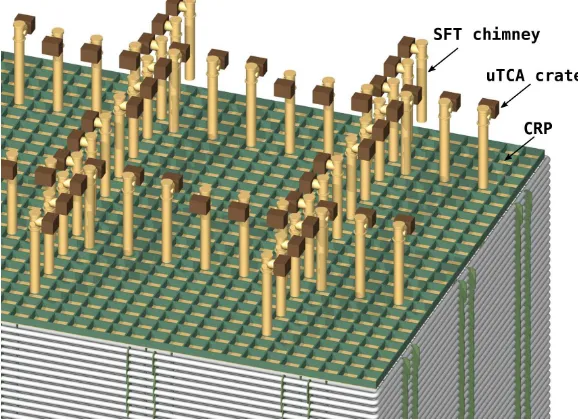
(0.5 m×0.5 m) LEM/anode sandwiches, providing tunable amplification and charge collection on two independent views organized in strips of 3 m length and 3.125 mm pitch. There are 1920 read-out channels for each CRP. Signals in each CRP unit are collected via three SFT chimneys hosting the FE cards with the cryogenic ASIC amplifiers (6400 channels/chimney) which are accessible and replaceable without contaminating the pure LAr volume. Each SFT chimney is coupled to a microTCA crate to provide for the signals’ digitization and data acquisition (DAQ). These crates are connected via optical fiber links to the DAQ back-end. The total number of readout channels per 10 kt module is 153,600.
Each CRP unit is independently suspended by three stainless steel ropes. The vertical level of each CRP unit can be automatically adjusted with respect to the LAr level via three suspension feedthroughs. The stainless steel ropes are operated by step motors located outside the suspension feedthroughs. Slow-control feedthroughs, one per CRP unit, are used for level meters and temper-ature probes readout, for pulsing the calibration signals, and to apply the high voltage (HV) bias on the two sides of the LEMs and on the extraction grid. The FC and the anode are constructed of modules of similar dimensions as those in ProtoDUNE-DP.
The number of components and corresponding parameters for the 12.096 kt DP module are sum-marized in Table 1.2.
Table 1.2: Quantities of items or parameters for the 12.096 kt DP module
Item Number or Parameter
Anode plane size W = 12 m, L = 60 m
CRP unit size W = 3 m, L = 3 m
CRP units 4×20 = 80
LEM-anode sandwiches per CRP unit 36
LEM-anode sandwiches (total) 2880
SFT chimney per CRP unit 3
SFT chimney (total) 240
Charge readout channels / SFT chimney 640
Charge readout channels (total) 153,600
Suspension feedthrough per CRP unit 3
Suspension feedthroughs (total) 240
Slow Control feedthrough per sub-anode 1
Slow Control feedthroughs (total) 80
HV feedthrough 1
HV for vertical drift 600 kV
Voltage degrader resistive chains 12
Cathode modules 80
Field cage rings 197
Field cage modules (3 m×12 m) 48
PMTs (total) 720 (1/m2)
Chapter 1: Design Motivation 1–9
large detector sizes like the DP module. In this design,the charge amplification in the CRPs compensates for the charge attenuation on the long drift paths. This configuration also simplifies construction by optimally exploiting the long vertical dimensions of the cryostat, providing a large homogeneous fiducial volume free of embedded passive materials (effectively increasing the detector size), reducing the number of readout channels, and ultimately lowering costs.
The CRPs collect the charge in a projective way, with practically no dead region, and read the signals out in two collection views, eliminating the need for induction views, which simplifies the reconstruction of complicated topologies. The tunable high S/N provides operative margins with respect to the noise and electron lifetime conditions, and lowers the threshold on the minimal detectable energy depositions .
The scope of a DP module includes the design, procurement, fabrication, testing, delivery, instal-lation and commissioning of the detector components, which is organized in detector consortia, specific to DP or joint with SP.
• CRP, including extraction grid, LEM and anode and readout planes (DP consortium);
• Analog and digital electronics and SFT chimney (DP consortium);
• photon detection system (PDS) (DP Consortium);
• Cathode, FC and HV system (joint SP-DP consortium);
• Slow-control (joint SP-DP consortium);
• Back-end DAQ system (joint SP-DP consortium).
1.5
Detector systems
1.5.1
Charge Readout Planes
An extraction efficiency of 100 % of the electrons from the liquid to the gas phase is achieved with an E field of the order of 2 kV/cm across the liquid-gas interface, applied between an extraction grid submersed in the liquid and charge amplification devices situated in the ultra-pure argon gas.
These amplification devices, called LEMs, are horizontally oriented 1 mm-thick printed circuit boards with electrodes on the top and bottom surfaces. They are drilled through with many holes that collectively form a micro-pattern structure; when a 3 kV potential difference is applied across the electrodes the ionization electrons are amplified by avalanches (Townsend multiplication) occurring in the pure argon gas in this micro-pattern structure due to the high E field (30 kV/cm).