This is a repository copy of
A correct, precise and efficient integration of set-sharing,
freeness and linearity for the analysis of finite and rational tree languages
.
White Rose Research Online URL for this paper:
http://eprints.whiterose.ac.uk/1206/
Article:
Hill, P.M., Zaffanella, E. and Bagnara, R. (2004) A correct, precise and efficient integration
of set-sharing, freeness and linearity for the analysis of finite and rational tree languages.
Theory and Practice of Logic Programming, 4 (3). pp. 289-323. ISSN 1471-0684
https://doi.org/10.1017/S1471068403001868
[email protected] https://eprints.whiterose.ac.uk/ Reuse
See Attached
Takedown
If you consider content in White Rose Research Online to be in breach of UK law, please notify us by
DOI: 10.1017/S1471068403001868 Printed in the United Kingdom
A correct, precise and efficient integration of
set-sharing, freeness and linearity for the
analysis of finite and rational tree languages
PATRICIA M. HILL
School of Computing, University of Leeds, Leeds, UK (e-mail:[email protected])
ENEA ZAFFANELLA, ROBERTO BAGNARA
Department of Mathematics, University of Parma, Parma, Italy (e-mail:{zaffanella,bagnara}@cs.unipr.it)
Abstract
It is well known that freeness and linearity information positively interact with aliasing information, allowing both the precision and the efficiency of the sharing analysis of logic programs to be improved. In this paper, we present a novel combination of set-sharing with freeness and linearity information, which is characterized by an improved abstract unification operator. We provide a new abstraction function and prove the correctness of the analysis for both the finite tree and the rational tree cases. Moreover, we show that the same notion of redundant information as identified in Bagnaraet al. (2000) and Zaffanella et al. (2002) also applies to this abstract domain combination: this allows for the implementation of an abstract unification operator running in polynomial time and achieving the same precision on all the considered observable properties.
KEYWORDS: abstract interpretation, logic programming, abstract unification, rational trees, set-sharing, freeness, linearity
1 Introduction
Even though the set-sharing domain is, in a sense, remarkably precise, more precision is attainable by combining it with other domains. In particular, freeness and linearity information has received much attention by the literature on sharing analysis (recall that a variable is said to be free if it is not bound to a non-variable term; it is linear if it is not bound to a term containing multiple occurrences of another variable).
As argued informally by Søndergaard (1986), the mutual interaction between linearity and aliasing information can improve the accuracy of a sharing analysis. This observation has been formally applied in Codishet al. (1991) to the specification of the abstract mgu operator for the domainASub. In his PhD thesis, Langen (1990)
proposed a similar integration with linearity, but for the set-sharing domain. He has also shown how the aliasing information allows to compute freeness with a good degree of accuracy (however, freeness information was not exploited to improve aliasing). King (1994) has also shown how a more refined tracking of linearity allows for further precision improvements.
The synergy attainable from a bi-directional interaction between aliasing and freeness information was initially pointed out by Muthukumar and Hermenegildo (1991, 1992). Since then, several authors considered the integration of set-sharing with freeness, sometimes also including additional explicit structural information (Codishet al., 1993; Codishet al., 1996; Fil´e, 1994 King and Soper, 1994).
Building on the results obtained in Søndergaard (1986), Codishet al. (1991) and Muthukumar and Hermenegildo (1991), but independently from Langen (1990), Hans and Winkler (1992) proposed a combined integration of freeness and linearity information with set-sharing. Similar combinations have been proposed (Bruynooghe and Codish, 1993; Bruynoogheet al., 1994a, 1994b). From a more pragmatic point of view, Codishet al. (1993, 1996) integrate the information captured by the domains of Søndergaard (1986) and Muthukumar and Hermenegildo (1991) by performing the analysis with both domains at the same time, exchanging information between the two components at each step.
Most of the above proposals differ in the carrier of the underlying abstract domain. Even when considering the simplest domain combinations where explicit structural information is ignored, there is no general consensus on the specification of the abstract unification procedure. From a theoretical point of view, once the abstract domain has been related to the concrete one by means of a Galois connection, it is always possible to specify the best correct approximation of each operator of the concrete semantics. However, empirical observations suggest that sub-optimal operators are likely to result in better complexity/precision trade-offs (Bagnaraet al., 2000). As a consequence, it is almost impossible to identify “the right combination” of variable aliasing with freeness and linearity information, at least when practical issues, such as the complexity of the abstract unification procedure, are taken into account.
1991; King, 2000; Søndergaard, 1986), whereas such a property is enjoyed by our proposal.
By extending the results of Hill et al. (2002) to this combination, we provide a new abstraction function that can be applied to any logic language computing on domains of syntactic structures, with or without the occurs-check; by using this abstraction function, we also prove the correctness of the new abstract unification procedure. Moreover, we show that the same notion of redundant information as identified in Bagnara et al. (2002) and Zaffanella et al. (2002) also applies to this abstract domain combination. As a consequence, it is possible to implement an algorithm for abstract unification running in polynomial time and still obtain the same precision on all the considered observables: groundness, independence, freeness and linearity.
This paper is based on Zaffanella (2001, Chapter 6), the PhD thesis of the second author. In section 2, we define some notation and recall the basic concepts used later in the paper. In section 3, we present the domain SFL that integrates set-sharing, freeness and linearity. In section 4, we show that SFL is uniformly more precise than the domainASub, whereas all the previous proposals for a domain integrating
set-sharing and linearity fail to satisfy such a property. In section 5, we show that the domainSFLcan be simplified by removing some redundant information. In section 6, we provide an experimental evaluation using theChinaanalyzer (Bagnara, 1997). In section 7, we discuss some related work. Section 8 concludes with some final remarks.
The proofs of the results stated here are not included, but all of them are available in an extended version of this paper (Hillet al., 2003).
2 Preliminaries
For a set S, ℘(S) is the powerset ofS. The cardinality of S is denoted by #S and the empty set is denoted by ?. The notation ℘f(S) stands for the set of all the
finite subsets of S, while the notationS ⊆f T stands forS ∈℘f(T). The set of all
finite sequences of elements ofS is denoted byS∗, the empty sequence byǫ, and the concatenation ofs1, s2∈S∗ is denoted bys1. s2.
2.1 Terms and trees
Let Sig denote a possibly infinite set of function symbols, ranked over the set of natural numbers. LetVarsdenote a denumerable set of variables, disjoint fromSig. ThenTerms denotes the free algebra of all (possibly infinite) terms in the signature
Sig having variables in Vars. Thus a term can be seen as an ordered labeled tree, possibly having some infinite paths and possibly containing variables: every inner node is labeled with a function symbol in Sig with a rank matching the number of the node’s immediate descendants, whereas every leaf is labeled by either a variable in Vars or a function symbol in Sig having rank 0 (a constant). It is assumed that
Ift∈Terms then vars(t) and mvars(t) denote the set and the multiset of variables occurring int, respectively. We will also write vars(o) to denote the set of variables occurring in an arbitrary syntactic objecto.
Supposes, t∈Terms:sandtareindependent if vars(s)∩vars(t) =?; we say that variableyoccurs linearly int, more briefly written using the predication occ lin(y, t), ify occurs exactly once in mvars(t); tis said to be ground if vars(t) =?; t isfree
ift∈Vars;tislinear if, for ally∈vars(t), we have occ lin(y, t); finally,tis a finite term (or Herbrand term) if it contains a finite number of occurrences of function symbols. The sets of all ground, linear and finite terms are denoted by GTerms,
LTerms andHTerms, respectively.
2.2 Substitutions
A substitution is a total function σ: Vars → HTerms that is the identity almost everywhere; in other words, thedomain ofσ,
dom(σ)def={x∈Vars|σ(x)=x},
is finite. Given a substitutionσ:Vars→HTerms, we overload the symbol ‘σ’ so as to denote also the functionσ:HTerms→HTerms defined as follows, for each term
t∈HTerms:
σ(t)def=
t, iftis a constant symbol;
σ(t), ift∈Vars;
fσ(t1), . . . , σ(tn)
, ift=f(t1, . . . , tn).
Ift ∈HTerms, we write tσ to denote σ(t). Note that, for each substitution σ and each finite termt∈HTerms, iftσ∈Vars, thent∈Vars.
Ifx∈Vars andt∈HTerms\ {x}, then x→t is called abinding. The set of all bindings is denoted byBind. Substitutions are denoted by the set of their bindings, thus a substitutionσis identified with the (finite) set
{x→xσ|x∈dom(σ)}.
We denote by vars(σ) the set of variables occurring in the bindings of σ. We also define range(σ)def={vars(xσ)|x∈dom(σ)}.
A substitution is said to becircular if, forn >1, it has the form
{x1→x2, . . . , xn−1→xn, xn→x1},
wherex1,. . . ,xn are distinct variables. A substitution is inrational solved form if it
has no circular subset. The set of all substitutions in rational solved form is denoted byRSubst. A substitution σ is idempotent if, for all t∈Terms, we have tσσ =tσ. Equivalently,σ is idempotent if and only if dom(σ)∩range(σ) =?. The set of all idempotent substitutions is denoted byISubst andISubst⊂RSubst.
The composition of substitutions is defined in the usual way. Thus τ◦σ is the substitution such that, for all termst∈HTerms,
and has the formulation
τ◦σ={x→xστ|x∈dom(σ)∪dom(τ), x=xστ}. (1) As usual, σ0 denotes the identity function (i.e. the empty substitution) and, when
i >0,σidenotes the substitution (σ◦σi−1).
For each σ∈RSubst ands∈HTerms, the sequence of finite terms
σ0(s), σ1(s), σ2(s), . . .
converges to a (possibly infinite) term, denotedσ∞(s) (Intrigila and Zilli, 1996; King, 2000). Therefore, the function rt :HTerms×RSubst →Terms such that
rt(s, σ)def=σ∞(s)
is well defined. Note that, in general, this function is not a substitution: while having a finite domain, its “bindings”x→rt(x, σ) can map a domain variablexinto a term rt(x, σ)∈Terms\HTerms. However, as the name of the function suggests, the term rt(x, σ) is granted to be rational, meaning that it can only have a finite number of distinct subterms and hence, be finitely represented.
Example 1
Consider the substitutions
σ1={x→f(z), y→a} ∈ISubst,
σ2={x→f(y), y→a} ∈RSubst\ISubst,
σ3={x→f(x)} ∈RSubst\ISubst,
σ4={x→f(y), y→f(x)} ∈RSubst\ISubst,
σ5={x→y, y→x} ∈/RSubst.
Note that there are substitutions, such as σ2, that are not idempotent and
non-etheless define finite trees only; namely, rt(x, σ2) = f(a). Similarly, there are other
substitutions, such as σ4, whose bindings are not explicitly cyclic and nonetheless
define rational trees that are infinite; namely, rt(x, σ4) = f(f(f(· · ·))). Finally note
that the ‘rt’ function is not defined onσ5∈/RSubst.
2.3 Equality theories
Let {r, s, t, s1, . . . , sn, t1, . . . , tn} ⊆ HTerms. We assume that any equality theory T
overTerms includes thecongruence axioms denoted by the following schemata:
s=s, (2)
s=t↔t=s, (3)
r=s∧s=t→r=t, (4)
s1=t1∧ · · · ∧sn=tn→f(s1, . . . , sn) =f(t1, . . . , tn). (5)
In logic programming and most implementations of Prolog it is usual to assume an equality theory based on syntactic identity. This consists of the congruence axioms together with theidentity axiomsdenoted by the following schemata, wheref andg
are distinct function symbols orn=m:
f(s1, . . . , sn) =f(t1, . . . , tn)→s1=t1∧ · · · ∧sn=tn, (6) ¬f(s1, . . . , sn) =g(t1, . . . , tm). (7)
The axioms characterized by schemata (6) and (7) ensure the equality theory depends only on the syntax. The equality theory for a non-syntactic domain replaces these axioms by ones that depend instead on the semantics of the domain and, in particular, on the interpretation given to functor symbols.
The equality theory of Clark (1978), denotedFT, on which pure logic program-ming is based, usually called theHerbrand equality theory, is given by the congruence axioms, the identity axioms, and the axiom schema
∀z∈Vars:∀t∈(HTerms\Vars) :z∈vars(t)→ ¬(z=t). (8) Axioms characterized by the schema (8) are called theoccurs-check axioms and are an essential part of the standard unification procedure in SLD-resolution.
An alternative approach used in some implementations of logic programming systems, such as Prolog II, SICStus and Oz, does not require the occurs-check axioms. This approach is based on the theory of rational trees (Colmerauer, 1982, 1984), denoted RT. It assumes the congruence axioms and the identity axioms together with a uniqueness axiom for each substitution in rational solved form. Informally speaking these state that, after assigning a ground rational tree to each variable which is not in the domain, the substitution uniquely defines a ground rational tree for each of its domain variables. Note that being in rational solved form is a very weak property. Indeed, unification algorithms returning a set of equations in rational solved form are allowed to be much more “lazy” than one would expect. We refer the interested reader elsewhere (Jaffar et al., 1987; Keisu, 1994; Maher, 1988) for details on the subject.
In the sequel we use the expression “equality theory” to denote any consistent, decidable theory T satisfying the congruence axioms. We also use the expression “syntactic equality theory” to denote any equality theory T also satisfying the identity axioms.
We say that a substitution σ ∈RSubst is satisfiable in an equality theory T if, when interpretingσ as an equation system in rational solved form,
Let e ∈ ℘f(Eqs) be a set of equations in an equality theory T. A substitution
σ∈RSubst is called asolution for einT ifσ is satisfiable inT andT ⊢ ∀(σ→e); we say thateis satisfiable if it has a solution. If vars(σ)⊆vars(e), thenσ is said to be a relevant solution for e. In addition, σ is a most general solution for ein T if
T ⊢ ∀(σ ↔e). In this paper, a most general solution is always a relevant solution of e. When the theory T is clear from the context, the set of all the relevant most general solutions for einT is denoted by mgs(e).
Example 2
Let e={g(x) =g(f(y)), f(x) =y, z=g(w)}and
σ={x→f(y), y→f(x), z→g(w)}.
Then, for any syntactic equality theoryT, we haveT ⊢ ∀(σ↔e). Sinceσ∈RSubst, then σ and hence e is satisfiable in RT. Intuitively, whatever rational tree tw is
assigned to the parameter variable w, there exist rational trees tx, ty and tz that,
when assigned to the domain variables x, y and z, will turnσ into a set of trivial identities; namely, lettxandtybe both equal to the infinite rational treef(f(f(· · ·))),
which is usually denoted by fω, and let t
z be the rational tree g(tw). Thus σ is a
relevant most general solution foreinRT. In contrast,
τ={x→f(y), y→f(x), z→g(f(a))}
is just a relevant solution foreinRT. Also observe that, for any equality theoryT,
T ⊢ ∀σ→ {x=f(f(x))}
so that σ does not satisfy the occurs-check axioms. Therefore, neither σ nor e are satisfiable in the Herbrand equality theory FT Intuitively, there is no finite treetx
such that tx=f(f(tx)).
We have the following useful result regarding ‘rt’ and satisfiable substitutions that are equivalent with respect to any given syntactic equality theory.
Proposition 3
Let σ, τ∈RSubst be satisfiable in the syntactic equality theoryT and suppose that
T ⊢ ∀(σ↔τ). Then
rt(y, σ)∈Vars ⇐⇒ rt(y, τ)∈Vars, (9) rt(y, σ)∈GTerms ⇐⇒ rt(y, τ)∈GTerms, (10) rt(y, σ)∈LTerms ⇐⇒ rt(y, τ)∈LTerms. (11)
2.4 Galois connections and upper closure operators
Given two complete lattices (C,6C) and (A,6A), a Galois connection is a pair of monotonic functions α:C→A andγ:A→C such that
The functions α and γ are said to be the abstraction and concretization functions, respectively. A Galois insertion is a Galois connection where the concretization functionγis injective.
Anupper closure operator (uco) ρ:C →C on the complete lattice (C,6C) is a monotonic, idempotent and extensive1 self-map. The set of all uco’s onC, denoted
by uco(C), is itself a complete lattice. For anyρ∈uco(C), the setρ(C), i.e. the image underρof the lattice carrier, is a complete lattice under the same partial order6C
defined on C. Given a Galois connection, the function ρ def= γ◦α is an element of uco(C). The presentation of abstract interpretation in terms of Galois connections can be rephrased by using uco’s. In particular, the partial order⊑defined on uco(C) formalizes the intuition of an abstract domain being more precise than another one; moreover, given two elements ρ1, ρ2 ∈ uco(C), their reduced product (Cousot and
Cousot 1979), denotedρ1⊓ρ2, is their glb on uco(C).
2.5 The set-sharing domain
The set-sharing domain of Jacobs and Langen (Jacobs and Langen 1989), encodes both aliasing and groundness information. LetVI ⊆f Vars be a fixed and finite set
of variables of interest. An element of the set-sharing domain (a sharing set) is a set of subsets ofVI (the sharing groups). Note that the empty set is not a sharing group.
Definition 4
(The set-sharing lattice) Let SG def= ℘(VI)\ {?} be the set of sharing groups. The set-sharing lattice is defined asSH def=℘(SG), ordered by subset inclusion.
The following operators on SH are needed for the specification of the abstract semantics.
Definition 5
(Auxiliary operators onSH)For eachsh,sh1,sh2∈SH and eachV ⊆VI, we define
the following functions:
thestar-union function (·)⋆:SH →SH, is defined as
sh⋆def= {S∈SG | ∃n>1.∃S1, . . . , Sn∈sh . S =S1∪ · · · ∪Sn};
the extraction of the relevant component of sh with respect to V is encoded by rel :℘(VI)×SH →SH defined as
rel(V ,sh)def={S∈sh |S∩V =?}; theirrelevant component of sh with respect toV is thus defined as
rel(V ,sh)def=sh\rel(V ,sh);
1 Namely,c6
thebinary union function bin :SH×SH →SH is defined as bin(sh1,sh2)
def
= {S1∪S2 |S1∈sh1, S2∈sh2};
theself-bin-union operation onSH is defined as
sh2 def= bin(sh,sh);
theabstract existential quantification function aexists : SH×℘(VI)→SH is defined as
aexists(sh, V)def= {S\V |S∈sh, S\V =?} ∪ { {x} |x∈V}.
In Bagnara et al. (1997, 2002), it was shown that the domain SH contains many elements that are redundant for the computation of the actual observable
properties of the analysis, definite groundness and definite independence. The following formalization of these observables is a rewording of the definitions provided in Zaffanellaet al. (1999, 2002).
Definition 6
(The observables of SH) The groundness and independence observables (on SH)
ρCon, ρPS ∈uco(SH) are defined, for eachsh ∈SH, by
ρCon(sh) def
={S ∈SG|S ⊆vars(sh)}, ρPS(sh)
def
={S ∈SG|(P ⊆S∧#P = 2) =⇒ (∃T ∈sh . P ⊆T)}.
Note that, as usual in sharing analysis domains, definite groundness and definite in-dependence are both represented by encoding possible non-groundness and possible pair-sharing information.
The abstract domain PSD (Bagnara et al., 2002; Zaffanella et al., 2002) is the simplest abstraction of the domain SH that still preserves the same precision on groundness and independence.
Definition 7
(The pair-sharing dependency lattice PSD) The operatorρPSD ∈uco(SH) is defined,
for eachsh ∈SH, by
ρPSD(sh) def
= S∈SG
∀y∈S :S=
{U∈sh |y∈U⊆S}.
Thepair-sharing dependency lattice isPSDdef=ρPSD(SH).
Example 8
LetVI ={v, w, x, y, z}and consider2 sh={vx, vy, xy, xyz}. Then
ρCon(sh) ={v, vx, vxy, vxyz, vxz, vy, vyz, vz, x, xy, xyz, xz, y, yz, z},
ρPS(sh) ={v, vx, vxy, vy, w, x, xy, xyz, xz, y, yz, z},
ρPSD(sh) ={vx, vxy, vy, xy, xyz}.
When observingρCon(sh), the only information available is that variable wdoes not
occur in a sharing group; intuitively, this means thatw is definitely ground. All the other information encoded insh is lost; for instance, in sh variablesv andz never occur in the same sharing group (i.e. they are definitely independent), while this happens inρCon(sh).
When observing ρPS(sh), it should be noted that two distinct variables occur in
the same sharing group if and only if they were also occurring together in a sharing group of sh, so that the definite independence information is preserved (e.g. v and
z keep their independence). On the other hand, all the variables in VI occur as singletons inρPS(sh) whether or not they are known to be ground; for instance,{w}
occurs inρPS(sh) althoughw does not occur in any sharing group insh.
By noting thatρPSD(sh)⊂ρCon(sh)∩ρPS(sh), it follows thatρPSD(sh) preserves both
the definite groundness and the definite independence information ofsh; moreover, as the inclusion is strict,ρPSD(sh) encodes other information, such as variable covering
(the interested reader is referred to (Bagnaraet al., 2002; Zaffanellaet al., 2002) for a more formal discussion).
2.6 Variable-idempotent substitutions
One of the key concepts used in Hillet al. (2003) for the proofs of the correctness results stated in this paper is that of variable-idempotence. For the interested reader, we provide here a brief introduction to variable-idempotent substitutions, although these are not referred to elsewhere in the paper.
The definition of idempotence requires that repeated applications of a substitution do not change the syntactic structure of a term and idempotent substitutions are normally the preferred form of a solution to a set of equations. However, in the domain of rational trees, a set of solvable equations does not necessarily have an idempotent solution (for instance, in Example 2, the set of equations e has no idempotent solution). On the other hand, several abstractions of terms, such as the ones commonly used for sharing analysis, are only interested in the set of variables occurring in a term and not in the concrete structure that contains them. Thus, for applications such as sharing analysis, a useful way to relax the definition of idempotence is to ignore the structure of terms and just require that the repeated application of a substitution leaves the set of variables in a term invariant.
2 In this and all the following examples, we will adopt a simplified notation for a set-sharing elementsh,
Definition 9
(Variable-idempotence)A substitutionσ∈RSubstisvariable-idempotent3if and only if for allt∈HTerms we have
vars(tσσ) = vars(tσ).
The set of variable-idempotent substitutions is denotedVSubst.
As any idempotent substitution is also variable-idempotent, we have ISubst ⊂ VSubst ⊂RSubst.
Example 10
Consider the following substitutions which are all inRSubst.
σ1={x→f(y)} ∈ISubst⊂VSubst,
σ2={x→f(x)} ∈VSubst\ISubst,
σ3={x→f(y, z), y→f(z, y)} ∈VSubst\ISubst,
σ4={x→y, y→f(x, y)} ∈/VSubst.
3 The domain SFL
The abstract domain SFL is made up of three components, providing different kinds of sharing information regarding the set of variables of interestVI: the first component is the set-sharing domainSH of Jacobs and Langen (1989); the other two components provide freeness and linearity information, each represented by simply recording those variables of interest that are known to enjoy the corresponding property.
Definition 11
(The domain SFL) LetF def= ℘(VI) andLdef= ℘(VI) be partially ordered by reverse subset inclusion. The abstract domainSFLis defined as
SFLdef= { sh, f, l |sh ∈SH, f∈F, l∈L}
and is ordered by6S, the component-wise extension of the orderings defined on the
sub-domains. With this ordering,SFLis a complete lattice whose least upper bound operation is denoted by alubS. The bottom element ?,VI,VIwill be denoted by ⊥S.
3.1 The abstraction function
When the concrete domain is based on the theory of finite trees, idempotent substitutions provide a finitely computablestrong normal form for domain elements,
3 This definition, which is the same as that originally provided in Hillet al. (1998), is slightly stronger
meaning that different substitutions describe different sets of finite trees.4 In
contrast, when working on a concrete domain based on the theory of rational trees, substitutions in rational solved form, while being finitely computable, no longer satisfy this property: there can be an infinite set of substitutions in rational solved form all describing the same set of rational trees (i.e. the same element in the “intended” semantics). For instance, the substitutions
σn ={x→ n
f(· · ·f(x)· · ·)},
forn= 1, 2, . . . ,all map the variablex into the same infinite rational treefω.
Ideally, a strong normal form for the set of rational trees described by a substitution σ∈RSubst can be obtained by computing the limit σ∞. The problem is thatσ∞ can map domain variables to infinite rational terms and may not be in
RSubst.
This poses a non-trivial problem when trying to define “good” abstraction functions, since it would be really desirable for this function to map any two equivalent concrete elements to the same abstract element. As shown in Hill
et al. (2002), the classical abstraction function for set-sharing analysis (Cortesi and Fil´e, 1999; Jacobs and Langen, 1989), which was defined only for substitutions that are idempotent, does not enjoy this property when applied, as it is, to arbitrary substitutions in rational solved form. In Hill et al. (1998, 2002), this problem is solved by replacing the sharing group operator ‘sg’ of Jacobs and Langen (1989) by an occurrence operator, ‘occ’, defined by means of a fixpoint computation. However, to simplify the presentation, here we define ‘occ’ directly by exploiting the fact that the number of iterations needed to reach the fixpoint is bounded by the number of bindings in the substitution.
Definition 12
(Occurrence operator)For each σ ∈RSubst and v ∈Vars, the occurrence operator
occ :RSubst×Vars→℘f(Vars) is defined as
occ(σ, v)def={y∈Vars|n= #σ, v∈vars(yσn)\dom(σ)}.
For eachσ∈RSubst, the operator ssets : RSubst→SH is defined as ssets(σ)def={occ(σ, v)∩VI |v∈Vars} \ {?}.
The operator ‘ssets’ is introduced for notational convenience only.
Example 13
Let
σ={x1→f(x2), x2→g(x3, x4), x3→x1},
τ={x1→f(g(x3, x4)), x2→g(x3, x4), x3→f(g(x3, x4))}.
Then dom(σ) = dom(τ) ={x1, x2, x3}so that occ(σ, xi) = occ(τ, xi) =?, for i= 1,
2, 3 and occ(σ, x4) = occ(τ, x4) ={x1, x2, x3, x4}. As a consequence, supposing that
VI ={x1, x2, x3, x4}, we obtain ssets(σ) = ssets(τ) ={VI}.
In a similar way, it is possible to define suitable operators for groundness, freeness and linearity. As all ground trees are linear, a knowledge of the definite groundness information can be useful for proving properties concerning the linearity abstraction. Groundness is already encoded in the abstraction for set-sharing provided in Definition 12; nonetheless, for both a simplified notation and a clearer intuitive reading, we now explicitly define the set of variables that are associated to ground trees by a substitution in RSubst.
Definition 14
(Groundness operator)Thegroundness operatorgvars :RSubst→℘f(Vars) is defined,
for eachσ∈RSubst, by
gvars(σ)def= {y∈dom(σ)| ∀v∈Vars:y /∈occ(σ, v)}. Example 15
Consider σ∈RSubst where
σ={x1 →x2, x2→f(a), x3→x4, x4→f(x2, x4)}.
Then gvars(σ) = {x1, x2, x3, x4}. Observe that x1 ∈gvars(σ) although x1σ ∈ Vars.
Also,x3 ∈gvars(σ) although vars(x3σi) ={x2, x4} =?for all i>2.
As for possible sharing, the definite freeness information can be extracted from a substitution in rational solved form by observing the result of a bounded number of applications of the substitution.
Definition 16
(Freeness operator) The freeness operator fvars : RSubst →℘(Vars) is defined, for eachσ∈RSubst, by
fvars(σ)def={y∈Vars|n= #σ, yσn∈Vars}.
As σ∈RSubst has no circular subset,y∈fvars(σ) impliesyσn∈Vars\dom(σ).
Example 17
Let VI ={x1, x2, x3, x4, x5}and considerσ∈RSubst where
σ={x1→x2, x2→f(x3), x3→x4, x4→x5}.
Then fvars(σ)∩VI = {x3, x4, x5}. Thus x1 ∈/ fvars(σ) although x1σ ∈ Vars. Also,
x3∈fvars(σ) althoughx3σ∈dom(σ).
Definition 18
(Linearity operator)The linearity operator lvars :RSubst →℘(Vars) is defined, for eachσ∈RSubst, by
lvars(σ)def= {y∈Vars|n= #σ,∀z∈vars(yσn)\dom(σ) : occ lin(z, yσ2n)}.
In the next example we consider the extraction of linearity from two substitutions. The substitutionσshows that, in contrast with the case of set-sharing and freeness, for linearity we may need to compute up to 2n applications, where n = #σ; the substitution τ shows that, when observing the term yτ2n, multiple occurrences of
domain variables have to be disregarded.
Example 19
LetVI ={x1, x2, x3, x4}and considerσ∈RSubst where
σ={x1→x2, x2→x3, x3→f(x1, x4)}.
Then lvars(σ)∩VI = {x4}. Observe that x1 ∈/ lvars(σ). This is because x4 ∈/
dom(σ),x1σ3 =f(x1, x4) so thatx4∈vars(x1σ3) andx1σ6=f
f(x1, x4), x4
so that occ lin(x4, x1σ6) does not hold. Note also that occ lin(x4, x1σi) holds fori= 3, 4, 5.
Consider nowτ∈RSubst where
τ={x1→f(x2, x2), x2→f(x2)}.
Then lvars(τ)∩VI =VI. Note that we havex1 ∈lvars(τ) although, for all i > 0,
x2∈dom(τ) occurs more than once in the termx1τi.
The occurrence, groundness, freeness and linearity operators are invariant with respect to substitutions that are equivalent in the given syntactic equality theory.
Proposition 20
Letσ, τ∈RSubst be satisfiable in the syntactic equality theoryT and suppose that
T ⊢ ∀(σ↔τ). Then
ssets(σ) = ssets(τ), (12) gvars(σ) = gvars(τ), (13) fvars(σ) = fvars(τ), (14) lvars(σ) = lvars(τ). (15) Moreover, these operators precisely capture the intended properties over the domain of rational trees.
Proposition 21
Ifσ∈RSubst andy, v∈Vars then
y ∈occ(σ, v) ⇐⇒ v∈varsrt(y, σ), (16)
y∈gvars(σ) ⇐⇒ rt(y, σ)∈GTerms, (17)
y∈fvars(σ) ⇐⇒ rt(y, σ)∈Vars, (18)
It follows from (16) and (18) that any free variable necessarily shares (at least, with itself). Also, as Vars∪GTerms ⊂LTerms, it follows from (17), (18) and (19) that any variable that is either ground or free is also necessarily linear. Thus we have the following corollary.
Corollary 22
Ifσ∈RSubst, then
fvars(σ)⊆varsssets(σ),
fvars(σ)∪gvars(σ)⊆lvars(σ).
We are now in position to define the abstraction function mapping rational trees to elements of the domain SFL.
Definition 23
(The abstraction function for SFL) For each substitution σ ∈RSubst, the function
αS:RSubst→SFLis defined by αS(σ)
def
= ssets(σ),fvars(σ)∩VI,lvars(σ)∩VI.
The concrete domain ℘(RSubst) is related to SFL by means of the abstraction function αS:℘(RSubst)→SFLsuch that, for each Σ∈℘(RSubst),
αS(Σ)
def
= alubS{αS(σ)|σ∈Σ}.
Since the abstraction function αS is additive, the concretization function is given by
the adjoint (Cousot and Cousot 1977)
γS
sh, f, ldef= {σ∈RSubst|ssets(σ)⊆sh,fvars(σ)⊇f,lvars(σ)⊇l}.
With Definition 23 and Proposition 20, one of our objectives is fulfilled: substitu-tions in RSubst that are equivalent have the same abstraction.
Corollary 24
Let σ, τ ∈ RSubst be satisfiable in the syntactic equality theory T and suppose
T ⊢ ∀(σ↔τ). ThenαS(σ) =αS(τ).
Observe that the Galois connection defined by the functions αS and γS is not a
Galois insertion since different abstract elements are mapped by γS to the same
set of concrete computation states. To see this it is sufficient to observe that, by Corollary 22, any abstract element d =sh, f, l ∈SFL such that f *vars(sh), as is the case for the bottom element ⊥S, satisfies γS(d) = γS(⊥S) = ?; thus, all such d’s will represent the semantics of those program fragments that have no successful computations. Similarly, by letting V =VI \vars(sh)∪f, it can be seen that, for anyl′such thatV∪l=V∪l′,we have, again by Corollary 22,γS(d) =γS
sh, f, l′. Of course, by taking the abstract domain as the subset of SFL that is the co-domain of αS, we would have a Galois insertion. However, apart from the simple
cases shown above, it is somehow difficult toexplicitly characterize such a set. For instance, as observed in (Fil´e 1994), if
we have γS(d) = γS(⊥S) = ?. It is worth stressing that these “spurious” elements
do not compromise the correctness of the analysis and, although they can affect the precision of the analysis, they rarely occur in practice (Bagnara et al., 2000; Zaffanella, 2001).
3.2 The abstract operators
The specification of the abstract unification operator on the domainSFLis rather complex, since it is based on a very detailed case analysis. To achieve some modularity, that will be also useful when proving its correctness, in the next definition we introduce several auxiliary abstract operators.
Definition 25
(Auxiliary operators in SFL) Let s, t ∈HTerms be finite terms such that vars(s)∪
vars(t)⊆VI. For eachd =sh, f, l ∈SFLwe define the following predicates:
sand t are independent in d if and only if indd:HTerms2 →Bool holds for (s, t),
where
indd(s, t) def
=relvars(s),sh∩relvars(t),sh=? ;
tisground in d if and only if groundd:HTerms→Bool holds fort, where
groundd(t) def
=vars(t)⊆VI \vars(sh);
y∈vars(t)occurs linearly (int) in d if and only if occ lind:VI ×HTerms→Bool
holds for (y, t), where occ lind(y, t)
def
= groundd(y)∨
occ lin(y, t)∧(y∈l)
∧ ∀z∈vars(t) :y= z =⇒ indd(y, z) ;
tisfree in d if and only if freed:HTerms→Bool holds fort, where
freed(t) def
= (t∈f);
tislinear in d if and only if lind:HTerms→Bool holds fort, where
lind(t) def
= ∀y∈vars(t) : occ lind(y, t).
The function share withd:HTerms →℘(VI) yields the set of variables of interest
that may share with the given term. For eacht∈HTerms, share withd(t)
def
= varsrelvars(t),sh .
The function cyclict
x:SH → SH strengthens the sharing set sh by forcing the
coupling ofxwitht. For eachsh∈SH and each (x→t)∈Bind, cyclictx(sh)
def
As a first correctness result, we have that the auxiliary operators correctly approximate the corresponding concrete properties.
Theorem 26
Let d ∈SFL, σ∈γS(d) andy∈VI. Let also s, t∈HTerms be two finite terms such
that vars(s)∪vars(t)⊆VI. Then
indd(s, t) =⇒ varsrt(s, σ)∩varsrt(t, σ)=?; (20)
indd(y, t) ⇐⇒ y /∈share withd(t); (21)
freed(t) =⇒ rt(t, σ)∈Vars; (22)
groundd(t) =⇒ rt(t, σ)∈GTerms; (23)
lind(t) =⇒ rt(t, σ)∈LTerms. (24) Example 27
LetVI ={v, w, x, y, z}and consider the abstract elementd =sh, f, l ∈SFL, where
sh ={v, wz, xz, z}, f={v}, l={v, x, y, z}.
Then, by applying Definition 25, we obtain the following:
• groundd(x) does not hold whereas groundd
h(y)holds.
• freed(v) holds but freedh(v)does not hold.
• Both indd(w, x) and inddf(w, y), f(x, y) hold whereas indd(x, z) does not
hold; note that, in the second case, the two arguments of the predicate do sharey, but this does not affect the independence of the corresponding terms, becausey is definitely ground in the abstract elementd.
• Let t = f(w, x, x, y, y, z); then occ lind(w, t) does not hold because w /∈ l;
occ lind(x, t) does not hold becausexoccurs more than once int; occ lind(y, t)
holds, even though y occurs twice in t, because y is definitely ground in d; occ lind(z, t) does not hold because both x and z occur in term t and, as
observed in the point above, indd(x, z) does not hold.
• For the reasons given in the point above, lind(t) does not hold; in contrast,
lind
f(y, y, z)holds.
• share withd(w) ={w, z}and share withd(x) ={x, z}; thus, bothwand xmay
share one or more variables with z; since we observed that w and x are definitely independent in d, this means that the set of variables thatw shares withzis disjoint from the set of variables thatxshares withz.
• Lett=f(w, z); then cyclict
z(sh) = rel
{w, z},sh∪rel{w},sh
={v} ∪ {wz}
=sh\ {xz, z}.
Definition 28
(amguS)The function amguS:SFL×Bind →SFLcaptures the effects of a binding
on an element of SFL. Let d = sh, f, l ∈ SFL and (x → t) ∈ Bind, where
{x} ∪vars(t)⊆VI. Let also
sh′def= cyclict
x(sh−∪sh′′),
where
shxdef= rel{x},sh, sht
def
= relvars(t),sh, shxt
def
=shx∩sht, sh− def
= rel{x} ∪vars(t),sh,
sh′′def=
bin(shx,sht), if freed(x)∨freed(t);
binshx∪bin(shx,sh⋆xt),
sht∪bin(sht,sh⋆xt), if lind(x)∧lind(t);
bin(sh⋆x,sht), if lind(x);
bin(shx,sh⋆t), if lind(t);
bin(sh⋆x,sh⋆t), otherwise. LettingSx
def
= share withd(x) andSt
def
= share withd(t), we also define
f′def=
f, if freed(x)∧freed(t);
f\Sx, if freed(x);
f\St, if freed(t);
f\(Sx∪St), otherwise; l′def=VI \vars(sh′)∪f′∪l′′,
where
l′′def=
l\(Sx∩St), if lind(x)∧lind(t);
l\Sx, if lind(x);
l\St, if lind(t);
l\(Sx∪St), otherwise.
Then
amguS
d, x→tdef=
⊥S, ifd =⊥S∨
T =FT ∧x∈vars(t);
sh′, f′, l′ otherwise.
The next result states that the abstract mgu operator is a correct approximation of the concrete one.
Theorem 29
Letd ∈SFL and (x→t)∈Bind, where {x} ∪vars(t)⊆VI. Then, for allσ∈γS(d)
andτ∈mgsσ∪{x=t}in the syntactic equality theoryT, we haveτ∈γS
We now highlight the similarities and differences of the operator amguS with
respect to the corresponding ones defined in the “classical” proposals for the integ-ration of set-sharing with freeness and linearity, such as Bruynooghe et al. (1994a, 1995), Hans and Winkler (1992) and Langen (1990). Note that, when comparing our domain with the proposal in Bruynooghe et al. (1994a), we deliberately ignore all those enhancements that depend on properties that cannot be represented in SFL
(i.e. compoundness and explicit structural information).
• In the computation of the set-sharing component, the main difference can be observed in the second, third and fourth cases of the definition of sh′′: here we omit one of the star-unions even when the terms x and t possibly share. In contrast, in Bruynooghe et al. (1994a, 1995), Hans and Winkler (1992) and Langen (1990), the corresponding star-union is avoided only when indd(x, t) holds. Note that when indd(x, t) holds in the second case of sh′′,
then we haveshxt=?; thus, the whole computation for this case reduces to sh′′= bin(shx,sht), as was the case in the previous proposals.
• Another improvement on the set-sharing component can be observed in the definition of sh′: the cyclictx operator allows the set-sharing description to
be further enhanced when dealing with explicitly cyclic bindings, i.e. when
x ∈ vars(t). This is the rewording of a similar enhancement proposed in Bagnara (1997) for the domain Pos in the context of groundness analysis. Its net effect is to recover some groundness and sharing dependencies that would have been unnecessarily lost when using the standard operators. When
x /∈vars(t), we have cyclictx(sh−∪sh′′) =sh−∪sh′′.
• The computation of the freeness component f′ is the same as specified in Bruynoogheet al. (1994a) and Hans and Winkler (1992) and is more precise than the one defined in Langen (1990).
• The computation of the linearity component l′ is the same as specified in Bruynooghe et al. (1994a), and is more precise than those defined in Hans and Winkler (1992) and Langen (1990).
In the following examples we show that the improvements in the abstract computation of the sharing component allow, in particular cases, to derive better information than that obtainable by using the classical abstract unification operators.
Example 30
Let VI ={x, x1, x2, y, y1, y2, z}andσ∈RSubst such that
σdef={x→f(x1, x2, z), y→f(y1, z, y2)}.
By Definition 23, we have d def= αS
{σ}=sh, f, l, where
sh={xx1, xx2, xyz, yy1, yy2}, f =VI\ {x, y}, l=VI.
Consider the binding (x → y) ∈ Bind. In the concrete domain, we compute (a substitution equivalent to) τ∈mgsσ∪ {x=y}, where
Note thatαS
{τ}=shτ, fτ, lτ, where shτ={xx1yy1, xx2yy2z}, so that the pairs of
variablesPx={x1, x2}andPy ={y1, y2}keep their independence.
When evaluating the sharing component of amguS(d, x→y), using the notation
of Definition 28, we have
shx={xx1, xx2, xyz}, sht ={xyz, yy1, yy2},
shxt={xyz}, sh−=?.
Since both lind(x) and lind(y) hold, we apply the second case of the definition of sh′′so that
shx∪bin(shx,sh⋆xt) ={xx1, xx1yz, xx2, xx2yz, xyz},
sht∪bin(sht,sh⋆xt) ={xyy1z, xyy2z, xyz, yy1, yy2},
sh′′= binshx∪bin(shx,sh⋆xt),sht∪bin(sht,sh⋆xt)
={xx1yy1, xx1yy1z, xx1yy2, xx1yy2z, xx1yz,
xx2yy1, xx2yy1z, xx2yy2, xx2yy2z, xx2yz,
xyy1z, xyy2z, xyz}.
Finally, as the binding is not cyclic, we obtainsh′=sh′′. Thus amguS captures the
fact that pairsPxandPy keep their independence.
In contrast, since indd(x, y) does not hold, all of the classical definitions of
abstract unification would have required the star-closure of both shx and sht,
resulting in an abstract element including, among the others, the sharing group
S = {x, x1, x2, y, y1, y2}. Since Px∪Py ⊂ S, this independence information would
have been unnecessarily lost.
Similar examples can be devised for the third and fourth cases of the definition ofsh′′, where only one side of the binding is known to be linear. The next example shows the precision improvements arising from the use of the cyclictx operator. Example 31
Let VI = {x, x1, x2, y} and σ def
= {x → f(x1, x2)}. By Definition 23, we have
d def= αS
{σ}=sh, f, l, where
sh={xx1, xx2, y}, f=VI \ {x}, l=VI.
Let t = f(x, y) and consider the cyclic binding (x → t) ∈ Bind. In the concrete domain, we compute (a substitution equivalent to)τ∈mgsσ∪ {x=t}, where
τ={x→f(x1, x2), x1→f(x1, x2), y→x2,}.
Note that if we further instantiateτby groundingy, then variablesx,x1andx2would
become ground too. Formally we haveαS
{τ}=shτ, fτ, lτ, whereshτ={xx1x2y}.
Thus, as observed above, y covers x, x1 and x2. When abstractly evaluating the
binding, we compute
shx={xx1, xx2}, sht ={xx1, xx2, y},
Since both lind(x) and lind(t) hold, we apply the second case of the definition ofsh′′,
so that
shx∪bin(shx,sh⋆xt) =shx⋆ ={xx1, xx1x2, xx2},
sht∪bin(sht,sh⋆xt) ={xx1, xx1x2, xx1x2y, xx1y, xx2, xx2y, y},
sh′′= binshx∪bin(shx,shxt⋆),sht∪bin(sht,sh⋆xt)
={xx1, xx1x2, xx1x2y, xx1y, xx2, xx2y}.
Thus, asx∈vars(t), we obtain
sh′= cyclictx(sh−∪sh′′)
= rel{x} ∪vars(t),sh′′∪relvars(t)\ {x},sh′′
=?∪rel{y},sh′′
={xx1x2y, xx1y, xx2y}.
Note that, in the elementsh−∪sh′′=sh′′(which is the abstract element that would
have been computed when not exploiting the cyclictx operator) variable y covers
none of variablesx,x1 andx2. Thus, by applying the cyclictx operator, this covering
information is restored.
The full abstract unification operator aunifyS, capturing the effect of a sequence of
bindings on an abstract element, can now be specified by a straightforward inductive definition using the operator amguS.
Definition 32
(aunifyS)The operator aunifyS: SFL×Bind
∗ →SFL is defined, for each d ∈SFL
and each sequence of bindings bs∈Bind∗, by aunifyS(d,bs)
def
=
d, ifbs=ǫ;
aunifyS
amguS(d, x→t),bs
′, ifbs= (x→t).bs′.
Note that the second argument of aunifyS is a sequence of bindings (i.e. it is not
a substitution, which is a set of bindings), because amguS is neither commutative
nor idempotent, so that the multiplicity and the actual order of application of the bindings can influence the overall result of the abstract computation. The correctness of the aunifyS operator is simply inherited from the correctness of the underlying
amguSoperator. In particular, any reordering of the bindings in the sequencebsstill
results in a correct implementation of aunifyS.
The ‘merge-over-all-path’ operator on the domain SFL is provided by alubS and
is correct by definition. Finally, we define the abstract existential quantification operator for the domainSFL, whose correctness does not pose any problem.
Definition 33
(aexistsS)The function aexistsS:SFL×℘f(VI)→SFLprovides theabstract existen-tial quantification of an element with respect to a subset of the variables of interest. For each d def= sh, f, l ∈SFL andV ⊆VI,
aexistsS
The intuition behind the definition of the abstract operator aexistsSis the following.
As explained in section 2, any substitution σ ∈RSubst can be interpreted, under the given equality theory T, as a first-order logical formula; thus, for each set of variablesV, it is possible to consider the (concrete) existential quantification∃V . σ. The goal of the abstract operator aexistsS is to provide a correct approximation of
such a quantification starting from any correct approximation forσ.
Example 34
Let VI ={x, y, z} and σ ={x →f(v1, v2), y → g(v2, v3), z → f(v1, v1)}, so that, by
Definition 23,
d =αS
{σ}={xy, xz, y},?,{x, y}.
Let V = {y, z} and consider the concrete element corresponding to the logical formula ∃V . σ. Note that T ⊢ ∀(τ ↔ ∃V . σ), where τ = {x → f(v1, v2)}. By
applying Definition 33, we obtain
aexistsS(d, V) ={x, y, z},{y, z},{x, y, z}=αS
{τ}.
It is worth stressing that such an operator does not affect the setVI of the variables of interest. In particular, the abstract element aexistsS(d, V) still has to provide
correct information about variables y and z. Intuitively, since all the occurrences of y and z in ∃V . σ are bound by the existential quantifier, the two variables of interest are un-aliased, free and linear.
Note that an abstractprojection operator, i.e. an operator that actually modifies the set of variables of interest, is easily specified by composing the operator aexistsS
with an operator that simply removes, from all the components ofSFL and from the set of variables of interestVI, those variables that have to be projected out.
4 A formal comparison between SFL and ASub
As we have already observed, Example 30 shows that the abstract domainSFL, when equipped with the abstract mgu operator introduced in section 3.2, can yield results that are strictly more precise than all the classical combinations of set-sharing with freeness and linearity information. In this section we show that the same example has another interesting, unexpected consequence, since it can be used to formally prove that all the classical combinations of set-sharing with freeness and linearity, including those presented in Bagnaraet al. (2000), Bruynoogheet al. (1994a), Hans and Winkler (1992) and Langen (1990), are not uniformly more precise than the abstract domainASub (Sondergaard, 1986), which is based on pair-sharing.
To formalize the above observation, we now introduce the ASub domain and
the corresponding abstract semantics operators as specified in Codishet al. (1991). The elements of the abstract domain ASub have two components: the first one is
in the second component, then xmay be non-linear. The second component always encodes a symmetric relation; thus, for notational convenience and without any loss of generality (King, 2000), we will represent each pair (x, y) in such a relation as the sharing groupS ={x, y}, which will have cardinality 1 or 2, depending on whether
x=y or not, respectively.
Definition 35
(The domain ASub⊥)The abstract domainASub⊥ is defined asASub⊥def={⊥ASub} ∪
ASub, where
ASubdef=
G, R ∈℘(VI)×SH
G∩vars(R) =?, ∀S ∈R: 16#S62
.
Fori∈ {1,2}, letκi=Gi, Ri ∈ASub. Then κ1ASubκ2
def
⇐⇒ G1⊇G2∧R1⊆R2.
The partial orderASubis extended onASub⊥by letting⊥ASubbe the bottom element.
Let u, v ∈ VI and κ = G, R ∈ ASub. Then u ←→κ v is a shorthand for the
condition{u, v} ∈R, whereasu ⇐⇒κ vis a shorthand foru=v∨ {u, v} ∈R. It is well-known that the domainASub⊥can be obtained by a further abstraction
of any domain such asSFLthat is based on set-sharing and enhanced with linearity information. The following definition formalizes this abstraction.
Definition 36
(αASub:SFL→ASub⊥)Let d =sh, f, l ∈SFL. Then
αASub(d) def
=
⊥ASub, ifd =⊥S; G, R, otherwise; where
Gdef={x∈VI |x /∈vars(sh)},
Rdef={ {x} ⊆VI |x∈vars(sh)∧x /∈l}
∪ { {x, y} ⊆VI |x=y∧ ∃S∈sh.{x, y} ⊆S}.
The definition of abstract unification in Codish et al. (1991) is based on a few auxiliary operators. The first of these introduces the concept of abstract multiplicity for a term under a given abstract substitution, therefore modeling the notion of definite groundness and definite linearity.
Definition 37
(Abstract multiplicity) Let κ=G, R ∈ASub and let t∈HTerms be a term such that vars(t)⊆VI. We say thaty ∈vars(t) occurs linearly (int) in κ if and only if occ linκ:VI ×HTerms→Bool holds for (y, t), where
occ linκ(y, t)
def
We say that t has abstract multiplicity m in κ if and only if χκ(t) = m, where χκ:HTerms→ {0,1,2}is defined as follows:
χκ(t)
def =
0, if vars(t)⊆G;
1, if∀y∈vars(t) : occ linκ(y, t);
2, otherwise.
For any bindingx→t, the functionχκ:Bind → {0} ∪ {1,2}2 is defined as follows
χκ(x→t)
def
=
0, ifχκ(x) = 0 orχκ(t) = 0;
χκ(x), χκ(t)
, otherwise.
It is worth noting that, modulo a few insignificant differences in notation, the multiplicity operator χκ defined above corresponds to the abstract multiplicity
operator χA, which was introduced in Codish et al. (1991, Definition 3.4) and provided with an executable specification in King (2000, Definition 4.3). Similarly, the next definition corresponds to Codishet al. (1991, Definition 4.3).
Definition 38
(Sharing caused by an abstract equation) For each κ ∈ ASub and (x → t) ∈ Bind, where Vx ={x} and Vt = vars(t) are such that Vx∪Vt ⊆VI, the function
soln :ASub×Bind →ASub is defined as follows
soln(κ, x→t)def=
Vx∪Vt,?, ifχκ(x→t) = 0; ?,bin(Vx, Vt), ifχκ(x→t) = (1,1); ?,bin(Vx, Vx∪Vt), ifχκ(x→t) = (1,2); ?,bin(Vx∪Vt, Vt), ifχκ(x→t) = (2,1); ?,bin(Vx∪Vt, Vx∪Vt), ifχκ(x→t) = (2,2);
where the function bin :℘(VI)2→SH, for each V , W ⊆VI, is defined as follows
bin(V , W)def={ {v, w} ⊆VI |v∈V , w∈W}.
The next definition corresponds to Codishet al. (1991, Definition 4.5).
Definition 39
(Abstract composition) Let κ, κ′∈ASub, whereκ =G, R andκ′=G′, R′. Then κ◦κ′def= G′′, R′′, where
G′′def= G∪G′, R′′def=
{u, v} ∈SH
{u, v} ∩G′′=?,
u←→κ v∨∃x, y . u ⇐⇒κ x←→κ′ y ⇐⇒κ v
.
We are now ready to define the abstract mgu operator for the domain ASub⊥.
Definition 40
(AbstractmguforASub⊥)Letκ∈ASub⊥and (x→t)∈Bind, where{x}∪vars(t)⊆ VI. Then
amguASub(κ, x→t) def
=
⊥ASub, ifκ=⊥ASub;
κ◦soln(κ, x→t), otherwise.
By repeating the abstract computation of Example 30 on the domain ASub, we
provide a formal proof that all the classical approaches based on set-sharing are not uniformly more precise than the pair-sharing domainASub.
Example 41
Consider the substitutions σ, τ ∈ RSubst and the abstract element d ∈ SFL as introduced in Example 30.
By Definition 36, we obtainκ=αASub(d) =?, R, where
R={xx1, xx2, xy, xz, yy1, yy2, yz}.
When abstractly evaluating the binding x → y according to Definition 40, we compute the following:
χκ(x→y) = (1,1),
soln(κ, x→y) =?,{xy},
amguASub(κ, x→y) =κ◦soln(κ, x→y) =?, R
′′,
where
R′′=R∪ {x, xy1, xy2, x1y, x1y1, x1y2, x1z, x2y, x2y1, x2y2, x2z, y, y1z, y2z, z}.
Note that{x1, x2}∈/ R′′ and{y1, y2}∈/R′′, so that these pairs of variables keep their
independence. In contrast, as observed in Example 30, the operators in Bagnara
et al. (2000), Bruynooghe et al. (1994a), Hans and Winkler (1992) and Langen (1990) will fail to preserve the independence of these pairs.
We now show that the abstract domainSFL, when equipped with the operators introduced in section 3.2, is uniformly more precise than the domain ASub.
In particular, the following theorem states that the abstract operator amguS of
Definition 28 is uniformly more precise than the abstract operator amguASub.
Theorem 42
Let d ∈SFL andκ∈ASub⊥ be such thatαASub(d)ASubκ. Let also (x→t)∈Bind,
where{x} ∪vars(t)⊆VI. Then
αASub
amguS(d, x→t)
ASubamguASub(κ, x→t).
Similar results can be stated for the other abstract operators, such as the abstract existential quantification aexistsS and the merge-over-all-path operator alubS. It is
worth stressing that, when sequences of bindings come into play, the specification provided in Codishet al. (1991, Definition 4.7) requires that thegrounding bindings (i.e. those bindings such thatχκ(x→t) = 0) are evaluated before the non-grounding
operator aunifyS, the same evaluation strategy has to be adopted when computing
on the domain SFL; this improvement is well-known (Langen, 1990, pp. 66–67) and already exploited in most implementations of sharing analysis (Bagnaraet al., 2000).
5 SFL2: Eliminating redundancies
As done in Bagnaraet al. (2002) and Zaffanellaet al. (2002) for the plain set-sharing domainSH, even when considering the richer domainSFLit is natural to question whether it contains redundancies with respect to the computation of the observable properties.
It is worth stressing that the results presented in Bagnara et al. (2002) and Zaffanellaet al. (2002) cannot be simply inherited by the new domain. The concept of “redundancy” depends on both the starting domain and the given observables: in theSFLdomain both of these have changed. First, as can be seen by looking at the definition of amguS, freeness and linearity positively interact in the computation
of sharing information:a priori it is an open issue whether or not the “redundant” sharing groups can play a role in such an interaction. Secondly, since freeness and linearity information can be themselves usefully exploited in a number of applications of static analysis (e.g. in the optimized implementation of concrete unification or in occurs-check reduction), these properties have to be included in the observables.
We will now show that the domain SFL can be simplified by applying the same notion of redundancy as identified in Bagnara et al. (2002). Namely, in the definition of SFL it is possible to replace the set-sharing component SH byPSD
without affecting the precision on groundness, independence, freeness and linearity. In order to prove such a claim, we now formalize the new observable properties.
Definition 43
(The observables ofSFL)The (overloaded)groundness andindependenceobservables
ρCon, ρPS ∈uco(SFL) are defined, for each sh, f, l ∈SFL, by
ρCon
sh, f, ldef=ρCon(sh),?,?,
ρPS
sh, f, ldef=ρPS(sh),?,?;
the freeness and linearity observables ρF, ρL ∈ uco(SFL) are defined, for each sh, f, l ∈SFL, by
ρF
sh, f, ldef=SG, f,?, ρL
sh, f, ldef=SG,?, l.
The overloading of ρPSD working on the domain SFL is the straightforward
Definition 44
(Non-redundant SFL) For each sh, f, l ∈ SFL, the operator ρPSD ∈ uco(SFL) is
defined by
ρPSD
sh, f, ldef=ρPSD(sh), f, l.
This operator induces the latticeSFL2 def
=ρPSD(SFL).
As proved in Zaffanella et al. (2002), we have thatρPSD ⊑(ρCon⊓ρPS); by the above
definitions, it is also clear that ρPSD ⊑(ρF⊓ρL); thus, ρPSD is more precise than the
reduced product (ρCon⊓ρPS⊓ρF⊓ρL). Informally, this means that the domainSFL2
is able torepresent all of our observable properties without precision losses. The next theorem shows that ρPSD is a congruence with respect to the aunifyS,
alubS and aexistsS operators. This means that the domainSFL2 is able topropagate
the information on the observables as precisely as SFL, therefore providing a completeness result.
Theorem 45
Letd1,d2 ∈SFLbe such thatρPSD(d1) =ρPSD(d2). Then, for each sequence of bindings
bs ∈Bind∗, for each d′∈SFLandV ∈℘(VI),
ρPSD
aunifyS(d1,bs)
=ρPSD
aunifyS(d2,bs)
, ρPSD
alubS(d1,d′)
=ρPSD
alubS(d2,d′)
, ρPSD
aexistsS(d1, V)
=ρPSD
aexistsS(d2, V)
.
Finally, by providing the minimality result, we show that the domain SFL2 is
indeed the generalized quotient (Cortesiet al., 1998; Giacobazziet al., 1998) ofSFL
with respect to the reduced product (ρCon⊓ρPS⊓ρF⊓ρL).
Theorem 46
For each i ∈ {1,2}, let di = shi, fi, li ∈ SFL be such that ρPSD(d1) = ρPSD(d2).
Then there exist a sequence of bindings bs ∈ Bind∗ and an observable property
ρ∈ {ρCon, ρPS, ρF, ρL}such that
ρaunifyS(d1,bs)
=ρaunifyS(d2,bs)
.
As far as the implementation is concerned, the results proved in Bagnara et al. (2002) for the domain PSD can also be applied to SFL2. In particular, in the
definition of amguS every occurrence of the star-union operator can be safely
replaced by the self-bin-union operator. As a consequence, it is possible to provide an implementation where the time complexity of the amguS operator is bounded by
Theorem 47
Let sh ∈SH and (x →t)∈Bind, where {x} ∪vars(t) ⊆VI. Let sh− def= rel{x} ∪
vars(t),sh, shx
def
= rel{x},sh, sht
def
= relvars(t),sh, shxt
def
= shx∩sht, shW
def
= rel(W ,sh), whereW = vars(t)\ {x}, and
sh⋄def= binshx∪bin(shx,sh⋆xt),sht∪bin(sht,sh⋆xt)
.
Then it holds
ρPSD
cyclict
x(sh−∪sh⋄)
=
ρPSD
sh−∪bin(shx,sht), ifx /∈vars(t); ρPSD
sh−∪bin(sh2x,shW)
, otherwise.
Therefore, even when termsx and t possibly share (i.e. when shxt =?), by using
SFL2we can avoid the expensive computation of at least one of the two inner binary
unions in the expression forsh⋄.
6 Experimental evaluation
Example 30 shows that an analysis based on the new abstract unification operator can be strictly more precise than one based on the classical proposal. However, that example is artificial and leaves open the question as to whether or not such a phenomenon actually happens during the analysis of real programs and, if so, how often. This was the motivation for the experimental evaluation we describe in this section. We consider the abstract domain Pos×SFL2 (Bagnara et al., 2001),
where the non-redundant version SFL2 of the domain SFL is further combined,
as described in (Bagnara et al., 2001, Section 4), with the definite groundness information computed byPos and compare the results using the (classical) abstract unification operator of Bagnaraet al. (2002, Definition 4) with the (new) operator amguS given in Definition 28. Taking this as a starting point, we experimentally
evaluate eight variants of the analysis arising from all possible combinations of the following options:
1. the analysis can be goal independent or goal dependent;
2. the set-sharing component may or may not have widening enabled (Zaffanella
et al., 1999);
3. the abstract domain may or may not be upgraded with structural information using the Pattern(·) operator (see Bagnaraet al. (2000, 2001, Section 5)). The experiments have been conducted using theChina analyzer (Bagnara, 1997) on a GNU/Linux PC system.China is a data-flow analyzer for (constraint) logic programs performing bottom-up analysis and deriving information on both call-patterns and success-call-patterns by means of program transformations and optimized fixpoint computation techniques. An abstract description is computed for the call-and success-patterns for each predicate defined in the program. The benchmark suite, which is composed of 372 logic programs of various sizes and complexity, can be considered representative.
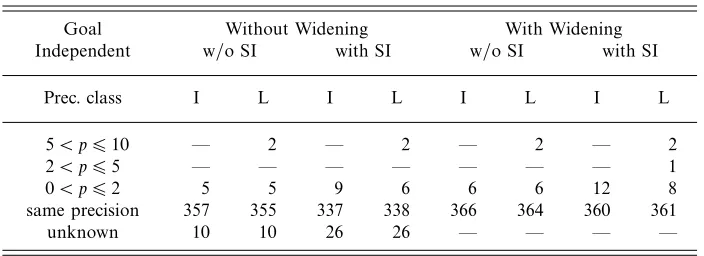
Table 1. Classical Pos×SFL2 versus enhanced one: precision
Goal Without Widening With Widening
Independent w/o SI with SI w/o SI with SI
Prec. class I L I L I L I L
5< p610 — 2 — 2 — 2 — 2
2< p65 — — — — — — — 1
0< p62 5 5 9 6 6 6 12 8
same precision 357 355 337 338 366 364 360 361
unknown 10 10 26 26 — — — —
variables detected. For each variant of the analysis, these numbers are then compared by computing the relative precision improvements and expressing them using percentages. The benchmark suite is then partitioned into several precision equivalence classes and the cardinalities of these classes are shown in Table 1. For example, when considering a goal independent analysis without structural information and without widenings, the value 5 found at the intersection of the row labeled ‘0 < p 6 2’ with the column labeled ‘I’ should be read: “for five benchmarks there has been a (positive) increase in the number of independent pairs of variables which is less than or equal to two percent.” Note that we only report on independence and linearity (in the columns labeled ‘I’ and ‘L’, respectively), because no differences have been observed for groundness and freeness. The precision class labeled ‘unknown’ identifies those benchmarks for which the analyses timed-out (the time-out threshold was fixed at 600 seconds). Hence, for goal independent analyses, a precision improvement affects from 1.6% to 3% of the benchmarks, depending on the considered variant.
When considering the goal dependent analyses, we obtain a single, small improve-ment, so that no comparison tables are included here: the improveimprove-ment, affecting linearity information, can be observed when the abstract domain includes structural information.
With respect to differences in the efficiency, the introduction of the new abstract unification operator has no significant effect on the computation time: small differ-ences (usually improvements) are observed on as many as 6% of the benchmarks for the goal independent analysis without structural information and without widenings; other combinations register even less differences.
We note that it is not surprising that the precision and efficiency improvements occur very rarely since the abstract unification operators behave the same except under very specific conditions: the two terms being unified must not only be definitely linear, but also possibly non-free and share a variable.
7 Related work
Sharing information has been shown to be important for finite-tree analysis (Bagnara
program point, cannot be bound to an infinite rational tree (in other words, they are necessarily bound to acyclic terms). This novel analysis is irrelevant for those logic languages computing over a domain of finite trees, while having several applications for those (constraint) logic languages that are explicitly designed to compute over a domain including rational trees, such as Prolog II and its successors (Colmerauer, 1982, 1990), SICStus Prolog (Swedish Institute of Computer Science, Programming Systems Group, 1995), and Oz (Smolka and Treinen, 1994). The analysis specified in Bagnara et al. (2001) is based on a parametric abstract domainH×P, where theH component (the Herbrand component) is a set of variables that are known to be bound to finite terms, while the parametric componentP can be any domain capturing aliasing, groundness, freeness and linearity information that is useful to compute finite-tree information. An obvious choice for such a parameter is the domain combination SFL. It is worth noting that, in Bagnara et al. (2001), the correctness of the finite-tree analysis is proved byassuming the correctness of the underlying analysis on the parameterP. Thus, thanks to the results shown in this paper, the proof for the domainH×SFLcan now be considered complete.
Codishet al. (2001) describe an algebraic approach to the sharing analysis of logic programs that is based onset logic programs. A set logic program is a logic program in which the terms are sets of variables and standard unification is replaced by a suitable unification for sets, calledACI1-unification (unification in the presence of an associative, commutative, and idempotent equality theory with a unit element). The authors show that the domain of set-substitutions, with a few modifications, can be used as an abstract domain for sharing analysis. They also provide an isomorphism between this domain and the set-sharing domainSH of Jacobs and Langen. The approach using set logic programs is also generalized to include linearity information, by suitably annotating the set-substitutions, and the authors formally state the optimality of the corresponding abstract unification operator lin-mguACI1
(Lemma A.10 in the Appendix of Codish et al. (2000)). However, this operator is very similar to the classical combinations of set-sharing with linearity (Bruynooghe
et al., 1994a; Hans and Winkler, 1992; Langen, 1990): in particular, the precision improvements arising from this enhancement are only exploited when the two terms being unified are definitely independent. As we have seen in this paper, such a choice results in a sub-optimal abstract unification operator, so that the optimality result cannot hold. By looking at the proof of Lemma A.10 in Codishet al. (2000), it can be seen that the case when the two terms possibly share a variable is dealt with by referring to an example:5 this one is supposed to show that all the possible
sharing groups can be generated. However, even our improved operator correctly characterizes the given example, so that the proof is wrong. It should be stressed that the amguS operator presented in this paper, though remarkably precise, is
not meant to subsume all of the proposals for an improved sharing analysis that appeared in the recent literature (for a thorough experimental evaluation of many of these proposals, the reader is referred elsewhere (Bagnaraet al., 2000; Zaffanella,
5 The proof refers to Example 8, which however has nothing to do with the possibility that the two