Theses Thesis/Dissertation Collections
8-2014
Power Generation for a 2D Tethered Wing Model
with a Variable Tether Length
Ashwin Chander Ramesh
[email protected]Follow this and additional works at:http://scholarworks.rit.edu/theses
This Thesis is brought to you for free and open access by the Thesis/Dissertation Collections at RIT Scholar Works. It has been accepted for inclusion in Theses by an authorized administrator of RIT Scholar Works. For more information, please [email protected].
Recommended Citation
Power Generation for a 2D Tethered Wing
Model with a Variable Tether Length
by
Ashwin Chander Ramesh
A Thesis Submitted in Partial Fulfillment of the Requirements for the Degree of Master of Science
in Mechanical Engineering
Supervised by
Assistant Professor Dr. Mario W. Gomes Department of Mechanical Engineering
Kate Gleason College of Engineering Rochester Institute of Technology
Rochester, New York August 2014
Approved by:
Dr. Mario W. Gomes, Assistant Professor
Thesis Advisor, Department of Mechanical Engineering
Dr. Agamemnon Crassidis, Associate Professor
Committee Member, Department of Mechanical Engineering
Dr. Steven Day, Associate Professor
Committee Member, Department of Mechanical Engineering
Dr. Wayne Walter, Professor, PE
Rochester Institute of Technology Kate Gleason College of Engineering
Title:
Power Generation for a 2D Tethered Wing Model with a Variable Tether Length
I, Ashwin Chander Ramesh, hereby grant permission to the Wallace Memorial Library to reproduce my thesis in whole or part.
Ashwin Chander Ramesh
iii
Acknowledgments
The Master’s degree at RIT has been a great experience and an amazing journey for
me. Firstly I would like to thank my family who have always stood by me. I would
like to thank my mother Shanthi who has guided me with advice and encouraged
me to pursue my every dream, my sister Sanju who makes my day by having long
conversations with me and making me feel like I’m back home for the time I am
talking to her.
The completion of the thesis could not be possible without the support of the Dr.
Gomes. Working with you has been a life changing experience for me. I have learned
a lot of things from you, not only academic but also real life lessons. I am very glad
I met you and you have been a great influence on me. Thank you for being patient
with me and guiding me through any and all problems.
I would also like to thank my committee members Dr. Crassidis and Dr. Day
for all your help with my research and academic progress. The faculty at Mechanical
Engineering are really great, and I thank them for teaching me everything that I have
learned over the past two years. Without this knowledge I would likely not have been
able complete my thesis successfully.
I would like to thank Jill, Diane, Diedra and Hillary for always welcoming me at the
ME office with a nice smile and all your help with the scheduling, room reservation,
registration and all other academic paper work. Bill thank you for all the software,
and computer support that you have provided over the past two years and hiring me
to work as a labbie. Mostly I thank everyone for being a good friend.
v
Bill, Paul, Kyle, Saj and all the other students who have worked in the Energy and
Motion Lab. Energy and Motion Lab has been my second home at Rochester for more
than a year and my labmates have been like family to me. You guys have always
been available for me when I needed you and all your inputs at lab meetings were
very helpful to me. I sincerely hope we continue to stay in touch, and bounce ideas
Abstract
Power Generation for a 2D Tethered Wing Model with a Variable Tether
Length
Ashwin Chander Ramesh
Supervising Professor: Dr. Mario W. Gomes
Airborne wind energy systems consist of a lifting body and a tether. Several airborne wind energy systems have been created by others, but the most promising consists of a wing which translates through the air in a crosswind motion. Two computational models of a translating wing system were used to study the dynamics and performance of these systems. The first model that was examined consists of a rigid connecting arm between a rotating base station and a wing. A study of this model showed that one can increase the power production of the system by changing the wing angle relative to the connecting arm during motion. Using a variable relative wing angle, an average power of 7.7W is generated which is an increase of 30% over the fixed wing angle system.
Contents
Acknowledgments . . . iv
Abstract . . . vi
0.0.1 General . . . 2
0.0.2 Rigid boom model . . . 3
0.0.3 Variable tether model . . . 3
1 Background Information . . . 4
1.1 Introduction . . . 4
1.2 Literature Review . . . 6
1.2.1 High altitude wind energy . . . 6
1.2.2 Kinetic Energy Extraction . . . 9
1.2.3 Companies constructing prototype kite wind-energy systems . 15 1.2.4 Different systems used for power extraction . . . 19
1.2.5 Practical study of crosswind motion . . . 28
1.2.6 Dynamics and stability . . . 31
1.2.7 Kiteplane . . . 38
1.3 Objectives . . . 44
2 Rigid boom model with fixed and variable bridle angles . . . 46
2.1 System Description . . . 48
2.2 Simulation and equations of motion . . . 51
2.3 Results . . . 55
2.3.1 Fixed bridle angle . . . 55
2.4 Variable bridle angle . . . 58
2.5 Conclusion . . . 65
3 Half cycle analysis of a tethered wing model with a variable tether length . . . 66
3.1 Introduction . . . 66
3.1.1 System description . . . 67
3.1.2 Simulation and equations of motion . . . 69
3.1.3 Results and Discussion . . . 71
4 Variable tether length system analysis . . . 77
4.1 Introduction . . . 77
4.2 Constant-Length-Reel-out System (CLRS) . . . 77
4.2.1 Results for the constant-length-reel-out-system . . . 78
4.2.2 Analysis of the control parameters for the CRLS . . . 89
4.3 Reel-in-reel-out system(RRS) . . . 92
4.3.1 Results for the reel-in-reel-out-system . . . 95
4.3.2 Analysis of the control parameters for the reel-in-reel-out-system 98 5 Conclusion. . . 104
Bibliography . . . 107
A Simulation Code . . . 110
A.1 Rigid boom fixed beta . . . 110
A.1.1 Main file . . . 110
A.1.2 Force calculations . . . 113
A.1.3 Function file called by ODE45 when β = β . . . 114
A.1.4 Function file called by ODE45 when β = -β . . . 115
A.2 Rigid boom variable beta . . . 115
A.2.1 Main file . . . 115
A.2.2 Function file called by ODE45 when kite is moving from θstart to θend . . . 118
A.2.3 Function file called by ODE45 when kite is moving from θend to θstart . . . 119
A.2.4 Event function 1 . . . 119
A.2.5 Event function 2 . . . 120
A.2.6 Event function 3 . . . 120
A.3 Constant length reel-out system . . . 120
A.3.1 Main file . . . 120
A.3.2 Force calculation . . . 124
A.3.3 Events for first phase . . . 125
A.3.4 Events for second phase . . . 125
A.3.5 Events for third phase . . . 125
A.3.6 Events for fourth phase . . . 126
ix
A.3.8 Function file called by ODE45 . . . 126
A.4 Reel in reel out system . . . 127
A.4.1 Main file . . . 127
B Aerodynamics. . . 133
B.1 Lift and Drag Coefficient Table . . . 133
B.2 Parameter search . . . 133
B.2.1 Constant-Length-Reel-Out System (CLRS) . . . 133
2.1 Parameters used for the rigid boom model . . . 54
2.2 Optimal parameters chosen for the fixed and the variable beta systems 59 3.1 Parameter values for the analysis of the deploy stroke . . . 69
4.1 Parameters used for the constant-length-reel-out system . . . 82
4.2 Local maximum parameters for the constant-length-reel-out system . 92 4.3 Parameters used for the RRS . . . 95
4.4 Local maximum parameters for the RRS . . . 103
B.1 2D and 3D lift and drag coefficients [7]. This model uses steady state lift and drag coefficients. McConnagy et al. analyzed these experimen-tal values of lift and drag coefficients for a range of Reynolds numbers (104to107) [16] and observed that the lift and drag coefficients selected hold good for this range. . . 134
B.2 Initial conditions for the first phase of the CLRS . . . 135
B.3 Initial conditions for the second phase of the CLRS . . . 135
B.4 Initial conditions for the second phase of the CLRS . . . 138
B.5 Initial conditions for the fourth phase of the CLRS . . . 140
B.6 Initial conditions for the first phase of the RRS . . . 146
B.7 Initial conditions for the second phase of the RRS . . . 147
List of Figures
1.1 Average wind-speed over the Netherlands over 20 years. Image taken from [13] . . . 6 1.2 The wind power density profiles at the five largest cities in the world.
Image taken from [3] . . . 7 1.3 Wind power density comparison for land versus sea at different
alti-tudes. Image taken from [3] . . . 8 1.4 A sketch of the design of ’Charvolant’ -a kite drawn carriage. Image
taken from [17] . . . 10 1.5 A sketch of the carriage being powered by a kite . Image taken from [17] 11 1.6 Density of effective area of added drag affects global KEE. Image taken
from [15] . . . 12 1.7 Atmospheric kinetic energy deceases with increase in KEE. Image taken
from [15] . . . 13 1.8 The production rate of atmospheric kinetic energy increases with
in-crease in KEE. Image taken from [15] . . . 13 1.9 Kitegen para-foils reaches altitudes of about 1000m and tethered to a
spinning carousel at the ground. Image taken from [3] . . . 16 1.10 Kitegen para-foils reaches altitudes of about 1000 mand tethered to a
spinning carousel at the ground. Image taken from [3] . . . 17 1.11 Flying electric generators by Sky Windpower. Tethered rotor-crafts
reaches altitudes of 10,000 m. Image taken from [3] . . . 18 1.12 Kitegen para-foils reaches altitudes of about 1000 m and tethered to a
spinning carousel at the ground. Image taken from [3] . . . 18 1.13 Flying electric generators by Sky Windpower. Tethered rotor-crafts
reaches altitudes of 10,000 m. Image taken from [3] . . . 19 1.14 Forces and velocities on a weightless simple kite. Image taken from [14] 21 1.15 Forces and velocity vectors on a mass-less kite during the crosswind
motion. Image taken from [14] . . . 21 1.16 Comparison of the power obtained in the three cases with a fixed L/D
ratio kite. Image taken from [14] . . . 23 1.17 Forces acting on a kite during ascent. Image taken from [10] . . . 25
1.18 Variation of average power with load during ascent.Image taken from [10] . . . 26 1.19 Instantaneous power during the descent.Image taken from [10] . . . . 27 1.20 Normalized instantaneous power for different loads during ascent.Image
taken from [10] . . . 27 1.21 Drag flaps used for steering stability. Image taken from [13] . . . 29 1.22 Servos located under the kite for control of angle of attack. Image
taken from [13] . . . 30 1.23 Control mechanism for the tether attachment point on the kite. Image
taken from [13] . . . 30 1.24 2D model of a kite with the bridle angle,azimuth angle,lift force and
center of pressure. Image taken from [19] . . . 32 1.25 Basic system diagram. Image taken from [19] . . . 32 1.26 Equilibrium altitude increases with increase in wind velocity. Image
taken from [19] . . . 33 1.27 Simplified representation of a tethered kite system with a moving
ground vehicle. Image taken from [24] . . . 35 1.28 Nominal system parameters. Image taken from [24] . . . 36 1.29 Optimal kite trajectories for low and high wind speeds.[24]. Image
taken from [24] . . . 38 1.30 Power generated increases with increase in cycle time.[24]. Image taken
from [24] . . . 39 1.31 Variation of azimuth angle ψ and the zenith angle φ at the ground
station .Image taken from [21] . . . 41 1.32 Pitching moment of the Kiteplane. Image taken from [21] . . . 42 1.33 Lift and Drag forces acting on the left and right wing. Image taken
from [21] . . . 42 1.34 zenith and pitch equilibrium. Image taken from [21] . . . 43 1.35 symmetric 2D motion of the Kiteplane. Image taken from [21] . . . . 43
2.1 The free body diagram rigid boom model . . . 47 2.2 The schematic of the rigid boom model . . . 48 2.3 The schematic view for the fixed beta system during the deploy stroke 50 2.4 The schematic view for the variable beta system during the deploy stroke 50 2.5 Average power as a function of beta to find the right parameter to
xiii
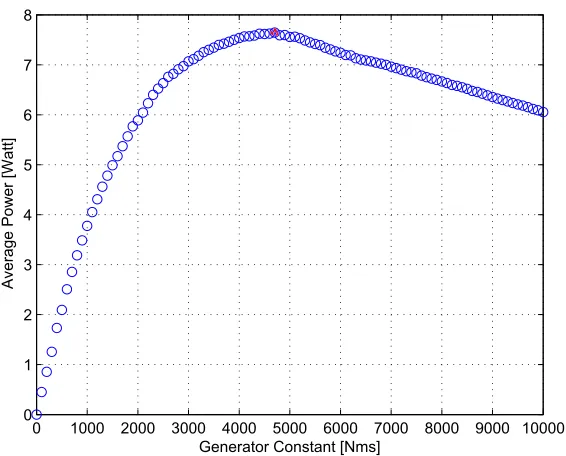
2.6 Average power as a function of generator constant to find the right value to maximize power production while keeping the beta fixed at 52◦. 57
2.7 Fixed beta system . . . 57 (a) The acngular position attains periodicity with time for a fixed
beta system. . . 57 (b) The angular velocity attains periodicity with time for a fixed beta
system. . . 57 2.8 The system transitioning from transient to the steady-state can be
noticed for a fixed beta system. . . 58 2.9 The beta value which generated the highest torque is chosen as optimal
for a range 0◦
≤β ≤360◦. . . . 59
2.10 Surface plot showing the optimal beta values to maximize torque at the pivot point of the rigid boom system. . . 60 2.11 Contour plot for optimal beta values as a function of angular position
and angular velocity. . . 61 2.12 Variable beta system . . . 62
(a) Change in angular position for a variable beta system. The ac-ngular position attains periodicity with time for a variable beta system. . . 62 (b) Change in angular velocity for a variable beta system. The
ac-ngular velocity attains periodicity with time for a variable beta system. . . 62 2.13 Beta changes with time to maximize torque at every time step to
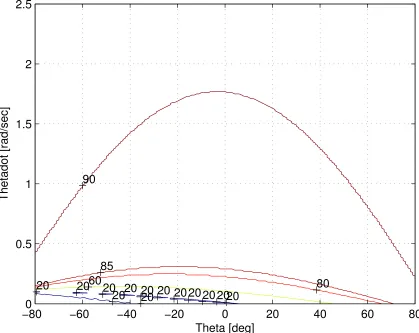
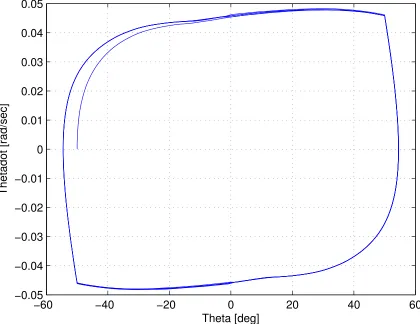
in-crease average cycle power . . . 63 2.14 The phase plane showing both transient and steady-state phases for
variable beta. This system reaches steady state over time. . . 64 2.15 Optimal generator constant for variable beta system . . . 65
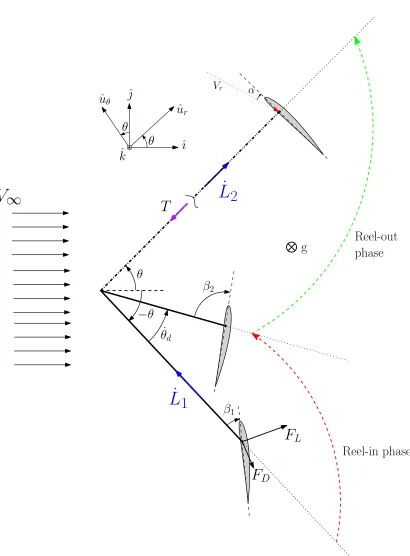
3.1 The schematic view for a half cycle of the variable tether length . . . 68 3.2 Time taken to reach a desired angular velocity for various beta values
during the reel-in phase . . . 73 3.3 Energy consumed for variousβ values and reel-in rates . . . 74 3.4 Average power for variousβ values and reel-in rates during the reel-in
3.5 Instantaneous power for the half-cycle of the variable tether system. Power is consumed by the system during the reel-in phase and gen-erated during the reel-out phase. The negative power shown on the graph is when the system consumes power. . . 75 3.6 Tension force is proportional to the instantaneous power produced
dur-ing the reel-out phase . . . 75
4.1 The schematic view of the deploy stroke showing phases one and two of the CLRS . . . 79 4.2 The schematic view of the return stroke showing phases three and four
of the CLRS . . . 80 4.3 The schematic view of the final phase of one set for CLRS . . . 80 4.4 The schematic view of the CLRS showing three cycles which comprise
a single set . . . 81 4.5 Five different beta values chosen for the five phases in one set for the
CLRS . . . 83 4.6 The change from the constant-length and reel-out phases can be seen
noticed with change in length for the CLRS. The constant-length, reel-out and retraction phases can be seen. . . 83 4.7 The fluctuation in angular velocity with tether length for the CLRS . 84 4.8 Phase plane plot for third set of the CLRS. The three distinct curves
represent the three cycles of the system in each set. . . 84 4.9 Instantaneous power for the third set of the CLRS . . . 85 4.10 A closer view of the instantaneous power for the third set of the CLRS
showing the constant length, reel-out and the retraction phases. Power is not generated during the constant-length phase, generated during the reel-out phase and consumed by the system for the retraction phase. 86 4.11 Instantaneous for the three cycles of one set without the retraction phase. 87 4.12 Relative velocity for the third set of the CLRS. The relative velocity
increases resulting in higher peaks with time, because of the change in tether length with time. . . 88 4.13 Variation of the relative velocity with angular position for the CLRS.
The relative velocity reduces at the end of each stroke. . . 88 4.14 Analyzing the bridle angle to locate a local maximum of average power
xv
4.15 Analyzing the θswitch to locate a local maximum of average power for
the CLRS system. The θswitchis a crucial control parameter as it is the
angular position at which the system transitions between the constant-length phase and the reel-out phase. . . 90 4.16 Analyzing the beta for the reel-out phases to locate a local maximum
of average power production for the CLRS . . . 91 4.17 Analyzing the reel-out rates for the CLRS to locate a local maximum
of average power production . . . 91 4.18 The schematic view of the deploy stroke showing phases one and two
for RRS . . . 93 4.19 The schematic view of the return stroke showing phases three and for
the RRS . . . 94 4.20 Five different beta values chosen for the five phases in a cycle of the
RRS . . . 96 4.21 Change in length of the tether during the reel-in and reel-out phases
of the RRS . . . 97 4.22 The phase plane plot for the third set of the system of the RRS . . . 97 4.23 Instantaneous power for the third set of the RRS . . . 98 4.24 Closer look at the instantaneous power for the last set of the RRS.
Positive power is generated when the tether is reeled out and power is consumed by the system when the tether is reeled in . . . 99 4.25 Change in length of the tether during the reel-in and reel-out phases
of the RRS. The three distinct curves represent the three cycles in a set. . . 100 4.26 Analyzing the bridle angle for the reel-in phase to locate a local
maxi-mum of average power for the RRS . . . 101 4.27 Analyzing the bridle for the reel-out phases to locate a local maximum
of average power production for the RRS . . . 101 4.28 Analyzing the various reel-in rates for the reel-in phase to locate a local
maximum of average power production for one set of the RRS . . . . 102 4.29 Analyzing the reel-out rates for the RRS to locate a local maximum of
average power . . . 102 4.30 Analyzing the θswitch to locate a local maximum of average power for
the RRS. The θswitch is a crucial control parameter as it is the angular
B.1 Choosing the optimal control parameter for the first phase of the reel-out system . . . 136 (a) Searching for the optimal beta to minimze time consumed . . . 136 (b) Analysing the angular velocity of the system at the end of the
first phase as a function of time . . . 136 (c) Analyzing the angular velocity of the system for diferrent bridle
angles . . . 136 B.2 Analyzing a close range of control parameters for the second phase . . 138
(a) Analyzing averge power as a function of reelout rates and beta angles . . . 138 (b) Analyzing averge power as a function of reelout rates and beta
angles . . . 138 B.3 Analyzing reel-out rates while keeping beta fixed at 98◦ for the second
phase to maximize power production . . . 139 (a) Average power produced during the secon phase while keeping
the bridle fixed . . . 139 (b) Checking the angular velocity of the system at the end of the
second phase for various reel-out rates while keeping the bridle fixed. . . 139 B.4 Analyzing different beta angles while keeping the reel-out rate fixed a
4m/s during the second phase . . . 139 (a) Analyzing the range of beta angles to maximize power production
for the second phase . . . 139 (b) Checking the angular velocity of the system at the end of the
second phase for various beta angles while keeping the reel-out rates fixed . . . 139 B.5 Selecting the optimal beta for the third phase of the reel-out system . 141
(a) Average power produced during the third phase for a range of bridle angles . . . 141 (b) Angular velocity reached at the end of the third phase as a
func-tion of the time consumed . . . 141 (c) Angular velcoity reached at the end of the third phase for a range
of beta angles . . . 141 B.6 Analyzing averge power as a function of reelout rates and beta angles 142 B.7 Analyzing a range of beta values while keeping the reel out rate fixed
xvii
(a) Average power produced during the fourth phase while keeping the reelout rate fixed for a range of beta . . . 143 (b) The angular velocity reached at the end of the phase for a range
of beta values . . . 143 B.8 Analyzing a range of reel-out rates while keeping the beta fixed at −98◦143
(a) Average power produced for a range of reel-out rates while keep-ing the beta constant . . . 143 (b) Angular velocity of the system at the end of the fourth phase for
a range of reel-out rates . . . 143 B.9 Optimizing the control parameters for the first phase of the
reel-in-reel-out system . . . 145 (a) The variation in power used for the first phase for diferrent reel
in rates and bridel angle . . . 145 (b) A closer view of the variation in bridle angle between 0◦ and 80◦ 145
(c) The time taken to reach the predefined angular position for di-ferrent control parameters are analysed . . . 145 (d) A closer view of the variation in bridle angle between 0◦ and 80◦ 145
B.10 Analyzing optimal control parameters for the first phase . . . 146 (a) Analyzing optimal control paramters for the first phase for a
small range as a function of power . . . 146 (b) Analyzing optimal control paramters for the first phase for a
small range as a function of time . . . 146 B.11 Optimizing the control parameters for the second phase of the
reel-in-reel-out system . . . 149 (a) The variation in average power used for the second phase for
diferrent reel-out rates and bridel angle . . . 149 (b) The variation in average power used for the second phase for
diferrent reel-out rates and bridel angle . . . 149 (c) The time taken to reach the predefined angular position for
di-ferrent control parameters are analysed . . . 149 (d) The time taken to reach the predefined angular position for
di-ferrent set of control parameters are analysed . . . 149 B.12 The time taken to reach the end of the second phase for deterrent
(a) Analyzing the optimal bridle angle and the reel-out rate to max-imze power . . . 150 (b) Analyzing the optimal bridle angle and the reel-out rate to
mkin-imze the time used . . . 150 B.14 Optimizing the control parameters for the third phase of the
reel-in-reel-out system . . . 151 (a) The variation in power used for the third phase for diferrent reel
in rates and bridel angle . . . 151 (b) A closer view of the variation in bridle angle between 0◦ and−80◦ 151
(c) The time taken to reach the predefined angular position for di-ferrent control parameters are analysed . . . 151 (d) A closer view of the variation in bridle angle between 0◦ and
−80◦ 151
B.15 Analyzing optimal control parameters for the third phase . . . 152 (a) Analyzing optimal control paramters for the third phase for a
small range as a function of power . . . 152 (b) Analyzing optimal control paramters for the first phase for a
small range as a function of time . . . 152 B.16 Optimizing the control parameters for the fourth phase of the
reel-in-reel-out system . . . 153 (a) The variation in average power used for the fourth phase for
diferrent reel in rates and bridel angle . . . 153 (b) The variation in average power used for the fourth phase for
diferrent reel in rates and bridel angle . . . 153 (c) The time taken to reach the predefined angular position for
di-ferrent control parameters are analysed . . . 153 (d) The time taken to reach the predefined angular position for
di-ferrent set of control parameters are analysed . . . 153 B.17 A closer view to locate the optimal control parameters . . . 154
(a) Analyzing the optimal bridle angle and the reel-out rate to max-imze power . . . 154 (b) Analyzing the optimal bridle angle and the reel-out rate to
Nomenclature
0.0.1 General
ˆı Inertial coordinate frame, X-axis
ˆ
Inertial coordinate frame, Y-axis ˆ
k Inertial coordinate frame, Z-axis
β Angle between the chordline of the airfoil and the tether
θstart Angular position at which the kite starts
α Angle of attack ~
L Lift force ~
D Drag force ~
T Tether tension
CD 3-D Drag coefficient
CL 3-D Lift coefficient
Cd 2-D Drag coefficient
Cl 2-D Lift coefficient
ρ Air density ˆ
λL Unit vector in the direction of the lift force
ˆ
λD Unit vector in the direction of the drag force
Pavg Average cycle power
τgen generator constant
Vr Relative velocity acting on the kite
g Gravity
b Span of airfoil
c Chord length of airfoil
V∞ Free stream velocity
Vk Velocity of the kite
AR Aspect ratio of the airfoil
e Span effieciency factor
3
0.0.2 Rigid boom model
m Kite mass
mb Mass of boom
lb Boom length
θstart Initial angular position
θend Final angular position
βf ixed Bridle angle for the fixed beta system
Iboom Moment of inertia of the boom
Ikite Moment of inertia of the kite
Ecycle Energy generated for one full cycle
to Initial start time of the cycle
tf Time at end of cycle
kgen−f ixed Generator constant for the fixed beta system
kgen−var Generator constant for the variable beta system
0.0.3 Variable tether model
θswitch Angular position where the system transitions from constant-length to reel-out phase
L Length of tether
˙
L Rate of change of length of tether ˙
Lr Reel-in rate for retraction phase
β1 Bridle chosen for the first phase
β2 Bridle chosen for the second phase
β3 Bridle chosen for the third phase
Chapter 1
Background Information
1.1
Introduction
The usage of kites and their history go back to the 18th century. George Pocock
invented the ’Charvolant’, a kite-drawn carriage. Pocock experimented pulling loads
using kite power, he experimented with pulling vehicles using kite power. Pocock
discusses how the large kites were able to pull a carriage with passengers by harnessing
wind energy [17]. Modern day turbines have a maximum height of approximately 120
m. Power generated by a wind turbine is a function of wind speed and density of
the medium going over the blades. The wind power available per unit area of swept
blades can be written as shown in Eqn. 1.1. Archer [3] determined that for some
regions of the earth above 2000 m, the wind power density increases with height and
the altitude range between 500 m and 2000 m has relatively constant wind power
densities. Tethered systems can be designed to harvest energy at these promising
high altitudes to harnessing the kinetic energy of these winds. Loyd[14] analyzed
the power production capabilities of several simple tethered kite systems, his paper
explores and expands upon the crosswind motion model discussed by Loyd to harvest
wind energy. Goela et al. [10] created and examined a simplified model of a water
pumping system using a kite. Goelas et al. kite pumping system consists of three
5
connects the aerodynamic body to the energy conversion system. Some researchers
have conducted experiments to control the motion of actual power generating kites.
For example, Lansdorp et al. [13] examined how a kites path can be controlled by
varying the orientation of a surfkite by mounting servos on the kite itself. The model
examined here is a 2D kite model. McConnaghy [16] analysed power generation of a
hydrokite system, her system was essentially an underwater kite which exploits
cross-flow motion to harness hydropower. Hydrokite systems could be used to transform
kinetic energy in a river into useable electrical energy. Similar to Goelas simple kite
model which consisted of an ascent stroke and a descent stroke, McConnaghys model
consisted of a deploy and a return stroke. The model that is examined here is an
extension of the McConnaghys 2D steady state model that consisted of a rigid boom,
a hydrofoil and a fixed beta for each stroke. In our study we look at how changing
the tether length and the orientation of the wing can affect its path and the systems
power production. Canaleet al. in his paper [6] talks about the ’Yo-Yo’ system which
effectively consists of two phases, a power and a return phase. This system very similar
to our model consists of a base station, a tether and a aerodynamic body. Energy is
generated during the power phase when the tether is unwound from the base station.
The tether is reeled back in to its original tether length once the maximum tether
length is reached, energy is consumed by the system during this phase. No theoretical
or experimental study has been conducted for a tethered system that cycles between
zero velocity states to maximize power production. The concept of using an input
force on the tether to bring the system to desired speed is explored in detail on a 2D
Fig. 1.1: Average wind-speed over the Netherlands over 20 years. Image taken from [13]
1.2
Literature Review
1.2.1 High altitude wind energy
Wind speeds increase with in altitude, the graph shows the data of wind speed
col-lected in Holland over a period of 20 years.[13]
Power generated by a wind turbine is a function of wind speedVw and density of
the medium ρgoing through the blades. Wind speed increases with height above the
boundary layer, while air density decreases. Wind power density δ can be calculated
from these two parameters. The wind power available per unit area of swept blades
can be written as.
δ = (1/2)ρVw3 (1.1)
To calculate wind power density throughout the troposphere, Archer[3] uses wind
7
Fig. 1.3: Wind power density comparison for land versus sea at different altitudes. Image taken from [3]
for Environmental Prediction (NCEP) and the Department of Energy (DOE), with
a frequency of 6-hours from 1979 to 2006. Archer found that the highest wind power
densities are at altitudes 8,000 to 10,000 m above ground as shown inFig. 1.3. For
high-altitude wind power harvesting 10,000m above ground is most suitable altitude.
Above 2000 m wind power density increases with height, the altitude range between
500 and 2000 m has relatively constant wind power densities. The wind power
densi-ties are analyzed at different altitudes for the five largest cidensi-ties in the world. The wind
power densities are not symmetric or periodic with altitude. This can be inferred as
there is a large difference between the values of 5% and the 50% percentiles but only a
small difference between the 50% and the 95% percentiles. For cities that are affected
by polar jet streams like Tokyo, Seoul and New York the energy harvesting at high
altitude is efficient. The wind power densities are greater than 10 kW/m2 for more
than 50% of the time at 8,000 m altitude as shown in the Fig. 1.2.
9
The maximum wind power density at 1,000 m are found generally over the oceans.
Over land, the best locations are the tip of South America and the horn of Africa.
The data show that 5% of the time, the wind power density at 1,000 m is effectively
zero over land. On an average the δat 10,000 m is five times larger than at 1,000m.
The comparison is as shown in the Fig. 1.2. Above 10,000m 50% of the time the δ is
found to be greater than 10 kW/m2 as shown in Fig. 1.2 . Sometimes high values of
δ can be achieved at low altitudes. The wind speed at different altitudes also depend
on weather conditions. Low-level jets sometimes cause high δ at altitudes around
1000 m.
1.2.2 Kinetic Energy Extraction
The large scale energy harvesting devices can alter the general circulation patterns in
the troposphere and have significant effects on global and local climate. The current
global demand for power is noted to be 18T W annually. There is enough power in
the earth’s winds to replace the renewable energy completely and make the planet
more Eco-friendly by reducing the emissions. Wind turbines have been used in this
world for many centuries. Marvel et al. [15] mentions that wind turbines fixed on
earth can extract kinetic energy at the rate of 400T W[15]. Ground structures such
as windmills cannot be used to reach very high altitudes. But high altitude winds
are steadier and faster than surface winds. At high rates of extraction of energy
leads to climatic consequences like change in local temperatures. That is because
huge windmill blades chop up the incoming wind and mix the different layers of the
atmosphere. High altitude wind-energy systems could extract wind energy at the
rate of 1800 T W. Generally the wind power growth will be limited by economic
or environmental factors. However for the study conducted by Kate Marvel the
environmental factors that effect the amount of energy that can be extracted from
11
Fig. 1.6: Density of effective area of added drag affects global KEE. Image taken from [15]
energy that can be extracted from both surface and high altitude winds, considering
only geophysical limits.
Geophysical limits are quantified by applying additional drag forces which remove
momentum from the atmosphere in the global climate model. The simulations were
performed using the National Center for Atmospheric Research Community
Atmo-sphere Model (Version 3.5). Small amounts of additional drag added to the surface
environment or the atmosphere lead to increase in rate of kinetic energy extraction
(KEE). If infinite amount of drag is added in the climate model, then the atmosphere
is motionless and there is no kinetic energy to extract. This implies that there is a
limitation on the added drag to maximize the KEE. The effects of increased drag in
the atmosphere were studied by Marvel et al. . In the global climate model used by
K.Marvel[15], surface friction was uniformly increased across the globe, and there was
a decrease in the atmospheric kinetic energy.
Generally in the case of wind turbines, the kinetic energy is converted to
mechan-ical or electrmechan-ical. Most of this electrmechan-ical or mechanmechan-ical energy is dissipated as heat. In
the climate model discussed, the added drag affects the surface roughness and heat
dissipation. The parameter introduced to vary additional drag is ρArea, where ρArea
is the effective extraction area per unit volume. The Fig. 1.6 shows KEE vs ρArea for
13
Fig. 1.7: Atmospheric kinetic energy deceases with increase in KEE. Image taken from [15]
When low values of drag are added, with increase in ρArea(extraction area) there is
an increase in KEE. The graph shows that d(KEE/(ρArea))>0. At the point when
the KEE is close to the geophysical limit d(KEE/(ρArea)) = 0. As shown in the
1.7, for both the near-surface and whole-atmosphere cases, the geophysical limits are
not reached since the slope does not reach a zero value. From the Fig. 1.7 and 1.6
the author K.Marvel[15] infers that the geophysical limit on wind power availability
is greater than 428 TW in the near-surface case and greater than 1873 TW in the
whole-atmosphere cases since the geophysical limits are not reached.
If the Earth was not rotating, atmospheric mass will accelerate down rapidly
converting available potential energy into kinetic energy. On a rotating earth, the
apparent Coriolis forces would prevent the conversion of potential energy into kinetic
energy. The added drag changes the flows such that the flow permits the conversion
of potential energy to kinetic energy. In the atmosphere kinetic energy is produced
by conversion of available potential energy. Increases in the net dissipation result in
increase in net production of potential energy. The energy transfer in the atmosphere
must take place such that energy is transferred from regions of energy accumulations
to regions of energy losses. In steady sate, net kinetic energy dissipation is balanced
by net kinetic energy production. In 1.8 the energy transfer from low altitudes to
high altitudes with energy losses can be seen. When drag is added near the surface,
for large KEE there is a decrease in Poleward atmosphere heat transfer whereas
when added to the whole atmosphere there is no decrease until KEE exceeds 1600
T W . Poleward atmosphere heat transport is a function of the eddy currents in the
atmosphere, therefore added drag to the atmosphere affects the eddies which in turn
increase or decrease the poleward heat transport. Transfer of poleward atmosphere
heat is the net heat that can be transferred as sensible heat and latent heat. The
drag applied on the near-surface and the whole-atmosphere leads to a cooling effect
15
could result from increased heating of warm air masses and decreased cooling of cool
air masses. From the simulation discussed [15], the area of snow and ice covered land
expands as KEE increases. The simulation carried out by Marvel in the study does
not limit the added drag to high velocity winds or certain locations, but is generalized
for all locations across the earth. Therefore Marvelet al. concludes by saying that the
amount of kinetic energy can be extracted from the atmosphere depends on which part
of atmosphere is considered for extraction, whether the part considered is extracted
at near surface or whole atmosphere.
1.2.3 Companies constructing prototype kite wind-energy systems
Archer et al. [3] discusses two basic approaches to harness wind power at high
alti-tudes. Fig. 1.9 shows a design of the KiteGen where an aerodynamic body is connected
by tethers to generators at the ground. These tethers are pulled and released by a
control unit. Kitegen team mention in their website that the most favorable altitude
in terms of wind power is around 10,000 mwhere the average wind speeds can exceed
45m/s. The Kitegen research team have estimated that at 800m, the wind speed is
estimated to be 7.2 m/s on a global average. The KiteGen uses parafoils to collect
energy. The kinetic energy generated is collected and transmitted in the form of
elec-trical energy by the generators on the ground. The main advantage of such tether
systems is that they can reach high altitudes.
Another approach is as shown in 1.11 this design was proposed by Sky Windpower
where four rotors are mounted on an airframe, tethered to the ground via insulated
aluminum conductors. Th rotors help generate lift and power . This aircraft initially
is supplied with electricity to reach the desired altitude. Multiple high altitude wind
turbines could be arranged in arrays for large scale power generation.
Fig. 1.9: Kitegen para-foils reaches altitudes of about 1000mand tethered to a spinning carousel at the ground. Image taken from [3]
The standardized power generation equation used by the Skywind power is as
shown in the equation. E is the efficiency of capturing the wind energy that is
available in a unit area. This is called as Betz limit and this cannot exceed 59.3%. H
is the amount of time for which the system was used. The average capacity factor for
flying electric generators range between 35% to 40%. Capacity factor is defined as the
actual generated power over rated power. By being able to reach the optimal height,
higher rates of capacity factor are obtained and power harvested is maximized. One
of the main concerns in this model are the electrical losses, therefore the transmission
is at high voltage. Substituting V =IR in the formula for power P =V I, P =I2R
which is the equation for power loss across a wire. The equation for power loss shows
that higher the voltage supplied lesser the power loss.
The ampyx power uses a tethered airplane concept. The system consists of a
tethered aerostructure and a ground station. Conversion to electrical power happens
at the ground station while the tether is let out. When the tether is let out and the
power stroke is completed, plane is controlled to dive to a lower altitude such that
17
Fig. 1.11: Flying electric generators by Sky Windpower. Tethered rotor-crafts reaches altitudes of 10,000m. Image taken from [3]
19
Fig. 1.13: Flying electric generators by Sky Windpower. Tethered rotor-crafts reaches altitudes of 10,000 m. Image taken from [3]
power consumed during the reel in phase is lesser compared to the reel out phase.
1.2.4 Different systems used for power extraction
Goela [9] discusses about the positive output that can be obtained from the kites in
his paper. At altitudes of 300 m, the available wind power is around 10 times larger
than the wind power at 50 m [9]. The power generation of the kites is split into two
strokes, the power stroke where the maximum power is developed when the tension in
the tether is maximum and the tether is let out. The return stroke is when the tether
is reeled back in, this is the second stroke. When the wind velocity is minimum, then
the kite would tend to lose its altitude. To prevent this from happening various cases
have been discussed in this paper. One of the solutions discussed in by Goela was, to
fill the empty spaces in the kite with helium gas. This helium gas would generate an
upward pull to balance the downward gravity force due to weight of the kite and the
line and maintain altitude in the air. Another method discussed was to tie a helium
filled balloon to the kite. The disadvantage in this method is that the drag force on
the kite would increase. This concept of power generation has many applications.
flying at a high altitude maybe hazardous to low flying airplanes. Therefore to avoid
any accidents, the line and the kites could be mounted with flashy lights that make
the system visible.
Loyd[14] discusses the power generation based on simple kite models. The kite
is an aerodynamic body attached to a tether. Loyd uses a C5-A airframe as the
aerodynamic body for his theoretical analysis. Lift and drag forces are generated as
the kite moves relative to the air. For the calculations of power generation by the
models a few assumptions are made. The study neglects the weight of the kite and the
drag produced by the tether. The kite is assumed to have constant velocity. Three
models are discussed here
(1) A simple kite
(2) Crosswind motion
(3) Drag power
(1) A simple kite
A simple kite faces into the wind and the motion of the kite would be relative to
the wind. Power would be generated when the tether is unwound from the drum. The
tether extends at velocityVL (load velocity)relative to the increase with wind velocity
VW (wind velocity). Tether tension is produced collinear to VL. The weight and drag
of the kite are assumed to add to the kite, the tether tension is in the negative ˆn
direction. Where ˆn is a unit vector in the radial direction as shown in Fig. 1.14.
~
T =−Tnˆ (1.3)
The Power generated by the simple kite is
P =T~ ·V~L (1.4)
21
Fig. 1.14: Forces and velocities on a weightless simple kite. Image taken from [14]
In this model the kite would be positioned such that the tether is parallel to the
wind. The path of the kite is perpendicular to the oncoming wind, and results in
apparent wind speed higher than the actual wind speed. The power produced in this
case isF c(kite lift power). The vector drawing of this system is as shown in Fig. 1.15.
Fcmax=
4 27
L (Dk)
2 (1.5)
(3)Drag power:
When a crosswind kite pulls a downwind, the lift produces a high tether tension
which produces power. This is called as lift power production. Power can also be
produced by loading the kite with additional drag by adding the air turbines on the
kite. The max Fd(kite drag power) is
Fdmax =
4 27
L (Dk)2
(1.6)
This paper discusses positive power production for each of the three models. From
the Fig. 1.16 observations can be made such that power produced in the crosswind
motion and the drag power are more than the simple kite. As already mentioned the
path of the kite makes the apparent wind speed higher than the actual wind speed.
This increases the aerodynamic forces acting on the kite and therefore creates more
tension on the tether. Since instantaneous power is a function of tension, higher
values of tension results in higher rates of power. Half of the tether weight is added
to the weight of the kite. This system cannot be purely crosswind because the tether
has a drag and both the kite and the tether have mass. Canale in his paper [6]
mainly looks at two types of systems. One is the Yo-Yo configuration and the other
is the carousel configuration.The Yo-Yo configuration in specific is very similar to our
variable length system model, In our variable length model 4.3. The yo-yo model
23
reeled-out and the other where the tether is reeled back in to bring the tether back to
its original tether length. A similar concept like the crosswind motion discussed by
Loyd [14] will be used to develop power by me in my thesis. The kite’s aerodynamic
surface would convert the wind energy into motion of the kite. Similar equations of
motion generated for the crosswind motion will be used in my thesis.
Simple kite
Goela[10] discusses the study of harnessing wind power using tethered airfoils and
kites using an approach similar to the simple kite system discussed by Loyd. A
kite-powered pumping system consists of three main parts.
(1) an aerodynamic body.
(2) A tether that is connected to the aerodynamic body.
(3) An energy conversion system.
In a kite-powered pump the reciprocating motion of the kite is converted into
energy. This pump has two strokes, an ascent stroke and a descent stroke. In the
ascent stroke the kite (aerodynamic body) pulls the load up and in the descent stroke
the load pulls the kite down. The load is a mass being lifted by the kite. This
paper studies a 2D model of the kite pump in a vertical plane as shown in Fig. 1.17.
At the initial position high lift force is required to pull the load during the ascent
stroke. Similarly a low lift force is required during descent to generate maximum
positive power. The equations of motion are formulated assuming that the tether is
weightless, rigid and straight. Simple diagram of the pumping model discussed by
Goela [10] is shown in Fig. 1.17.
In the ascent stroke the lift forces generated on the kites are enough to overcome
the gross load, therefore the kite ascends. At the start of the ascent stroke the CL/CD
ratio are chosen to be maximum. This helps generate high lift during the ascent stroke.
25
Fig. 1.17: Forces acting on a kite during ascent. Image taken from [10]
the angle of attack is reduced and the gross load can overcome the lift force generated
and result in the return stroke. At the end of the return stroke a mechanism will be
triggered on the ground station to unload the gross load and simultaneously increase
the angle of attack. For the theoretical study conducted by Goela [10], constant
CL/CD ratio are used. During the ascent stroke a high CL/CD ratio of 6.5 is used
and during the descent stroke a low CL/CD ratio of 2.0 is used.
The main aim of the study conducted by Goela was to find the conditions which
will result in a periodic motion which generate positive power output. To obtain
positive power output the power produced during ascent by increasing lift force and
conserve power during descent by decreasing the lift force. A periodic motion requires
that the start and the end points of the cycle are the same for every cycle. For a given
Fig. 1.18: Variation of average power with load during ascent.Image taken from [10]
be in equilibrium.
The initial tether angle is equal to or lesser than the equilibrium angle to obtain
a positive output. From Fig. 1.18, the maximum power was obtained when the
initial tether angle was zero. However, a tether angle of 70o is chosen because the
assumptions of the straight line tether is better satisfied and for a more realistic
approach. In Fig. 1.19 and 1.20, the transient behavior changes into steady state
pattern with time can be seen. When Wla(weight load during ascent)<= 1.0, the
pump initially starts in the descent mode but after a short time shifts to the ascent
mode as shown in 1.20. Power was calculated by dividing the product of the load and
the stroke with the ascent time as shown in equation 1.7.
Pcycle=
(Wla−Wld)×stroke
cycletime (1.7)
27
Fig. 1.19: Instantaneous power during the descent.Image taken from [10]
Wld leads to lowCL/CD ratio during descent, therefore reducing the cycle time during
descent. When a long tether is used or if any another initial tether angle is used, the
tether may deviate from the ideal straight line and the assumption of the straight
line tether might fail.
1.2.5 Practical study of crosswind motion
Bas Lansdorp [13]discusses about power generation using kites using experimental
data. In the experiment the tether is connected to drum on the ground. The drum
is further connected to a generator. The high tension created during the crosswind
motion pulls the tether around the drum driving the generator. High crosswind
velocity would generate high lift and therefore the kite ascends. This is the power
stroke of the kite and positive half of the cycle. To generate a positive output the
tether tension of the kite has to be reduced when the tether is pulled back. A high
ratio between the tether tension while ascending and descending will increase the
maximum positive power. Positive energy is obtained by producing alternate cycles
of high power production during reel out and low power consumption during reel
in phase. Compared to the wind turbine, such a system can reach high altitudes
to harvest energy from stronger winds. A single line tether has low drag than two
or more lines. There are many ways to steer the kite from the ground. There are
three types of control mechanisms that can are discussed in this paper. One type
uses drag flaps mounted under the surfkite to maintain stability. This mechanism
had low performance on the maneuverability of the kite. However at a later point
the drag flap mechanism was further explores by Lansdorp [12] and the stability can
be improved by designing an optimal drag flap. Another mechanism was to change
the angle of attack of the kite. This was done by mounting servo motors under
the kite. The servos change the angle of the kite by pulling the lines in or letting
29
Fig. 1.21: Drag flaps used for steering stability. Image taken from [13]
also discussed by William, he focused on the dynamics of the tethered kite for these
control mechanisms[22].
The third control mechanism discussed in this paper is also a mechanism used to
control the angle of attack of the surfkite, this is also further explored by Williams[23].
The angle of attack can be controlled by moving the contact points of the tether on
the surfkite. If they are moved in the same direction, the angle of attack can be
increased or decreased. Whereas if they are moved asymmetrically, the kite path can
be controlled. This mechanism was observed to have good control authority, however
the only disadvantage in the system was increase in drag forces on the kite. Sensors
are used to measure various parameters such as the
1)Force vector in the tether.
2)Apparent windspeed.
A GPS was mounted on each wingtip of the kite to determine the position. Many
times the lift and drag forces are a functions of angle of attack. The pitch stability
is important, because a negative angle of attack will lead to instability of the kite.
The steering mechanism plays an important role in the power production of the kite
as the steering mechanism can be used to control tether tension. Williams also talks
about developing a controller that adjusts the trajectory of the kite by sensing the
Fig. 1.22: Servos located under the kite for control of angle of attack. Image taken from [13]
31
1.2.6 Dynamics and stability
Sanchez [19] examines a tethered body system consisting of three main parts:
1)a kite.
2) a bridle.
3)a tether line.
The equations of motion of the system are calculated using the following
assump-tions
1)The kite is rigid.
2)The aerodynamic characteristics are calculated using a flat plate model.
3)The bridle lines under traction and are assumed to be rigid.
4)The principal line is mass-less, rigid and straight.
5)The length of the tether line is constant.
Sanchez mainly studies the stability of the system and station keeping. The model
discussed in the paper is constrained to move only in the vertical plane therefore the
kite has only two degrees of freedom. But in order for the aerodynamic body to not
fall to the ground, an additional holonomic constraint is added such that f(x,z,θ,t)=0.
This additional constraint avoids the kite from hitting the ground. Here x and z are
coordinates, t is time andθis the pitch angle. The kite system is studied and analyzed
in 2D co-ordinate system.
The bridle geometry depends on the bridle length and the bridle angle. The
author used Lagranges equations to derive the equations of motions for the system.
The normal force coefficient Cn(normal force coefficient) and the center of pressure
are dependent on the angle of attack as shown in the fig 1.25.
At different angles of attack there are regions where the pressure is negative and
regions where the pressure is positive. But as the angle of attack starts increasing, for
a certain angle of attack the lift coefficient suddenly drops this is because as the angle
Fig. 1.24: 2D model of a kite with the bridle angle,azimuth angle,lift force and center of pressure. Image taken from [19]
33
Fig. 1.26: Equilibrium altitude increases with increase in wind velocity. Image taken from [19]
body is in a stalled state for some time. The stalled state causes a loss in lift force
instantaneously. Then this negative pressure on the upper surface of the kite or airfoil
creates a relatively larger force on the wing than is caused by the positive pressure
resulting from the air striking the lower wing surface.
There are two ways to control the equilibrium of the kite.
1)Change the bridle angle of the kite.
2)Change the L/D ratios of the kite.
The author says that the equilibrium of the system depends on three parameters.
The three parameters studied here are the azimuth angle, equilibrium pitch angle and
the equilibrium altitude. There are two ways to control the kite’s equilibrium. One
way is to change the bridle angle of the kite, the other is to change the aerodynamic
characteristics like the lift coefficient. The observations made in this study are that
the equilibrium pitch angle decreases and the altitude increases with increase in wind
velocity. With increase in wind velocity, the kite rises and the azimuth angle increases
However for the study control system of the model the bridle length is kept
con-stant and the bridle angle is varied. The control system developed can control the
altitude the kite must reach or maintain. To calculate the bridle angle, the azimuth
angle is to be calculated using the given equation 1.8.
Γ =Asinho
l (1.8)
where ho is the height to be maintained.
and l is the length of the tether.
The altitude to be maintained ho and the tether lengthl are known.
θ can be found using equation 1.9
Γ =AtanβCnθcosθ−1 βCnθsinθ
(1.9)
The bridle angleδcan be found by substituting the azimuth value in equation 1.9
and 1.10.
cos(δ−θ) +β(σ−cosδ)Cnθ (1.10)
The bridle geometry is changed depending on the wind velocity and altitude to be
maintained. To test the control system developed, the kite system is exposed to a gust
of wind. The wind velocity is increased from 7m/s to 7.5m/s. The control system
helps maintain the altitude of the kite by altering the bridle geometry. The bridle
angle theoretically needs to be reduced, such that the aerodynamic forces acting on
the kite are the same before and during the gust of wind.
Ockels [24] discusses a tethered kite system attached to a moving ground vehicle.
The results obtained in this paper are mostly theoretical. The system discussed in
this paper is shown in Fig. 1.27. However the results discussed by Williams in this
paper were theoretical. Alexander in his paper discusses his experimental results [1]
35
Fig. 1.27: Simplified representation of a tethered kite system with a moving ground vehicle. Image taken from [24]
determine the controllability and maneuverability of the kite.
This system is similar to the concept discussed by Pocock [17]. The kite is
con-nected to the ground vehicle. For simplifying the calculations, the ground vehicle and
the kite are modeled as point masses. The drag and gravity forces acting on the kite
and the tether are not neglected. Since the above mentioned two forces are acting
on the tether, the profile of the tether is sometimes a slightly curved shape. However
this profile of the tether might lead to string-like vibrations and lead to complications
in the analysis, therefore they are neglected for this model and the profile is modeled
as a rigid straight line. ro and ˙ro are the are the position and the velocity of the
vehicle in the xyz coordinate system . The instantaneous mass of the vehicle is given
by mo = mo −ρL where ρ is the density per unit length of the tether and L is the
length of the deployed tether. The tether is split up into n number of elements. The
drag acting on each element of the tether will be different. The total tether drag is
calculated by adding all the instantaneous drag along the length of the tether. The
point mass of the kite is represented in the coordinate systemL, θ andφ as shown in
the figure 1.27. The equations of motion for the system are derived using LaGrange’s
Fig. 1.28: Nominal system parameters. Image taken from [24]
The position vector is as given in the equation.
~r(s) =ro+scosφsinθˆı+ssinφˆ+scosφcosθˆk (1.11)
˙
r(s) = ˙x+ ( ˙scosφsinθ−sφ˙sinφsinθ+sθ˙cosφcosθ)ˆi (1.12)
+ ( ˙y+ ˙ssinφ+sφ˙cosφ)j+ ( ˙z+ ˙scosφcosθ−sφ˙cosφcosθ−sθ˙cosφcosθ)k
Ockels discusses the optimum means to fly the kite to generate maximum positive
power [24]. This study discusses the effects of various parameters of the kite such
as the tether length, tether mass, kite mass and kite area on the power production.
The maximum tether length must be chosen appropriately because long length size
can degrade the performance. This is because of the large tether drag and increase
in weight with increase in length. The nominal initial parameters are shown in the
Fig. 1.28.
37
that the performance of the system could be increased by 8% over the nominal when
the tether length is reduced to 500 m. There is substantial decrease in performance
with decrease in kite area. In this case, the kite mass alters the performance of the
system to a small factor. With a 80% decrease in kite mass there is only a 3.65%
increase in performance. Increasing the length to around 1200 m also lead to an
increase in performance by 1.3%. Further increase or decrease in length beyond the
above mentioned data resulted in decrease in performance. Decrease in the vehicle
friction coefficient and vehicle mass increases the performance. Increases in wind
velocity change the kite path as can be seen in Fig. 1.29. The instantaneous power
is given by TL. During every cycle it is required to let the tether out and reel the˙
tether back in. When the wind speed is low, the kite moves in a direction transverse
to the wind. The kite paths is most sensitive at low wind speeds due to the low
lift generated. The kite paths tend to make eight figures when moving transverse
to the wind. Small changes in wind speed lead to large changes in the kite force.
Fig. 1.30 shows the average power generated by the system as a function of cycle
time. Increasing the cycle time increases the performance. For nominal parameters
the average power generated is around 80kW. For a cycle time between 5-20 seconds,
the kite path is a almost a perfect circle. As the cycle time increases, the paths are
more elliptical.
The study also shows that high angle of attack is maintained during the power
stroke of the cycle to produces high tether tension, which further corresponds to high
reel rate which corresponds to high instantaneous power. During the return stroke
the angle of attack is reduced to produce less tether tension. Although the tether is
reeled in at a higher rate than it is reeled out, the power consumed is lesser than the
power generated because of the significantly different magnitudes of tension between
the two phases.
Fig. 1.29: Optimal kite trajectories for low and high wind speeds.[24]. Image taken from [24]
The tether diameter is kept as small as possible to minimize tether drag and therefore
increase power production. The density of the tether is also preferred to be less for
maximum power generation. However the tether diameter and density are chosen
depending on the actual tension loads that the kite system will experience, which in
turn are a function of the wind velocity at the location. Canale in his paper discusses
the maneuverability of a parafoil [4]. In his paper he discusses the dynamics of the
parafoil and methods to controlling its trajectory by controlling the angle of attack
acting on the system. The α is controlled by controlling the tether length. This
system consists of two lines and the trajectory of the parafoil is achieved by optimal
tether control. On the same lines Canale also recreates a system studied by KiteGen
and explores the results theoretically to check the performance of the system [5].
1.2.7 Kiteplane
W.Ockels talks about a new concept of a tethered airplane and also discusses regarding
energy extraction from wind currents at high altitudes[21] using this system. One of
the concepts is the pumping kite concept[10]. The high degree of freedom in the kite
39
Fig. 1.30: Power generated increases with increase in cycle time.[24]. Image taken from [24]
of a kite are constrained by the tether and the bridle. Ockels [21] discusses the
dynamics and design of a Kiteplane. The Kiteplane developed at the ASSET chair
of Delft University of Technology is shown in the Fig. 1.33. The Kiteplane discussed
is a single line and is maneuverable. The bridle helps control bending moment across
the wing and constraints the rotational freedom of the Kiteplane. The bridle acts as
a revolute joint between the tether and the Kiteplane. The roll and yaw motion of
the kites are coupled, at a high elevation angle the roll motion is constrained and at
a low elevation the yaw motion is constrained. The Kitepalne has an elliptical wing
geometry with a positive dihedral. For kite systems the optimal control problems are
solved using point-mass models, but for more accurate stability analysis the model
cannot be taken as point-mass. In this paper the model is not considered as a point
mass. However since a flexible geometry is not convenient for stability relations, a
rigid body approach is used here. The dynamics of the Kiteplane are similar to that
of an airplane, except the tether force acts in the direction of the gravity and thrust.
The kite system consists of a ground station, a tether and an aerodynamic body.
The ground station consists of a drum on the ground that is capable of letting the
tether in and out. The ground station is modeled as a point mass for convenience.
The tether is free to rotate about longitudinal axis. The tether has three degrees of
freedom in this model about which the orientation of the tether depend on. The two
three reference frames, Earth reference frame, tether reference frame , body reference
frame. Another reference frame used in this paper is the aerodynamic reference plane.
The apparent wind velocity vectorvapp, the angle of attackαand the side slip angleβ
together determine the aerodynamic forces and moments on the kite on this reference
plane. Fig. 1.31 displays the ground station and defines the azimuth angle ψ and
zenith angle φ.
The position vector from the cg with respect to the Earths reference plane is as
in equation.
h r
i
cg=TET
h
0 0 −lT
iT
+TEB
h
−xT 0 −zT
iT
(1.13)
The xt and zt represent the location of the bridle hinge line at the cg point, as
shown in the equation they are negated since the point is moved from the joint to the
cg. The TET and TEB represent the rotational matrices. The equation of motion are
derived from the lagrange’s equation of second kind. For a rigid body, the resulting
aerodynamic forces are said to act on the cg. The aerodynamic forces are resolved
into the force vector Fa and the moment vector Ma. The aerodynamic forces are
distributed across the Kiteplane in parts. The Aerodynamic forces and moments are
broken down as shown in the Fig. 1.33.
Dihedral angle is taken as one of the parameters for wing dynamics. The lift
and the drag forces on the wing halves are calculated at the mean aerodynamic
cord(MAC). The lift and drag forces are calculated at each wing and tail individually
as represented in 1.33. The angle of attack for the wing is different from the angle of
attack of the tail. Standard or steady state lift and drag coefficients are used here.
41
Fig. 1.31: Variation of azimuth angleψ and the zenith angleφat the ground station .Image taken from [21]
approach is chosen since the tether is modeled as a mass-less rigid one-dimensional
rod.
FGS =k(lT −lT0)+dl˙T (1.14)
In this equationk is the spring constant anddis the damping constant. From the
free body diagram of the kite, the static stability of the system can be determined.
The stability of the system is viewed at two different planes. From the Fig. 1.34, the
equilibrium zenith angle and pitch are obtained. The Fig. 1.34 is phase-plane plot
between α and ψ. The angle of attack α that satisfies pitch equilibrium does not
Fig. 1.32: Pitching moment of the Kiteplane. Image taken from [21]
43
Fig. 1.34: zenith and pitch equilibrium. Image taken from [21]
zenith angle depends on the L/D ratio, mass, α and wind velocity. As shown in the
Fig. 1.34 an equilibrium is achieved at α is 8o. However, these equilibrium values
change with change in nominal parameter values and operating conditions.
The lateral stability analysis is much simpler to analyze. If the kite moves outside
the symmetry plane, the tether forces and gravity impacts the roll and yaw motion
of the system. To analyze the stability of the system, the model is reduced to 2D as
shown in Fig. 1.35. The pitch angle θT and the bridle angle χare analyzed here. The
wing dihedral causes a difference in α in the two wing halves. The study concludes
that a large wing dihedral angle combined with a small vertical tail plane area gives
stable symmetric pendulum motion in the lateral plane.
1.3
Objectives
The performance of the kite models that are simulated in this study are extremely
sensitive to system parameters and initial conditions. Two different tethered kite
models are analyzed in detail to show that a positive power can be produced by using
such systems. The sensitivity of the kite models to the control parameters of the
system are analyzed in detail.
• In
![Fig. 1.1: Average wind-speed over the Netherlands over 20 years. Image taken from [13]](https://thumb-us.123doks.com/thumbv2/123dok_us/102691.9599/25.612.177.440.91.358/fig-average-wind-speed-netherlands-years-image-taken.webp)
![Fig. 1.2: The wind power density profiles at the five largest cities in the world. Image taken from[3]](https://thumb-us.123doks.com/thumbv2/123dok_us/102691.9599/26.612.172.444.185.574/power-density-proles-ve-largest-cities-world-image.webp)