Steve Vinoski
Publisher: Addison Wesley
First Edition February 12, 1999 ISBN: 0-201-37927-9, 1120 pages
Review
Here is the CORBA book that every C++ software engineer has been waiting for. Advanced CORBA® Programming with C++ provides designers and developers with the tools required to understand CORBA technology at the architectural, design, and source code levels. This book offers hands-on explanations for building efficient applications, as well as lucid examples that provide practical advice on avoiding costly mistakes. With this book as a guide, programmers will find the support they need to successfully undertake industrial-strength CORBA development projects.
The content is systematically arranged and presented so the book may be used as both a tutorial and a reference. The rich example programs in this definitive text show CORBA developers how to write clearer code that is more maintainable, portable, and efficient. The authors’ detailed coverage of the IDL-to-C++ mapping moves beyond the mechanics of the APIs to discuss topics such as potential pitfalls and efficiency. An in-depth presentation of the new Portable Object Adapter (POA) explains how to take advantage of its numerous features to create scalable and high-performance servers. In addition, detailed discussion of advanced topics, such as garbage collection and multithreading, provides developers with the knowledge they need to write commercial applications.
Other highlights:
In-depth coverage of IDL, including common idioms and design trade-offs
Complete and detailed explanations of the Life Cycle, Naming, Trading, and Event Services
Discussion of IIOP and implementation repositories
Insight into the dynamic aspects of CORBA, such as dynamic typing and the new DynAny interfaces
Many of the designations used by manufacturers and sellers to distinguish their products are claimed as trademarks. Where those designations appear in this book and Addison-Wesley was aware of the trademark claim, the designations have been printed in initial caps or all caps.
The authors and publisher have taken care in the preparation of this book, but make no expressed or implied warranty of any kind and assume no responsibility for errors or omissions. No liability is assumed for incidental or consequential damages in connection with or arising out of the use of the information or programs contained herein.
The publisher offers discounts on this book when ordered in quantity for special sales. For more information, please contact:
Corporate, Government, and Special Sales Addison Wesley Longman, Inc.
One Jacob Way
Reading, Massachusetts 01867 (781) 944-3700
Library of Congress Catalog-in-Publication Data Henning, Michi
Advanced CORBA® Programming with C++ / Michi Henning, Steve Vinoski. p. cm. — (Addison-Wesley professional computing series)
Includes bibliographical references and index. ISBN 0-201-37927-9
1. C++ (Computer program language) 2. CORBA (Computer architecture) I. Vinoski, Steve. II. Title. III. Series.
QA76.73.C153 H4581999 005.13'3—dc21
Copyright © 1999 by Addison Wesley Longman, Inc.
All rights reserved. No part of this publication may be reproduced, stored in a retrieval system, or transmitted, in any form, or by any means, electronic, mechanical, photocopying, recording, or otherwise, without the prior consent of the publisher. Printed in the United States of America.
Published simultaneously in Canada.
Text printed on recycled and acid-free paper. 4 5 6 7 8 9 10—CRS—0302010099
Dedication
To Anni and Harry, for setting me on the path. To Jocelyn, for letting me follow it.
—Michi
To Cindy, my wife and best friend—for your sacrifices, your support, your patience, and your love.
Preface
Prerequisites Scope of this Book Acknowledgments
Michi's Acknowledgments Steve's Acknowledgments
1. Introduction 1.1 Introduction
1.2 Organization of the Book 1.3 CORBA Version
1.4 Typographical Conventions 1.5 Source Code Examples 1.6 Vendor Dependencies 1.7 Contacting the Authors
I: Introduction to CORBA
2. An Overview of CORBA 2.1 Introduction
2.2 The Object Management Group 2.3 Concepts and Terminology 2.4 CORBA Features
2.5 Request Invocation
2.6 General CORBA Application Development 2.7 Summary
3. A Minimal CORBA Application 3.1 Chapter Overview
3.2 Writing and Compiling an IDL Definition 3.3 Writing and Compiling a Server
3.4 Writing and Compiling a Client 3.5 Running Client and Server 3.6 Summary
II: Core CORBA
4. The OMG Interface Definition Language 4.1 Chapter Overview
4.2 Introduction 4.3 Compilation 4.4 Source Files 4.5 Lexical Rules 4.6 Basic IDL Types 4.7 User-Defined Types 4.8 Interfaces and Operations 4.9 User Exceptions
4.10 System Exceptions
4.11 System Exceptions or User Exceptions? 4.12 Oneway Operations
4.15 Modules
4.16 Forward Declarations 4.17 Inheritance
4.18 Names and Scoping
4.19 Repository Identifiers and pragma Directives 4.20 Standard Include Files
4.21 Recent IDL Extensions 4.22 Summary
5. IDL for a Climate Control System 5.1 Chapter Overview
5.2 The Climate Control System
5.3 IDL for the Climate Control System 5.4 The Complete Specification
6. Basic IDL-to-C++ Mapping 6.1 Chapter Overview 6.2 Introduction
6.3 Mapping for Identifiers 6.4 Mapping for Modules 6.5 The CORBA Module 6.6 Mapping for Basic Types 6.7 Mapping for Constants
6.8 Mapping for Enumerated Types
6.9 Variable-Length Types and _var Types 6.10 The String_var Wrapper Class
6.11 Mapping for Wide Strings 6.12 Mapping for Fixed-Point Types 6.14 Mapping for Sequences
6.15 Mapping for Arrays 6.16 Mapping for Unions
6.17 Mapping for Recursive Structures and Unions 6.18 Mapping for Type Definitions
6.19 User-Defined Types and _var Classes 6.20 Summary
7. Client-Side C++ Mapping 7.1 Chapter Overview 7.2 Introduction
7.3 Mapping for Interfaces 7.4 Object Reference Types
7.5 Life Cycle of Object References 7.6 Semantics of _ptr References 7.7 Pseudo-Objects
7.8 ORB Initialization 7.9 Initial References 7.10 Stringified References 7.11 The Object Pseudo-Interface 7.12 _var References
7.13 Mapping for Operations and Attributes 7.14 Parameter Passing Rules
7.17 Summary
8. Developing a Client for the Climate Control System 8.1 Chapter Overview
8.2 Introduction
8.3 Overall Client Structure 8.4 Included Files
8.5 Helper Functions 8.6 The main Program
8.7 The Complete Client Code 8.8 Summary
9. Server-Side C++ Mapping 9.1 Chapter Overview 9.2 Introduction
9.3 Mapping for Interfaces 9.4 Servant Classes 9.5 Object Incarnation 9.6 Server main
9.7 Parameter Passing Rules 9.8 Raising Exceptions 9.9 Tie Classes
9.10 Summary
10. Developing a Server for the Climate Control System 10.1 Chapter Overview
10.2 Introduction
10.3 The Instrument Control Protocol API 10.4 Designing the Thermometer Servant Class 10.5 Implementing the Thermometer Servant Class 10.6 Designing the Thermostat Servant Class 10.7 Implementing the Thermostat Servant Class 10.8 Designing the Controller Servant Class 10.9 Implementing the Controller Servant Class 10.10 Implementing the Server main Function 10.11 The Complete Server Code
10.12 Summary
11. The Portable Object Adapter 11.1 Chapter Overview
11.2 Introduction 11.3 POA Fundamentals 11.4 POA Policies 11.5 POA Creation 11.6 Servant IDL Type
11.7 Object Creation and Activation 11.8 Reference, ObjectId , and Servant 11.9 Object Deactivation
11.15 Summary
12. Object Life Cycle 12.1 Chapter Overview 12.2 Introduction 12.3 Object Factories
12.4 Destroying, Copying, and Moving Objects 12.5 A Critique of the Life Cycle Service
12.6 The Evictor Pattern
12.7 Garbage Collection of Servants 12.8 Garbage Collection of CORBA Objects 12.9 Summary
III: CORBA Mechanisms
13. GIOP, IIOP, and IORs 13.1 Chapter Overview 13.2 An Overview of GIOP
13.3 Common Data Representation 13.4 GIOP Message Formats
13.5 GIOP Connection Management 13.6 Detecting Disorderly Shutdown 13.7 An Overview of IIOP
13.8 Structure of an IOR 13.9 Bidirectional IIOP 13.10 Summary
14. Implementation Repositories and Binding 14.1 Chapter Overview
14.2 Binding Modes 14.3 Direct Binding
14.4 Indirect Binding via an Implementation Repository 14.5 Migration, Reliability, Performance, and Scalability 14.6 Activation Modes
14.7 Race Conditions
14.8 Security Considerations 14.9 Summary
VI: Dynamic CORBA
15. C++ Mapping for Type any 15.1 Chapter Overview 15.2 Introduction
15.3 Type any C++ Mapping 15.4 Pitfalls in Type Definitions 15.5 Summary
16. Type Codes
16.1 Chapter Overview 16.2 Introduction
16.3 The TypeCode Pseudo-Object
16.6 Type Code Constants
16.7 Type Code Comparison for Type any 16.8 Creating Type Codes Dynamically 16.9 Summary
17. Type DynAny
17.1 Chapter Overview 17.2 Introduction
17.3 The DynAny Interface 17.4 C++ Mapping for DynAny
17.5 Using DynAny for Generic Display 17.6 Obtaining Type Information 17.7 Summary
V: CORBAservices
18. The OMG Naming Service 18.1 Chapter Overview 18.2 Introduction 18.3 Basic Concepts
18.4 Structure of the Naming Service IDL 18.5 Semantics of Names
18.6 Naming Context IDL 18.7 Iterators
18.8 Pitfalls in the Naming Service 18.9 The Names Library
18.10 Naming Service Tools 18.11 What to Advertise 18.12 When to Advertise 18.13 Federated Naming
18.14 Adding Naming to the Climate Control System 18.15 Summary
19. The OMG Trading Service 19.1 Chapter Overview 19.2 Introduction
19.3 Trading Concepts and Terminology 19.4 IDL Overview
19.5 The Service Type Repository 19.6 The Trader Interfaces
19.7 Exporting Service Offers 19.8 Withdrawing Service Offers 19.9 Modifying Service Offers
19.10 The Trader Constraint Language 19.11 Importing Service Offers
19.12 Bulk Withdrawal 19.13 The Admin Interface 19.14 Inspecting Service Offers 19.15 Exporting Dynamic Properties 19.16 Trader Federation
19.17 Trader Tools
19.20 Avoiding Duplicate Service Offers
19.21 Adding Trading to the Climate Control System 19.22 Summary
20. The OMG Event Service 20.1 Chapter Overview 20.2 Introduction
20.3 Distributed Callbacks 20.4 Event Service Basics 20.5 Event Service Interfaces
20.6 Implementing Consumers and Suppliers 20.7 Choosing an Event Model
20.8 Event Service Limitations 20.9 Summary
VI: Power CORBA
21. Multithreaded Applications 21.1 Chapter Overview 21.2 Introduction
21.3 Motivation for Multithreaded Programs 21.4 Fundamentals of Multithreaded Servers 21.5 Multithreading Strategies
21.6 Implementing a Multithreaded Server 21.7 Servant Activators and the Evictor Pattern 21.8 Summary
22. Performance, Scalability, and Maintainability 22.1 Chapter Overview
22.2 Introduction
22.3 Reducing Messaging Overhead 22.4 Optimizing Server Implementations 22.5 Federating Services
22.6 Improving Physical Design 22.7 Summary
A. Source Code for the ICP Simulator A.1 Overview
A.2 Transient Simulator Code A.3 Persistent Simulator Code
B. CORBA Resources B.1 World Wide Web B.2 Newsgroups B.3 Mailing Lists B.4 Magazines
Preface
For years, both of us have been (and still are) teaching CORBA programming with C++ to software engineers all over the world. One of the most frequently asked questions in our courses is, "Where can I find a book that covers all this?" Although many books have been written about CORBA, most of them focus on high-level concepts and do not address the needs of software engineers. Even though CORBA is conceptually simple, the devil lies in the detail. Or, more bluntly, books focusing on high-level concepts are of little use when you must find out why your program is dumping core.
To be sure, there are resources available about CORBA, such as newsgroups, Web pages, and the Object Management Group (OMG) specifications. However, none of them really meets the needs of a programmer who must get the code to work (and preferably by yesterday). We wrote this book so that there would finally be a tutorial and reference that covers CORBA programming with C++ at the level of detail required for real-life software development. (And, of course, we wrote it so that we would have a good answer for our students.)
Writing such a book is a tall order. Explaining the CORBA specification and APIs is one thing, and it's a necessary part of the book. However, knowing the various APIs will not, by itself, make you a competent programmer (only a knowledgeable one). To be competent, you need not only knowledge of the mechanics of the platform but also an understanding of how the different features interact. You must combine them effectively to end up with an application that performs and scales well and is maintainable, extensible, portable, and deployable.
To help you become competent (as opposed to merely knowledgeable), we go beyond the basics in a number of ways. For one thing, we provide advice as to what we consider good (and bad) design, and we make no attempt to hide problems with CORBA (which, like any other complex software system, has its share of wrinkles). Second, we go beyond the APIs by explaining some of CORBA's internal mechanisms. Even though you can use an ORB without knowing what goes on under the hood, it is useful to understand these mechanisms because they have a profound influence on how well (or how poorly) an application will perform. Third, we devote considerable space to a discussion of the merits of various design decisions; typically, when a design provides a gain in one area it also involves a loss in another. Understanding these trade-offs is crucial to building successful applications. And fourth, where appropriate, we make recommendations so that you are not left without guidance.
you are better off than you would be with a book that just dumps the facts on you without providing the deeper insight required to use them.
Prerequisites
This book is not a beginner's book, in the sense that we do not devote much space to explaining the structure of the OMG or the specification adoption process. We also do not provide a high-level overview of the architectural goals of CORBA or all its services and facilities (see [31] for a high-level overview). Instead, we assume that you want to know how to write real CORBA applications with C++. Despite the lack of overview material, you should be able to follow the material even if you have never seen CORBA before. If you have experience in network programming or have used another RPC platform, you will find it easy to pick things up as you go.
Much of this book consists of source code, so we expect you to be literate in C++. However, you do not need to be a C++ guru to follow the code. We have avoided obscure or little-understood features of C++, preferring clarity to cleverness. If you understand inheritance, virtual functions, operator overloading, and templates (not necessarily in intricate detail), you will have no problems. Some of the source code uses the Standard Template Library (STL), which is now part of the ISO/IEC C++ Standard. We have limited ourselves to very simple uses of this library, so you should be able to understand the source code even if you have never seen STL code before.
If you have never written threaded code, you will find the chapter on writing threaded servers tough going. Unfortunately, there was not enough room to provide an introduction to programming with threads. However, the Bibliography lists a number of excellent books on the topic.
Despite our best efforts to show realistic and working source code, we had to make a number of compromises to keep code examples understandable and of manageable size. When we demonstrate a particular feature, we often use straight-line code, whereas in a realistic application the code would better be encapsulated in a class or helper function. We have also minimized error handling to avoid obscuring the flow of control with lots of exception handlers. We chose this approach for didactic purposes; it does not imply that the code pretends to reflect best possible engineering practice. (The Bibliography lists a number of excellent books that cover source code design in great detail.)
Scope of this Book
Despite its size, our main regret is that this book is too short. Ever-increasing page counts and ever-closer deadlines forced us to drop chapters on the Dynamic Invocation Interface (DII), the Dynamic Skeleton Interface (DSI), and the Interface Repository (IFR). Fortunately, the vast majority of applications do not need those features, so dropping these chapters is not much of a loss. If your application happens to require the dynamic interfaces, the background we provide here will enable you to easily pick up what you need from the CORBA specification.
Another feature notable by its absence is Objects-By-Value (OBV). We chose not to cover OBV because it is too new for anyone to have any substantial engineering experience with it. In addition, at the time of writing, there are still a number of technical wrinkles to be ironed out and we expect the OBV specification to undergo further changes before it settles down.
Size and time limitations also meant that we could not cover every possible CORBA service. For example, we did not cover the Transaction Service or Security Service because each of them would require a book of its own. Rather than being complete, we have restricted ourselves to those services that are most essential for building applications: the Naming, Trading, and Event Services. We cover those services in more detail than any other publication we are aware of.
An important part of this book is the presentation of the Portable Object Adapter (POA), which was added in CORBA 2.2. The POA provides the server-side source code portability that was missing from the (now deprecated) Basic Object Adapter. The POA also provides a number of features that are essential for building high-performance and scalable applications. We have therefore paid particular attention to showing you how to use the POA effectively in your designs.
Acknowledgments
As with any book, the authors are only part of the story, and this is the place to thank the large number of people who have contributed to making this book possible. At Addison Wesley Longman, Mike Hendrickson and our editor, Deborah Lafferty, believed us when we told them that this book needed to be written. Without their faith in us, you would not be reading this. Brian Kernighan reviewed several drafts and made us redo the job where necessary. His clarity of thought and critical eye have greatly improved this book. John Fuller and Genevieve Rajewski, our production editors, put up with all our naive questions and enabled two amateurs to take a book to camera-ready stage. Our copy editor, Betsy Hardinger, edited every page in this book with meticulous attention to detail. Her efforts taught us more about clarity of style than we thought possible.
Particular thanks go to Colm Bergin, Jonathan Biggar, Bart Hanlon, Jishnu Mukerji, and Doug Schmidt, our expert reviewers. They read the entire manuscript and spotted many problems that would have otherwise gone unnoticed. Their comments kept us honest throughout. Alan Shalloway reviewed the book from the perspective of a newcomer and made valuable suggestions on how to improve the presentation of some of the more difficult topics.
Todd Goldman and Tim Gill from Hewlett-Packard gave us permission to draw on earlier ORB training material written by Michi. John Vinoski and Dan Rabideau of Green Bay Engraving take credit for designing the Möbius strip on the cover.
We are grateful to Steve's employer, IONA Technologies, for allowing us to use the next generation of their Orbix product (called "ART") to develop and test our code examples. Their generosity provided us with the opportunity to make sure that our examples were correct and functional. The fact that ART conforms to CORBA 2.3 allowed us to target the most recent version of the CORBA specification available as of this writing.
We also would like to thank the many contributors to comp.object.corba and the corba-dev mailing list. The discussions there have influenced much of the content of this book. A number of people have provided feedback, corrections, and constructive criticism since the first printing of this book. Rather than list them all here (and have to keep updating this Preface for each new printing), we have placed a list of everyone who contributed at <http://www.awl.com/cseng/titles/0-201-37927-9>. Our thanks go to all these people for helping to make this a better book.
Michi's Acknowledgments
encouragement. Without their support and patience, this book would have never been written.
Steve's Acknowledgments
I would like to thank my employer, IONA Technologies, for supporting my efforts to write this book, which occasionally kept me away from the office. In particular, I would like to thank Barry Morris for his support and encouragement, Stephen Keating for taking up the slack when I had to miss work because of all-night writing sessions, and the whole IONA Boston product development team for their patience and support.
I would also like to thank Bart Hanlon, who not only reviewed this book but also was my manager at my former employer, for continually encouraging me for several years to tackle this project and for teaching me a lot about tackling projects in general. In the technical realm, I have learned from many people over the course of my career, but I owe much to John Morris, Craig Bardenheuer, Denis deRuijter, Dale LaBossiere, Tom Moreau, and Bob Kukura, who at one time or another greatly influenced my education in the realms of distributed systems and engineering in general. I would also like to thank my C++ Report co-columnist, Doug Schmidt, a true technical visionary whose work in object-oriented network programming, C++ frameworks, and CORBA has paved the way for books such as this one. He not only helped review this book, but also agreed to let me use material from our columns in writing it.
Finally, without the support of my family, I would have never been able to even consider writing this book. I'd like to thank my wife, Cindy, and our children, Ryan and Erin, for putting up with my extremely long hours and days of writing and working. Thanks also to my parents, Ed and Dooley, who have always supported me with their seemingly limitless patience and love. I also owe my brother, John, a special thanks for his wonderful artwork on our book cover.
Michi Henning and Steve Vinoski
Chapter 1. Introduction
1.1 Introduction
1.2 Organization of the Book 1.3 CORBA Version
1.4 Typographical Conventions 1.5 Source Code Examples 1.6 Vendor Dependencies 1.7 Contacting the Authors
1.1 Introduction
CORBA (Common Object Request Broker Architecture) is now well established in the mainstream of software development and has found phenomenal industry acceptance. CORBA is supported on almost every combination of hardware and operating system in existence. It is available from a large number of vendors (even as freeware), supports a large number of programming languages, and is now being used to create mission-critical applications in industries as diverse as health care, telecommunications, banking, and manufacturing. The increasing popularity of CORBA has created a corresponding increase in demand for software engineers who are competent in the technology.
Naturally, CORBA has had to evolve and grow (sometimes painfully) to reach its current levels of popularity and deployment. When the first version of CORBA was published in 1991, it specified how to use it only in C programs. This was a result of building CORBA from proven technology. At that time, most production-quality distributed systems were written in C.
When the Object Management Group (OMG) issued a Request For Proposals (RFP) for a standard mapping of CORBA to C++, these developers and other groups submitted their mappings to the standardization process. As is common for OMG RFP submissions, the submitting groups joined forces to try to reach consensus and arrive at a single C++ mapping specification that would draw from the strengths of all the submitted mappings. The process of producing a single standard C++ mapping for CORBA took approximately 18 months, lasting from the spring of 1993 until the fall of 1994. For technical reasons, such as the richness of C++ and its support for diverse programming styles, the consensus-building process was not an easy one. At one point, because of the competitive spirit and political nature of some of the parties involved (both characteristics are inevitable in any industry standards group), the C++ mapping standardization effort fell apart completely. However, the need for a standard C++ mapping eventually overcame all obstacles, and the standardization was completed in the fall of 1994.
The C++ mapping was first published with CORBA 2.0. Since its adoption, the mapping has been revised several times to fix flaws and to introduce minor new functionality. Despite this, the mapping has remained surprisingly stable and portable even while the C++ language was undergoing its own standardization process. The standard C++ mapping removed a major obstacle to broad acceptance of CORBA because it created source code portability, at least for the client side. The server side still suffered from portability problems until CORBA 2.2.
CORBA 2.0 also removed another major obstacle by providing the Internet Inter-ORB Protocol (IIOP). IIOP guarantees that system components developed for different vendors' ORBs can interoperate with one another, whereas before CORBA 2.0, different system components could communicate only if all of them used the same vendor's ORB.
The C++ mapping and IIOP were key features that initiated CORBA's move into the mainstream and made it a viable technology for many commercial companies. This increased popularity of CORBA also meant an increased demand for extensions and bug fixes. As a result, the specification has been revised three times since the publication of CORBA 2.0. CORBA 2.1 was largely a cleanup release that addressed a number of defects. CORBA 2.2 added one major new feature: the Portable Object Adapter (POA). The POA, together with an update to the C++ mapping, removed the server-side portability problems that existed to that point. CORBA 2.3, the most recent release, as of this writing, fixed many minor bugs and added one major new feature, Objects-By-Value.
1.2 Organization of the Book
The book is divided into six parts and two appendices.
Part I, Introduction to CORBA, provides an overview of CORBA and presents the source code for a minimal CORBA application. After reading this part, you will know the basic architecture and concepts of CORBA, understand its object and request dispatch model, and know the basic steps required to build a CORBA application.
Part II, Core CORBA, covers the core of CORBA with C++: the Interface Definition Language (IDL), the rules for mapping IDL into C++, how to use the POA, and how to support object life cycle operations. This part introduces the case study we use throughout this book; following each major section, we apply the material presented there to the case study so that you can see how the various features and Application Programming Interfaces (APIs) are used for a realistic application. After reading this part, you will be able to create sophisticated CORBA applications that exploit many CORBA features.
Part III, CORBA Mechanisms, presents an overview of the CORBA networking protocols and shows the mechanisms that underpin CORBA's object model, such as location transparency and protocol independence. After reading this part, you will have a good idea of what goes on beneath the hood of an ORB and how design choices made by various vendors influence a particular ORB's scalability, performance, and flexibility.
Part IV, Dynamic CORBA, covers dynamic aspects of CORBA: type any, type codes, and type DynAny. After reading this part, you will know how you can use these CORBA features to deal with values whose types are not known at compile time. This knowledge is essential for building generic applications, such as browsers or protocol bridges.
Part V, CORBAservices, presents the most important CORBA services, namely the Naming, Trading, and Event Services. Almost all applications use one or more of these services. The Naming and Trading Services allow applications to locate objects of interest, whereas the Event Service provides asynchronous communication so that clients and servers can be decoupled from each other. After reading this part, you will understand the purpose of these services and you will be aware of the architectural consequences and trade-offs implied by their use.
Part VI, Power CORBA, discusses how to develop multithreaded servers and presents a number of architectural and design issues that are important for building high-performance applications.
Appendix A shows the source code for an instrument control protocol simulator that you can use if you want to experiment with the source code in this book.
1.3 CORBA Version
At the time of this writing, CORBA 2.3 is in the final stages of review, so this book describes CORBA as of revision 2.3. We try to point out when we use newer CORBA features in our examples in case those features are not yet supported by your particular ORB. We do not describe CORBA 3.0 because at the time of this writing (October 1998), CORBA 3.0 does not exist, even in draft form.
1.4 Typographical Conventions
This book uses the following typographical conventions:
IDL source code appears in Lucida Sans Typewriter. C++ source code appears in Courier.
File names (whether they contain IDL or C++ code) appear in Courier. UNIX commands appear in Courier Bold.
IDL and C++ frequently use identical names, such as TypeCode and TypeCode. If you see a term in Lucida, it typically refers to the corresponding IDL construct; however, we also use Lucida when we use a term in its general, language-independent sense. If you see a term in Courier, it definitely refers to the corresponding C++ construct.
1.5 Source Code Examples
You can find the source code for the case study in this book at <http://www.awl. com/cseng/titles/0-201-37927-9>. Although we have made every effort to ensure that the code we present is correct, there may be bugs we have missed, so we cannot warrant the code as being fit for any particular use (although we would appreciate hearing from you if you find any bugs!).
Keep in mind that in many code examples, we have made compromises in favor of clarity. For example, we have omitted industrial-strength error handling in order to keep examples short and to avoid losing the message in the noise. Similarly, the code examples are designed to be understandable by sight, so we often use in-line code where, for a well-engineered application, the same code would better be encapsulated in a function or class. In this sense, the source code does not always reflect best engineering practice. However, we point out style, design, and portability issues in many places. The Bibliography also lists a number of excellent books that cover such engineering issues.
The source code was written for an ISO/IEC C++ Standard [9] environment and uses a number of ISO/IEC C++ features, such as namespaces and the C++ bool and string
In a number of examples, we have made simple use of the Standard Template Library (STL). You should be able to follow these examples even if you do not yet know STL. (However, if you are not familiar with STL, we strongly suggest that you acquaint yourself with this library as soon as possible. STL has made a greater contribution to C++ programmer productivity than any other ISO/IEC C++ feature.)
We compiled and tested all of our example code against the next generation of the IONA Technologies Orbix product that, as of this writing, is still in development. This system, called ART, closely tracks ongoing changes to the CORBA specification and enabled us to verify our code against an ORB that conforms to the latest version (2.3) of the CORBA specification.
1.6 Vendor Dependencies
This book is free of vendor-dependent code and will work with any CORBA 2.3-compliant ORB (that is, an ORB that provides a POA). If your ORB vendor does not provide a POA yet, do not despair—much of this book is concerned with things other than the POA, and you will find a lot of material that is useful even if you are using a pre-CORBA 2.3 ORB.
We do not explain common, but vendor-specific, extensions to CORBA. Doing so would have distracted from the standards focus of the book and would have cluttered the presentation with proprietary material that is useful only to a subset of readers (and subject to change without warning). If you are interested in using proprietary extensions, you still need to read your vendor's documentation.
A number of aspects of CORBA, such as the development environment and implementation repositories, are not standardized at all. This makes it difficult to show concrete examples without choosing a specific vendor's implementation. In such cases, we show examples that use a hypothetical ORB and explain the principles in sufficient detail for you to be able to easily pick up the remaining details from your vendor's documentation.
1.7 Contacting the Authors
Chapter 2. An Overview of CORBA
2.1 Introduction
2.2 The Object Management Group 2.3 Concepts and Terminology 2.4 CORBA Features
2.5 Request Invocation
2.6 General CORBA Application Development 2.7 Summary
2.1 Introduction
Computer networks typically are heterogeneous. For example, the internal network of a small software company might be made up of multiple computing platforms. There might be a mainframe that handles transactional database access for order entry, UNIX workstations that supply hardware simulation environments and a software development backbone, personal computers that run Windows and provide desktop office automation tools, and other specialized systems such as network computers, telephony systems, routers, and measurement equipment. Small sections of a given network may be homogeneous, but the larger a network is, the more varied and diverse its composition is likely to be.
There are several reasons for this heterogeneity. One obvious reason is that technology changes over time. Because networks tend to evolve rather than being built all at once, the best technologies from different time periods end up coexisting on the network. In this context, "best" may refer to qualities such as the lowest cost, the highest performance, the least expensive mass storage, the most transactions per minute, the tightest security, the flashiest graphics, or other qualities deemed important at the time of purchase. Another reason for network heterogeneity is that one size does not fit all. Any given combination of computer, operating system, and networking platform will work best for only a subset of the computing activities performed within a network. Still another reason is that diversity within a network can make it more resilient because any problems in a given machine type, operating system, or application are unlikely to affect other networked systems running different operating systems and applications.
For example, problems you encounter while porting a networked application for use on a new platform in the network may result in two or more versions of the same application. If you make any changes to any version of the application, you must go back and modify all the other versions appropriately and then test them individually and in their various combinations to make sure they all work properly. The degree of difficulty presented by this situation increases dramatically as the number of different platforms in the network rises.
Keep in mind that heterogeneity in this context does not refer only to computing hardware and operating systems. Writing a robust distributed application from top to bottom—for example, from a custom graphical user interface all the way down to the network transports and protocols—is tremendously difficult for almost any real-world application because of the overwhelming complexity and the number of details involved. As a result, developers of distributed applications tend to make heavy use of tools and libraries. This means that distributed applications are themselves heterogeneous, often glued together from a number of layered applications and libraries. Unfortunately, in many cases, as the distributed system grows, the chance decreases dramatically that all the applications and libraries that compose it were actually designed to work together.
At a very general level, you can tackle the problem of developing applications for heterogeneous distributed systems by following two key rules.
Find platform-independent models and abstractions that you can apply to help solve a wide variety of problems.
Hide as much low-level complexity as possible without sacrificing too much performance. These rules are general enough to be used to develop any portable application whether or not it is distributed. However, the additional complexities introduced by distribution make each rule carry more weight. Using the right abstractions and models can essentially provide a new homogeneous application development layer over the top of all the distributed heterogeneous complexity. This layer hides low-level details and allows application developers to solve their immediate problems without having to first solve the low-level networking details for all the diverse computing platforms used by their applications.
The CORBA specification, written and maintained by the OMG, supplies a balanced set of flexible abstractions and concrete services needed to realize practical solutions for the problems associated with distributed heterogeneous computing. After describing the OMG and CORBA, the remainder of this chapter provides a high-level overview of the computing model, the components, and the important concepts of CORBA.
2.2 The Object Management Group
largest software consortium, with more than 800 members. This is due in no small part to the skills that OMG participants have for specifying reasonable high-level abstractions that hide low-level details. In particular, the first key specifications produced by the OMG—the Object Management Architecture (OMA) and its core, the CORBA specification—provide a complete architectural framework that is both rich enough and flexible enough to accommodate a wide variety of distributed systems.
The OMA uses two related models to describe how distributed objects and the interactions between them can be specified in platform-independent ways. The Object Model defines how the interfaces of objects distributed across a heterogeneous environment are described, and the Reference Model characterizes interactions between such objects.
The Object Model defines an object as an encapsulated entity with an immutable distinct identity whose services are accessed only through well-defined interfaces. Clients use an object's services by issuing requests to the object. The implementation details of the object and its location are kept hidden from clients.
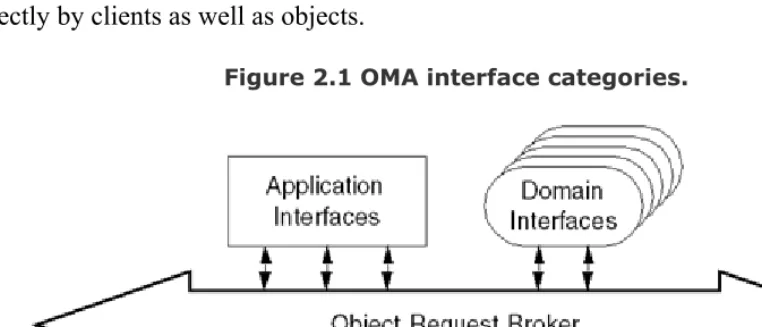
[image:26.612.78.459.443.606.2]The Reference Model provides interface categories that are general groupings for object interfaces. As Figure 2.1 shows, all interface categories are conceptually linked by an Object Request Broker (ORB). Generally, an ORB enables communication between clients and objects, transparently activating those objects that are not running when requests are delivered to them. The ORB also provides an interface that can be used directly by clients as well as objects.
Figure 2.1 OMA interface categories.
Figure 2.1 shows the interface categories that use the ORB's activation and communication facilities.
references. Object services are normally considered part of the core distributed computing infrastructure.
Domain Interfaces play roles similar to those in the Object Services category except that domain interfaces are domain-specific, or vertically oriented. For example, there are domain interfaces used in health care applications that are unique to that industry, such as a Person Identification Service [28]. Other interfaces are specific to finance, manufacturing, telecommunications, and other domains. The multiple Domain Interface bubbles in Figure 2.1 indicate this multiplicity of domains.
Application Interfaces are developed specifically for a given application. They are not standardized by the OMG. However, if certain application interfaces begin to appear in many different applications, they become candidates for standardization in one of the other interface categories.
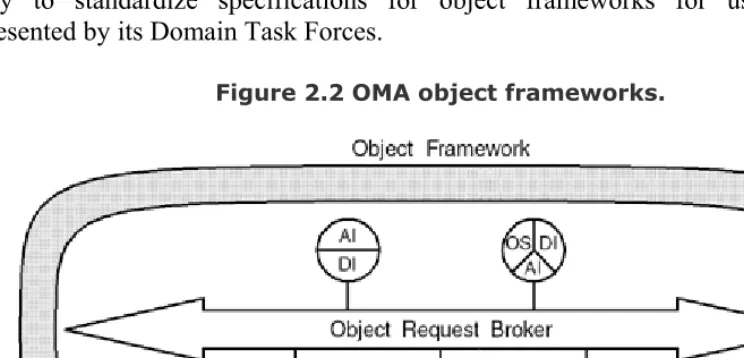
[image:27.612.86.458.486.665.2]As the OMG gradually populates the interface categories, the bulk of its standardization efforts will shift upward from the ORB infrastructure and Object Services levels into domain-specific object frameworks. The object framework concept, illustrated in Figure 2.2, builds from the interface categories just described, recognizing and promoting the notion that CORBA-based programs are composed of multiobject components supporting one or more of the OMA interface categories. Figure 2.2 represents these components as circles, some with only one interface category and others with multiple categories. Unfortunately, the term framework is overused in general, but used in this context it follows the classic definition of a software framework: a partial solution to a set of similar problems that requires application customization for completeness. The OMG is likely to standardize specifications for object frameworks for use in industries represented by its Domain Task Forces.
Figure 2.2 OMA object frameworks.
specifications, are devoted to exploring the effects and consequences of these seemingly simple models, so this is all we will say about them for now. See [31] for more details about the OMA and the OMG.
2.3 Concepts and Terminology
CORBA provides platform-independent programming interfaces and models for portable distributed object-oriented computing applications. Its independence from programming languages, computing platforms, and networking protocols makes it highly suitable for the development of new applications and their integration into existing distributed systems.
Like all technologies, CORBA has unique terminology associated with it. Although some of the concepts and terms are borrowed from similar technologies, others are new or different. Understanding these terms and the concepts behind them is key to having a firm grasp of CORBA itself. The most important terms in CORBA are explained in the following list.
A CORBA object is a "virtual" entity capable of being located by an ORB and having client requests invoked on it. It is virtual in the sense that it does not really exist unless it is made concrete by an implementation written in a programming language. The realization of a CORBA object by programming language constructs is analogous to the way virtual memory does not exist in an operating system but is simulated using physical memory.
A target object, within the context of a CORBA request invocation, is the CORBA object that is the target of that request. The CORBA object model is a single-dispatching model in which the target object for a request is determined solely by the object reference used to invoke the request.
A client is an entity that invokes a request on a CORBA object. A client may exist in an address space that is completely separate from the CORBA object, or the client and the CORBA object may exist within the same application. The term client is meaningful only within the context of a particular request because the application that is the client for one request may be the server for another request.
A server is an application in which one or more CORBA objects exist. As with clients, this term is meaningful only in the context of a particular request.
A request is an invocation of an operation on a CORBA object by a client. Requests flow from a client to the target object in the server, and the target object sends the results back in a response if the request requires one.
nor can they access or modify the contents of an object reference. An object reference refers only to a single CORBA object.
A servant is a programming language entity that implements one or more CORBA objects. Servants are said to incarnate CORBA objects because they provide bodies, or implementations, for those objects. Servants exist within the context of a server application. In C++, servants are object instances of a particular class.
The definitions of these terms will be refined in later chapters, but these definitions will be sufficient for understanding the CORBA features described in the next section.
2.4 CORBA Features
This section provides an overview of the following major features of CORBA: OMG Interface Definition Language
Language mappings
Operation invocation and dispatch facilities (static and dynamic) Object adapters
Inter-ORB Protocol
Figure 2.3 shows the relationships between most of these CORBA features, which we describe in the following sections. Later chapters cover each feature in much greater detail.
Figure 2.3 Common Object Request Broker Architecture (CORBA).
2.4.1 General Request Flow
The client can choose to make requests either using static stubs compiled into C++ from the object's interface definition (see Section 2.4.2) or using the Dynamic Invocation Interface (DII) (see Section 2.4.4). Either way, the client directs the request into the ORB core linked into its process.
The client ORB core transmits the request to the ORB core linked with the server application.
The server ORB core dispatches the request to the object adapter (see Section 2.4.5) that created the target object.
The object adapter further dispatches the request to the servant that is implementing the target object. Like the client, the server can choose between static and dynamic dispatching mechanisms for its servants. It can rely on static skeletons compiled into C++ from the object's interface definition, or its servants can use the Dynamic Skeleton Interface (DSI).
After the servant carries out the request, it returns its response to the client application. CORBA supports several styles of requests.
When a client invokes a synchronous request, it blocks while it waits for the response. These requests are identical to remote procedure calls.
A client that invokes a deferred synchronous request sends the request, continues processing, and then later polls for the response. Currently, this style of request can be invoked only using the DII.
CORBA also provides a oneway request, which is a best-effort request that may not actually be delivered to the target object and is not allowed to have responses. ORBs are allowed to silently drop oneway requests if network congestion or other resource shortages would cause the client to block while the request was delivered.
A future version of CORBA (very likely version 3.0) will also support asynchronous requests that can be used to allow occasionally connected clients and servers to communicate with one another. It will also add support for making deferred synchronous calls using static stubs as well as the DII.
The next few sections describe the CORBA components required to make requests and to get responses.
2.4.2 OMG Interface Definition Language
In CORBA, object interfaces are defined in the OMG Interface Definition Language (IDL). Unlike C++ or Java, IDL is not a programming language, so objects and applications cannot be implemented in IDL. The sole purpose of the IDL is to allow object interfaces to be defined in a manner that is independent of any particular programming language. This arrangement allows applications implemented in different programming languages to interoperate. The language independence of IDL is critical to the CORBA goal of supporting heterogeneous systems and the integration of separately developed applications.
OMG IDL supports built-in simple types, such as signed and unsigned integer types, characters, Boolean, and strings, as well as constructed types such as enumerated types, structures, discriminated unions, sequences (one-dimensional vectors), and exceptions. These types are used to define the parameter types and return types for operations, which in turn are defined within interfaces. IDL also provides a module construct used for name scoping purposes.
The following example shows a simple IDL definition:
interface Employee { long number(); };
This example defines an interface named Employee that contains an operation named number. The number operation takes no arguments and returns a long. A CORBA object supporting the Employee interface is expected to implement the number
operation to return the number of the employee represented by that object.
Object references are denoted in IDL by using the name of an interface as a type. For example:
interface EmployeeRegistry {
Employee lookup(in long emp_number); };
The lookup operation of the EmployeeRegistry interface takes an employee number as an input argument and returns an object reference of type Employee that refers to the employee object identified by the emp_number argument. An application could use this operation to retrieve an Employee object and then use the returned object reference value to invoke Employee operations.
Arguments to IDL operations must have their directions declared so that the ORB knows whether their values should be sent from client to target object, vice versa, or both. In the definition of the lookup operation, the keyword in signifies that the employee number argument is passed from the client to the target object. Arguments can also be declared
client. The inout keyword indicates an argument that is initialized by the client and then sent from the client to the target object; the object can modify the argument value and return the modified value to the client.
A key feature of IDL interfaces is that they can inherit from one or more other interfaces. This arrangement allows new interfaces to be defined in terms of existing ones, and objects implementing a new derived interface can be substituted where objects supporting the existing base interfaces are expected. For example, consider the following Printer
interfaces:
interface Printer { void print(); };
interface ColorPrinter : Printer {
enum ColorMode { BlackAndWhite, FullColor }; void set_color(in ColorMode mode);
};
The ColorPrinter interface is derived from the Printer interface. If a client application is written to deal with objects of type Printer, it can also use an object supporting the ColorPrinter interface because such objects also fully support the
Printer interface.
IDL provides one special case of inheritance: all IDL interfaces implicitly inherit from the Object interface defined in the CORBA module. This special base interface supplies operations common to all CORBA objects.
2.4.3 Language Mappings
Because OMG IDL is a declarative language, it cannot be used to write actual applications. It provides no control constructs or variables, so it cannot be compiled or interpreted into an executable program. It is suitable only for declaring interfaces for objects and defining the data types used to communicate with objects.
Language mappings specify how IDL is translated into different programming languages. For each IDL construct, a language mapping defines which facilities of the programming language are used to make the construct available to applications. For example, in C++, IDL interfaces are mapped to classes, and operations are mapped to member functions of those classes. Similarly, in Java, IDL interfaces are mapped to public Java interfaces. Object references in C++ map to constructs that support the operator-> function (that is, either a pointer to a class or an object of a class with an overloaded operator->
OMG IDL language mappings exist for several programming languages. As of this writing, the OMG has standardized language mappings for C, C++, Smalltalk, COBOL, Ada, and Java. Other language mappings exist as well—for example, mappings have also been independently defined for languages such as Eiffel, Modula 3, Perl, Tcl, Objective—C, and Python--but at this time they have not been standardized by the OMG. IDL language mappings are critical for application development. They provide concrete realizations of the abstract concepts and models supplied by CORBA. A complete and intuitive language mapping makes it straightforward to develop CORBA applications in that language; conversely, a poor, incomplete, or ineffective language mapping seriously hampers CORBA application development. Official OMG language mapping specifications therefore undergo periodic revision and improvement to ensure their effectiveness.
The existence of multiple OMG IDL language mappings means that developers can implement different portions of a distributed system in different languages. For example, a developer might write a high-throughput server application in C++ for efficiency and write its clients as Java applets so that they can be downloaded via the Web. The language independence of CORBA is key to its value as an integration technology for heterogeneous systems.
2.4.4 Operation Invocation and Dispatch Facilities
CORBA applications work by receiving requests or by invoking requests on CORBA objects. When the OMG originally issued its RFP for the technologies that eventually became the CORBA specification, two general approaches to request invocation were submitted.
Static invocation and dispatch In this approach, OMG IDL is translated into language-specific stubs and skeletons that are compiled into applications. Compiling stubs and skeletons into an application gives it static knowledge of the programming language types and functions mapped from the IDL descriptions of remote objects. A stub is a client-side function that allows a request invocation to be made via a normal local function call. In C++, a CORBA stub is a member function of a class. The local C++ object that supports stub functions is often called a proxy because it represents the remote target object to the local application. Similarly, a skeleton is a server-side function that allows a request invocation received by a server to be dispatched to the appropriate servant.
Developers writing applications in statically typed languages such as C++ usually prefer to use the static invocation approach because it provides a more natural programming model. The dynamic approach can be useful for applications, such as gateways and bridges, that must receive and forward requests without having compile-time knowledge of the types and interfaces involved.
2.4.5 Object Adapters
In CORBA, object adapters serve as the glue between servants and the ORB. As described by the Adapter design pattern [4], which is independent of CORBA, an object adapter is an object that adapts the interface of one object to a different interface expected by a caller. In other words, an object adapter is an interposed object that uses delegation to allow a caller to invoke requests on an object without knowing the object's true interface.
CORBA object adapters fulfill three key requirements.
They create object references, which allow clients to address objects. They ensure that each target object is incarnated by a servant.
They take requests dispatched by a server-side ORB and further direct them to the servants incarnating each of the target objects.
Without object adapters, the ORB would have to directly provide these features in addition to all its other responsibilities. As a result, it would have a very complex interface that would be difficult for the OMG to manage, and the number of possible servant implementation styles would be limited.
In C++, servants are instances of C++ objects. They are typically defined by deriving from skeleton classes produced by compiling IDL interface definitions. To implement operations, you override virtual functions of the skeleton base class. You register these C++ servants with the object adapter to allow it to dispatch requests to your servants when clients invoke requests on the objects incarnated by those servants.
Until version 2.1, CORBA contained specifications only for the Basic Object Adapter (BOA). The BOA was the original CORBA object adapter, and its designers felt that it would suffice for the majority of applications, with other object adapters filling only niche roles. However, CORBA did not evolve as expected because of the following problems with the BOA specification.
A number of critical features were missing from the BOA specification. Certain interfaces were not defined and there were no servant registration operations. Even those operations that were specified contained many ambiguities. ORB vendors developed their own proprietary solutions to fill the gaps, resulting in poor server application portability between different ORB implementations.
The Portability Enhancement RFP [27] issued by the OMG in 1995 to address these issues contained a seven-page listing of problems with the BOA specification.
CORBA version 2.2 introduced the Portable Object Adapter to replace the BOA. Because the POA addresses the full gamut of interactions between CORBA objects and programming language servants while maintaining application portability, the quality of the POA specification is vastly superior to that of the BOA. As a result, the BOA specification has been removed from CORBA. We provide detailed coverage of the POA in Chapter 11.
2.4.6 Inter-ORB Protocols
Before CORBA 2.0, one of the most common complaints lodged against CORBA was its lack of standard protocol specifications. To allow remote ORB applications to communicate, every ORB vendor had to develop its own network protocol or borrow one from another distributed system technology. This resulted in "ORB application islands." Each one was built over a particular vendor's ORB, and thus they were unable to communicate with one another.
CORBA 2.0 introduced a general ORB interoperability architecture called the General Inter-ORB Protocol (GIOP, pronounced "gee-op"). GIOP is an abstract protocol that specifies transfer syntax and a standard set of message formats to allow independently developed ORBs to communicate over any connection-oriented transport. The Internet Inter-ORB Protocol (IIOP, pronounced "eye-op") specifies how GIOP is implemented over Transmission Control Protocol/Internet Protocol (TCP/IP). All ORBs claiming CORBA 2.0 interoperability conformance must implement GIOP and IIOP, and almost all contemporary ORBs do so.
2.5 Request Invocation
Clients manipulate objects by sending messages. The ORB sends a message to an object whenever a client invokes an operation. To send a message to an object, a client must hold an object reference for the object. The object reference acts as a handle that uniquely identifies the target object and encapsulates all the information required by the ORB to send the message to the correct destination.
When a client invokes an operation via an object reference, the ORB does the following: Locates the target object
Activates the server application if the server is not already running Transmits any arguments for the call to the object
Activates a servant for the object if necessary Waits for the request to complete
Returns any out and inout parameters and the return value to the client when the call completes successfully
Returns an exception (including any data contained in the exception) to the client when the call fails
The entire request invocation mechanism is completely transparent to the client, to whom a request to a remote object looks like an ordinary method invocation on a local C++ object. In particular, request invocation has the following characteristics.
Location transparency The client does not know or care whether the target object is local to its own address space, is implemented in a different process on the same machine, or is implemented in a process on a different machine. Server processes are not obliged to remain on the same machine forever; they can be moved around from machine to machine without clients becoming aware of it (with some constraints, which we discuss in Chapter 14).
Server transparency The client does not need to know which server implements which objects.
Language independence The client does not care what language is used by the server. For example, a C++ client can call a Java implementation without being aware of it. The implementation language for objects can be changed for existing objects without affecting clients.
Architecture independence The client is unaware of the CPU architecture that is used by the server and is shielded from such details as byte ordering and structure padding.
Operating system independence The client does not care what operating system is used by the server. The server may even be implemented without the support of an operating system—for example, as a real-mode embedded program.
Protocol independence The client does not know what communication protocol is used to send messages. If several protocols are available to communicate with the server, the ORB transparently selects a protocol at run time.
Transport independence The client is ignorant of the transport and data link layer used to transmit messages. ORBs can transparently use various networking technologies such as Ethernet, ATM, token ring, or serial lines.
2.5.1 Object Reference Semantics
Object references are analogous to C++ class instance pointers but can denote objects implemented in different processes (possibly on other machines) as well as objects implemented in the client's own address space. Except for this distributed addressing capability, object references have semantics much like ordinary C++ class instance pointers have.
Every object reference identifies exactly one object instance. Several different references can denote the same object. References can be nil (point nowhere).
References can dangle (like C++ pointers that point at deleted instances). References are opaque (the client is not allowed to look at their contents). References are strongly typed.
References support late binding. References can be persistent. References can be interoperable.
These points deserve further explanation because they are central to the CORBA object model.
Each reference identifies exactly one object.
An object can have several references.
Several different references can denote the same object. In other words, each reference "names" exactly one object, but an object is allowed to have several names.
If you find this strange, remember that the same thing can happen in C++. A C++ class instance pointer denotes exactly one object, and the pointer value (such as 0x48bf0) identifies that object. However, as shown in [15], multiple inheritance can cause a single C++ instance to have as many as five different pointer values.
The situation is similar in CORBA. If two object references have different contents, it does not necessarily mean that the two references denote different objects. It follows that an object reference is not the same as an object's identity. This has profound implications for the design of object systems, and we explore some of these implications in Sections 7.11.3 and 20.3.2.
References can be nil.
CORBA defines a distinguished nil value for object references. A nil reference points nowhere and is analogous to a C++ null pointer. Nil references are useful for conveying "not found" or "not there" semantics. For example, an operation can return a nil reference to indicate that a client's search for an object did not locate a matching instance. Nil references can also be used to implement optional reference parameters. Passing a nil value at run time indicates that the parameter is "not there."
References can dangle.
After a server has passed an object reference to a client, that reference is permanently out of the server's control and can propagate freely via means invisible to the ORB (for example, as a string carried by e-mail). This means that CORBA has no built-in automatic mechanism for the server to inform a client when the object belonging to a reference is destroyed. Similarly, there is no built-in automatic way for a client to inform a server that it has lost interest in an object reference. This does not mean that you cannot create such semantics if your application requires them; it means only that CORBA does not provide these semantics as built-in features.
To find out whether an object reference still denotes an existing object, a client can invoke the non_existent operation, which is supported by all objects.
References are opaque.
representation of an object reference. Instead, they must treat an object reference as a black box that can be manipulated only through a standardized interface.
The encapsulation of object references is a key aspect of CORBA. It lets you add new features, such as different communication protocols, over time without breaking existing source code. In addition, vendors can use the proprietary part of object references to provide value-added features, such as performance optimizations, without compromising interoperability with other ORBs.
References are strongly typed.
Every object reference contains an indication of the interface supported by that reference. This arrangement allows the ORB run time to enforce type safety. For example, an attempt to send a print message to an Employee object (which does not support that operation) is caught at run time.
For statically typed languages such as C++, type safety is also enforced at compile time. The language mapping does not permit you to invoke an operation unless the target object is guaranteed to offer that operation in its interface. (This is true only if you are using the generated stubs to invoke operations. If you are using the Dynamic Invocation Interface, static type safety is necessarily lost.)
References support late binding.
Clients can treat a reference to a derived object as if it were a reference to a base object. For example, assume that the Manager interface is derived from Employee. A client may actually hold a reference to a Manager but may think of that reference as being of type Employee. As in C++, a client cannot invoke Manager operations via an
Employee reference (because that would violate static type safety). However, if a client invokes the number operation via the Employee reference, the corresponding message is still sent to the Manager servant that implements the Employee interface.
This arrangement is exactly analogous to C++ virtual function calls: invoking a method via a base pointer calls the virtual function in the derived instance. One of the major advantages of CORBA, compared with traditional RPC platforms, is that polymorphism and late binding work for remote objects exactly as they do for local C++ objects. This means that there is no artificial wall through your architecture in which you must map an object-oriented design onto a remote procedure call paradigm. Instead, polymorphism works transparently across the wire.
References can be persistent.
References can be interoperable.
CORBA specifies a standard format for object references. This means that one ORB can use references created by a different vendor's ORB, whether they are exchanged as parameters or as strings. For that reason, these standard object references are also known as Interoperable Object References, as we explained in Section 2.4.6.
Note that in addition to the standard IOR format, an ORB can provide proprietary reference encodings. This capability can be useful if an ORB is tailored for a particular environment, such as an object-oriented database. However, proprietary references cannot be exchanged with ORBs from a different vendor.
2.5.2 Reference Acquisition
Object references are the only way for a client to reach target objects. A client cannot communicate unless it holds an object reference. How, then, does a client obtain references (the client must have at least one reference to start with)? We address this bootstrapping issue in Chapter 18. For now, it is sufficient to say that references are published by servers in some way. For example, a server can
Return a reference as the result of an operation (as the return value or as an inout or
out parameter)
Advertise a reference in some well-known service, such as the Naming Service or Trading Service
Publish an object reference by converting it to a string and writing it into a file
Transmit an object reference by some other out-of-band mechanism, such as sending it in e-mail or publishing it on a Web page
By far the most common way for a client to acquire object references is to receive them in response to an operation invocation. In that case, object references are parameter values and are no different from any other type of value, such as a string. Clients simply contact an object, and the object returns one or more object references. In this way, clients can navigate an "object web" in much the same way as following hypertext links.
Clients use other methods to acquire object references only rarely. For example, the lookup of a reference in a Trader or the reading of an object reference from a file typically happens only during bootstrapping. After the client has the first few object references, it uses them to acquire more references to other objects by invoking operations.