Developments in
Dynamic Field Gradient Focusing:
Microfluidics and Integration
Thesis submitted in accordance with the requirements of the
University of Liverpool for the degree of Doctor in Philosophy
by
Thomas Robert Wray
i
Acknowledgements
I would like to express my thanks to my supervisor Professor Peter Myers for his
excellent guidance and ideas throughout this project and most importantly for all of
the real ale and granting me the opportunity to undertake this project.
Thanks are also extended to all the members of the Myers group particularly fellow
PhD student Dr Kevin Skinley for making the lab a great place to work.
I would also like to thank Thermo Fisher Scientific for sponsoring the DTA awards
and providing funding for this research through Dr Harold Ritchie. Thanks also go
to Pfizer for providing further funding through Dr Melissa Hannah-Brown.
I also thank all of the staff within the University Of Liverpool Department Of
Chemistry for any support over all of my time studying here.
For collaborations during the project I would like to thank Dr Tony Edge and his
team from Thermo Fisher Scientific and Dr Jetinder Singh and David Atkinson from
the University Of Liverpool Department Of Engineering.
I am grateful to my family for all of their support and understanding during all of
my studies. A big thanks to all my friends, especially everyone at the BKJJA, for all
of their enduring encouragement.
Special thanks go to my partner Kate for all of her continued support and always
being there for me, helping me through the hard times and making the good times
the best. Thanks to Kate, I have got to where I am now which I couldn’t have done
ii
Developments in
Dynamic Field Gradient Focusing:
Microfluidics and Integration
Abstract
By Thomas Robert Wray,
University of Liverpool, August 2012
Advances in modern science require the development of more robust and improved
systems for electroseparations in chromatography. In response, the progress of a
new analytical platform is discussed. DFGF (Dynamic Field Gradient Focusing) is a
separation technique, first described in 1998, which exploits the differences in
electrophoretic mobility and hydrodynamic area of analytes to result in separation.
This is achieved by taking a channel and applying a hydrodynamic flow in one
direction and a counteracting electric field gradient acting in the opposite direction,
resulting in analytes reaching a focal point according to their electrophoretic
mobility.
Work through this project has seen innovations to improve existing DFGF devices,
including the design and manufacture of a novel packing material, while
developing the latest DFGF system. This incorporates a microfluidic separation
channel, eliminating the need for packing material or monolith. The new
microfluidic device also features whole-on-column UV detection. Improvements
through the developments of this device are discussed, most notably the utilisation
of a new rapid prototyping technique. Examples of applications undertaken with
the new device are demonstrated including novel samples and integration with
iii
Contents
Acknowledgements i
Abstract ii
Table of Contents iii
List of Tables vii
List of Figures ix
1. Introduction 1
1.1 Background 1
1.2 Separation of Proteins 4
1.2.1 Chromatographic Protein Separation Techniques 5
1.2.2 Electrophoretic Protein Separation Techniques 9
1.2.3 Electrofocusing Techniques 10
1.3 References 15
2. DFGF 18
2.1 Theory 18
2.2 DFGF Set Up 21
2.2.1. DFGF Configuration 22
2.2.2. Packing Method 23
2.2.3. General Operation 25
2.2.4. Dynamic Flow Control: Flux Instruments Rheos Pumps and
Janeiro 3.0 25
2.2.5. Dynamic Electric Field: Power Supply and Control 27
2.2.6. Data collection and presentation 30
2.3. Experimental with First Generation Device 35
2.3.1. First generation DFGF Device 35
2.3.2 Separation of two component test mixture: Bromophenol Blue
and Amaranth 35
2.3.3 Separations of the Bio-Rad Kaleidoscope pre-stained
iv
2.4 Experimentation with the Protasis DFGF device 47
2.4.1 The Protasis DFGF device: An Overview 47
2.4.2 Protasis Experimentation with a single analyte 48
2.4.3 Protasis separation of a two component test mixture 48
2.4.4 Protasis separation of Bio-Rad Kaleidoscope pre-stained
standards test mixture 49
2.5 Discussion 55
2.6 Novel packing material for DFGF 59
2.6.1 Development of Particles for DFGF 59
2.6.2 Procedure for manufacture of macroporous monodispersed
spherical silica 60
2.6.3 Droplet Generation 61
2.6.3.1 Fused Silica Tubing and a pump 61
2.6.3.2 Spraying with water misters and pneumatic sprayer 62
2.6.3.3 Inkjet and Domino Printer controlled droplet generation 64
2.6.4 Testing the particles with Gas Chromatography 69
2.6.5 DFGF experimentation with 80µm Silica particles 72
2.6.5.1 Packing the DFGF with the 80µm Silica particles 72
2.6.5.2 DFGF separations with novel packing material 74
2.7 Conclusions 81
2.8 References 85
3. Microfluidic DFGF 87
3.1 Microfluidics 87
3.2 The New Microfluidic DFGF 88
3.2.1 Microfluidic DFGF design 88
3.2.2 DFGF Quartz Chip 89
3.2.3 The microfluidic DFGF device design 92
3.3 Experimental 94
3.3.1 Integration with power supply 94
3.3.2 Microfluidic DFGF -Instructions for Use 96
3.3.3 First Separation using the microfluidic DFGF 97
3.3.4 Electrode decomposition, New Gold electrodes 100
v
3.3.6 Separation using lower voltages 108
3.3.7 Sample leakage issues 111
3.3.8 Rapid Prototyping (RP) 122
3.3.9 Stereolithography Rapid Prototyping 122
3.3.10 RP Mask for Electrode Manufacture 124
3.3.11 RP Modified Electrode channels 128
3.3.12 Testing with the 100µm Electrode Channel 132
3.3.13 Testing with the 200µm Electrode Channel 134
3.3.14 PDA Detection 143
3.4 Conclusions 154
3.5 References 157
4. Applications using the microfluidic DFGF 159
4.1 DFGF Applications 159
4.2 Functionalised Gold Nano Particle Separation 159
4.2.1 Gold Nano Particle separation in a packed column using the
first gen. DFGF 161
4.2.2. Microfluidic DFGF GNP Separation 165
4.3 Post column Detection 170
4.3.1 Capacitively Coupled Contactless Conductivity Detection
(C4D) 171
4.3.2 Microfluidic DFGF post column detection 171
4.3.3 Results with all detection 175
4.4 Applications with Analytical Instrumentation 191
4.4.1. 2D-HPLC 191
4.4.2 HPLC-DFGF-MS: Single Valve Work 192
4.4.2 2D-HPLC: Dual Valve Set Up 199
4.5 Conclusions 206
4.6 References 211
5. Final Conclusions 212
5.1 Conclusions 212
5.2 Further work 217
vi
Appendix 225
Appendix A. List of Abbreviations 225
Appendix B. Protasis voltage array and control software 228
Appendix C. ImageJ Visual Basic script 247
Appendix D. VBA MS Excel based system for graph generation 248
Appendix E. First generation DFGF construction 251
Appendix F. LabView C4D and UV DAQ System 252
vii
List of Tables
Table 1.1. Summary of the properties of purification techniques utilised for proteins. 4
Table 2.3.1. Kaleidoscope Pre-Stained Standards Test Mixture. 40
Table 2.3.2. Voltage profile for Kaleidoscope separation in figure 2.3.8. 45
Table 2.4.1. Summary of voltage profiles used to separate 40µL Kaleidoscope mixture. 50
Table 2.4.2. EFG and flow rates applied to separate the Kaleidoscope mixture in figure 2.4.5.
54
Table 2.6.2. Particles manufactured using the hand spray and pneumatic spray. 63
Table 2.6.3. EFG Applied to separate the mixture of BPB and AM. 76
Table 2.6.4. Experimental conditions applied to the device to separate the Kaleidoscope test mixture with the monodispersed packing material.
79
Table 3.3.1. Summary of conditions for a microfluidic DFGF test separation of BPB and AM.
98
Table 3.3.2. Conditions for the separation of BPB, AM and AY in figure 3.3.9. 105
Table 3.3.3. Conditions used to result in the focusing of the 3 component mixture of AM and BPB and Acid Yellow.
109
Table 3.3.4. Experimental parameters for the separation of 5µL of 10% BPB AM and AY test mixture.
112
Table 3.3.5. Conditions for the separation of the Bio-Rad Kaleidoscope Pre-stain Standards in figure3.3.16.
120
Table 3.3.6. Conditions used to separate AM and BPB testing the 200µm electrode channel.
136
Table 3.3.7. Optimised Microfluidic DFGF device. 138
viii Table 3.3.9. Table of voltage profiles and flow rates for the repeat separation of the
kaleidoscope test mixture using the optimised microfluidic DFGF.
142
Table 3.3.10. Summary of controlling parameters and features available in data acquisition from the PDA using the bespoke software.
144
Table 3.3.11. Optimum PDA Detection parameter using the LCD backlight. 149
Table 3.3.12. Separation of the kaleidoscope mixture detected with the PDA detectorin
figure 3.3.35.
150
Table 3.3.13. UV light source stability issues. 154
Table 4.2.1. Voltage profiles and flow rates applied to separate the functionalised GNPs. 162
Table 4.2.2. Parameters used in separating the GNPs in the microfluidic DFGF. 168
Table 4.3.1. Optimal conditions for detection by C4Dfromthe profiling for BPB. 173
Table 4.3.2. Changes in EFG for the separation of AM and BPBin figure 4.3.8. 182
Table 4.3.3. Conditions for the separation of AM and BPB monitored by C4D and UV.
The detection data is shown in figure4.3.9.
184
Table 4.3.4. Conditions for repeat separation of the Kaleidoscope proteins in figure 4.3.11.
187
Table 4.4.1. Timings for the application of the EFG in the microfluidic device during 2D method.
ix
List of Figures
Figure 1.1.1. Protein structure of Lysozyme. 3
Figure 1.2.1. Configuration of the EFGF device. 13
Figure 2.1.1. Theoretical model for DFGF. 19
Equation 2.1.1. The Flux equation. 19
Equation 2.1.2. The flux equation solved for C, where Mi is the total number of moles
of analyte.
19
Equation 2.1.3. Χi defines a point along the length of the separation channel where an
analyte will come into focus.
20
Equation 2.1.4. Variance of the width of a focused band of analyte. 20
Figure 2.2.1. DFGF Set Up and supporting equipment. 21
Figure 2.2.2. DFGF Channel Configuration. 22
Figure 2.2.3. DFGF packing apparatus. 24
Figure 2.2.4. Flux Instruments Rheos Janeiro 3.0 software. 26
Figure 2.2.5. Protasis Power supply schematic. 27
Figure 2.2.6. Protasis UController HV Control Software. 28
Figure 2.2.7. An example of a linear EFG generated by the Labview Protasis Ucontroller software in Automatic Mode.
x Figure 2.2.8. An example of the EFGs which can be applied by the Labview
Ucontroller software in Manual Mode.
30
Figure 2.2.9. A) Nikon D80 with a 60mm 1:2.8D macro lens configured to take images of the separation channel with the addition of a LED ring illuminator. B) Nikon Camera Control Pro software user interface.
31
Figure 2.2.10. A) Detection using GIMP to subtract images highlighting any changes in the positions of analytes with a corresponding profile measurement. B) Next a
profile plot is generated using ImageJ, in this instance, FIJI16, a rich featured version
of ImageJ.
32
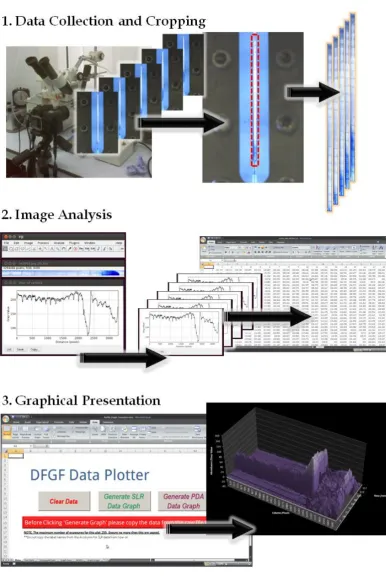
Figure 2.2.11. 1) Data Interpretation. 2) The cropped image stack is loaded into ImageJ and all the profiles are measured. 3) This data was loaded into the MS Excel ‘Profile Generator’ producing a graph of the separation.
34
Figure 2.3.1. Structure of Bromophenol Blue (BPB) 4,4'-(1,1-dioxido-3H-2,1-benzoxathiole-3,3-diyl)bis(2,6-dibromophenol).
35
Figure 2.3.2. Structure of Amaranth (AM) trisodium (4E)-3-oxo-4-[(4-sulfonato-1-naphthyl)hydrazono]naphthalene-2,7-disulfonate.
36
Figure 2.3.3. Separation and focusing of Bromophenol Blue (BPB) and Amaranth (AM).
37
Figure 2.3.4. Injection of BPB with a static linear EFG. 38
Figure 2.3.5. BPB focusing as shown in the form of a Montage. Constructed by taking the cropped images and stacking them in order.
39
Figure 2.3.6. Kaleidoscope bands migrating back and forth along the separation channel in a focused band of the protein mixture.
41
Figure 2.3.7. A) Graphical representation of kaleidoscope mixture focused in the first gen. device. B) Montage of the images displaying the movement of the bands along the separation channel.
42
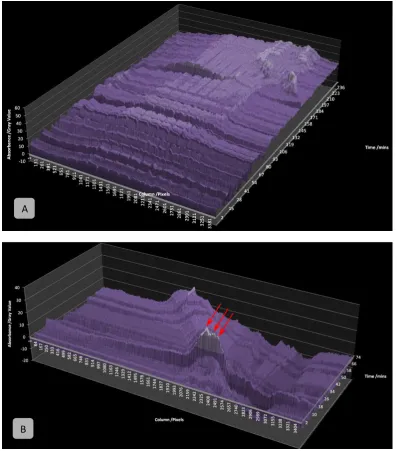
Figure 2.3.8. A) ‘Run1’ From Table2.3.2 Displaying the kaleidoscope test mixture being manipulated in the separation channel. B) ‘Run2’ From Table2.3.2 An immediate follow up experiment injecting the sample and focusing again. Three separated bands can be seen in the plot.
46
xi Figure 2.4.2. More than 20µL of 10%v/v Lissamine green solution being injected and
focused into a tight band.
48
Figure 2.4.3. A mixture of Amaranth and BPB separated and focused. 49
Figure 2.4.4. A) Graphical representation of the separation of 40µL Kaleidoscope mixture. B) Single plot at 147mins displaying at least four bands.
51
Figure 2.4.5. The separation of Kaleidoscope test mixture displayed graphically. Five component peaks are observed during the separation.
54
Figure 2.5.1. LEFT: Displays the Protasis device. RIGHT: top area of separation channel with the blemishing of the acrylic after running at the maximum 1000V without cooling.
57
Figure 2.5.2.Optical Microscope image of polyacrylamide packing material in DFGF channel. Void spaces and irregular interstitial spacing are visible across the entire bed.
58
Figure 2.5.3. Left to right, images displaying a bed rearrangement leading to the collapse of the membrane.
59
Figure 2.6.1. Drop generator system. 62
Figure 2.6.2. Printer Head of the Domino printer. 65
Figure 2.6.3. Optimal ‘Break Up’ of droplets from the spray head on the Domino printer.
66
Figure 2.6.4. Spraying monodispersed particles using the modified Domino printer. 67
Figure 2.6.5. Mercury Porosimetry of the 80µm silica particles. 68
Figure 2.6.6. SEM images of the drop by drop 80µm silica particles. 69
Figure 2.6.7. Optical microscopy of the packed GC column. 70
Figure 2.6.8. GC separation of Petroleum Ether and DCM at 60°C using the 1.2m column packed with 80µm silica.
xii Figure 2.6.9. FTIR analysis of the 80µm particles before and after treatment at
1000°C.
72
Figure 2.6.10. First Gen. DFGF packed with 80µm porous silica particles. 73
Figure 2.6.11. A) Graphical representation of a flow through of 10% BPB AM
mixture at 1µLmin-1. B) Montage of images displaying the mixture as purple in
colour, showing no derivation of red or blue corresponding to BPB or AM.
75
Figure 2.6.12. Separation of BPB and AM in a faster time utilising the larger pore monodispersed packing material.
77
Figure 2.6.13. A) Graph of the separation of the Kaleidoscope test mixture. B) Montage of the Kaleidoscope separation.
80
Figure 3.2.1. Initial design of a microfluidic DFGF from Dolomite. 89
Figure 3.2.2. Design of the Microfluidic DFGF separation channel chip and electrode chip.
90
Figure 3.2.3. Microfluidic DFGF device exploded view. 91
Figure 3.2.4. Microfluidic DFGF device design summary. 93
Figure 3.3.1. Prototype Electrode connector made from IDC connector. 94
Figure 3.3.2. A) Microfluidic DFGF Electrode Connector. B) Connector inserted in the recess at the back of the microfluidic DFGF. C) All HV connections in place using IDC connectors.
95
Figure 3.3.3. Dolomite User Guide for the microfluidic DFGF. 96
Figure 3.3.4. Initial Separation of BPB and AM with the microfluidic DFGF. 99
Figure 3.3.5. Severe degradation of the platinum electrodes on the microfluidic DFGF electrode chip.
100
xiii
Figure 3.3.7. Gold electrode array on an existing electrode chip. 102
Figure 3.3.8. Completed gold electrode array and chip holder base with fixed connector.
103
Figure 3.3.9. The molecular structure of Acid Yellow, Disodium 2,5-dichloro-4-[3-methyl-5-oxo-4-(4-sulfonatophenyl)diazenyl-4H-pyrazol-1-yl]benzenesulfonate.
104
Figure 3.3.10. Separation and focusing of BPB, AM and AY. 107
Figure 3.3.11. A) Graphical representation of the focusing of the 3 component mixture of AM and BPB and Acid Yellow. B) Image of the separation channel of the focused band where it is apparent that some of the sample has leaked from the separation channel.
110
Figure 3.3.12. Graph showing the separation and focusing of a 5µL injection of the BPB AM and AY.
113
Figure 3.3.13. Membrane from experiment in figure 3.3.11. 114
Figure 3.3.14. Enlarged cross section of the microfluidic DFGF detailing the issue with the channel dimensions and leakage issue.
116
Figure 3.3.15. Prototype Teflon insert to provide a narrower electrode channel and better support for the membrane in comparison to the original PEEK electrode channel and gasket.
117
Figure 3.3.16. Prototype Platinum Electrodes on a plastic chip with holes drilled for the flow of electrode channel buffer and an IDC connector to interface with the Protasis Power Supply.
118
Figure 3.3.17. Separation and focusing of the Bio-Rad Kaleidoscope test mixture in the microfluidic DFGF using the prototype platinum electrode array and prototype Teflon electrode channel.
121
Figure 3.3.18. Schematic displaying the setup of Stereolithography Apparatus. 123
Figure 3.3.19. Electrode chip mask design drawn in CAD software. 125
xiv
Figure 3.3.21. Decomposed PVD electrodes after 20mins at 200Vcm-2. 127
Figure 3.3.22. Final Electrode chip. Houses five platinum electrodes on a glass chip with IDC connector.
127
Figure 3.3.23. A, B & C) ‘Gasket Holder’ drawn in CAD ready for SLA manufacture. Top, Base, and Front elevations respectively. D) Manufacture of ‘Gasket Holder’ using SLA RP.
128
Figure 3.3.24. Cross section schematics of the ‘Gasket Holder’ with channel widths of 100µm and 200µm respectively.
130
Figure 3.3.25. A) This graph displays the need to collect images at a shorter time intervals as the analyte comes into focus seemingly instantaneously where this effect in actual is a gradual phenomenon. B) The montage also displays this as the AM and BPB are observed.
132
Figure 3.3.26. Separation of BPB and AM using 100µm electrode channel. 133
Figure 3.3.27. Graph of separation using the 200µm electrode channel. 136
Figure 3.3.28. Separation of Kaleidoscope test mixture displaying a region of focused proteins.
140
Figure 3.3.29. Separation of the kaleidoscope test mixture using the optimised microfluidic DFGF with enhanced imaging.
142
Figure 3.3.30. Toshiba TC101 PDA Detector. 144
Figure 3.3.31. PDA Software user interface with option to collect single samples or collect a sequence which are stored in the capture buffer before writing to a *.CSV file.
144
Figure 3.3.32. PDA DFGF configuration using ambient light. Left: Image illustrates the setup. Right: Cross section of the chip and the PDA.
145
Figure 3.3.33. PDA detector graph showing three peaks corresponding to the three markers on the separation channel.
146
Figure 3.3.34. PDA Light sources. 148
xv Figure 3.3.36. Test displaying the introduction of a Test mixture into the separation
channel.
152
Figure 4.2.1. CPS Analysis of the functionalised GNPs. 160
Figure 4.2.2. Graphical representation and Montage of the separation of the functionalised GNPs in the first gen. DFGF device.
163
Figure 4.2.3. SEM of the packing material from the band 40mm along the channel displaying singular GNPs on the surface of the polyacrylamide spheres.
164
Figure 4.2.4. SEM of the packing material from the band 55mm along the channel displaying aggregates of the GNPs on the surface of the polyacrylamide spheres.
165
Figure 4.2.5. Graphical representation of the open channel microfluidic DFGF separation of the GNPs.
168
Figure 4.2.6. Image of the separation channel with the GNP’s separated from the aggregates.
169
Figure 4.3.1. UV and C4D set up. 172
Figure 4.3.2. Profile of condition for C4D detection of BPB. 173
Figure 4.3.3. Labview DAQ System for C4D and UV detectors. 174
Figure 4.3.4. The first data successfully collected from the DAQ system showing a flat base line for each detector.
175
Figure 4.3.5. Graphical representation of the whole column reflectance data displaying the BPB moving through the microfluidic DFGF.
177
Figure 4.3.6. BPB injected and brought into focus and detected. 178
Figure 4.3.7. Elution detection from the microfluidic DFGF separation of AM and BPB.
179
Figure 4.3.8. Separation of AM and BPB with post column detection. 183
Figure 4.3.9. Separation of AM and BPB over three injection with C4D and UV
detection.
xvi Figure 4.3.10. Post separation channel detection for the separation of kaleidoscope test
mixture in chapter three figure3.3.28.
185
Figure 4.3.11. Graph displaying the PDA data for the separation of the kaleidoscope
test mixture with C4D and UV detection.
188
Figure 4.3.12. Post separation channel detection for the separation of the Kaleidoscope test mixture described in chapter three figure33.34.
190
Figure 4.4.1. HPLC-DFGF-MS Set up. 193
Figure 4.4.2. Injection of insulin pumped at 100uLmin-1 without applied electric field. 194
Figure 4.4.3. Injection of insulin pumped at 100uLmin-1 with the electric field applied
between 1min and 6.5min with 1000V on each electrode.
195
Figure 4.4.4. Overlaid chromatograms from the test injection of insulin with and without the use of the electric field.
195
Figure 4.4.5. Injection and flow through of the sample without a column at 2μLm-1
with no electric field applied.
197
Figure 4.4.6. Injection and flow through of the sample without a column at 2μLm-1
with an electric field applied from 0mins until the end of the run.
197
Figure 4.4.7. Overlaid chromatograms for focusing effect without a column in place. 198
Figure 4.4.8. Integration of the microfluidic DFGF with a 2D HPLC valve switching array.
199
Figure 4.4.9. Switching valve positions and flow of sample for the DFGF assisted 2D HPLC procedure.
202
Figure 4.4.10. The DFGF assisted 2D HPLC procedure running without the use of the EFG for comparison.
203
Figure 4.4.11. Chromatogram from the DFGF assisted 2D HPLC separation with the EFG in operation.
204
Figure 4.4.12. Overlaid chromatograms from the DFGF assisted 2D HPLC separations with and without the pre-concentration of the electric field.
205
1
Chapter
1
. Introduction
1.1 Background
Advancements in cellular research and the completion of the human genome
project have driven the demand on the analysis of biomacromolecules to reach a
point outstretching current abilities. As the coding of human and other genomes
are now understood, the next step is to identify and characterise specific proteins
and determine which processes and pathways regulate their production at a cellular
level. For the last decade many chromatographic techniques have been extensively
developed but still fail to deliver the efficiency and selectivity required for
separations and purification of proteins in the areas of biological, medical and
physical sciences. This can be attributed to proteins themselves being a challenging
matrix for separation.
Proteins are the most abundant macromolecules occurring naturally. These
macromolecules range from small peptides to massive polymers and are found in
thousands of diverse forms. These varieties of proteins, regardless of origin, are
made up from the same twenty standard amino acids. Despite twenty fundamental
building blocks the range of proteins and their application in organisms is vast.
From the silk from spiders, feathers of a bird, poisons in mushrooms, to more
specific and novel proteins namely Enzymes. Enzymes, all of which being proteins,
are the most diverse and specialised1.
There are twenty amino acid components which are composed of a primary amine
(-NH3+), a carboxylic acid (-COOH) group bonded to a central alpha carbon, and a
2 However, there is one exception to this general structure, namely proline, which has
a secondary cyclic amine and is therefore characterised as an imino acid2. A protein
itself is formed by linking different combinations of these side chains by a covalent
peptide bond formed between the amino group of one, and the alpha carbon of the
next amino acid. This gives proteins their characteristic of having a rigid back bone,
from planner peptide groups, and suspended side chains.
As a result of this complicated macromolecular arrangement, a proteins structure is
described in terms of four levels of intricacy1. The primary structure of a protein is
the linear chain of amino acids linked by the covalent peptide bonds. Also included
in the primary structure are other covalent bonds such as disulphide bonds from
cysteine residues that are in close proximity but not part of the linear chain.
The secondary protein structure is dependent on the nature of ‘folding’ within
sections of the polypeptide chain. Protein folding is a rearrangement in space of the
polypeptide structure into a lower energy conformation.
There are two common types of folding, α-helix and β-pleated sheets. The
formation of an α-helix is a result of the carbonyl oxygen of each peptide bond
hydrogen bonding to the hydrogen of the amino group of the amino acid four units
along the chain. These bonds run parallel to the axis of helix and depending on the
interactions of the amino acid R-groups this conformation can be stabilised or
destabilised. The β-pleated sheets occur where polypeptide bonds, from the same
chain or different chains, have hydrogen bonds between them. This bonding is
planer and has a slight twist which in some cases can result in a β-barrel2.
The tertiary structural elements of proteins refer to the three-dimensional
3 For example, when introduced to water, a protein will fold as to expose the
hydrophilic elements of the chain and protect the hydrophobic species.
Interestingly, once the protein has folded in its natural media it is held in place by
electrostatic interaction of the side chains and by hydrogen bonding with the
disulphides.
Quaternary protein structures are where proteins are made up of more than one
polypeptide chains. This therefore refers to the spatial arrangement of different
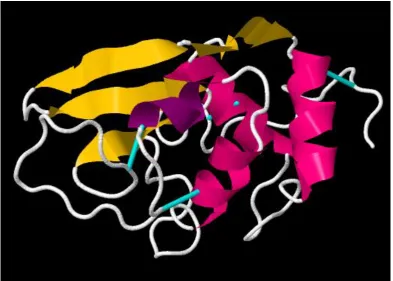
[image:21.595.123.517.347.628.2]polypeptide units and the interactions between them.
4 1.2 Separation of Proteins
These different elements of the proteins structure generate a number of properties
which can be exploited to result in successful and efficient separations and
purification. A summary of the most common methods of purification techniques
and the properties exploited are listed in table 1.1 below.
Technique Property
Exploited Capacity Resolution Yield Cost
pH
precipitation Charge High Very Low Medium Low
Ammonium sulphate precipitation
Hydrophobicity High Very Low High Low
Aq. Two phase extraction
Mixture,
Bip-Affinity High Very Low High Low
Ion exchange
chromatography Charge Medium Medium Medium Medium
Hydrophobic interaction chromatography
Hydrophobicity Medium Medium Medium Medium
Isoelectric
focusing Charge/ pI Low High Medium High
Dye Affinity
chromatography Mixture Medium High Medium Medium
Ligand affinity
chromatography Bio-Activity
Medium-
Low Very High Low High
Size Exclusion
Chromatography Size
Very
Low Low High Medium
Table 1.1. Summary of the properties of purification techniques utilised for proteins3.
Common procedures for the purification of proteins will include a number of steps
5 Initially, the most important factors are a high capacity and low cost to yield the
highest volume of protein from its source.
After this, or additional steps, the resolution is most important to enable the
determination and identification of individual proteins from a complex mixture.
There are many existing methods for a range of separation techniques which are
applicable to proteins. These can be described as two types of technique. Firstly,
chromatographic techniques where separation occurs by partitioning between the
mobile and stationary phase. Secondly, electrophoretic separations where electric
fields are used to mobilise individual proteins to unique points within a gel or
channel.
1.2.1 Chromatographic Protein Separation Techniques
The most effective and commonly used chromatographic separation techniques
include Size Exclusion, Ion Exchange, Affinity chromatography, High Performance
Liquid Chromatography and Liquid Chromatography Mass Spectrometry
(LC/MS)4.
Size Exclusion Chromatography (SEC), or gel filtration, exploits the differences in
the overall size of proteins to result in separation5. This is achieved by packing a
column with a porous spherical insoluble polymer particle, typically porous
polyacrylamide beads, and pumping the sample through this packed bed. This
packing results in a range of pathways through the column. Smaller species and
small impurities flow through the column and diffuse in and out of the pores and
6 Larger species, i.e. the desired proteins, are too large to flow through the pores of
the packing material and flow through the column following a path only through
the interstitial space and elute from the column faster. As shown in table 1.1 size
exclusion is a low resolution and low capacity technique.
Ion Exchange Chromatography separates proteins according to net charge. Anion
exchange utilises a positively charged stationary phase packed into a column6,7. A
protein sample is introduced and pumped through the column by the mobile phase,
typically buffered solution at pH 7. The result of this is that any proteins with a
negative charge will have bound to the stationary phase and any neutral or
positively charged species will have passed straight through the column. To elute
the negatively charged species, the mobile phase is changed from a buffer solution
to a salt solution of NaCl. The chloride ions then outcompete the protein for
charged sites on the stationary phase resulting in displacement and elution. Cation
exchange is the opposite, running a negatively charged stationary phase. Elution
can be controlled in both polarities by changing the pH of the buffer solution
resulting in changes to the net charge of the proteins. Ion Exchange provides a
separation technique which can deliver separation of large mixtures; however the
reproducibility of separations using these columns is poor due to the differences in
efficiency of ligand coverage over the stationary phase and packing of the charged
material being difficult.
Affinity Chromatography, AC, utilises the binding specificities of a given protein to
another molecule, the ligand, to result in separation 8,9. Once a suitable ligand has
been identified to function as a binding site, it is covalently bonded to the stationary
7 Next a sample mixture containing the desired protein is mobilised through the
column with mobile phase favouring the conditions for absorption of the protein to
the ligand. Only the specific desired protein will interact with the carefully chosen
ligand and the other undesired proteins and impurities are flushed out of the
column. To elute the desired protein the mobile phase is changed to favour
desorption and the protein is collected in high purity.
Despite the high resolution there are difficulties in scale up of this separation
technique. Most importantly AC is a highly labour intensive and costly approach
because of the work involved in identifying and creating a specific stationary phase,
as a result this process is more commonly used in areas such as pharmaceuticals
were purity is considered paramount and far outweighs the cost.
High Performance Liquid Chromatography, HPLC, utilises high pressure pumps
and smaller particle sizes to increase the migration of samples through a column10.
The decrease in particle size facilitates faster separations by increasing the surface
area of the stationary phase and providing a shorter diffusion pathway through the
particles. This results in the ability to operate at higher flow rates further increasing
the speed of separation and reducing the diffusion of samples11.
Reverse Phase High Performance Liquid Chromatography, RP-HPLC, separates
analytes according to differences in hydrophobic interaction. A functionalised
hydrophobic stationary phase is packed into the column and a polar mobile phase is
passed through at high pressure. Conversely ‘Normal Phase’ HPLC consists of the
opposite, with a polar stationary phase and non-polar mobile phase, the separation
occurs as a result of the sample having an affinity to the mobile or stationary
8 RP-HPLC is preferred for the analysis of proteins and biological samples as the
resolution is very high, facilitating the separation of polypeptides of the same mass
with differing sequences. Furthermore the aqueous mobile phase used in RP-HPLC
is more compatible with biological samples compared to the high organic content
used for Normal Phase HPLC. For larger polypeptides and, even larger proteins,
the retention mechanism in RP-HPLC differs from that of smaller molecules. When
smaller molecules flow through the column the species are constantly partitioning
between the mobile and stationary phase.
Yet proteins and polypeptides are too large to continually partition and simply
absorb to the hydrophobic surface of the stationary phase until the concentration of
organic modifier in the mobile phase is increased to reach a critical point which
causes desorption12. At this point the species flows through the column with
minimal interaction with the stationary phase. Though this technique provides
separations with good resolution, there are shortcomings with the ability of the
technique to handle complex samples. Furthermore the protein sample will often
be denatured in RP-HPLC conditions removing any biological activity of recovered
protein13.
To overcome the issue of sample complexity a second dimension of separation can
be added before separation by RP-HPLC. Two Dimensional HPLC, 2D-HPLC,
introduces an Ion Exchange column to fractionate the sample before further
separation by RP-HPLC, improving the resolution and selectivity of separations by
combining retention mechanisms14–18. Where 2D-HPLC is implemented, Mass
Spectrometry is the de-facto detection method falling under the category of Liquid
9 LC/MS is a powerful tool in protein characterisation as the molecular weight of a
given sample is determined while also deciphering sequence information by the
detected mass fragements4,14. As the MS provides an increase in resolving power
and reduced analysis time, separations can be run in less time, making MS more
favourable than other detection methods such as refractive index or UV detection.
1.2.2 Electrophoretic Protein Separation Techniques
The most widely used electrophoretic separation techniques include; 2D Gel
-Electrophoresis Mass Spectrometry (2-DGE/MS)19, and Capillary Electrophoresis
Mass Spectrometry (CE/MS)20. Commercial instrumentation has been developed
for CE/MS, LC/MS and GE/MS21. The most widely implemented technique
appears to be 2-DGE/MS4. This is due to this method facilitating the separation of
different proteins yielding sufficient quantities for further analysis.
State-of-the-art 2-D gel operations use precision robotics to dissect the gels, enabling
the bands of protein to be analysed further by mass spectrometry. Having run an
electrophoretic separation by applying an electric field over a polyacrylamide gel,
migrations of individual proteins form bands at different lengths along the gel.
These bands are then fed into optical readers and analysed by a computer to give a
chromatogram, before being further analysed by MS. This process can sample
thousands of proteins a day, but in spite of this, it can still take months to determine
the proteins native structural elements. It is fundamental that in proteome research
proteins from cells and tissues need to be isolated in high purity and quantity for
10 Chromatography and electrophoresis are most extensively used in high-resolution
purification22,23. As a result work has been conducted to combine these techniques
in hope of devising a hybrid of the advantages of both24.
Electroseparation methods have long been required and developed, but with the
complexity of Isotachophoresis (ITP), the sample limitations of Capillary
Electrophoresis (CE) and the mobile phase and support problems in Capillary
Electrokinetic Chromatography (CEC), High Performance Liquid Chromatography
(HPLC) is still the major liquid separation technique. This is despite the major
problems and limitations in the analysis time and resolution, e.g. chiral
separations25–27, and isoform fractionation28. Therefore alternative methods and
instrumentation are needed. Research has continued on the combined development
of these electrophoretic techniques by combining the new developments of;
microfabrication, detection, and computer controlled fluidics and voltages. This has
seen new electrophoretic techniques emerge that remove key disadvantages of the
individual techniques. These techniques are known as electro- chromatography
(EC)24. The most recent advancements utilise electrophoretic mobilisation at the
same time as a hydrodynamic flow making these focusing techniques. Advances in
this area began with Counteracting Chromatographic Electrophoresis (CACE)29.
1.2.3 Electrofocusing Techniques
In CACE, different grades of chromatographic media are setup up in the direction
of flow. Simultaneously an electric field is applied in the opposing direction to the
mobile phase. This field can then be manipulated to counteract the hydrodynamic
11 This work by O'Farrell et al.29 focused proteins into bands using an electric field, without the use of a pH gradient. However, this method of separation showed poor
performance with mixtures of proteins and had issues with scale up30.
Comparing electrofocusing techniques described above with CE, the performance is
similar. However, the gains made in complex and costly modifications to CE are
inherently encompassed in electrofocusing technologies. This introduces significant
advantages for challenging analytical separations, providing high resolution and
high concentration of samples, lending itself to small scale applications31. Isoelectric
focusing (IEF) however enables scale up at the cost of large increases in time for
separations to occur.
IEF is a form of zone electrophoresis which separates analytes across a static pH
gradient resulting in separation according to isoelectric point. Though IEF offers
very high resolution, it has inherent problems with the complexity of stabilising the
pH gradient under running conditions, particularly at preparative and large scales.
At the isoelectric point (pI), many samples become insoluble. Furthermore some
groups of samples are unable to be focused by this method either because
degradation occurs at their isoelectric point; for example, nucleic acids. Moreover,
IEF is a batch technique which is analogous to other chromatographic techniques
presenting difficulties in implementing a continuous flow system. In addition to
these issues the ampholytes which are key to stabilising the pH gradient, contribute
a high cost to the recovery of protein purified to the cost of focusing30.
Flow counterbalanced capillary electrophoresis (FCCE)32 developed by Jorgenson et
al. provides separation by CE. The difference with this approach is that a counter
12 The effect of the this counteracting flow is that the separation occurs more gradually
over the length of the capillary which has the same effect as increasing the length of
the column. Improvements in resolution and efficiency of a given CE separation
were demonstrated by using FCCE without modification of the buffer, field
strength, or method of detection.
Even though there are two opposing forces within the capillary, this is not a true
focusing device as the analytes do not become stationary at any point in the
separation. To fully concentrate a desired protein the opposing forces must control
the flow movement of the species in both directions.
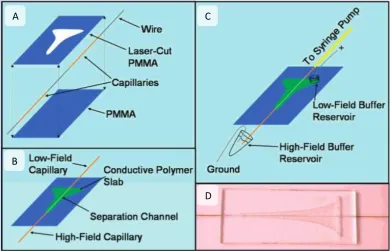
Electric Field Gradient Focusing, EFGF, described by Lee et al.33,34, is a true electrofocusing technique. A capillary is placed inside a secondary reservoir
constructed from a conductive polymer. The configuration of the EFGF device is
shown in figure 1.2.1. As a hydrodynamic flow is applied in one direction through
the capillary, an electrokinetic force is applied in the secondary reservoir acting in
the opposite direction. The conductive polymer allows the propagation of the
electric field, but not the sample. This results in analytes reaching focal points at
13 Figure 1.2.1. Configuration of the EFGF device. A) Exploded view of components made from Poly(methyl methacrylate), (PMMA). B) Assembled device. C) Assembled device with buffer reservoirs. D) Image of actual EFGF device.
It is noted that this is a static electric field gradient acting across the full length of
the device. This configuration allows for the separation of analytes; however the
electric field either retains all of the samples or allows them to elute. To solve this
issue and facilitate the stacking of a concentrated sample, a tandem EFGF was
redeveloped to isolate and re-focus a target protein once separated from a matrix35.
Further work on EFGF saw the evaluation of the influence of the hydrogel used to
form the channels36. This work raised questions over the shape of the reservoir
channel which was later changed to facilitate a more stable electric field.
Improvements to this system saw the use of polyethylene glyocol for the
construction of the reservoir and therefore an increase in the effectiveness of the
electric field propagation37. A
B
C
[image:31.595.124.516.73.324.2]14
Key observations were made in a theoretical study38 which indicated that the shape
of the channel had a direct effect on the propagation of the electric field. A bi-linear
EFGF39 was developed which is a step towards the similar technique of Dynamic
Field Gradient Focusing, DFGF. The main difference between the EFGF technique
and DFGF is that in EFGF only a linear electric field gradient is applied to result in
separation, where as DFGF allows adjustments to be made to the electric field at
multiple points in situ to accurately manipulate and refine a separation in real time. Dynamic Field Gradient Focusing is described and demonstrated throughout this
thesis with the aim of performing separations of proteins similar to those of the
15 1.3 References
1. D. Nelson and M. Cox, Principles of Biochemistry, 3rd Ed., 2000.
2. C. Brandon and J. Tooze, Introduction to Protien Structure, 2nd Ed., 1999.
3. P. G. Tuñón, University of Leeds, 2006.
4. S. P. Gygi and R. Aebersold, Current Opinion in Chemical Biology, 2000, 4,
489-494.
5. J. O. Baker, W. S. Adney, M. Chen, and M. E. Himmel, Handbook Of Size
Exclusion Chromatography And Related Techniques, CRC Press, 2003. 6. F. E. Regnier, Analytical Biochemistry, 1982, 126, 1-7.
7. T. Hanai, Journal of Liquid Chromatography & Related Technologies, 2007, 30, 1251-1275.
8. C.-H. Chen and W.-C. Lee, Journal of Chromatography A, 2001, 921, 31-37.
9. W.-C. Lee and K. H. Lee, Analytical Biochemistry, 2004, 324, 1-10.
10. GRACE VYDAC, The Handbook of Analysis and Purification of Peptides and
Proteins by Reversed-Phase HPLC, 3rd Ed., 2002.
11. T. Macko and D. Berek, Journal of Liquid Chromatography & Related
Technologies, 1998, 21, 2265-2279.
12. G. Xindu and F. E. Regnier, Journal of Chromatography A, 1984, 296, 15-30.
13. M. Rubinstein, Analytical Biochemistry, 1979, 98, 1-7.
14. J. Tang, M. Gao, C. Deng, and X. Zhang, Journal of chromatography. B,
Analytical technologies in the biomedical and life sciences, 2008, 866, 123-32.
16 16. Y. Li, X. Fang, S. Zhao, T. Zhai, X. Sun, and J. J. Bao, Chemistry Letters, 2010,
39, 983-985.
17. Y.Yang J.Chae, Y. Yang, and J. Chae, in 2007 IEEE 20th International Conference
on Micro Electro Mechanical Systems (MEMS), IEEE, 2007, pp. 421-424.
18. A. W. Moore and J. W. Jorgenson, Analytical Chemistry, 1995, 67, 3448-3455.
19. S. D. Patterson and R. Aebersold, Electrophoresis, 1995, 16, 1791-1814.
20. P. K. Jensen, L. Pasa-Tolić, K. K. Peden, S. Martinović, M. S. Lipton, G. A.
Anderson, N. Tolić, K. K. Wong, and R. D. Smith, Electrophoresis, 2000, 21, 1372-80.
21. Y. Li, D. L. DeVoe, and C. S. Lee, Electrophoresis, 2003, 24, 193-9. 22. C. F. Ivory, Separation Science and Technology, 1988, 23, 875-912.
23. P. Righetti and C. Secchi, Journal of Chromatography A, 1972, 72, 165-175.
24. A. L. Crego, A. González, and M. L. Marina, Critical Reviews in Analytical
Chemistry, 1996, 26, 261-304.
25. B. Preinerstorfer, M. Lammerhofer, and W. Lindner, Electrophoresis, 2009, 30,
100-132.
26. G. Gübitz and M. G. Schmid, Journal of Chromatography A, 2008, 1204, 140-156.
27. B. Chankvetadze, Journal of Chromatography A, 2007, 1168, 45-70; discussion
44.
28. W. W. P. Chang, C. Hobson, D. C. Bomberger, and L. V. Schneider,
Electrophoresis, 2005, 26, 2179-2186.
29. P. H. O’farrell, Science (New York, N.Y.), 1985, 227, 1586-9.
30. C. F. IVORY, Separation Science and Technology, 2000, 35, 1777-1793.
17
32. W. H. Henley, R. T. Wilburn, A. M. Crouch, and J. W. Jorgenson, Analytical
chemistry, 2005, 77, 7024-31.
33. S. L. Lin, H. D. Tolley, and M. L. Lee, Chromatographia, 2005, 62, 277-281.
34. P. H. Humble, R. T. Kelly, A. T. Woolley, H. D. Tolley, and M. L. Lee,
Analytical chemistry, 2004, 76, 5641-8.
35. S.-L. Lin, Y. Li, H. D. Tolley, P. H. Humble, and M. L. Lee, Journal of
chromatography. A, 2006, 1125, 254-62.
36. P. H. Humble, J. N. Harb, H. D. Tolley, A. T. Woolley, P. B. Farnsworth, and
M. L. Lee, Journal of Chromatography A, 2007, 1160, 311-319.
37. X. Sun, P. B. Farnsworth, A. T. Woolley, H. D. Tolley, K. F. Warnick, and M.
L. Lee, Analytical chemistry, 2008, 80, 451-60.
38. D. Maynes, J. Tenny, B. W. Webbd, and M. L. Lee, Electrophoresis, 2008, 29,
549-60.
39. X. Sun, D. Li, A. T. Woolley, P. B. Farnsworth, H. D. Tolley, K. F. Warnick,
18
Chapter
2
. Dynamic Field Gradient Focusing
2.1 Theory
Dynamic Field Gradient Focusing (DFGF) is a relatively new separation technique
which exploits the differences in electrophoretic mobility and hydrodynamic radius
of analytes to result in a separation1. This is achieved by taking a channel and
applying a hydrodynamic flow in one direction and a counteracting electric field
gradient (EFG) causing an electrophoretic force acting in the opposite direction,
resulting in analytes reaching unique focal points across the length of the channel.
At these focal points the sample is concentrated into a tight band giving separation
and concentration in a single step2. This is described graphically in, figure 2.1.1.
Figure 2.1.1. Theoretical model for DFGF3. The counteracting dynamic field gradient gives rise
to inertia and a net force on the charged species bringing components of a given sample to unique focal points regardless of their initial location in the column.
From the model above the behaviour of a given analyte in a known electric field can
19 Equation 2.1.1. The Flux equation, where; J is the molar flux, D is the dispersion coefficient, C is the concentration, u is the velocity of the buffer, µ is the electrophoretic mobility of species, and E
is the strength of the electric field4.
For an analyte to be considered focused, the molar flux must be zero, indicating the
species is stationary, i.e. the opposing forces cancel each other. As seen in the flux
equation, there are a number of conditions which in turn can be manipulated to
focus an analyte into a band. This is also applicable for isoelectric focusing5, and
EFGF4. The flux equation can be solved for C, concentration of a band of analyte,
giving a Gaussian distribution shown, by Zheng3, below in equation 2.1.2.
Equation 2.1.2. The flux equation solved for C, where Mi is the total number of moles of analyte,
A is the cross section area of the channel and σ is variance3.
From equation 2.1.2 for the concentration of a band, the focal point Χ at which the
band will be stationary along the length of the channel and the variance σ, the area
either side of Χ a sample could focus, can be derived. These are shown below in
20
Equation 2.1.3. Χi defines a point along the length of the separation channel where an analyte
will come into focus3.
Equation 2.1.4. Variance of the width of a focused band of analyte3.
From equation 2.1.3 it is observed that increasing the electric field gradient will
decrease the separation between bands. However from equation 2.1.4 increasing
the electric field gradient will make the bands narrower. Therefore to increase
separation and decrease variance both higher fields and flow rates are required.
From the diffusion contribution (Di) to variance, equation 2.1.4, it is apparent that
focusing is indeed caused by the forces of hydrodynamic flow (µi) and
electrophoretic mobility, from the applied EFG (E1), counteracting one another.
This shows the technique is independent of channel length focusing the sample in a
position relative to the strength of these forces, particularly the EFG. In addition,
21 2.2 DFGF Set Up
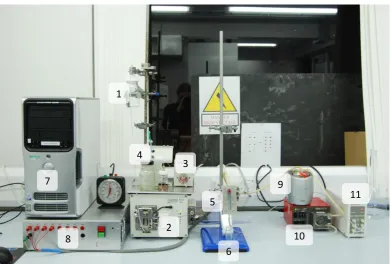
Figure 2.2.1. DFGF set up with electrical connections in red, separation channel fluid flow in
light blue and electrode channel fluid flow in dark blue. Supporting equipment: 1) Separation
channel buffer reservoir. 2) Computer controlled Flux Instruments Rheos2200 Pump. 3) 6 Port
switching valve. 4) Injection port. 5) DFGF device. 6) Outlet for sample collection. 7) Computer.
8) Computer controlled high voltage power supply. 9) Electrode channel buffer reservoir with
cooler. 10) Peristaltic pump. 11) De-gasser 12) Nikon D80 digital SLR camera with 60mm
macro lens.
1 2
4
3 5
6
7
8 11 10 9
12 1
2 4
3
5
6 7
8
9
10
22 Figure 2.2.2. Side view of the DFGF channel configuration. Consisting of; 1) Packed separation channel. 2) Separate purge channel housing the electrodes. 3) Cellulose Dialysis Membrane dividing the two channels. 4) Platinum electrodes.
2.2.1. DFGF Configuration
The DFGF was setup as shown above in figure 2.2.1. The DFGF cell itself is
composed of two acrylic layers which combine to form two channels divided by
strip of cellulose dialysis membrane, detailed in figure 2.2.2. This dual channel
arrangement eliminates pH changes and gas evolution from the separation channel
which can be detrimental to separation6. Cellulose dialysis membrane7 is used as it
allows the EFG to propagate through into the separation channel by allowing small
ions to pass through. However large species, i.e. the sample, cannot permeate the
membrane, therefore are trapped in the separation channel preventing them from
being electrolysed. Gases and other electrolysis products are also unable to pass
through the membrane from the electrode channel. Constant flow of buffer through
electrode channel flushes away these species. The computer controlled Flux
Instruments Rheos 22008 pump drives the hydrodynamic flow of buffer though the
injection valve into the cell and on to collection or further detection. The peristaltic
pump circulates buffer solution around the electrode channel via a degasser to
remove any electrolysis gasses. 1
2
4
23
The dynamic electric field gradient is supplied and manipulated from the Protasis9
voltage array using Labview control software (appendix B). Detection is performed
by a Nikon D80 digital SLR camera with 60mm Macro lens10.
Separations are monitored and controlled in real time using the computer and an
assortment of software. Before the DFGF is operated the separation channel must
be packed with a packing media to provide a narrower diffusion pathway through
the separation channel and to lower the solvent volume present. As the dimensions
of these channels are at the millimetre scale, any focusing would require an
extremely high voltage to apply an EFG capable of counteracting such a larger
volume without a packing material or monolith.
2.2.2. Packing Method
The DFGF was prepared for packing by rinsing components with deionised water.
Regenerated cellulose dialysis membrane with a molecular weight cut off (MWCO)
twice that of the intended analyte was cut to the dimensions 20mm wide and 90mm
in length. With the membrane in place on the Teflon gasket the two halves of the
DFGF cell are bolted together, tightening the bolts sequentially across opposite
corners. The separation and purge channels were then tested for leaks. A 1/16” in
line frit and 0.030" ID PEEK capillary tubing was connected to the outlet of the
separation channel. The same ID PEEK tubing was also connected to the inlet
having been connected to the packing reservoir and vibrating packing apparatus.
The cell was then immersed in the sonic bath and the reservoir charged with 500mg
of Bio-Rad 45-90µm spherical polyacrylamide11 packing material suspended in
24 Compressed air was used to charge the separation channel with the packing slurry.
Packing solvent was pushed through the channel for 3hours at a constant pressure
of 4bar. The system was then equilibrated for 24hours at 1µLmin-1 with Flux
Instruments Rheos 2200 pump8. The DFGF packing apparatus configuration is
shown below, figure 2.2.3.
Figure 2.2.3. DFGF packing apparatus. 1) Compressed Air Supply with Pressure Gauge. 2) Slurry Reservoir. 3) Vibrating Motor. 4) DFGF Device. 5) Sonic Probe. 6) Beaker with DFGF submerged in water and sonic probe. 7) DFGF Outlet.
4
1
1 2
3 2
4
5 5
3
6
6
7
[image:42.595.109.525.241.578.2]25 2.2.3. General Operation
In general the operation of the device would follow this standard procedure. A
linear EFG of around 80% of the maximum field, using ~800V across the length of
the separation channel, was applied for 20mins before each experiment to ensure
equilibration of the packed bed. The hydrodynamic flow of 50mM tris HCl buffer
solution was pumped through the separation channel at 1µLmin-1. Next the sample
was loaded into the sample loop which was then switched in.
Once the sample was visible in the cell ~30mins was left for the sample to reach a
stable focal point. Typically, the linear EFG would be adjusted with the aim of
separation. If samples were separated the electric field was manipulated manually,
meaning overriding a linear gradient to produce bespoke voltage profiles, to hold a
single species back and allow the others to elute off the device. Alternatively, the
bands would be moved back down the column to refocus and increase the
separation by increasing the EFG. Additionally, the flow rate was altered to further
focus bands of sample giving dynamic flow as well as dynamic field. On injection
of the sample, images of the separation channel were collection at regular intervals
to record the separation. Each aspect of this control is explained in more detail
below.
2.2.4. Dynamic Flow Control: Flux Instruments Rheos Pumps and Janeiro 3.0
Incorporating the Flux Instruments Rheos 2200 pump8 into the DFGF set up adds
dynamic control over the flow rate used resulting in the technique being Dynamic
Flow Dynamic Field Gradient Focusing. These pumps are controlled over RS232
26 This computer control enables the flow rate to be adjusted in the order of
±0.1µLmin-1. Most piston pumps used in chromatographic techniques give a
pulsing flow which worsens as the flow rate is lowered12. The Rheos 2200 pump8
utilises a pulse dampening system to result in a stable flow even at flow rates as low
as 0.1µLmin-1.
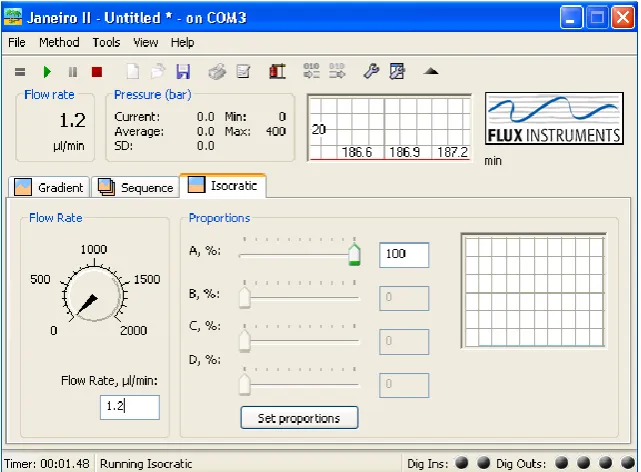
The Flux Instruments Janeiro control software allows control over a number of
parameters which are advantageous for DFGF. Figure 2.2.4 displays the user
interface of Janeiro. The flow rate can set by adjusting the dial controller or by
entering a value into the flow rate input. Also the maximum pressure and warning
pressure can be set to stop the pump in the event of a sudden increase in pressure
[image:44.595.159.480.392.628.2]which could cause the packing or membrane to fail.
27 2.2.5. Dynamic Electric Field: Power Supply and Control
The supporting equipment for the Protasis device, figure 2.4.1, is the equipment
which has been used for all of the experimentation throughout this thesis. The
power supply consists of four individual UltraVolt High Voltage generators13
connected to respective high voltage (HV) outputs sharing a common ground rail
with a designated HV connection.
The HV generators were controlled independently by analogue signals from a
universal serial bus (USB) interface board, shown in figure 2.2.5.
28 Figure 2.2.6. Protasis UController HV Control Software. 1) Voltages supplied to electrodes. 2) Electrode Spacing. 3) Mode selector switch. 4) EFG Value. 5) Indicator Lights. 6) Electric field profile. 7) Power off button.
The Protasis DFGF Power Supply Unit was controlled by bespoke software
(appendix B) written in National Instruments LabView. The user interface, figure
2.2.6, enables control of the system in two modes, manual and automatic. Firstly, in
automatic mode, the software uses the value entered for electrode spacing to
calculate the maximum electric field gradient and uses this to calculate the required
voltage for each of the four positive electrodes to generate the gradient entered by
the user. In this mode the system designates the voltages applied to the electrodes
according to the linear EFG entered. 1
2
4
5 3
6
29 A linear EFG is where the slope of the gradient is the same between all of the
electrodes. An example of a linear EFG is shown in figure 2.2.7 with the
corresponding applied voltages and electrode spacing. The specified gradient is
plotted on a histogram shown in the bottom left of the interface, figure 2.2.6.
Figure 2.2.7. An example of a linear EFG generated by the Protasis Labview Ucontroller software in Automatic Mode. The dashed red line highlights the linear Electric Field Gradient.
In manual mode the software enables direct control of each electrode independently
using the sliders in the top left of the interface (figure 2.2.6), to apply different
gradients in different regions of the device, i.e. the EFG between each of the
electrodes can be different, figure 2.2.8. This level of control enables focused bands
30 Figure 2.2.8. An example of the EFGs which can be applied by the Labview Ucontroller software in Manual Mode. Notice the electric field gradient is no longer linear therefore the area on the bottom left is shaded out.
2.2.6. Data collection and presentation
A simple method of detection with DFGF was to use reflectance measurements
from digital exposures to monitor the position of bands in the separation channel.
Utilising a Nikon D80 DSLR camera10 with a 60mm 1:2.8D macro lens, exposures
were taken at set intervals incorporating the full length of the separation channel
31 Figure 2.2.9. A) Nikon D80 with a 60mm 1:2.8D macro lens configured to take images of the separation channel with the addition of a LED ring illuminator. B) Nikon Camera Control Pro software user interface.
By stacking these images in an image editing software, namely Adobe Photoshop or
GNU Image Manipulation Program (GIMP), it was possible to observe differences,
hence the position of a given analyte, by subtracting the first background image
from an image collected later. This preceding detection method is shown in figure
2.2.10A. For analysis of these subtracted images, “image analysis” software
ImageJ15 was used to generate a ‘Profile Plot’ of the separation channel, shown in
figure 2.2.10B.