This is a repository copy of
The entrainnient of solid particles into rolling
elastohydrodynamic contacts
.
White Rose Research Online URL for this paper:
http://eprints.whiterose.ac.uk/94790/
Version: Accepted Version
Article:
Dwyer-Joyce, R.S. and Heymer, J. (1996) The entrainnient of solid particles into rolling
elastohydrodynamic contacts. Tribology Series, 31. pp. 135-140. ISSN 0167-8922
https://doi.org/10.1016/S0167-8922(08)70777-6
[email protected] https://eprints.whiterose.ac.uk/
Reuse
Unless indicated otherwise, fulltext items are protected by copyright with all rights reserved. The copyright exception in section 29 of the Copyright, Designs and Patents Act 1988 allows the making of a single copy solely for the purpose of non-commercial research or private study within the limits of fair dealing. The publisher or other rights-holder may allow further reproduction and re-use of this version - refer to the White Rose Research Online record for this item. Where records identify the publisher as the copyright holder, users can verify any specific terms of use on the publisher’s website.
Takedown
If you consider content in White Rose Research Online to be in breach of UK law, please notify us by
The Entrainment of Solid Particles into Rolling Elastohydrodynamic Contacts
R S Dwyer-Joyce and J Heymer
Department of Mechanical and Process Engineering, University of Sheffield, Mappin Street, Sheffield, S1 3JD, United Kingdom
ABSTRACT
The entry of lubricant borne solid particles into machine element contacts is important, both for prediction of three body abrasive wear, and for an understanding of the behaviour of solid lubricant additives. This paper describes a quantitative study of particle entrainment into a rolling elastohydrodynamic contact. The level of surface indentation is used as an indication of the number of particles entrained into the contact. It is shown that over the range of test conditions considered; concentrations of particles in the contact can be many times higher than those in the bulk, larger particles are more likely to become entrained, and at higher speed less particles of all sizes become entrained.
1. INTRODUCTION
Solid particles suspended in a bulk lubricant may be an intentional addition or a potentially harmful contaminant. Molybdenum Disulphide and PTFE particles are commonly added to oils to improve their lubricity. These soft materials are thought to form a film adhered to the component surfaces. On the other hand, solid contaminating particles are also frequently present in industrial lubrication systems. These particles may originate as wear debris, carbon combustion products, or environmental contaminants. These particles enter into machine element contacts (such as bearings, gears, and seals) and cause surface damage. This damage frequently leads to premature failure through abrasive wear [1] or surface initiated rolling contact fatigue [2].
Both the beneficial effects of the former category and the deleterious effects of the latter are controlled by the ability of the solid, lubricant borne, particles to enter into the conjunctions of lubricated machine elements.
In the past, the interferometric method has proved a useful tool to study the behaviour of particles in the region of an elastohydrodynamic contact. One of the contacting elements is replaced by glass giving a ‘window’ on the contact area and lubricant entry region.
Wan and Spikes [3] and Dwyer-Joyce et al [4] showed how particles of various size and material behaved in and around ehl contacts. Ductile metals were shown to deform and the flattened platelets enter the contact. Brittle materials were found to fracture in the contact entry region and the fragments pass through the contact. The fragment size being controlled by the fracture toughness of the debris material. High speed video photography was used to show the motion of particles in the contact entry region. A mass of particles tended to build up in the inlet region, with some flowing around the contact sides , and those on a central streamline passing through.
It was also noted [4] that brittle particles below their critical crack size passed through the contact un-fractured. This fact was later used [5] in a study of the three body abrasive wear process. Finely graded small size diamond particles were used as test contaminants. These did not breakdown in the lubricated contact and so abrasive mass loss could be directly attributable to a particle of known geometry.
speeds is costly (requiring short duration photography or high speed video).
In this study a relatively simple (although somewhat tedious) approach is followed. The level of surface indentation generated by the particles is used to quantify the entrainment process. The study is limited to a nominally pure rolling axisymmetric elastohydrodynamic contact. Small size diamond particles have been used, so that each entrained particle is responsible for a single surface indentation.
2. TEST APPARATUS & METHOD
The test geometry consists of a steel ball (diameter 25.4 mm) loaded and freely rolling on the upper surface of a flat rotating steel disk. Figure 1 shows a sketch of the apparatus. The ball is supported by rollers and spring loaded onto the disk. The upper surface of the disk is polished to facilitate the inspection of surface indentation.
steel ball polished disk specimen
spring loaded
belt drive to variable speed
motor
[image:3.596.60.260.372.571.2]rolling bearing support
Figure 1. Diagrammatic sketch of the test apparatus.
Finely graded diamond powder (DeBeers type MDA) was used as test particles. The size ranges used were 1-2 µm, 2-4 µm, 3-6 µm, 4-8 µm, and 6-12 µm. In addition a test series was carried out with 26-32 µm spherical particles of M50 steel. The test lubricant, Shell Turbo T68 (a mineral base stock without EP additive) was thoroughly mixed with the required quantity of diamond powder. The mixture was continuously fed,
using a constant flow syringe, onto the disk, so as to become directly entrained into the contact.
After testing, the disk is removed and examined under a microscope. Several photomicrographs of each test track were made. The number of surface indentations in each was recorded and then scaled to give a number of indentations per unit area of test track. For each test, a new ball and track on the disk was used.
Test durations (i.e. number of disk revolutions) were chosen such that a measurable number of surface indentations were generated. Too few indentations give statistically poor results. Too many indentations result in a lengthy counting process.
3. RESULTS
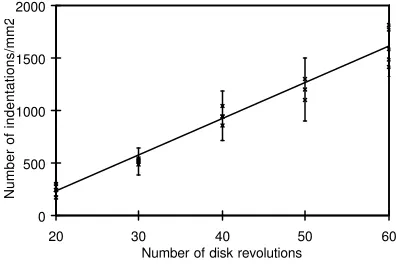
The first test series was designed to investigate the validity of the method. The particle size and concentration was maintained constant and the duration of each test varied. Figure 2 shows the result; the number of indentations counted per unit area is plotted as a function of test duration.
0 500 1000 1500 2000
20 30 40 50 60
Number of disk revolutions
Number of indentations/mm2
Figure 2. Number of indentations per unit area against test duration (expressed as a number of disk revolutions). Particle concentration 0.15 g/l, contact
rolling speed 0.2 m/s.
[image:3.596.302.503.411.545.2]Within the scatter in the data the number of indentations per unit area appears to be approximately linear with test duration. This suggests that particles are not remaining imbedded in the surfaces; and a single entrained particle does indeed cause a single indent. However, the best line fit does not tend to zero (as of course it should). The results for low test revolutions suffer from high statistical inaccuracy (they are based on only a few indentation counts per photomicrograph), and are likely to represent an underestimate.
To verify that particles were not left imbedded in the rolling element surfaces; a used test specimen pair were lightly cleaned and re-run with fresh un-contaminated lubricant. No further indentations were observed.
The number of indentations per unit area can be expressed as a number of particles in the contact at
any instant, Nc (by dividing by the number of
revolutions and multiplying by the contact area). If we assume the particles are cubic in shape of side length,
d, the mass of particles in the contact is given by
mc = N c dρ 3 (1)
where ρ is the density of the particle material. The
volume of oil entrained into the contact (corrected for the compressibility of the fluid using the empirical relation of [6]) is given approximately by;
Vc a h pm
pm = + +
π 2 1 2 31 1 7 .
. (2)
where pm is the mean contact pressure (in GPa) and a is
the contact radius (both determined from Hertzian analysis). The volume of fluid/particle mix in the contact is increased by the particles embedding in the contacting surfaces. However the number of particles present in the contact at any instant is so small that this extra volume embedded in the surfaces is negligable compared with the total volume in the contact.
The lubricant film thickness, h is determined from the
relations of Hamrock and Dowson [7]. The division of these expressions then leads to an effective
concentration of particles in the contact (expressed as particle mass per unit fluid volume).
A useful parameter ‘particle entry ratio’, φis defined
here as the ratio of the particle concentration in the contact to that in the bulk, x, thus;
φ
ρ
π
=
+
+
N d
x a h
p
p
c m m 3 21 17
1 2 3
.
.
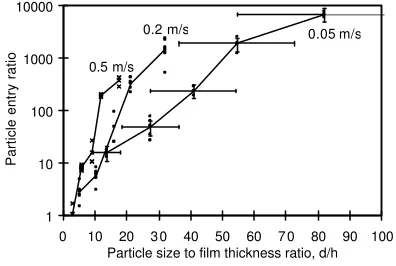
(3)The effect of a variation of particle size on particle entrainment is shown in Figure 3. The plot shows the particle entry ratio (defined by equation 3 above) plotted against particle size (a mean for each size range has been used). Each test series was repeated at three contact rolling speeds. Error bars are drawn on only one data set for clarity. The solid lines join the mean data points. 1 10 100 1000 10000
0 10 20 3 0 40 50 60 7 0 80 90 100 Particle size to film thickness ratio, d/h
Particle entry ratio
0.5 m/s
[image:4.596.302.500.348.481.2]0.2 m/s 0.05 m/s
Figure 3. Plot of particle entry ratio, φagainst the mean particle size for three contact rolling speeds. Particle
concentration 0.15 g/l.
The trend is clear; the contact has a significant particle concentrating effect across the whole range of particle sizes. Further more, the larger particles are many times more likely to be entrained into the contact than the smaller.
0 1 10 100 1000 10000
0.000 0.200 0.400 0.600 0.800 1.000 Contact rolling speed, m/s
Particle entry ratio
6 - 12 micron
[image:5.596.68.267.115.248.2]1 - 2 micron
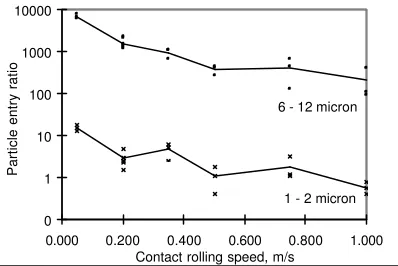
Figure 4. Plot of the particle entry ratio, φagainst the contact rolling speed for two sizes of particle. Particle
concentration 0.15 g/l.
The presence of diamond particles in an industrial lubrication system is obviously unlikely. This material was chosen since it would not fracture in the contact (and so allow the prediction of particle entrainment directly from an indentation count). Ductile materials are deformed but also do not fragment [4]. Therefore, they may also be tested for entrainment behaviour in this way.
[image:5.596.306.494.118.251.2]Industrial lubrication systems frequently contain hard steel fragments (originating from work hardened wear debris) typically in concentrations of the order 0.5 to 1 g/l. To provide a simplified analogue of this environmental condition, a 1 g/l concentration of 26-34 µm particles of M50 steel was tested for particle entry.
Figure 5 shows a plot of the particle entry ratio with increasing contact speed. Again, we see that the contact has a significant concentrating effect. The trend, as in the previous tests, is for particle entry to reduce with increasing contact rolling speed.
The entrainment ratio for 30 µm steel particles is lower
than that for 9 µm diamond particles (comparing
figures 4 and 5). The relationship between particle size and entry ratio is not simply a monotonically increasing curve. Clearly from this data no deductions can be made concerning the effects of particle density, material, or indeed shape.
10 100 1000 10000
0.000 0.200 0.400 0.600 0.800 1.000 Contact rolling speed, m/s
Particle entry ratio
Figure 5. Plot of the particle entry ratio against contact rolling speed for 26-34 µm particles of M50 steel.
4. DISCUSSION
Perhaps the most surprising result is that concentrations in the contact reached as high as 8000 times that in the bulk. Under certain test conditions the contact is exerting an enormous concentrating effect (like a steamroller compressing everything in its path!).
smaller particles off central flow line swept
to sides
paticles on central line swept into
contact
Figure 7. Plan view of the circular contact and the motion of entrained particles.
From the results presented it is clear that both particle size and speed of rolling have a significant effect on particle entrainment. When the fluid/particle mixture enters the inlet region of this type of flooded point contact, most of the fluid is swept around the contact sides (see figure 7).
[image:5.596.309.496.385.532.2]the contact whilst those travelling off-axis tend to get swept around the sides.
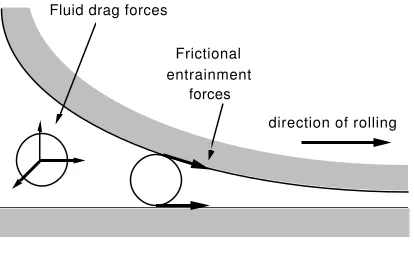
Those that reach the nip as the two rolling elements approach will be subjected to high frictional forces in the direction of entrainment (see figure 8). These friction forces will increase as the particle is entrained further into the entry zone and causes plastic indentation of the contacting surfaces. When the particle is trapped in the entry region the Stokes’ viscous drag forces are likely to be small in magnitude compared to these friction forces.
Frictional entrainment
forces Fluid drag forces
[image:6.596.63.270.272.400.2]direction of rolling
Figure 8. Forces acting on particles in the contact entry region. The magnitude of fluid drag is small compared
with the frictional entrainment forces.
It is suggested therefore, that the entrainment process is governed by fluid motion around the contact, until the particles are trapped in the entry region when friction forces cause their inevitable entrainment.
Thus, high contact rolling speeds result in increased drag forces on the particles and a greater degree of contact evasion. The effect of particle size is twofold. Drag forces are greater on larger particles tending towards contact evasion. However, more importantly large particles become trapped in the inlet region, and subjected to frictional entrainment forces, further from the contact. It is this that results in the concentrating effect which is more marked for larger particle sizes.
These features were observed, qualitatively, in the high speed video studies of [4]. Particles were observed building up in the inlet region. Smaller sized particles tended to pass around the contact sides, with only those on a central streamline becoming entrained. Larger particles were observed to be far less mobile;
becoming trapped by the surfaces and thus directed by large friction forces before significant fluid forces could cause contact evasion.
These tests have only dealt with the case of a nominally pure rolling circular point contact. Without further experiment or computational fluid dynamics analysis, it is only possible to surmise as to entrainment behaviour of other lubricated contact cases. The flow of fluid around the contact is clearly a dominating factor. Thus for line, transverse elliptical (ball bearings for example), and starved contacts where fluid flow around the contact is reduced, the particle entry ratio is likely to be even higher than the fully flooded axisymmetric case. The effect of contact sliding may also be significant; one of the frictional entrainment forces (shown in figure 8) will act in the opposite direction, reducing the likelihood of particle entry.
5. CONCLUSION
The aim of this work has been to quantify the entrainment of solid lubricant borne particles into elastohydrodynamic contacts. A simple flexible method, of using surface indentation to measure particle entry, has been developed. Over a limited range of test conditions some interesting results have ensued.
Broadly, over this limited test range, the conclusions are summarised thus;
(i) The contact acts to concentrate the suspended
particles; such that the concentration in the contact can be several thousand times higher than that in the bulk lubricant.
(ii) Larger particles are more likely be entrained into
a contact than s maller particles.
(iii) The entrainment of particles is reduced as the
speed of rolling increases.
(iv) Large steel particles, of a size commensurate
with the debris commonly found in industrial lubrication systems, show similar behaviour.
of low speed contacts would promote particle entry. Conversely, the designer of a filtration system may be advised to concentrate on filtering out large particles since these show a greater likelihood of particle entry (although of course there are a great many small particles which, although a lesser proportion are entrained, may cumulatively result in high levels of surface damage and wear).
The scope for future work is great. A variety of contact geometries under combined rolling and sliding would generalise the work to be more industrially applicable; as would a more detailed study of the size and speed effect on ductile particles.
REFERENCES
[1] Lorosch, H. K., (1983), “Research on Longer Life
for Rolling Element Bearings”, Trans. ASLE, Vol.
41, No.1, pp. 37-43.
[2] Sayles, R. S. and Macpherson, P. B., (1982), “The
Influence of Wear Debris on Rolling Contact
Fatigue”, ASTM STP 771, J.J.C.Hoo, Ed,
American Society Test & Materials, pp. 255-275.
[3] Wan, G. T. Y. and Spikes, H. A., (1987), “The
Behaviour of Suspended Solid Particles in Rolling and Sliding Elastohydrodynamic Contacts”,
Trans. ASLE, Vol. 31, No.1, pp. 12-21.
[4] Dwyer-Joyce, R. S., Hamer, J. C., Sayles, R. S.
and Ioannides, E., (1991), “Lubricant Screening for
Debris Effects to Improve Fatigue and Wear
Life”, Proc. 18th Leeds-Lyon Symp. Tribology.
[5] Dwyer-Joyce, R. S. , Sayles, R. S., and Ioannides,
E., (1994), “An Investigation into the
Mechanisms of Closed Three Body Abrasive
Wear”, Wear, Vol. 175, pp 133-142.
[6] Dowson, D. and Higginson, G. R., (1977),
“Elasto-Hydrodynamic Lubrication, 2nd ed.”, Pergamon Press.
[7] Hamrock, B.J. andDowson, D., (1977),
“Isothermal Elastohydrodynamic Lubrication of Point Contacts, Part III, Fully Flooded Results”,