R E S E A R C H A R T I C L E
Open Access
Brief adult respiratory system health status
scale-community version (BARSHSS-CV):
developing and evaluating the reliability
and validity
Hongzhe Dou
1, Yuejia Zhao
1, Yanhong Chen
1, Qingchun Zhao
1, Bo Xiao
2, Yan Wang
3, Yonghe Zhang
3,
Zhiguo Chen
3, Jie Guo
3and Lingwei Tao
4*Abstract
Background:The evaluation of respiratory system health status in hospitalized patients is usually based on many laboratory examinations and imaging examinations. Medical examinations require a lot of manpower, material resources, financial resources, and may cause a certain degree of mechanical damage and radiation damage. It is not easily used widely and economically to assess the respiratory health status of community adults. Therefore, researchers developed a brief adult respiratory system health status scale-community version (BARSHSS-CV) and tested its reliability and validity.
Methods:Using clinical characteristics and pathogenic factors of respiratory system diseases as a theoretical basis and through reference to relevant literature, researchers developed an initial scale. A randomized cluster sampling strategy was used to recruit adults in the communities of Baoding City, Shijiazhuang City, Cangzhou city and Chifeng City in China. Researchers randomly selected 1 district from each city. Subsequently, 4 communities were respectively randomly selected from 4 districts. Then, researchers conducted the questionnaire survey in 4 communities. Finally, researchers investigated 615 community adults. 584 valid questionnaires were recovered. By applying exploratory factor analysis, confirmatory factor analysis, content validity index, Cronbach’sαcoefficient, mean inter-item correlation coefficient and test-retest reliability, researchers tested the reliability and validity of scale and created the final BARSHSS-CV.
Results:BARSHSS-CV Cronbach’sα=0.951, content validity = 0.933, test-retest reliability = 0.963 and factor cumulative contribution rate = 67.168% by exploratory factor analysis. By confirmatory factor analysis, Chi square value (χ2) was 442.117, degrees of freedom (df) was 161, Chi square value/degrees of freedom (χ2 /df) was 2.746, root-mean-square error of approximation (RMSEA) was 0.065, goodness of fit index (GFI) was 0.902, incremental fit index (IFI) was 0.955, comparative fit index (CFI) was 0.955, normed fit index (NFI) was 0.931, Tueker-Lewis index (TLI) was 0.947. BARSHSS-CV consisted of 20 items and 3 dimensions.
Conclusions:BARSHSS-CV with good test-retest reliability and content/construct validity is a brief and economical tool for assessing the state of respiratory system amongst adult communities. BARSHSS-CV may help medical staff in community primary medical institutions quickly, conveniently and economically assess the status of respiratory system and the main problems of respiratory system in community adults.
Keywords:Community, Adult, Respiratory system, Health level, Reliability, Validity
* Correspondence:[email protected]
4School of Public Health, Capital Medical University, No.10 Xitoutiao,
Youanmenwai, Beijing 100069, China
Full list of author information is available at the end of the article
Background
Globally, the issue of air pollution has impacted the health of millions of individuals. [1]. Air pollution dir-ectly contributes to many serious effects on public health in China The National Plan on Air Pollution Con-trol was formulated by the Chinese government in 2012, which set goals and measures to prevent and control air pollution. The first plan was proposed in 2013, which projected that by 2017 the quality of air would be dra-matically improved [2]. Infectious diseases are an im-portant threat to human health, and infectious diseases of respiratory system are the most common [3]. Chronic obstructive pulmonary disease (COPD) is an important cause of premature mortality, and asthma prevalence also continues to increase in community adults [4, 5]. Respiratory system diseases are very common diseases contributing to the world’s global disease burden. Col-lectively respiratory system diseases of adults are associ-ated with a significant burden on healthcare systems, as well as on society [6, 7]. Effective assessment and man-agement plans have been shown to reduce morbidity and mortality from respiratory system diseases among community adults [7]. With the increase of atmospheric concentrations of SO2, CO and suspended particles, the variation of pathogenic microorganisms, and the in-crease of drug-resistant bacteria, the number of people suffering from respiratory system diseases and the mor-tality of related diseases have increased significantly in the community [3,8,9].
At present, much research is focused on the diagnosis and treatment of specific respiratory system diseases in hospitalized patients. However, there are relatively few studies on the respiratory system health level of adults in the community [10,11]. The evaluation of respiratory system health status in hospitalized patients is usually based on a large number of laboratory examinations and imaging examinations. For example, in blood tests an crease in the number of white blood cells and an in-crease in the proportion of neutrophils may indicate bacterial infection. In the sputum examination, the drug sensitivity test for bacteria in sputum can guide clinical medication. Chest X-ray examination, CT examination and MRI examination are helpful in the diagnosis of re-spiratory system organic lesions [3]. However, these medical examinations need to rely on many medical de-vices and professional technicians. Due to manpower, material resource, financial resource and damage of medical examinations, community-based adults gener-ally can’t receive these medical examinations frequently. Furthermore, it is difficult to be widely and economically used to assess the respiratory health status of adults in the community. Therefore, our research team developed a brief adult respiratory system health status scale-community version (BARSHSS-CV) and tested its
reliability and validity. The validity reflects whether the measurement tool effectively measures what the researcher wants to measure. It mainly evaluates the accuracy and correctness of scale. The reliability reflects the measured value variation caused by random errors in the measurement process. It mainly evaluates the accuracy and stability of scale [12]. Potentially the BARSHSS-CV may act as a brief, rapid, effective and economical evaluation tool for extensively assessing the respiratory system health status among community adults in the future.
Methods
Development of BARSHSS-CV-I
Using common clinical characteristics and pathogenic fac-tors of the respiratory system diseases as the theoretical basis [3] and through extensive reference to relevant litera-ture, an initial pool of 40 items was generated (Add-itional file 1). After analyzing and discussing, the research team retained 26 items and developed an initial scale (brief adult respiratory system health status scale-community version-I, BARSHSS-CV-I) (Additional file 2), which in-cluded 26 items and 4 dimensions. The four dimensions were named: Dimension 1, mild respiratory system symp-tom; Dimension 2, severe system respiratory sympsymp-tom; Di-mension 3, medical history; DiDi-mension 4, susceptibility factor. All of the items were presented in simple and reader-friendly language so that the adults in the community could clearly understand the meaning of each item [13,14].
Development of BARSHSS-CV-II
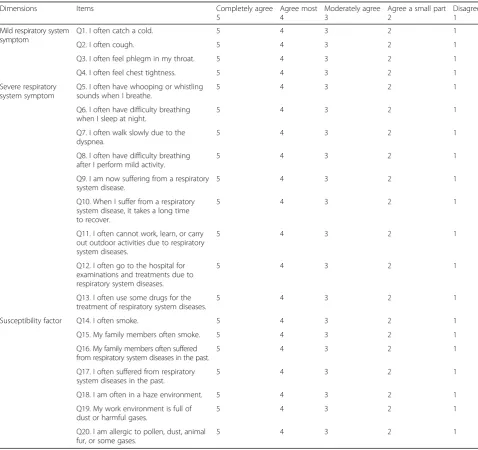
thought that when a healthy person stayed in a hot or cold room for a long time, the person might also feel uncom-fortable. Therefore, Q7 and Q8 were not specific symp-toms of respiratory system diseases. These experts thought that chest trauma and chest surgery might dam-age the muscles and bones of chest, but they did not ne-cessarily damage the respiratory system. Therefore, Q20 and Q21 were also deleted. Finally, this scale retained 20 items (Table 1). Each item was rated according to a 5-point Likert scale (5 = completely agree; 4 = agree most; 3 = moderately agree; 2 = agree a small part, 1 = disagree). In the way of reverse scoring, the scores were 1 point, 2 points, 3 points, 4 points, and 5 points, respectively. The total score of scale was the sum of all items’scores. The
higher the score, the better the community adult respira-tory system health status. Subsequently, 5 community adults were asked to complete BARSHSS-CV-II to test scale wording and comprehension so that we could im-prove item wording and statement expression. Every item in the BARSHSS-CV-IIwas presented in simple and reader-friendly language so that the community adults could clearly understand the meaning of items [13,14].
Large sample testing and development of the final BARSHSS-CV
[image:3.595.57.536.283.733.2]A randomized cluster sampling strategy was used to re-cruit adults in the communities of Baoding City, Shijiaz-huang City, Cangzhou City and Chifeng City in China,
Table 1The content of the brief adult respiratory system health status scale-community version (BARSHSS-CV)
Dimensions Items Completely agree
5
Agree most 4
Moderately agree 3
Agree a small part 2
Disagree 1
Mild respiratory system symptom
Q1. I often catch a cold. 5 4 3 2 1
Q2. I often cough. 5 4 3 2 1
Q3. I often feel phlegm in my throat. 5 4 3 2 1
Q4. I often feel chest tightness. 5 4 3 2 1
Severe respiratory system symptom
Q5. I often have whooping or whistling sounds when I breathe.
5 4 3 2 1
Q6. I often have difficulty breathing when I sleep at night.
5 4 3 2 1
Q7. I often walk slowly due to the dyspnea.
5 4 3 2 1
Q8. I often have difficulty breathing after I perform mild activity.
5 4 3 2 1
Q9. I am now suffering from a respiratory system disease.
5 4 3 2 1
Q10. When I suffer from a respiratory system disease, it takes a long time to recover.
5 4 3 2 1
Q11. I often cannot work, learn, or carry out outdoor activities due to respiratory system diseases.
5 4 3 2 1
Q12. I often go to the hospital for examinations and treatments due to respiratory system diseases.
5 4 3 2 1
Q13. I often use some drugs for the treatment of respiratory system diseases.
5 4 3 2 1
Susceptibility factor Q14. I often smoke. 5 4 3 2 1
Q15. My family members often smoke. 5 4 3 2 1
Q16. My family members often suffered from respiratory system diseases in the past.
5 4 3 2 1
Q17. I often suffered from respiratory system diseases in the past.
5 4 3 2 1
Q18. I am often in a haze environment. 5 4 3 2 1
Q19. My work environment is full of dust or harmful gases.
5 4 3 2 1
Q20. I am allergic to pollen, dust, animal fur, or some gases.
between June 2015 and May 2016. Four cities were se-lected because air pollution in each of these cities is at a serious level [15]. Researchers randomly selected 1 dis-trict from each city, a total of 4 disdis-tricts. Subsequently, 4 communities were respectively randomly selected from these 4 districts. Then, the researchers conducted the questionnaire survey of adults in the 4 communities. The researchers planned to investigate 150 community adults in each community, a total of 600 community adults. Finally, the research team investigated 615 adults in the communities. Inclusion criteria: (1) Community adults that have a satisfactory level of understanding, can correctly understand the contents of questionnaires their respective answers. (2) Not suffering from brain diseases, mental diseases or other serious diseases. Sam-ple size determination: When we evaluated the hypothe-sized measurement model, the exploratory factor analysis (EFA) and the confirmatory factory analysis (CFA) were appropriately used. 10–15 individuals per item were included in the sample size for the factor ana-lysis. Factor analysis results were relatively more stable and reliable in cases where the sample size is greater than 20 individuals per item [16]. Since this scale con-tained 20 items, the large sample should be more than 400. However, to increase the results reliability and sta-bility, after comprehensively considering the feasibility of this research, we increased the number of samples. Therefore, finally, a total of 615 questionnaires were dis-tributed. 12 adults did not complete the demographic characteristics questionnaire or this scale. 19 adults did not complete this scale. Finally, 584 complete and valid questionnaires were recovered, and the valid recovery rate was 94.96% (94.96% =584/615). By analyzing the data of 584 valid questionnaires, the researchers tested the scale internal reliability and content/construct valid-ity and developed the final scale (BARSHSS-CV). The test-retest reliability of BARSHSS-CV was tested in the subsample of 50 participants from the large sample over two week’s interval [17]. By asking if the participants had a change in health status during the 2 week interval, researchers determined that the participants had stable health status during the 2 week interval between test and re-test.
Ethical consideration and survey method
The Hebei province federation of social science circles ap-proved this study (Permit Number: 201501808). This re-search was conducted according to the standards of the Declaration of Helsinki. The research team explained the purpose of this study to the adults in the communities. After obtaining verbal consent from the community-based adults to participate in the study, researchers provided in-formation to participants on how to complete the ques-tionnaires. The researchers distributed and recovered the
questionnaires in the communities. The questionnaires used standardized language and instructions.
Statistical analysis
The researchers used Epidata3.1 software to input the data twice and completed a consistency check. AMOS 17.0 software and SPSS 17.0 were used to analyze the data. This study used the descriptive statistics (frequency and percentage) to analyze the characteristics of com-munity adults. Testing methods for reliability and valid-ity [12]: ① The confirmatory factor analysis (CFA) and the exploratory factor analysis (EFA) were applied to as-sess the construct validity of scale.②The content valid-ity index (CVI) was applied to evaluate the content validity of scale. ③ Mean inter-item correlation coeffi-cient (MIIC) and Cronbach’sαcoefficient and test-retest reliability were applied to assess the scale reliability. The level of significance was p< 0.05. The retention of fac-tors were based on the following criteria: ① The scree plot of EFA;②Eigenvalues greater than 1;③The factor loadings above 0.500; ④ Items equal to or more than 2 being retained [17]. The model fit of scale structure was considered acceptable if Chi square value/degrees of freedom (χ2 /df ) < 3, root-mean-square error of approxi-mation (RMSEA) < 0.08, goodness of fit index (GFI) > 0.90, incremental fit index (IFI) > 0.90, comparative fit index (CFI) > 0.90, normed fit index (NFI) > 0.90, and Tueker-Lewis index (TLI) > 0.90 [14,17,18].
Results
Characteristics of the large sample
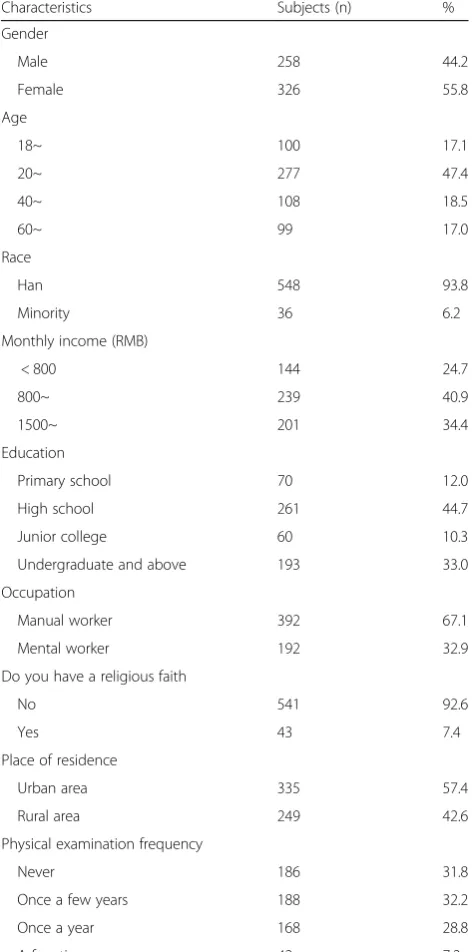
A total of 615 community adults were given question-naires, 584 valid questionnaires were recovered; the valid recovery rate was 94.96%. These community adults in-cluded 258 men (44.2%) and 326 women (55.8%) from urban area (57.4%) and rural area (42.6%). They included Han race (93.8%) and minority (6.2%). These community adults were classified into four age groups including < 20, 20–39, 40–59 and≥60, accounting for 17.1%, 47.4%, 18.5% and 17.0% respectively. These community adults were classified into three monthly income groups in-cluding < 800 RMB, 800–1499 RMB and≥1500 RMB, accounting for 24.7%, 40.9% and 34.4% respectively. The characteristics of the large sample data are shown in de-tail in Table2.
Testing of reliability and validity
Construct validity
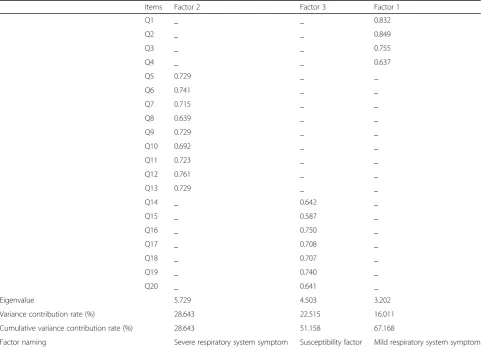
sphericity test value was 8705.183 (df = 190,P< 0.001) and KMO value (Kaiser-Meyer-Olkin value) was 0.951. From our findings it was clear that the data were suitable for factor analysis. Furthermore, we carried out factor extrac-tion using undefined factor number condiextrac-tions. The cu-mulative variance contribution rate of factors was 67.168%. Three factors (Eigenvalue> 1) were extracted. The factor analysis scree plot of BARSHSS-CV-IIindicated an inflection point between the 3rd factor and the 4th
factor. The scree plot of EFA indicated the 3-factor struc-ture was suitable (Fig.1). Through the above comprehen-sive analysis, the research team thought the final version of BARSHSS-CV contained three factors and 20 items. Final three factors were renamed: Factor 1, mild tory system symptom (4 items); Factor 2, severe respira-tory system symptom (9 items); Factor 3, susceptibility factor (7 items) (Table 3). The content of the brief adult respiratory system health status scale-community version (BARSHSS-CV) is shown in the Table1.
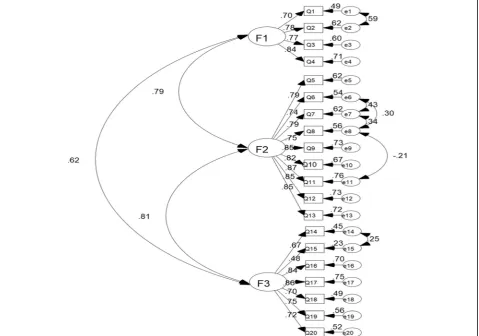
Confirmatory factor analysis (CFA) To determine the most appropriate BARSHSS-CV dimensional structure, the researcher used the AMOS17.0 software and randomly se-lected a 70% sample size of 409 samples and used the max-imum likelihood method to perform BARSHSS-CV confirmatory factor analysis of the 20-item and 3-factor structure. The value of Chi square value (χ2) was 442.117. The value of degrees of freedom (df) was 161. The value of Chi square value/degrees of freedom (χ2 /df) was 2.746. The value of root-mean-square error of approximation (RMSEA) was 0.065. The value of goodness of fit index (GFI) was 0.902. The value of incremental fit index (IFI) was 0.955. The value of comparative fit index (CFI) was 0.955. The value of normed fit index (NFI) was 0.931. The value of Tueker-Lewis index (TLI) was 0.947(Table4). The standard path and parameter estimation of CFA was in the Fig.2.
Internal consistency test
Correlation coefficients of factors in the BARSHSS-CV ranged from 0.416 to 0.699 (P< 0.01). Correlation coeffi-cients between factors and the whole scale of BARSHSS-CV ranged from 0.750 to 0.922 (P< 0.01). (Table5).
Content validity
Expert evaluation suggests the scale’s content validity index (CVI) was 0.933 and each of the items CVI ranged from 0.667 to 1.00. Five community adults reported that they could clearly understand the meaning of each item without difficulty as soon as we improved item wording and statement expression.
Reliability
[image:5.595.56.293.102.579.2]The Cronbach’s α coefficient of entire BARSHSS-CV was 0.951, and the Cronbach’sαcoefficients of all factors were from 0.873 to 0.945. The mean inter-item correl-ation coefficient value (MIIC) of entire BARSHSS-CV was 0.500. MIIC values of all factors were from 0.511 to 0.656. The entire BARSHSS-CV test-retest reliability co-efficient was 0.963, and the test-retest reliability coeffi-cient of each factor were from 0.931 to 0.977 (Table6). Table 2Characteristic data of the large sample
Characteristics Subjects (n) %
Gender
Male 258 44.2
Female 326 55.8
Age
18~ 100 17.1
20~ 277 47.4
40~ 108 18.5
60~ 99 17.0
Race
Han 548 93.8
Minority 36 6.2
Monthly income (RMB)
< 800 144 24.7
800~ 239 40.9
1500~ 201 34.4
Education
Primary school 70 12.0
High school 261 44.7
Junior college 60 10.3
Undergraduate and above 193 33.0
Occupation
Manual worker 392 67.1
Mental worker 192 32.9
Do you have a religious faith
No 541 92.6
Yes 43 7.4
Place of residence
Urban area 335 57.4
Rural area 249 42.6
Physical examination frequency
Never 186 31.8
Once a few years 188 32.2
Once a year 168 28.8
A few times a year 42 7.2
Fig. 1Scree plot of exploratory factor analysis
Table 3Rotated component matrix, eigenvalue and cumulative variance contribution rate
Items Factor 2 Factor 3 Factor 1
Q1 _ _ 0.832
Q2 _ _ 0.849
Q3 _ _ 0.755
Q4 _ _ 0.637
Q5 0.729 _ _
Q6 0.741 _ _
Q7 0.715 _ _
Q8 0.639 _ _
Q9 0.729 _ _
Q10 0.692 _ _
Q11 0.723 _ _
Q12 0.761 _ _
Q13 0.729 _ _
Q14 _ 0.642 _
Q15 _ 0.587 _
Q16 _ 0.750 _
Q17 _ 0.708 _
Q18 _ 0.707 _
Q19 _ 0.740 _
Q20 _ 0.641 _
Eigenvalue 5.729 4.503 3.202
Variance contribution rate (%) 28.643 22.515 16.011
Cumulative variance contribution rate (%) 28.643 51.158 67.168
Factor naming Severe respiratory system symptom Susceptibility factor Mild respiratory system symptom
[image:6.595.57.541.365.714.2]Discussion
Worldwide, the older health care model is gradually be-ing transformed; we are shiftbe-ing from a model that views medical workers as having the leading role in patient care interactions into a newer modern model that in-volves patients in decisions relating to their health man-agement [19, 20]. The medical policy guidelines and medical system in China mostly focus on the diagnosis, treatment and nursing of the specific respiratory system diseases. The BARSHSS-CV may provide a way to help medical staff in community settings to conveniently and economically assess respiratory system health. Medical staff can also implement targeted intervention and health guidance for the respiratory system health care among community adults to help community adults
establish healthy protection awareness, establish a healthy lifestyle, and reduce the incidence of respiratory system diseases to reduce the related medical burden on the government, society, family and themselves individu-ally [21,22].
[image:7.595.305.537.111.166.2]Both exploratory factor analysis and confirmatory fac-tor analysis are used when a hypothesized measurement model is assessed in the study. The sample size in the study should be 10–15 subjects per item for factor ana-lysis of scale [23]. The sample size of our research was enough for factor analysis of BARSHSS-CV. In the exploratory factor analysis, to assess the suitability of Table 4The results of confirmatory factor analysis
χ2 df χ2/df RMSEA GFI IFI CFI NFI TLI
442.117 161 2.746 0.065 0.902 0.955 0.955 0.931 0.947
χ2, Chi square value; df, degrees of freedom;χ2 /df, Chi square value/degrees of freedom;RMSEAroot-mean-square error of approximation,GFIgoodness of fit index,IFIincremental fit index,CFIcomparative fit index,NFInormed fit index,TLITueker-Lewis index
Fig. 2Standard path and parameter estimation of confirmatory factor analysis. F1, Factor 1, mild respiratory system symptom; F2, Factor 2, severe system respiratory symptom; F3, Factor 3, susceptibility factor.
Table 5Correlation coefficients among the factors of BARSHSS-CV and between the factors and the total scale of BARSHSS-BARSHSS-CV
Factor Factor 2 Factor 3 BARSHSS-CV
Factor 1 0.591** 0.416** 0.750**
Factor 2 _ 0.699** 0.922**
Factor 3 _ _ 0.827**
Factor 1, mild respiratory system symptom; Factor 2, severe system respiratory symptom; Factor 3, susceptibility factor. This symbol‘_‘indicated no such correlation coefficient.**
[image:7.595.60.540.365.701.2]analysis, Bartlett sphericity test (8705.183, df = 190, P< 0.001) was significant and the Kaiser-Meyer-Olkin value (0.951) in our study was greater than 0.6 [24]. The above results showed that the scale data were very suitable for factor analysis. The results of exploratory factor analysis indicated 20 items of BARSHSS-CV loaded substantially onto 3 conceptually clear factors. The dimension 3 (medical history) and the dimension 4 (susceptibility fac-tor) in the BARSHSS-CV-II were merged into dimension 3 (susceptibility factor) in the final BARSHSS-CV. The reason for the change of two dimensions may be because the medical history dimension is also essentially the measurement of the susceptibility of the individual’s spiratory system. If individuals suffered from related re-spiratory system diseases in the past, it may indicate that individuals may have some genetic or environmental susceptibility factors, and the probability of recurring re-spiratory system adverse symptoms may increase corres-pondingly. Therefore, the research team finally merged the medical history dimension into the susceptibility fac-tor dimension so that the BARSHSS-CV structure be-comes more concise, clear and easier to use. In the confirmatory factor analysis, the model goodness of fit is assessed by RMSEA < 0.080, GFI > 0.900, IFI > 0.900, CFI > 0.900, NFI > 0.900, TLI > 0.900 [14, 17, 18]. The results of confirmatory factor analysis in our research met these criteria. The results of confirmatory factor analysis indicate the stability and fit of 3-factor model structure of BARSHSS-CV are both good.
In the internal consistency test of BARSHSS-CV, cor-relation coefficients between all factors and the whole BARSHSS-CV are from 0.750 to 0.922, showing that the internal consistency of BARSHSS-CV is good. The values of correlation coefficients between all factors are from 0.416 to 0.699, showing that the correlation of the factors is a moderate correlation [14]. Thus, the re-sults of BARSHSS-CV show that there is a moderate correlation among different factors. But there are also a certain degree of differences between different fac-tors. Therefore, these factors can measure different aspects of community adult respiratory system health status. Three factors can effectively and comprehen-sively measure the respiratory system health status of adults in the community.
If items pertaining to the scale can identify the content and topic that we intend to measure, this is referred to as the content validity. The number of expert choices of 3 and 2, which is divided by the total number of experts, represents each item content validity index belonging to the scale. All item content validity indexes make up the average total content validity index [14]. The content validity index of scale was 0.933. The content validity in-dexes of all items were from 0.667 to 1.00. The results indicates that BARSHSS-CV can measure the variables we want to measure; all items can reflect the correct content, and the content validity of BARSHSS-CV is very good.
Mean inter-item correlation (MIIC), Cronbach’s alpha and test-retest reliability can be used to evaluate the reli-ability of scale [17, 25, 26]. When the MIIC of scale is greater than 0.3, the internal consistency of scale is usu-ally acceptable [26]. The mean inter-item correlation co-efficient values of the whole BARSHSS-CV and all factors were greater than 0.5. The usual criterion of a satisfactory internal consistency is a Cronbach’s alpha of
≥0.7 [14]. In our research, the Cronbach’s alpha value of whole BARSHSS-CV and the Cronbach’s alpha values of all factors were greater than 0.8. BARSHSS-CV also re-veals a high test-retest reliability over a two week inter-val, with test-retest reliability coefficients across all dimensions and the whole BARSHSS-CV ranging from 0.931 to 0.977. Therefore, after the comprehensive ana-lysis, BARSHSS-CV developed in our research has a sat-isfactory reliability.
Limitations and future direction
[image:8.595.53.543.99.168.2]Because of limited study conditions, the scope of sampling needs to be further expanded making BARSHSS-CV more widely verified and applied in more areas of country. BARSHSS-CV can be further improved and revised in the future. A major limitation of this study, and an area for future research should be to investigate the concurrent validity of this new measure with other established ques-tionnaire measures of respiratory health status. Using laboratory examinations and imaging examinations as the measurement golden criterion of the respiratory system health status of adults in the community, it requires a high cost and medical resources. Furthermore, the compliance Table 6MIIC, Cronbach’sαcoefficient and test-retest reliability of each factor and the whole BARSHSS-CV
Factor Number of Items MIIC Cronbach’sα Test-retest reliability
Factor 1 4 0.634 0.873 0.931
Factor 2 9 0.656 0.945 0.944
Factor 3 7 0.511 0.878 0.977
BARSHSS-CV 20 0.500 0.951 0.963
of participants will also significantly decline. Due to the lack of an economical, effective, and appropriate golden criterion for measuring the respiratory system health status of adults in the community, testing the criterion validity of BARSHSS-CV is difficult [17]. In the future study, we will recruit some patients in the respiratory departments of hos-pitals and compare the BARSHSS-CV score with the results of laboratory examinations and imaging examinations of the patients to further evaluate the sensitivity and specificity of BARSHSS-CV, so that BARSHSS-CV can be more help-ful and better for clinical decision. Furthermore, the scale validation in other countries and the cross-cultural scale re-vision are needed to develop the international application of BARSHSS-CV in the future.
Conclusion
To sum up, the research has rigorously developed and val-idated BARSHSS-CV with good internal/re-test reliability and good content/construct validity. BARSHSS-CV is a brief, rapid, effective and economical evaluation tool for extensively assessing the respiratory system health status among community adults in the future. BARSHSS-CV can be used to assess the respiratory system health status of adults in the community, help medical staff in health care institutions conduct targeted interventions, as well as provide health guidance for community adults relating to the health care of the respiratory system and help commu-nity adults establish a healthy lifestyle.
Additional files
Additional file 1:The item pool. The initial pool of 40 items. (DOCX 14 kb)
Additional file 2:BARSHSS-CV-I. The content of the brief adult respiratory system health status scale-community version-I(BARSHSS-CV-I). (DOCX 16 kb)
Abbreviations
BARSHSS-CV:Brief adult respiratory system health status scale-community version; CFA: Confirmatory factor analysis; CFI: Comparative fit index; CVI: Content validity index; df: Degrees of freedom; EFA: Exploratory factor analysis; GFI: Goodness of fit index; IFI: Incremental fit index; KMO: Kaiser-Meyer-Olkin; MIIC: Mean inter-item correlation coefficients; NFI: Normed fit index; PCA: Principal component analysis; RMSEA: Root-mean-square error of approximation; TLI: Tueker-Lewis index;χ2 /df: Chi square value/degrees of freedom;χ2: Chi square value
Acknowledgements
Authors would like to thank Rong Xiao Ph.D., Linhong Yuan Ph.D., Cui Zhou Ph.D., School of Public Health of Capital Medical University, for their help in this study.
Funding
This study was supported by a grant from Hebei Province Federation of Social Science Circles (No. 201501808), a grant from Health and Family Planning Commission of Hebei (No. 20150072) and a grant from Health and Family Planning Commission of Hebei (No. 20180707). The funders had no role in the design of the study and collection, analysis, or the interpretation of data and writing of the manuscript.
Availability of data and materials
The data that support this analysis may be available on reasonable request from the corresponding author. They are not publicly available as they contain information that could compromise research participant privacy and consent.
Authors’contributions
Conceived and designed the study (HZD, YJZ, LWT); Collected data and analyzed data (YHC, QCZ, BX, YW, YHZ, ZGC, JG); Wrote the manuscript (HZD, YJZ, LWT). All authors read and approved the final manuscript.
Ethics approval and consent to participate
The Hebei province federation of social science circles approved this study (Permit Number:201501808). This research was conducted according to the standards of the Declaration of Helsinki. In order to save participants’time and improve the response rate of participants, the verbal consent was obtained from participants. Obtaining only verbal consent was approved by the ethics committee. The research team explained the purpose of this study to the adults in the communities. After the permission of adults in the communities, on the spot, the researchers guided the community adults how to complete the questionnaires.
Consent for publication
Not Applicable.
Competing interests
The authors declare that they have no competing interests.
Publisher’s Note
Springer Nature remains neutral with regard to jurisdictional claims in published maps and institutional affiliations.
Author details
1Affiliated Hospital of Hebei University, No.212 Yuhua East Road, Baoding
071000, China.2The NO.5 Hospital of Baoding, No.340 Ruixiang Street, Baoding 071000, China.3College of Nursing, Hebei University, No.342 Yuhua East Road, Baoding 071000, China.4School of Public Health, Capital Medical University, No.10 Xitoutiao, Youanmenwai, Beijing 100069, China.
Received: 16 April 2018 Accepted: 29 August 2018
References
1. Sierra-Vargas MP, Teran LM. Air pollution: impact and prevention. Respirology. 2012;17(7):1031–8.
2. Chen Z, Wang JN, Ma GX, Zhang YS. China tackles the health effects of air pollution. Lancet. 2013;382(9909):1959–60.
3. Ge J, Xu Y. Internal medicine. 8th ed. Beijing: People's Medical Publishing House; 2013.
4. Croft JB, Wheaton AG, Liu Y, Xu F, Lu H, Matthews KA, Cunningham TJ, Wang Y, Holt JB. Urban-Rural County and state differences in chronic obstructive pulmonary disease - United States, 2015. MMWR Morb Mortal Wkly Rep. 2018;67(7):205–11.
5. Farah C, Hosgood HD 3rd, Hock JM. Spatial prevalence and associations among respiratory diseases in Maine. Spatial and spatio-temporal epidemiology. 2014;11:11–22.
6. To T, Stanojevic S, Moores G, Gershon AS, Bateman ED, Cruz AA, Boulet LP. Global asthma prevalence in adults: findings from the cross-sectional world health survey. BMC Public Health. 2012;12:204.
7. Ferrante G, Baldissera S, Campostrini S. Epidemiology of chronic respiratory diseases and associated factors in the adult Italian population. Eur J Pub Health. 2017;27(6):1110–6.
8. Migliaretti G, Dalmasso P, Gregori D. Air pollution effects on the respiratory health of the resident adult population in Turin, Italy. Int J Environ Health Res. 2007;17(5):369–79.
9. Zhou M, He G, Liu Y, Yin P, Li Y, Kan H, Fan M, Xue A, Fan M. The associations between ambient air pollution and adult respiratory mortality in 32 major Chinese cities, 2006-2010. Environ Res. 2015;137:278–86. 10. Wu MY, Wu TI, Tseng YH, Shen WC, Chang YS, Huang CC, Lin PJ. The
11. Jonsdottir H. Nursing care in the chronic phase of COPD: a call for innovative disciplinary research. J Clin Nurs. 2008;17(7B):272–90. 12. Sun Z, Xu Y. Medical statistics. 4th ed. Beijing: People's Medical Publishing
House; 2014.
13. Billings-Gagliardi S, Mazor KM. Development and validation of the stroke action test. Stroke. 2005;36(5):1035–9.
14. Zhao Q, Yang L, Zuo Q, Zhu X, Zhang X, Wu Y, Yang L, Gao W, Li M. Instrument development and validation of the stroke pre-hospital delay behavior intention scale in a Chinese urban population. Health Qual Life Outcomes. 2014;12:170.
15. Gao J, Woodward A, Vardoulakis S, Kovats S, Wilkinson P, Li L, Xu L, Li J, Yang J, Li J, et al. Haze, public health and mitigation measures in China: a review of the current evidence for further policy response. Sci Total Environ. 2017;578:148–57.
16. Xu Y. Social survey design and data analysis - from topic to publication. Chongqing: Chongqing University Press; 2011.
17. Zhang Q, Huang F, Liu Z, Zhang N, Mahapatra T, Tang W, Lei Y, Dai Y, Tang S, Zhang J. Cross-cultural validation of the high blood pressure health literacy scale in a Chinese community. PLoS One. 2016;11(4):e0152182. 18. Sun T, Zhao XW, Yang LB, Fan LH. The impact of psychological capital on
job embeddedness and job performance among nurses: a structural equation approach. J Adv Nurs. 2012;68(1):69–79.
19. Janiszewski D, O'Brian CA, Lipman RD. Patient experience in a coordinated care model featuring diabetes self-management education integrated into the patient-centered medical home. The Diabetes educator. 2015;41(4):466– 71.
20. Blondon KS. Patient attitudes about financial incentives for diabetes self-management: a survey. World J Diabetes. 2015;6(5):752–8.
21. Li P, Gong Y, Zeng G, Ruan L, Li G. A new mode of community continuing care service for COPD patients in China: participation of respiratory nurse specialists. Int J Clin Exp Med. 2015;8(9):15878–88.
22. Hedley AJ, McGhee SM, Barron B, Chau P, Chau J, Thach TQ, Wong TW, Loh C, Wong CM. Air pollution: costs and paths to a solution in Hong Kong--understanding the connections among visibility, air pollution, and health costs in pursuit of accountability, environmental justice, and health protection. Journal of toxicology and environmental health Part A. 2008; 71(9–10):544–54.
23. Ekback M, Benzein E, Lindberg M, Arestedt K. The Swedish version of the multidimensional scale of perceived social support (MSPSS)--a psychometric evaluation study in women with hirsutism and nursing students. Health Qual Life Outcomes. 2013;11:168.
24. Mills RJ, Young CA, Pallant JF, Tennant A. Development of a patient reported outcome scale for fatigue in multiple sclerosis: the neurological fatigue index (NFI-MS). Health Qual Life Outcomes. 2010;8:22. 25. Reissmann DR, Benecke AW, Aarabi G, Sierwald I. Development and
validation of the German version of the orofacial esthetic scale. Clin Oral Investig. 2015;19(6):1443–50.